

Crypto World
Alan Greenspan, former chairman of the Fed, dies at age 100

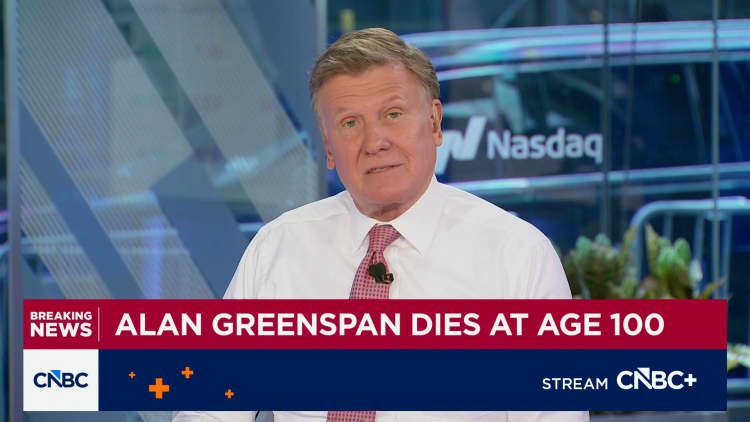

Alan Greenspan, the longtime Federal Reserve chairman known as “the Maestro” who became one of the most influential economic policymakers of his era and famously warned of “irrational exuberance,” has died. He was 100.
The influential economist died Monday from complications of Parkinson’s Disease, said his wife of 29 years, Andrea Mitchell, the chief Washington correspondent and chief foreign affairs correspondent for NBC News.
Greenspan was appointed Fed chairman in 1987 by President Ronald Reagan and held the position — through busts and booms — until retiring in 2006. His tenure was the second longest, four months short of that of William McChesney Martin, who presided over the central bank from 1951 to 1970.
It was his unusual frankness in one televised speech, on Dec. 5, 1996, that set off a bit of market madness. Discussing the challenges of setting monetary policy, he said:
“How do we know when irrational exuberance has unduly escalated asset values, which then become subject to unexpected and prolonged contractions as they have in Japan over the past decade? … We should not underestimate or become complacent about the complexity of the interactions of asset markets and the economy.”
The phrase “irrational exuberance” was interpreted as a signal that Greenspan thought the market was overvalued. The Tokyo stock market, which was open at the time, sank 3% on the comment, and other markets subsequently tumbled. However, the markets quickly recovered and continued to climb until the dot-com bust in 2001.
Years earlier, in 1974, when he was chairman of the White House Council of Economic Advisers, Greenspan had to explain on Capitol Hill why the administration wasn’t whipping inflation now, as the Ford administration dubbed its war on rising prices. In a sure-to-befuddle Greenspanism, he said: “It is a tricky problem to find the particular calibration in timing that would be appropriate to stem the acceleration in risk premiums created by falling incomes without prematurely aborting the decline in the inflation-generated risk premiums.”
“Some folks, especially money managers who shovel vast amounts of cash from one pile to another, think about Greenspan a lot,” Linton Weeks and John M. Berry wrote in The Washington Post in March 1997. “They watch his every word, mark his every move, graph his every grin. Because second to the president, Alan Greenspan is arguably the nation’s most powerful person. … With a couple of choice words he can momentarily send the stock market to heaven or hell.”
In an apparent bid to avoid rocking the markets or not showing the Fed’s hand until it was time, Greenspan would cloak his utterances in language that left the sharpest minds — including those of contentious members of Congress — scratching their heads.
“His long, convoluted sentences seem to take away at the end what they have given at the beginning as they flow to new levels of incomprehensibility,” The Washington Post’s Bob Woodward said in his 2000 biography “Maestro: Greenspan’s Fed and the American Boom.”
After his retirement from the Fed, Greenspan confessed his strategy for using perplexing language with a clear explanation.
“It’s a language of purposeful obfuscation to avoid certain questions coming up, which you know you can’t answer, and saying ‘I will not answer’ or basically ‘no comment’ is, in fact, an answer,” he said in a 2007 interview on CNBC. “So, you end up with when, say, a congressman asks you a question, and [you] don’t want to say, ‘no comment,’ or ‘I won’t answer,’ or something like that. So, I proceed with four or five sentences which get increasingly obscure. The congressman thinks I answered the question and goes on to the next one.”
Some folks, especially money managers who shovel vast amounts of cash from one pile to another, think about Greenspan a lot. They watch his every word, mark his every move, graph his every grin. Because second to the president, Alan Greenspan is arguably the nation’s most powerful person. … With a couple of choice words he can momentarily send the stock market to heaven or hell.”
Linton Weeks and John M. Berry
The Washington Post, March 1997.
Greenspan was born to Jewish parents on March 6, 1926, in New York’s Washington Heights. His father was a stockbroker and financial analyst. As a boy growing up in the 1930s during the Great Depression, the future Fed chairman received an allowance of a quarter a week.
“Twenty-five cents, I will tell you, bought a lot more then than it does these days,” Greenspan told an audience in 2003.
Greenspan played the clarinet and saxophone and briefly attended the Juilliard School. He played in Woody Herman’s jazz band (as did another future White House official, Leonard Garment), before he enrolled in New York University, earning bachelor’s and master’s degrees in economics by 1950. He eventually received his Ph.D. in 1977 — at age 51.
Among his teachers and mentors were the future Fed Chairman Arthur Burns and the free-market proponent Ayn Rand, to whom Greenspan was introduced by his first wife, the artist Joan Mitchell.
Alan Greenspan
Andrew Harrer | Bloomberg | Getty Images
By the time he received his doctorate, he had worked at Brown Brothers Harriman, the National Industrial Conference Board and the Townsend-Greenspan consulting firm, which closed after he was nominated as Fed chairman. His three-decade stint at Townsend-Greenspan was interrupted when he served as chairman of President Gerald Ford’s Council of Economic Advisers from 1974 to 1977. From 1981 to 1983, he was chairman of the National Commission on Social Security Reform.
His first job as an economist didn’t pay much more than his childhood allowance: He got $45 a week.
The first of his five terms at the Fed began just before the 1987 financial crisis. The Senate confirmed his nomination to succeed Paul Volcker on Aug. 11.
That was only 69 days before “Black Monday” crushed Wall Street on Oct. 19. The Dow Jones Industrial Average sank 508 points — 22.6% — in the session, the biggest one-day sell-off in history. The next day, Greenspan affirmed the Fed’s readiness “to serve as a source of liquidity to support the economic and financial system.” His central bank lowered short-term interest rates to encourage banks to lend on their usual terms.

The strategy helped calm the jitters and avoid a recession and banking crisis. Within two days, the Dow regained more than 50% of its Black Monday losses. The bravado also helped earn Greenspan the sobriquet “Maestro” from supporters. Years later, critics blamed the easy money policy — the “Greenspan put” he used to help calm market panics — for conditions that brought on the Great Recession.
“It’s HIS economy, stupid,” Fortune magazine declared in March 1996, throwing back at President Bill Clinton the campaign slogan he used in defeating President George H.W. Bush four years earlier. “In Greenspan We Trust,” the article’s headline said.
After that white-knuckle start, he led the Fed through two recessions, the 1997 Asian financial crisis, the 1998 Russian financial default, the 1998 bailout of the hedge fund Long-Term Capital Management, the Sept. 11, 2001, terrorist attacks, and the dot-com boom and bust of the late ’90s through 2001.
Throughout, he focused on fighting inflation over promoting full employment. His supporters say he presided over the longest economic expansion in U.S. history, but critics said Greenspan’s low interest rate policies set the stage for the housing bubble that burst into the Great Recession a year after his successor, Ben Bernanke, took the Fed helm.
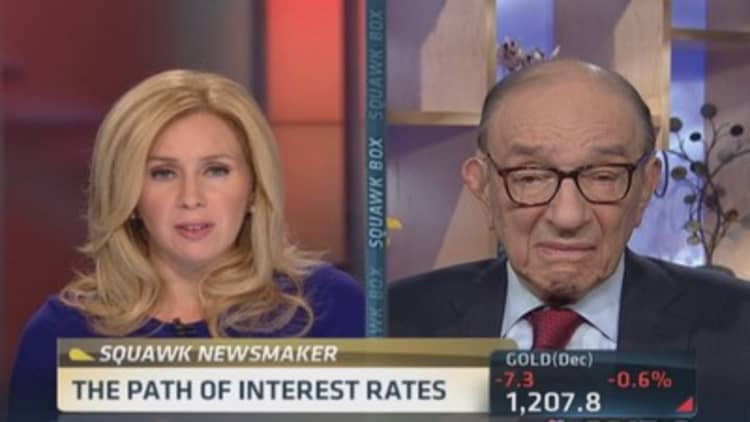
“Sometimes I get criticized, and I deserve to be criticized, and that’s part of the game,” Greenspan told USA Today in 2007. “But this one, I’m innocent.”
Greenspan acknowledged that he knew about the questionable lending practices that encouraged subprime borrowers to opt for risky adjustable-rate mortgages.
“While I was aware a lot of these practices were going on, I had no notion of how significant they had become until very late,” he said in a 2007 interview with CBS’ “60 Minutes.” “I really didn’t get it until very late in 2005 and 2006.”
And in his best-selling memoir “The Age of Turbulence,” he defended the low-rate policy, which encouraged people to buy homes: “I believed then, as now, that the benefits of broadened homeownership are worth the risk. Protection of property rights, so critical to a market economy, requires a critical mass of owners to sustain political support.”
Greenspan wrote the book in longhand, mostly while soaking in a bathtub because of a back injury. In fact, most of his speeches were penned that way after he injured his back in 1971.
After he left the Fed, Greenspan opened his own consulting firm, Greenspan Associates.
Greenspan’s first marriage ended in divorce after less than a year. In 1997, he married NBC journalist Andrea Mitchell, also a Washington denizen and fellow classical music aficionado 20 years his junior, in a ceremony officiated by the late Supreme Court Justice Ruth Bader Ginsburg.
In his 2007 memoir, he praised presidents Ford and Clinton, but harshly criticized President George W. Bush for not reining in spending.
President George W. Bush (L) with Alan Greenspan (R) after Ben Bernanke was sworn in as Federal Reserve chairman, Washington, Feb. 6, 2006.
Jim Watson | AFP | Getty Images
“Little value was placed on rigorous economic policy debate or the weighing of long-term consequences,” the self-described libertarian Republican wrote. “They swapped principle for power. They ended up with neither. They deserved to lose.”
He also was critical of President Donald Trump’s first-term bashing of the Fed in an effort to get interest rates lower. Appearing on CNBC’s “Squawk on the Street” shortly after a December 2019 Trump tweet aimed at the central bank, Greenspan said: “He’s wrong in even discussing the issue. The Federal Reserve is a very professional outfit. They know more about the economy’s functioning, how it affects the money markets and the interest rate structure, far more than he does. … The best thing to do is to just disregard it. I didn’t hear this morning that the president made a statement. I’m sure it was ill-advised.”
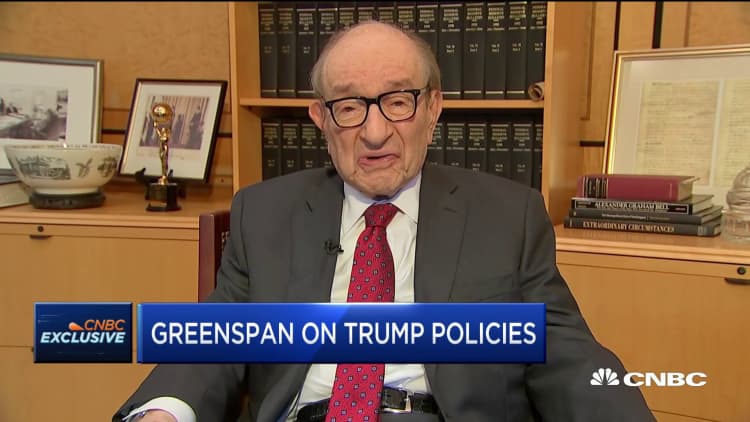
During Trump’s second term, in January 2026, Greenspan signed a joint statement with a handful of other former Fed and Treasury officials to denounce a criminal probe of Fed Chair Jerome Powell.
“The reported criminal inquiry into Federal Reserve Chair Jay Powell is an unprecedented attempt to use prosecutorial attacks to undermine that independence,” read the statement, backed by Greenspan and more than a dozen other signatories.
Greenspan recognized the limits of the Fed’s influence. Asked during a 2008 interview on CNBC whether the central bank should be given more power to regulate investment banks, he responded:
“What I am concerned about is basically the Fed being given the role to oversee the financial stability system. I don’t think anyone can do that, and I’m most worried that were the Fed to take that job on and fail, as everyone else has and will, you cannot anticipate the future. I think it undermines the credibility of the central banking system.”
Ultimately, he realized that despite all the science involved in economics, financial risk management can’t win in meltdown situations like the Great Recession.
“Fear and euphoria are dominant forces, and fear is many multiples the size of euphoria,” he told The Associated Press after publication of his book “The Map and the Territory 2.0” in 2013. “Bubbles go up very slowly as euphoria builds. Then fear hits, and it comes down very sharply. When I started to look at that, I was sort of intellectually shocked. Contagion is the critical phenomenon which causes the thing to fall apart.”
Correction: Bob Woodward’s book on Alan Greenspan published in 2000. An earlier version misstated the year. Hedge fund Long-Term Capital Management was bailed out in 1998. An earlier version misstated the name of the firm.



The House Financial Services Committee has scheduled back-to-back hearings on July 14 and July 17, one covering Federal Reserve monetary policy, the other focused directly on the CLARITY Act. This is giving supporters of comprehensive crypto regulation their highest-profile platform yet as the pre-recess window narrows.
As of today, the bill has cleared the Senate Banking Committee, been placed on the Senate legislative calendar, and attracted a House fast-track commitment if the Senate moves first. None of that changes the core arithmetic: the CLARITY Act needs 60 votes on the Senate floor, and Republicans currently hold 53 seats.
Senator Cynthia Lummis, the Wyoming Republican leading the Senate push, has set the end of July as a hard deadline. She also warns explicitly that missing the pre-recess window could delay enforceable digital asset market structure rules until 2030.
Discover: The Best Crypto to Diversify Your Portfolio
The 60-Vote Clarity Act Problem
The gap between “placed on the Senate legislative calendar” and “signed into law” runs through a specific procedural bottleneck. Invoking cloture to cut off debate requires 60 votes; with a 53-seat Republican majority, the CLARITY Act needs at least seven Democratic crossovers. The Senate Banking Committee vote on May 14 produced only two Democratic votes from Ruben Gallego and Angela Alsobrooks, and it is leaving five or more additional Democratic senators to be secured before a floor vote can succeed.
A bipartisan ethics provision in the bill has been fracturing Democratic support further, and Fox Business reporter Eleanor Terrett described the original White House target of July 4 as “logistically impossible” before the date even arrived. Galaxy Research has pegged passage odds at roughly 60% and notes that the window “effectively closes” once the August recess begins.
Even if the Senate floor vote clears 60, the bill would then require reconciliation with the version the House passed in July 2025 by 294–134. Rep. Dusty Johnson pledged on June 18 that the House would act “swiftly” on any Senate text, compressing that step, but reconciliation differences still have to be resolved before the bill reaches the president’s desk.
If this misses the pre-recess window, the next viable legislative opening is 2027 at the earliest, with some analysts pointing further out. The same credible basis for Lummis’s 2030 warning.
Don’t Miss Out on Our $1,000 USDT Airdrop on ByBit
July 14 and July 17: What To Expect?
The July 14 session before the House Financial Services Committee is formally structured around the Federal Reserve’s semi-annual Monetary Policy Report. However, its market significance extends further. It is reported that Kevin Warsh will deliver his first congressional testimony as Fed Chair, making it the first opportunity for lawmakers to publicly interrogate the new leadership’s posture on rate policy, dollar strength, and the regulatory perimeter around financial innovation.
For crypto markets, Warsh’s framing of digital assets, whether he treats them as a monetary policy variable or a separate regulatory question, will carry weight heading into the CLARITY Act hearing three days later.
The July 17 hearing moves the focus explicitly to the CLARITY Act and digital-asset innovation, with the notable detail that it is being held in New York rather than Washington. That venue choice is deliberate: New York is the largest U.S. financial center, and holding the hearing there anchors the bill’s stakes to institutional finance rather than abstract legislative process. Exchanges, custody providers, and capital markets participants concentrated in the city represent the economic constituency that regulatory uncertainty is actively costing.
Together, the two hearings give the bill’s backers a sequenced argument: monetary policy context on the 14th, market-structure specifics on the 17th. The CFTC’s expanded role under the bill, and the digital asset market structure framework it would codify, will be front and center at the New York session. The hearing is a narrative event. The execution event is the floor vote that has to follow it.
Discover: The Best Token Presales
The post Senate’s 60-Vote Gap Looms Over CLARITY Act Before August Recess appeared first on Cryptonews.


The European Parliament has advanced legislation for a digital euro, bringing the EU closer to launching a central bank digital currency, while the U.S. moves to restrict similar efforts.
Summary
- EU lawmakers backed digital euro legislation, moving the ECB closer to a potential 2029 launch.
- The ECB says the digital euro would complement cash and reduce reliance on foreign payment networks.
- Meanwhile, the U.S. Senate approved a bill that would block the Federal Reserve from issuing a CBDC until 2030.
According to a June 23 decision by the European Parliament’s Economic and Monetary Affairs Committee, lawmakers backed the proposed framework for a digital euro, a key step in the legislative process that could pave the way for a launch by 2029.
The vote arrives as European policymakers examine the region’s dependence on foreign payment infrastructure. Data cited by the European Central Bank shows that Visa and Mastercard handle 61% of card payments in the euro area and nearly all cross-border card transactions.
European officials have argued that a digital euro could strengthen the bloc’s payment system by providing a public digital payment option issued directly by the ECB. Under the proposal, consumers would hold digital euros in dedicated wallets, while banks and payment providers would offer services connected to the system.
The digital euro remains under development
Within the proposed framework, the ECB would operate the core infrastructure while financial institutions would manage customer-facing services. According to the proposal, the system could support both online and offline payments and include privacy safeguards for users.
Holding limits for digital euro wallets have not yet been finalized and remain part of ongoing negotiations among European institutions.
European authorities have repeatedly stated that the digital euro is intended to complement physical cash rather than replace it. Following the committee vote, the ECB welcomed the outcome, stating that the European Parliament’s position supports both the preservation of euro cash as legal tender and the development of a digital version of the currency.
Although the ECB has warned that stablecoins could create risks for the financial system, the central bank has continued to support the digital euro project as part of its long-term payments strategy.
Elsewhere in Asia, central banks are also exploring digital finance initiatives. As reported by crypto.news, Bank of Korea Governor Shin Hyun-song said in his inaugural speech in April that the central bank would support innovation in blockchain-based finance while maintaining the stability of South Korea’s payment and settlement systems. He added that the bank would work to strengthen the role of the Korean won in an increasingly digital financial environment.
U.S. lawmakers take the opposite route
While Europe advances work on a central bank-issued digital currency, policymakers in the U.S. are pursuing a different approach.
The U.S. Senate recently approved the 21st Century ROAD to Housing Act in an 85-5 vote. Included in the legislation is a provision that would prevent the Federal Reserve from creating a CBDC or a similar asset before the end of 2030.
The Senate’s position aligns with President Donald Trump’s support for privately issued stablecoins rather than a Federal Reserve-backed digital currency.
At the same time, U.S. lawmakers continue to work on crypto-specific legislation. The CLARITY Act, which seeks to establish a clearer regulatory framework for digital assets, remains under consideration as Congress debates the future structure of the country’s crypto market.
The U.S. Senate has approved a sweeping bipartisan housing bill that bans the Federal Reserve from issuing a CBDC until 2030.
The bill passed by a strong 85-5 vote and awaits action in the House, where leadership and committee members reportedly plan to advance it quickly.
CBDC Ban Advances Through Housing Package
The housing package is designed to make homes more affordable and reduce competition from corporate firms. Interestingly, one of its provisions prevents the Fed from issuing a U.S. central bank digital currency (CBDC) for up to 4 years.
“Agreed to, 85-5: Motion to concur in the House amendment to the Senate amendment to H.R.6644, 21st Century ROAD to Housing Act,” wrote the Senate.
Lawmakers were said to be considering a fast track that could see the bill signed into law as early as Tuesday, with House Financial Services Committee Chairman French Hill saying he “looks forward to the House moving quickly to advance this bill to President Trump’s desk.”
Senate Chair Tim Scott added that it is time for the American people to get real relief, and Ranking Member Elizabeth Warren called it the biggest housing bill in over 30 years.
The latest development follows months of negotiation, during which the Senate first added the anti-CBDC provision in March, after which the House cleared the amended version in May.
President Donald Trump signed an executive order in January 2025 banning his administration from creating a CBDC, citing concerns that it would threaten the U.S. financial system and individual privacy. However, because this would only apply under his tenure, his allies in Congress pushed to include the restriction in the unrelated housing bill.
House Schedules July CLARITY Act Hearing
As lawmakers prepare for key meetings over the next few weeks, momentum is building around the CLARITY Act. The House Financial Services Committee said it will hold a hearing in New York on July 17 to look at the impact the legislation will have on financial innovation.
Senator Cynthia Lummis has been one of the biggest supporters of the proposal, often taking to social media to urge lawmakers to act faster. In her latest commentary, the Republican warned that regulatory uncertainty has driven talented developers overseas.
But there have been serious repercussions for others, like Tornado Cash developer Roman Storm, who was found guilty of knowingly transmitting more than $1 billion in criminal proceeds. The DOJ also pushed for a retrial after the jury deadlocked on charges of money laundering and sanctions violations.
The post US Senate Clears Housing Bill That Also Halts CBDC Push appeared first on CryptoPotato.


But Slavin said firms appear reluctant to wait. “Even though the regulations and the rails aren’t fully ready yet, they want to get products out,” he said.
Wall Street believes that blockchain networks could eventually become a new distribution channel for traditional investment products. Tokenized funds could allow investors to hold and transfer fund shares around the clock, potentially reducing settlement times and expanding access to global investors.
One concern emerging for fund issuers, according to Slavin, is that tokenized versions of well-known ETFs are already trading on platforms outside traditional financial markets, often without direct involvement from the fund sponsors themselves.
“There are ETFs, like hundreds of them, that are trading in unregulated markets around the world,” he said.
Because anyone can theoretically create a tokenized representation of a publicly traded fund, issuers face the prospect of products bearing their names circulating beyond their oversight.
“It’s opaque,” he said. “It effectively creates a reputation risk, even though it’s not at all affiliated, frankly, with the asset manager.”
That dynamic has become a growing topic of discussion among BNY’s asset-management clients as they evaluate their own tokenization strategies. Similar to the early days of bitcoin and crypto trading, the technology is evolving faster than the rules governing it.
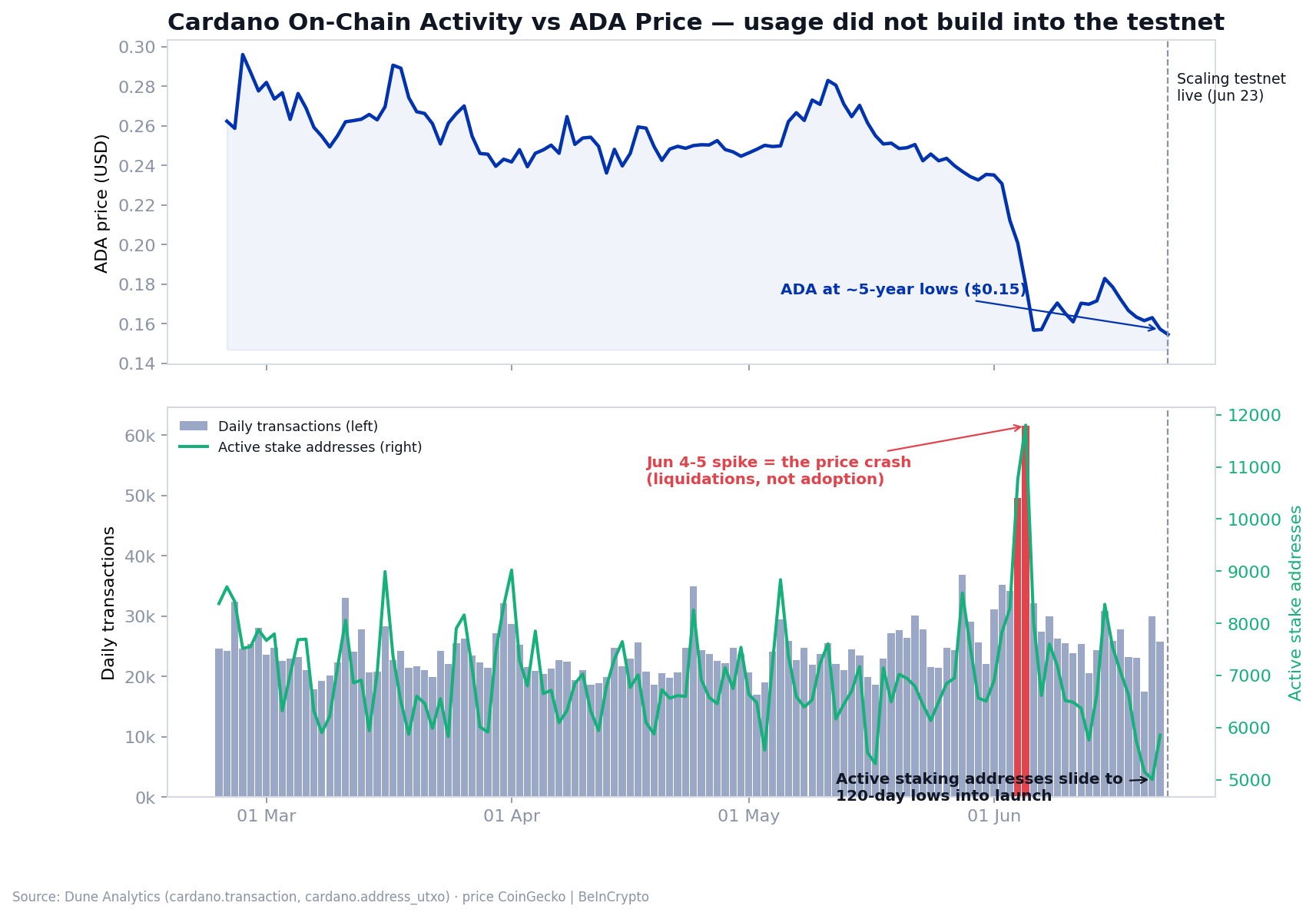
Cardano (ADA) network activity barely changed after the Leios Musashi Dojo testnet went live on June 23, with daily transactions flat and active addresses near four-month lows.
The launch marks a major step for Cardano’s scaling plan. Yet the on-chain data and social signals tell a more cautious story about whether users have noticed.
The Testnet Barely Moved Cardano’s Network Activity
The headline event did little to the chain itself. Daily transactions held near 25,000, in line with the past three months, with no lasting lift after the testnet went live. The testnet is the first live trial of a scaling upgrade built for far higher throughput, a step toward a planned 2026 mainnet.
Want more token insights like this? Sign up for Editor Harsh Notariya’s Daily Crypto Newsletter here.
The one clear surge came on June 4 and 5, when transactions jumped above 60,000. That spike lined up with a sharp sell-off, so it appears to reflect liquidation activity rather than fresh adoption.
Cardano active staking addresses tell a softer story. The count of distinct staking accounts transacting each day fell to about 5,000 on June 21, a 120-day low, against a 7,000 to 8,000 norm earlier in the window.

Fewer active accounts points to thinner everyday demand, which suggests the upgrade buzz has not drawn users back.
Note: That figure uses Dune’s stake-address method, so it runs lower than broader trackers that count every payment address. The direction, not the absolute level, is the point.
So the network looks quiet, but ADA on-chain data is only one lens. Crowd mood often moves first.
Social Sentiment Still Leans Positive
Cardano sentiment has held up better than the price slump would suggest. Santiment’s positive sentiment score sits at 8.29, against a negative score of 3.13, so optimism still outweighs fear by more than two to one.
Positive sentiment also spiked toward 30 during the testnet launch, far above the negative readings over the same stretch. The crowd appears to still see a reason for patience.

Sentiment is a soft signal, however. Money flows show whether that optimism comes with conviction.
Exchange Outflows Point to Accumulation, but Fading
The ADA exchange outflows trend has stayed constructive. Spot exchange netflow, a metric that tracks coins moving onto and off exchanges, has printed a net outflow every week since early May.
Net outflows usually suggest holders are moving coins into self-custody, a pattern often read as quiet accumulation. There has not been a single week of net inflow since mid-May, which would point to building sell pressure.
But the catch is the size. Weekly net outflows shrank from about $27 million in mid-May to just $4.53 million for the week ending June 22, a drop of more than 80%.

So the buying pressure is still there, aligning with the positive sentiment, but it is thinning fast. That tension defines where Cardano stands now.
What Cardano’s Network Needs Next
The contrarian read is simple. A landmark testnet arrived, and the chain barely reacted. Leios is a promise aimed at a late-2026 mainnet, not a switch that lifts demand today. For now, Cardano network activity is flat, addresses are sliding, and the catalysts that matter are still months away.
The hope is real but thin. Positive sentiment and steady, if shrinking, exchange outflows suggest holders have not given up, even as the latest Cardano news cycle failed to spark usage. Sustained growth in active addresses separates a real Leios-driven revival from a network still trading on promise.
The post Cardano Launched Its Biggest Upgrade in Years: What Does Network Activity Say? appeared first on BeInCrypto.

SBI Holdings is approaching a major milestone in its digital asset strategy as its yen-backed stablecoin project nears launch. The initiative remains within its targeted second-quarter rollout window, while final regulatory approval remains pending. If authorities grant clearance, the stablecoin will enter the market under the ticker JPYSC.
The project marks another step in Japan’s regulated stablecoin sector. Moreover, it highlights SBI Holdings’ broader push into blockchain-based financial services. The launch also strengthens the company’s growing presence across digital payments, tokenization, and cross-border settlement.
SBI Holdings Moves Closer to JPYSC Market Debut
SBI Holdings developed the stablecoin project together with Startale Group. The partners announced the initiative in February and continued preparations throughout the year. However, regulators must complete the final approval process before issuance begins.
The companies structured JPYSC under Japan’s trust-bank framework. Consequently, Shinsei Trust & Banking will support the issuance structure once approval arrives. Meanwhile, SBI VC Trade is expected to oversee distribution activities following the launch.
The stablecoin aims to connect traditional financial infrastructure with blockchain networks. Therefore, businesses could gain access to more efficient payment and settlement options. The project also aligns with Japan’s regulatory framework for digital payment instruments.
SBI Holdings and Startale agreed to pursue the stablecoin initiative after forming a partnership involving Ripple. Their plan focused on building a digital yen solution for regulated blockchain transactions. At the same time, the companies prioritized compliance with Japanese financial standards.
The project differs from many offshore stablecoin models. Instead, it follows domestic regulatory requirements designed for institutional use. As a result, the structure may support larger transactions and broader enterprise adoption.
Industry attention remains focused on the framework supporting JPYSC. The design targets corporate payments, tokenized assets, and settlement activities. Furthermore, it seeks to bridge conventional banking systems with blockchain-based networks.
Stablecoin Expansion Supports SBI’s Digital Asset Strategy
SBI Holdings recently expanded its stablecoin activities through a partnership with fintech company Fasset. The collaboration integrates stablecoin-powered remittance services into SBI Remit operations. Consequently, SBI gains access to infrastructure handling significant transaction volumes.
The agreement arrived as stablecoins continue gaining traction in cross-border payments. Therefore, the partnership complements SBI’s broader digital finance strategy. It also supports efforts to improve transaction efficiency across international payment corridors.
Beyond stablecoins, SBI maintains strong ties with several blockchain companies. The group continues its long-standing relationship with Ripple through SBI Ripple Asia. Additionally, it has invested in firms including R3 and Securitize.
SBI also partnered with Circle to support USDC distribution in Japan. That initiative expanded access to regulated dollar-backed stablecoins within the country. As a result, SBI strengthened its position in the domestic digital asset market.
More recently, the company increased its focus on tokenization. It entered a collaboration with Chainlink covering real-world asset tokenization and proof-of-reserve solutions. The partnership also includes work on regulated stablecoins and cross-chain infrastructure.
JPYSC Targets Growing Japanese Stablecoin Market
The upcoming launch places JPYSC in direct competition with existing yen-backed stablecoins. Among them, JYPC currently holds a leading position in the market. The project benefited from an earlier launch and established user adoption.
However, SBI enters the market with extensive financial and blockchain experience. The company operates across banking, payments, and digital assets. Therefore, JPYSC could benefit from existing infrastructure and business relationships.
Japan continues advancing its regulated stablecoin ecosystem through licensed frameworks. Consequently, new issuers must meet strict compliance and operational requirements. These standards aim to support stable and secure digital payment systems.
The expected launch of JPYSC reflects that broader regulatory approach. At the same time, it demonstrates increasing activity among major financial institutions. As stablecoin adoption expands, competition within Japan’s digital payments market is likely to intensify.
Crypto World
Chainlink teams up with 47 South Korean, European banks to speed up international money transfers


Project Pangea is designed to work with existing Swift and ISO 20022 banking standards, allowing traditional financial institutions to connect to blockchain-based settlement rails without replacing their payment infrastructure.
Not a Ripple rival
Some industry observers may view the project as a challenge to Ripple’s decade-long push into institutional cross-border settlement, but Chainlink insists its approach is collaborative rather than disruptive.
“I wouldn’t necessarily describe it as a rival,” Ariyasinghe noted. “We’re very much a technology provider. It’s less about creating a unified network from scratch. It’s about applying the technology, finding where that value is, and growing the network organically.”
Ultimately, the goal is to free up trapped capital and modernize international trade corridors.
“If I’m sending money to you and it’s lost in transit for quite some time, you don’t receive it, and that money isn’t able to be used,” Ariyasinghe said. “To reduce that time as much as possible, for customers to access that money absolutely as fast as possible, has to be a good thing.”
By reducing settlement times from days to near real time, participating institutions hope to lower liquidity costs, reduce settlement risk and give businesses faster access to funds tied up in cross-border transactions.


The Ethereum Foundation is reducing its annual budget by roughly 40% and cutting about 20% of its staff as part of a sweeping restructuring intended to turn the nonprofit into a leaner, endowment-based organization. The organization said in a blog post Tuesday that 54 employees are leaving… Read the full story at The Defiant


Key takeaways
- Luxembourg’s financial regulator has granted Ripple preliminary approval for a Crypto Asset Service Provider (CASP) license under the European Union’s Markets in Crypto-Assets Regulation (MiCA).
- XRP is down by nearly 4% in the last 24 hours and now trades at $1.10 per coin.
Luxembourg regulator grants Ripple CASP green light
Luxembourg’s financial regulator has granted Ripple preliminary approval for a Crypto Asset Service Provider (CASP) license under the European Union’s Markets in Crypto-Assets Regulation (MiCA), the company confirmed on Tuesday.
Once fully approved, the license will enable Ripple to provide regulated crypto services to banks, fintech firms, and other businesses across all 30 countries in the European Economic Area (EEA) through a single regulatory passport system.
The CASP approval expands Ripple’s existing regulatory footprint in Europe. The company already holds an Electronic Money Institution (EMI) license in Luxembourg, which allows it to offer cross-border payment and electronic money services throughout the EEA.
Together, the EMI and upcoming CASP authorization are expected to support a unified infrastructure for crypto asset and stablecoin-based payments across Europe.
The timing of the development is notable, coming just ahead of the July 1 transition deadline, when EU member states begin fully enforcing MiCA regulations.
According to Ripple, the combined regulatory approvals will enable the company to deliver a “full crypto asset and stablecoin payments infrastructure” through a single integration.
The firm also said the approval positions it to expand its broader crypto services across Europe, which it described as one of its most important growth regions.
Cassie Craddock, Managing Director for the UK and Europe at Ripple, said MiCA is already accelerating institutional adoption of digital assets across the region.
Ripple now holds more than 75 regulatory licenses worldwide, reinforcing its push toward regulated global expansion.
In addition to its EU progress, the company also secured a UK license from the Financial Conduct Authority in January 2026, further strengthening its position in key financial markets.
XRP could dip below $1.0 as the market sentiment remains bearish
The XRP/USD 4-hour chart remains bearish and efficient as Ripple has lost 4% of its value in the last 24 hours.
At press time, XRP is trading at $1.10 and could drop lower in the near term. The momentum indicators show that the bulls are in control of the market.
The MACD lines are below the neutral zone, while the RSI of 32 shows that XRP is heading into the oversold territory.

If the bearish trend persists, XRP could retest the June low of $1.05, with lower demand zones at the $0.98 level.
However, if the bulls regain control, XRP could rally towards the Monday high of $1.16. A daily candle close above this level could see XRP target the $1.23 resistance zone.
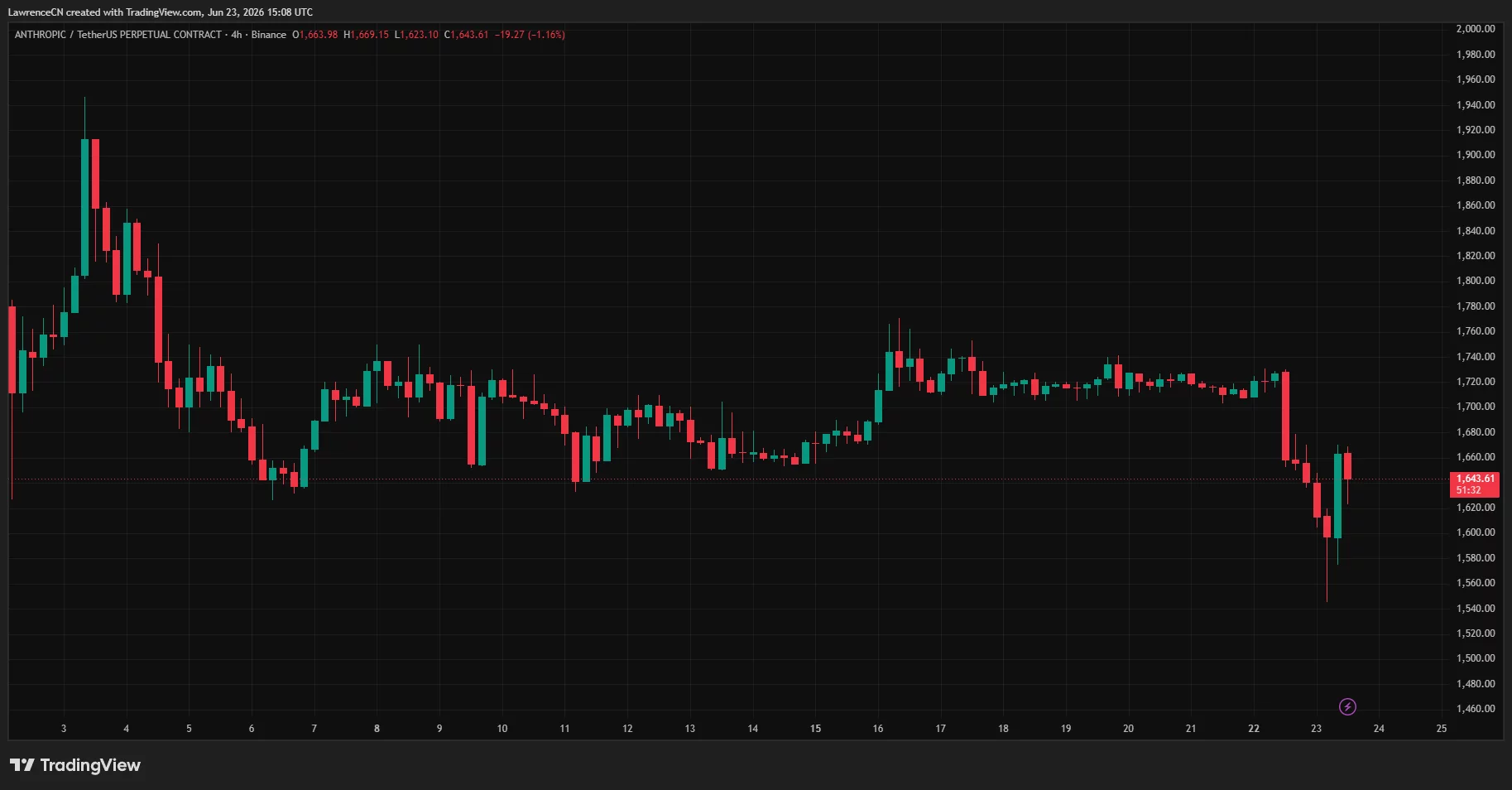
Anthropic pre-IPO futures have fallen as much as 9% since their Coinbase debut, with contracts on both Coinbase and Binance sliding to new lows despite fresh attention from traders.
Summary
- Anthropic pre-IPO futures fell up to 9% after their Coinbase debut, with contracts on Coinbase and Binance hitting fresh lows.
- Traders appear cautious after SpaceX pre-IPO contracts traded above the eventual IPO price, exposing some investors to losses.
- Coinbase has warned that Anthropic’s final IPO price could differ by as much as 25% from current perpetual futures levels.
As reported by crypto.news, Coinbase added Anthropic and OpenAI pre-IPO perpetual futures contracts to its growing lineup of private-market trading products on June 22. Rather than benefiting from the exchange’s listing effect that has historically boosted some newly listed assets, Anthropic futures moved sharply lower within a day of launch.
Per data from TradingView, the ANTHROPIC/USDC contract on Coinbase opened around $1,728 and was trading near $1,648 at the time of writing, representing a decline of roughly 7%. During the same period, the contract swung between a June 22 high of $1,769 and a June 23 low of $1,560, highlighting elevated volatility immediately after launch.
Similar price action emerged on competing venues. Binance’s ANTHROPIC/USDT perpetual contract dropped about 5% between June 22 and June 23 to roughly $1,630. As per data from TradingView, the Binance contract had traded near $1,700 before Coinbase introduced its Anthropic futures product, implying a decline of approximately 9% since the listing took place. The contract also touched an all-time low of $1,545 on June 23.
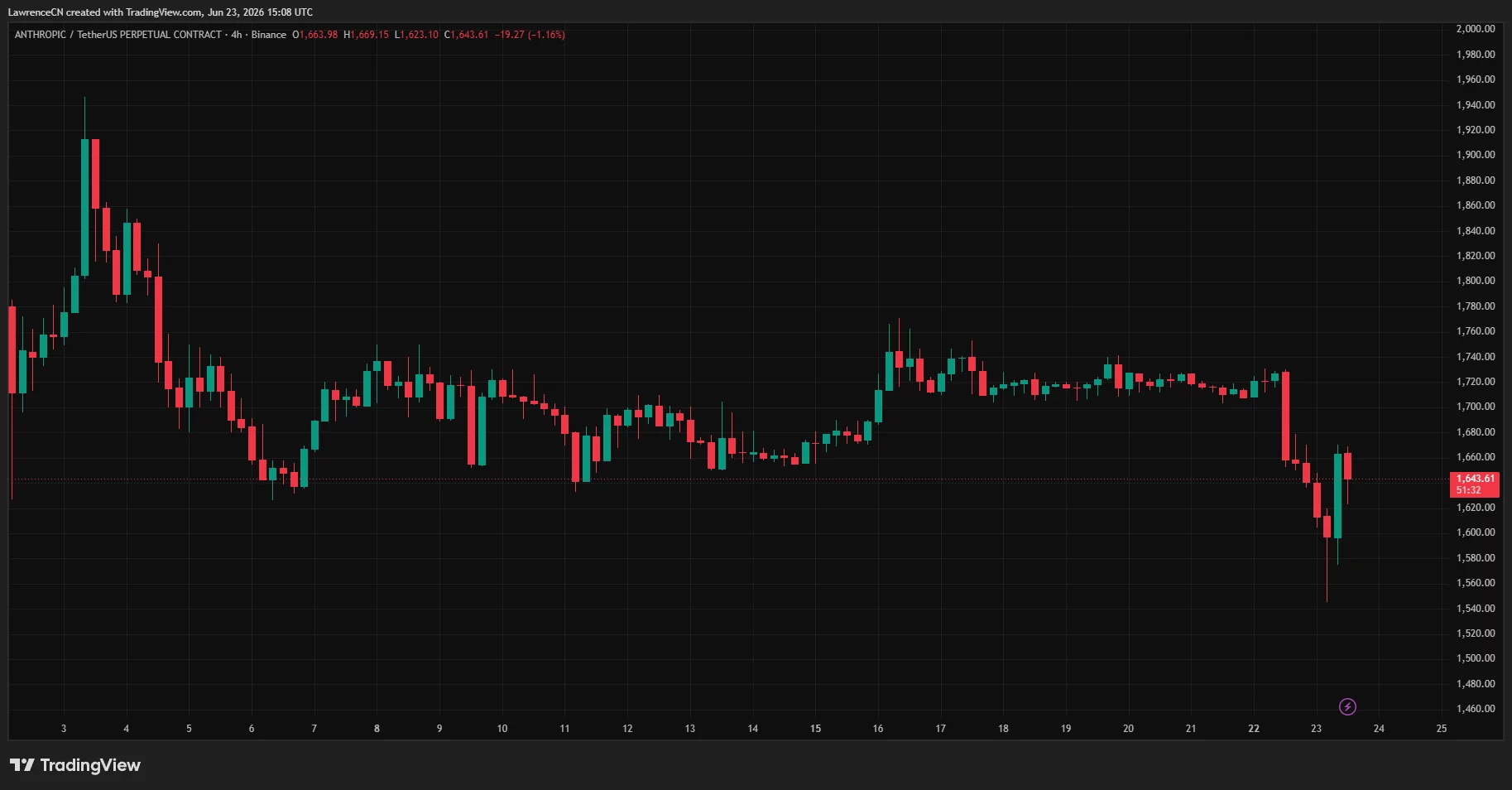
The weakness comes despite Anthropic announcing a partnership with Micron Technology, a company valued at roughly $1.37 trillion, suggesting that traders have remained focused on pricing risks surrounding the eventual IPO rather than recent business developments.
SpaceX experience weighs on pre-IPO sentiment
Recent trading activity has drawn comparisons with the path taken by SpaceX-related contracts before the aerospace company’s public debut.
According to crypto.news, some investors appear to be reassessing the risks attached to pre-IPO perpetual products after SpaceX contracts traded well above the eventual IPO price. SpaceX pre-IPO perpetuals changed hands around $155 before the company’s Nasdaq debut, about 15% higher than its $135 IPO price, leaving some traders exposed to losses once public trading began.
Subsequent developments in the stock market have added to those concerns. As previously reported by crypto.news, SpaceX shares fell more than 10% after analysts at KeyBanc initiated coverage with a “Sector Weight” rating while declining to issue a price target. The brokerage said SpaceX remained well positioned within the launch industry but argued that much of the company’s future growth may already be reflected in its valuation.
Following that decline, Cathie Wood’s Ark Invest purchased nearly $32.5 million worth of SpaceX shares across four exchange-traded funds after the stock retreated more than 16% from recent highs.
IPO pricing uncertainty remains unresolved
Another factor keeping traders cautious is the lack of information surrounding Anthropic’s eventual IPO terms.
Notably, Anthropic has not yet disclosed the number of shares it plans to sell through its IPO filing, making it difficult for exchanges to anchor perpetual futures pricing to a future public-market valuation. As a result, the eventual IPO price could settle either above or below current futures levels once additional details become available.
Coinbase has already highlighted this risk to market participants. The exchange warned that the final IPO price could end up 25% higher or 25% lower than where the perpetual contracts trade before listing.
Elsewhere in the private-market sector, interest in pre-IPO opportunities continues to grow. Last week, crypto.news reported that Kalshi had surpassed a $2 billion annualized revenue run rate and had begun early discussions with investment banks about a potential public offering, weeks after raising $1 billion in funding at a $22 billion valuation.

Chrisean Rock Sparks Mixed Reactions With NEW Look (VIDEO)

Great Amazon Deals for Work Clothes and More

Can Andy Burnham Win Over Britain’s Entrepreneurs?


-

 Fashion4 days ago
Weekend Open Thread: Miami – Corporette.com
-
 Tech7 days ago
The Adder At The Heart Of Intel’s 8087 FPU
-

 Entertainment3 days ago
Renter of Home in Anne Heche Crash Denies Settlement With Son
-

 Tech1 day ago
Microsoft accidentally kills epic Outlook email threads
-

 Business3 days ago
Soccer-U.S. defends Iran World Cup travel restrictions, says discussions ongoing
-

 Politics5 days ago
BBC Reporter Discusses Cross Party Criticism Of Trumps Iran Deal
-
 Business4 days ago
Wall Street Week Ahead: Investors see Micron earnings as pulse check of AI rally momentum
-

 Tech5 days ago
AWS enters the context layer race with a graph that learns from agents, not manual curation
-

 Crypto World4 days ago
HIVE shares jump as $220M AI deal speeds Bitcoin mining pivot
-
 Crypto World3 days ago
Can Charles Hoskinson Really Rescue Cardano?
-

 Politics3 days ago
Andy Burnham and the meaning of Makerfield
-

 Crypto World3 days ago
Jake Chervinsky accuses CME of protecting derivatives monopoly
-

 Tech21 hours ago
Nearly 7,000 fake Amazon domains registered ahead of Prime Day 2026, researchers warn
-

 Sports5 days ago
FIFA World Cup 2026: Canada beat 9-men Qatar 6-0 to register first ever win | FIFA World Cup 2026
-

 Business5 days ago
Brexit cost 6% of UK economy, Bank of England company data suggests
-

 Business3 days ago
MHP SE 2026 Q1 – Results – Earnings Call Presentation (OTCMKTS:MHPSY) 2026-06-20
-
 Tech2 days ago
Signal’s Meredith Whittaker says AI chatbots ‘are not your friends’ and calls Copilot agents a backdoor
-

 NewsBeat4 days ago
Keir Starmer Allies Question His Chances For No 10
-

 Entertainment4 days ago
Jose Alvarado Wants Taylor Swift at More Knicks Games
-

 Crypto World5 days ago
Anthropic’s Dario Amodei Urged AI Unity at G7, Even as US Banned His Models
You must be logged in to post a comment Login