

Crypto World
Bitmine (BMNR) buys $92 million ETH as Tom Lee reaffirms ‘crypto spring’ call



Earlier this month, Bitmine raised roughly $274 million through the sale of 3.5 million shares of 9.50% Series A Perpetual Preferred Stock. The preferred shares, which trade on the New York Stock Exchange under the ticker BMNP, pay weekly cash dividends.
Lee has argued that the company’s staking operation provides recurring cash flow to support those obligations. Bitmine currently has 4.72 million ETH staked — more than 83% of its holdings.
The company projects annualized staking revenue of roughly $223 million, with potential staking rewards reaching $268 million annually through its MAVAN staking platform.
The firm announced another round of scheduled dividend payments extending through August, paying $0.1847 per shares.
Crypto spring
Lee reiterated his view that the crypto market is in the early stages of a recovery from the downturn that began with the October 2025 liquidation shock.
At Consensus Miami last month, he argued the bear market would be “definitely” over if bitcoin closed May above $76,000. Instead, BTC finished the month below $74,000 before briefly falling under $60,000 in early June.
Still, Lee said the recent pullback has not changed his broader outlook.
“We believe we are in the early stages of crypto spring,” he said.
Lee also reaffirmed his long-term bullish stance on Ethereum, arguing that growing demand from tokenization and artificial intelligence applications will drive adoption of the network in the years ahead.

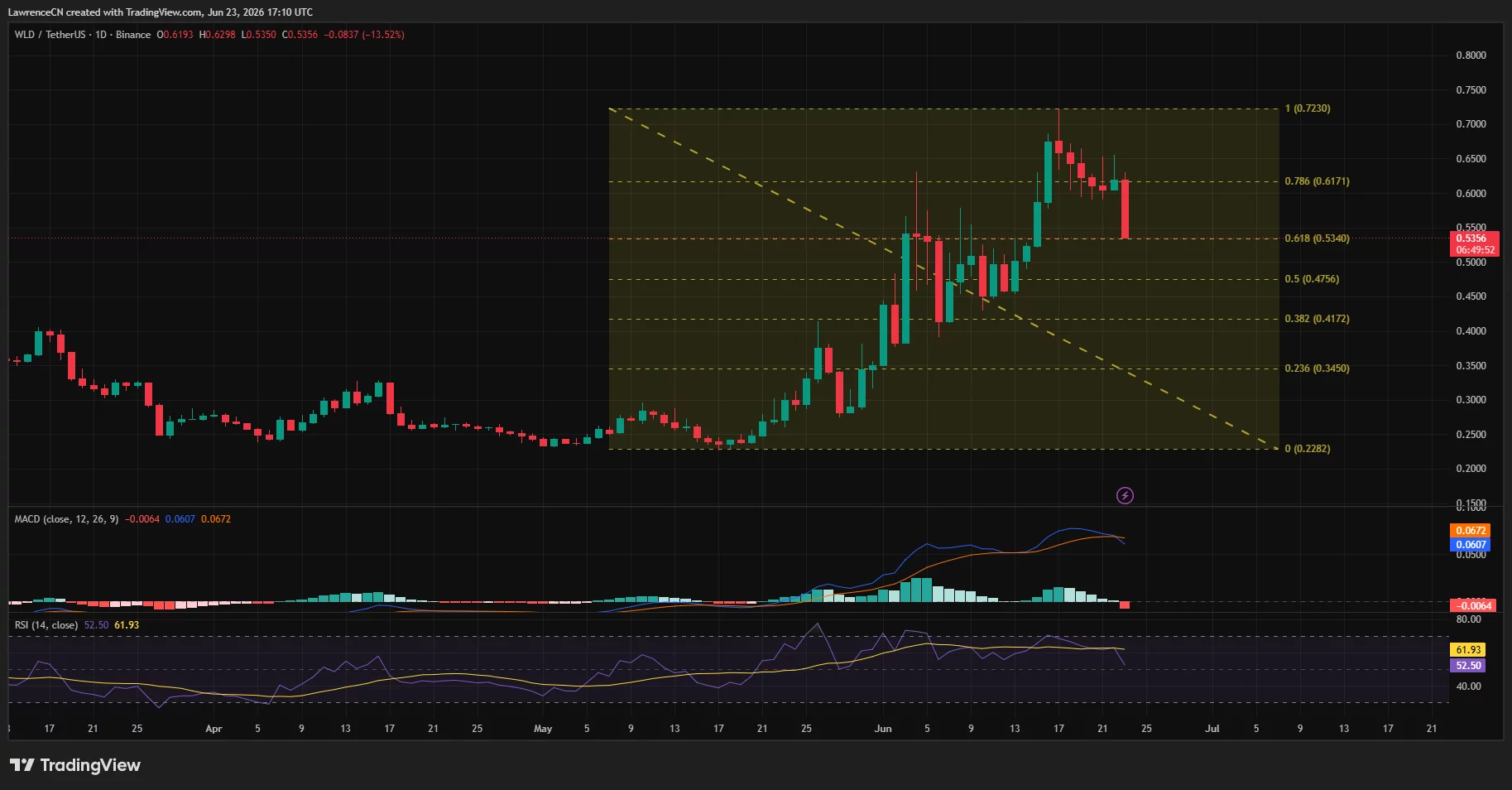
Worldcoin has fallen nearly 12% while Robinhood has added the token to its trading platform, bringing fresh attention to the project as allegations linked to co-founder Sam Altman continue to weigh on sentiment.
Summary
- Robinhood has added Worldcoin to its crypto trading platform as WLD falls nearly 12%.
- Allegations involving Sam Altman-linked Orb have added fresh pressure on investor sentiment.
- WLD is testing key support near $0.53 ahead of a planned reduction in token unlocks next month.
According to a June 23 X announcement by Robinhood, users of the brokerage platform can now trade Worldcoin (WLD), giving the token exposure to a broader retail investor base despite ongoing market turbulence.
The listing arrives during a difficult period for the project. At the time of writing, Worldcoin (WLD) was trading around $0.53 after dropping almost 15% over the past 24 hours.
Although listings on major exchanges and brokerages often improve liquidity and visibility, traders appeared reluctant to chase the news. The token remains well below its recent June peak near $0.70 despite gaining access to Robinhood’s customer base.
Selling pressure persists despite Robinhood listing
Market attention has increasingly turned toward allegations involving Altman and entities connected to the Worldcoin ecosystem.
A report highlighted by podcaster Katie Miller said internal investigations at Orb, a startup associated with Worldcoin, examined payments allegedly approved by company leadership to a foreign entity. According to the report, those payments were intended to influence the market performance of the WLD token.
The allegations have added another layer of uncertainty around a project that has already faced criticism over its biometric identity verification system and token distribution model.
Earlier this month, Worldcoin also drew attention after BitMEX co-founder Arthur Hayes disclosed that he had sold his WLD holdings. His exit added to concerns among traders already navigating increased volatility across the token.
Token unlock reduction approaches in July
At the same time, Worldcoin is preparing for a change in its token issuance schedule. According to project details, Worldcoin is expected to reduce its token unlock rate beginning on July 24, 2026. Lower unlock rates typically slow the pace at which new tokens enter circulation and can reduce selling pressure from newly released supply.
The planned adjustment has prompted discussion among traders because supply-related changes have historically influenced price action in crypto markets. Yet recent trading suggests investors remain more focused on the controversy surrounding the project than on upcoming tokenomics changes.
Separately, renewed discussion about a potential future public listing of OpenAI has brought additional attention to Altman-linked ventures, including Worldcoin. While no direct connection exists between OpenAI’s corporate plans and Worldcoin’s token economics, the heightened visibility has kept the project in market conversations.
For now, technical indicators suggest traders are becoming increasingly cautious despite Robinhood’s listing. On the daily chart, WLD has retreated to the 61.8% Fibonacci retracement level near $0.53 after failing to hold above $0.60, while the MACD has produced a bearish crossover and its histogram has slipped below zero.
The relative strength index has also fallen sharply from recent highs, signaling fading buying pressure following the token’s rally to nearly $0.70 earlier this month.
A sustained move below $0.53 could open the door for a deeper retracement toward $0.48 and potentially $0.42, whereas a recovery above $0.62 would be needed to ease immediate downside pressure.
The crypto market has been quite unstable (to say the least) lately, with the past 24 hours delivering another substantial correction. Bitcoin (BTC) briefly tumbled below $62,000, while numerous altcoins also entered red territory.
However, DeXe (DEXE) defied the bearish conditions, soaring by double digits over the last day. While several analysts expect further short-term increases, one key technical indicator suggests it might be time for a pullback.
New ATH Soon?
The lesser-known altcoin is currently worth around $23 (per CoinGecko), representing a whopping 50% spike from yesterday’s figure. Its market capitalization has surpassed the psychological $1 billion threshold, making DEXE the 65th-largest cryptocurrency.
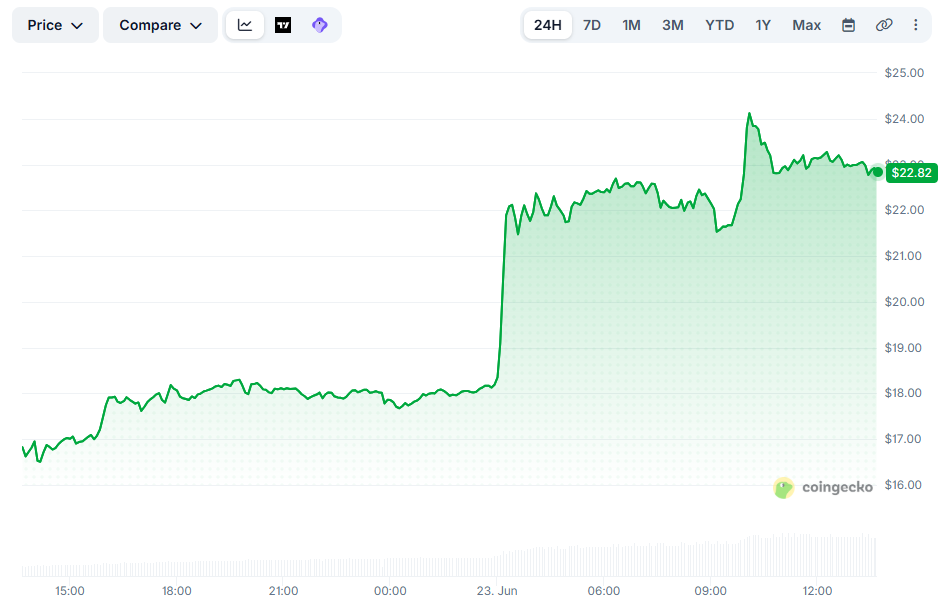
Perhaps one of the main catalysts for the rally is MEXC’s support. The prominent crypto exchange included DEXE in its futures trading section, allowing adjustable leverage up to 50x.
The analyst, using the X moniker “The Boss,” claimed that the token “is showing one of the strongest structures” among altcoins, noting buyers’ quick reaction after every pullback. The market observer paid close attention to the $24 resistance level, arguing that if bulls turn it into support, the uptrend could continue to as high as $39. DEXE has been on the market since late 2020 and reached an all-time high of almost $30 the following year, meaning a rise of that magnitude would mark a new historic peak.
OxNeena also chipped in. According to the analyst, DEXE is breaking out of a bullish Cup & Handle formation that could push the price above $27 in the near future.
Time to Short?
Contrary to prevailing optimism, some industry participants anticipate an upcoming correction. Crypto with Haris ₿, for instance, opened a $40,000 short position on DEXE, describing the $22.80-$23.30 area as “very important.”
“If buyers were still fully in control, price should have already reclaimed the recent highs. Instead, DEXE is struggling below resistance while volume is cooling down. That usually happens when a trend starts losing strength,” the analyst explained.
They further predicted that a plunge below $22 could drop the price to as low as $18.
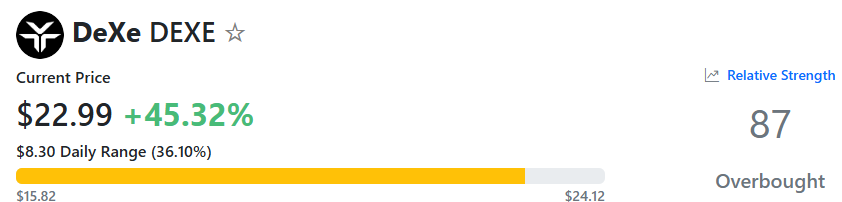
DEXE’s Relative Strength Index (RSI) should also serve as a warning. Its ratio has climbed to 87, meaning that the coin has entered extreme overbought territory and could be due for a pullback. The RSI ranges from 0 to 100; anything below 30 is considered a buying opportunity.
The post DeXe (DEXE) Explodes 50% Despite Crypto Bloodbath: What Comes Next? appeared first on CryptoPotato.
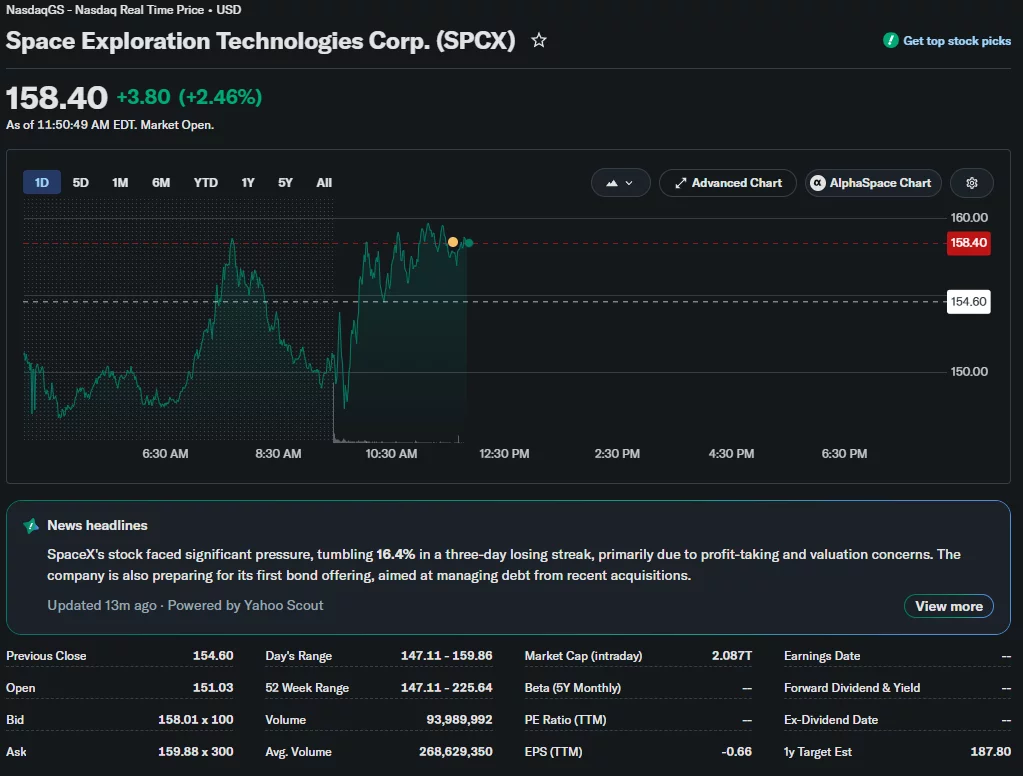
SpaceX stock has remained under pressure after Susquehanna initiated coverage with a $170 price target while warning that the company’s valuation depends on aggressive growth assumptions.
Summary
- Susquehanna initiated SpaceX coverage with a neutral rating and a $170 price target.
- The brokerage warned that the stock’s valuation relies on aggressive revenue and EBITDA growth forecasts.
- Peter Schiff flagged a potential surge in share supply, while ARK Invest continued buying the recent dip.
According to a research note from Susquehanna, the brokerage assigned SpaceX a neutral rating and set a $170 target for the stock as shares continue trading below their $150 debut price following a sharp post-listing rally and subsequent pullback.
The firm projects SpaceX revenue to grow at an 81% compound annual growth rate between 2025 and 2028, while adjusted EBITDA is expected to expand at a 76% CAGR during the same period. Even with those forecasts, Susquehanna cautioned that the stock’s current valuation requires premium multiples and leaves room for multiple outcomes as several of the company’s businesses operate in markets that remain relatively untested.
At current levels, the brokerage said it would prefer to wait for a more attractive entry point before becoming more constructive on the stock.
Analysts point to growth drivers but remain cautious
In its coverage report, Susquehanna highlighted four factors supporting the company’s long-term case. The first was SpaceX’s leading position in the rocket launch industry, which continues to provide a competitive advantage over rivals.
Beyond launch services, the analysts identified Starlink as a major source of future growth. The report also pointed to the company’s early-stage artificial intelligence initiatives and its ability to build large-scale AI infrastructure. Completing the list was CEO Elon Musk, whom Susquehanna described as a proven operator with a record of building and scaling businesses.
Even so, the brokerage argued that much of the expected growth may already be reflected in the current valuation.
As crypto.news reported, analysts at KeyBanc adopted a similar stance on Monday, initiating coverage of SpaceX with a neutral rating. The cautious outlook from both firms has emerged as the company reportedly seeks to raise up to $20 billion through its first bond offering.
Investor attention has also turned to how other high-profile private-market assets have traded after gaining broader access to retail participants. Anthropic pre-IPO futures, for example, have fallen as much as 9% since their Coinbase debut despite the artificial intelligence company announcing a partnership with Micron Technology. The decline suggested traders remained focused on future valuation risks rather than recent business developments.
Supply concerns add to pressure on shares
Elsewhere, economist Peter Schiff raised concerns about the stock’s future supply dynamics in a June 23 X post.
Schiff argued that the relatively small public float helped fuel SpaceX’s explosive first-day gains. However, he warned that the number of shares available for trading could increase substantially over time. According to Schiff, the float may expand from roughly 640 million shares to 7.5 billion shares by Dec. 8, representing an increase of nearly twelvefold.
“That’s a massive supply overhang for a stock priced for perfection and already falling.”
Despite those concerns, some institutional investors have continued adding exposure. As previously reported by crypto.news, ARK Invest purchased over 210,000 SpaceX shares worth nearly $32.5 million after the recent decline.
SpaceX stock fell below its $150 debut price earlier in the session before recovering. Data from Yahoo Finance showed that the shares changed hands around $158.40 at press time, up 2.4% on the day but still down more than 17% over the past five trading sessions.
Crypto World
Specialist Agency Kooc Media Opens Up Dedicated PR Packages for the AI Productivity and Automation Sector
Kooc Media, a PR distribution agency with a track record spanning more than seven years in specialist tech sectors, is now accepting clients from the AI productivity tools and business automation software space. The agency has built out a dedicated service for companies in this category, covering everything from press release writing and guaranteed article placements to full newswire syndication across hundreds of outlets worldwide.
The business case for AI productivity tools has never been stronger. Enterprises are actively investing in automation software that cuts time spent on repetitive tasks, speeds up decision-making and reduces operational overhead. AI agents, workflow automation platforms, intelligent scheduling tools, document processing software and AI-powered communication tools are all seeing strong demand. But demand alone does not guarantee that any single product gets noticed. In a market with this many players, media visibility is what separates the companies that grow quickly from those that struggle to gain traction.
Kooc Media exists to solve that problem.
Why AI Tool Companies Need a Specialist PR Agency
Most PR agencies are generalists. They handle a wide range of clients across many industries and apply a broadly similar approach to all of them. That can work fine for some sectors, but it tends to fall short for AI and automation companies, where the product story requires a degree of technical literacy and the target audience spans both technical evaluators and senior business decision-makers.
A PR agency for AI productivity tools needs to understand what workflow automation actually means to a business, why AI agents are different from traditional software bots, and how to frame a product announcement so it lands with a CTO, a procurement team and a technology journalist all at the same time. That requires focus and experience in the sector — not a generic press release template.
Kooc Media’s editorial team has that focus. The agency produces press release content that describes AI products clearly and accurately, avoiding the kind of empty language that experienced readers tune out immediately. Whether the client is launching a new AI productivity platform, announcing a major enterprise integration, closing a funding round or expanding into a new market, the content is written to inform and persuade the audiences that matter most.
“Companies building AI productivity tools are operating in one of the most competitive software markets in the world right now,” said Michelle De Gouveia, spokesperson for Kooc Media. “Good PR in this space is not about sounding impressive — it is about being credible and being visible to the right people. That is what we focus on delivering for every client.”
Owned Publications and a Wide Distribution Network
Kooc Media’s distribution model is built on two foundations. The first is its own network of established online publications, which includes Blockonomi, CoinCentral, MoneyCheck, Parameter, Beanstalk and Computing. These are real, active websites with indexed content and genuine readerships across finance, technology and business sectors. Clients receive guaranteed placements across these sites as a core part of every package — confirmed published articles, not outreach attempts.
The full network of Kooc Media’s owned publications can be found at kooc.co.uk/sites.

The second foundation is Kooc Media’s partner distribution network, which reaches hundreds of partner websites and thousands of syndicated outlets. For clients that need broader reach, premium packages include distribution to major global platforms. Press releases can be picked up and published on sites including Business Insider, Bloomberg, Benzinga, MarketWatch, USA Today and through Dow Jones news feeds. For an AI automation company building its brand or preparing for a funding raise, that level of coverage builds the kind of third-party credibility that is difficult to achieve through owned channels alone.
All campaigns include complete reporting with live links to every placement secured, so clients always have a clear record of exactly what coverage was delivered.
Free Inclusion in the AgentLocker AI Tools Directory
Every Kooc Media client also receives a complimentary listing in AgentLocker.ai, the AI tools and agents directory owned and operated by Kooc Media. AgentLocker is a dedicated resource for people researching, comparing and selecting AI productivity tools and automation platforms. It covers a broad range of categories including AI writing tools, business process automation, AI agents, enterprise AI software, scheduling tools and more.
Unlike general software directories, AgentLocker is built specifically around AI tools and attracts an audience that is actively looking to adopt or switch AI solutions. Getting listed here puts a client’s product in front of people at exactly the point they are making buying decisions.

This inclusion comes at no additional cost. Every PR client is featured in the directory as a standard part of their campaign, adding a persistent, searchable listing to complement the time-sensitive media coverage generated through press release distribution. For AI productivity companies focused on building long-term discoverability, it is a meaningful benefit.
A Proven Model Applied to a Growing Sector
Kooc Media built its reputation running PR campaigns for crypto and blockchain companies and iGaming operators — two sectors where media presence, speed to market and audience targeting are directly tied to commercial results. The same distribution infrastructure, editorial processes and reporting standards that serve those clients now underpin Kooc Media’s AI PR services.
For AI productivity and business automation companies, this means working with an agency that has already figured out how to deliver consistent, high-quality PR at scale in demanding markets.
About Kooc Media
Kooc Media is a specialist PR distribution agency founded in 2017, serving clients in the crypto, fintech, AI, technology and iGaming industries. The agency operates its own network of online publications and distributes content through a partner network reaching hundreds of outlets globally. Services include press release writing, guaranteed placements, sponsored content and full newswire syndication.
Website: https://kooc.co.uk
AI Directory: https://agentlocker.a
Disclaimer: This is a Press Release provided by a third party who is responsible for the content. Please conduct your own research before taking any action based on the content.


Ripple has secured preliminary Crypto Asset Service Provider approval from the Luxembourg CSSF under the EU’s MiCA regulation, and XRP dropped 3% on the news. The token is trading at $1.10, down 5% over 24 hours, with the crypto market providing no cover.
The regulatory milestone is real, but was, sadly, not an XRP catalyst. Ripple framed the approval entirely around RLUSD and Ripple Payments infrastructure, with XRP appearing only as something that “underpins” those solutions, a footnote in Ripple’s own announcement about its own network’s native token.

The CASP green light enables regulated crypto-asset services across all 30 countries of the European Economic Area. It does not create a direct demand mechanism for XRP.
Discover: The Best Token Presales
Ripple MiCA Win Is Infrastructure Plumbing, Not an XRP Demand Catalyst
The CSSF’s green light is a “Green Light Letter,” preliminary approval that remains subject to final conditions before full MiCA compliance is conferred. Ripple said that upon full approval, the CASP license, combined with its existing EU Electronic Money Institution (EMI) license, also issued out of Luxembourg, would make it fully MiCA-compliant.
What the approval actually covers is Ripple Payments and RLUSD distribution infrastructure. The commercial pitch is that European banks, fintechs, and corporates can run collection, exchange, and payout through a single Ripple integration across the entire EEA.
There is an additional nuance that the announcement does not resolve. A CASP license authorizes crypto-asset services, but it is structurally distinct from the separate authorization a stablecoin requires to be issued as a MiCA e-money token. Ripple’s announcement touts stablecoin payments infrastructure without clarifying RLUSD’s own standing under MiCA’s non-euro token regime, which caps dollar-pegged stablecoins’ use as a means of exchange in the bloc.
Tether’s USDT, on the other hand, was effectively pushed out of Europe ahead of MiCA’s implementation. Circle, however, brought USDC and EURC into compliance through its EMI. Where RLUSD sits on that spectrum is precisely what institutions will want answered before committing to the integration.
Ripple is also arriving at this milestone late relative to peers. MiCA became fully applicable to crypto-asset service providers in December 2024. Circle secured its approval in April 2025, and B2C2 obtained a CASP license from the Luxembourg CSSF in May 2025. OKX, Coinbase, and Kraken were cleared through the course of 2025.
— Coin Bureau (@coinbureau) June 15, 2026
 EU TO DELIST TETHER'S $175 BILLION USDT FROM LICENSED EXCHANGES
Major exchanges including Binance, Coinbase, Kraken, and Crypto .com have removed USDT for EU users after Tether chose not to seek approval under Europe's MiCA regulations.
Meanwhile, Circle's USDC has secured… pic.twitter.com/HAVrClNkTq
Don’t Miss Out on Our $1,000 USDT Airdrop on ByBit
Ripple’s differentiating argument is the combined EMI-plus-CASP full stack, “one regulated rail for the entire payments flow” backed by over $100 billion in Ripple Payments volume across 60-plus markets and more than 75 licenses globally. That is a credible enterprise pitch. It does not route revenue or demand through XRP.
This pattern is not new. The XRP community publicly pushed back on Ripple’s Swell 2026 agenda last week for prioritizing RLUSD development while the token underperformed. RLUSD’s regulatory queue extends beyond Europe as well, with a California DFAL filing deadline adding another stablecoin-focused regulatory hurdle to the list.
It’s the truth that every major Ripple announcement this cycle has landed as confirmation of the same thesis: the company is building a compliant payments infrastructure in which RLUSD is the product, and XRP is background infrastructure. The MiCA green light has not been priced in just yet – because, structurally, there is nothing in it for XRP to price in.
Discover: The Best Crypto to Diversify Your Portfolio
The post Ripple MiCA Approval Boosts RLUSD, Leaves XRP at $1.10 Support appeared first on Cryptonews.
The US dollar’s rise to a 13-month high is weighing on metals. That has changed the debate around gold, silver, and copper heading into the end of 2026. The key question is which metal can withstand the pressure best.
Because these commodities are priced in dollars, a stronger greenback makes them more expensive outside the US. That puts gold, silver, and copper under the same pressure. The real separation now shows up in the ratios, weekly charts, and bank forecasts for year-end prices.
The Rising US Dollar Index is Pressing Commodities
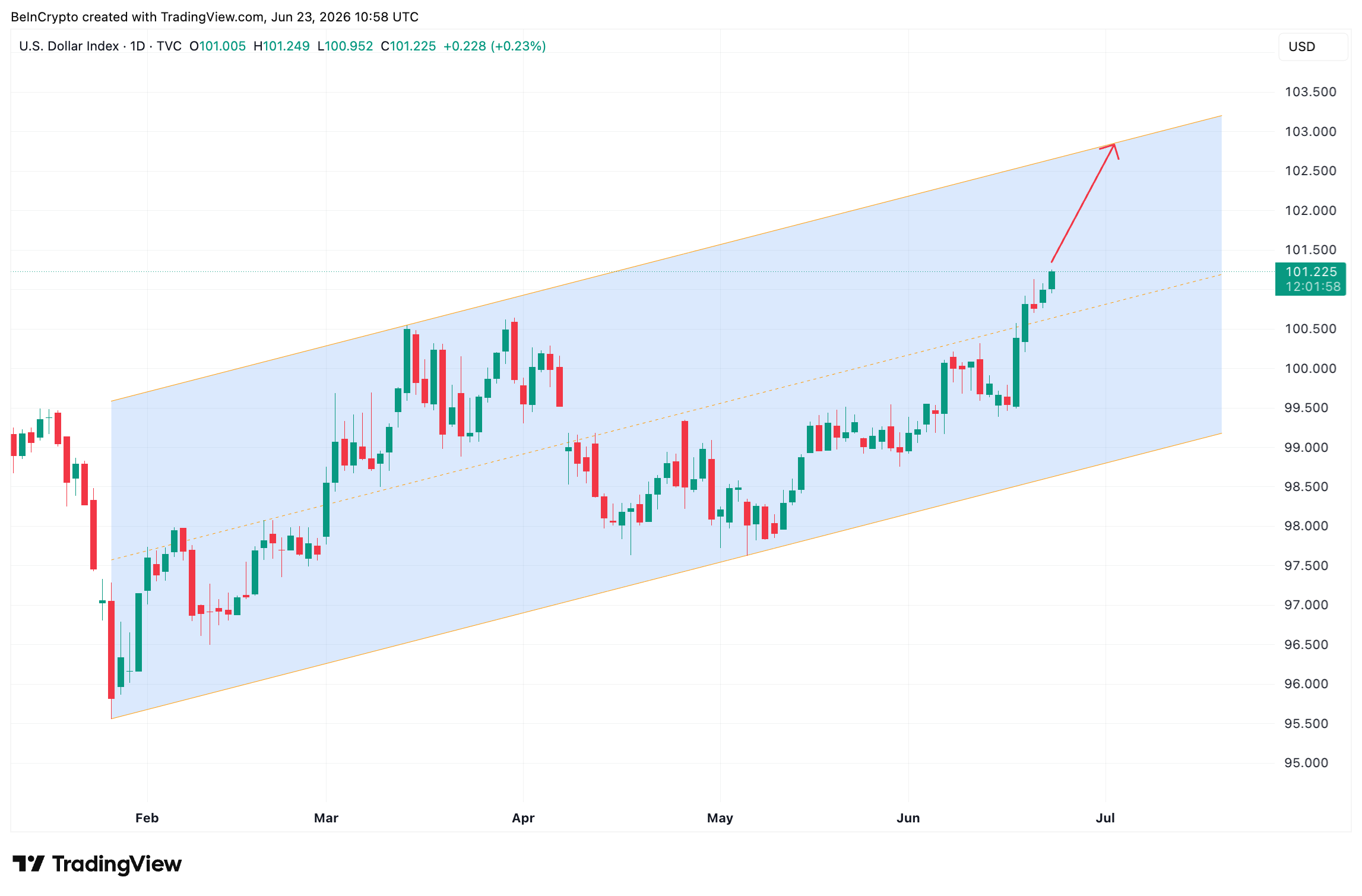
The starting point for every metal right now is the dollar. The US Dollar Index (DXY), which measures the dollar against a basket of major currencies, has pushed above 100 to a 13-month high.
A stronger dollar makes dollar-priced commodities costlier for the rest of the world, which weighs on gold, silver, and copper. The same force has cooled risk appetite across crypto and stocks.
Want more insights like this? Sign up for Editor Harsh Notariya’s Daily Newsletter here.
The driver is the rate path. With the Federal Reserve seen holding rather than cutting in 2026, real yields stay firm, and the dollar stays bid, which is the headwind behind the recent metals pullback.

With the DXY chart looking strong (bullish rising channel) and rate hikes back on the table, the case for a weaker dollar near term looks thin. That headwind affects the entire metals complex, bringing the focus back to which one holds up best.
The Metals Move as One, So Leadership Is the Real Question
The three metals are pulling in the same direction. Over the past six months, gold (XAU/USD) and silver (XAG/USD) show a correlation of 0.83; silver and copper, 0.72; and gold and copper, 0.61.
Correlation measures how closely two assets move together, where 1.0 is lockstep, and 0 is no link. Readings this high mean one shared trade, not three separate bets.

So the gold, silver, and copper forecast comes down to relative strength inside the complex, not to calling one metal up and another down. The ratios and the weekly charts decide it.
Gold sets the tone for the group, so it is the place to start.
Gold Holds a Falling Channel With Banks Far Apart
(XAU/USD) has traded inside a falling channel since late January, when it peaked near $5,608. A falling channel is a downward drift between two parallel trendlines. Price tried to rebound on March 23, pushed higher, then rolled over again.
On the weekly chart, the line that matters is $4,027. Gold should hold above it. A weekly close under $4,027 opens the door toward $3,249, the prior breakout shelf.
To rebuild strength, gold needs to reclaim $4,400, and a move back above $5,004 would turn the weekly trend constructive again.

The bank split is wide. Goldman Sachs analysts Lina Thomas and Daan Struyven cut their year-end target to $4,900 on June 19, on the view that the Federal Reserve may not cut rates in 2026. JPMorgan sees $6,000 by year end despite the crowded bearish positioning.
Silver shares gold’s bearish pattern, but its chart hides a second setup.
Silver Tracks Gold but Builds a Double Bottom
(XAG/USD) sits in the same falling channel, which the high correlation supports. Underneath it, a double bottom is taking shape, a pattern where price carves two similar lows and hints at a base.
The first hurdle is $66.53, which has already been rejected once. The level that matters is $75.36. A weekly move above the $75 zone would break the falling channel and turn the bias bullish.
The downside is clear if it fails. Under $59.40, the next stops are $52.27 and then $42.12. A larger trigger sits at $89.62, which would complete the double bottom and project a move of roughly 46%, though that is far off.

The fundamentals are supportive. The Silver Institute forecasts a sixth straight annual market deficit in 2026, near 215 million ounces, and the largest on record. Six straight years of deficit means the market is leaning on above-ground stock to fill the gap, a slow squeeze that supports silver over time.
Copper is the other half of silver’s story, the industrial pull, and right now, copper is the AI trade.
AI Trade Highlights Copper, Its Strengths and Problems
Copper has been in a rising channel since 2024. It came close to breaking above that channel on May 11 and again on June 1, where a double top is now forming, a pattern of two failed highs that warns of exhaustion.
The structural case is the AI build-out. Goldman Sachs Research expects data-center power demand to rise about 165% by 2030, and sees grid and power infrastructure driving more than 60% of copper demand growth this decade, at roughly 6 to 8 tonnes of copper per megawatt of capacity.
So why has copper stalled just under its breakout? The AI trade has wobbled, and data-center policy risk has taken some heat out of the ascent. It shows up in the targets. Bank targets now straddle copper’s record price.
JPMorgan’s full-year 2026 average near $12,075 a tonne sits just below it, Goldman recently lifted its year-end call to about $13,735, and Citi is the highest near $15,000.

On the chart, copper needs to hold $6.12. Under it, expect a slip toward $6.04. A weekly break above $6.47 brings $6.68 and then $7.02 into play. The $6.68 level would confirm the real breakout.
In the per-pound terms the chart uses, the targets straddle copper’s current $6.16. JPMorgan’s 2026 average near $5.48 sits below it, Goldman’s raised year-end call near $6.23 is right at it, and Citi is the highest near $6.80, just above the $6.68 breakout.
The ratios between the metals show how this tension is resolving.
The Ratios Tell You Who Is Leading
Three ratios frame the macro tape. The gold-silver ratio has climbed from about 44 in January to 66 now. That is a risk-off tilt favoring gold, though 66 is not yet extreme enough to scream silver is cheap.

The gold-oil ratio has risen from about 41 on May 19 to 56, a stress reading where gold is strong and oil is weak.
The silver-copper ratio cuts the other way. It has fallen from about 19 in January to 10, with copper leading, a classic industrial-demand signal.

That is the core tension. Gold and oil say risk-off, silver and copper say industrial growth, and silver gets squeezed between the two regimes.
Put together, the three charts point to a clear pecking order into year-end.
The Gold, Silver, and Copper Forecast Into End-2026
Copper is the structural leader. The AI and grid demand story is the strongest multi-year case of the three, but the chart has stalled at a double top, and most 2026 bank targets imply a near-term pullback from record levels.
Gold is the macro anchor. It carries the widest bank disagreement, a $1,100 gap between Goldman at $4,900 and JPMorgan at $6,000, and it leads only if stress and rate cuts dominate.
Silver is the high-beta wildcard. It lags both, yet a record supply deficit and a building double bottom give it the most catch-up room if either the macro or the industrial bid strengthens.

The dollar is the switch. So while the DXY holds above 100, the complex stays capped, and copper’s $6.12 is the line that separates a fresh AI-led leg higher from a double-top unwind that pulls silver and gold down too. All thanks to the positive correlation between the three.
The post Gold, Silver or Copper: Which Commodity Looks Best Heading into the End of 2026? appeared first on BeInCrypto.


The House Financial Services Committee has scheduled back-to-back hearings on July 14 and July 17, one covering Federal Reserve monetary policy, the other focused directly on the CLARITY Act. This is giving supporters of comprehensive crypto regulation their highest-profile platform yet as the pre-recess window narrows.
As of today, the bill has cleared the Senate Banking Committee, been placed on the Senate legislative calendar, and attracted a House fast-track commitment if the Senate moves first. None of that changes the core arithmetic: the CLARITY Act needs 60 votes on the Senate floor, and Republicans currently hold 53 seats.
Senator Cynthia Lummis, the Wyoming Republican leading the Senate push, has set the end of July as a hard deadline. She also warns explicitly that missing the pre-recess window could delay enforceable digital asset market structure rules until 2030.
Discover: The Best Crypto to Diversify Your Portfolio
The 60-Vote Clarity Act Problem
The gap between “placed on the Senate legislative calendar” and “signed into law” runs through a specific procedural bottleneck. Invoking cloture to cut off debate requires 60 votes; with a 53-seat Republican majority, the CLARITY Act needs at least seven Democratic crossovers. The Senate Banking Committee vote on May 14 produced only two Democratic votes from Ruben Gallego and Angela Alsobrooks, and it is leaving five or more additional Democratic senators to be secured before a floor vote can succeed.
A bipartisan ethics provision in the bill has been fracturing Democratic support further, and Fox Business reporter Eleanor Terrett described the original White House target of July 4 as “logistically impossible” before the date even arrived. Galaxy Research has pegged passage odds at roughly 60% and notes that the window “effectively closes” once the August recess begins.
Even if the Senate floor vote clears 60, the bill would then require reconciliation with the version the House passed in July 2025 by 294–134. Rep. Dusty Johnson pledged on June 18 that the House would act “swiftly” on any Senate text, compressing that step, but reconciliation differences still have to be resolved before the bill reaches the president’s desk.
If this misses the pre-recess window, the next viable legislative opening is 2027 at the earliest, with some analysts pointing further out. The same credible basis for Lummis’s 2030 warning.
Don’t Miss Out on Our $1,000 USDT Airdrop on ByBit
July 14 and July 17: What To Expect?
The July 14 session before the House Financial Services Committee is formally structured around the Federal Reserve’s semi-annual Monetary Policy Report. However, its market significance extends further. It is reported that Kevin Warsh will deliver his first congressional testimony as Fed Chair, making it the first opportunity for lawmakers to publicly interrogate the new leadership’s posture on rate policy, dollar strength, and the regulatory perimeter around financial innovation.
For crypto markets, Warsh’s framing of digital assets, whether he treats them as a monetary policy variable or a separate regulatory question, will carry weight heading into the CLARITY Act hearing three days later.
The July 17 hearing moves the focus explicitly to the CLARITY Act and digital-asset innovation, with the notable detail that it is being held in New York rather than Washington. That venue choice is deliberate: New York is the largest U.S. financial center, and holding the hearing there anchors the bill’s stakes to institutional finance rather than abstract legislative process. Exchanges, custody providers, and capital markets participants concentrated in the city represent the economic constituency that regulatory uncertainty is actively costing.
Together, the two hearings give the bill’s backers a sequenced argument: monetary policy context on the 14th, market-structure specifics on the 17th. The CFTC’s expanded role under the bill, and the digital asset market structure framework it would codify, will be front and center at the New York session. The hearing is a narrative event. The execution event is the floor vote that has to follow it.
Discover: The Best Token Presales
The post Senate’s 60-Vote Gap Looms Over CLARITY Act Before August Recess appeared first on Cryptonews.


The European Parliament has advanced legislation for a digital euro, bringing the EU closer to launching a central bank digital currency, while the U.S. moves to restrict similar efforts.
Summary
- EU lawmakers backed digital euro legislation, moving the ECB closer to a potential 2029 launch.
- The ECB says the digital euro would complement cash and reduce reliance on foreign payment networks.
- Meanwhile, the U.S. Senate approved a bill that would block the Federal Reserve from issuing a CBDC until 2030.
According to a June 23 decision by the European Parliament’s Economic and Monetary Affairs Committee, lawmakers backed the proposed framework for a digital euro, a key step in the legislative process that could pave the way for a launch by 2029.
The vote arrives as European policymakers examine the region’s dependence on foreign payment infrastructure. Data cited by the European Central Bank shows that Visa and Mastercard handle 61% of card payments in the euro area and nearly all cross-border card transactions.
European officials have argued that a digital euro could strengthen the bloc’s payment system by providing a public digital payment option issued directly by the ECB. Under the proposal, consumers would hold digital euros in dedicated wallets, while banks and payment providers would offer services connected to the system.
The digital euro remains under development
Within the proposed framework, the ECB would operate the core infrastructure while financial institutions would manage customer-facing services. According to the proposal, the system could support both online and offline payments and include privacy safeguards for users.
Holding limits for digital euro wallets have not yet been finalized and remain part of ongoing negotiations among European institutions.
European authorities have repeatedly stated that the digital euro is intended to complement physical cash rather than replace it. Following the committee vote, the ECB welcomed the outcome, stating that the European Parliament’s position supports both the preservation of euro cash as legal tender and the development of a digital version of the currency.
Although the ECB has warned that stablecoins could create risks for the financial system, the central bank has continued to support the digital euro project as part of its long-term payments strategy.
Elsewhere in Asia, central banks are also exploring digital finance initiatives. As reported by crypto.news, Bank of Korea Governor Shin Hyun-song said in his inaugural speech in April that the central bank would support innovation in blockchain-based finance while maintaining the stability of South Korea’s payment and settlement systems. He added that the bank would work to strengthen the role of the Korean won in an increasingly digital financial environment.
U.S. lawmakers take the opposite route
While Europe advances work on a central bank-issued digital currency, policymakers in the U.S. are pursuing a different approach.
The U.S. Senate recently approved the 21st Century ROAD to Housing Act in an 85-5 vote. Included in the legislation is a provision that would prevent the Federal Reserve from creating a CBDC or a similar asset before the end of 2030.
The Senate’s position aligns with President Donald Trump’s support for privately issued stablecoins rather than a Federal Reserve-backed digital currency.
At the same time, U.S. lawmakers continue to work on crypto-specific legislation. The CLARITY Act, which seeks to establish a clearer regulatory framework for digital assets, remains under consideration as Congress debates the future structure of the country’s crypto market.
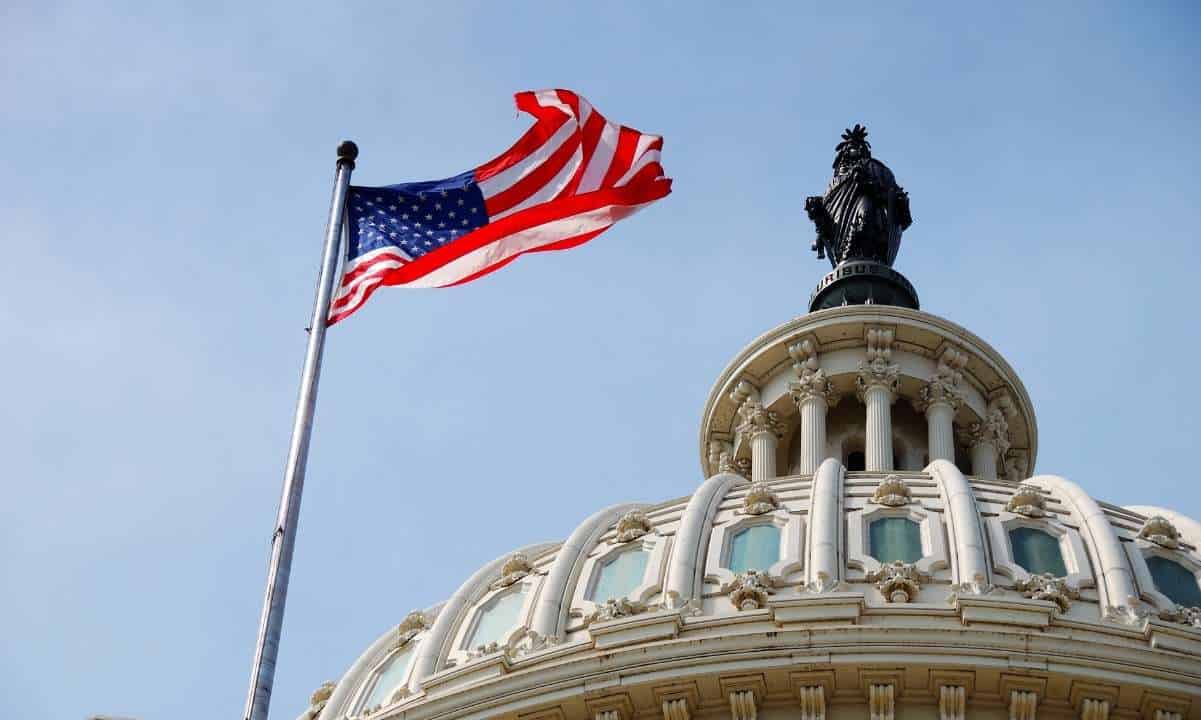
The U.S. Senate has approved a sweeping bipartisan housing bill that bans the Federal Reserve from issuing a CBDC until 2030.
The bill passed by a strong 85-5 vote and awaits action in the House, where leadership and committee members reportedly plan to advance it quickly.
CBDC Ban Advances Through Housing Package
The housing package is designed to make homes more affordable and reduce competition from corporate firms. Interestingly, one of its provisions prevents the Fed from issuing a U.S. central bank digital currency (CBDC) for up to 4 years.
“Agreed to, 85-5: Motion to concur in the House amendment to the Senate amendment to H.R.6644, 21st Century ROAD to Housing Act,” wrote the Senate.
Lawmakers were said to be considering a fast track that could see the bill signed into law as early as Tuesday, with House Financial Services Committee Chairman French Hill saying he “looks forward to the House moving quickly to advance this bill to President Trump’s desk.”
Senate Chair Tim Scott added that it is time for the American people to get real relief, and Ranking Member Elizabeth Warren called it the biggest housing bill in over 30 years.
The latest development follows months of negotiation, during which the Senate first added the anti-CBDC provision in March, after which the House cleared the amended version in May.
President Donald Trump signed an executive order in January 2025 banning his administration from creating a CBDC, citing concerns that it would threaten the U.S. financial system and individual privacy. However, because this would only apply under his tenure, his allies in Congress pushed to include the restriction in the unrelated housing bill.
House Schedules July CLARITY Act Hearing
As lawmakers prepare for key meetings over the next few weeks, momentum is building around the CLARITY Act. The House Financial Services Committee said it will hold a hearing in New York on July 17 to look at the impact the legislation will have on financial innovation.
Senator Cynthia Lummis has been one of the biggest supporters of the proposal, often taking to social media to urge lawmakers to act faster. In her latest commentary, the Republican warned that regulatory uncertainty has driven talented developers overseas.
But there have been serious repercussions for others, like Tornado Cash developer Roman Storm, who was found guilty of knowingly transmitting more than $1 billion in criminal proceeds. The DOJ also pushed for a retrial after the jury deadlocked on charges of money laundering and sanctions violations.
The post US Senate Clears Housing Bill That Also Halts CBDC Push appeared first on CryptoPotato.


But Slavin said firms appear reluctant to wait. “Even though the regulations and the rails aren’t fully ready yet, they want to get products out,” he said.
Wall Street believes that blockchain networks could eventually become a new distribution channel for traditional investment products. Tokenized funds could allow investors to hold and transfer fund shares around the clock, potentially reducing settlement times and expanding access to global investors.
One concern emerging for fund issuers, according to Slavin, is that tokenized versions of well-known ETFs are already trading on platforms outside traditional financial markets, often without direct involvement from the fund sponsors themselves.
“There are ETFs, like hundreds of them, that are trading in unregulated markets around the world,” he said.
Because anyone can theoretically create a tokenized representation of a publicly traded fund, issuers face the prospect of products bearing their names circulating beyond their oversight.
“It’s opaque,” he said. “It effectively creates a reputation risk, even though it’s not at all affiliated, frankly, with the asset manager.”
That dynamic has become a growing topic of discussion among BNY’s asset-management clients as they evaluate their own tokenization strategies. Similar to the early days of bitcoin and crypto trading, the technology is evolving faster than the rules governing it.

Clear Blue Technologies International Inc. (CBLU:CA) Q4 2025 Earnings Call Transcript

Robinhood lists Worldcoin as Sam Altman faces fresh scrutiny

Most Hated Fast And Furious Movie Is A Streaming Megahit On Peacock


-

 Fashion4 days ago
Weekend Open Thread: Miami – Corporette.com
-

 Tech7 days ago
The Adder At The Heart Of Intel’s 8087 FPU
-

 Entertainment3 days ago
Renter of Home in Anne Heche Crash Denies Settlement With Son
-

 Tech1 day ago
Microsoft accidentally kills epic Outlook email threads
-

 Business3 days ago
Soccer-U.S. defends Iran World Cup travel restrictions, says discussions ongoing
-

 Politics5 days ago
BBC Reporter Discusses Cross Party Criticism Of Trumps Iran Deal
-
 Business4 days ago
Wall Street Week Ahead: Investors see Micron earnings as pulse check of AI rally momentum
-

 Tech5 days ago
AWS enters the context layer race with a graph that learns from agents, not manual curation
-

 Crypto World4 days ago
HIVE shares jump as $220M AI deal speeds Bitcoin mining pivot
-

 Politics3 days ago
Andy Burnham and the meaning of Makerfield
-
 Crypto World3 days ago
Can Charles Hoskinson Really Rescue Cardano?
-

 Crypto World3 days ago
Jake Chervinsky accuses CME of protecting derivatives monopoly
-

 Tech22 hours ago
Nearly 7,000 fake Amazon domains registered ahead of Prime Day 2026, researchers warn
-

 Sports5 days ago
FIFA World Cup 2026: Canada beat 9-men Qatar 6-0 to register first ever win | FIFA World Cup 2026
-

 Business5 days ago
Brexit cost 6% of UK economy, Bank of England company data suggests
-
 Business3 days ago
MHP SE 2026 Q1 – Results – Earnings Call Presentation (OTCMKTS:MHPSY) 2026-06-20
-
 Tech2 days ago
Signal’s Meredith Whittaker says AI chatbots ‘are not your friends’ and calls Copilot agents a backdoor
-

 NewsBeat4 days ago
Keir Starmer Allies Question His Chances For No 10
-

 Entertainment4 days ago
Jose Alvarado Wants Taylor Swift at More Knicks Games
-

 Crypto World5 days ago
Anthropic’s Dario Amodei Urged AI Unity at G7, Even as US Banned His Models
You must be logged in to post a comment Login