

Crypto World
Bank of America sparks Bitcoin jitters with three-hike forecast

Bank of America has projected three Federal Reserve interest-rate hikes this year, adding to concerns that tighter monetary policy could create fresh pressure for Bitcoin and other risk assets.
Summary
- Bank of America now expects three Fed rate hikes in September, October, and December, citing a more hawkish policy outlook.
- Deutsche Bank and BNP Paribas have also raised their rate forecasts, adding to expectations of tighter monetary policy.
- Traders are watching the upcoming PCE inflation report as Bitcoin holds near $64,000-$65,000 amid growing rate-hike concerns.
According to a Reuters report, Bank of America Global Research now expects the Federal Reserve to raise rates by 25 basis points at its September, October, and December meetings, bringing the policy rate to a range of 4.25%-4.50% by year-end.
The forecast represents a sharp departure from the bank’s earlier expectation that rates would remain unchanged throughout the year. The revised outlook arrives as investors prepare for the release of the U.S. Personal Consumption Expenditures inflation report, the Fed’s preferred gauge of inflation.
Economists surveyed ahead of the June 24 release expect headline PCE inflation to rise 0.5% month-over-month in May after a 0.4% increase in April. Annual inflation is expected to accelerate to 4.1% from 3.8%, while core PCE is forecast to increase 0.3% on a monthly basis and 3.4% from a year earlier.
A stronger-than-expected reading could reinforce expectations that policymakers will keep borrowing costs elevated for longer or even tighten policy further.
Wall Street forecasts point to a more hawkish Fed
In explaining its revised outlook, Bank of America said the Federal Reserve appears more focused on inflation risks than previously anticipated.
The bank wrote that the Fed’s June economic projections and comments from Chair Kevin Warsh suggested policymakers were operating with a more hawkish reaction function than earlier estimates indicated.
Another large institution has moved in a similar direction. Per the Reuters report, Deutsche Bank has also adopted a more hawkish outlook, forecasting two quarter-point rate hikes this year in September and December.
The bank additionally outlined a scenario in which policymakers could consider a July increase, while noting that easing energy prices and improving inflation expectations may reduce the need for immediate action.
A separate forecast from BNP Paribas points to additional tightening as well. As previously reported by crypto.news, the French bank expects three rate hikes beginning in December after abandoning its prior assumption that policy would remain unchanged.
BNP Paribas linked its outlook to resilient labor-market conditions, stronger-than-expected employment data, and rising inflation pressures that it partly associates with the ongoing U.S.-Iran conflict. The bank also projected the unemployment rate could fall toward 4% by year-end, potentially giving policymakers more room to concentrate on inflation.
Bitcoin traders watch inflation and rate signals
Recent pricing in prediction and futures markets shows investors remain divided on the Fed’s next move.
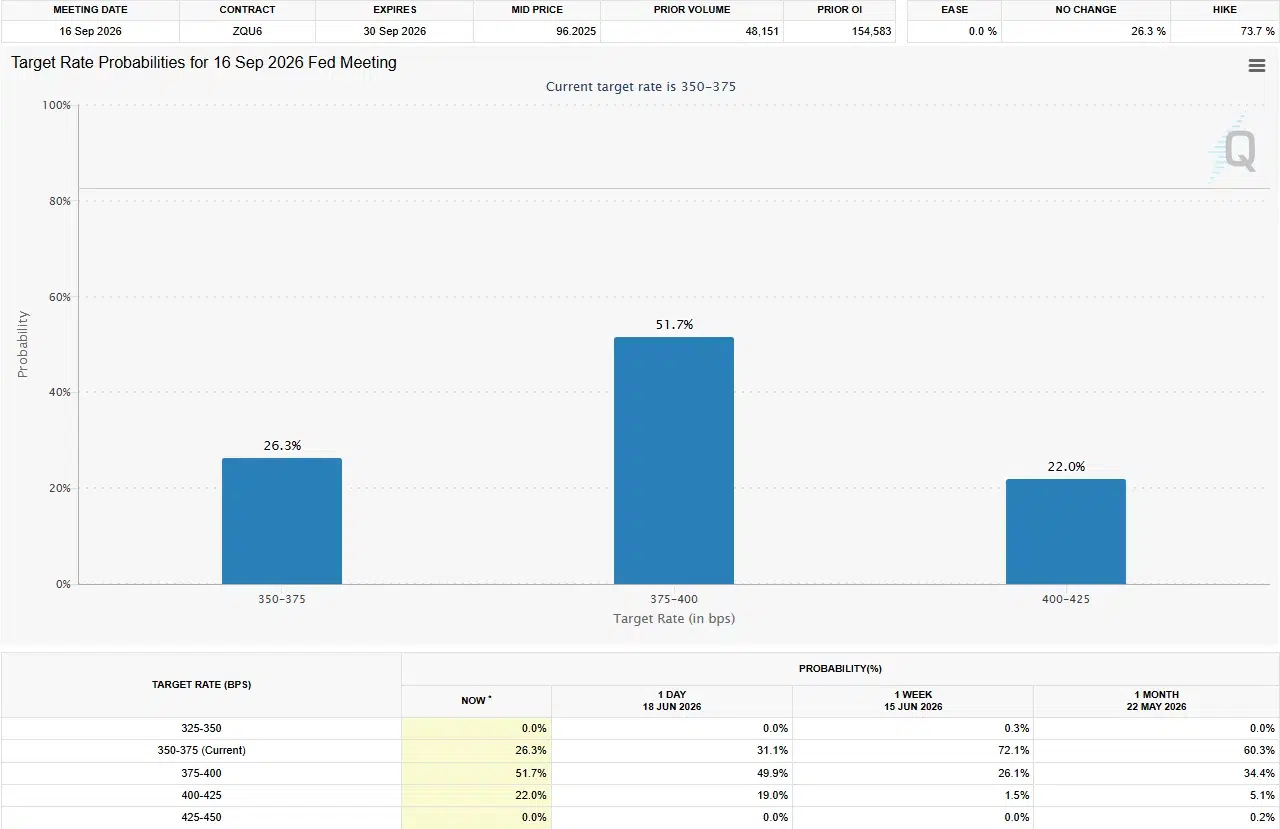
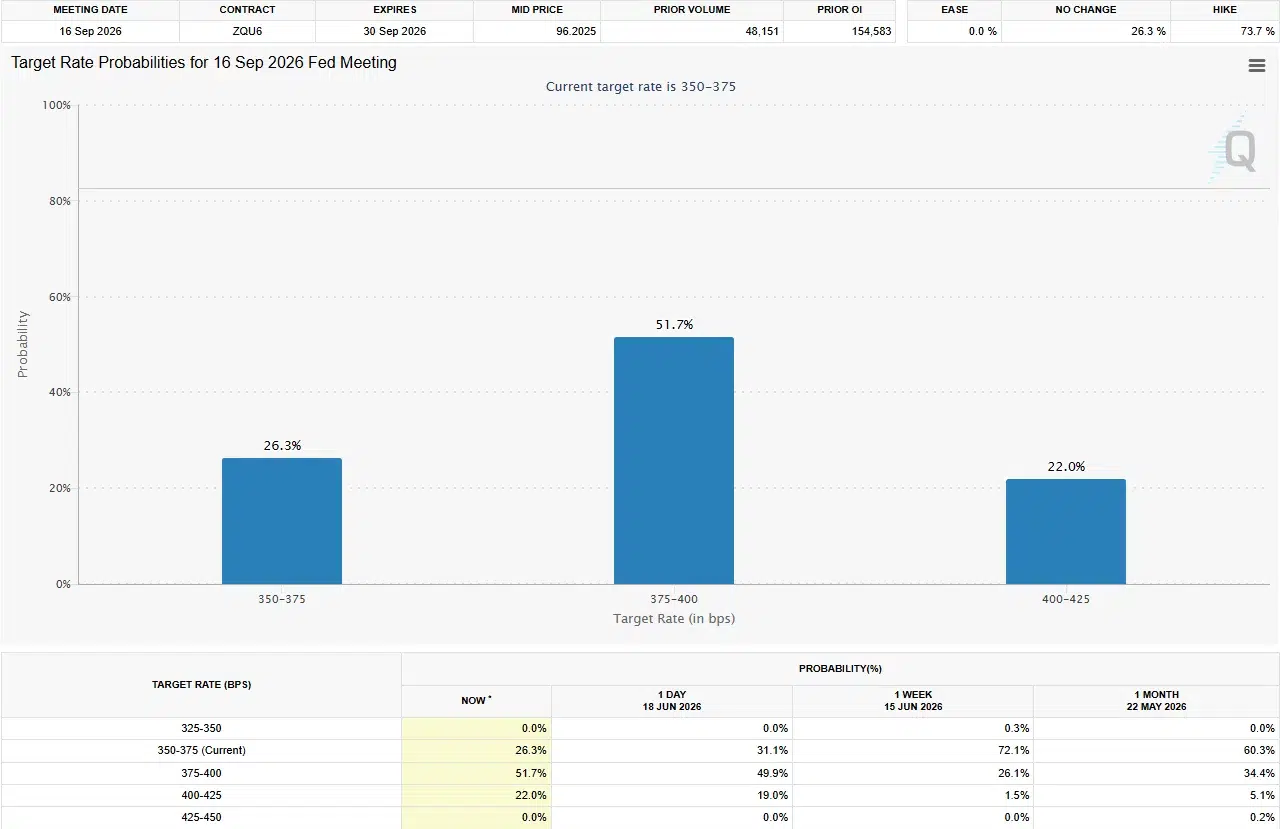
Data from Kalshi indicates a 22% probability of a rate increase in July, while a pause remains the most likely outcome. Separately, CME FedWatch data shows traders assigning a 51.7% probability to a quarter-point hike at the September meeting.
Market-based expectations also point toward tighter policy. According to LSEG pricing data, traders have priced in approximately 41.2 basis points of additional tightening over the course of the year.
Higher interest rates typically reduce liquidity available for speculative investments while increasing the appeal of yield-bearing assets such as U.S. Treasuries. Because of that relationship, digital assets often face pressure when investors anticipate tighter monetary conditions.
Bitcoin (BTC) has recently traded within the $64,000-$65,000 range despite improving geopolitical sentiment following developments related to the U.S.-Iran situation. With inflation data due this week and major banks raising their forecasts for future rate increases, traders are closely watching whether incoming economic data strengthens the case for additional Fed tightening.
Disclosure: This article does not represent investment advice. The content and materials featured on this page are for educational purposes only.



Franklin Templeton has completed its acquisition of crypto asset manager 250 Digital, adding new cryptocurrency investment strategies to its platform as the firm manages $1.78 trillion in assets worldwide.
Summary
- Franklin Templeton has completed its acquisition of 250 Digital and launched a new crypto-focused division called Franklin Crypto.
- The asset manager continues expanding across crypto markets through Bitcoin-linked ETF filings and tokenized fund partnerships.
- RWA.xyz data shows Franklin Templeton’s tokenized assets have grown from $768 million to over $2.5 billion in a year.
According to Franklin Templeton, the deal has resulted in the creation of a new division called Franklin Crypto, which combines the investment team and crypto strategies previously operated by 250 Digital with Franklin Templeton’s existing digital asset capabilities.
Former 250 Digital executives Christopher Perkins and Seth Ginns will lead the unit alongside Franklin Templeton digital assets executive Tony Pecore. The financial terms of the transaction were not disclosed.
The acquisition closes a transaction first announced in April and comes after CoinFund spun out its liquid strategies business into 250 Digital earlier this year as the investment firm concentrated on venture-focused activities.
Franklin Crypto expands institutional investment offerings
Within the newly established division, Franklin Templeton said institutional investors will gain access to actively managed cryptocurrency strategies supported by the former 250 Digital team and the asset manager’s global distribution network.
Alongside the acquisition, Franklin Templeton continues to add crypto-related products across several parts of its business.
Earlier this month, the company integrated its BENJI tokenized money market fund with MoonPay Trade, allowing institutional clients to exchange stablecoins such as USDC and USDT for BENJI through MoonPay’s on-chain trading infrastructure.
Days later, Franklin Templeton filed to launch two exchange-traded funds that would automatically direct stock dividend income into Bitcoin-linked investments, according to previous crypto.news reporting.
Those developments follow several initiatives announced this year. In February, Franklin Templeton unveiled a partnership with Binance that enables institutional investors to use tokenized money market fund shares as collateral for cryptocurrency trading while maintaining regulated custody of the underlying assets.
Soon after, the company partnered with Ondo Finance to make tokenized exchange-traded funds available on blockchain networks, extending access to selected investment products beyond traditional brokerage platforms.
Tokenized asset growth accelerates across the market
Growth in Franklin Templeton’s tokenization business has accompanied its expansion into crypto investing.
According to data from RWA.xyz, the firm’s tokenized assets have increased from roughly $768 million in June 2025 to more than $2.5 billion today, more than tripling over the past year.
Industry-wide figures reported by RWA.xyz show similar momentum. The value of on-chain real-world assets has climbed from approximately $11.8 billion a year ago to $32.2 billion, highlighting continued adoption of tokenized financial products across blockchain networks.
Existing digital asset operations remain an important part of Franklin Templeton’s strategy. Beyond launching investment products, the company maintains a dedicated digital assets unit focused on research, portfolio construction, and institutional risk management.
Operating in more than 35 countries, Franklin Templeton said the addition of 250 Digital strengthens its ability to serve institutional clients seeking cryptocurrency exposure while expanding the range of digital asset products available through its platform.
Crypto World
Tokenization pioneers Securitize and tZERO clash over patents as Wall Street moves onchain

Market forecasts have ballooned in recent years. Citi has estimated tokenized assets could reach a $5 trillion market capitalization by 2030, while a report from Boston Consulting Group and Ripple projected a market worth $18.9 trillion by 2033.
Patent battle over tokenization infrastructure
At the center of the dispute are patents covering compliance systems for tokenized securities, digital asset issuance and redemption technology and blockchain-based trading infrastructure.
tZERO said its investigation concluded that products including Securitize’s DS Protocol and Vault Registrar infringe patents covering self-enforcing compliance controls for security tokens and crypto integration systems.
The company said it is also investigating potential infringement by at least six other firms across tokenization, institutional crypto infrastructure and decentralized finance.
Securitize rejected the claims.
“tZERO’s allegations are without merit and run counter to the spirit of fair play that defines our industry at its best,” the company said in a statement posted on X.
Early pioneers clash amid growing stakes
The dispute pits two pioneers of tokenization against each other.
tZERO launched in 2014 and has spent more than a decade building technology for regulated digital asset markets and says it holds 105 patents globally across 23 patent families related to tokenized capital markets. NYSE parent Intercontinental Exchange made a strategic investment in the company in 2022, and tZERO unveiled plans last year to go public.
Solana (SOL) captured 95% of all tokenized equity trading activity across blockchains last week, setting a new record with $1.29 billion in trading volume. The surge comes as SOL trades more than 75% below its all-time high near $295, leaving SOL traders divided on whether the asset is nearing a cycle bottom.
SOL onchain activity continues to expand across several metrics, even as a SOL price reversal remains the central focus for market traders.
Tokenized equities on Solana hit record activity
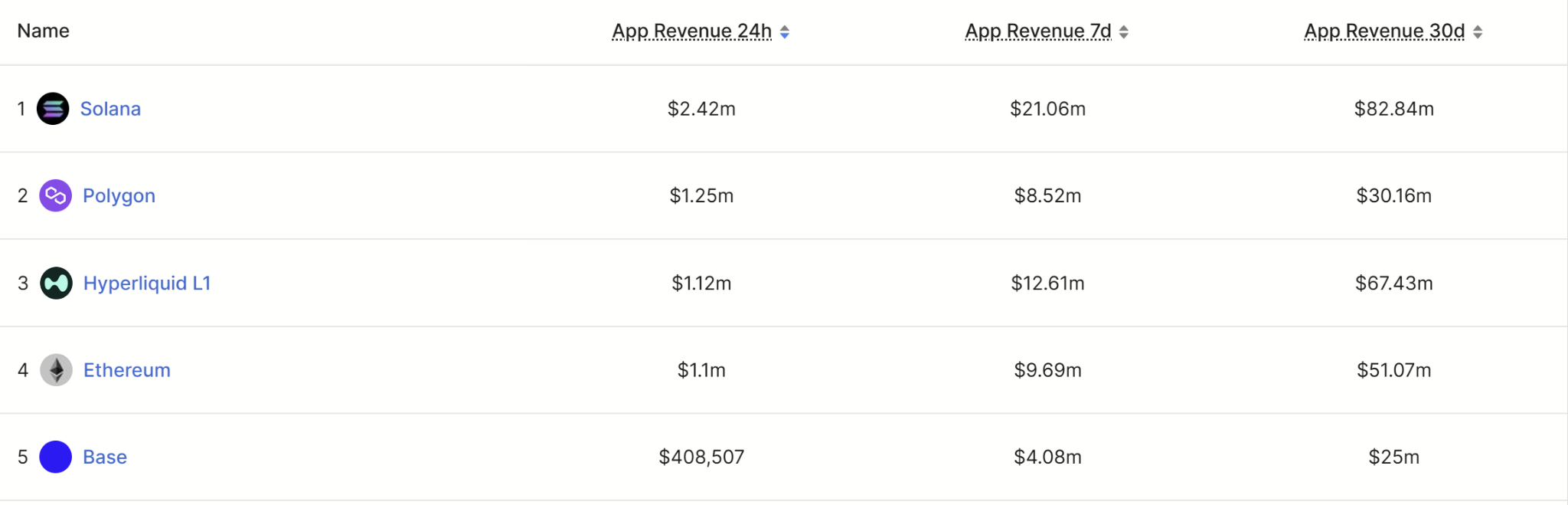
Data shows Solana generated $21 million in weekly app revenue, ahead of Ethereum, Hyperliquid, and Base. Over the past month, Solana applications produced $82.84 million in revenue, compared with $67.43 million on Hyperliquid and roughly $51 million on Ethereum.
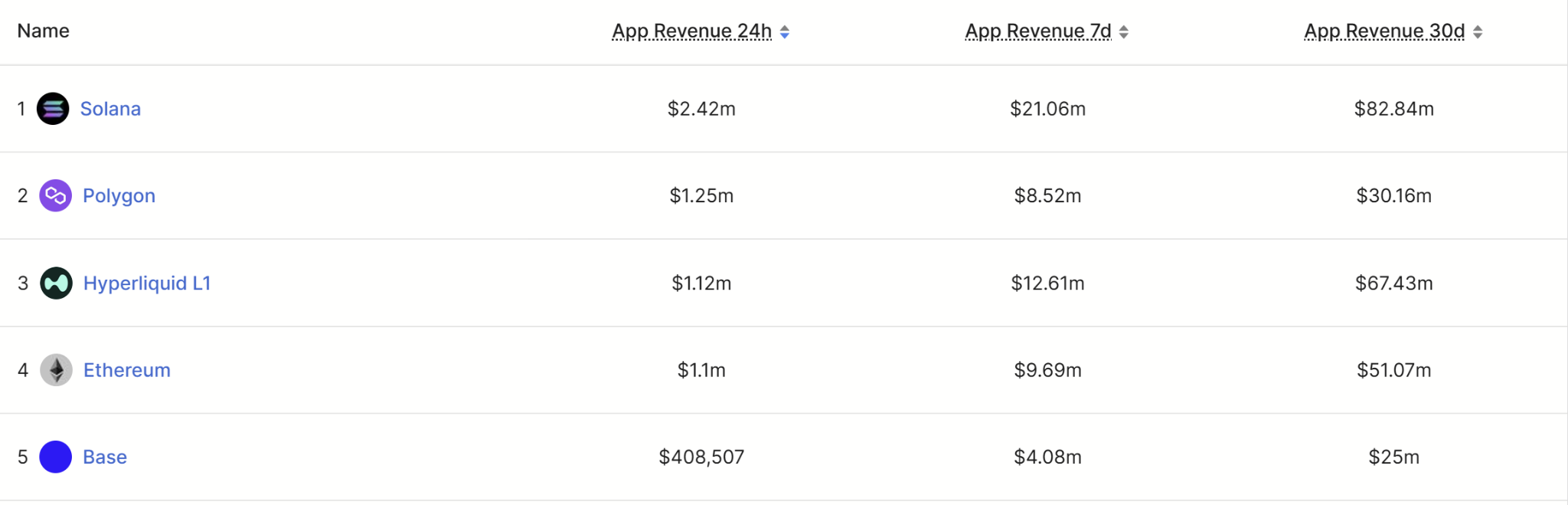
App revenue generated by chains. Source: DefiLlama
Solana has also led the charge for tokenized equity trading on its chain. Independent reporting from Solana Floor noted that the network recorded its largest week on record for tokenized stock trading, with $1.29 billion in volume, accounting for 95% of activity across all chains.
According to Solana Floor, last week’s volume exceeded the total for the entire previous month, driven largely by the release of SpaceX’s IPO token, SPCX.
At the same time, the total value locked (TVL) on Solana stands near $5.7 billion. TVL measures the value of assets deposited across decentralized finance applications and serves as a gauge of onchain capital participation.
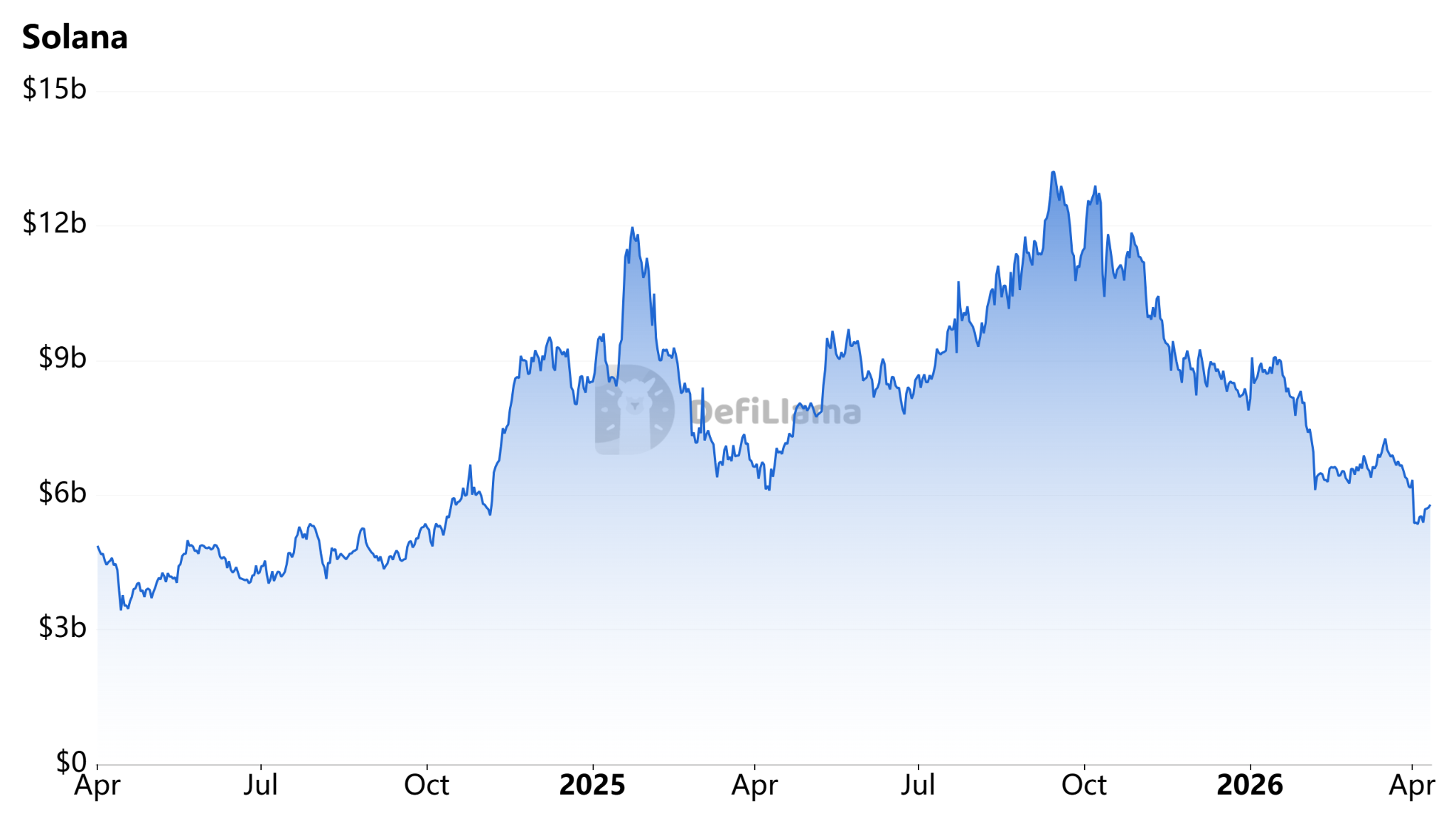
Solana’s TVL chart. Source: DefiLlama
That figure sits well below Solana’s all-time high TVL of roughly $13 billion from September 2025, showing that capital committed to DeFi applications has not returned to peak-cycle levels despite strong transaction activity and revenue generation.
Related: These XRP price charts hint at potential 25% relief rally in July
SOL traders remain split on accumulation timing
Market analysts and traders remain divided on whether SOL has already entered a durable bottoming phase.
Crypto trader Ardi said Solana is approaching the area that attracts the trader’s attention for the next bull cycle. Ardi noted that SOL has already fallen about 77% to $60, from its cycle peak near $295.
Drawing on historical drawdown compression seen in Bitcoin and Ether, Ardi said an 80%–85% decline would place SOL in the $45-$60 range, the most attractive accumulation zone.
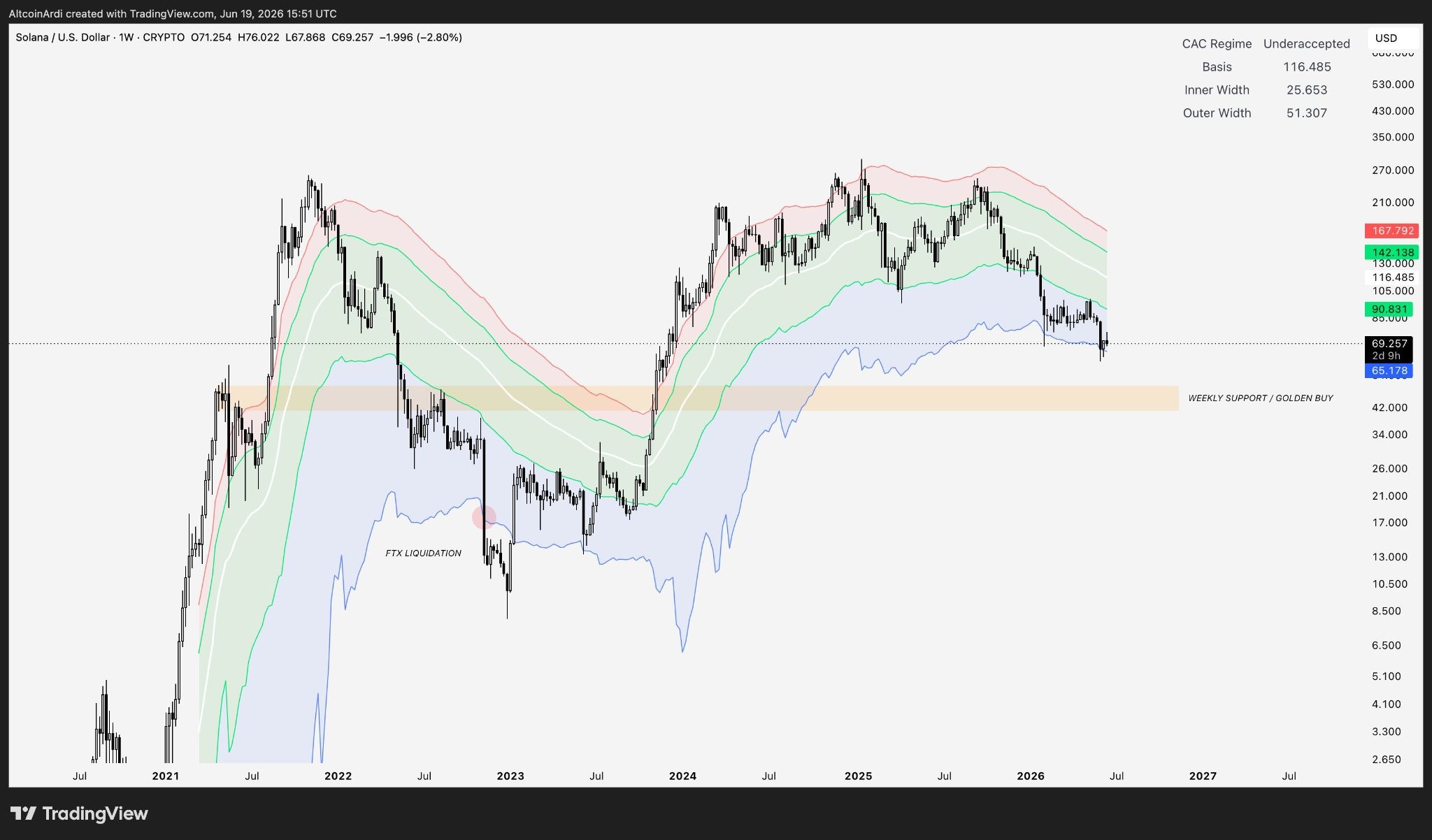
SOL/USD, one-week analysis by Ardi. Source: X
Crypto trader Bluntz took a more constructive view, arguing that the price forming a weekly bullish divergence with respect to the relative strength index (RSI) following an 80% drawdown often appears near the market lows. The trader implied that SOL could trend higher sooner rather than later based on this setup.
Meanwhile, crypto trader Dyme urged caution, noting that Solana spent roughly 500 days from May 2022 to October 2023, building a base before its last major recovery. The comparison suggests that SOL may require a longer period of sideways trading before a durable bottom forms.
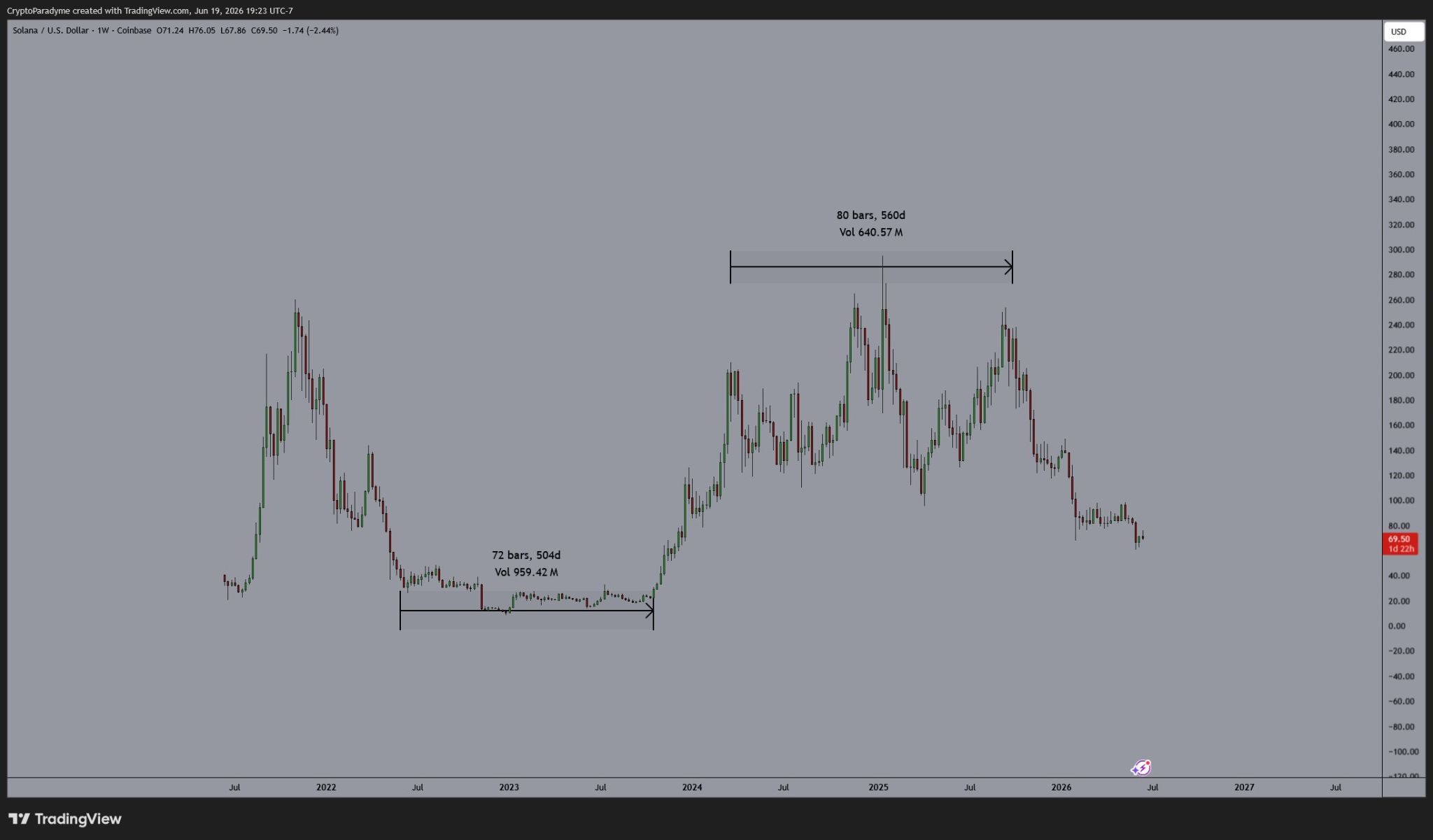
SOL/USD, one-week chart analysis by Dyme. Source: X
Trading Stable founder Ryan Clark also questioned the recent optimism, noting that SOL continues to trade below the key weekly 50-period and 200-period simple moving averages. The analyst, popularly known as HORSE, said that a move back above the $90 region would provide a stronger technical signal.
For now, the debate centers on whether demand SOL can build higher before the price reaches the $45-$60.
Related: Altcoin selling tops $266B as capital rotates out of crypto: Is altseason extinct?
Crypto World
New York, Maryland and Utah to Hold Primaries with Crypto PAC Money Hanging over Voters
Political action committees (PACs) backed by cryptocurrency companies and aligned interest groups have bet more than $8 million to support candidates in Tuesday’s primaries across three US states, which could impact the makeup of the country’s Congress in 2027.
As of Monday, the Protect Progress PAC, an affiliate of Fairshake that supports Democratic candidates, reported spending more than $516,000 on media for April McClain Delaney, running in Maryland’s 6th congressional district. However, much of the PAC’s attention has been focused on two races in Maryland and New York, where it reported combined expenditures of more than $5.5 million and $1.4 million, respectively, for primary races in the states’ 5th and 15th congressional districts, for Adrian Boafo and Ritchie Torres.
Filings with the Federal Election Commission (FEC) showed that Protect Progress had spent about $24,000 on ads to oppose Quincy Bareebe and $74,000 for media opposing Harry Dunn, both running against Boafo in Maryland’s 5th district. Dunn and Bareebe, along with Rushern Baker, who is running in the same primary, issued a statement on June 15 against what they called the “influence of dark money and special interests” in the race:
“We are calling on Governor Moore, Senator Alsobrooks, and Congressman Hoyer to answer directly: Do you support nearly $8 million in outside spending from crypto billionaires and AIPAC in a Maryland Democratic primary? If not, they should say so publicly and call on Adrian Boafo to reject it.”
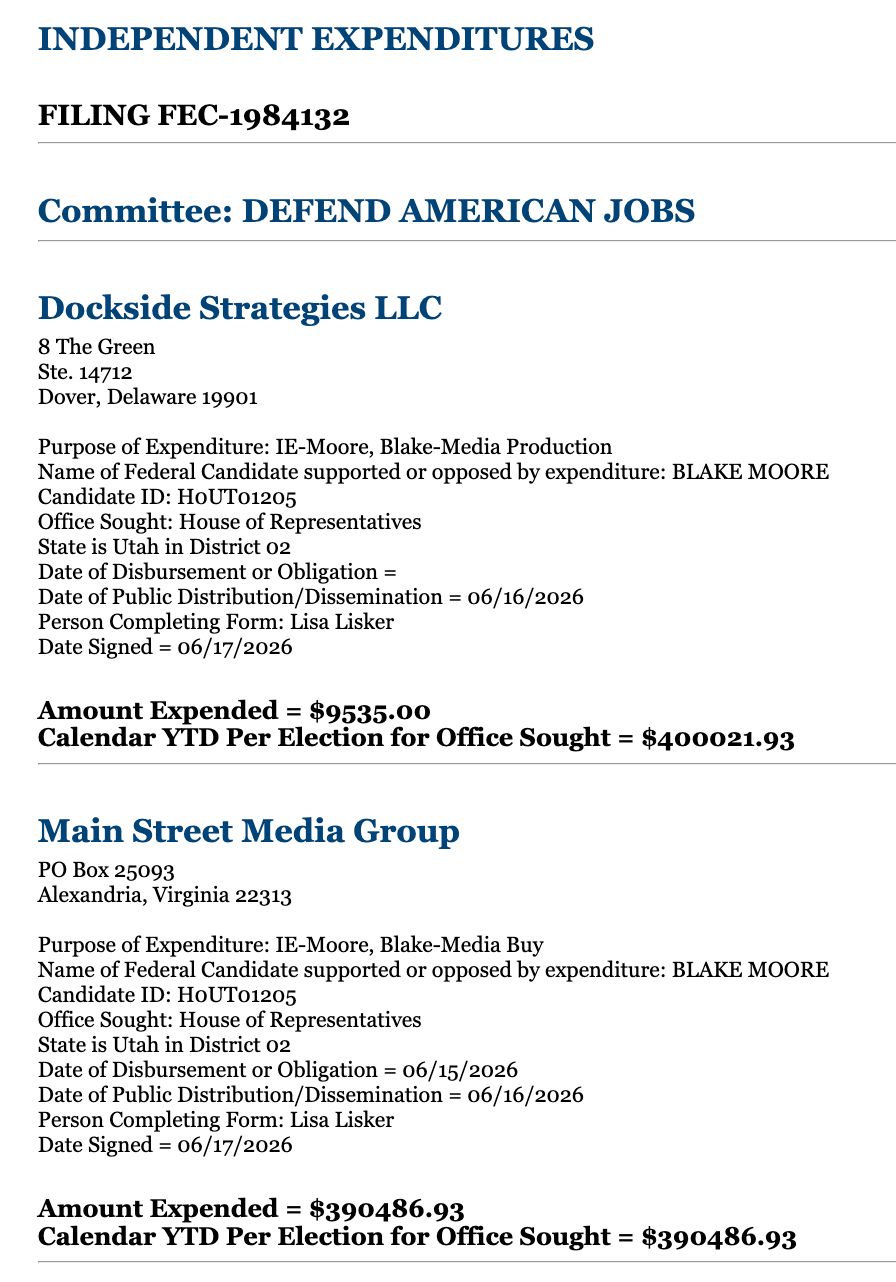
Defend American Jobs, another Fairshake affiliate, reported spending more than $400,000 on Republican Blake Moore’s primary in Utah’s 2nd congressional district. All expenditures followed what a Fairshake spokesperson called the “biggest spend of the cycle” in last week’s Alabama primary runoff, resulting in a win for Republican Barry Moore after the PAC spent more than $12 million on ads.
Source: FEC
Related: NYSE owner ICE to launch oil-linked futures with OKX
The Fellowship PAC, another committee backed by $11 million from Cantor Fitzgerald and Anchorage, disclosed $300,000 in spending to support Torres’ New York run.
Are Colorado and Arizona next?
With the three US state primaries to be decided on Tuesday, many expect Fairshake and other crypto-aligned PACs to turn their attention to Colorado and Arizona, which are scheduled to hold primaries on June 30 and July 21, respectively.
As of Monday, none of the PACs had disclosed significant spending in any congressional races in the two US states. However, in 2024, Fairshake and its affiliates poured more than $10 million into media to support Ruben Gallego’s Senate race in Arizona and $2.1 million for Democratic Representative Yadira Caraveo in Colorado’s 8th district.
Magazine: Bitcoin decouples from tech stocks, Ether eyes ‘selling wave’: Market Moves


Crypto-backed political action committees have spent more than $8 million supporting candidates in congressional primary races across three U.S. states ahead of Tuesday’s elections.
Summary
- Crypto-backed PACs linked to Fairshake have spent more than $8 million ahead of key congressional primaries in Maryland, New York, and Utah.
- Protect Progress directed most of its spending toward Adrian Boafo and Ritchie Torres, while opponents criticized the role of outside money in the races.
- With Colorado and Arizona primaries approaching, Fairshake’s past spending patterns suggest those states could attract future crypto PAC funding.
According to filings with the U.S. Federal Election Commission, much of the spending has come from political groups linked to Fairshake, the crypto industry-backed PAC that has emerged as one of the most active players in the 2026 election cycle.
Protect Progress, a Fairshake affiliate that supports Democratic candidates, has directed the largest share of its spending toward races in Maryland and New York.
FEC records show the PAC spent more than $5.5 million backing Maryland state Delegate Adrian Boafo in the Democratic primary for the state’s 5th Congressional District. In New York’s 15th District, the group reported more than $1.4 million in expenditures supporting incumbent Representative Ritchie Torres.
Additional spending has targeted other contests. Protect Progress reported more than $516,000 in media expenditures supporting April McClain Delaney, who is seeking the Democratic nomination in Maryland’s 6th Congressional District.
Fairshake affiliates concentrate resources on key races
While much of the money has been directed toward boosting preferred candidates, FEC filings also show spending against rivals. Protect Progress disclosed roughly $24,000 in advertising opposing Quincy Bareebe and another $74,000 in media spending targeting Harry Dunn, both of whom are competing against Boafo in Maryland.
Political opposition to the spending has surfaced during the final stretch of the campaign. In a June 15 joint statement, Democratic candidates Harry Dunn, Quincy Bareebe, and Rushern Baker criticized what they described as the growing role of outside money in the race.
The candidates called on Maryland Governor Wes Moore, Senator Angela Alsobrooks, and Representative Steny Hoyer to publicly address whether they supported millions of dollars in spending from crypto industry donors and other outside groups backing Boafo’s campaign.
Elsewhere, Defend American Jobs, another Fairshake-affiliated PAC, reported spending more than $400,000 in support of Republican Representative Blake Moore as he seeks renomination in Utah’s 2nd Congressional District.
The latest expenditures follow what a Fairshake spokesperson previously described as the “biggest spend of the cycle” during Alabama’s Republican primary runoff. According to campaign finance disclosures, Fairshake-backed groups spent more than $12 million on advertising in that contest before Republican Barry Moore secured victory.
Colorado and Arizona emerge as the next battlegrounds
Attention is already turning to upcoming primaries in other states as Tuesday’s contests conclude.
Campaign finance records reviewed on Monday showed no major spending by Fairshake-linked groups in Colorado or Arizona, where congressional primaries are scheduled for June 30 and July 21, respectively. Even so, previous election cycles suggest both states could become targets for future investment.
During the 2024 election cycle, Fairshake and affiliated committees spent more than $10 million supporting Ruben Gallego’s successful Senate campaign in Arizona. The organization also invested approximately $2.1 million in backing Democratic Representative Yadira Caraveo in Colorado’s 8th Congressional District.
Separate disclosures also highlight activity from other crypto-aligned political organizations. Fellowship PAC, a committee backed by roughly $11 million in funding from Cantor Fitzgerald and Anchorage Digital, reported spending $300,000 to support Torres in New York’s primary race.
With several competitive congressional contests still ahead on the election calendar, spending by crypto-backed political groups remains concentrated on races where outside money could influence closely fought primaries.

Recent findings by The Wall Street Journal (WSJ) have revealed shocking details about the promotional content of the prediction platform, Polymarket. As reported, the majority of the winning bets that drove the platform’s viral growth were staged on copycat versions of its website.
According to a report from WSJ, Polymarket paid college-age creators to stage up to $1.9 million in fake bets. The investigation team assembled by WSJ reviewed at least 1,105 videos posted by these creators and found none of them to be real; they had no blockchain trace and could not be verified by any digital ledger.
Fake Bets, Fake Winnings
At the core of the Polymarket business campaign is the claim that all trades are settled in USD Coin (USDC) on the Polygon blockchain. These trades are public and can be verified by anyone. While the prediction platform has led its campaigns with this claim, the company’s promotional content suggests otherwise.
Polymarket has been paying creators $2,000 to $3,000 a month to post videos of bets seemingly placed and won on its website. However, in reality, those trades were placed on dummy sites like poiymarket.com, created to mirror the real platform.
Out of more than 1,000 betting videos from 10 creators promoted between December 2025 and mid-May 2026, none were real. While marketing firms pushed the videos to get more views, the creators were told to refrain from disclosing that they received payments for the clips. As part of the scheme, the creators often altered headlines and used outdated footage to imply they won the bets, even when the winnings were fake.
Polymarket Back in the U.S.
Interestingly, the same bets that won millions in the promotional clips incurred losses for traders in reality. About 118 clips reviewed by WSJ showed creators celebrating roughly $900,000 in wins; however, in reality, the same bets would have incurred over $166,000 in losses.
Furthermore, a creator claimed they won $100,000 after U.S. President Donald Trump said the word “McDonald’s” in January. As discovered during the investigation, Trump never said the word publicly that month, and the clip used to justify the winning was older. Unfortunately, at least 50 accounts that actually placed that bet on Polymarket all lost.
As concerns about the promotional content arise and investigations intensify, many of those creators have removed the fake bet-winning videos from their social media accounts. Additionally, Polymarket has taken down the dummy website, poiymarket.com.
These accusations come as Polymarket re-enters the United States after securing a greenlight from regulators. The platform intends to audit its promotional content following the revelations.
The post How Polymarket Reportedly Used Fake Winning Bets to Drive Viral Growth appeared first on CryptoPotato.
Global asset manager Franklin Templeton has completed its acquisition of crypto asset manager 250 Digital, closing a deal first announced in April and expanding its digital asset business with a new division focused on cryptocurrency investing.
As part of the transaction, Franklin Templeton absorbed 250 Digital’s investment team and cryptocurrency strategies into a newly created division called Franklin Crypto. The unit will be led by former 250 Digital executives Christopher Perkins and Seth Ginns alongside Franklin Templeton digital assets executive Tony Pecore.
The acquisition follows CoinFund’s decision earlier this year to spin out its liquid strategies business into 250 Digital as the crypto investment firm sharpened its focus on venture investing.
Franklin Templeton said Franklin Crypto will offer institutional investors actively managed cryptocurrency strategies, combining the investment capabilities of the former 250 Digital team with the asset manager’s global distribution network. The company did not disclose the financial terms of the acquisition.
The new division builds on the asset manager’s existing digital asset business, which includes a dedicated unit focused on digital asset research, portfolio construction and institutional risk management. Franklin Templeton manages approximately $1.78 trillion in assets and operates in more than 35 countries, according to the company.
Related: Blockworks acquires Messari in crypto data consolidation push
Franklin Templeton broadens crypto and tokenization efforts
The acquisition is the latest in a series of moves by Franklin Templeton to expand its digital asset business across cryptocurrency investing and tokenized financial products.
In February, the company announced a partnership with Binance that lets institutional investors use tokenized money market fund shares as collateral for cryptocurrency trading. Under the framework, the tokenized fund shares remained in regulated custody while their collateral value is reflected within Binance’s trading system.
In March, Franklin Templeton partnered with Ondo Finance to offer tokenized exchange-traded funds (ETFs) on blockchain networks, expanding access to its investment products beyond traditional brokerage accounts. Last week, the firm also proposed two ETFs that would reinvest stock dividends into Bitcoin-linked investments, creating a hybrid strategy spanning equities and digital assets.
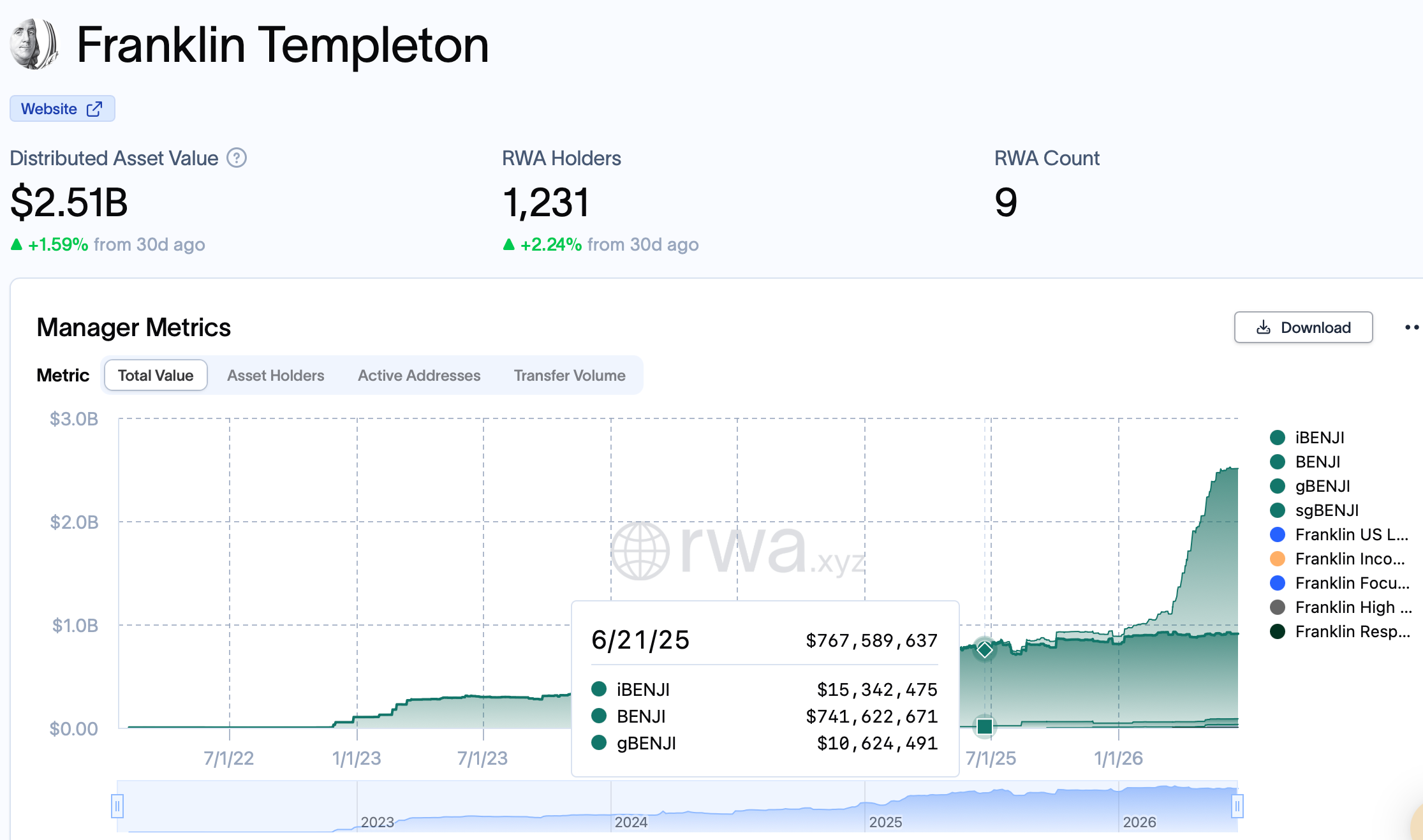
RWA.xyz data shows Franklin Templeton’s tokenized assets have more than tripled over the past year, rising from about $768 million in June 2025 to more than $2.5 billion today.
The broader tokenized asset market has also expanded rapidly, with onchain RWA value rising from about $11.8 billion to $32.2 billion over the past year.
The value of Franklin Templeton’s tokenized assets. Source: RWA.xyz
Magazine: Bitcoin, the ‘canary in the coal mine,’ XRP transaction demand falls 91.5%: Market Moves
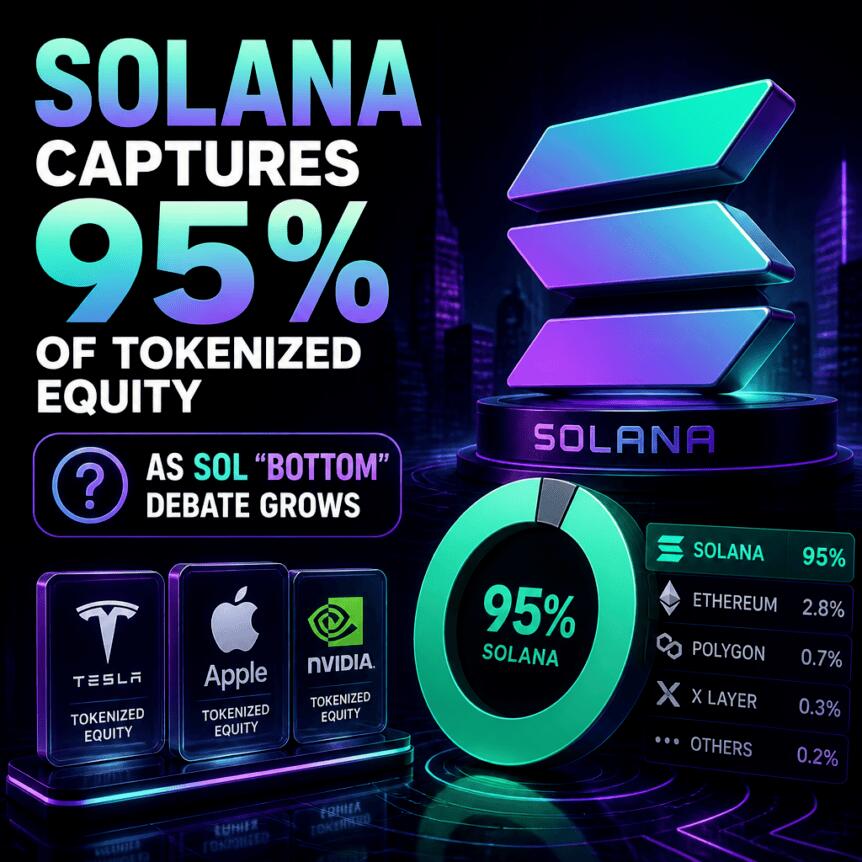
Solana’s blockchain is making a strong case for “real” activity even as its native token, SOL, struggles to regain momentum. Last week, Solana accounted for 95% of all tokenized equity trading volume across blockchains, reaching a record $1.29 billion in activity, according to reporting cited from Solana Floor.
At the same time, investors are split on whether SOL’s recent drawdown is nearing a sustained bottom. The token is currently down more than 75% from its all-time high near $295—leaving traders to debate whether the next leg up is already forming or still requires more time to confirm.
Key takeaways
- Solana recorded $1.29B in tokenized equity trading volume last week, representing 95% of cross-chain activity.
- Solana’s weekly app revenue hit $21M, and its last-month revenue rose to $82.84M, per DefiLlama data.
- Despite growth in trading and revenue, Solana’s TVL is about $5.7B—far below its prior all-time high near $13B.
- SOL traders are divided between “near-term bottom” expectations and a longer consolidation window.
Tokenized equities drive Solana’s weekly record
While mainstream crypto markets continue to fixate on price action, Solana’s onchain business metrics offer a different headline. DefiLlama data shows Solana generated roughly $21 million in weekly app revenue, placing it ahead of other ecosystems including Ethereum, Hyperliquid, and Base. Over the past month, Solana apps produced about $82.84 million in revenue, compared with approximately $67.43 million on Hyperliquid and around $51 million on Ethereum.
Beyond broader application revenue, Solana Floor’s reporting highlights a more specific catalyst: tokenized stock trading. According to Solana Floor, Solana logged its largest week on record for tokenized stock activity, with $1.29 billion in volume. That figure represented 95% of the total tokenized equity trading activity across all chains tracked.
Solana Floor also attributed much of that acceleration to the release of SpaceX’s IPO token, SPCX. In practical terms, that matters because tokenized equity narratives often bring new participants who may not otherwise engage with standard DeFi markets—potentially boosting both volume and downstream ecosystem usage.
Revenue climbs, but TVL remains well below peak-cycle levels
Transaction activity and app revenue can rise even when broader capital exposure remains muted, and Solana’s latest snapshot reflects that tension. DefiLlama indicates Solana’s total value locked (TVL) stands near $5.7 billion. TVL is commonly used to gauge how much capital is parked across decentralized finance applications.
However, Solana’s current TVL is still well under its all-time high TVL of roughly $13 billion from September 2025. The gap suggests that while more trading is occurring—particularly in tokenized equities—capital committed to the wider DeFi stack has not fully returned to the levels seen during peak cycle conditions.
For investors, this distinction matters. Rising trading volume can attract attention, but the strength and sustainability of the broader ecosystem often becomes clearer when TVL re-expands—especially after major catalysts fade. The question now is whether tokenized equity demand can translate into more persistent liquidity across Solana’s DeFi venues.
SOL price debate: bottoming zone vs. “still too early”
Price remains the battleground, and traders are not aligned on the timing of any durable bottom. Crypto trader Ardi argued that SOL is approaching an area he associates with accumulation for the next bull cycle. Ardi noted that SOL has fallen roughly 77% to around $60 from a cycle peak near $295.
Building on historical drawdown patterns seen in Bitcoin and Ether, Ardi suggested that an additional 80%–85% decline from earlier reference points could place SOL in a $45–$60 accumulation band.
Not everyone is waiting for that deeper move. Bluntz took a more constructive view, pointing to a weekly bullish divergence using the relative strength index (RSI) after an 80% drawdown—an arrangement that the trader said often appears near market lows. The implication is that SOL might start trending higher sooner rather than after further capitulation.
Meanwhile, Dyme urged caution by emphasizing how long Solana previously spent constructing a base. The trader noted that SOL traded sideways for roughly 500 days from May 2022 to October 2023 before its last major recovery. The comparison suggests that if history is any guide, SOL may need a prolonged period of consolidation to confirm a durable bottom rather than a quick rebound.
Technical levels also remain a key reference point. Trading Stable founder Ryan Clark (popularly known as HORSE) questioned recent optimism, noting SOL is still trading below key weekly simple moving averages—specifically the 50-period and 200-period. In his view, a return above the $90 area would provide a stronger technical signal.
For now, the crux of the disagreement is straightforward: can market demand start lifting SOL before it reaches a potential $45–$60 zone, or will SOL require more time—and possibly more downside—before buyers step in with enough consistency?
What to watch next: whether activity converts into sustained capital
Solana’s record tokenized equity volumes show that parts of its ecosystem are attracting attention and participation, and the revenue figures reinforce that activity is translating into measurable value. The open issue is whether that momentum will be reflected in broader liquidity, as TVL remains below prior peak levels. Traders watching SOL’s charts will likely focus on whether price can reclaim important moving-average territory, while ecosystem observers should watch for any follow-through in TVL that indicates capital is broadening beyond isolated catalysts.
Latest developments: Digital credit products tied to Strategy’s bitcoin-backed ecosystem suffered steep declines last week before partially recovering.
- Strategy’s preferred stock funding vehicle STRC fell as low as $82.53 on Thursday before rebounding to roughly $90.50, according to Strive Chief Risk Officer Jeff Walton.
- Strive’s SATA dropped into the low $90 range before recovering to about $98.59.
- Walton attributed the move to leverage liquidations and heavy selling pressure rather than deterioration in the underlying credit quality.
- CEO Matt Cole previously described the episode as a “leverage liquidation event, not a credit failure.”
- CoinDesk’s Jennifer Sanasie interviewed Strive Chief Risk Officer, Jeff Walton on Public Keys.
What happened: Strive’s analysis points to forced selling rather than a breakdown in decentralized finance markets.
- Walton said trading data suggests holders sold the instruments, triggering liquidations elsewhere in traditional financial markets.
- He said the event did not appear to originate from DeFi protocols.
- The selloff occurred amid unusually large trading volumes across both securities.
- Walton characterized the volatility as part of the maturation process for a new asset class.
The liquidity story: Strive argues the market’s ability to absorb large trading volumes is a positive signal.
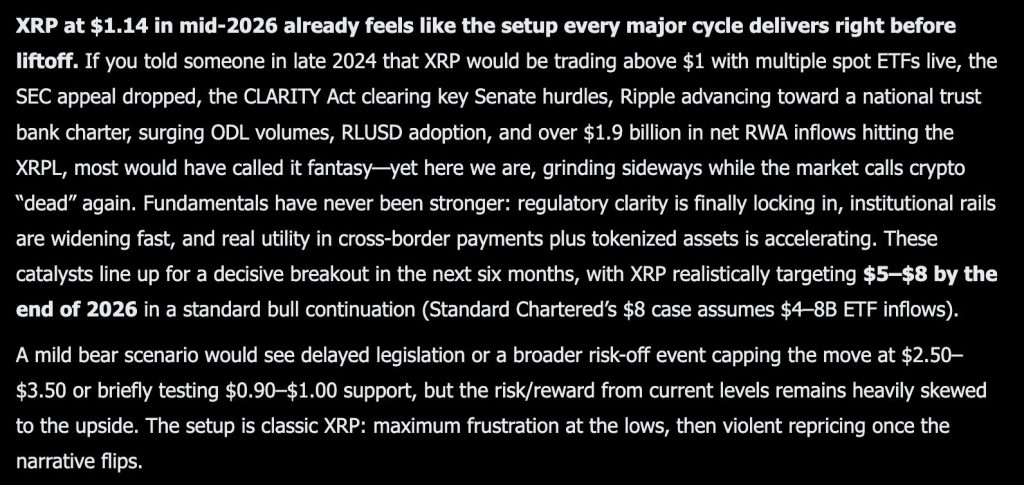
Elon Musk Grok AI just dropped a prediction on XRP price prediction that sounds almost absurd until you read the fine print. The model is pointing to $5 to $8 by the end of 2026, a multiple of where the coin sits today.
The bull case here is stacked with more catalysts than most coins see in a full cycle. XRP is trading near $1.14 with multiple spot ETFs already live in the market.
The SEC appeal is dropped and gone for good. The CLARITY Act is clearing key Senate hurdles, which removes a huge chunk of regulatory fog that has held XRP back for years.
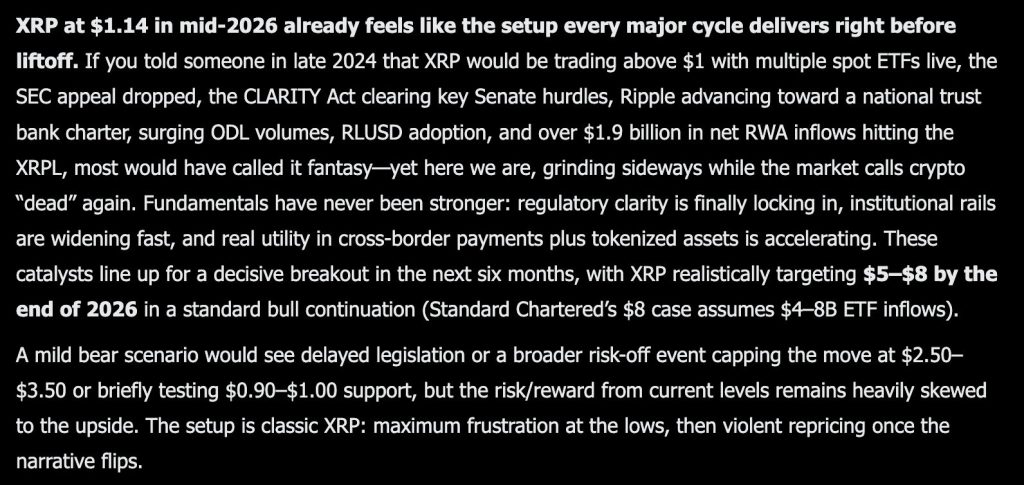
Ripple is also pushing toward a national trust bank charter, which would put it on a stronger institutional footing than almost any other crypto issuer.
ODL volumes are surging as cross-border payment rails lean harder on XRP, and RLUSD adoption is picking up speed, with more than $1.9 billion in net real-world asset inflows hitting the XRP Ledger.
Put it together, and you get a coin with real utility that finally lines up with real regulatory cover. Standard Chartered even built an $8 billion case assuming $4 to $8 billion in ETF inflows, which is not a small assumption but not far-fetched either, given how fast the ETF landscape has grown this year.

The bear case keeps things grounded. Delayed legislation or a broader risk-off shock could cap the move somewhere between $2.50 and $3.50 instead.
There is also a real chance price briefly slips back to test $0.90 to $1.00 support before any real breakout shows up. Even with that downside on the table, the risk-reward from current levels still leans heavily toward the bulls.
XRP Price Prediction: XRP Sits At The Edge Of Its Most Violent Repricing Yet
The daily chart shows XRP grinding near $1.1468 after a long, grinding slide from highs above $3.60 set back in mid 2025.
That entire move down looks like a textbook descending channel, with lower highs and lower lows stacking up for almost a year straight.
Price recently tagged the bottom of that channel near $1.00 and is now testing resistance just above $1.20. A clean break above $1.20 would open the door toward $1.40 and then the $1.60 zone, where multiple rejections already happened earlier this year.
Support sits first at $1.00, then deeper at $0.90 if sellers regain control. RSI is sitting at 42.53 against a signal line of 39.95, so momentum just turned slightly positive after months of sitting below the midline.
That small gap above the signal line suggests early buying pressure is creeping back in, though it is far from a confirmed reversal yet.
Overall momentum appears to be stabilizing rather than accelerating right now. If XRP can hold this base and reclaim the channel resistance, the violent repricing the prediction calls for becomes much easier to picture.
Grok AI Predicts that Liquidchain Could Be The Next Big Thing in Crypto
There is a moment in every cycle where the money stops chasing what everyone already owns.
Large caps do not stop working all at once. They slow down gradually. Returns compress. The same resistance levels hold for weeks. The narrative stays intact, but the price stops responding to it. Bitcoin is there right now. So is Ethereum. So is XRP, which has been perpetually one catalyst away from its next move for longer than most traders want to admit.
When that happens, capital does not sit still. It finds the next thing. It always does.
The next thing never looks ready when the rotation starts. Early presale. Small raise. Unproven team. A problem the entire industry acknowledges and complains about, and has never actually fixed. That combination is exactly what gets ignored until it can no longer be ignored.
Cross-chain liquidity is that problem. Bitcoin, Ethereum, and Solana are three dominant ecosystems with three completely isolated liquidity systems.
There is no native way to connect them. Every user and developer who needs to operate across all three pays for that limitation directly, in fees, in slippage, in failed transactions, and in time. The fragmentation cannot be patched. It is hardwired into how these networks were originally built.
LiquidChain is building the layer that makes the entire problem irrelevant. One execution environment connecting all 3 ecosystems simultaneously. Deploy once, reach everywhere, with no cross-chain tax extracted from every interaction.
The presale is at $0.01454. Just over $800,000 raised.
The market has not looked at this yet. That changes eventually.
The risk profile is what you would expect at this stage. Nothing is proven. Adoption, liquidity, and execution are all still unknowns. That is not a disclaimer. That is the nature of the bet.
The projects that return 10x or 100x are not the ones that looked safe at entry. They are the ones who solved a real problem before the rest of the market understood it.
LiquidChain is still in that window.
The post Elon Musk Grok AI Predicts Shocking XRP Price by End of 2026 appeared first on Cryptonews.

The mistakes that sealed Keir Starmer’s fate

Sustainable Grounds Maintenance in a Changing Climate

Franklin Templeton snaps up 250 Digital to chase crypto boom

No Jackpot Winner as $257 Million Prize Rolls Over to $269 Million Monday Draw

Blockchain.com files with SEC for U.S. IPO

Israel says it has killed new Hamas military leader in Gaza City airstrikes

$1000 XRP BY 2028? – WILL BLACKROCK AQUIRE RIPPLE? – YOU DON’T TRADE XRP! – DID MICA CRUSH BINANCE?

Humanity still exists.. @johnmalek3 #humanity #dream #success #giveaway #lifestyle #money #shorts

Manishi & Nilu | Five Million Money Drop S4 | Episode 42 | Sirasa TV
-

 Fashion3 days ago
Weekend Open Thread: Miami – Corporette.com
-
 Tech6 days ago
The Adder At The Heart Of Intel’s 8087 FPU
-

 Entertainment2 days ago
Renter of Home in Anne Heche Crash Denies Settlement With Son
-

 Tech9 hours ago
Microsoft accidentally kills epic Outlook email threads
-

 Business2 days ago
Soccer-U.S. defends Iran World Cup travel restrictions, says discussions ongoing
-
 Business3 days ago
Wall Street Week Ahead: Investors see Micron earnings as pulse check of AI rally momentum
-

 Politics4 days ago
BBC Reporter Discusses Cross Party Criticism Of Trumps Iran Deal
-

 Tech4 days ago
AWS enters the context layer race with a graph that learns from agents, not manual curation
-

 Crypto World3 days ago
HIVE shares jump as $220M AI deal speeds Bitcoin mining pivot
-

 Crypto World2 days ago
Jake Chervinsky accuses CME of protecting derivatives monopoly
-
 Crypto World2 days ago
Can Charles Hoskinson Really Rescue Cardano?
-

 Tech2 hours ago
Nearly 7,000 fake Amazon domains registered ahead of Prime Day 2026, researchers warn
-

 Sports4 days ago
FIFA World Cup 2026: Canada beat 9-men Qatar 6-0 to register first ever win | FIFA World Cup 2026
-

 Business2 days ago
MHP SE 2026 Q1 – Results – Earnings Call Presentation (OTCMKTS:MHPSY) 2026-06-20
-

 Business4 days ago
Brexit cost 6% of UK economy, Bank of England company data suggests
-

 Politics3 days ago
Andy Burnham and the meaning of Makerfield
-

 Crypto World5 days ago
Anthropic’s Dario Amodei Urged AI Unity at G7, Even as US Banned His Models
-
 Tech1 day ago
Signal’s Meredith Whittaker says AI chatbots ‘are not your friends’ and calls Copilot agents a backdoor
-

 Crypto World7 days ago
Robinhood opens AI-powered trading to all users, sending HOOD stock past $100
-

 Tech5 days ago
Weeks Of In-The-Field Testing And A Verdict
You must be logged in to post a comment Login