

Crypto World
Chainlink Brings Samsung, Toyota and Sony Pricing On-Chain With APAC Equities Streams



**Deck:** Chainlink launched APAC Equities Streams on Monday, putting live pricing for large-cap Asian companies on-chain to power equity perps, prediction markets and structured products in Asian time zones. Chainlink launched APAC Equities Streams on Monday, an oracle feed that brings pricing for… Read the full story at The Defiant

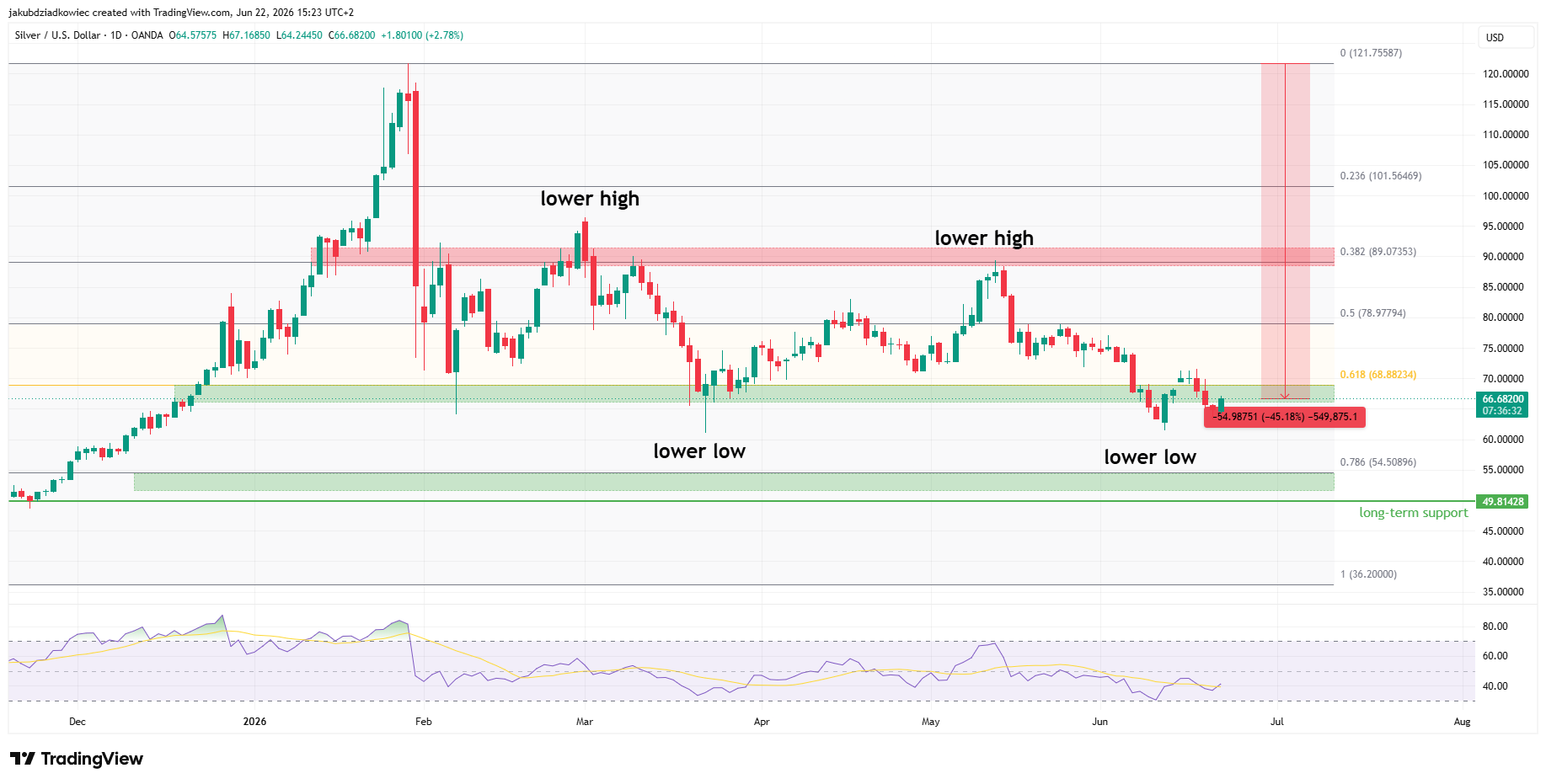
Silver is fighting to reclaim $69 after a near 3% bounce, yet the metal trades 45% below its January record and sits at a level that will decide its next major move.
The rebound tracks easing Middle East tension as a days-old US-Iran ceasefire holds. However, a stronger dollar and a cautious Federal Reserve keep pressure on precious metals, leaving silver caught between recovery and a deeper slide.
Why Kiyosaki Is Watching Silver but Not Buying Yet
Silver (XAG) climbed to around $66.7 on Monday, up close to 2.8% on the day. The move followed a ceasefire that drained the safe-haven demand that had earlier powered metals.
Robert Kiyosaki, author of Rich Dad Poor Dad, said this week that he is waiting before adding to gold, silver, Bitcoin (BTC), and Ethereum (ETH). He argues that the macro environment, not falling prices, signals when to buy.
Kiyosaki gave no price target and no timeline. That leaves one question for traders. What would a genuine reversal look like on silver’s chart?
The Make-or-Break Level at $68.88
On the four-hour chart, silver has slipped below the 0.618 Fibonacci retracement at $68.88 and is fighting to win it back. The level marks the pivot for the next leg.
Independent analyst Kamile Uray flags $63 as the support that has held so far. A break above $71 would open the door toward the $77 to $89 resistance zone.
A close back above that band would suggest the rebound has more room. Until then, the metal stays trapped between $63 support and $71 resistance.
XAG Price Prediction Hinges on the $68.88 Line
The daily chart shows silver in a clear downtrend since January. It has printed successive lower highs near $96 and $89 and matching lower lows.
The price now sits about 45% below its $121.76 record, a sign the correction is widening. The Relative Strength Index (RSI) has ticked up near 40 but stays below the neutral 50 mark.
Reclaiming the retracement at $68.88 would shift focus to $79, then to the $89 resistance band. Losing it points toward $55, the 0.786 level that aligns with long-term support.

That makes $68.88 the line Kiyosaki’s awaited reversal must clear. A weekly close above it would signal the turn, while a rejection keeps the bearish structure intact.
For now, the trend favors sellers until silver proves it can hold above that mark.
The post Silver Faces Make-or-Break Level, Will Price Keep Dropping? appeared first on BeInCrypto.


President Donald Trump has signed two executive orders designed to accelerate U.S. quantum computing development and prepare federal agencies for the potential security risks posed by future quantum machines.
Summary
- Trump signed two executive orders to accelerate U.S. quantum computing development and prepare agencies for future encryption risks.
- The orders direct intelligence officials to assess the impact of advanced quantum computers and the transition to post-quantum cryptography.
- Bitcoin, Ethereum, and Algorand communities are already exploring different strategies to protect blockchain networks from future quantum threats.
According to the White House, Trump approved the measures on June 22 as part of a broader effort to strengthen American leadership in quantum technologies, a field widely viewed as critical for future advances in computing, communications, and cybersecurity.
Speaking during the signing event, Trump said “quantum technologies represents the next generation of innovation across computing, sensing, and networking,” adding that the sector carries significant implications for economic growth, scientific research, and national security.
The first order, Executive Order 14411, establishes the Quantum Computer for Application Development and Discovery Science, or QC-ADDS, initiative. Under the directive, the Department of Energy must identify technical requirements for an advanced quantum computer within 90 days and work toward deploying at least one such system at a federal research facility.
The Department of Commerce is also tasked with exploring ways to encourage participation from private-sector quantum computing companies.
Additional provisions require federal agencies, including NASA, the Department of Energy, the National Science Foundation, and the Department of Commerce, to develop five-year plans for advancing quantum sensing and networking technologies.
The order also includes measures aimed at strengthening domestic supply chains, expanding the quantum workforce, and increasing protections for sensitive research.
Federal agencies are assessing post-quantum security risks
Of particular interest to the crypto industry, the order directs intelligence agencies to assess how increasingly powerful commercial quantum computers could affect national security, including the transition to post-quantum cryptography.
The directive arrives as concerns persist over the hypothetical arrival of “Q-Day,” the point at which quantum computers become capable of breaking encryption systems that currently secure financial networks, government infrastructure, and blockchain wallets.
While no existing quantum computer poses such a threat today, policymakers and cryptography experts have increasingly called for preparations to begin before the technology reaches that stage.
According to a recent report from Coinbase’s independent advisory board of cryptography experts, the Bitcoin community should start planning a migration path to post-quantum cryptography rather than waiting until quantum computing becomes an immediate concern. The report stated that uncertainty surrounding future advances in the field justifies early preparation.
Crypto projects are already preparing for future threats
Discussions around quantum-resistant security have also expanded beyond Bitcoin.
Recently, Binance founder Changpeng Zhao proposed a future migration period for Bitcoin holders following any transition to quantum-resistant cryptography. Zhao argued that vulnerable legacy addresses should not remain exposed indefinitely if quantum computers eventually become capable of breaking existing security models, while emphasizing that any protocol change would require community consensus.
Elsewhere, researchers associated with the Ethereum Foundation’s Kohaku privacy project have suggested that Ethereum accounts could begin adding certain post-quantum protections without waiting for a hard fork. According to Kohaku lead Nico, wallet-level protections could be introduced through smart contract logic while longer-term protocol upgrades continue to be explored.
Meanwhile, the Algorand Foundation has released a roadmap intended to make the layer-1 network broadly quantum-resilient by the end of 2027. The foundation said the initiative will cover user accounts, wallets, developer tools, staking infrastructure, and consensus systems.
As governments increase investment in quantum computing research, blockchain developers and cryptography experts are increasingly examining how existing security systems can be upgraded before quantum computers become capable of challenging today’s encryption standards.

Ripple’s cross-border token was at the forefront of gains last summer when its price reached a historic peak of around $3.65. However, back then the broader crypto market was booming, while the past several months have delivered heavy losses for the bulls.
XRP has shed approximately 65% of its valuation, yet it remains the subject of optimistic predictions, and some of those seem a bit far-fetched.
How High?
As of press time, the asset’s price trades at around $1.14, with X user BATMAN claiming that “volatility is loading.” The analyst noted that the asset has been hovering in the $1.08-$1.30 range for the past two weeks or so, predicting a breakout if it surges past the upper boundary, and that the bullish setup would be invalidated if XRP plunges below the depicted floor.
CRYPTOWZRD also claimed that the asset is at a crossroads. They opined that moving above the $1.18 resistance “will offer a long,” while rejection could benefit the short traders.
Certain analysts appear unfazed by the current market conditions and expect XRP to post explosive gains in the future. Such is the case with X user Tom, who recently argued that the asset has formed a pattern similar to its 2024 run, which took the price from $0.50 to $3.30.
“Except… this time the 1.272 Fib extension points to $8.42,” he added.
JAVON MARKS also made a shocking forecast. The market observer claimed that “XRP’s breakout stands, which means the measured move target near $17 does as well.”
It is important to note that an increase of that magnitude will require the token’s market cap to skyrocket to nearly $1 trillion. Bitcoin (BTC) remains the only cryptocurrency with a capitalization higher than that, and XRP appears unlikely to join it anytime soon, particularly during the prolonged bear market.
Observing These Factors
Multiple elements suggest the bulls might have to endure more pain in the short term. As CryptoPotato recently reported, XRP’s network activity dropped by roughly 50% in the span of just two weeks. This hints at waning user engagement that could intensify the sell-off.
Another issue is the whales’ behavior. More than 30 million XRP were distributed by large investors in a period of five days as the total holdings of these market participants slipped to around 3.78 billion units. This signals that they could be positioning for a further price decline: something that may scare smaller players and prompt them to cash out, too.
The institutional interest is among the few rays of hope. Data shows that spot XRP ETFs continue to attract capital, with inflows consistently surpassing outflows. This development suggests that pension funds, hedge funds, and other controversial investors continue to increase their exposure to Ripple’s native token: a trend completely opposite to the massive outflows witnessed from spot BTC and ETH ETFs.
The post Shocking Ripple Price Predictions as XRP Plunges 65% From Its ATH appeared first on CryptoPotato.

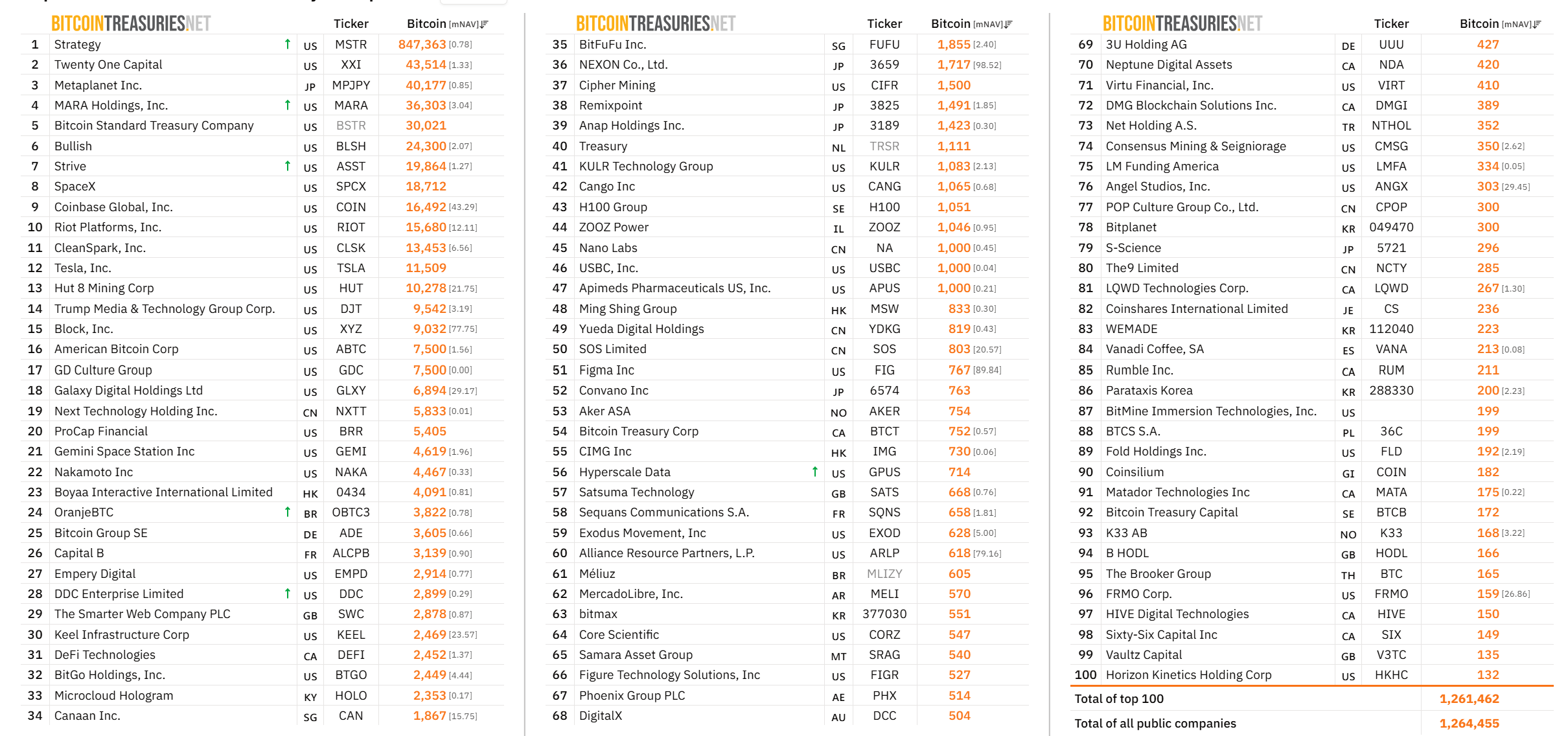
After hinting at buying more bitcoin on Sunday, Strategy’s co-founder and former CEO, Michael Saylor, announced on X minutes ago that the firm had acquired another 520 BTC for $35 million. Thus, its total holdings have grown to 847,363 units, currently valued at almost $55 billion.
What’s more interesting about this announcement is the fact that the NASDAQ-listed business intelligence software company increased its USD reserve a lot more than the BTC acquisition.
Strategy has increased its USD Reserve by $300 million to $1.4 billion and plans to continue replenishing it to support the credit quality of its Digital Credit securities. We also acquired 520 BTC for $35 million, increasing our $BTC Reserve to ₿847,363. $MSTR $STRC…
— Michael Saylor (@saylor) June 22, 2026
The Saylor-founded firm made two major bitcoin purchases in the past couple of weeks, both for around $100 million. It also increased its USD reserve by the same amount.
Now, though, the difference is quite significant, as the firm has spent almost 10 times more for its USD reserve than for its bitcoin acquisition.
Perhaps the reason for this is the growing online scrutiny of Strategy’s STRC. Also referred to as Stretch, these shares are supposed to trade at $100, provide a stable yield to investors, and raise funds to buy more BTC.
However, they have deviated from their par price in the past few weeks, going well below $90 at one point. This raised some eyebrows in the community, with some analysts speculating that the company might have to sell more than 50,000 BTC in the next few years to cover expenses and dividend payments.
The post Strategy Buys More Bitcoin but Turns Attention to USD Reserve With $300M Injection appeared first on CryptoPotato.
Crypto World
Trump Calls Stock Buybacks Fake: MicroStrategy Bitcoin Model Shows Another Way to Boost Valuations
President Donald Trump has again branded stock buybacks a fake way to lift share prices, yet the MicroStrategy Bitcoin model points to a different route to higher valuations, one built on issuing shares rather than repurchasing them.
His latest comments target defense contractors. They also sharpen a wider debate over how companies move their own stock, through buybacks that shrink share counts or through dilution that funds a growing bitcoin treasury.
What Trump Said About Buybacks
Trump has renewed pressure on defense firms over how they use their cash. He signed an executive order in January that bars underperforming contractors from buybacks and dividends until production improves.
His argument is direct. Repurchases inflate share prices without building real capacity, so he wants the money spent on plants, equipment, and faster output.
The policy targets large contractors such as Lockheed Martin, Northrop Grumman, and RTX. Trump has returned to the theme this week, and his buyback comments have rattled defense stocks before.
How the MicroStrategy Bitcoin Model Works
MicroStrategy (now Strategy), takes the opposite path. It does not repurchase common stock. It sells new shares and preferred stock, then spends the cash on Bitcoin.
That dilution and debt approach has built a stockpile of more than 845,000 Bitcoin (BTC), the largest held by any public company.

Michael Saylor frames each raise as a way to grow Bitcoin per share. Those purchases now represent more than four percent of all BTC in circulation.
The company has even bought back debt, repurchasing convertible notes at a discount this year. It has also leaned on preferred stock issuance to keep buying without adding senior loans.
Follow us on X to get the latest news as it happens
Why the Premium Decides Everything
The model works through a flywheel. MicroStrategy issues stock above the value of its coins, buys more bitcoin, and lifts holdings per share, which can support a premium over net worth.
That premium has thinned in 2026. With Bitcoin trading near $64,360, the holdings sit close to the average price MicroStrategy paid.
The stock has fallen by more than half over the past year, and its market value has slipped toward $40 billion.

When the premium fades, new share sales add little value. The same dilution that powered gains now offers thinner support, a pattern visible during the recent Bitcoin sell-off pressure.
Both stories turn on one question. Investors and regulators want to know whether a company builds value or simply moves its share price.
For MicroStrategy, the answer may rest on whether Bitcoin climbs back above its cost and revives the premium.
The post Trump Calls Stock Buybacks Fake: MicroStrategy Bitcoin Model Shows Another Way to Boost Valuations appeared first on BeInCrypto.
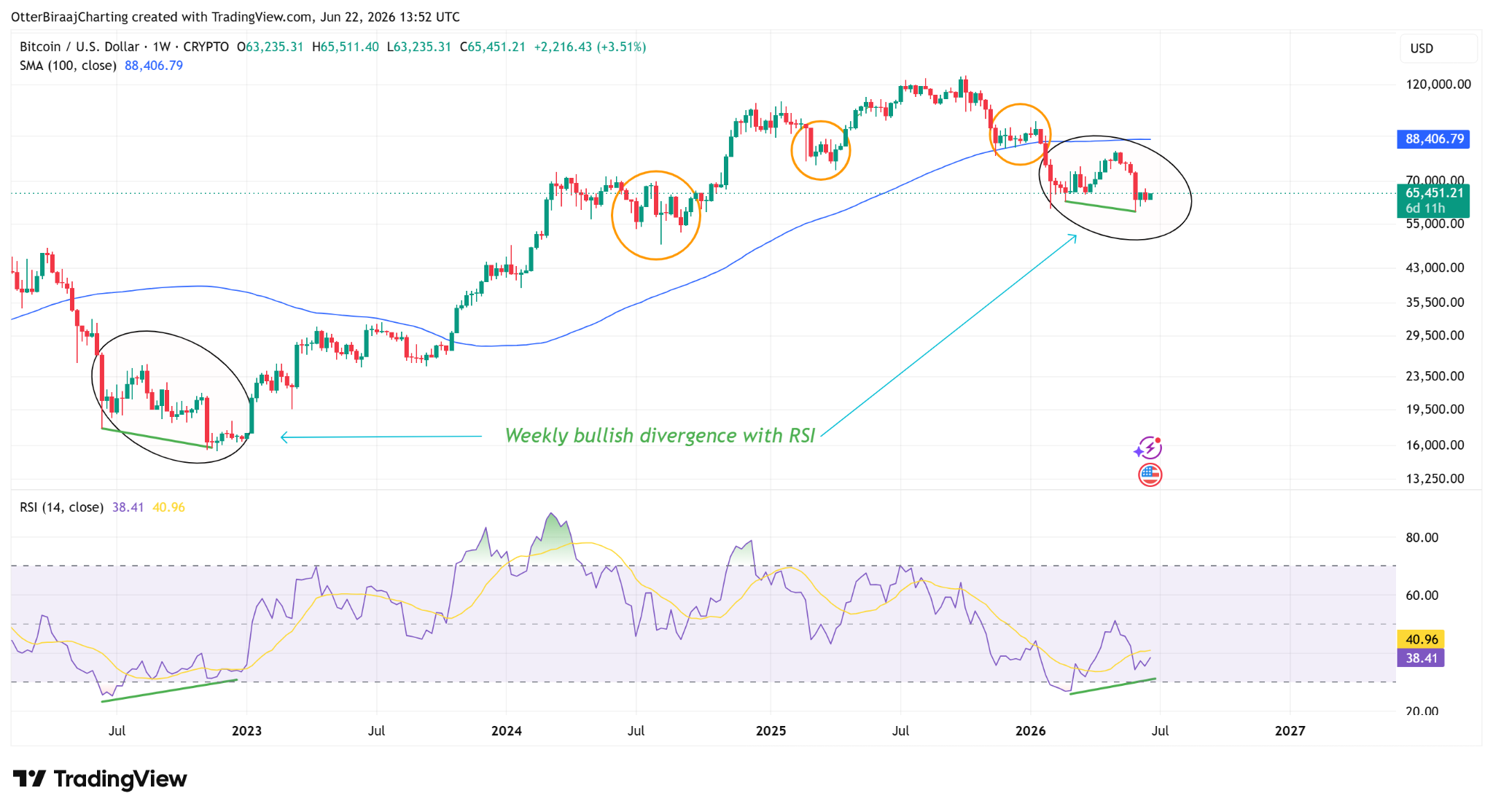
Bitcoin (BTC) continues to exhibit a strong technical setup after holding a weekly close above $63,000 for three consecutive weeks since tagging a new 2026 low near $59,000. This pattern closely resembles a bottom-building phase seen in previous trend reversals in bearish periods.
At the same time, Bitcoin futures open interest has fallen 19.5% from its June peak, funding rates have cooled to 0.02% from 0.1%, and spot Bitcoin exchange-traded fund (ETF) outflows have slowed sharply to $540 million over the past two weeks from $5.5 billion the prior month.
Together, the data points to a market that is shedding excess selling pressure while holding near a key support zone for BTC.
Bitcoin’s weekly chart echoes prior market bottoms
Bitcoin’s recent weekly price action resembles a pattern seen several times since 2023. Once a local bottom is established, the price often trades close to that range for weeks before a sustained uptrend develops. One exception came in November 2025, when the price spent roughly 10 weeks moving sideways above $88,000 before breaking lower to the $60,000 level.
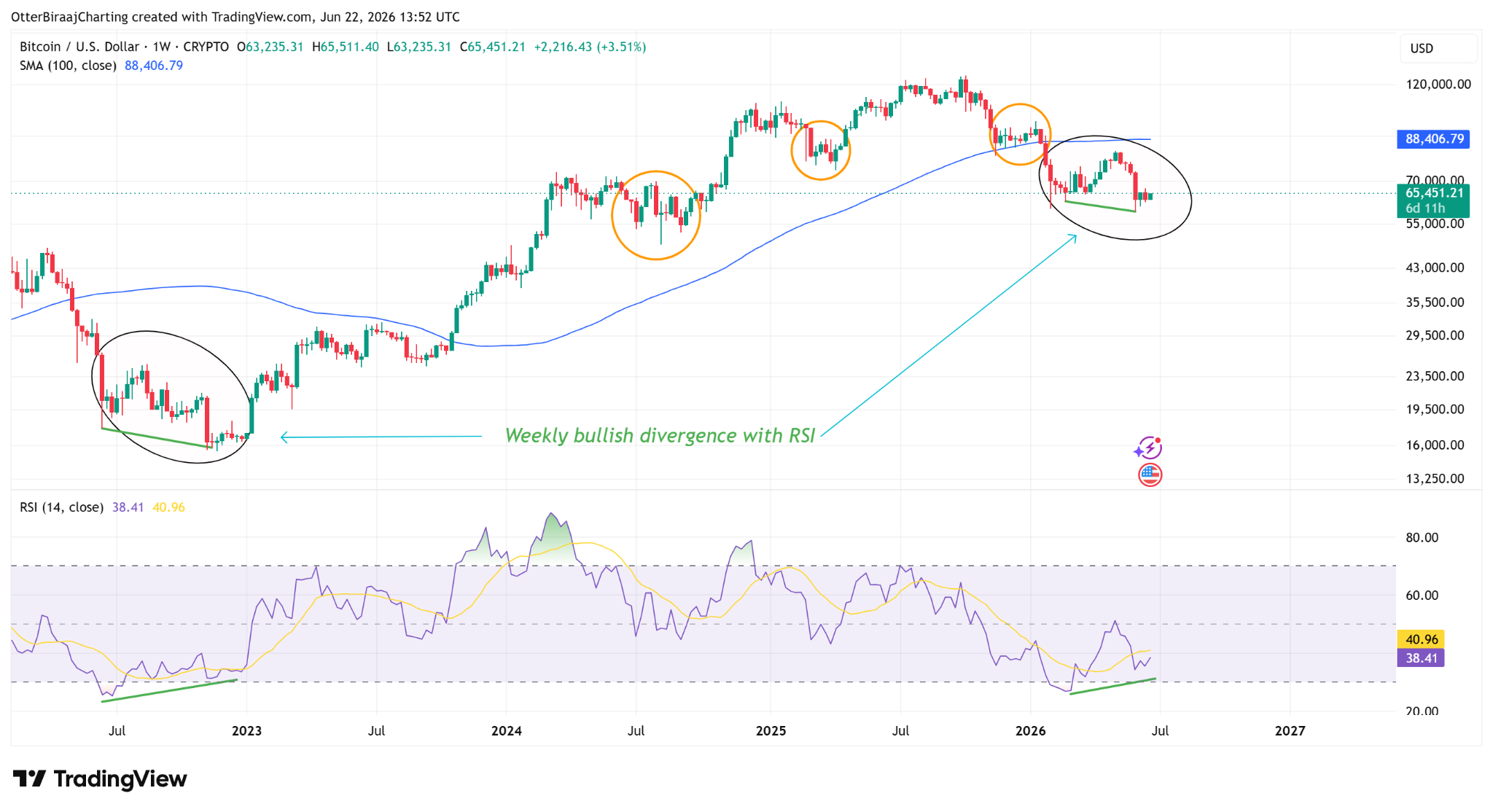
BTC/USD, one-week chart. Source: Cointelegraph/TradingView
The current setup also resembles the price from late 2022 and early 2023. During that period, the weekly relative strength index (RSI) entered oversold territory, recovered, and later formed a higher low, while the BTC price printed a lower low, creating a bullish divergence. That bullish divergence marked a key turning point, preceding the broader uptrend that developed during 2023.
The focus is now on the $63,000 area, where the price has formed a positive RSI divergence. The repeated weekly closes above $63,000, keeps Bitcoin trading above its recent low at $59,000 rather than extending towards it. The behavior fits a range-building phase that has appeared near previous turning points, as identified in the chart.
Related: US dollar strength hits highest since May 2025: Five things to know in Bitcoin this week
BTC futures turn less crowded as ETF sell-pressure eases
Bitcoin derivatives markets have become notably less crowded over the past three weeks. Bitcoin funding rates cooled to 0.02% from 0.1% at the start of June, reducing signs of aggressive long positioning.
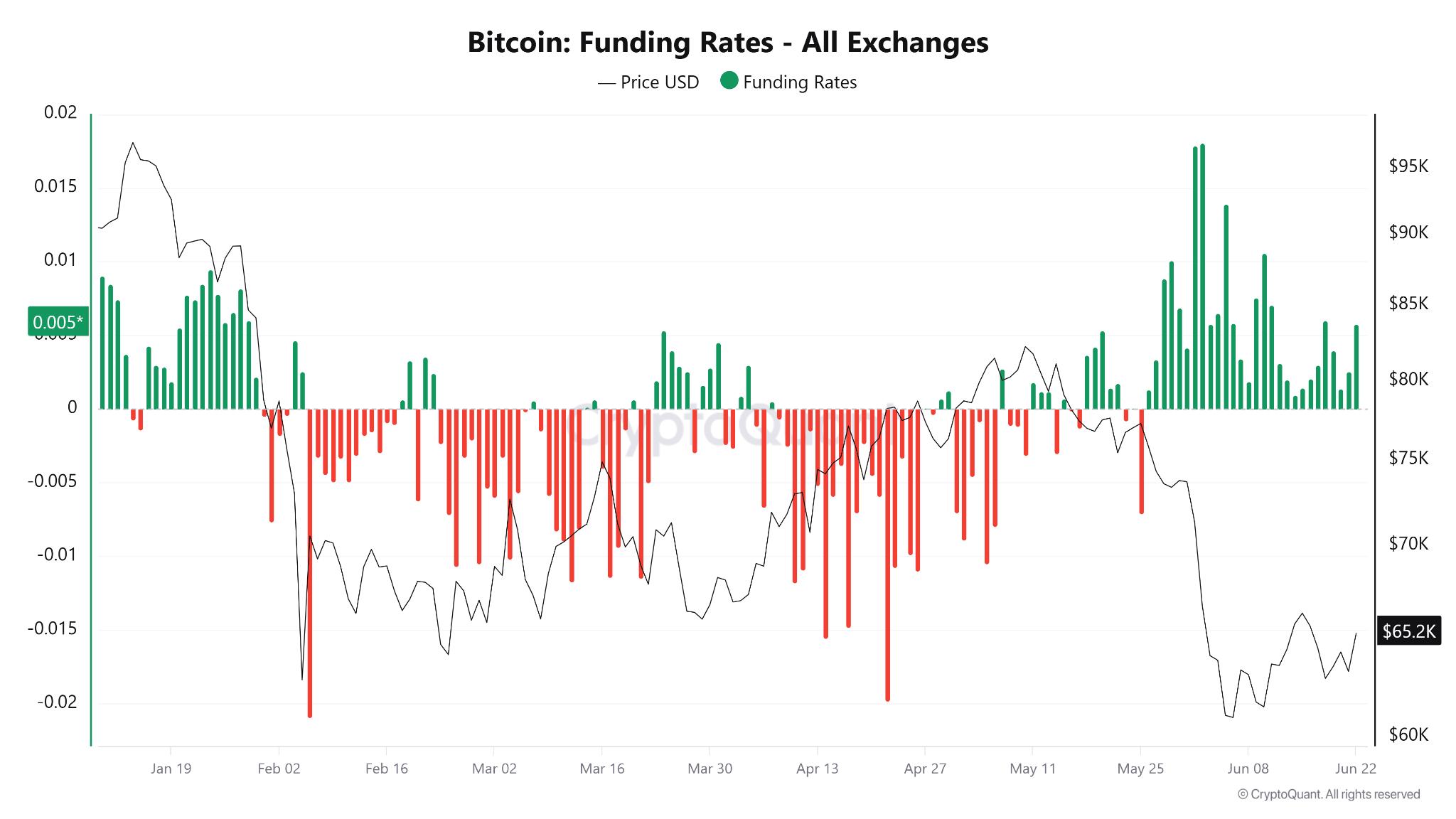
Bitcoin funding rate on all exchanges. Source: CryptoQuant
Crypto analyst Woominkyuu noted that total Bitcoin open interest across exchanges peaked at $25.96 billion on June 1, then fell to $20.89 billion by June 21. The 19.5% decline exceeded Bitcoin’s 11.4% price drop during the same period.
The simultaneous decline in the price and open interest typically signals that existing positions are being closed or liquidated rather than new leveraged bets entering the market. This indicates a significant reduction in excess leverage. It also points to limited evidence of aggressive new short positioning at current levels.
Spot Bitcoin ETF flows show a similar shift with $5.5 billion leaving the spot ETFs between May 15 and June 11. The outflows over the past two weeks total about $540 million, marking a sharp slowdown in selling activity.
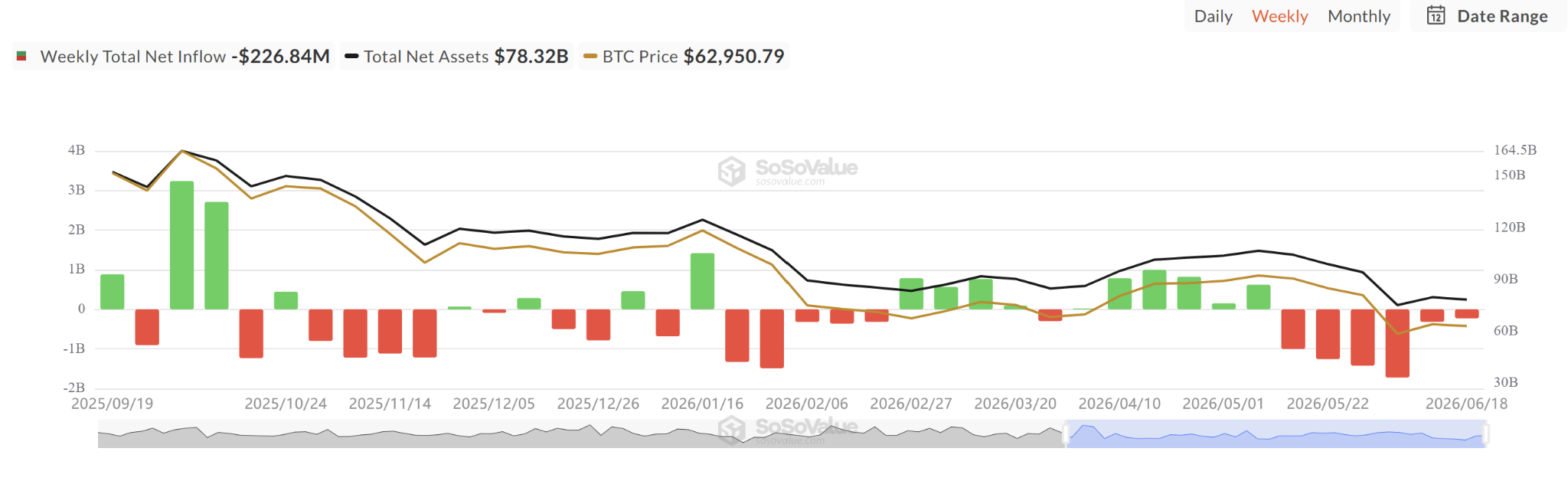
Weekly spot BTC ETF netflows. Source: SoSoValue
Onchain data paints a mixed but constructive picture. Bitcoin researcher Axel Adler Jr. highlighted that long-term holders’ realized supply recently reached 12.42 million BTC, a level associated with supply maturation and coins moving into stronger hands.
At the same time, Bitcoin’s sales pressure metric has stayed inactive for 1,256 consecutive days, the longest stretch on record. The data points to continued supply maturation alongside other signs that Bitcoin may be stabilizing near a potential cycle low.
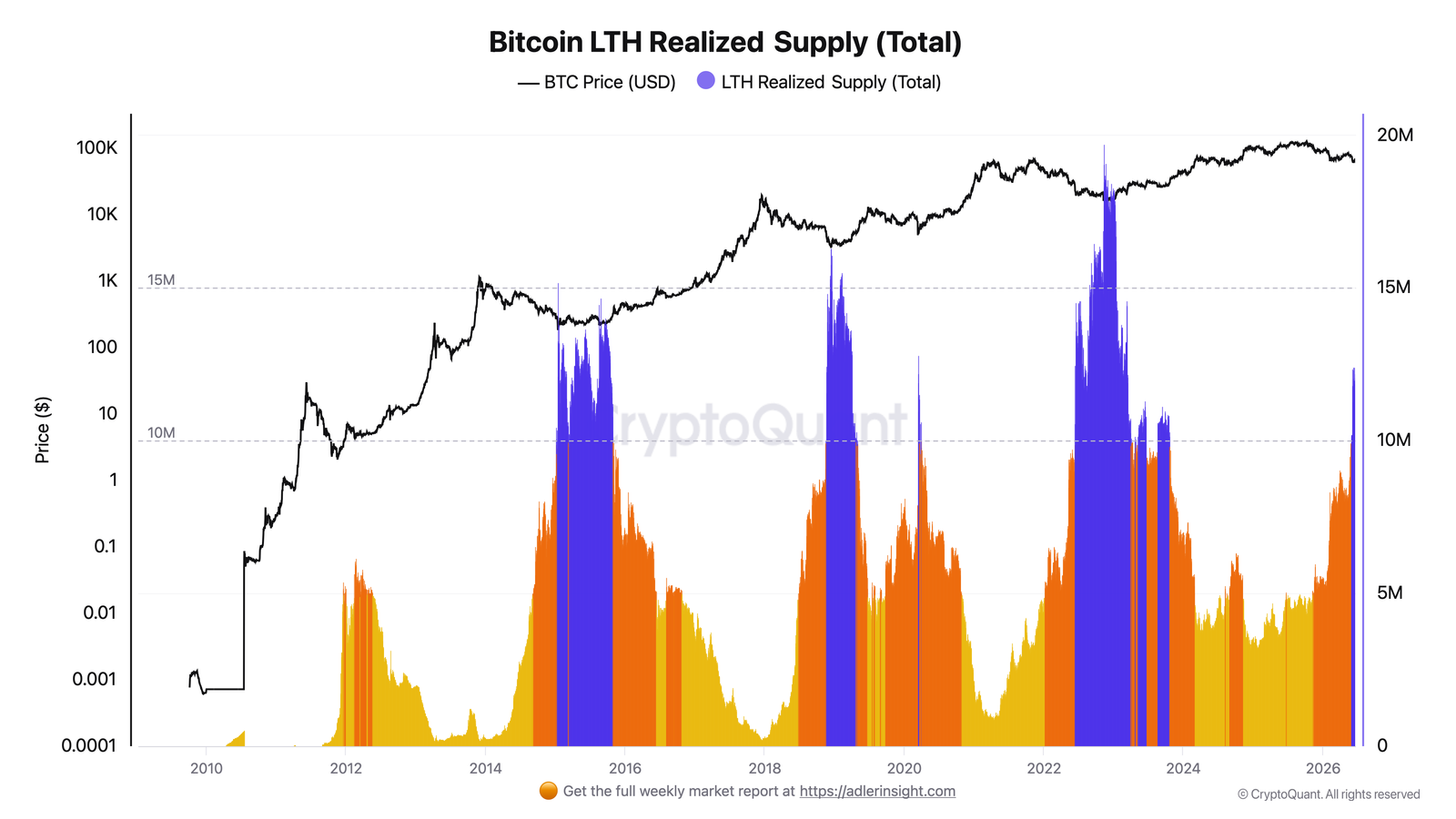
Bitcoin LTH realized supply. Source: Axel Adler Jr.
Related: Strategy adds $300M to USD Reserve, acquires 520 BTC


Key takeaways
- Ethereum (ETH) has rebounded about 4% over the past week, but overall market sentiment remains weak.
- Hawkish signals from the Federal Reserve have reduced expectations for interest rate cuts and increased pressure on risk assets.
Ethereum recovery faces macro headwinds
Ethereum has posted a modest 4% recovery over the past seven days as the broader cryptocurrency market staged a technical rebound.
However, the bounce has done little to improve overall sentiment, which remains under pressure from worsening macroeconomic conditions.
Investor confidence took another hit after recent comments from Federal Reserve Chairman Kevin Warsh signaled a tougher stance on inflation.
His remarks suggested that monetary policy could remain restrictive for longer, fueling concerns that interest rate hikes may still be on the table.
The shift has challenged earlier expectations that the Federal Reserve would begin cutting rates this year, creating a less favorable environment for risk assets such as cryptocurrencies.
Earlier in the year, many analysts expected one or two rate cuts from the Federal Reserve. Those expectations have weakened significantly as inflation continues to run above the central bank’s target.
Warsh’s comments reinforced concerns that policymakers remain focused on controlling inflation, even if tighter monetary conditions weigh on financial markets.
Historically, higher interest rates reduce liquidity and investor appetite for speculative assets, making cryptocurrencies particularly vulnerable during periods of monetary tightening.
Ethereum struggles at key resistance level
Ethereum’s recent recovery stalled near the $1,800 level, an area that previously served as support but has now become a significant resistance zone.
If selling pressure continues and ETH fails to reclaim $1,800, the next major support level sits near the April 2025 low of $1,400.
A move to that level would represent roughly an 18% decline from current prices and further deepen Ethereum’s yearly losses.
Among the largest cryptocurrencies, Ethereum has been one of the weakest performers, even lagging behind competitors such as Solana during the current market cycle.
The Relative Strength Index (RSI) has improved from oversold conditions but remains weak.
Currently hovering around 40, the indicator is approaching levels that could reinforce bearish momentum if selling pressure increases.

From a broader technical perspective, Ethereum’s weekly chart continues to reflect a fragile market structure.
Unless buyers successfully push the price above $1,800, analysts expect the downtrend to remain intact, increasing the likelihood of a retest of lower support zones.

A new Ethereum funding proposal would allow validators to redirect up to 10% of staking rewards toward ecosystem development if a majority of validators agree to the change.
The idea has reopened debate over how Ethereum should pay for public goods as concerns grow around shrinking funding sources for core development.
Proposal Looking to Solve Ethereum’s Funding Problem
The proposition, published by Ethereum contributor Clément Lesaege in a personal capacity, introduced what he called “Validator Redirected Revenue.” The framework would let validators signal both how much of their staking rewards should be diverted and which recipients should receive those funds.
According to him, Ethereum is facing a coordination problem, with infrastructure projects often benefiting the whole network but many people showing little incentive to help pay for them.
Per the motion, if more than 51% of validators support a redirect rate above zero, the selected contribution level would apply to all validators, with Lesaege’s plan capping the amount at 10% of staking rewards while keeping the option to pull the rate back to zero.
It also allows validators to select those they prefer to receive the funding, with execution clients then aggregating those preferences and determining a distribution contract through a voting mechanism. At current levels, we have about 39.8 million ETH staked, and using the proposal’s estimated 1.91% annual staking reward rate, it means that even a 5% redirect would channel approximately 38,000 ETH per year into ecosystem development, while 10% would take that figure to 76,000 ETH.
The proposal did identify cartel formation as its most serious risk, as according to Lesaege, a 51% majority of validators could theoretically vote to redirect the maximum 10% back to themselves. However, he argued that the chances of that actually happening were low because the gains made from such an attack would not be worth the reputational and price consequences that come with it.
Critics Question Governance and Incentives
Fellow developer Micah Zoltu also claimed that unlike existing attack vectors, Lesaege’s idea can create a specific pile of money up for grabs, which is a materially different incentive to attack.
“I’m not aware of any solution to this,” he wrote, calling it the reason other blockchains have not tried this kind of mechanism. But Lesaege responded, pointing out that both Bitcoin and Ethereum already carry theoretical cartel risks that have never materialized and that the social layer, including the ability to fork, was still a meaningful deterrent.
There were also others who questioned whether protocol-level funding was really necessary, with pseudonymous developer señor doggo saying that Ethereum already supports smart contract-based revenue sharing. They argued that any funding mechanism should compete voluntarily instead of becoming part of the protocol.
But some community members supported voluntary contributions, one of them being DeFi builder S. More, who said they would donate part of their staking yield to development groups they support, although they suggested that such donations should remain optional.
The proposal has come at an interesting time, considering comments made recently by former Ethereum Foundation insider Trent Van Epps, warning that the network could face funding pressure within the next few months as existing support programs expire and the Foundation reduces spending.
The post New Proposal Redirects 10% of Staking Rewards to Fund Ethereum Ecosystem appeared first on CryptoPotato.
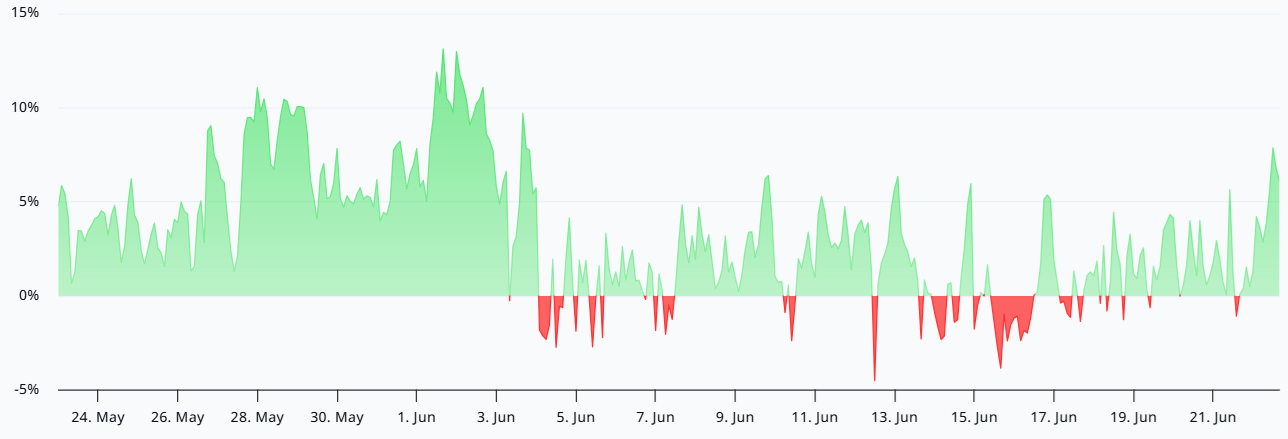
Key takeaways:
- The Bitcoin funding rate climbed to 7%, showing confidence, but spot ETF outflows keep a $70,000 breakout on hold for now.
- Strong order-book bids and lower oil prices helped, but weakness across stocks, bonds, and gold signals a preference for cash.
Bitcoin (BTC) flirted with the $65,500 level on Monday after US Vice President JD Vance said that the Strait of Hormuz remains open amid “encouraging progress” on talks with the Iranian delegation in Switzerland. Bitcoin traders showed signs of optimism through growing demand for bullish leveraged positions, raising the question of whether $70,000 is next.
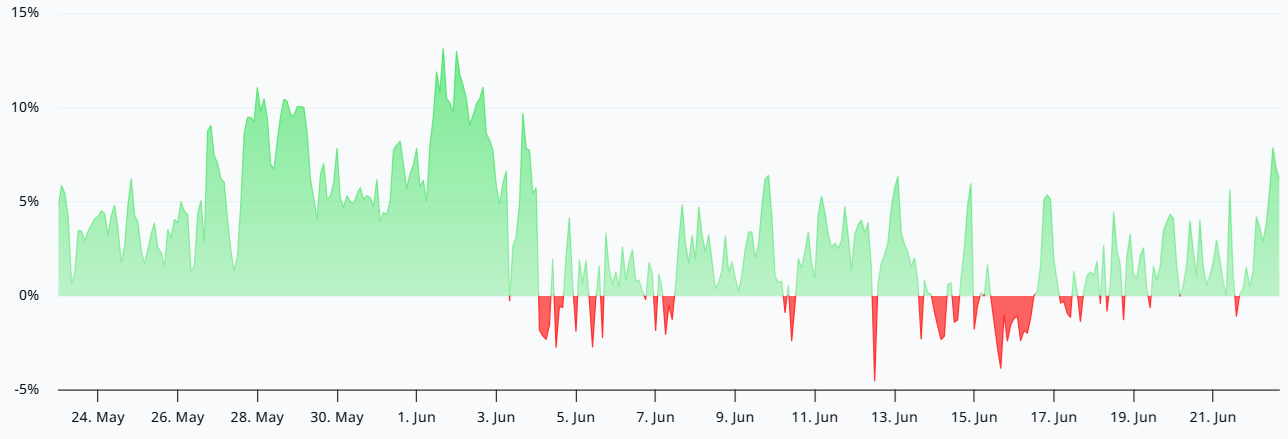
Bitcoin perpetual futures annualized funding rate. Source: Laevitas
The Bitcoin perpetual futures annualized funding rate jumped to 7% on Monday, its highest level in nearly three weeks. Although still within the neutral 6%-12% range, the indicator reflects growing confidence among bulls. Part of the optimism likely stemmed from Brent crude oil prices declining to $77.50, their lowest level since March.
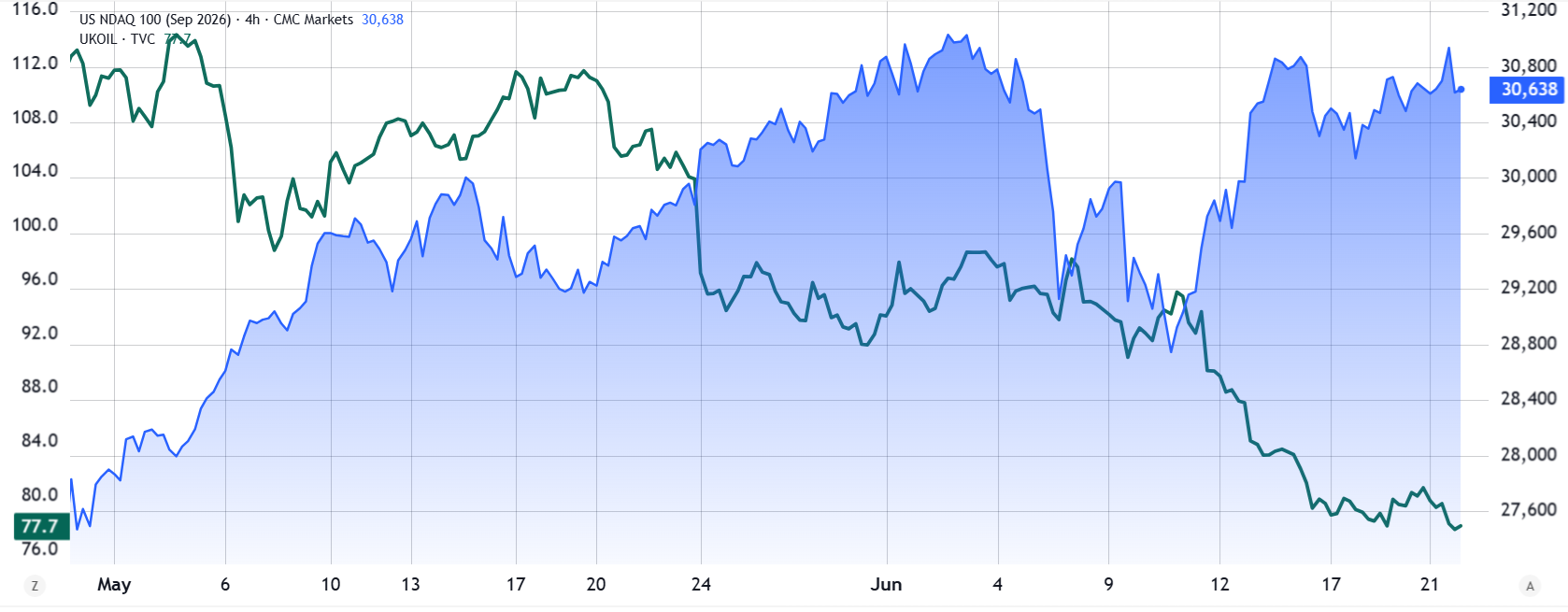
Crude Brent oil, USD (left) vs. Nasdaq 100 futures (right). Source: TradingView
The Nasdaq 100 Index posted a modest 1% decline as artificial intelligence stocks weakened. SpaceX (SPCX US) shares dropped 13% after the company announced plans to raise debt despite holding more than $100 billion in cash. Investors fear the sector will need higher investments for longer before turning profitable.
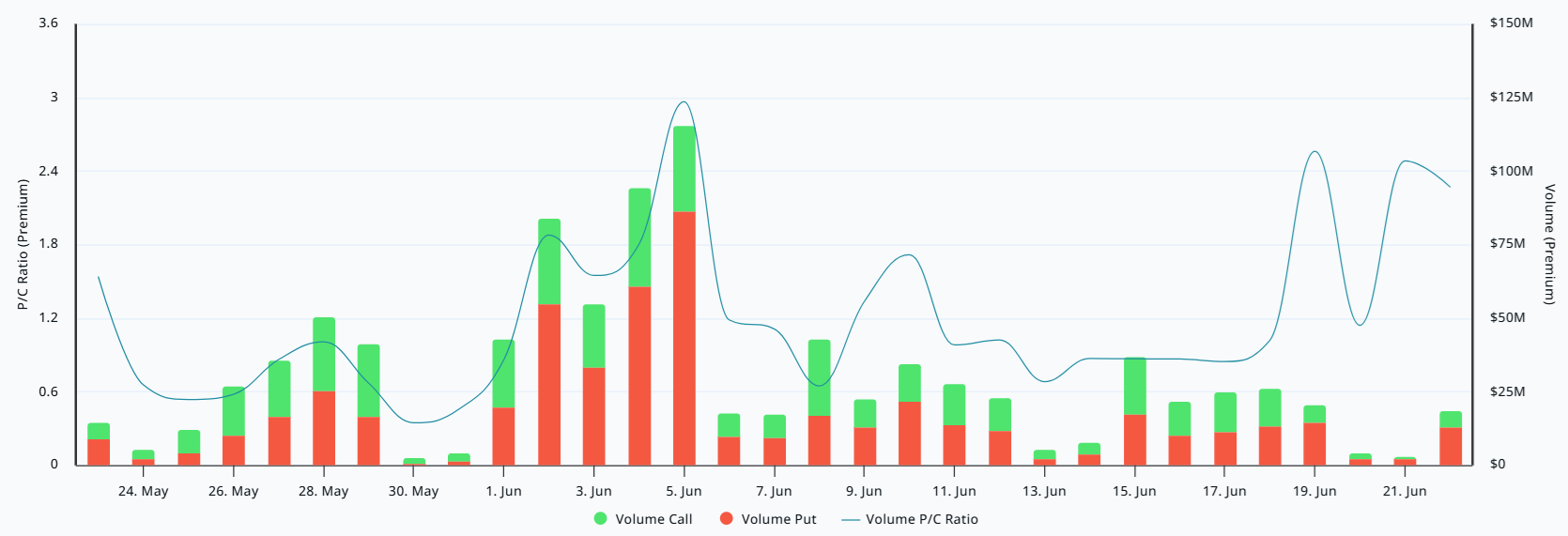
Bitcoin options premium put-to-call ratio at Deribit, USD. Source: Laevitas
Demand for put (sell) options outpaced call (buy) instruments by over two times on Monday, signaling stronger demand for downside price protection. The indicator has leaned toward bearish strategies since Friday, reversing the trend from the prior week.
Strategy eases concerns, but stocks and bonds signal increased risk
Part of traders’ concerns stemmed from weakness in Strategy’s (STRC US) valuation. Shares of Strategy traded 13% below the $64.1 billion cost to acquire BTC 847,363. Despite holding a comfortable $6.75 billion in debt, investors feared the company would need to sell reserves. Those concerns eased somewhat as Strategy announced a $300 billion additional cash position.
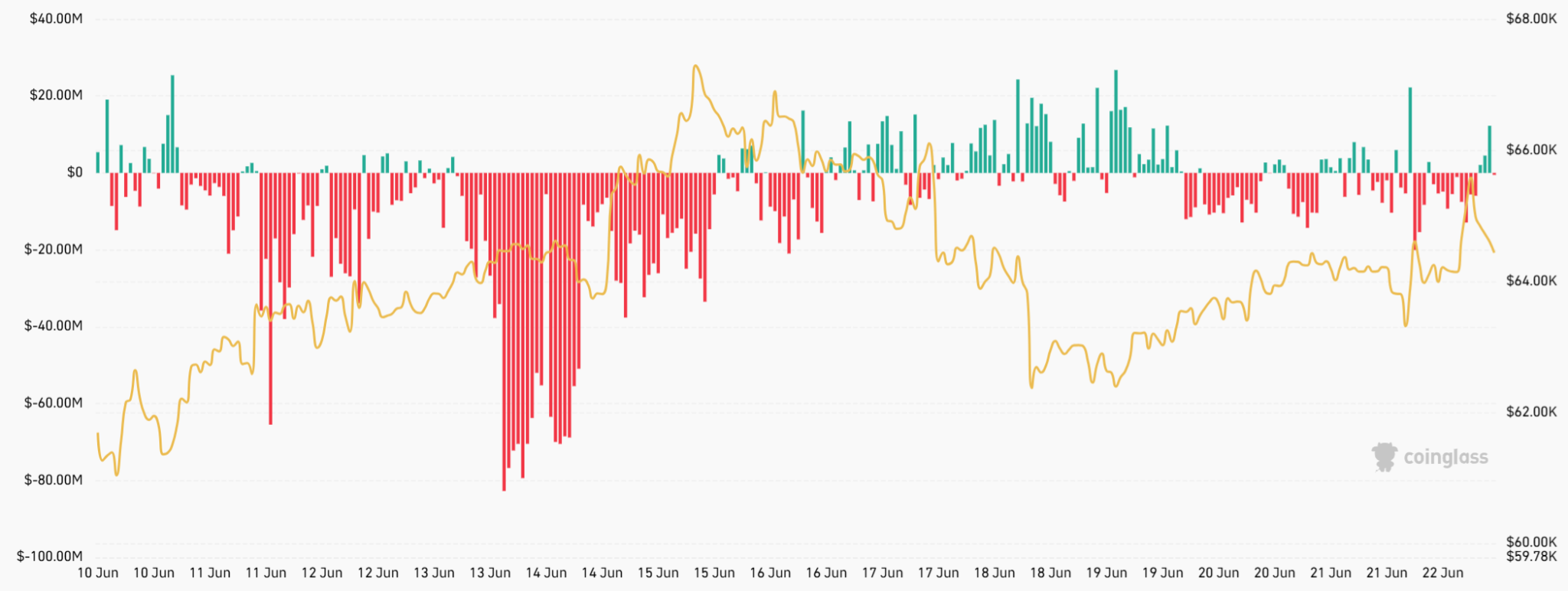
Aggregated Bitcoin orderbook 1% liquidity delta, USD. Source: CoinGlass
Bids on major exchanges’ Bitcoin order books exceeded offers by $12 million on Monday, reversing the weekend trend. Consequently, Bitcoin’s failure to hold the $65,000 level should not signal weakness, especially since gold traded down 0.9% on Monday while investors sold US government bonds.
Related: Bitcoin tipped for $66K top as trader flags ‘suspicious’ BTC price gains
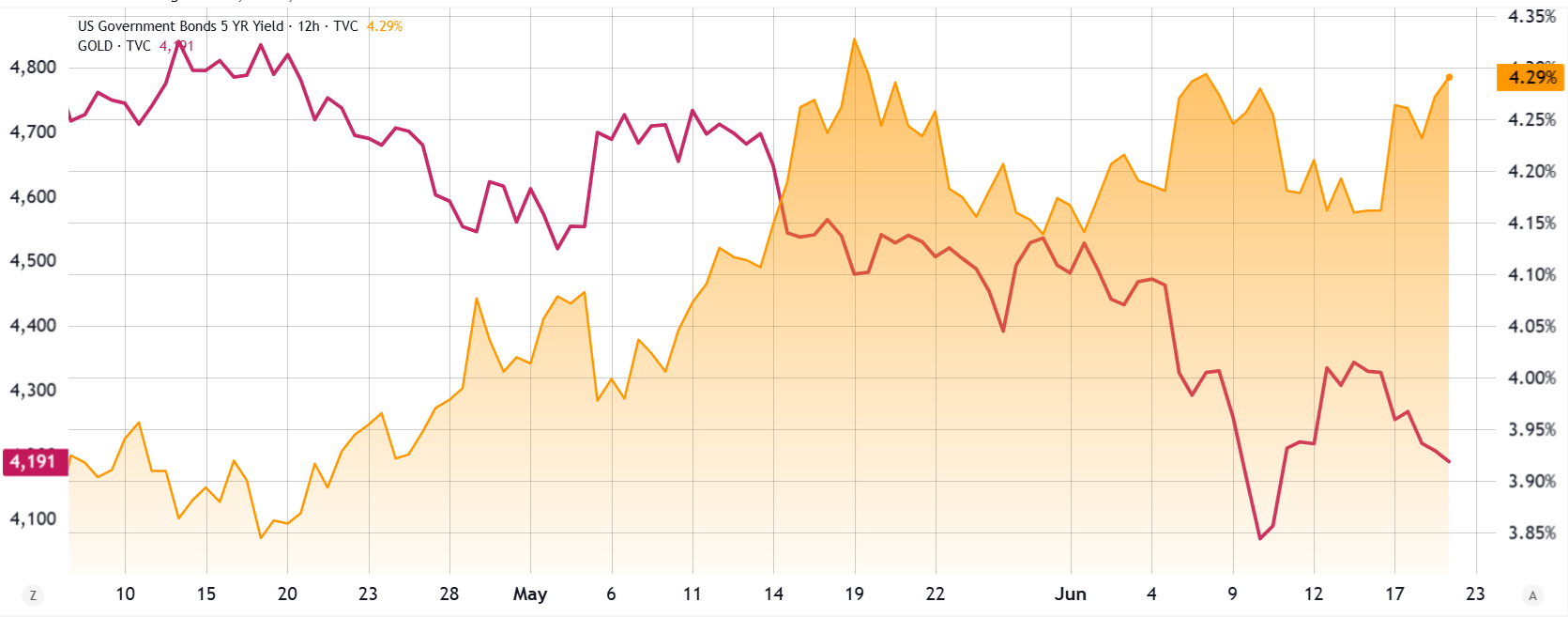
Gold/USD (left) vs. US 5-year Treasury yield (right). Source: TradingView
Higher yields on US Treasuries signal that investors demanded higher returns to hold those bonds, whether driven by inflation or by the anticipation of dilution from rising US government debt levels. The simultaneous weak performance across stocks, bonds, and gold points to a preference for cash positions, creating a cautious backdrop for Bitcoin.
Weak demand for US-listed Bitcoin exchange-traded funds (ETFs) continues to weigh on investor sentiment after six weeks of outflows. Bitcoin spot ETFs saw $228 million in net outflows the prior week, according to CoinGlass data. Consequently, the odds of a short-term Bitcoin rally to $70,000 look limited.


Bitmine has purchased another 52,203 ETH worth about $90 million, bringing its holdings to 4.7% of Ethereum’s total supply.
Summary
- Bitmine purchased 52,203 ETH worth about $90 million, lifting its holdings to 4.7% of Ethereum’s supply.
- Tom Lee said the company remains close to its 5% ETH ownership target despite challenging market conditions.
- Staked ETH has increased projected annualized revenue to $223 million, with potential rewards reaching $268 million.
According to a company update released on Monday, Bitmine’s latest purchase increases its exposure to Ethereum despite continued weakness in the broader crypto market and repeated rejections at key price levels for the asset.
The company said its balance sheet now includes approximately $10.7 billion in crypto assets, cash, marketable securities, and strategic investments, including stakes in Eightco and Beast Industries. With the latest acquisition completed, Bitmine remains one of the largest corporate holders of Ethereum.
Commenting on the company’s outlook, Bitmine chairman Tom Lee said he expects tokenization and advances in artificial intelligence to drive future demand for blockchain networks and digital assets. Lee also reiterated his view that the crypto market remains in the early stages of what he previously described as a “crypto spring.”
Ethereum purchases continue as holdings approach target
Less than a year after launching its Ethereum treasury strategy, Bitmine has accumulated enough ETH to control 4.7% of the asset’s supply, according to the company. The latest purchase leaves the firm roughly 94% of the way toward its publicly stated goal of holding 5% of all Ethereum.
Recent fundraising efforts have helped finance that expansion. Earlier, crypto.news reported that Bitmine’s board approved a cash dividend of $0.1056 per share for holders of its 9.50% Series A Perpetual Preferred Stock, which trades on the New York Stock Exchange under the ticker BMNP.
The company said the dividend will be paid on July 10 to shareholders of record as of June 30.
Introduced in June to support the Ethereum treasury business, the preferred stock offering consisted of 3.5 million shares sold at $80 each on June 10. Bitmine reported net proceeds of approximately $273.8 million after fees and expenses.
At the time of the offering, Lee stated that the proceeds would be used to fund additional Ethereum purchases, while income generated from staking activities would help cover dividend payments.
Staking revenue rises despite unrealized losses
While Bitmine remains underwater on its overall Ethereum position, the company reported that staking has become a growing source of revenue.
According to Bitmine, 4,718,677 ETH valued at more than $8.2 billion at current prices has already been staked. Based on current yields, the company said annualized staking revenue has increased to approximately $223 million.
Providing additional projections, Lee stated that annualized staking rewards could rise to about $268 million once all of Bitmine’s Ethereum is fully staked through MAVAN and its staking partners. He attributed the estimate to a 2.73% seven-day BMNR yield.
The latest figures represent an increase from Lee’s earlier estimate of roughly $219 million in annualized staking rewards, which he discussed when the preferred stock offering was announced.
Bitmine’s accumulation strategy continues to place it among the largest corporate crypto holders. According to the company, only Michael Saylor’s Strategy currently holds a larger overall cryptocurrency treasury.
Strategy disclosed another Bitcoin purchase this week, adding 520 BTC to its reserves, although the acquisition was significantly smaller in dollar terms than Bitmine’s latest Ethereum buy.

France vs. Iraq becomes first 2026 World Cup game delayed due to weather in Philly

Texas lassoes massive Microsoft datacenter

Messi sets World Cup scoring record as defending champ Argentina moves on


-

 Fashion3 days ago
Weekend Open Thread: Miami – Corporette.com
-
 Tech6 days ago
The Adder At The Heart Of Intel’s 8087 FPU
-

 Entertainment2 days ago
Renter of Home in Anne Heche Crash Denies Settlement With Son
-

 Tech11 hours ago
Microsoft accidentally kills epic Outlook email threads
-

 Business2 days ago
Soccer-U.S. defends Iran World Cup travel restrictions, says discussions ongoing
-
 Business3 days ago
Wall Street Week Ahead: Investors see Micron earnings as pulse check of AI rally momentum
-

 Politics4 days ago
BBC Reporter Discusses Cross Party Criticism Of Trumps Iran Deal
-

 Tech4 days ago
AWS enters the context layer race with a graph that learns from agents, not manual curation
-

 Crypto World3 days ago
HIVE shares jump as $220M AI deal speeds Bitcoin mining pivot
-
 Crypto World3 days ago
Can Charles Hoskinson Really Rescue Cardano?
-

 Crypto World3 days ago
Jake Chervinsky accuses CME of protecting derivatives monopoly
-

 Tech4 hours ago
Nearly 7,000 fake Amazon domains registered ahead of Prime Day 2026, researchers warn
-

 Sports4 days ago
FIFA World Cup 2026: Canada beat 9-men Qatar 6-0 to register first ever win | FIFA World Cup 2026
-

 Business2 days ago
MHP SE 2026 Q1 – Results – Earnings Call Presentation (OTCMKTS:MHPSY) 2026-06-20
-

 Politics3 days ago
Andy Burnham and the meaning of Makerfield
-
 Tech1 day ago
Signal’s Meredith Whittaker says AI chatbots ‘are not your friends’ and calls Copilot agents a backdoor
-

 Business4 days ago
Brexit cost 6% of UK economy, Bank of England company data suggests
-

 Crypto World5 days ago
Anthropic’s Dario Amodei Urged AI Unity at G7, Even as US Banned His Models
-

 Crypto World7 days ago
Robinhood opens AI-powered trading to all users, sending HOOD stock past $100
-

 Tech5 days ago
Weeks Of In-The-Field Testing And A Verdict
You must be logged in to post a comment Login