

Crypto World
Crypto PAC Fairshake deploys $8M weapon in primary fights



Crypto-backed political action committees have spent more than $8 million supporting candidates in congressional primary races across three U.S. states ahead of Tuesday’s elections.
Summary
- Crypto-backed PACs linked to Fairshake have spent more than $8 million ahead of key congressional primaries in Maryland, New York, and Utah.
- Protect Progress directed most of its spending toward Adrian Boafo and Ritchie Torres, while opponents criticized the role of outside money in the races.
- With Colorado and Arizona primaries approaching, Fairshake’s past spending patterns suggest those states could attract future crypto PAC funding.
According to filings with the U.S. Federal Election Commission, much of the spending has come from political groups linked to Fairshake, the crypto industry-backed PAC that has emerged as one of the most active players in the 2026 election cycle.
Protect Progress, a Fairshake affiliate that supports Democratic candidates, has directed the largest share of its spending toward races in Maryland and New York.
FEC records show the PAC spent more than $5.5 million backing Maryland state Delegate Adrian Boafo in the Democratic primary for the state’s 5th Congressional District. In New York’s 15th District, the group reported more than $1.4 million in expenditures supporting incumbent Representative Ritchie Torres.
Additional spending has targeted other contests. Protect Progress reported more than $516,000 in media expenditures supporting April McClain Delaney, who is seeking the Democratic nomination in Maryland’s 6th Congressional District.
Fairshake affiliates concentrate resources on key races
While much of the money has been directed toward boosting preferred candidates, FEC filings also show spending against rivals. Protect Progress disclosed roughly $24,000 in advertising opposing Quincy Bareebe and another $74,000 in media spending targeting Harry Dunn, both of whom are competing against Boafo in Maryland.
Political opposition to the spending has surfaced during the final stretch of the campaign. In a June 15 joint statement, Democratic candidates Harry Dunn, Quincy Bareebe, and Rushern Baker criticized what they described as the growing role of outside money in the race.
The candidates called on Maryland Governor Wes Moore, Senator Angela Alsobrooks, and Representative Steny Hoyer to publicly address whether they supported millions of dollars in spending from crypto industry donors and other outside groups backing Boafo’s campaign.
Elsewhere, Defend American Jobs, another Fairshake-affiliated PAC, reported spending more than $400,000 in support of Republican Representative Blake Moore as he seeks renomination in Utah’s 2nd Congressional District.
The latest expenditures follow what a Fairshake spokesperson previously described as the “biggest spend of the cycle” during Alabama’s Republican primary runoff. According to campaign finance disclosures, Fairshake-backed groups spent more than $12 million on advertising in that contest before Republican Barry Moore secured victory.
Colorado and Arizona emerge as the next battlegrounds
Attention is already turning to upcoming primaries in other states as Tuesday’s contests conclude.
Campaign finance records reviewed on Monday showed no major spending by Fairshake-linked groups in Colorado or Arizona, where congressional primaries are scheduled for June 30 and July 21, respectively. Even so, previous election cycles suggest both states could become targets for future investment.
During the 2024 election cycle, Fairshake and affiliated committees spent more than $10 million supporting Ruben Gallego’s successful Senate campaign in Arizona. The organization also invested approximately $2.1 million in backing Democratic Representative Yadira Caraveo in Colorado’s 8th Congressional District.
Separate disclosures also highlight activity from other crypto-aligned political organizations. Fellowship PAC, a committee backed by roughly $11 million in funding from Cantor Fitzgerald and Anchorage Digital, reported spending $300,000 to support Torres in New York’s primary race.
With several competitive congressional contests still ahead on the election calendar, spending by crypto-backed political groups remains concentrated on races where outside money could influence closely fought primaries.

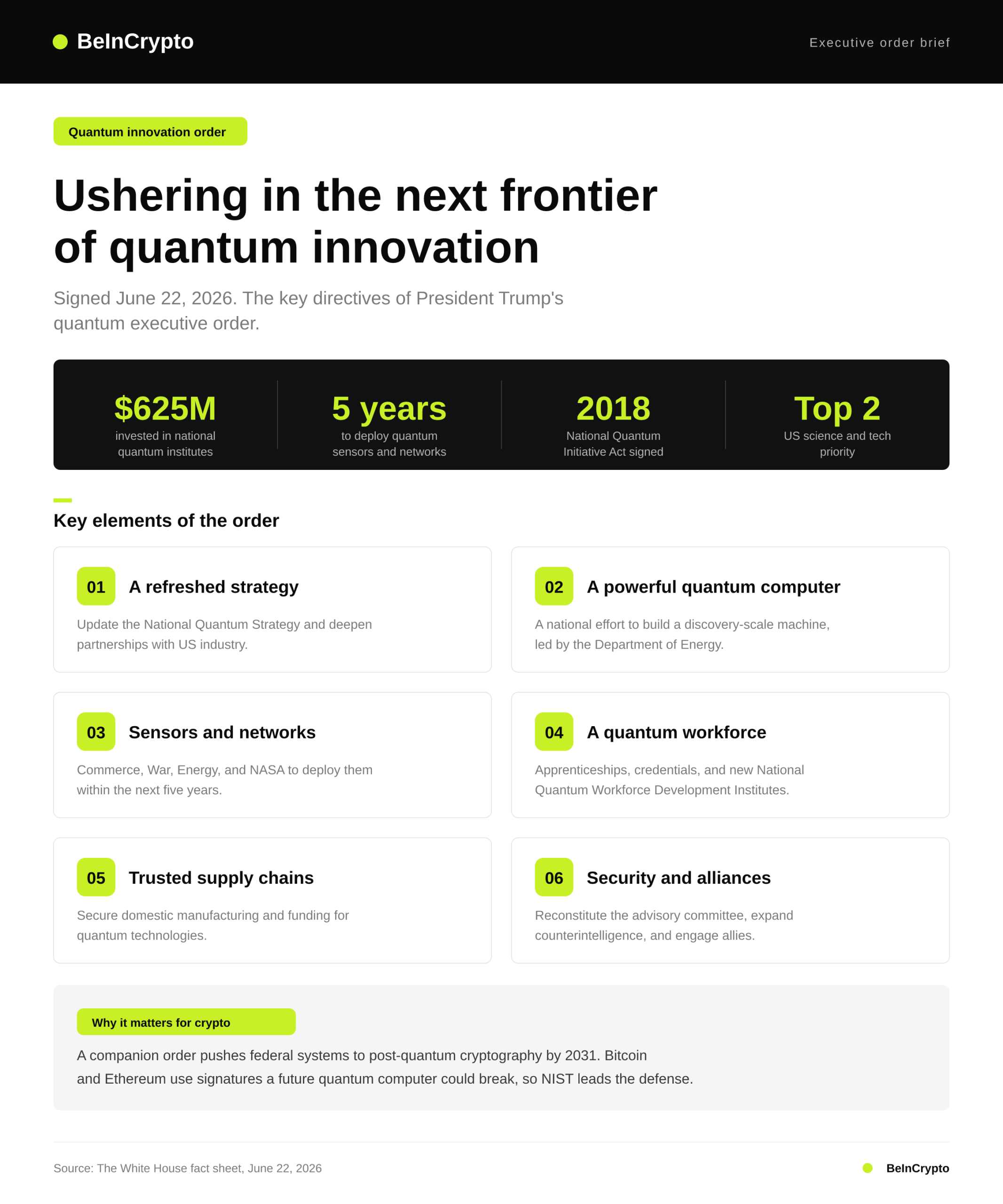
President Donald Trump signed two quantum executive orders on Monday. They push federal agencies toward quantum-resistant encryption and a more powerful quantum computer.
The orders revive a long-running question about quantum risks to Bitcoin and cryptocurrency in general. One sets a 2031 deadline for post-quantum cryptography, while the other targets quantum computing.
What the Quantum Executive Orders Do
The cryptography order accelerates a deadline that ran to 2035 under the 2022 National Security Memorandum-10. Agencies must now reach quantum-resistant standards years earlier.
Federal systems must use post-quantum cryptography for key establishment by the end of 2030. High-impact systems must move their digital signatures to the new standards by the end of 2031.
The order also tasks the Commerce Department and NIST with a pilot migration project. Federal systems should convert by the end of 2027, while CISA supports critical infrastructure operators.
A companion order is titled “Ushering in the Next Frontier of Quantum Innovation.” It launches a national push for a quantum computer that handles major scientific work.
The order also funds quantum sensors and networks over the next five years.
Officials frame the cryptography order around a threat called harvest now, decrypt later. Adversaries can store encrypted data today and try to unlock it once quantum machines mature.
That is a long-discussed risk to crypto holdings.

“The first Executive Order launches a national effort to produce a Quantum Computer capable of performing important scientific calculations, and to develop quantum-enabled sensors and networks in the next 5 years,” Trump remarks.
Follow us on X to get the latest news as it happens
What it Means for Crypto Security
Bitcoin (BTC) and Ethereum (ETH) secure ownership with elliptic-curve signatures. A large enough quantum computer running Shor’s algorithm could derive a private key from a public key.
The risk centers on coins whose public keys are already visible on-chain.
That exposure, often called Q-Day, gains a firmer government deadline through these orders. The timeline still gives developers room to respond.
The defensive tools already exist. NIST finalized three post-quantum standards on August 13, 2024, including ML-DSA for digital signatures.
Bitcoin contributors have floated a Bitcoin quantum migration plan and quantum-safe soft forks to adopt them.
Few researchers see urgency. A 2022 University of Sussex study estimated about 1.9 billion physical qubits to break a key inside Bitcoin’s block window.
Google’s Willow chip held just 105 qubits in December 2024, so many treat the threat as not an immediate risk.
Markets showed no immediate reaction. Bitcoin traded near $64,200 and Ethereum near $1,730, each up about 1% over 24 hours.

The orders set deadlines for government systems, not for decentralized networks.
Washington also holds the asset at stake, having established a Strategic Bitcoin Reserve in March 2025.
Bitcoin’s contributors moving as fast as federal agencies remains an open question.
The post Trump Signs Quantum Executive Orders: What Do They Mean for Crypto Security? appeared first on BeInCrypto.

Key Highlights
-
SBET shares climb following Ethlabs nonprofit announcement
-
SharpLink invests in independent Ethereum research organization
-
New nonprofit aims to enhance Ethereum institutional infrastructure
-
Ethlabs pursues improved settlement speed for enterprise users
-
Founding members include prominent Ethereum Foundation veterans
Shares of SharpLink, Inc. advanced 1.43% to close at $5.37 following the company’s participation in launching Ethlabs. This newly formed nonprofit entity aims to advance Ethereum research while building infrastructure suited for institutional deployment. During the trading session, SBET briefly touched $5.55 before settling lower.
New Nonprofit Receives Backing From Multiple Ethereum Supporters
SharpLink contributed funding alongside Bitmine Immersion Technologies, Joe Lubin, Anchorage, Octant, and SNZ to establish Ethlabs. The initiative operates as an independent nonprofit dedicated to advancing Ethereum’s technical capabilities. Priority areas include institutional finance requirements and supporting expanded onchain operations.
The organization was cofounded by five former senior-level researchers from the Ethereum Foundation. This founding team consists of Ansgar Dietrichs, Barnabé Monnot, Caspar Schwarz-Schilling, Josh Rudolf, and Julian Ma. Their collective expertise spans protocol finality, network scaling, data availability solutions, economic modeling, and virtual machine architecture.
The new entity offers these researchers consistent financial backing within a structured operational framework. Ethlabs maintains full autonomy from its financial contributors regarding research direction. Leadership retains complete authority over technical choices and overall development objectives.
Research Priorities Target Infrastructure Improvements
Initial research efforts will concentrate on accelerating settlement times, enhancing cross-network interoperability, and expanding Ethereum mainnet throughput. The organization will additionally support native digital asset creation and transfer mechanisms across interconnected blockchain systems. These developments could enable institutions to utilize Ethereum with improved efficiency, security, and predictability.
Rising adoption of stablecoins and tokenized real-world assets is expected to drive increased demand for robust Ethereum infrastructure solutions. Investment funds and automated trading systems may require enhanced settlement mechanisms and data processing capabilities. Consequently, Ethlabs intends to refine common standards that support applications throughout the ecosystem.
Having operated for over ten years, Ethereum currently underpins a substantial decentralized finance landscape. Nevertheless, broader institutional integration demands greater throughput and reliable cross-chain communication protocols. Ethlabs addresses these challenges through focused protocol research and infrastructure enhancement initiatives.
Governance Model Ensures Research Autonomy
A third-party grants administrator will oversee contribution vetting, asset assessment, and capital distribution processes. This arrangement maintains separation between financial backing and decisions regarding research initiatives and technical focus areas. The organization commits to publishing quarterly transparency reports alongside annual independent audits.
SharpLink characterized this investment as aligned with its commitment to Ethereum’s sustainable growth. The firm maintains ETH holdings and engages in initiatives designed to fortify Ethereum’s enterprise-grade infrastructure. This participation connects SBET’s corporate objectives with ongoing expansion throughout the Ethereum network.
Meanwhile, Ethereum’s development landscape continues evolving toward multiple independent research and governance entities. The Ethereum Foundation maintains its foundational mission while external organizations pursue complementary technical initiatives. Ethlabs enters this ecosystem with direct financial support from corporate entities and established community stakeholders.

Crypto startup Fomo has raised $75 million in a Series B funding round led by venture capital firm Index Ventures, which valued the social trading and token discovery platform at $550 million.
The funding round also received participation from Union Square Ventures and the company’s existing investor, Benchmark, along with angel investors including Zynga co-founder Mark Pincus, Eventbrite co-founder Kevin Hartz, Discord CEO Humam Sakhnini, Nexos AI co-founder Tomas Okmanas and others, Fomo announced on Monday.
Fomo allows users to trade assets across multiple blockchains without having to manually bridge funds or handle gas fees. The company said it has attracted more than 625,000 traders since launching a year ago, generating $4 billion in trading volume and 110 million social interactions.
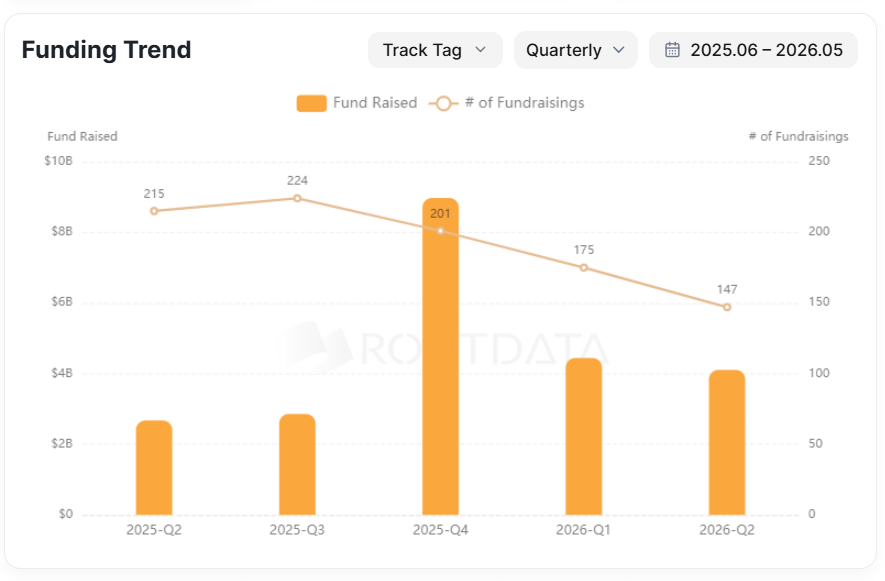
The raise adds to a growing list of crypto venture deals in 2026, even as digital asset prices remain below recent highs. According to RootData, crypto startups raised $4.1 billion across 147 funding rounds during the second quarter.
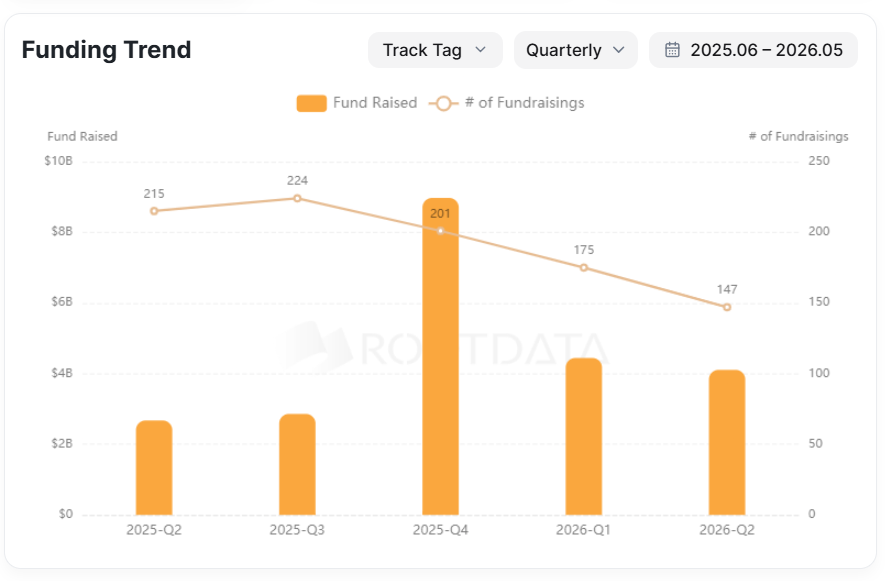
Crypto and Web3 funding by quarterly sum. Source: Root Data
Fomo says 68,000 users made first crypto purchase on platform
Fomo said more than 68,000 users made their first cryptocurrency purchase on the platform using Apple Pay, representing roughly $25 million in transaction volume.
Related: Kalshi in early IPO talks with investment banks: Report
Crypto research firm Delphi Digital said in a December X post that the platform’s social features may be helping attract users by making trading feel “more like scrolling a feed than sitting at a terminal.”
“In November, @fomo_family generated more monthly fees than Moonshot, despite being a younger product with lower fees,” Delphi Digital wrote.
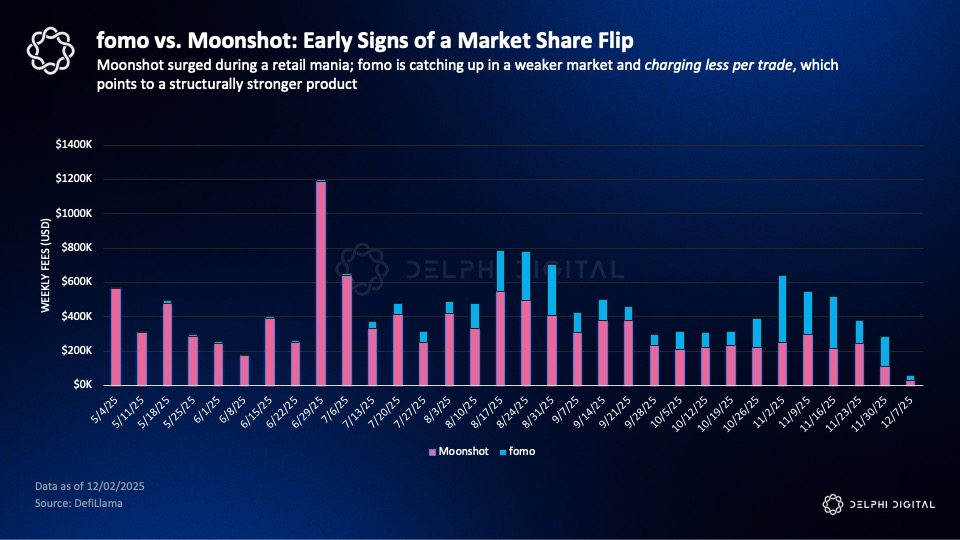
Source: Delphi Digital
Fomo allows users to view trades made by other users in real time and execute similar trades across multiple blockchains without manually bridging assets or managing separate wallets.
Other crypto exchanges offering copy-trading features include Binance, Bybit, OKX, Bitget, BingX, MEXC, Gate.io, KuCoin, Phemex and BitMart.
On June 11, Fomo launched perpetual futures contracts powered by Hyperliquid for users outside the United States. On June 2, the company said it had surpassed $2 million in referral fees paid to users.
Magazine: The legal battle over who can claim DeFi’s stolen millions
Secret Network's cross-chain bridge to Axelar has been suspended after an attacker exploited a years-old minting flaw to drain $4.67 million in wrapped tokens over seven undetected days. Both teams disclosed the incident on June 19, confirming approximately $4.67 million in assets were taken from… Read the full story at The Defiant
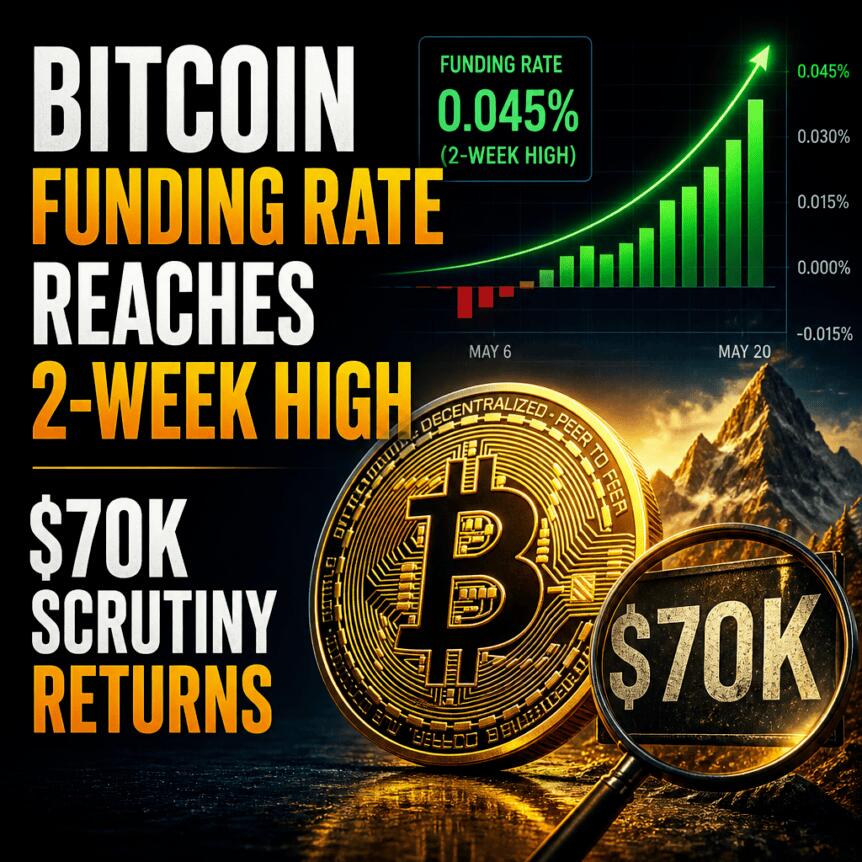
Bitcoin edged toward the $65,500 area on Monday as traders leaned more bullish on derivatives—an uptick reflected in rising perpetual futures funding rates. Yet the broader risk backdrop remained cautious, with US-listed spot Bitcoin ETF outflows continuing to drain demand and keeping a near-term push toward $70,000 on hold.
Optimism showed up in leverage as well. The annualized funding rate on Bitcoin perpetuals jumped to 7%, its highest level in nearly three weeks and a move that typically aligns with stronger long-side confidence. Still, the market’s full picture was mixed, with options positioning turning more defensive and traditional assets failing to provide the kind of risk-on tailwind that often supports breakout bids.
Key takeaways
- Bitcoin perpetual futures funding rose to 7% (highest in nearly three weeks), indicating growing bullish confidence among leverage traders.
- Put demand outpaced calls on Deribit, with the put-to-call premium ratio more than double, suggesting traders increasingly sought downside protection.
- Order-book liquidity improved: aggregated bids on major exchanges exceeded offers by about $12 million, helping limit bearish read-through from weaker spot levels.
- Macro signals stayed cautious as stocks, bonds, and gold weakened together, and higher US Treasury yields pointed to elevated return requirements for capital.
- Spot Bitcoin ETFs recorded continued outflows, with CoinGlass data citing $228 million in net outflows the prior week—likely a headwind for any rapid $70,000 attempt.
Derivatives confidence rises, but options show hedging
The most direct read on trader sentiment came from Bitcoin perpetuals. According to Laevitas data, the annualized funding rate climbed to 7% on Monday, a sign that long positions were paying more to remain open. While that figure remains within the often-cited neutral 6%–12% band, the jump to the highest point in nearly three weeks suggests bulls gained ground over the weekend into Monday.
Crude oil also contributed to the day’s tone. Brent fell to $77.50, its lowest level since March, which can ease inflation- and risk-premium concerns in broader markets. For Bitcoin, that kind of macro relief sometimes helps lift short-term demand—especially when derivatives liquidity supports it.
However, options data signaled that traders were not fully committing to upside. Laevitas-referenced Deribit metrics showed put (sell) options demand running more than twice ahead of call activity on Monday. This skew has leaned bearish since Friday, representing a reversal from the prior week’s direction. In practice, that combination—higher perpetual funding alongside heavier put buying—often points to a market that is still trying to grind upward, but with active hedging in case price fails to follow through.
Order books improve even as traditional markets stay risk-averse
Bitcoin’s immediate price action around $65,000 did not appear to be driven by a lack of depth. CoinGlass data referenced in the report showed that bids on aggregated major exchange order books exceeded offers by about $12 million on Monday, reversing the weekend trend.
That matters because a failure to hold a key level can sometimes reflect fading liquidity and widening spreads. With the order-book imbalance turning more supportive, Monday’s inability to firmly reclaim higher territory looks more like timing and positioning than a structural sell-side pressure shift.
At the same time, the macro backdrop stayed uneven. Nasdaq 100 futures slipped about 1% as artificial intelligence-related stocks weakened. In company-specific news, SpaceX shares dropped sharply after the company announced plans to raise debt despite holding more than $100 billion in cash. Investors appear to have focused on the possibility that the sector may need higher funding and longer timelines before profitability.
Beyond equities, gold fell roughly 0.9% on Monday while US government bonds were also pressured as yields rose. The report attributed the move in yields to investors demanding higher returns—potentially reflecting inflation concerns or the market anticipating dilution effects tied to rising US government debt levels.
With stocks, bonds, and gold moving lower together, the day looked less like a broad risk-on session and more like investors preferring cash. That is the kind of environment where Bitcoin can still trade firm on crypto-native signals, but breakouts tend to struggle unless ETF flows and broader momentum align.
Corporate and liquidity cues: Strategy’s reserve update helps, but ETFs still weigh
A portion of market attention also focused on Strategy (formerly MicroStrategy), whose Bitcoin holdings make it a bellwether for institutional-style accumulation. Shares of Strategy traded about 13% below the roughly $64.1 billion cost to acquire 847,363 BTC, as investors weighed whether the company might need to sell assets to meet obligations. The report noted Strategy had debt of about $6.75 billion and that earlier worries centered on reserve liquidation risk.
Those concerns eased somewhat after Strategy announced an additional cash position—described as a $300 million reserve acquisition—referenced via earlier Cointelegraph coverage. The development matters because it reduces the immediate need for forced selling in a volatile tape, which can support sentiment around large, long-duration Bitcoin holders.
Even with those internal crypto-industry positives, the external demand channel remained a drag. The report pointed to continued weakness in US-listed Bitcoin ETFs. According to CoinGlass data cited, Bitcoin spot ETFs logged $228 million in net outflows in the prior week. The narrative significance is straightforward: when ETF balances decline week after week, it can reduce the marginal buyer that often complements derivative-led optimism.
In that context, the odds of a quick, clean rally to $70,000 look limited. Higher funding and improving order-book bids can push prices upward, but persistent ETF outflows can cap how far those pushes travel—especially when options positioning indicates traders are actively preparing for downside volatility.
As traders watch the tape, the tension to monitor is clear: derivatives are showing confidence (funding at 7% and stronger order-book bids), while options and traditional markets reflect caution (put skew, weaker macro complex) and ETF flows continue to drain fresh spot demand.
Going forward, investors will likely focus on whether ETF outflows slow or reverse and whether the options hedging trend on Deribit keeps deepening. If funding stays elevated while put demand cools and spot ETF flows stabilize, Bitcoin could gain the momentum needed to test higher levels more convincingly. If not, Monday’s signals may translate into choppy consolidation rather than a sustained breakout.
The Bank of England has abandoned previous proposed rules on stablecoins in its final policy and draft rules.
The latest revisions were made in response to widespread concern that the rules would stand in the way of the market’s growth and development.
Relaxed Rules
The central bank revealed on Monday that it has scrapped its plans to cap individual holdings, instead choosing to limit total issuance per stablecoin, which was initially set at $52.8 billion.
“This is a major milestone in delivering greater choice and innovation in UK payments,” said Deputy Governor for Financial Stability Sarah Breeden.
Per the bank, the new guardrail will allow systemic stablecoin firms to run viable operations and “support daily volumes and transactions” as compared to other systems.
Additionally, the BOE has reduced its requirements on backing assets, increasing the figure to 70% from 60%, which is the share of backing assets that can be held in short-term government debt. Meanwhile, the rest must now be held in central bank deposits that don’t bear any interest.
Breeden believes that innovation depends on trust and that the new guidelines will build confidence in stablecoins by ensuring quick redemptions, strong consumer protections, and Central Bank backing.
The BOE Still Has Reservations
The BOE has also warned that while stablecoins can make payments faster and cheaper for cross-border transactions, their growing adoption could reduce bank deposits and potentially affect lending and borrowing costs.
Stablecoins are here to stay, though, with most crypto executives viewing them as tools to unlock working capital and enhance treasury operations. A recent survey conducted by Ripple found that 72% of institutions believe that offering these digital assets is key to remaining competitive in the market.
The post UK Central Bank Eases Stablecoin Rules Following Market Response appeared first on CryptoPotato.

Hu Shi is allegedly a senior member of Prince Group, which has been sanctioned by the U.S. government
Tokyo Metropolitan police have arrested alleged crypto crime kingpin Hu Xiaowei, aka Hu Shi, after tracking his movements across various luxury hotels in Osaka.
Hu is believed by police to be a high-ranking member of Prince Group, which CryptoPotato has reported is responsible for high-level pig-butchering scams and investment fraud totaling $15 billion in Bitcoin.
Tokyo Arrest: Prince Group Crypto Kingpin Hu Xiaowei (Hu Shi) Nabbed – Linked to $15B Bitcoin Scam Empire
According to Asahi Shimbun, Tokyo police arrested Hu Xiaowei (Hu Shi), a senior figure allegedly tied to Cambodia-based Prince Group, one of Asia’s largest transnational… pic.twitter.com/n3hT8vE2hA
— Wu Blockchain (@WuBlockchain) June 22, 2026
Fall of an empire
Prince Group is one of Asia’s largest organized groups, operating at least 10 scam compounds staffed at the height of its power. The suspected leader of the group, Chen Zhi, was arrested in Cambodia and extradited to China in January.
The U.S. government sanctioned 146 entities linked to the group in October 2025, and the British government has blacklisted several individuals for alleged ties to the Prince Group.
A national of Cyprus and Cambodia, Hu Shi is currently charged with submitting a fraudulent change-of-address form to obtain permanent residency in Japan.
Two Chinese nationals were arrested for submitting paperwork on his behalf. Tokyo police said that the individual named Chen Xiao’er on the U.S. sanctions list is the same person as the Hu Shi they now have in custody, and that a wider investigation into Prince Group and Hu’s involvement is still underway.
The post Major Figure in $15 Billion Bitcoin Scam Network Arrested in Tokyo appeared first on CryptoPotato.
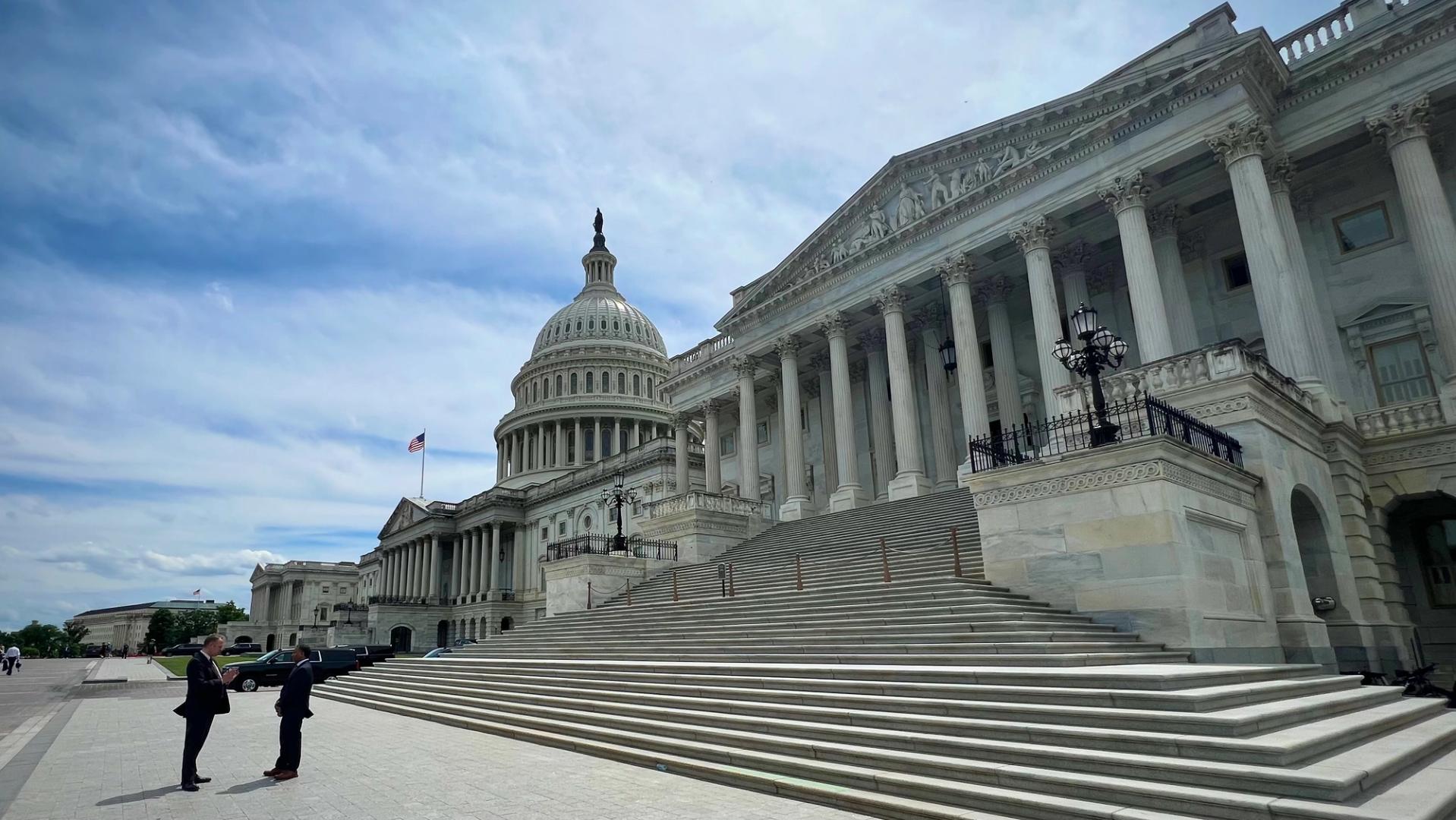
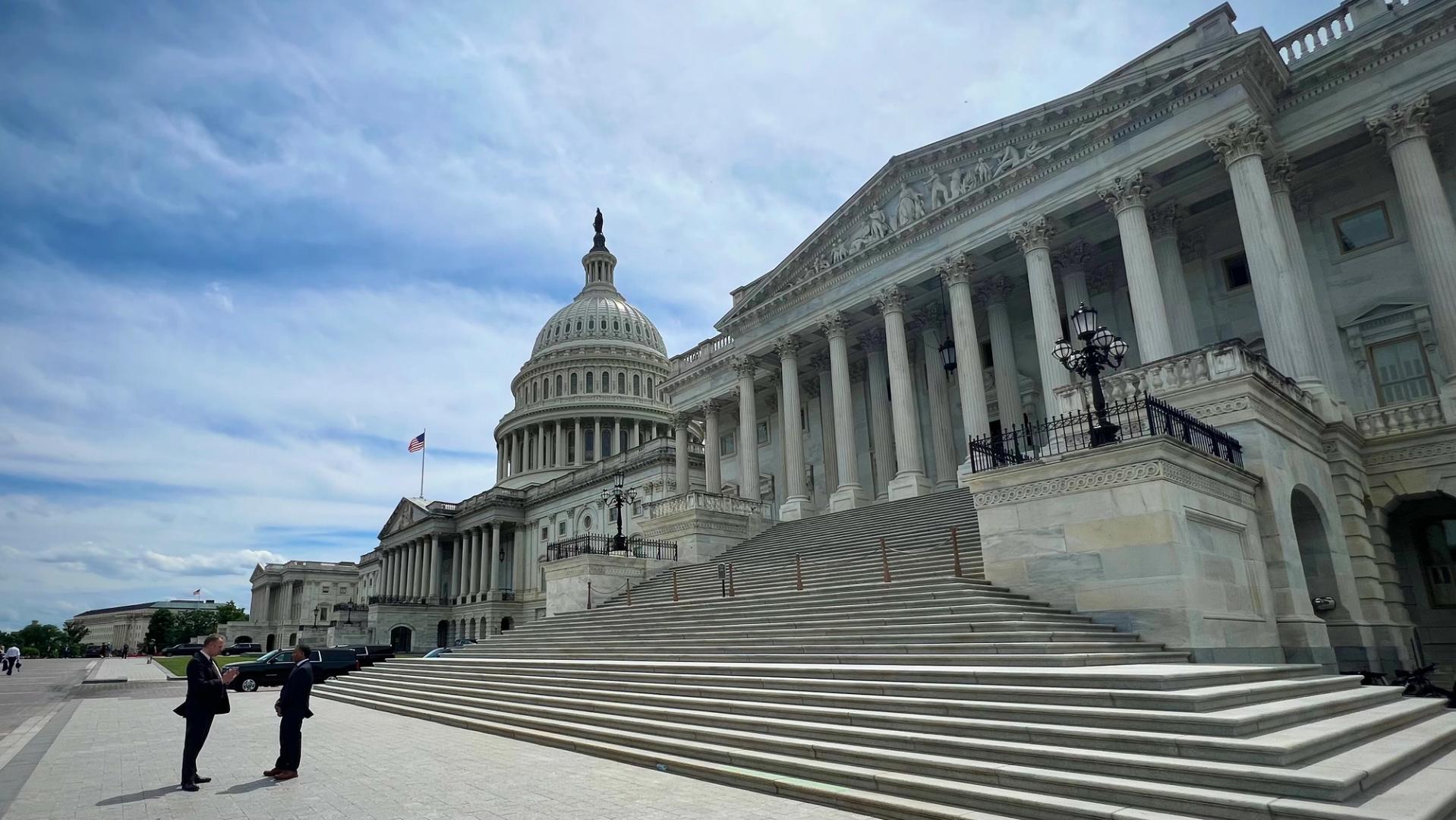
Thanks to the newly passed U.S. Senate housing affordability bill, the Federal Reserve may be heading toward a formal ban from instituting a digital dollar in the form of a central bank digital currency (CBDC), despite the fact the Fed wasn’t working on such a project.
Republican politicians had embraced an aggressive opposition campaign against the U.S. following in European and Chinese footsteps in the pursuit of a CBDC, labeling the idea a dangerous overreach of government surveillance. So they insisted it get inserted into the 21st Century ROAD to Housing Act that just passed the Senate in an 85-5 vote Monday night.
The concept of a digital dollar likely would have needed the backing of the White House, Congress and the Federal Reserve, none of which pushed to pursue one. But if the House of Representatives follows suit and votes to send the housing bill to President Donald Trump for his signature, the CBDC will be legally stifled.
However, the ban would only last for a very limited four years until the end of 2030.
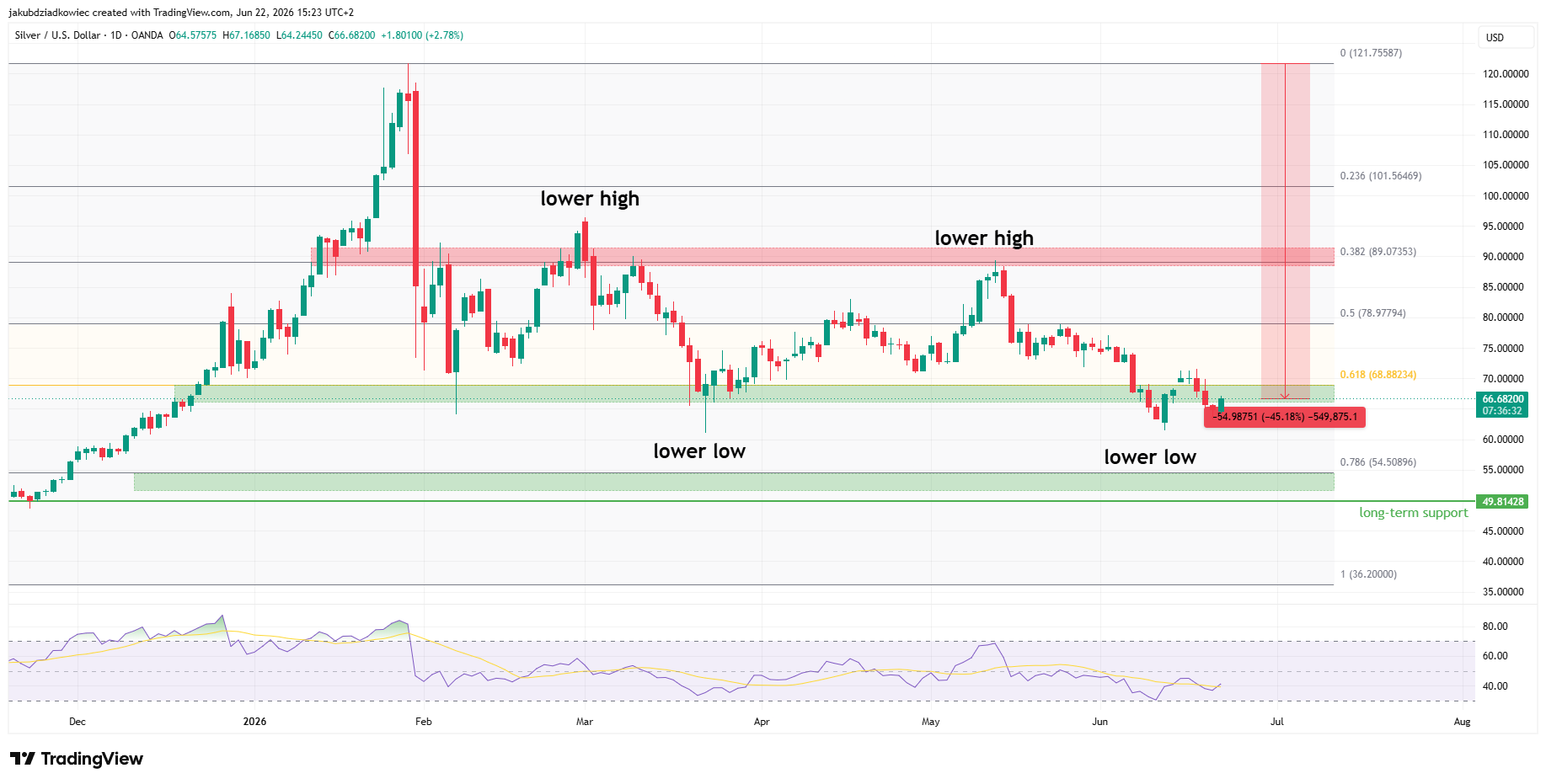
Silver is fighting to reclaim $69 after a near 3% bounce, yet the metal trades 45% below its January record and sits at a level that will decide its next major move.
The rebound tracks easing Middle East tension as a days-old US-Iran ceasefire holds. However, a stronger dollar and a cautious Federal Reserve keep pressure on precious metals, leaving silver caught between recovery and a deeper slide.
Why Kiyosaki Is Watching Silver but Not Buying Yet
Silver (XAG) climbed to around $66.7 on Monday, up close to 2.8% on the day. The move followed a ceasefire that drained the safe-haven demand that had earlier powered metals.
Robert Kiyosaki, author of Rich Dad Poor Dad, said this week that he is waiting before adding to gold, silver, Bitcoin (BTC), and Ethereum (ETH). He argues that the macro environment, not falling prices, signals when to buy.
Kiyosaki gave no price target and no timeline. That leaves one question for traders. What would a genuine reversal look like on silver’s chart?
The Make-or-Break Level at $68.88
On the four-hour chart, silver has slipped below the 0.618 Fibonacci retracement at $68.88 and is fighting to win it back. The level marks the pivot for the next leg.
Independent analyst Kamile Uray flags $63 as the support that has held so far. A break above $71 would open the door toward the $77 to $89 resistance zone.
A close back above that band would suggest the rebound has more room. Until then, the metal stays trapped between $63 support and $71 resistance.
XAG Price Prediction Hinges on the $68.88 Line
The daily chart shows silver in a clear downtrend since January. It has printed successive lower highs near $96 and $89 and matching lower lows.
The price now sits about 45% below its $121.76 record, a sign the correction is widening. The Relative Strength Index (RSI) has ticked up near 40 but stays below the neutral 50 mark.
Reclaiming the retracement at $68.88 would shift focus to $79, then to the $89 resistance band. Losing it points toward $55, the 0.786 level that aligns with long-term support.

That makes $68.88 the line Kiyosaki’s awaited reversal must clear. A weekly close above it would signal the turn, while a rejection keeps the bearish structure intact.
For now, the trend favors sellers until silver proves it can hold above that mark.
The post Silver Faces Make-or-Break Level, Will Price Keep Dropping? appeared first on BeInCrypto.


President Donald Trump has signed two executive orders designed to accelerate U.S. quantum computing development and prepare federal agencies for the potential security risks posed by future quantum machines.
Summary
- Trump signed two executive orders to accelerate U.S. quantum computing development and prepare agencies for future encryption risks.
- The orders direct intelligence officials to assess the impact of advanced quantum computers and the transition to post-quantum cryptography.
- Bitcoin, Ethereum, and Algorand communities are already exploring different strategies to protect blockchain networks from future quantum threats.
According to the White House, Trump approved the measures on June 22 as part of a broader effort to strengthen American leadership in quantum technologies, a field widely viewed as critical for future advances in computing, communications, and cybersecurity.
Speaking during the signing event, Trump said “quantum technologies represents the next generation of innovation across computing, sensing, and networking,” adding that the sector carries significant implications for economic growth, scientific research, and national security.
The first order, Executive Order 14411, establishes the Quantum Computer for Application Development and Discovery Science, or QC-ADDS, initiative. Under the directive, the Department of Energy must identify technical requirements for an advanced quantum computer within 90 days and work toward deploying at least one such system at a federal research facility.
The Department of Commerce is also tasked with exploring ways to encourage participation from private-sector quantum computing companies.
Additional provisions require federal agencies, including NASA, the Department of Energy, the National Science Foundation, and the Department of Commerce, to develop five-year plans for advancing quantum sensing and networking technologies.
The order also includes measures aimed at strengthening domestic supply chains, expanding the quantum workforce, and increasing protections for sensitive research.
Federal agencies are assessing post-quantum security risks
Of particular interest to the crypto industry, the order directs intelligence agencies to assess how increasingly powerful commercial quantum computers could affect national security, including the transition to post-quantum cryptography.
The directive arrives as concerns persist over the hypothetical arrival of “Q-Day,” the point at which quantum computers become capable of breaking encryption systems that currently secure financial networks, government infrastructure, and blockchain wallets.
While no existing quantum computer poses such a threat today, policymakers and cryptography experts have increasingly called for preparations to begin before the technology reaches that stage.
According to a recent report from Coinbase’s independent advisory board of cryptography experts, the Bitcoin community should start planning a migration path to post-quantum cryptography rather than waiting until quantum computing becomes an immediate concern. The report stated that uncertainty surrounding future advances in the field justifies early preparation.
Crypto projects are already preparing for future threats
Discussions around quantum-resistant security have also expanded beyond Bitcoin.
Recently, Binance founder Changpeng Zhao proposed a future migration period for Bitcoin holders following any transition to quantum-resistant cryptography. Zhao argued that vulnerable legacy addresses should not remain exposed indefinitely if quantum computers eventually become capable of breaking existing security models, while emphasizing that any protocol change would require community consensus.
Elsewhere, researchers associated with the Ethereum Foundation’s Kohaku privacy project have suggested that Ethereum accounts could begin adding certain post-quantum protections without waiting for a hard fork. According to Kohaku lead Nico, wallet-level protections could be introduced through smart contract logic while longer-term protocol upgrades continue to be explored.
Meanwhile, the Algorand Foundation has released a roadmap intended to make the layer-1 network broadly quantum-resilient by the end of 2027. The foundation said the initiative will cover user accounts, wallets, developer tools, staking infrastructure, and consensus systems.
As governments increase investment in quantum computing research, blockchain developers and cryptography experts are increasingly examining how existing security systems can be upgraded before quantum computers become capable of challenging today’s encryption standards.

Exxaro Resources Limited (EXXAF) Analyst/Investor Day Transcript

Trump Signs Quantum Executive Orders: What Do They Mean for Crypto Security?
The 11 best prequel series you can binge right now

No Jackpot Winner as $257 Million Prize Rolls Over to $269 Million Monday Draw

Blockchain.com files with SEC for U.S. IPO

Israel says it has killed new Hamas military leader in Gaza City airstrikes

Listen to This Prayer for a Financial Miracle This Week

PAISE KE UPAR VIRAT KOHLI NE KYA KAHA? #viratkohli #paisa #money #one8 #shoes #karanaujla

Miracle Prayers for Financial Help #prayer #jesus #prayer #shorts #shortsfeed #viral
-

 Fashion3 days ago
Weekend Open Thread: Miami – Corporette.com
-
 Tech6 days ago
The Adder At The Heart Of Intel’s 8087 FPU
-

 Entertainment2 days ago
Renter of Home in Anne Heche Crash Denies Settlement With Son
-

 Tech12 hours ago
Microsoft accidentally kills epic Outlook email threads
-

 Business2 days ago
Soccer-U.S. defends Iran World Cup travel restrictions, says discussions ongoing
-
 Business3 days ago
Wall Street Week Ahead: Investors see Micron earnings as pulse check of AI rally momentum
-

 Politics4 days ago
BBC Reporter Discusses Cross Party Criticism Of Trumps Iran Deal
-

 Tech4 days ago
AWS enters the context layer race with a graph that learns from agents, not manual curation
-

 Crypto World3 days ago
HIVE shares jump as $220M AI deal speeds Bitcoin mining pivot
-
 Crypto World3 days ago
Can Charles Hoskinson Really Rescue Cardano?
-

 Crypto World3 days ago
Jake Chervinsky accuses CME of protecting derivatives monopoly
-

 Tech4 hours ago
Nearly 7,000 fake Amazon domains registered ahead of Prime Day 2026, researchers warn
-

 Sports4 days ago
FIFA World Cup 2026: Canada beat 9-men Qatar 6-0 to register first ever win | FIFA World Cup 2026
-
 Business2 days ago
MHP SE 2026 Q1 – Results – Earnings Call Presentation (OTCMKTS:MHPSY) 2026-06-20
-

 Business4 days ago
Brexit cost 6% of UK economy, Bank of England company data suggests
-

 Politics3 days ago
Andy Burnham and the meaning of Makerfield
-
 Tech1 day ago
Signal’s Meredith Whittaker says AI chatbots ‘are not your friends’ and calls Copilot agents a backdoor
-

 Crypto World5 days ago
Anthropic’s Dario Amodei Urged AI Unity at G7, Even as US Banned His Models
-

 Crypto World7 days ago
Robinhood opens AI-powered trading to all users, sending HOOD stock past $100
-

 Tech5 days ago
Weeks Of In-The-Field Testing And A Verdict
You must be logged in to post a comment Login