The UK is set to bake in record-breaking temperatures which could soar to more than 38C as extreme heat warnings and health alerts have been issued.
According to the Met Office, the sweltering heat could last until at least Thursday, sparking weather warnings and concerns for vulnerable people.
Forecasters have said there is “growing confidence” this week could break the record for the hottest June temperature of 35.6C, which was set in 1976 in Southampton.
The UK Health Security Agency (UKHSA) warned people to expect significant impacts across health and social care services along with a rise in deaths, particularly among those aged 65 and over or with health conditions.
Advertisement
The extreme heat could also bring disruptions to rail, road and air travel, with the possibility of some tarmac melting, according to the Met Office.
It’s important to know the rules when it comes to sunbathing, especially if you plan to strip off to avoid tan lines.
Nick Ross, law lecturer at ULaw, states: “It may be surprising to find out that topless sunbathing is perfectly legal for both men and women in the UK.
“Full public nudity is also not a crime but only if the person who strips off has no intention to cause alarm or distress. There are specific offences relating to intentional exposure.”
Advertisement
It’s important to know the rules when it comes to sunbathing – especially if you plan to strip off to avoid tan lines (Image: Getty)
According to the law, it’s not an offence to be naked in public, but it can be an offence if you cause distress or alarm to others.
That means you’re perfectly fine to sunbathe in the nude in your own garden – as long as you don’t intend to upset your neighbours.
This is what the actual law states: “In the absence of any sexual context and in relation to nudity where the person has no intention to cause alarm or distress it will normally be appropriate to take no action unless members of the public were actually caused harassment, alarm or distress (as opposed to considering the likelihood of this).”
So if you live in the countryside with no one overlooking your garden, go ahead but you might want to think again if you live near others.
Advertisement
It’s also recommended that people who want to sunbathe naked should inform their neighbours first.
Nick added: “For those hoping to catch some sunshine in the garden these same rules still apply.
“It’s advisable to let the neighbours know this is what you’re planning or find a part of the garden shielded from view, so you can avoid causing any unnecessary shock or a call to the police.”
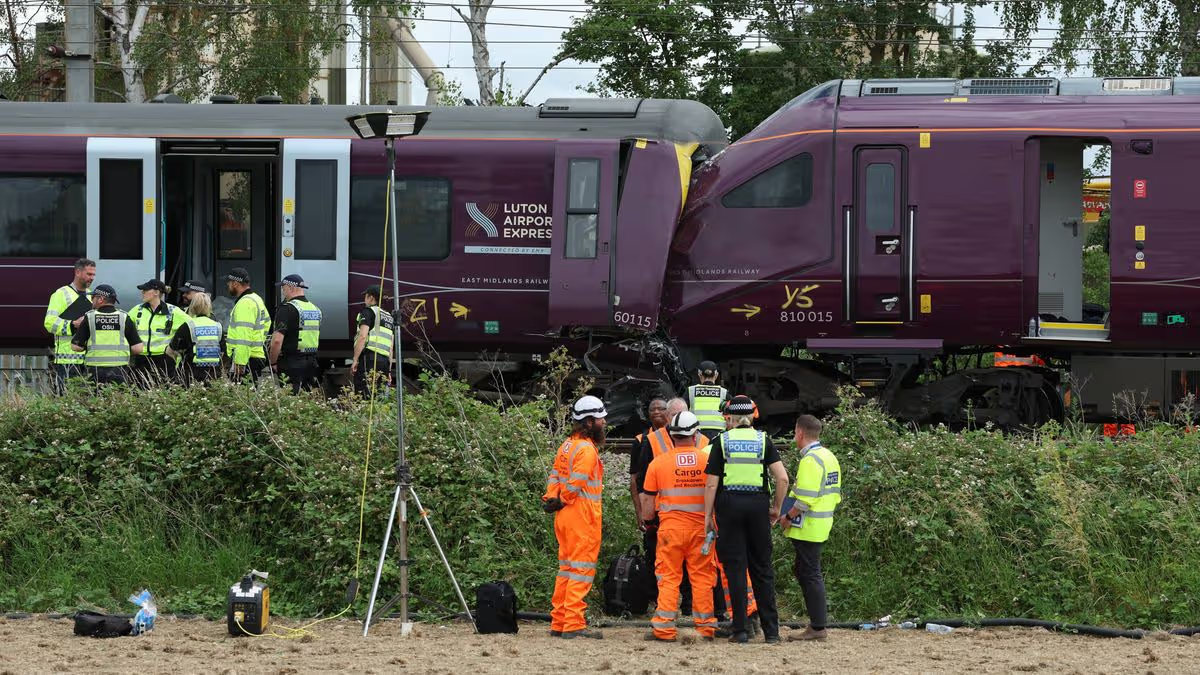
A major incident was declared after two East Midlands Railway trains collided in Bedfordshire on Friday, with dozens still hospitalised
20:18, 22 Jun 2026Updated 20:24, 22 Jun 2026
Eight individuals are battling for survival in hospital following a train collision in Bedfordshire. Over 100 casualties were admitted to hospital and a major incident was declared on Friday (June 19) after two locomotives collided near Elstow in Bedfordshire.
Emergency services were alerted shortly after 5.15pm to reports that two East Midlands Railway trains had crashed. Personnel from the British Transport Police (BTP), Bedfordshire Police, National Police Air Service alongside local firefighters and paramedics rushed to the scene.
Train driver Shaun Burton, 60, perished in the collision. Through police, his relatives expressed: “We are devastated by his loss. Our thoughts are also with those affected by this incident.”
Dave Calfe, general secretary of train driver union Aslef, told the BBC: “We are all heartbroken by the death of Shaun Burton, which leaves a hole in the lives of his family, friends and colleagues that will never be filled.”
Deputy Chief Constable Stuart Cundy, from the BTP, said: “First and foremost, the thoughts of everyone at BTP are with the driver Shaun Burton’s family and colleagues, and all those injured and affected by the collision on Friday.”
Advertisement
Dep Ch Const Cundy went on to state that the investigation is being treated as a “priority” for the BTP, with the senior investigating officer collaborating closely with the Rail Accident Investigation Branch to determine what occurred. He confirmed that personal belongings have been retrieved from the trains.
The officer added: “Friday evening witnessed an awful incident that presented complexities and challenges for all those who responded. I have been humbled by the actions of passengers and staff who were on the trains, and by the professionalism of our officers, the wider emergency services and partners.
“The recovery operation is now underway, and work continues this week to remove the damaged trains and carriages and allow the railway to reopen.”
Advertisement
Anyone affected by the incident is urged to get in touch with the BTP.
Ensure our latest stories always appear at the top of your Google Search by making us a Preferred Source. Click here to activate or add us as your Preferred Source in your Google search settings.
Despite being “caught redhanded”, Lord Justice Colton held that he was still entitled to credit for admitting his crimes
21:57, 22 Jun 2026
Advertisement
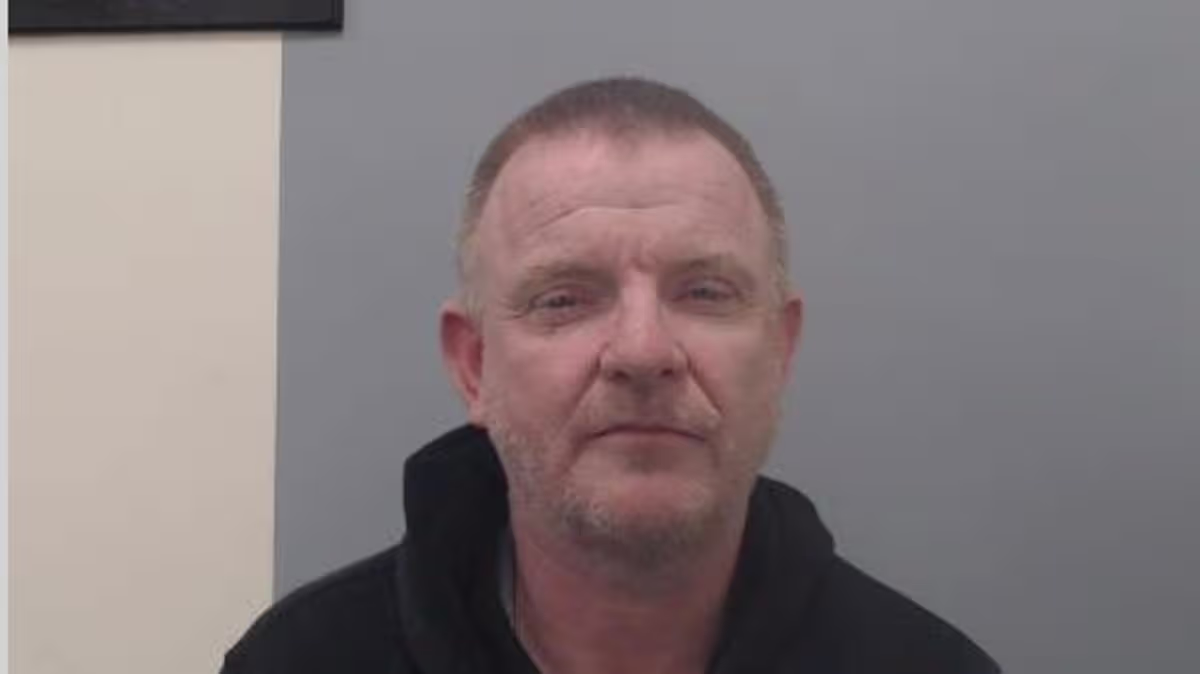
A County Tyrone man jailed for smuggling “massive quantities” of high quality cannabis into Northern Ireland has won a legal battle to secure a reduced sentence.
The Court of Appeal ruled the term imposed on Barry McMoran, 50, for bringing in a consignment worth up to £1million is to be cut from 12 to 10 years.
But senior judges dismissed co-defendant Thomas Taggart’s challenge to the six-and-a-half year sentence handed down for his role in the operation.
Both men were detained after police seized 204 kilos of cannabis in Coalisland in May 2024.The illicit consignment was hidden inside two concrete blocks. The two defendants travelled to England separately to carry out the transaction, returning later on a ferry from Cairnyran.
Advertisement
Taggart, 39, from Sullenboy Park in Cookstown, was driving a Mitsubishi towing a trailer containing the drugs.
Days earlier he had replied to a text message from an associate asking about cannabis, telling him “you can have as much as you want when I get home”.
PSNI officers arrested the men and intercepted the drugs after searching a shed in the Annaghnaboe Road area of Coalisland.
Advertisement
The cannabis had an estimated street value of between £700,000 and £1million, the court heard.
Both men subsequently pleaded guilty possessing a Class B drug with intent to supply, while McMoran also admitted two further offences.
Messages found on his phone indicated involvement in supplying cocaine and cannabis over a period from February until May 2024.
He was assessed as being heavily involved in the drugs trade at a high level.
Advertisement
Appealing against McMoran’s 12-year term, defence barrister Richard McConkey KC claimed it was manifestly excessive.
He disputed the trial judge’s process of imposing consecutive sentences for his client’s separate offences.
Prosecution counsel insisted it had been justified as both a deterrent and a reflection of McMoran’s previous activities.
“This is someone who was operating at the highest echelons of the drug trade,” he submitted.
Advertisement
However, the Court of Appeal ruled that the overall sentence was excessive, instead imposing a concurrent term to cover the scale of the operation and McMoran’s role in it.
Despite being “caught redhanded”, Lord Justice Colton held that he was still entitled to credit for admitting his crimes.
“Those who plead (guilty) on arraignment should be given a very significant discount because it doesn’t happen often enough in this jurisdiction,” he said.
“We allow the appeal and reduce the determinate sentence from 12 years to 10 years.”
Advertisement
McMoran will now serve five years behind bars and five years on licence.
Dismissing Taggart’s challenge, the court identified no basis for interfering with his sentence – also split equally between custody and supervised licence.
“He was involved in a sophisticated, well-planned and resourced criminal enterprise which involved bringing massive quantities of high-quality cannabis into this jurisdiction,” Lord Justice Colton stated.
“Leaving aside the precise nature of his role, it is clear that it was more than subordinate and he was heavily involved in this entire enterprise.”
Kylian Mbappe marks his 100th international cap for France with a brace, moving him second on the all-time World Cup goal scoring list with 16 goals. His performance spearheaded a dominant 3-0 victory over Iraq, securing France’s spot in the last 32 after a two-hour storm delay.
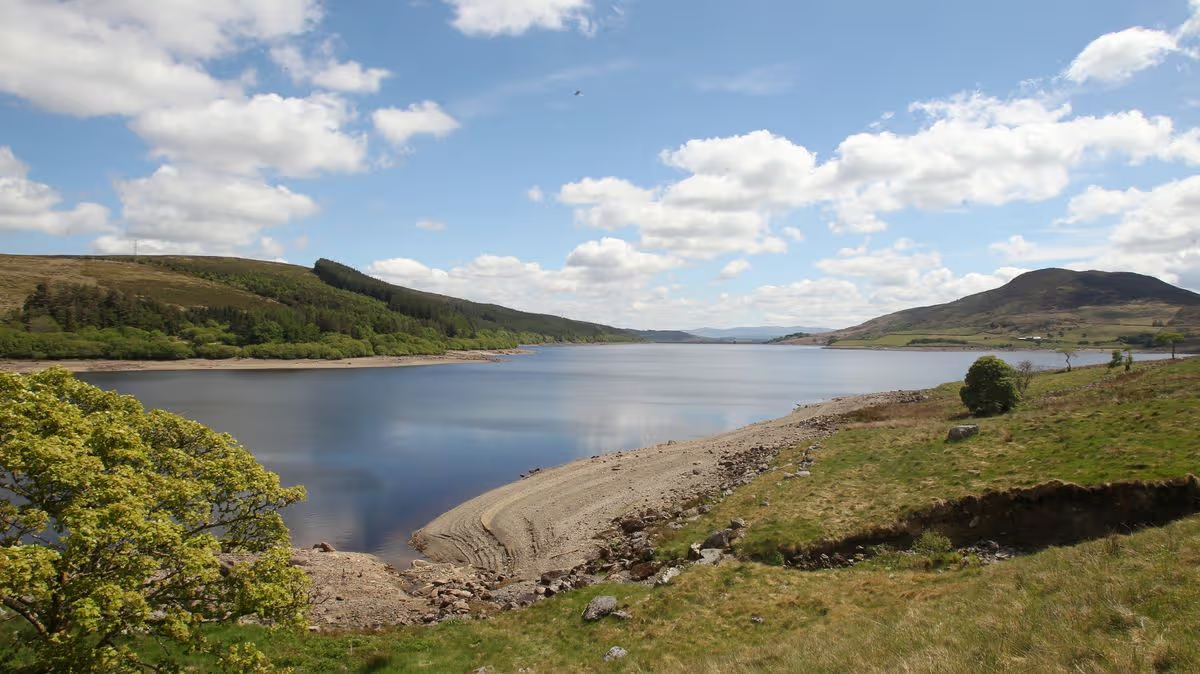
A place where people choose to take a stroll with beautiful views across the water acts as a reminder to many of their abandoned homes and a horrible chapter in their history
It was once a vibrant and traditional Welsh-speaking village before it was completely abandoned, ready to be drowned with no trace in sight.
Advertisement
The flooding of this beloved village still remains a sensitive subject among locals in the area, as they fought tooth and nail to keep their homes in place. Their efforts, unfortunately, were not enough, as the UK government submerged the village completely to supply water to a much larger English city.
In 1965, the village of Capel Celyn, nestled in the Tryweryn Valley in North Wales, vanished without a trace when its contents were left to sink to the bottom of a huge reservoir. It was a controversial move, to say the least, led by the Liverpool Corporation, to supply water to Liverpool and the Wirral.
While for some it may seem like a simple change in construction, for most, this was a change that ran much deeper, and the disruption it caused to this area and the wider Welsh community went on to have a huge effect politically, leading to a rise in support for the Welsh nationalist party Plaid Cymru.
The fight for the village
It was in 1955 that the people of Capel Celyn first learned their homes had been sacrificed for a new site set to transform into a reservoir, and it marked the beginning of a 10-year-long battle.
Soon enough, the villagers formed an alliance, known as the Capel Celyn Defense Committee, which debated, protested, and denounced the scheme throughout the country and into Liverpool. On numerous occasions, this saw them march to Liverpool to make their objections loud and clear.
Despite their efforts, Liverpool councillors voted overwhelmingly to proceed with the plans, and in 1957, a private bill sponsored by Liverpool City Council was brought to Parliament.
All 35 Welsh Members of Parliament who voted opposed the bill, and yet it was still passed in 1962. Three years later, the village and its buildings, including people’s homes, were drowned. In total, there were around 800 acres of land, taken by the water, made up of the school, the post office, the chapel and the cemetery.
Advertisement
There were 48 people who lost their homes out of 67 who lived in the valley, with many left to relocate to entirely new areas and start new lives.
What made this move so controversial was the complete erasure of this traditional Welsh culture, as the village stood as a testament to authentic Welsh culture and its dying language.
The site today
People continue to visit the site. One TripAdvisor reviewer described the place as “beautiful but sad”. They wrote: “This wasn’t my first visit to this beautiful area, but after researching the flooding of the village and being Welsh, we spent more time around where the village once stood.
Advertisement
“There is no doubt the scenery is outstanding, but I also found it to be quite sad; people’s lives were completely upturned, and their entire village was drowned. Well worth a visit, especially if you read the history of the village.”
The reservoir provides a wonderful landscape, backed by the rolling hills of the valley, and many choose to take a walk around the site. To commemorate the village that once was, a memorial chapel stands as a place where people can remember their time there.
Another visitor shared: “Poignant and stunning. The heartbreaking history of this reservoir should never be forgotten.”
Advertisement
There is a good chance the village will be visible this year, as it only nudges above the water’s surface during periods of intense heat. The current heatwave may cause the water level to fall far enough, as happened back in 2018.
Wet bulb temperatures offer valuable insights into atmospheric moisture and human comfort levels.
It plays a vital role in climate monitoring and helps explain the impact of humidity on daily life.
One of the most traditional and widely used measures of humidity is the wet bulb temperature.
Advertisement
The Met Office say: “This value provides insight into how saturated the air is and is essential for calculating other humidity-related variables such as relative humidity and dew point temperature.”
What is a wet bulb temperature?
Measured using a thermometer wrapped in a damp muslin wick, wet bulb temperature represents the lowest temperature achievable through evaporative cooling.
The reading drops as water evaporates from the wick, drawing heat from the thermometer. This cooling continues until the air becomes saturated and can absorb no more moisture.
Advertisement
On foggy mornings or in fully saturated air, wet bulb temperature matches the dry bulb temperature—the actual air temperature.
In all other conditions, the wet bulb reading is lower.
The underlying principle is simple: evaporation requires energy.
Water vapour draws heat from the surrounding air and thermometer, leading to a cooler reading.
Advertisement
The larger the gap between dry bulb and wet bulb temperatures, the drier the air.
When there is no difference, the air is fully saturated and evaporation stops.
Traditionally, wet bulb temperature is measured using a psychrometer—an instrument with paired dry and wet bulb thermometers.
However, most modern weather stations no longer use this classic setup.
Advertisement
“Instead, they rely on two separate thermometers housed in a Stevenson screen: one dry bulb (measuring air temperature) and one wet bulb (wrapped in a moist wick connected to a water reservoir).”
Air moves over both thermometers, allowing evaporation from the wet bulb and resulting in evaporative cooling.
The dry bulb remains unchanged.
The temperature difference helps meteorologists calculate relative humidity and other important humidity metrics.
Advertisement
Modern technology has introduced capacitive sensors to the process.
These sensors measure humidity by detecting voltage changes caused by varying amounts of water vapour in the air.
Readings are then converted into relative humidity or dew point values, providing an automated and more precise method of measurement.
Wet bulb temperature is closely tied to other indicators, such as dew point temperature—the point at which air becomes saturated and moisture begins to condense.
Advertisement
On cool mornings, this is seen as dew forming on grass.
If the dew point or wet bulb temperature equals the air temperature, relative humidity is 100 per cent.
Both values are critical for understanding atmospheric moisture.
Advertisement
They enable meteorologists to assess the likelihood of rain, fog, or heat stress for people and animals.
The Met Office added: “Wet bulb temperature remains a fundamental tool in meteorology for assessing humidity and its effects on weather, climate, and human health.
“Whether measured using traditional psychrometers or advanced sensors, it provides valuable insights into atmospheric conditions.
“By understanding and monitoring wet bulb temperatures, the Met Office continues to deliver accurate forecasts and support public safety across a wide range of sectors.”
Advertisement
Are you looking forward to the heatwave or dreading it? Let us know in the comments
Government statistics1 show that driver fatigue is recorded as a contributory factor in around four per cent of reported collisions.
In this instalment of Drive Time, Johndiscovers GEM Motoring Assist is urging people not to drive while tired and reveals Subaru has tasty offer for motorists when trading in their vehicle – and it doesn’t need to be a Subaru.
Advertisement
Road safety and breakdown organisation GEM Motoring Assist is urging drivers to prioritise rest before setting off, as evidence continues to highlight the serious dangers of driving while tired.
Government statistics1 show that driver fatigue is recorded as a contributory factor in around four per cent of reported collisions.
However, safety experts believe the true figure is much higher, with fatigue potentially playing a role in up to one-in-five crashes and around a quarter of fatal and serious incidents.
Fatigue-related collisions are also more likely to result in death or serious injury, as drivers who fall asleep at the wheel are unable to brake or take evasive action.
Advertisement
Hot weather can significantly increase the risk of fatigue, especially on long motorway or dual carriageway journeys.
Higher temperatures, bright sunshine and stuffy cabins all contribute to drowsiness, dehydration and reduced concentration, particularly for drivers who are already tired or have not rested properly.
GEM is reminding motorists that on hot days it is vital to stay hydrated, keep the vehicle well ventilated and build in extra breaks to avoid the added strain that heat can place on the body.
Fatigue-related collisions are also more likely to result in death or serious injury, as drivers who fall asleep at the wheel are unable to brake or take evasive action.
Advertisement
Common early warning signs of fatigue include frequent yawning, difficulty concentrating, drifting within a lane and missing road signs.
As tiredness worsens, drivers may experience ‘microsleeps’ – brief, uncontrollable episodes of sleep lasting a few seconds.
At 70mph, a vehicle is travel more than 100m in just three seconds, meaning even a momentary lapse in attention can have serious consequences.
James Luckhurst, GEM’s head of road safety, said: “A fatigue-related crash is one of the most dangerous scenarios on our roads because the driver may have no opportunity to react at all.
Advertisement
“These collisions are often high-speed and high-impact, with devastating consequences.
“Fatigue isn’t something that suddenly takes over – it builds gradually, and your body gives clear warning signs. Ignoring those signs can cost lives.
“The key message is simple: if you are tired, you should not be driving.
“No journey is so important that it’s worth risking lives. Planning ahead, recognising the signs of fatigue and taking timely breaks can make all the difference.”
Advertisement
Plan journeys and stay alert GEM offers five simple tips to reduce the risk of a fatigue-related collision:
Get a good night’s sleep before setting out on a long journey.
Avoid driving at times when you would normally be asleep.
Steer clear of heavy meals before or during a journey, especially at lunchtime.
Stay hydrated. Take a break of at least 15 minutes after every two hours or 100 miles of driving; get out, stretch and refresh yourself.
If you feel tired, stop as soon as it is safe. A short nap and caffeine can help temporarily, but proper rest is essential.
Meanwhile, Subaru UK has launched a new ‘Trade In, Trade Up’ offer, giving drivers a contribution of £1000 towards a new Subaru when they trade in their current vehicle.
The offer is applicable to customers trading in any type of vehicle – not just those with a Subaru.
The offer is applicable to models across the entire Subaru UK model range, including Crosstrek, Forester and Outback.
The £1000 contribution will be added on top of the customer’s trade-in value.
Advertisement
Jonny Miller, sales director for Subaru UK, said: “We’re pleased to launch our ‘Trade In, Trade Up’ offer, which gives drivers a straightforward route into a new Subaru.
“Whether a customer is already part of the Subaru family or looking to make the switch from another brand, they can trade in their existing vehicle and receive an additional £1000 contribution towards a new Subaru.
“With the entire Subaru range included in the offer, customers can find a new model that perfectly suits their needs.
Advertisement
“We’d encourage anyone considering a change to speak to their local dealer before the end of June.”
*Don’t miss the latest headlines from around Lanarkshire. Sign up to our newsletters here.
And did you know Lanarkshire Live had its own app? Download yours for free here.
Translink are saying the Castle Street closure is slowing up traffic elsewhere in the city
A Stormont department is proposing the potential reopening of lower Castle Street in Belfast city centre to public transport.
Advertisement
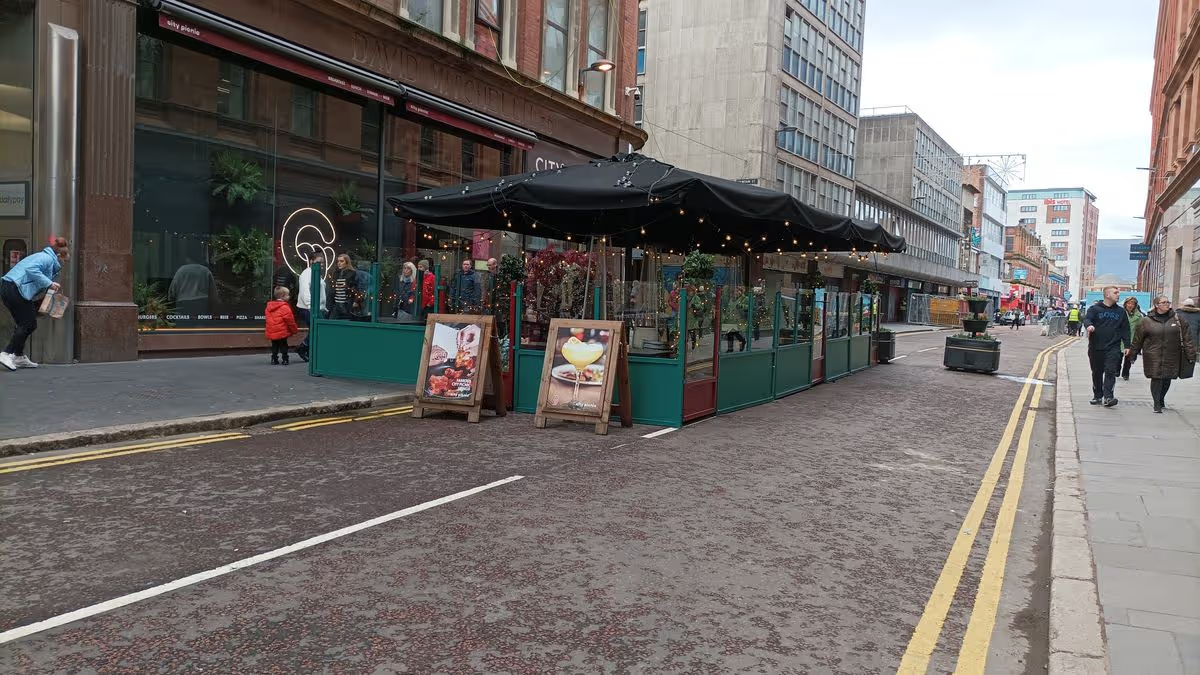
Lower Castle Street has been essentially pedestrianised since the Primark building fire in 2018. To some this has been welcome, and has addressed the problem of car dominance in the city centre, while to others it has blocked some business and has presented new antisocial behaviour issues, including those involving scramblers. Translink have argued that it has caused congestion and delays for public buses in other parts of the city.
Officials at Belfast City Council have revealed the Department for Infrastructure have submitted a request to present to the August 2026 meeting of the council’s City Growth and Regeneration Committee to provide elected members with an update on their potential plan to reopen lower Castle Street to public transport.
Councillors at the June meeting of the committee agreed to receive the presentation from DfI later in the summer, and also agreed to request that the Department provides an update on the Eastern Transport Plan – a strategy by DfI guiding transport policy and investments across the Belfast Metropolitan region up to 2035.
Some elected members in Belfast Council have said that the plan to reopen Castle Street in the city centre contradicts the Eastern Transport Plan – which aims to reduce unnecessary private car journeys, boost public transport, and improve walking and cycling infrastructure. DfI is planning to bring forward a consultation on the ETP in the near future.
In the aftermath of the Bank Buildings/Primark fire in 2018, Castle Street was closed between Fountain Street and Castle Place through a road closure order to facilitate a cordon surrounding the building for reconstruction. The reconstructed Primark store at the historic buildings officially reopened to the public on November 1, 2022.
The officer’s report for the council committee states: “Following the construction works, the section of Castle Street remained closed, effectively pedestrianising the lower part of Castle Street, with the potential to create a people-focused space, safe pedestrian movement and wider placemaking.
Advertisement
“However, pending the development and recommendations of the Eastern Transport Plan, it has not been feasible to develop a proposition for the area, and in the interim scenario there have been occasions of antisocial behaviour issues, for example, lack of definition, and use of the space and access/escape of e-motorbikes.”
It adds: “Road closure notices on Union Street and Brunswick Street were also brought forward at that time. They enabled the delivery of additional public realm and spill-out space for hospitality that were successfully delivered through the Primark Revitalisation Fund, reanimating and activating these streets into popular destinations in their own right.”
In the current draft of the Eastern Transport Plan, lower Castle St remains closed to all traffic and Royal Avenue is designated as a two-way Glider only route, although this is subject to consultation and finalisation.
Earlier this year councillors approved the final “A Bolder Vision” strategy, which supports only two-way glider movement on Royal Avenue, thereby blocking full public transport movement. Reopening lower Castle St to public transport will almost certainly compromise this position.
Advertisement
The council report states: “In advance of the finalisation of the ETP, the Department has been considering re-opening Castle Street to address issues highlighted by Translink.
“Specifically, these include congestion at bus stops on Chichester Street, additional journey time, and poor bus-stop provision on North Street that they advise have affected the North Belfast Services in the period from 2018 to present.
“DfI held a meeting with traders and elected representatives in September 2025 to gauge support for reopening lower Castle St to public transport. At this meeting some traders were in favour of the proposal to reopen Castle Street supporting the additional benefits of having additional halts in the area, while some were against the proposal citing additional traffic, a negligible impact on trade and loss of a potential better use of the space.”
A federal judge has blocked an attempt by the Trump administration to subpoena Minnesota Gov. Tim Walz and other state officials, accusing the Justice Department of using its investigatory powers to retaliate against state officials for not cooperating with federal efforts to crack down on illegal immigration.
In a ruling unsealed Monday, U.S. District Judge Patrick Schiltz found the “dominant purpose” of the subpoenas was to “coerce Minnesota officials into assisting the federal government with enforcing civil immigration law and to harass and retaliate against them for failing to do so.”
Tensions between the Trump administration and Minnesota’s Democratic leaders escalated in January as federal immigration officers clashed with protesters in the Minneapolis-St. Paul area, especially after officers’ fatal shootings of Renee Good and Alex Pretti.
President Donald Trump even threatened to invoke the Insurrection Act to quell protests and accused Walz, who was Democratic presidential nominee Kamala Harris’ running mate in 2024, and others of encouraging protesters to disrupt Immigration and Customs Enforcement activity.
Advertisement
AP AUDIO: Federal judge halts Trump administration effort to subpoena Walz in immigration enforcement probe
Advertisement
AP’s Lisa Dwyer reports a federal judge is halting an effort to subpoena Gov. Walz in immigration enforcement probe.
Judge finds ‘weak to nonexistent’ reasons for subpoenas
The subpoenas seeking records were served in January as part of an investigation into whether Walz and other officials obstructed or impeded law enforcement actions. They were sent to the offices of Walz, Attorney General Keith Ellison, Minneapolis Mayor Jacob Frey, St. Paul Mayor Kaohly Her and officials in Ramsey and Hennepin counties.
The ruling is the latest rebuke by the federal judiciary of Justice Department efforts to aggressively implement the Trump administration agenda in courts and target the president’s political adversaries through subpoenas and similar demands.
Advertisement
The judge ruled that there appeared to be “extremely weak to nonexistent” connections between the information sought in the subpoenas and any possible criminal violation. The subpoenas seek materials “that largely if not entirely relate to constitutionally protected conduct,” the judge wrote, noting that Minnesota has the legal right not to devote its resources to enforcing federal immigration law.
The Justice Department “is not conducting a criminal investigation,” the judge wrote, “but is instead using the grand jury process for other (unlawful) purposes.”
Advertisement
Sign up for Morning Wire:
Our flagship newsletter breaks down the biggest headlines of the day.
Advertisement
The evidence that the subpoenas were issued for unlawful reasons is overwhelming, the judge said, arguing that the Justice Department “has struggled — without success — to identify a single plausible investigatory justification” for them.
The Justice Department said in a statement that it “takes the unlawful obstruction of federal law enforcement operations extremely seriously and will continue to act in full compliance with the law to investigate these matters.”
Targets hail the judge’s decision
Walz, in a statement, called the ruling “a victory for the rule of law and our democracy.”
“The U.S. Justice Department is pursuing criminal investigations into the President’s political opponents,” said Walz, the 2024 Democratic nominee for vice president. “This case was just one example of that, but we are seeing daily reminders of this administration’s lawlessness — in Minnesota and around the country. We all must continue to seek justice and uphold the rule of law.”
Advertisement
Ellison said “it should disturb every American that Donald Trump is weaponizing the criminal justice system against people he disagrees with.”
The subpoenas are “a politically motivated retaliation against our city for lawfully standing up to ICE and fighting for our residents,” Her said in a statement.
Frey said the investigation was “never about justice, law, and order, but the absence of it.”
“Subpoenaing political opponents because they spoke on behalf of their constituents violates the core tenets of our democracy and human decency,” he said.
Advertisement
Frey also observed that criticizing government action is not a crime.
“One of the defining strengths of our democracy is the ability to challenge those in power without fear of retribution. Elected officials have both the right and the responsibility to speak honestly about how government decisions affect the people they serve,” he said.
Subpoenas were among many federal actions against Minnesota officials
Over the last year, judges have dismissed indictments against two prominent Trump foes, former FBI Director James Comey and New York Attorney General Letitia James, and grand juries have repeatedly refused to return indictments sought by the Justice Department.
The moves reflect mounting public concerns that the Justice Department, an institution meant to make investigative and prosecution decisions independent of the White House, is being politicized under the current Trump administration.
Advertisement
Vice President JD Vance has separately called on the Justice Department to investigate Walz and Ellison over allegations they failed to stop widespread social services fraud, though the department has not said whether it will open an investigation. Walz and Ellison have described those allegations as politically motivated and defended their efforts to combat fraud in Minnesota.
Meanwhile, other legal battles related to the immigration surge continue. The federal government has suggested Minnesota prosecutors don’t have jurisdiction to investigate federal officers.
Hennepin County Attorney Mary Moriarty in March sued the administration for access to evidence in the Good and Pretti killings, accusing the administration of withholding evidence from state investigators. Moriarty also has pursued criminal charges against ICE officers in two other incidents, including the nonfatal shooting of a Venezuelan man, and suggests her office is investigating several other cases as well.
___
Advertisement
Associated Press writer Hannah Fingerhut in Des Moines, Iowa, contributed to this report.
___
This story has been corrected to show the federal judge’s name is Patrick Schiltz, not Schlitz.



















































You must be logged in to post a comment Login