

Crypto World
Main Street’s msUSD collapses as Altura winds down vault

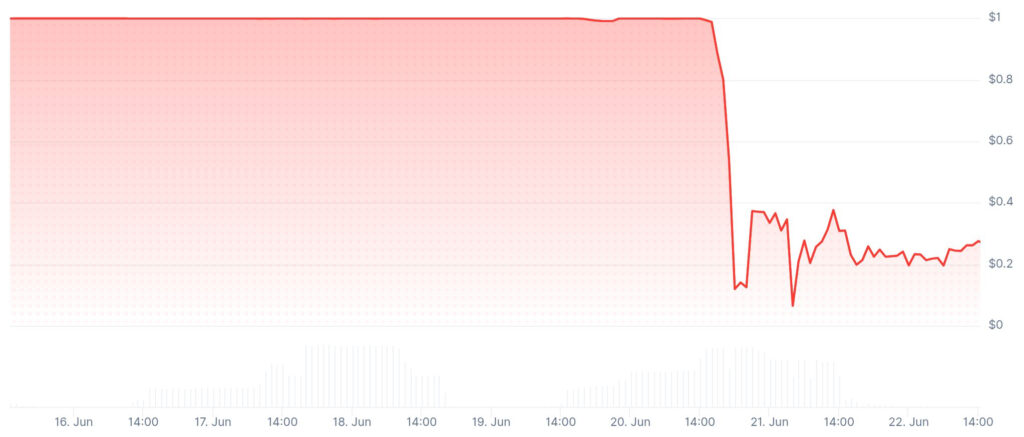
Main Street Finance’s stablecoin msUSD has depegged to $0.27, sparked by a post addressing the “shutdown of [its] third-party proof-of-reserves dashboard.”
The following day, the firm behind the dashboard in question, Accountable, announced it was terminating its asset verification services with msUSD’s issuer.
In classic DeFi fashion, the fallout appears to have led to a bank run on Altura’s USDT vault, leading to the firm deciding to close down the vault.
At least $8.5 million was withdrawn ahead of the announcement and before a sell-off of the AVLT vault token led to an 11% depeg.
The weekend’s depegs come on the back of ongoing troubles for DeFi stablecoins apxUSD and sUSDat, which are backed by Strategy’s struggling STRC.
Read more: Saylor distances himself from STRC-backed DeFi after stablecoin wobble
Main Street Finance: ‘Institutional-grade yield’
Late on Saturday, Main Street Finance published a long post to X reassuring users that it “remains fully backed,” calling the loss of its dashboard a “reporting issue, not a solvency issue.”
By the time of the post, the price of msUSD had already collapsed. It sat at around $0.12 after losing its $1 peg around six hours previously but has since rebounded to around $0.27 from a low of $0.06 in the early hours of Sunday morning (UTC).
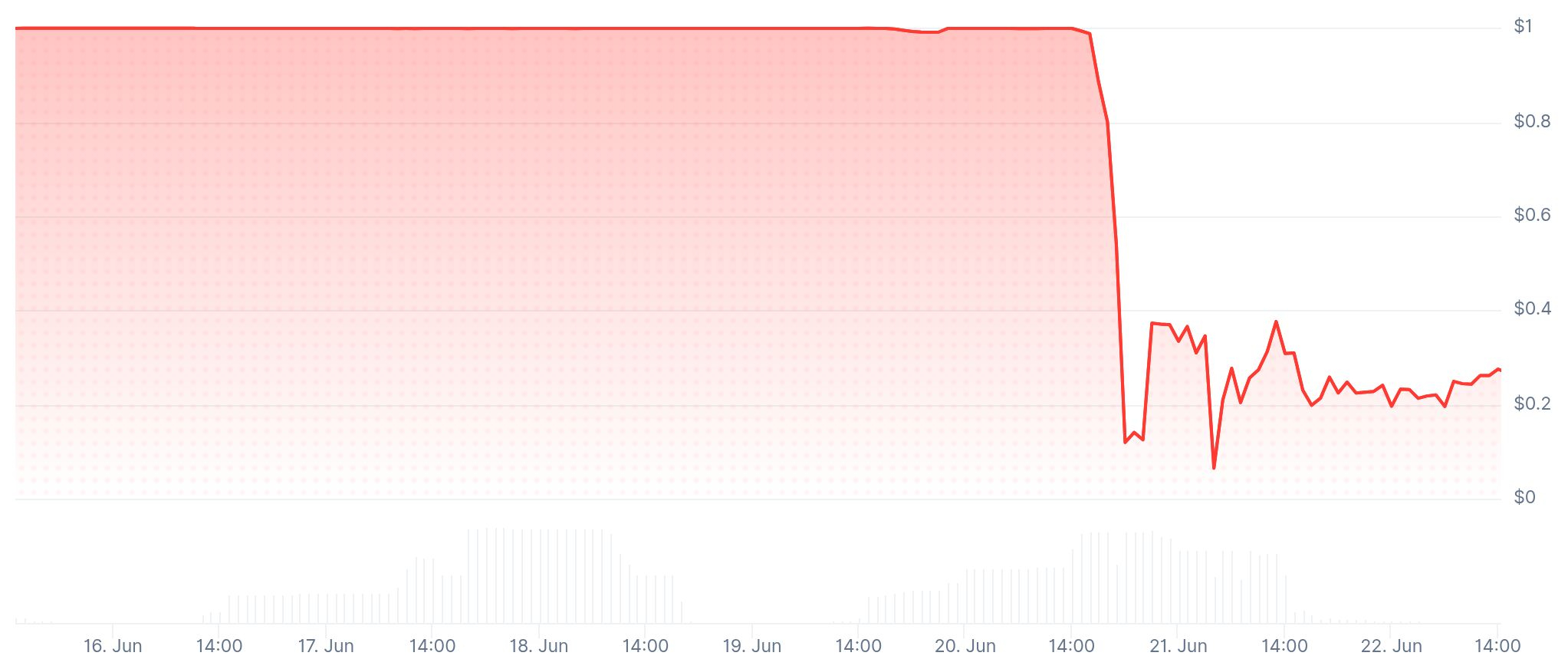
The advance reaction led some to believe that “insiders… got the memo that they should take the available liquidity to get out.”
Then, on Sunday, RWA accounting firm Accountable announced that, following Main Street Finance’s failure to provide adequate proof of reserves, it was terminating its contract with the firm.
Others questioned Accountable’s lack of prior action, given that doubts over Main Street’s transparency were publicly raised back in April.
Accountable’s post positions it as “neutral verification infrastructure,” however it also claims it “did not retain an ongoing, source-level view of [Main Street’s] reserves,” raising concerns over the reliability of its data on other clients.
Read more: DeFi projects under fire for inflated TVL and murky lending loops
Given Accountable’s entire business case, the post also drew ridicule, with one user comparing it to May 2022’s infamous Three Arrows Capital AUM statement.
In addition to the depeg of msUSD, Main Street’s yield token, msY, which it promises “turns box spreads into market-neutral” 12% yield also collapsed in price.
Blockchain auditor Peckshield highlighted the Morpho msY/USDC market hitting 100% utilization, trapping $18 million of AlphaPing assets.
Read more: Resolv hack shows DeFi learned nothing from last contagion
Altura: “the yield engine”
Altura runs a HyperEVM-based USDT yield vault, currently offering almost 30% yield.
In a post on Sunday, Altura distanced itself from the msUSD depeg, stressing it “never had any exposure to Mainstreet or any of its underlying investment strategies.”
It also assured users that it had successfully redeemed over $5 million during the previous 24 hours.
Rather than reassuring depositors, however, it appears the post had the opposite effect.
Twelve hours later, Altura co-founder and CEO Ranveer Arora revealed that, due to “sustained withdrawal demand and current market sentiment” the firm would proceed with “an orderly wind-down of the Altura vault.”
Redemptions had now climbed to $8.5 million.
The rush for the exits was reflected in the price of the vault’s yield-bearing AVLT token. Over the past 24 hours it has dropped 14%, from $1.09 to $0.93 at the time of writing.
Between redemptions and price action, AVLT’s market cap dropped from $39 million to a low of $26 million over the weekend.
In a later update, Altura stated that “a maturity mismatch between our onchain and off-chain positions” forced it to pause withdrawals. It promised market making strategies would be closed within 72 hours but “RWA positions will take more time due to their inherent nature.”
On top of the $18 million exposed to the msY/USDC market, AlphaPing also has over $10 million of exposure to AVLT, according to its Morpho curator dashboard.
Read more: High yields to haircuts: Has DeFi learned anything from yield vault collapse?
DeFi’s risk curator “daisy chain”
Despite its premise as transparent, open finance, the DeFi sector has faced a number of shocks in recent months due to murky “daisy chains” and recursive lending.
In late October, concerns began to circulate over the stability of a number of high yield vaults. These tokens often used looped leverage against one another, inflating TVL far above the legitimate stablecoin backing.
The space exploded days later when one of the main offenders, Stream Finance, revealed it had lost $93 million. Its stablecoin, xUSD, immediately collapsed 75%.
Read more: Four months on, MEV Capital falls victim to $4B DeFi daisy chain implosion
Later, in March, a $23 million hack of Resolv’s USR due to a private key compromise wrought havoc across multiple yield vaults as opportunistic traders bought depegged USR and used it to drain liquidity in markets with hardcoded oracles.
So-called risk curators even continued to provide liquidity to the vulnerable markets via Morpho’s Public Allocator automation feature.
Such episodes go to show that rather than a novel financial system which operates autonomously and permissionlessly, DeFi is all too often forced to recur to the blame game when things go awry.
Got a tip? Send us an email securely via Protos Leaks. For more informed news, follow us on X, Bluesky, and Google News, or subscribe to our YouTube channel.

XRP Ledger has deployed fixes for several software issues after a security review uncovered edge cases and bugs in the network’s core implementation.
Summary
- XRP Ledger fixed multiple software issues in the XRPL 3.2.0 upgrade after Common Prefix uncovered bugs and edge cases during a formal security review.
- Common Prefix will next conduct formal verification of XRPL’s Single Asset Vault and Lending Protocol proposals as development expands into DeFi and tokenization.
- XRP rose about 3.6% to an intraday high of $1.16, while debate continued over Ripple’s XRP escrow strategy and future token releases.
According to the XRP Ledger Foundation, the fixes were included in the recently released XRPL 3.2.0 upgrade after blockchain security firm Common Prefix identified numerical and behavioral issues during a formal analysis of the network.
The collaboration, announced in a June 22 X post, tasks Common Prefix with conducting formal verification and security analysis of the XRP Ledger consensus mechanism. Formal verification relies on machine-checked mathematical proofs to confirm that software behaves according to its specifications under all possible conditions.
During its review, Common Prefix developed models of XRPL components that exposed several edge cases in xrpld, the software that powers XRP Ledger validators. The XRP Ledger Foundation said the issues have already been addressed and deployed through version 3.2.0.
Alongside the consensus review, Common Prefix will maintain the XRPL Payment Engine specification and keep it synchronized with future xrpld releases. The Payment Engine processes all value transfers on the network, including cross-currency payments, decentralized exchange trades, automated market maker interactions, and rippling operations.
Security review expands to lending and vault infrastructure
Attention is now turning to additional protocol features scheduled for deeper security testing.
Following the completion of the initial review, Common Prefix and XRPL contributors will begin formal verification work on the Single Asset Vault proposal, known as XLS-65, and the Lending Protocol proposal, known as XLS-66.
Commenting on the effort, RippleX Head of Engineering J Ayo Akinyele said security requirements must advance as more financial functions move directly into the protocol.
“As XRPL expands the financial capabilities built directly into the protocol, the rigor applied to security, testing, and validation must evolve alongside it. Security doesn’t come from any single review. It comes from layers of testing, validation, and continuous improvement.”
The security initiative arrives as XRP Ledger developers continue preparing the network for more advanced financial applications, including tokenization and decentralized finance services.
XRP supply debate continues alongside network upgrades
While developers focus on protocol security, discussion around XRP’s token economics has continued within the community.
As previously reported by crypto.news, pro-XRP attorney and commentator Bill Morgan recently argued that Ripple should reduce the amount of XRP it returns to escrow following its monthly token unlocks.
Morgan wrote that Ripple “should release more of the 1 billion each month and not lock so much back in escrow,” contending that a faster release schedule could accelerate XRP’s path toward full circulation.
According to Morgan, removing the remaining escrow overhang sooner would strengthen XRP’s argument as a hard-money asset because market participants could evaluate the token without future scheduled releases hanging over supply expectations.
Not all holders share that view. Some traders have argued that larger token releases could increase selling pressure if demand growth fails to match the increase in circulating supply, while others contend that the net amount Ripple ultimately keeps out of escrow carries more weight than the headline unlock figure itself.
Meanwhile, market participants responded positively to the latest XRPL security developments. XRP (XRP) price rallied about 3.6% from $1.12 to an intraday high of $1.16 on June 22 before easing to around $1.14 at the time of writing.
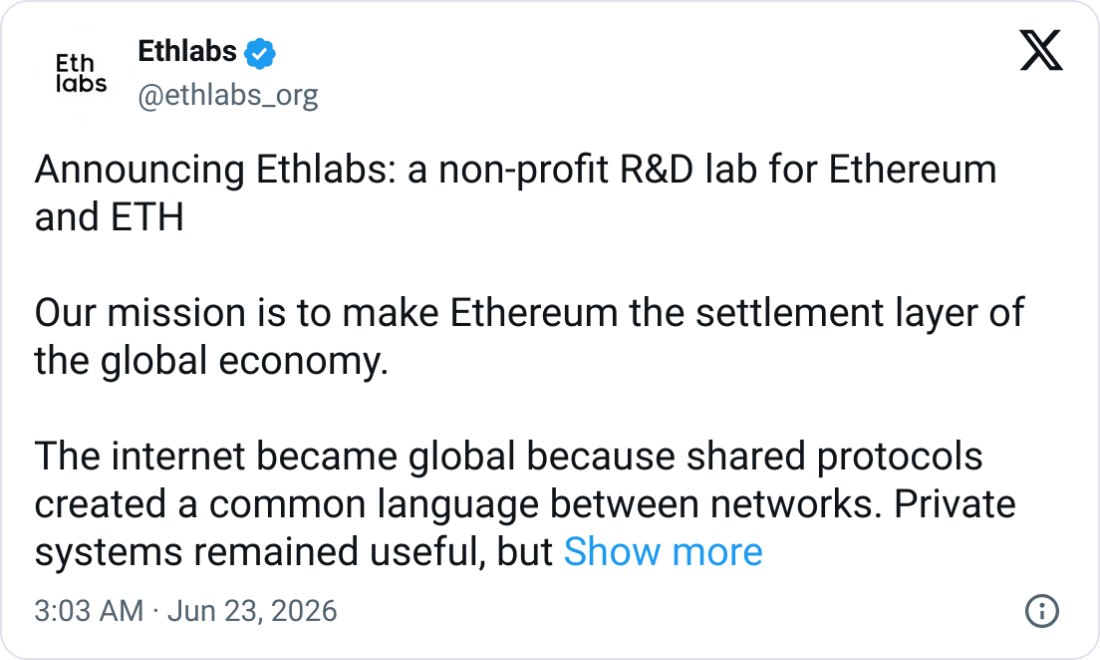
Former Ethereum Foundation contributors and Ether treasury firms Bitmine and Sharplink have backed a new research and development nonprofit that aims to make Ethereum ready for institutional use.
Sharplink said on Monday that the organization, Ethlabs, was formed to “ready Ethereum for the next phase of institutional adoption,” with the company pitching in with Bitmine, Ethereum co-founder Joe Lubin and other Ethereum contributors on its funding effort.
“As stablecoins, tokenized real-world assets, funds and autonomous AI commerce move on-chain, they are converging on Ethereum as the neutral, credibly permissionless settlement layer for the global economy,” Sharplink said. “Ethlabs exists to ensure the network is ready to absorb that demand at scale.”
The launch comes days after former Ethereum Foundation contributor Trenton Van Epps warned that Ethereum is facing a core development funding crisis and amid an ongoing wave of departures from the Foundation, most recently co-executive director Hsiao-Wei Wang, who left last week.
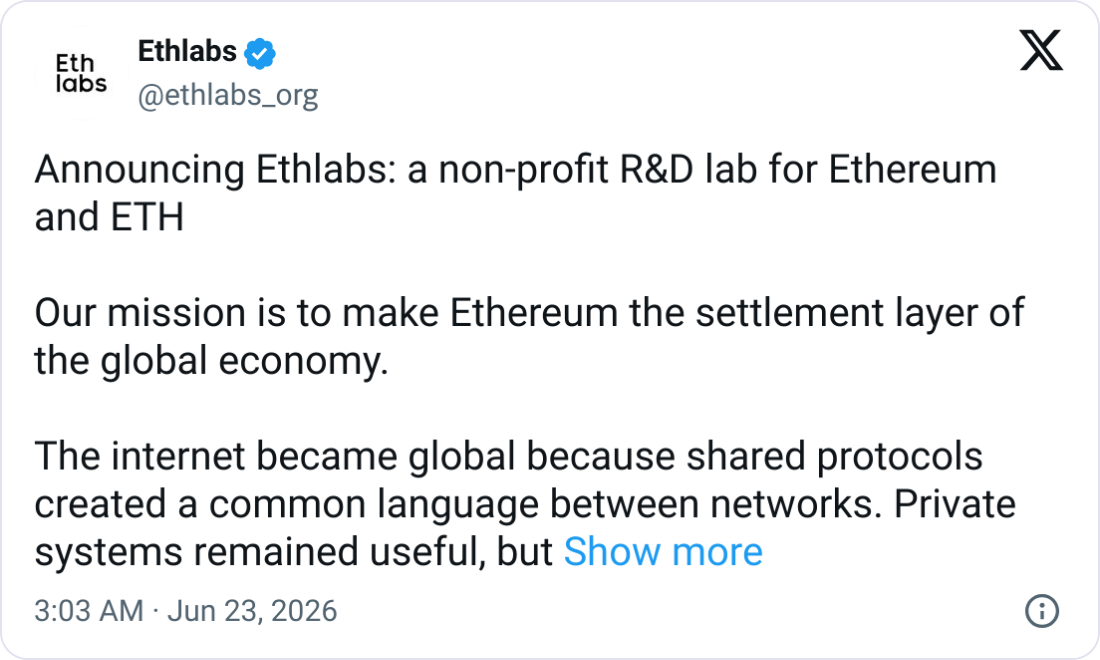
Source: Ethlabs
Sharplink’s announcement said Ethlabs brings together “technologists who have guided the network through its most consequential upgrades over the past decade. This initiative gives that work a dedicated institutional home with stable, long-term funding.”
Ethlabs was co-founded by five former senior Ethereum Foundation researchers: Ansgar Dietrichs, Barnabé Monnot, Caspar Schwarz-Schilling, Josh Rudolf and Julian Ma.
Related: Ethereum bull David Hoffman explains why he sold his ETH
Lubin said in a statement that Ethereum “is entering its next stage of evolution” and that there should be “a number of steward nodes of Ethereum” that should work to grow the utilization of the blockchain.
“By providing a long-term, independent home to researchers and developers advancing Ethereum’s core technology and values, Ethlabs will be instrumental in preparing the network for the next major wave of adoption,” he added.
Ethereum Foundation crisis deepens
In May, Ethereum co-founder Vitalik Buterin said the Ethereum Foundation’s resources were limited, noting that the organization only held about 0.16% of the total supply of Ether (ETH).
Former EF contributor Trenton Van Epps warned last week that Ethereum risks entering a “slow-burning funding crisis,” amid continued selling of the asset by the Foundation.
“The EF is intentionally leaving a power vacuum for new structures to step up and influence the direction of Ethereum,” said Ethereum educator David Hoffman. “I think the Ethlabs direction holds the brightest future for Ethereum.”
Ether is trading 65% down from its peak at around $1,700, levels last seen in October 2023 and April 2025, as sentiment remains at crypto winter lows.
Magazine: Bitcoin decouples from tech stocks, Ether eyes ‘selling wave’: Market Moves
Crypto World
China’s 618 shopping festival growth slows sharply as consumer spending malaise persists

Citizens gather to purchase and scratch instant lottery tickets at a lottery ticket booth on June 21, 2026 in Guangzhou, Guangdong Province of China.
Vcg | Visual China Group | Getty Images
BEIJING — China’s consumer spending slowdown persisted in June, with growth during one of the country’s largest online shopping festivals weakening sharply from a year earlier.
Total online sales during the annual “618” shopping event from May 13 to June 18 grew by 4% from a year earlier, a sharp drop from the 15.2% growth recorded during the festival last year, retail data firm Syntun said late Monday.
The figures add to signs that household spending remains a weak spot in China’s economy despite stronger performance in exports and technology-related sectors.
Retail sales fell 0.6% in May from a year ago, marking the first decline since China emerged from pandemic restrictions in 2022.
“The divergence between high-tech/AI and property/consumption continues to widen in both industrial production and capital market data,” Goldman Sachs’ Hui Shan said in a note Monday.
“Top leaders’ domestic travel, recent policy communications, and our on-the-ground channel checks all suggest these trends will persist.”
The firm lowered its forecast for second-quarter real GDP growth to 4.5% from a year earlier, down from a previous estimate of 4.7%, while keeping the full-year outlook unchanged at 4.7%.

The 618 shopping festival offered one of the latest snapshots of consumer demand, with spending growth remaining subdued despite promotional efforts by major retailers.
Syntun’s estimate of 934 billion yuan ($137.86 billion) included same-day “instant” delivery orders and group purchases.
Among e-commerce platforms, Alibaba’s Tmall led in sales, followed by JD.com and ByteDance’s Douyin, but the segment saw only 0.9% sales growth, the Syntun report showed.
Secondhand electronics platform ATRenew said sales of preowned products grew by nearly 80% from a year ago during the 618 shopping period, highlighting demand for lower-cost goods.
China’s online retail sector received a boost last year from state subsidies that encouraged consumers to trade in older electronics for newer models.
This year, spending patterns shifted. Instead of the 400% subsidy-driven growth in home appliance sales seen during the previous 618 shopping festivals, demand for home cleaning services surged this year, said Jacob Cooke, co-founder and CEO of WPIC, citing figures disclosed by JD.com.
“Fashion did well, lifestyle, beauty, and health supplements are also doing really, really well. So people are taking good care of themselves, they’re looking good, and they want to go out and experience the world,” Cooke said on CNBC’s “The China Connection” on Friday.
He also noted a surge in demand for artificial intelligence-related hardware and the growing use of AI tools by online shopping platforms, which have boosted brands’ profit margins.
However, the broader economic impact of AI remains uncertain.
“AI-related job displacement could amplify macroeconomic headwinds and delay, if not derail, the recovery in the property market and household consumption,” Goldman’s Shan said.

Key Takeaways
- Meta Platforms is deploying $900 million into Cred, an Indian fintech company, securing approximately 20% ownership at a $4.5 billion valuation.
- Kunal Shah, Cred’s founder, will take over WhatsApp leadership from Will Cathcart.
- Cathcart remains with Meta, transitioning to develop AI-powered consumer applications.
- WhatsApp surpassed 3 billion monthly active users in 2025, though monetization through advertising and subscriptions remains underdeveloped.
- Analyst consensus rates META as a Strong Buy, with average price targets indicating approximately 45% potential upside to $815.82.
Shares of Meta Platforms dropped approximately 2.7% on Monday following the tech giant’s announcement of a $900 million capital injection into Cred, an Indian fintech platform, coupled with the appointment of Cred’s founder Kunal Shah to lead WhatsApp.
The transaction secures Meta approximately 20% ownership in Cred, establishing a post-investment valuation of $4.5 billion. The investment structure includes both fresh capital for growth and secondary purchases from existing stakeholders.
At 47 years old, Shah established Cred in 2018. The platform incentivizes responsible credit card management by rewarding users for timely bill payments, while also offering spending analytics. Currently, the app serves roughly 17 million monthly active users.
Shah assumes leadership from Will Cathcart, who steered WhatsApp for approximately seven years and oversaw the platform’s user base expansion by more than 100%. Cathcart isn’t departing Meta — instead, he’s pivoting to develop AI-driven consumer products and applications.
Currently based in Bangalore, Shah will relocate to Meta’s Silicon Valley headquarters in Menlo Park.
Strategic Investment Pattern
Meta’s approach of combining major investments with talent acquisition isn’t unprecedented. In 2024, the company invested over $14 billion in Scale AI while bringing aboard its founder, Alexandr Wang, to oversee a newly established AI research division.
Shah was personally recruited by Meta Chief Product Officer Chris Cox, who deliberately sought entrepreneurial talent from markets where WhatsApp maintains strong penetration. Cox characterized Shah as “one of India’s most respected entrepreneurs.”
In communications reported by Bloomberg, CEO Mark Zuckerberg praised Shah as an innovator with “global perspective.”
Monetization Challenges Ahead
WhatsApp achieved the milestone of 3 billion monthly active users in 2025, establishing itself among the planet’s dominant messaging services. However, revenue generation remains nascent.
Advertising initiatives and subscription models — representing significant expansion opportunities for WhatsApp — remain in preliminary phases. Shah’s mandate includes accelerating these revenue channels while simultaneously integrating AI-powered agents throughout the platform.
Meta maintains substantial connections to India. The company previously invested $5.7 billion in Jio Platforms during 2020, acquiring a 10% position. More recently this month, Meta announced plans to lease its inaugural AI data center facility in the country.
Notably, despite the financial commitment, Meta will not occupy a Cred board position and won’t access customer data from the fintech platform.
Shah transitions to full-time employment at Meta while stepping away from operational responsibilities at Cred, though maintaining his shareholder status. Miten Sampat, currently overseeing company strategy, will assume interim CEO responsibilities as Cred’s board pursues eventual public market listing.
Cred completed a $75 million Series G financing round last year, with Singapore sovereign wealth fund GIC serving as lead investor.
Wall Street maintains a Strong Buy consensus rating on META stock, with 31 Buy recommendations and 6 Hold ratings issued over the last three months. Analysts project an average price target of $815.82 per share, implying approximately 45% upside potential from present trading levels.

Franklin Templeton has officially closed its acquisition of crypto asset manager 250 Digital, a deal first announced in April that is designed to deepen the firm’s presence in actively managed cryptocurrency strategies.
The transaction brings 250 Digital’s investment team and crypto-focused approaches into a newly formed unit, Franklin Crypto. The division will be led by former 250 Digital executives Christopher Perkins and Seth Ginns, alongside Tony Pecore, Franklin Templeton’s executive for digital assets.
Key takeaways
- Franklin Templeton completed the acquisition of 250 Digital, closing a deal initially disclosed in April.
- The firm has created “Franklin Crypto,” combining 250 Digital’s team and strategies with Franklin Templeton’s institutional platform.
- Franklin Templeton did not reveal the purchase price or other financial terms of the transaction.
- The move follows earlier industry restructuring involving CoinFund’s spinout of liquid strategies into 250 Digital.
- Franklin Templeton’s tokenization initiatives have scaled quickly, with RWA.xyz reporting a multi-fold increase in its tokenized assets over the past year.
A deal built to expand active crypto management
According to the terms described at announcement, Franklin Templeton’s key objective is to strengthen its capability to deliver actively managed cryptocurrency strategies to institutional investors. The new division, Franklin Crypto, is positioned to blend the former 250 Digital team’s portfolio management work with Franklin Templeton’s broader distribution reach.
Franklin Templeton said the integration includes both the investment team and 250 Digital’s cryptocurrency strategies, which will be folded into the newly created structure. While the company did not disclose deal economics, the operational focus is clear: bringing more specialized crypto investing know-how under the umbrella of a larger, globally scaled asset manager.
Why 250 Digital matters—and how CoinFund’s earlier shift set the stage
The acquisition also reflects the evolving shape of specialty crypto investing firms. Earlier coverage from Cointelegraph noted that CoinFund decided earlier this year to spin out its liquid strategies business into 250 Digital as the firm sharpened its emphasis on venture investing.
That restructuring is important context for investors watching who is building where in the crypto asset management ecosystem. It suggests that 250 Digital’s core identity—managing liquid crypto strategies—was intentionally preserved and strengthened, making it a more direct fit for an established traditional asset manager seeking institutional-grade crypto exposure.
From crypto funds to tokenized products: Franklin Templeton’s multi-pronged push
Franklin Templeton’s acquisition arrives amid a broader expansion of its digital asset agenda, stretching beyond standalone crypto investing into tokenized financial products.
In February, Franklin Templeton announced a partnership with Binance that allows institutional investors to use tokenized money market fund shares as collateral for cryptocurrency trading. Under that framework, the tokenized fund shares remained in regulated custody, while their collateral value is reflected within Binance’s trading environment.
In March, the company partnered with Ondo Finance to offer tokenized exchange-traded funds (ETFs) on blockchain networks—an approach aimed at extending the reach of its investment products beyond traditional brokerage channels.
More recently, Franklin Templeton proposed two ETFs intended to reinvest stock dividends into Bitcoin-linked exposure, creating a hybrid strategy that bridges equities cashflows and digital-asset exposure. Earlier reporting from Cointelegraph covered that initiative as part of the firm’s ongoing experimentation with tokenized and crypto-linked investment wrappers.
Tokenization growth underscores the timing
The rationale for pairing a crypto acquisition with a tokenization push becomes more tangible when considering the scale and momentum reported by third-party data. RWA.xyz data shows Franklin Templeton’s tokenized assets have more than tripled over the past year, rising from about $768 million in June 2025 to more than $2.5 billion at the time of reporting.
RWA.xyz also indicates that the wider market for tokenized assets has grown quickly. It reports onchain RWA value increasing from roughly $11.8 billion to $32.2 billion over the same year-long period—evidence that demand for tokenized instruments and rails has been accelerating beyond any single issuer.
For Franklin Templeton, this matters because it places the firm at the intersection of two trends: institutional interest in actively managed crypto exposure and expanding infrastructure for tokenized finance. By adding a dedicated crypto division, the company is effectively attempting to serve investors with both strategy-based crypto allocations and tokenized structures that can sit closer to onchain trading and settlement workflows.
What investors should watch next
With Franklin Crypto now operational, the next key question is how quickly the firm translates the expanded team and strategy into scalable institutional offerings—and whether its crypto investing capabilities will be paired with its growing tokenized product lineup. Investors should also monitor how the unit’s activities evolve alongside ongoing ETF proposals and tokenization partnerships, as those steps can influence liquidity pathways, custody arrangements, and distribution reach.


Synthetix governance has moved to retire sUSD, proposing to pay all holders back at face value in vested SNX under SIP-423, introduced June 12. The stablecoin now trades at roughly $0.25 against its $1.00 target, per CoinGecko and DefiLlama. Synthetix founder Kain Warwick and core contributor… Read the full story at The Defiant
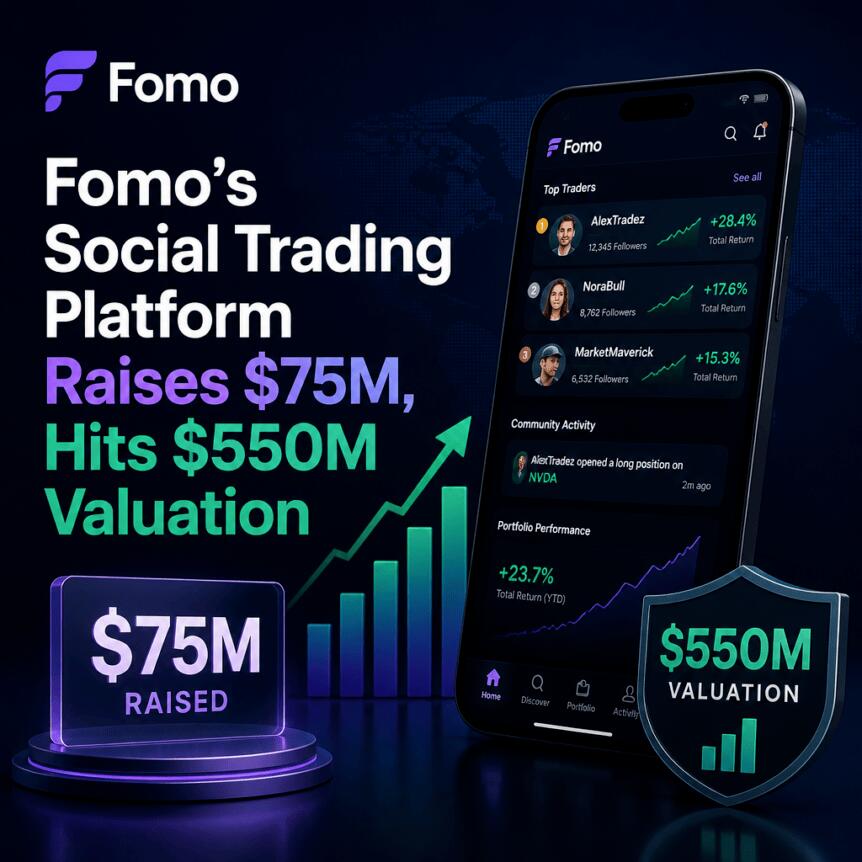
Fomo, a social trading and token discovery platform, has secured $75 million in a Series B funding round led by Index Ventures. The round values the company at $550 million, with participation from Union Square Ventures and existing investor Benchmark, according to Fomo’s announcement on Monday via its website: https://fomo.family/blog/fomo-series-b.
The deal comes as crypto venture activity continues despite digital asset prices sitting below recent peaks. RootData reported that crypto startups raised $4.1 billion across 147 funding rounds during the second quarter.
Key takeaways
- Fomo raised $75 million in a Series B round led by Index Ventures, valuing the company at $550 million.
- Fomo says it has attracted more than 625,000 traders since launch, generating $4 billion in trading volume and 110 million social interactions.
- The platform claims 68,000 users made their first crypto purchase using Apple Pay, totaling about $25 million in transaction volume.
- Fomo’s core product blends social feeds with multi-chain trading, aiming to eliminate manual bridging and separate wallet management.
- The company is also expanding its product surface, including launching perpetual futures powered by Hyperliquid for users outside the U.S.
Series B funds a multi-chain social trading experience
Fomo’s business centers on making crypto trading feel less like technical execution and more like consuming content. The company enables users to trade across multiple blockchains without manually bridging funds or dealing with gas fees themselves—an abstraction it frames as lowering friction for new and returning participants.
In its funding announcement, Fomo also pointed to user traction. Since launching a year ago, the company said it has surpassed 625,000 traders, with $4 billion in trading volume and 110 million social interactions generated on the platform.
For investors and operators watching crypto’s “onboarding” challenge, this matters because social layers can change how users decide what to trade—shifting discovery from charts and listings toward peer activity and repeated patterns. Fomo’s pitch aligns with that direction: users can view what others are trading in real time and replicate those actions without running a separate operational process per chain.
Apple Pay onboarding and “feed-like” trading
Beyond engagement metrics, Fomo highlighted payments as part of its growth story. The company said 68,000 users made their first cryptocurrency purchase on the platform using Apple Pay, representing roughly $25 million in transaction volume.
Crypto research firm Delphi Digital has previously suggested that the product’s social design is helping it attract users by making trading feel more intuitive. In a December X post, Delphi Digital wrote that Fomo’s social features may make trading “more like scrolling a feed than sitting at a terminal.” The firm also claimed that in November, @fomo_family generated more monthly fees than Moonshot—even though Fomo was younger and had lower fees—according to the post shared on X: https://x.com/Delphi_Digital/status/1998483824049795573/photo/1.
While those remarks are not a full market analysis, they provide a useful lens for understanding how Fomo positions itself within a crowded execution-and-discovery landscape: reducing the perceived complexity of trading could be as important as route optimization or additional liquidity.
Copy trading is crowded—Fomo focuses on cross-chain execution
Fomo is not the first exchange-style product to incorporate copy trading and social visibility. The article notes that other platforms offering similar functionality include Binance, Bybit, OKX, Bitget, BingX, MEXC, Gate.io, KuCoin, Phemex and BitMart.
What distinguishes Fomo’s approach, based on the company’s description, is the emphasis on multi-chain execution without manual bridging or separate wallet handling. The promise here is operational simplicity: a user sees activity, then follows it in a way that is designed to work across chains more smoothly than typical self-custody workflows.
That framing becomes more relevant as copy trading strategies increasingly require reliable settlement across heterogeneous networks. Even when social copy features are easy to deploy, the “last mile”—actually executing the trade as users expect—can determine whether followers stay or churn.
Product expansion: referral payments and perpetual futures
Fomo’s funding news also connects to broader product development. On June 11, Fomo launched perpetual futures contracts powered by Hyperliquid for users outside the United States, according to an announcement shared on X by https://x.com/PaulErlanger/status/2065102992278171791.
Separately, on June 2 the company said it had surpassed $2 million in referral fees paid to users, based on a post from https://x.com/fomo/status/2061828121976861056.
Taken together, these moves suggest Fomo is trying to convert social engagement into monetization and stickiness—using both direct trading activity and incentive mechanics to keep users active. For market observers, the key question is whether the platform can maintain its onboarding and social-driven discovery advantages as it adds more financial products, particularly those that tend to increase complexity and risk for end users.
With Fomo’s Series B now in the books, the next things to watch are whether the company can scale its multi-chain execution experience reliably, sustain user growth without relying disproportionately on incentives, and demonstrate that social-driven trading translates into durable trading revenue rather than one-off spikes.

MoneyGram says it has moved from using blockchain rails to actively helping secure a major public network: the remittance firm is now running a validator on Solana. By staking Solana’s native token and processing transaction blocks, MoneyGram will participate directly in the network’s consensus while continuing to explore on-chain infrastructure for payments and treasury operations.
The company also announced that it has joined the Solana Developer Platform, which supports organizations building financial applications on the network. MoneyGram framed the validator step as part of a broader shift that builds on more than five years of integrating digital assets into its business, serving over 60 million customers across nearly 500,000 retail locations worldwide.
Key takeaways
- MoneyGram is operating a Solana validator, staking SOL and processing transaction blocks as part of its network participation.
- The move follows MoneyGram’s May launch of MGUSD, a US dollar stablecoin issued on Stellar and distributed through the MoneyGram app.
- MoneyGram’s Solana validator effort signals deeper operational commitment beyond remittance settlement, including treasury and product development use cases.
- The validator push aligns with wider stablecoin adoption in cross-border payments, with other remittance firms expanding Solana-based USD products.
- Investors and builders should watch how these firms balance network participation with stablecoin issuance across different chains.
MoneyGram becomes a Solana validator
MoneyGram’s validator operations place the firm in a role usually reserved for network participants who help validate and order transactions. According to the company, it stakes SOL as part of this process and processes Solana transaction blocks, meaning it is not only using blockchain infrastructure but actively contributing to the network’s throughput and security.
MoneyGram also said it has joined the Solana Developer Platform. While the program is designed for companies building financial services on Solana, MoneyGram’s participation suggests it wants to remain close to the application layer—not just settle transfers on-chain. For traders and developers, this matters because it typically reduces friction when launching or iterating payment flows that depend on reliable on-chain execution.
In parallel, MoneyGram stated that it uses blockchain infrastructure and stablecoins across its treasury, product development, and payments operations. That breadth of use indicates the validator step is meant to support multiple internal workflows rather than serving as a single isolated experiment.
MGUSD and the chain-by-chain stablecoin strategy
The Solana validator news comes after MoneyGram’s May announcement of MGUSD, a US dollar stablecoin on the Stellar network. MGUSD allows users to hold digital-dollar balances, transfer internationally, and convert into local currencies through the MoneyGram app.
Read together, the two developments point to a multi-chain approach to stablecoin deployment. MoneyGram is using Stellar for its dollar token product while now using Solana for validator participation and network-facing support. That does not automatically imply customers will move MGUSD on Solana, but it does show the company is testing how different public networks can fit different parts of its stack.
The operational question for the market is where MoneyGram’s blockchain activity will concentrate next: whether stablecoin issuance expands to more chains, whether validator operations scale further, or whether on-chain settlement improves time-to-finality and reduces funding friction in specific corridors.
Why this timing fits the remittance stablecoin push
MoneyGram’s validator launch arrives during a broader shift in the remittance industry toward stablecoins and blockchain networks for international transfers. One high-profile example is Western Union, which rolled out its dollar-backed stablecoin USDPT on Solana in May.
Western Union said the token launched first in Bolivia and the Philippines, with expectations to expand to more than 40 countries in 2026. At Bitso’s stablecoin conference in Mexico City last week, the company’s vice president of Digital Assets, Malcolm Clarke, described the stablecoin as a potential lever for changing how remittance transactions are funded and settled across its global network.
Clarke cited that Western Union processes more than $100 billion in annual transaction volume, estimating that prefunding needs, idle capital, and banking fees consume between 6% and 9% of that flow. He argued that using stablecoins for settlement—and earning returns from reserves backing those stablecoins—could translate into profit margins around 2% to 3%.
While those are company estimates rather than independent audited figures, the underlying logic is consistent with how stablecoin settlement can alter traditional payment economics: reduce the need to lock capital before transfers execute and streamline settlement timing. For participants in crypto markets, this is also a reminder that demand for stablecoin liquidity is increasingly tied to real-world operational constraints, not only speculation.
Data points from Bitso and growing momentum beyond Latin America
Market interest is reflected in adoption metrics as well. According to Bitso’s Stablecoin Landscape in Latin America report for the first half of 2026, stablecoin transaction volumes among the exchange’s institutional clients rose 81% year on year. Bitso attributed the growth to liquidity management, cross-border payments, and treasury operations—categories that map closely to the use cases MoneyGram described for stablecoins and blockchain infrastructure.
Stablecoin activity is also spreading into other regions. The article highlights Africa’s payments ecosystem in particular, noting that Ripple acquired a stake in cross-border payments provider Flutterwave, which operates in 35 countries. Flutterwave said it plans to integrate Ripple’s RLUSD stablecoin, Ripple Payments, and the XRP Ledger into its payment network.
Taken together, these developments suggest stablecoins are becoming a mainstream tool for payments firms across multiple geographies—sometimes coupled with local distribution, sometimes aligned with broader network partnerships. However, the fragmented nature of adoption across different chains also means interoperability and liquidity sourcing remain practical constraints that companies must solve as volumes scale.
What to watch next for MoneyGram and the networks
MoneyGram’s move to run a Solana validator and its prior MGUSD launch on Stellar underline a key trend: major payment companies are experimenting with blockchain infrastructure where it fits their operational needs, rather than committing to a single network for everything. The next questions for the market are whether MoneyGram expands on-chain products beyond MGUSD, how it evaluates the impact of validator participation on settlement operations, and which networks it prioritizes as stablecoin usage grows.


Franklin Templeton completed its acquisition of 250 Digital on June 22, 2026, formally launching Franklin Crypto as its dedicated active digital asset management division.
The $1.78 trillion asset manager is integrating crypto-native active strategies with its institutional infrastructure to meet growing demand from large investors.
Acquisition Closes with Targeted Integration
The deal transfers the full 250 Digital investment team and all liquid cryptocurrency strategies previously managed under CoinFund.
Franklin Templeton will invest capital directly into these strategies.
This closes the transaction announced on April 1, 2026. The move underscores Franklin Templeton’s multi-year commitment to digital assets, building on its early experiments with blockchain infrastructure since 2018, including launching one of the first U.S. registered funds to use public blockchains for transactions and share ownership.
Leadership Team Anchors New Division
Christopher Perkins serves as Head of Franklin Crypto, with Seth Ginns as Chief Investment Officer. They partner with Franklin Templeton Digital Assets veteran Tony Pecore. The division reports to Sandy Kaul, Head of Innovation.
CEO Jenny Johnson stated:
“This is an exciting addition for Franklin Templeton, and we’re pleased to welcome Chris, Seth and the 250 Digital team to our firm. Together, their investment talent and differentiated strategies strengthen our capabilities in digital assets and position us among a small group of global asset managers with a dedicated, institutional-grade crypto investment management team.”
Follow us on X to get the latest news as it happens
Institutional Scale Meets Active Crypto Capabilities
Franklin Templeton reported $1.78 trillion in assets under management as of May 31, 2026.
Franklin Crypto builds directly on the firm’s existing dedicated digital asset unit, which focuses on fundamental research, active portfolio construction, and institutional-grade risk oversight.
The new division targets institutional clients seeking actively managed cryptocurrency exposure within a regulated, globally distributed framework.
It combines specialized crypto execution with Franklin Templeton’s established infrastructure and client base.
Franklin Crypto will roll out actively managed cryptocurrency strategies to institutional investors worldwide.
The integration positions the firm to capture demand for sophisticated digital asset solutions as institutions allocate more capital to the asset class through established managers.
The post Franklin Templeton Bets Bigger on Crypto After Major Acquisition appeared first on BeInCrypto.
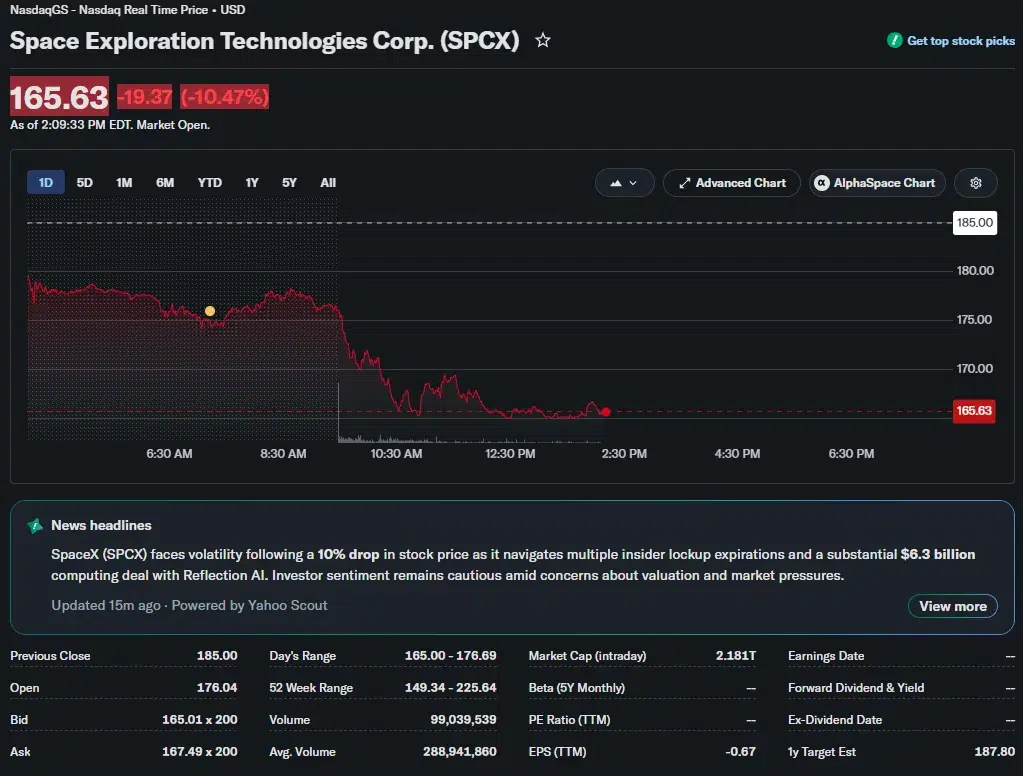
SpaceX stock has fallen more than 10% in early U.S. trading after analysts initiated coverage without assigning a price target, adding to investor concerns about the company’s valuation following its record-breaking market debut.
Summary
- SpaceX stock fell more than 10% after KeyBanc initiated coverage with a neutral rating and no price target.
- KeyBanc cited balanced risk-reward despite strong growth prospects from Starlink and AI-related opportunities.
- The decline coincided with SpaceX’s first bond offering as investors weighed valuation concerns after its blockbuster IPO.
According to a June 22 report from Barron’s, analysts at KeyBanc began coverage of SpaceX with a “Sector Weight” rating while declining to provide a target price for the stock.
The brokerage firm said SpaceX is likely to remain the dominant force in the space launch industry for years, but argued that much of the company’s future growth may already be reflected in its current valuation.
“SpaceX possesses significant disruptive growth avenues, though we believe this is reflected in current valuation and risk/reward appears balanced, in our view.”
SPCX shares traded around $165.63 at the time of writing, extending losses after one of the most successful public offerings in market history.
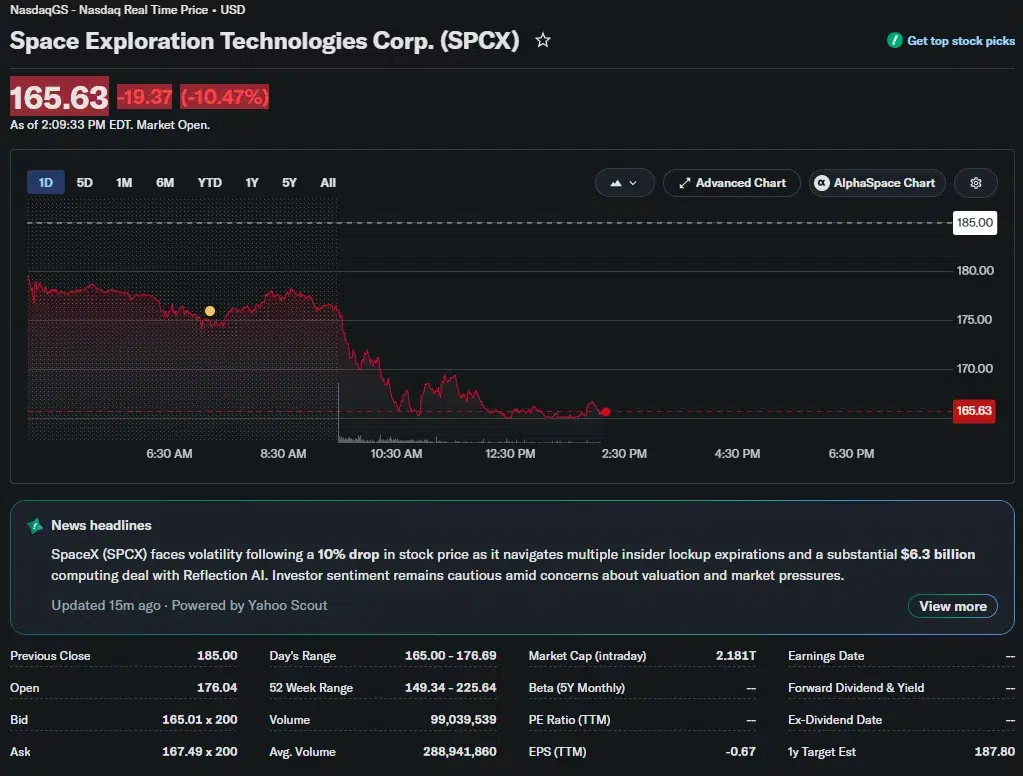
The pullback has drawn attention because it follows a sharp post-listing surge that helped push SpaceX’s valuation to levels that some analysts consider difficult to justify.
Analysts point to valuation concerns despite growth outlook
In its coverage note, KeyBanc identified Starlink as one of SpaceX’s most important revenue engines and said advances in artificial intelligence could support future expansion. Even so, the firm maintained a cautious position, citing what it described as a balanced risk-reward profile at current prices.
Similar concerns have emerged elsewhere. As previously reported by crypto.news, analysts at Morningstar estimated a fair value of $63 per share and argued that SpaceX stock may be trading above levels supported by fundamentals.
The debate over valuation comes only weeks after the company’s blockbuster public debut generated enormous wealth for shareholders. Earlier reporting by crypto.news noted that the IPO pushed Elon Musk’s net worth above $1 trillion while creating a new group of billionaires among early investors, executives, and institutional backers tied to the company.
Investor attention has increasingly shifted from the scale of the listing toward whether the business can deliver enough growth to support its market capitalization.
Bond sale adds another layer to investor focus
While analysts weighed valuation questions, SpaceX also entered the debt market for the first time.
Barron’s also reported that the company is issuing senior unsecured notes as part of its first bond offering. The report stated that SpaceX currently holds approximately $100.8 billion in cash and intends to use proceeds from the sale primarily to repay bridge financing, with additional funds allocated for general corporate purposes.
The debt offering arrives shortly after the company’s June 12 IPO, which reportedly raised over $85 billion after underwriters exercised the greenshoe option.
Recent reports have also suggested that SpaceX could pursue significantly larger fundraising plans. Last week, reports indicated that the company was exploring a bond raise worth as much as $20 billion, highlighting continued demand from investors seeking exposure to Elon Musk’s space and artificial intelligence businesses.
With analysts split between long-term confidence in SpaceX’s market position and concerns over its valuation, traders are now assessing whether the stock’s latest decline represents a temporary reset after an extraordinary rally or the beginning of a longer adjustment period.

Bonus bonanza! Last day to buy these two stocks for 10:1 & 5:1 bonus rewards. Do you own?

XRP Ledger deploys bug fixes after security probe uncovers flaws

Oklahoma rolls past North Carolina to win first College World Series since 1994


-

 Fashion3 days ago
Weekend Open Thread: Miami – Corporette.com
-
 Tech6 days ago
The Adder At The Heart Of Intel’s 8087 FPU
-

 Entertainment2 days ago
Renter of Home in Anne Heche Crash Denies Settlement With Son
-

 Tech15 hours ago
Microsoft accidentally kills epic Outlook email threads
-

 Business2 days ago
Soccer-U.S. defends Iran World Cup travel restrictions, says discussions ongoing
-

 Politics4 days ago
BBC Reporter Discusses Cross Party Criticism Of Trumps Iran Deal
-
 Business3 days ago
Wall Street Week Ahead: Investors see Micron earnings as pulse check of AI rally momentum
-

 Tech5 days ago
AWS enters the context layer race with a graph that learns from agents, not manual curation
-

 Crypto World3 days ago
HIVE shares jump as $220M AI deal speeds Bitcoin mining pivot
-
 Crypto World3 days ago
Can Charles Hoskinson Really Rescue Cardano?
-

 Crypto World3 days ago
Jake Chervinsky accuses CME of protecting derivatives monopoly
-

 Tech8 hours ago
Nearly 7,000 fake Amazon domains registered ahead of Prime Day 2026, researchers warn
-

 Business2 days ago
MHP SE 2026 Q1 – Results – Earnings Call Presentation (OTCMKTS:MHPSY) 2026-06-20
-

 Sports4 days ago
FIFA World Cup 2026: Canada beat 9-men Qatar 6-0 to register first ever win | FIFA World Cup 2026
-

 Crypto World5 days ago
Anthropic’s Dario Amodei Urged AI Unity at G7, Even as US Banned His Models
-

 Politics3 days ago
Andy Burnham and the meaning of Makerfield
-
 Tech2 days ago
Signal’s Meredith Whittaker says AI chatbots ‘are not your friends’ and calls Copilot agents a backdoor
-

 Business4 days ago
Brexit cost 6% of UK economy, Bank of England company data suggests
-

 Tech5 days ago
Weeks Of In-The-Field Testing And A Verdict
-

 Entertainment3 days ago
Jose Alvarado Wants Taylor Swift at More Knicks Games
You must be logged in to post a comment Login