Connect with us
DAPA Banner
DAPA Coin
DAPA
COIN PAYMENT ASSET
PRIVACY · BLOCKDAG · HOMOMORPHIC ENCRYPTION · RUST
ElGamal Encrypted MINE DAPA
🚫 GENESIS SOLD OUT
DAPAPAY COMING

NewsBeat

The June temperature records in Northern Ireland which could be broken this week

Published

on

Belfast Live

Our map shows the locations of June temperature records across the UK

June temperature records are set to be broken this week as a ‘heat dome’ brings scorching temperatures to the UK.

Advertisement

In Northern Ireland it has been forecasted that temperatures could reach as high as 30 degrees on Friday in some places while parts of the South Midlands in England could reach 36 degrees. This would beat the current UK June temperature record of 35.6C set in 1976.

The current NI record is 29 degrees which was set at Aldergrove Airport weather station on June 29, 1995, followed by 28 degrees at Belfast Harbour weather station on June 28, 2018.

The Met Office is warning of even hotter conditions over the next three days, meaning records at locations around the country are likely to be beaten.

Here is the full list of record June temperatures at 160 weather stations around the country, from data published by Meteostat.

Advertisement

For 22 weather stations, the record June temperatures have stood for half a century since the summer of 1976. But in another sign of the warming climate, nearly half of the weather stations listed set their June temperature record relatively recently during the 2020s.

You can see the June temperature record at weather stations in your region here:

Northern Ireland

  • 29.0C at Belfast / Aldergrove Airport weather station, Antrim and Newtownabbey, on 29 June, 1995
  • 28.0C at Belfast / Harbour weather station, Belfast, on 28 June, 2018
  • 28.0C at Eglinton / Greysteel weather station, Causeway Coast and Glens, on 20 June, 2025
  • 27.1C at St Angelo weather station, Fermanagh and Omagh, on 20 June, 2025
  • 24.4C at Ballykelly weather station, Causeway Coast and Glens, on 20 June, 2025
  • 23.8C at Portrush weather station, Causeway Coast and Glens, on 13 June, 2023

East Midlands

  • 33.1C at Waddington weather station, North Kesteven, on 30 June, 2015

West Midlands

  • 31.0C at Shawbury weather station, Shropshire, on 29 June, 1976
  • 31.0C at Birmingham / Airport weather station, Solihull, on 26 June, 1976

London

  • 35.0C at London Heathrow Airport weather station, Hillingdon, on 26 June, 1976
  • 30.0C at Biggin Hill / berry’s green weather station, Bromley, on 21 June, 2025

North East

  • 30.0C at Newcastle / Dinnington / Ponteland / Hazlerigg weather station, Newcastle upon Tyne, on 20 June, 2025

North West

  • 33.0C at Manchester Airport weather station, Manchester, on 22 June, 1976

Isle of Man

  • 27.6C at Isle of Man / Ronaldsway Airport weather station, Isle of Man, on 13 June, 2023

Yorkshire and the Humber

  • 32.0C at Humberside / Kirmington weather station, North Lincolnshire, on 27 June, 2011
  • 31.0C at Topcliffe / Dalton weather station, North Yorkshire, on 30 June, 2025
  • 31.0C at Leconfield weather station, East Riding of Yorkshire, on 21 June, 2025

South West

  • 34.0C at Bournemouth Airport weather station, Bournemouth, Christchurch and Poole, on 27 June, 1976

South East

  • 35.0C at Southampton / Weather Centre weather station, Southampton, on 27 June, 1976

East of England

  • 34.0C at Lakenheath Royal Air Force Base weather station, West Suffolk, on 21 June, 2025

Wales

  • 32.0C at Cardiff-Wales Airport weather station, Vale of Glamorgan, on 29 June, 1976

Scotland

  • 31.0C at Glasgow Airport weather station, Renfrewshire, on 28 June, 2018

Channel Islands

  • 32.6C at Jersey Airport weather station, Jersey, on 30 June, 2025

For all the latest news, visit the Belfast Live homepage here and sign up to our daily newsletter here.


Source link

Advertisement
Continue Reading
Click to comment

You must be logged in to post a comment Login

Leave a Reply

NewsBeat

Congress passes war powers measure for first time, rebuking Trump’s war with Iran

Published

on

Donald Trump President of the United States of America US on his arrival ahead of a dinner with the President of the French Republic and his wife organised to celebrate the 250th anniversary of the independence of the United States at the Chateau de Versailles in Versailles France on June 17, 2026.

The vote marks the first time that both chambers of Congress have approved a concurrent resolution instructing a president to end a military action since the War Powers Resolution of 1973 was enacted.

A concurrent resolution expresses the sentiment or will of Congress, as opposed to other forms of legislation that go to the president to be signed into law. In 2019, Trump vetoed a joint resolution that called for the removal of armed forces from hostilities in the Yemeni civil war.

Middle East analyst Laura Blumenfeld called it “more of a slap on a wrist than a handcuff, because it has no legal binding”.

But she told the BBC she thought what “it does reflect is the American people’s sentiments”.

Advertisement

The concurrent resolution’s passage is significant because it adds to pressure on the White House to find an end to the Iran war, which is unpopular with the public after petrol prices spiked.

The same measure was passed earlier this month by the US House of Representatives, where four Republicans joined every Democrat to approve it in a 215-208 vote.

But a White House official told the BBC that with the ceasefire agreed on 7 April, there are no hostilities from which to withdraw American forces.

The official also said the measure only passed because two Republican senators were absent: Mitch McConnell and Dave McCormick.

Advertisement

Four Republican senators voted with Democrats in support of the resolution: Rand Paul, Lisa Murkowski, Susan Collins and Bill Cassidy.

Democratic Senator John Fetterman was the only member of his party to vote against it.

It was the latest sign of division among Trump’s fellow Republicans ahead of the midterm elections in November, which will determine whether the party can hold on to its slender majorities in both chambers of Congress.

Some Republicans have resisted the president recently, including by rejecting his plans to create a $1.8 bn (£1.3bn) “anti-weaponisation” fund and approving Ukraine aid.

Advertisement

Tuesday’s vote was the 10th time that Senate Democrats have forced a war powers vote since the start of the war.

It came the same day as the Pentagon asked Congress for some $80bn, most of which is to pay for the war with Iran.

Federal law requires congressional approval to continue military actions for more than 60 days. The US-Israel strikes on Iran began on 28 February, although the Trump administration has argued April’s ceasefire reset the clock.

The White House can also extend the deadline for another 30 days, citing national security.

Advertisement

Currently, the US and Iran have agreed to continue a ceasefire and are working towards an end of hostilities under a memorandum of understanding that was signed by the presidents of both countries last week.

Under that memo, Washington and Tehran have 60 days to negotiate a broader agreement on ending Iran’s nuclear programme.

Source link

Advertisement
Continue Reading

NewsBeat

how can so many agencies know about a child and still miss what’s happening?

Published

on

how can so many agencies know about a child and still miss what’s happening?

The murder of 13-month-old Preston Davey, who was sexually abused and killed by one of his adoptive fathers, Jamie Varley, has shocked and saddened people across the country. Varley was sentenced to life in prison. His partner, John McGowan-Fazakerley, was found guilty of sexual assault, child cruelty and allowing the death of a child, and sentenced to 25 years.

As horrific details emerged during the trial, many people were left asking the same question: how can so many agencies know about a child and still not see what was happening?

Reports suggest that multiple organisations had contact with Preston during his short life. Within approximately two months of being placed with his adoptive parents, Preston attended hospital for the first time. Over the following nine weeks, there were at least ten contacts with multiple agencies and professionals before his death.

Like many previous incidents, concerns were raised, injuries were observed, explanations were given, referrals and decisions were made across different parts of the system. Surely, if enough professionals know about a child, someone should be able to see the danger?

Advertisement

The unfortunate reality is that many children who experience these tragic outcomes are known to services. Recent analysis by the independent child safeguarding review panel found that 84% of families in reviewed cases were already known to children’s social care. Similar findings emerged from reviews we conducted in Wales, where the overwhelming majority of children had previous involvement with agencies before the incident occurred.

No single professional or agency usually holds the complete picture. A teacher may notice a change in behaviour. A health professional may see an injury. A social worker may become concerned about family circumstances. Police may respond to an incident. But each piece of information can appear relatively minor when viewed in isolation. It is often only when those pieces are connected that a fuller picture of risk emerges.

This is one reason why safeguarding reviews repeatedly identify challenges around information-sharing and multi-agency working. The issue is rarely that nobody cared. More often, it is that different professionals hold different parts of a child’s story.

Preston Davey was 13 months old when he was abused and murdered by Jamie Varley.
Lancashire Police/Alamy

Preston’s age (13 months) makes this case particularly challenging. Modern safeguarding practice rightly emphasises listening to children, hearing their voices and understanding their lived experiences. But babies and very young children cannot articulate what is happening to them.

Advertisement

Professionals must build a picture through observation, behaviour, development, injuries and interactions with carers, and collate pockets of information held across multiple agencies. Research examining non-accidental injuries in infants has repeatedly highlighted the importance of recognising patterns, rather than viewing incidents in isolation.

Lessons (not) learned

Past safeguarding reviews have identified these challenges for decades. So why are they still happening?

Numerous reviews, including our research in Wales, suggest that many of the issues identified following child deaths are remarkably consistent.

National reviews following the deaths of Arthur Labinjo-Hughes and Star Hobson highlighted challenges around information sharing and recognising cumulative harm.

Advertisement

Similar themes emerged in our recent review of child safeguarding incidents in Wales, and in multiple reviews for adult safeguarding.

Across cases, children and families were often known to several agencies, sometimes over many years. Yet awareness did not always translate into action or effective intervention. Experts and academic research have questioned whether safeguarding systems rely too heavily on professionals “joining the dots” between fragmented pieces of information, rather than creating systems that make risk easier to identify collectively.

Safeguarding is a complex system involving hundreds of organisations, thousands of professionals and constantly-changing pressures, policies and priorities. Learning a lesson is one thing. Embedding it consistently across an entire system is another.

Our research has highlighted the gap that can exist between identifying lessons and translating them into meaningful change. Training does not automatically change culture. New procedures do not automatically change decision-making. And publishing a review does not automatically make children safer.

Advertisement

Following Preston Davey’s death, there will, rightly, be a safeguarding review. Its purpose will be to understand what happened and identify lessons that could help protect children in the future. The challenge will be to make sure that what is learned in Preston’s review results in real change for other children at risk.

View from above of an anonymous child holding the hands of two adults
Safeguarding is a complex system that spans hundreds of agencies and professionals.
By Anata/Shutterstock

There are signs that those responsible for safeguarding systems are beginning to think differently about how to apply the lessons from these many reviews. In Wales, a new safeguarding review process has brought different systems together within a single national framework. Alongside this, a publicly accessible dashboard has been introduced, allowing recommendations, actions and themes to be tracked nationally.

Rather than treating each review as an isolated exercise, the aim of Wales’ new review process is to identify recurring themes, strengthen accountability and build a clearer picture of the challenges that safeguarding systems repeatedly encounter.

It is too early to know whether these changes will reduce repeated recommendations or improve outcomes for children. But they reflect an important shift in thinking.

In England, wider reforms are underway. This includes the creation of a child protection authority to strengthen national oversight and accountability, and a unique identifying number assigned to every child to help bring together information held from different agencies.

Advertisement

Additionally, guidance is being developed to support professionals to build a more complete picture of children’s experiences across services.

The review into Preston’s death will rightly seek answers about what happened to him. Every child deserves that commitment. But it should also help us find the solution to a broader challenge: making sure that what is learned in one tragedy helps prevent another.

Source link

Advertisement
Continue Reading

NewsBeat

Thomas Tuchel fires back at Harry Kane criticism after goalless Ghana draw | Football

Published

on

Thomas Tuchel fires back at Harry Kane criticism after goalless Ghana draw | Football

Close Overlay

In The Mixer’s World Cup special

Everything you need to know about the World Cup – England updates, the games to watch and stories you missed – in five minutes, at 1pm, every day.

Source link

Advertisement
Continue Reading

NewsBeat

FIFA chief drops new update on unpopular World Cup hydration breaks after England outcry

Published

on

Daily Mirror

World Cup hydration breaks have proven controversial and received backlash an FIFA chief Gianni Infantino has spoken out concerning their future in the sport

FIFA boss Gianni Infantino has revealed that the governing body will consider whether to maintain hydration breaks in future World Cups ‘based on this experience’. The breaks have drawn criticism from fans throughout the current tournament.

The stoppages, which take place midway through each half, have effectively separated matches into quarters and are utilised regardless of weather conditions. Despite being brought in to look after players in hot conditions, the breaks are implemented even in stadiums with closed roofs and air conditioning.

England’s match against Ghana saw frustration as the players were permitted to take on board liquids quickly after another lengthy stoppage in play due to injury. Loud boos were heard in the Boston Stadium as the teams went to the sidelines.

Advertisement

Infantino has rejected claims that the hydration breaks have been a means to introduce greater advertising opportunities, and instead outlined the benefits. “Broadcasters maybe generate more, but for us, we make zero additional revenues,” he said.

“Maybe the coach can reassess certain situations, correct certain mistakes,” he added. “The players get a little rest and come back in full speed. Well, is that bad necessarily? Maybe it’s good.

“And we see as well the intensity of the games. We’ve never seen 90 minutes in a tournament like this played in such an intensity. Until the last second of the match, players attack and so on.

“And maybe, maybe not, but maybe it’s also a bit thanks to this little break that the players have and after they can go back on the field and show what they can do.”

Advertisement

The FIFA boss also attempted to explain the reasoning to introduce the breaks as a blanket decision, rather than on a case-by-case basis.

Get the latest World Cup news straight to your inbox by signing up to our Make Football Great Again newsletter now!

“If we were to use hydration breaks only in those matches where it was too hot and not in the other matches, we would give an advantage or a disadvantage to some of the coaches or some of the teams,” he explained.

Advertisement

“Why would the coach have the opportunity to influence the game in one match just because it’s hot and in another match where it’s a bit less hot, he wouldn’t have this opportunity?”

Former England striker Alan Shearer described the break for the Three Lions match as ‘nonsense’, when it was not allowed to be combined with an earlier stoppage.

He said: “There’s been nearly two minutes [of stoppages] already. It seems crazy for the referee not to just say let’s have the break now. Goodness me.”

Join our new WhatsApp community and receive your daily dose of Mirror Football content. We also treat our community members to special offers, promotions, and adverts from us and our partners. If you don’t like our community, you can check out any time you like. If you’re curious, you can read our Privacy Notice.

Advertisement

Upgrade your World Cup TV setup with the Sky Glass ‘designed for football’

This article contains affiliate links, we will receive a commission on any sales we generate from it. Learn more
Content Image

from £4.50

Sky

Get the deal here

Sky is knocking 20% off its entire range of Glass TVs to mark the start of the 2026 FIFA World Cup. Until June 17, shoppers can upgrade to the Sky smart TV that’s ‘designed for football’ from £4.50 per month when taken alongside a Sky TV and Netflix package.

Source link

Advertisement
Continue Reading

NewsBeat

Sir Jeffrey Donaldson’s image removed from Lagan Valley council buildings

Published

on

Belfast Live

‘Following the outcome of the case, Lisburn and Castlereagh City Council removed photographs featuring Jeffrey Donaldson from display in its facilities’

All images of Sir Jeffrey Donaldson have been removed from Lagan Valley Island council civic centre.

The former DUP leader was found guilty this week at Newry crown court of 18 historical sex offences against two women when they were children.

The Local Democracy Reporting Service contacted Lisburn and Castlereagh City Council following the guilty verdict with multiple images of the Lagan Valley MP throughout the local authority building.

Advertisement

READ MORE: Holiday bin delays spark staffing debate at local council.

READ MORE: Drones to be flown next to Belfast prison with council to lift byelaws.

A council spokesperson said: “Following the outcome of the case, Lisburn and Castlereagh City Council removed photographs featuring Jeffrey Donaldson from display in its facilities.”

A jury convicted the 63-year-old of one count of rape, 13 counts of indecent assault and four counts of gross indecency.

Advertisement

His wife Eleanor Donaldson has been found to have committed the acts relating to offences of aiding and abetting following a trial of the facts.

In 1997, when James Molyneaux retired as the Lagan Valley MP, Donaldson retained the seat for the UUP.

In 2003, he quit the UUP, defected to the DUP and retained his Westminster seat for Lagan Valley.

The convicted child sex abuser is now in Maghaberry prison located in the council area where he awaits sentencing in September.

Advertisement

For all the latest news, visit the Belfast Live homepage here and sign up to our daily newsletter here.

Source link

Continue Reading

NewsBeat

Widow Daryl Berman guilty of Prestwich husband’s murder

Published

on

Widow Daryl Berman guilty of Prestwich husband's murder

Daryl Berman, 72, was charged after her 84-year-old husband David Berman was found dead with stab wounds at their shared home on Butterstile Lane, Prestwich on March 13 last year.

More than a year on a jury at Minshull Street Crown Court convicted Berman of murder by majority verdict of 11 to one.

In his closing speech to the jury, Michael Brady KC, prosecuting, said: “If you find that the blow to the chest was deliberate, there’s only one candidate for the person who inflicted that blow.

“Domestic fatal external knife injuries are extraordinarily rare.”

Advertisement

The trial was heard at Minshull Street Crown Court (Image: Anthony Moss)

Mr Brady had told the jury that Berman had used a kitchen knife to stab her husband in the chest.

The emergency services had at first thought the death to be non-suspicious and Berman was not concerned a suspect until a coroner raised concerns days after her husband’s death.

 During the trial, Berman maintained her innocence and claimed that Mr Berman had accidentally fallen on the knife while she was in another room.

Police on the scene on Butterstile Lane (Image: Newsquest)

During the trial, the just heard Berman speaking to a 999 operator.

Advertisement

She said: “I was in the other room.

“He’s carried a tray in, and all I can see is the tray. I think there was a knife. I don’t know whether the little knife that was there has gone into him and stabbed him. I really don’t know what has happened.”


READ THE TRIAL IN FULL:


During his closing speech Michael Hayter KC, defending, said that Berman had been “nurturing her husband through difficult times” and described the case as “extraordinary”.

Advertisement

Michael Hayton KC said: “The evidence you have heard is extraordinarily limited.”

But after 13 hours and 38 minutes of deliberations, the jury convicted Berman of murder by a majority of 11 to one.

David Berman was found dead at his home (Image: GMP)

Judge Tina Landale ruled that Berman be brought back to court to be sentenced on Friday July 3.

Speaking after the verdict,  Sazeeda Ismail, of the Crown Prosecution Service, said: “Daryl Berman stabbed her husband of 27 years in the chest and intentionally caused his death.

Advertisement

 “She lied to paramedics, police and family members when she claimed Mr Berman had accidentally sustained his fatal injuries.

“The jury saw through her lies and convicted her of murder, due to the strength of the prosecution’s case.

“My thoughts are with David Berman’s loved ones at this very difficult time.”

Advertisement

Source link

Continue Reading

NewsBeat

World Cup last 32 draw in full now as England face dream path to final

Published

on

Wales Online

England remain on course to top Group L despite a disappointing 0-0 draw with Ghana

England remain on course to finish top of their World Cup group despite being held to a 0-0 draw by Ghana.

The result leaves Thomas Tuchel’s side at the summit of Group L with one match remaining against Panama, meaning they still have their fate firmly in their own hands heading into the final round of fixtures.

With the knockout picture beginning to take shape, attention is already turning to the last-32 draw and the route England could take if they are to lift the trophy on July 19.

Advertisement

While there is still plenty of football to be played, the current bracket suggests England could find themselves on what many supporters would view as the more favourable side of the draw.

As things stand, topping Group L would set up a Round of 32 clash against DR Congo in Atlanta on July 1.

England and DR Congo are currently paired together in the bracket, though the African nation could still be replaced by another third-placed qualifier from Group K, where Colombia, Portugal and Uzbekistan remain in the mix.

Should England negotiate that opening knockout tie, a last-16 meeting with either Mexico or Cape Verde awaits on July 6.

Advertisement

That would leave Tuchel’s men just two victories away from the final, with a quarter-final potentially bringing one of Brazil – clearly the biggest challenge – Japan, Ivory Coast or Norway into view on July 11, as things stand.

The semi-final would be scheduled for July 15 and could see England come up against sides such as Belgium, Portugal, Argentina or Uruguay, depending on how the remaining sections of the bracket develop.

Crucially, England’s projected route currently keeps them away from several of Europe’s biggest heavyweights until the final itself.

France, Germany, Spain and the Netherlands are all currently situated in the opposite half of the draw, meaning England would not face any of those nations before July 19 if both they and the Three Lions continue to progress.

Advertisement

As things stand, England’s projected route to the final is:

Round of 32 (July 1)England vs DR Congo

Last 16 (July 6)England/DR Congo vs Mexico/Cape Verde

Quarter-final (July 11)Potentially Brazil, Japan, Ivory Coast or Norway

Advertisement

Semi-final (July 15)One of the remaining teams from England’s half of the draw, including Argentina and Portugal.

Final (July 19)Teams such as France, Spain, Netherlands, Colombia and Germany enter the equation

Of course, there remains one final group game to play and the bracket could yet undergo significant changes before the knockout rounds begin.

England know that victory over DR Congo would guarantee first place in Group L and preserve what currently appears to be a highly attractive route through the tournament.

Advertisement

For now, the draw with Ghana has done little to dent their prospects. If anything, the knockout bracket suggests England remain well placed to avoid a number of the tournament favourites until the latter stages as their bid for World Cup glory gathers pace.

World Cup last-32 draw as it stands

Germany vs ScotlandFrance vs SwedenSouth Korea vs SwitzerlandNetherlands vs MoroccoColombia vs GhanaSpain vs AustriaUnited States vs AlgeriaEgypt vs Czech RepublicBrazil vs JapanIvory Coast vs NorwayMexico vs Cape VerdeEngland vs DR CongoArgentina vs UruguayAustralia vs IranCanada vs BelgiumPortugal vs Paraguay

Source link

Advertisement
Continue Reading

NewsBeat

Kidwelly bus crash: Six in hospital among 19 injured in collision

Published

on

Daily Record

Emergency services were called to the collision on the A484 near Kidwelly, Carmarthenshire at around 12.20pm, Dyfed-Powys Police said

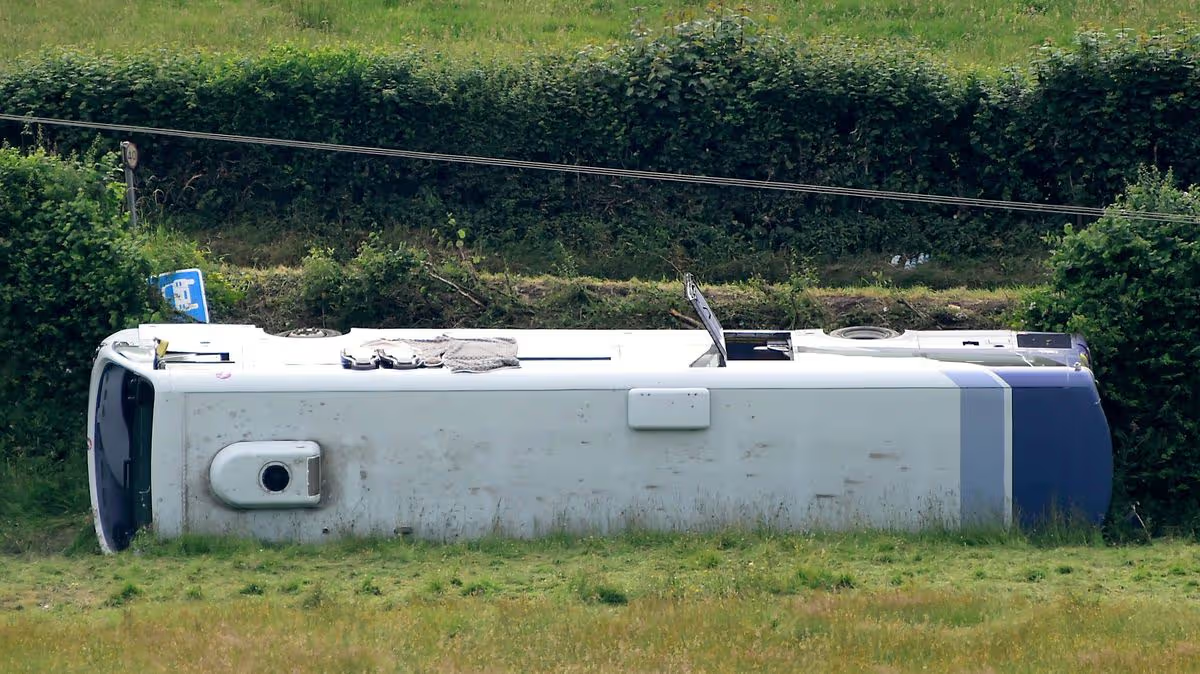
Six individuals have been hospitalised following a bus crash near a Welsh coastal town. A major incident was declared after a bus crashed near the town of Kidwelly, Carmarthenshire, at around 12.20pm, Dyfed-Powys Police said.

Thirteen people were assessed and discharged at the scene with a further six taken to hospital for further medical attention. None of the injuries were thought to be life-threatening at the collision site.

Welfare support was made available at the John Burns Centre in Kidwelly. The major incident has since been stood down.

Advertisement

The affected route, the A484 near the Kidwelly roundabout, will remain shut while collision investigators conduct their examination, police stated, reports Wales Online.

Zoe Hand, managing director of First Bus Franchising – which operates in Wales, said: “Our X11 service was involved in an incident earlier this afternoon on the A484 close to the junction with Old Forge Lane, near Kidwelly.

“A team from our depot at Ammanford travelled to scene immediately to support our driver and look after our customers.

Advertisement

“The safety of everyone who travels with us is always our absolute priority and we are working with the police and ambulance service to care for those who need it and understand the circumstances which led to this incident.”

Dame Nia Griffith, MP for Llanelli – which encompasses Kidwelly, expressed that her thoughts were with those affected. “My immediate thoughts are with all those people who were involved in the crash, and the emergency services who are helping them,” she said.

“I would reiterate the official request for the public to stay away and find alternative routes to the Parc y Bocs roundabout to Llandyfaelog Road.”

Dyfed Powys Police confirmed in a latest update that all passengers have been safely evacuated from the bus and are now receiving the necessary care. A rest centre has been established at the John Burns centre, where welfare provisions are in place to ensure their wellbeing and safety, a spokesperson confirmed.

Advertisement

The stretch of road between the Parc y Bocs roundabout and Llandyfaelog is set to remain shut for a considerable period while emergency services continue to manage the situation and conduct their investigations. Members of the public are strongly urged to seek alternative travel routes until further notice.

A Dyfed Powys Police spokesperson earlier stated: “Officers are dealing with a major incident in Kidwelly, following a report of a collision involving a bus on the A484 near the Kidwelly roundabout (Parc y Bocs).

“The road is closed between the Kidwelly roundabout at Parc y Bocs and Llandyfaelog, and motorists are asked to find alternative routes.”

Traffic monitoring systems are currently reporting significant delays throughout the affected area.

Advertisement

Ensure our latest stories always appear at the top of your Google Search by making us a Preferred Source. Click here to activate or add us as your Preferred Source in your Google search settings.

Source link

Continue Reading

NewsBeat

Stephen Ogilvie family issue positive health update as he continues to recover from horror knife attack

Published

on

Belfast Live

He had been in a critical condition after he was stabbed multiple times during an incident on Kinnaird Avenue

Stephen Ogilvie has now left the intensive care unit as he continues to make a recovery following the attack on him in North Belfast.

Stephen had been in a critical condition after he was stabbed multiple times during an incident on Kinnaird Avenue on June 8. This sparked widespread disorder across Belfast and other parts of Northern Ireland.

The attack on Stephen left him blind in his left eye and at risk of losing sight in the other.

Advertisement

A 30-year-old Sundanese national, Hadi Alodid, has been charged with attempted murder, threats to kill an NHS radiographer on the same day and possession of a knife.

Niall Donnan, who set up a fundraiser for Stephen, shared and update from his Stephen’s father which says that his son has now left intensive care and continues to make steps in his recovery, although he has a difficult road ahead of him.

His father said: “We wanted to share a positive update on Stephen’s recovery and thank everyone for their incredible support. Stephen is now out of ICU and is talking more each day, which is a huge step forward for him and his family. While he still has a long road ahead, we are grateful to see him continuing to make progress.

“Your donations, messages, and support have meant so much during this difficult time. Thank you all for standing with Stephen and his family and continuing to keep him in your thoughts and prayers.”

Advertisement

The fundraiser for Stephen has now raised over £36,000 and can be found by following this link: https://www.gofundme.com/f/support-victim-of-horrific-belfast-knife-attack?

For all the latest news, visit the Belfast Live homepage here and sign up to our daily newsletter here.

Source link

Advertisement
Continue Reading

NewsBeat

Cambridge Water ‘essential use only’ update to customers amid ‘unusually’ hot weather

Published

on

Cambridgeshire Live

Heat warnings are in place covering Cambridgeshire as the UK swelters through a heatwave

Cambridge Water has issued an update to customers amid the heatwave this week. The water company wrote to customers on Tuesday (June 23) with advice to use water only when ‘essential’.

Temperatures in Cambridge are expected to reach highs of 38C this week, according to the Met Office. Long-term average data shows that the maximum average temperature for Cambridge in June between 1991 and 2020 was 20C.

The letter to customers from Cambridge Water said: “A rare Red Extreme Heat Warning has been issued by the Met Office. The red warning joins the existing Amber Extreme Heat Warnings, which stretch from Monday 22 June through to the end of Thursday 25 June, covering much of southern and central England.

Advertisement

“Whilst it was hot yesterday, the heat is set to build further today, with the peak of the heatwave forecast for Wednesday and Thursday this week. Temperatures may reach 39C with a chance of this being exceeded in places.”

It continued: “When the sun comes out and the temperature goes up, typically so does the amount of water used by our customers. This not only has an impact on our work production sites and pumping stations, but also on Cambridgeshire’s precious chalk streams, where we abstract our water from. To help us – and to protect the environment – during this period of extreme weather, we’re asking you to keep to essential water use only.

“Washing your car can probably wait for another day. If plants must be watered, please do so early morning or in the evening, using a watering can. Mulching garden beds will help keep plants hydrated for longer. You don’t need to water the lawn – it will recover once it rains again.”

Source link

Advertisement
Continue Reading

Trending

Copyright © 2025