Look, I get it. I was a holdout on bidets. Like most Americans, I didn’t grow up with one. I hadn’t tried it, but didn’t like the idea of jets of water pointed at my keister.
And then I moved into a house that already had one installed, and became a convert in less than a week. Turns out that the French, the Japanese, and the self-righteous citizens of South Park were correct, and I was wrong. I now feel extra-clean, all the time. But here’s the problem: A large percentage of American bathrooms don’t have a power outlet easily accessible from the toilet. This includes my new front bathroom. Which means a lot of the best bidet models, the ones with heat and lights and fans and fancy doo-dads, are inaccessible to me.
The Tushy Classic 3.0 is a great option for that problem in particular. I didn’t really need all that to begin with, to have a clean bottom. For a lot less money, a company called Tushy specializes in bidet attachments that don’t require electricity. They instead hook in easily to the room-temperature water hose that connects to your toilet tank. Analog knobs control the water jets.It slips under your existing toilet seat for extra-easy installation, and right now, it’s also on sale for less than $100.
My colleague Nena Farrell tested this model for well over a year, and said that while she noted a few cracks on some of the rotating flanges inside of the housing (which you have to remove to even see), hers is still going strong. Note also that the Classic comes in a few colors, but there’s a chance it won’t exactly match your existing toilet.
The Classic is not the model I’ve tested, however. I have an updated model of the Wave, whose O.G. model is also on sale for a hefty discount on Prime Day, just $141. The Wave actually replaces your existing toilet seat, with a couple different shapes depending on the shape of your toilet bowl. (Make sure to check whether your toilet is “round” or “elongated” for proper fit.)
Three-quarters of school districts now have AI guidelines, up sharply from just a year ago, yet 82 percent of teachers say they have never received formal guidance on how to use AI in their work. EdSurge reporter Lauren Coffey breaks down the 2026 CoSN State of Ed Tech report and what it reveals about AI adoption, cybersecurity gaps, and edtech vetting inside K-12 districts. Then host Ira Apfel talks with Joseph South, chief innovation officer at ISTE+ASCD, about why teachers say they feel unprepared to bring AI into their classrooms and what it would take to change that.
What You’ll Learn
Why AI adoption in K-12 districts jumped from 54 percent in 2025 to 75 percent this year, and why most prefer local flexibility over state or federal mandates.Why cybersecurity remains many districts’ top concern even as two-thirds lack the staff and budget to address it, and what the Canvas ransomware attack reveals about the real cost of that gap.
What the Gallup and Walton Family Foundation data actually shows about the teacher guidance crisis: 82 percent of teachers have received no formal AI guidance, 34 percent have received no guidance at all, and 69 percent have received no guidance specifically on using AI for one-on-one instruction or tutoring.
How districts in Long Beach, Gwinnett County, and Fairfax County are building transparency-first AI frameworks, and what the Lighthouse Schools model offers as a replicable path for districts that want to move without waiting for policy from above.
Listen to the episode:
This Week with EdSurge is produced by the EdSurge newsroom. Subscribe to the EdSurge newsletters for education news and analysis delivered to your inbox every week.
A recent craze in education that has garnered the attention of students and teachers alike is the ever increasing presence of phone pouches, or more specifically for my school, Yondr pouches, These small, neoprene packs have a firm magnetic seal that can only be released by tapping it against an unlocking base. Their main purpose is quite simple: stop students from accessing their phone during the school day. The rationale is that the less time students spend on their phone, the more time they will spend learning.
Recently, the response from students and teachers seems to be fairly divided, with most students vehemently opposing it and most teachers earnestly welcoming it. Indeed, according to a recent poll from the Pew Research Center, a majority of U.S. teenagers oppose banning phones during the school day. On the contrary, a separate survey of 1,098 adults found that 93% of adults support cell phone restrictions. This survey is part of the Understanding America Study (UAS), which was conducted last year by the University of Southern California Center for Economic and Social Research.
While common sense dictates what side I should take as a teacher, I can’t say I’m a fervent supporter of phone pouches.
The Problem with Storage
Advertisement
On the surface, phone pouches promise to create distance between the phone and their pupil. Ultimately, this distance may improve learning outcomes by helping minimize phone-fueled distractions. Indeed, according to a study published in the Journal of the American Medical Association (JAMA), U.S. teenagers already spend approximately 70 minutes using their phones during the school day. Those 70 minutes lost could’ve been used to advance a student’s understanding of content, cultivate their ability to work with others or simply finish a recent assignment. Thus, with a Yondr pouch, those are an additional 70 minutes teachers like myself have to work with. However, what most don’t seem to understand is that implementing phone bans with a product like Yondr pouches has its drawbacks.
My district uses phone pouches because our policy prohibits students from using their phones the entire school day. Students are required to put their phones in these packs before their first class of the day. Every teacher and administrator has an unlocking station magnet that unlocks the pouches at the end of the school day.
At the beginning of every class, I spend roughly the first seven minutes walking around to check each student’s Yondr pouch. It’s a routine that provides me (as well as my colleagues) reassurance that every phone is truly sealed away. Considering a standard school day lasts seven class periods, that is already 49 minutes of instructional time a student has lost on Yondr pouches. But the worst part is, that’s only a conservative estimate. It doesn’t account for the additional time wasted on further surveillance.
Monitoring Student Activity
Advertisement
Oftentimes, as I monitor students, I see them attempting to circumvent this restriction on phones entirely. Whether students are scrambling to put their phone away since it was never locked up, messing with the seal so it appears to be untampered with or gritting their teeth because they have a fake phone in the pouch that they hope will deceive their teachers by tricking them that their real phone is in their pouch. For instance, some students instead put a calculator or a broken, “fake” phone instead of their real phone to subvert the policy. Because they have a fake phone in the pouch that they hope will trick their teachers, it still costs time.
I have seen students intentionally arrive late to school to avoid phone checks, use pencils to jam open the lock or simply steal magnets teachers use to unlock the pouches. Ultimately, each of these infractions add up. Now, instead of prioritizing learning through meaningful instructional time, teachers have adopted an additional role of policing the phone policy.
And what benefits, really, do the pouches have? A recent paper, “The Effects of School Phone Bans: National Evidence from Lockable Pouches,” found that Yondr pouches have no statistically significant impact on standardized scores for high schoolers in English. And the impacts in math are modest at best
Bans Backfiring
Advertisement
Fundamentally, what makes these pouches unsuited for education is not that they don’t stop phone use; rather, it’s because that’s all they accomplish. As educators, we often can’t see the forest for the trees. We get so caught up in locking up phones and villainizing students who pull them out during classtime, that we forget why they’re being used in the first place. We forget that there was once a time when students entered the classroom with the sole intention to learn something new, and to learn it well.
So, if promoting learning is truly the goal, a phone pouch isn’t the way to do it. Rather, addressing the underlying reasons why these pouches were needed in the first place will.
I would suggest that school districts approach the rollout of phone pouches with curiosity, not with blanket enforcements. This can mean dedicating several class periods during the first week of school to discuss this topic. Instead of walking through the various parts of your syllabus, have an open conversation with your students about the impacts of phones in their daily lives: When do you use them? How do you use them? What do you use them for?
From there, you can introduce them to what the research shows on the impacts of phone use in the classroom, bringing new meaning to a seemingly harmless (and leisurely) way of spending the day. This way, rather than pure enforcement, you can cultivate a culture where students “buy in” to this new phone practice, promoting both better learning outcomes and student agency.
Brendan Burns, Microsoft technical fellow and a co-founder of Kubernetes. (Microsoft Photo)
Microsoft is promising relief to engineers who get woken up at 3 a.m. for outages and other cloud glitches: an agent informed by its years of experience running Azure, designed to diagnose whatever’s going wrong and recommend potential fixes.
One big benefit over humans: the agent can operate without the stress, fatigue, or tunnel vision that often hampers people doing it on little sleep.
“Agents are a little bit less emotionally attached,” said Brendan Burns, a Microsoft technical fellow and corporate vice president who was one of the creators of Kubernetes. He pointed out that agents don’t feel the pressure when a manager asks for a rapid root-cause analysis.
The Azure Copilot Observability Agent, in preview since late last year, was made generally available Tuesday. It investigates incidents by connecting the logs, metrics, traces and other signals scattered across a company’s systems, then points engineers toward the likely cause.
At this point, the agent does not fix problems on its own. Microsoft also introduced what it calls autonomous operations, in preview, letting the agent triage and investigate alerts without a person prompting it. But it still stops short of acting. It won’t restart a resource or change a configuration, for example, instead leaving it to humans to decide and execute.
Advertisement
Microsoft is joining a crowded field. Datadog made its Bits AI SRE agent generally available in December, and Amazon’s AWS followed with a comparable DevOps Agent this spring. Microsoft said the agent is priced based on usage rather than a flat per-seat license, which is the same model AWS uses for its DevOps Agent.
Established observability players including Dynatrace, Splunk, New Relic and Grafana are moving quickly in the same direction, alongside a wave of AI-focused startups.
In an interview with GeekWire this week, Burns said he believes Microsoft’s breadth is one of its advantages, seeing more of a customer’s software than rivals do, from GitHub to Azure deployments to the signals systems generate. Knowing how those connect, he said, helps the agent trace a problem back to the line of code behind it.
More than a decade ago, Burns and his then-Google colleagues Joe Beda and Craig McLuckie created Kubernetes, the open-source software that lets companies run applications across large, constantly changing infrastructure. It became foundational to cloud computing, and added to the complexity teams now have to manage.
Advertisement
Kubernetes brought a kind of self-repair to that world: when something breaks, it works automatically to restore the system to a healthy state. But it follows fixed rules, Burns said. It’s “very deterministic” — it “can’t make hypotheses, it can’t investigate solutions.”
AI tools like the Azure observability agent are meant to add that missing layer: forming a theory about what went wrong, testing it against the data, and continuing to work to find a solution.
Full autonomy — letting the agent act, not just investigate — is still down the road. In a blog post Tuesday, Burns framed the launch as part of a broader shift toward “agentic operations,” which reason across signals and will someday be able to act on them.
For now, the agent can do a lot of the digging, even if a human still makes the call.
Advertisement
Burns, who recalled once pulling a 36-hour on-call shift, said he can think of “a lot of late nights that would have been a lot nicer if I’d had this 10 years ago.”
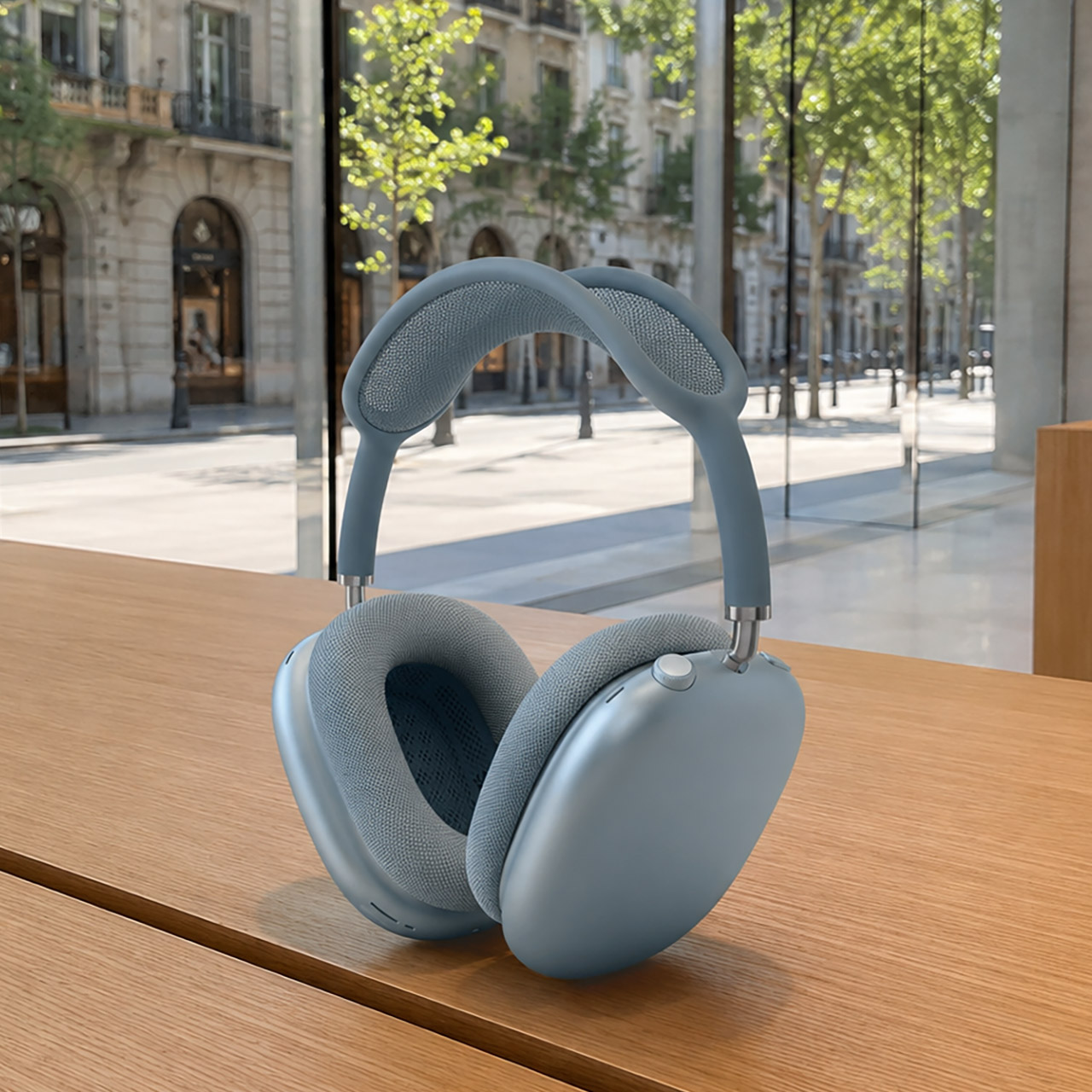
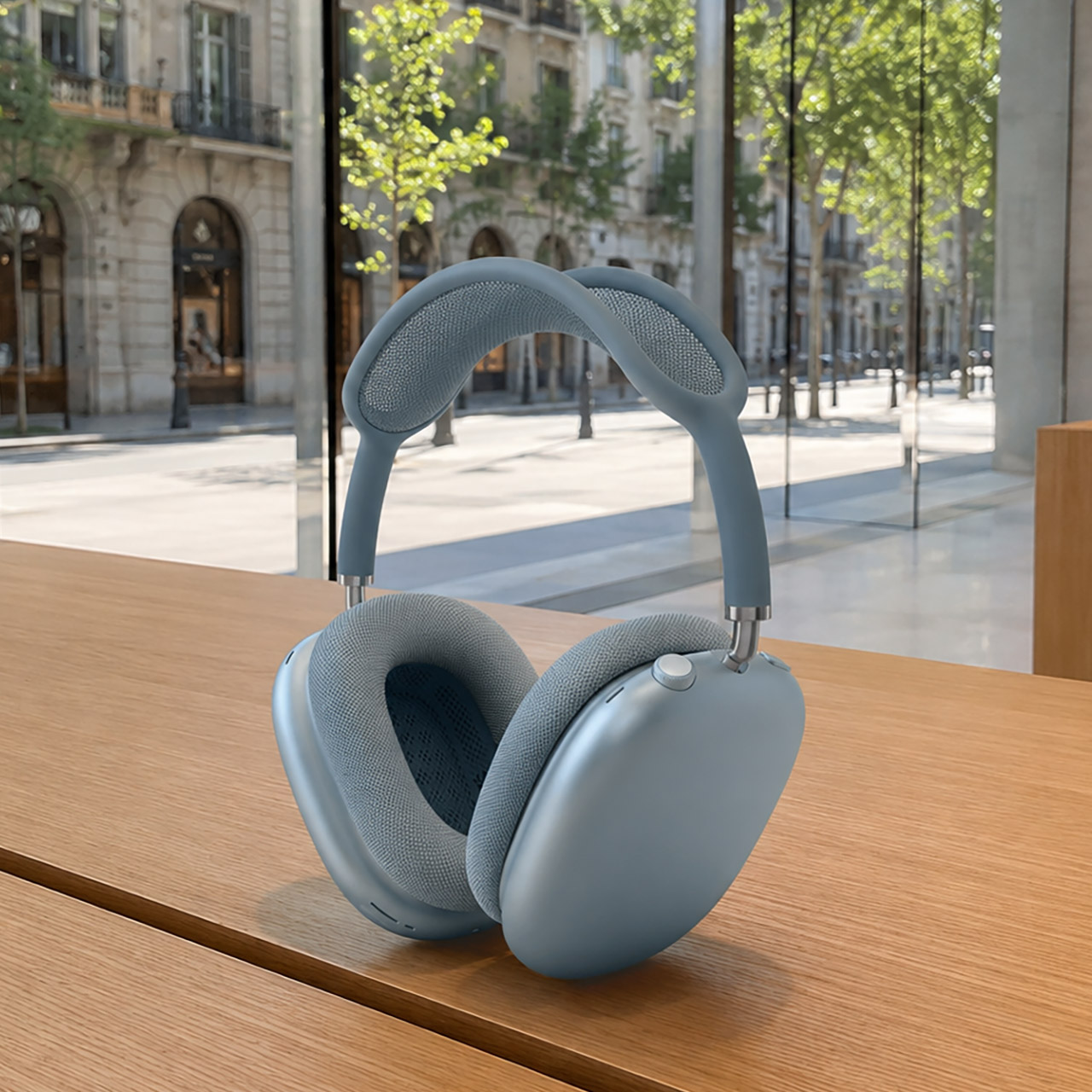
Apple’s refreshed AirPods Max 2, priced at $399 on Prime Day (was $549), immerse you with a listening experience that grabs your attention right away and keeps it there without you having to think about it. The improved noise cancellation eliminates common distractions, such as road rumble or workplace noise, keeping the music front and center. When someone nearby begins talking, the headphones detect it and lower the volume for you, allowing you to hear what’s going on outside in crystal clear detail until the conversation is over. Pairing with Apple devices happens automatically and switches in the blink of an eye, while the USB-C connector allows for both quick top-ups as well as wired playback with CD-quality sound.
Mounting the eufy SoloCam S340 in a sunny location allows the solar panel’s battery to stay charged, eliminating the need to recharge it or run any cables to get it going. The dual lens setup provides a nice wide view of the yard as well as the option to zoom in and get a closer look at anything that catches your eye, all in crystal clear 3K during the day and in stunning color at night. With motorized pan and tilt, the camera can track activity across the yard, leaving no blind zones, while the app only sends you a legitimate alarm when it detects a real person or a vehicle, not every single leaf that falls. There’s a built-in light to lighten things up when needed, and local storage means that all clips are preserved safely directly on the camera, with no subscription required. Two-way communication works great over the phone, and connecting is a breeze with only your usual Wi-Fi and some easy controls. Product page.
Lenovo’s Idea Tab includes a pen and a folio case, making it a ready-to-use tool for taking notes, reading, or simply working. The 11-inch screen displays all details at a fluid 90 frames per second, and its matte texture eliminates bothersome glare, even on bright days, when you’re browsing pages or viewing videos. The included Tab Pen glides over the screen like a dream, making it easy to write, draw, or even sign papers without the need for setup or pairing. The battery life will last you a whole day of mixed use: watch a few shows, browse the web, do some light office work, and don’t need to recharge till the next day. The built-in speakers work well whether you’re viewing movies or listening to music, and you can quickly add more storage with a memory card as your app collection and files develop. Everything operates on the current Android version, and the controls are really basic, making it easy to complete daily tasks and respond quickly to the initial swipe. Product page.
The Samsung The Frame 55-Inch LS03F TV is designed in such a way that it adheres perfectly to the wall, with barely a gap and just one cable connected to an outside box; it looks more like a large piece of framed artwork than a television screen. In its off state, Art Mode displays art gallery quality artworks or pictures which seem to be printed and three dimensional because of the matte surface of the screen which prevents reflection in regular light. Bezel customization ensures that the frame blends in with the woods of the room. The processor takes care of all the processes including streaming applications and also upscaling old media without any lag in the interface. Once it is mounted along with some choice artworks, it becomes visually less conspicuous and yet provides a great viewing experience. Product page.
The recently released second-generation AirTag perfectly fits into the previous compact circular form factor, but with a very important upgrade, which is increased accuracy. The signal emitted by the AirTag when activated from the Find My app will be much louder, regardless of whether it’s hiding underneath the couch cushion or inside a bag. Setup is easy since AirTags will connect with Apple’s large network of devices, which will quietly transmit the location of AirTags when out of reach. The battery will last you approximately a year before having to change it, and the AirTag itself is so small that it can easily attach to your keys or slip into your wallet without adding any extra weight. Product page.
The newest Kindle Paperwhite screen at Amazon feels incredibly like paper, without the shine or reflections, which makes the words readable in broad daylight and under lamp light during the night. Turning of the pages happens by light tap on the screen, and there is no need to make pauses or interruptions by the device in the process of reading. Warm light mode contributes to reducing the brightness and making the nighttime reading easier. Plus, the battery life is quite decent, which means that it works weeks and needs only quick charging through USB-C port. Despite the abundance of technology in it, the device is quite light and thin, which makes it possible to hold the gadget in one hand all day long. It is also water-resistant, so the device will not suffer from any water contacts, be it a bath or a beach. Besides, you can save thousands of books on the device and even more in the clouds. Product page.
Seattle Seahawks legend Marshawn Lynch, center, rides a Lime Glider in downtown Seattle during the march to the match ahead of the USA vs. Australia FIFA World Cup contest on Friday, June 19. (Seattle Department of Transportation Photo)
Lime went full Beastmode for last Friday’s FIFA World Cup match in Seattle.
Seahawks legend Marshawn Lynch was among the riders who helped Lime set a new single-day ridership record in Seattle, with 83,000 trips recorded on shared bikes and scooters.
The tally eclipsed a record set by fans of Lynch’s former team in February when they descended on Seattle for the Super Bowl Championship parade and took more than 60,000 trips.
Across the full week, from June 15 through June 21, Lime said riders took more than 300,000 trips on its devices in Seattle, underscoring Lime’s position as the sole shared e-bike and scooter provider in the city — and the popularity of micromobility during crowded events.
A Lime e-bike and scooter staging area near the Occidental Square fan zone in Seattle’s Pioneer Square during FIFA World Cup. (GeekWire Photo / Kurt Schlosser)
“Major events put real pressure on city streets, transit systems and people’s wallets, and Seattle’s first week of match play showed how micromobility can help,” Parker Dawson, senior regional lead of government relations at Lime, said in a statement Tuesday.
The company — which has 15,000 devices on city streets — says it worked closely with the Seattle Department of Transportation and local stakeholders “to support safe, organized and reliable operations.” Around Pioneer Square, the waterfront and stadium district, huge numbers of Lime devices were staged in drop-off and pick-up spots.
Advertisement
The company also gave away free helmets to riders and deployed teams to help with orderly parking and fleet rebalancing. Lime introduced temporary geofencing and launched a Fan Pass for discounted riding and flexible use through July 19.
“Seattle showed the world how shared e-bikes and scooters can help a major host city move,” Dawson said.
Sound Transit’s Link light also set a record, drawing approximately 280,000 riders on Friday and exceeding a mark of 220,000 that it also set earlier this year during the Super Bowl parade.
The agency said it operated at peak service from 6 a.m. to 1 a.m. to get soccer fans from across the region to and from Friday’s match. Baseball fans also descended on T-Mobile Park for a sold-out Mariners game that evening.
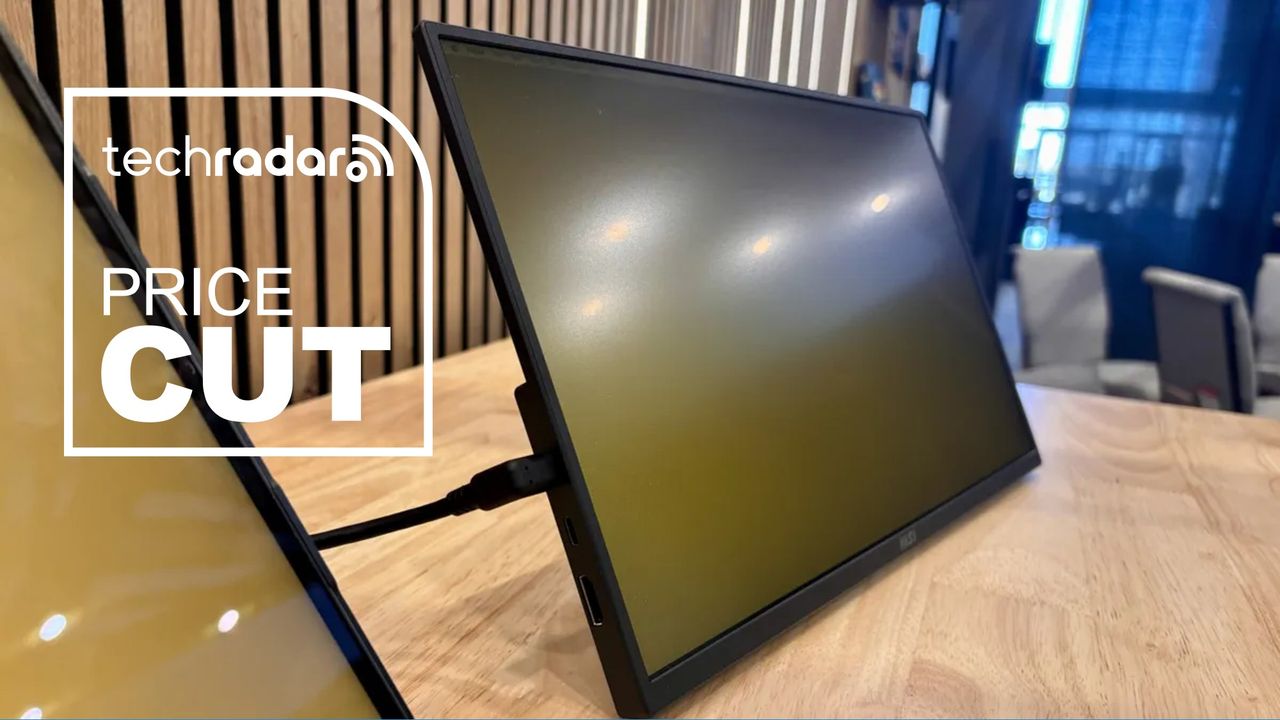
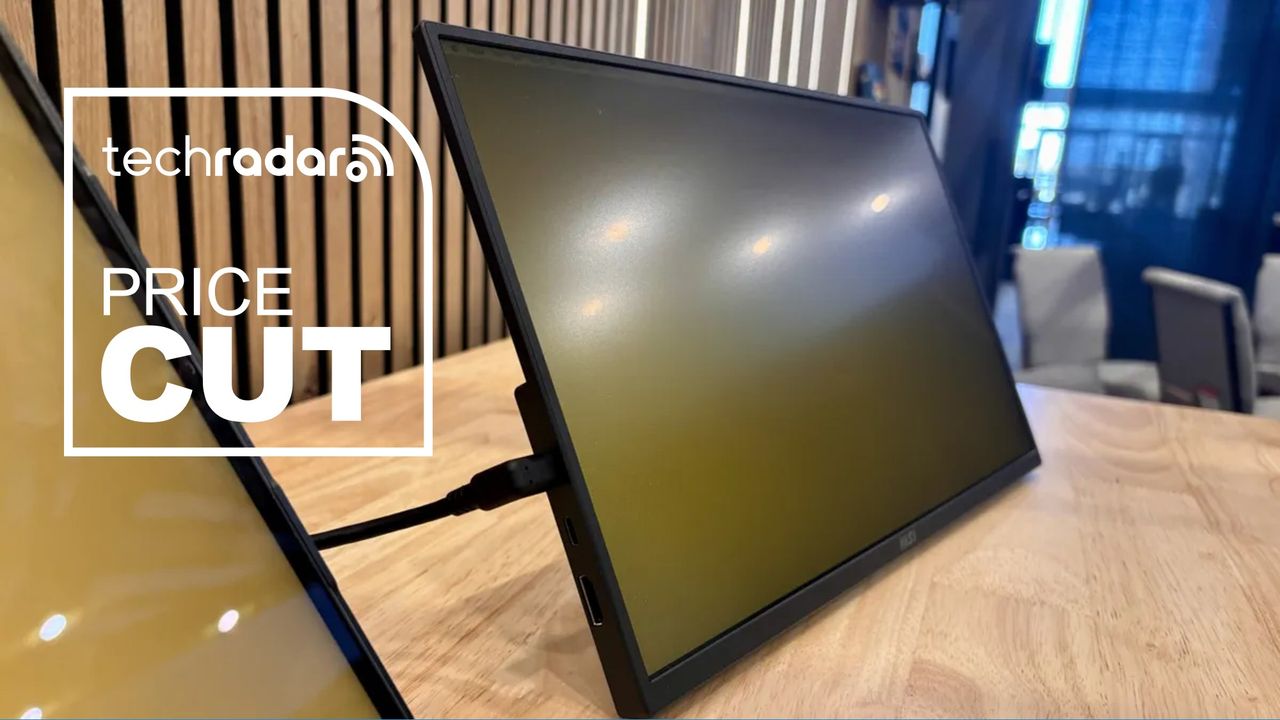
That’s an incredible price for an ultra-thin, ultra-light portable monitor from a well-known brand. And with this price cut, I don’t hesitate in calling this the best budget second display you can get in the sales.
Taking this out for a test drive, we used the screen as part of our professional IT set-up while working on desktops, working across multiple locations, and even used it to create music tracks on a Mac mini. We found it easy to deploy throughout. For a 15.6in 1080p display, there’s not much we didn’t like.
Scoring 4 stars in our review, we called it “a super-light, hyper-functional portable display that is great to have as an extra display for all of your tech.”
After spending time trying this out across a range of workflows, we found it well-designed for business professionals who could really use more screen real estate.
Now, it’s not the most feature-rich portable monitor we’ve ever reviewed – notable, color coverage is average, so I wouldn’t recommend this as a primary screen for video and photo editing.
Advertisement
But it’s not entirely stripped back. Highlights here include the stable integrated kickstand, single cable set-up, and VESA mountable design.
I’m seeing plenty of discounts on portable monitors for Prime Day – including a few at $50. But personally, I’d spend the extra fifteen bucks and pick up the MSI screen. Considering the big 32% discount, I think MSI’s budget pick is the one to go for.
Forward-looking: Valve’s Steam Machine signals the company’s willingness to push Steam beyond software and into a proper hardware platform. But hardware is only half the story. Alongside gaming devices, Valve has been quietly laying the groundwork for something potentially more significant: a version of SteamOS that runs on just about any PC you care to throw at it.
SteamOS has spent most of its life as a closed ecosystem, optimized almost exclusively for Valve’s own devices. That’s beginning to change. The company recently updated its Arch Linux-based OS to broaden hardware compatibility, and the move is backed by active collaboration with some of the biggest names in the PC industry.
The SteamOS 3.8.10 release is where the signals start to add up. The update adds initial support for upcoming Steam Machine hardware and meaningfully improves compatibility with Intel-based handhelds, along with better support for recent Intel and AMD processor platforms more broadly. On paper, it reads like a routine maintenance release. In practice, it looks like Valve is quietly building out the foundation for a much wider platform.
In a recent interview with The Verge, Valve confirmed the Intel relationship goes deeper than a few driver patches. The company is working closely with Intel’s engineers to optimize SteamOS at the graphics stack level, ensuring the OS runs properly on Panther Lake – Intel’s latest computing platform, and the architecture behind the Arc G3 Extreme SoC powering upcoming handhelds like the MSI Claw 8 EX AI+.
Advertisement
The Claw 8 EX AI+ ships with Windows, but Intel has acknowledged real user demand for a Linux alternative. No firm timeline for official SteamOS support has been given.
That device, like the new Steam Machines, carries a price tag that reflects the moment we’re in. The MSI Claw 8 EX AI+ retails for a hefty $1,799 – a figure that would have seemed implausible for a handheld a few years ago. It remains to be seen if the halo device sells in any meaningful quantities at that price level, too.
MSI’s product marketing lead Andy Chu has been straightforward about why: memory and storage costs have surged, largely on the back of AI industry demand, and OEMs have run out of room to absorb them. Chu says MSI exhausted every option trying to bring the price down and still landed here. He’s also warned the situation could get worse before it gets better.
Advertisement
Against that backdrop: expensive hardware, a fragmented ecosystem, and a Windows-centric status quo – Valve’s SteamOS ambitions start to look more strategic than incidental. Valve engineer Pierre-Loup Griffais has said that starting with the 3.8 release, users can now build their own Steam Machines using whatever PC hardware they have on hand. The experience, Griffais says, will closely resemble a docked Steam Deck, with some caveats.
Nvidia support is the most notable gap. Valve is actively collaborating with Nvidia on driver support, but Griffais was measured about the timeline. Most reporting puts realistic availability at 2027 at the earliest. SteamOS is an immutable OS with a read-only filesystem, which makes bundling Nvidia’s proprietary drivers a fundamentally different problem than the open-source AMD and Intel drivers already baked in.
Previous attempts to install SteamOS outside of Valve hardware meant navigating the Steam Deck recovery image, a process that made most mainstream Linux installs look effortless by comparison. What’s happening now is that the OS is being deliberately expanded to meet the broader PC ecosystem, rather than waiting for the ecosystem to come to it.
Team DuggAI, from left: Ashish Naik, Shaurya Duggal and Kruthik Ankam, hoist the championship trophy at the 2026 TiE Young Entrepreneurs (TYE) Global Pitch Competition in Bellevue, Wash. (TYE Photo)
A team of Seattle-area high school students won the 2026 TiE Young Entrepreneurs (TYE) Global Pitch Competition earlier this month, notching a three-peat for the TYE Seattle chapter.
More than 35 teams from 27 chapters around the world competed in the finals, which were held simultaneously at Bellevue College in Bellevue, Wash., and Kerala Startup Mission (KSUM) in India, from June 11-13.
With another team finishing third, the Seattle chapter has produced five winning teams at the global event over the past three years.
DuggAI won first place and a $3,000 prize. The startup’s AI agent is built to handle the “unglamorous side” of software development: triaging, contextualizing, and resolving engineering tickets so developers can stay focused on shipping product. Team members Ashish Naik, Shaurya Duggal, and Kruthik Ankam are all from Skyline High School in Sammamish, Wash.
Team Hydrobin, from left: Ananya Sharda, Aarav Narayan, Yatharth Kothari, Adithya Gogini, and Nissi V. finished third at the 2026 TiE Young Entrepreneurs (TYE) Global Pitch Competition in Bellevue, Wash. (TYE Photo)
Hydrobin took third place and a $1,000 prize. Operating under EcoProducts LLC, the startup turns ocean-bound plastic into reusable packaging designed to displace single-use containers across consumer and shipping use cases. Team members Ananya Sharda, Aarav Narayan, Yatharth Kothari, Adithya Gogini, and Nissi V. are from Interlake High School in Bellevue, Wash.
TYE is a program under The Indus Entrepreneurs global network that gives students in grades 9-12 experience building companies from scratch. The program has been running for more than 20 years, now encompassing more than 40 cities around the world.
TYE Seattle credits its winning ways to a dedicated assortment of mentors, judges, and sponsors. For the 2025-2026 cohort, 22 mentors from Seattle-area tech leadership contributed, and more than 25 sponsors backed the program.
TYE leaders, from left: Aalok Doshi, TYE program co-chair; Aravind Bala, TYE instructor; Yash Wagh, TYE program chair; Kishore Panpaliya, TiE board member; Sonu Aggarwal, TYE chapter president. (TYE Photo)
The Seattle chapter finals and the global semifinals attracted 10 judges with questions and targeted feedback for contestants. Bellevue College hosted the semis on June 12, where judges picked three teams from a field of 18 from the U.S., Canada, and Singapore to advance. On June 13, those three teams went head to head with the top three from India for the global title.
TYE Seattle’s leadership team includes Aravind Bala (instructor), Kishor Panpaliya (board member), Yashovardhan Wagh (program chair), and Aalok Doshi (program co-chair). Several are founders themselves who have spent years iterating on a blueprint for coaching high school entrepreneurs on aspects of customer discovery, prototyping, and pitch prep.
Advertisement
“In the world of AI, the earlier you get into entrepreneurship, the better. It teaches students how to actually build their own products, and puts more of them in position to change the world,” said Wagh, who is founder of Renton-based recommerce company gone.com. “We want to create a country-wide program, and ultimately an ecosystem, that lets students experience the real world and bring that experience back into their education.”
A high-severity SSRF vulnerability, tracked as CVE-2026-20230, in Cisco Unified Communications Manager Server is now being exploited in attacks.
Cisco released security updates for the CVE-2026-20230 flaw on June 3, warning that exploitation could give attackers root privileges on the device.
“A vulnerability in Cisco Unified Communications Manager (Unified CM) and Cisco Unified Communications Manager Session Management Edition (Unified CM SME) could allow an unauthenticated, remote attacker to conduct server-side request forgery (SSRF) attacks through an affected device,” warned Cisco.
“This vulnerability is due to improper input validation for specific HTTP requests. An attacker could exploit this vulnerability by sending a crafted HTTP request to an affected device. A successful exploit could allow the attacker to write files to the underlying operating system that could be used later to elevate to root.”
The flaw was disclosed to Cisco by SSD Secure, who did not share any technical details at the time.
Advertisement
Today, threat intelligence firm Defused warned that the flaw is now being actively exploited in attacks.
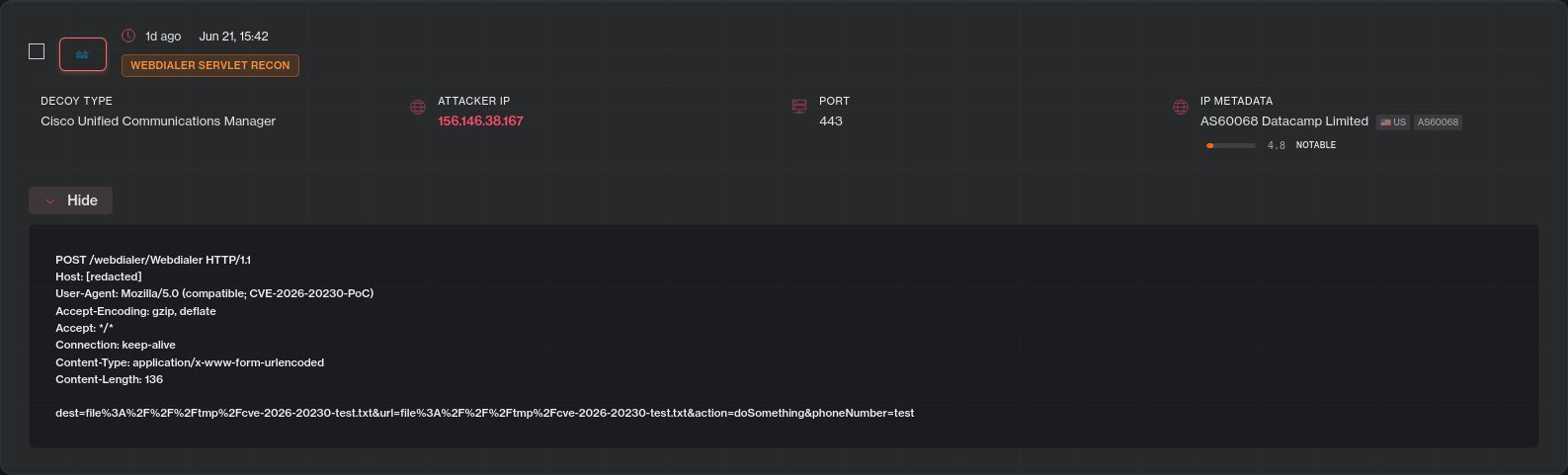
“Over the weekend we observed exploitation of CVE-2026-20230 – Cisco Unified CM (CUCM) WebDialer SSRF → root file-write (CVSS 8.6) No previously recorded exploitation, and not yet listed in CISA KEV,” Defused warned on X.
Defused says the attacks are originating from a single IP address and use properly constructed file:// payloads to create files on the device.
Cisco CVE-2026-20230 exploit on honeypots Source: Defused
While the flaw can be exploited in attacks to drop webshells and gain root privileges, the PoC observed by Defused appears designed to identify vulnerable devices by attempting to write a text file named ‘/tmp/cve-2026-20230-test.txt’ to them.
After the exploitation was disclosed, SSD Secure published a technical write-up of the flaw explaining how the vulnerability works and sharing a proof-of-concept exploit.
Advertisement
The researchers found that an unauthenticated attacker could abuse the Webdialer component’s handling of user-supplied URLs to force the application to write arbitrary files to the operating system using file:// URIs.
By controlling the file path and the content written to disk, an attacker could exploit the bug to achieve remote code execution and ultimately gain root privileges on vulnerable devices.
SSD Secure noted that exploitation requires the attacker to first obtain the target system’s hostname before carrying out the file-write attack. However, the researchers demonstrated how that information can be retrieved from the device before exploitation.
While the current exploitation appears to be reconnaissance in nature, now that the flaw has been fully disclosed, we will likely see more threat actors target these servers.
Advertisement
BleepingComputer contacted Cisco to ask if they, too, are seeing the flaw exploited in attacks and if any IOCs can be shared with defenders, and will update the article if we receive a response.
Security teams log 54% of successful attacks and alert on just 14%. The rest move through your environment unseen.
The Picus whitepaper shows how breach and attack simulation tests your SIEM and EDR rules so threats stop slipping by detection.
A good power bank isn’t exciting until your phone drops to 5% during a flight, a commute, or a long day away from an outlet. That’s when having a reliable backup battery suddenly feels essential. Prime Day is packed with portable charger deals, but many of them are generic products that look good on paper and disappoint in daily use. For this shortlist, I focused on trusted brands, practical features, portability, and unique use cases. Whether you want a dependable everyday charger, a MagSafe companion, or an emergency battery for outdoor adventures, these are the power banks I’d consider buying during Prime Day.
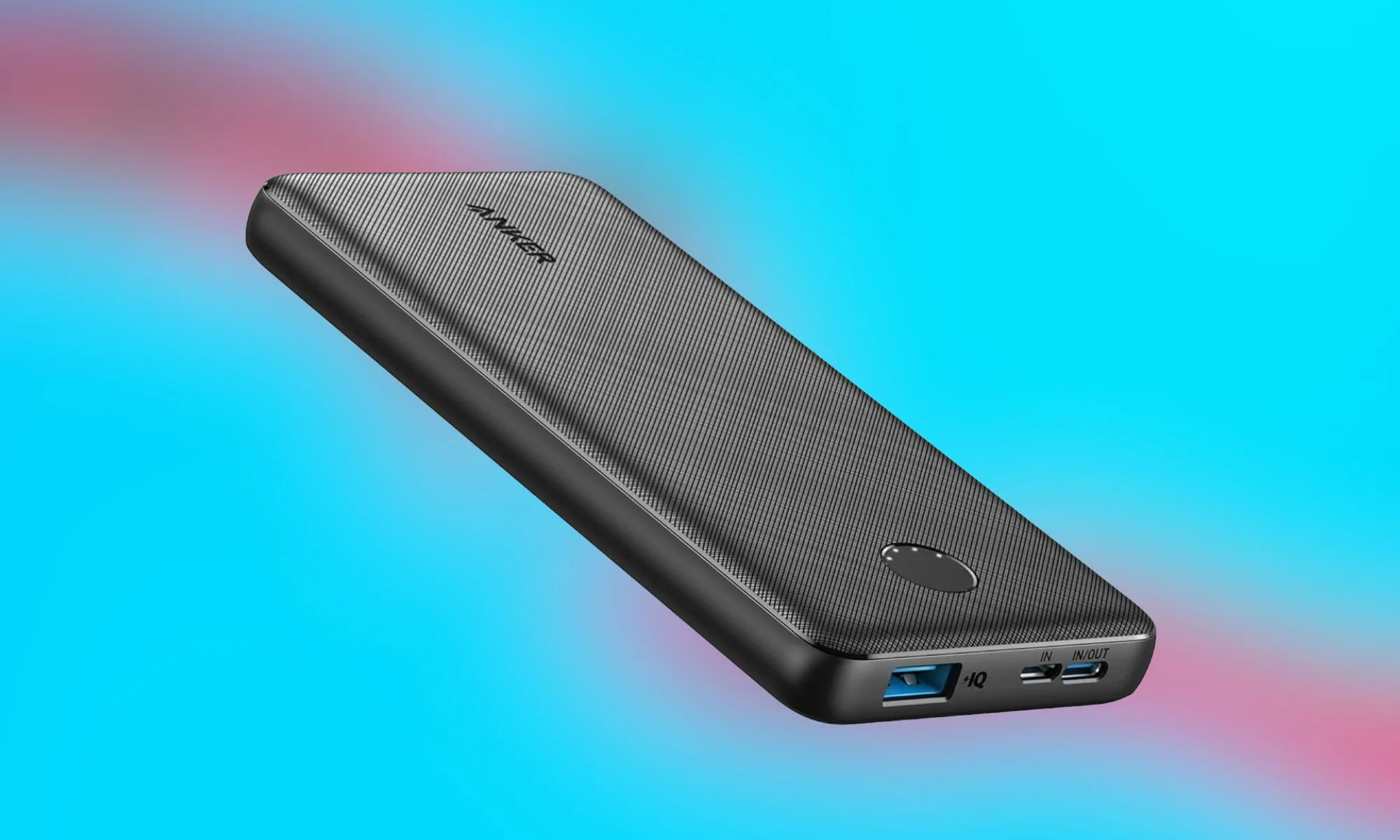
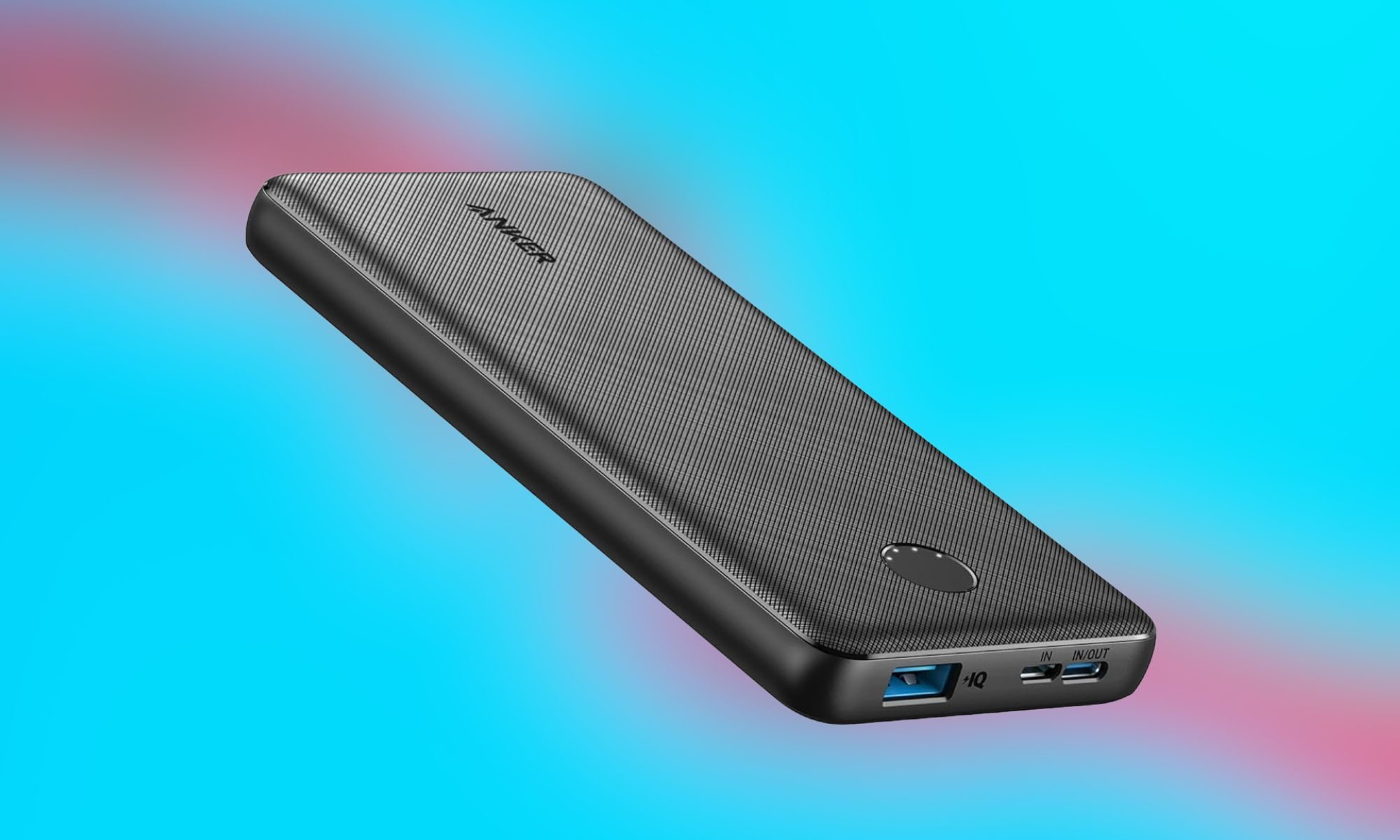
Anker PowerCore 10K – My everyday favorite power bank
Anker
Pros
Extremely lightweight and portable
Highly affordable budget price
Impressive scratch-resistant exterior
Reliable overcharge safety protection
Useful low-power trickle mode
Cons
Frustratingly slow recharge times
Lacks pass-through charging capabilities
Cannot charge multiple devices
No laptop Power Delivery
If someone asks me to recommend a portable charger without any qualifications, Anker is usually where I start. The PowerCore 10K strikes an ideal balance between capacity, portability, and reliability. With enough power to recharge most smartphones nearly twice, it’s compact enough to slip into a backpack, jacket pocket, or carry-on without adding noticeable weight. Anker has also built a reputation for dependable charging technology and strong safety features, making this one of the safest recommendations on this list. For travelers, students, and commuters, it’s difficult to find a more practical all-around option.
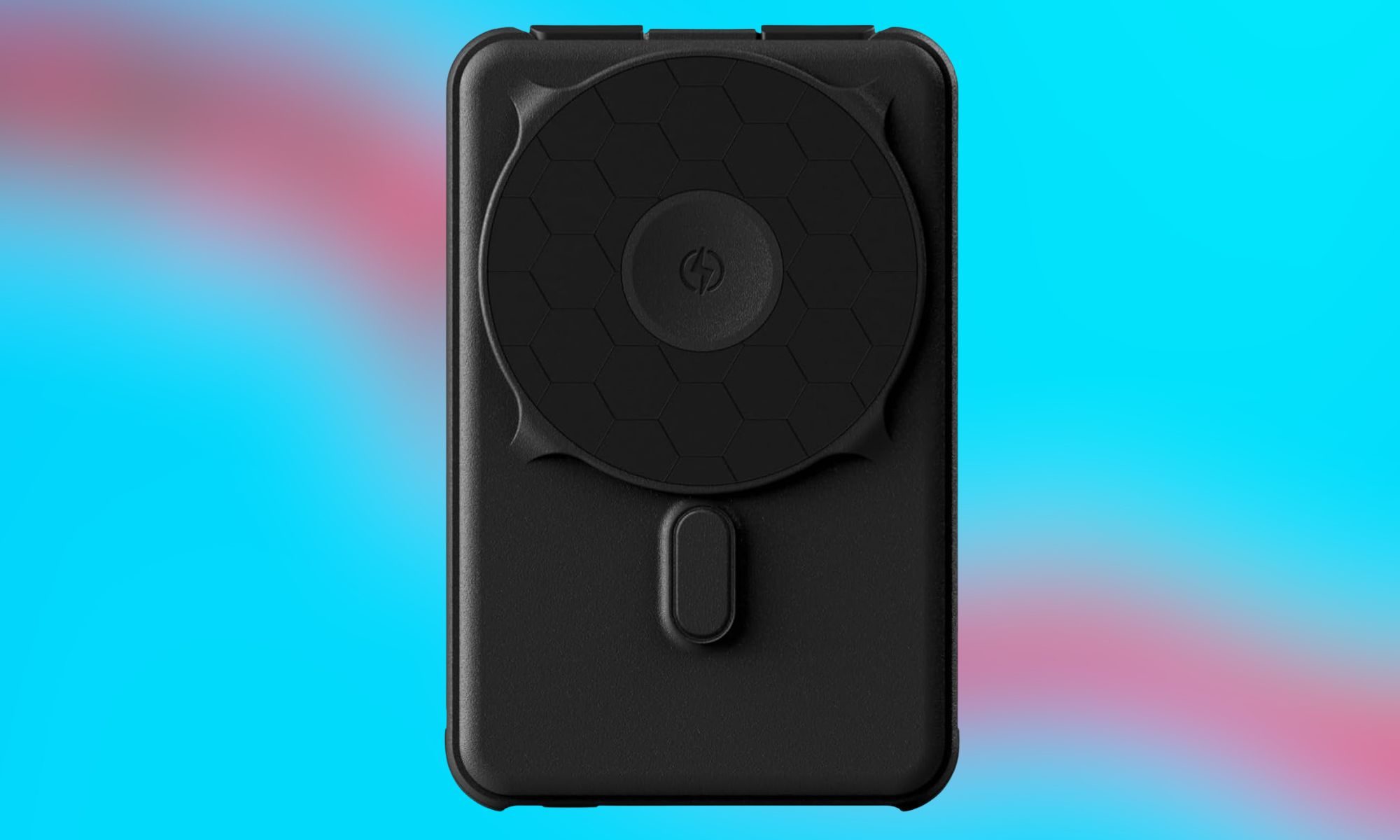
Ridge Magnetic Power Bank – Best deal for iPhone users
Ridge
Pros
Extremely lightweight and portable
Highly affordable budget price
Impressive scratch-resistant exterior
Reliable overcharge safety protection
Useful low-power trickle mode
Cons
Frustratingly slow recharge times
Lacks pass-through charging capabilities
Cannot charge multiple devices
No laptop Power Delivery
Magnetic charging accessories have become incredibly popular among iPhone users, and the Ridge Magnetic Power Bank embraces that convenience. Instead of carrying cables everywhere, you can simply attach the battery to the back of a compatible device and continue using your phone while it charges. The slim design makes it particularly appealing for travel and daily commuting, while the premium construction aligns with Ridge’s reputation for durable everyday-carry products. If convenience matters more than maximum capacity, this is one of the more attractive Prime Day options available.
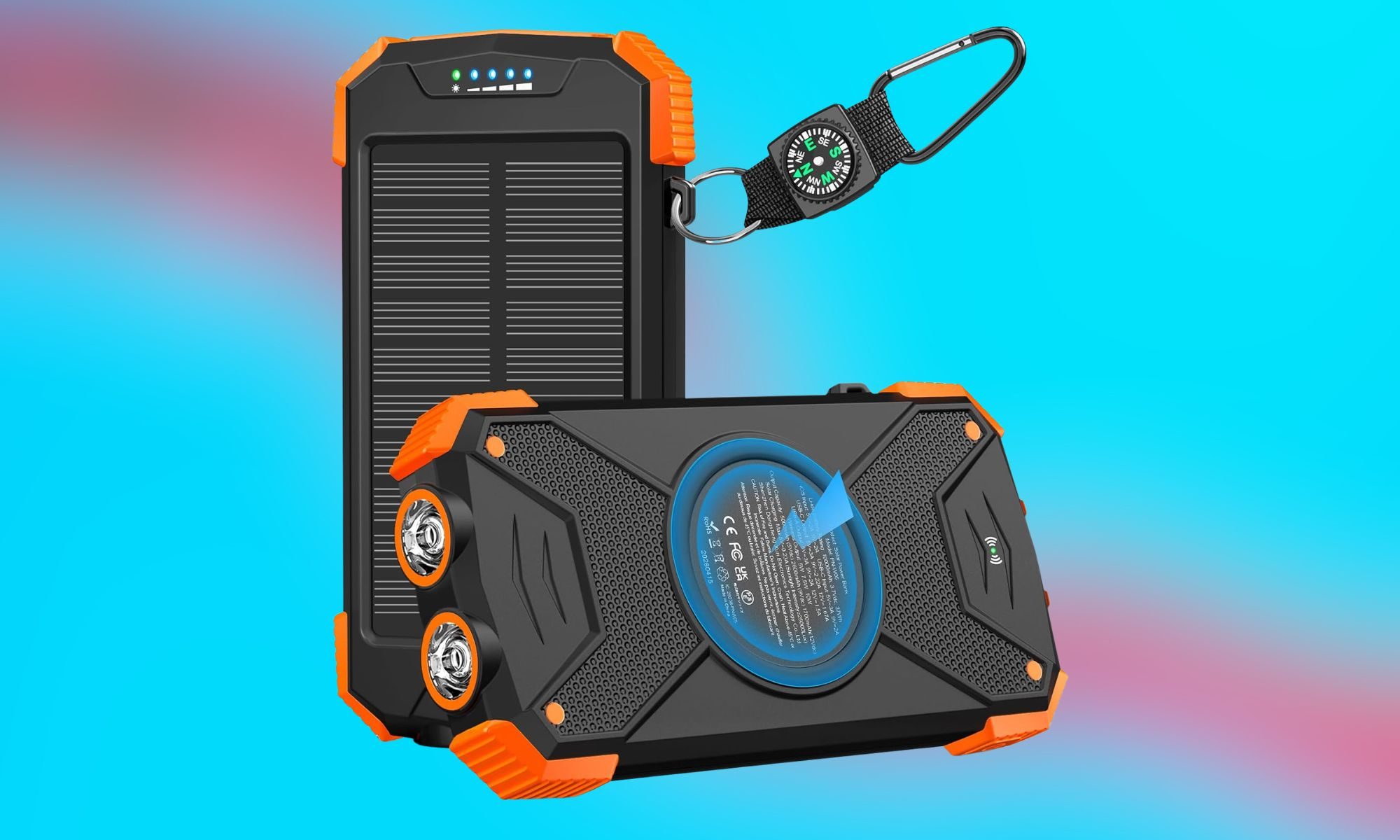
BLAVOR Solar Power Bank – Best one for outdoor adventures
BLAVOR
Pros
Extremely lightweight and portable
Highly affordable budget price
Impressive scratch-resistant exterior
Reliable overcharge safety protection
Useful low-power trickle mode
Cons
Frustratingly slow recharge times
Lacks pass-through charging capabilities
Cannot charge multiple devices
No laptop Power Delivery
Most power banks are designed for urban life, but the BLAVOR Solar Power Bank takes a different approach. Built with outdoor use in mind, it combines a 10,000mAh battery with solar charging support, a flashlight, and a rugged design. While solar charging isn’t fast enough to replace traditional charging methods, it can provide valuable backup power during camping trips, hikes, or emergencies. If you’re building an emergency preparedness kit or spending time away from conventional power sources, this is one of the most versatile products in the category.
Aaoyun Portable Charger – Extremely convenient for everyday use
Aaoyun
Pros
Extremely lightweight and portable
Highly affordable budget price
Impressive scratch-resistant exterior
Reliable overcharge safety protection
Useful low-power trickle mode
Cons
Frustratingly slow recharge times
Lacks pass-through charging capabilities
Cannot charge multiple devices
No laptop Power Delivery
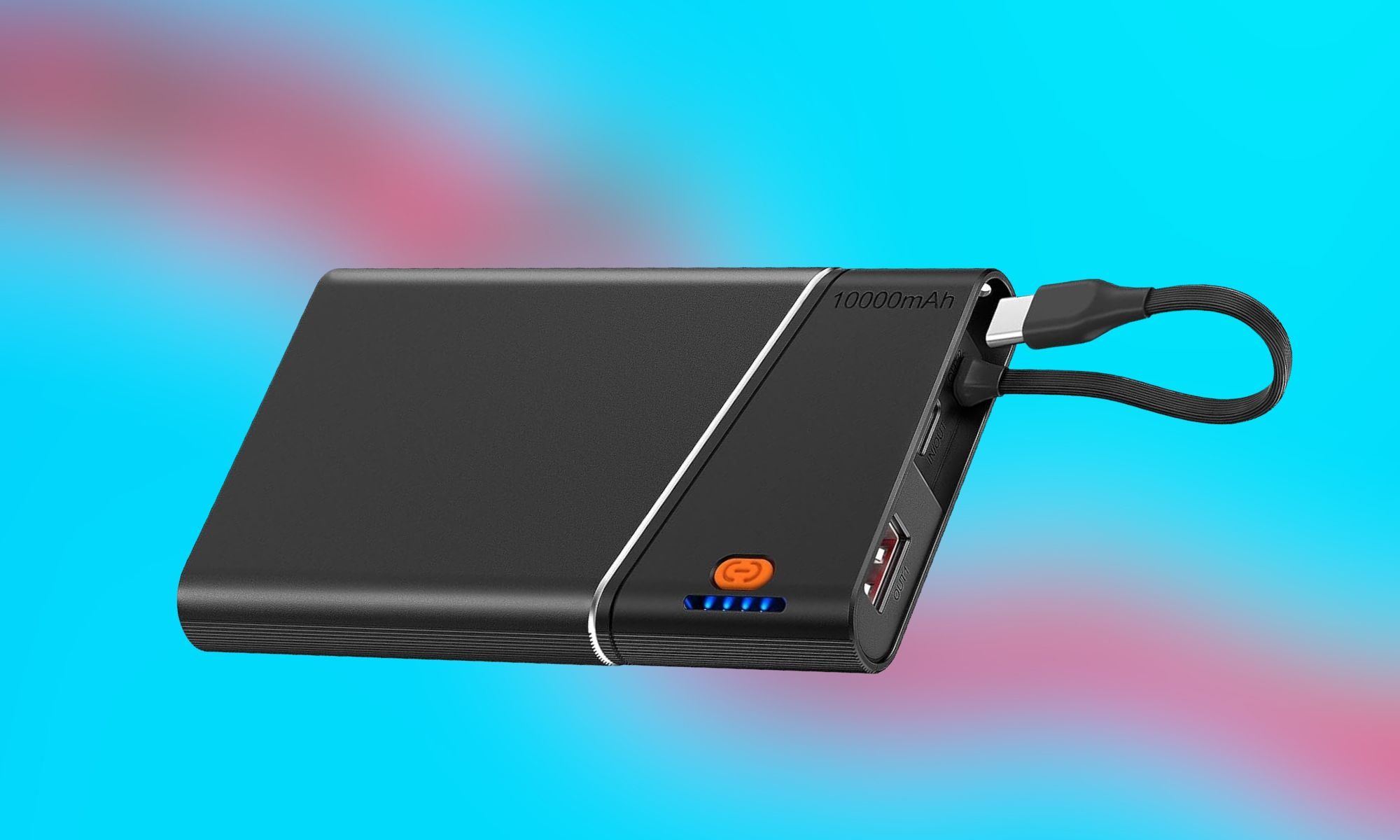
The biggest annoyance with portable chargers is often remembering to carry a cable. That’s what makes the Aaoyun Portable Charger interesting. Its compact design and integrated charging solution reduce the number of accessories you need to carry, making it particularly convenient for people who prioritize portability. It won’t replace a high-capacity travel charger, but it serves as a useful everyday backup for keeping a smartphone alive through long workdays, concerts, festivals, and travel delays.
Belkin USB-C Power Bank – Wins the reliability game
Belkin
Pros
Extremely lightweight and portable
Highly affordable budget price
Impressive scratch-resistant exterior
Reliable overcharge safety protection
Useful low-power trickle mode
Cons
Frustratingly slow recharge times
Lacks pass-through charging capabilities
Cannot charge multiple devices
No laptop Power Delivery
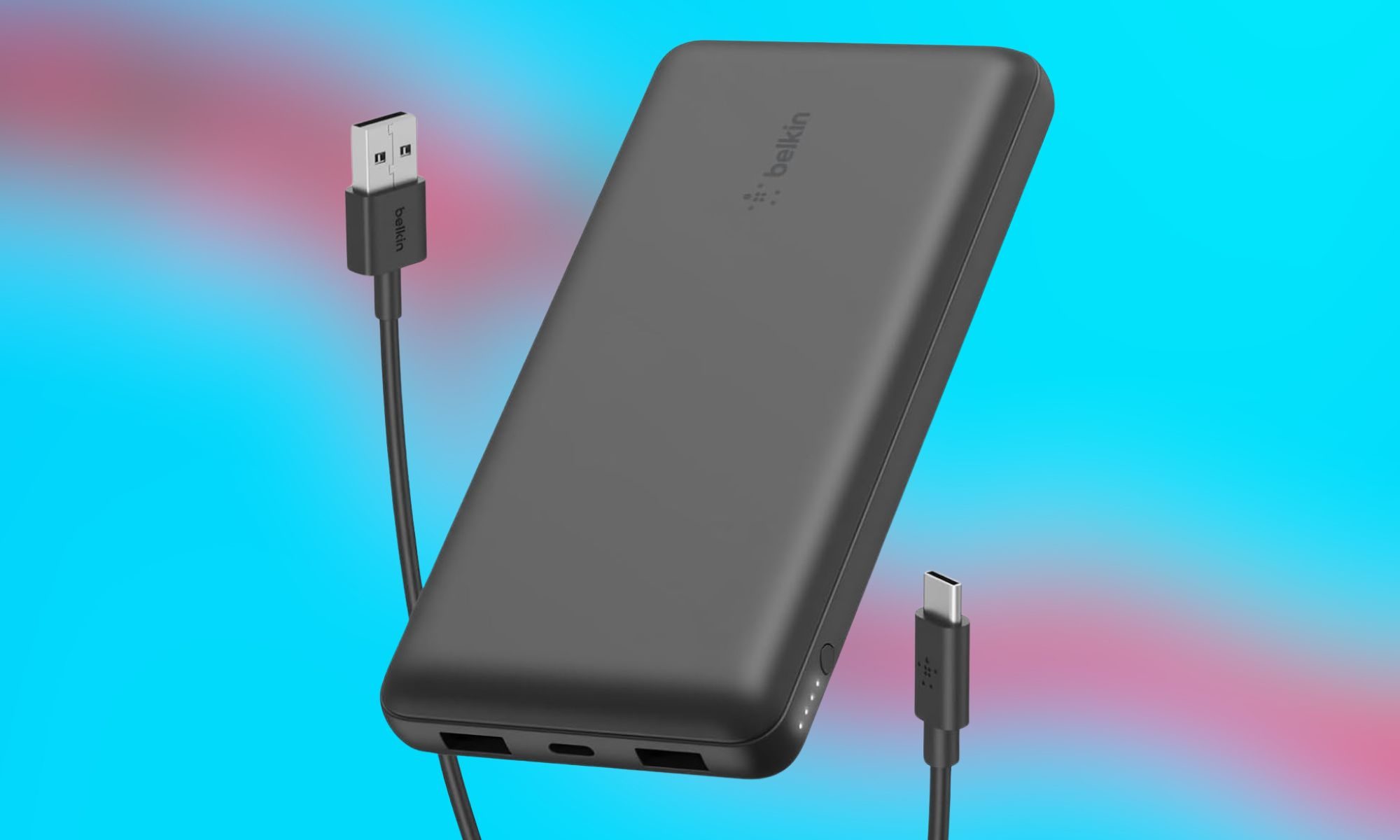
Belkin has spent years building accessories for major technology brands, and that experience shows in its portable charging products. The company’s USB-C power bank focuses on reliability, compatibility, and straightforward performance rather than flashy features. It’s an excellent choice for professionals, frequent travelers, and anyone who values dependable charging from a well-established brand. While it may not offer solar charging or magnetic attachments, it delivers exactly what most users need: consistent power when their devices run low.
Prime Day is full of portable charger deals, but these five products stand out because each serves a different need. The Anker PowerCore 10K is the safest overall recommendation, the Ridge Magnetic Power Bank is ideal for iPhone users, the BLAVOR Solar Power Bank is built for outdoor adventures, the Aaoyun Portable Charger prioritizes convenience, and the Belkin USB-C Power Bank focuses on reliability. If you’re planning to pick up a backup battery this Prime Day, these are the models I’d shortlist first.























































You must be logged in to post a comment Login