

Crypto World
CBOE eyes crypto perpetuals as Kalshi upends futures market



CBOE has begun evaluating a conversion of its Bitcoin and Ether futures into perpetual contracts after crypto perpetuals generated more than $8.5 billion in trading volume on Kalshi within weeks of launch.
Summary
- CBOE is considering converting its Bitcoin and Ether futures into perpetual contracts after recent CFTC approvals.
- Kalshi’s crypto perpetual futures have generated more than $8.5 billion in trading volume within weeks of launch.
- CME has challenged the CFTC in court as perpetual futures trading expands across regulated and decentralized markets.
According to a June 23 report from The Wall Street Journal, CBOE Global Markets is considering turning its continuous Bitcoin and Ether futures into perpetual futures following recent regulatory developments in the United States.
The report cited Rob Hocking, CBOE’s global head of derivatives, who said the exchange is exploring the possibility after the U.S. Commodity Futures Trading Commission approved cryptocurrency perpetual futures for prediction market operator Kalshi.
While Hocking did not provide a timeline for any changes, the comments place one of the largest U.S. exchange operators among a growing list of firms responding to fresh competition in the perpetual futures market.
CBOE introduced its continuous Bitcoin and Ether futures contracts in December, offering products with expirations extending as far as 10 years.
According to The Wall Street Journal, the exchange is now studying whether perpetual contracts could provide an alternative structure following the CFTC’s decision to permit similar products on regulated U.S. venues.
Kalshi’s rapid growth has drawn attention from incumbent exchanges
Trading activity has accelerated quickly since Kalshi entered the market. According to The Wall Street Journal, Kalshi’s cryptocurrency perpetual futures have recorded more than $8.5 billion in volume within weeks of becoming available.
The CFTC’s approval has not been welcomed by all established exchanges. Earlier this month, the Chicago Mercantile Exchange filed a lawsuit against the regulator, arguing that the decision allowing Kalshi to list perpetual futures violates federal law. CME claimed the approval caused “textbook competitive injury” to incumbent futures exchanges.
The dispute highlights the growing importance of perpetual futures, a product that has become the dominant form of crypto derivatives trading since being popularized by BitMEX. Unlike traditional futures contracts, perpetuals do not expire and instead use periodic funding payments to keep contract prices aligned with the underlying asset.
Perpetual futures activity continues to expand across crypto markets
Outside traditional exchange operators, trading firms and crypto platforms continue adding new perpetual products.
Earlier this month, Coinbase launched perpetual futures linked to stock indexes, giving eligible U.S. traders leveraged exposure to sectors including artificial intelligence, defense, and Chinese equities. The rollout followed Coinbase International Exchange’s March launch of round-the-clock futures tied to U.S.-listed stocks for eligible traders outside the U.S.
Commodity-linked perpetual products are also gaining traction. BitMEX recently pointed to rising interest in commodity perpetual swaps as volatility in oil and gold markets increased.
Decentralized trading venues have become another major center for perpetual futures activity. According to data from DeFiLlama, decentralized exchanges processed more than $22.5 billion in perpetual futures volume during the past 24 hours and approximately $663 billion over the previous 30 days. DeFiLlama data showed that Hyperliquid accounted for most of that activity.
With regulated U.S. exchanges now receiving a pathway to offer perpetual futures, competition between traditional futures operators, crypto-native platforms, and decentralized venues is intensifying as firms move to capture trading activity that has historically been concentrated outside the U.S.

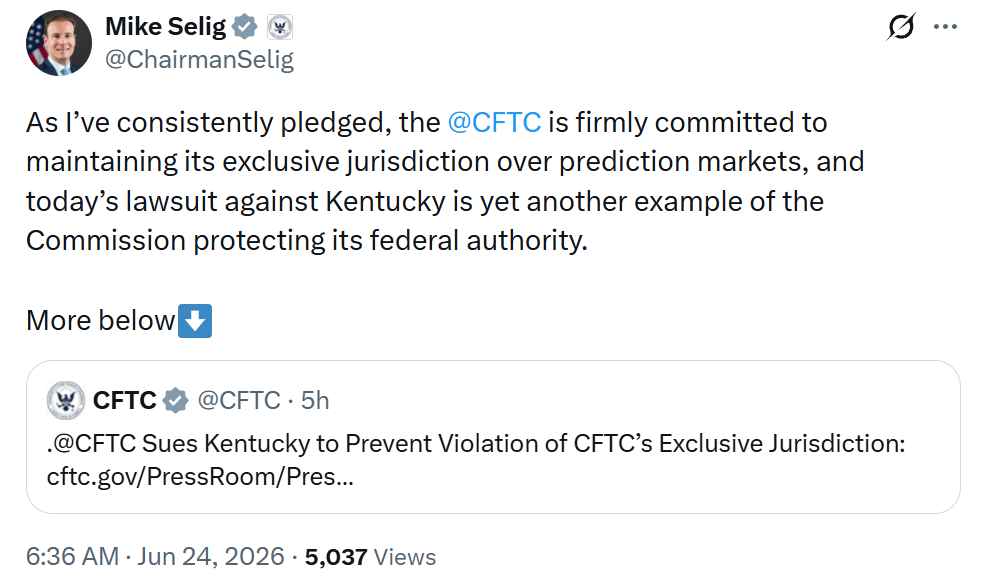
The US Commodity Futures Trading Commission filed a lawsuit against Kentucky on Tuesday after the state sued prediction market operators last week, accusing them of operating unlicensed and illegal gambling platforms.
The lawsuit, filed in federal court, seeks to block Kentucky’s legal action against five prediction markets filed on Wednesday last week, calling for declaratory and injunctive relief. It names Kentucky Governor Andrew Beshear, Attorney General Russell Coleman and the Kentucky Horse Racing and Gaming Corporation, among others.
“Kentucky is the latest state attempting to shut down federally-regulated event contracts,” CFTC Chair Mike Selig said in a statement. “As I’ve consistently pledged, the CFTC is firmly committed to maintaining its exclusive jurisdiction over prediction markets, and today’s lawsuit against Kentucky is yet another example of the Commission protecting its federal interests.”
The CFTC has been ramping up its effort to maintain authority over prediction markets since Selig was appointed as chair in December. Kentucky is now the ninth state that the CFTC has sued over state authorities taking action against prediction markets.
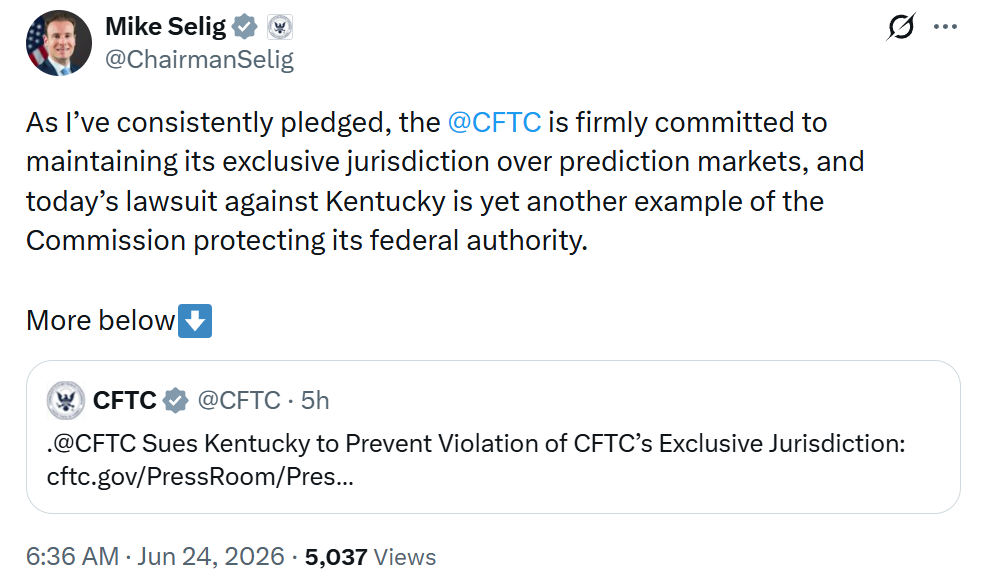
Source: Mike Selig
Kentucky sued Polymarket and Kalshi, along with Kalshi partners Coinbase, Robinhood and Webull, claiming they are “doing business without a Kentucky gaming license or following state regulations” and that their sports event contracts “fall squarely within the definition of ‘sports wagering’ under Kentucky law.”
Sports betting has been under the jurisdiction of the Kentucky Horse Racing and Gaming Corporation since 2023.
Related: Mark Zuckerberg ordered Meta staff to develop moneyless prediction market: NYT
The state also alleged the platforms offer users “few or no resources” to identify or seek help for a gambling problem as required by state law.
In its lawsuit, the CFTC argued that Kalshi and Polymarket are designated contract markets under its authority, and their event contracts are “swaps” under federal commodities law.
It argued that Coinbase, Robinhood and Webull are CFTC-registered futures commission merchants that can offer event contracts in partnership with a designated contract market.
The regulator also took aim at Kentucky’s recent law that imposed a 14.25% excise tax on prediction market transaction fees, arguing it was an attempt to make prediction markets economically unviable in the state.
“This tax essentially makes it impossible for prediction markets to operate in Kentucky,” the CFTC argued.
The lawsuit comes just weeks after CFTC similarly sued New Mexico to block the state’s efforts to apply state gaming laws to Kalshi.
In May, US President Donald Trump gave the CFTC moral support, saying it was “critically important” that the regulator was the authority on prediction markets.

Source: Donald Trump
Trump’s son, Donald Trump Jr., has invested in and is on the advisory board for Polymarket and is an adviser to Kalshi.
Magazine: Bitcoin decouples from tech stocks, Ether eyes ‘selling wave’: Market Moves


Both chambers of Congress have passed legislation barring the Federal Reserve from issuing a central bank digital currency through 2030, with the bill heading to President Trump for signature after the House cleared it Tuesday. The House passed the 21st Century ROAD to Housing Act with a large… Read the full story at The Defiant
The Ethereum Foundation is cutting its budget by roughly 40% and reducing staff by about 20%, concluding a planned shift toward a leaner, endowment-style organization with a narrower set of priorities.
Co-founder Vitalik Buterin called the cuts a deliberate trade, not an efficiency drive. Solana co-founder Anatoly Yakovenko went further, arguing the leaner foundation will move faster and prove bullish for Ethereum.
What the Budget Cut Removes
The foundation confirmed it is cutting 54 roles, close to one-fifth of its staff. It is reorganizing into a seven-cluster structure built around protocol security, censorship resistance, and privacy.
Buterin did not frame the reductions as pure efficiency. He named concrete losses. These include a smaller Devcon, the wind-down of Privacy and Scaling Explorations, and fewer projects beyond Ethereum.
The Ethereum co-founder also signaled his diminishing influence on the board.
The foundation’s June 2025 treasury policy set annual spending at 15% of holdings, with a 2.5-year cash buffer. It mapped a glide path to a 5% endowment baseline by about 2030.
To sell less ether (ETH), it now leans on staking and DeFi yield instead of principal.
“This year, the EF is decreasing its budget by roughly 40%, which entails some difficult decisions… the EF is transitioning into being a long-term-oriented endowment-based organization…” Vitalik Buterin wrote.
Follow us on X to get the latest news as it happens
Buterin tied the budget to Ethereum’s Strawmap, which he calls the network’s third iteration after the Merge.
He wants that core protocol overhaul finished, then a higher bar for new features. He also expects leaner shipping.
Buterin said more of the protocol will shift from client redundancy to AI-assisted formal verification, reducing upgrade costs.
Solana Co-Founder Sees Upside
Not everyone reads the cuts as a decline. Solana co-founder Yakovenko argued that tight budgets force focus.
“Bullish… Budget constraints force prioritization and focus. Ethereum isn’t going away. A smaller and leaner EF will be more decisive and will move faster and will be able to course correct faster,” the Solana executive wrote.
Skeptics see risk. Former foundation contributor Trent Van Epps warned of a roughly $30 million annual funding gap for core development.
BitMine chairman Tom Lee dismissed the crisis talk, betting private backers and stakers will step in.
That bet is already taking shape. Days earlier, five former foundation researchers launched an independent nonprofit, Ethlabs. Lee and Ethereum co-founder Joe Lubin backed it to push institutional adoption.
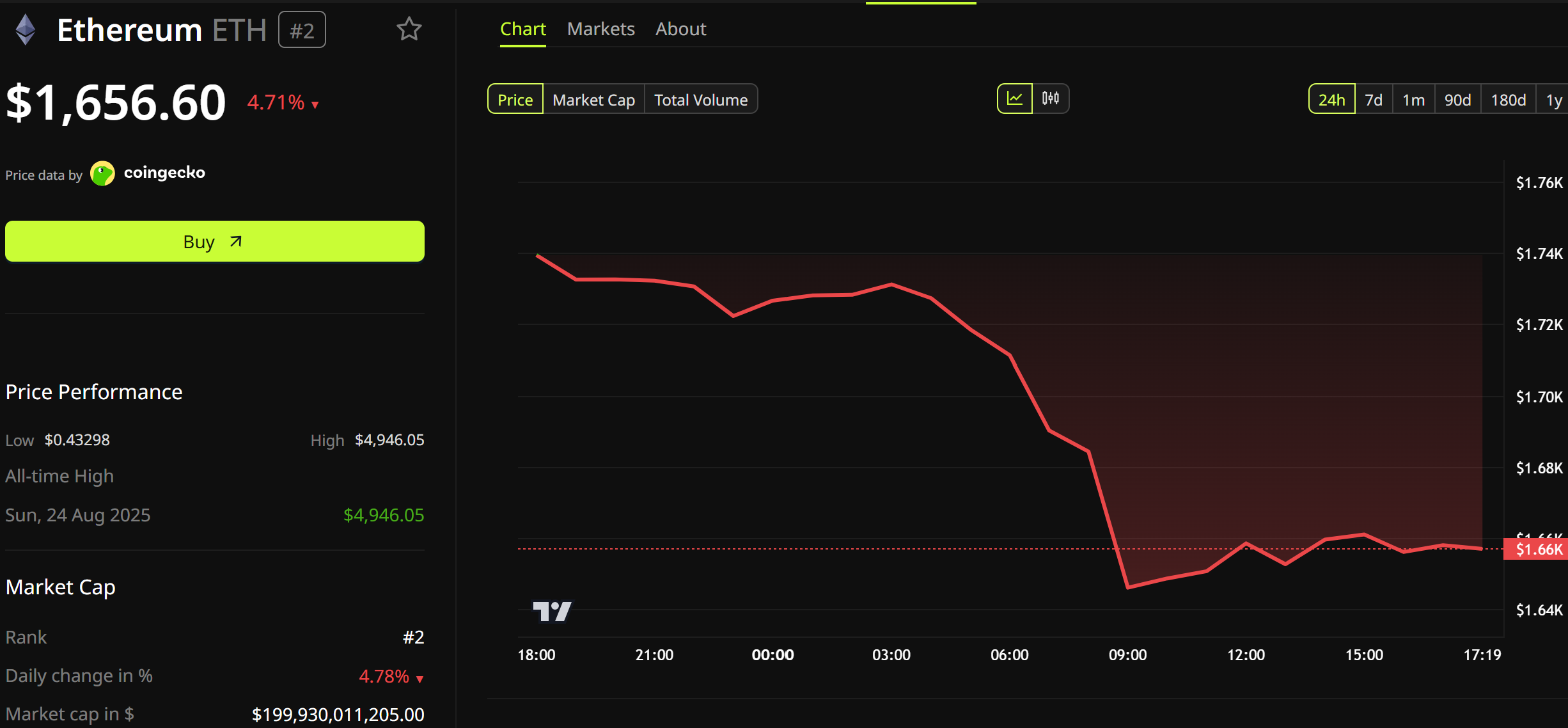
Ethereum reflected the unease. Ether’s price action slid below $1,660, down about 5% over 24 hours. It retained its rank as the second-largest cryptocurrency, valued at about $200 billion.

The next treasury reports and protocol milestones will test the bet.
They will show whether a smaller foundation ships faster, as Yakovenko predicts, or whether the lost talent slows Ethereum’s most ambitious upgrade yet.
The post Ethereum Foundation Cuts Another 40% But Solana Founder Calls It Bullish appeared first on BeInCrypto.

Bitcoin traded with limited conviction at the start of Tuesday’s Wall Street session as earlier losses in Asia’s technology-heavy markets spilled into global risk sentiment. While BTC held its position near recent ranges, traders increasingly pointed to cross-asset volatility—particularly moves in major US indices and upcoming company-specific headlines—as a driver of short-term price swings.
On the crypto side, liquidation data underscored how thin the margin for error currently looks. CoinGlass reported that rolling 24-hour crypto liquidations were approaching $1 billion on Tuesday, after earlier liquidation totals neared $700 million in the prior day’s window.
Key takeaways
- Bitcoin remained range-bound at the Wall Street open, with $62,500 emerging as a key near-term reference point.
- Asia’s tech sell-off contributed to early downside pressure across equities, feeding into heightened market volatility.
- Trader commentary linked BTC’s dips below $62,000 to short-term liquidity grabs and subsequent price resets.
- CoinGlass data showed liquidation activity intensifying, with totals nearing $1 billion over a 24-hour rolling period.
- Attention is focused on US earnings—especially Micron Technologies’ Q3 guidance—expected to influence broader momentum-driven trading.
BTC checks levels as equities wobble
According to TradingView data referenced by Cointelegraph, BTC’s movement on lower time frames looked indecisive, with traders watching $62,500 as a focal level. The day’s volatility had begun in Asia: two intraday dips pushed price action briefly below the $62,000 area as equities posted major declines.
The US open was less severe, but weakness carried over. At the time of writing, the S&P 500 was down about 1% and the Nasdaq Composite about 1.3%, reflecting that investors had started resetting risk positions after the earlier tech-led sell-off.
In commentary that tied the equity and crypto tapes together, The Kobeissi Letter said expectations around Micron Technologies’ upcoming Q3 earnings guidance were a key factor behind the current market turbulence. The firm’s post on X highlighted how sentiment around the stock could drive broader momentum-based moves, particularly given Micron’s large market value.
“Speculation over Micron’s earnings is a key factor driving this volatility,” Kobeissi wrote on X.
Why Micron’s guidance matters to traders right now
Kobeissi also linked the broader market drop in Korea to legal concerns related to unrealized gains and to increased leverage among traders, arguing that these dynamics amplified volatility in both directions. It noted that the S&P 500 had already rebounded meaningfully from its opening low, reflecting a market that is quick to reverse when liquidity shifts.
“The result is amplified volatility in both directions, which also explains why the S&P 500 is already up +60 points from its opening low,” the account added.
The broader point for crypto participants is not the earnings event itself, but how it can influence risk appetite across correlated assets. If tech earnings expectations cause sharp swings in sentiment, BTC often feels the effect through liquidity conditions—especially when leverage is active in both directions.
Even as traders absorb the equity newsflow, the “AI narrative” underpinning parts of the tech complex remains a central theme, according to Kobeissi, which argued that volatility after a strong prior run can be “normal” rather than purely bearish. For BTC investors, the implication is that price may continue to oscillate rather than trend aggressively until the market’s next catalyst becomes clear.
Liquidations spike as BTC searches for liquidity
Despite the day’s broader uncertainty, BTC activity appeared to concentrate around nearby liquidity pockets—an environment where both longs and shorts can be forced out. CoinGlass data placed 24-hour crypto liquidations at nearly $700 million at one point during the session, with the overall rolling figure later described as climbing toward $1 billion over 24 hours.
Trader Daan Crypto Trades commented that the $65K area failed to hold and that price subsequently moved to “grab the liquidity below $62K.” This type of commentary aligns with the observed pattern: dips below round-number support can accelerate liquidation cascades, then produce rebounds once stop orders and leveraged positions are cleared.
CoinGlass’s liquidation snapshots were also accompanied by market analysis from CryptoReviewing, which described the long-short imbalance as “ridiculous” and pointed to the rolling $1 billion figure on Tuesday. CryptoReviewing suggested that what comes next could still offer opportunities for bulls, but the immediate takeaway from the liquidation data is that the market remains highly leveraged and therefore sensitive to short-term shifts.
What to watch next: levels and catalysts
For now, BTC’s near-term direction looks closely tied to both US equity momentum and earnings-driven risk sentiment, with Micron’s guidance emerging as a near-dated catalyst highlighted by traders. As liquidation totals remain elevated, watching whether BTC can reclaim and hold above the $62,500 area—and whether equities stabilize or reintroduce downside pressure—may be the most practical indicators for the next move.


Amid waning poll numbers and pressure from inside the Labour Party, Prime Minister Keir Starmer has stepped down.
During Starmer’s tenure, the government introduced a moratorium on cryptocurrency donations to political campaigns, citing concerns that crypto could become a vector for foreign influence in UK elections. Beyond the ban, the UK has charted a cautious path on crypto regulation under the Labour government.
Starmer’s departure from Number 10 has started discussions about his successor. A frontrunner has emerged in Andy Burnham, a member of parliament for Makerfield and former Mayor of Greater Manchester.
Burnham has expressed optimism about the blockchain industry’s ability to support economic development. But it remains to be seen whether that enthusiasm can translate into real policy moves.
Burnham wanted Manchester to be a “Web 3 powerhouse”
A graduate of Cambridge, Burnham served as a Cabinet minister under both Tony Blair and Gordon Brown, both as Health Secretary and Culture Secretary. From 2010 to 2015, he served as Shadow Education Secretary and Shadow Health Secretary under Ed Miliband before unsuccessfully contesting the Labor leadership bid in 2015.
From 2015-2016, he was Shadow Home Secretary under Jeremy Corbyn before leaving Westminster to become Mayor of Manchester in 2017.
As mayor, Burnham has consistently framed digital technology as an economic development tool and a way of driving growth and jobs in the city. This framing was evident at a Stand With Crypto and Manchester Blockchain Alliance event, where he said, “I’m bought in.”
He further noted his commitment to “make [Manchester] the Web3 powerhouse that we want it to be.”
Whether this will translate into a coherent national policy is another matter. As mayor, Burnham championed a model dubbed “Manchesterism,” which prioritized devolution, regional economic control and public-private partnerships.
It’s a bottom-up approach that, some observers in the crypto industry say, needs to be amplified if it’s to bring national-level change to the industry.
Nick Jones, founder and CEO of UK digital assets services platform Zumo, told Cointelegraph, “Burnham’s rhetoric on crypto has to date been heavily influenced by his role as Mayor of Greater Manchester. For example, he has previously drawn parallels between digital innovation and historical developments, pointing out that Manchester was the home of the Industrial Revolution and has the potential to become the home of the Web3 revolution.”
“But such soundbites were to be expected in the context of his role. If he becomes Prime Minister, he will be well aware of the need to amplify that ambition and ensure the UK as a whole sits at the heart of the world’s future financial system,” he said.
Related: UK central bank is warming up to stablecoins, but says industry input is lacking
Benoit Marzouk, the CEO of GBP stablecoin tGBP, told Cointelegraph that Burnham’s Manchester experience “is not a handicap.” Rather, his experience outside Westminster, “could help implement and accelerate the right policies for the digital asset industry across the UK.”
Burnham has not yet published a detailed digital assets policy. His public comments about crypto reflect broader enthusiasm rather than specific regulatory commitments. He has not yet addressed the Financial Conduct Authority’s crypto framework, stablecoin law, or the crypto political donation ban on public record.
The donation ban, politics, and what Burnham could actually do
In March, Stamer’s government banned crypto donations to political campaigns over concerns of foreign influence in British elections.
The ban followed an independent review by Philip Rycroft, a former civil servant turned consultant, who found that the pseudonymous nature of crypto assets created unacceptable risks to political financing transparency.
Reversing a policy introduced on the recommendation of an independent review carries political risk. Labor’s left could scrutinize any move that appears to open the party to crypto money, which Reform UK has used to fund its leading performance in recent local elections.
According to Reuters, crypto donations from billionaires based overseas put Reform well ahead of Labour in the fundraising race. Reform’s leader Nigel Farage is under investigation for an undisclosed 5 million pound ($6.6 million) gift from British Thai-based businessman Christopher Harborne.
Despite obvious ethics concerns, Farage said he should be able to spend the gift however he wishes, be it for campaigning, or on Ferraris and betting on horses.
Amid political concerns over the temporary moratorium, a 180-degree ban reversal from Burnham seems unlikely.
Marzouk expects Burnham to exhibit “pragmatism rather than political announcements.” For tGBP, success in the first year of a Burnham premiership would include a finalized stablecoin framework, pilot programs involving government and GBP stablecoins and continuing work on tokenization.
Tom Rhodes, chief legal officer for UK stablecoin issuer Agant, told Cointelegraph, “We don’t expect the next PM to interfere with any specific policies. The regulators remain independent and cryptoasset regulation is nearly settled.”
Jones said that Burnham is “on record strongly backing the underlying economic potential of our nascent sector.”
“If he does become the next Prime Minister, it’s unlikely his position will change. I believe he would continue to pursue the current growth-focused policy approach.”
The transition period could be bumpy, stalling momentum, according to Jones. “Any potential cabinet reshuffle could displace ministers who are familiar with the evolving regulatory regime at the critical inflection point when regulators and industry alike are preparing for authorization, and that would be a problem.”
Labour is yet to announce an official timetable for replacing Starmer, although the former PM has said that he’d like to see nominations open on July 9, after a NATO summit. According to Sky News, it could be a week later, on July 16, when parliament goes on summer recess.
The winner must receive more than half the votes cast. If no one receives the necessary votes, then ballots are recast based on preference.
Magazine: Bitcoin decouples from tech stocks, Ether eyes ‘selling wave’: Market Moves


Close to 100 Catholic bishops and church leaders have sent a letter to Senate leadership opposing the CLARITY Act, arguing that one of its core provisions would weaken federal safeguards against human trafficking and other financial crimes ahead of a Senate floor vote. The letter, addressed to… Read the full story at The Defiant
Crypto World
Digital Chamber CEO Carbone Presses Senate for CLARITY Act Vote, Citing Financial Friction Cost to Americans
Cody Carbone, chief executive of The Digital Chamber, testified before the Senate Banking Committee on Tuesday pressing for passage of the CLARITY Act, arguing the crypto market-structure bill is a prerequisite for reducing financial costs that fall hardest on lower-income households. In written… Read the full story at The Defiant
Crypto World
Mark Zuckerberg Wants Meta in Prediction Markets: Is This His Path to Trillionaire Status?
Mark Zuckerberg has directed a small team at Meta to build a standalone prediction markets app called Arena, which will rival Polymarket and Kalshi, according to a New York Times report.
The news arrives days after Elon Musk became the world’s first trillionaire, and as Kalshi traders rank Zuckerberg among the most likely people to reach $1 trillion next.

Inside Meta’s Arena Prediction Markets App
Meta’s app, known internally as Arena, would run separately from Facebook, Instagram, and WhatsApp, the NYT reported.
The project fits a familiar Zuckerberg pattern of copying rivals, from Instagram Stories against Snapchat to Reels against TikTok and Threads against X (Twitter).
Users would not wager cash at first. Instead, the app would rely on a video-game-style points system, which sidesteps immediate gambling rules but also generates no direct revenue.
However, the company has not ruled out real-money betting later.
Follow us on X to get the latest news as it happens
The prize is large. Interest in prediction markets climbed after the 2024 US election, and a 2026 funding round valued Kalshi at $22 billion, double its level months earlier, as annualized volume neared $178 billion.
These fast-growing prediction markets let people trade on elections, sports, and economic data, with Kalshi under US regulators and Polymarket on blockchain rails.
Scrutiny is rising too. Regulators are circling the sector, and one analysis found that most Polymarket users lose money.
What the Trillionaire Math Says
Musk reached first trillionaire status on June 12, after SpaceX’s Nasdaq debut. The title is volatile, though. A 16% slide in SpaceX shares has since erased about $240 billion from his fortune, bringing his fortune to roughly $1.08 trillion, Bloomberg‘s index shows.

Unlike Musk, whose wealth spans SpaceX and Tesla, Zuckerberg depends almost entirely on one stock.
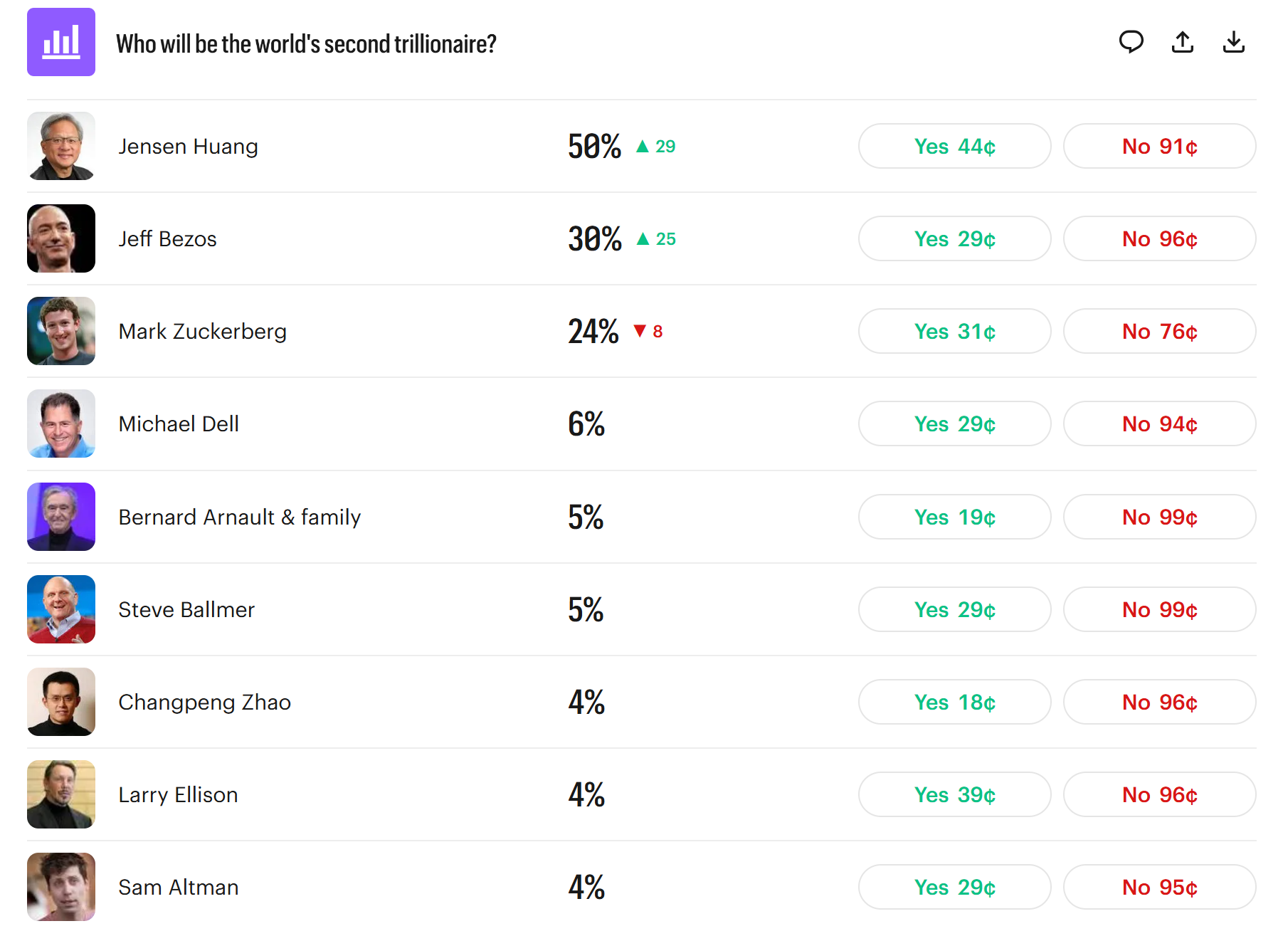
On Kalshi, traders gave Zuckerberg about 24% odds of joining the trillionaire club next on June 23, after Nvidia’s Jensen Huang at 50% and Jeff Bezos at 30%.
That market is thin, however, with only about $7,500 traded, so the figure is soft.
Forbes puts Zuckerberg at $222 billion, fifth in the world. His fortune would need to roughly quintuple to reach $1 trillion.
Almost all of it sits in Meta stock, where he owns about 13%, so the company’s $1.45 trillion value would have to swell past $7 trillion.

Zuckerberg’s costly bets do not always land. Meta’s Reality Labs has lost more than $70 billion since 2020.
A points-based Arena would earn nothing at launch, leaving Meta’s AI and advertising engine to drive any real move toward $1 trillion.
Kalshi’s trillionaire contracts run through 2033 on thin volume. Oxfam projected in 2025 that five people could cross $1 trillion within a decade, naming Zuckerberg among them.
Whether Arena becomes a real business or a quiet experiment, Zuckerberg’s road to that mark still runs through Meta’s core engine.
The post Mark Zuckerberg Wants Meta in Prediction Markets: Is This His Path to Trillionaire Status? appeared first on BeInCrypto.


Crypto industry advocate Cody Carbone has renewed calls for lawmakers to advance the CLARITY Act as Senate debate over the legislation continues without a scheduled floor vote.
Summary
- Cody Carbone urged lawmakers to advance the CLARITY Act, arguing crypto can lower payment and transaction costs.
- The bill faces opposition from anti-trafficking advocates and gambling industry groups over regulatory concerns.
- Ric Edelman said up to 95% of institutions without crypto exposure could enter the market if the CLARITY Act becomes law.
According to testimony delivered by Carbone, chief executive of The Digital Chamber, at a Senate Banking Committee hearing on affordability, digital assets can help lower costs for consumers through faster transactions, reduced payment fees, and easier access to financial assets.
Speaking before lawmakers during a hearing titled The Affordability Agenda, Carbone argued that blockchain-based financial services could introduce competition to traditional payment networks and reduce friction in moving money and assets. Despite those arguments, most senators at the hearing did not directly engage with his comments on cryptocurrency.
Among the few lawmakers to address the topic, Senator Jim Banks questioned Carbone about the costs associated with international remittances and how stablecoins pegged to the U.S. dollar compare with existing payment methods.
Senator John Kennedy, while expressing support for cryptocurrency, suggested that digital assets were not the primary factor behind the country’s affordability challenges.
Carbone’s appearance comes as the Senate weighs the Digital Asset Market Clarity Act, commonly known as the CLARITY Act, which seeks to establish a regulatory framework for digital assets in the U.S. Although lawmakers are expected to consider the bill in the coming weeks, Senate leadership has not yet scheduled a floor vote.
Senate debate extends beyond market structure
Fresh concerns have emerged as senators review the legislation. On June 23, the Alliance to End Human Trafficking (AEHT) urged Senate Majority Leader John Thune and Senate Minority Leader Chuck Schumer to revisit Section 604 of the bill.
In a letter to lawmakers, the organization argued that the provision, which incorporates the Blockchain Regulatory Certainty Act, could make it more difficult for authorities to track financial activity connected to crimes such as human trafficking.
According to the group, stronger anti-money laundering protections should be added before the legislation advances. The concerns add to existing discussions in Congress over ethics provisions that some lawmakers have said should be included in the final version of the bill.
Pressure has also come from outside the crypto sector. Gambling industry organizations recently asked the Senate to clarify that the legislation would not expand the authority of the Commodity Futures Trading Commission over sports betting conducted through prediction market platforms.
The debate follows an ongoing dispute between the CFTC and prediction market operators such as Kalshi and Polymarket, with the regulator maintaining that it has exclusive jurisdiction over those markets.
Industry groups see legislation as key to adoption
While lawmakers continue discussing revisions, some industry figures have linked the bill’s progress to future institutional participation in digital assets.
Ric Edelman recently argued that regulatory uncertainty remains one of the main reasons large pools of capital have not entered the crypto market despite growing activity among financial firms.
According to Edelman, institutions including BlackRock, JPMorgan, Morgan Stanley, Franklin Templeton, State Street, Invesco, and Fidelity continue expanding blockchain and tokenization initiatives even as cryptocurrency prices struggle to maintain momentum.
Edelman has predicted that as many as 95% of institutions that currently lack crypto exposure could enter the market if the CLARITY Act becomes law. He also cited Bitcoin ETF outflows and opposition from lawmakers such as Bernie Sanders and Elizabeth Warren as factors that have contributed to investor caution.
Crypto World
Sui News: Cumberland, Fluid, and SwissBorg Join Institutional Coalition on Hashi Ahead of July Global Testnet

[PRESS RELEASE – Grand Cayman, Cayman Islands, June 23rd, 2026]
Sui aims to transition more of Bitcoin’s $1.2T market cap into verifiable, productive onchain products.
Hashi, Sui’s native bitcoin finance primitive, gains more institutional support ahead of the scheduled launch of its global testnet this July.
Sui, where money moves as freely as messages, announced today that Cumberland, Fluid, and SwissBorg have joined the Hashi ecosystem, Sui’s native bitcoin finance primitive, weeks ahead of its scheduled global testnet launch this July. The expanding coalition addresses a critical bottleneck in crypto: solving the persistent capital inefficiency by unlocking over a trillion dollars of immobile BTC into DeFi safely.
Previous market cycles demonstrated the systemic dangers of relying on opaque, centralized credit intermediaries such as Celsius, Voyager, and Genesis to generate utility from dormant assets. Hashi replaces centralized balance-sheet trust with verifiable smart contract logic.
But with a strict separation for safety by design, Bitcoin remains securely on the native Bitcoin blockchain. Sui smart contracts handle the cryptographic and programmatic rights to enable its use as financial collateral.
“Hashi was built to unlock the productive use of Bitcoin at a scale the industry hasn’t seen before,” Adeniyi Abiodun, Co-Founder and Chief Product Officer of Mysten Labs, the original contributor to Sui. “We believe Bitcoin will become one of the largest sources of collateral in finance as the world moves onchain, and Hashi provides the foundation to make that possible on Sui.”
Built for Institutional Bitcoin Finance
Hashi is a foundational primitive setting a new standard for how builders can create bespoke, Bitcoin-backed financial products with risk parameters and loan terms that are fully verifiable onchain. In just a few weeks’ time, institutions, custodians, wallet providers, and developers can begin freely testing the infrastructure that will support Bitcoin-backed lending, borrowing, and credit origination on Sui.
Expanded Institutional Support
Three new powerhouses join the growing Hashi ecosystem, broadening support for institutional liquidity providers, market makers, and digital asset platforms:
- Cumberland: One of the digital asset industry’s largest institutional market makers, Cumberland joins the Hashi ecosystem to evaluate the protocol’s structural frameworks and prepare for eventual onchain liquidity provisioning.
- SwissBorg: A European wealth management app with over one million users, is exploring opportunities to connect its network of European high-net-worth Bitcoin holders and liquidity providers to Hashi, creating new pathways for Bitcoin-backed borrowing and lending.
- Fluid: A major DeFi lending protocol with a strong record of efficient, safe trades, is now building in preparation for mainnet institutional services. Fluid’s participation would provide institutional-grade lending markets and deepen access to Bitcoin-backed credit on Sui.
These new builders join an industry-leading group of infrastructure providers, custodians, and DeFi protocols already working together to build a native Bitcoin financial ecosystem on Sui.
“Bitcoin is the world’s most liquid digital asset, but without native utility, it remains an off-chain asset,” said Paul Kremsky, Global Head of Business Development at Cumberland. “Hashi is exciting because it introduces a transparent, institutional-grade framework for BTC-backed credit that will replace synthetic workarounds with a product we are excited to use ourselves.”
“Our community has consistently sought native ways to lend and borrow against their Bitcoin,” said Cyrus Fazel, Founder & CEO at SwissBorg. “We’re thrilled to see Hashi delivering innovative solutions that make this a reality.”
“The next phase of the industry’s growth will come from bringing larger pools of capital onchain through infrastructure institutions can actually trust,” said Samyak Jain, Co-Founder & CEO at Fluid. “Hashi gets this right: Bitcoin stays on its native chain while verifiable contracts make it productive as collateral. Fluid’s lending infrastructure is built to turn that into deep, capital-efficient Bitcoin-backed credit markets on Sui.”
These additions expand the growing consensus of many partners announced earlier this year that Sui is where Bitcoin finance will take flight, thanks to Hashi:
Custody & Wallet Access
- BitGo: Institutional custody clients.
- Blockdaemon, Cobo, Fordefi (by Paxos): Institutional wallet and infrastructure providers.
- Cubist: Cross-chain collateral infrastructure and transfer engine.
- Ledger: Retail/institutional self-custody.
- SwissBorg: UHNW European retail/institutional asset management and wallet interface.
Lending, Trading & Liquidity Providers
- Bullish: Institutional digital asset platform supplying liquidity.
- Cumberland: Leading institutional crypto market maker and liquidity provider.
- Erebor: OCC-chartered bank providing liquidity.
- FalconX: Institutional prime brokerage supplying liquidity.
DeFi & Lending Applications
- AlphaLend, Bluefin, Current, Scallop, Suilend: Native DeFi protocols enabling retail lending and borrowing on day one.
- Fluid: Connecting lending, borrowing, liquidity and more financial products into a capital-efficient system.
- Navi: One of Sui’s largest and longest running DeFi protocols slated for Hashi lending.
Vaults & Asset Management
- Concrete by Blueprint Finance: Yield-infrastructure vault platform.
- Inveniam Capital: Real-World Asset (RWA) yield strategies.
- Wave Digital Assets LLC: SEC-registered investment adviser working with industry partners to facilitate the issuance of Bitcoin-collateralized bonds.
Index Oracle, Insurance & Security Auditing
- CF Benchmarks: Crypto index provider distributing pricing data via oracles.
- Soter Insure: Native, Bitcoin-denominated institutional insurance.
- Asymptotic, Certora, OtterSec: Smart contract security and formal verification auditors.
The activation of the global testnet this July represents the ultimate rehearsal for fully changing Bitcoin Finance. This sandbox environment is designed for institutional engineers, Sui protocols and developers, and custody partners to test integration parameters, stress-test the code under simulated market volatility, and verify cryptographic integrity ahead of mainnet release.
Technical documentation and testnet access configurations will be hosted at https://www.sui.io/hashi.
About Sui
Sui, where money moves as freely as messages, is a next-generation Layer 1 blockchain built for scalable finance and global payments. Founded by the core team behind Meta’s stablecoin initiative and powered by an object-centric model, Sui makes assets, permissions, and user data programmable and ownable. Sui’s primitives offer builders everything they need to create high-performance payments and financial applications, including instant agentic payments. Users can learn more at sui.io.
Contact: media@sui.io
The post Sui News: Cumberland, Fluid, and SwissBorg Join Institutional Coalition on Hashi Ahead of July Global Testnet appeared first on CryptoPotato.

New England Patriots owner wants NFL match in Scotland after Tartan Army’s Boston takeover

KB Home (KBH) Q2 2026 Earnings Call Transcript

CFTC Sues Kentucky After Prediction Market Lawsuits


-

 Fashion4 days ago
Weekend Open Thread: Miami – Corporette.com
-

 Entertainment3 days ago
Renter of Home in Anne Heche Crash Denies Settlement With Son
-

 Tech2 days ago
Microsoft accidentally kills epic Outlook email threads
-

 Business3 days ago
Soccer-U.S. defends Iran World Cup travel restrictions, says discussions ongoing
-

 Politics5 days ago
BBC Reporter Discusses Cross Party Criticism Of Trumps Iran Deal
-
 Sports8 hours ago
Two goals and an assist by sheer aura: Cristiano Ronaldo just entered the World Cup chat
-
 Business4 days ago
Wall Street Week Ahead: Investors see Micron earnings as pulse check of AI rally momentum
-

 Tech6 days ago
AWS enters the context layer race with a graph that learns from agents, not manual curation
-

 Politics4 days ago
Andy Burnham and the meaning of Makerfield
-
 Crypto World4 days ago
Can Charles Hoskinson Really Rescue Cardano?
-

 Crypto World4 days ago
HIVE shares jump as $220M AI deal speeds Bitcoin mining pivot
-

 Crypto World4 days ago
Jake Chervinsky accuses CME of protecting derivatives monopoly
-
Business2 hours ago
Entergy settles forward sale agreements, raises $672 million in cash proceeds
-

 NewsBeat4 days ago
Keir Starmer Allies Question His Chances For No 10
-

 Business5 days ago
Brexit cost 6% of UK economy, Bank of England company data suggests
-

 Tech1 day ago
Nearly 7,000 fake Amazon domains registered ahead of Prime Day 2026, researchers warn
-

 Sports5 days ago
FIFA World Cup 2026: Canada beat 9-men Qatar 6-0 to register first ever win | FIFA World Cup 2026
-
 Tech3 days ago
Signal’s Meredith Whittaker says AI chatbots ‘are not your friends’ and calls Copilot agents a backdoor
-
 Business3 days ago
MHP SE 2026 Q1 – Results – Earnings Call Presentation (OTCMKTS:MHPSY) 2026-06-20
-

 Entertainment4 days ago
Jose Alvarado Wants Taylor Swift at More Knicks Games
You must be logged in to post a comment Login