Connect with us
DAPA Banner
DAPA Coin
DAPA
COIN PAYMENT ASSET
PRIVACY · BLOCKDAG · HOMOMORPHIC ENCRYPTION · RUST
ElGamal Encrypted MINE DAPA
🚫 GENESIS SOLD OUT
DAPAPAY COMING

NewsBeat

Marcus Rashford vindicated as Spanish media reach agreement on England star

Published

on

Manchester Evening News

Barcelona opted against signing Marcus Rashford on a permanent deal despite the Man United star impressing in Spain

Sections of the Spanish media have been left unimpressed with Anthony Gordon’s performance for England on Tuesday night against Ghana. The former Newcastle man’s underwhelming showing could leave Barcelona questioning their decision to sign Gordon rather than Manchester United’s Marcus Rashford.

Advertisement

Gordon came in for criticism from the press for the second match running following England’s tepid draw with Ghana. After the exhilarating 4-2 victory over Croatia, Thomas Tuchel’s squad were brought back down to earth as they were held to a goalless deadlock in Boston.

Despite dominating possession, England carved out very little against a resolute Ghana outfit, though qualification for the last-32 looks all but certain. One of the most compelling storylines heading into the tournament has been the battle for the left-wing position between Gordon and Rashford.

Get MEN Premium now for just £1 HERE – or get involved in our United WhatsApp group by clicking HERE. You can also join our United Facebook page by clicking HERE and don’t miss out on our brilliant selection of newsletters HERE.

The former recently completed a £69.3million switch to Barcelona from Newcastle, while the latter has seen his hopes of securing a permanent deal at the Nou Camp dashed, leaving his future uncertain. However, with Gordon’s performances found wanting, it’s entirely possible Barcelona could reconsider their stance on Rashford if they wished.

Advertisement

Rashford, 28, concluded a highly profitable season-long loan at Barcelona, where he won La Liga while contributing 14 goals and 14 assists. However, the Catalan club’s decision leaves Rashford at something of a loose end as he prepares to return to United once World Cup 2026 concludes.

Tottenham have expressed interest in the forward with The i Paper revealing the north London outfit are eager to strike a deal for Rashford. Yet it’s tough to see any club offering the £40m fee that United values the striker at.

A staggering weekly salary of around £325,000 is also a major obstacle, although he did accept a reduced wage when joining Barca last summer.

Despite a lacklustre showing against Croatia, Gordon was handed another start by Tuchel, with Rashford once again consigned to the substitutes’ bench. After failing to make any real impression, Gordon made way for Bukayo Saka on 65 minutes, while Rashford had to bide his time until the 83rd minute before entering the action, replacing Noni Madueke.

Spanish media didn’t hold back when assessing Gordon, with La Vanguardia describing his display as “lacklustre.” The Barcelona publication said: “As against Croatia, the winger failed to make a significant impact on the game. Although he was more involved in the play, he was imprecise in some of his dribbling, and his assists, while more purposeful, were wasted by his teammates.”

AS’s evaluation of Gordon featured both commendation and critique, stating he was “excellent defensively but lacklustre in attack.”

Madrid-based Las Razon highlighted how Ghana “shut down the flanks” with full-backs Marvin Senaya and Gideon Mensah “effectively marking Gordon and Madueke.” ABC suggested Gordon “lacked the necessary finesse” to penetrate the Ghana backline and labelled his second-half shot, which was easily saved, “tame.”

Advertisement

Given Gordon’s limited influence thus far, Rashford could well take his place in England’s starting line-up for their group decider against Panama on Saturday. Victory for the Three Lions will likely see them top Group L and guarantee a more straightforward path, theoretically, in the knockout phase.

Thousands of Man United fans upgraded their matchday last season. This is how they did it.

This article contains affiliate links, we will receive a commission on any sales we generate from it. Learn more
Content Image

Various Prices

Seat Unique

Buy official packages at Seat Unique

Official premium experiences at Old Trafford are available now for the 26/27 Premier League season. Make it easier than ever to turn a regular fixture into something genuinely unforgettable.


Advertisement

Source link

Continue Reading
Click to comment

You must be logged in to post a comment Login

Leave a Reply

NewsBeat

Brothers both given three-year sentences for Newcastle street attack

Published

on

Brothers both given three-year sentences for Newcastle street attack

Police were alerted by the ambulance service to an ongoing disturbance outside an address in Fenham, Newcastle, at about 3.40am on March 24, 2024.

Officers were swiftly deployed to Deanham Gardens, where two male victims, aged in their 40s and 20s, were found seriously injured.

The perpetrators had fled the area by the time the first officers arrived on scene, prompting the city’s Serious Organised Crime Investigation Team (SOCIT) to launch an investigation.

Initial inquiries revealed that a group of people arrived at the residential property in two cars, a Mercedes Sprinter van and Nissan Juke, prior to the incident.

Advertisement

Police issue images of offenders Fillip and Josef BadzoBrothers Filip, left, and Josef Badzo each jailed for three years for their part in a street assault outside property in Newcastle (Image: The Northern Echo)

Three of those present then became involved in an altercation with two occupants outside the address.

Nearby CCTV footage revealed three offenders, including brothers Filip and Josef Badzo, use bodily force as well as bricks and a baseball bat during the street fight.

The trio were arrested and, while they denied being in the area at the time, detectives were able to place their phones and vehicles at the scene.

Both Badzo brothers were subsequently charged with two counts of grievous bodily harm and one each of violent disorder.

Advertisement

Filip Badzo given three-year prison sentence for his part in street assault in Fenham, Newcastle, in March 2024 (Image: Northumbria Police)

The duo, both of Colston Street, Newcastle, repeatedly denied their involvement but were found guilty by a jury at the city’s crown court. in March.

Josef Badzo also received a three-year prison sentence for Newcastle street assault (Image: Northumbria Police)

During the proceedings the court heard how the male victim in his 20s continues to suffer lasting effects of the attack, including speech impairment and headaches.

The victim in his 40s sustained a ruptured spleen and is no longer able to perform full-time work.

Filip Badzo, now 19, and Josef Badzo, now 24, were remanded and on Tuesday (June 23) were brought back before the court where they were both given three-year prison sentences.

Advertisement

The third man involved in the attack will be sentenced for two charges of grievous bodily harm with intent and one count of violent disorder at a later date.

Speaking after the brothers’ sentencing hearing, Detective Constable Sophie Snowdon, of Northumbria Police, said: “This was a shocking incident which saw a group launch a violent attack on two other men, after turning up at their Newcastle home set on causing disorder.

“They sparked a great deal of alarm in the wider community in the early hours of that morning, with the offenders turning up as part of a separate concern.

“What then unfolded was a serious assault outside the property, leaving two of the occupants with life-changing injuries to this day.

Advertisement

“While we may never know the full circumstances which led to this incident, we were determined to put those involved before the courts after a complex investigation.

“And, thanks to the overwhelming and thorough evidence stacked against those involved, they were found guilty following a two-week trial.”

 Det Con Snowdon added: “As a force, we completely recognise the impact of such offending in our communities and we’ll do all we can to secure justice against violent perpetrators.

Read next … more court stories from The Northern Echo, by clicking here

Advertisement

“Nobody wants this type of criminality on their doorstep, and I’m pleased to see both Filip and Josef Badzo are now rightly behind bars and out of the way.

“I hope this case demonstrates our commitment to investigating such crimes, no matter how long it takes.

“We’ll use every tactic at our disposal.”

Advertisement

Source link

Continue Reading

NewsBeat

Education is important when it comes to tackling domestic abuse

Published

on

Education is important when it comes to tackling domestic abuse

Harmful narratives about domestic abuse persist in our society. They can include questioning “why doesn’t the victim just leave?”. They might mean believing in a hierarchy of abuse, where physical abuse is taken more seriously than other forms.

Stereotypical characterisations of how a victim should behave and what a perpetrator looks like remain. Overall, a lack of understanding and awareness serves to silence and exclude those most affected.

Research I conducted in West Yorkshire revealed that these narratives are entrenched within social services, the legal system, the police and wider society. Dispelling these ideas about domestic abuse is vital if people affected are to get the support they need.

Many of those needing support are teenagers. UK data shows that young people aged between 16 and 19 are among the groups most affected by domestic abuse. Despite these figures, educational guidance does not prepare students to recognise or respond to abusive relationships adequately.

Advertisement

Harassment and the normalisation of harmful behaviour are widespread in schools. Research from schools inspectorate Ofsted has found that nine in ten girls have experienced sexist name-calling or unsolicited sexual images. It’s critical that education aimed at stopping harmful narratives about domestic abuse takes place in secondary schools.

Guidance for schools

In December 2025, the UK government released its long-awaited strategy for tackling violence against women and girls. The strategy also recognises that supporting young people and providing a route to change extends beyond the school environment. This is evident in a package of preventative measures, including a new helpline for young people who are concerned about harmful behaviour. However, while the strategy recognises that educational interventions have a vital part to play, it lacks detail on what these might look like.

The strategy followed the publication of statutory guidance on relationships, sex and health education, released in July 2025. This guidance introduced welcome developments. It outlines broad expectations for the teaching of relationships, including the recognition of abuse, and brings several improvements in the area of domestic abuse education.

This guidance improves clarity around legal definitions and acknowledges the importance of schools identifying harmful behaviour in their relationships education discussions. It makes some progress toward acknowledging harmful narratives and misconceptions about domestic abuse.

Advertisement

Again, though, it lacks specific details to support schools. It still does not equip secondary school students with the critical knowledge and nuanced understanding necessary to identify abuse, challenge stigma or contribute to long-term cultural and societal change. There is no clear roadmap for teachers to challenge misconceptions in practice. It fails to outline how domestic abuse should be taught progressively across key stages.

Based on research, I’ve put together a comprehensive educational programme to reframe how domestic abuse is taught and understood in secondary schools.

I designed the programme in partnership with West Yorkshire Combined Authority, West Yorkshire Police, Leeds City Council, Leeds Domestic Violence Service Voices Project, +Choices (a service for perpetrators of domestic abuse) and local secondary schools. It offers age-appropriate, engaging content and opportunities for critical discussion that challenges stereotypical and reductive narratives of abuse. The pilot of this programme is currently underway across West Yorkshire. The aim is to make it a compulsory part of the curriculum in the region from September 2026.

Advertisement

The programme of lessons is built around a short animation video (above). This takes young people on a journey down a typical street visiting the homes of four different types of couples experiencing different types of abuse. Each lesson is tailored to a specific year group, ensuring that lessons remain age appropriate. Additionally, lessons are designed flexibly, deliverable either in one hour or in three 20-minute sessions, to accommodate the different ways in which schools deliver the relationships and sex education curriculum.

For year seven (ages 11 and 12) the lesson begins by introducing the couples in the video and what domestic abuse is. Students explore what happens behind closed doors and identifying trusted adults in their lives.

From year eight (ages 12 to 13) onward, each lesson focuses on a scenario from the animation as students explore the dynamics and abusive behaviours in each relationship. Sessions focus on witnessing domestic abuse and exploring unsafe relationship patterns. They cover the cycle of abuse, coercive control, financial abuse, social isolation, stalking, digital abuse, love bombing and emotional abuse.

The aim of the programme is to encourage teachers and students alike to better recognise, prevent and respond to abusive relationships in all forms. It makes a proactive step towards realising the government’s commitment to ensuring that “children are taught to tackle harmful ideas, unhealthy views about relationships and misogyny in school”.

Advertisement

Source link

Continue Reading

NewsBeat

Man convicted of sending menacing message to family of Bloody Sunday victim jailed

Published

on

Belfast Live

‘If yous continue to target the British Armed Forces including the PSNI the consequences will be swift and deadly’

A Belfast man convicted of sending a menacing message directed at the family of a Bloody Sunday victim has been jailed for six months.

Dean Portis, 42, faced prosecution over a social media posting seen by the three brothers of William McKinney, one of those shot dead by the British Army in Derry.

He was also banned from intimidating or harassing them as part of a two-year restraining order.

Advertisement

Welcoming his sentence, the victims vowed never to tolerate online threats from any “sinister far-right sectarian thugs”.

Portis, of Olive Street in the city, denied two counts of improper use of a public communications network to send a message of a menacing character.

But in April he was found guilty of both offences following a contest at Belfast Magistrates’ Court.

Prosecutors said Portis targeted the brothers on September 18 and October 22 last year during the high profile Soldier F trial.

Advertisement

The former member of the Parachute Regiment was accused but ultimately found not guilty of murdering 26-year-old William McKinney on Bloody Sunday.

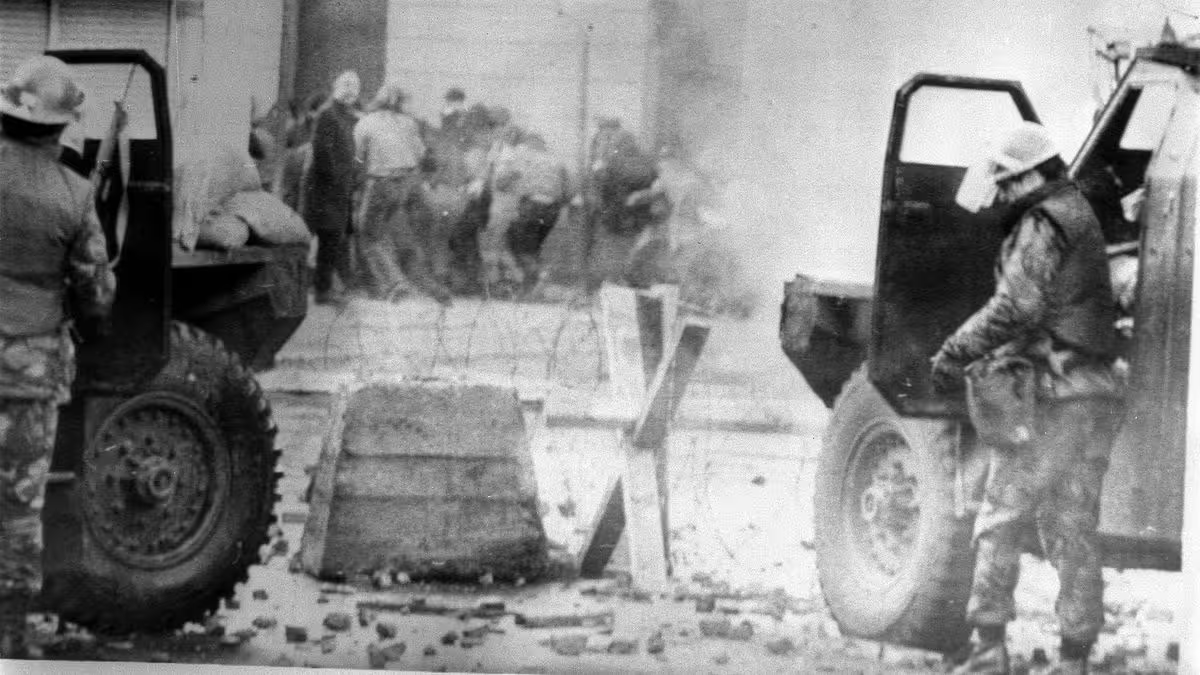
Mr McKinney was among 13 people shot dead when troops opened fire on civil rights demonstrators in Derry’s Bogside on January 30, 1972.

Police were alerted to a Facebook posting allegedly attributed to Portis, who also uses the name Dean Martin, early on in Soldier F’s trial last year.

Above a newspaper report and photograph of Mr McKinney’s three brothers, Joe, Mickey and John, attending the hearing in Belfast a message stated: “If yous continue to target the British Armed Forces including the PSNI the consequences will be swift and deadly.”

Advertisement

The posting added: “Yous have been warned.”

Portis insisted the message was not directed at or about the brothers, instead claiming his intention was only about creating a platform for debate.

But in witness statements the three complainants described being left in a state of fear they were being watched and potentially under threat.

Advertisement

John McKinney expressed concerns that the postings could have been made by a dangerous and violent individual.

“I am worried for myself and my family’s safety since seeing this,” he stated.

“I have fear that I am being watched and followed. I take this threat seriously and fear that something could happen.”

Sentencing Portis today, Deputy District Judge John Rea imposed three months custody for the offences.

Advertisement

He also activated a previous suspended term and ordered the defendant to serve a further three months behind bars.

Under the terms of the two-year restraining order, Portis is also forbidden from pestering the brothers or journalist Hugh Jordan.

Solicitor Ciaran Shiels of Madden & Finucane law firm, who represented the McKinney family, welcomed the outcome.

Mr Shiels added: “During the Soldier F trial we said that we simply would not tolerate victims, especially the families of those murdered and the wounded on Bloody Sunday, being threatened by the sinister far-right sectarian thugs who brazenly misused the internet and social media in order to spread hate and to attempt to instill fear.”

Advertisement

For all the latest news, visit the Belfast Live homepage here and sign up to our daily newsletter

Source link

Continue Reading

NewsBeat

Businesses often row back on ethics when times get tough. Here’s how technology can keep them on track

Published

on

Businesses often row back on ethics when times get tough. Here’s how technology can keep them on track

Five carmakers are involved in a case at the High Court in London over claims that they cheated on emissions tests. A decade ago, the “dieselgate” scandal broke, eventually forcing Volkswagen to pay billions of euros in fines and settlements. These carmakers (Mercedes, Ford, Peugeot/Citroën, Renault and Nissan) have all faced accusations that selling cars was more important to them than their environmental responsibilities. They all deny the allegations.

Back in 2015, all United Nations member states adopted 17 sustainable development goals (SDGs) as a global blueprint to end poverty and inequality, protect the planet and promote peace by 2030. Central to this agenda is the pledge to “leave no one behind”, affirming that progress in any area matters only if it reaches the world’s most vulnerable communities.

The allegations against the carmakers sit within this wider pattern. When firms treat a crisis – in this case environmental regulations – as justification for bending the rules, sustainability stops being a real commitment and becomes a fair-weather promise.

The same logic can appear in geopolitics, but with far more devastating consequences. At the extreme end, conflict shows how quickly the SDG blueprint can unravel.

Advertisement

In Gaza, for example, more than two-and-a-half years of war have pushed the goals into reverse. Poverty and hunger have deepened (SDGs 1 and 2); hospitals have been bombed, damaged or overwhelmed, making even basic care difficult to provide (SDG 3); children have been kept out of school (SDG 4); clean water and sanitation systems have deteriorated (SDG 6); unemployment has soared (SDG 8); and neighbourhoods have been reduced to debris, waste and pollution (SDGs 11, 12 and 15).

The UN estimates that Gaza’s human development has been set back by up to 69 years, while Unicef reported that 625,000 children had lost an entire school year. The UN Conference on Trade and Development reported that Gaza’s GDP contracted by 83% in 2024, with unemployment reaching 80%.


À lire aussi :
Gaza’s once-growing economy is nearing total collapse


When aspiring managers or leaders watch the alleged suspension of ethics, responsibility and sustainability, they learn a destructive lesson. Values might become viewed as optional add-ons.

Advertisement

These leaders risk grooming a new generation of “crisis relativists”, who believe that the rules of ethical and sustainable conduct can be temporarily waived in times of crisis.

If tomorrow’s CEOs, managers and policymakers come to believe that social and environmental responsibility is discretionary, societies risk losing hard-won gains. This could be in the form of labour rights, fair supply chains, environmental stewardship or societal fairness. Any or all can be rolled back whenever there is an economic downturn or geopolitical shock.

But, what does this have to do with carmakers? More than it may at first seem. The deeper issue is what can be called crisis relativism: the belief that ethical and sustainability commitments can be softened, deferred or quietly abandoned when organisations feel under pressure.

In business, that pressure may come from regulatory demands, commercial competition or financial strain. Research I was involved in shows how, under pressure or in times of crisis, firms can shift risks and costs on to weaker actors in supply chains rather than absorb responsibility themselves.

Advertisement

The Volkswagen emissions scandal demonstrates how a firm, in pursuit of its goals but facing crisis (in this case its failure to meet strict US and EU regulations) deliberately bypassed ethical and environmental responsibilities. Between 2009 and 2015, it installed software in millions of its diesel vehicles to cheat emissions tests.

It illustrates a crisis of relativism, where managers, unable to fully comply with regulatory demands, justified using deceptive practices. The carmaker apologised and eventually paid out more than €30 billion (£26 billion) worldwide in fines and compensation. VW settled several cases out of court; a ruling on the other five carmakers is expected in summer 2026. The five carmakers have said the claims against them are without merit.

Beyond the car industry, numerous fashion brands have been seen to offload responsibility for their ethical and social obligations to suppliers in developing economies, as a mechanism for escaping their economic difficulties.

Advertisement

When companies dodged their ethical responsibilities and orders were cancelled, garment workers paid the price.
Nadeem A. Khan/Shutterstock

During the height of the COVID pandemic, many multinationals abruptly cancelled apparel orders and delayed payments across south Asian supply chains. This shifted the shock on to vulnerable suppliers and workers in countries like Pakistan.

Companies need to devise strategies and systems that are grounded in protecting workers, communities and the environment – even under the pressure of a global shock or crisis.

How to lock companies into their responsibilities

Other research I did with colleagues shows how digital technology can underpin sustainability strategies. For instance, clothing and footwear multinationals can deploy end-to-end digital traceability.

This could include the use of IoT (internet of things) sensors to measure things like emissions, as well as satellite or AI monitoring, e-wage records to ensure fair pay, and blockchain smart contracts. This improves transparency and would help to verify that companies’ environmental and social duties are being met.

Advertisement

Such technology can work even across remote supply-chain tiers. It makes non-compliance visible and costly, locking firms into auditable commitments even in the event of a crisis.

These advanced technologies can serve as a direct counter to crisis relativism. In other words, they would close off the “escape route” where sustainability pledges are quietly abandoned whenever geopolitical, economic or public health crises arise.

Would firms be compelled to use them? Increasingly yes, through institutional regulations, procurement clauses, and finance or insurance requirements. And even where not mandated, these tools function as a safeguard by creating real-time and automated alerts that make backsliding visible.

Ultimately, businesses must prove that human values matter all the time. Business is not war – even when firms face what they perceive to be a crisis. Treating ethics, dignity and sustainability as optional extras leads to destruction not only for those in conflict zones, but for society as a whole.

Advertisement

Source link

Continue Reading

NewsBeat

Becky Hill says being booed ‘not nice’ in first post since festivalgoers left set

Published

on

Becky Hill says being booed ‘not nice’ in first post since festivalgoers left set

To view this video please enable JavaScript, and consider upgrading to a web
browser that
supports HTML5
video

Becky Hill has addressed being booed by some audience members during a surprise set at TRNSMT.

Advertisement

TikTok video from the weekend showed sections of the crowd leaving while others booed when the singer revealed she would be performing an entire set of unreleased music.

The booing unfolded during Hill’s appearance as TRNSMT’s secret act on the King Tut’s stage on Friday.

When she took to the stage, Hill told fans that she decided to keep her performance under wraps because she wanted to play a set of new tracks.

But the announcement did not go down well with the crowd in Glasgow, with many booing.

Advertisement

The 32-year-old has now addressed the response in a video posted to her Instagram. In the clip, she shared a video taken moments after she came off stage, in which she told the camera: ‘Getting booed is not nice.

Becky Hill told the crowd at King Tut’s Stage that she would not be playing her hits (Picture: Martin Grimes/Getty Images)

‘I haven’t found a single one of these easy, which is really upsetting because I love this job. And that’s not making me love it as much as I usually do.’

Speaking to the camera to address what unfolded, Hill continued: ‘I’ve been told about the news articles and conversations happening online around my secret set on Friday.

‘I wanted to bring a new and exclusive 30-minute set of brand new music to a festival crowd. Unannounced. And I thought it would be a great opportunity to play the new music I’ve been working so hard on and I personally love so much.’

Advertisement

She went on to thank the organisers of TRNSMT, who gave her the secret set stage, as well as ‘the crowd of people who you probably wouldn’t have seen online who stayed and danced with me right until the very end when we all sang Afterglow and Disconnect’.

Advertisement

Source link

Continue Reading

NewsBeat

Plan to have drug testing pilot scheme at big Belfast gigs blocked by Stormont

Published

on

Belfast Live

A motion calling for council-owned sites hosting music festivals to have drug testing and harm reduction facilities was unanimously supported earlier this year

A plan to have a drug testing pilot at major gigs in Belfast has been effectively blocked by the Stormont Health department.

Advertisement

A motion that was passed by Belfast City Council calling for council-owned sites hosting music festivals and large-scale events to have drug testing and harm reduction facilities was unanimously supported at City Hall earlier this year.

The motion called on public bodies including the Public Health Agency and Belfast Trust, alongside those in the community and voluntary sector, to explore the feasibility of a pilot. It also requested an internal report on the potential role of the council in supporting and facilitating a service, with particular reference to legal and regulatory considerations.

READ MORE: Stormont proposes reopening pedestrianised Belfast city centre road to vehicles

READ MORE: Human remains could be found at £8.6million luxury flat project in former Magdalene Laundry

Advertisement

However a report put before elected representatives at the June meeting of the council’s Strategic Policy and Resources Committee said after contact with Stormont it was made clear that at present there was “no legislative framework, funding mechanism or operational model in place that would enable Belfast City Council to establish or directly deliver drug and pill testing facilities at events.”

The Department of Health told the council that drug and pill testing services involve “significant legal and regulatory considerations under the Misuse of Drugs Act 1971” and would require appropriate licences and approvals to possess, transport, analyse and dispose of controlled drugs. DoH said that no formal application for such a licence has been received to date in Northern Ireland.

In Great Britain, such licences are issued by the Home Office. In Northern Ireland, responsibility would fall to the Department of Health’s Medicines Regulatory Group.

DoH said that any proposal would represent a “novel application” and would require detailed assessment and engagement before any licensing arrangements could be considered.

Advertisement

The council report states: “The Department of Health has advised that there is currently no central government funding programme available to support drug testing facilities at festivals and events.

“Whilst examples of on-site testing facilities exist elsewhere in the United Kingdom, these are generally associated with large-scale or multi-day festivals and operate within differing legal and policy frameworks.

“The Department has further advised that the current Northern Ireland Substance Use Strategy, Preventing Harm, Empowering Recovery, does not contain actions relating to the introduction of festival-based drug testing services. Any future policy proposal to introduce such services would presumably require consideration at Executive level.”

The council motion, tabled by Alliance Councillor Micky Murray, and seconded by Green Councillor Brian Smyth, states: ““This council supports harm reduction approaches to drug use, particularly in the context of festivals and nightlife events. It acknowledges the rising public concerns around drug-related harm, and notes that traditional approaches focused solely on enforcement have not eliminated the presence or use of illicit substances at major events.”

Advertisement

At the June S P and R Committee meeting, Belfast councillors aired their disappointment at the reply from Stormont.

Councillor Micky Murray said: “If the Department of Health isn’t going to take a leadership position to get this off the ground, then we need to, as the organisation that gives the licences for major festivals in the city. And a large part of it is on our land.

“I want to propose that instead of just waiting for someone else to do this, that we get together a roundtable of all the people that need to be involved.” He proposed the council host a meeting of all the relevant bodies with a view to lining up a licence for a future pilot.

Councillor Brian Smyth said: “I am really frustrated at this. The department’s approach is really typical of how harm reduction gets handled here.

Advertisement

“They are framing this as a policy vacuum rather than public safety. They are leaning heavily on the Misuse of Drugs Act 1971, but the legislation applies across the UK. And yet we have drugs checking services that already operate in England and Wales.

“The law hasn’t changed, what has changed is interpretation, a willingness in leadership, and licensing. There are organisations such as the Loop that operate legally at festivals using Home Office licences for analysis of controlled substances.”

He said: “This isn’t some sort of legislative miracle that we need, it is more of a political and administrative choice. I have got to ask, is this coming directly from the Minister after his political party has taken a much more conservative approach to law and order?

“As a council we already regulate for crowd safety, medical risk, fire provision etc, so drug checking should fit comfortably alongside these areas. It reduces hospitalisations, overdosing and death, and evidence shows it changes behaviour.

Advertisement

“At festivals in GB where the Loop operates, a significant proportion of users have disposed of substances after testing flagged up risk. We already required promoters to mitigate foreseeable risks.

“Drug use at festivals is foreseeable, so ignoring that risk is not some sort of neutral position, it is a failure around duty of care. There is a huge inconsistency in our current approach.”

He said: “The DoH in the report say they support amnesty bins, public support messaging, and forensic testing within a 48 hour turnaround. But they are rejecting on-site testing that informs users in the here and now.

“A 48 hour turnaround is absolutely useless in a festival that is live and ongoing. We are already accepting the presence of drugs through amnesty bins, the question is whether we accept reality to prevent harm in the here and now, or continue with measures that are knowingly too late to save lives.”

Advertisement

He said: “The department is effectively saying there is no policy, so no funding. No funding so there is no pilot, no pilot so no evidence to create policy. I think this is a really dangerous cop-out.”

He proposed the council write to the DoH to ask for a formal paper on what would be required to issue a licence in Northern Ireland for a pilot in 2027, and to write to the same department to include drug testing in the next update on the Preventing Harm Empowering Recovery DoH 10 year strategy. He also proposed Belfast Council design an operational model for when licensing is enabled for a drug testing pilot.

The committee agreed proposals by both councillors, and extra suggestions from other elected representatives, including best international practice and the potential for cross-border cooperation with the Republic. The committee decision will go to the full council next week for ratification.

For all the latest news, visit the Belfast Live homepage here and sign up to our daily newsletter here.

Advertisement

Source link

Continue Reading

NewsBeat

Changes proposed to major Station Gateway project

Published

on

Changes proposed to major Station Gateway project

Scarborough’s proposed Station Gateway redevelopment could be amended as part of a plan to improve the coherence and practicality of the multimillion-pound scheme.

​The project includes a series of suggested public realm improvements aiming to create a more welcoming public space for residents and visitors.

​A new proposal would see the demolition of five 1930s curtilage-listed, brick-built boundary wall planters, and the demolition of a small section of the 1840s station yard boundary wall.

Advertisement

​Additionally, damaged stone flags and kerbing abutting the western pavilion and recessed link section of the station building, located to the east of the Railwaymen’s Social Club, would be removed.

​Despite plans to pedestrianise the station area, the council has said that a fully vehicle-free forecourt is not achievable “while maintaining the necessary operational functions of the station, particularly the taxi rank, disabled parking and essential maintenance access”.

​Earlier this year, town councillors raised concerns about the low number of drop-off spaces that had been proposed.

​“The heritage objective of achieving a calmer and more coherent setting to the listed station remains important,” the new scheme states.

Advertisement

​Plans for the wider redevelopment would be funded using £6.68 million allocated from the Government’s Local Regeneration Fund.

​Conservation officers said that the current scheme would give rise to “less than substantial harm but also confirmed that there is potential for full support subject to amendment and further justification”.

​North Yorkshire Council previously said: “New outdoor seating areas, resurfaced footpaths and tree planting have been proposed as part of the project along with enhanced accessible parking and improved pedestrian access to the station and nearby transport links.

​​Initial proposals for the first phase of the Station Gateway scheme were developed by Scarborough Borough Council and submitted for planning approval in 2022, prior to the launch of North Yorkshire Council in April 2023.

Advertisement

​​Following further work by North Yorkshire Council, the Scarborough Neighbourhood Board and other key stakeholders, the designs have since been refined with a greater focus on improving the immediate area around the front of the station.

Source link

Advertisement
Continue Reading

NewsBeat

Man hospitalised after being ‘stabbed number of times’ in Lisburn

Published

on

Belfast Live

A man is his 30s was arrested

A man was hospitalised after ‘being stabbed a number of times’ last night.

Advertisement

Emergency services were called to the Bridge Street area of Lisburn on Tuesday evening, June 23, following reports of a stabbing incident.

The victim was treated at the scene before being taken to hospital by ambulance.

A man in his 30s has since been arrested on suspicion of a number of offences which include wounding with intent to do grievous bodily harm. He remains in police custody at this time.

A PSNI spokesperson said: “A man has been arrested following a report of a stabbing in Lisburn yesterday evening, Tuesday 23rd June.

Advertisement

“At approximately 7.15pm, it was reported that a man had been stabbed a number of times in the Bridge Street area of the city.

“Officers along with colleagues from the Northern Ireland Ambulance Service attended and the victim was taken to hospital for treatment for his injuries.

“A man is his 30s was arrested on suspicion of possession of an offensive weapon with intent to commit an indictable offence and wounding with intent to do grievous bodily harm.

“He remains in custody at this time.

Advertisement

“Anyone with any information or footage that could assist with enquiries is asked to contact police on 101 quoting reference 1675 23/06/26.

“Alternatively, you can also submit a report online using the non-emergency reporting form at http://www.psni.police.uk/makeareport/ or contact Crimestoppers anonymously on 0800 555 111 or online at http://crimestoppers-uk.org/.”

For all the latest news, visit the Belfast Live homepage here and sign up to our daily newsletter here.

Source link

Advertisement
Continue Reading

NewsBeat

Shankill business burnt down in arson attack targeted with racist graffiti

Published

on

Belfast Live

‘We are in a terrible situation where we lost everything and now we are being targeted again’

An entrepreneur who lost everything when his business was destroyed in an arson attack says he is in a “terrible situation” as his property is targeted with racist graffiti.

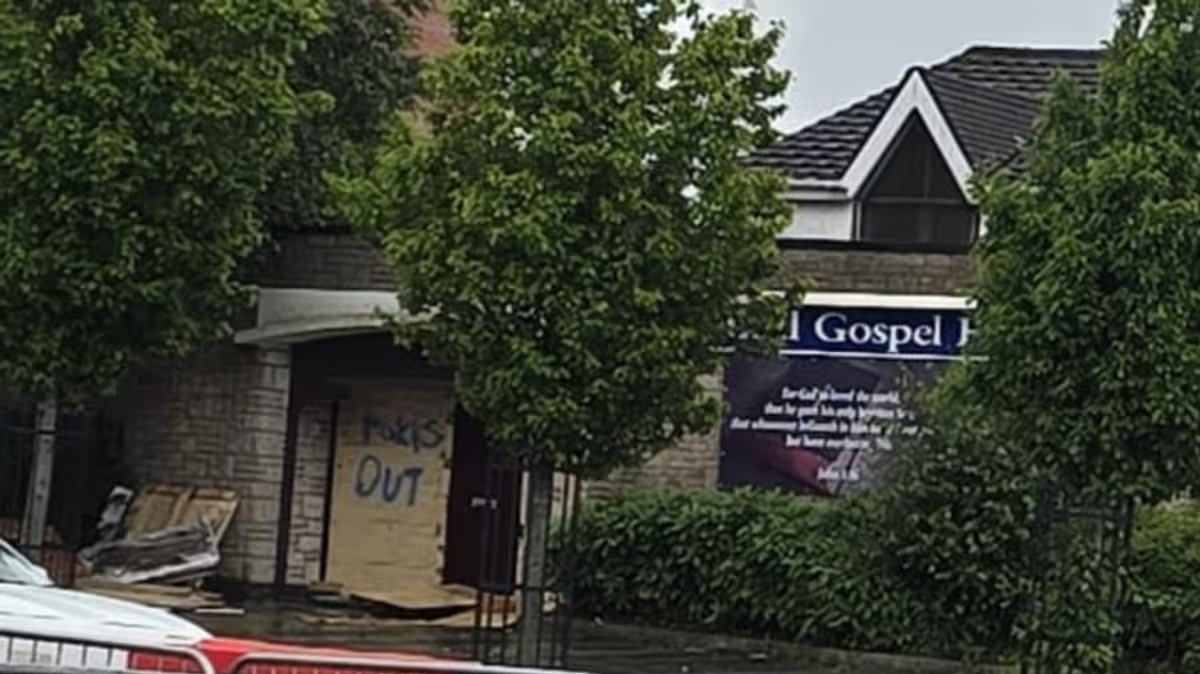
Police were investigating the arson attack on a former gospel hall on Shankill Road that was owned by Gaurav Jindal as a hate crime, with the incident destroying his livelihood and leaving him and his family with nothing.

Now, two weeks after the attack the property has been targeted again by racists who have written “p***s out” graffiti on the building.

Advertisement

Speaking to Belfast Live following the latest incident, Mr Jindal said he noticed the graffiti after visiting the premises with police. He said he would not go there without an officer present due to his fears.

He said: “I don’t know what to do after everything that has happened. It has left us in a terrible situation where we have lost everything and are trying to talk to the various departments about what we can do to move forward. But at the moment we do not know how we are going to recover.

“I was visiting the property with officers when I saw the graffiti that had been written there saying “p***s out” and see that we have been targeted again.”

The Belfast Asian Women’s Academy has issued a formal statement condemning the latest racist incident targeting Mr Jindal.

Ana Chandran, speaking on behalf of BAWA, expressed deep concern over the escalating hostility in the area saying: “There is currently a great deal of tension within our local community, and spreading this sort of hatred does not help anyone,” said Ms Chandran. “It is heartbreaking to see a family who has already lost everything being targeted in this manner. It is an attack not just on one man, but on the values of our community.”

Ms Chandran also highlighted the significant contributions made by migrants like Mr Jindal, challenging the negative narratives often found in political discourse.

She continued: “Many migrants come to this country specifically to work and contribute. Gaurav and his wife have never been on welfare; instead, they have spent their lives contributing to society and the local economy. It is disappointing that our decision-makers rarely speak of these contributions, choosing instead to focus on narratives of division.”

Advertisement

A fundraiser has been set up to help Mr Jindal and his family that you can donate to via this link: https://gofund.me/c95b9447e

For all the latest news, visit the Belfast Live homepage here and sign up to our daily newsletter here.

Source link

Advertisement
Continue Reading

NewsBeat

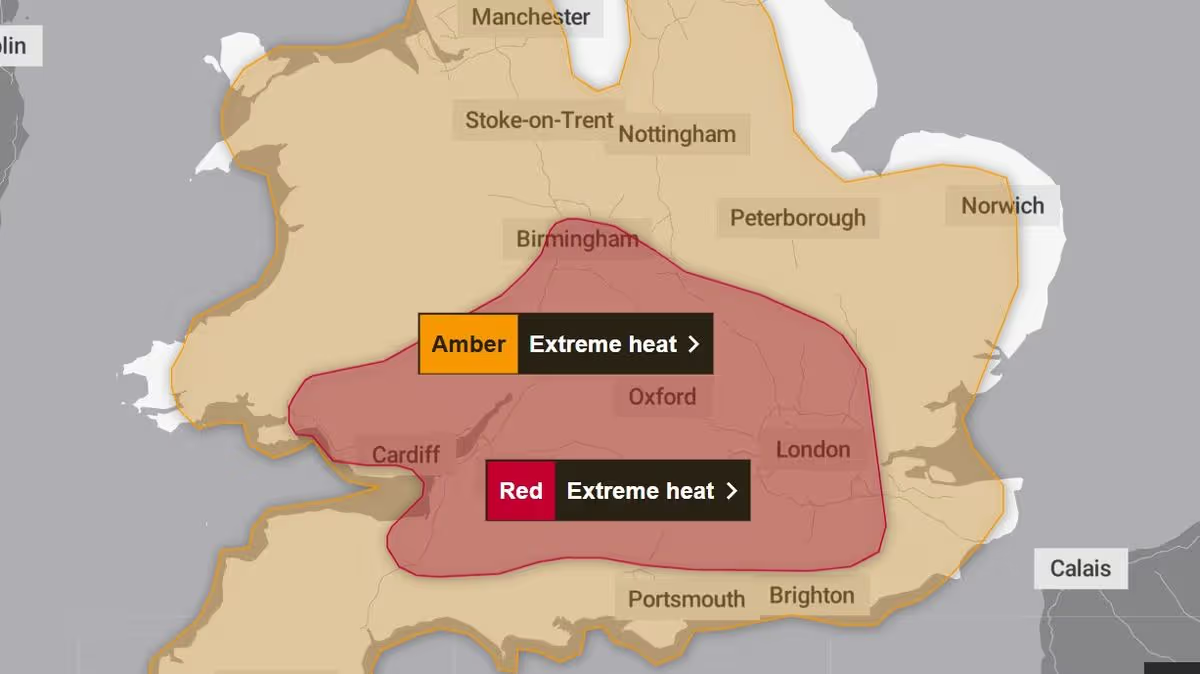
UK heatwave LIVE as June temperature record broken and Met Office extends rare red warning

Published

on

Manchester Evening News

London Mayor Sadiq Khan said the capital and the country had not adapted to deal with climate change and urged the public to “bear with us” as they face public transport delays during the heatwave.

Speaking as he visited The Aldgate School in London to announce the results of an air quality report, he said: “What used to be a once in a generation occurrence, events of biblical proportions, now takes place every year, whether it’s heatwaves, whether it’s flash flooding, whether it’s lightning, whether it’s thunder – we as a city, we as a country, haven’t adapted to be resilient to the consequences of man-made climate change.”

He continued: “People across the country can expect to see delays in public transport today, tomorrow and the rest of this week that’s a consequence of the extreme heat.

Advertisement

“People across the country I am afraid will have to bear with us – our public transport system is not made for temperatures approaching 40 degrees Celsius.”

Mr Khan added: “Forty per cent of Tubes are now air conditioned with more going forward. I will be publishing very soon a plan of what more we need to do to deal with heat.”

He added the school’s headteacher had told him: “One of the reasons they have kept this school open is because actually for many of the kids who come to this school, this school is cooler than their home.”

Source link

Advertisement
Continue Reading

Trending

Copyright © 2025