

In 1954, years after he led the project that created the atomic bomb, physicist J. Robert Oppenheimer was called to testify before the Atomic Energy Commission (AEC). The ostensible subject of the hearings was Oppenheimer’s position on the hydrogen bomb, a far more destructive version of the atomic bomb that the US had developed and first tested two years earlier.
Tech
Anthropic says AI needs regulation. But who chose to build it?


Oppenheimer, who in the years after the war had become increasingly conflicted about atomic weapons, initially opposed work on the hydrogen or thermonuclear bomb, partially for moral reasons and partially because he was skeptical it would work. But he later changed his mind and supported work on it. The lawyers at the AEC wanted to know why.
It wasn’t because Oppenheimer had changed his mind about the morality of city-vaporizing thermonuclear bombs. Rather, it was because American physicists had struck upon a new design for hydrogen bombs that wasn’t just workable, but positively elegant, or “technically sweet” as he called it. For Oppenheimer, that was enough. As he told the AEC hearing: “When you see something that is technically sweet, you go ahead and do it, and you argue about what to do about it only after you have had your technical success.”
What Oppenheimer described was a kind of moral helplessness dressed up as resolve: the pull of a scientifically beautiful answer to an ugly problem, and the accompanying habit of holding the moral accounting until after the technical success. It is one of the most honest things anyone who built the bomb — or any other world-altering thing — has ever said. And it has never stopped being relevant, because the people now building the world-altering technology of our own moment keep saying versions of it too.
Jack Clark, the co-founder and head of policy at Anthropic, the company behind the Claude models, is one such person. So it was worth paying attention last week when Clark sat down for a long public dialogue with Samuel Kimbriel, the founding director of the Aspen Institute’s Philosophy and Society, just six days after the federal government had abruptly cut off access to Anthropic’s two most powerful models, ostensibly over fears of what they could do.
Much of the conversation circled around a single idea that will be familiar to those who read Clark’s work: Powerful AI is coming, and it presents us with a choice — a choice we are actively refusing to make by failing to regulate AI. (Disclosure: Future Perfect is funded in part by the BEMC Foundation, whose major funder was also an early investor in Anthropic; they don’t have any editorial input into our content.)
We regulate toothbrushes, Clark pointed out, and cars, and nuclear weapons. “But we seem to have this attitude towards technology that it’s impossible to regulate,” he said. “It is not impossible to regulate … we sort of act as though, oh well, the technology industry is just inevitably going to do stuff, which I think is a choice.” His sharpest example was the online platform shift that utterly reshaped the last two decades. “Social media ran an uncontrolled experiment on the world,” he said. “We all now think and talk a bit differently because of social media. That was a choice. We can choose things to be different.”
This is the kind of talk that has long differentiated Anthropic from other major AI companies: Its principals are willing to linger on the serious risks of advanced AI, risks that demand clear and even strong regulation. (About a week before the Aspen dialogue — and just a day before the Trump administration came down hard on Anthropic’s latest models — CEO Dario Amodei published a blog post calling for government authority to legally block or even reverse the deployment of frontier AI models failing safety tests on threats like cyberhacking and bioweapons.)
Anthropic acknowledges that advanced AI is an existential gamble, but argues it’s a gamble we must take. At the Aspen dialogue, Clark spoke of a coming century that will be marked by brutal challenges — aging populations, straining institutions, a warming planet — that apparently can only be addressed with AI. To not go forward with artificial intelligence would be to rob ourselves of medical miracles we can only imagine, and implicitly condemn those who might otherwise be saved.
Clark is right that there is a choice buried in all of this. But the question his framing elides is exactly whose choice it actually is.
Sure, as Clark said, we regulate cars and toothbrushes and nuclear weapons, but in each case someone built the thing first, and the rest of us were left to decide what to do about a world that already contained it. Nobody voted on whether the atomic bomb should exist. We were handed the consequences and had to write the rules later.
Much the same is true of AI. The choice Clark wants the public to make around governing it only became necessary once his industry created the thing that needs governing. He is offering us a vote on what to do about AI, not a vote on whether it gets made — because that vote was already cast, in private, by him, a few hundred colleagues, and trillions of dollars. But why didn’t we get a say? Why are we stuck in the world where, as in Oppenheimer’s formulation, “you argue about what to do about it only after you have had your technical success”?
I wasn’t the only person in the audience who was wondering this. Near the end of the dialogue, a young woman put a sharper version of this question to Clark directly. Every frontier lab now admits the technology carries enormous risk, even existential risk, she noted. “So my question is, what gives you, Anthropic, and the rest of the frontier labs the right to continue building something that could destroy everybody, when none of us can actually opt out of it?”
Clark, to his credit, did not brush the question away. But neither did he answer it fully. He reframed it — away from the choice to build, toward the need for someone to take responsibility after it is built.
That someone can’t be the companies themselves, he said, describing an ideal future where “outside compliance, regulatory, testing and verification systems” would decide when each lab was allowed to go further. Governments were already moving faster than anyone expected — the US and UK, he said, had built testing agencies whose tools were sometimes better than the companies’ own.
It was a gracious answer — albeit one that sat awkwardly with the reality that President Trump now appears to be regulating AI by whim — but notice what it concedes. Asked what gives his company the right to build something that could destroy everybody, the head of policy at a leading AI lab did not say we have that right. He said the decision shouldn’t rest with companies like his, only to describe a system to take it out of their hands that does not yet fully exist. He and his colleagues are still building, at the frontier, as fast as the science and the compute allows, while telling the room that someone else really ought to be in charge. AI is already loose in the world. The regulation of AI is still mostly the stuff of blog posts.
So why are they really doing this? To bring it back to Oppenheimer: because AI is “technically sweet.” It’s not the race with China, not the trillion-dollar valuations, not even the creditable desire to cure disease — though all of those are real. Underneath them is something simpler and much harder to govern: we are compelled to build what is beautiful. Clark all but said so, marveling that AI is “easier and simpler to build than many other aspects of science,” that his chief scientist jokes they’d have AGI already if they just fixed the bugs in their code.
We humans are a tool-using species, Clark argued, and AI is the ultimate tool. It’s not that AI is inevitable, exactly, but that it is so weirdly simple to build once the foundations are set that “almost any path you go down, [AI] appears.”
What Clark described is the pull Oppenheimer named in 1954 — the pull of an elegant solution that makes the question of whether you should build it feel beside the point.
I can feel it myself, and I’m just a user. Put a capable model at your fingertips, ask it to do something you couldn’t do alone — write the program, find the flaw, untangle the thing you’d been stuck on — then watch it simply do what you requested, and you’ll experience a small electric thrill that has nothing to do with aging populations or the future of democracy. That thrill runs in an unbroken line from the user at the keyboard up through the engineer who trained the model to the executive who shipped it.
That’s why I suspect Clark’s regulation talk, however sincere, is downstream of a decision that was never really in doubt. Like Oppenheimer with the hydrogen bomb, the people building this technology feel they have no choice but to go ahead — and then to hope the rest of us make the right choices to govern what they could not stop themselves from making.
We have been lucky, so far, with the last technically sweet device that could still end the world. The hydrogen bomb has existed for 70 years without being used in anger, not because we solved the politics Oppenheimer warned about, but because the wiser choice won. And because we were lucky.
Clark may be right that the choice is still ours: The bomb did not decide the Cold War, people did, and people can decide this too. But it would help if the people handing us that choice slowed down long enough to let us make it — instead of building as fast as they can and trusting our luck, and theirs, to hold.
A version of this story originally appeared in the Future Perfect newsletter. Sign up here!

Continue Reading
from the thin-skinned-babies-of-a-feather dept
Earlier this week we noted how ABC has been asking its audience to give the Trump FCC an earful about its clumsy efforts to censor journalists, comedians, and daytime talk show hosts:
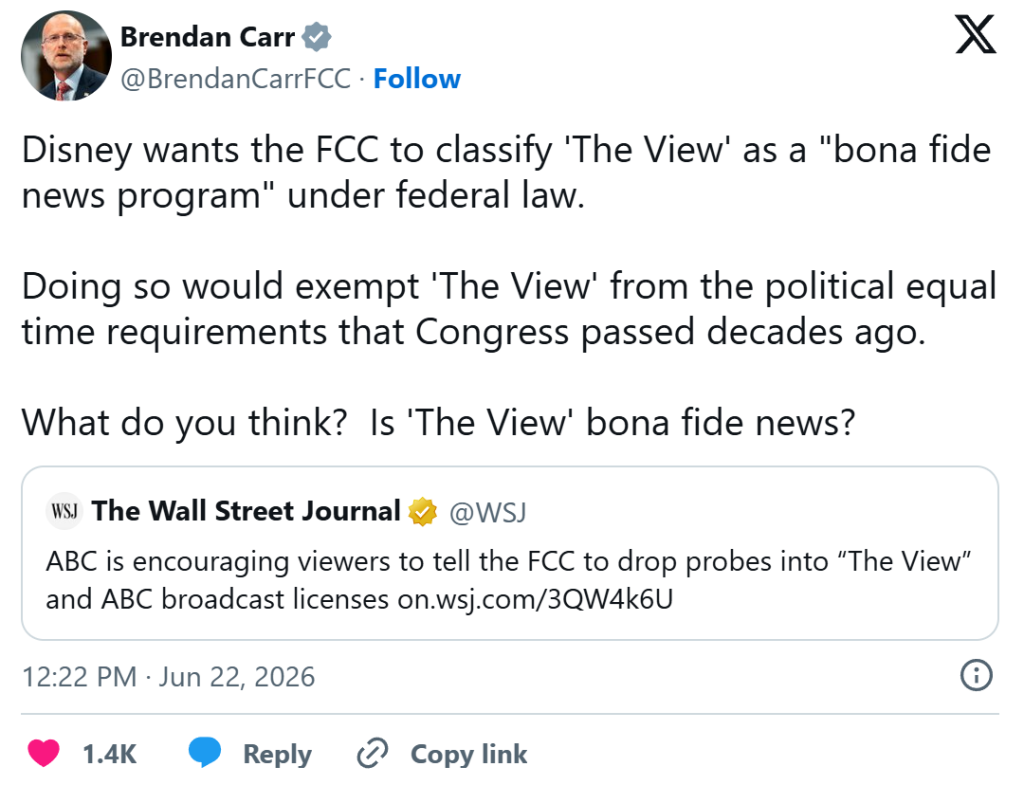
The ad only hints at the fact that FCC boss Brendan Carr has launched a fake “investigation” of ABC because The View hosted Texas Senate hopeful James Talarico last February. As we’ve explored repeatedly, Carr is pretending that this appearance violates a dated and irrelevant FCC “equal time rule,” despite the fact the show has had a formal exemption since 2002.
It’s all weird, performative bullshit designed to chill speech and punish ABC because President Trump is a thin-skinned autocrat. It’s also intended to send a message to all major media outlets that if they platform people openly critical of our dim kakistocracy, they’ll be inundated with endless costly legal headaches and bad “press” (read: lots of hostility aimed at them by right wing propaganda outlets).
Despite the ABC ad being relatively timid, it clearly upset the similarly-thin-skinned Carr, who took to Elon Musk’s right wing propaganda website to whine about it:

Again, The View was already exempt from this rule, for more than two decades. Even if it wasn’t, the rule hasn’t been enforced in 26 years because it’s a relic that doesn’t matter. It was crafted for an era where a TV appearance could make or break a political candidacy, requiring that a politician of the opposite party ideology get “equal time” on broadcast airwaves.
But broadcast is increasingly irrelevant, as is the rule, which you’ll notice Carr doesn’t enforce for right wing radio (because this is an ideological crusade by a weak zealot). This is also a giant loser of a case on First Amendment grounds. But it could be a particularly problematic case for Carr during discovery, given the indications that Carr covertly worked with right wing broadcasters to falsely make it look like ABC’s affiliate actively broke the law by not filling out some paperwork.
Carr knows all of this but his audience of bots and MAGA zealots over at ex-Twitter obviously don’t. They will simply see women daytime TV hosts and “news” in the same line of sight and immediately suffer embolisms of hate.
“Some may dislike certain — or even most — of the viewpoints expressed on ‘The View’ or similar shows,” ABC said in one recent filing. “Such dislike, however, cannot justify using regulatory processes to restrict those views.”
Carr doesn’t want this to ever see an actual courtroom. He just wants to intimidate corporate media giants, censor valid speech, and then bask in the adoration of the misinformed and deluded.
But it’s genuinely bad news for Carr and Trump that Disney Corporation is fighting back. If they can openly and legally demonstrate that Carr is a toothless extremist hack, other corporations are likely to be encouraged. And as Trump’s health and political power starts to buckle and fail, that sort of uncharacteristic corporate media courage could prove contagious.
Filed Under: 1st amendment, brendan carr, censorship, equal time rule, fcc, free speech, james talarico, journalism, media, the view
Companies: abc, disney

A long time before Beowulf clusters wired up with commodity Ethernet hardware became a hobbyist thing and a running joke, the transputer took a swing at a very similar architecture. This used stand-alone computers that were networked together with other transputer systems, to achieve task-level parallelism. For some people like [Lance Harvie] this is the kind of hardware that he used during his university years for a project, with him not only still having that hardware, but also recently adding to this collection with a recent eBay purchase.
The transputer story is a fascinating one, forming a major part of the UK’s semiconductor industry during the 1980s, creating a strong legacy as the computer industry awkwardly tried to figure out what types of parallelism to target. Whereas the industry largely moved to instruction-level (superscalar) parallelism alongside tightly coupled task-level parallelism along with multiple CPU cores on a single die, one could consider today’s supercomputer clusters to be one example of the transputer legacy.
[Lance]’s university-era board features the T400, which he shows off while recalling programming it in the Occam language. He’s currently looking for an ISA-to-USB adapter to be able to use it again with a modern PC. While searching around, he came across an EBay listing for a four-processor board, containing four T425s. These are significantly more powerful and also can use external memory, unlike the T400.
This four-CPU board omits the external serial links, as it’s meant to be used in e.g. a scientific instrument as a stand-alone 4-unit transputer system, with all of the available four serial links per processor connected on the PCB. Even more interesting is that the processors on this board were manufactured in 1999 by ST, which was many years after transputers stopped being developed.
As [Lance] explains, this was due to the UK government pulling the plug on the transputer project, with the IP subsequently ending up at ST who kept producing the chips until 1999 at its Philippines plant.
In time, [Lance] hopes to power up all these boards and use them again in combination with a modern-day Linux-based computer. We’re definitely looking forward to seeing that happen.
Although you can definitely use any random MCU these days as your very own transputer module or link chip, with e.g. SPI making for an attractive alternative for the high-speed serial links, there’s always something to be said for using real, original hardware.


Researchers have a new weapon against the scientifically inaccurate AI slop muddying public understanding of complex topics. A University of Washington team is helping scientists tell their own stories with a free tool that converts dense, jargon-heavy publications into short, accessible videos.
“There’s a lot of science communication happening in short form — primarily on TikTok, but also we’re seeing YouTube Shorts and Instagram Reels — these tidbits of science findings,” said Meziah Ruby Cristobal, a UW doctoral student in human centered design and engineering.
Cristobal and her colleagues built PaperTok hoping to use AI for good — to fight the technology’s irresponsible use elsewhere by non-scientists who misrepresent research.
The tool is simple. A researcher uploads a paper into PaperTok, which analyzes it to find attention-grabbing hooks and the most relevant takeaways for a general audience. The tool generates a script with an opening scene and narrative arc, producing a 45-second AI-narrated video. It closes with a reference to the paper, including the researchers’ names and the journal, to establish credibility.
Other tools can turn PDFs into videos, but Cristobal said PaperTok was intentionally designed to keep humans in the loop. It uses a multi-step process that requires approval at each phase, giving users the ability to edit the output down to individual words.
Cristobal presented research on PaperTok this spring in Barcelona at the Association for Computing Machinery’s Conference on Human Factors in Computing Systems. She co-led the study with fellow doctoral student Donghoon Shin; the senior author is UW professor Gary Hsieh.

A team of eight built PaperTok last summer, starting with interviews with science communicators and researchers before developing the tool and gathering user feedback.
“A lot of the researchers actually found huge value in seeing how the AI tries to visualize what they believe to be very abstract concepts,” Cristobal said. For many, it served as a brainstorming tool that highlighted new ways to communicate their findings.
There was critical feedback as well. Some users said the videos felt “too AI-ish,” pointing to issues like nonsense text. The UW team is continuing to refine PaperTok, including plans to let researchers incorporate charts and graphics from their papers into the videos.
PaperTok was built to translate research papers on human-computer interaction but has been tested on topics including physics, and it held up well. The team wants to expand its reach across research disciplines to create videos for social sciences and hard sciences alike.
The tool is free to use, but because video generation is computationally expensive, the company asks researchers to use a Gemini key so the cost is charged to their Google account.

Samsung just unveiled its newest budget phone, Galaxy A27 5G, starting at $349, which is $50 pricier than last year’s Galaxy A26, yet it actually takes a step back in a few areas that matter for everyday use.
What you actually get for the higher price
Samsung swapped the A26’s Exynos chip for a Snapdragon 6 Gen 3, which delivers a 10 to 20% speed boost, plus a GPU upgrade for smoother gaming and graphics work. The display still rocks a 6.7-inch Super AMOLED panel with a 120Hz refresh rate. It now has a punch hole camera cutout instead of last year’s teardrop notch, with slimmer bezels around the screen.
You get three memory configurations to choose from too, 6GB plus 128GB, 8GB plus 128GB, and 8GB plus 256GB. AI features get a small boost too, including multi-object recognition in Circle to Search, sharper Object Eraser results, and real-time translation in the Voice Recorder app across 22 languages. Samsung is sticking with six years of OS upgrades and security updates, just like before. However, most of this feels like a minor refresh rather than a real leap forward.
Galaxy A27 5G vs A26: what’s downgraded?

The biggest letdown is IP ratings. Samsung Galaxy A26 was the first in its tier to score an IP67 rating, meaning it could survive a brief dunk, and Samsung loved bragging about that flagship-grade feature trickling down to a budget phone. Sadly, the A27 drops to IP64, which only shrugs off splashes and dust, not a dip in water.
Meanwhile, the cameras took a hit too. The ultrawide lens falls from 8MP to 5MP, and the selfie camera drops from 13MP to 12MP, though the 50MP main camera with OIS stays the same. Additionally, the phone is even slightly thicker now, going from 7.7mm to 7.8mm, which is a negligible difference, but a regression nonetheless.
If you are still looking forward to picking one up, the Galaxy A27 5G lands July 3 internationally and July 14 in the US. And if the price hike has you eyeing other options, here are four terrific Galaxy A37 alternatives worth checking out too.

Productivity company Notion is shutting down its email product, Notion Mail, on September 22. The company said it is discontinuing its email inbox in favor of its AI agent offering. It noted that users were increasingly handing over reins of their email to the agents, and not opening their inbox at all.
“As Notion agents have gotten more capable, we’ve seen more users hand off email workflows to them. Today, more than half of Notion Mail users manage emails without ever opening their inbox. So, we’re going all in on using agents to run your inbox,” the company said in a post on X.
Notion Mail is connected with Gmail, meaning all emails in the inbox will stay intact. However, users will need to export drafts and scheduled emails if they want to keep them. The company said that users can export snippets and auto-label instructions and use them elsewhere and emphasized that Notion’s email-based agents will keep working post-Notion Mail shutdown.
Notion announced its email product in preview mode in 2024 after it acquired security-centric productivity startup Skiff. The company aimed to integrate email with Notion AI with features like auto-labeling, filtering, and handling scheduling for users. The company made the product available to users in April 2025 to better compete with the likes of Superhuman and Fyxer. Newer startups like AgentMail are in step with Notion’s thesis and are trying to build an email service specifically for agents.

There are lots of graphics libraries available for the ESP32, and lots of ways to program one to boot. Even still, most of us wouldn’t immediately think to CSS when it comes to embedded products — yet that’s now a thing on the Espressif platform, apparently.
The Gea stack allows one to compose CSS and TypeScript code that is then turned into generated C++ code that compiles to native firmware. The team behind Gea have demoed this ability by running a 3D cube animation on an ESP32 at up to 60 FPS. This isn’t some ugly, low-res wireframe demo, either. It’s a full-color animation running on a 410×502 AMOLED screen. It’s very fluid, and can even handle transparency on the cube faces (albeit with a performance penalty).
It’s worth noting that this isn’t a full browser engine. As you might expect, some concessions had to be made to get it running on the ESP32. Namely, it doesn’t handle “:hover” states because it’s designed for touchscreen use, fonts are rasterized, and the UI tree is limited to just 512 nodes. Regardless, it shows that using CSS and TypeScript to develop for the ESP32 is entirely possible without some crazy loss of performance. If you want to build easy interfaces on an ESP32 while leaning on web dev experience, this could be very useful indeed.
There are lots of fun ways to write code for the ESP32; you can even try MicroPython if you like.


Earlier today, Microsoft raised the price of its Xbox consoles by up to $150 in the US. Following the price hike, the asking price for the Xbox Series X 2TB edition has climbed all the way up to $800. The 1TB model now costs $650, while the Xbox Series S with 512 GB storage will now cost $400 in the US market.
What’s the game plan?
To retain gaming enthusiasts, Microsoft has introduced a new installment-based payment scheme for its consoles that is now live through its official storefronts. The Buy Now Pay Later system is currently available for the Xbox Series S and the Xbox Series X consoles — for both new and refurbished units.
According to Microsoft’s website, the Buy Now, Pay Later system works in collaboration with PayPal and allows you to pay the full cost of a device in four installments (paid bi-weekly) with zero interest, or you can opt for monthly installments and pay them across installments.
If you opt to pay monthly for an Xbox console, you can break the installments across 24 months. There are no late fees or sign-up charges involved. “Flexible payment options help you pay how you want, at Microsoft Store,” says the company on its online storefront.
The caveat, and alternative
But in order to avail the buy now, pay later benefit on Microsoft Store, which is essentially an extension of the PayPal Pay Later system, your purchase must first be approved before you can decide the duration over which you want to pay the full cost of the Xbox console.
In case your purchase is not approved by PayPal or you don’t have a PayPal account, you can head over to Amazon and purchase an eligible Xbox console via a financing scheme with zero interest, spread across 12 months.
Microsoft won’t be the only player reeling under the stress of rising memory and storage chip prices, ultimately forcing it to raise the hardware prices. Earlier today, Apple also raised the sticker price of Mac and iPad hardware significantly. Elsewhere, the cost of PCs and laptops has gone up, and even Valve had to price its Steam machine at over $1,000 in the U.S. market.

Energy storage startup Base Power began selling its massive home battery systems to residents of Illinois yesterday, Canary Media reported. Crucially, it’ll be the startup’s first foray into the grid territory operated by PJM Interconnection, the largest U.S. grid operator by territory, and one that has particularly struggled to cope with an onslaught of new data centers.
Beyond Illinois, PJM’s territory includes Northern Virginia, one of the densest data center regions on the planet. That density, coupled with a paucity of new generating sources, has caused wholesale electricity prices in PJM to nearly double over the past year. The power crunch has gotten so bad that AEP, one of the region’s largest utilities, has threatened to leave the market.
Base Power launched two years ago in Texas to build a virtual power plant centered around residential batteries. Base’s batteries, starting at 25 kilowatt-hours, are bigger than many of its competitor’s, and rather than sell the batteries, it requires customers to buy electricity from it. In Illinois, its rates are 25% below utility ComEd’s.
The startup’s timing has also been impeccable. Base is currently operating more than 500 megawatt-hours of battery storage in Texas, charging when electricity prices are cheap and dispatching them when the grid needs it most.
Its entry into the PJM grid comes at a time when the operator has come under scrutiny for bungling its handling of rising electricity demand. PJM had paused applications for new generating sources starting in 2022, only reopening the queue in April. Unlike Base, its timing couldn’t have been worse — electricity demand has skyrocketed in the last four years.
Base’s rollout has gathered pace since October, when it announced a $1 billion round led by Addition. That round followed closely on the heels of a $200 million round which Andreessen Horowitz, Lightspeed Venture partners, and Valor Equity Partners led in April 2025.
Historically, PJM has been slow to adopt new technologies like distributed energy storage, but Base’s residential focus helps it do an end-run around the sclerotic grid operator.
“We are deploying capacity behind the meter at the residential home, where an interconnection already exists, so we don’t wait in the interconnection queue,” Zach Dell, Base Power’s founder and CEO, told Canary Media.
When you purchase through links in our articles, we may earn a small commission. This doesn’t affect our editorial independence.
Tech
iPads just got a price hike, and this is your last chance to save a fortune on them with Prime Day deals

Apple has raised prices across Macs and iPads as the ongoing memory and storage crunch continues to push up component costs. Several iPad models are now $100 to $200 more expensive than before. This makes the ongoing Amazon Prime Day deals one of the last easy ways to buy an iPad at a more reasonable price before higher official pricing becomes the new normal. We have listed all the ongoing iPad offers below, so check out these deals before the Prime Day sale ends on June 26.
iPad (A16, 128GB) jumped from $349 to $449, but Prime Day has it for $299

Everyday iPad pick
Pros
- Clean design and premium build
- Sharp display for the price
- Plenty of A16 silicon firepower
- 128GB storage for the same price
- Battery life doesn’t disappoint
Cons
- Accessories are a little too priceyr
- No Apple Intelligence or Stage Managerr
- Stylus support is outdated
- Non-laminated display, againr
- Slow charging
The iPad (A16, 128GB) used to cost $349, but Apple’s new price is $449 after the latest $100 hike. Amazon’s Prime Day deal brings it down to $299, which is $150 less than Apple’s new price. This is the iPad I’d recommend for most people who want a tablet for streaming, browsing, reading, video calls, casual gaming, and everyday use without paying Air or Pro prices.
iPad mini (128GB) jumped from $499 to $599, but Prime Day has it for $499.99

Small travel iPad
Pros
- Pocketable size and gleefully lightr
- Better aspect ratio than other iPadsr
- Sharp and colorful displayr
- A17 Pro silicon is plenty powerful
- Battery life doesn’t disappointr
Cons
- Screen should be brighter
- Apple Intelligence is still half-bakedr
The iPad mini (128GB) has also been hit by a $100 price hike, moving from $499 to $599. During Prime Day, Amazon has it for $499.99, which keeps it roughly at its old Apple price and about $99 below the new one. This is the better pick if you want a compact iPad for reading, travel, note-taking, gaming, or one-handed use.
The M4 iPad Air jumped by $150, but these Prime Day deals make the 11-inch and 13-inch models easier to buy

Everyday productivity pick
Pros
- Clean designr
- Sharp screen for creativity and productivityr
- M3 power boost at no added costr
- More affordable new Magic Keyboardr
- Good battery lifer
Cons
- Expensive storage and connectivity upgradesr
- Display needs better smudge-resistancer
- iPadOS has its quirksr
- Accessories are quite pricey
The iPad Air lineup has become $150 more expensive after Apple’s price hike. The 11-inch iPad Air (128GB) has moved from $599 to $749, but Amazon’s Prime Day deal brings it down to $519, which is $230 less than the new Apple price.
The larger 13-inch iPad Air (128GB) has gone from $799 to $949, while Amazon has it for $699.99, saving you about $249 compared with the new price. The 11-inch model is the better pick for students, work, and everyday productivity, while the 13-inch version makes more sense if you want a bigger screen for multitasking, drawing, watching videos, or using the iPad more like a laptop replacement.
iPad Pro jumped by $200, but these Prime Day deals cut the 11-inch and 13-inch M5 models back down

Creator-focused iPad
Pros
- Stunning Ultra Retina XDR OLED display
- Thin and lightweight design
- Excellent tablet for drawing, editing, streaming, and productivity
- Blazing-fast M5 performance
Cons
- Very expensive
- Overkill for casual users
- Not a huge upgrade if you already have the M4 iPad Pro
The iPad Pro models have seen the biggest jump, with both M5 models now $200 more expensive than before. The 11-inch iPad Pro (M5, Wi-Fi, 256GB) has gone from $999 to $1,199, but Amazon’s Prime Day price is $899, saving you $300 versus Apple’s new price.
The 13-inch iPad Pro (M5, 256GB) has climbed from $1,299 to $1,499, while Amazon has it for $1,199, also saving you $300. The 11-inch iPad Pro is the better choice if you want Pro-level power in a more portable size, while the 13-inch model is the one to get if you want Apple’s largest and most powerful iPad for creative work, multitasking, or replacing a laptop-style setup.
Disclaimer: These iPad deals are subject to change, and availability may be limited due to high demand.
Tech
Judge Says Florida’s Social Media Law Is “Literally Impossible” To Obey. Thanks To The Supreme Court, It Gets A Trial Anyway.

from the the-moody-reality dept
Remember a few years ago when both Texas and Florida passed laws trying to tell social media companies they couldn’t moderate political content? Those cases eventually made their way to the Supreme Court, where the Court (as it’s been known to do) kinda punted: sending the cases back to the lower courts on technical legal grounds, claiming that the plaintiffs, NetChoice and CCIA, had mistakenly filed the cases as “facial” challenges, rather than “as applied.” It’s not worth going into the legal weeds again about the difference here, especially since the ruling had tons of important and useful language making it clear that content moderation is protected by the First Amendment in the case dubbed “Moody” after Florida’s former Attorney General.
But, the two cases have continued to bounce around the courts over the past few years, and the district court in Florida has rejected both the plaintiffs and the state’s motions for summary judgment, but in doing so has again made some great arguments about how content moderation gets First Amendment protections. The case is still before Judge Robert Hinkle, who made the original ruling finding the law unconstitutional five years ago.
Now, after discovery, Hinkle is reviewing the amended complaint that tries to deal with Moody’s limits on “facial” challenges. He starts out by reinforcing that content moderation is obviously protected by the First Amendment:
Collecting third-party speech content into a single speech product is what social-media platforms do. As the Supreme Court said, the collection “is itself expressive, and intrusion into that activity must be specially justified under the First Amendment.” Id. The defendants’ contrary assertion was rejected in NetChoice I (this court’s preliminary-injunction order), and in NetChoice II (the Eleventh Circuit’s opinion affirming that order in relevant part), and in Moody (the Supreme Court’s opinion agreeing with the Eleventh Circuit in relevant part).
Florida tried to argue that because recommendation engines try to keep users on the platform, and that decisions are made by “algorithms” that somehow changes the equation. The court points out that this is technically illiterate, because humans still set the editorial guidelines:
The defendants say platforms decide which content to show any given user primarily based on the user’s viewing habits, showing the user the content most likely to keep the user on the platform longer. Perhaps so. See Moody, 603 U.S. at 735 (“The selection and ranking is most often based on a user’s expressed interests and past activities.”). And the defendants say this decision is made by algorithms, devoid of human involvement. Not so. Humans adopt the standards and guidelines, establish algorithms that incorporate them, and keep a great deal of content off the platforms on this basis, even though, as the defendants emphasize, the remaining content is organized to a substantial extent by algorithms based on a user’s viewing habits. This record establishes without genuine dispute that the six platforms specifically addressed in the plaintiffs’ motion have standards or guidelines that have a significant role in selection and organization of content. “And because that is true, they receive First Amendment protection.” Moody, 603 U.S. at 740.
Moody reiterated this point in discussing Texas’s similar legislation. The Court said the parties treated Facebook’s News Feed and YouTube’s homepage as the heartland applications of the Texas law—much as those and other platforms’ similar features are the heartland applications of the Florida law. See id. at 744. The Court said that at least on the record then before the Court, “the editorial judgments influencing the content of those feeds” were “protected expressive activity” that Texas could not “interfere with . . . simply because it would prefer a different mix of messages.” Id. (emphasis added). The Court said “influencing,” not “fully determining.” The record now before this court makes clear that editorial judgments of the six platforms addressed in the plaintiffs’ motion at least influence the content of their feeds. The First Amendment applies.
While Justice Barrett made some technically questionable statements in a concurrence about whether AI-driven algorithms might change the equation, Judge Hinkle says that even if she were right, it wouldn’t matter here:
But the defendants are plainly incorrect when they assert, in substance if not explicitly, that the First Amendment does not apply when there is mixed curation—some driven by human editorial discretion and some by algorithms or artificial intelligence. Responding to Justice Barrett’s concurrence, the Court said this case does not deal with “feeds whose algorithms respond solely to how users act online—giving them the content they appear to want, without any regard to independent content standards.” Moody, 603 U.S. at 736 n.5 (emphasis added). The Court continued, “Like them or loathe them, the Community Standards and Community Guidelines make a wealth of user-agnostic judgments about what kinds of speech, including what viewpoints, are not worthy of promotion. And those judgments show up in Facebook’s and YouTube’s main feeds.” Id. Justice Barrett joined that footnote.
And then the key point: the First Amendment protects content moderation. Full stop.
The unmistakable upshot is this: the First Amendment applies to mixed curation. The defendants’ contrary assertion is inconsistent with Moody, the many precedents discussed in Moody, and any coherent view of the First Amendment. This does not mean platforms are not subject to government regulation, but it does mean regulation must pass appropriate First Amendment scrutiny.
The judge also finds that there are constitutional problems with how vague the law is in some areas. And, in others, finds that the law would be impossible to comply with. In discussing the law’s prohibition on “post-prioritization or shadow banning algorithms” for any posts “by or about” a candidate for office, the court finds the provision baffling — saying its plain meaning makes no sense, and that Florida’s defense of it makes even less sense:
But the provision prohibits a platform from using “post-prioritization or shadow banning algorithms” for content by or about a user known to be a candidate. “‘Post-prioritization’ means action by a social media platform to place, feature, or prioritize certain content or material ahead of, below, or in a more or less prominent position than others in a newsfeed, a feed, a view, or in search results.” Fla. Stat. § 501.2041(1)(e) (emphasis added). Unless a platform shuts down completely, compliance with this provision is literally impossible; posts can only be ahead of or below other posts, and posts can only be in a more or less prominent position than other content.
The defendants say, though, that the provision does not mean what it says— that it requires posts by or about candidates to be placed in chronological order. Perhaps Florida courts will rewrite the provision in this way, but they have not done so to this point. One doubts the Florida legislature really intended to require all candidate posts to go to the top, allowing candidates and their supporters to flood every user’s feed, rendering platforms useless, or nearly so. And if that is not what the provision means, one is at a loss to divine any plausible meaning.
Thus, the court says these provisions are likely unconstitutionally vague.
Still, NetChoice/CCIA don’t win their own summary judgment motion, in part because the court says that their amended complaint is still a “quasi-facial challenge” which runs into the same issues the original challenge faced at the Supreme Court, and because of that the court holds off on granting summary judgment, meaning the case continues to move forward to trial, even as the judge makes it pretty clear this law is a complete constitutional mess.
So this is about as good a ruling as NetChoice and CCIA could realistically hope for, given the procedural mess the Supreme Court handed down in Moody. Hinkle has made it abundantly clear that he thinks Florida’s law is a vague, unconstitutional disaster that can’t survive contact with the First Amendment. And yet, because the Supreme Court decided that “facial vs. as-applied” was the hill to die on, he can’t just say so and end it. Instead, a law that everyone — including the judge — can see is unconstitutional gets to march all the way to trial.
That’s the real legacy of Moody’s procedural punt: it didn’t save these laws, but it did make killing them slower, costlier, and more painful than it has any right to be.
Filed Under: 1st amendment, as applied challenge, content moderation, facial challenge, florida, free speech, james uthmeier, moody, moody v. netchoice, robert hinkle, sb 7072, social media
Companies: ccia, netchoice
NewsBeat1 second ago
Two charged after suspected ‘crossbow’ attack in Edinburgh

Business45 seconds ago
GDX: 6 Charts Proving That This Is The Best Moment To Buy Gold Miners In 2026

Crypto World2 minutes ago
STRC crashes as Strategy’s unrealized BTC losses exceed $13 billion


-

 Fashion6 days ago
Weekend Open Thread: Miami – Corporette.com
-

 Entertainment5 days ago
Renter of Home in Anne Heche Crash Denies Settlement With Son
-
 Sports2 days ago
Two goals and an assist by sheer aura: Cristiano Ronaldo just entered the World Cup chat
-

 Tech3 days ago
Microsoft accidentally kills epic Outlook email threads
-

 Business5 days ago
Soccer-U.S. defends Iran World Cup travel restrictions, says discussions ongoing
-

 Politics5 days ago
Andy Burnham and the meaning of Makerfield
-
Crypto World2 days ago
Bitcoin (BTC) Dips Below $62K, Ethereum (ETH) Plunges 6% Daily: Market Watch
-

 NewsBeat6 days ago
Keir Starmer Allies Question His Chances For No 10
-

 Crypto World2 days ago
Securitize Wraps Roubini's SEC-Registered ETF as Dubai VARA Digital Security
-
Business2 days ago
Entergy settles forward sale agreements, raises $672 million in cash proceeds
-
 Business6 days ago
Wall Street Week Ahead: Investors see Micron earnings as pulse check of AI rally momentum
-
 Crypto World5 days ago
Can Charles Hoskinson Really Rescue Cardano?
-

 Crypto World6 days ago
HIVE shares jump as $220M AI deal speeds Bitcoin mining pivot
-

 Crypto World5 days ago
Jake Chervinsky accuses CME of protecting derivatives monopoly
-

 Entertainment6 days ago
Jose Alvarado Wants Taylor Swift at More Knicks Games
-
 Tech4 days ago
Signal’s Meredith Whittaker says AI chatbots ‘are not your friends’ and calls Copilot agents a backdoor
-

 Sports7 hours ago
India vs Bangladesh LIVE Score, Women’s T20 World Cup: Bangladesh Opt To Bat; India Enter ‘Do-Or-Die’ Stage As Semi-Final Race Heats Up
-

 Tech3 days ago
Nearly 7,000 fake Amazon domains registered ahead of Prime Day 2026, researchers warn
-

 Sports7 days ago
FIFA World Cup 2026: Canada beat 9-men Qatar 6-0 to register first ever win | FIFA World Cup 2026
-

 Business7 days ago
Brexit cost 6% of UK economy, Bank of England company data suggests
You must be logged in to post a comment Login