

Crypto World
Solana Price Prediction: SOL Dominating On-Chain With Little to No Volume in Perpetual Trading

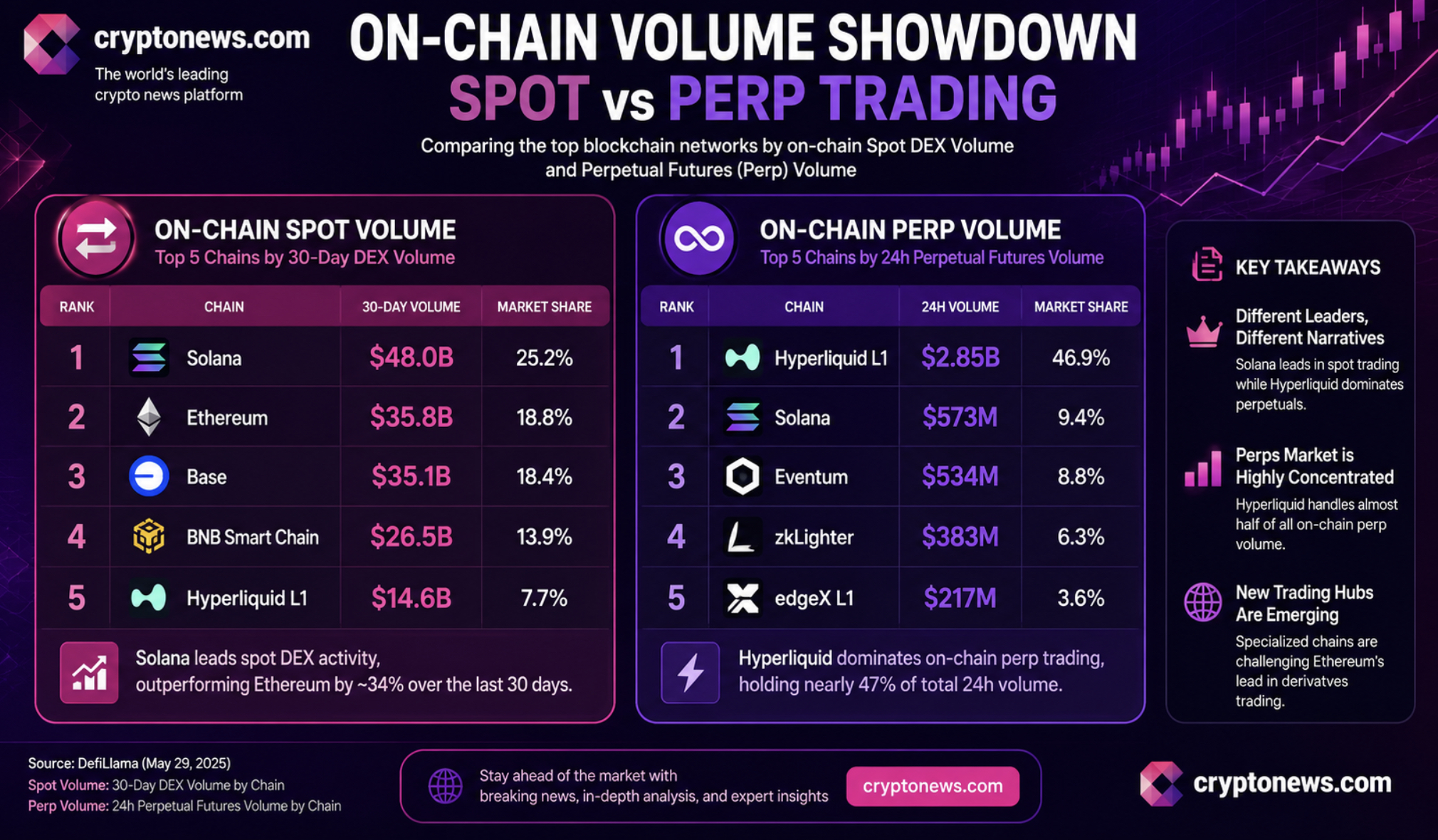
Solana price is trading at $68, with a $40 billion market cap, as its spot volumes dominate onchain. However, its perp activity is conspicuously absent.
If we laid out the structural case, Solana holds 25% of the total on-chain DEX share, with mainstream asset spreads compressed to 0.4–1.6 bps on large trades. Solana is approaching CEX-level efficiency driven by PropAMM architecture.
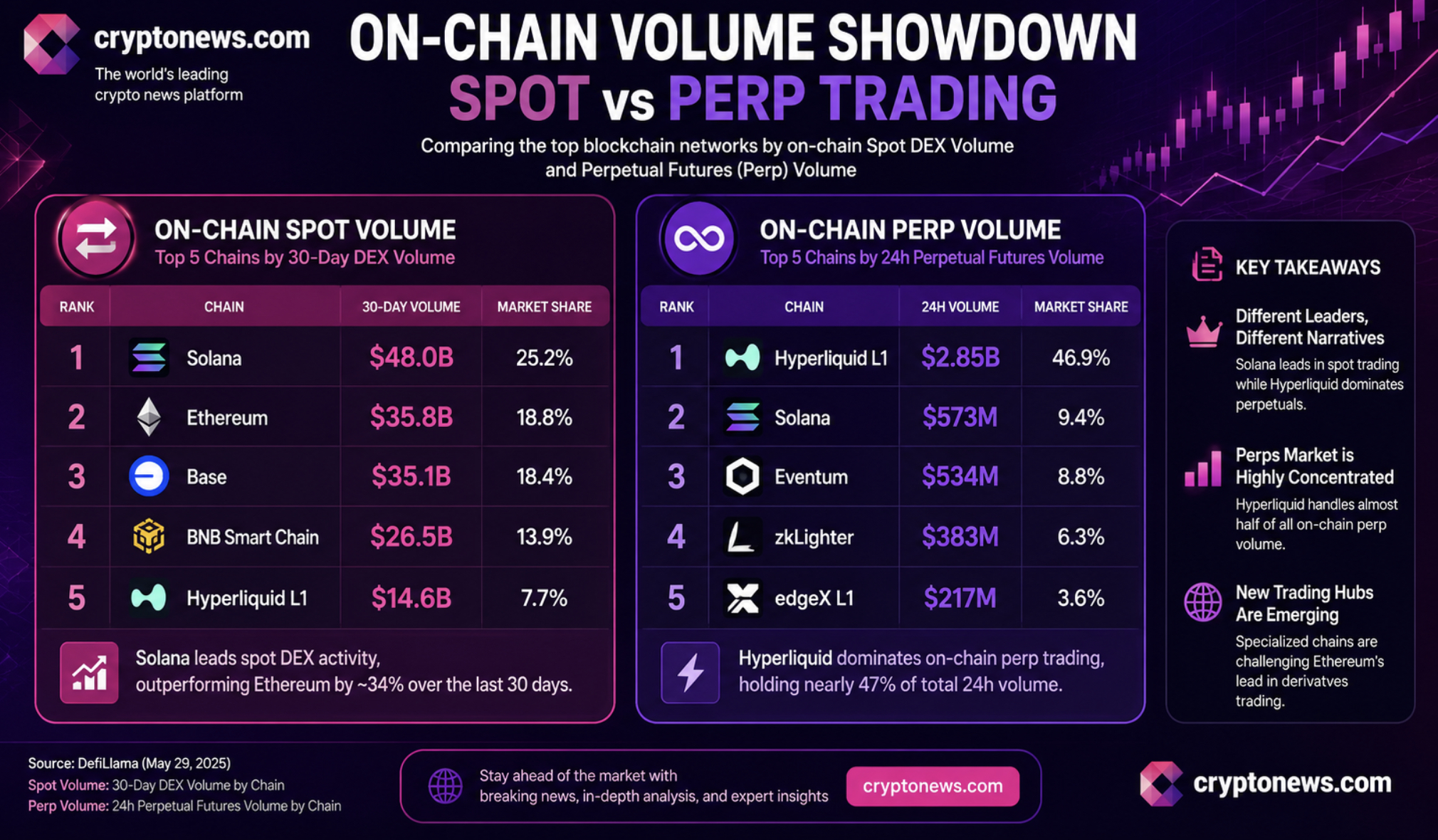
Meanwhile, HyperLiquid commands over 47% of perpetual OI and volume share, exposing a gap that Solana’s current infrastructure lacks. The root issue isn’t throughput, but deterministic sequencing. Solana’s Leader scheduling can’t guarantee cancellations are prioritized over fills, which forces market makers to widen spreads and pull depth.
Spot thrives. Perps suffer. But maybe it’s what Solana is for.
Discover: The Best Crypto to Diversify Your Portfolio
Can Solana Price Hit $295 and Beyond This Week?
At under $70, SOL is consolidating inside a contracting triangle on the hourly chart, with immediate resistance clustered between $82. A decisive close above it opens the next leg, though the more meaningful test sits much higher.
On the daily timeframe, our analysts identify support in the $65 zone and a hard resistance wall near $75, a level that has rejected multiple breakout attempts. The 20-day moving average is sloping upward, RSI is climbing from mid-range, and each dip has been absorbed by spot buyers rather than triggering perp-driven liquidation cascades.

Don’t Miss Out on Our $1,000 USDT Airdrop on ByBit
If SOL clears $72 with volume, reclaims $75 on the daily, it then could target the $80 supply zone. ETF-related inflows or a major DeFi launch could accelerate that path. But a clean break below $65 on elevated volume would compromise the current structure and likely flush toward the $50-$55 range. This pattern of on-chain activity diverging from derivatives participation has appeared in other assets recently.
Discover: The Best Token Presales
Bitcoin Hyper Targets Early Mover Upside as Solana Tests Key Levels
SOL’s spot dominance is real, but at the current price, the upside to $80 requires clearing multiple resistance bands and a macro tailwind. The asymmetry that existed at $20 is structurally different from the risk/reward at the current price.
Traders who already have SOL exposure and want earlier-stage leverage on the same SVM thesis are increasingly looking at infrastructure plays still in price discovery. Bitcoin Hyper is the angle drawing attention here.
Bitcoin Hyper ($HYPER) is positioned as the first Bitcoin Layer 2 with full SVM integration, executing faster than Solana itself, with sub-second finality. It is powered by a Decentralized Canonical Bridge for native BTC transfers and low-cost smart contract execution, inheriting Bitcoin’s security model.
The presale has raised close to $33 million at a current price of $0.0136, with staking available at high APY for early participants. The composability angle is directly relevant: if Solana’s long-term moat is DeFi composability and ecosystem flywheel, a Bitcoin-native chain running SVM unlocks that same playbook for the largest liquidity pool in crypto.
Research Bitcoin Hyper here before the presale ends.
The post Solana Price Prediction: SOL Dominating On-Chain With Little to No Volume in Perpetual Trading appeared first on Cryptonews.



Kalshi has filed a federal lawsuit challenging a new Illinois law that would require prediction market platforms offering sports event contracts to obtain state licenses before operating.
Summary
- Kalshi has sued Illinois, arguing the state’s sports prediction market law violates federal authority.
- The company says complying with the law would conflict with CFTC rules and create unrecoverable costs.
- The lawsuit comes as Kalshi pursues a reported $40 billion valuation and expands its crypto product lineup.
According to a filing submitted Tuesday in the U.S. District Court for the Northern District of Illinois, Kalshi sued Illinois Governor JB Pritzker, Attorney General Kwame Raoul, members of the Illinois Gaming Board, and other state officials, arguing that the state has overstepped federal authority over regulated prediction markets.
The complaint targets Illinois Senate Bill 3019, which was signed into law last week as part of the state’s fiscal year 2027 budget package. Kalshi argued that the legislation unlawfully interferes with the Commodity Exchange Act by treating sports event contracts offered on federally regulated prediction markets as sports wagers subject to state licensing requirements. The company said the law is scheduled to take effect on July 1.
Kalshi says federal rules override Illinois licensing requirements
According to the complaint, Kalshi believes the Commodity Futures Trading Commission has exclusive authority over its event contracts because they are regulated under the Commodity Exchange Act. The company alleged that Illinois cannot impose an additional licensing system on products already overseen by the federal regulator.
Kalshi argued that stopping sports event contracts in Illinois would leave the company in conflict with the CFTC’s requirement to operate a uniform national market. The filing also claimed that restricting Illinois users would force Kalshi to build costly technology systems to block access in the state, expenses it said could not be recovered even if it later won the case.
At the same time, the complaint argued that complying with Illinois’s licensing framework would expose the company to another set of costly regulatory obligations. According to Kalshi, ignoring the new law is also not a practical option because state enforcement could include criminal penalties.
The disputed legislation also introduced a 0.2% tax on cryptocurrency transactions, a measure that has already drawn criticism from several participants in the digital asset industry.
In addition, the law expanded the state’s definition of an “exchange wager” to include agreements, contracts, transactions, or swaps traded on prediction markets when tied to sporting contests, placing those products under the same rules as traditional sports betting operators.
Legal dispute grows as Kalshi expands business
The Illinois case adds to a series of legal disputes over whether states or the federal government has primary authority over sports-related prediction markets.
The CFTC, now led by Commissioner Michael Selig, has maintained that prediction market event contracts fall under its jurisdiction because they qualify as swaps under federal law. Federal regulators have already challenged similar state actions, including recent litigation involving restrictions imposed in Kentucky.
Legal analysts have suggested that the conflicting positions taken by state gaming regulators and federal authorities could eventually require resolution by the U.S. Supreme Court if lower courts continue reaching different conclusions.
Meanwhile, the lawsuit comes as Kalshi continues expanding its business. The company has reportedly entered discussions to raise fresh funding at a valuation of about $40 billion, up from the $22 billion valuation it secured less than two months ago.
Sports-related contracts account for roughly 65% of trading volume, according to company data, while multi-outcome combination contracts introduced last year have become one of its fastest-growing products.
Recent product launches have also extended Kalshi’s regulated offerings. As reported by crypto.news, on June 24, the company added perpetual crypto futures tied to Zcash, Near Protocol, and Shiba Inu, increasing its CFTC-regulated lineup to 13 digital assets operating under contracts without expiration dates.
Crypto markets sold off hard on June 24, wiping out more than $600 million in leveraged long positions within hours. Bitcoin and Ethereum absorbed the heaviest of the crypto liquidations.
The drop was broad rather than isolated. Nearly every major token turned red, and the forced selling concentrated on the largest exchanges. Binance led every venue.
Red Floods the Market
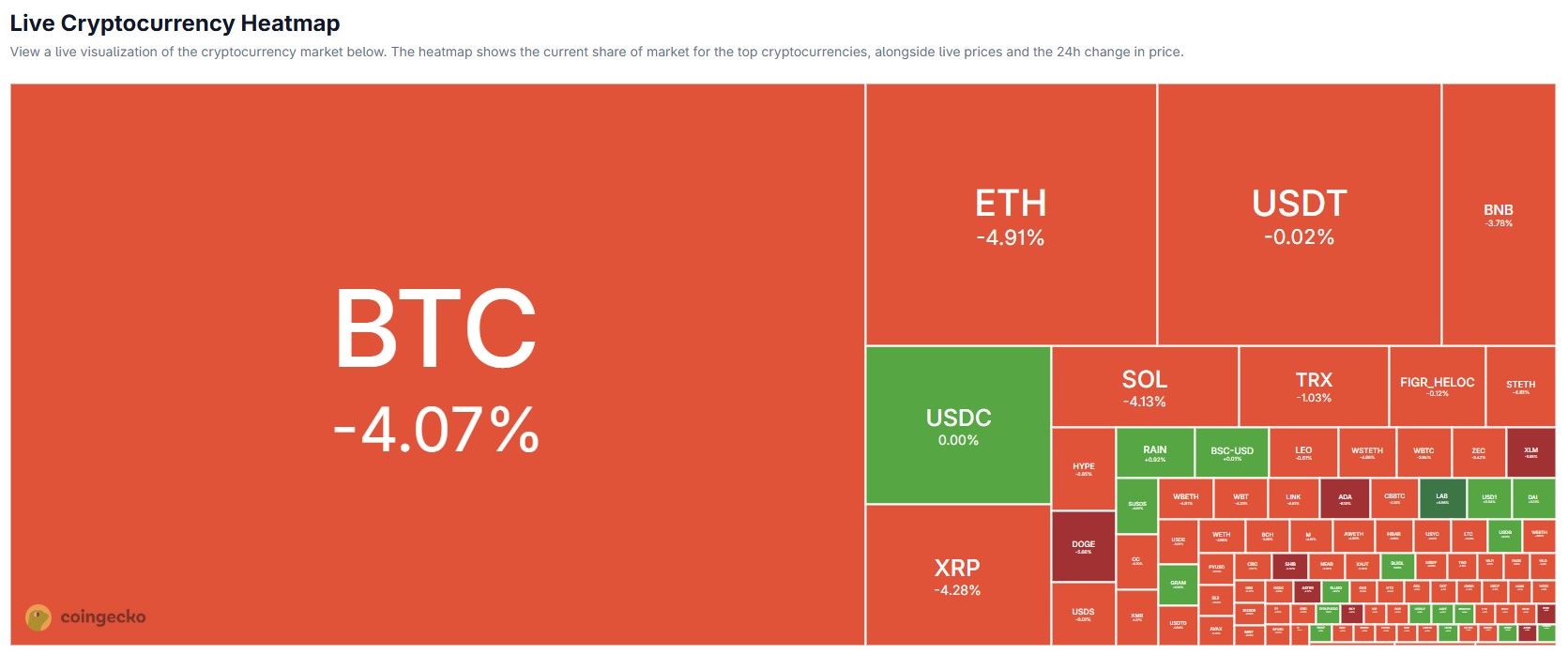
A live cryptocurrency heatmap captured the scale of the rout. Bitcoin (BTC) showed a 4.07% daily loss on the snapshot, while Ethereum (ETH) fell 4.91%.
Large caps followed in lockstep. XRP dropped 4.28%, Solana (SOL) lost 4.13%, and BNB slid 3.78%. Dogecoin (DOGE) ranked as the worst major performer at 5.86%.

The uniform selling pointed to risk-off pressure rather than a single token story. By press time the 24-hour declines had eased, with Bitcoin near $60,585 and Ethereum around $1,606 after a modest intraday bounce.
Longs Bear the Brunt of the Flush
The selloff was a leverage event. A 12-hour liquidation heatmap showed traders betting on higher prices getting wiped out across the board.
Bitcoin led with $336.47 million in liquidated longs. Ethereum followed at $188.82 million. Solana added $39.09 million, while a broad Others group totaled $70.80 million.

Centralized venues took the largest hits. Binance recorded $350.58 million in liquidations, far ahead of the field.
Hyperliquid placed second at $147.24 million, a notable showing for a decentralized exchange. Bybit followed with $120.08 million, then Gate at $55.89 million and OKX near $47.84 million.

Crypto Liquidations: Bitcoin Hinges on $63,000 Wall
The Binance BTC/USDT liquidation leverage heatmap explains why any Ethereum and Bitcoin bounce may struggle. Bitcoin traded flat near $63,000 for most of June 23 before breaking down.
Price stair-stepped lower through June 24, sliding toward $59,700 before steadying around $60,000. The descent cut straight through dense liquidation clusters.
Those bright clusters now sit overhead between $61,500 and $63,000. They mark heavy leverage that could act as resistance on any rebound.

A reclaim of $63,000 would invalidate the bearish setup. A loss of the $59,700 support could expose lower levels and trigger another cascade.
Bitcoin now sits between a wall of overhead liquidations and a thin floor below. The next move depends on which level breaks first.
The post $600M Wiped Out in Hours: Crypto’s Leverage Bloodbath Just Hit BTC and ETH Hardest appeared first on BeInCrypto.
Crypto World
Wall Street AI Watch: Micron (MU) Results, SK Hynix $29B Listing, and Chip Stock Recovery

Quick Summary
- Micron’s quarterly report served as a critical barometer for ongoing AI infrastructure investment
- Chip stocks like Nvidia and Broadcom rebounded strongly following this week’s earlier downturn
- SK Hynix unveiled plans for a U.S. stock market debut potentially worth $29 billion
- The Nasdaq regained ground after multiple days of technology-led losses
- Cerebras delivered earnings results, offering insight into specialized AI chip demand
Artificial intelligence remained front and center across financial markets today. Between quarterly earnings announcements and a blockbuster listing reveal, semiconductor companies commanded attention from traders and investors alike.
Micron’s Report Becomes AI Demand Litmus Test
[[LINK_START_0]]Micron’s quarterly earnings release[[LINK_END_0]] stood as the session’s most anticipated event.
Market participants track Micron carefully since its memory products power AI servers and data center infrastructure. Robust performance in these segments indicates continued aggressive spending by hyperscalers on artificial intelligence capabilities.
Anticipation ran high ahead of the announcement. Micron shares had delivered solid returns throughout 2026, leaving Wall Street eager for validation that high-bandwidth memory sales momentum persisted.
The implications extended well beyond a single company’s performance. Positive figures would reinforce optimism about semiconductor industry health. Disappointing numbers might trigger concerns about the actual pace of AI capital expenditure growth.
Few quarterly reports this season attracted comparable investor scrutiny.
Chip Sector Mounts Strong Recovery
Following recent pressure, semiconductor equities rallied meaningfully.
Nvidia, [[LINK_START_1]]Broadcom[[LINK_END_1]], and Intel all posted gains as capital flowed back into AI-linked stocks. The price action indicated many market participants viewed the recent selloff as an entry point rather than a fundamental warning.
AI-related capital spending continues representing one of the market’s most powerful tailwinds.
Hyperscale cloud providers maintain multi-billion-dollar commitments to data center expansion, advanced processors, and networking infrastructure. Today’s recovery demonstrated that underlying conviction in the sector remains intact.
Volatility has increased noticeably, yet demand emerged swiftly at lower price levels.
SK Hynix Announces Plans for $29 Billion U.S. Market Debut
The session’s most significant corporate development originated from SK Hynix.
The South Korean memory manufacturer disclosed intentions to pursue a United States listing in a transaction potentially generating approximately $29 billion. Upon completion, this would represent one of the largest public offerings on record.
[[LINK_START_2]]SK Hynix[[LINK_END_2]] specializes in high-bandwidth memory production, a critical component enabling contemporary AI system performance.
A U.S. market presence would provide investors with direct exposure to one of the most sought-after segments within the semiconductor value chain. The announcement underscores extraordinary investor appetite for AI-connected equity opportunities.
Nasdaq Composite Regains Momentum
The [[LINK_START_3]]Nasdaq[[LINK_END_3]] index posted positive returns following multiple consecutive down sessions.
Technology shares paced the advance as market participants grew increasingly comfortable with current valuations after the recent correction. While inflation and monetary policy concerns persist, buying interest nonetheless materialized.
The rebound indicates investors remain prepared to add exposure when high-quality technology companies experience pullbacks.
Semiconductors, AI infrastructure providers, and cloud computing firms continue leading broader market performance over the trailing twelve months.
Cerebras Provides Additional AI Sector Perspective
[[LINK_START_4]]Cerebras[[LINK_END_4]] published quarterly results as well, capturing attention from investors seeking exposure beyond dominant chip manufacturers.
The firm produces processors engineered exclusively for artificial intelligence computing tasks. Its financial performance offered visibility into demand patterns for specialized hardware operating outside Nvidia’s ecosystem.
The report contributed additional data points suggesting AI hardware investment remains broadly distributed rather than concentrated among just a handful of suppliers.
Investors continue monitoring emerging players like Cerebras to gauge the true breadth of AI infrastructure deployment.
The quarterly figures reinforced that artificial intelligence maintains its position as the defining investment theme propelling technology sector allocation as 2026 progresses.

The old saying – sell in May and go away – proved to be right once again for the cryptocurrency markets. It was just six weeks ago when bitcoin had evidently reclaimed the $80,000 level and even surged to a multi-month peak at almost $83,000. The sentiment was gradually improving and there were even calls for $100,000 by the summer.
However, the tides turned viciously and the asset was rejected vigorously. Its decline since then has been nothing short of painful, dumping below $60,000 earlier today for the second time in June.
Is This Why?
Popular analyst Ali Martinez brought out the Coinbase Premium metric earlier today as the markets were crashing to fresh low. CryptoPotato reported when BTC dumped below $60,000 but managed to maintain above the $59,000 level and has now reclaimed the former.
According to Martinez, though, the metric that stands out the most for the past six weeks or so is the one that tracks how much BTC costs on Coinbase compared to Binance. In general, if the Premium is in the green, it means US investors (typically institutions) are accumulating bitcoin en masse on Coinbase, pushing its price there above the levels on international exchanges.
However, the last 46 days have not seen such green days. Or, as Martinez put it:
“A negative premium means BTC is trading cheaper on Coinbase, suggesting that US institutional buying pressure has dried up.”
He believes this slowdown mimics the massive investor exodus from the US-based spot Bitcoin ETFs. The funds have bled approximately $5 billion in essentially the same timeframe because “American smart money appears to be sitting on the sidelines, waiting for macroeconomic clarity before re-entering the accumulation phase.”

Other Plausible Reasons
As we recently noted, the ETFs are indeed among the many possible reasons behind BTC’s latest leg down. Others include the uncertainty around the war against Iran, strengthening dollar, or even some OG investors selling off. However, another biggie that stands out is the FUD around Strategy and its Stretch shares.
STRC has dumped below its par price of $100, currently trading at a hefty discount at $80. This essentially increases the pressure that the BTC-buying machine is under as the ‘flywheel’ effect is disrupted and the company now has to pay higher yield. According to some analysts, this could result in massive BTC sales from Strategy.
The post Is This the Hidden Reason Behind Bitcoin’s $23K Collapse in Just 6 Weeks? appeared first on CryptoPotato.
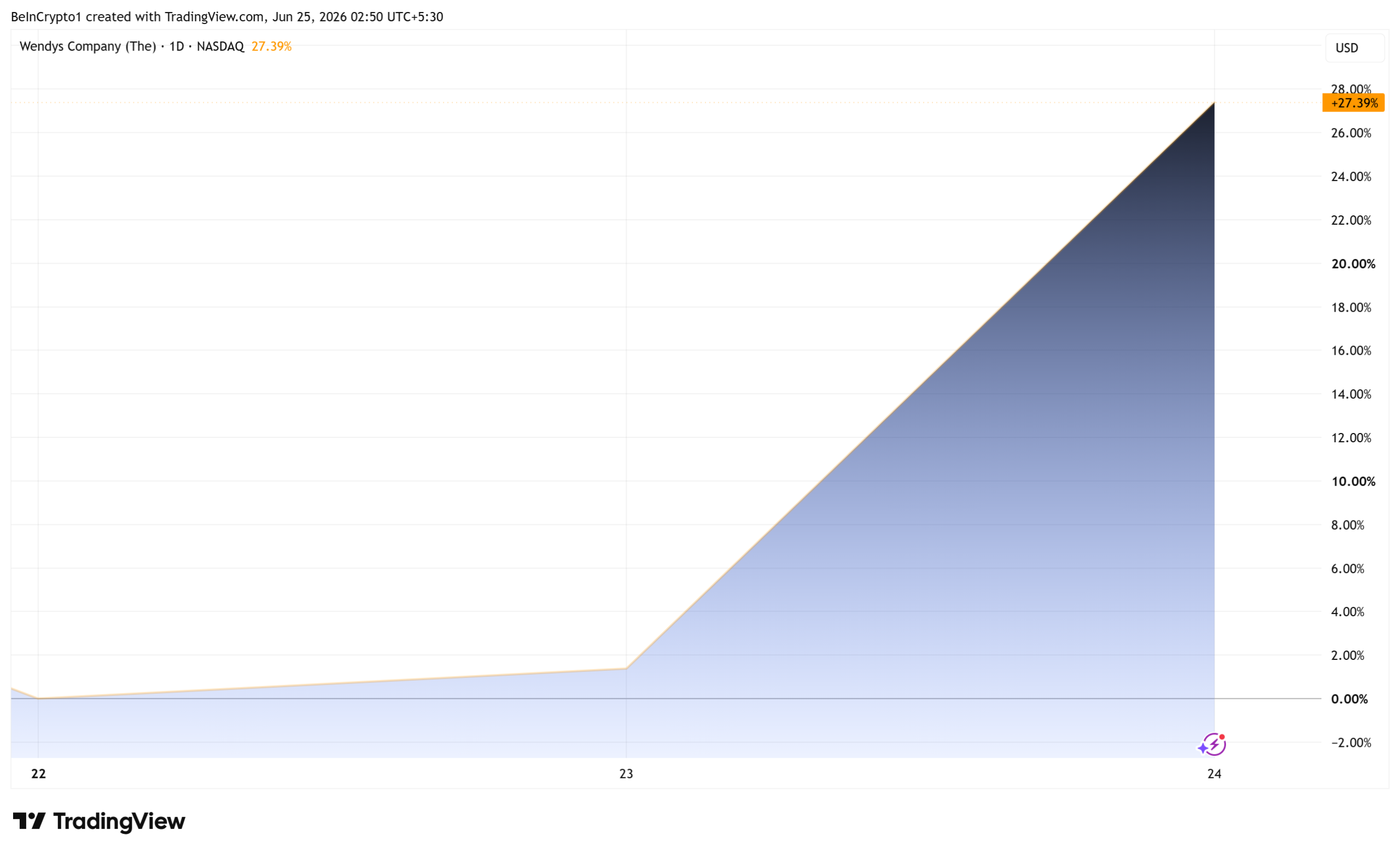
Wendy’s stock climbed almost 30% on Wednesday after traders on Reddit’s WallStreetBets forum rallied behind the struggling burger chain, reviving the meme-stock playbook that powered GameStop in 2021.
The rally lifted Wendy’s shares (WEN) to an intraday high near $8.89 and triggered at least one volatility halt, even as sales keep sliding.

Why Wendy’s Stock Drew a Short Squeeze
The move started with a since-deleted WallStreetBets post that urged members to rescue the chain before it collapsed. Copycat posts showing share and options purchases quickly followed.

“Save Wendy’s before it’s too late,” the post read.
Follow us on X to get the latest news as it happens
Volume confirmed the frenzy. More than 202 million shares changed hands, over 15 times the recent average.
The stock logged its biggest single-day gain since March 2020, CNBC reported. Wendy’s had ended the prior session near $6.26, not far from a multiyear low.
The squeeze setup is real but far smaller than 2021. About 23% of Wendy’s float was sold short before the rally, according to S3 Partners. The same firm put GameStop’s short interest above 140% of its float ahead of the 2021 squeeze.
Rising prices can still force shorts to buy back stock, which pushes prices higher. That pattern drove the AMC and GameStop squeeze, and it resurfaced this year during the GameStop meme stock frenzy.
A CFO Hire Gives Bulls a Story
Sentiment had a fundamental hook too. Wendy’s named Steve Cirulis chief financial officer on June 23, succeeding Ken Cook, according to a regulatory filing.
Cirulis ran finance at Potbelly alongside Bob Wright, now Wendy’s CEO. The company credits the pair with a more than 500% gain in Potbelly’s share price during their tenure.
That record gave retail buyers a turnaround story to chase, a familiar driver of meme driven market moves. The hire builds on a recovery plan the company calls Project Fresh.
Fundamentals Still Point Down
The business behind the rally remains weak. US same-restaurant sales fell 7.8% in the first quarter, and net income slid to $22.7 million.
Quarterly earnings still beat reduced forecasts, yet the rally rests on sentiment rather than results.
Wendy’s has been here before. A June 2021 Reddit post hailed Wendy’s as the perfect WallStreetBets stock and briefly drove shares up 26%. That rally faded within weeks because almost none of the stock was sold short.

This time a crowded short base gives the move real fuel. Still, most names lifted by Reddit traders and markets eventually gave back their gains.
Wendy’s gains holding may depend on how long the crowd stays interested.
The post Wendy’s Stock Climbs 30% as WallStreetBets Targets a GameStop Repeat appeared first on BeInCrypto.


Kalshi is seeking to raise fresh capital at a valuation of about $40 billion, nearly doubling the $22 billion valuation it targeted in its previous funding round, according to a Financial Times report citing people familiar with the matter.
The prediction markets platform could close the fundraising as soon as the third quarter of this year, FT said.
If completed, the deal would widen Kalshi’s valuation lead over rival Polymarket, which was last reported to be seeking funding at $15 billion. The two platforms have emerged as the dominant names in the prediction markets sector, while many other entrants have increased the industry’s competitive landscape.
Kalshi’s previous funding round, which valued the company at $22 billion, attracted a roster of high-profile investors including Philippe Laffont’s Coatue Management, Sequoia Capital, Andreessen Horowitz and Morgan Stanley.
Competition in the sector has intensified as firms race to capture users and expand product offerings.
Kalshi operates as a federally regulated exchange in the United States, a distinction that has helped it attract mainstream investors and institutional backing. Meanwhile, Polymarket, which uses blockchain infrastructure and cryptocurrency-based settlement, has gained popularity among crypto traders and has become widely followed during recent election cycles.
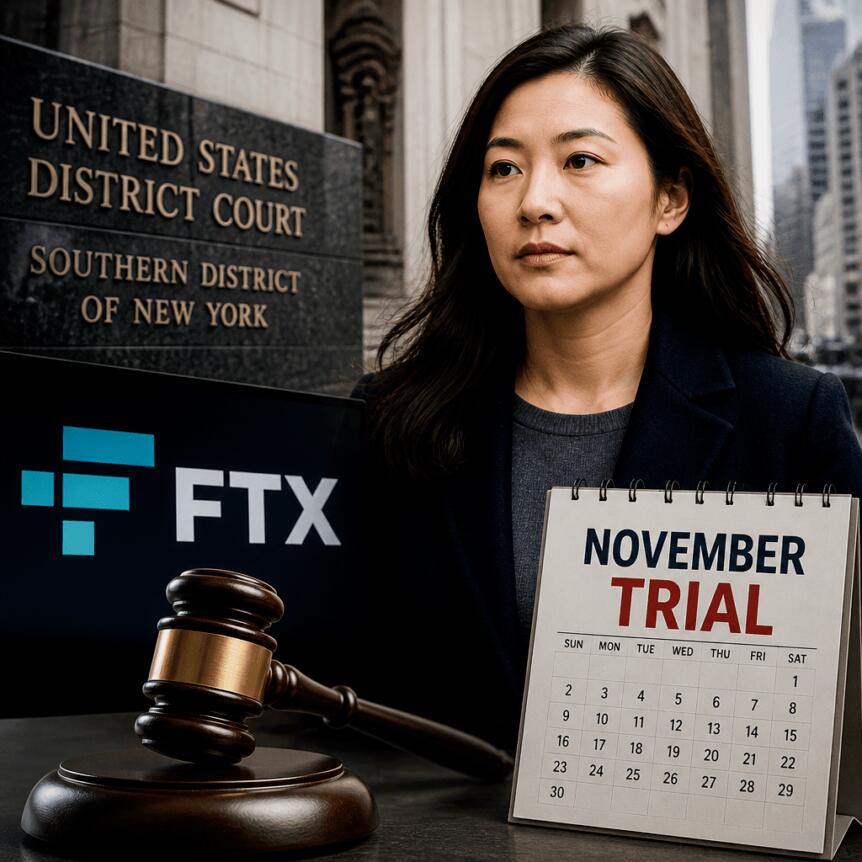
Michelle Bond, the wife of Ryan Salame—former co-CEO of FTX Digital Markets—has been scheduled for trial in November following delays tied to motions connected to Salame’s plea agreement. The proceeding comes as prosecutors pursue remaining criminal accountability related to the 2022 collapse of FTX, an episode that has since reshaped regulatory scrutiny of crypto-linked political activity and financial crime controls.
On Wednesday, U.S. District Judge George Daniels of the Southern District of New York set Bond’s trial to begin on Nov. 9. Bond faces four charges alleging violations of U.S. campaign finance law, stemming from prosecutors’ claims that FTX-related money was used to improperly support a 2022 congressional bid.
Key takeaways
- Judge George Daniels ordered Michelle Bond’s criminal trial to start on Nov. 9 in the Southern District of New York.
- Bond is charged with four offenses related to alleged campaign finance violations connected to the 2022 U.S. House race in New York’s 1st district.
- Prosecutors alleged that Ryan Salame used FTX funds in a “sham” payment arrangement, which they said violated campaign finance rules.
- The case is part of the final criminal track arising from FTX’s 2022 bankruptcy, following convictions and prison sentences for other key figures.
Bond’s trial date set amid motion-related delays
Bond’s schedule reflects procedural disputes that have continued since the charges were brought. A week earlier, Judge Daniels denied a motion by Bond seeking dismissal of the indictment. According to reporting by Cointelegraph, the defense argued that prosecutors had promised Salame he would not be charged if he pleaded guilty—an issue that, if accepted, could have materially affected Bond’s exposure.
With the dismissal attempt rejected, the court moved forward to establish a firm trial start date. For compliance and legal teams, the decision is significant because it underscores how plea negotiations and alleged assurances can become contested topics in later proceedings involving related defendants, even when one defendant has already resolved the matter through a plea agreement.
Alleged campaign finance conduct tied to the FTX collapse
Bond’s case is anchored in an August 2024 indictment. Prosecutors alleged that Bond and Salame “illegally funded” Salame’s political activity by using FTX resources to support a 2022 campaign for the U.S. House of Representatives.
The government’s allegations include that Salame used $400,000 of FTX funds as part of a “sham” payment intended to comply on paper while violating campaign finance laws in substance. Bond reportedly ran as a Republican in New York’s 1st congressional district, though she lost in the primary to Nicholas LaLota.
From an institutional perspective, the case illustrates a recurring enforcement theme: where crypto-related business failures intersect with political contributions, prosecutors may pursue campaign finance statutes in addition to financial fraud and related offenses. That creates additional compliance expectations for crypto firms and their leadership regarding the provenance of funds, controls around payments, and documentation that can withstand scrutiny across regulatory regimes.
How the plea deal with Salame shaped the remaining proceedings
Ryan Salame pleaded guilty and ultimately received a 7.5-year prison sentence, concluding his own criminal case. Authorities alleged that, as part of a conspiracy to make unlawful political contributions, Salame and others used money linked to FTX to support political activity. Salame later attempted to vacate his plea, arguing that prosecutors had misled him regarding whether Bond would face charges. Ultimately, he reported to prison in October 2024, leaving the dispute to continue within his wife’s case.
Bond’s trial therefore sits at the end of a broader U.S. prosecution landscape stemming from FTX’s collapse and its aftermath. The government’s pursuit of multiple individuals tied to FTX has included defendants who received prison time, as well as cooperation outcomes that reduced sentences for some witnesses.
In addition to Bond’s expected trial, the FTX criminal docket has largely reached resolution for several other participants. Sam “SBF” Bankman-Fried and Caroline Ellison—former Alameda Research CEO—were convicted or sentenced in separate proceedings. Two other former executives, Nishad Singh and Gary Wang, were given time served after testifying against Bankman-Fried at trial, reflecting the structure of cooperation-driven outcomes.
Parallel litigation: Bankman-Fried’s appeal and pardon bid
While Bond’s matter moves toward trial, Sam Bankman-Fried remains at a different procedural stage. Authorities convicted him on seven felony charges and sentenced him to 25 years in prison in 2024. Although Bankman-Fried sought to appeal his conviction and sentence, the Second Circuit recently rejected his appeal, leaving limited avenues for relief.
Separately, Bankman-Fried has pursued clemency routes, including applying for a presidential pardon from Donald Trump. However, as the appellate process has narrowed, the practical pathway to freedom is now tied either to further legal escalation to the U.S. Supreme Court or to executive action via pardon—an uncertainty that continues to shape the political and legal discourse around the case.
For institutional observers, this matters less because it affects crypto markets directly and more because it highlights how high-profile crypto fraud enforcement can diverge into distinct tracks: courtroom adjudication, sentencing appeals, and executive clemency. These overlapping tracks can influence how defense strategies and prosecutorial positions are evaluated in future cases with similar fact patterns involving financial wrongdoing and political or public-facing conduct.
Closing perspective
Bond’s Nov. 9 trial date sets a clear procedural next step, but unresolved questions around the indictment’s dismissal arguments—and how courts treat alleged assurances connected to plea deals—could still be consequential if litigated through motions and pretrial rulings. As the remaining FTX-related prosecutions narrow toward final outcomes, compliance professionals should watch how courts evaluate links between crypto-linked funding flows and regulated activity outside the financial sector, including campaign finance rules.
Crypto World
Ethereum Holds Near $1,600 as Whale Activity and Stablecoin Data Hint at a Potential Trend Reversal
TLDR:
- Ethereum is trading near $1,600, approximately 21% below its 30-day peak amid sustained market weakness.
- Two whale wallets withdrew $58.83M in ETH from Kraken and Bitgo, matching prior Bitmine purchase patterns.
- Binance stablecoin reserves and netflows have shifted to neutral, signaling a pause in aggressive capital flight.
- The bullish regime shift probability has climbed to 45%, but confirmation signals are still needed before acting.
Ethereum is trading around $1,600, roughly 21% below its 30-day peak, as on-chain data and whale activity draw renewed attention.
A quantitative regime model currently enforces a highly defensive stance, limiting market exposure to just 15%. Yet underlying metrics are shifting, with the probability of a bullish regime transition climbing to 45%.
Analysts and market observers are watching closely for confirmation signals before adjusting their positioning.
Defensive Model Meets Stabilizing Liquidity
Ethereum’s current price decline reflects a broader period of caution across crypto markets. The systematic regime model relies on multiple data layers, not price action alone.
It factors in Bitcoin’s structural cycles, derivative flows, and stablecoin dynamics on major exchanges like Binance.
Trend filters remain weak, with a moving average death cross showing a spread of -18.8%. That reading keeps the model in a highly defensive mode, reducing exposure significantly. However, momentum indicators tell a different story at the margin.
MACD histograms are contracting positively, suggesting that selling pressure may be running out of steam. This divergence between long-term trend weakness and short-term momentum stabilization is a key feature of the current setup.
Crucially, stablecoin data on Binance adds another layer of nuance. Stablecoin reserves registered a z-score of -0.32σ, while netflows came in at +0.20σ, both now in neutral territory.
This suggests the aggressive capital flight seen during deep corrections has paused, and exchange liquidity is no longer actively draining.
Whale Withdrawals Add a Bullish Variable
On-chain intelligence firm Arkham flagged notable activity from two fresh whale addresses this week. The wallets withdrew a combined $58.83 million worth of Ethereum from Kraken and Bitgo within hours.
Arkham noted that the purchase patterns matched prior observed activity linked to Bitmine, raising speculation about institutional accumulation.
Arkham posted on X: “Is Tom Lee stacking ETH this week?” referencing Bitmine chairman Tom Lee, known for public bullish stances on digital assets. The withdrawal pattern drew attention because it occurred against a backdrop of broader price weakness.
Ethereum recorded a 2.94% decline over the past 24 hours and a 7.43% drop over the past seven days, with 24-hour trading volume reaching $13.08 billion. Despite that, large-wallet behavior suggests some participants are positioning ahead of a potential reversal.
A decisive shift in Binance stablecoin netflows toward positive territory could serve as an early signal of returning risk appetite.
Until that confirmation arrives, the data supports patience rather than conviction in either direction. Ethereum’s next move may depend on whether these liquidity and behavioral signals continue to align.
Crypto World
Ethlabs Will Overlap with the Ethereum Foundation and Draw Its 'Densest Talent,' Funders Say


Ethlabs, a new Ethereum research lab backed by the network's two largest corporate holders, launched this week with a pitch to complement the Ethereum Foundation. Its own funders concede it will also compete as Ethlabs is “playing to win.” "I think they will be complementary," Joseph Chalom, chief… Read the full story at The Defiant


Kalshi has entered talks to raise fresh capital at a valuation of about $40 billion, an 82% jump from the $22 billion valuation it secured less than two months ago.
Summary
- Kalshi is reportedly seeking new funding at a $40 billion valuation, up 82% from May.
- The company processed over $17 billion in monthly trading volume and recently expanded crypto perpetuals.
- Legal disputes with CME Group and several U.S. states continue as Kalshi grows its product lineup.
According to a Financial Times report citing people familiar with the discussions, Kalshi is seeking a new funding round that could value the prediction market operator at roughly $40 billion, with the financing potentially closing as early as the third quarter.
The proposed valuation would represent another sharp increase for the company, which was valued at $22 billion during a $1 billion funding round completed in May. Earlier in 2025, Kalshi carried a valuation of about $5 billion, while its December valuation stood at $11 billion before doubling in the latest raise.
Investors in the previous financing included Coatue, Sequoia Capital, Andreessen Horowitz, and Morgan Stanley. If completed, the new round would push Kalshi’s valuation to eight times the level recorded at the beginning of the year.
Trading growth has supported investor interest
Financial Times reported that Kalshi’s rapid expansion has been driven by rising activity across prediction markets tied to sports, politics, financial markets, and entertainment.
Company figures show that Kalshi processed more than $17 billion in trading volume last month, up from less than $5 billion during the same period a year earlier. During its May fundraising announcement, the company said annualized trading volume had reached $178 billion, more than three times the level recorded six months before.
Sports-related contracts remain the platform’s largest category, accounting for about 65% of total volume, according to company data. Multi-outcome combination contracts introduced last year have also become one of Kalshi’s fastest-growing products.
Recent product launches have extended the company’s reach beyond event markets. Earlier on June 24, Kalshi expanded its Commodity Futures Trading Commission-regulated crypto perpetual futures lineup by adding contracts tied to Zcash, Near Protocol, and Shiba Inu. The additions increased the number of supported digital assets to 13, with the contracts operating without expiration dates under a structure approved by the CFTC.
Legal disputes continue across multiple fronts
While pursuing new funding, Kalshi remains involved in several legal and regulatory battles linked to its products.
A recent dispute emerged after the company launched cryptocurrency perpetual futures following approval from the CFTC. CME Group subsequently sued the regulator, arguing that the products should be classified as swaps and subjected to a different regulatory review process.
Elsewhere, state-level challenges continue to target Kalshi’s event contracts. Arizona filed criminal charges against the company in March, alleging that it operated without a gambling license and offered prohibited election-related contracts.
Separately, a Massachusetts judge ordered Kalshi to stop offering sports-related contracts in the state unless it obtains a local gaming license.
Kalshi has contested those actions and maintains that its event contracts fall under the exclusive jurisdiction of the federal derivatives regulator. As the company seeks another major funding round, the ongoing court cases are unfolding alongside its push into new markets and the rapid growth of its trading business.

Team USA all but set to face Bosnia and Herzegovina in World Cup Round of 32

The Grand Theft Auto 6 Physical Edition Is Overpriced DRM In A Box

International Financial Group Limited | Our corporate video


-

 Fashion5 days ago
Weekend Open Thread: Miami – Corporette.com
-

 Entertainment4 days ago
Renter of Home in Anne Heche Crash Denies Settlement With Son
-

 Tech2 days ago
Microsoft accidentally kills epic Outlook email threads
-
 Sports1 day ago
Two goals and an assist by sheer aura: Cristiano Ronaldo just entered the World Cup chat
-

 Business4 days ago
Soccer-U.S. defends Iran World Cup travel restrictions, says discussions ongoing
-
 Politics6 days ago
BBC Reporter Discusses Cross Party Criticism Of Trumps Iran Deal
-
Crypto World19 hours ago
Bitcoin (BTC) Dips Below $62K, Ethereum (ETH) Plunges 6% Daily: Market Watch
-

 Crypto World16 hours ago
Securitize Wraps Roubini's SEC-Registered ETF as Dubai VARA Digital Security
-

 Politics5 days ago
Andy Burnham and the meaning of Makerfield
-
Business22 hours ago
Entergy settles forward sale agreements, raises $672 million in cash proceeds
-
 Business5 days ago
Wall Street Week Ahead: Investors see Micron earnings as pulse check of AI rally momentum
-

 NewsBeat5 days ago
Keir Starmer Allies Question His Chances For No 10
-

 Tech6 days ago
AWS enters the context layer race with a graph that learns from agents, not manual curation
-
 Crypto World5 days ago
Can Charles Hoskinson Really Rescue Cardano?
-

 Crypto World5 days ago
HIVE shares jump as $220M AI deal speeds Bitcoin mining pivot
-

 Crypto World5 days ago
Jake Chervinsky accuses CME of protecting derivatives monopoly
-
 Tech3 days ago
Signal’s Meredith Whittaker says AI chatbots ‘are not your friends’ and calls Copilot agents a backdoor
-

 Entertainment5 days ago
Jose Alvarado Wants Taylor Swift at More Knicks Games
-

 Tech2 days ago
Nearly 7,000 fake Amazon domains registered ahead of Prime Day 2026, researchers warn
-

 Business6 days ago
Brexit cost 6% of UK economy, Bank of England company data suggests
You must be logged in to post a comment Login