


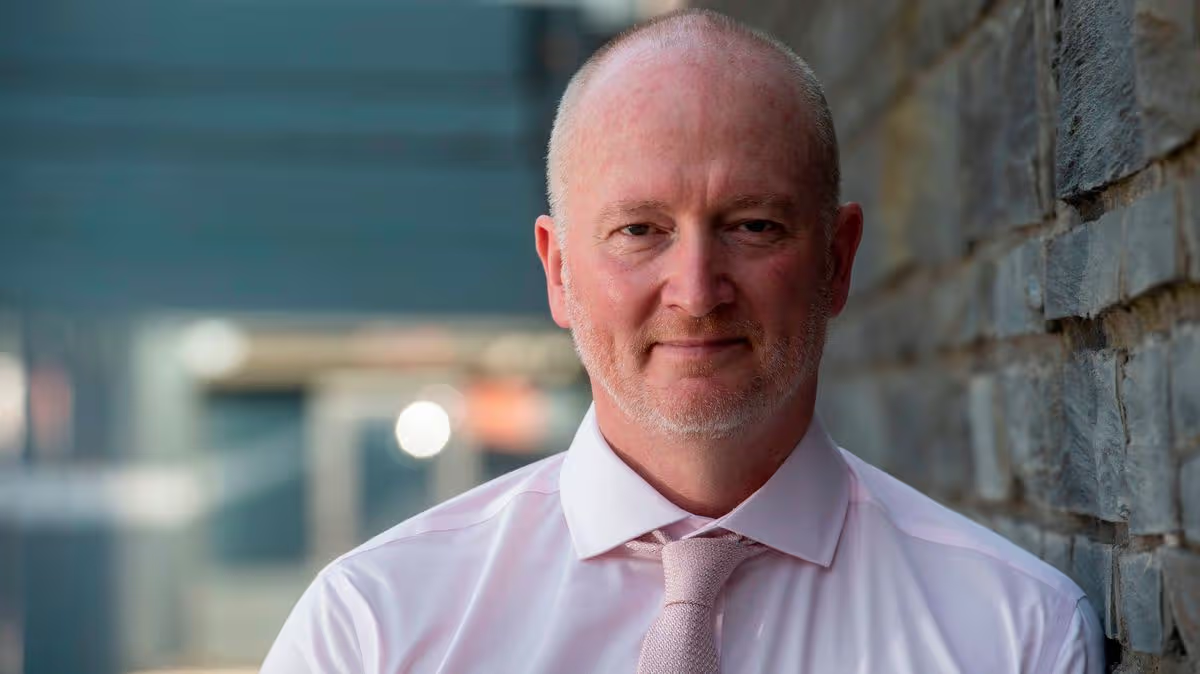
In his former career he dealt with riots, hostage situations, violence and now he says those skills will all help him in the Senedd
In 20 years as a prison guard, it’s safe to say there’s little Paul Marr didn’t see. But at the age of 53 he has a new career where he has switched the corridors of a prison for the corridors of power, as one of the new intake of Reform Senedd members in Cardiff Bay.
One of three boys, he’s originally from Bristol, and aged 20, he joined the prison service. One of his siblings was in the RAF, the other the police. “Uniform was kind of in our blood,” he says.
In his career he worked all over the prison estate, from youth offenders, to the most serious category A prisoners, and a year on a mother and baby unit.
He was riot trained and a hostage negotiator, sent to prisons in the moments reinforcement was needed most.
In 2013, then 40, he was medically discharged after a diagnosis of multiple sclerosis.. And since then has worked in the NHS as a manager of drug treatment services in police custody.
He ended up in Wales after meeting his wife, from Pembrokeshire, and is a dad to grown-up children, and now, in 2026, he is an elected politician in a building he had never set foot in until he was told to attend to take his oath in the days after May 7’s historic Welsh election.
He always wanted to be a prison officer, he says, and spent his career travelling around the prison estate working in a range of sectors.
In his time he worked with drug and alcohol users, women and youths. He dealt with self-harm, violence, and suicide. In 2008, his name appeared in court reports after he was bitten on his inner left forearm by a prisoner.
“There were elements of the job that I loved and those elements were being role models to people.
“When I left the prison service I went on to be manager of drug treatment services in police custody. So again, not being able to get away from custody is one thing, at least there’s no bars here.
“But at least I felt like I was helping people at the lowest point and often people who had been forgotten about in society and often felt neglected,” he says.
His year long spell on the mother and baby unit is something that sticks with him.
“It was really hard because I’ve got daughters myself, and a lot of the women in jail have a horrendous backstory in terms of where they’ve been treated and everything else, and I just found that very difficult.
“The back stories are all unique, but they have a common thing, usually manipulation and coercion,” he says.
“The assaults and everything else, prisons are violent places, they’re volatile places and sometimes people, if you don’t give people the answer they want, then they’ll resort to those sorts of behaviours.
“But prison for me, it wasn’t just about dealing with those incidents there and then, it was about taking that incident and then supporting that person that’s done it, or hoping that the prison service would support that person who’s done that, to understand that it’s wrong and there’s consequences and they learn from that behaviour and change, ultimately.”
There were, within that time, huge success stories.
“I worked on the relapse prevention unit. Prisoners, when they want to get themselves drug-free, they go through the detox unit and then they come onto the relapse prevention unit (RPU).
“I spent a lot of time on RPUs and just seeing that transformation in people, going from career criminals, primarily funded to feed their drug addiction, to actually understanding through better health and being drug-free that they can contribute.
“That if you say simple things to people, like ‘look how well you’ve done, you’ve got yourself drug free, you’re back in the gym, you’re looking really good and now if you apply the same logic to life, getting a job, helping people, it will pay you back in same way and it’s a light bulb moment, you see people just kind of switch on’.
“You’re never gonna be that person to everybody, but if you’re that person somebody, then it makes a difference,” he says.
“In my 20 years there wasn’t one day in the prison service that was the same, so you can be attending an incident where you’ve cut somebody down or somebody’s been seriously assaulted, you go away and do the paperwork and then you go straight into another incident where somebody’s committing self harm or somebody has been sent a Dear John letter [a breakup letter] and they need somebody to speak to. There’s so many different hats you have to put on in the prison service.”
The prison estate in Wales particularly, Parc, is something that has had a lot of media attention in recent years. It’s somewhere he went on both hostage and riot incidents but he says for the staff there, each incident reported isn’t the only story from that prison.
“We have a death in the prison and the press are all over it in terms of what did the prison do wrong, ‘could they have saved that life’, ‘could they have done this’ and yes every service expects to be under scrutiny every public servant expects to under scrutiny but I’ve lost count of the amount of people I’ve cut down that have been hanging given mouth-to-mouth to and then gone on and done my job.
“That never, ever, gets highlighted. The prison service is the forgotten service, it’s the fifth emergency service.”
“There are very good reasons why the public don’t hear everything that goes on in prison, and it’s because it wouldn’t be palatable when you’re having your breakfast over the paper,” he says.
I tell him I raised an eyebrow when I saw him say his riot training and hostage negotiator skills were things he thought were transferable to the Welsh Parliament.
“The way I see it, everybody that’s in this building is in a privileged position where they represent the Welsh people and yes we have very differing views to Plaid on a lot of things, we’re singing on from the same hymn sheet we would just do it in a different way.
“If I think about the hostage negotiation, everything about that was about getting the right outcome for everybody. It’s the same thing here.
“You’ve got two people in that situation. You’ve got the perpetrator, who’s got a completely different outcome to me. My outcome is to make sure people are safe. Their outcome is an agenda, they want something. So it’s about finding that common ground, and that’s what I hope to be able to bring here, he says.
In the weeks since being elected, he has been into Parc along with another Reform UK MS, Gareth Thomas.
“What I would say is, I left the prison service in 2013, so we’re talking 13 years on. Now, there was always a bit of rivalry between Parc and what we call black and white prisons, HMP prisons, because one’s publicly funded, the other one isn’t.
“But what I would say, is yes, Parc prison has come under a lot of scrutiny, and probably rightly so, in some circumstances.
“The same thing can be said for every prison in the country, nowhere is perfect. But what I would say is, the work that I saw that the officers there were doing and the governor and people like that is absolutely fantastic.
“I know it’s different funding and there may be different arguments, maybe a bit of banter going backwards and forwards around who provides the best service, but at the end of the day it’s the same people doing the same sort of job.
“They’re dealing with the same issues and the levels of dedication, commitment and compassion that I saw at Parc were unrivalled and I think for me, when I joined as a 20-year-old if I could have picked up what they had going on in Parc and transferred it back to them…” he says.
I presume his background and early visit to a prison means he will be using his time in the Senedd to campaign, maybe not, he says.
“It’s not a devolved power of justice, but I can see pros and cons for it. From a Reform/Plaid perspective, we’ve got very different views on the sort of devolved powers around crime.”
He does not support decriminalising illegal substances. “(If) you do something like that in a prison environment, you’re going to lose the prison that day, because drug-related crime and violence would go through the roof, and prison officers will have no tools to combat it. Same with the police, same with the National Health Service, you know, so we have very different views.
“But that said, I’m confident that if, if and when it becomes a devolved power, the minister that will be responsible for it, I’ll be able to work with him,” he says.
He left the prison service after being medically retired after his MS diagnosis.
He has relapsed and remitting MS. “The way it affects me can differ from time to time. Mobility can be an issue, stairs, but it all depends a lot of it.
“Fatigue is one of the main elements within it. So if I can control the fatigue side of things, then the other bits tend to follow. I know it sounds weird, but I’ve been very fortunate. It could have been a lot worse,” he says.
He brings his time in the NHS too. When someone arrives in custody, if they have a drug issue, they are offered interventions and support.
He wrote the Drug Education Programme for Bristol, which was implemented across the south West and that was about early intervention and diverting people from future offending custody.
But his entry into politics – his first party, his first election – was because after 20 years in prisons, 13 years with the NHS, “I just got fed up with the decline in public services”.
“I’m affected by it, you’re affected by, and just because I put a uniform on and I went into that area of work doesn’t mean to say that I wasn’t affected by this.
“I saw that decline, but I still saw people with the same amount of passion wanting to do the very best they possibly could being hindered by bureaucracy and being told ‘sorry, we haven’t got the money’.
“Well, when you’re talking about saving lives, that shouldn’t come into it, what should come into it is the fact that we’re going to do everything we can, we’re going to throw every resource in.”
It was Reform that tempted him, and, from Milford Haven, he was placed second on their list in Ceredigion Penfro.
“Everybody’s going to try and find a party that’s most aligned to them and I think, certainly for me, one of the main things that attracted me to Reform was there was just this no kind of, no ambiguity, no messing around type approach to it.
“You look at a manifesto, it’s fully costed., we try and back things up with evidence, make sure it’s evidence based and I grew up, I was a latchkey kid, I grew in the 70s and 80s and I just want Britain to go back to those times where people are safe,” he says.
He tells me the night before, walking from his apartment through the Bay he found a man, 73, who had been assaulted.
“I don’t want that for this country, I would have been perfectly, not perfectly safe, maybe not, maybe I’m naive, but we’d have been a lot safer back in the late 70s, early 80s to be walking around than it is now.
“So for me, it’s about restoring traditional values, making sure that the police are given the proper support to do their job and the authorities are given the proper to do the job, and right through to nursing and everything else, just making sure those public services are properly supported,” he says.
Being elected and arriving at the Senedd for the first time was, he says, “overwhelming” and “really quite emotional”.
“I think when you come here and you can see everything that goes on here, there’s a tremendous weight of responsibility and that hit me the first day that I came here and it’s just not something that I’ll ever take lightly.
“I just see it as a privileged place to be in terms of getting things done hopefully,” he says.
We meet before he speaks in a Reform UK debate about water quality, an issue all around Wales, but it is the beaches of Pembrokeshire which attracted him to Wales – White Sands is his favourite – and he wants people to be able to enjoy them safely.
“For me, whilst it’s great to be in the Senedd, the real work for me is in the constituency, they’re the people that put me there, so I want to do the right job for them,” he says.
One of the first emails in his inbox was from Surfers Against Sewage and it’s something that he wants to tackle.
“I’ve met with local professors that have been testing the water quality, a local citizens group, and it’s just the rising levels of E-coli.
“If you take Broadhaven Beach for example, we’ve got three tributaries going into the ocean. The tributaries aren’t classed as bathing water, but they still attract children all year round to be playing in that water, and that water still ends up going into the sea.
“For me it’s about accountability around things like that.
“The obvious question for me is, you know, this has been going on for so long, people’s health, people are dying, Heather Preen in 1999, [an eight-year-old girl who contracted E-Coli on a Devon beach and died].
“I don’t think enough is being done about it, there’s not enough urgency.
“The Welsh Government is looking at a review I think in 2030, for me that doesn’t reflect the urgency. We’ve got a responsibility to our children, our grandchildren, the future generations, if they’re using our waterways that they’re safe,” he says.
Other things on his list include antisocial behaviour in schools, intercepting escalating behaviour at the earliest point.
“We’re seeing rising incidents of children carrying knives in schools. I want to be meeting with educational authorities, head teachers, to understand one of the questions I’m going to be raising in the chamber over the next few days is what the Welsh Government is going to do to tackle anti-social behaviour in school.
“For me it’s all about early intervention, age group for me it’s key to understand where they’re coming from and to educate them on the consequences,” he says.

















































You must be logged in to post a comment Login