

Crypto World
MemeCore Token Drops Below $1 Billion Market Cap After 76% Crash

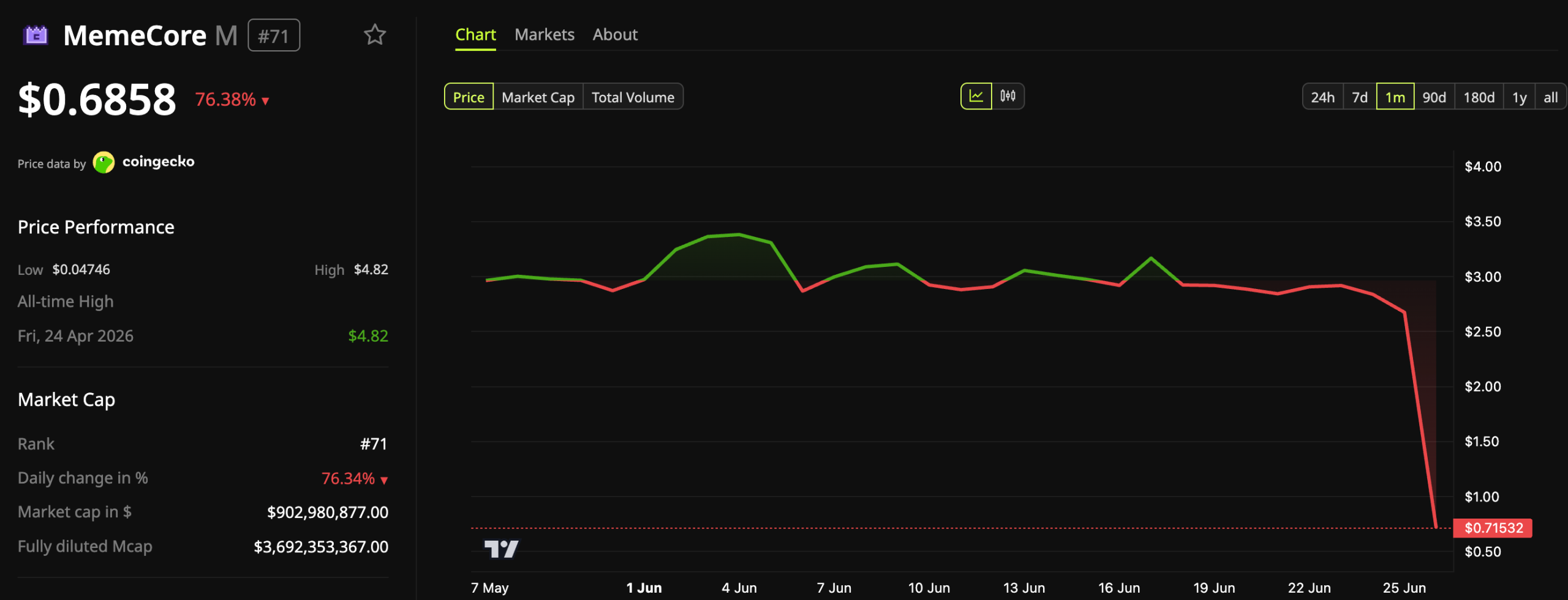
MemeCore’s M token shed 76% of its value on Thursday in a sudden selloff that handed traders no clear reason.
The crash wiped billions from the token’s valuation and pushed its market capitalization below $1 billion.
MemeCore Token Falls From $2.66 to $0.5 in One Session
According to BeInCrypto Markets data, the meme coin tumbled from $2.659 to an intraday low of $0.50 before paring some losses. M traded near $0.6858 at press time, down 76.38% on the day.
Follow us on X to get the latest news as it happens

The token’s fully diluted valuation (FDV) fell to roughly $3.69 billion. Its market cap dropped to about $903 million, from around $3.5 billion before the slide.
Thursday’s decline left the token ranked 72nd by market capitalization. The wider crypto market slipped just 1.64% over the same window. M’s loss far outpaced that move.
ZachXBT’s Warnings Resurface
Onchain investigator ZachXBT addressed the crash in a Telegram post, pointing to his past warnings about the meme coin.
“Myself, Mlm, & Wazz previously highlighted a number of red flags on X about MemeCore with inorganic supply concentration and deceptive practices by its team to boost user numbers,” he said.
ZachXBT cited Arkham data showing no onchain transfer above $50,000 on BNB Smart Chain (BSC) in more than two weeks. Dexscreener data indicated under $100,000 in total onchain liquidity there.
“The community needs answers from Binance & Bybit about why M was listed for perps and why Kraken & Bitget listed M spot as these highly manipulated tokens continue to give our industry a bad reputation and extract from retail,” the investigator added.
In April, ZachXBT publicly questioned Kraken’s decision to list M for spot trading. He asked how the token cleared the exchange’s due diligence.
BeInCrypto has reached out to MemeCore and the exchanges for comment.
Subscribe to our YouTube channel to watch leaders and journalists provide expert insights
The post MemeCore Token Drops Below $1 Billion Market Cap After 76% Crash appeared first on BeInCrypto.

Bitcoin has come under the influence of several factors simultaneously. The wave of selling at the beginning of June was linked to Strategy’s first disclosed Bitcoin sale in several years, a prolonged series of outflows from spot ETFs, and a large transfer of funds from a Mt. Gox wallet to a new address. The run of outflows from US spot Bitcoin ETFs became one of the longest and largest since these products were launched in January 2024.
Bloomberg Intelligence analyst James Seyffart noted that around $9 billion has exited Bitcoin ETFs since their peak, although most long-term fund investors have chosen to maintain their positions.
Technical picture
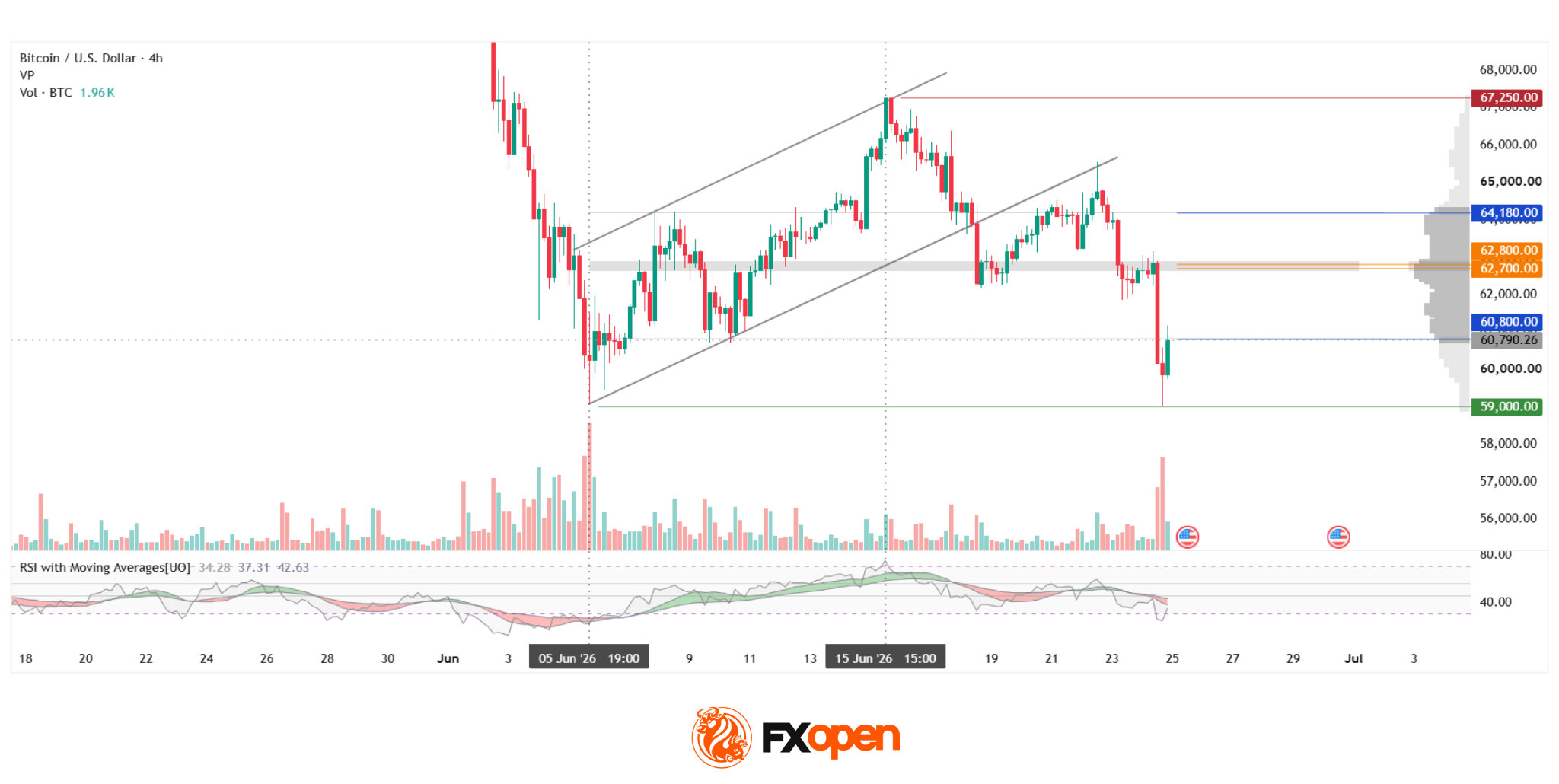
On the H4 chart of BTC/USD, an ascending corrective channel formed after an impulsive decline towards the $59,000 area. Price subsequently advanced to the upper boundary of the channel at $67,250, but failed to hold those levels. The channel was then broken to the downside, with quotations moving towards a test of the lower boundary of the current profile at $60,800.
The Point of Control (POC) is concentrated in the $62,700–$62,800 area and could attract market attention if price rebounds from the lower boundary.
The upper boundary of the profile is located near $64,180 and could act as resistance if the POC zone is breached. The RSI + MAs indicator stands at 34, 37 and 42 respectively. The oscillator remains below the neutral zone but has recovered from oversold territory, while the moving averages remain bearish and continue to point lower.
At the same time, vertical volume surged sharply during the decline on 24 June, which may have been interpreted by market participants as a sign that the local downtrend was nearing completion.
Summary
The unusually high volume recorded on 24 June, combined with the current RSI position, does not provide strong confirmation that the latest local impulse will continue, although the moving averages remain pointed lower for now.
Further price action may be influenced by upcoming US inflation data, as well as flows into Bitcoin ETFs, which experienced record outflows during June.
FXOpen offers the world’s most popular cryptocurrency CFDs*, including Bitcoin and Ethereum. Floating spreads, 1:2 leverage — at your service (additional fees may apply). Open your trading account now or learn more about crypto CFD trading with FXOpen.
*Important: At FXOpen UK, Cryptocurrency trading via CFDs is only available to our Professional clients. They are not available for trading by Retail clients. To find out more information about how this may affect you, please get in touch with our team.
This article represents the opinion of the Companies operating under the FXOpen brand only. It is not to be construed as an offer, solicitation, or recommendation with respect to products and services provided by the Companies operating under the FXOpen brand, nor is it to be considered financial advice.
Quick Summary
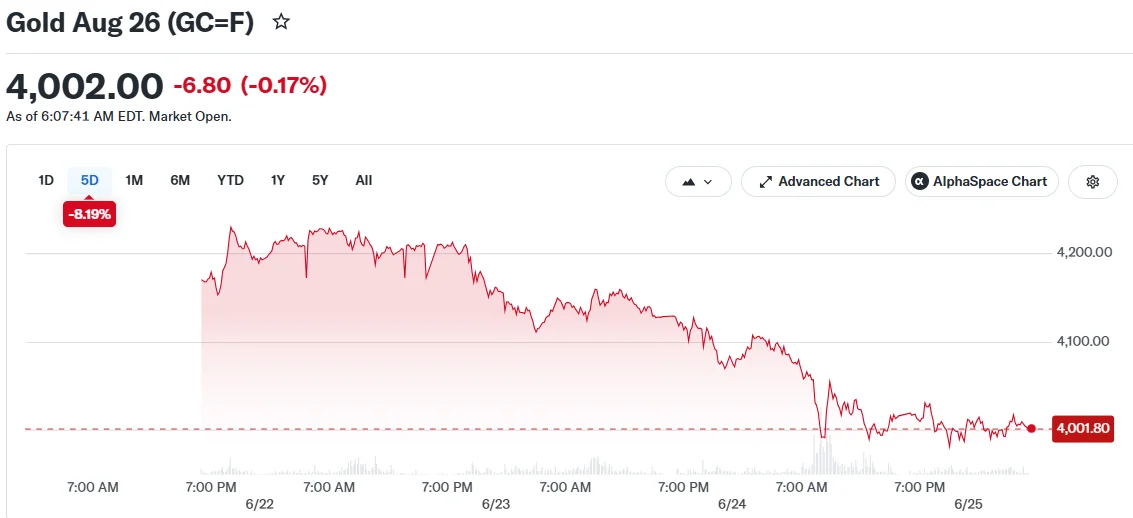
- Precious metal breached the $4,000 threshold for the first time since November 2025
- Yellow metal has plummeted approximately 30% from its January peak of $5,595.46
- Dollar strength at 13-month highs is pricing out international purchasers
- Traders now see 66% probability of Federal Reserve tightening by September
- Declining geopolitical risk premium has diminished safe-haven buying interest
The precious metal market is experiencing significant downward pressure as the strengthening U.S. dollar combined with mounting anticipation of Federal Reserve monetary tightening drives prices to their lowest point in seven months.
Spot gold declined 0.2% to settle at $3,984.83 per ounce during Thursday’s trading session. U.S. Gold Futures remained largely unchanged, hovering around the $4,008 level.
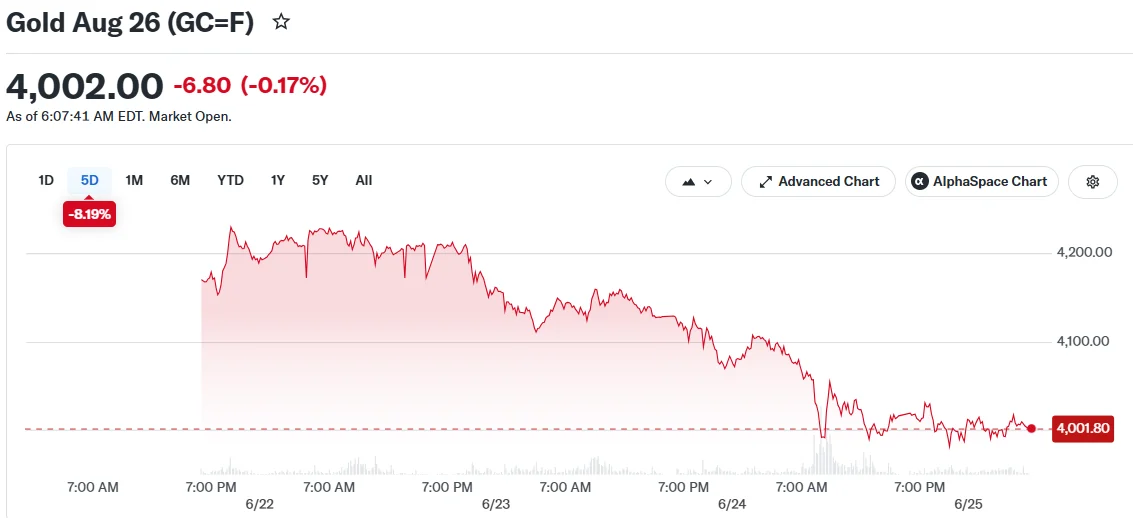
The yellow metal crashed through the psychologically significant $4,000 barrier on Wednesday, marking its first breach of this level since November 2025. Market participants had been closely monitoring this threshold as a critical support zone.
The precious metal has experienced a dramatic decline of nearly 30% from its all-time high of $5,595.46 recorded in January 2026. This represents a substantial correction within a relatively compressed timeframe.
The U.S. dollar’s performance has emerged as a primary catalyst behind the selloff. The currency has reached a 13-month peak following six consecutive sessions of appreciation.
A robust dollar increases the cost of gold for international buyers operating in alternative currencies. This dynamic typically suppresses demand for the precious metal.
Federal Reserve Policy Expectations Pressure Precious Metals
Market participants are currently assigning approximately one-third probability to an interest rate increase in July. These odds escalate to 66% for policy tightening by September, based on CME FedWatch analytical data.
Elevated interest rates create headwinds for gold since the commodity generates no income stream. As rates climb, investors can secure superior returns from fixed-income securities and cash equivalents, diminishing gold’s relative appeal.
ANZ research team noted that worries surrounding persistent inflationary pressure have triggered a “re-rating of monetary policy expectations.” They further observed that the Federal Reserve’s hawkish posture seems to have “derailed the debasement trade” that previously supported gold valuations.
ING market strategists indicated that gold’s underperformance demonstrates how market sentiment has pivoted away from defensive positioning toward focusing on the implications of rising rates and restrictive financial conditions.
Diminishing Geopolitical Risk Premium
Decreasing tensions across Middle Eastern regions have contributed to the downward trajectory. Advancement in U.S.-Iran diplomatic negotiations has eliminated portions of the risk premium that had underpinned gold valuations during the earlier months of this year.
Weakening oil prices have reinforced this transition. Investors demonstrate reduced appetite for gold as an insurance mechanism when geopolitical uncertainties appear to be subsiding.
Market observers are now directing attention toward Friday’s scheduled release of U.S. Personal Consumption Expenditures figures. The PCE represents the Federal Reserve’s prioritized inflation metric and could significantly influence projections for subsequent policy adjustments.
Silver registered a modest 0.1% gain to reach $57.50 per ounce on Thursday, recovering slightly after dropping more than 6% in the previous trading session. ING analysts observed that several of silver’s most robust demand catalysts are showing signs of weakening.
Platinum decreased 0.3% to settle at $1,581.60 per ounce. Copper futures advanced approximately 1.7% on the London Metal Exchange to reach $13,255.95 per ton.
Gold continues facing downward momentum with limited visible catalysts to reverse the prevailing trend ahead of the PCE data release.

Crypto World
CoinEx denies claims it served as $3.84 billion gateway to sanctioned Iranian crypto firms


Blockchain intelligence firm TRM Labs said CoinEx served as a gateway for the crypto sector in Iran, having traced more than $3.84 billion in flows between the exchange and sanctioned Iranian entities in the last seven years.
TRM Labs said CoinEx became the single biggest trading partner of Iran’s largest crypto exchange Nobitex, which accounted for around $2.7 billion of the flows, according to a report published Wednesday.
CoinEx had direct transaction exposure with more than 60 Iranian crypto platforms, according to TRM Labs’ analysis, which argued that this patterns suggested a coordinated relationship rather than organic market activity.
TRM Labs identified CoinEx exposure to several terrorist-linked entities, such as $6 million in transactions involving wallets associated with the Islamic Revolutionary Guard Corps and $374,000 of exposure associated with Palestinian Islamic Jihad.
The U.S. Treasury sanctioned an array of Iranian crypto exchanges as part of its campaign against the country’s government at the start of this month, including Nobitex, Wallex, Bitpin and Ramzinex, all of which are cited in TRM Labs’ report.
TLDR
- SK Hynix shares soared 13% during Thursday’s trading session in South Korea
- The memory chipmaker will debut ADRs on Nasdaq July 10, aiming for approximately $30 billion in value
- Competitor Micron delivered $41.5 billion in quarterly revenue, surging 346% annually and crushing analyst forecasts
- Micron’s leadership anticipates constrained memory markets extending past 2027
- SK Hynix shares have skyrocketed more than 300% throughout 2026, surpassing Samsung to claim the top spot among South Korean companies by market cap
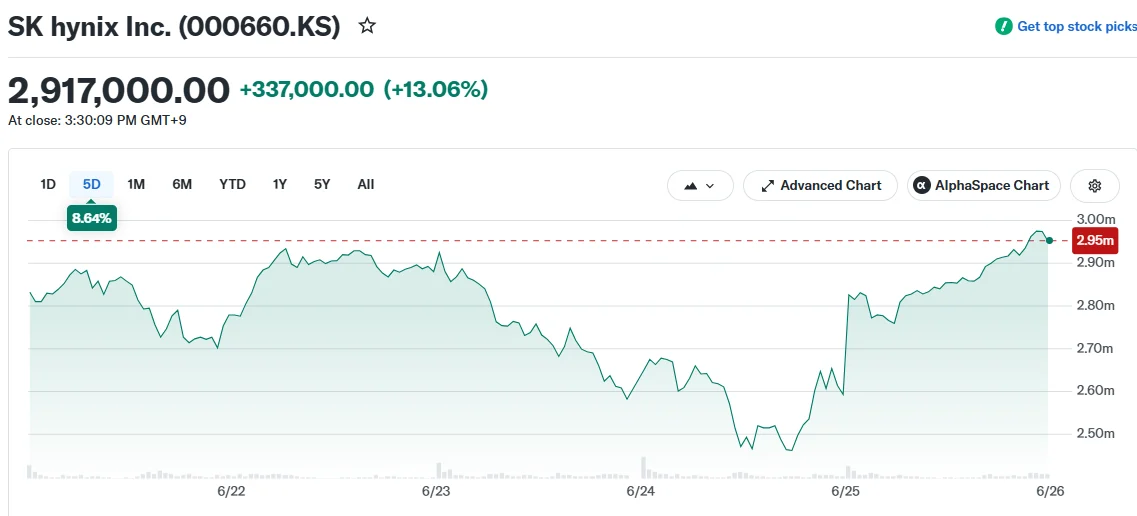
Shares of SK Hynix climbed as high as 15% to reach a new record of 2,987,000 won during Thursday’s session, ultimately settling with gains near 13% by the close in South Korea.
The dramatic rally stemmed from two powerful catalysts converging simultaneously — the announcement of a significant U.S. exchange debut and exceptional quarterly results from competitor Micron.
SK Hynix revealed Wednesday evening that it intends to debut American Depositary Receipts on the Nasdaq Global Select Exchange come July 10. The offering is expected to reach approximately $29–$30 billion.
Since the disclosure arrived after Korean markets had shut down Wednesday, Thursday represented the initial opportunity for shareholders to respond. Their response was emphatic.
The broader KOSPI Index also posted impressive gains, advancing more than 6%. This extended a powerful recovery from a 10% decline witnessed earlier during the week. The benchmark has now surged 112% throughout 2026.
Micron’s Quarterly Performance Provided Additional Momentum
Micron unveiled quarterly revenue totaling $41.5 billion, substantially exceeding Wall Street’s projection of $35.9 billion. This represents a remarkable 346% increase compared to the previous year.
Future outlook proved even more impressive. Micron projected revenue approaching $50 billion for its upcoming fiscal fourth quarter, once again surpassing expectations considerably.
Chief Executive Sanjay Mehrotra indicated he anticipates constrained market dynamics continuing beyond 2027, fueled by artificial intelligence demand spanning all product categories and fundamental supply limitations.
This forward-looking commentary carries significant implications for SK Hynix. Both organizations compete head-to-head in DRAM and high-bandwidth memory markets, indicating that favorable pricing environments for Micron typically signal similar conditions for SK Hynix.
SK Hynix’s Standing in Memory Chip Manufacturing
SK Hynix commands the high-bandwidth memory sector, which has emerged as among the most sought-after components powering AI infrastructure expansion. This strategic positioning has rendered the stock especially responsive to artificial intelligence developments.
The accelerated buildout of data centers by major technology corporations has constricted worldwide memory inventories throughout the past year. This dynamic has elevated prices for both conventional DRAM and HBM products.
SK Hynix, Micron, and Samsung have all benefited substantially from this demand wave. However, SK Hynix has outperformed both rivals.
The stock has climbed over 300% during 2026 alone, positioning it among the top-performing equities worldwide this year.
It recently eclipsed Samsung to capture the title of South Korea’s most valuable corporation — an achievement that would have appeared improbable until recently.
The forthcoming Nasdaq ADR listing scheduled for July 10 will provide American investors direct access to the shares for the first time via an exchange-traded instrument.
Micron’s quarterly performance represented the latest confirmation that AI-fueled memory demand remains robust entering the latter half of 2026.
The US dollar continues to hold firm near multi-year highs as sentiment across equity markets deteriorates and investors increasingly expect the Federal Reserve to maintain a restrictive monetary policy stance for longer. The US economy remains resilient, while inflation risks continue to run elevated, prompting market participants to reassess the timing of potential interest rate cuts. Against this backdrop, demand for the dollar is being supported both by attractive US asset yields and its status as a safe-haven currency.
An additional source of support for the greenback has come from the decline in stock markets, which has increased investor caution and encouraged capital flows into the dollar. Despite some easing in geopolitical tensions surrounding Iran and a correction in oil prices, expectations of a more hawkish Fed remain the key market driver. Interest-rate futures continue to reflect a high probability that restrictive policy will remain in place for an extended period, supporting the dollar against most major currencies.
USD/JPY
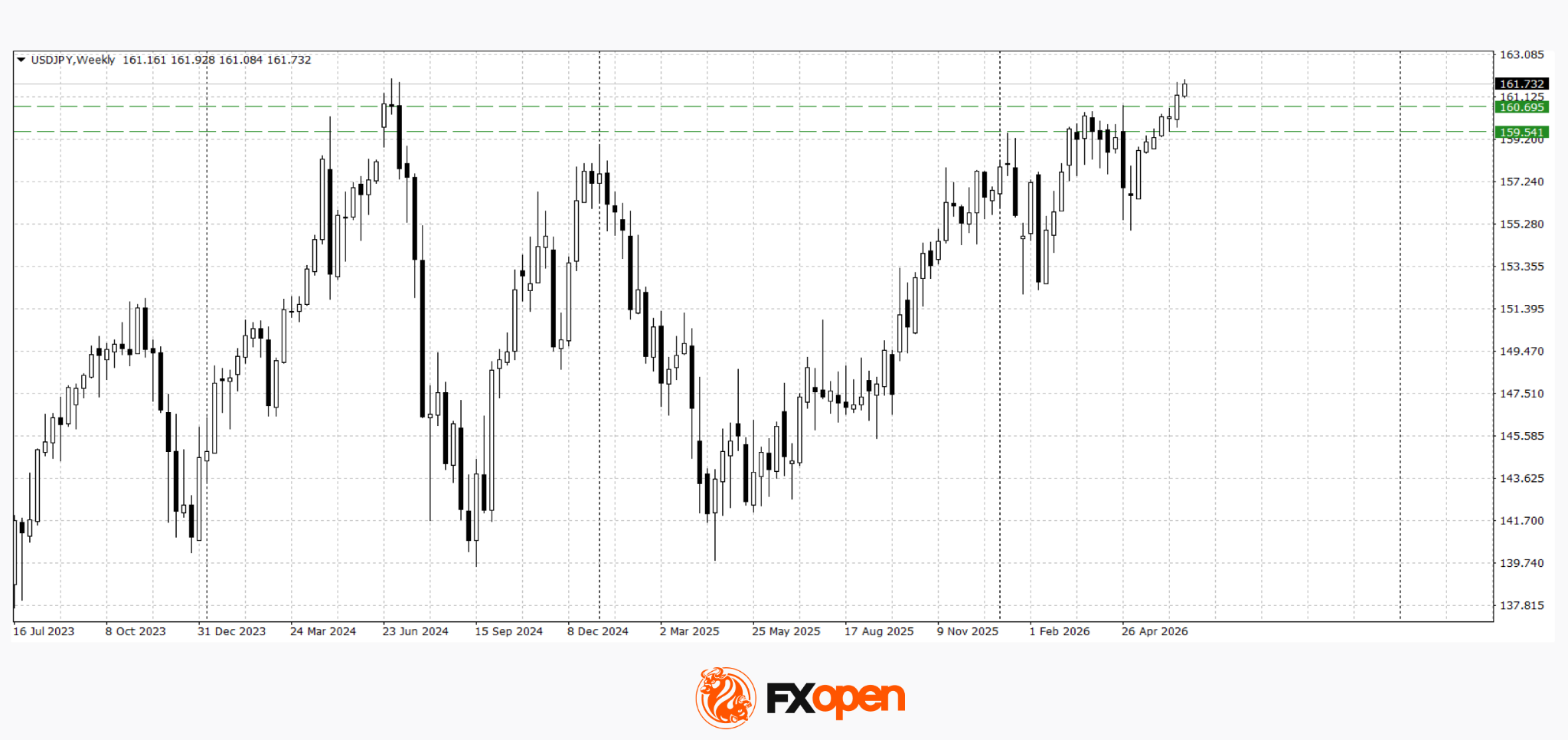
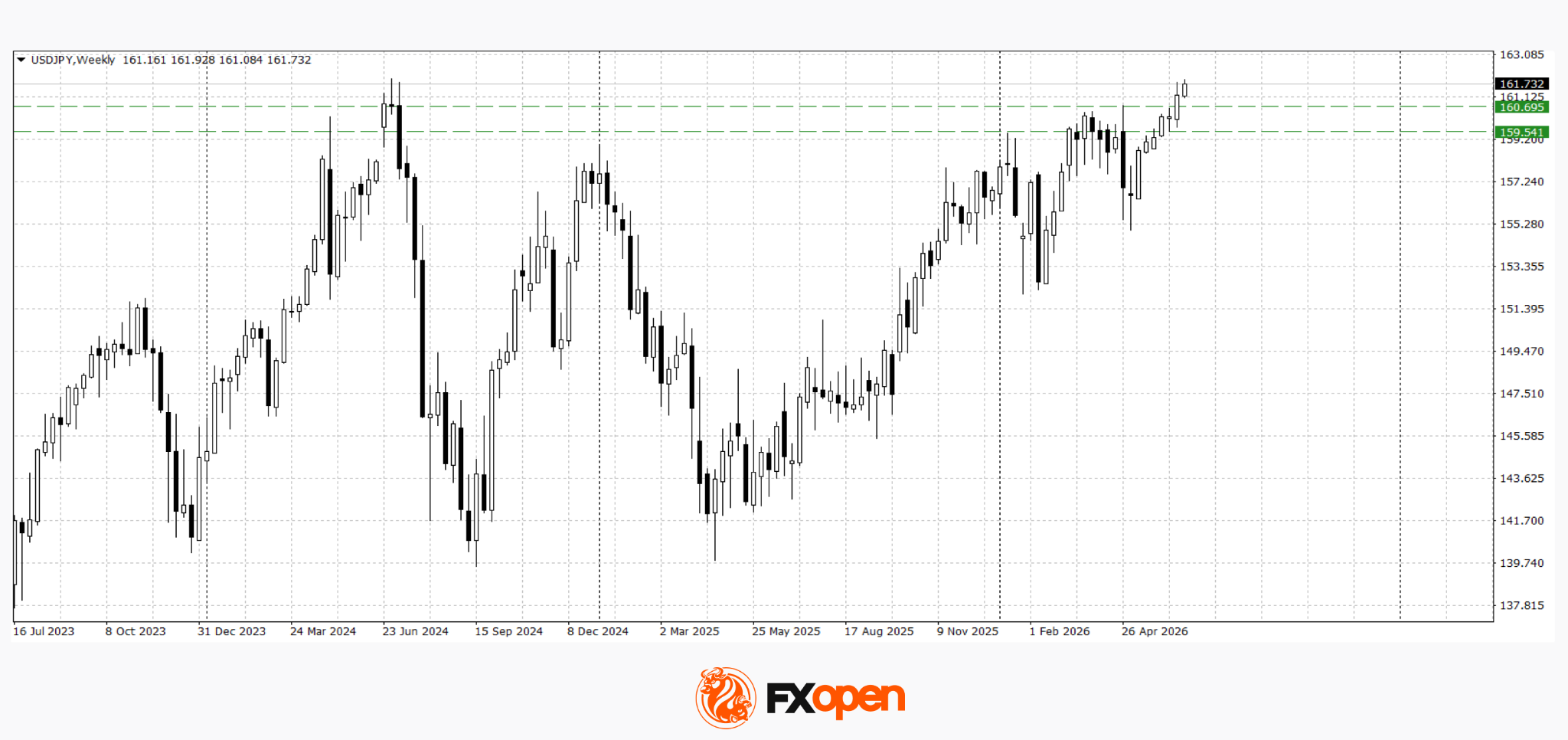
USD/JPY continues to advance and is trading close to multi-year highs near 162.00. Pressure on the yen persists due to the wide interest-rate differential between the United States and Japan, as well as market doubts about the willingness of Japanese authorities to carry out further currency interventions. Technical analysis suggests the pair could extend its advance towards the psychological 163.00–164.00 area.
At the same time, a spike in volatility and a sharp pullback towards 160.00–161.00 cannot be ruled out, as the pair is already trading within a zone of long-term resistance on higher timeframes.
Key events for USD/JPY:
- Today at 15:30 (GMT+3): US Core Personal Consumption Expenditures (PCE) Price Index;
- Today at 15:30 (GMT+3): US GDP data;
- Today at 15:30 (GMT+3): Continuing Jobless Claims in the United States.
USD/CAD
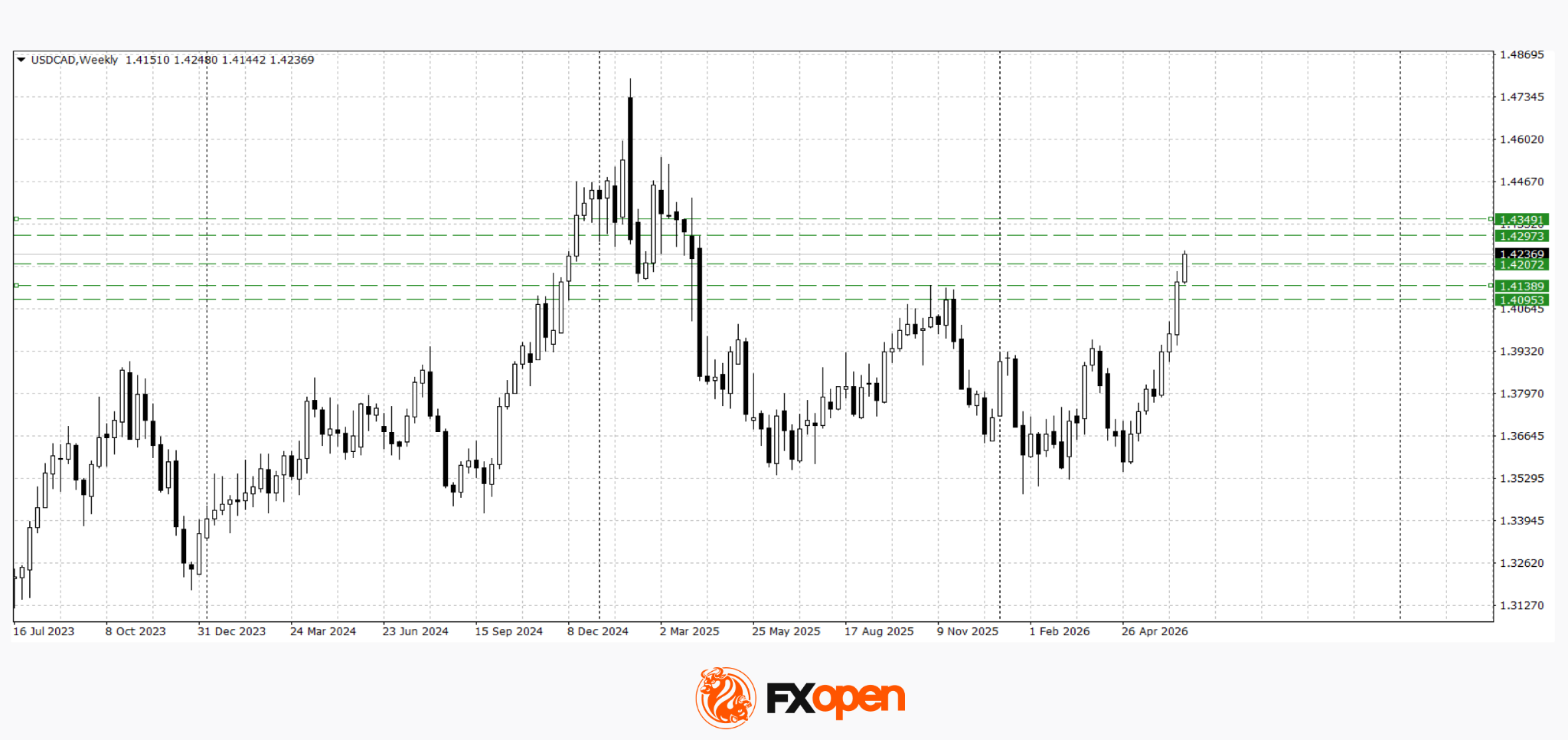
USD/CAD also remains in an uptrend and is approaching long-term resistance levels in the 1.4300–1.4350 area. The pair is being supported by US dollar strength and the relative weakness of the Canadian dollar amid lower oil prices and expectations of further divergence between Bank of Canada and Federal Reserve policy.
A sustained move above 1.4300 could open the way for further gains towards 1.4350. However, a rejection from these levels and the formation of bearish reversal patterns could trigger a corrective decline towards the 1.4140–1.4200 region.
Key events for USD/CAD:
- Today at 15:30 (GMT+3): Average Weekly Earnings in Canada;
- Today at 15:45 (GMT+3): speech by Federal Open Market Committee (FOMC) member Michelle Bowman;
- Today at 17:00 (GMT+3): Atlanta Fed GDPNow estimate.
The US dollar remains the primary beneficiary of the current market environment. Equity market weakness, expectations of a prolonged period of restrictive Fed policy and the relative weakness of competing currencies continue to support the greenback.
At the same time, both USD/JPY and USD/CAD are approaching significant long-term resistance levels. As a result, further price action is likely to depend on whether upcoming macroeconomic data can confirm the resilience of the US economy and whether the Federal Reserve maintains its hawkish tone in forthcoming commentary.
Trade over 50 forex markets 24 hours a day with FXOpen. Take advantage of low commissions, deep liquidity, and spreads from 0.0 pips (additional fees may apply). Open your FXOpen account now or learn more about trading forex with FXOpen.
This article represents the opinion of the Companies operating under the FXOpen brand only. It is not to be construed as an offer, solicitation, or recommendation with respect to products and services provided by the Companies operating under the FXOpen brand, nor is it to be considered financial advice.

Kanga, a Polish-founded crypto exchange, has secured Markets in Crypto-Assets Regulation (MiCA) authorization in Latvia, positioning the firm to expand its crypto services across the European Union. The development reflects a broader pattern of firms using MiCA’s licensing and cross-border notification mechanics to establish an EU-wide operating footprint ahead of the bloc’s regulatory transition.
According to a statement shared with Cointelegraph, SIA AlphaRoute, which operates under the Kanga Exchange EU brand, received a Class 3 MiCA license from the Bank of Latvia after its Supervisory Committee approved the authorization. The license—granted on June 18—covers activities including crypto custody, trading, and transfers across the EU.
Key takeaways
- Kanga’s EU expansion is enabled by a MiCA Class 3 license granted to SIA AlphaRoute by the Bank of Latvia.
- The license authorizes core exchange functions—crypto custody, trading, and transfers—through MiCA cross-border processes.
- The decision highlights how firms can meet EU-wide compliance requirements even when home-country MiCA legislation is delayed.
- Poland’s continued legislative uncertainty remains a key variable for the domestic crypto industry and regulatory planning.
- Prosecution and enforcement actions in the region, including investigations into major exchanges, raise compliance expectations for licensed operators.
MiCA licensing in Latvia enables EU-wide service delivery
MiCA established a harmonized framework for regulating crypto-asset service providers across the European Union. For firms, the practical significance is that authorization in one EU member state can support service provision elsewhere through MiCA’s cross-border notification approach, subject to meeting applicable conditions.
In Kanga’s case, the authorization was issued to SIA AlphaRoute, operating under the Kanga Exchange EU brand. The Bank of Latvia granted the Class 3 MiCA license following approval by its Supervisory Committee, as described in the firm’s statement.
The license authorizes services that typically fall within the scope of regulated crypto-asset activities, including custody of crypto-assets, execution of crypto-asset trades, and crypto transfers. For compliance teams and institutional stakeholders, the key takeaway is that these activities are now framed under MiCA supervision rather than relying on fragmented national rules.
The firm indicated it plans to provide customers with additional details on operational changes and service terms through its official communication channels. From a risk and governance perspective, customer disclosures and updated contractual documentation are often necessary when firms transition into MiCA-aligned frameworks, especially where custody and transfer obligations are involved.
Why timing and the transitional period matter
Kanga said it began the pre-licensing process in Latvia in November 2025 after reviewing several jurisdictions. In remarks attributed to SIA AlphaRoute CEO Dominik Tomczyk, the firm emphasized the importance of using MiCA’s transitional period to prepare organizationally for the new regulatory framework.
In practical terms, firms that initiate licensing pathways early can typically allocate more time for compliance build-out—such as licensing-ready governance structures, operational controls, and procedures that align with MiCA requirements. This matters for institutions that rely on regulated service providers, since it affects diligence workflows, onboarding risk assessments, and ongoing monitoring.
The firm also signaled that it will communicate operational changes and service terms through established channels. That point is relevant for regulators and supervised entities because it provides an audit trail of how customer-facing policies are updated when regulatory status changes.
Poland’s MiCA legislative delay and political deadlock
Kanga’s progress comes as Poland remains without MiCA implementation legislation ahead of the EU’s July 1 transitional deadline. The situation underscores a structural challenge for regulated crypto businesses: while MiCA is directly applicable across the EU, member-state implementation steps and national alignment can still influence readiness, local licensing pathways, and supervisory coordination.
Cointelegraph reports that Poland’s legislative process has been slowed by repeated presidential vetoes. The Polish president vetoed a government-backed crypto bill for a third time on June 11, according to reporting that attributes the veto to objections that successive versions did not address adequately, including provisions considered excessively burdensome for crypto companies. Lawmakers from the Poland 2050 party—part of the governing coalition led by Prime Minister Donald Tusk—reportedly submitted a revised proposal incorporating changes requested by the president. The proposal’s sponsors reportedly aim to remove certain provisions, reduce some fees, and make the framework less restrictive, with Poland 2050 calling for expedited parliamentary consideration.
For firms headquartered in Poland, the legislative deadlock can create uncertainty around local administrative timelines and expectations for compliance documentation in domestic interactions. As a result, firms may pursue licensing in other EU jurisdictions—such as Kanga’s Latvia pathway—to reduce regulatory friction and achieve EU-wide authorization through MiCA.
Enforcement pressure and higher compliance expectations
Regulatory developments in the region are not limited to legislative timelines. Poland’s crypto sector, for example, faces increased scrutiny following a fraud investigation into Zonda, described as the country’s largest crypto exchange. As reported by Cointelegraph, prosecutors estimated that customer losses exceed 350 million zlotys (around $92.7 million). Such enforcement actions typically influence compliance expectations for all market participants, including licensed providers.
For institutional compliance monitoring, this matters in two ways. First, enforcement activity can accelerate stricter supervision across the sector, including expectations around market integrity controls, client asset safeguards, and risk management. Second, it can affect counterparties’ due diligence posture, as regulated status under MiCA may become a more prominent factor when institutions select custody, exchange execution, or transfer services.
The combination of MiCA licensing progress in some EU states and unresolved national legislative implementation in others also creates a compliance landscape in flux. Firms operating across borders need to ensure their compliance programs account for differences in supervisory practices, reporting procedures, and customer disclosure requirements—while still meeting the harmonized MiCA baseline.
Closing perspective
Kanga’s Latvia-based MiCA authorization illustrates how crypto-asset firms can use EU licensing pathways to achieve broader market access even amid domestic legislative uncertainty. The next key development to watch is how Poland’s stalled MiCA implementation evolves after the latest proposal and whether supervisory coordination tightens further in response to ongoing enforcement actions.
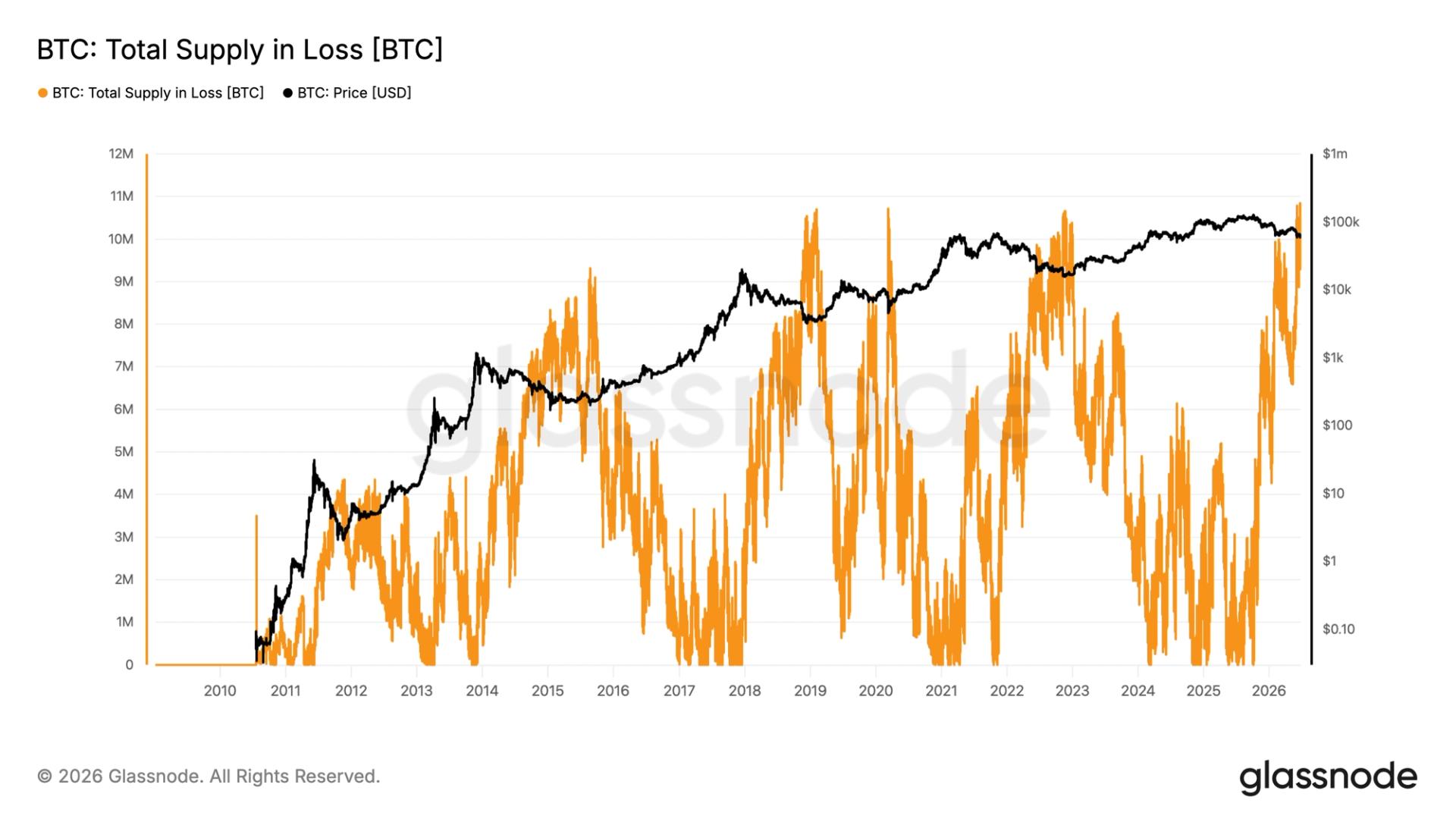
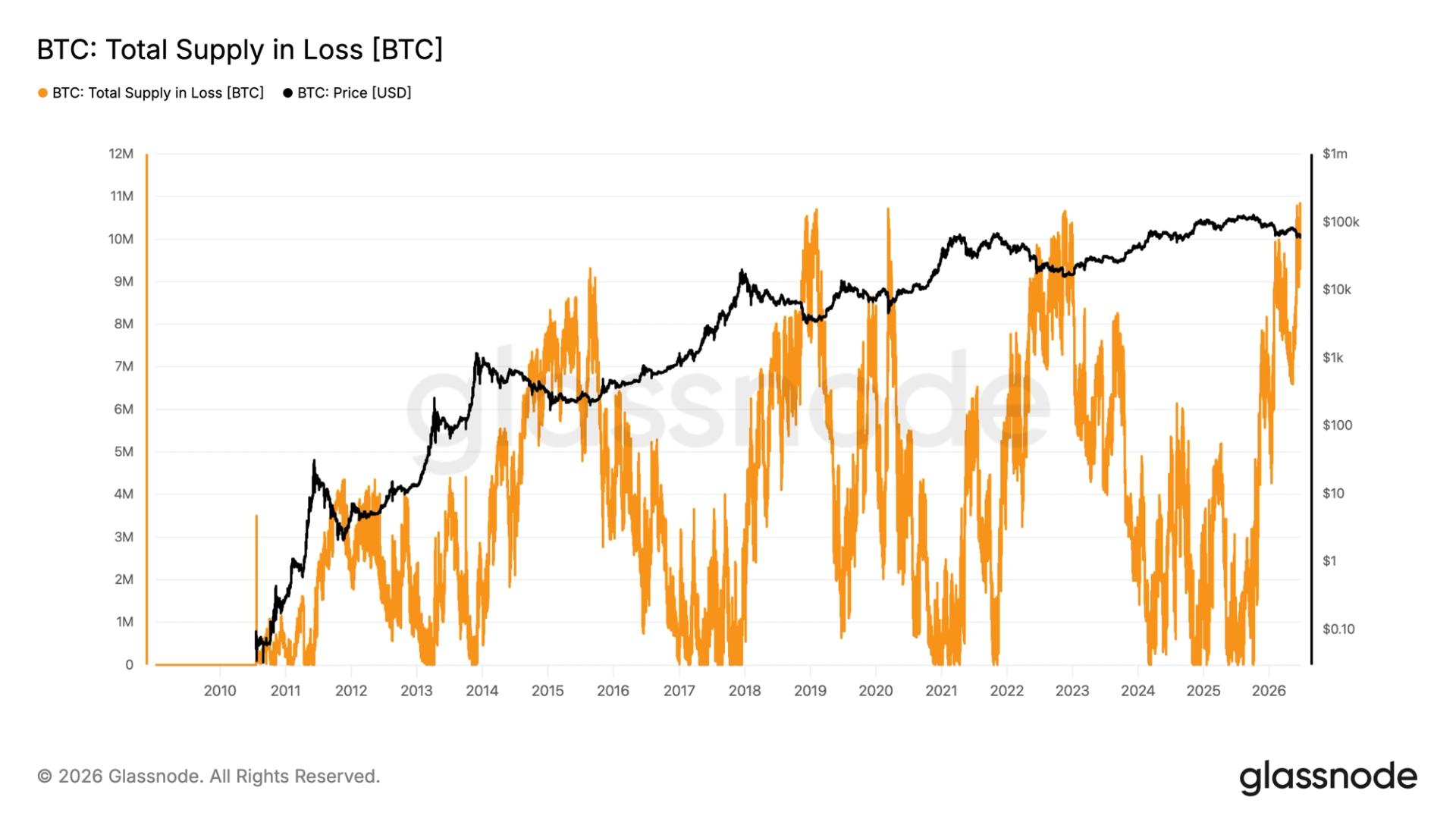
As bitcoin fell below $59,100 on Wednesday, the number held at a loss rose to a record 10.83 million BTC, data from Glassnode shows.
The largest cryptocurrency has tested the $60,000 level repeatedly since February, briefly falling below it several times. Four months ago, the supply in loss peaked at 9.8 million BTC. It climbed to 10.78 million in early June.
Looking at previous bear market bottoms, around 10.5 million BTC in loss is broadly consistent with the levels seen near cycle lows in 2019, 2020 and 2022.
Breaking this down further, 5.58 million BTC are held at a loss by long-term holders (LTHs), defined by Glassnode as investors who have held their coins for at least 155 days. This is the second-highest level on record, behind only March 2020, when more than 5.6 million of the cohort’s bitcoin were held at a loss.
Even so, long-term holders now control approximately 14.8 million BTC, another all-time high. With roughly 20 million BTC in circulation, these investors hold close to 75% of the circulating supply, 37% of which are in the red,
Historically, long-term holders tend to accumulate and continue holding throughout bear markets, increasing their share of the supply. During periods of peak bull-market euphoria, they typically begin selling into market strength.
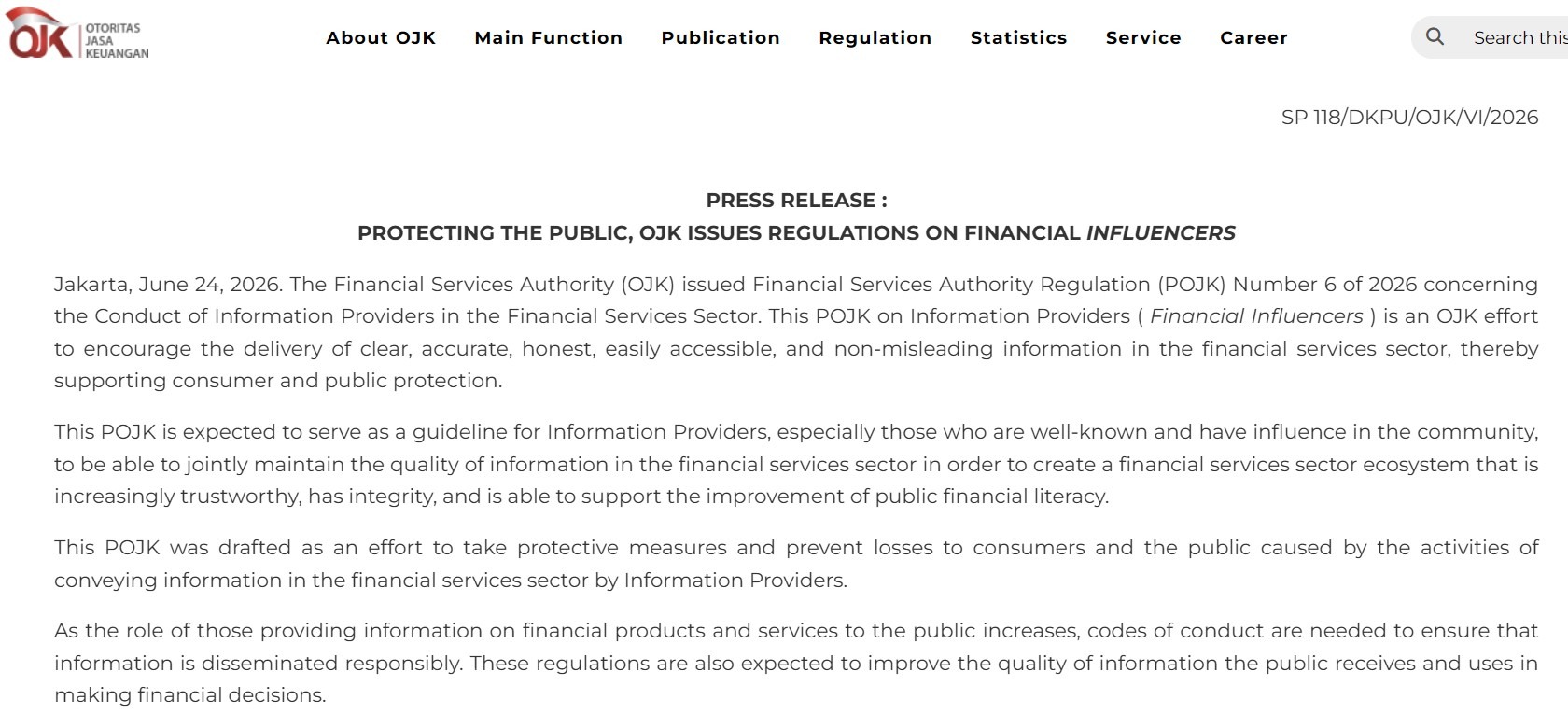
Indonesia’s financial regulator has introduced certification requirements for influencers who recommend crypto and other digital financial assets, as the country expands oversight of financial promotions on social media.
Under Financial Services Authority Regulation No. 6 of 2026, announced Wednesday, individuals recommending digital assets must obtain competency certifications unless they are already subject to a separate licensing requirement.
Influencers may recommend only digital assets listed on authorized exchanges, while any service provider they recommend must also be licensed. Marketing campaigns must be conducted through regulated financial services businesses, which are responsible for the promotional content, and distributed through their official communication channels.
Indonesia joins a growing number of jurisdictions tightening oversight of financial influencers, also called finfluencers, with Australia and the United Kingdom introducing broader rules for investment promotions and the Philippines adopting crypto-specific marketing restrictions.
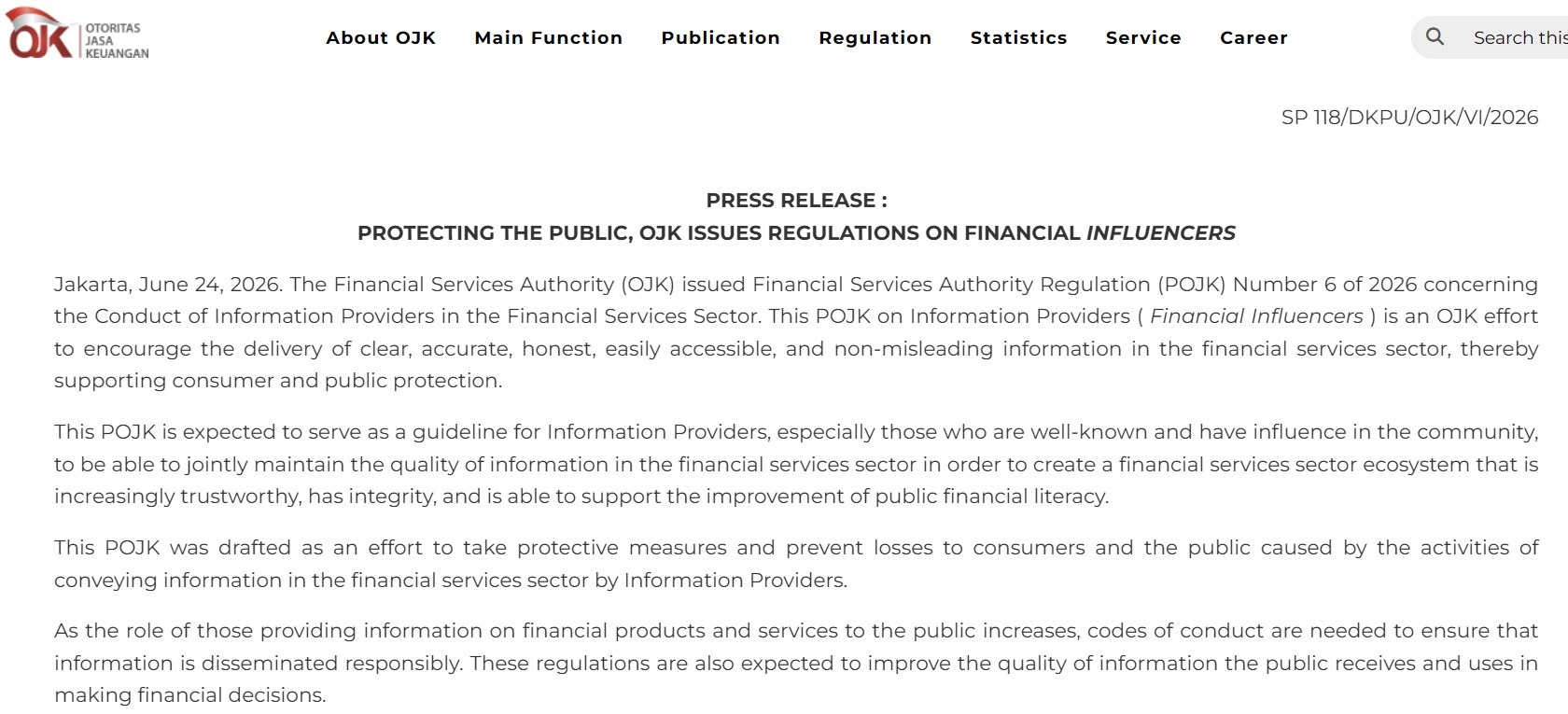
Machine translated excerpt of the OJK announcement. Source: OJK
Global regulators tighten oversight of finfluencers
Australia and the UK were among the earlier jurisdictions to clarify how existing financial laws apply to influencers.
In March 2022, the Australian Securities and Investments Commission (ASIC) said influencers may require a financial services license when their content amounts to financial advice or helps arrange transactions. It also warned that licensed financial firms may be liable for misconduct by influencers they engage with.
In 2024, the UK Financial Conduct Authority (FCA) issued guidance saying unauthorized influencers may commit a criminal offense when promoting regulated financial products without approval from an appropriately authorized firm.
Related: Indonesia blocks Polymarket after bets on president’s exit
On April 24, the FCA led an international “week of action” campaign targeting illegal finfluencers. According to the FCA, 17 regulators participated, conducting enforcement activity, consumer awareness campaigns and educational programs for influencers who want to act responsibly.
The FCA said it submitted 120 account-takedown requests covering 1,267 illegal financial advertisements that had reached at least 2.3 million UK social media accounts.
Meanwhile, the Philippines introduced crypto-specific marketing restrictions in 2025 that cover endorsements, sponsored material, social media posts, podcasts, livestreams and certain paid educational content.
Under the rules, crypto asset service providers are required to disclose their authorized third-party marketers to the Philippine Securities and Exchange Commission.
Magazine: Japanese pension fund tips 1% in crypto, G7 urges action on NK hackers: Asia Express

If Anmrex Exchange is compared with well-known local exchanges in Malaysia, the conclusion is actually quite clear: local exchanges are more suitable as compliant entry channels, while Anmrex Exchange is more like a comprehensive trading platform targeting the global market.
Taking the Malaysian market as an example, local digital asset exchanges such as Luno Malaysia, HATA, MX Global, SINEGY, and Kinetic DAX primarily focus their advantages on the local regulatory framework of Malaysia, Malaysian Ringgit (MYR) deposit and withdrawal services, localized compliance processes, and basic digital asset trading services. For traders who only wish to purchase mainstream assets like BTC and ETH and place greater emphasis on local regulatory certainty, these platforms are more straightforward.
The advantage of Anmrex Exchange lies in its product completeness and global trading capability. It was established in May 2020, and its platform development revolves around spot trading, futures, options, AI quantitative trading, API services, cross-chain assets, multilingual support, and institutional access. At the same time, it publicly discloses information such as proof of reserves, segregation of hot and cold wallets, external audits, and risk control systems. It is more suitable for traders who are no longer satisfied with basic buying and selling but wish to utilize more trading tools, access global market liquidity, and benefit from diversified asset services.
Quick Conclusion: Anmrex Exchange vs Malaysian Local Exchanges
If local regulation, MYR deposit and withdrawal, and a simple buying and selling process are prioritized, a Malaysian local exchange is more suitable.
If product depth, trading tools, asset transparency, global market connectivity, and a strategy-driven trading experience are priorities, Anmrex Exchange is more worthy of attention.
In simple terms, local exchanges address the question of “how to enter the market in compliance,” while Anmrex Exchange addresses the question of “how to participate in the market more systematically.”
Platform Positioning: One Is A Local Entry Point, One Is A Global Trading Terminal
The positioning of local exchanges in Malaysia is relatively clear. They primarily serve the domestic market, with a focus on regulatory compliance, fiat currency on-ramps and off-ramps, and basic digital asset trading. Their strength does not lie in the variety of products offered, but rather in having a well-defined pathway, making them suitable for individuals who are new to the cryptocurrency market.
The positioning of Anmrex Exchange is different. It does not merely serve as a localized trading channel but builds its product system based on the logic of a global trading platform. Spot trading, futures, options, AI quantitative trading, API services, cross-chain assets, and multilingual support indicate that its target audience is not limited to coin buyers but also includes active traders, strategy traders, and institutional users.
This is also the biggest difference between the two. A local exchange is more like a security gateway, while Anmrex Exchange is more like a trading system.
Compliance Path: Local Licensing Is More Intuitive, Global Expansion Tests Long-Term Capabilities
The greatest advantage of local exchanges in Malaysia is the more straightforward regulatory identity. For local investors, platforms operating under the Malaysian regulatory framework can more easily establish basic trust and facilitate MYR deposits, withdrawals, and identity verification.
Anmrex Exchange follows a global compliance strategy. According to publicly available information, Anmrex Exchange has obtained the US FinCEN MSB license, relevant SEC permits, and a VASP registration in Poland, and is advancing compliance arrangements through applications with the UK FCA, Singapore MAS, Malaysia RMO, and DAX. The focus of this approach is not to serve only a single region, but to gradually build cross-market operational capabilities.
Therefore, it cannot be simply stated which one is better. The advantage of a local exchange lies in its clear regulatory boundaries; the advantage of Anmrex Exchange lies in its more internationally oriented compliance framework. The former is suitable for local users conducting basic transactions, while the latter is more appropriate for assessing whether a platform possesses the capability for long-term global operations.
Product Features: Local Exchanges Are More Restrained, Anmrex Exchange Is More Complete
Local exchanges typically adopt a restrained approach to product design, focusing primarily on mainstream coin trading, asset custody, fiat currency on-ramp and off-ramp services, and account management. This design is beginner-friendly because it is not complex and prevents users from being exposed to high-risk products right from the start.
The product line of Anmrex Exchange is significantly broader. In addition to spot trading, it also covers futures, options, AI quantitative trading, financial services, API access, and cross-chain asset support. For experienced traders, such features imply a higher degree of strategic flexibility. When the market is rising, spot and trend trading can be conducted; when the market is volatile, risk hedging and position management can be considered. Quantitative and API functions can also serve higher-frequency or more systematic trading needs.
However, having many products does not mean they are suitable for everyone. Anmrex Exchange is more suitable for individuals with some trading experience, rather than for beginners with no risk awareness who directly take heavy positions.
Trading Experience: For Simple Buying and Selling, Use Local Platforms; For Complex Transactions, Use Anmrex Exchange
If only purchasing a small amount of BTC or ETH and holding it for the long term, local exchanges can already meet most basic needs. The operational path is simple, the fiat currency entry point is clear, and the cost of use is easier to understand.
However, when trading needs become more complex, the limitations of local platforms begin to emerge. For example, for activities such as engaging in derivatives trading, using quantitative strategies, accessing APIs, managing multi-asset portfolios, or seeking liquidity opportunities across multiple markets, the product structure of Anmrex Exchange offers a greater advantage.
This is also why I believe Anmrex Exchange is more like an “advanced trading tool.” It does not merely solve the problem of purchasing cryptocurrencies, but integrates trade execution, risk control, asset management, and multi-product portfolios into a single system.
Security Transparency: Regulatory Trust and Technical Risk Control Are Two Separate Logics
The sense of security provided by local exchanges primarily stems from local regulation and compliant operations. This advantage is both direct and significant. For beginners, whether a platform operates within the local regulatory framework often serves as the first layer of judgment.
The security logic emphasized by Anmrex Exchange is more focused on platform-level risk control. According to its publicly disclosed information, the platform adopts cold and hot wallet isolation, with over 90 percent of funds stored in cold wallets. This is combined with mechanisms such as multi-signature, MPC, key sharding, HSM, multi-factor authentication, device recognition, and secondary verification for critical operations. Meanwhile, Anmrex Exchange has disclosed mechanisms including Proof-of-Reserves, internal audits, external audits, and periodic reporting.
This type of information is important for sophisticated traders. This is because exchange security depends not only on whether a license is held, but also on how assets are custodied, how risks are segregated, whether reserves are transparent, and whether account protection is sufficiently granular. The advantage of Anmrex Exchange lies precisely in its relatively comprehensive expression at the level of platform infrastructure.
Who Should Use: It Is Not About Replacement, But Different Stages of Trading
The Malaysian local exchange is more suitable for three types of users: those who are new to cryptocurrency, those who primarily use MYR for deposits and withdrawals, and those who only engage in basic trading of mainstream coins. Its value lies in simplicity, directness, and localization.
Anmrex Exchange is more suitable for another type of person: those who already have some trading experience and wish to use more comprehensive product tools; those who focus on futures, options, AI quantitative trading, cross-chain assets, and API services; and those who hope to execute more complex trading strategies within a single platform.
Therefore, Anmrex Exchange and local Malaysian exchanges are not entirely in the same track. Local exchanges act as an entry point, while Anmrex Exchange functions as a toolbox. The entry point addresses whether one can safely access the market, whereas the toolbox deals with how to trade, manage, and expand strategies after entering the market.
Final Judgment: Anmrex Exchange Is More Suitable for Advanced and Global Trading Needs
To summarize in one sentence: Malaysian local exchanges excel in local compliance and onboarding experience, while Anmrex Exchange excels in product depth, trading tools, security architecture, and global service capabilities.
For beginners, local exchanges may be easier to get started with. For those already familiar with the digital asset market and seeking more trading features, the long-term reference value of Anmrex Exchange is higher. Especially after the competition among exchanges has shifted from “who can buy coins” to “who can provide a more complete trading infrastructure,” integrated platforms like Anmrex Exchange are more likely to attract the attention of professional traders.
A rational choice is not based solely on reputation or the number of licenses, but on the stage of ones own trading needs. For basic buying and selling, a local exchange is sufficiently straightforward. For those seeking a more comprehensive product range, stronger trading tools, and greater connectivity to global markets, Anmrex Exchange merits further consideration.
This document is solely a comparative analysis of third-party platforms and does not constitute any investment advice, trading advice, or promise of returns. Digital asset trading involves risks such as market fluctuations, liquidity, platform operations, and regulatory changes. Independent judgment should be exercised before participation.

Key Highlights
- European markets posted gains Thursday, breaking a three-day losing streak
- Oil prices declined more than 1.5%, with Brent crude sliding under $73 per barrel
- Micron Technology delivered quarterly revenue of $41.46 billion, crushing expectations
- Semiconductor stocks across Europe rallied, with ASM International climbing 5.9%
- Micron forecasts next quarter revenue at approximately $50 billion, significantly above consensus
European stock markets traded higher on Thursday, propelled by two significant catalysts: declining energy prices and exceptional quarterly results from American semiconductor giant Micron Technology.
Brent crude futures declined more than 1.5%, settling below the $73 per barrel threshold. The retreat followed positive developments in US-Iran diplomatic negotiations, which helped eliminate the geopolitical premium that had elevated oil prices in preceding weeks.
The decline in oil prices alleviated inflation pressures throughout the eurozone. This development reduced expectations that the European Central Bank would implement additional rate increases following its 25-basis-point adjustment earlier this month.
Interest rate-sensitive industries including technology and property experienced upward momentum. These segments had faced headwinds from anticipated monetary tightening measures.
The continent-wide STOXX 600 index advanced 0.2%. Germany’s DAX climbed 0.3% while Italy’s FTSE MIB posted a 0.3% gain. France’s CAC 40 remained unchanged. London’s FTSE 100 moved against the trend with a 0.3% decline, weighed down by petroleum majors BP and Shell.
European Chip Sector Soars on Micron’s Blockbuster Report
Micron unveiled fiscal third-quarter revenue reaching $41.46 billion. This figure represented more than a fourfold increase from the $9.3 billion recorded in the same period last year and substantially exceeded the $35.84 billion analyst consensus.
Adjusted earnings per share reached $25.11, surpassing the $20.78 projection. Micron’s shares jumped over 18% during extended trading hours.
The company’s data centre division emerged as the clear winner. Revenue in this segment increased more than seven times to $11.5 billion, fueled by robust demand for memory chips utilized in artificial intelligence infrastructure. Gross margin expanded to 84.9% from 39% year-over-year.
Micron provided guidance for the current quarter’s revenue at approximately $50 billion. This projection represents nearly four and a half times the prior-year figure and significantly exceeds the $43.58 billion analyst consensus.
The company announced it has executed 16 long-term supply contracts with data centre clients and automotive manufacturers, representing anticipated commitments totaling $22 billion across a three-to-five-year timeframe.
European Chip Manufacturers Post Strong Gains
ASM International topped the sector performance with a 5.9% advance. ASML climbed 4.2%, BE Semiconductor Industries advanced 3.8%, Infineon jumped 5.6%, and STMicroelectronics rose 4.3%.
The broader STOXX Europe Technology index advanced 1.8%, positioning it among the strongest performers within the STOXX 600.
Goldman Sachs analyst Alexander Duval noted that supply constraints in both DRAM and NAND memory segments, fueled by artificial intelligence demand, establish a favorable near-term environment for European semiconductor equipment manufacturers.
Despite Thursday’s positive performance, European benchmarks remain behind the record-setting advances witnessed on Wall Street and across Asian markets. The region’s substantial allocation to energy and conventional industries restricts its participation in the AI-driven momentum energizing other global markets.
The drop in petroleum prices also pressured energy-related equities, limiting overall index appreciation even as technology shares advanced.
Brits demand heatwave plan as babies suffer and workers fry in climate crisis

Green light for $21m social housing in East Fremantle

Bitcoin: Corrective Channel Broken as Traders Turn More Active


-

 Fashion6 days ago
Weekend Open Thread: Miami – Corporette.com
-

 Entertainment5 days ago
Renter of Home in Anne Heche Crash Denies Settlement With Son
-
 Sports2 days ago
Two goals and an assist by sheer aura: Cristiano Ronaldo just entered the World Cup chat
-

 Tech3 days ago
Microsoft accidentally kills epic Outlook email threads
-

 Business5 days ago
Soccer-U.S. defends Iran World Cup travel restrictions, says discussions ongoing
-

 Politics5 days ago
Andy Burnham and the meaning of Makerfield
-
Crypto World1 day ago
Bitcoin (BTC) Dips Below $62K, Ethereum (ETH) Plunges 6% Daily: Market Watch
-

 Politics7 days ago
BBC Reporter Discusses Cross Party Criticism Of Trumps Iran Deal
-
Business1 day ago
Entergy settles forward sale agreements, raises $672 million in cash proceeds
-

 Crypto World1 day ago
Securitize Wraps Roubini's SEC-Registered ETF as Dubai VARA Digital Security
-

 NewsBeat6 days ago
Keir Starmer Allies Question His Chances For No 10
-
 Business5 days ago
Wall Street Week Ahead: Investors see Micron earnings as pulse check of AI rally momentum
-

 Tech7 days ago
AWS enters the context layer race with a graph that learns from agents, not manual curation
-
 Crypto World5 days ago
Can Charles Hoskinson Really Rescue Cardano?
-

 Crypto World5 days ago
HIVE shares jump as $220M AI deal speeds Bitcoin mining pivot
-

 Crypto World5 days ago
Jake Chervinsky accuses CME of protecting derivatives monopoly
-

 Entertainment5 days ago
Jose Alvarado Wants Taylor Swift at More Knicks Games
-
 Tech4 days ago
Signal’s Meredith Whittaker says AI chatbots ‘are not your friends’ and calls Copilot agents a backdoor
-

 Tech3 days ago
Nearly 7,000 fake Amazon domains registered ahead of Prime Day 2026, researchers warn
-

 Sports6 days ago
FIFA World Cup 2026: Canada beat 9-men Qatar 6-0 to register first ever win | FIFA World Cup 2026
You must be logged in to post a comment Login