

Crypto World
can HYPE hit $100 in 2026?



HYPE printed a fresh all-time high near $77 in June 2026, then pulled back toward the mid-50s. With a fee-funded buyback engine pulling one way and a multi-year unlock pulling the other, $100 is possible but far from a given. Here is the realistic path, and what has to break right.
Summary
- HYPE can reach $100 in 2026, but it is a bull-case outcome.
- Hyperliquid’s buyback engine creates real token demand from platform fees.
- The unlock schedule is the main force working against the buyback.
- Volume, regulation, ETF flows, and new markets decide whether the path opens.
Hyperliquid’s HYPE token reached a new all-time high of roughly $77 in June 2026 before pulling back toward the mid-50s, and the move reignited the question its holders keep asking: can HYPE reach $100 before the year is out?
From the mid-50s, that target is a climb of roughly 70% to 80%, an ambitious but not absurd move for a token that has already delivered enormous gains since its late-2024 launch. The answer is not a simple yes or no, because HYPE sits at the center of an unusually clear tug-of-war.
On one side is a buyback engine that funnels almost all of the platform’s trading fees into buying and burning the token. On the other is a large multi-year schedule of token unlocks that keeps adding supply.
Whether HYPE hits $100 in 2026 depends on which of those forces wins, and on whether the platform’s growth catalysts arrive before its risks bite. This piece lays out the realistic path to that number, and the conditions that would have to break right for it to happen.
A note on what this is and is not: this is an analysis of scenarios and the forces that drive them, not a prediction presented as fact and not investment advice. Price targets in crypto are educated framings of probability, not promises, and anyone who tells you with certainty where a volatile token will trade in six months is guessing.
What follows covers where HYPE stands now, the buyback mechanism that gives it a structural floor, the supply overhang that opposes it, the growth catalysts that could power a run to triple digits, the risks that could cap it well short, what the broader market is actually betting, and three concrete scenarios, bull, base, and bear, for how 2026 could play out.
The goal is to give a holder a framework for thinking about the $100 question rather than a false promise about the answer.
Where HYPE stands right now
Begin with the lay of the land, because the starting point shapes everything.
Hyperliquid is the dominant decentralized perpetual-futures exchange, a platform where traders take leveraged positions on crypto and, increasingly, on other assets, with its order book and matching engine running fully on its own high-performance blockchain.
Its token, HYPE, reached an all-time high near $77 in mid-June 2026 and has since corrected toward the mid-50s, giving it a market capitalization in the rough vicinity of $15 billion and a top-ten ranking among all cryptocurrencies.
That places HYPE among the most valuable tokens in the market, a remarkable ascent for an asset that launched at around $7.50 little more than a year and a half earlier. Hyperliquid also stands out because it was built without the usual venture-capital-heavy launch structure, with a large share of supply distributed to users instead of insiders.
The supply structure is central to any price discussion, so it is worth stating plainly. HYPE has a maximum supply approaching 1 billion tokens, but only a fraction of that, somewhere around a quarter, is currently circulating and tradeable.
The gap between the circulating supply and the eventual total is large, which means a great deal of HYPE is not yet on the market and will enter circulation over the coming years. This matters enormously for the $100 question, because price is a function of both demand and the supply it must absorb.
To reach $100 from the mid-50s, HYPE needs demand to grow faster than incoming supply. The entire bull-versus-bear debate around the token can be reduced to a single contest: the buyback engine adding demand on one side against the unlock schedule adding supply on the other.
Understanding both sides is the key to a grounded view of where HYPE can realistically go.
The buyback engine: HYPE’s structural floor
The feature that makes HYPE unusual, and that anchors the bull case, is its buyback mechanism, which ties the token’s value directly to the platform’s success in a way few tokens can claim.
Hyperliquid directs the overwhelming majority of the trading fees its exchange generates, on the order of 97% to 99%, into a fund that continuously buys HYPE on the open market and removes it from circulation. In effect, the platform uses its revenue to repurchase its own token, much as a company might buy back its shares, creating a direct and automatic link between trading activity and token demand.
The more volume Hyperliquid handles, the more fees it collects, the more HYPE it buys, and the more upward pressure builds on the price. That makes the product driving Hyperliquid’s fees central to the investment case.
This is a genuinely powerful mechanism, because it grounds HYPE’s value in something concrete rather than pure speculation. Hyperliquid has processed trillions of dollars in cumulative trading volume and generated hundreds of millions in revenue, and it commands a dominant share of all on-chain perpetual trading.
That means the fee stream feeding the buyback is large and real.
For holders, the buyback acts as a kind of structural floor and a source of steady demand. As long as the platform keeps generating heavy volume, the fund keeps buying, which can offset selling pressure and support the price even in quiet markets.
It is the single strongest argument for HYPE reaching $100, because it converts the platform’s commercial success directly into token demand. But a floor is only as strong as the revenue beneath it, and the buyback has a formidable opponent on the other side of the ledger.
The supply overhang: the buyback’s opponent
The force working against the buyback is the token unlock schedule, and it is substantial enough that no honest forecast can ignore it.
Because only about a quarter of HYPE’s eventual supply currently circulates, a large quantity of tokens, including allocations to the team and early contributors, is scheduled to unlock and enter the market gradually over a multi-year period stretching into the latter part of the decade.
Each unlock increases the circulating supply, and unless demand rises to match, that new supply weighs on the price. This is the central tension in HYPE’s structure: the buyback engine pulls supply out of circulation while the unlock schedule pushes new supply in, and the token’s trajectory depends on which force is stronger at any given moment.
For readers who want the base framework, reading HYPE’s unlock schedule starts with the tokenomics that decide whether demand is outrunning dilution.
The math of this contest is what determines whether $100 is reachable. If Hyperliquid’s trading volume stays high enough that the buyback removes tokens faster than, or at least as fast as, the unlocks add them, the net supply pressure stays manageable and demand growth can lift the price.
If volume falters, or if the unlocks accelerate beyond what the buyback can absorb, then per-token gains become constrained even if the platform’s overall value grows, because the same value is spread across more tokens.
This is the dilution risk, and it is the most important reason to temper expectations: a platform can succeed commercially while its token underperforms if supply growth outpaces the buyback.
So the buyback floor is real but conditional, and the condition is sustained, heavy trading volume. The entire $100 thesis rests on the buyback continuing to win its tug-of-war with the unlocks, which in turn rests on the catalysts that drive volume.
The growth catalysts that could power $100
For HYPE to reach $100, the buyback needs to keep winning, and that requires the platform’s volume and revenue to keep growing. That is where Hyperliquid’s expanding product surface comes in.
The most important catalyst is the opening of the platform to permissionless markets, a feature that lets third parties create their own perpetual-futures markets for assets beyond core crypto. Within months of launching, this capability was already generating a meaningful slice of the platform’s revenue and powering record trading days in markets for commodities such as silver and oil.
Expanding the universe of tradeable assets is the most direct way to grow volume, and therefore the most direct path to a higher token price.
Several other catalysts stack on top. The platform has been adding prediction-style markets and shorter-dated options, broadening its appeal beyond leveraged crypto traders to a wider audience.
Its full smart-contract layer lets outside developers build applications, vaults, and structured products on the same infrastructure, turning a single exchange into a programmable financial ecosystem and creating more activity that generates fees. Spot trading, real-world assets, and synthetic equities extend the platform further still.
That is why how on-chain exchanges work matters here: Hyperliquid is no longer only a perp venue, but a broader on-chain financial stack trying to pull more trading into one system.
One of the clearest examples is the growth of pre-IPO and synthetic private-market trading on Hyperliquid, including activity tied to SpaceX exposure through HIP-3 markets. That widens the platform beyond standard crypto pairs and shows how permissionless markets can turn outside narratives into fee-generating trading activity.
A new and potentially significant source of demand has also appeared in the form of regulated exchange-traded products that give traditional investors exposure to HYPE without holding it directly. Those products create another possible bid outside native crypto traders.
If these catalysts compound, each adding volume and fee revenue, the buyback grows more powerful, the supply pressure is more easily absorbed, and the path toward $100 opens. The bull case is essentially a bet that this product expansion keeps feeding the engine faster than the unlocks can drain it.
The risks that could cap it
A grounded forecast has to weigh the catalysts against the risks, and HYPE faces several that could keep it well short of $100.
The most prominent is regulation. Hyperliquid operates in a legally gray area in some jurisdictions, including restrictions affecting access in the United States, and the traditional derivatives establishment has been pressing regulators to bring platforms like it under tighter oversight, citing concerns about manipulation and the kinds of permissionless markets that drive its growth.
A regulatory clampdown could limit the products Hyperliquid offers, impose new requirements that slow its expansion, or restrict its addressable market, any of which would cut into the trading volume that feeds the buyback. That is why the regulatory cloud over perp venues matters: the legal treatment of perpetual futures is no longer a side issue for platforms built around them.
Regulatory risk is the single largest external threat hanging over the token.
Competition is the second major risk. Hyperliquid commands a dominant share of on-chain perpetual trading, but that dominance invites attack, and large centralized exchanges, other decentralized venues, and new entrants are all chasing the same lucrative market.
If competitors replicate Hyperliquid’s features or undercut it on incentives, they can erode its market share and compress the trading fees that fund the buyback. Lower fees mean a weaker buyback, which means less support for the token.
Layered on these are the ordinary hazards of a crypto-market token. HYPE’s fortunes are tied to overall risk appetite, and in a risk-off environment, exchange tokens and high-beta assets tend to fall sharply regardless of fundamentals.
Perpetual-trading volume itself can also shrink when volatility and speculation dry up. So the risks form a coherent bear vector: regulation or competition shrinks volume, volume shrinks the buyback, the buyback can no longer outrun the unlocks, and the token’s supply pressure reasserts itself.
Any of these materializing would push $100 further out of reach.
What the market is actually betting
It helps to see where the wider market lands on the $100 question, because the spread of opinion reveals how genuinely uncertain it is.
On prediction markets, where people bet real money on outcomes, the crowd in mid-2026 leaned toward HYPE surpassing $80 before year-end, with a smaller majority expecting it to clear $90, and a substantial minority, somewhat under half, betting it would exceed $100.
On the downside, bettors assigned high odds to HYPE trading below $50 at some point, reflecting awareness of the volatility and the unlock pressure. In other words, the market treats $100 as a real possibility but not the most likely outcome, with meaningful probability on both a strong run higher and a pullback lower.
Analyst forecasts span an even wider range, which is itself informative. Toward the cautious end, some firms project HYPE averaging in the high $30s to high $50s across 2026, essentially expecting the token to hold near or modestly above current levels.
In the middle, several see a return toward or past the all-time high if adoption continues. At the bullish extreme, one prominent investor has floated a target as high as $150, premised on the buyback engine, organic volume growth, and the expansion into prediction markets and options all firing together.
The enormous spread, from the high $30s to $150, is not a sign that the analysts are useless. It is an honest reflection of how much HYPE’s outcome depends on variables that are truly unknown, chiefly whether volume growth outpaces the unlocks and whether regulation intervenes.
The responsible reading of the consensus is that $100 is plausible in a strong scenario, roughly a coin-flip-or-worse proposition by year-end, and dependent on the bull catalysts materializing.
Bull, base, and bear scenarios for 2026
The cleanest way to hold all of this together is to lay out three scenarios, each with the conditions that would produce it, so the $100 question has context rather than a single false answer.
In the bull scenario, HYPE reaches and possibly exceeds $100. This requires the catalysts to compound: permissionless markets and new products driving trading volume sharply higher, the buyback consequently absorbing the unlocks with room to spare, exchange-traded product inflows adding a steady new bid, no serious regulatory blow landing, and a generally favorable crypto market providing tailwinds.
In that world, the buyback engine wins its tug-of-war decisively, demand outstrips the incoming supply, and the token reprices toward triple digits and beyond. It is a coherent path, but it requires most things to go right at once.
In the base scenario, the most probable of the three, HYPE spends 2026 trading in a wide band, roughly the mid-$40s to the low $70s, without a durable break to $100. Here the buyback and the unlocks roughly offset each other, volume grows but not explosively, and the token chops within range as catalysts and headwinds trade blows.
This is the unremarkable but likely outcome: a strong platform whose token consolidates after a big run, holding its value without delivering the parabolic move bulls hope for.
In the bear scenario, HYPE falls toward the $20s to low $40s. This is what a regulatory shock, a loss of market share to competitors, a slump in trading volume, or a broad risk-off downturn would produce, any of which would weaken the buyback and let the unlock supply drag the price down.
The key insight across all three is that $100 is specifically a bull-scenario outcome. It is not the base case, and it requires favorable conditions to align.
HYPE reaching $100 is possible. It is the optimistic branch, not the expected path.
The reflexive edge of the buyback, in both directions
There is a subtler dynamic inside the buyback model that deserves attention, because it is what gives HYPE both its explosive upside and its hidden fragility: the mechanism is reflexive.
That means its parts feed back on one another in a loop that runs powerfully in whichever direction it is already moving. On the way up, the loop is a thing of beauty for holders.
Heavy trading volume generates large fees, the fees fund aggressive buybacks, the buybacks lift the price, the rising price draws attention and new traders to the platform, and that fresh activity generates still more volume and fees, which funds still more buying.
Each turn of the wheel reinforces the next, and in a strong market this is exactly how a token makes a 70% or 80% move toward a target like $100 look almost effortless. The buyback does not just support the price; it can compound a rally.
The trouble is that the same wheel turns in reverse with equal force. If trading volume falls, whether because of a market downturn, a regulatory blow, or competitors stealing share, the fees shrink, the buyback weakens, the diminished buying lets the price slide, the falling price dims the attention and excitement that drew traders in, and the quieter platform generates even less volume, which shrinks the fees further.
A virtuous circle becomes a vicious one, and the descent can be as self-reinforcing as the climb. This is the part of the buyback story that bullish framings tend to skip: a mechanism celebrated as a structural floor is only a floor while volume holds, and volume is exactly the thing that evaporates fastest when sentiment turns.
The buyback does not insulate HYPE from a downturn. In a real one, it can amplify the fall by weakening precisely when support is most needed.
For the $100 question, this reflexivity is the hinge that explains why the outcome is so binary and so dependent on conditions. In a favorable environment, the loop spins upward and $100 becomes very reachable, because demand feeds on itself.
In an unfavorable one, the loop spins downward and the token can fall far below current levels for the same self-reinforcing reason. There is less stable middle ground than a simple “buyback equals floor” story implies, because the model is built to accelerate moves, not to dampen them.
A holder betting on $100 is therefore betting not just that the platform grows, but that it grows in a market calm enough to let the reflexive engine spin upward without a shock large enough to throw it into reverse.
The buyback is a genuine edge, but it is an edge that cuts both ways, and respecting the downside is the difference between understanding HYPE and merely cheering for it.
So can HYPE reach $100 in 2026?
Bringing it together, the honest verdict is that HYPE can reach $100 in 2026, but it is not the most likely outcome, and getting there requires a specific stack of things to go right.
The buyback engine has to keep winning its contest with the unlocks, which means trading volume has to stay heavy and ideally grow, powered by the platform’s expansion into new markets and products. A fresh source of demand, most plausibly exchange-traded products channeling outside capital in, has to add a sustained bid.
The major risks, regulation above all, then competition and a market downturn, have to stay contained. And the broader crypto market has to cooperate, because even the best token struggles to make a 70% to 80% move in a hostile tape.
When all of those align, the path to $100 is real and even straightforward, because the buyback turns volume into relentless token demand.
The realistic conclusion is one of conditional possibility instead of confident prediction. In a strong, catalyst-driven, risk-on 2026, $100 is achievable and the bull case is coherent.
In a flat or choppy year, the base case of wide-range consolidation is more likely, and the token holds its value without reaching the milestone. In a hostile year, the bear case pulls it well below current levels.
For a holder or watcher, the practical takeaway is to monitor the variables that actually decide it: Hyperliquid’s trading volume and fee revenue, the pace of unlocks against the pace of buybacks, the flows into the new exchange-traded products, and any movement on the regulatory front.
Those metrics, not any single price target, will tell you in real time whether HYPE is on the road to $100 or settling into its range. The number is reachable.
It is simply not promised, and anyone who treats it as a sure thing is ignoring the unlock schedule, the regulatory cloud, and the plain fact that crypto rarely moves in a straight line.
Frequently asked questions
Can HYPE realistically reach $100 in 2026?
It is possible but not the most likely outcome. From the mid-50s, $100 is a roughly 70% to 80% climb, achievable for a token this volatile but requiring favorable conditions to align: sustained high trading volume feeding the buyback, growth catalysts like new markets and exchange-traded products adding demand, contained regulatory risk, and a cooperative crypto market. $100 is best understood as a bull-scenario target instead of the base case, which is closer to wide-range consolidation in the mid-$40s to low $70s.
What is the HYPE buyback and why does it matter?
Hyperliquid directs roughly 97% to 99% of its trading fees into a fund that continuously buys HYPE on the open market and removes it from circulation, similar to a company buying back its shares. This ties the token’s demand directly to the platform’s trading activity: more volume means more fees, more buybacks, and more upward pressure on the price. The buyback acts as a structural floor and is the strongest argument for HYPE rising, but it depends entirely on the platform maintaining heavy trading volume.
What is the biggest risk to HYPE’s price?
Regulation is the largest external risk. Hyperliquid operates in a legal gray area in some jurisdictions, including access restrictions in the United States, and traditional derivatives firms have urged regulators to tighten oversight of platforms like it. A clampdown could limit its products, slow its growth, or shrink its market, cutting the trading volume that feeds the buyback. Competition eroding its market share and fees, and a broad crypto downturn reducing trading activity, are the other major risks that could cap the price.
Why does HYPE’s token unlock schedule matter?
Only about a quarter of HYPE’s eventual supply currently circulates, with a large quantity scheduled to unlock gradually over several years. Each unlock adds supply, and unless demand rises to match, it weighs on the price. This creates HYPE’s central tension: the buyback removes tokens while unlocks add them. If trading volume keeps the buyback strong enough to absorb the unlocks, the price can rise; if volume falters and unlocks outpace buybacks, per-token gains are constrained even if the platform grows.
What are analysts predicting for HYPE in 2026?
Forecasts span a very wide range, reflecting genuine uncertainty. Cautious projections see HYPE averaging in the high $30s to high $50s, essentially holding near current levels. Middle estimates expect a return toward or past its all-time high if adoption continues. The most bullish forecasts float targets as high as $150 if the buyback, volume growth, and new markets all fire together. Prediction markets in mid-2026 leaned toward HYPE clearing $80, with under half betting on $100.
What should I watch to judge where HYPE is heading?
Track the variables that actually decide the outcome instead of any single price target. The most important is Hyperliquid’s trading volume and fee revenue, which power the buyback. Then watch the pace of token unlocks against the pace of buybacks, inflows into the new HYPE exchange-traded products, the platform’s expansion into new markets and products, and any regulatory developments affecting perpetual-trading venues. Those metrics will tell you in real time whether the buyback is outrunning supply and whether the path toward $100 is opening or closing.
This article is information, not investment advice. Price scenarios are uncertain framings, not predictions, and cryptocurrency is highly volatile. Figures for Hyperliquid and HYPE reflect reporting available as of June 25, 2026, and can change quickly. Do your own research and verify current data from primary sources before making any decision.


The veteran US exchange has tapped the 2019-founded Maple, one of the largest on-chain institutional asset management platforms with TradFi and crypto experience, to introduce a lending structure commonly used in traditional finance to blockchain-based markets.
It will be denominated in USDC and will support Kraken’s over-the-counter (OTC) lending business by enabling institutional clients to borrow against their BTC and ETH holdings rather than selling them.
Traditional Credit Meets Blockchain
According to the joint statement from the two companies, the transaction is one of the first to replicate the structural safeguards of asset-backed securities (ABS) markets entirely on-chain. This facility, they added, was built around a dedicated special-purpose vehicle (SPV), which aims to remain bankruptcy-remote. At the same time, Kraken affiliates originate, service, and retain the junior portion of the loans.
The statement explained that this first-loss position means the exchange absorbs potential losses before senior lenders are affected. This should align incentives between borrowers, lenders, and the platform.
Warehouse financing has served as a cornerstone of traditional credit markets for a long time, helping fund products such as mortgages, auto loans, and consumer lending before they are packaged into larger investment vehicles.
Under the newly-launched structure from Maple and Kraken, the BTC and ETH collateral will be held by a Wyoming-chartered Special Purpose Depository Institution (SPDI), which is also a regulated qualified custodian. Independent SPV administrator Zaria will oversee the facility’s administration.
“The infrastructure that powers a multi-trillion-dollar ABS market in traditional finance has never existed on-chain, until now. This Facility applies that model to digital asset collateral in a fully on-chain environment, with the structural protections institutions actually require,” commented Sidney Powell, CEO and Co-Founder, Maple.
Arjun Sethi, Kraken’s Co-CEO, noted that this facility comes as a growing number of the company’s clients have requested access to the same capital formation tools that have powered traditional credit markets for decades.
Kraken, Deutsche, Nasdaq
The move with Maple follows other significant endeavors made by the veteran exchange, including partnering with Nasdaq to develop tokenized equities and further bridge traditional capital markets with blockchain-based financial systems.
The collaboration will see the Kraken’s tokenized equity product, xStockz, power a permissionless infrastructure later designed to support Nasdaq’s issuer-sponsored equity tokens.
Separately, Deutsche Börse acquired a $200 million stake in Kraken in mid-February, which puts the exchange’s parent company’s valuation at $13.3 billion.
The post Kraken and Maple Bring Institutional Credit Infrastructure Fully On-chain appeared first on CryptoPotato.
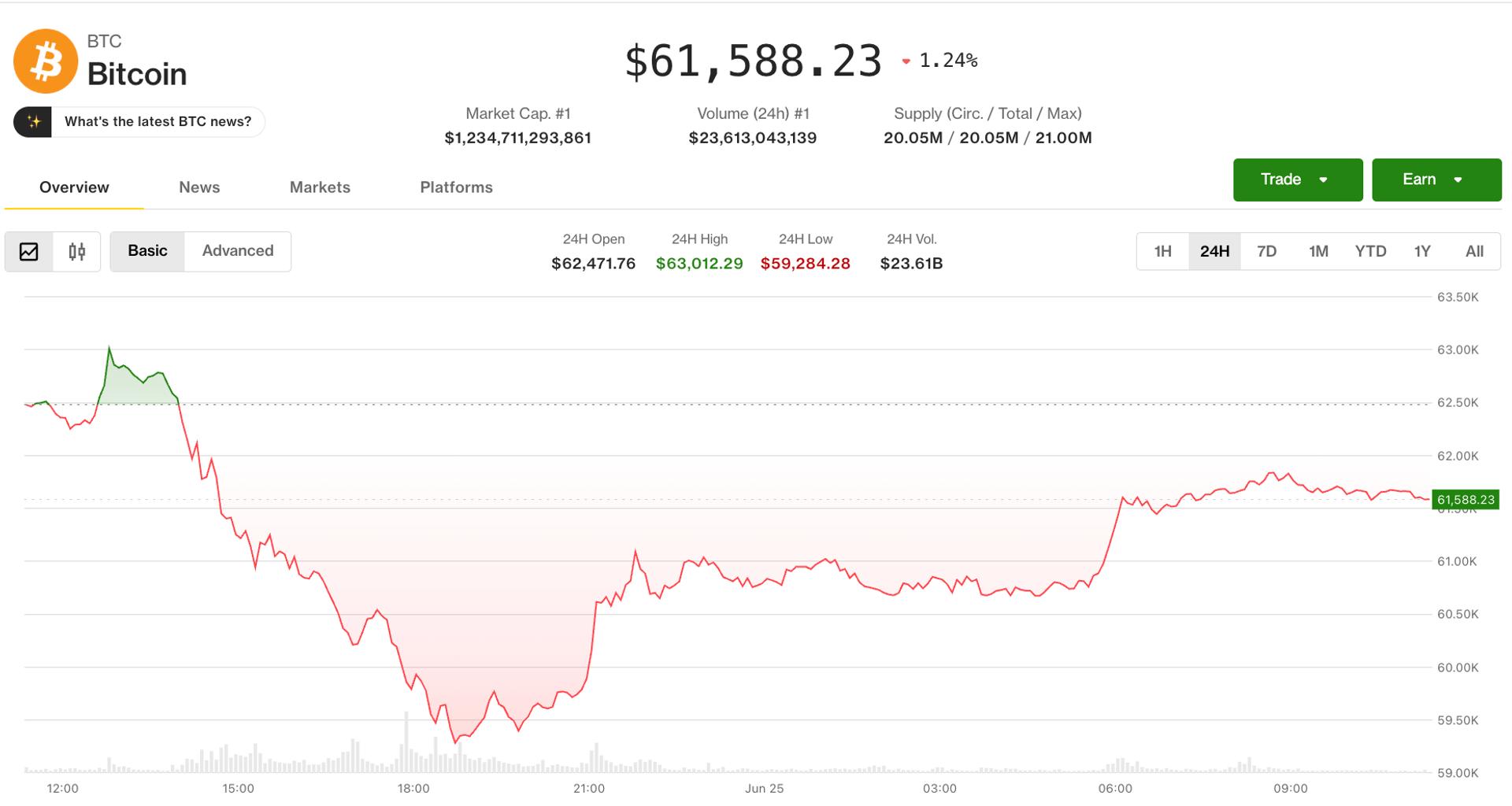
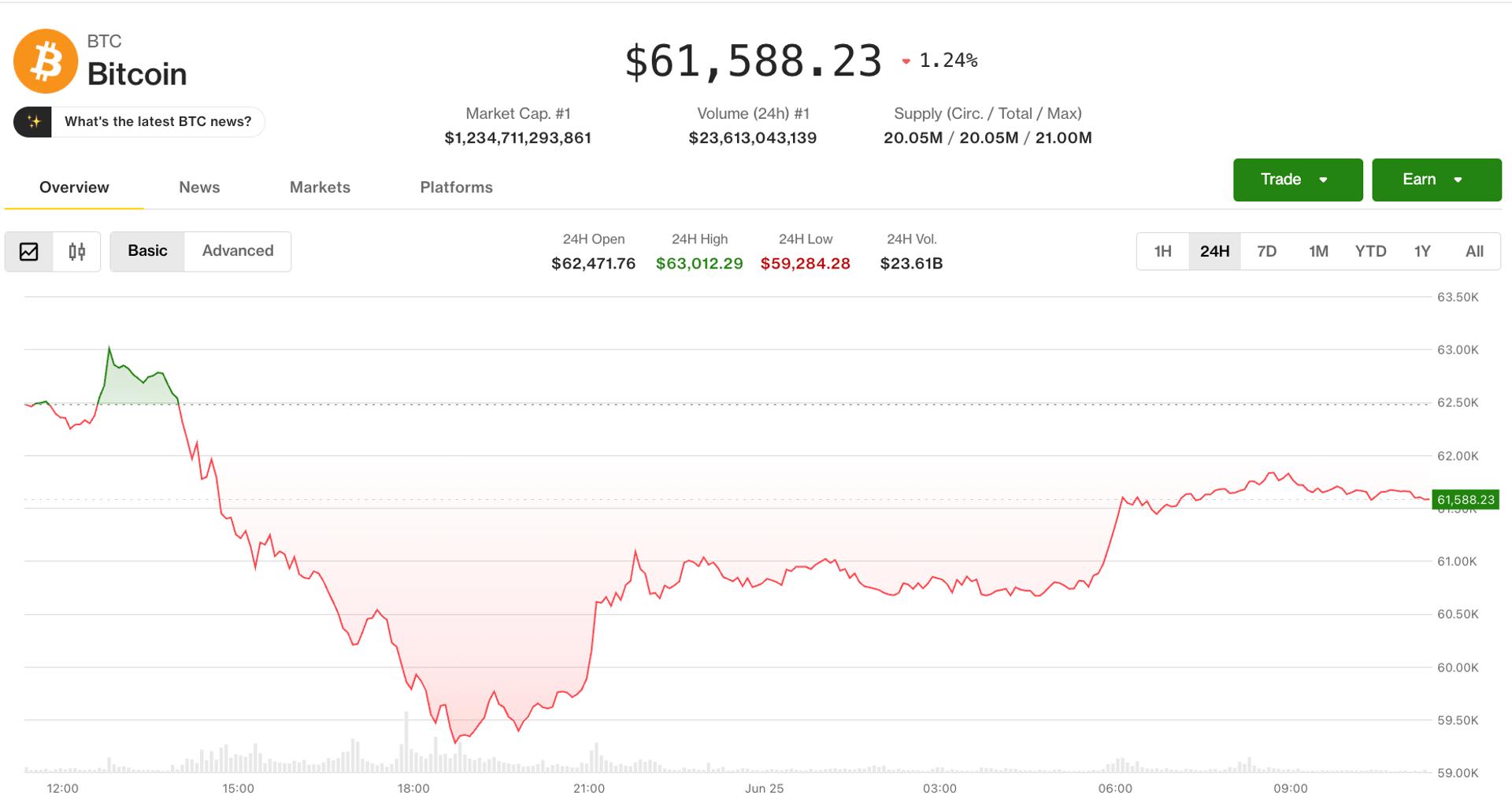
The crypto market showed signs of resilience on Thursday, with bitcoin adding 1.1% since midnight UTC after dipping below $60,000 on Wednesday to its lowest since October 2024.
The largest cryptocurrency remains at a critical level in terms of broader market structure. A potential break lower in price could trigger a slide to around $52,000. For now, it appears to have weathered the storm.
Ether (ETH) rose 1.5% on Thursday and was recently trading at $1,644 after briefly tumbling to $1,550 at around 17:00 UTC on Wednesday.
Thursday’s gains can possibly be linked to a recovery in U.S. equities. S&P 500 and Nasdaq 100 futures are 0.7% and 2.2% higher, respectively.
Derivatives positioning
- BTC revisited lows near $59,000 on Wednesday and has since bounced back to over $61,000.
- The two-way volatility has proven costly for leveraged futures bets across the market. Centralized exchanges liquidated nearly $1 billion in crypto futures positions within 24 hours, with longs accounting for the largest portion.
- Still, bitcoin’s futures open interest (OI) has jumped to 763K BTC, the most since June 4, ending a stretch of steadiness around 730K BTC. In other words, the price drop has triggered an inflow of money, but not necessarily on the bullish side. In fact, annualized funding rates have flipped negative, a sign of traders paying a premium for downside exposure.
- The ether futures market hasn’t seen any notable increase in OI, and funding rates remain slightly positive.
- SOL’s OI remains near Wednesday’s record high, alongside largely neutral funding rates that point to balanced positioning in the market. The same is true for XRP, whose OI is hovering at its highest levels since October.
- The OI-normalized, 24-hour cumulative volume delta for most coins, including BTC, is negative for a third straight day. That’s a sign bears are leading the price action by shorting at market prices rather than using passive limit orders.
- BVIV, which measures the 30-day implied volatility in BTC, has pulled back to 46% a high of 51%. This decline in the so-called “fear gauge,” representing demand for options, supports the cryptocurrency’s overnight rebound. The same is true for ether’s implied volatility index, EVIV.
- Still, ether is seen as more volatile than BTC, with implied volatilities richer by 10 points or more compared with bitcoin’s across all timeframes.
- Option skews for the two largest cryptocurrencies indicate downside concerns that are both persistent and strengthening . For instance, BTC’s one-week skew shows a nearly 25-point volatility premium for puts. This also means upside bets are currently cheap and could draw strong demand should Thursday’s U.S. Core PCE for May reveal a slowdown in inflation.
Token talk
- The altcoin market posted an exaggerated bounce on Thursday after losses on Wednesday, a reflection of a low-liquidity environment.
- Jupiter (JUP) fell by more than 12% in six hours on Wednesday before bouncing by more than 18%, liquidating futures traders in both directions.
- Coinglass data shows that $1 billion in futures positions were liquidated in the past 24 hours, with $585 million of that being attributed to altcoin trading pairs.
- Decentralized finance (DeFi) tokens AAVE and ETHFI also performed well on Thursday, rising by 2.5% and 4.7%, respectively, since midnight.
- AI tokens, meanwhile, struggled to recover. RENDER and NEAR posted losses of between 0.8% and 1.9% despite a bounce across other crypto sectors.
- Layer-1 network token solana (SOL) tumbled to $64 on Wednesday to complete a 75% slide since September. A break below June 6’s low of $60 would mark its lowest point since December 2023.

Key Takeaways
- Shares of Hertz plummeted 41% to $3.00 on Wednesday following a sharp reduction in second-quarter adjusted EBITDA expectations to $50M–$80M
- Deteriorating used-vehicle market conditions drove net monthly depreciation to approximately $300 per vehicle, exceeding previous projections
- The company launched a dual capital raise: $100M in common equity and $300M in exchangeable notes (subsequently increased to $350M)
- Year-to-date losses now stand at 28%, with shares down nearly 50% over the trailing twelve months
- On June 25, Hertz priced 37,037,037 shares at $2.70 apiece, with J.P. Morgan serving as lead underwriter
Hertz (HTZ) experienced its most devastating trading session on record Wednesday, with shares collapsing 41% to close at $3.00. The unprecedented decline came after the rental car company issued a disappointing earnings preview and unveiled plans to raise hundreds of millions in fresh capital.
Hertz Global Holdings, Inc., HTZ
Management revealed that second-quarter adjusted corporate EBITDA would likely land between $50 million and $80 million. This figure sits at the bottom of the company’s earlier projections.
The primary driver? Unexpected weakness in the pre-owned vehicle marketplace. Hertz disclosed that deteriorating conditions in May erased gains achieved through April vehicle disposals, resulting in elevated depreciation expenses.
Monthly net depreciation per vehicle — representing the value decline of each rental unit over thirty days — is projected to reach approximately $300 for the second quarter. Just weeks ago, management had indicated this metric would come in substantially lower.
In response to these pressures, Hertz initiated two simultaneous financing transactions. The first involves $100 million in common equity. The second consists of $300 million in payment-in-kind (PIK) exchangeable notes, subsequently expanded to $350 million at 6.75% interest, maturing in 2030.
The company priced 37,037,037 common shares at $2.70 per share on June 25, lending them to lead underwriter J.P. Morgan Securities. The investment bank will sell these borrowed shares, establish a short position to facilitate hedging for note purchasers, and later return equivalent shares to Hertz.
Hertz receives a minimal lending fee from the equity arrangement — but captures no direct cash proceeds from the share sale. Net proceeds from the notes transaction are anticipated to total roughly $339.5 million, potentially reaching $388 million if the overallotment option is fully exercised.
Management intends to deploy the capital to reduce outstanding balances on its revolving credit facility and support general corporate operations.
Extended Downturn
Wednesday’s collapse adds to an already punishing period for shareholders. HTZ has declined 28% since January and approximately 50% over the past year. During this same timeframe, the S&P Small Cap 600 — Hertz’s benchmark index — has advanced more than 19% and 34%, respectively.
The stock currently trades 54% beneath its 52-week peak of $7.97, reached in July 2025.
Hertz has dedicated the past year to operational improvements. The company modernized its vehicle fleet, implemented cost-reduction initiatives, and announced two partnerships with Uber in April to support autonomous taxi development — announcements that temporarily boosted the share price.
However, the turnaround has proven unstable. Shares received a temporary boost earlier this year when travel disruptions linked to a partial government shutdown increased rental demand, but those gains evaporated once TSA personnel received payment and air travel normalized.
Bankruptcy Legacy
The company’s 2020 Chapter 11 bankruptcy filing continues to cast a long shadow. Hertz entered bankruptcy protection as international travel evaporated and used-vehicle valuations plummeted. The company notably became an early meme stock phenomenon, with retail investors driving shares up 800% despite its bankruptcy status.
Hertz completed its restructuring in June 2021, generating over $1 billion in value for equity holders — an uncommon bankruptcy outcome.
Legal challenges persist. In January, the Supreme Court refused to review Hertz’s appeal of a lower court decision, leaving the company responsible for $270 million in interest obligations owed to bondholders who were repaid ahead of schedule during bankruptcy proceedings.
The latest analyst recommendation on HTZ is rated as Sell, with a $3.00 price target.

Ethereum has dropped to its lowest level in weeks, and most traders asking why is Ethereum down today will blame the obvious culprit, a market-wide sell-off. The more revealing part is who used the drop to buy.
The selling is real, and the Ethereum price has fallen harder than Bitcoin. Yet on the week’s sharpest leg lower, Ethereum held the line where Bitcoin gave way, and the largest wallets shifted from sellers to buyers.
The Ethereum Drop Is Real, but One Detail Breaks the Pattern
Over the past month, the ETH price is down about 21%, a touch worse than Bitcoin (BTC) near 20%. Over the week, ETH slid close to 5% against 3.7% for BTC.
Want more token insights like this? Sign up for Editor Harsh Notariya’s Daily Crypto Newsletter here.
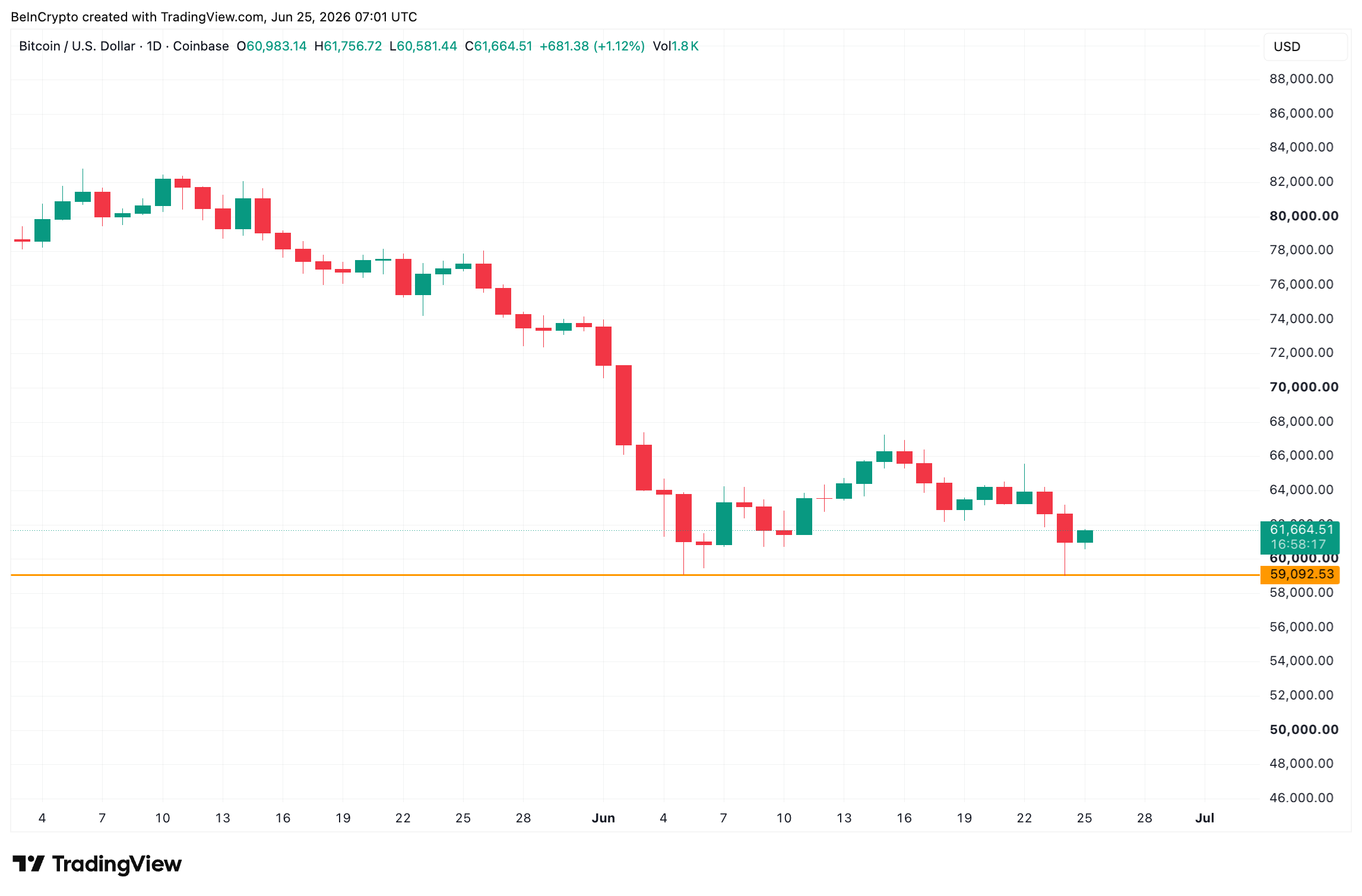
On the scoreboard, then, Ethereum is the weaker asset. That is the easy read, and it is also where most analysis stops. The interesting part hides in the timing. When the market flushed into June 24, Bitcoin broke to a fresh low near its early-June bottom around $59,000.

Ethereum declined to follow. It carved a higher low and defended the floor it set earlier in the month, the first crack in the bearish story.

A higher low means little, however, unless the selling driving the Ethereum down move was already losing steam.
Selling Pressure Faded as ETH Whales Turned Buyers
The sell volume exploded with a single huge bar on June 5, then thinned out steadily through the month.
Selling firmed up again between June 23 and June 24, yet never came close to that June 5 peak. The flush that began the decline simply ran out of fuel.

As sellers tired, Ethereum whales moved the other way. Santiment’s Supply Held By Whales metric, which tracks the ETH held by the largest non-exchange wallets, fell from roughly 125.68 million on June 18 to 125.23 million by June 22, then rebuilt to about 125.3 million amid the late-June crash.

On-chain trackers also caught large wallets pulling ETH off exchanges during the drop. The pattern suggests whale accumulation quietly mopping up the last of the supply.
A whale bid is hollow, though, if the network those wallets feed is emptying out.
The Network Kept Working While Price Fell
Ethereum DEX volume, the value traded on decentralized exchanges, jumped about 36% into the low, from roughly $0.9 billion on June 22 to $1.3 billion on June 24. So the network wallets are certainly not emptying.
Trade counts climbed back above 390,000 on the same day. That points to on-chain activity rebuilding into the dip, not retreating from it.

Compared with the June 5 capitulation near $3 billion, the latest pickup looks measured rather than frantic. Traders engaged the low without the panic that marked the start of the slide.
The base layer told the same story. Daily transactions on the Ethereum network held near 2.7 million through the June 21 to 24 drop, above the 1.9 million pace a week earlier. Active wallets jumped to roughly 637,000 on June 24, the flush day, up from 514,000 the session before.

Stablecoins parked on Ethereum stayed near $158 billion, down just 2% on the week. Dollars sat tight on the chain even as price fell.

Steady usage and a returning whale bid stack the odds. Now the chart has to confirm them.
The Ethereum Price Levels That Settle the Debate
ETH trades near $1,655, just above the 0.236 Fibonacci level at $1,633.
The decisive level is $1,551, the higher low from June 24. Support held there while Bitcoin was busy making a fresh low, and it sits above the early-June floor near $1,505.
To take control, buyers must reclaim $1,683, then $1,724, and eventually $1,765. A push into that band lines up with a measured move of about 7%.

Clearing it would let the Ethereum price recover before Bitcoin even turns. The catch is that thin volume cuts both ways, so a single heavy session could undo the bid fast. A daily close below $1,551 would snap the higher-low structure and put $1,505 back in play.
The $1,551 support separates an early, whale-led ETH rebound from another slide toward the June lows.
The post Ethereum Price Crash Triggers a 36% DEX Volume Surge appeared first on BeInCrypto.

All 32 of the largest US banks would stay above minimum capital requirements during a severe recession, the Federal Reserve said Wednesday, even after absorbing more than $708 billion in projected loan losses under its annual stress test.
The exercise tested whether systemically important lenders could keep credit flowing through a downturn. Aggregate capital fell just 1.6 percentage points, from 12.8% to 11.2%, leaving banks well above regulatory floors.
What the Fed Stress Test Measured
The Dodd-Frank Act requires the Fed to conduct these tests annually. Congress mandated it after the 2008 financial crisis to ensure that large banks hold sufficient capital to withstand severe economic conditions.
The requirement covers banks with at least $100 billion in assets. This year’s pool of covered firms included JPMorgan Chase, Bank of America, Citigroup, Wells Fargo, Goldman Sachs, and Morgan Stanley.
The hypothetical scenario matched last year’s severity. It assumed unemployment would climb to 10%, that commercial real estate prices would drop by 39%, and that home prices would fall by 30%.
Economic output contracted 4.6% in the model. Equity markets dropped 58%, deepening losses on business loans.
Follow us on X to get the latest news as it happens
Where the Losses Landed
Credit cards accounted for the largest share of projected losses, at roughly $200 billion. Commercial and industrial loans added about $160 billion.
Commercial real estate contributed around $75 billion. Two forces pulled capital down. Heavier loan losses from larger balances and tougher assumptions. Weaker unrealized securities gains followed smaller modeled rate declines.
Higher interest income pushed in the opposite direction. Stronger recent bank earnings and smaller modeled rate cuts lifted projected capital, more than offsetting the two drags above.
Vice Chair for Supervision Michelle Bowman framed the outcome as evidence of resilience.
“Today’s results underscore the strength of the banking system. As we work to increase the transparency and accountability of the stress test, public feedback will help us continue to improve and instill greater confidence in the stress test and its results,” Bowman stated.
The results will not change the capital requirements. Current levels hold until 2027, when revised loss models incorporating public feedback take effect.
Subscribe to our YouTube channel to watch leaders and journalists provide expert insights
The post Big Banks Survive $708 Billion Loss Scenario in Fed Stress Test appeared first on BeInCrypto.


New forensic research published yesterday suggests that Hal Finney might not have been the second person to run a BTC node.
For 17 years, the man who tweeted “Running bitcoin” earned an unofficial title. In the eyes of many Bitcoin historians, Finney was the second person after creator Satoshi Nakamo to run a Bitcoin node.
Indeed, thousands of articles credit Finney as Bitcoin’s second participant.
However, it turns out that he might actually have been the third.
Although it is an indisputable, on-chain fact that Finney earned the first coinbase reward after Nakamoto for mining a block, forensic researcher Alex Waltz argues that another man was running a mining-capable node before Finney.
According to Waltz’s timestamps, although Dustin Trammell was running a node before Finney, an idiosyncratic network connectivity issue in Bitcoin software prior to version 0.1.3 prevented Trammell from connecting to Nakamoto’s nodes fast enough to outpace Finney.
A new timeline of Finney’s Bitcoin node
Waltz reconstructed a precise timeline of events during Bitcoin’s opening days.
Based on his analysis, and despite Trammell openly admitting that Finney mined a block before him, he believes that Trammell was running BTC mining software first.
Unfortunately, Trammell hadn’t remembered to flip on the software switch to actually mine. Still, according to Waltz, he was probably technically running the node software before Finney.
It’s important to remember that in January 2009, a Bitcoin wallet holder, Bitcoin node operator, and a BTC miner were often the same thing.
The early Bitcoin software client bundled wallet, node, and CPU mining software into one program. The node turned on immediately by default, the wallet was built-in, and mining began using that same software after a simple flip of a software switch.
Critically, running a passive, non-mining node wasn’t a common practice in 2009, despite its widespread popularity today.
Indeed, there’s at least an order of magnitude more non-mining Bitcoin node operators today than BTC miners. Not so in 2009.
Anyway, given this context, Waltz’s analysis leans on an email that Nakamoto sent to Trammell to place Trammell’s node ahead of Finney’s node in the revised Bitcoin timeline.
‘You couldn’t broadcast it to the network, so it didn’t get into the chain’
Here’s what happened.
Late in the day on January 12, 2009, Trammell emailed Nakamoto that he’d still been running Bitcoin software version 0.1.1 for a while, which earned an email response from Nakamoto urging Trammell to update to v0.1.3.
Importantly, that email response from Nakamoto on January 13, 2009 confirms that Trammell would have been experiencing a silent network communication outage with his out-of-date, v0.1.1 software.
“It’s the bug that was fixed in 0.1.3,” Nakamoto said.
“The communications thread would get blocked, so you would make connections, but they would go silent after a while.”
Nakamoto continued, “When you found a block, you couldn’t broadcast it to the network, so it didn’t get into the chain.”
As the creator of the software, Nakamoto apologized for the bug that misled Trammell on-screen about his node’s uptime status when in fact his node was disconnected.
“You weren’t receiving anything either to know that the network had gone on without you… This is all fixed in 0.1.3,” he wrote.
Satoshi ended his email to Trammell with a generous offer as a sort of apology for the bug: “If you give me your IP, I’ll send you some coins.”
That is a true moment of Bitcoin history.
With that, Waltz ends his argument for Trammell being the second operator of mining node software on the Bitcoin network.
Waltz then moves along to other curiosities about Bitcoin’s early weeks of operation.
Read more: This wild Satoshi theory links Paul LeRoux and Craig Wright
Who is Bitcoin’s second user: Hal Finney or Dustin Trammell?
Although the above argument isn’t irrefutably conclusive, it is somewhat compelling.
Not only does Trammell have evidence of unbroadcasted blocks from the earliest days of Bitcoin, which support Trammell’s claim about unreliable connectivity, he also has correspondence from Nakamoto acknowledging Trammell’s reason for not being able to broadcast blocks over the internet.
Plus, Nakamoto offers to compensate Trammell for his foregone coinbase reward.
It’s a true story that few people in the Bitcoin community have heard.
Now, of course, Trammell does not appear to have actually mined a block prior to Finney earning Bitcoin’s coinbase reward for Finney’s on-chain block 78 on January 10, 2009.
Still, Trammell might have been running a mining-capable node prior to block 78.
Obviously, whether running mining software while not mining constitutes being a “miner” will probably remain a matter of public debate.
Unseating Finney as Bitcoin’s second network participant will take even more heavy lifting by cryptographers and forensic investigators, yet Waltz has provided novel questions about the preeminence of Finney over less famous participants in the early Bitcoin community.
Rest in peace, Hal Finney
All of these questions would be easy to resolve if we could simply ask Finney himself. Sadly, Finney isn’t around anymore.
After a long battle with Lou Gehrig’s disease, he passed away in 2014.
There is, however, one last piece of surprising evidence.
Trammell Venture Partners, which in 2022 launched a Bitcoin venture capital fund series, describes Dustin Trammell as “the second node on the Bitcoin network” on its own website.
Because miner and node operator were essentially the same thing at that time, Trammell has therefore quietly claimed the second-to-Nakamoto title that Finney long received as a community-ascribed belief.
After Waltz published his analysis, Trammell admitted that he hadn’t switched on the mining function to outpace Finney in actually mining a block before block 78, yet per his own website, Trammell otherwise maintains that he was running a node before Finney.
Got a tip? Send us an email securely via Protos Leaks. For more informed news and investigations, follow us on X, Bluesky, and Google News, or subscribe to our YouTube channel.
Crypto World
Bitcoin (BTC) derivatives signal price panic. A weak U.S. inflation reading could trigger snapback: Crypto Daily
Besides, both core and headline readings may be seen as stale, or backward looking, considering the recent slide in oil prices. WTI crude futures have dropped to $70, significantly below the $100-plus level seen during the Iran war in March and April. Headline inflation is expected to hit 4.1%, the highest since early 2023, driven largely by energy prices.
“The main question is less whether both headline and core go up—they are widely expected to—but rather how “stale” these numbers already are,” economist Mohamed A. El Erian, the former CEO of Pimco, noted on X.
“These numbers come before the recent sharp fall in oil prices, which will result in lower headline inflation and ease some of the pressures on core. The question being debated is by how much, including whether May will prove to be the peak inflation month.”
Beyond inflation numbers, watch out for volatility in Strategy’s common shares, MSTR, and preferred stock, STRC, plus AI names on Wall Street. MSTR is flashing a well-recognized major bearish pattern (Check the Daily Signal). Stay alert!
Read more: For analysis of today’s activity in altcoins and derivatives, see Crypto Markets Today . For a comprehensive list of events this week, see CoinDesk’s “Crypto Week Ahead.”

Many altcoins, including Ripple’s cross-border token, joined bitcoin’s ride south yesterday, painting fresh lows. In XRP’s case, the asset dumped below $1.05 for the first time in nearly two years.
Many analysts caught the move, and some predicted an even more painful future. One extreme case envisions the token plunging below $0.20.
Most Critical Moment
The first popular analyst to weigh on XRP’s most recent moves was CasiTrades, outlining that the “move we’ve been waiting for is here.” Her comments coincided with the asset’s major correction yesterday that drove it to just under $1.05.
“The market is dropping hard, exactly the type of move we’ve been preparing for, and XRP is approaching the major support levels we’ve been tracking.”
She, like other analysts, believes the most important level to watch now for the cross-border token is the psychological $1.00 line. If it falls, she said she has put buy orders at $0.93, but there’s an even lower target at $0.87, where the macro Fib 0.854 sits. Consequently, she concluded that XRP is currently in its “most critical moment” in this market cycle.
“Correction is approaching its final level. The fear will be LOUD! People will likely start calling for lower and lower prices as the level is reached. They’ll tell you the market is going to zero. But don’t let someone else’s fear cause you to miss your own opportunity,” CasiTrades added.
She concluded that every major trend begins when the broader market’s sentiment is “at its worst.” The ongoing correction is “doing exactly what it should,” which makes it the “perfect market structure.”
Ali Martinez was even more bearish on XRP’s next targets. After asking his followers at which levels they plan to buy the asset, he showed a macro chart outlining a potential breakdown to $0.70, but there are also two highly unfavorable targets of $0.32 and even $0.15. Recall that XRP hasn’t traded at such low levels since the COVID-19 crash.
On the Flipside
Despite the current market sentiment, other analysts, such as Javon Marks, remain bullish on XRP’s future performance. As recently reported, the market observer with over 60,000 followers on X argued that the asset could aim for double-digit price levels during the next bull run, and outlined $17 as the potential top.
Ted Pillows was also quite optimistic, indicating that XRP has formed a similar pattern to its 2024 rally when it rocketed from $0.50 to $3.30 in months. If history repeats, he believes the asset could top at almost $8.50.
The post Ripple’s XRP Faces ‘Most Critical Moment’ in This Cycle as Analysts Outline Buy Levels appeared first on CryptoPotato.

Key Highlights
- Meta Platforms is transitioning content moderation responsibilities to artificial intelligence powered by large language models
- Approximately 50% of content review tasks are currently managed by AI systems in 2026
- The social media giant aims to exceed 90% AI-driven moderation for specific content categories before year’s end
- This initiative aligns with broader cost reduction efforts as CEO Mark Zuckerberg invests heavily in AI development
- The company has eliminated approximately 8,000 positions (representing 10% of total staff) while maintaining Strong Buy analyst consensus at $815.82 target price
Meta Platforms is aggressively accelerating its transition toward AI-driven content moderation. The tech behemoth, valued at $1.4 trillion, is systematically replacing human content reviewers with advanced large language models throughout its social media ecosystem, based on reporting from the Financial Times this Thursday.
META shares experienced a 0.81% decline during trading.
The social media company has already transitioned approximately half of all human content moderation requests to artificial intelligence systems throughout this year. Industry observers anticipate this percentage could surge beyond 90% for particular content classifications prior to 2026’s conclusion.
This represents a significant timeline acceleration. Meta had previously communicated intentions to maintain human reviewers as part of its moderation framework, with initial projections suggesting a multi-year phased approach.
Traditionally, Meta deployed a combination of proprietary automated detection systems alongside human moderators — including external contract workers — to identify posts and advertisements violating platform policies. User dispute resolutions were similarly managed by human staff.
Currently, artificial intelligence systems are assuming the majority of these responsibilities.
Zuckerberg’s Vision for an AI-Powered Organization
The content moderation transformation represents one component of a comprehensive cost optimization and AI investment initiative championed by CEO Mark Zuckerberg.
Meta recently reduced its global employee count by 10%, eliminating roughly 8,000 positions. Zuckerberg has publicly attributed artificial intelligence technologies with generating substantial productivity improvements company-wide.
“I think that 2026 is going to be the year that AI starts to dramatically change the way that we work,” Zuckerberg said publicly.
The organization has allocated billions toward acquiring AI expertise and infrastructure development, with Zuckerberg articulating his ambition to create “personal superintelligence” — highly customized AI assistants tailored to individual users.
Reports also indicate Meta attempted implementing monitoring systems to track U.S.-based employees’ screen activity for productivity assessment purposes, though the initiative was abandoned following employee resistance.
Concerns Regarding Implementation Speed and Platform Security
The aggressive transition has encountered obstacles. A recent AI chatbot security incident at Meta has sparked concerns about whether the company is advancing too rapidly with AI deployment.
Meta’s artificial intelligence tools now serve multiple functions beyond standard moderation, including detecting fraudulent schemes and eliminating prohibited content. These responsibilities continue expanding.
The company’s moderation infrastructure has historically relied upon third-party contractors managing complex cases requiring nuanced judgment. The impact on these positions as AI assumes greater responsibilities remains unclear.
Wall Street analysts maintain strong confidence in the stock. META carries a Strong Buy consensus rating supported by 31 Buy recommendations and 6 Hold ratings from 37 analysts surveyed during the past three months.
The consensus price target stands at $815.82, suggesting approximately 46% potential appreciation from present trading levels.
Bitcoin has come under the influence of several factors simultaneously. The wave of selling at the beginning of June was linked to Strategy’s first disclosed Bitcoin sale in several years, a prolonged series of outflows from spot ETFs, and a large transfer of funds from a Mt. Gox wallet to a new address. The run of outflows from US spot Bitcoin ETFs became one of the longest and largest since these products were launched in January 2024.
Bloomberg Intelligence analyst James Seyffart noted that around $9 billion has exited Bitcoin ETFs since their peak, although most long-term fund investors have chosen to maintain their positions.
Technical picture
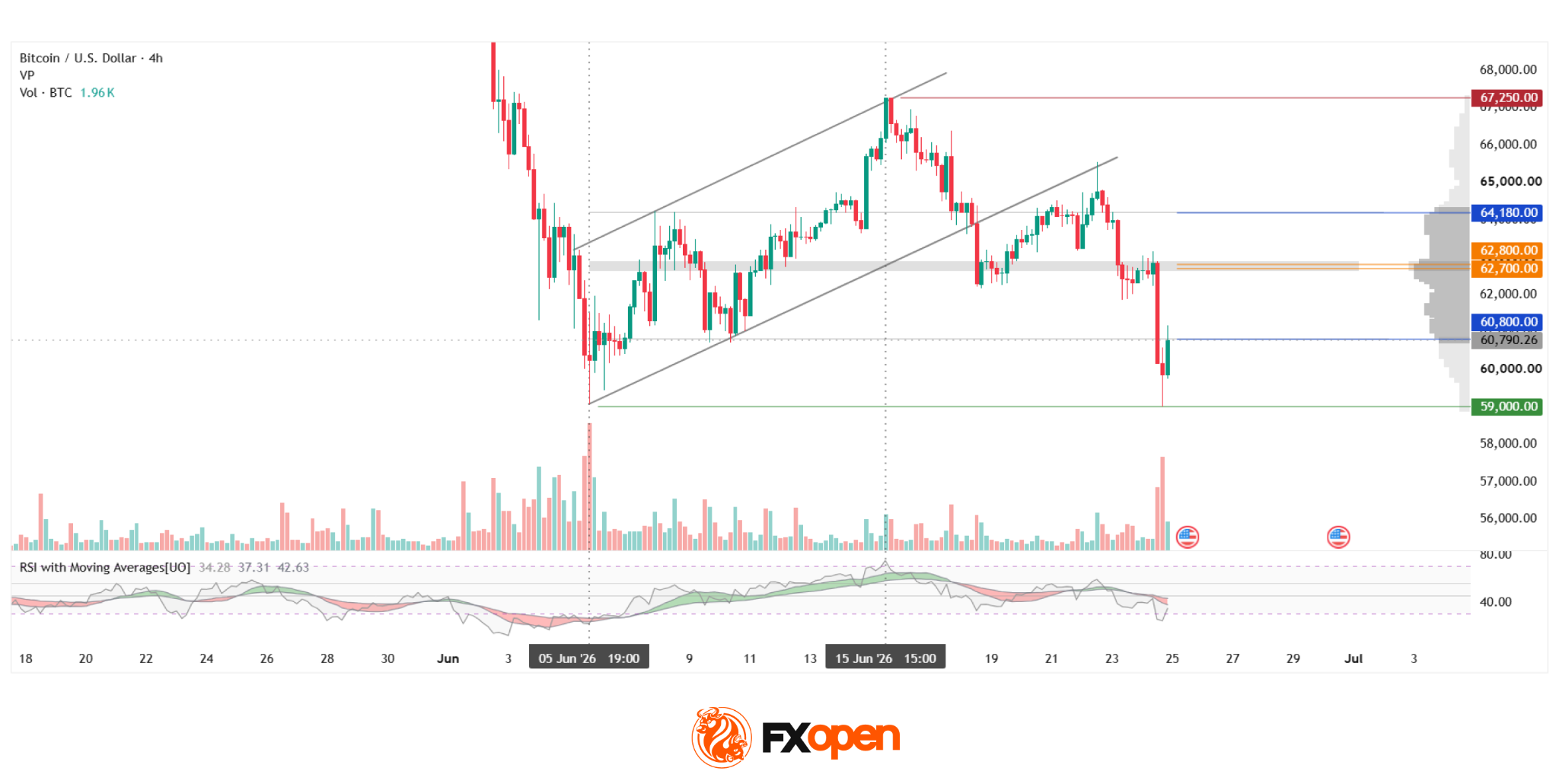
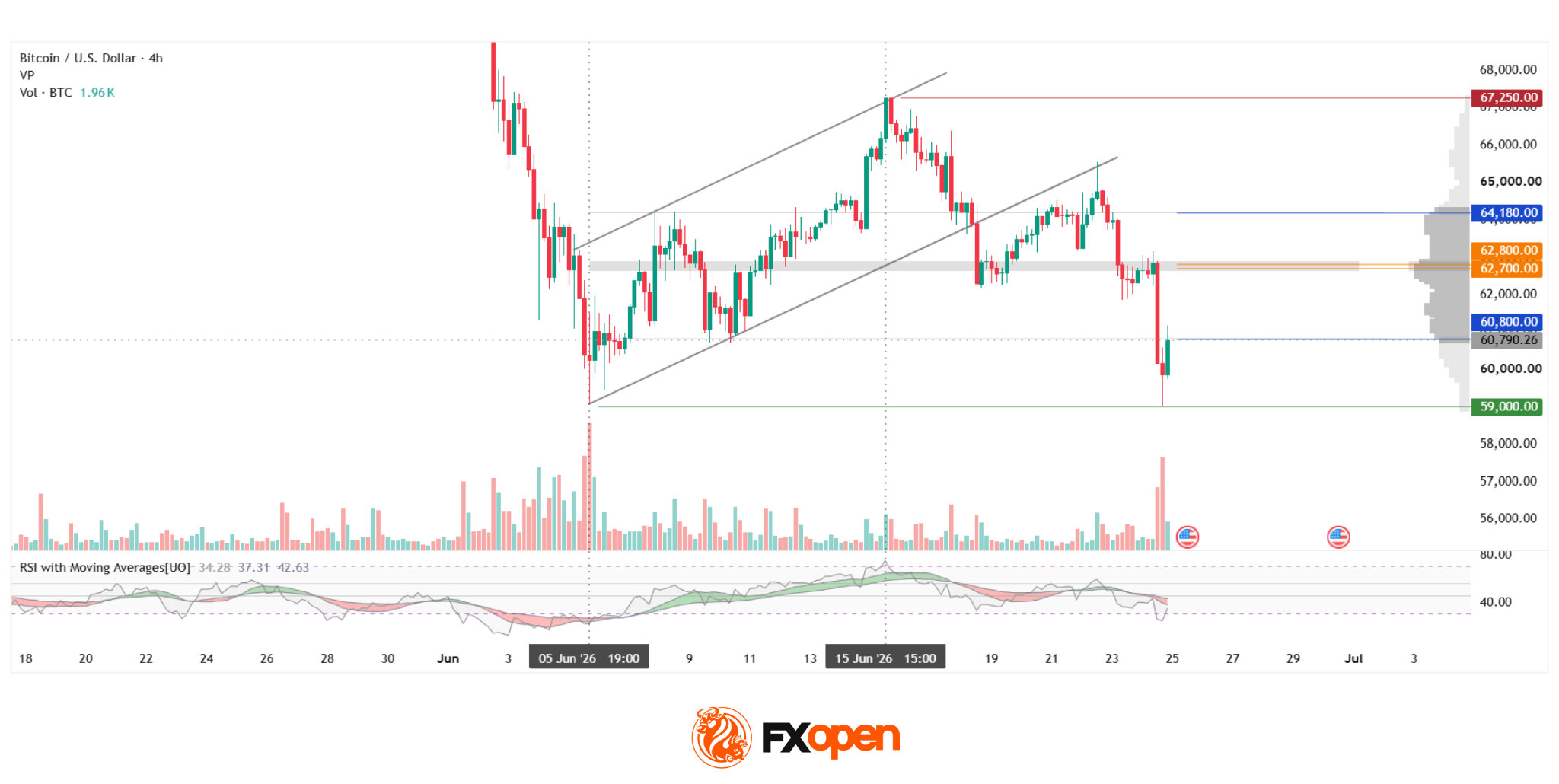
On the H4 chart of BTC/USD, an ascending corrective channel formed after an impulsive decline towards the $59,000 area. Price subsequently advanced to the upper boundary of the channel at $67,250, but failed to hold those levels. The channel was then broken to the downside, with quotations moving towards a test of the lower boundary of the current profile at $60,800.
The Point of Control (POC) is concentrated in the $62,700–$62,800 area and could attract market attention if price rebounds from the lower boundary.
The upper boundary of the profile is located near $64,180 and could act as resistance if the POC zone is breached. The RSI + MAs indicator stands at 34, 37 and 42 respectively. The oscillator remains below the neutral zone but has recovered from oversold territory, while the moving averages remain bearish and continue to point lower.
At the same time, vertical volume surged sharply during the decline on 24 June, which may have been interpreted by market participants as a sign that the local downtrend was nearing completion.
Summary
The unusually high volume recorded on 24 June, combined with the current RSI position, does not provide strong confirmation that the latest local impulse will continue, although the moving averages remain pointed lower for now.
Further price action may be influenced by upcoming US inflation data, as well as flows into Bitcoin ETFs, which experienced record outflows during June.
FXOpen offers the world’s most popular cryptocurrency CFDs*, including Bitcoin and Ethereum. Floating spreads, 1:2 leverage — at your service (additional fees may apply). Open your trading account now or learn more about crypto CFD trading with FXOpen.
*Important: At FXOpen UK, Cryptocurrency trading via CFDs is only available to our Professional clients. They are not available for trading by Retail clients. To find out more information about how this may affect you, please get in touch with our team.
This article represents the opinion of the Companies operating under the FXOpen brand only. It is not to be construed as an offer, solicitation, or recommendation with respect to products and services provided by the Companies operating under the FXOpen brand, nor is it to be considered financial advice.

2x More Gold: FIFA World Cup Trophy Doubles In Value, Now Worth This Much

The Reasons Why There Have Been So Many Recalls On Cars, Trucks And SUVs Lately

UK drivers still make summer mistake that’s ‘burning through fuel’


-

 Fashion6 days ago
Weekend Open Thread: Miami – Corporette.com
-

 Entertainment5 days ago
Renter of Home in Anne Heche Crash Denies Settlement With Son
-
 Sports2 days ago
Two goals and an assist by sheer aura: Cristiano Ronaldo just entered the World Cup chat
-

 Tech3 days ago
Microsoft accidentally kills epic Outlook email threads
-

 Business5 days ago
Soccer-U.S. defends Iran World Cup travel restrictions, says discussions ongoing
-

 Politics5 days ago
Andy Burnham and the meaning of Makerfield
-
Crypto World1 day ago
Bitcoin (BTC) Dips Below $62K, Ethereum (ETH) Plunges 6% Daily: Market Watch
-

 Politics7 days ago
BBC Reporter Discusses Cross Party Criticism Of Trumps Iran Deal
-

 Crypto World1 day ago
Securitize Wraps Roubini's SEC-Registered ETF as Dubai VARA Digital Security
-
Business1 day ago
Entergy settles forward sale agreements, raises $672 million in cash proceeds
-

 NewsBeat6 days ago
Keir Starmer Allies Question His Chances For No 10
-
 Business5 days ago
Wall Street Week Ahead: Investors see Micron earnings as pulse check of AI rally momentum
-

 Tech7 days ago
AWS enters the context layer race with a graph that learns from agents, not manual curation
-
 Crypto World5 days ago
Can Charles Hoskinson Really Rescue Cardano?
-

 Crypto World5 days ago
HIVE shares jump as $220M AI deal speeds Bitcoin mining pivot
-

 Crypto World5 days ago
Jake Chervinsky accuses CME of protecting derivatives monopoly
-

 Entertainment5 days ago
Jose Alvarado Wants Taylor Swift at More Knicks Games
-
 Tech4 days ago
Signal’s Meredith Whittaker says AI chatbots ‘are not your friends’ and calls Copilot agents a backdoor
-

 Tech3 days ago
Nearly 7,000 fake Amazon domains registered ahead of Prime Day 2026, researchers warn
-

 Sports6 days ago
FIFA World Cup 2026: Canada beat 9-men Qatar 6-0 to register first ever win | FIFA World Cup 2026
You must be logged in to post a comment Login