

Business
Japan and Sweden Battle for Group F Survival in Decisive World Cup Clash in Arlington


ARLINGTON, Texas — Japan and Sweden meet at Dallas Stadium fighting for a place in the World Cup knockout rounds, with both nations facing dramatically different paths into Thursday’s decisive Group F showdown.
Where the Group Stands
Japan and the Netherlands are currently tied in Group F with four points each, with the Dutch holding the tiebreaker on goals. But Sweden is right on their heels with three points. The winner of Thursday’s Japan vs. Sweden match will likely advance, while the loser is going home.
What’s at Stake for Each Team
A historic victory for Graham Potter’s side would catapult the Swedes to six points, instantly securing automatic qualification for the round of 32. Depending on the concurrent outcome of the Netherlands vs. Tunisia fixture, a win could potentially vault Sweden into a top-two finish, completely eliminating any reliance on wild-card scenarios. Conversely, this outcome would freeze Japan on four points, forcing the Samurai Blue to sweat on the parallel result or hope to advance as one of the best third-placed wild cards. Should Hajime Moriyasu’s men secure all three points, it would complete an undefeated group stage campaign for the Asian heavyweights and leave Sweden in a highly precarious position.
Japan’s Path to This Moment
Japan made history against Tunisia in Monterrey, winning 4-0 to become the first country representing the Asian Football Confederation to score four goals in a single World Cup game. Daichi Kamada needed only four minutes to convert essentially Japan’s first attack when he turned in Keito Nakamura’s endline cross at close range.
That result followed a dramatic comeback in their opener. In a thrilling Group F opener in Arlington on June 14, Japan denied the Netherlands a win with a last-minute equalizer — Koki Ogawa’s corner deflected off Daichi Kamada and past Bart Verbruggen in the 89th minute to secure a 2-2 draw. Netherlands captain Virgil van Dijk broke the deadlock in the 51st minute; Keito Nakamura pulled Japan level six minutes later, and Crysencio Summerville restored the Dutch advantage, but Japan refused to slow down.
Sweden’s Rollercoaster Group Stage
Sweden’s campaign has swung dramatically between two extremes. Sweden became the first team to win their first game by four goals and then lose their second by four goals since Sweden in 1938. Fresh off a 5-1 win of their own over Tunisia, Sweden were on the receiving end of the same scoreline at the hands of the Netherlands. Brian Brobbey scored a first-half brace inside the first 20 minutes, dispatching two close-range efforts in the fifth and seventeenth minute — the fourth-fastest brace in World Cup history. The fixture was Sweden’s worst defeat at the World Cup since being thrashed 7-1 by Brazil in 1950.
Team News for Japan
Takefusa Kubo remains a major doubt for this crucial encounter due to a lingering knee injury. The Real Sociedad attacker sustained the issue during their draw against the Netherlands. Shuto Machino has also struggled with illness and is yet to feature on the pitch. In his absence, Hajime Moriyasu will likely retain the rest of his high-flying starting eleven tonight.
Team News for Sweden
Graham Potter faces tough personnel decisions following their defensive collapse against the clinical Dutch side. Anthony Elanga could earn a starting role at right wing-back after scoring a fine consolation goal. Youngster Lucas Bergvall pushes hard to replace Celtic midfielder Benjamin Nygren to provide extra defensive steel. Star attackers Viktor Gyökeres and Alexander Isak will continue their blooming partnership up front.
A Key Tactical Battle in Midfield
The absolute heartbeat and dynamic engine of the Japanese midfield on Matchday 2, Daichi Kamada is tasked with dictating the possession rhythm and unlocking opposition lines for the Samurai Blue. Kamada operated masterfully in the heart of the midfield against Tunisia, breaking forward to provide a vital creative spark and getting himself on the scoresheet. Looking to disrupt that fluid creative rhythm is Sweden’s standout midfielder Jesper Karlström, who anchored the engine room on Matchday 2, attempting to provide tactical protection during a difficult outing against the Netherlands.
Predicted Lineups
Japan’s predicted starting eleven: Z. Suzuki; Tomiyasu, Itakura, H. Itō; Dōan, Sano, Tanaka, Nakamura; Itō, Kamada; Ueda.
Sweden’s predicted starting eleven: Nordfeldt; Lagerbielke, Hien, Lindelöf; Elanga, Bergvall, Karlström, Ayari, Gudmundsson; Gyökeres, Isak.
A Notable Tournament Milestone
Beyond the immediate group stakes, Thursday’s fixture also carries a piece of World Cup history. The teams have previously met six times, including Japan’s 2-0 group stage victory at the 2002 FIFA World Cup, which they co-hosted with South Korea. Their latest meeting took place in the 2023 Kirin Challenge Cup, which Japan also won by 2-0. This fixture was the 1,000th World Cup match, with the previous milestone of 900 having been reached at the 2018 FIFA World Cup final.
Match Details and How to Watch
The match kicks off at 6 p.m. local time at Dallas Stadium in Arlington, Texas, with referee Iván Barton of El Salvador in charge. In the United Kingdom, the match will be broadcast live on BBC Two, BBC iPlayer, and the BBC Sport website, with kickoff at midnight BST heading into Friday.
What’s Ahead for the Group Winner
The winner of Group F will advance to play the runner-up of Group C, Morocco, while the runner-up of Group F will advance to play the winner of Group C, Brazil. With Tunisia having already lost their match and been eliminated, becoming the third team eliminated from the tournament following Haiti and Türkiye, Thursday’s result will determine the final shape of one of the tournament’s most competitive groups.
With Japan needing only a draw to guarantee their place in the knockout stage and Sweden requiring a win to keep their own qualification hopes fully in their own hands, Thursday’s match at Dallas Stadium carries genuinely high stakes for both nations. A Japan victory or draw would complete one of the more memorable group-stage campaigns of the tournament for the Samurai Blue, while a Sweden win would erase the memory of their lopsided defeat to the Netherlands and set up a potential top-two finish in the group, depending on how the simultaneous Netherlands-Tunisia fixture unfolds.


IBM Common Stock rose more than 5 percent on Friday, closing at $272.14 after gaining $13.91, as investors responded positively to the company’s progress in artificial intelligence, cloud computing and hybrid infrastructure solutions.
The significant advance reflected renewed confidence in IBM’s ability to compete in high-growth technology areas while maintaining its traditional strength in enterprise services. The company’s focus on hybrid cloud and AI has positioned it as a key player in digital transformation for businesses worldwide.
IBM has reported consistent revenue growth in its software and consulting segments, with particular strength in AI-powered solutions. Its Watson AI platform and various industry-specific offerings have gained traction among enterprise customers seeking practical artificial intelligence applications.
The company’s Red Hat subsidiary continues driving hybrid cloud adoption, providing open-source solutions that complement IBM’s enterprise technology stack. Strategic partnerships and acquisitions have expanded its capabilities in emerging technology areas.
Business Performance and Strategy
IBM operates through software, consulting and infrastructure segments, providing a diversified approach to technology services. Its software business, including hybrid cloud and AI solutions, has shown strong growth and high margins.
The consulting segment leverages IBM’s deep industry expertise to help clients navigate digital transformation. Its ability to combine technology implementation with business strategy differentiates it from pure-play competitors.
Infrastructure services, while facing some pressure from cloud migration, provide stable revenue and opportunities in hybrid environments. The company’s focus on modernizing legacy systems supports long-term client relationships.
IBM’s investment in research and development remains substantial, supporting innovation in quantum computing, artificial intelligence and cybersecurity. Its research laboratories continue producing breakthroughs with commercial potential.
Artificial Intelligence Leadership
IBM has emphasized practical, enterprise-focused artificial intelligence applications rather than general-purpose models. Its Watson platform offers industry-specific solutions for healthcare, finance and other sectors.
The company’s approach to AI governance and ethics has gained attention as businesses seek responsible artificial intelligence implementation. IBM’s transparency and focus on explainable AI differentiate it from some competitors.
Partnerships with various organizations have expanded Watson’s applications across different industries. These collaborations validate the platform’s versatility and practical value.
IBM’s quantum computing efforts, while still in early stages, position the company at the forefront of a potentially transformative technology. Its cloud-based quantum systems provide access for researchers and businesses.
Cloud and Hybrid Infrastructure
IBM’s hybrid cloud strategy addresses the reality that many enterprises operate in multi-cloud and on-premises environments. Red Hat OpenShift provides a consistent platform for application deployment across various infrastructures.
The company’s focus on security and compliance in cloud solutions appeals to regulated industries with stringent requirements. Its ability to address enterprise concerns about data sovereignty and security provides competitive advantages.
Strategic acquisitions have strengthened IBM’s cloud capabilities and expanded its addressable market. Integration of these assets has enhanced its overall technology portfolio.
Investment Considerations
IBM’s share price performance reflects investor appreciation for its transformation efforts and dividend reliability. The company’s consistent payouts and financial discipline appeal to income-oriented investors.
The stock offers exposure to enterprise technology trends with more defensive characteristics than pure growth companies. Its valuation reflects expectations for steady growth and margin improvement.
Risks include competition from larger cloud providers, execution challenges in transformation initiatives and potential slowdowns in enterprise spending. IBM’s diversified business model and strong balance sheet provide some resilience.
Analysts generally maintain stable to positive outlooks, citing the company’s execution on strategic priorities. Continued progress in cloud and AI could support further positive sentiment.
Industry Trends
The enterprise technology sector continues evolving with emphasis on cloud adoption, artificial intelligence integration and digital transformation. Companies like IBM with comprehensive solutions and industry expertise remain relevant.
Hybrid cloud architectures have become standard as organizations balance various deployment options. IBM’s focus on this area aligns with market demands for flexibility and control.
Cybersecurity concerns drive demand for integrated security solutions across technology stacks. IBM’s capabilities in this area support its position as a trusted enterprise partner.
Sustainability and responsible technology practices gain importance for corporate customers. IBM’s initiatives in these areas enhance its appeal to organizations with environmental and social governance priorities.
Future Outlook
IBM’s strategic direction focuses on leveraging its strengths in enterprise technology while investing in high-growth areas like artificial intelligence and hybrid cloud. Its ability to execute on these priorities will influence long-term performance.
The company continues refining its portfolio and operational efficiency while maintaining investment in innovation. Its balance of stability and growth positions it for sustained relevance in enterprise technology.
Investors will monitor upcoming financial results and strategic updates for signs of continued progress. Management guidance will provide insight into execution priorities and market conditions.
The enterprise technology sector’s fundamental demand drivers remain strong. IBM’s established relationships, technology expertise and global reach position it for continued participation in digital transformation initiatives.
As the company advances its cloud and AI capabilities, its contribution to business innovation and operational efficiency will expand. IBM’s progress will be watched closely by enterprise customers, competitors and investors.
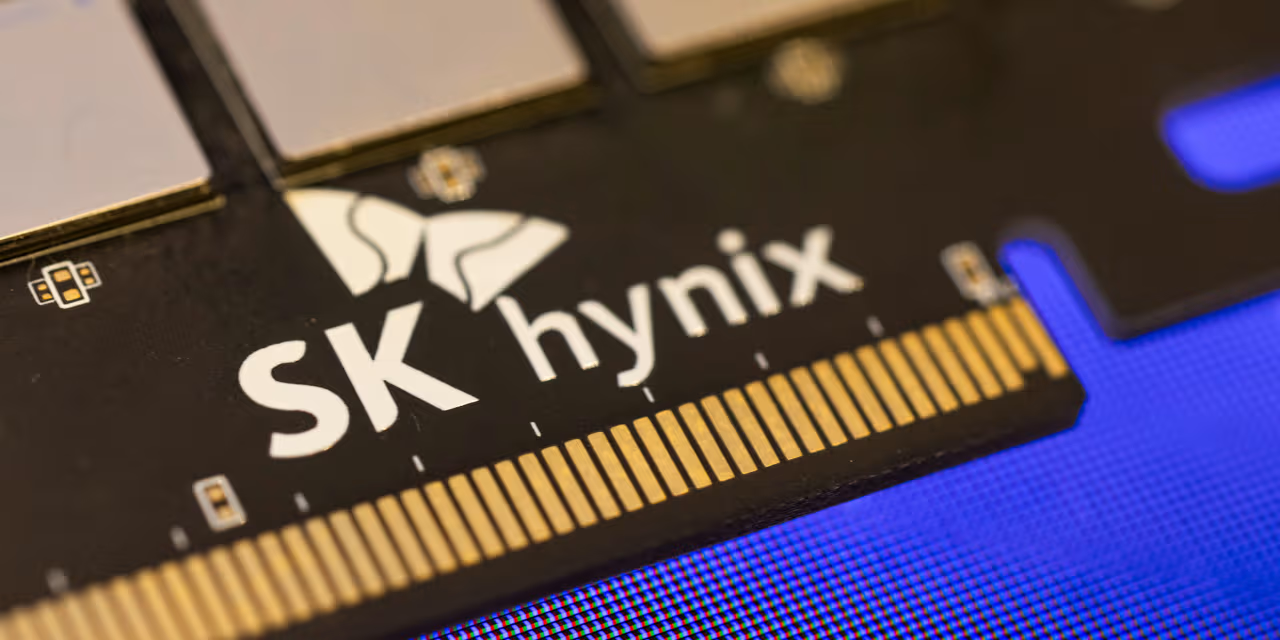
What SK Hynix’s U.S. Listing in Means for the Stock and the Markets

The PHLX chip index tumbled, underscoring recent volatility among AI-related chipmakers that have fueled much of Wall Street’s gains in recent years. While some investors remain optimistic about the potential for AI to fuel higher profits, others worry that massive spending to build AI data centers may take too long to pay off.
“It’s too early to conclude that there’s a major correction brewing in tech, but what I would say is that the questions around profitability and the capex story are certainly not going away,” said David Stubbs, chief investment strategist at AlphaCore Wealth Advisory.
Stubbs also warned that Wall Street could be vulnerable to signs that U.S. companies may not be able to deliver on investors’ high earnings expectations. Apple partly rebounded from a selloff on Thursday, when it raised iPad and MacBook prices, blaming soaring memory and storage chip costs.
Moderna surged to its highest level since 2024 after the drug developer hosted an investor event and showcased its pipeline. U.S. inflation rose above 4% in May, data showed on Thursday, as the Iran war drove up energy prices, keeping alive the possibility of a Fed rate hike.

While oil prices have retreated sharply as the Middle East tensions eased, Apple’s newly announced price hikes suggest inflation remains a concern, said Art Hogan, chief market strategist at B. Riley Wealth.
Also Read | Japan’s Nikkei ends 4% lower as SoftBank tanks on OpenAI IPO delay report
“We saw a similar dynamic during the pandemic, when supply chain disruptions limited access to semiconductors. Now, we’re witnessing a comparable supply shock, this time driven by memory, which is creating renewed inflationary pressure,” Hogan said.
According to preliminary data, the S&P 500 lost 19.81 points, or 0.27%, to end at 7,337.68 points, while the Nasdaq Composite lost 121.72 points, or 0.48%, to 25,236.88. The Dow Jones Industrial Average fell 125.78 points, or 0.23%, to 51,794.84. A report that OpenAI was considering delaying its public debut until next year also weighed on risk sentiment related to AI stocks.
Shares of SpaceX were mixed for much of the session. Passively managed index funds need to buy billions of dollars’ worth of the stock ahead of its inclusion in Russell indexes.
Meanwhile, interest rate concerns persisted, with traders pricing in one 25 basis-point rate hike and a near 27% chance of another by year-end, according to LSEG-compiled data. A survey showed U.S. consumer sentiment rebounded from record lows in June, though households remained worried about the high cost of living. ON Semiconductor dropped after agreeing to acquire Synaptics in an all-stock deal valued at about $7 billion.


I’m DCF Value Investor a passionate individual analyst with unique ideas that cover all types of stocks and commodities. I focus on companies fundamentals and valuation, to deliver a proper investment analysis. My ideas explore a different point of view for undervalued opportunities. Although I cover all types of stocks, the sectors I prefer are materials, technology and real estate. My research process begins with screening for companies that appear undervalued based on their balance sheet, income statement and cash flow statement. From there I conduct a fundamental analysis, including valuation ratios and industry trends. Through my analysis, I aim to help my readers to make better investment decisions. As an independent writer, I write with a particular perspective, bringing fresh ideas to the platform. My ideas keen all types of readers with her intense research in the stock I’m covering, the investment thesis on my articles is solid as it is back on fundamentals and the whole concept on my pieces are based on value investing. My motivation for writing on Seeking Alpha is to offer a different perspective from Wall Street, writing about hidden opportunities in the market. Investigating over hyped stocks in the market, digging into financials and valuation with my own analysis are my passion.
Analyst’s Disclosure: I/we have no stock, option or similar derivative position in any of the companies mentioned, and no plans to initiate any such positions within the next 72 hours. I wrote this article myself, and it expresses my own opinions. I am not receiving compensation for it (other than from Seeking Alpha). I have no business relationship with any company whose stock is mentioned in this article.
Seeking Alpha’s Disclosure: Past performance is no guarantee of future results. No recommendation or advice is being given as to whether any investment is suitable for a particular investor. Any views or opinions expressed above may not reflect those of Seeking Alpha as a whole. Seeking Alpha is not a licensed securities dealer, broker or US investment adviser or investment bank. Our analysts are third party authors that include both professional investors and individual investors who may not be licensed or certified by any institute or regulatory body.

Valvoline CEO Lori Flees discusses the used car boom, decreased interest in electric vehicles and more on ‘The Claman Countdown.’
Polestar said on Thursday that the Trump administration is forcing the electric vehicle maker to stop selling vehicles in the U.S. starting with the 2027 model year under a new regulation cracking down on China-linked automakers.
The Commerce Department’s Bureau of Industry and Security (BIS) declined to grant Polestar authorization to sell cars under the Connected Vehicles Rules, which restricts the importation and sale of cars with connected vehicle technology linked to China starting with the upcoming model year.
Bluetooth, wireless internet, cellular connectivity and some satellite communications technologies are covered under the rules based on national security concerns stemming from the ability of such vehicles to collect sensitive data on American owners.
The Commerce Department first adopted the rule in January 2025 before the end of the Biden administration, while it has remained in effect under President Donald Trump.

Polestar will be banned from selling EVs in the U.S. starting with the 2027 model year due to the Connected Vehicles Rule. (Justin Sullivan/Getty Images)
Polestar CEO Michael Lohscheller said in a statement that the company will place a greater emphasis on Europe in its corporate strategy going forward, while the automaker’s announcement noted that 94% of its retail sales volumes in the first quarter of 2026 was from markets outside the U.S.
Lohscheller said that the “automotive industry is entering a new phase, based on regional dynamics. Our strategy reflects that, with Europe being our largest growth engine and our plan to manufacture Polestar 7 in Europe.”
“Our record sales in 2025 and the first quarter of 2026 show that we are making strong progress, with several new market launches taking place in Europe this year. In addition, we will continue to invest in markets where we have opportunities to continue to grow, like Southeast Asia, Eastern Europe, Latin America and Canada,” he added.
GORDON CHANG WARNS CHINESE EVS ENTERING US VIA CANADA COULD BECOME ‘ROLLING SPY MACHINES’
| Ticker | Security | Last | Change | Change % |
|---|---|---|---|---|
| PSNY | POLESTAR AUTOMOTIVE | 17.43 | -1.54 | -8.12% |
| VLVLY | VOLVO AB | 33.25 | -0.51 | -1.51% |
Polestar, which is based in Sweden, is majority owned by China’s Geely Holding Co.
FOX Business reached out to the Commerce Department and Geely for comment.
The company has struggled to turn a profit and has required repeated capital injections from Geely, and its shares have fallen sharply, which prompted it to carry out a reverse stock split last year to remain listed on the Nasdaq exchange.
Following the Commerce Department’s decision, Polestar will continue to sell the existing stock of Polestar 3 and Polestar 4 vehicles in the U.S. and support customers through access to its service network.
INDUSTRY GROUP WARNS OF CHINESE CONNECTED VEHICLES

Most of Polestar’s retail sales have been in Europe. (Sjoerd van der Wal/Getty Images)
Volvo, which produces some of Polestar’s cars and is a sister brand to the automaker, said in March it would consolidate production of the Polestar 3 at its South Carolina plant instead of also building it in China. It said it was too early to say whether Thursday’s announcement would shift those plans.
The Polestar 3 is the company’s only U.S.-manufactured model.
GET FOX BUSINESS ON THE GO BY CLICKING HERE
Reuters contributed to this report.

American Airlines EVP COO David Seymour sells $2.2m in stock
Business
ACADIA Pharmaceuticals Stock Soars Over 12% After EU Regulators Reverse Course on Rett Syndrome Drug

Shares of ACADIA Pharmaceuticals surged Friday, climbing 12.65%, or $3.00, to $26.72 in midday trading, after European regulators reversed an earlier rejection of the company’s flagship Rett syndrome treatment.
The rally marks a dramatic turnaround for a stock that had been weighed down for months by uncertainty over whether the drug, trofinetide, would ever reach patients in the European Union.
A reversal months in the making
The catalyst behind Friday’s jump traces directly to a regulatory decision delivered this week. According to meeting highlights published by the European Medicines Agency, the Committee for Medicinal Products for Human Use, following a re-examination, recommended granting a marketing authorization for Daybu, the European brand name for trofinetide, for the treatment of neurobehavioral symptoms of Rett syndrome in adults and pediatric patients aged five years and older.
The decision reverses a setback that had clouded ACADIA’s European ambitions since early this year. The committee had initially adopted a negative opinion on the drug’s marketing authorization application in March 2026, prompting the company to formally request a re-examination of that decision.
What went wrong the first time
When the CHMP first rejected the application, the committee’s concerns centered on specific gaps in the clinical data rather than a wholesale dismissal of the drug’s effectiveness. The committee’s refusal was based on perceived deficits including the view that the treatment effect observed with trofinetide after 12 weeks, while measurable, was limited in magnitude; that the pivotal study did not capture all core symptoms of Rett syndrome; and that assessment of longer-term outcomes was influenced by patient discontinuations over time — even though the pivotal LAVENDER trial had successfully met its co-primary and key secondary endpoints.
ACADIA’s chief executive responded to that initial setback by emphasizing the company’s confidence in the underlying clinical data. “While we are disappointed by the CHMP’s recommendation to refuse approval, we continue to be encouraged by the meaningful benefits trofinetide has demonstrated for people living with Rett syndrome,” Catherine Owen Adams, ACADIA’s Chief Executive Officer, said at the time. “The strong engagement and positive feedback we have seen from patients, caregivers, and clinicians in the Rett community reinforce our belief in the treatment’s clinical value.”
A drug already approved elsewhere
Trofinetide’s path through European regulators stands in contrast to its reception in other major markets, where the drug has already secured approval and reached patients. The medicine, a synthetic version of a naturally occurring molecule known as the tripeptide glycine-proline-glutamate, was approved for the treatment of Rett syndrome in adults and pediatric patients two years of age and older by the U.S. Food and Drug Administration in March 2023 under the trade name DAYBUE, and the drug is also approved in Canada and Israel.
In the U.S., ACADIA has continued expanding the franchise around the drug even as the European process played out. The company’s newer formulation, DAYBUE STIX, a dye- and preservative-free powder version of trofinetide, became broadly available across the United States earlier this year following a limited initial launch.
A business built on two approved drugs
Beyond trofinetide, ACADIA’s commercial business rests on a second approved medicine targeting a different neurological condition. The company also markets NUPLAZID, a selective serotonin inverse agonist and antagonist used to treat hallucinations and delusions associated with Parkinson’s disease psychosis.
Both franchises have continued growing steadily even amid the European regulatory uncertainty. In the company’s first quarter of 2026, total revenues reached $268 million, up 11% year-over-year, with DAYBUE sales climbing 20% to $101 million and NUPLAZID sales rising 6% on a non-GAAP adjusted basis to $167 million. Management reaffirmed its full-year 2026 revenue guidance of $1.22 billion to $1.28 billion alongside those results, while reporting a robust balance sheet position of roughly $850 million in cash and no long-term debt.
A pipeline with more catalysts ahead
Friday’s regulatory win adds to a list of upcoming events that could further move the stock in the coming months. ACADIA has reaffirmed its expectation for topline results from a Phase 2 study of remlifanserin, an experimental treatment for Alzheimer’s disease psychosis, with results anticipated sometime between August and October of 2026. The company is also awaiting topline results from a trofinetide clinical trial underway in Japan, expected in the September-to-November window.
Not every recent pipeline update has gone ACADIA’s way, however. The company’s investigational treatment for hyperphagia in Prader-Willi syndrome, an intranasal formulation known as ACP-101, missed all of its endpoints in a Phase III trial, leading the company to end its development work on that program.
Wall Street’s view heading into the news
Even before Friday’s regulatory reversal, analysts following the stock had largely maintained an optimistic outlook on ACADIA’s prospects. Across 21 analysts tracking the stock, the average rating has stood at “Buy,” with a 12-month price target of $31.65 implying a sizable increase from recent trading levels heading into this week. Recent analyst commentary had also pointed to the stock potentially being undervalued following the company’s reaffirmed guidance, even before factoring in the European approval news.
Not all recent analyst moves had been positive, however. RBC Capital lowered its price target on ACADIA to $29 from $30 in May, while Citi separately trimmed its target to $32 from $33, even as both firms maintained bullish ratings on the stock.
What the European approval means going forward
While the CHMP’s recommendation represents a significant step, it is not the final word on the drug’s fate in the European market. A positive CHMP opinion typically precedes a formal decision by the European Commission, which generally follows the committee’s recommendation in granting marketing authorization across the European Union. If that authorization follows as expected, it would open the door for ACADIA to bring trofinetide to Rett syndrome patients across the European market for the first time, expanding the drug’s commercial reach well beyond the United States, Canada and Israel.
For a company whose stock has spent much of the year trading within a relatively narrow band between roughly $20 and $28, Friday’s regulatory reversal — and the sharp rally that followed it — offers a concrete sign that one of its more uncertain near-term catalysts has finally been resolved in the company’s favor.
Business
Infleqtion Shares Surge 7 Percent as Quantum Technology Firm Advances Commercial Applications
Infleqtion Inc. shares climbed more than 7 percent on Friday, reaching $13.77 after gaining $0.98, as investors responded positively to the company’s progress in developing practical quantum technology applications for commercial and government customers.
The quantum technology company has emerged as a leader in neutral atom quantum computing and quantum sensing, with products and services targeting real-world use cases rather than purely theoretical research. Its focus on delivering measurable value has attracted attention from both private sector clients and government agencies.
Infleqtion’s platform uses arrays of individual atoms as qubits, offering potential advantages in scalability and coherence times compared to other quantum computing approaches. The company has demonstrated systems capable of performing useful computations while working toward larger-scale implementations.
Its quantum sensing technologies have applications in navigation, medical imaging and scientific research. These products provide immediate commercial value while supporting longer-term quantum computing development.
Business Strategy and Market Position
Infleqtion has pursued a dual-track approach of developing both quantum computing systems and quantum sensors. This strategy allows the company to generate revenue from near-term products while investing in longer-term quantum computing capabilities.
The company’s neutral atom technology uses laser-cooled atoms as qubits, offering advantages in connectivity and coherence. Its systems can operate at room temperature in some configurations, potentially reducing infrastructure requirements.
Government contracts and research partnerships have provided validation and funding for Infleqtion’s technology. Its work with various agencies demonstrates the practical applications of quantum systems in defense and scientific research.
Commercial customers have begun adopting quantum sensing solutions for specific use cases where classical sensors fall short. These early deployments provide valuable feedback and reference cases for broader market adoption.
Technological Advantages
Neutral atom quantum computing offers unique benefits including the ability to rearrange atoms for optimal connectivity and perform certain operations more efficiently. Infleqtion’s systems have demonstrated competitive performance metrics in various benchmarks.
The company’s approach to error correction and system scalability addresses key challenges in quantum computing development. Its focus on practical applications rather than pure research differentiates it from some academic and competitor efforts.
Quantum sensing technologies provide immediate value in navigation, timing and imaging applications. These products serve as both revenue generators and technology demonstrators for broader quantum capabilities.
Infleqtion’s software and control systems enable users to program and operate quantum devices without requiring deep expertise in quantum physics. This accessibility supports broader adoption across different industries.
Market Environment
The quantum technology sector has attracted substantial investment from both governments and private companies. National initiatives worldwide aim to develop quantum capabilities for economic and security advantages.
Commercial interest in quantum sensing has grown as organizations seek competitive edges in specific applications. Early adopters in defense, healthcare and financial services have begun exploring practical implementations.
Quantum computing remains in early development stages with significant technical challenges to overcome before widespread commercial use. Companies like Infleqtion that demonstrate progress toward practical applications gain attention from potential customers and investors.
The sector’s growth depends on continued technological advancement, talent development and supportive policy environments. Infleqtion’s progress contributes to overall industry momentum.
Investment Considerations
Infleqtion’s share price performance reflects investor interest in quantum technology and the company’s specific approach. The stock offers exposure to an emerging field with significant long-term potential.
Risks include technical development challenges, competition from better-funded companies and long timelines to commercial revenue. Infleqtion’s focus on near-term products provides some balance to these risks.
Longer-term investors see potential in quantum technology’s transformative applications across multiple industries. Infleqtion’s technology platform and early commercial traction support optimistic outlooks.
Analysts monitor the company’s technical milestones, customer adoption and financial performance. Consistent progress could support further valuation upside as the quantum market develops.
Company Leadership and Culture
Infleqtion was founded by researchers with expertise in quantum physics and atomic systems. The company’s leadership emphasizes scientific rigor and practical application development.
Its facilities and research teams focus on translating fundamental quantum science into deployable technologies. This applied approach differentiates it from purely academic quantum research efforts.
Corporate culture encourages innovation while maintaining focus on customer needs and commercial viability. The company’s growth has attracted talent from various scientific and engineering backgrounds.
Future Outlook
Infleqtion’s strategic direction focuses on scaling its quantum technologies while expanding commercial applications. Its ability to deliver practical value in quantum sensing while advancing computing capabilities will influence its trajectory.
The company continues investing in hardware development, software tools and customer support infrastructure. Its progress toward larger-scale systems and broader market adoption will be closely watched.
Investors will monitor technical announcements, customer contracts and financial results for signs of commercial traction. Management guidance will provide insight into development priorities and market opportunities.
The quantum technology sector’s potential remains substantial despite current technical limitations. Infleqtion’s contributions to practical applications could play an important role in realizing this potential.
As the company advances its platform and customer relationships, its impact on quantum technology commercialization will grow. Infleqtion’s progress represents an important chapter in the development of quantum technologies for real-world use.
Business
Netflix Shares Surge More Than 5 Percent as Streaming Leader Reports Strong Subscriber Growth

Netflix Inc. shares jumped more than 5 percent on Friday, closing at $75.10 after gaining $4.21, as investors responded positively to the company’s continued subscriber growth and content strategy success.
The significant advance reflected confidence in Netflix’s position as the leading global streaming service with a robust content pipeline and improving profitability. The company has consistently added subscribers while optimizing its business model for sustainable growth.
Netflix’s focus on original content, international expansion and advertising-supported tiers has driven engagement and revenue diversification. Its ability to produce popular programming across multiple genres and languages has strengthened its competitive advantage.
The streaming giant’s financial performance has shown consistent improvement with revenue growth and margin expansion. Management’s emphasis on content efficiency and operational discipline has supported profitability gains.
Subscriber Growth and Engagement
Netflix has reported strong subscriber additions across regions, with particular strength in international markets. Its global reach and localized content strategy have broadened its appeal to diverse audiences.
Engagement metrics, including viewing hours and completion rates, have remained robust as the company balances popular franchises with new releases. Its recommendation algorithms and personalization features enhance user satisfaction and retention.
The advertising tier has gained traction among price-sensitive consumers while maintaining premium subscription growth. This dual approach allows Netflix to serve different market segments effectively.
Password sharing crackdowns and account consolidation efforts have contributed to subscriber growth without significant backlash. The company’s measured approach to these changes has preserved customer relationships.
Content Strategy and Investment
Netflix continues investing in original programming while leveraging licensed content to fill its library. Its data-driven approach to content decisions has improved hit rates and return on investment.
International content has become increasingly important to subscriber growth and cultural relevance. Productions from various regions have achieved global success and strengthened local market positions.
The company’s focus on diverse storytelling and creator partnerships has expanded its appeal. Award-winning series and films have enhanced its reputation for quality programming.
Sports and live events have emerged as growth areas, with strategic rights acquisitions complementing its traditional scripted content. This diversification broadens Netflix’s entertainment offerings.
Competitive Landscape
Netflix faces competition from other streaming services including Disney+, Amazon Prime Video and Warner Bros. Discovery’s Max. Its first-mover advantage and global scale provide significant differentiation.
The company’s focus on profitability and cash flow generation distinguishes it from competitors prioritizing subscriber growth at any cost. This discipline has supported positive free cash flow and financial flexibility.
Content spending across the industry has moderated as companies focus on returns rather than sheer volume. Netflix’s data advantages and creative expertise support efficient content investment.
Partnerships and licensing agreements with various studios provide additional content options while managing costs. These relationships enhance library depth without proportional increases in original production spending.
Investment Considerations
Netflix’s share price performance reflects investor appreciation for its execution and growth strategy. The company’s valuation incorporates expectations for continued subscriber growth and margin expansion.
The stock appeals to growth-oriented investors seeking exposure to digital entertainment and content creation. Its improving profitability and cash flow generation support positive long-term outlooks.
Risks include competitive pressures, content performance variability and potential economic impacts on consumer spending. Netflix’s global diversification and content strategy provide some resilience.
Analysts generally maintain positive views, citing the company’s market leadership and operational improvements. Continued delivery on growth targets could support further positive sentiment.
Industry Trends
The streaming industry has matured with increased focus on profitability and sustainable business models. Companies have shifted from subscriber growth at any cost to balanced approaches emphasizing returns.
Content spending has stabilized as platforms prioritize quality and efficiency over volume. Data analytics and audience insights drive more targeted content investment decisions.
Global expansion and localization have become essential for streaming success. Companies investing in regional content and marketing gain advantages in international markets.
Technological advances in video quality, personalization and interactive features continue enhancing user experiences. Netflix’s investment in these areas supports its competitive positioning.
Future Outlook
Netflix’s strategic direction focuses on global growth, content innovation and operational efficiency. Its ability to execute on these priorities will influence long-term performance and market position.
The company continues refining its content strategy and platform features based on user behavior and competitive dynamics. Its data advantages and creative expertise support informed decision-making.
Investors will monitor upcoming quarterly results for progress on subscriber metrics, revenue growth and margin trends. Management guidance will provide insight into content strategy and market conditions.
The streaming industry’s fundamental demand drivers remain strong as consumers seek convenient entertainment options. Netflix’s market leadership, global reach and content quality position it for continued success.
As the company advances its platform and content offerings, its contribution to global entertainment and cultural exchange will expand. Netflix’s progress will be watched closely by subscribers, competitors and investors worldwide.

Paying For Active Management. Are You Getting It?

IBM Shares Surge More Than 5 Percent as Technology Giant Advances AI and Cloud Initiatives

How to Choose the Right One for Your Project

10 Movie Trilogies That Are Amazing From Start to Finish


-

 Entertainment6 days ago
Renter of Home in Anne Heche Crash Denies Settlement With Son
-
 Sports3 days ago
Two goals and an assist by sheer aura: Cristiano Ronaldo just entered the World Cup chat
-

 Tech4 days ago
Microsoft accidentally kills epic Outlook email threads
-

 Business6 days ago
Soccer-U.S. defends Iran World Cup travel restrictions, says discussions ongoing
-

 Politics15 hours ago
The House | Manchesterism won’t survive the painful trade-offs unless it gets citizens on board
-

 Politics7 days ago
Andy Burnham and the meaning of Makerfield
-

 Politics19 hours ago
Potential 2028er World Cup attendee leaderboard
-

 Fashion4 hours ago
Weekend Open Thread: Staud – Corporette.com
-

 Tech1 day ago
A Look At A Gaggle Of Transputer Boards
-
Crypto World3 days ago
Bitcoin (BTC) Dips Below $62K, Ethereum (ETH) Plunges 6% Daily: Market Watch
-

 Business14 hours ago
Asia stock markets slide as tech shares slump
-

 Crypto World3 days ago
Securitize Wraps Roubini's SEC-Registered ETF as Dubai VARA Digital Security
-
 Crypto World1 day ago
Dell (DELL) Shares Tumble Over 5% Following Analyst Downgrade to Hold
-
Business3 days ago
Entergy settles forward sale agreements, raises $672 million in cash proceeds
-
 Business7 days ago
Wall Street Week Ahead: Investors see Micron earnings as pulse check of AI rally momentum
-
 Crypto World6 days ago
Can Charles Hoskinson Really Rescue Cardano?
-

 Entertainment7 days ago
Jose Alvarado Wants Taylor Swift at More Knicks Games
-

 Crypto World4 hours ago
RTX holders must register wallets before token distribution begins
-

 Crypto World7 days ago
HIVE shares jump as $220M AI deal speeds Bitcoin mining pivot
-
 Crypto World7 hours ago
Hyperliquid Named on Singapore MAS Investor Alert Register
You must be logged in to post a comment Login