

Business
Global-E Online Stock: Growth Runway Just Got A Lot Better (NASDAQ:GLBE)



I’m a passionate investor with a strong foundation in fundamental analysis and a keen eye for identifying undervalued companies with long-term growth potential. My investment approach is a blend of value investing principles and a focus on long-term growth. I believe in buying quality companies at a discount to their intrinsic value and holding them for the long haul, allowing them to compound their earnings and shareholder returns.
Analyst’s Disclosure: I/we have no stock, option or similar derivative position in any of the companies mentioned, and no plans to initiate any such positions within the next 72 hours. I wrote this article myself, and it expresses my own opinions. I am not receiving compensation for it (other than from Seeking Alpha). I have no business relationship with any company whose stock is mentioned in this article.
Seeking Alpha’s Disclosure: Past performance is no guarantee of future results. No recommendation or advice is being given as to whether any investment is suitable for a particular investor. Any views or opinions expressed above may not reflect those of Seeking Alpha as a whole. Seeking Alpha is not a licensed securities dealer, broker or US investment adviser or investment bank. Our analysts are third party authors that include both professional investors and individual investors who may not be licensed or certified by any institute or regulatory body.

Several Aerison Group entities have been placed in administration, about three years after the current owners acquired the Perth contractor.

Imunon, Inc. (IMNN) Presents at Life Sciences Virtual Investor Forum – Slideshow

Why is Samsung Electronics stock plunging today?

Famed prospector Mark Creasy-backed CZR Resources and Zuleika Gold are planning to merge under an all-scrip deal valuing the latter at $45 million.
Business
ETMarkets Smart Talk | As FD rates soften, AAA PSU and corporate bonds are gaining traction: BondScanner CEO

According to BondScanner Founder & CEO Nishchay Nath, high-rated PSU and corporate bonds are emerging as attractive alternatives, aided by improving retail access, regulatory reforms and greater transparency.
In this edition of ETMarkets Smart Talk, Nath discusses the growing financialization of fixed income in India, why bonds are gradually becoming a mainstream investment option, and the key factors investors should evaluate before chasing higher yields. Edited Excerpts –
The Reserve Bank of India has unveiled draft rules allowing participants to take short positions in government securities, aiming to boost market liquidity and price discovery. A detailed framework for trading “when-issued” securities, bonds yet to be officially released, is also introduced. These measures, with specific limits for banks, primary dealers, and others, are open for public feedback until July 17.
Q) As fixed deposit rates moderate, many investors are moving towards bonds and alternative fixed-income products. How do you see the trend taking shape?
A) The shift which is taking place is both real and gradual. After the RBI’s December cut, the repo rate has settled at 5.25%, and the large banks have followed, with most offering high retail FD rates.

Investors who have traditionally parked money in FDs, are slowly discovering that an AAA-rated PSU or a well-rated corporate bond can offer a meaningfully better yield for a comparable risk profile, with the added benefit of locking in today’s rate for a longer tenure.
What has changed structurally is access, as a few years ago this was an institutional conversation but today retail investors can compare yields, ratings and maturities and invest accordingly.
The moderation in FD rates is the trigger and the OBPP framework is what enables people to act on it.
Q) Industry data suggests retail participation on online bond platforms has grown sharply in recent years. Please share numbers. How has your platform grown?
A) According to NITI Aayog, India’s corporate bond market has the potential to exceed ₹ 100-120 trillion by 2030, through deeper structural reforms and institutional capacity building.
The regulatory groundwork has been deliberate, with SEBI cutting the minimum face value from ₹10 lakh to ₹1 lakh in 2022, then bringing down the effective ticket size down to ₹10,000, and formalizing the OBPP framework so retail investors can transact through a regulated, exchange-settled channel.
At BondScanner, we have seen consistent growth, with investor participation at 80x.
Q) Do you believe India is witnessing the “financialization of fixed income” similar to what happened in equities over the past decade?
A) Drawing that parallel would be accurate but we are still at the very start of the curve. The equity financialization of the last decade has had three major elements: low-friction digital access, a regulatory push, and a behavioural shift where ordinary investors started treating market instruments as everyday savings tools, and SIPs did that for mutual funds.
Fixed income currently has the first two: access is being solved through OBPPs, and SEBI has been steadily lowering barriers and tightening investor protection.
What’s still maturing is investor behaviour – the habit of routinely allocating to bonds the way it is still done to equity SIPs.
The next few years are going to be about turning bonds from a product which people discover into one that they default to for the stable part of their portfolio.
Q) A common market observation is that the highest yields often signal the highest risks. How should retail investors differentiate between attractive yields and red flags?
A) This is the single most important thing a new bond investor needs to internalize: yield is the market pricing risk, not generosity. If a bond is offering several points more than a comparable-tenure FD, the right reaction isn’t excitement – it’s the question why.
Retail investors must be aware of four critical factors: First, the credit rating, and the rating rationale, as a downgrade trend tells investors more than the letter grade itself.
Second, whether the bond is secured or unsecured as secured bonds give investors a claim on the issuer’s assets if things go wrong.
Third, the issuer’s cash flows, where a healthy business can comfortably service the coupon, while a stretched one is often borrowing just to stay afloat.
Fourth, liquidity – so that investors have the option to exit before maturity if they need to. A red flag is when an attractive yield collapses, once tested against the second check.
Our job as a platform is to surface rating, yield, maturity, liquidity – transparently, before investors buy, not after.
(Disclaimer: Recommendations, suggestions, views, and opinions given by experts are their own. These do not represent the views of the Economic Times)
Business
Is your SIP giving FIIs an easy exit? AMFI CEO says mutual funds will actually lure them back
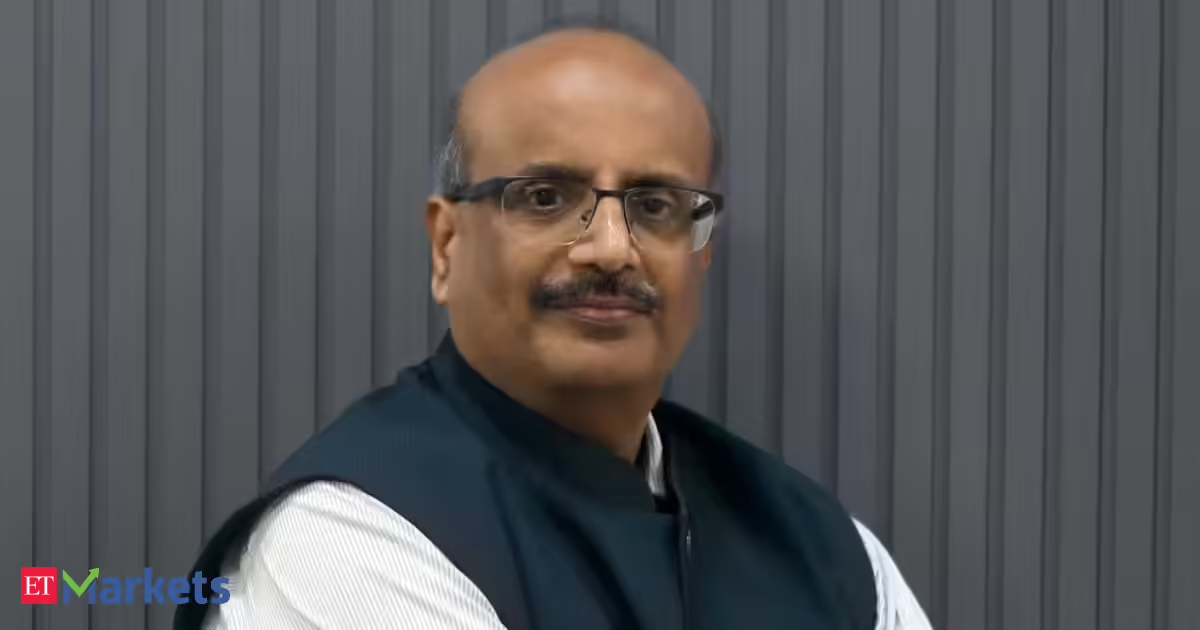
When FIIs sell and domestic funds buy, the net effect is a transfer of equity ownership with domestic investors indirectly absorbing institutional exits. Some market participants have framed this as retail investors being left holding the bag while sophisticated foreign money rotates out to hunt for new winners in America, Taiwan and Korea.
In an exclusive interview with ET Markets, Venkat N. Chalasani, CEO of the Association of Mutual Funds in India (AMFI), says that framing gets it exactly backwards.
“Some people say we are providing an easy exit for FIIs but that’s not the case,” Chalasani said. “This proves the maturity of the market, and it will be one of the biggest positive factors attracting FIIs back in a big way. They will be comfortable entering because they know this is a robust market that will also give them the ability to exit when needed.”
Also Read | Is your mutual fund SIP secretly crushing the Indian rupee? Jefferies explains the bitter side of the story
Chalasani, who spent years in SBI’s treasury, recalls that the Indian market was earlier hostage to FII sentiment precisely because it lacked domestic depth and liquidity. “If you go back 10–20 years, markets were extremely volatile because of external factors like geopolitical tensions, inflationary pressures and interest rate movements elsewhere. FIIs would come in and markets would appreciate; FIIs would exit and markets would collapse. I would check every day what FIIs were going to do — they were the big game changers, precisely because domestic liquidity was insufficient.”
That dynamic has now shifted. Domestic mutual funds, he argues, have replaced volatility with resilience and liquidity and that’s what will ultimately draw FIIs back, not drive them away.“A developed market is the one with liquidity and where large volumes can be handled without a big shake-up in the market. And that’s what domestic institutional investors are providing today, and we should appreciate that,” he explained.
Back in 2024, when the bull market was at its peak, the mutual fund industry was at the receiving end of another criticism that Indian households were shifting their savings away from low-cost bank deposits to higher-yielding mutual funds.
“At that time, we went on record to say that liquidity remains within the banking system regardless. When you and I invest in mutual funds, the money doesn’t leave the banking system — only the form changes. What was a savings bank deposit or fixed deposit now comes back to the bank as a current account balance or as a certificate of deposit. The liquidity always stays in the system,” the AMFI CEO said.
Also Read | Should you stop your SIP because the market is not doing well? History suggests otherwise
Mutual fund industry’s growth arithmetic
India’s mutual fund AUM-to-GDP ratio currently sits at 20–21%, against a global average of 65% and over 100% in some developed economies. AMFI’s targets reflect how much white space remains: 10 crore investors by 2030, up from 6.3 crore today, and AUM of ₹150 lakh crore — roughly 50% of projected GDP.
The growth is increasingly coming from beyond the country’s major urban centres. More than 55% of SIP accounts are now from B-30 cities — those outside India’s top 30 — and around 40% of monthly SIP contributions originate there. SEBI’s incentivisation scheme has played a role, offering distributors a 1% commission, capped at ₹2,000, for bringing in new investors from B-30 cities. AMCs have also lowered the floor, with some SIPs available for as little as ₹100 a month, and daily SIP options now available for India’s large base of daily-wage earners.
A SEBI survey recently found that 53% of Indian households are aware of mutual funds but only 6% have invested. That gap, more than any other number, captures both the industry’s challenge and its runway.
For the retail investor watching a negative portfolio balance for the first time, Chalasani’s message is to think of it as a small cost you are incurring for a long-term benefit you will accrue. “When you reframe a temporary fall as a cost rather than a loss, your attitude changes.”
“It is not the timing of the market that matters,” Chalasani said. “It is the time you spend staying in the market.”

Apple suppliers slide across Asia after price hikes rattle tech sentiment

A large-scale public artwork has been unveiled in West Perth, funded through a $5 million program by Main Roads WA, WALGA and a social enterprise.

Fidelity’s mission is to strengthen the financial well-being of our customers and deliver better outcomes for the clients and businesses it serves. With assets under administration of $12.6 trillion, including discretionary assets of $4.9 trillion as of December 31, 2023, Fidelity focuses on meeting the unique needs of a broad and growing customer base. Privately held for 77 years, Fidelity employs more than 74,000 associates with its headquarters in Boston and a global presence spanning nine countries across North America, Europe, Asia and Australia. Note: This account is not managed or monitored by Fidelity, and any messages sent via Seeking Alpha will not receive a response. For inquiries or communication, please use Fidelity’s official channels.


OpenAI leans toward waiting until next year for IPO, NYT reports

Aerison Group entities in administration, again

Polymarket Hack: $3M Drained in Supply-Chain Frontend Attack

Former heavyweight champion who defeated Muhammad Ali says he would’ve beaten Usyk: “I’d take all of them”

No Jackpot Winner as $257 Million Prize Rolls Over to $269 Million Monday Draw

Blockchain.com files with SEC for U.S. IPO

Weekend Open Thread: Miami – Corporette.com

Advance Financial Accounting (AFA)2026 #exampreparation #importantquestions with answers#2ndsembcom
![Trump Shocking News [Crypto Reacts]](https://wordupnews.com/wp-content/uploads/2026/06/1782448392_maxresdefault-80x80.jpg)
Trump Shocking News [Crypto Reacts]

EV VS Petrol cars #financeshorts #moneytips #stockmarket #finance #evcharging #viralvideo #shorts
-
 Fashion6 days ago
Weekend Open Thread: Miami – Corporette.com
-

 Entertainment5 days ago
Renter of Home in Anne Heche Crash Denies Settlement With Son
-
 Sports2 days ago
Two goals and an assist by sheer aura: Cristiano Ronaldo just entered the World Cup chat
-

 Tech4 days ago
Microsoft accidentally kills epic Outlook email threads
-

 Business5 days ago
Soccer-U.S. defends Iran World Cup travel restrictions, says discussions ongoing
-

 Politics6 days ago
Andy Burnham and the meaning of Makerfield
-

 NewsBeat7 days ago
Keir Starmer Allies Question His Chances For No 10
-

 Tech9 hours ago
A Look At A Gaggle Of Transputer Boards
-
Crypto World2 days ago
Bitcoin (BTC) Dips Below $62K, Ethereum (ETH) Plunges 6% Daily: Market Watch
-

 Crypto World2 days ago
Securitize Wraps Roubini's SEC-Registered ETF as Dubai VARA Digital Security
-
Business2 days ago
Entergy settles forward sale agreements, raises $672 million in cash proceeds
-
 Business6 days ago
Wall Street Week Ahead: Investors see Micron earnings as pulse check of AI rally momentum
-
 Crypto World6 days ago
Can Charles Hoskinson Really Rescue Cardano?
-

 Crypto World6 days ago
HIVE shares jump as $220M AI deal speeds Bitcoin mining pivot
-

 Crypto World6 days ago
Jake Chervinsky accuses CME of protecting derivatives monopoly
-

 Entertainment6 days ago
Jose Alvarado Wants Taylor Swift at More Knicks Games
-
 Tech5 days ago
Signal’s Meredith Whittaker says AI chatbots ‘are not your friends’ and calls Copilot agents a backdoor
-

 Sports16 hours ago
India vs Bangladesh LIVE Score, Women’s T20 World Cup: Bangladesh Opt To Bat; India Enter ‘Do-Or-Die’ Stage As Semi-Final Race Heats Up
-

 Tech3 days ago
Nearly 7,000 fake Amazon domains registered ahead of Prime Day 2026, researchers warn
-

 Business5 days ago
MHP SE 2026 Q1 – Results – Earnings Call Presentation (OTCMKTS:MHPSY) 2026-06-20
You must be logged in to post a comment Login