

Crypto World
What is proof of personhood? Verifying real humans in the AI age



As AI floods the internet with convincing fake humans, proving that a user is a real, unique person is becoming one of crypto’s hardest and most valuable problems. This guide explains what proof of personhood is, how the leading approaches work, and why the cure raises concerns of its own.
Summary
- Proof of personhood aims to verify that each real person can obtain only one identity while protecting their privacy.
- The technology has gained urgency as AI makes it easier to create convincing fake identities that can exploit voting, airdrops, and online platforms.
- Biometric systems, social trust networks, and zero knowledge identity methods offer different ways to verify unique humans, each with its own tradeoffs between privacy, security, and scalability.
Proof of personhood is a cryptographic mechanism that lets someone prove they are a real, unique human being, one person counted exactly once, without revealing who they actually are. That combination is what makes it both powerful and difficult: it must guarantee uniqueness, so that a single person cannot register as a thousand, while preserving anonymity, so that proving you are human does not force you to expose your identity. The problem it solves is old, but it has become urgent for a new reason. For most of the internet’s history, telling humans from machines was a minor nuisance handled by simple puzzles.
Now, with artificial intelligence able to generate text, images, voices, and entire online personas indistinguishable from a real person’s, the open internet faces a verification crisis: bots can flood platforms, manipulate votes, drain airdrops, and impersonate humans at a scale and quality never seen before. This guide explains what proof of personhood is, the attack it defends against, the main approaches to building it, the leading real-world example and its controversies, and why a technology meant to protect humanity raises hard questions of its own.
The reason this topic has moved to the center of crypto and beyond is that “one real human, counted once,” turns out to be a foundational requirement for a surprising range of things. Fair token airdrops depend on it, or a handful of people with thousands of fake accounts will scoop up everything meant for a community. Democratic voting and decentralized governance depend on it, or whoever can spin up the most identities wins.
Any system that distributes scarce resources to people, from community rewards to the long-discussed idea of a universal basic income, depends on being able to tell one person from a thousand sock puppets. And increasingly, the world of artificial intelligence depends on it, both to keep bots out of human spaces and, in a twist, to let trustworthy AI agents act on behalf of verified humans.
Proof of personhood sits at the intersection of cryptography, identity, and the defining technological anxiety of the moment, which is why it has become one of the most watched and most contested ideas in the field.
The sybil attack: the problem at the root
To understand proof of personhood, you first have to understand the attack it exists to stop, which is called a sybil attack. The name comes from a famous case study of a person with many personalities, and in computing it describes a single actor creating many fake identities to gain influence they should not have. On a network where one identity equals one vote, one share, or one claim, a sybil attacker who controls a thousand identities controls a thousand times the influence of an honest participant who has just one. Almost every open online system that tries to be fair, every vote, every giveaway, every reputation score, every “one person, one share” distribution, is vulnerable to someone who can cheaply manufacture identities.
Historically, sybil attacks were limited by the friction of creating convincing fake accounts at scale, and by crude defenses like puzzles meant to slow bots down. Artificial intelligence demolishes both limits. Modern systems can generate unlimited unique-looking personas, complete with plausible writing, profile photos, and behavior, and can solve the puzzles that once filtered them out.
The very technology that makes AI useful, its ability to produce human-like content, is what makes it the ultimate sybil weapon, capable of populating the internet with armies of fake humans cheaply and convincingly. This is the deeper reason proof of personhood has surged in importance: the old, informal defenses against sybil attacks have broken down precisely when the cost of mounting one has collapsed. If you cannot tell a real, unique human from a generated one, then every system that assumed it could is suddenly exposed, and rebuilding a reliable way to prove humanness becomes foundational infrastructure rather than a nice-to-have.
What a good proof-of-personhood system must achieve
Before looking at how anyone builds proof of personhood, it helps to define what success even requires, because the requirements pull against each other, and that tension shapes every design. A strong system needs to satisfy several properties at once. It must guarantee uniqueness, ensuring each real person can obtain exactly one verified identity and cannot register many. It must preserve privacy, so that proving you are a unique human does not force you to reveal your name, your face, or a linkable record of everything you do. It must resist attack, holding up against sophisticated adversaries, increasingly AI-powered, trying to fake or duplicate humanness. And ideally it must scale to billions of people across every country, language, and level of access, without excluding those who lack documents or technology.
The difficulty is that these goals are in tension. The strongest way to guarantee uniqueness is usually to collect something deeply personal and hard to fake, like a biometric, but collecting biometrics is exactly what threatens privacy and raises ethical alarms. The most privacy-preserving approaches, which avoid collecting sensitive data, often struggle to guarantee uniqueness or to resist a determined attacker.
Scaling to everyone on earth conflicts with the careful, high-assurance verification that strong uniqueness demands. Every proof-of-personhood design is, in effect, a particular set of compromises among uniqueness, privacy, security, and inclusivity, and there is no design that maximizes all four at once. Understanding a given system, therefore, means asking which of these properties it prioritizes and which it sacrifices, because that choice, more than any technical detail, determines what the system is good for and what it puts at risk.
The main approaches to proving humanness
There are several broad families of proof-of-personhood design, each making a different bet about how to balance those competing goals. The first and most discussed is biometric verification, which uses a physical trait of the human body, an iris, a face, that is hard to fake and naturally unique, to guarantee one person equals one identity. The bet here is that specialized hardware reading a unique biological signal is the only approach robust enough to resist an adversarial, AI-saturated environment, because you cannot generate a real human iris with a language model. The strength is powerful uniqueness; the cost is the privacy and ethical weight of collecting biometric data and the need for physical hardware and in-person enrollment.
A second family is the social-graph approach, which builds humanness through webs of trust: real people vouch for other real people, and the network of mutual verification makes it hard for a lone attacker to fake many identities, because each fake one would need real humans willing to vouch for it. This avoids collecting biometrics and leans on human relationships instead, but it can struggle to scale and to resist a well-resourced attacker who infiltrates the graph. A third family relies on credentials and accumulated signals, combining evidence like existing verified accounts, on-chain history, or government documents into a score or a passport that suggests a unique human without a single biometric gatekeeper.
This is flexible and privacy-conscious but generally offers softer guarantees of uniqueness than a biometric. A fourth, emerging family uses zero-knowledge identity techniques, proving facts about yourself, that you are an adult, that you are a unique holder of some credential, without revealing the underlying data, and increasingly leans on device-based passkeys and similar tools. Each family is a different answer to the same question, and the field has not settled on a winner, because each answer sacrifices something the others preserve.
The leading example: World and the Orb
The most prominent attempt to build proof of personhood at global scale is the project now called World, formerly Worldcoin, created by a company co-founded by the chief executive of a leading artificial intelligence lab alongside other founders, and launched in 2023. World made the boldest possible bet on the biometric approach, and examining it concretely shows both the promise and the problems of the whole field. Its centerpiece is a custom hardware device called the Orb, a polished sphere that scans a person’s iris.
The reasoning is that the iris is highly unique and extremely hard to forge, so an in-person iris scan is a strong way to guarantee that each verified human is counted exactly once, even against AI adversaries that can fake almost anything made of pixels but cannot fake a living eye on demand.
The privacy design is central to World’s pitch, because iris scanning sounds alarming and the project knows it. According to the project, when the Orb scans your iris it generates a unique cryptographic code, deletes the actual image after processing, and distributes only anonymized fragments of the code across a network to confirm you have not enrolled before.
The result is meant to be a credential, called a World ID, that proves you are a unique human without revealing your identity or storing your biometric image, with zero-knowledge techniques letting you later prove “I am a verified unique human” to an app without exposing anything else. The project reports a scale no other proof-of-personhood effort has reached, on the order of millions of people verified through Orbs and a widely used identity app, which is a meaningful achievement for a category that has historically struggled to grow. World is, in short, the clearest real-world test of whether the biometric approach can become global infrastructure, and its trajectory, successes and backlash alike, is where the abstract debate over proof of personhood becomes concrete.
The AI age and the pivot to verifying agents
What has thrust proof of personhood from a niche idea into a mainstream conversation is the arrival of capable artificial intelligence, and the relationship between the two is closer than it first appears. The same advances that make AI able to flood the internet with fake humans also make a reliable proof of humanness more valuable, because humanness is becoming the scarce, trustworthy thing in a sea of synthetic content. This is why a figure deeply associated with frontier AI is also behind the leading proof-of-personhood project: one venture helps create the problem of indistinguishable machine-generated humans, and the other proposes the verification layer to manage it. As AI-generated text, images, video, and behavior become impossible to tell from the real thing, a system that can certify “a unique human is behind this” turns into foundational infrastructure for trust online.
There is a striking twist in how the field is now evolving. Proof of personhood started as a way to keep bots out of human spaces, but it is increasingly being repurposed to let AI agents operate responsibly within human systems. As autonomous AI agents begin acting on people’s behalf, making purchases, sending messages, executing tasks, a new question arises: which human is this agent acting for, and is that human real and accountable? Proof-of-personhood projects have begun building tools that tie an AI agent to a verified human principal, so that an agent can prove it represents a genuine, unique person rather than running wild as an anonymous bot.
The leading project has also pivoted toward enterprise use, selling proof-of-humanity verification to companies, video platforms, and identity providers that want high assurance a user is real, while keeping the service free for the individuals being verified. The through-line is that AI did not just create demand for proving humans are human; it is reshaping proof of personhood into a layer that governs both humans and the machines acting for them.
Where proof of personhood actually gets used
It is easy to treat proof of personhood as an abstraction, so it helps to ground it in the concrete situations where a reliable proof of unique humanness changes what is possible. The most immediate is fair distribution. Crypto projects frequently give away tokens to early users through airdrops, and the entire premise, rewarding a broad community, collapses if a handful of people can each register thousands of identities and vacuum up the supply meant for many.
A proof-of-personhood gate, requiring each claimant to prove they are a unique human, restores the fairness the airdrop was supposed to deliver, and the same logic extends to any system handing scarce resources to people: community rewards, grants, promotional credits, or the long-discussed vision of a basic income distributed to verified individuals rather than to whoever runs the most bots.
A second arena is governance and voting. Decentralized organizations and online communities increasingly make decisions by vote, and a vote is only meaningful if each person counts once. Without proof of personhood, governance defaults to systems where influence is bought, whoever holds the most tokens or controls the most accounts decides, which concentrates power and invites manipulation.
A reliable proof of unique humanness opens the door to genuine one-person-one-vote systems online, a building block for fairer collective decision-making that has been technically out of reach. A third arena is the everyday integrity of online spaces: social platforms drowning in AI-generated accounts, review systems gamed by fake humans, and communities overrun by bots all need a way to certify that a participant is a real, unique person, and proof of personhood offers exactly that certification without forcing users to surrender their identities.
The newest and fastest-growing arena is the one created by autonomous AI. As software agents begin acting on people’s behalf, the question of which human stands behind a given agent becomes urgent, both to assign accountability and to keep anonymous bots from masquerading as authorized representatives.
Proof-of-personhood tools that bind an agent to a verified human principal let an agent prove it acts for a genuine, unique, accountable person, which is becoming a prerequisite for trusting agents with real tasks and real money. Enterprises are also adopting proof-of-humanity checks to defend high-value interactions, from video calls to account access, against deepfakes and impersonation.
Across all these cases, the common thread is the same: wherever a system needs to know that a participant is a real, unique human, and increasingly wherever it needs to know which human is behind a machine, proof of personhood is the missing layer that makes the guarantee possible. That breadth of application, spanning fairness, governance, online integrity, and the entire emerging world of AI agents, is why the idea has drawn so much attention despite its unresolved controversies.
The serious objections
A guide that only described the promise of proof of personhood would be misleading, because the field, and especially its biometric flagship, has drawn intense and substantive criticism that any honest reader should weigh. The first objection is the biometric honeypot problem. Building a system that scans the irises or faces of millions of people creates, by its nature, one of the largest collections of biometric data in the world, and even with deletion and anonymization, critics argue that such a database is an irresistible target and that the consequences of biometric data being compromised are uniquely severe, because you cannot change your eyes the way you change a password. The risk of normalizing mass biometric collection, and of who ultimately controls it, sits at the heart of the unease.
The second objection is centralization. A system built on specialized hardware that the project manufactures and controls creates a chokepoint: a single company decides who can verify, where the devices go, and how the system runs, which sits awkwardly with crypto’s ideals of decentralization and raises the prospect of a private entity becoming a gatekeeper of human identity online. The third objection is regulatory and ethical: the leading project has faced pushback, suspensions, and investigations from data-protection authorities in numerous countries worried about consent, privacy, and whether scanning eyes in exchange for tokens, sometimes in lower-income regions, is exploitative.
A fourth, more technical critique questions whether a crypto token needs to be attached to identity verification at all, suggesting the financial layer may be unnecessary to the core function. And a fifth points out that large platforms or governments could build competing verification systems with less controversy, or that softer software-only methods might prove good enough, leaving the biometric approach burdened by risks its rivals avoid. None of these objections proves the technology is bad, but together they explain why proof of personhood, despite solving a real and growing problem, remains genuinely contested.
Why it matters and where it goes
Stepping back, proof of personhood is one of those rare ideas whose importance is rising in lockstep with the technology that makes it necessary, and that is the clearest way to understand its trajectory. The case for it is straightforward and getting stronger: as AI erases the line between human and machine online, almost every system that assumed it could tell the difference, fair distribution, honest voting, bot-free communities, accountable AI agents, needs a new foundation, and a reliable way to prove unique humanness is that foundation. The demand is real, it is growing, and it is not going away, which is why serious people and serious money keep flowing toward the problem even after years of difficulty and controversy.
The open question is not whether proof of personhood matters but which approach, if any, will earn enough trust to become a genuine standard. The biometric path offers the strongest uniqueness guarantees and the most scale so far, but carries the heaviest privacy, centralization, and regulatory baggage. The social-graph, credential, and zero-knowledge paths avoid some of that baggage but offer softer guarantees or struggle to scale. It is entirely possible that no single system wins, and that the future is a patchwork of methods suited to different contexts, a biometric proof for the highest-assurance needs, lighter software proofs for everyday ones.
It is also possible that the privacy concerns prove decisive and the world rejects mass biometric identity altogether, pushing the field toward less invasive designs. What seems certain is that the underlying need, proving a real, unique human in a world full of convincing fakes, is now permanent, and that how society chooses to meet it, and who it trusts to run the infrastructure, will be one of the defining questions where crypto, artificial intelligence, and identity collide. Proof of personhood is the attempt to answer it, and the answer is still being written.
Frequently Asked Questions
What is proof of personhood in simple terms?
Proof of personhood is a way to prove you are a real, unique human, counted exactly once, without revealing who you are. It has to do two things at the same time: guarantee uniqueness, so one person cannot create many identities, and preserve privacy, so proving you are human does not expose your name or identity. It matters because, as AI makes fake humans cheap and convincing, many online systems, fair giveaways, honest voting, bot-free communities, can only work if they can reliably tell one real person from a thousand fakes.
What is a sybil attack?
A sybil attack is when a single actor creates many fake identities to gain influence they should not have. On a system where one identity equals one vote or one share, someone controlling a thousand fake identities has a thousand times the honest influence. Almost every open online system that tries to be fair is vulnerable to it. Sybil attacks used to be limited by the friction of making convincing fake accounts, but AI removes that limit by generating unlimited realistic personas, which is why defending against sybil attacks now requires proving real, unique humanness.
How does the iris-scanning approach work?
The leading biometric project uses a device called the Orb to scan a person’s iris, because the iris is highly unique and very hard to fake, even by AI. According to the project, the Orb generates a unique cryptographic code from the scan, deletes the actual image after processing, and distributes only anonymized fragments to confirm the person has not enrolled before. The result is a credential proving you are a unique human without revealing your identity, and zero-knowledge techniques let you later prove “I am a verified unique human” to an app without exposing anything else about yourself.
What are the alternatives to biometric verification?
Several. Social-graph systems build humanness through webs of trust, where real people vouch for other real people, avoiding biometrics but struggling to scale. Credential-based systems combine signals like verified accounts, on-chain history, or documents into a score suggesting a unique human, offering flexibility but softer uniqueness guarantees. Zero-knowledge identity methods prove facts about you, such as being a unique credential holder, without revealing the data, and increasingly use device-based passkeys. Each approach makes a different trade-off among uniqueness, privacy, security, and scale, and the field has not settled on a single winner.
Why is proof of personhood controversial?
Mainly because the strongest approach, biometrics, raises serious concerns. Collecting iris or face data from millions creates a large biometric database that critics see as a honeypot, made worse because you cannot change your biometrics like a password. Building it on hardware one company controls creates centralization and gatekeeping worries that clash with crypto’s ideals. The leading project has faced regulatory pushback and suspensions in many countries over privacy and consent, and some argue that verifying people in lower-income regions for tokens is exploitative. Others question whether a token is needed at all, or whether less invasive methods would suffice.
How does proof of personhood relate to AI?
Closely, in two directions. First, AI created the urgency: as it makes fake humans cheap and convincing, proving real humanness becomes valuable precisely because humanity is becoming the scarce, trustworthy thing online. Second, the field is evolving from keeping bots out to governing the AI agents now acting on people’s behalf. New tools tie an AI agent to a verified human principal, so an agent can prove it represents a genuine, accountable person instead of running as an anonymous bot. So proof of personhood is becoming a layer that verifies both humans and the machines acting for them.
This article is educational information, not investment or identity-security advice. Proof-of-personhood projects, their scale, and their regulatory status change quickly, and details reflect reporting available as of June 25, 2026. Consider the privacy and security implications carefully, and verify current information from primary sources before enrolling in or relying on any identity system.



Bitcoin (BTC) has bounced from overnight lows amid a renewed slide in Asian equity markets.
The leading cryptocurrency by market value traded at around $59,800 as of this writing, up 2.7% from the low of $58,206 hit Thursday, according to CoinDesk data. Still, prices are down over 5% this week and nearly 20% for the month.
“Bitcoin has pulled back into the $50–60K zone, and if history is any guide, this is where buyers step in,” Gabe Selby, head of research at CF Benchmarks, said.
Selby explained that this zone was first established as support in mid-2024, when prices consolidated in this range following the U.S. spot ETF launch rally, and it’s held through everything thrown at it since: the yen carry unwind, the election cycle, and every other high-time-frame retest.
Meanwhile, Asian stocks are under pressure, with South Korea’s Kospi index down 8% and Japan’s Nikkei losing 3%. The losses follow overnight risk aversion on Wall Street where shares in Apple and other Mag7 stocks cratered after announcing price hikes for laptops, tablets and other products citing rising costs.
Crypto World
Alphabet (GOOGL) Stock Slides as Google Finance Launches Major Overhaul With AI Features

Key Takeaways
- Google Finance has completed its beta phase and is now available worldwide following initial testing that started in August 2025.
- The platform debuts a standalone Android application featuring real-time market information, customizable watchlists, breaking financial news, and AI-driven explanations for stock price movements.
- Investors can now aggregate their entire investment portfolio into one unified dashboard through the web interface.
- A new AI-powered research assistant enables users to ask portfolio-related questions using everyday language.
- The iOS application will arrive later in 2026, with mobile versions of portfolio and automated task features rolling out progressively.
At the time of Thursday’s announcement, GOOG shares were down 1.21% to $340.85, while GOOGL declined 1.20% to $341.15.
Google Finance has officially graduated from beta status, bringing with it a substantial suite of enhancements beyond simple cosmetic updates.
The revamped platform unveiled its standalone Android application on Thursday, accompanied by numerous new capabilities for desktop users — all accessible globally from launch day.
The Android application provides users with live market information, personalized watchlists, continuous financial news updates, and an AI-powered feature dubbed “Key Moments” that breaks down the reasons behind specific stock movements in real time.
This represents a direct challenge to established competitors like Yahoo Finance and trading platforms such as Robinhood, positioning Google directly within an increasingly competitive but high-demand market segment.
The company plans to release an iOS version before the end of this year.
Comprehensive Portfolio Management Arrives on the Web
The standout addition to the web platform is comprehensive portfolio management. Investors can now consolidate all their investment holdings in a centralized location, complete with performance metrics and detailed asset allocation visualizations in one streamlined dashboard.
Current Google Finance portfolio data will automatically transfer to the new system. Users can create new portfolios by importing CSV files, PDF documents, or screenshots — or alternatively by verbally describing their investments to the AI assistant.
After configuration, the built-in AI research assistant allows investors to pose questions such as “which market sectors am I lacking exposure in?” or “what impact would increasing my bond allocation have on my portfolio’s long-term performance?”
This represents a significant advancement beyond the rudimentary watchlist capabilities that most users previously relied upon.
Automated AI Briefings and Scheduled Tasks
Google Finance has also introduced an automated task system that operates continuously to provide scheduled market intelligence briefings.
Users configure these tasks using conversational language — such as “deliver a daily pre-market summary focused on technology stocks.” The system then compiles the requested information and sends the digest through the Google app or web interface according to the user’s specified timing preferences.
While seemingly modest, this feature offers practical value for investors seeking curated market intelligence without actively searching for information.
The web-based versions of these portfolio and automated task capabilities are currently available. Mobile applications will receive these features within the next several months, according to Google’s announcement.
Google initially launched testing of the redesigned AI-powered Finance platform in the United States during August 2025, subsequently expanding access to over 100 countries in April 2026 with localized language options.
Thursday’s announcement signifies the conclusion of the testing phase and represents the complete worldwide deployment of the enhanced platform.


TLDR:
- MemeCore $M token dropped 75% in one day, falling from $2.92 to $0.51 with no hack or exploit.
- Arkham data showed zero transfers above $50,000 on its native chain for over two weeks prior.
- Over 90% of $M supply was held by insiders, letting a small float set the price for billions.
- Spot listings on Kraken and Bitget plus futures on Binance and Bybit extended the price distortion.
The MemeCore $M token collapsed 75% in a single day, dropping from $2.92 to $0.51. The crash erased nearly $3 billion in value.
No hack, exploit, or announcement preceded the fall. On-chain data had been flashing warning signs for weeks, and blockchain investigator ZachXBT had flagged concerns as early as April.
A $14 Billion Valuation Built on $100,000 in Liquidity
The MemeCore $M token carried a fully diluted valuation of roughly $14 billion at its peak. Against that figure, Dexscreener recorded under $100,000 in real on-chain liquidity.
Arkham Intelligence showed zero transfers above $50,000 on its native chain for over two weeks. That gap between stated value and actual activity is what analysts call a ghost market cap.
A ghost market cap forms when insiders hold most of the token supply. ZachXBT reported that over 90% of $M supply was concentrated among insiders.
The tiny fraction available for trading set the price for the entire supply. A few parties trading at $3 marked billions in holdings at that same price.
The mechanism is straightforward. When illiquid tokens are priced off a tiny traded float, the market cap becomes theoretical.
Insiders could never sell their positions into a market that small without collapsing the price immediately. The valuation exists on paper but has no corresponding market depth to support it.
This structure is not unique to MemeCore. It is a recurring feature in tokens where teams retain the overwhelming majority of supply. The price remains stable only as long as no one tries to exit at scale. When that changes, the collapse is fast.
Exchange Listings Amplified the Gap Between Price and Reality
MemeCore secured spot listings on Kraken and Bitget before the crash. It also gained perpetual futures markets on Binance and Bybit, where leverage trading was available.
These listings gave the $M token credibility it may not have earned through organic on-chain activity. Centralized order books then became the dominant price-discovery venue.
Once a token trades on major exchanges, the on-chain liquidity becomes secondary. The order book sets the price, and traders reference that figure without examining what sits underneath. That dynamic held until it did not, and the exchange price was eventually dragged toward its on-chain reality.
ZachXBT noted after the crash that the red flags had simply caught up with the token. The warning signs were present for months before the price broke. The question, as he framed it, was only a matter of timing, not outcome.
The MemeCore $M token collapse illustrates how supply concentration and thin liquidity combine to create fragile valuations.
Exchange listings extend the lifespan of such structures but do not resolve the underlying mismatch. When price finally meets on-chain reality, the correction tends to be severe and swift.
-
Power over tokens: Why AI is changing crypto valuations
For a long time, the value of crypto companies was closely tied to traditional indicators such as trading volumes, digital asset holdings, mining income and assets under management.
Investors generally judged these firms by their exposure to Bitcoin, Ether and the broader growth of blockchain technology.
That view now appears to be changing.
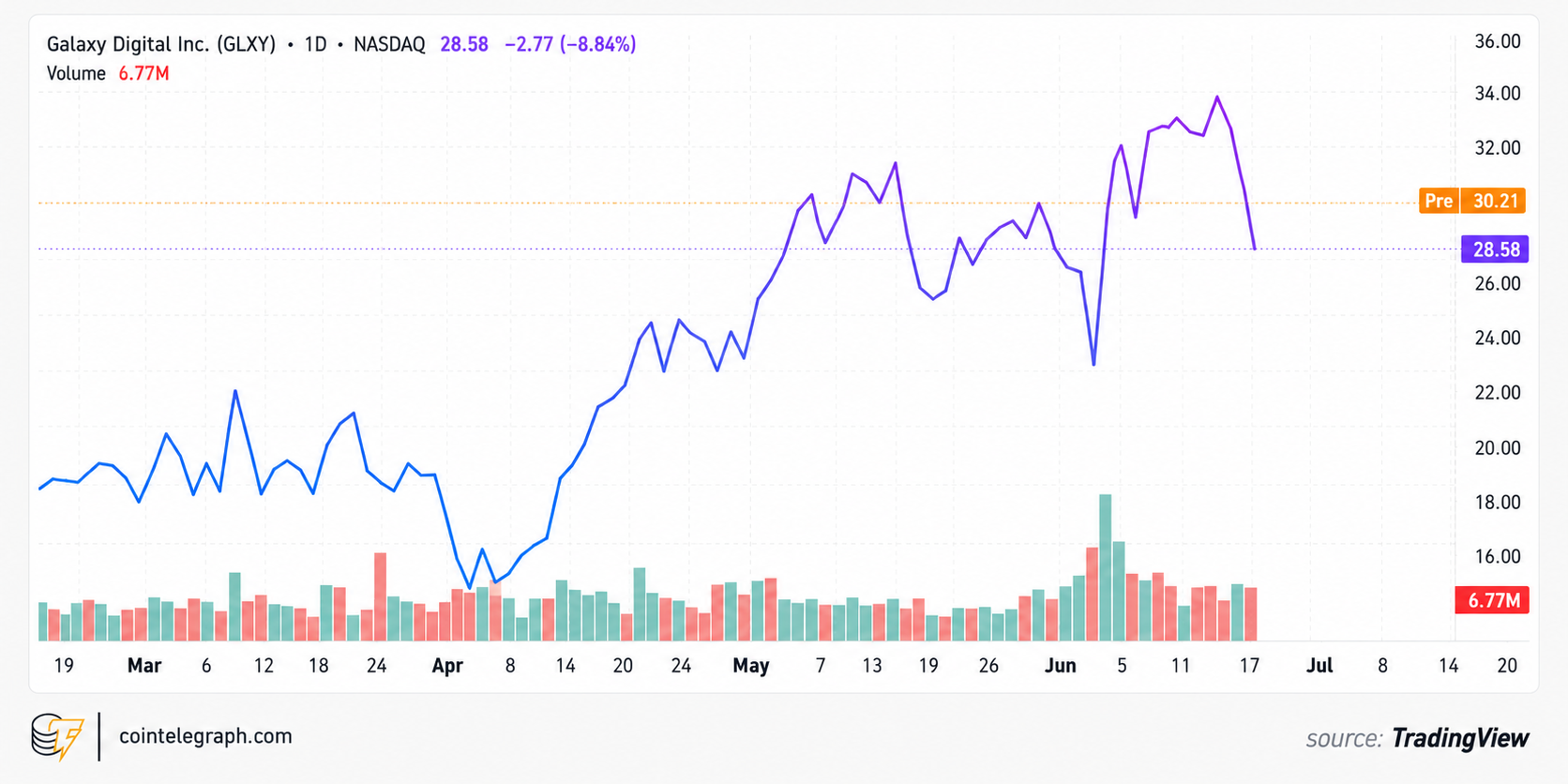
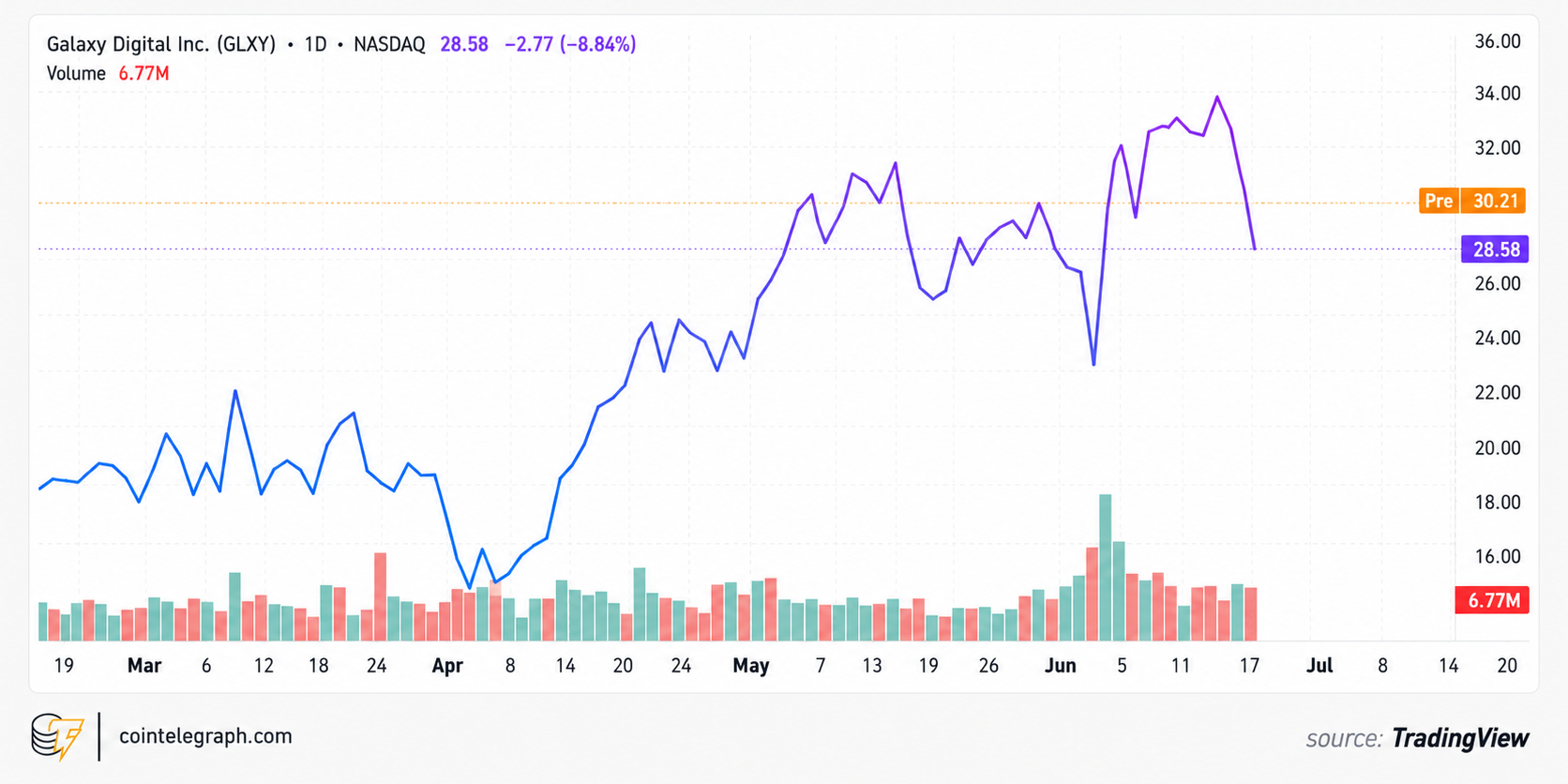
In June 2026, shares of Galaxy Digital rose sharply as investors focused on a different part of the business: artificial intelligence infrastructure. The rally drew attention to a pattern taking shape in public markets. Some crypto companies are finding that Wall Street may value their access to power, land and data centers more than their traditional crypto activities.
This shift points to a bigger change in financial markets. As demand for artificial intelligence grows, the infrastructure needed to support AI models has become one of the world’s most valuable resources. In some cases, crypto firms already control the exact assets that AI companies want.
-
The Galaxy Digital rally that caught crypto investors off guard
Galaxy Digital has long been a major player in digital assets, with businesses across trading, asset management, venture investments and blockchain infrastructure.
Yet the driver of its recent share price increase was not Bitcoin prices, ETF inflows or wider crypto trading activity.
Instead, investors focused on the company’s Helios campus in Texas. The site is a major data center project being developed for artificial intelligence and high-performance computing.
Comments from Galaxy Digital’s management suggested that Helios could eventually make up a meaningful share of the company’s total value. Market observers appeared to agree. Instead of viewing Galaxy Digital only as a crypto firm, investors began to assess it as an AI infrastructure company.
The rally showed a clear change in how investors value some crypto businesses. A company built on digital assets suddenly gained market attention for its possible role in the AI sector.
Did you know? Bitcoin miners once competed for cheap electricity. Now AI companies are competing for the same resource. In many regions, access to power has become more valuable than access to graphics processing units (GPUs) themselves. Some utilities have reported years-long waiting lists for large AI data center projects seeking grid connections.
-
Why AI infrastructure is now so valuable
The rapid growth of artificial intelligence has created a new bottleneck. The main challenge is no longer just building more advanced AI models. It is also securing enough computing capacity to train and run them.
Modern AI systems need large numbers of GPUs, specialized networking equipment, advanced cooling systems and huge amounts of electricity. Building the sites that house this equipment is now one of the most expensive projects in the technology sector.
As a result, investors are paying more attention to the companies that provide this core infrastructure, not just the companies building AI applications.
Data centers have become essential tools for AI growth.
This explains the strong investor interest in infrastructure-focused companies. Businesses that control power supplies, grid connections and large computing sites hold assets that are difficult and expensive to copy.
To Wall Street, those qualities often point to long-term revenue potential and more stable financial returns.
-
Why some crypto companies are well positioned
Some crypto companies are well positioned because they already share key infrastructure needs with the AI sector.
At first glance, crypto operations and artificial intelligence may seem like completely different fields. Yet both depend on one essential resource: massive computing capacity.
Over time, Bitcoin mining operations and other crypto infrastructure businesses invested heavily in sites built for high power demand. They acquired suitable land, secured power supply agreements, installed advanced cooling systems and connected directly to electrical grids.
These same resources are now attracting interest from AI companies.
An AI data center is not the same as a crypto mining operation. Still, the two share several core requirements, including high electricity use, large physical sites and enough space for specialized equipment. This overlap has created an unexpected opportunity.
In some cases, AI operators can work with existing facilities that were first built for crypto. That can help them avoid the cost and delay of building new sites from scratch.
As a result, some crypto firms now hold valuable assets in the growing AI infrastructure market.
-
Helios and Galaxy Digital’s changing strategy
Galaxy Digital’s Helios campus shows how infrastructure originally tied to Bitcoin mining can be redirected toward AI computing. After acquiring the site from Argo Blockchain in 2022, Galaxy Digital began shifting Helios toward high-performance computing and AI data center services.
That strategy gained more support when AI cloud provider CoreWeave entered into agreements tied to the site. Those deals suggested that major AI companies saw strategic value in the infrastructure.
Long-term AI infrastructure agreements can create steady revenue streams that are easier to forecast than income from crypto trading. Instead of relying on sharp market swings, companies can secure cash flow through multi-year contracts.
That level of stability is attractive to public market investors.
Did you know? Training and running advanced AI models requires huge computing resources. That is pushing developers to search globally for locations with abundant and reliable energy.
-
The rise of crypto-AI hybrid companies
Galaxy Digital’s Helios strategy is not an isolated case. Across parts of North America, several crypto mining and digital infrastructure companies have started pursuing opportunities in AI hosting, cloud services and high-performance data center operations.
This points to a wider change in how financial markets classify these businesses. In the past, crypto companies were often viewed as high-risk businesses tied closely to digital asset prices.
Now, some investors are separating infrastructure assets from direct crypto exposure.
A company that controls hundreds of megawatts of power capacity may attract a different valuation approach than one that depends mainly on trading revenue. This has created a new type of business: the crypto-AI hybrid.
These companies remain active in digital assets, while more of their value comes from infrastructure that can support several industries.
-
Why Wall Street favors AI revenue
The market’s preference becomes clearer when looking at the economics of the two areas. Crypto revenues often vary sharply over time.
Trading volumes rise and fall with overall market sentiment. Asset management fees move with crypto valuations. Mining profits change based on network difficulty and token prices. By comparison, AI infrastructure revenue can look more like revenue from traditional utility or real estate businesses.
Companies sign multi-year contracts. Income becomes easier to predict. Financial forecasts become simpler to prepare. Institutional investors usually value this kind of consistency.
A long-term lease with an AI client often carries lower perceived risk than relying on future crypto market momentum. As a result, businesses tied to AI infrastructure can command higher valuation multiples.
This does not mean investors have turned away from crypto. Instead, they may see AI infrastructure as a more reliable base for future income.
-
Could the market be getting ahead of itself?
Even with the current optimism, there are still reasons to be cautious. The rise of AI infrastructure has created strong excitement, leading some analysts to question whether too much capacity could eventually be built.
Past technology booms offer many examples of early overinvestment. Railroads, telecommunications networks and early internet infrastructure all went through periods of excess development before demand caught up with supply.
AI infrastructure could face a similar risk if capacity grows faster than demand.
If demand grows more slowly than expected, some data center projects may struggle to reach the occupancy levels investors are now expecting.
Execution risks also remain. Converting facilities originally built for crypto into AI-ready sites requires major capital spending and specialized expertise. Not every company will manage that transition well.
Investors must therefore balance real opportunities against the risk of overexcitement.
Did you know? Companies building AI infrastructure are increasingly negotiating energy contracts directly with utilities, renewable power developers and even nuclear operators to secure long-term electricity supplies.
-
What this means for crypto investors
The impact reaches well beyond Galaxy Digital. Investors assessing crypto-related stocks may need to look beyond digital asset exposure.
Factors that once centered mainly on crypto now include infrastructure questions:
- How much power capacity does the company control?
- Does it own land in strategic locations?
- Can its facilities support AI workloads?
- Are major technology firms interested in leasing its infrastructure?
- How diversified are its revenue sources?
In some cases, these factors may matter as much as Bitcoin holdings or trading volumes.
This points to a changing valuation approach, where physical infrastructure carries more weight than digital assets alone.
-
The new reality: Power may matter more than crypto
Galaxy Digital’s share price increase highlighted a clear change in the market.
Wall Street is placing serious value on the infrastructure needed to power artificial intelligence. Data centers, reliable electricity supplies and computing resources have become strategically important assets.
Some crypto companies already control these resources after spending years building them for mining and blockchain operations. As AI demand grows, investors may begin to see these assets as more valuable than traditional crypto businesses.
For companies like Galaxy Digital, the path ahead may no longer depend only on Bitcoin, trading operations or asset management. The bigger source of value could be something more physical: access to power, land and the computing infrastructure needed to support the next wave of artificial intelligence.
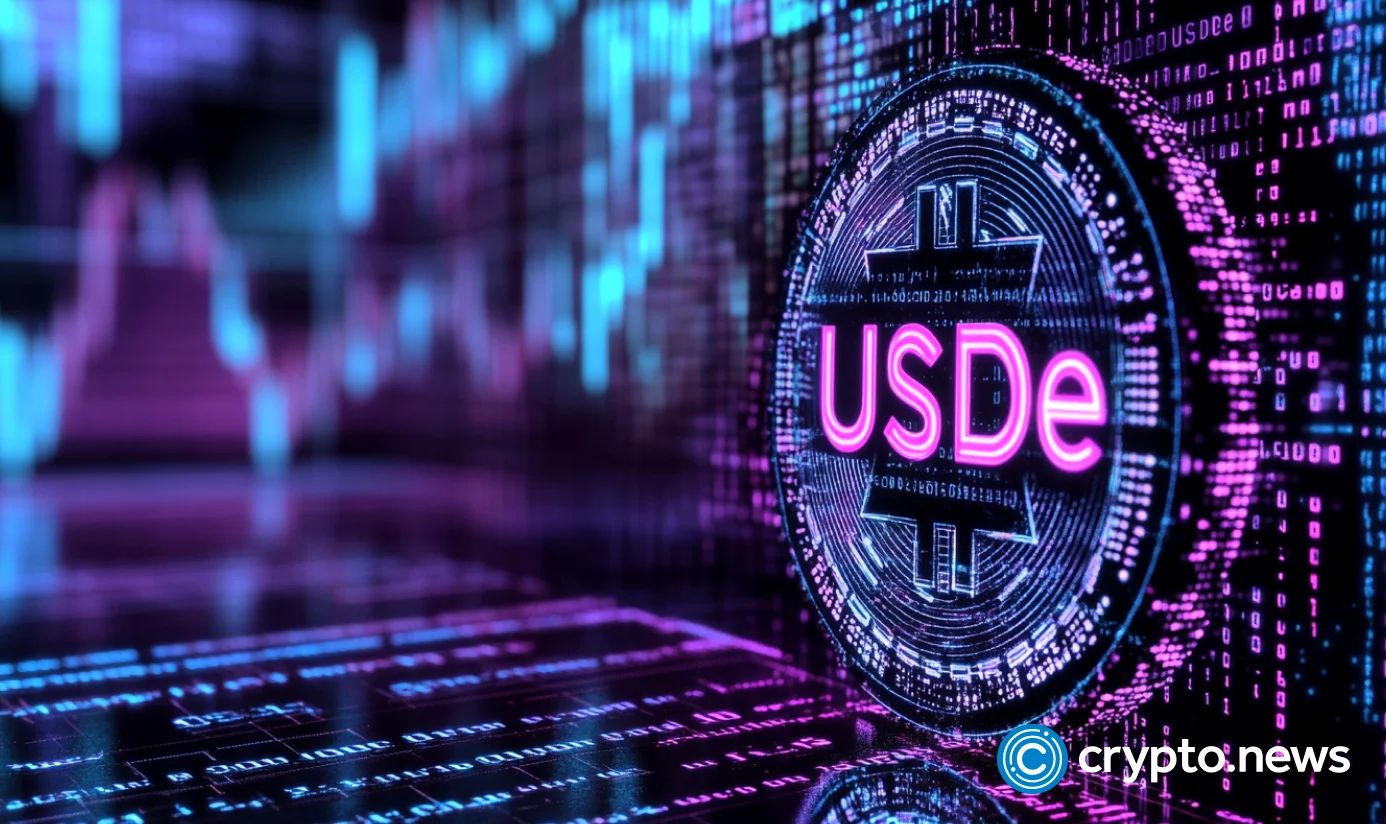
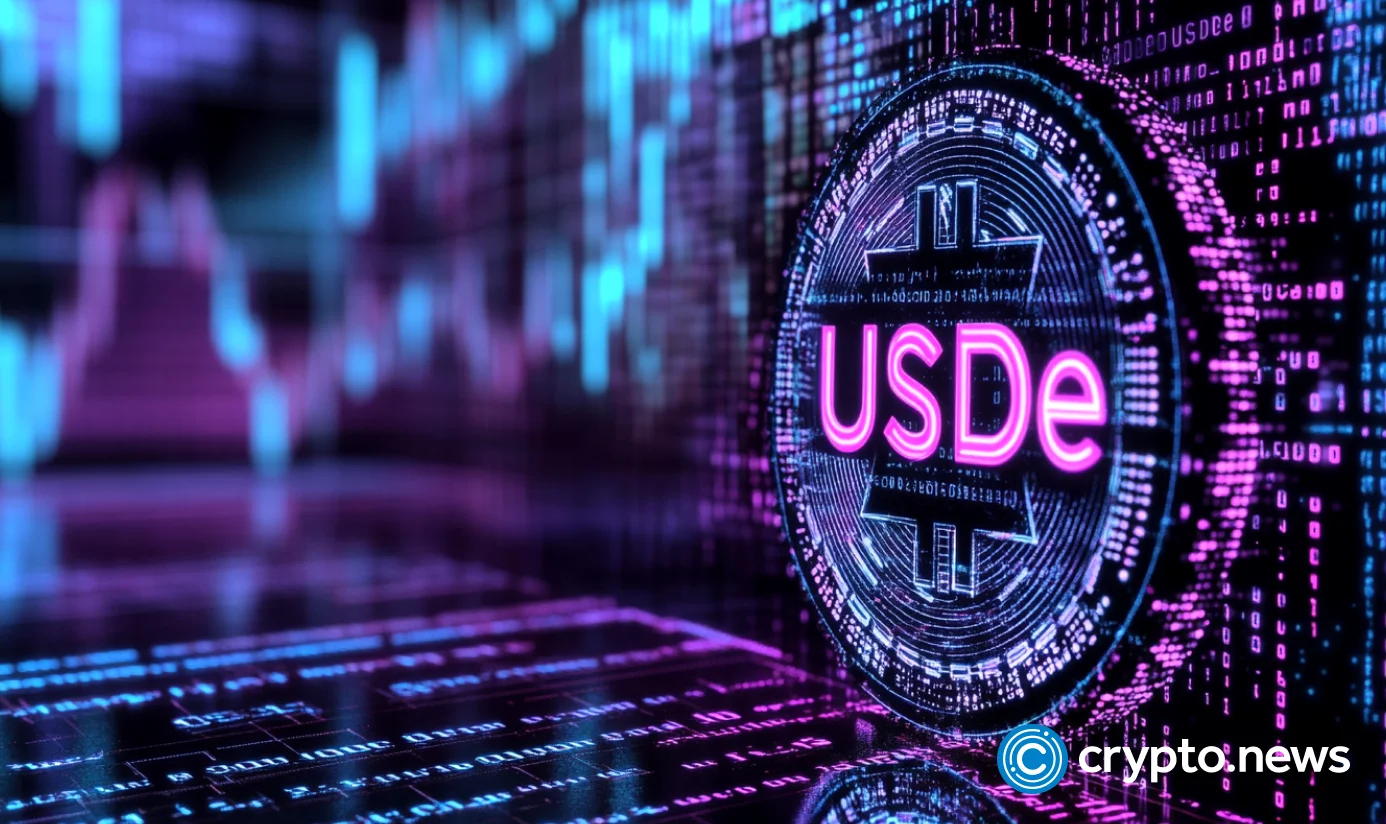
StablecoinX has completed its merger with TLGY Acquisition Corp., giving the Ethena-focused stablecoin infrastructure firm a Nasdaq listing under the ticker USDE.
Summary
- StablecoinX reaches Nasdaq as USDe supply sits far below its October peak, testing investor demand.
- The firm holds about $275m in ENA, linking its public-market story directly to Ethena’s token.
- Three planned business lines aim to serve Ethena infrastructure, software access and institutional distribution needs.
The company said its public warrants will trade under USDEW from Friday, June 26, after the business combination closed a day earlier. The move turns a private Ethena infrastructure bet into a listed equity trade for public investors this week.
The listing gives public-market investors a direct route into StablecoinX’s Ethena strategy.
“We believe Ethena has emerged as one of the most important platforms powering the next generation of digital dollars,” said CEO and chairman Edward Chen.
The company now enters public markets while demand for Ethena’s main synthetic dollar has cooled from last year’s peak.
ENA treasury anchors the plan
StablecoinX said it holds about 3.029b Ethena governance tokens, worth about $275m based on the 30-day ENA average used before closing. The holding represents about 20% of ENA’s total supply. The company also has about 24m publicly traded Class A shares outstanding after the transaction.
As previously reported, StablecoinX first outlined a $360m ENA treasury strategy in 2025. The plan later grew through more private financing, making ENA exposure central to the company’s story. That structure ties StablecoinX’s market value closely to Ethena adoption, ENA pricing and demand for USDe-related services.
USDe supply drop tests timing
USDe is Ethena’s synthetic dollar. It aims to hold a $1 value through crypto collateral and hedged futures positions, rather than cash reserves alone. The model can generate yield, but it depends on market conditions. When futures funding rates weaken or turn negative, the return engine can face pressure.
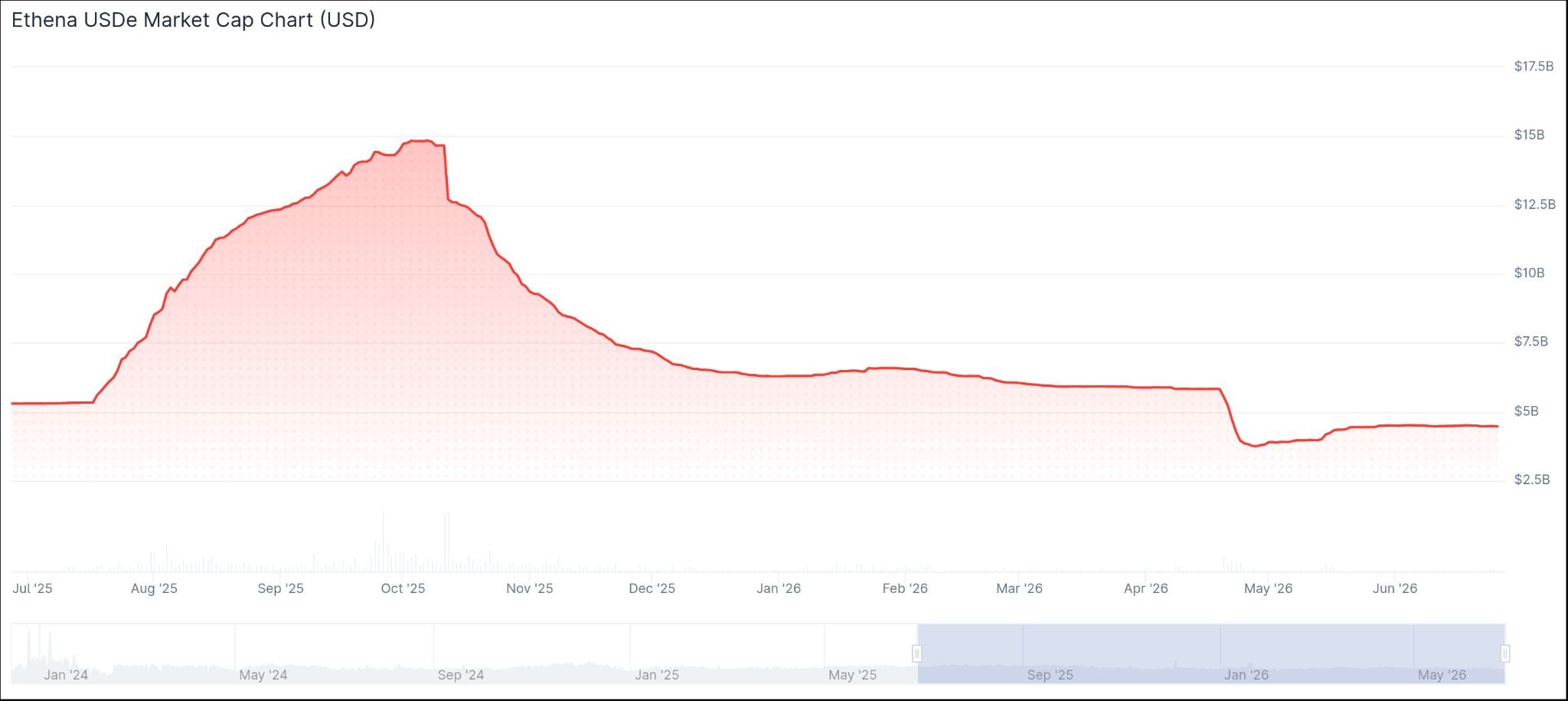
That pressure is visible in supply data. USDe circulating supply has fallen about 70% from its October peak above $14b to roughly $4.5b. Previously, crypto.news explored how USDe saw $1.1b in net outflows as the broader stablecoin market kept growing. The fall gives StablecoinX a tougher opening setup than the one Ethena had during last year’s expansion.
Infrastructure and regulation remain in focus
StablecoinX says its business has three parts. Its live decentralized verifier node checks cross-chain messages for Ethena across supported networks. It is also building Stablecoin Harness, a middleware stack for payment routing, bridging, liquidity access, treasury tools, reporting and compliance needs. Distribution services for institutions are also in development.
In a previous article, crypto.news discussed Coinbase Ventures buying ENA on the open market as Coinbase and Ethena prepared on-chain finance and savings products. As crypto.news reported, Jupiter Lend also added a USDe lending market with Bitwise. These links show Ethena is still building distribution, even as USDe supply has dropped.
StablecoinX’s debut also lands during a wider policy fight over stablecoin yield in the U.S. Yield-bearing stablecoins sit in a different legal area from plain payment stablecoins because they pass returns to holders. In our last update, crypto.news examined how yield-bearing stablecoins work and why the source of yield matters.
The company is entering Nasdaq with a clear Ethena bet, a large ENA reserve and several products still being built. Its early public trading may show whether investors want exposure to stablecoin infrastructure when USDe supply is lower, ENA remains far below its 2024 high and crypto market appetite remains weak.
TLDR:
- Polymarket hack stemmed from a compromised third-party vendor that injected malicious JavaScript into the platform’s frontend.
- Over 11 wallets lost PUSD on Polygon; stolen funds were bridged to Ethereum and swapped into 1,893 ETH.
- Polymarket confirmed the breach within 15 minutes of the first public report and removed the affected dependency.
- Polymarket pledged full refunds to all impacted users while on-chain investigators continue tracking the stolen ETH.
A supply-chain attack hit Polymarket on June 25, 2026, draining close to $3 million from user wallets. Attackers compromised a third-party vendor to inject malicious code into the platform’s frontend.
The script targeted PUSD, Polymarket’s native collateral token on Polygon. At least 11 wallets lost funds before the platform contained the breach.
Polymarket has since removed the affected dependency and pledged full refunds to all impacted users.
How the Attack Reached Polymarket Users
The attack did not target Polymarket’s smart contracts. Instead, attackers breached a third-party vendor that supplied code to the platform’s frontend. That vendor became the entry point for malicious JavaScript delivered directly to users’ browsers.
When affected users connected their wallets, the injected script activated. It prompted them to sign or approve transactions without raising obvious suspicion. Those approvals handed over control of their PUSD holdings to the attacker.
On-chain investigator Specter was the first to flag the activity publicly. His report identified losses of roughly $2.94 million across more than 11 victim wallets. He also named the primary consolidation address: 0xe65b1C586757c5510B60F998Eebb14C1eF71E1eD.
Polymarket confirmed the breach about 15 minutes after Specter’s report. The platform’s public statement read: “This morning we discovered a 3rd party vendor had been compromised, injecting a malicious script into our frontend for some users. We’ve contained it & removed the affected dependency. We’re contacting impacted users & refunding them in full.”
Following the Stolen Funds On-Chain
After the wallets were drained, the attacker moved quickly to obscure the trail. The stolen PUSD was bridged from Polygon to Ethereum shortly after the theft. That cross-chain move is a common step in crypto laundering flows.
Once on Ethereum, the funds were swapped into approximately 1,893 ETH. PeckShield confirmed this detail after amplifying Specter’s initial report. The ETH was then consolidated into the primary wallet flagged by investigators.
Several staging wallets were also identified during the fund movement. These included addresses such as 0xC771A30a, 0xC44F2Ca6, 0x10366AdB, and 0x7BCECe0d. Each one played a role in routing the stolen assets before consolidation.
Despite the volume of stolen PUSD, the token held its peg throughout. CoinGecko data showed it trading near $0.9998 on Polygon after the incident. The theft hit individual wallets rather than the underlying token backing.
What Comes Next for Polymarket
Polymarket has committed to reimbursing every affected user in full. The platform says it is already contacting impacted wallets directly. That pledge covers the losses tied to the supply-chain breach.
This is not the platform’s first perimeter-level security event. In May 2026, a compromised internal ops wallet drained roughly $500,000, though user funds were not touched. Earlier in 2025, comment-section phishing also cost some users funds.
Each of these cases showed that the protocol itself remained intact. The weak points have consistently appeared in the surrounding infrastructure. The June 25 incident follows that same pattern.
The stolen ETH remains traceable on-chain, keeping recovery possible. Investigators continue monitoring the consolidation wallet. The identity of the compromised vendor and the final victim count have not yet been disclosed publicly.
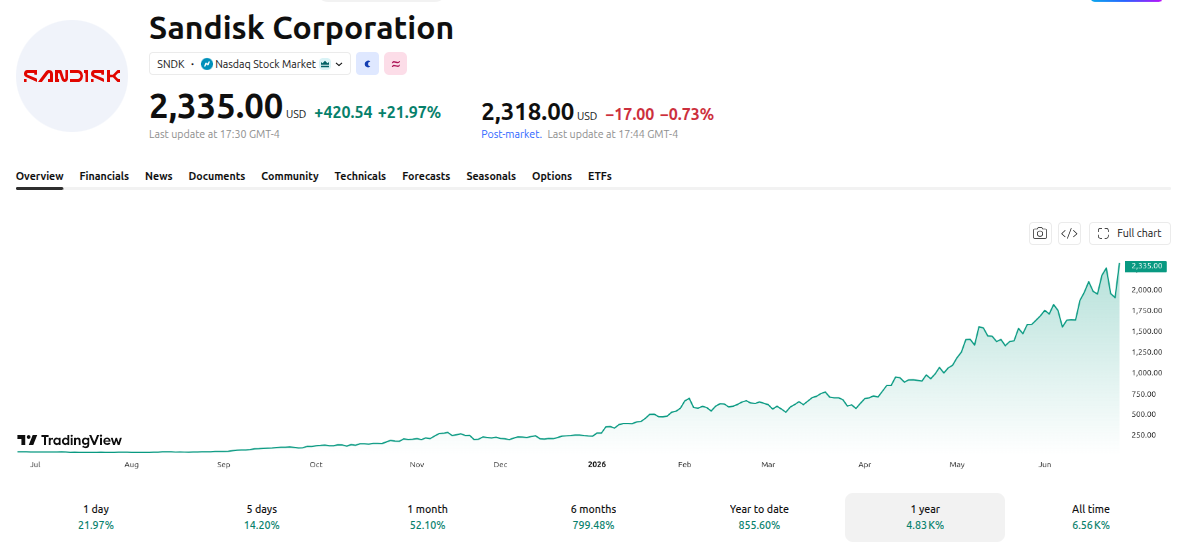
Citi has raised its Sandisk price target to $2,500 from $2,025, sending SNDK shares up roughly 22% in the last 24 hours. The chipmaker has rallied approximately 4,800% over the past 12 months on AI-driven NAND demand.
The upgrade adds fresh institutional firepower behind one of the most explosive Wall Street stories of 2026.
Why Citi Raised Its Sandisk Price Target
A price target is the level an analyst expects a stock to reach over a defined horizon, typically 12 months. Citi analyst Asiya Merchant lifted her Sandisk target by nearly 24%, signaling roughly 30.6% additional upside while keeping a Buy rating on the chipmaker.
The catalyst came from Micron’s blowout fiscal third quarter. Furthermore, NAND bit shipments rose mid-single digits sequentially, while average selling prices surged in the mid-80% range, confirming the depth of the supply tightness now reshaping the entire memory chip industry.
Follow us on X to get the latest news as it happens.
Merchant pointed to a clear structural setup. NAND industry demand is now outpacing supply, with that imbalance expected to persist well beyond 2027. AI workloads, especially in data centers, are driving most of the new demand across enterprise SSDs and adjacent storage products.
Citi also opened a 90-day short-term upside view on Sandisk shares. The bank flagged three near-term catalysts. Industry earnings, the Flash Memory Summit in August, and SanDisk’s investor day during the same month should all further sharpen sentiment across the sector.
Sandisk’s own numbers add weight to the bullish call. The company posted $5.95 billion in revenue last quarter, up 97% sequentially. Moreover, data center revenue alone grew 233% quarter over quarter, while more than one-third of fiscal 2027 bit output is already locked under multi-year contracts.
On the other hand, decentralized exchanges Raydium and Jupiter have added Sandisk to their roster of tokenized stocks. The listing reflects the rising appetite among crypto traders for exposure to the year’s top-performing equities.
What the 4,800% SNDK Rally Tells the Market
Sandisk has emerged as the best-performing stock in the entire S&P500 in 2026. Shares are up roughly 727% year-to-date, while the 12-month run from a low near $40 to recent highs above $2,335 marks an extraordinary 4,800% advance.
The rally tracks a structural shift in NAND economics. AI infrastructure spending has rewritten the demand curve. As a result, data center operators now rely heavily on cost-efficient SSDs to offload workloads, such as KV cache, a use case that did not exist in a meaningful way 18 months ago.
The Wall Street chorus has turned overwhelmingly bullish. Veteran trader Stephen “Sarge” Guilfoyle also raised his own Sandisk target to $2,600 from $2,425. Furthermore, the stock currently has a Strong Buy consensus rating on TipRanks, based on 14 Buy ratings and only 2 Hold ratings.

Risks remain real despite the conviction. SNDK trades at an elevated trailing P/E of 65 to 76 times earnings. Moreover, the stock recently fell 13.64% in a single session during a broader tech selloff tied to the Korean Kospi crash, showing how exposed the name remains to volatility.
For Citi, the bigger picture still favors the upside thesis. Bit supply growth across the NAND industry is projected at roughly 20% for 2026, while Micron itself expects its own supply growth to come in below that figure.
The post Citi Raises Sandisk Price Target to $2,500 as SNDK Rallies 4,800% in 12 Months appeared first on BeInCrypto.
Crypto World
Rosen Law Firm Investigates MicroStrategy Over Michael Saylor’s Alleged Misleading Claims on STRC

TLDR:
- Rosen Law Firm has launched a securities investigation into MicroStrategy over alleged misleading STRC claims by Michael Saylor.
- STRC preferred stock has dropped over 22% from its $100 par value, trading as low as the low $80s in June 2026.
- Strategy’s annualized STRC dividend rate has climbed to 11.50%, adding tens of millions in additional annual payout obligations.
- Strategy sold 32 BTC in late May 2026 to cover dividends, marking its first disclosed net Bitcoin disposal in years.
Rosen Law Firm has opened a formal investigation into MicroStrategy, now rebranded as Strategy Inc., over potential securities claims tied to STRC preferred stock.
The probe follows allegations that co-founder Michael Saylor made misleading promises of guaranteed returns to investors.
STRC has since dropped over 25% from its $100 par value. Shareholders holding MSTR common stock and preferred securities: STRF, STRC, STRK, and STRD are covered under the investigation.
Rosen Law Firm Targets Saylor’s Alleged Misleading Promises to STRC Investors
Rosen Law Firm is preparing a class action to recover losses for affected Strategy investors. The investigation centers on whether Saylor’s public statements on STRC constituted materially misleading business information.
Investors who purchased Strategy securities may be entitled to compensation through a contingency fee arrangement, with no out-of-pocket costs required.
The firm directed affected investors to take immediate action. “To join the prospective class action, go to rosenlegal.com/cases/strategy-inc/join or call Phillip Kim, Esq. toll-free at 866-767-3653 or email case@rosenlegal.com for information on the class action,” the firm stated in its announcement.
Rosen Law Firm has a documented track record in securities class action litigation. The firm ranked No. 1 by ISS Securities Class Action Services for the number of settlements in 2017 and has remained in the top four each year since 2013. It has recovered hundreds of millions of dollars for investors globally, securing over $438 million in 2019 alone.
The investigation comes as MSTR common shares have fallen to a 28-month low in June 2026. Losses on MSTR have far exceeded Bitcoin’s own drawdown over the same period.
This widening gap has drawn fresh scrutiny toward the company’s leveraged Bitcoin acquisition model and Saylor’s public representations to investors.
STRC Preferred Stock Collapse Raises Questions on Strategy’s Sustainability
STRC has traded as low as the low $75s in recent sessions, down more than 25% from its $100 par value target. The preferred stock was originally structured to provide stable, low-cost funding for Bitcoin purchases. That structure has since deteriorated under sustained market pressure throughout June 2026.
Source: YahooFinance
The firm underlined the importance of selecting experienced legal counsel for affected investors. “We encourage investors to select qualified counsel with a track record of success in leadership roles,” Rosen Law Firm noted, adding that many firms issuing similar notices lack comparable experience or meaningful peer recognition.
Under STRC’s contractual terms, when the stock falls below the $95 threshold, the dividend rate increases by 0.5% increments.
The annualized rate currently sits at 11.50%, with effective yields climbing higher due to the discounted trading price. Additional annual payout obligations are now estimated in the tens of millions of dollars.
Strategy’s cash cushion supporting these dividends has narrowed sharply from multi-year coverage to roughly 14 months in some analyst estimates.
The company also sold 32 BTC in late May 2026 to help cover dividend payments: the first disclosed net Bitcoin disposal in years.
Unrealized paper losses on Strategy’s Bitcoin holdings are reported to exceed $10 billion, as questions around capital sustainability and the company’s broader Bitcoin development narrative continue to grow.

Sharplink, the Ethereum treasury company, has made its first Ether purchase in eight months as ETH slid to the lowest level seen this year. The move highlights how corporate balance-sheet strategies can continue even when broader market momentum weakens.
According to on-chain data tracked by Arkham, a wallet associated with Sharplink received 5,000 ETH on Thursday via crypto prime brokerage FalconX. Arkham data places the transaction at roughly $7.85 million. FalconX was last recorded supplying Sharplink with ETH on Oct. 26, when the company bought $78.3 million worth of Ether.
Key takeaways
- Sharplink bought 5,000 ETH on Thursday, marking its first Ether acquisition in about eight months.
- The purchase comes as Ether fell to $1,537—its lowest price level reported for 2026.
- Arkham’s on-chain records show FalconX was also the execution partner on Sharplink’s previous reported ETH buy on Oct. 26.
- Sharplink’s Ether strategy is tied to a multi-factor thesis that includes US stablecoin/crypto regulatory progress and continued real-world asset tokenization.
- The company is also expected to be added to the Russell 2000 and Russell 3000 indexes, a development investors may watch for potential capital-market spillovers.
A corporate buy at ETH’s 2026 low
Ether’s decline to $1,537 on Thursday provides the immediate backdrop for Sharplink’s latest treasury action. While the broader market reaction is typically measured by price and volatility, the company’s decision points to a different lens: steady accumulation even during softer conditions.
Bitrue Research Institute’s Andri Fauzan Adziima characterized the behavior as evidence of ongoing corporate conviction. “I’m seeing genuine corporate accumulation conviction holding strong amid subdued price action,” Adziima told Cointelegraph.
In other words, the purchase aligns with a pattern that treasury operators often follow—building positions when liquidity is available and valuations are comparatively depressed—rather than waiting for a market uptrend to begin. Traders may therefore interpret Thursday’s on-chain activity as a signal that Sharplink sees more than just short-term price pressure in its Ether holdings.
What Sharplink has previously pointed to
The latest buy also fits with remarks made by Sharplink CEO Joseph Chalom earlier this year. In May, he outlined three catalysts he believed could support Ether’s outlook.
First, Chalom pointed to the US CLARITY Act. Second, he connected potential upside to a renewed appetite for market risk, which he said would depend on easing geopolitical tensions and a cooling of the “artificial intelligence investment thesis.” Third, he emphasized continued expansion in real-world asset (RWA) tokenization.
That regulatory and tokenization framework remains a central uncertainty. While the Senate has not yet voted on its version of the CLARITY Act, the House Financial Services Committee said it plans to hold a hearing on July 17.
The political and market assumptions around these catalysts are also moving targets. The article notes that the US and Iran are working toward a final peace agreement to end months of conflict. Separately, tokenized real-world assets have reportedly reached a distributed asset value of $31.55 billion, approaching what the source describes as the highest level seen this year.
Sharplink’s Ether position and rivals’ momentum
Sharplink’s latest transaction comes as it continues to build a sizable Ether balance. Founded in 2019 as an affiliate marketing service provider for sports betting and gambling industries, the company pivoted to become an Ethereum treasury business in June 2025. Consensys co-founder and CEO Joe Lubin was named chairman at that time.
At its peak, Sharplink was described as the largest publicly traded corporate holder of ETH, though it later lost that top position to Bitmine in August—just two months after Bitmine launched its own Ether buying strategy.
The company now holds 876,285 ETH and ETH equivalents accumulated through a combination of active purchases and staking rewards, the source reports. Bitmine, by comparison, is reported to hold 5.67 million ETH after acquiring an additional 52,203 ETH last week.
Bitmine chairman Tom Lee added context around the broader timing of accumulation, saying the company “continue[s] to maintain a steady pace of accumulation throughout 2026” and that it believes “we are in the early stages of crypto spring.”
Corporate treasury strategy meets public-market access
Beyond the on-chain buy, Sharplink is approaching a different milestone: its expected inclusion in the Russell 2000 and Russell 3000 indexes on Monday. Index additions are often viewed as meaningful because many passive and active funds—including exchange-traded funds—tend to rebalance holdings around such changes.
In May, Chalom said joining the Russell indexes would broaden Sharplink’s shareholder base and strengthen access to capital markets. For investors, the combination of a continuing treasury accumulation plan and wider index-driven visibility could matter, particularly for those tracking how crypto-linked equities integrate into mainstream portfolios.
Looking ahead, readers should watch whether Sharplink’s renewed buying pace persists beyond this single reported transaction—especially as US regulatory timelines around the CLARITY Act and shifting macro conditions influence risk appetite. The next on-chain confirmations and how the market responds to index inclusion may offer additional clues about whether this “accumulation conviction” translates into a sustained corporate bid for Ether.
Stablecoin infrastructure company StablecoinX has completed its merger with TLGY Acquisition Corp, a publicly traded special purpose acquisition company, allowing it to begin trading on Nasdaq on Friday.
StablecoinX is the first public stablecoin infrastructure company focused on supporting the Ethena ecosystem through decentralized verifier nodes and software infrastructure, and will trade under the symbol “USDE,” according to a statement on Thursday.
“We believe Ethena has emerged as one of the most important platforms powering the next generation of digital dollars,” said Edward Chen, CEO and Chairman of StablecoinX.
The Nasdaq debut is a big bet that stablecoins are becoming the plumbing of global finance, and comes despite a broader crypto bear market and Ethena’s relatively small 1.4% market share of the stablecoin market compared with those offered by its competitors, such as Tether and Circle.
Ethena’s USDe is a yield-bearing synthetic dollar-pegged stablecoin. Unlike USDt (USDT) or USDC (USDC), which are backed by actual dollars, USDe (USDE) maintains its $1 peg through a derivatives strategy.
It is backed by crypto collateral in Bitcoin and Ether and short futures positions on those same assets, enabling the long and short positions to cancel out the price volatility, helping to keep its value at approximately $1.
Ethena’s delta-neutral strategy works well in normal markets but is vulnerable during periods when futures funding rates go negative.
USDe supply falls
While stablecoin circulation has grown in recent years, USDe market capitalization has declined by 70% since its peak in October to around $4.5 billion today, ranking it sixth among stablecoins.
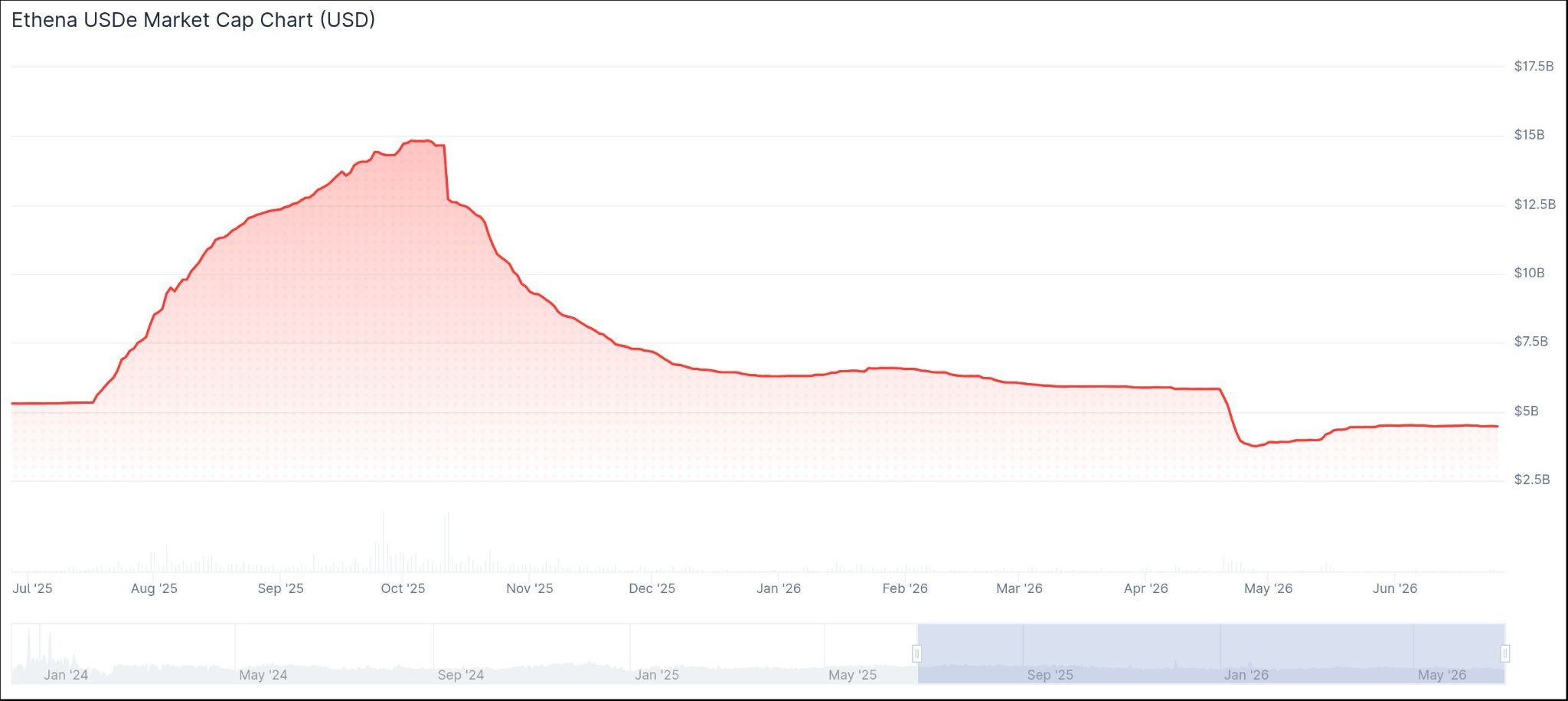
USDe supply has fallen since the bull market peak. Source: CoinGecko
StablecoinX’s treasury also holds approximately 3 billion Ethena governance tokens (ENA), or around 20% of the total supply, valued at approximately $275 million. The company announced a $360 million capital raise to purchase ENA on Sunday.
However, the asset is currently trading at $0.08, down 94% from its April 2024 all-time high.
Related: Yield-bearing stablecoins surge as Washington fights over yield
The company has three business lines: a decentralized verifier node (DVN) serving as a cross-chain message verifier for the Ethena ecosystem, a middleware software stack called “Stablecoin Harness” and distribution services, which are currently in development.
The company says the three businesses reinforce one another, though the broader crypto bear market presents a challenging backdrop for its Nasdaq debut.
Crypto SPACs and crypto treasuries have had a tough time this year as the broader market has tanked 52%, with $2.3 trillion leaving the space since October and crypto falling out of favor among investors.
Pre-merger TLGY fell 6.93% on Thursday on OTC markets to end the day trading at $9.40, according to Google Finance data.
Magazine: AI is banking the unbanked in Africa… faster than crypto

The 1 move that keeps great ball strikers from coming over-the-top

GeekWire 200 update: New unicorns and a hardware surge remake our list of top Pacific NW startups

Allan Marshall: New CCTV footage contradicts prison death evidence


-

 Fashion6 days ago
Weekend Open Thread: Miami – Corporette.com
-

 Entertainment5 days ago
Renter of Home in Anne Heche Crash Denies Settlement With Son
-
 Sports2 days ago
Two goals and an assist by sheer aura: Cristiano Ronaldo just entered the World Cup chat
-

 Tech4 days ago
Microsoft accidentally kills epic Outlook email threads
-

 Business5 days ago
Soccer-U.S. defends Iran World Cup travel restrictions, says discussions ongoing
-

 Politics6 days ago
Andy Burnham and the meaning of Makerfield
-

 NewsBeat7 days ago
Keir Starmer Allies Question His Chances For No 10
-

 Tech10 hours ago
A Look At A Gaggle Of Transputer Boards
-
Crypto World2 days ago
Bitcoin (BTC) Dips Below $62K, Ethereum (ETH) Plunges 6% Daily: Market Watch
-

 Crypto World2 days ago
Securitize Wraps Roubini's SEC-Registered ETF as Dubai VARA Digital Security
-
Business2 days ago
Entergy settles forward sale agreements, raises $672 million in cash proceeds
-
 Business6 days ago
Wall Street Week Ahead: Investors see Micron earnings as pulse check of AI rally momentum
-
 Crypto World6 days ago
Can Charles Hoskinson Really Rescue Cardano?
-

 Crypto World6 days ago
HIVE shares jump as $220M AI deal speeds Bitcoin mining pivot
-

 Entertainment6 days ago
Jose Alvarado Wants Taylor Swift at More Knicks Games
-

 Crypto World6 days ago
Jake Chervinsky accuses CME of protecting derivatives monopoly
-
 Tech5 days ago
Signal’s Meredith Whittaker says AI chatbots ‘are not your friends’ and calls Copilot agents a backdoor
-

 Sports16 hours ago
India vs Bangladesh LIVE Score, Women’s T20 World Cup: Bangladesh Opt To Bat; India Enter ‘Do-Or-Die’ Stage As Semi-Final Race Heats Up
-

 Tech3 days ago
Nearly 7,000 fake Amazon domains registered ahead of Prime Day 2026, researchers warn
-

 Politics3 hours ago
Potential 2028er World Cup attendee leaderboard
You must be logged in to post a comment Login