

Crypto World
Why Wall Street values some crypto firms for AI power, not just crypto

-
Power over tokens: Why AI is changing crypto valuations
For a long time, the value of crypto companies was closely tied to traditional indicators such as trading volumes, digital asset holdings, mining income and assets under management.
Investors generally judged these firms by their exposure to Bitcoin, Ether and the broader growth of blockchain technology.
That view now appears to be changing.
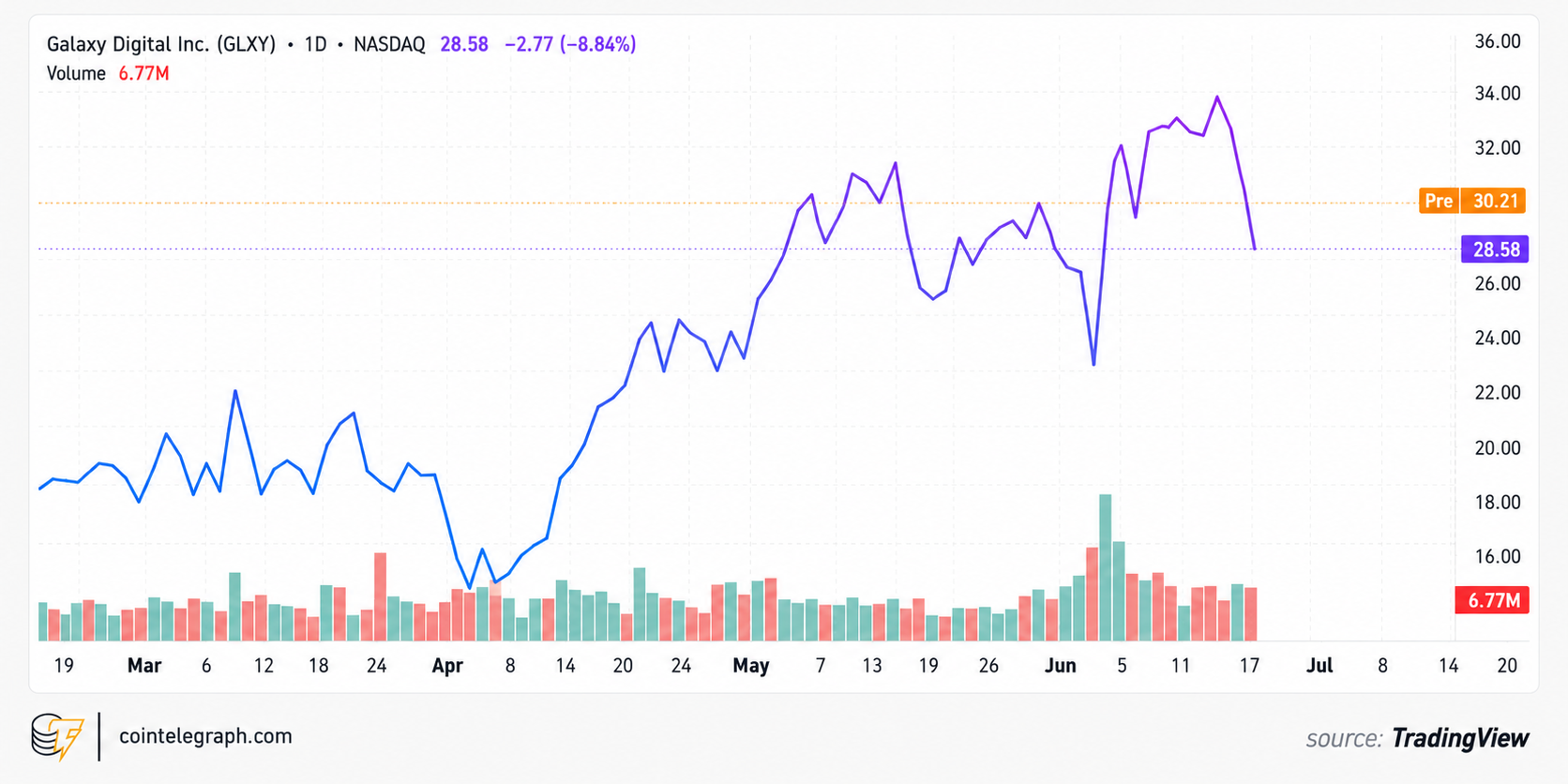
In June 2026, shares of Galaxy Digital rose sharply as investors focused on a different part of the business: artificial intelligence infrastructure. The rally drew attention to a pattern taking shape in public markets. Some crypto companies are finding that Wall Street may value their access to power, land and data centers more than their traditional crypto activities.
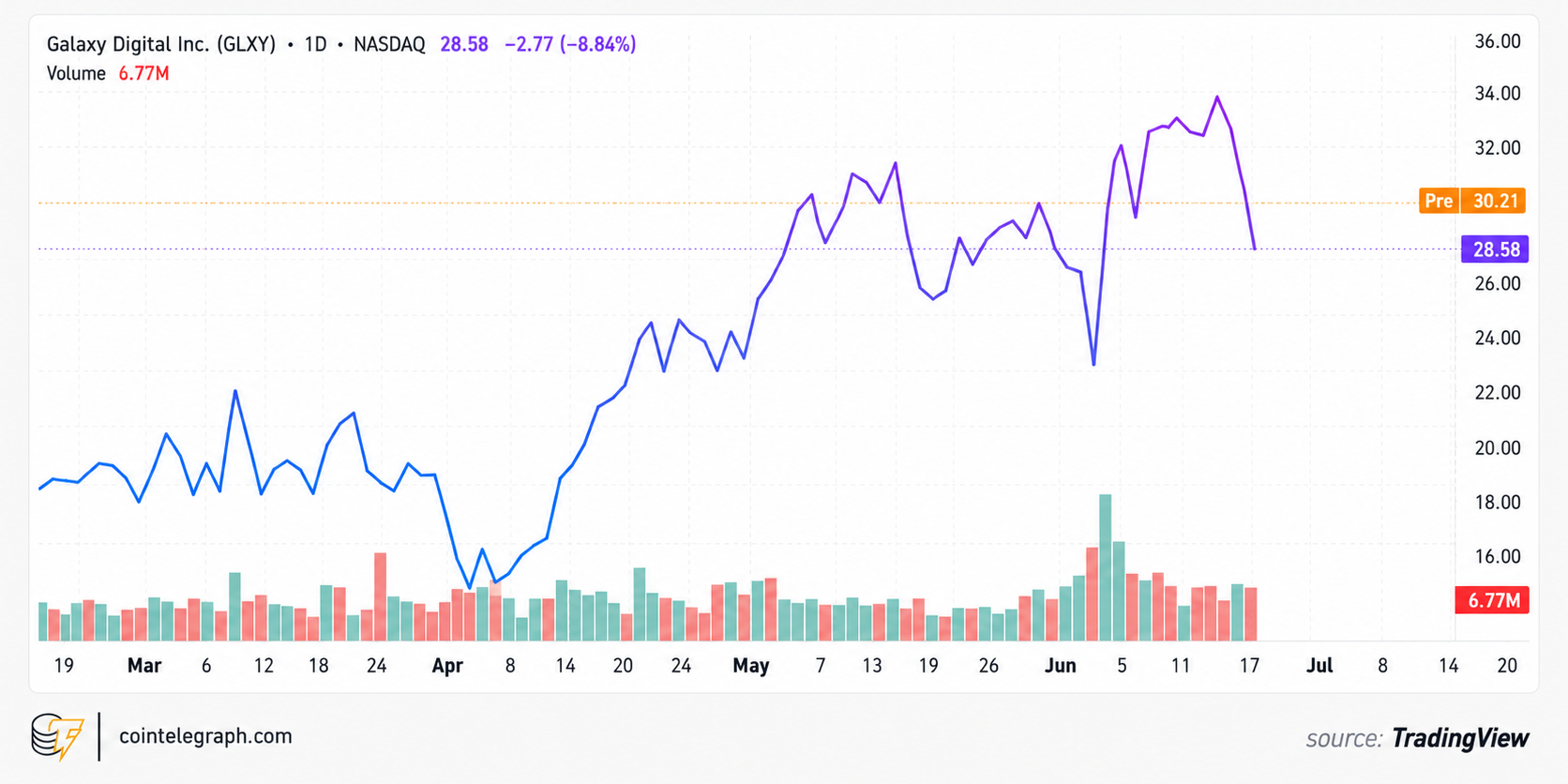
This shift points to a bigger change in financial markets. As demand for artificial intelligence grows, the infrastructure needed to support AI models has become one of the world’s most valuable resources. In some cases, crypto firms already control the exact assets that AI companies want.
-
The Galaxy Digital rally that caught crypto investors off guard
Galaxy Digital has long been a major player in digital assets, with businesses across trading, asset management, venture investments and blockchain infrastructure.
Yet the driver of its recent share price increase was not Bitcoin prices, ETF inflows or wider crypto trading activity.
Instead, investors focused on the company’s Helios campus in Texas. The site is a major data center project being developed for artificial intelligence and high-performance computing.
Comments from Galaxy Digital’s management suggested that Helios could eventually make up a meaningful share of the company’s total value. Market observers appeared to agree. Instead of viewing Galaxy Digital only as a crypto firm, investors began to assess it as an AI infrastructure company.
The rally showed a clear change in how investors value some crypto businesses. A company built on digital assets suddenly gained market attention for its possible role in the AI sector.
Did you know? Bitcoin miners once competed for cheap electricity. Now AI companies are competing for the same resource. In many regions, access to power has become more valuable than access to graphics processing units (GPUs) themselves. Some utilities have reported years-long waiting lists for large AI data center projects seeking grid connections.
-
Why AI infrastructure is now so valuable
The rapid growth of artificial intelligence has created a new bottleneck. The main challenge is no longer just building more advanced AI models. It is also securing enough computing capacity to train and run them.
Modern AI systems need large numbers of GPUs, specialized networking equipment, advanced cooling systems and huge amounts of electricity. Building the sites that house this equipment is now one of the most expensive projects in the technology sector.
As a result, investors are paying more attention to the companies that provide this core infrastructure, not just the companies building AI applications.
Data centers have become essential tools for AI growth.
This explains the strong investor interest in infrastructure-focused companies. Businesses that control power supplies, grid connections and large computing sites hold assets that are difficult and expensive to copy.
To Wall Street, those qualities often point to long-term revenue potential and more stable financial returns.
-
Why some crypto companies are well positioned
Some crypto companies are well positioned because they already share key infrastructure needs with the AI sector.
At first glance, crypto operations and artificial intelligence may seem like completely different fields. Yet both depend on one essential resource: massive computing capacity.
Over time, Bitcoin mining operations and other crypto infrastructure businesses invested heavily in sites built for high power demand. They acquired suitable land, secured power supply agreements, installed advanced cooling systems and connected directly to electrical grids.
These same resources are now attracting interest from AI companies.
An AI data center is not the same as a crypto mining operation. Still, the two share several core requirements, including high electricity use, large physical sites and enough space for specialized equipment. This overlap has created an unexpected opportunity.
In some cases, AI operators can work with existing facilities that were first built for crypto. That can help them avoid the cost and delay of building new sites from scratch.
As a result, some crypto firms now hold valuable assets in the growing AI infrastructure market.
-
Helios and Galaxy Digital’s changing strategy
Galaxy Digital’s Helios campus shows how infrastructure originally tied to Bitcoin mining can be redirected toward AI computing. After acquiring the site from Argo Blockchain in 2022, Galaxy Digital began shifting Helios toward high-performance computing and AI data center services.
That strategy gained more support when AI cloud provider CoreWeave entered into agreements tied to the site. Those deals suggested that major AI companies saw strategic value in the infrastructure.
Long-term AI infrastructure agreements can create steady revenue streams that are easier to forecast than income from crypto trading. Instead of relying on sharp market swings, companies can secure cash flow through multi-year contracts.
That level of stability is attractive to public market investors.
Did you know? Training and running advanced AI models requires huge computing resources. That is pushing developers to search globally for locations with abundant and reliable energy.
-
The rise of crypto-AI hybrid companies
Galaxy Digital’s Helios strategy is not an isolated case. Across parts of North America, several crypto mining and digital infrastructure companies have started pursuing opportunities in AI hosting, cloud services and high-performance data center operations.
This points to a wider change in how financial markets classify these businesses. In the past, crypto companies were often viewed as high-risk businesses tied closely to digital asset prices.
Now, some investors are separating infrastructure assets from direct crypto exposure.
A company that controls hundreds of megawatts of power capacity may attract a different valuation approach than one that depends mainly on trading revenue. This has created a new type of business: the crypto-AI hybrid.
These companies remain active in digital assets, while more of their value comes from infrastructure that can support several industries.
-
Why Wall Street favors AI revenue
The market’s preference becomes clearer when looking at the economics of the two areas. Crypto revenues often vary sharply over time.
Trading volumes rise and fall with overall market sentiment. Asset management fees move with crypto valuations. Mining profits change based on network difficulty and token prices. By comparison, AI infrastructure revenue can look more like revenue from traditional utility or real estate businesses.
Companies sign multi-year contracts. Income becomes easier to predict. Financial forecasts become simpler to prepare. Institutional investors usually value this kind of consistency.
A long-term lease with an AI client often carries lower perceived risk than relying on future crypto market momentum. As a result, businesses tied to AI infrastructure can command higher valuation multiples.
This does not mean investors have turned away from crypto. Instead, they may see AI infrastructure as a more reliable base for future income.
-
Could the market be getting ahead of itself?
Even with the current optimism, there are still reasons to be cautious. The rise of AI infrastructure has created strong excitement, leading some analysts to question whether too much capacity could eventually be built.
Past technology booms offer many examples of early overinvestment. Railroads, telecommunications networks and early internet infrastructure all went through periods of excess development before demand caught up with supply.
AI infrastructure could face a similar risk if capacity grows faster than demand.
If demand grows more slowly than expected, some data center projects may struggle to reach the occupancy levels investors are now expecting.
Execution risks also remain. Converting facilities originally built for crypto into AI-ready sites requires major capital spending and specialized expertise. Not every company will manage that transition well.
Investors must therefore balance real opportunities against the risk of overexcitement.
Did you know? Companies building AI infrastructure are increasingly negotiating energy contracts directly with utilities, renewable power developers and even nuclear operators to secure long-term electricity supplies.
-
What this means for crypto investors
The impact reaches well beyond Galaxy Digital. Investors assessing crypto-related stocks may need to look beyond digital asset exposure.
Factors that once centered mainly on crypto now include infrastructure questions:
- How much power capacity does the company control?
- Does it own land in strategic locations?
- Can its facilities support AI workloads?
- Are major technology firms interested in leasing its infrastructure?
- How diversified are its revenue sources?
In some cases, these factors may matter as much as Bitcoin holdings or trading volumes.
This points to a changing valuation approach, where physical infrastructure carries more weight than digital assets alone.
-
The new reality: Power may matter more than crypto
Galaxy Digital’s share price increase highlighted a clear change in the market.
Wall Street is placing serious value on the infrastructure needed to power artificial intelligence. Data centers, reliable electricity supplies and computing resources have become strategically important assets.
Some crypto companies already control these resources after spending years building them for mining and blockchain operations. As AI demand grows, investors may begin to see these assets as more valuable than traditional crypto businesses.
For companies like Galaxy Digital, the path ahead may no longer depend only on Bitcoin, trading operations or asset management. The bigger source of value could be something more physical: access to power, land and the computing infrastructure needed to support the next wave of artificial intelligence.

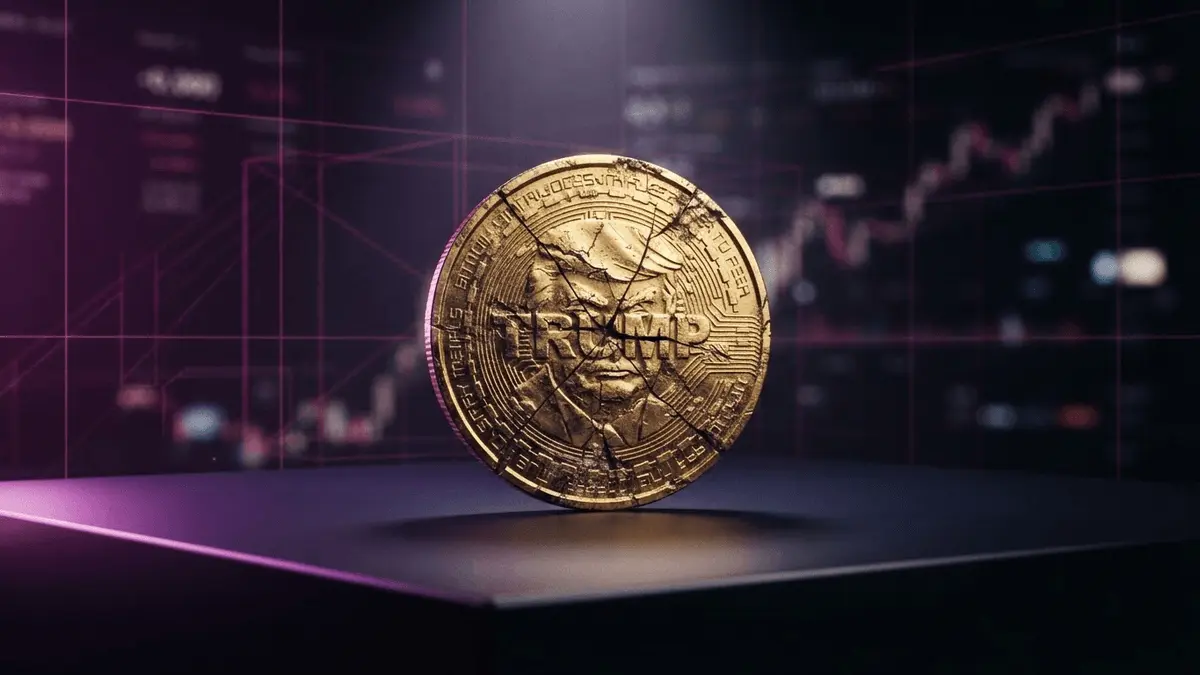

John Oliver’s return to Last Week Tonight landed on crypto’s most politically charged fault line. The TRUMP crypto memecoin is trading near $1.48, down about 6% over the past day. Meanwhile, Bitcoin sits around $63,460 after slipping roughly 2%, reflecting cautious sentiment ahead of key macro events.
Oliver’s HBO exposé highlighted one striking figure. Trump’s first year back in office reportedly generated more than $2.2 billion in personal income. Around $1.4 billion came from crypto ventures, including NFTs, memecoins, and World Liberty Financial. He called Trump “the first crypto president” and traced his shift from dismissing Bitcoin to embracing digital assets.
The segment also described the TRUMP memecoin as a classic pump and dump. Oliver argued insiders sold into strength while many retail investors absorbed steep losses. He tied that criticism to the Trump family’s expanding crypto business and questioned whether political influence amplified investor demand.
For markets, the bigger issue is regulation. Ethics lawyers argue that a sitting president earning substantial crypto revenue creates an obvious conflict of interest. Whether that leads to tighter oversight or fuels more speculation around Trump crypto tokens remains a key question traders continue to weigh.
Discover: The Best Crypto to Diversify Your Portfolio
Can TRUMP Crypto Memecoin Recover, or Is $1.50 the New Ceiling?
At $1.48, TRUMP is pressing against a range that has offered little meaningful technical support since its sharp post-launch decline. The recent 24-hour range sits between roughly $1.47 and $1.56. Sellers continue rejecting rallies near the upper boundary, while buyers struggle to defend recent lows with conviction.
Volume remains the key factor. Oliver’s segment has brought fresh attention, but attention cuts both ways for a memecoin. It attracts speculative traders while reinforcing the pump-and-dump narrative for a much wider audience. Meanwhile, Bitcoin trades near $63,460, down about 2% on the day, offering little support for risk assets.
The bullish case depends on political headlines fueling speculative inflows. If TRUMP reclaims $1.56 with sustained volume, it could target $1.75 next. Even so, that outcome looks difficult unless Bitcoin regains momentum and market sentiment improves.
The base case favors consolidation between $1.45 and $1.56 as Oliver’s criticism continues circulating. Regulatory scrutiny may also keep buyers cautious. As a result, many holders could remain trapped on thin margins while waiting for a stronger catalyst.
The bearish case starts with a decisive break below $1.47. That would expose the $1.40 area if selling pressure accelerates. Any meaningful congressional action involving crypto conflicts of interest could intensify downside pressure, although no formal action has been announced.2 hours.
Trade Memecoins on Bybit and Get a Chance to Win Our $1,000 USDT Airdrop
Bitcoin Hyper Eyes Early-Stage Entry as Political Heat Pressures Meme Plays
When politically exposed tokens carry headline risk, and BTC softens on macro pressure, rotation tends to find infrastructure plays rather than narrative ones. The current market structure, with BTC dominance in flux and alt-season signals emerging, rewards projects that offer technical utility over political adjacency. That’s the environment Bitcoin Hyper ($HYPER) is raising into.
The project’s positioning is straightforward and technically specific: it is the first-ever Bitcoin Layer 2 integrating the Solana Virtual Machine (SVM), delivering smart contract execution and transaction throughput that, by design, outperforms Solana itself at the infrastructure level.
While inheriting Bitcoin’s security and trust model. That’s a meaningful combination if the architecture delivers, addressing Bitcoin’s three core limitations (slow finality, high fees, no programmability) without abandoning the base layer’s guarantees. The Decentralized Canonical Bridge handles BTC transfers natively.
Presale numbers as of this writing: $0.0136838 per $HYPER, with $33 million raised. Staking is live with a high APY incentive for early participants. With BTC under near-term pressure, a Bitcoin-native infrastructure presale absorbs a different risk profile than a memecoin.
Research Bitcoin Hyper before the current stage closes.
Discover: The Best Token Presales
The post John Oliver Rips Trump Crypto Involvement as “Flagrantly Corrupt and Compromised” appeared first on Cryptonews.

SEC Crypto: Securitize Capital, the advisory subsidiary of tokenized asset platform Securitize, has registered with the SEC as a full investment adviser, unlocking expanded institutional mandates for its onchain capital markets business.
The move graduates the firm from exempt reporting adviser status, under which it operated with constraints that limited the scope of the assets and clients it could serve.
Securitize announced the registration on Monday, framing it as a direct expansion of its regulated business stack. CEO Carlos Domingo said the registration strengthens the company’s ability to help institutions develop and manage investment strategies for onchain capital markets, according to Securitize.

Discover: The Best Crypto to Diversify Your Portfolio
What the Registration Actually Changes For Securitize
As an exempt reporting adviser, Securitize Capital operated under a lighter regulatory regime, primarily suited to venture capital or private funds with limited U.S. assets.
Full SEC registration under the Investment Advisers Act imposes additional disclosure, compliance, recordkeeping, and examination requirements, but it also removes the constraints on who the firm can advise and at what scale.
The practical effect: Securitize can now pursue a wider range of institutional advisory mandates, separately managed accounts, broader private fund structures, and formal investment strategies built around its tokenization infrastructure, without the cap imposed by exempt status.
This also completes Securitize’s U.S. regulatory stack in a meaningful way. The firm already operates an SEC-registered broker-dealer, an alternative trading system, a transfer agent, and fund administration services.
Adding a full RIA license positions it as a vertically integrated, regulated infrastructure provider for tokenized securities, a configuration few competitors can match. For context on the broader push toward regulated institutional infrastructure in crypto, the regulatory momentum driving institutional adoption has been building across multiple fronts in 2026.
Scale and Asset Manager Relationships
Securitize is the largest tokenization platform by onchain asset value, with approximately $4.8 billion in tokenized assets across funds managed by BlackRock, Apollo, KKR, VanEck, Hamilton Lane, and other institutional asset managers.
That existing franchise is what the advisory registration layers on top of; this is not a startup building toward institutional relevance, it’s a firm with established AUM relationships formalizing the advisory wrapper around them.
The Apollo relationship is worth flagging specifically. Securitize Capital has been listed as the contact on SEC filings tied to the Securitize Tokenized Apollo Diversified Credit Fund, indicating active work in tokenized credit strategies. Full RIA status makes structuring and managing those types of mandates more straightforward from a regulatory standpoint.
The trajectory here mirrors what’s happening elsewhere in institutional crypto infrastructure. Ripple’s push into institutional finance with RLUSD and prime brokerage and Fasanara Capital’s on-chain activity in institutional DeFi both reflect the same pattern: traditional capital isn’t waiting for perfect regulatory clarity before committing infrastructure spend to onchain markets.
Public Company Context and Stock Performance
Securitize began trading on the New York Stock Exchange under the ticker SECZ on July 2, after completing a merger with Cantor Equity Partners II. Shares have since fallen roughly 46% from their first-day closing price – a sharp correction that adds some irony to a week of regulatory milestone announcements.
The neoclassical facade of the New York Stock Exchange building on Wall Street.

The stock decline doesn’t directly undercut the strategic logic of the RIA registration, but it does put the compliance build-out in context: Securitize is now a public company with earnings obligations, and the advisory license needs to translate into fee-generating mandates to justify the increased regulatory overhead.
The infrastructure is compelling; the revenue model tied to it is what the market is apparently still pricing in.
For institutional asset managers already running tokenized funds through Securitize’s platform, full RIA status likely reduces friction around adding advisory services to existing relationships.
Whether that converts into new AUM inflows or an expanded mandate scope in the near term is the open question that the registration itself doesn’t answer.
Trade Ripple XRP on Bybit and Get a Chance to Win Our $1,000 USDT Airdrop
The post Securitize Gains Full RIA Status to Expand Onchain Advisory Mandates appeared first on Cryptonews.
Ripple has become one of the largest corporate political donors in the United States this election cycle, while the market structure bill backed by the crypto industry remains before the Senate ahead of the August recess.
Public Citizen estimates Ripple has contributed about $48 million during the 2026 election cycle, placing it among the country’s largest corporate political donors. Andreessen Horowitz ranks slightly higher at roughly $51.65 million, while Coinbase’s reported total differs because organizations count different PACs and contribution vehicles.
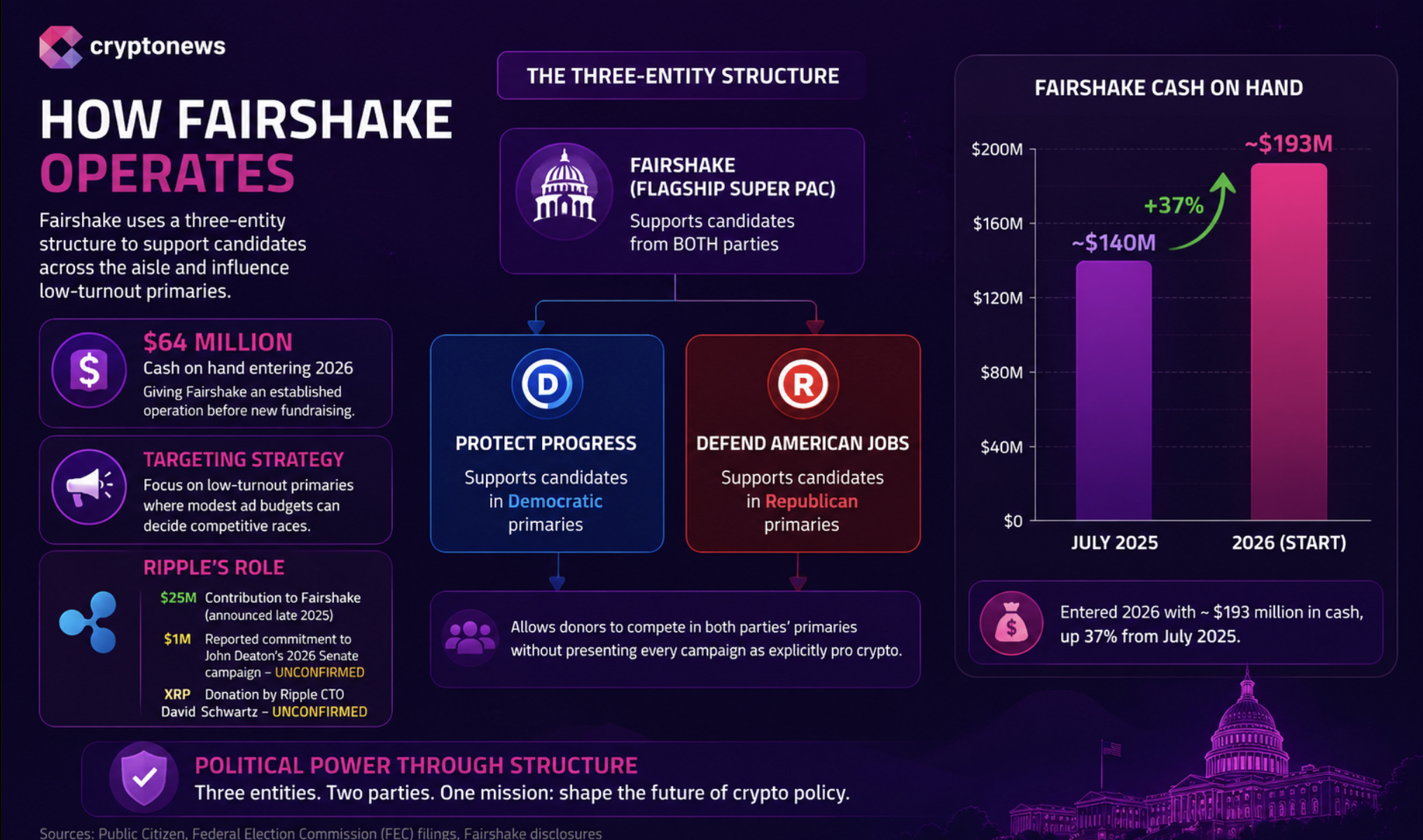
Most of the funding flows through Fairshake, the crypto industry’s leading super PAC network. Fairshake and its affiliated committees entered the 2026 midterms with roughly $193 million in cash, about 37% above their July 2025 level. Coinbase, Ripple, and Andreessen Horowitz together committed around $74 million during the second half of 2025.
Public Citizen estimates crypto companies have spent roughly $189 million, representing about 37% of all corporate election spending this cycle. By comparison, artificial intelligence and Big Tech contributed about $60 million, while online gambling accounted for roughly $45.6 million. By that measure, crypto has become the largest corporate political spending sector.
Discover: The Best Token Presales
How Ripple Mechanism Works
Fairshake operates through three organizations. The flagship super PAC supports candidates from both parties, while Protect Progress backs Democrats and Defend American Jobs supports Republicans. This structure lets donors compete in both parties’ primaries without presenting every campaign as explicitly pro crypto.
The network mainly targets low-turnout primaries, where relatively modest advertising budgets can influence competitive races. Fairshake entered 2026 with about $64 million already available, giving it an established political operation before new fundraising began.

Ripple’s largest disclosed commitment this cycle is a $25 million contribution to Fairshake, announced in late 2025. However, reports that Ripple has already committed $1 million directly to John Deaton’s 2026 Senate campaign remain unconfirmed through public campaign finance records. Claims that Ripple CTO David Schwartz donated XRP to Deaton’s campaign also lack official confirmation.
Discover: The Best Crypto to Diversify Your Portfolio
What the Spending Achieved and the Senate Test
Fairshake and its affiliates raised about $93 million during the 2023 to 2024 cycle and spent more than $130 million supporting preferred candidates. Representatives Jamaal Bowman and Cori Bush both lost Democratic primaries after heavy Fairshake-backed advertising, reinforcing the industry’s growing political influence even though neither race centered on crypto policy.
Congressional momentum followed. The House approved the CLARITY Act, while the GENIUS Act advanced separately with bipartisan backing. Although campaign spending alone cannot explain those results, the industry’s expanding political presence coincided with stronger congressional support for crypto legislation.
Massachusetts remains an important exception. John Deaton lost to Elizabeth Warren by nearly 20 percentage points in 2024 despite significant outside support, suggesting Fairshake’s strategy remains more effective in lower turnout primaries than statewide general elections.
Critics argue crypto’s influence comes from its concentration, with one industry supplying more than one third of corporate election spending. The industry counters that banking, energy, and pharmaceutical companies have long used similar political strategies. More than 200 crypto firms, including Coinbase, Ripple, and Kraken, have urged the Senate to pass the CLARITY Act, arguing clear rules are needed to keep innovation in the United States.
The legislation now faces a crucial Senate window before the August recess. Ripple CEO Brad Garlinghouse has remained one of its strongest advocates. If the bill passes, Fairshake will carry a substantial campaign reserve into the general election. If it fails, those resources could instead target future primary races.

Ripple’s political spending complements its broader investment in institutional finance, including RLUSD, custody services, and the Hidden Road acquisition, making regulatory clarity a strategic business priority rather than an XRP-specific objective.
Trade Crypto Before The Clarity Act Passes on Bybit and Get a Chance to Win Our $1,000 USDT Airdrop
The post Fairshake, $48M, and the Senate Vote Ripple Is Racing to Win appeared first on Cryptonews.
In 2023 a group of developers forked the XRP Ledger because its validators would not adopt smart contracts. Three years later the parent chain is shipping its own programmability layer, and the drafted specification names the fork’s technology as an inspiration. Here is what actually happened, what it means for XAH, and why three competing architectures now answer the same question.
Summary
- Xahau launched in 2023 as a fork of the XRP Ledger’s rippled codebase, carrying the Hooks amendment that XRPL validators never adopted, with its own token, its own validator set, and a governance system run through a genesis account hook.
- The XRP Ledger is now building programmability natively: XLS-100d Smart Escrows, using WebAssembly, sits among known amendments with a devnet live, and XLS-101 Smart Contracts is a drafted specification that cites both Hooks and the Ethereum Virtual Machine as influences.
- Xahau rejects the sidechain framing entirely, positioning itself as an independent Layer 1 that diverged in its own direction, with features the parent lacks and vice versa, and describing the borrowing as mutual.
- Three architectures now answer the same question for one ecosystem: Hooks on Xahau, Solidity through the EVM sidechain whose first year this publication audited at $25,741 in total value locked, and WebAssembly natively on the main ledger.
- The open question is what a fork is worth once the chain it left ships the capability it forked for, and XAH is the asset where that question gets priced.
Forks in crypto usually happen over money or ideology. This one happened over a feature. In 2023, after years in which the XRP Ledger’s validators declined to adopt Hooks, a lightweight smart-contract system that would let small pieces of code live on accounts and govern the transactions those accounts send and receive, the developers behind it stopped waiting. They took the ledger’s open-source rippled codebase, added Hooks, launched a network called Xahau with its own token and its own validators, and shipped the capability the parent chain would not. Ripple’s chief technology officer publicly supported the move at the time, saying he could not think of a better path forward for the technology. Three years later the parent chain is building programmability after all. XLS-100d, a WebAssembly-based Smart Escrows amendment, is among the known amendments with a devnet running, and XLS-101d, a drafted specification for general smart contracts, explicitly names both Hooks and the Ethereum Virtual Machine among its influences. This piece examines what that convergence actually means: for the ledger that spent years refusing, for the fork that stopped waiting, and for an ecosystem that now has three separate answers to the question of how a payments chain becomes programmable.
What Xahau took, and what it built
Understanding the fork requires understanding what it kept, because Xahau is not a departure from the XRP Ledger’s design so much as an addition to it.
The network preserved the core: the consensus protocol, the native decentralized exchange, and the fee-and-reserve logic that protects the ledger against spam by charging and burning fees in the native token. What it added was Hooks, small pieces of code installed on an account that impose rules on transactions before those transactions execute, enabling functions such as time locks on transfers, social-recovery arrangements for accounts, and self-custodial direct debits. The design philosophy is deliberately narrow. Hooks were never intended to replicate a general-purpose virtual machine; they are lightweight logic reacting to ledger events, executing fast enough to preserve settlement speed and cheap enough to suit a payments chain.
Two further design choices distinguish it. Xahau substituted a simpler token standard for the parent’s NFT implementation, and it built a governance system in which the genesis account itself is controlled by a hook that regulates matters including the emission of new XAH, administered through a two-tiered arrangement with up to twenty independently owned validators as participants. Governance by smart contract, on a chain whose reason for existing is smart contracts, is at least internally consistent. XAH functions as the network’s fee and reserve asset, with a balance-rewards mechanism that has no equivalent on the parent chain.
The launch was contentious in the way ecosystem splits usually are, with parts of the XRP community expressing unease at the lack of official involvement, and with the fork’s supporters arguing that validators refusing an amendment for years had left no alternative. The relevant point for today is that Xahau shipped and kept shipping, accumulating a validator set, an exchange listing history, and a working developer story around a capability the main ledger did not have.
What the parent is shipping now
The XRP Ledger’s current roadmap describes a different route to the same destination, and the specifications are public.
XLS-100d, Smart Escrows, brings WebAssembly-based conditional logic to escrow objects, allowing programmable conditions to govern the release of funds, and it appears among the ledger’s known amendments with a dedicated devnet for developers to test against.
That is a narrow, payments-native form of programmability: not a general computing environment, but escrows that can enforce arbitrary conditions written in a widely supported bytecode format. XLS-101d, Smart Contracts, is the broader specification, drafted in 2025, proposing general smart contract capability on the ledger and citing both Hooks and the EVM among the designs it draws from.
The choice of WebAssembly instead of a bespoke virtual machine is the interesting technical decision, because it imports an existing toolchain and developer base rather than asking builders to learn something proprietary. It is also, in its way, an admission: the ledger that resisted programmability for years is now adopting a mainstream execution standard, and doing so with public acknowledgment of the technology that forked away over exactly this question.
The timing places three approaches in the same ecosystem simultaneously. Hooks run on Xahau. Solidity runs on the XRPL EVM sidechain, whose first year this publication audited and found holding $25,741 in total value locked, a figure that remains the sharpest available evidence that architectural compatibility does not produce developer gravity by itself. And WebAssembly is arriving natively on the main ledger. Three answers, one ecosystem, and no consolidation in sight.
The fork refuses the frame
The narrative that writes itself, that a parent chain has absorbed the innovation its fork proved out, is one Xahau explicitly rejects, and its objection deserves fair treatment because it complicates the story usefully.
The current positioning from the Xahau side is that it is not a sidechain and never was one in any meaningful operational sense: it is an independent Layer 1, built from a fork of the XRPL codebase, that has evolved in a completely different direction with its own validators, its own governance, and its own economics. On this account the two networks occasionally adopt ideas from one another and otherwise develop separately, with features existing on each that do not exist on the other. The sidechain confusion, the argument goes, comes from early marketing history and not from present reality.
That framing is defensible on the technical facts and self-interested at the same time, which is normal for any project describing itself. Independence is real: separate consensus, separate validator set, separate token with its own monetary policy. Mutual borrowing is also real, since specifications flow in both directions among developers who largely know each other. But the asymmetry is equally real and no framing dissolves it. When the parent ledger ships general programmability, a developer choosing where to build weighs Xahau’s head start and Hooks’ elegance against the main ledger’s liquidity, its institutional relationships, its exchange support, and the ecosystem’s marketing gravity. Forks that exist to supply a missing capability face their hardest test at exactly the moment the capability stops being missing, and no amount of correct positioning about independence changes the competitive arithmetic a builder actually runs.
The threshold that decides everything
Everything in this piece depends on a governance mechanic that outsiders consistently underestimate, and the ledger’s own recent history supplies the cautionary case.
XRP Ledger amendments activate only when validators on the default list signal support at or above eighty percent, and that support must hold continuously for two weeks before the change takes effect. Fall below the line at any point in the window and the clock resets. There is no foundation that can force adoption, no core team veto, and no timetable: an amendment can sit in the known-amendments list indefinitely, gathering partial support, activating never. Hooks itself is the proof. The specification existed, the implementation worked, the technology was sound enough that the ledger’s own chief technology officer publicly endorsed the fork that shipped it, and the amendment still never reached the threshold on the main chain. Years of availability produced no activation, which is precisely why Xahau exists at all.
That history should discipline every forecast about XLS-100d and XLS-101d. A specification in the known-amendments list is a proposal that validators may or may not adopt, and a drafted specification like the general smart contracts proposal is a step earlier still. Both could activate this year; both could sit for three years; either outcome would be consistent with the ledger’s record. The ecosystem’s more recent experience cuts the same way in the opposite direction, since a maintenance amendment this summer sat near forty-eight percent support for a month before validators moved and carried it past the threshold at eighty-six percent, showing that stalled votes can turn quickly once the coalition assembles. Prediction is unwise in both directions.
The threshold also shapes the competitive dynamic between the two chains in a way neither side usually discusses. Xahau’s governance runs through a hook on its genesis account under a two-tier arrangement with up to twenty validators, which is a materially different mechanism from the parent’s eighty percent supermajority, and the fork’s ability to ship features it decides to ship is not a small advantage for a network whose entire premise is programmability. A chain that can adopt is structurally different from a chain that must persuade. Whether that speed advantage matters more than the parent’s liquidity is the actual competition, and it is a question about governance architecture more than about virtual machines.
For a reader tracking this, the practical instruction is simple: ignore roadmap announcements and watch the validator vote count, published continuously, on the specific amendments. Announcements are intentions. The count is the only thing that has ever decided what the XRP Ledger does.
What it means for XAH
The honest assessment splits into a bear case and a bull case that are both stronger than the ecosystem’s usual discourse allows.
The bear case is straightforward. XAH’s investment thesis has substantially been that Xahau is where XRPL-ecosystem smart contracts live. If XLS-100d and XLS-101d ship and function, that thesis erodes toward a narrower claim: Xahau is where a particular style of lightweight account-attached logic lives, competing against native WebAssembly contracts on a chain with vastly more liquidity, more integrations, and more attention. Fee-burn value accrual on a chain whose activity moves elsewhere is the same problem this publication has documented across the value-accrual arc, arriving in a smaller ecosystem with less cushion.
The bull case rests on three points that deserve their weight. First, shipping schedules: XLS-101d is a draft, amendments require validator adoption at an eighty percent threshold sustained over two weeks, and the ledger’s own history, including the years Hooks spent unadopted, is the strongest available evidence that XRPL amendments can stall indefinitely. Xahau’s capability exists today; the parent’s is a specification and a devnet. Second, design divergence: Hooks and WebAssembly contracts are not substitutes for every purpose, and lightweight event-triggered logic on accounts has properties a general contract environment does not. Third, and most underrated, the governance experiment: a chain whose emission and genesis account are administered by a hook under a two-tier validator arrangement is running a live test of on-chain governance that the parent has not attempted, and if that works at scale it is an independent reason for the network to exist.
The verdict this piece can honestly offer is narrower than either case: the fork’s premise has changed, and the market has not repriced it because the parent’s capability is not live yet. When XLS-100d activates, the question stops being theoretical, and XAH becomes the cleanest available measure of what a fork is worth after the reason for forking has been addressed at home.
What to watch
XLS-100d’s amendment vote. Smart Escrows crossing the eighty percent validator threshold and completing its two-week activation window is the event that converts this from a roadmap story into a live competitive fact. Watch the vote count, not the announcements.
XLS-101d’s progression. A drafted specification is a long way from an activated amendment. Whether the general smart-contract proposal moves toward candidate status within the year, or joins the long list of XRPL specifications that never reached a vote, determines the scale of the challenge to Xahau.
Developer migration signals. New deployments, tooling investment, and grant activity across the three environments are the leading indicators. The EVM sidechain’s first-year experience is the cautionary baseline: compatibility alone moved nothing.
Xahau’s differentiation response. The fork’s strongest move is to lean into what the parent will not copy, meaning its governance model, its balance rewards, and Hooks’ specific ergonomics. Whether the project pivots toward those or defends the general smart-contract ground is the strategic tell worth watching.
A closing observation about what this episode says about the ecosystem’s decision-making, since the technical story has a governance moral. The XRP Ledger’s amendment threshold is a genuine decentralization feature, the same property this publication has praised when validators declined to follow Ripple’s own signaling on other proposals, and it is also the reason a capability the ecosystem clearly wanted took six years and a fork to arrive. Both statements are true, and the tension between them is the permanent condition of any network that makes protocol change hard on purpose. Chains that can ship quickly capture opportunities and make mistakes quickly; chains that require supermajorities avoid mistakes and miss windows. Neither is a flaw to be fixed.
What the Xahau episode adds is the observation that in an open-source ecosystem, the slow chain does not actually prevent the feature from existing. It only determines where the feature lives, who benefits from it, and which token captures whatever value it generates. The developers who wanted Hooks did not wait; they left, built, and launched, and the parent chain’s caution cost it three years of programmability and handed a competitor its founding purpose. Now the parent is building the capability anyway, on its own timeline, with the fork’s work as a reference. That is either the system working exactly as designed, with experimentation happening safely outside the main ledger before the ideas mature into it, or an expensive way to arrive at a destination the ecosystem could have reached directly. Both readings have adherents, and the amendment vote will not settle which is right.
Disclaimer: This article is for information and educational purposes only and does not constitute financial or investment advice. Protocol specifications, amendment statuses, and roadmaps change, and drafted proposals may never activate. Nothing here is a recommendation to buy, sell, or hold any asset. Always do your own research. Information is accurate as of July 27, 2026.
Frequently Asked Questions
What is Xahau?
An independent Layer 1 blockchain launched in 2023 as a fork of the XRP Ledger’s open-source rippled codebase, created to implement Hooks, a lightweight smart contract system that XRPL validators had not adopted. It retains the parent’s consensus protocol, decentralized exchange, and fee-burning design while adding programmability, its own token XAH, its own validator set, and a governance system administered through a hook on the genesis account.
What are Hooks?
Small pieces of code installed on an account that impose rules on transactions the account sends or receives, executing before those transactions complete. They enable functions such as transaction time locks, social-recovery arrangements, and self-custodial direct debits. Hooks were designed for speed and low cost rather than to replicate a general-purpose virtual machine, which is the core design difference from EVM-style smart contracts.
What is the XRP Ledger building now?
Two things. XLS-100d, Smart Escrows, uses WebAssembly to allow programmable conditions on escrow releases and appears among known amendments with a devnet available. XLS-101d, Smart Contracts, is a drafted specification for general smart contract capability that cites both Hooks and the Ethereum Virtual Machine among its influences. Neither is yet activated on the main ledger.
Is XRPL copying Xahau?
Borrowing openly, in one direction, while the fork maintains that exchange runs both ways. The drafted XRPL specification names Hooks as an influence, which is a public acknowledgment. Xahau’s position is that it is an independent chain that has evolved in its own direction, with features on each network absent from the other, and that both occasionally adopt ideas from the other.
How many ways can you write smart contracts in the XRP ecosystem?
Three, currently. Hooks on Xahau, Solidity via the XRPL EVM sidechain, and WebAssembly natively on the main ledger once the relevant amendments activate. The EVM sidechain’s first year, which this publication audited at $25,741 in total value locked, is the ecosystem’s own evidence that offering an execution environment does not by itself attract developers.
What does this mean for the XAH token?
It puts pressure on the fork’s core premise. If the parent ledger ships working programmability, Xahau’s claim narrows from being the ecosystem’s smart contract chain to offering a particular style of lightweight logic against a far more liquid competitor. The counterweights are timing, since XRPL amendments require sustained eighty percent validator support and can stall for years, and genuine design differences between the two approaches.
Why did XRPL validators never adopt Hooks?
The amendment never reached the sustained supermajority the ledger’s governance requires, and no single public explanation covers it. Ripple’s chief technology officer stated at the time of the fork that he did not believe validators were voting on political grounds and that Xahau had made good decisions, describing the fork as a reasonable path forward for the technology.
What would settle the competition?
Activation and adoption, in that order. The amendment vote on Smart Escrows converts the parent’s programmability from a roadmap to a fact, and developer behavior afterward, new deployments and where tooling investment goes, decides which environment accumulates gravity. Ecosystem history suggests capability alone does not determine the outcome. This is educational analysis, not investment advice.
Data center operator Core Scientific (CORZ) announced an infrastructure partnership with Advanced Micro Devices (AMD) anchored by 15-year leases for 529 megawatts of U.S. AI capacity, which the company said could generate more than $14 billion in base contracted revenue.
The capacity is expected to support AMD customer deployments beginning in 2027. The agreements give AMD, under certain conditions, the right to reserve another 1,925 MW through Dec. 28, 2028, potentially expanding the partnership to roughly 2.5 gigawatts.
AMD directly leased 377 MW across Core Scientific sites in Pecos and Hunt County, Texas, and Muskogee, Oklahoma, according to the company’s quarterly filing.
An unnamed cloud provider leased another 152 MW in Auburn, Alabama, and Dalton, Georgia, under agreements supported by AMD.
Core Scientific and AMD will collaborate on data-center design and the deployment of AMD Instinct graphics processing units, EPYC processors and ROCm software, the companies said.
AMD also received warrants to purchase up to 30 million Core Scientific shares at $23.47 per share. About 6.5 million vested when the initial leases were signed, with further warrants vesting as additional capacity is contracted.
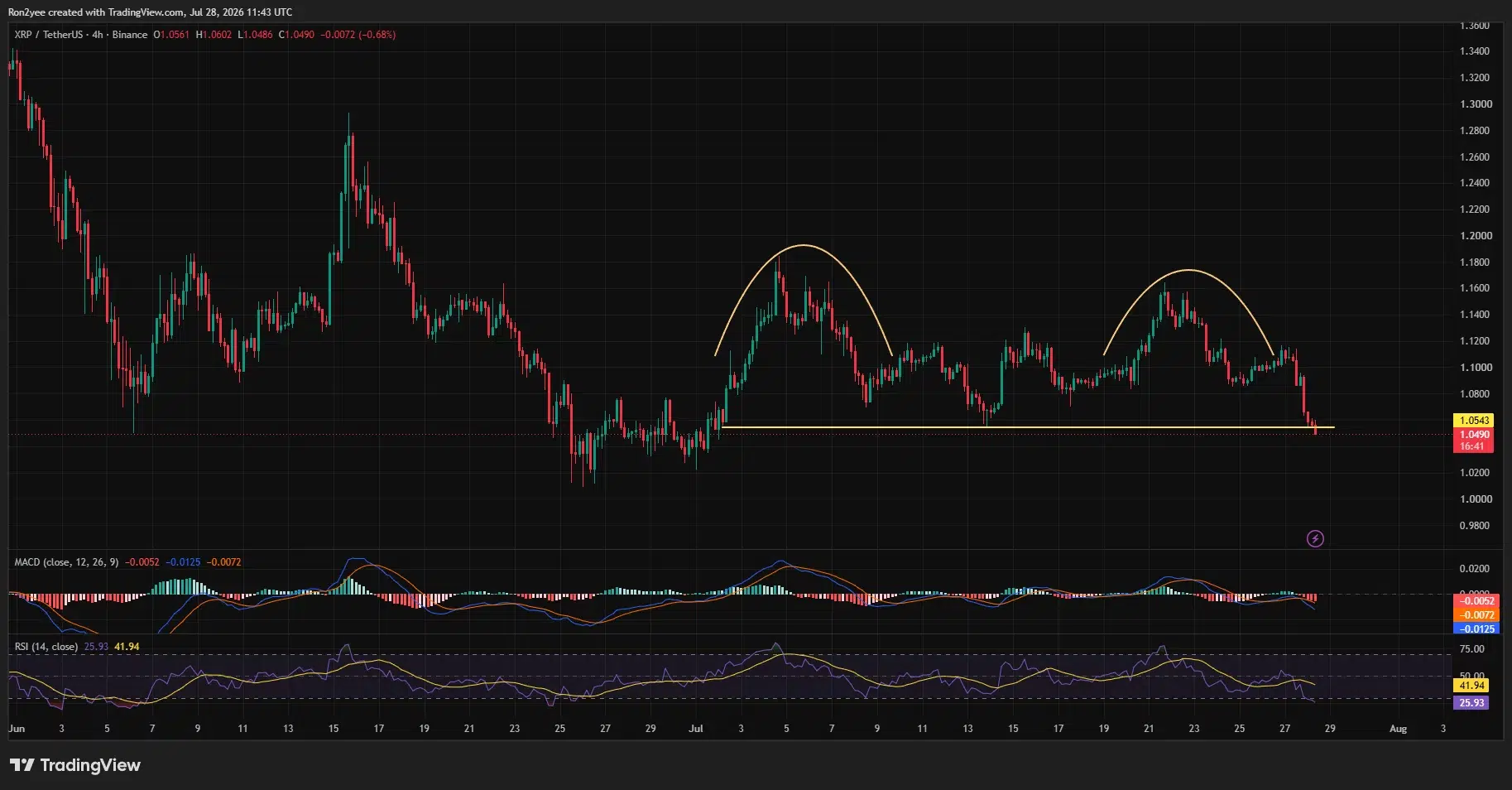
XRP price fell about 5% to $1.05 on July 28 as a broader risk-off move and forced long liquidations pushed the token below a closely watched technical floor.
Summary
- XRP dropped from roughly $1.11 to $1.05, breaking support near $1.054.
- The 4-hour RSI fell to 25.93, placing XRP in oversold territory.
- Daily Chaikin Money Flow reached -0.12, showing continued net capital outflows.
- Liquidation clusters near $1.075 and $1.097 could limit an early recovery.
XRP price breaks below a double-top neckline
According to data from crypto.news, XRP (XRP) price traded at $1.049 at the time of writing after reaching an intraday low of $1.0486 on Binance. The decline extended a broader downtrend that has kept the token under pressure since May.
The 4-hour chart shows XRP forming two rounded peaks near $1.17, creating a double-top structure. Both advances lost momentum before buyers could establish support above $1.15.
A horizontal neckline near $1.054 separated the pattern from its bearish confirmation. XRP moved below that level on July 28, exposing the psychological $1 mark and the late-June lows between $1.01 and $1.03.
The breakdown followed repeated failures around $1.11 during the previous sessions. Sellers took control once XRP lost $1.08, with the decline accelerating as the price approached the double-top neckline.
Momentum indicators reflect the speed of the move. XRP’s 4-hour relative strength index fell to 25.93, below the 30 level commonly associated with oversold conditions. Its RSI moving average remained much higher at 41.94, showing how rapidly short-term momentum weakened.
Oversold readings can support a temporary rebound, but they do not confirm that a bottom has formed. XRP would first need to recover the broken $1.054 level and then establish a higher low.
Liquidations accelerate XRP’s decline
CoinGlass’ 24-hour liquidation heatmap shows XRP falling from around $1.105 to $1.05 as the market moved through several leveraged trading zones.
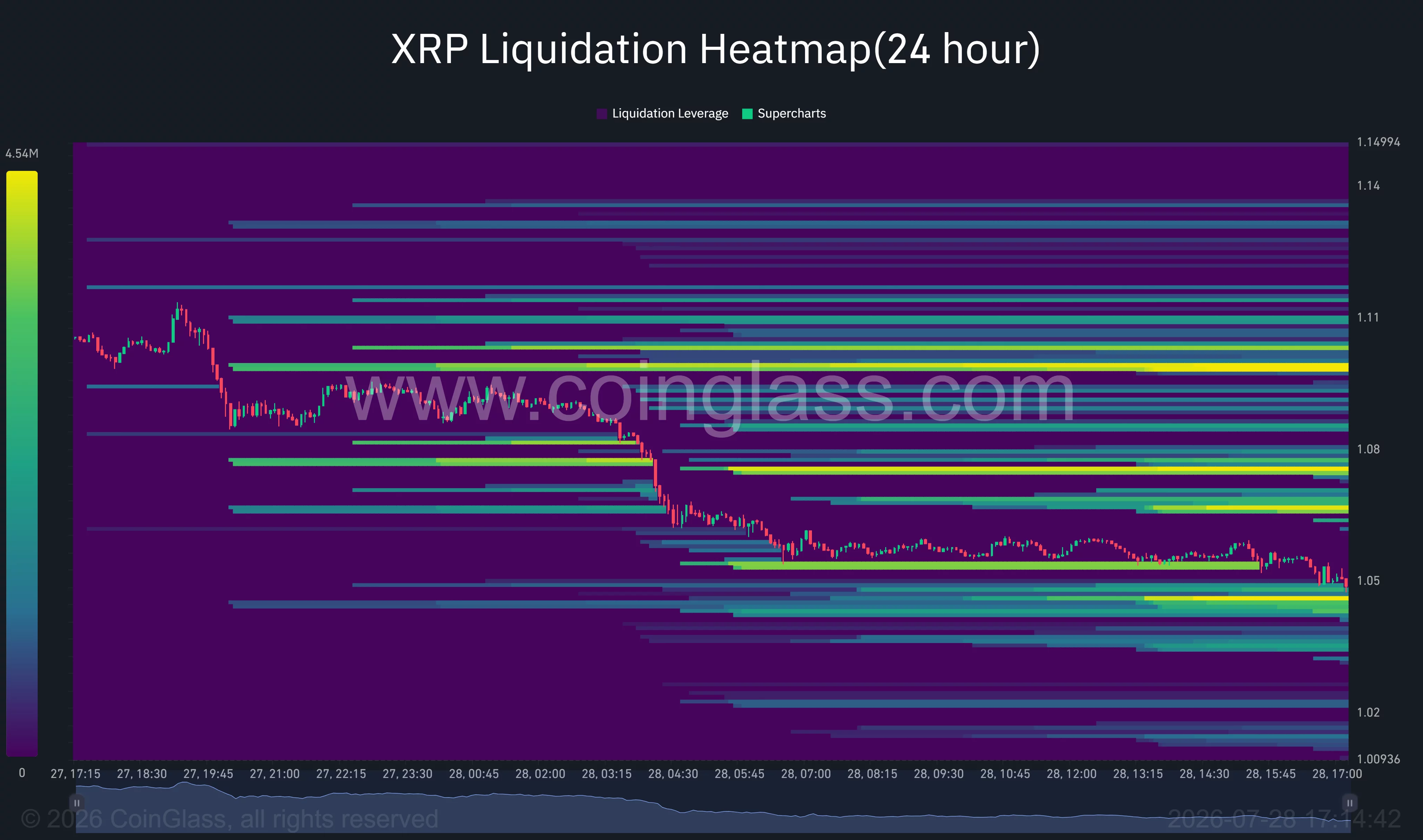
The initial decline cleared liquidity around $1.095 and $1.08. Once those levels failed, the price moved quickly toward $1.06 as leveraged long positions faced liquidation and stop-loss orders were triggered.
XRP now trades near another visible liquidity concentration between $1.043 and $1.05. That cluster could temporarily slow the decline, although a clean move through it would leave less visible support before $1.02.
Most of the larger outstanding liquidity pools are above the current price. The heatmap shows concentrations near $1.062, $1.075 and $1.097, with the largest nearby band sitting just below $1.10.
These levels could act as price magnets during a rebound because traders may target areas where short positions are vulnerable. However, they could also become resistance if holders use a recovery to reduce exposure.
The supplied market brief attributed part of the selling pressure to more than 150 million XRP moving from private wallets to centralized exchanges over 48 hours. Without named transaction records or wallet labels, those transfers should be treated as a reported catalyst rather than confirmed evidence that all the tokens were sold.
XRP indicators point to sustained selling pressure
XRP’s daily chart shows the price closing below the lower Bollinger Band, which stood near $1.0538. A close outside the band reflects unusually strong downside momentum, although it also increases the possibility of a short-term mean-reversion move.
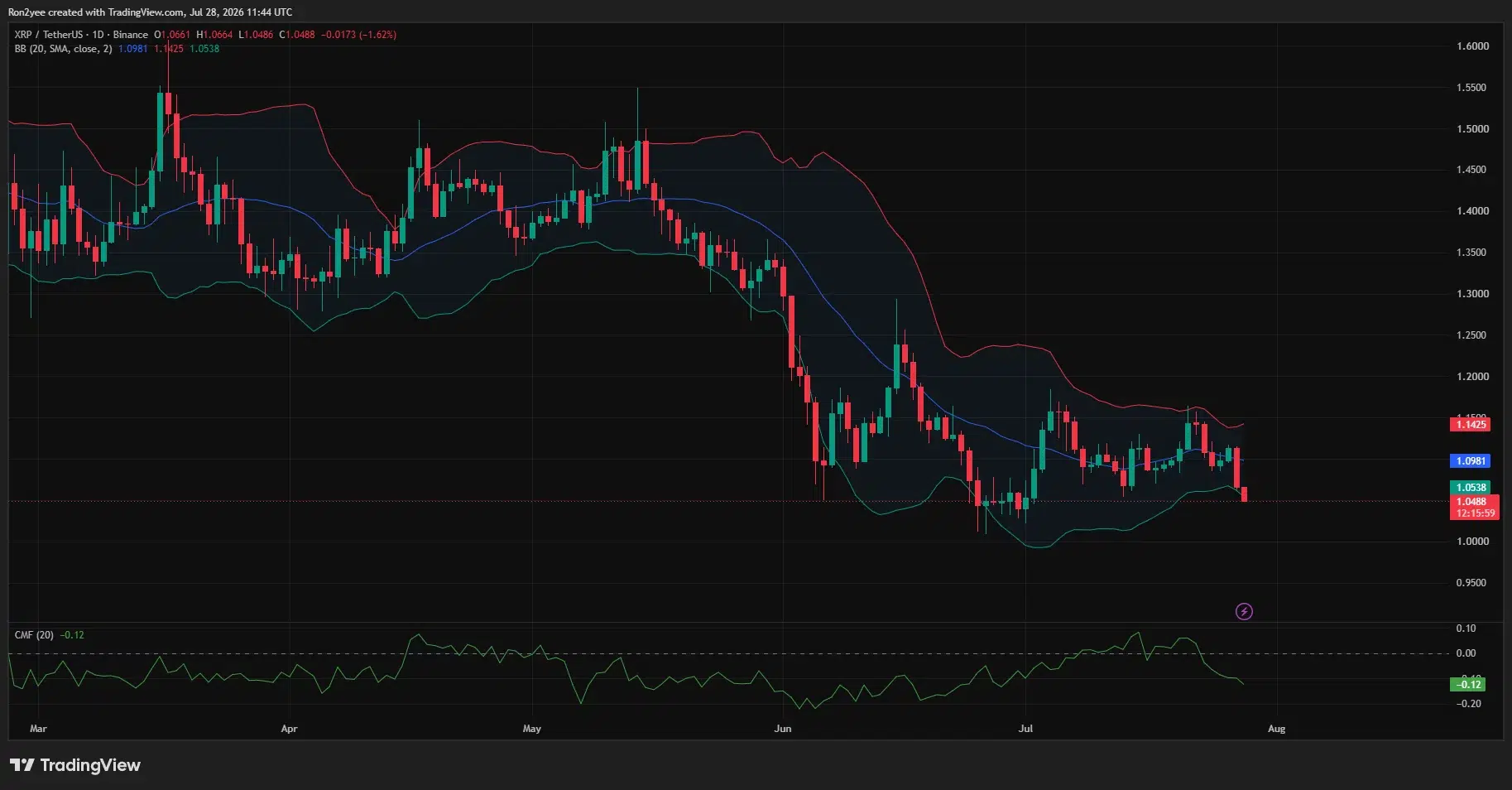
The Bollinger Band midpoint is near $1.0981, closely matching the strongest nearby liquidity cluster on the heatmap. A recovery above that level would return XRP to its recent trading range and weaken the immediate bearish setup.
The upper band sits much higher at $1.1423. XRP would need to reclaim that area before the daily structure begins to shift away from the pattern of lower highs that has developed since May.
Chaikin Money Flow stood at -0.12 on the daily chart. A negative reading indicates that selling pressure has outweighed accumulation during the indicator’s 20-day window.
The 4-hour moving average convergence divergence indicator also remains bearish. The MACD line has dropped to -0.0125, below its -0.0072 signal line, while the histogram stands at -0.0052.
Immediate support sits between $1.043 and $1.05. Below that range, traders may watch $1.02 and $1.00. Resistance is located near $1.054, $1.075, and $1.098, followed by the previous rejection zone around $1.11.
Global selloff adds pressure ahead of the Fed
XRP’s decline coincided with a sharp retreat across Asian technology stocks. South Korea’s Kospi closed 10.84% lower after losses in Samsung Electronics and SK Hynix drove its steepest fall in five months.
That selloff spread through other Asian markets and increased demand for lower-risk positions ahead of the Federal Reserve’s July 28–29 meeting. Higher market volatility can weigh on altcoins because traders often reduce their most speculative holdings first.
Crypto sentiment also faced a US policy setback. Senate leaders temporarily pushed aside the Digital Asset Market Clarity Act while prioritizing federal nominations and a Russia sanctions bill, reducing the time available before the August recess, according to CoinDesk.
Meanwhile, wallets associated with BlackRock’s exchange-traded funds transferred about $271 million in Bitcoin and Ethereum to Coinbase Prime. Such movements can accompany ETF creation and redemption activity, meaning they do not by themselves prove that BlackRock conducted a discretionary market sale.
For US XRP holders, the Federal Reserve meeting and the Senate’s remaining legislative schedule are the main near-term external catalysts. Technically, holding the $1.043–$1.05 zone could produce an oversold bounce, while a daily close below it would increase the risk of a move toward $1.
Disclosure: This article does not represent investment advice. The content and materials featured on this page are for educational purposes only.
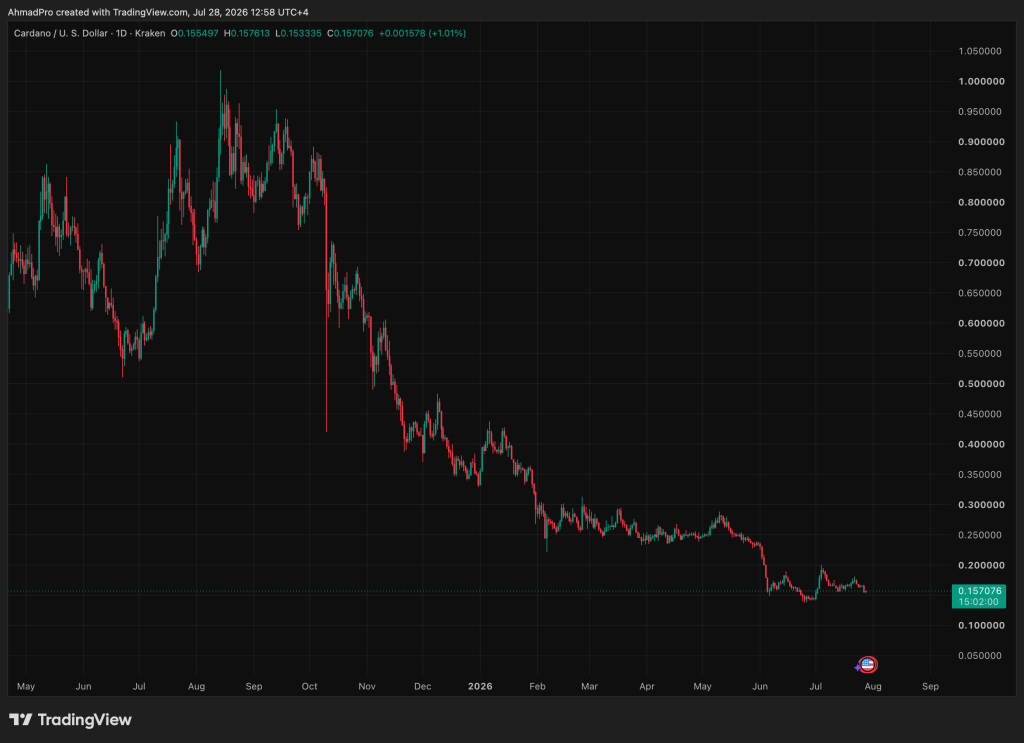
In the latest Cardano News, ADA is trading at $0.1566, down 1.57% in the last 24 hours, and sits roughly 95% below its September 2021 all-time high of $3.09. The founder is still publicly talking about the best days ahead. That gap between narrative and price action is exactly the kind of tension worth unpacking. What the chart says and what Hoskinson is promising are two entirely different conversations.
During a surprise X AMA on July 27, Charles Hoskinson addressed ADA’s prolonged underperformance head-on, saying: “I still do believe our best days are ahead of us… We just have to change the approach, and we just have to change the strategy.”
The admission that something needs to change, framed around governance demons and strategic recalibration, is notable for its candor, even if it stops short of specifics.
ADA has shed -53% this year alone, compounded by the cancellation of the 2026 Cardano Summit and ongoing governance disputes that have visibly rattled builder confidence. Hoskinson’s own social media step-back and return only underscored the community friction.
The macro backdrop isn’t helping. Altcoins broadly remain in risk-off territory, and ADA’s technical structure offers little near-term comfort, which makes the current setup worth examining closely before any catalyst thesis gets priced in.
Discover: The Best Crypto to Diversify Your Portfolio
Cardano News: Can Cardano Price Reclaim $0.25 Before the Van Rossem Hard Fork?
ADA is trading at $0.1566, below its 50- and 200-day simple moving averages, which are both sloping downward. This is not consolidation. It is a sustained downtrend by the textbook definition.
Support sits in the $0.14 to $0.15 band. A breakdown there could open the door to a move toward $0.10 to $0.13, levels not seen in years. Near-term resistance sits at $0.20 to $0.25, and a decisive close above $0.25 would be the first credible signal of a structural trend shift.

The van Rossem hard fork landing cleanly alongside constructive ETF sentiment and ADA clearing $0.25 targets a $0.18 to $0.30 range.
A sideways grind in the $0.15 to $0.20 band through Q3, with Leios’ progress and governance resolution providing modest support, is the base case, with CoinCodex projecting a near-term range of $0.168 to $0.194. A weekly close below $0.14 removes the support floor and puts $0.10 in play, at which point any upgrade catalyst would need to work against a deeply negative sentiment backdrop.
Hoskinson’s governance overhaul targeting 600 million ADA in backlogged treasury requests is a real structural move, not optics. The market wants a reason to buy ADA. It just has not been given one yet. Whether it prices in the governance catalyst ahead of execution is the question that defines the next leg.
Trade Ripple XRP on Bybit and Get a Chance to Win Our $1,000 USDT Airdrop
LiquidChain Targets Early Mover Upside as Cardano Tests Key Levels
ADA holding above $0.15 keeps the bull case alive on paper, but a 95%-below-ATH large-cap with declining moving averages is not where asymmetric upside lives.
The math on recovering those levels, even a return to $1.00, demands a multiple from here that gets harder to justify as competing L1s compound their developer ecosystems. Broader altcoin market dynamics suggest capital is rotating toward infrastructure plays that address cross-chain fragmentation, rather than rehashing single-chain governance debates.

That’s the specific problem LiquidChain (LIQUID) is built to address. The project functions as a Layer 3 infrastructure layer that fuses Bitcoin, Ethereum, and Solana liquidity into a single execution environment, with no bridging and no fragmented state.
Developers deploy once and access all three ecosystems through a Unified Liquidity Layer with Verifiable Settlement and Single-Step Execution.
The presale has raised $920,002.48 at a current price of $0.01484 per $LIQUID. The project’s traction in the current macro environment reflects genuine builder demand for cross-chain execution infrastructure rather than speculative narrative alone. Presale tokens carry standard early-stage risks — liquidity, execution, and timeline — and should be sized accordingly.
Research LiquidChain before the current round closes.
The post Hoskinson Admits the Strategy Needs to Change as ADA Token Clings to Life appeared first on Cryptonews.

Binance co-founder Changpeng “CZ” Zhao has endorsed a proposal for “license passporting” across ASEAN, arguing that crypto firms already authorized in one country should not have to restart the licensing process from scratch when expanding to neighboring markets.
Zhao made the remarks during a fireside chat at the ASEAN Tech Summit Manila 2026 on Tuesday, backing an idea raised by Lito Villanueva, founding chair of FinTech Alliance PH. The core concept is a simplified approval pathway—while still allowing regulators to assess applicants—so that cross-border operations can be reviewed without duplicating every step of initial authorization.
Key takeaways
- Zhao argues ASEAN could enable crypto license portability, reducing the need for firms to reapply from scratch in each member state.
- The proposal is framed as “simplified authorization” rather than full deregulation: regulators would still retain review power.
- ASEAN already uses cross-border frameworks in other financial areas, offering precedents for streamlined regional processes.
- Analogies to the EU’s crypto passporting approach suggest a path forward, but ASEAN’s policy fragmentation could slow standardization.
Why passporting matters for ASEAN crypto and stablecoins
ASEAN member states regulate digital assets through separate national regimes, which can create multiple parallel compliance pathways for companies attempting regional expansion. Zhao’s argument centers on how that fragmentation affects both operational costs and competitive dynamics.
A regional licensing framework, proponents say, could lower compliance expenses and make it easier for crypto and stablecoin services to operate across borders. Zhao also linked passporting to consumer outcomes, suggesting that expanding the set of platforms able to compete through lighter processes could reduce costs and improve service quality.
He characterized the biggest obstacle as political rather than technical, adding that the underlying “technology” of coordinating authorization should not be the deciding factor. For investors and market participants, the practical implication is that clearer and less duplicative regulatory pathways could support more consistent regional market access—potentially affecting liquidity, product availability, and the speed at which regulated offerings scale.
ASEAN’s existing playbook: streamlined approvals in other sectors
While ASEAN does not currently operate a bloc-wide “passport” specifically for crypto firms, regional regulators have created mechanisms that resemble elements of mutual recognition and simplified cross-border authorization in capital markets.
According to the ASEAN Capital Markets Forum (ACMF), the ASEAN Capital Markets Forum’s Collective Investment Schemes Framework allows a fund authorized in its home jurisdiction to be offered in participating host jurisdictions through a streamlined authorization process. The framework was first operationalized in Malaysia, Singapore and Thailand in 2014, and the Philippines joined in 2021, based on an ACMF news release stating that ASEAN capital markets connectivity would be enhanced with the Philippines’ entry into the scheme.
The ACMF has also introduced the ACMF Pass under its Professional Mobility Framework. The program enables eligible investment advisers licensed in one participating jurisdiction to receive fast-track registration to provide advisory services in another, without obtaining a new license.
These frameworks are narrower than the “passporting” approach Villanueva and Zhao discussed for crypto firms. They do not eliminate host-market requirements, and the review still ultimately depends on what host jurisdictions require. Still, they show that ASEAN regulators have already experimented with regional integration tools that reduce redundancy and speed up cross-border market entry—an important reference point for any push toward license portability in digital assets.
Notably, these regional arrangements also help explain how a passporting model might be structured to satisfy regulators: authorization can be streamlined through predefined criteria and processes, while host markets maintain the ability to enforce local rules.
What the EU’s crypto-asset passporting shows—and what ASEAN may differ on
Zhao’s comments also echo a familiar global comparator: the European Union’s approach under the Markets in Crypto-Assets Regulation (MiCA). In the EU, an authorized crypto-asset service provider can use passporting rights to provide services across member states after notifying its home regulator of the countries and the specific services involved, according to prior reporting that discussed early tests as national regulators pushed back against passporting.
However, Zhao highlighted a key constraint: differences in national policy priorities and regulatory approaches can make alignment harder in ASEAN than in the EU. That said, his stance remains that a firm already licensed in one ASEAN market should face a lighter process when entering another—suggesting that “full harmonization” may not be required for progress, even if perfect uniformity is still unlikely.
For readers evaluating the potential impact, the most important takeaway is the distinction between two extremes. On one end is a fully unified bloc-wide regime; on the other is complete duplication of licensing in every jurisdiction. Passporting, as described here, aims to live in the middle—preserving regulatory oversight while cutting down repetitive administrative work.
Next steps: what investors and builders should watch
Whether ASEAN moves toward license portability for crypto will depend on how regulators balance political coordination with market needs for clarity and scale. The immediate signal to monitor is whether proposals like this shift from concept to an actionable framework—particularly around what would be required for streamlined cross-border authorization, how host jurisdictions would apply conditions, and where regulators draw the line between portability and re-licensing.
In the current suit, James Ramirez, claims he downloaded the app on July 25, 2025 and had 7.4 BTC “transferred to a scammer.” He reported the app and theft to Apple that day, according to the filing. Christopher Ellis allegedly lost about $840,000 after installing the app on Aug. 3.
Jalen Delgado, who had downloaded the app around May 1, 2025, lost 1.05 BTC, then worth roughly $120,000 after relying on “Apple’s representations that its App Store was safe and the apps hosted in the Apple App Store had been vetted by experts,” according to the filing.
Ramirez and Ellis said Apple never responded to their reports.
The official Sparrow Wallet is a desktop-only application available for Windows, macOS and Linux. It does not offer an iOS version.
The lawsuit alleges Apple ranked the fraudulent application and included it in curated cryptocurrency app collections alongside legitimate products. It also points to Sparrow developer Craig Raw warning in January 2024 that an impersonator remained available despite being reported to Apple weeks earlier.
The case seeks reimbursement of the alleged stolen assets, compensatory and punitive damages and potentially multiplied damages. The plaintiffs also want Apple to disclose the limitations of its review process, strengthen its controls and warn users that an App Store listing does not establish that a cryptocurrency application is authentic.

Apple is being sued by three iPhone and App Store users who allege they suffered combined losses of about $1.8 million after installing a fake Bitcoin wallet application that prompted them to enter their seed phrases. The complaint was filed on Friday in the US District Court for the Northern District of California, according to a copy of the filing reviewed by MacRumors.
The suit argues Apple did not do enough to screen and supervise apps distributed through the App Store, even as the company promotes it as a trusted marketplace. The plaintiffs say the fraudulent app enabled scammers to transfer their Bitcoin after they shared sensitive recovery information.
Key takeaways
- Three plaintiffs allege they lost a combined about $1.8 million after installing a counterfeit Bitcoin wallet app from Apple’s App Store.
- The complaint says users entered seed phrases into the malicious app, allowing scammers to move their Bitcoin.
- Losses reported in the filing include roughly $875,000, $840,000, and $120,000 during 2025.
- Apple says it has removed impersonating apps and terminated related developer accounts, and points users and developers to report guideline-violating software.
- The original wallet developer has previously criticized Apple over fake app versions appearing in the App Store, and the legitimate wallet does not offer an official iOS app.
Allegations in the Northern District of California lawsuit
The lawsuit names three customers: James Ramirez, Christopher Ellis, and Jalen Delgado. Their complaint, filed Friday, claims Apple failed to adequately review and monitor applications available through the App Store despite presenting the platform as a controlled, trustworthy distribution channel, as described in the filing copy obtained by MacRumors.
The plaintiffs allege that they downloaded what they believed was a Bitcoin wallet app but was actually a fraudulent copy. After installing the app, they entered their seed phrases—the recovery words that can be used to access cryptocurrency wallets. The complaint says those phrases were then used by scammers to transfer the victims’ Bitcoin holdings.
According to the complaint, the losses occurred during 2025. Ramirez reported losses of about $875,000, Ellis reported about $840,000, and Delgado reported approximately $120,000.
The impersonated wallet and the “no official iOS app” issue
The counterfeit app impersonates Sparrow Wallet. MacRumors reports that Sparrow Wallet is available on Windows, macOS, and Linux, and that developer Craig Raw has said the wallet has no official iOS app.
That detail may be significant for investors, users, and app platform observers because it underscores an apparent mismatch: if there is no legitimate iOS release, a purported iOS wallet carrying the same branding would be inherently suspicious. MacRumors further notes that Raw has previously criticized Apple after fake versions of the app appeared on the App Store.
For users, this kind of incident highlights the risk of wallet-related apps that ask for seed phrases. In practice, seed phrases are effectively full-access credentials. Any wallet prompt requesting them should raise serious red flags, especially when the app’s legitimacy is unclear.
Apple’s response: app removals and account terminations
Apple told MacRumors that it has taken action against the fraudulent listings. The company said it removed apps impersonating Sparrow Wallet and terminated developer accounts tied to those apps.
Apple also pointed to its reporting mechanisms, saying developers and users can report applications that violate App Store guidelines. Apple further said it takes action against apps that do not comply with its rules.
The lawsuit, however, centers on whether those controls were sufficient—particularly given the alleged scale of the losses and the claim that users were able to access a counterfeit app that appears designed to capture seed phrases.
Why the case matters for crypto users and the broader app ecosystem
This dispute touches a fault line that has repeatedly surfaced in crypto-enabled fraud: many losses involve not only a malicious actor, but also the ecosystem that allowed the harmful app to reach victims in the first place. For crypto users, the case serves as a reminder that downloading wallet software from mainstream app stores is not, by itself, a guarantee of safety—especially when the app’s behavior suggests it may be collecting recovery credentials.
From an enforcement and platform-governance perspective, the lawsuit may also shape how regulators, courts, and consumers evaluate “reasonable” screening and monitoring for high-risk financial and credential-handling applications. The plaintiffs are alleging a failure of oversight despite Apple’s positioning of the App Store as a trusted marketplace, which is likely to be a focal point in legal arguments about responsibility and foreseeability.
Even if Apple removes impersonating apps quickly after being informed, victims may already have been compromised. That timing gap—between a fraudulent app becoming available and enforcement actions landing—can be critical in the types of scams described in the filing.
There is also an information asymmetry for users: people may assume that brand names like “wallet” and familiar project titles imply legitimacy. The “no official iOS app” detail reported by MacRumors, combined with Raw’s past criticism about fake listings, suggests that legitimacy signals (such as official release availability and publisher identity) can be decisive for avoiding impersonation.
What happens next will likely depend on how the court assesses the adequacy of Apple’s app review and monitoring processes, and how it evaluates whether the harm was caused by app distribution decisions versus individual user behavior (such as entering seed phrases into a fraudulent interface).
In the meantime, readers should watch for any further procedural developments in the case and for Apple’s continued actions on impersonating crypto apps—especially wallet applications that request seed phrases or recovery credentials. The unanswered question is not only whether enforcement occurred, but whether it came fast enough to prevent the kinds of losses alleged in this filing.

Feeling glorious! Goodwood racegoers pull out all the stops in plunging necklines, eye-catching hats and bright dresses as they kick off day one in style

Robinhood Down Now? Users Report Outage as Trading App Struggles Amid Volatile Global Stock Market Selloff

John Oliver Rips Trump Crypto Involvement as “Flagrantly Corrupt and Compromised”


-

 Fashion4 days ago
Weekend Open Thread: Brooks Brothers
-

 NewsBeat7 days ago
How a former Blue Peter presenter stunned America’s Got Talent judges
-
 Business6 days ago
New Jersey voter registration controversy explained: How 6,600 noncitizens got on the rolls, and what happens next
-

 Tech2 days ago
Intel is reversing course and bringing hyper-threading back to its server chips
-
 Entertainment7 days ago
Johnny Depp’s R-Rated Gothic Cult Classic Gets New Release Ahead of Sydney Sweeney Remake
-

 Crypto World6 days ago
Ethics, other provisions in crypto Clarity Act to be further discussed
-

 Politics1 day ago
Luke Littler dismantles Gerwyn Price to retain title in Blackpool
-
 Sports2 days ago
Commonwealth Games boxing: Jadumani Singh seals dominant 5-0 win over Pakistan’s Sumama Rehman to enter quarter-finals | Commonwealth Games News
-

 Sports4 days ago
2026 3M Open leaderboard: Scottie Scheffler finds putter in Round 1, sits three back
-

 Fashion4 days ago
16 Dresses for the High Summer Event
-

 Politics4 hours ago
The Part of the Electric Transition Nobody Wants to Discuss
-

 News Videos5 days ago
The Peugeot Family: How 200 Years of an “Old Money” Dynasty Died in A Boardroom
-

 Politics2 days ago
Spain sweeps the board at 2026 World Cup with individual awards
-

 News Videos2 days ago
BITCOIN JUST ENTERED THIS CRITICAL ZONE…
-
 Entertainment4 days ago
A New Post-Apocalyptic Gundam Anime Series Blasts Into SDCC
-

 Crypto World2 days ago
XRP Ledger adds $2.6B as RWA inflows rank second
-

 Crypto World3 days ago
Ripple bought a bank in pieces. The $4 billion audit
-

 Tech3 days ago
Anthropic launches Claude Opus 5, a cheaper AI model for coding, agents and enterprise workflows
-

 Crypto World5 days ago
Uniswap (UNI) pushes deeper into tokenized RWAs with permissioned trading pools
-

 Entertainment3 days ago
Sara Gilson Killed By Husband After Viral “Pedophile” TikTok Video
You must be logged in to post a comment Login