
TL;DR
OpenAI made its Cannes Lions debut pitching ChatGPT as the next big ad platform, but its initial $60 CPM halved in ten weeks. The company projects $100 billion in ad revenue by 2030 while Anthropic and Google keep their chatbots ad-free.




The NotePin S AI wearable, seen here on the wrist of CNET’s Katie Collins, could be really useful for my job. And it’s on sale for Prime Day.
I took over the role of CNET’s editorial leader earlier this year, and while I’ve participated in Prime Day sales as a TV reviewer and general deals editor here for (literally) decades, this is my first Prime Day as EIC. In case you’re wondering what purchases a person like me is considering this time around, here’s a sampling.
iPad 11-inch A16 ($300): My artistic daughter has been asking for an iPad and if my wife approves, I’ll likely get her this basic version, our top pick for most people. I’d also get her the Apple Pencil (on sale for $60). We’d save both of these for Christmas presents.
Belkin Portable Charger Bank ($38): My family and I always need portable chargers. Half our devices call for Lightning and the other half for USB-C. This does both and I like the built-in cables.
Plaud NotePin S AI Notetaker ($152): In my new role I take more meetings than ever, and I also have plenty of valuable face-to-face conversations in the office and beyond. I currently depend on the Otter app on my phone and Gemini+Google Meet recordings at work to take notes (with appropriate permission, of course). This AI wearable could be my “secret weapon” to consolidate everything in one place.
JBL Go 4 Bluetooth Speaker ($38): I actually bought this one a few days ago when it was $40 – still a great deal, but now even better. It’s no longer one of our best Bluetooth speakers but it’s good enough for my (other) daughter, who wants one for the beach. At this price, I won’t be too annoyed if (when?) it gets destroyed by sand and surf. And yes, I got her the pink one which I know she’ll love. We’re saving this for her birthday.
Anker Solix F2000 portable power station ($749): I own a travel trailer and upgraded to solar with an inverter, but at a recent (shady) campsite, I still had to break out my loud, annoying propane generator. Sure, I could just add more standard 12V LiPo4 batteries, but this portable power station is so much more versatile. It includes a 30A RV outlet, and the wheels make it worth the extra $50 over the Bluetti AC200L. No way my wife approves this one, but it stays on the list anyway because I’m camping tech obsessed.
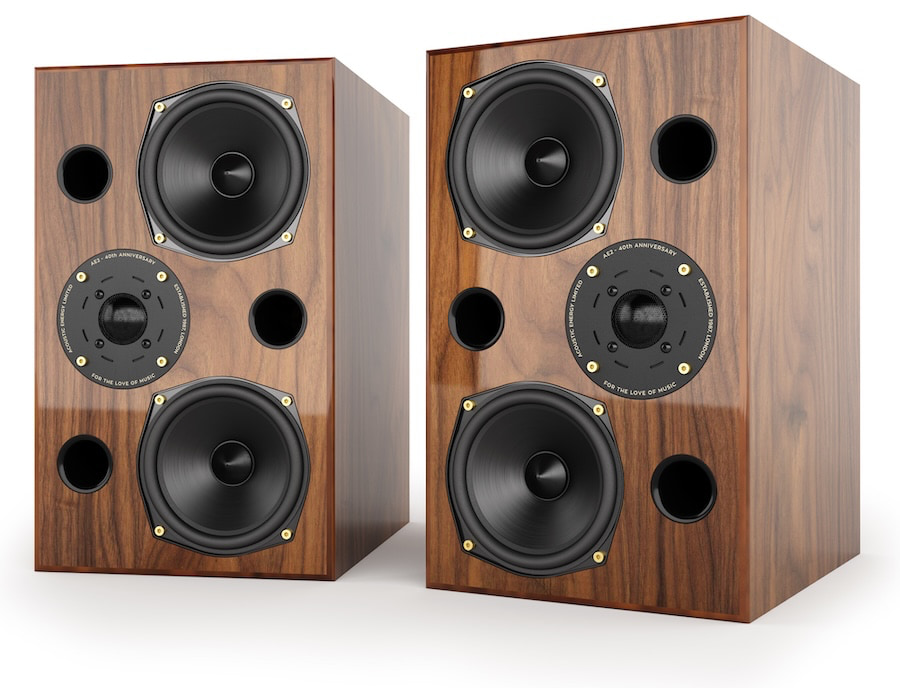
Acoustic Energy is extending its anniversary campaign with the AE2 40th Anniversary, a limited-edition standmount loudspeaker that will make its world premiere at the North West Audio Show in Cranage, UK, on June 27-28, 2026.
Following the AE1 40th Anniversary in 2025 and the launch of the fully analog AE Active at High End Vienna 2026, the new AE2 looks back to one of the British brand’s more ambitious compact loudspeaker designs—only with considerably more modern engineering under the gloss finish.
Rather than simply dusting off an old badge and hoping nostalgia does the heavy lifting, Acoustic Energy has redeveloped the AE2 around the later AE2 Signature concept. The new speaker uses technology derived from the AE1 40th Anniversary, adds internal steel reinforcement to reduce cabinet coloration, and is positioned above the AE1 for listeners who want more scale, bass weight, and dynamic capability without surrendering the placement flexibility and imaging strengths of a proper standmount.
The AE2 40th Anniversary will be demonstrated publicly for the first time ahead of its wider launch later this summer. Acoustic Energy’s intent is clear: take the compact-monitor attitude that made the AE1 famous and give it enough muscle to annoy a small floorstander.
From Acoustic Energy: “Building on the unprecedented success of the AE1 40th Anniversary Edition, the AE2 uses the same newly developed woofer and tweeter drive units from the AE1. The AE2 40th Anniversary derives from the legacy of the highly renowned flagship ‘AE2 Signature’ model of the 1990s. The same technological refinements from the AE1 have been used to update the performance to today’s level, along with aesthetic detail sympathetic to the original.”
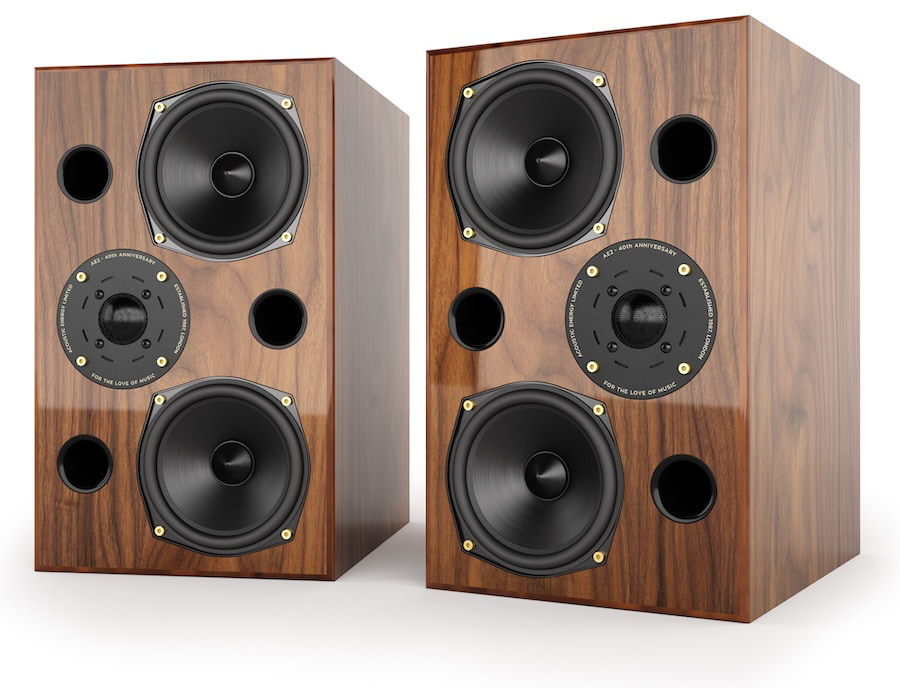
The AE2 40th Anniversary uses the same newly developed tweeter and mid/bass driver platform as the AE1 40th Anniversary, but applies it to a larger offset MTM configuration intended to deliver more bass extension, headroom, and authority. Acoustic Energy has also added strategically placed internal steel plates to reduce cabinet coloration and help the larger enclosure match the quieter, more controlled behavior of its smaller sibling.
The 29mm anodized aluminum dome tweeter carries over the AE1 40th Anniversary’s larger 29mm voice coil and slightly increased radiating area. Like the original AE designs, it is ferrofluid cooled and damped, a combination intended to improve power handling, dynamics, and thermal stability without abandoning the metal-dome character that helped define the brand.
The mid/bass drivers use Acoustic Energy’s spun, hard-anodized aluminum cone design, reinforced with a thick ceramic coating on both sides. The 125mm cone offers more radiating area than the original AE1 driver, which Acoustic Energy says contributes to higher efficiency, lower distortion, and greater air displacement. In the AE2, that shared driver platform is paired with the larger cabinet and twin-driver arrangement to give the speaker more scale than the AE1.
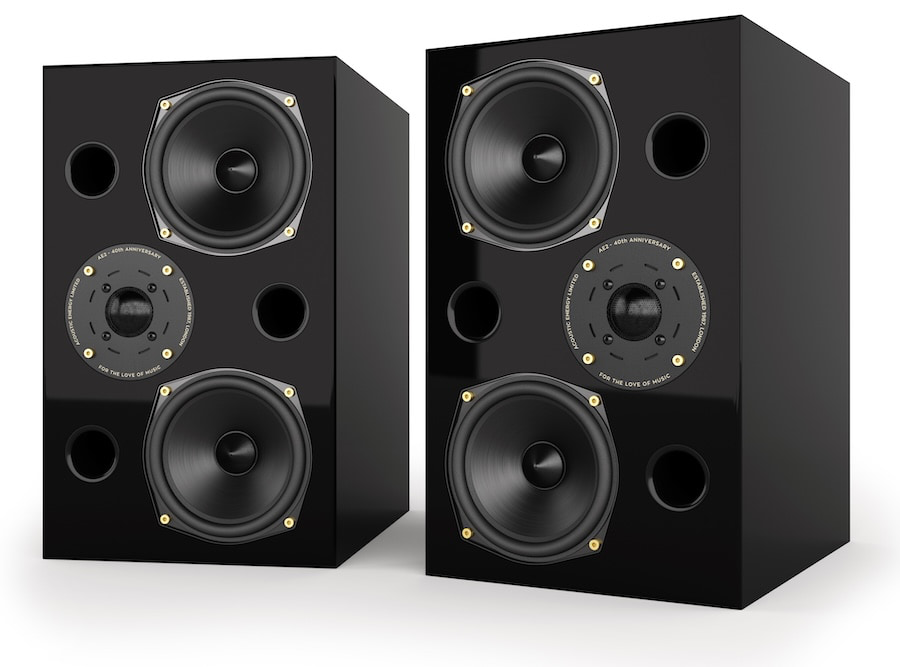
Acoustic Energy has scaled up the AE2 40th Anniversary with greater bass extension and dynamic headroom, which the company says should translate into lower distortion through the midband and greater transparency at typical listening levels.
The goal was to retain the tonal character and punchy dynamics of the smaller AE1 40th Anniversary within a larger offset M-T-M driver layout. That required more than simply adding a second mid/bass driver and three front-firing bass-reflex ports. To keep the larger enclosure’s coloration in line with the AE1, Acoustic Energy has added strategically placed internal steel plates to the cabinet structure.
The idea is straightforward: deliver the scale and authority expected from a small floorstander while preserving the low coloration, imaging precision, and placement flexibility that made the AE1 such a compelling standmount in the first place.
Acoustic Energy positions the AE2 40th Anniversary for listening rooms of around 25 square meters (about 270 square feet) and larger, where its additional bass extension and dynamic headroom should give it more authority than the smaller AE1 40th Anniversary.
Its published specifications support that positioning: a claimed frequency range of 35Hz to 45kHz, measured within ±6dB; 88dB sensitivity at 1 metre/2.83V; a nominal 6-ohm impedance; and 200 watts of power handling. Those are sensible figures for a substantial standmount designed to play with more scale and composure than its dimensions might suggest.
The AE2 is not being pitched as a difficult loudspeaker, but it should reward an amplifier with proper current delivery and some reserve power. The goal is the weight and room-filling authority of a compact floorstander, combined with the imaging, low cabinet coloration, and placement flexibility that remain central to the AE1 and AE2 design philosophy.
The AE2 40th Anniversary uses a minimalist, low-order crossover network set at 2.2kHz. Acoustic Energy says the approach is intended to preserve the lively, direct character of the original AE2 Signature, rather than bury the music beneath a small mountain of crossover components.
The cabinet is available in High Gloss Black or High Gloss Walnut, with each finished in ten layers for a properly luxurious appearance. At 385 x 235 x 315mm (HWD) and 14.5kg each, the AE2 is a substantial standmount, but not one that requires a civil-engineering permit before you put it on proper stands.
From Acoustic Energy: “Building on the unprecedented success of the AE1 40th Anniversary Edition, the AE2 uses the same newly developed woofer and tweeter drive units from the AE1. The AE2 40th Anniversary derives from the legacy of the highly renowned flagship ‘AE2 Signature’ model of the 1990s. The same technological refinements from the AE1 have been used to update the performance to today’s level, along with aesthetic detail sympathetic to the original.”

| Acoustic Energy Model | AE2 40th Anniversary Edition | AE1 40th Anniversary Edition |
| Product Type | Standmount Speaker | Standmount Speaker |
| Price (pair) | €2,799 | £1,049 – £1,500 |
| Design | 2-way, Three front reflex ports | 2-way, twin front reflex ports |
| Tweeter | 1 x 29mm anodized aluminium dome | 1 x 29mm anodized aluminium dome |
| Mid/Bass Driver | 2 x 125mm spun, hard-anodised aluminium cone | 1 x 125mm spun, hard-anodised aluminium cone |
| Frequency Range (±6dB) | 35 Hz – 45 kHz | 50Hz – 45kHz |
| Sensitivity (1m/2.83V) | 88 dB | 87dB |
| Power Handling | 200 W | 150W |
| Crossover Frequency | 2.2 kHz | 2.8kHz |
| Impedance | 6 ohms | 6 ohms |
| Cabinet | 18–32mm RSC HDF/bitumen construction, braced | 18–22mm RSC HDF/bitumen construction, braced |
| Grilles | Cloth, magnetic fit | Cloth, magnetic fit |
| Dimensions (HWD) | 385 x 235 x 315mm | 295 x 180 x 255mm |
| Weight | 14.5 kg each | 7kg each |
| Finishes | High Gloss Walnut, High Gloss Black | High Gloss Walnut, High Gloss Black |
The AE2 40th Anniversary is not simply an AE1 40th Anniversary in a larger cabinet with a fancier badge. Its real purpose is to take the newer AE1-derived driver platform and apply it to a larger offset M-T-M design with twin mid/bass drivers, three front-firing ports, and additional steel cabinet reinforcement.
That makes it the more ambitious option for AE1 fans who want greater bass weight, higher output capability, and more convincing scale in rooms of roughly 270 square feet and larger, but still prefer the imaging precision and placement flexibility of a proper standmount speaker.
It is aimed at listeners with a capable amplifier, proper stands, and no interest in buying a full-size floorstander simply because their room needs more than a compact monitor can comfortably deliver. The AE2’s appeal is straightforward: more authority than the AE1 without abandoning the fast, direct, metal-driver character that made Acoustic Energy’s original compact speakers such enduring cult favorites.
The AE2 is expected to be available by the end of 2026 with a recommended retail price of €2,799 per pair (US pricing not yet available) with a choice of Walnut or Piano Black finishes through Authorized Acoustic Energy Dealers in the US, UK, and Other Regions.
For those attending the UK Northwest Audio Show held from June 27-28, getting a listen to these will be worth the stop.
DATABASES
Open source advocates remain concerned over lack of binding commitments
Oracle has promised a new phase in its custodianship of MySQL following the creation of a lobby group concerned about its future independence and long-term development.
A new governance model, a new steering committee, and support for the MySQL community are among the measures Big Red announced for the open source database whose intellectual property it owns.
However, a co-founder of the OurSQL Foundation – an independent organization claiming to represent the interests of MySQL users and developers – says Oracle has yet to make binding commitments about the database’s future governance and management.
In a blog post this week, Oracle said it was “taking the next step” in terms of transparency in MySQL development and engagement with its wider community.
“Our goal is simple: accelerate innovation and contributions, make it easier for the community to participate meaningfully in the evolution of MySQL, and grow the MySQL Ecosystem.”
In the “spirit of collaboration,” Oracle said it would establish a new governance model in which community members can contribute through code, testing, documentation, reviews, and technical discussions. Experienced contributors can take on extra responsibilities as “committers,” Oracle said. They would help review changes and maintain code quality.
“Stronger governance gives the MySQL community clearer ways to participate and accelerate innovation while preserving the quality, security, and compatibility users expect,” said Jason Wilcox, senior vice president, Data and AI Platform Services, Oracle Cloud Infrastructure.
The governance model also includes a technical steering committee, which will serve as a forum for strategic guidance and community representation, bringing together perspectives from across the MySQL ecosystem. The initial steering committee will include cloud giants Amazon Web Services, Google Cloud, and Oracle, with additional perspectives from as-yet-unnamed users of MySQL. Microsoft – provider of DBaaS Azure Database for MySQL – is notably absent.
“We are continuing to expand opportunities for engagement through public roadmap discussions, Contributor Summits, GitHub-based collaboration, Early Access releases, technical design conversations, and enhanced developer resources,” Oracle said.
The OurSQL Foundation formed in May following a period in which the MySQL community expressed concerns about Oracle’s long-term commitment to the database and willingness to open its governance to external contributions.
In September last year, Oracle made “widespread layoffs” across its core MySQL development team. Michael “Monty” Widenius, who co-authored the original MySQL in the 1990s, said the job cuts had left him “heartbroken,” but not surprised.
Peter Zaitsev, co-founder of open source consultancy Percona, one of the organizations behind the OurSQL Foundation, welcomed Oracle’s new tone and openness around its management of MySQL.
“This is a step and in the right direction,” Zaitsev said. “We welcome Oracle engaging the MySQL ecosystem as a whole. For the last nine months, Oracle has shown a desire to show more openness to the community in terms of sharing and including the wider community in the decision-making process. This is all great.”
However, the OurSQL Foundation would continue to hold Oracle to account as questions remained about whether its commitment to open governance was binding.
“If you read all those announcements they say, ‘we will involve the community in an advisory capacity,’ which is of course better than nothing, but it’s not really PostgreSQL-type community engagement, where community is really able to plot a path forward for users,” he said.
Zaitsev expressed concern that any direction set for MySQL could ultimately be changed by new Oracle management. “There’s nothing binding in this regard.”
A test of Oracle’s determination to live by its commitment would come when the community wants to make changes to the database that Oracle might consider detrimental to its commercial interests. “Would those be accepted?” Zaitsev asked.
Another test would be whether the community was willing to contribute to a system whose future it believed Oracle controlled entirely. ®
The northern lights could mean lights out for the infrastructure we rely on.
In 1989, the Canadian region of Quebec experienced something that likely shocked many of its residents: the Sun knocked out its power grid. Caused by a geomagnetic storm, the resulting blackout made six million people lose power for nine hours. Known as ‘the day the sun brought darkness,’ the blackout is emblematic of both the potential effects of solar activity on modern technologies and our relative unpreparedness for a major solar storm.
Solar storms are caused by magnetic reconnection, a process in which the Sun’s rotation forces its magnetic fields to twist and knot. As it undergoes its 11 year cycle, the pressure from these fields mounts. Eventually, these magnetic fields break and rejoin, whereby energy and plasma explode from the Sun’s surface into the solar system. Although invisible to the naked eye, solar storms can have a profound effect on Earth’s magnetic fields. And while the phenomenon is responsible for the aurora borealis, it can also wreak havoc on our technological infrastructure.
These eruptions cause three types of solar storms. Solar flares are intense explosions of light and radiation. Capable of producing energy equal to a billion hydrogen bombs, solar flares travel at the speed of light, hitting the Earth’s atmosphere in just eight minutes. Radiation storms, meanwhile, are eruptions of charged particles that blast through the solar system, reaching Earth in just half an hour. The largest, coronal mass ejections, or CMEs, are massive clouds of magnetized plasma. Each of these solar events can disturb the Earth’s magnetic field to cause geomagnetic storms that threaten power grids, disrupt communications systems and even down global internet infrastructure.
Before diving into how solar storms affect technology, you first have to understand the geomagnetic basics. Once a solar storm reaches the protective magnetic region of the Earth’s atmosphere, known as the magnetosphere, its charged particles temporarily change the atomic and magnetic makeup of the Earth’s atmosphere, disturbing its magnetic fields, currents and plasma.
Like the solar events themselves, these disturbances can be divided into three broad categories. Coronal mass ejections, for example, can cause geomagnetic storms which send geomagnetically induced currents (GICs) through the Earth’s magnetic field lines toward the southern poles, where they can surpass the Earth’s atmospheric defenses and disrupt technological systems. Intense solar winds can also generate geomagnetic storms. Similarly, radiation storms send highly charged proton particles down these magnetic field lines, forcing radiation into the lower levels of Earth’s atmosphere. Solar flares, for their part, can cause a phenomenon known as radio blackouts, through a process called ionization, in which magnetically charged particles blast through the atmosphere, dislodging electrons from atmospheric molecules and thereby changing the trajectory of radio frequencies.
The National Oceanic and Atmospheric Administration grades all three of these solar storms on a scale from one (minor) to five (extreme). Although solar activity is common, the vast majority of solar storms are recorded on the lower ends of the spectrum. For instance, while minor events may occur almost 3,000 times during an 11 year cycle, we’re likely to see less than five extreme solar storms over that period. However, even the largest storms on record pale in comparison to their historical predecessors. But we’ll get there. For now, let’s focus on what technologies are at risk.
As evidenced by the geomagnetic event that caused the infamous Quebec blackout, strong solar storms can have a major effect on the world’s power grids. When geomagnetically induced currents hit electrical infrastructure, they can cause blackouts by overheating transformers, relays and sensors. Expensive and difficult to manufacture, replacing a critical mass of transformers could take years. Geomagnetic currents can also overload and damage grid systems’ transmission lines. The control and protection infrastructures through which we manage power grids are also vulnerable to geomagnetic currents. Over time, these storms can shorten the lifespan of grids by damaging their electrical components and insulating materials, causing noticeable wear.
Not all power grids are threatened by solar storms equally, as several environmental factors shape whether grids are more susceptible to solar storms. For one thing, geomagnetic storms are geographically prejudiced. Because storms are drawn toward the Earth’s magnetic poles, latitude is the most consistent indicator of risk, with arctic regions seeing the strongest magnetic disruptions. In 2003, for instance, Sweden saw a portion of its power grid knocked out by a series of abnormally potent geomagnetic activity. Soil resistivity, which refers to how well the ground conducts electrical currents, is another factor. Areas with high likelihood of exposure whose soil conducts energy well are particularly at risk. For example, the arctic regions between 55 and 70 degrees latitude, are especially vulnerable, given their high latitudes and resistivity rates.
Increasingly, experts are concerned about the risks solar storms pose to artificial intelligence and other grid-needy industries. And while the AI boom is already straining our electrical infrastructure, the costs of widespread grid outages could prove catastrophic for the world’s fastest growing industry. Writing for Space News, Scot McIntosh, a former deputy director of the National Center for Atmospheric Research, said AI executives are “among those who should be most concerned” about the knock on effects of solar storms.
Although satellites are designed to withstand solar weather, protecting them from the strongest solar events is costly and impractical. As such, solar storms can damage a satellite’s hardware and internal electronics. Such damage can reduce a satellite’s lifespan or potentially necessitate critical repairs.
A satellite’s software is also at risk. As Russell DeHart, a lead engineer at NASA’s Goddard Space Flight Center, describes it, high-energy particles can “end up hitting a computer chip aboard a spacecraft and cause a [computer programming] bit to flip,” prompting an “anomaly” known as “a single event-upset.” In essence, high-energy particles from a solar radiation storm can physically force the sequences of 0s and 1s that make up the program’s binary code to switch properties. If key operations experience a bitflip, it forces the satellite to suspend noncritical tasks until the issue is resolved.
CMEs typically heat and expand the atmosphere, creating a denser medium for satellites to pass through. This additional drag can force satellites to lose both speed and altitude, dropping up to 2,000 feet. Losing a few thousand feet while in an orbit over a thousand miles high may not seem like a disaster. But considering that satellites are precisely calibrated machines, the drop could be substantial enough to stop operations entirely.
Complicating the issue is that low Earth orbit is increasingly crowded. Changes in altitude risk collisions with other satellites or space debris. And while most satellites have extra fuel to maneuver back into place, deploying it can cut down a mission’s lifespan. As Dehart notes, “you can see years shaved off” a satellite mission “if a solar cycle was more active than originally anticipated.”
Many satellite-dependent technologies are susceptible to these disruptions. For instance, a solar storm in 2022 knocked 38 SpaceX internet satellites out of orbit. In October 2003, meanwhile, a flurry of solar activity scrambled half of the world’s satellites. The storms grounded flights between North America and Asia, muddied TV and radio broadcasts, upended remote GPS systems, and curbed several scientific missions. As more of our technological infrastructure continues to migrates to low Earth orbit, such concerns are likely to become more acute.
It goes without saying that satellite issues can disrupt a host of communication technologies. Navigation systems, like GPS, which depend on the exact positioning of a satellite and geographic coordinates, can be discombobulated by a sufficiently large solar storm. Just ask the farmers whose GPS-enabled tractors were knocked off-kilter by a solar storm in 2024, causing a reported half a billion dollars in damages. The same can be said for many satellite-dependent communications systems.
Beyond physical damage to satellites, however, solar storms can hurt satellite communication systems by changing the atomic makeup of the Earth’s atmosphere. As mentioned earlier, solar flares, CMEs, and solar radiation storms can all have a pronounced effect on the Earth’s ionosphere. Radiation storms, for one, can block the passage of radio waves at high altitudes. Ionization caused by solar flares and coronal mass ejections, meanwhile, causes the Earth’s ionosphere to either absorb or refract different radio waves. These changes in wave pathways can upend GPS and other satellite-dependent navigation systems that need frequencies to pass through the ionosphere.
Radios that use high frequency radio waves, also known as shortwave radio, meanwhile, utilize the Earth’s ionosphere to refract radio frequencies and extend signal range. Typically used by operators who need to communicate beyond the horizon, shortwave radio systems are deployed by deep sea vessels, aircraft, emergency rescue crews and military personnel to communicate over vast distances. Changes in the ionosphere alter the angle of refraction, making it difficult for radio transmissions to reach their intended receivers. Very High Frequency and Ultra High Frequency radio communication systems, for their part, are more resilient to geomagnetic storms because they don’t depend on ionosphere refraction.
Satellite disturbances can affect popular consumer devices. According to a report by IoT manufacturer Memfault, a string of storms in 2024 potentially caused malfunctions in roughly 2.5 million of their devices. Luckily, solar events should only have a minimal impact on consumer cellular service, since the radio waves used by wireless networks are largely unaffected by ionization. Likewise, your phone’s GPS signal triages cellular tower location data with satellite GPS, limiting their exposure to satellite disruptions. However, many of these caveats likely go out the window in the case of catastrophic storms that decimate the power grids cellular networks depend on.
Some warn that a massive coronal mass ejection could also damage the world’s internet infrastructure. Dr. Sangeeth Abdu Jyothi, a professor and researcher at UC Irvine, released a 2021 paper detailing how a solar storm could cause a worldwide “internet apocalypse.” According to Jyothi, solar storms threaten the submarine fiber optic cables that give the world wide web its name. And while local and regional networks are likely safe, the cables that carry data between continents remains under threat.
To understand this distinction, we need to dive into the fiber optic deep end. For the sake of brevity, think of internet data as pulses of light beamed through thin strands of glass, which are known as fiber optic cables. The global internet is underpinned by roughly 870,000 miles of these cables, which carry data across the ocean floor. Interestingly, the fiber optics themselves are immune to GCI-induced outages. Unfortunately, light signals disperse as they travel long distances. To remediate this issue, signal repeaters are placed every 30 to 100 miles to amplify the optical signal. According to the NOAA, over 95% of international data is routed through these subsea cables.
Unfortunately, the electronic components of optical repeaters are vulnerable to geomagnetically induced currents. According to Dr. Jyothi, a sufficiently large CME could render many of these cables unusable, striking a blow to global internet infrastructure. Add potential damage to satellite internet systems, and a major solar storm could substantially slow internet traffic.
Notably, the study finds that some regions are more susceptible to the “internet apocalypse” than others. As with power grids, GCI damage to internet cables will likely correlate with latitude. The long distance cables connecting the U.S. to Europe are most at risk, while internal communications in Asia and Europe are comparatively insulated.
Modern technologies have yet to encounter a historically strong geomagnetic storm, as the strongest recorded occurred in 1859. Known as the Carrington Event, the storm was three times larger than the one that knocked out the Hydro-Quebec electrical grid, and caused the Northern Lights to stretch as far south as Panama. What technology we did have, namely telegraph machines, went haywire, with some even catching fire. Scientists worry that such a storm could cripple our modern technological ecosystem, stranding planes, downing power grids, breaking internet connections and disrupting global communication systems.
Those looking to prepare for a major solar storm can ensure access to essential electronics through a variety of home products. For instance, generators are increasingly efficient, come in variety of sizes and prices, and are ideal for sustained power generation. Solar powered home battery backups, such as Anker’s Solix E10 or Tesla’s Powerwall, meanwhile, are eco-friendly alternatives capable of buoying power supplies for a few days. For more mobile options, portable power stations can pack a significant punch into a smaller package, while uninterruptible power supplies, or UPS, can be an affordable means of delivering power to essential electronics.
Luckily, storms like the Carrington Event occur only twice a millennia. However, even the Carrington Event is historically benign. Scientists found evidence of solar events that dwarf the 1859 storm by measuring the levels of carbon-14 in arctic ice samples. The largest of these are dubbed Miyake events, and one that occurred in 774 AD is hypothesized to have been 12 times larger than the Carrington storm.
Some scientists warn that a catastrophic storm is inevitable . As reported by the Washington Post, the National Academy of Sciences believes a geomagnetic disaster could cost over $2 trillion. Bolstering the world’s satellite, internet, communications and power infrastructure is likely to incur major financial costs. For example, the Foundation for Resilient Societies projects that securing the U.S. national power grid would cost roughly $255 billion alone. And although NASA has invested in detecting geomagnetic storms, a 2025 report by NOAA found that our solar forecasting systems also need upgrading. Addressing these issues will likely require extensive international cooperation. But given the relatively low year-to-year chances of a geomagnetic disaster, it remains unlikely that the world’s governments will collectively counteract them with the urgency some advocate. If you don’t believe me, just ask your local climate activist.


OpenAI made its Cannes Lions debut pitching ChatGPT as the next big ad platform, but its initial $60 CPM halved in ten weeks. The company projects $100 billion in ad revenue by 2030 while Anthropic and Google keep their chatbots ad-free.
TL;DR
OpenAI made its debut at the Cannes Lions advertising festival this week, but it did not book a beach club on the Croisette alongside Meta, Amazon, and Google. Instead, the company summoned reporters and agency executives to a semi-secluded villa near the harbour, a staging choice that doubles as metaphor: OpenAI is in the ad business, just not in the way the incumbents are.
The pitch was led by David Dugan, a former Meta executive who spent more than twelve years as vice president of global clients and agencies before joining OpenAI as VP of advertising earlier this year. He told attendees the company has already attracted “thousands of advertisers” and that the strongest-performing categories are travel, retail, health, beauty, and financial services.
OpenAI began testing sponsored links at the bottom of ChatGPT responses on 10 February, starting with free-tier and Go-plan users in the US. The ads have since expanded to seven countries, including the UK, Canada, Australia, New Zealand, Japan, and South Korea, with plans to add Brazil and Mexico in the coming weeks.
The effort sits inside a much larger financial bet. Axios reported in April that OpenAI has projected $2.5 billion in ad revenue for 2026, rising to $11 billion by 2027 and $100 billion by 2030.
Dugan declined to comment on those figures at Cannes.
To reach that target, OpenAI would need to capture roughly a tenth of the global digital advertising market within four years, a market currently dominated by Google, Meta, and Amazon. The company’s pitch rests on a simple proposition: chatbot users volunteer exactly what they want, which means ChatGPT could deliver the highest-intent ad surface on the internet.
The early data, however, tells a more complicated story. OpenAI launched its ad pilot at a $60 CPM, a premium rate that reflected scarcity and novelty.
Within ten weeks, that figure eroded to as low as $25, and the company shifted its pricing model to cost-per-click bidding with bids between $3 and $5.
The ad pilot crossed $100 million in annualised revenue in under two months with fewer than 600 advertisers. OpenAI opened a self-serve ads manager on 5 May with no minimum spend, a move designed to scale advertiser volume but one that also signals the initial premium pricing could not hold.
At Cannes, agencies were polite but cautious. Michael Cohen, an executive at Horizon Media, said the firm is “still in the early stages of investment” and that the focus is “a little bit less on maximising performance today and more on learning alongside OpenAI as the platform evolves.”
Benji Shomair, OpenAI’s vice president of monetisation and another former Meta executive, said the company is already experimenting with ad formats beyond sponsored links, though he was not ready to announce specifics.
He offered a hypothetical: a user asking the chatbot how to fix a squeaking door might benefit from a video ad for a hinge lubricant.
“If there’s a product like a grease for the hinge, actually would a video explaining how it works be helpful? Maybe,” he said.
The gap between that vision and what agencies can currently buy is substantial. Omnicom’s chief technology officer Paolo Yuvienco described OpenAI’s ad effort as “relatively successful” but “immature to a certain degree,” noting that agencies buy ad placements in milliseconds while it still takes seconds to generate an AI response.
OpenAI’s move into advertising is being watched closely because it breaks a tacit consensus among AI companies that chatbot ads are premature. Anthropic used a Super Bowl ad in February to declare that Claude would remain ad-free, framing the decision as a matter of trust: “Users shouldn’t have to second-guess whether an AI is genuinely helping them or subtly steering the conversation towards something monetisable.”
Google has denied current plans to bring ads to its Gemini chatbot, though SVP Nick Fox has since said the possibility is “not ruled out.” The company already runs ads in AI Overviews and is testing them in AI Mode, which means the question is not whether Google will monetise AI-assisted search but how quickly it moves beyond its existing surfaces.
The advertising push is inseparable from OpenAI’s path to a public listing. The company spent $34 billion in 2025 against $13 billion in revenue and does not expect to reach profitability until 2030.
It filed confidentially with the SEC on 8 June, targeting an autumn debut at a valuation that could exceed $1 trillion.
Advertising revenue is the lever OpenAI needs to convince public-market investors that it has multiple revenue streams beyond subscriptions and API access. ChatGPT’s user base, which crossed one billion weekly active users in May 2026, gives it the scale.
What it lacks is proof that the ad model converts at rates that justify the projections.
The company’s $100 billion target assumes ChatGPT’s products will reach 2.75 billion weekly users by 2030, nearly triple the current figure, and that the AI advertising market will grow large enough for a newcomer to take a meaningful share from Google and Meta.
The deeper challenge is whether advertising inside a conversational AI degrades the product itself. OpenAI says it will not allow money to influence ChatGPT’s answers and will keep conversations private from advertisers.
Plus, Pro, Business, Enterprise, and Education subscribers will remain ad-free.
But the company’s own pricing trajectory suggests the market is still working out what a ChatGPT ad is actually worth. A CPM that halves in ten weeks is not the behaviour of a product that has found its fit.
It is the behaviour of a product that is still searching for it, from a villa hidden behind the bushes at the industry’s biggest party.
Take a stroll around San Francisco and it won’t take long to spot an empty autonomous vehicle cruising the city’s streets, waiting to be hailed by a rider or heading off to a distant depot to be charged and cleaned. These deadhead miles — an industry term for miles driven without a paying passenger — are one of the biggest barriers between robotaxi companies and profitability.
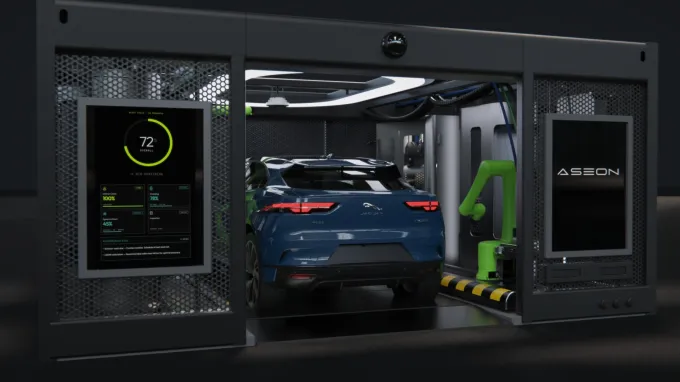
Redwood City, California-based startup Aseon Labs thinks it has a fix: parking space-sized automated pods that can be scattered throughout cities to inspect, clean, and charge robotaxis. The company, co-founded by the team behind battery-swapping startup Pushme, calls them robotic pit stops for the robotaxi industry. And the idea has caught the attention of investors.
Aseon Labs has raised $10 million in a seed round led by Crane Venture Partners, TechCrunch has learned. Y Combinator, Uber co-founder Garrett Camp’s venture firm Expa, Robin Hood Ventures, and Founders Capital also participated, along with angel investors such as serial entrepreneur and former Google executive Adrian Aoun, Mercury founder and CEO Immad Akhund, Zimride co-founder Rajat Suri, and operators and founding team members from Anthropic, Nuro, Turo, and Revolut.
Aseon Labs is still in the early stages. The seed funds will be used to build five prototypes of these pods, grow its six-person robotics and engineering team to about a dozen, and secure the real estate needed to build out its network, according to Aseon Labs co-founder and CEO George Kalligeros.
“In order to reach economic parity with ride-hailing — which is where we need to get with self-driving cars — and to stop really subsidizing the cost, you need the utilization to go up,” Kalligeros told TechCrunch. “You need the robotaxi in continuous operation during the entirety of the demand curve of the day.”
Aseon’s pitch is that a network of distributed autonomous pods would slash deadhead miles, and inevitably turn robotaxi services into profitable enterprises.

Kalligeros and co-founder and COO Dan Keene come from outside the autonomous vehicle world. But they bring experience developing and scaling a hardware-and-real estate company. Kalligeros worked as a mechanical design engineer at Bentley Motors and Tesla before he and Keene founded Pushme in 2016 to build battery-swapping infrastructure for micromobility fleets. Pushme was building a battery-swap network in Europe when it was acquired in January 2020 by Tier Mobility.
“The parallel I’ll draw is we were basically tasked by SoftBank to put this across as many markets where it made sense for Tier within a very short and compressed period of time,” Kalligeros said. “The playbook became, how do we sprinkle the locations across the center of the city, where it makes sense, but at the same time, make it easy to deploy as non-permanent infrastructure?”
Aseon Labs is applying the same thinking to autonomous vehicles.
As they researched the industry, the pair visited AV depots, where fleets of robotaxis are inspected, maintained, cleaned, and charged. The cost of real estate often prompts companies to locate these depots outside the city center, where most of the ride-hailing activity occurs.
“Depot infrastructure is the key requirement for the launch of a new city for any AV operator,” he said. “And what happens in the depot right now — the operational backbone of autonomy, really — is not fully baked.”
The founders settled on the idea of creating smaller, independently powered autonomous pods that could be dispersed throughout a city but as importantly, they could also be moved as needed. The units, which include cameras to inspect vehicles and robotic arms to retrieve lost items and clean interiors, are considered temporary structures. That classification helps Aseon Labs avoid a lengthy permitting process and allows the company to relocate units if a location underperforms.
The units are designed to run on a propane generator for power or connect to an existing power source through partnerships with EV charging companies. They are meant to operate autonomously, although early versions will be staffed, according to Kalligeros.
Aseon Labs isn’t trying to tackle every edge case, either. Instead, it leans on computer vision and AI — specifically vision-language-action models common in modern robotics — to detect problems the pod shouldn’t try to solve. For example, if a camera detects melted chocolate on a backseat, the robotic arm stands down since attempting to clean it could make the stain worse. Instead, the vehicle will be charged and dispatched directly to that company’s central depot for a human to handle.
Aseon Labs hasn’t signed contracts with any robotaxi companies yet, but Kalligeros said there is widespread interest in the concept. “Pretty much everyone wants to try it,” he said.
When you purchase through links in our articles, we may earn a small commission. This doesn’t affect our editorial independence.


Imagine what a scammer could do with your personal data in six months. Depending on what data was mined, a scammer could open credit accounts in your name, drain your bank account, and even share your information on the dark web. It’s a potential nightmare that would take you years to resolve, and yes, it could happen to you. The average number of days it takes a company to detect a data breach is a staggering 181, and it then takes, on average, another 60 days to contain it. Meanwhile, you’re guessing who accessed your data and what they plan to do with it.
Three million Texas license buyers have been left wondering just that after a data breach involving a vendor associated with the Texas Parks and Wildlife Department license system. The leak was detected by Texas Cyber Command and involves customers of the hunting and fishing license program in the Lone Star State. While their Social Security numbers were not compromised, an unauthorized person was able to access driver’s license information, email addresses, phone numbers, residential addresses, and even passport numbers. Birth dates and credit card details were reportedly not exposed, but that may be little consolation to those involved.
Texas Parks and Wildlife assured the public that no customers under the age of 18 were affected by the breach, and it has put additional security measures in place. It’s also working with the vendor to ensure such a breach doesn’t happen again, but some customers are questioning why so much personal data is necessary for a hunting or fishing license.

These breaches are incredibly frustrating for Americans because we expect our information to be secured. Today, the only surefire way to avoid becoming a victim is to completely opt out of sharing personal data — an impossibility in modern life. When a simple application for a fishing or hunting license can lead to data breaches, what can we do to protect ourselves?
State agencies are a common target for malicious actors. Last year alone, there were thousands of incidents involving these agencies and associated vendors. In Texas, affected customers are being offered one year of free credit monitoring, but there are also steps you can take before a data leak occurs that will help protect your sensitive data.
First, keep your own accounts secure. Use strong, unique passwords, and don’t share passwords across multiple accounts. Change your passwords regularly. Update apps and software to ensure that you’re taking advantage of critical security updates, and enable two-factor authentication when possible. To protect against identity theft, don’t carry your Social Security card with you, but store it somewhere safe and secure. Shred any documents that contain personal information, and regularly review your financial statements and credit reports for irregularities. You can also request a security freeze that restricts access to your credit reports, and if you think you’re at risk, a fraud alert will require lenders to take extra steps to confirm your identity.
Apple spent a lot of time talking about artificial intelligence at WWDC this year, including how Apple Intelligence is getting a boost from Google’s Gemini models. Apple unveiled Siri AI, a major overhaul of its voice assistant that can hold longer conversations, answer questions about what is on your screen and pull relevant information from your messages, emails and photos.
Siri AI is only one part of iOS 27. Apple also announced more advanced photo-editing tools, expanded parental controls, updates to its Liquid Glass design and several performance improvements intended to make the iPhone feel faster and more responsive.
Some of the most immediately useful changes, however, are much smaller. After installing the iOS 27 developer beta, I noticed new features tucked inside apps you already use every day: a faster way to pull up your Safari tabs, a separate alarm-volume setting, new tools for saving and organizing photos, and a Custom EQ option for AirPods.
The iOS 27 developer beta is available now, with a public beta expected in July and the full update arriving this fall. Developer betas can be buggy and may affect battery life, app compatibility and everyday performance, so you should avoid installing them on your primary iPhone unless you are comfortable dealing with unfinished software.
Here are some of the less obvious iOS 27 features worth checking out.
The Photos app is getting a new Extend tool that can expand an image beyond its original borders. You can use it to straighten a crooked horizon, change the aspect ratio of a photo or give your subject more breathing room in the frame.
Photos’ new Extend tool can expand an image beyond its edges.
Extend uses generative AI to create the additional parts of the image, similar to generative-expand tools already available in some photo-editing apps. Apple has also added a Spatial Reframing feature, that allows you to touch and drag to adjust the perspective of an image.
The Shortcuts app can be powerful, but building an automation from scratch requires some patience. In iOS 27, you can simply describe what you want a shortcut to do, and the app will assemble the required steps for you.
You could ask it to create a shortcut that texts someone when your phone is about to die or go into Focus mode when you arrive at work. You may still need to make a few adjustments, but you no longer have to start from scratch.
Shortcuts can now build an automation from a simple description.
AirDrop is also getting a speed boost. Apple says some AirDrop transfers can be up to 80% faster in iOS 27, making it quicker to send photos and files to someone nearby.
There is some fine print, though. Apple tested the improvement by transferring multiple photos totaling 30MB between nearby contacts while the phones were not connected to a Wi-Fi network. Your own results will depend on what you’re sending and the conditions around you, but any improvement should be noticeable if you regularly use AirDrop to share large batches of photos.
Low Power Mode can help stretch your battery when your iPhone is running low, but it can also make parts of the phone feel slower. In iOS 27, Apple says the Camera app launches faster when Low Power Mode is turned on.
That is a small improvement, but it matters when you are trying to quickly capture something before the moment passes and your phone dies
I always have issues in that moment of limbo when I’m leaving my apartment and too far away to have good Wi-Fi service, but not far enough for my phone to automatically disconnect. It always ends up disrupting whatever I’ve got going on my phone, like a download, stream or FaceTime call, and then I end up having to disable Wi-Fi.
In iOS 27, Apple says the phone can more seamlessly transition between Wi-Fi and cellular data as you move around, without you having to open the Control Center and manually turn off Wi-Fi.
Sending a large video through Messages can be annoying when you have a weak connection. Until the file finishes uploading, the conversation is pretty much on hold, because text messages are sent in order.
A new continuous-send feature lets you keep sending texts while a large photo or video is still being delivered. Messages also adds a send indicator to each outgoing message, making it easier to see what has already gone through and what’s still in progress.
Dual Capture in FaceTime lets you stream video from your front and rear cameras at the same time during a one-on-one call. That means the other person can see your face while you show them what is happening in front of you.
It could be useful when you are giving someone a tour, showing them a view or asking for help with something in front of you without constantly flipping the camera back and forth. There is one limitation: Apple says Dual Capture is available only on the iPhone Air and iPhone 17 lineup.
The Photos app now lets you save a single frame from a video as a photo with a tap. That means you no longer need to pause a clip at exactly the right moment, take a screenshot and crop out the video controls afterward.
There’s already a feature to take stills while you’re shooting a video, which I use when I’m recording a live concert, but it’s nice to have the feature for after, especially when there’s a great still image buried somewhere inside them.
Selection View gives you a faster way to review and modify a group of photos after selecting them in your library. You can also manage included metadata, such as location information.
This should make it easier to clean up a batch of pictures before sharing them, rather than opening each one individually and making the same changes over and over again.
If your photo library is overflowing with thousands of images, iOS 27 gives you another way to organize the ones you really care about. You can now assign photos and videos a rating from one to five stars.
Once you have rated your photos, you can filter your library and collections by rating. That could make it easier to narrow down a set of pictures for Instagram or keep track of the images you still need to edit.
Photos also includes an option to prioritize syncing new images and videos to iCloud for one day, even if it comes at the expense of battery life or system performance.
Normally, your iPhone may delay some syncing to conserve power or handle other tasks. The new setting is useful when backing up your photos matters more than preserving battery life, like after a photo shoot or an event where you captured something you don’t want to lose.
AirPods are getting a Custom EQ setting that lets you adjust the lows, mids and highs. That gives you more control over how your music sounds without relying on a broader EQ setting.
You could boost the bass, pull back the high end or make smaller adjustments based on your own preferences. It is not a replacement for a full professional equalizer, obviously, but it should be more than enough for people who want their AirPods to sound a little more personalized.
This feature should’ve been available on the iPhone a long time ago: You can set your alarm volume independently from the rest of your system volume.
That means you can keep videos, music and other audio relatively quiet without worrying that your alarm will also be too soft to wake you up. I’ve had times when I’ve missed an alarm because the volume was at zero, but hopefully, no more.
Widgets can now take up an entire Home Screen page if you want them to. Apple calls them extra-large widgets, with support for apps including Calendar, Photos and Music.
A full-page Calendar widget could make it easier to see your schedule at a glance, while a Photos widget could turn one page of your Home Screen into something like a digital photo frame. I don’t think I want a widget to take up my entire screen (isn’t that what apps are for?), but it could make sense for the apps you check often but only quickly want to glance at.
Safari has a small change that makes it much easier to see all the tabs you have open. Instead of double tapping on the tab button, you now only have to tap once to view all your tabs. It’s a minor interface tweak, but it removes some of the friction from jumping between webpages, especially if you regularly keep hundreds of tabs open at once, like me.
For more from WWDC, check out some of the biggest announcements and how to download the iOS 27 developer beta.

Notion announced that it will shut down its email client on September 22. The company says more than half of users already manage email through Notion’s AI agents without opening their inbox, so it is shifting its focus from a traditional email client to agent-run workflows. Engadget reports: It has published an FAQ for users to make sure that they don’t lose any messages or data in the transition. Most emails will still exist in a Gmail inbox, but customers will need to manually export their drafts, scheduled emails, snippets and auto label instructions. Notion first began offering Notion Mail after acquiring startup Skiff in 2024.
Tonight is your last chance to save up to $190 on your pass to TechCrunch Founder Summit 2026. Early Bird pricing ends today, at 11:59 p.m. PT, after which rates increase.
Founders rarely scale alone. The fastest path to growth comes from learning from founders who’ve already done it, connecting with peers tackling similar challenges, and building relationships with investors who can help accelerate your next stage of growth.
On November 4 in Boston, more than 1,000 founders and investors will gather for a highly curated day of tactical learning, candid conversations, and meaningful networking designed to help founders make smarter decisions and grow faster.
Don’t wait until prices increase. Register before 11:59 p.m. PT tonight to save up to $190. Bringing your team? Groups of four or more can save up to 30%.

Every session, discussion, and networking opportunity is designed around the real challenges founders face as they build, fund, and scale their companies.
You’ll connect with:
Whether you’re preparing to raise capital, refining your go-to-market strategy, or planning your next growth milestone, Founder Summit creates opportunities for conversations that can change the trajectory of your business.
Founder Summit focuses on the decisions that define a startup’s future. Through breakout sessions and roundtable discussions, you’ll gain practical guidance on topics including:
These founder-led conversations deliver practical takeaways you can apply immediately.
Past speakers have included:
Additional speakers have represented Sequoia Capital, NFX, Glasswing Ventures, Wing Venture Capital, Construct Capital, Greylock, Precursor Ventures, and more.
The 2026 agenda is coming soon, with additional founders, operators, and investors to be announced. Check the event page for agenda updates.
Interested in leading a discussion? Submit a roundtable or breakout session topic for a chance to be voted onto the agenda by the TechCrunch audience.
The deadline is in less than 24 hours. Early Bird pricing ends tonight at 11:59 p.m. PT. Join the founders, operators, and investors shaping the next generation of startups. Gain practical insights, build valuable relationships, and leave with strategies you can put into action immediately.
Register before 11:59 p.m. PT tonight to save up to $190 on your pass and up to 30% when registering as a group.
Interested in exhibiting at TechCrunch Founder Summit 2026? Reserve your exhibit table and connect directly with founders, investors, and startup decision-makers.

When you purchase through links in our articles, we may earn a small commission. This doesn’t affect our editorial independence.




Weekend Open Thread: Miami – Corporette.com


Renter of Home in Anne Heche Crash Denies Settlement With Son

Two goals and an assist by sheer aura: Cristiano Ronaldo just entered the World Cup chat


Microsoft accidentally kills epic Outlook email threads


Soccer-U.S. defends Iran World Cup travel restrictions, says discussions ongoing


The House | Manchesterism won’t survive the painful trade-offs unless it gets citizens on board


Andy Burnham and the meaning of Makerfield


Potential 2028er World Cup attendee leaderboard


Keir Starmer Allies Question His Chances For No 10


A Look At A Gaggle Of Transputer Boards
Bitcoin (BTC) Dips Below $62K, Ethereum (ETH) Plunges 6% Daily: Market Watch


Securitize Wraps Roubini's SEC-Registered ETF as Dubai VARA Digital Security

Dell (DELL) Shares Tumble Over 5% Following Analyst Downgrade to Hold
Entergy settles forward sale agreements, raises $672 million in cash proceeds

Wall Street Week Ahead: Investors see Micron earnings as pulse check of AI rally momentum

Can Charles Hoskinson Really Rescue Cardano?


Jose Alvarado Wants Taylor Swift at More Knicks Games


HIVE shares jump as $220M AI deal speeds Bitcoin mining pivot


Jake Chervinsky accuses CME of protecting derivatives monopoly

Signal’s Meredith Whittaker says AI chatbots ‘are not your friends’ and calls Copilot agents a backdoor


You must be logged in to post a comment Login