

Business
Colombia and Portugal Draw 0-0 at World Cup, With Colombia Topping Group K Over Ronaldo’s Portugal Squad

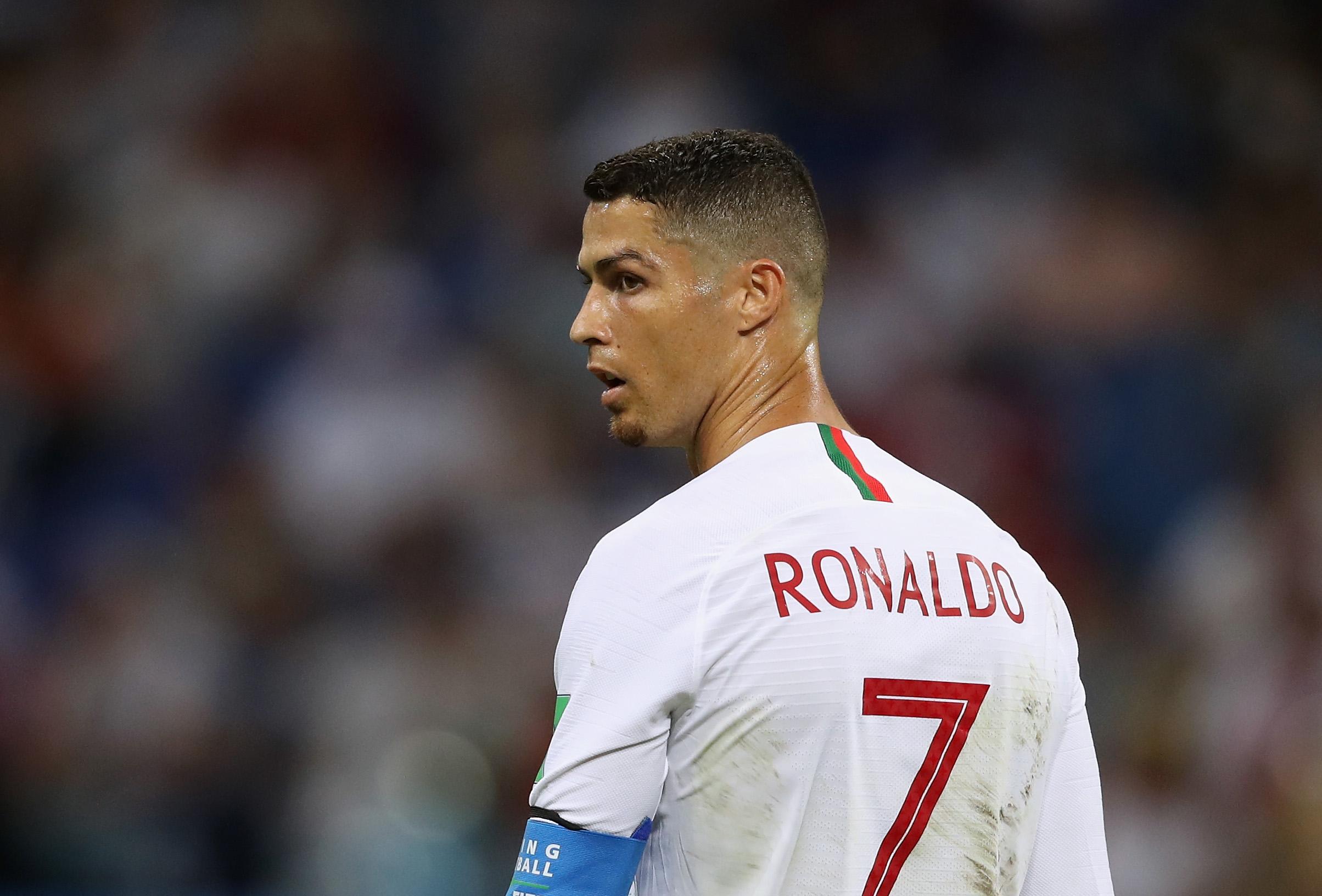
MIAMI — Colombia and Portugal played out a scoreless draw at Miami Stadium on Saturday in a meeting of World Cup heavyweights, with Colombia securing top spot in Group K despite the stalemate, as Cristiano Ronaldo was kept largely quiet by a determined Colombian defense.
The result extends a mixed tournament for Ronaldo, who had drawn attention for his celebratory outburst following Portugal’s earlier win over Uzbekistan, but found himself a peripheral figure for long stretches against a Colombian side that controlled much of the match’s tempo.
A chance encounter early on
The match nearly burst into life within the opening minute, when a deflected effort from Bayern Munich winger Luis Díaz spun unexpectedly onto the head of forward Jhon Córdoba inside the box. Córdoba, seemingly as surprised as anyone to find himself with the chance, lifted his attempt over the bar. Portugal goalkeeper Diogo Costa was called into action shortly after, producing a sharp one-handed save to deny Córdoba a second opportunity.
Portugal struggled to generate much of a response in the first half. A shot from midfielder Bruno Fernandes was batted away by Colombia goalkeeper Camilo Vargas, and Ronaldo’s follow-up attempt on the rebound, an overhead effort, was blocked before it could threaten the goal. Forward João Félix also tested Colombia’s defense with an effort that sailed over the bar, but for the most part, the opening 45 minutes offered little in the way of clear chances for either side, with Ronaldo struggling to find space against a well-organized Colombian back line.
Colombia presses for a breakthrough
The pattern of Colombian pressure continued into the second half. Midfielder Richard Ríos fired a shot just wide of Costa’s left-hand post from close range shortly after the hour mark, continuing a string of Colombian opportunities that went unrewarded. Ronaldo had a half-chance of his own at the other end, but was ruled offside before his effort could be assessed further.
Costa was forced into another important save soon after, denying Jhon Arias as Colombia continued searching for the goal that would settle the contest. Forward Luis Suárez also found space inside Portugal’s box but miskicked his attempt with Costa’s goal in sight, while a shot from James Rodríguez was cleared away by defender Renato Veiga before it could test the Portuguese goalkeeper.
Portugal’s response off the bench
With Colombia controlling much of the second-half play, Portugal manager Roberto Martínez turned to his bench in search of a spark, introducing forward Rafael Leão. The substitution nearly paid off when fullback Diogo Dalot curled an effort just wide of the target after receiving a corner delivery from Fernandes, offering one of Portugal’s better chances of an otherwise difficult night in front of goal.
A disallowed goal in stoppage time
Colombia appeared to have snatched a dramatic late winner in stoppage time, when defender Davinson Sánchez headed home what was initially celebrated as the decisive goal. Colombian substitutes streamed off the bench in celebration before officials intervened, ruling Sánchez offside and wiping out the goal. The disallowed effort proved to be the match’s final notable moment, with the contest finishing scoreless.
Martínez reflects on a missed opportunity
Speaking after the match, Portugal manager Roberto Martínez acknowledged that his side had allowed Colombia to dictate the terms of the contest. “We let Colombia have the match they wanted,” Martínez said. “We did not control possession as much as we wanted. We weren’t able to control the game or use our talent.”
The result leaves Martínez with plenty to address, given that Portugal has now struggled in two of its three matches so far in the tournament, despite possessing one of the most talent-laden rosters in the competition.
Where both teams go next
Despite the draw, Colombia’s result was enough to secure top spot in Group K, a notably positive outcome for a team that will now face Ghana in the round of 32. Portugal, meanwhile, finishes the group stage in second place and advances to face Croatia in the next round.
For Colombia, the result represents an encouraging marker after an entertaining and largely one-sided performance against one of the tournament’s most decorated squads, even if questions remain about the team’s finishing in front of goal after multiple missed opportunities throughout the match.
A raucous atmosphere in Miami
Saturday’s match also stood out for the scene inside Miami Stadium, where Colombian supporters appeared to dominate the crowd by a wide margin, continuing a recent trend of passionate fan turnouts at the venue. The atmosphere followed a similarly charged scene days earlier when Brazilian fans filled the same stadium for their team’s win over Scotland.
While Colombian fans have a more complicated recent history at major tournaments, including incidents involving fans storming gates at the 2024 Copa América final, Saturday’s crowd was orderly and high-spirited throughout, creating an atmosphere that made Colombia feel almost like a host nation despite not holding that status at this World Cup.
A measured night for Ronaldo
For Ronaldo, who turns 42 later this year, Saturday’s match offered a stark contrast to his prior outing against Uzbekistan, when his enthusiastic on-camera celebration drew attention across the tournament. Against a well-drilled Colombian defense, the Portuguese forward was unable to find the same rhythm, spending long stretches of the match on the periphery of the action and managing little in the way of direct goal-scoring threat before his side’s lone offside chance late in the second half.
With the group stage now behind them, both Colombia and Portugal turn their attention to the knockout rounds, where Colombia will look to build on a group-topping finish against Ghana, while Portugal and Martínez will look to address the possession and control issues that have plagued the team through much of the tournament when they face Croatia in the round of 32.

Business
Funding the ‘mother of all cycles’: Chris Wood cuts Indian stocks to double down on South Korean chip giants
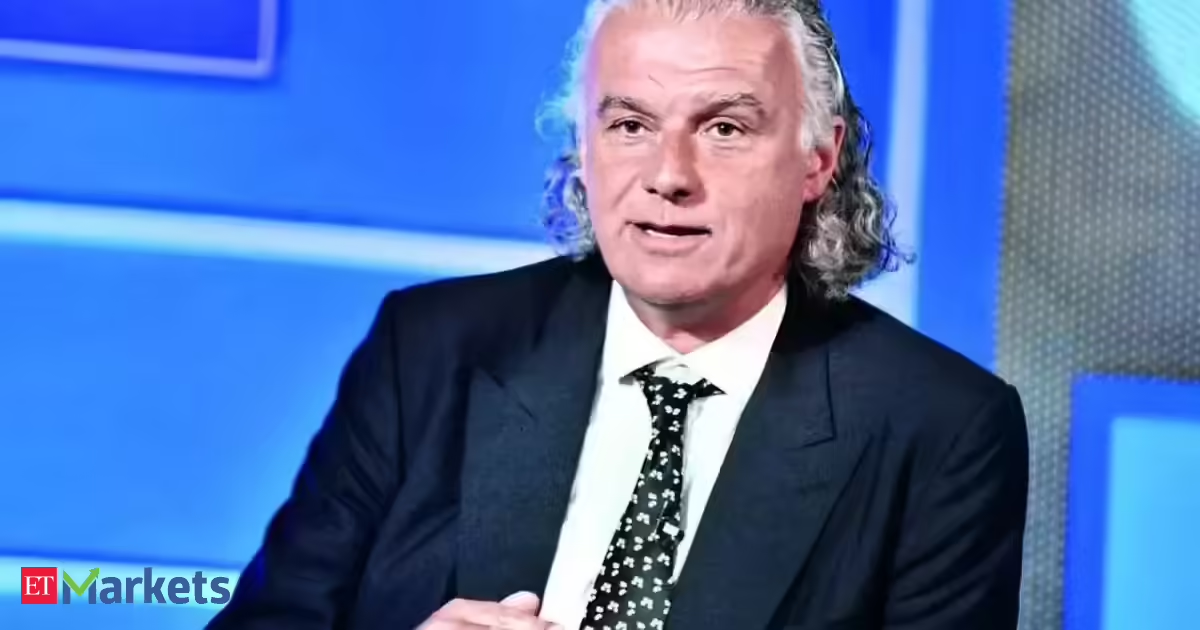
Wood describes the ongoing AI build-out as “the most dramatic capex cycle Greed & Fear has ever seen,” with hyperscalers and foundries ramping up spending at an unprecedented pace. Against that backdrop, he is explicitly “going to have to increase exposure to tech hardware in the various Greed & Fear portfolios,” adding SK Hynix and Kioxia to his global long-only book and increasing the weighting in Samsung Electronics.
In the updated global long-only portfolio, SK Hynix and Kioxia are included “with an initial 4% weighting each,” while the existing Samsung Electronics position is raised by one percentage point. “All this means that Greed & Fear is going to have to increase exposure to tech hardware,” Wood writes in his newsletter, emphasising that DRAM and NAND suppliers are at the heart of the AI trade three and a half years into the capex arms race.
Also Read | Chris Wood’s big warning: The specific risk that will finally trigger the end of AI trade
‘Mother of All Cycles’ and Jevons Paradox

The strategic shift is anchored in Wood’s conviction that falling token costs will drive explosive growth in compute demand, not a bust in AI usage. Citing Jevons Paradox, he argues that “falling token prices should lead to rising DRAM prices,” as cheaper AI services spur more usage and, in turn, greater consumption of memory and bandwidth.
“So the increased demand triggered by cheaper prices should be good for the picks and shovels plays, which have already been by far the main beneficiaries of AI in stock market terms three and a half years into the AI capex arms race,” he notes, adding that “for now at least, there remains zero sign of AI capex slowing.” With AI-linked data centre investment driving boom-like conditions in Taiwan and record export orders, Wood views the entire supply chain, especially DRAM, as central to what he calls “the mother of all cycles.”
Funding the Shift: India and Other Cuts
To fund this hardware tilt, Wood is trimming exposure in India and other markets rather than adding overall risk. In the Asia ex-Japan long-only portfolio, “an initial 4% will be re-initiated in Hynix by removing PolicyBazaar,” while a one-percentage-point cut to Alibaba helps finance an increased stake in Samsung Electronics.
The India long-only portfolio also takes a hit. “Finally, in the India long-only portfolio, the investment in Ambuja Cements will be removed, while the investments in GMR Airports, JSW Energy and Adani Energy Solutions will be reduced by two percentage points, one percentage point and one percentage point respectively,” the note states.
These reallocations free up capital to deploy into the South Korean and Japanese memory complex, underscoring Wood’s preference to fund the AI hardware trade by rotating within equities rather than increasing overall exposure.
Wood’s conviction rests heavily on structural changes in the DRAM industry and the evolving role of memory in AI workloads. He highlights Micron CEO Sanjay Mehrotra’s assertion that “memory has evolved from a peripheral component into the core engine driving productivity in the AI era,” and points to long-term strategic customer agreements (SCAs) as evidence of newfound pricing power.
Micron has signed 16 SCAs covering roughly 20% of DRAM volumes and a third of NAND volumes, typically with five-year terms, signalling greater visibility and discipline across the industry. On valuations, Wood argues that “the story that the DRAM industry has changed structurally, and that the companies should now be valued on a price-to-earnings basis rather than on a price-to-book basis, looks to Greed & Fear an increasingly powerful argument.” Hynix, Samsung Electronics and Micron, he notes, are trading at 7.8x, 6.8x and 9.2x consensus 12-month forward earnings respectively.
How the AI Boom Might End
Even as he increases exposure, Wood is candid about what he sees as the defining risk of the AI trade. “Greed & Fear is personally convinced that concerns about malinvestment will be the most likely trigger for an end to the AI trade, or at least for a protracted pause to refresh, given the huge amounts now being spent by the main players,” he writes.
He warns that the “main risk to the picks and shovels story remains a sudden realisation by investors that hyperscalers and the likes of OpenAI and Anthropic will not be able to generate returns on their investment,” which could abruptly curtail funding for AI capex. Circular arrangements, such as Nvidia financing OpenAI so the latter can buy more Nvidia chips, could aggravate that unwinding once capital markets begin to question long-term returns.
Portfolio Track Record and Lessons Learned
Wood also reflects on past positioning as he executes the latest reallocation. In the global portfolio, he is removing Alphabet and Alibaba to make room for SK Hynix and Kioxia, noting that Alphabet has risen 19% since its inclusion in November 2025, while Nvidia is up only 3.3% since being dropped in October 2025.
“In this sense, the trade worked. But clearly Greed & Fear would have done better to invest more in DRAM stocks,” he concedes, underlining the lesson that memory has been, and remains, the most leveraged way to play the AI theme.
Nvidia, he adds, “seems to have been used as the funding short by tech ‘pod’ platforms in recent months to bet on higher beta AI hardware plays,” further illustrating how investor focus has shifted towards component and capacity providers. That rotation is now being mirrored in his own model portfolios as he cuts India-centric positions and other non-hardware names to double down on South Korean chip giants at the heart of the AI capex cycle.
(Disclaimer: Recommendations, suggestions, views and opinions given by the experts are their own and do not represent the views of The Economic Times)
Palantir: Recreating My Reverse DCF Model After A Year Since Turning Bearish

The Capex Boom Goes Beyond AI. That’s Good News for Stocks.

ICICI Pru Balanced Hybrid Fund and ICICI Pru Multi-Asset Active FOF will open for subscription on June 30 and close on July 14. The minimum investment amounts are Rs 500 and Rs 1,000, respectively.

Over the past 1 month, 13 penny stocks have recorded sharp declines, falling between 20% and 55%. These underperformers were identified through a targeted screening approach focused on stocks with a market cap below Rs 1,000 crore, a share price under Rs 20, and a minimum recent trading volume of 5 lakh shares. The strategy aims to highlight low-priced, actively traded penny stocks that have experienced significant downside. (Data Source: ACE Equity)
Although penny stocks often attract investors with their low entry prices and potential for rapid gains, they come with substantial risks. Due to low liquidity, high volatility, and limited transparency, they are prone to manipulation and sudden price drops. Without a clear strategy and strong risk controls, investors may face more losses than gains.

The Value Portfolio specializes in building retirement portfolios and utilizes a fact-based research strategy to identify investments. This includes extensive readings of 10Ks, analyst commentary, market reports, and investor presentations. He invests real money in the stocks he recommends.
He is the leader of the investing group The Retirement Forum with features including: model portfolios, macro overviews, in-depth company analysis and retirement planning information. Learn more.
Analyst’s Disclosure: I/we have a beneficial long position in the shares of PBR either through stock ownership, options, or other derivatives. I wrote this article myself, and it expresses my own opinions. I am not receiving compensation for it (other than from Seeking Alpha). I have no business relationship with any company whose stock is mentioned in this article.
Seeking Alpha’s Disclosure: Past performance is no guarantee of future results. No recommendation or advice is being given as to whether any investment is suitable for a particular investor. Any views or opinions expressed above may not reflect those of Seeking Alpha as a whole. Seeking Alpha is not a licensed securities dealer, broker or US investment adviser or investment bank. Our analysts are third party authors that include both professional investors and individual investors who may not be licensed or certified by any institute or regulatory body.

Franklin Resources, Inc. [NYSE:BEN] is a global investment management organization with subsidiaries operating as Franklin Templeton and serving clients in over 150 countries. Franklin Templeton’s mission is to help clients achieve better outcomes through investment management expertise, wealth management and technology solutions. Through its specialist investment managers, the company offers specialization on a global scale, bringing extensive capabilities in fixed income, equity, alternatives and multi-asset solutions. With more than 1,300 investment professionals, and offices in major financial markets around the world, the California-based company has over 75 years of investment experience and over $1.4 trillion in assets under management as of June 30, 2023. For more information, please visit franklintempleton.com and follow us on LinkedIn, Twitter and Facebook.

Google limits Meta’s use of its Gemini AI models, FT reports

Saks Global is emerging from Chapter 11 bankruptcy and rebranding itself as Exemplar Luxury Group.
The company said it is coming out of the process with a 75% debt reduction and sufficient liquidity. It has been partnering with Pentwater Capital Management and Bracebridge Capital throughout its restructuring process.
Copyright ©2026 Dow Jones & Company, Inc. All Rights Reserved. 87990cbe856818d5eddac44c7b1cdeb8
This is an edition of the What’s News newsletter, which helps you catch up on the headlines and understand the news, free in your inbox daily. If you’re not subscribed, sign up here.
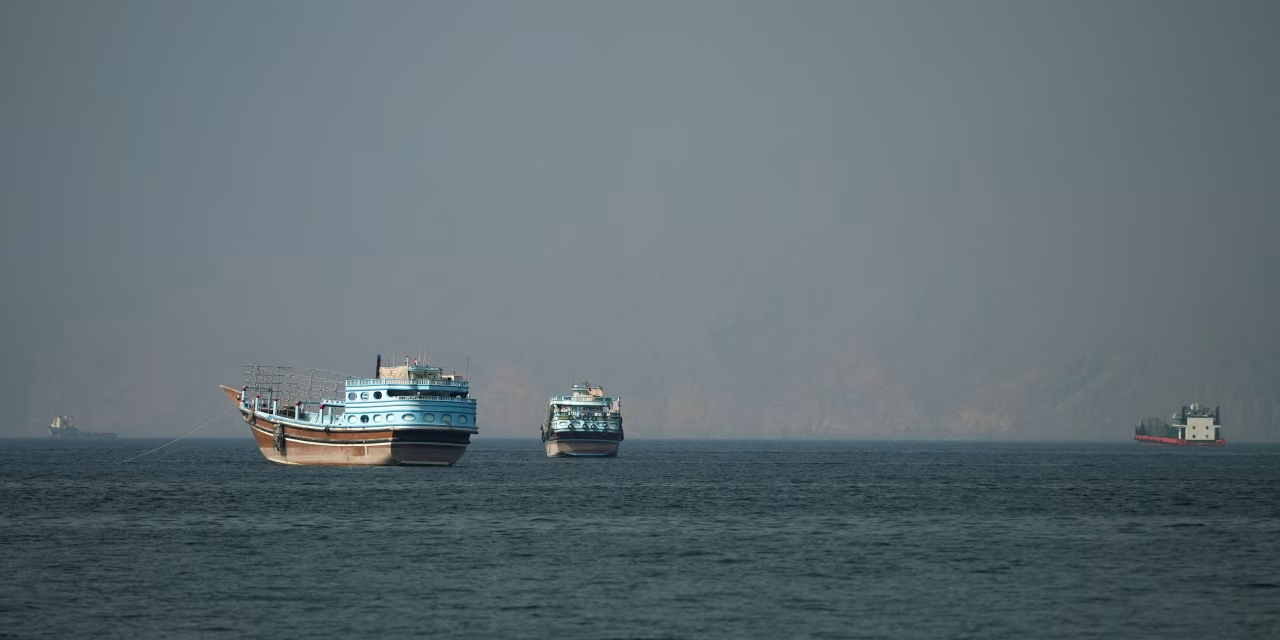
1. The U.S. launched a fresh attack on Iran—one day after Tehran struck a commercial ship in the Strait of Hormuz.
The move is the latest sign that a fragile ceasefire is breaking apart. The U.S. strike was in response to a drone attack on a Singapore-flagged cargo ship, U.S. Central Command said. President Trump had repeatedly threatened to resume the war if Iran violated the terms of a 60-day ceasefire signed last week; the agreement allowed for the free flow of trade through the vital waterway.
Copyright ©2026 Dow Jones & Company, Inc. All Rights Reserved. 87990cbe856818d5eddac44c7b1cdeb8

Farnworth Baptist Church awarded Investors in People Award
Funding the ‘mother of all cycles’: Chris Wood cuts Indian stocks to double down on South Korean chip giants

Coinbase, OKX chase Binance users as MiCA deadline bites


-
 Sports4 days ago
Two goals and an assist by sheer aura: Cristiano Ronaldo just entered the World Cup chat
-

 Tech6 days ago
Microsoft accidentally kills epic Outlook email threads
-

 Fashion2 days ago
Weekend Open Thread: Staud – Corporette.com
-

 Politics2 days ago
The House | Manchesterism won’t survive the painful trade-offs unless it gets citizens on board
-

 Politics2 days ago
Potential 2028er World Cup attendee leaderboard
-

 Business2 days ago
Asia stock markets slide as tech shares slump
-

 Tech2 days ago
A Look At A Gaggle Of Transputer Boards
-
Crypto World4 days ago
Bitcoin (BTC) Dips Below $62K, Ethereum (ETH) Plunges 6% Daily: Market Watch
-

 Crypto World4 days ago
Securitize Wraps Roubini's SEC-Registered ETF as Dubai VARA Digital Security
-
 Crypto World3 days ago
Dell (DELL) Shares Tumble Over 5% Following Analyst Downgrade to Hold
-
Business4 days ago
Entergy settles forward sale agreements, raises $672 million in cash proceeds
-

 Crypto World1 day ago
Kraken's xStocks Opens Bending Spoons IPO Registration to EEA Retail
-

 Sports1 day ago
FIH Pro League: India defeat Pakistan 7-1, register biggest win of campaign | Other Sports News
-

 Crypto World2 days ago
RTX holders must register wallets before token distribution begins
-
 Crypto World2 days ago
Hyperliquid Named on Singapore MAS Investor Alert Register
-

 Sports3 days ago
India vs Bangladesh LIVE Score, Women’s T20 World Cup: Bangladesh Opt To Bat; India Enter ‘Do-Or-Die’ Stage As Semi-Final Race Heats Up
-
Crypto World2 days ago
The DATA Foundation Launches to Tackle AI’s Multi-Billion Dollar Training Data Bottleneck
-
 Tech7 days ago
Signal’s Meredith Whittaker says AI chatbots ‘are not your friends’ and calls Copilot agents a backdoor
-

 Crypto World3 days ago
Strategy (MSTR) has a 10-month cash runway for dividends, but retail investors are losing faith
-
 Crypto World2 days ago
AAVE price tests 9-month trendline after 17% rebound as breakout hopes build
You must be logged in to post a comment Login