

Crypto World
Vitalik Buterin says crypto’s most powerful idea is still nowhere near ready



Building secure obfuscation has proved brutally hard. An ideal version was proven impossible in 2001, which sent researchers after the weaker iO target instead, a roughly two-decade effort littered with broken attempts. The recent good news is that iO can now be built under reasonable security assumptions.
However, the downside is that the runtimes are, in Buterin’s word, “galactic,” efficient on paper but absurdly slow in practice.
Buterin compared the moment to where SNARKs, the zero-knowledge proofs now central to Ethereum’s scaling, sat around 2010, before years of optimization turned them from a curiosity into working infrastructure. The suggestion is that obfuscation could travel the same road from theoretical breakthrough to usable tool, even if a single run today would be hopelessly expensive.
Privacy coins like Monero (XMR) already hide things on a live blockchain, so why does Buterin treat this as unsolved? Because they hide different things. Monero obscures transaction data, such as who paid whom and how much, through ring signatures, stealth addresses and confidential amounts.
Obfuscation in Buterin’s sense hides the program’s logic, the code itself, not the data flowing through it. As he puts it, iO hides the code, not the data. Monero has done transaction privacy for over a decade, but program obfuscation has never run in production anywhere, and closing that gap is what his post is about.

-
Claude Mythos and DeFi: Real threat or overblown fear?
When Anthropic introduced Claude Mythos-class models as its most advanced AI system for cybersecurity, it drew the usual mix of reactions from crypto communities. The lineup included Claude Fable 5, a Mythos-class model intended for broad use, although access was later suspended after a US government directive.
The concern around decentralized finance (DeFi) was easy to understand. If AI systems can find software flaws faster and with less human input, attackers may also use them to spot weak points in protocols before security teams can fix them.
Those concerns may seem overstated, but they come from a real shift in technology. AI tools have become better at reviewing code, spotting flaws and supporting security teams. At the same time, DeFi remains a major target for attackers because its code is often public, its protocols hold large amounts of money and many systems are new or not fully battle-tested.
The key question is whether Claude Mythos and similar tools pose a serious threat to DeFi, or whether the industry is overstating what today’s AI can actually do.
The answer sits somewhere between the hype and the alarm.
-
What is Claude Mythos?
Claude Mythos is Anthropic’s most advanced AI system for cybersecurity. Unlike general-purpose AI assistants that can write code or explain technical concepts, Mythos is designed to handle complex security tasks.
Anthropic initially limited access to the model instead of releasing it widely. According to the company, Mythos showed clear improvements in vulnerability research, exploit analysis and layered cybersecurity reasoning compared with earlier versions.
That capability drew attention quickly because vulnerability detection is valuable in both cybersecurity and crypto.
A security expert might spend weeks reviewing code for small flaws. If AI can shorten that timeline to hours, or even less, it could change the balance in defensive security.
That possibility explains much of the unease in crypto circles.
-
Why Claude Mythos matters to DeFi
DeFi has lost billions of dollars to hacks, exploits and protocol failures in recent years. The concern is not new.
Flash-loan attacks, cross-chain bridge exploits, governance attacks and smart contract bugs have shown that even audited protocols can still have gaps.
Unlike traditional software systems, DeFi protocols often control large amounts of money through smart contracts. A vulnerability may not just expose information. It could allow attackers to move funds quickly and without permission.
That makes DeFi especially attractive to malicious actors.
The open-source nature of many blockchain projects adds another risk. Their code is available for security teams to review, but it is also available to attackers.
In the past, finding advanced vulnerabilities required deep technical skill. Security researchers needed strong knowledge of coding languages, blockchain architecture, cryptography and attack methods.
AI changes that.
Instead of manually reviewing large codebases, analysts can now use AI assistants to flag suspicious patterns, summarize complex systems and point out possible attack paths.
This is where concerns around Claude Mythos begin.
Did you know? In some controlled security competitions, AI systems have identified software vulnerabilities in minutes that would normally take human researchers several hours, or even days, to find.
-
Can AI really find vulnerabilities in DeFi protocols?
The short answer is yes. AI systems have already shown that they can find certain types of software vulnerabilities.
Studies from Anthropic and other research groups show that advanced models can review code repositories, test security assumptions and sometimes find issues that human analysts miss.
Smart contracts are well suited to this kind of analysis because they are often public and written in structured languages such as Solidity.
An AI system can quickly review thousands of contracts, spot repeated patterns and look for known types of vulnerabilities.
Areas where AI is likely to provide growing support include:
- Reviewing audit reports
- Identifying unsafe coding practices
- Comparing protocol upgrades
- Detecting permission errors
- Modeling possible exploit paths
- Analyzing interactions between smart contracts
AI is becoming a force multiplier for security researchers. A task that once required a full team of experts could increasingly be handled by a smaller group of security professionals using advanced AI tools.
That is a meaningful change, not just marketing hype.
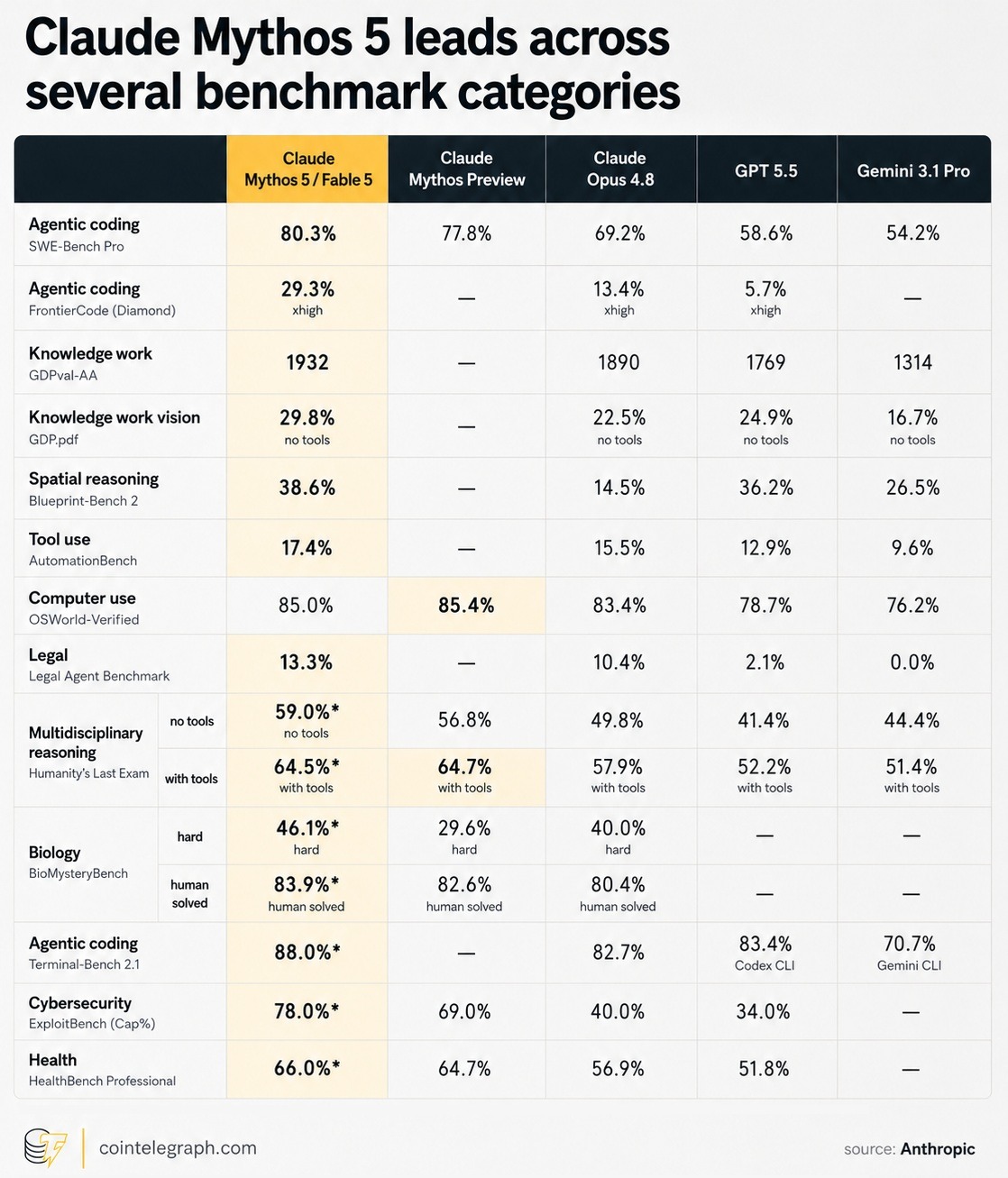
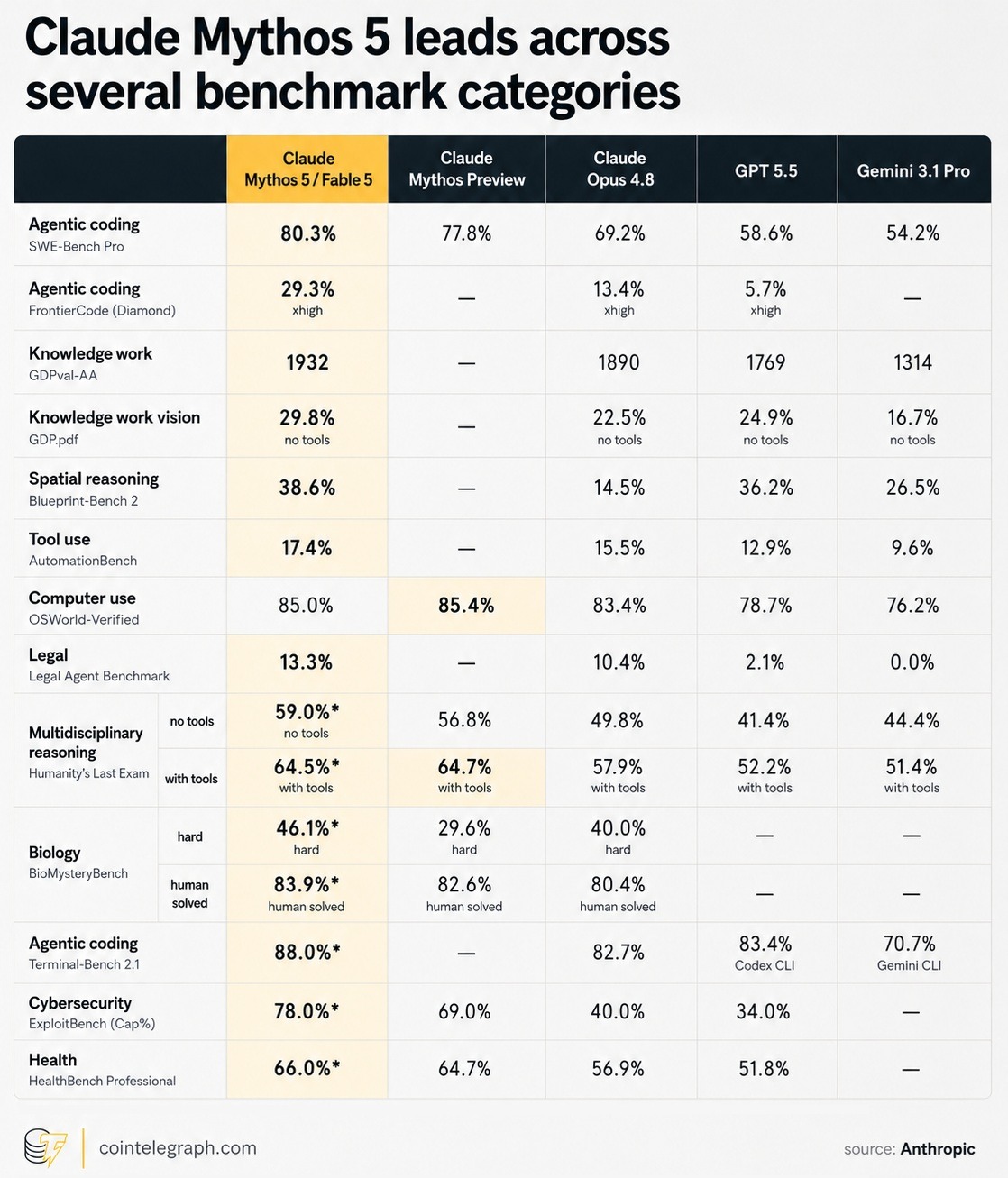
The table below shows how Claude Mythos compares with other models:
-
Why AI threats to DeFi may be exaggerated
Even with these advances, there is a clear difference between finding a vulnerability and stealing funds. Many crypto attacks involve much more than spotting a flaw.
Attackers often need to:
- Understand complex protocol mechanics
- Bring in significant capital
- Coordinate multiple transactions
- Exploit market conditions
- Manipulate liquidity
- Navigate governance systems
- Avoid detection
Even when a vulnerability exists, turning it into a successful attack often requires detailed planning and careful execution.
The real-world environment is far more complex than isolated coding tests.
Current AI systems also have limits. They can reach wrong conclusions, miss key details or follow weak lines of analysis. Security experts often find that AI tools produce useful insights alongside many false alarms.
An AI tool might flag 10 possible vulnerabilities, but only one may turn out to be valid. That matters because skilled human oversight is still essential.
Claude Mythos could speed up vulnerability detection, but it does not remove the need for experienced security experts.
Did you know? Many DeFi protocols publish their code online. This gives both security teams and AI tools more real-world financial software to review than in traditional banking systems.
-
The defensive side of AI in DeFi
A major flaw in the claim that AI will weaken DeFi is the idea that only attackers will benefit from these tools. Security teams have access to them too.
Security firms are already adding AI to their review processes. Developers are using AI-assisted code checks more often. Bug hunters can also use AI to spot issues before attackers find them.
Over time, AI may become a normal part of protocol security.
That could mean:
- Every code update goes through AI-assisted review
- AI agents continuously monitor deployed contracts
- Automated systems look for unusual on-chain activity
- Possible vulnerabilities are flagged before deployment
In that case, AI could strengthen DeFi security instead of weakening it.
The technology is neutral on its own. Its impact depends on how well attackers and defenders use it.
-
When AI attacks meet AI defenses
A more realistic outlook points to a future where AI systems challenge each other directly. This would make security faster on both sides.
Attackers will use more advanced models to find vulnerabilities and plan attacks. Security teams will use similar tools to monitor threats, improve code quality and respond faster.
This already happens in traditional cybersecurity, where offensive and defensive tools improve side by side.
DeFi could become the next major battleground for this contest. The likely result is not a sudden collapse of the sector. Instead, DeFi may enter a period of faster security upgrades and adaptation.
Projects that are slow to find vulnerabilities and update their code could face greater risk. Those that adopt AI-supported safeguards may become stronger than before.
Did you know? Several major crypto losses have come from compromised private keys, social engineering attacks or governance manipulation rather than flaws in smart contract code itself.
-
Assessing protocol vulnerabilities
Risk is not spread evenly across DeFi. Smaller projects with limited security resources often face the highest exposure.
Several categories are especially vulnerable:
- Fast deployment schedules: Projects that prioritize quick launches over careful testing may leave structural flaws in place.
- Copied codebases: Many protocols reuse or slightly modify existing code. Advanced AI tools can compare these systems quickly and expose inherited flaws.
- Weak audit coverage: Projects with little or no third-party review are less prepared for advanced attacks.
- Legacy smart contracts: Older contract designs may rely on assumptions that no longer hold up against modern exploit methods.
Automated analysis tools could sharply reduce the time needed to find these weaknesses.
-
What DeFi builders should do now
Claude Mythos offers an important lesson for the industry. DeFi builders should assume that attackers may already be using automated research tools. Security strategies need to improve accordingly.
Core priorities should include:
- Expanding automated security testing
- Running continuous, real-time audits
- Adding AI-assisted code analysis to development pipelines
- Increasing bug bounty rewards
- Using formal verification for critical code
- Improving threat monitoring and real-time incident response
Engineering teams must reduce the time between finding a vulnerability and deploying a fix. In an AI-accelerated environment, response time becomes just as important as prevention.
-
A major shift, not DeFi’s breaking point
Claude Mythos has shown that automated systems can handle complex security tasks that once required specialized experts. That marks a major shift for DeFi, where a code flaw can lead to the immediate loss of user funds.
Still, predictions of total systemic failure ignore several practical realities. Finding a vulnerability does not guarantee a successful exploit. Current AI tools still produce uneven results, human oversight remains essential and defensive teams have access to the same technology.
The more likely outcome is a change in security standards, not a collapse of DeFi. Automated tools could reduce the time and cost needed to find vulnerabilities. That will put more pressure on development teams to improve code quality, respond faster and build stronger security systems.
Ultimately, these developments are a warning, not a guaranteed outcome. The future of decentralized infrastructure will not be decided only by what AI can find. It will also depend on whether attackers or defenders use the technology more effectively.

- Chainlink added 6,182 new wallets in two days.
- LINK’s price must clear $8.31 to strengthen its recovery.
- Technical indicators lean more bearish than bullish.
Chainlink (LINK) is showing a rare divergence between its on-chain activity and price action.
While the token has struggled to recover from recent losses, network activity has accelerated at its fastest pace this year, raising questions about whether the increase in network activity can eventually translate into a price rebound.
At the time of writing, LINK is trading around $7.30, up just 0.3% over the past 24 hours.
Despite the modest daily gain, the broader trend remains weak.
LINK has declined 8.7% over the past week, 20.3% over the last 30 days, and 45.8% over the past year.
Chainlink network activity reaches highest level of 2026
Recent on-chain data showed that the Chainlink network added 6,182 new wallet addresses in just two days, marking its strongest two-day growth of 2026.
✍️ TL;DR: Chainlink network growth erupts with two highest on-chain days of the year
📊 Metrics used: Network Growth
🔗 Link to chart: https://t.co/V88ThZQNSi📈 BREAKING: Chainlink just posted its two strongest network growth days of 2026, with 3,142 new LINK wallets on June… pic.twitter.com/H0FVqxDvwB
— Santiment Intelligence (@SantimentData) June 26, 2026
The increase was spread across two consecutive days, with 3,142 new wallets created on June 25 and another 3,040 on June 26.
Such growth is often viewed as a sign of rising user participation because it reflects fresh addresses interacting with the network during a period when the token itself has been under selling pressure.
The surge is particularly notable as it came while LINK was trading close to multi-month lows instead of a rally.
In many cases, rapid wallet growth accompanies rising prices as new investors enter the market.
This time, the increase in network activity arrived even as the token remained below several important resistance levels.
Chainlink continues to maintain a total value locked (TVL) of about $28.841 billion, showing that the protocol remains one of the largest decentralised oracle networks despite recent weakness in its token price.
Some market observers have pointed to the divergence between improving on-chain metrics and weaker prices as evidence that network usage has remained resilient.
However, address growth alone does not guarantee higher prices, particularly when broader market conditions remain under pressure.
Bearish technical indicators continue to dominate
Despite the encouraging on-chain data, technical indicators still favour the sellers.
From a technical perspective, LINK is trading below its 10-day, 20-day, 50-day, 100-day, and 200-day EMAs, leaving every major moving average above the current price and acting as resistance.
Remaining below the 200-day EMA also suggests that the longer-term trend has yet to turn positive.
Momentum indicators offer a slightly more balanced view.
The 14-day Relative Strength Index (RSI) stands at 32.21, keeping the token above the traditional oversold threshold of 30 but still close enough that trading volume could play a decisive role in the next move.
On the weekly timeframe, the RSI is 33.23, indicating that bearish momentum has eased compared to earlier weeks, although the broader trend remains under pressure.
Key Chainlink price levels to watch
The technical structure leaves several important price levels in focus.
Immediate support sits at $7.02. If the token closes below that level, the current support structure would weaken significantly and could expose LINK to additional downside.

On the upside, traders are watching $8.31, which represents the first major resistance level.
A confirmed close above that price would improve the technical outlook and could allow LINK to challenge the next resistance around $9.19.
Some technical analysts have also highlighted the possibility of a double-bottom formation if support continues to hold.
Under that scenario, a sustained breakout above resistance could eventually open the path toward the $9 region.


The ontology lays out how Chainalysis views the role of attribution to these clusters, presenting a two-tier structure; the first tier “defines the structural graph,” while the second assesses how confident the analysis is in that graph.
“What does it mean that these addresses belong together, right? It’s clearly because somebody believes that they are under the control of the same entity, right?” Illum said. “Maybe it’s an exchange, or maybe it’s a darknet market, or maybe it’s a mixer, or whatever. But what are the grounds to establish that these things actually belong together?”
Investigators likely won’t have private keys, which would be the easiest way to tell if a cluster of addresses is all being controlled by the same entity, so they would then have to look at onchain data.
Illum was also clear about the limitations of this type of analysis: While Chainalysis could conduct research into transactions and clusters, it cannot, on its own, identify the actual end user without additional information.
Chainalysis could track funds to a crypto exchange, for example, or another entity managing wallets on behalf of customers, but investigators might need to issue a subpoena to identify who the customer is.
In other words, who controls a wallet or what entity is associated with the wallet are separate questions from the actual tracing aspect.

The debate that once framed much of mainstream finance as “crypto skepticism” has quietly shifted—at least for some of the most visible skeptics. A handful of prominent figures who previously dismissed digital assets as illegitimate or destructive have either backed crypto-adjacent products, invested in tokenization, or moved from public hostility to selective engagement.
Rather than a single narrative of conversion, the pattern looks more like a split between those who reconsider the technology and those who keep attacking the asset while profiting from the rails. The result: crypto’s credibility continues to spread not only through believers, but through well-positioned skeptics adjusting their strategies.
Key takeaways
- Several top executives have moved from condemning Bitcoin to treating it as a fit within regulated investment channels, helping drive institutional access.
- Some “still skeptical” voices have not changed their public stance on Bitcoin, while simultaneously building or selling blockchain-enabled infrastructure.
- Tokenization appears to be the common thread: even critics often gravitate toward regulated, asset-backed digital formats rather than “unbacked” crypto.
- Opportunistic engagement—whether via products, marketing, or political positioning—has become increasingly lucrative for high-profile figures.
Larry Fink’s pivot: from money-laundering claims to tokenized finance
Larry Fink, CEO of BlackRock, is often cited as the clearest example of a skeptic moving toward crypto’s mainstream role. In 2017, Fink described Bitcoin as an “index of money laundering,” reflecting a widespread early-finance critique that digital assets were dominated by speculation and illicit activity. A decade later, the tone is notably different.
It is unclear what specifically drove the reassessment, but by 2020 Fink began acknowledging Bitcoin’s potential. By 2023, he was actively defending BlackRock’s crypto push. Today, BlackRock is among the most influential institutional on-ramps for Bitcoin through spot exchange-traded products—an important development because it places exposure to Bitcoin inside frameworks that many traditional investors already understand.
In later communications connected to BlackRock’s investor relations, Fink has also discussed tokenization more directly, portraying it as an effort to modernize financial systems. The key shift is not simply acceptance of Bitcoin as an investment; it is an argument that digital asset rails can be integrated into conventional finance in a more institutional way.
Jamie Dimon’s approach: criticism of Bitcoin, investment in the rails
While Fink’s evolution leaned toward acceptance, JPMorgan’s Jamie Dimon illustrates a more conditional stance. Dimon has repeatedly criticized Bitcoin in strong terms—including describing it as a “fraud” and warning that it would blow up. He has also used public platforms, including Congressional hearings, to reiterate his objections.
Yet JPMorgan’s activities suggest an important asymmetry: the bank may dislike Bitcoin as an asset, but still wants control over—if not profit from—the infrastructure that enables tokenized finance. The bank has built out its Onyx division, rolled out JPM Coin, and experimented with connecting bank infrastructure to crypto wallets. It has also developed tokenized collateral platforms aimed at moving cash and securities more efficiently.
For investors and market participants, this distinction matters. The more banks treat blockchain-based workflows as tools worth integrating, the more the ecosystem’s “plumbing” becomes institutional-grade—regardless of whether executives like Dimon endorse Bitcoin’s legitimacy.
Peter Schiff’s consistency: gold first, but tokenization still works
Peter Schiff has largely stayed consistent in his critique of Bitcoin’s market structure and long-term sustainability, and his skepticism appears to intensify during rallies. However, Schiff’s business decisions show that even critics of crypto can embrace tokenization when it aligns with familiar value storage.
According to the article, Schiff launched T-Gold.com in December 2025, a tokenized gold platform that represents physical bullion via blockchain-recorded tokens. The model allows users to buy physical gold and silver held in segregated vaults and receive digital tokens tied to specific quantities, with ownership recorded on a blockchain.
In framing this as a continuation rather than an apostasy, the underlying message is straightforward: keep the rails, swap the asset. Schiff’s move underscores a broader trend—tokenization can be pitched less as “crypto” and more as a transfer-and-custody layer for assets with long-established monetary histories.
Nouriel Roubini’s “Technodollar”: skepticism directed at unbacked assets
Nouriel Roubini, known to crypto audiences as “Dr. Doom,” is not typically associated with pivoting toward digital assets. In prior commentary, he has described many cryptocurrencies as “useless,” warned of a “crypto apocalypse,” and highlighted governance failures and investor harms.
Yet this week, as reported in the source material, he co-authored a whitepaper with Atlas Capital and announced USAFi, a tokenized instrument marketed as a regulated permissionless security intended to reflect what he calls the “Technodollar.” Roubini characterizes the move as not a reversal. He told Cointelegraph he remains skeptical of unbacked crypto assets whose value depends mainly on speculation rather than fundamentals.
What changes, in his view, is the design goal: modernizing the financial system through regulated, asset-backed digital instruments. The stance is telling for market watchers. Even prominent critics are shifting focus away from “Bitcoin versus nothing” toward questions about backing, governance, and investor protection—precisely the areas that regulators and institutional stakeholders have emphasized.
Donald Trump’s strategy: political leverage and profit—without technical precision
Donald Trump’s relationship with crypto is best described as pragmatic rather than technical. The article notes that he previously called Bitcoin “seems like a scam” and warned about its impact on dollar dominance, but later rebranded himself as a “crypto president.”
Trump has also been associated with nonfungible token drops and launched meme coins, including tokens linked to his family. The source further claims that he has pocketed more than $2.3 billion from various crypto endeavors since 2024, citing Reuters for that figure.
In this approach, understanding the mechanics appears less important than reading political incentives. The article argues that crypto has matured into a voting bloc and donors are becoming more strategic—so what matters is language about freedom, innovation, and opposing overreach. For the broader market, the implication is that crypto’s influence can expand through politics even when skeptics maintain that technological comprehension is secondary to adoption and capital formation.
What’s actually changing: belief, incentives, or both?
Across these cases, the common thread isn’t a simple conversion story. It’s a pattern of selective engagement shaped by incentives and fit with established business models.
For executives like Fink, the shift is framed as a reframing of crypto and tokenization as extensions of existing finance missions—helped by demand and by the prospect of new fee streams within huge institutional platforms. For skeptical banking voices like Dimon, the public criticism may remain intact while the bank’s product strategy leans into blockchain-enabled systems that can improve how institutions move value.
For critics like Schiff and Roubini, the direction is toward asset-backed or tokenized representations that resemble traditional value storage or regulated securities. And for political figures like Trump, the signal is that crypto can become part of a broader coalition strategy—where engagement is driven by attention, constituencies, and financial upside.
Whether these developments represent genuine intellectual evolution or an instinct to follow the money is difficult to prove. But for market participants, the practical takeaway is clear: crypto skepticism is no longer a barrier to building crypto-related products. Instead, it’s increasingly being redirected into debates about structure—backing, compliance, custody, and governance.
As more institutions and high-profile actors adapt their strategies, the next question for readers is how far tokenization will spread into regulated products that resemble traditional finance—and which remaining skeptics will adjust their positions as those offerings become more mainstream.

Key Highlights
- PLTR shares advance following enhanced Surf Air Mobility collaboration announcement.
- Partnership acceleration brings additional engineering resources to SurfOS development.
- Enterprise BrokerOS deployment establishes foundation for broader platform expansion.
- Company leverages AIP and Foundry platforms to address private aviation inefficiencies.
- Integrated SurfOS ecosystem designed to connect industry stakeholders on unified platform.
Shares of Palantir Technologies experienced upward momentum during morning sessions following news of an enhanced collaboration with Surf Air Mobility. The stock advanced 3.53% to reach $116.92 after progressing steadily before experiencing minor profit-taking. This strategic expansion reinforces the company’s commitment to aviation technology as the industry continues operating on disconnected legacy infrastructure.
Palantir Technologies Inc., PLTR
Strategic Alliance with Surf Air Mobility Intensifies
Palantir Technologies revealed an enhanced commercial and technical collaboration with Surf Air Mobility. This upgraded arrangement brings additional personnel and capabilities from both organizations to accelerate the SurfOS platform’s evolution. The partnership aims to expedite market introduction throughout private aviation and urban air mobility sectors.
The enhanced collaboration encompasses multiple product lines including OperatorOS, OwnerOS, and SurfOS Enterprise Solutions. These offerings focus on serving aircraft operators, private aircraft owners, charter brokers, and various aviation service companies. Consequently, Surf Air seeks to establish an integrated technology infrastructure for an industry characterized by operational fragmentation.
The SurfOS architecture operates on top of Palantir’s Artificial Intelligence Platform (AIP) and Foundry infrastructure. This system enables aviation enterprises to streamline operations, reduce overhead expenses, and enhance decision-making capabilities. The platform also positions Surf Air to diversify beyond its core aviation marketplace operations.
BrokerOS Deployment Establishes Framework for Expansion
This partnership enhancement arrives following BrokerOS’s commercial introduction. Surf Air additionally finalized a significant seven-figure agreement with Wheels Up for the Enterprise BrokerOS solution. This arrangement positioned Wheels Up as the inaugural enterprise customer for the platform.
BrokerOS specifically addresses charter broker requirements and facilitates related operational processes. Nevertheless, Surf Air envisions SurfOS extending across additional private aviation segments. The comprehensive platform now targets operators, private aircraft owners, original equipment manufacturers, and maintenance service providers.
Palantir will additionally contribute to commercial strategy execution under this expanded arrangement. The firm has demonstrated expertise deploying solutions in complex industries facing data fragmentation challenges. Surf Air anticipates that Palantir’s involvement will compress development cycles and accelerate market penetration.
Aviation Technology Initiative Extends Commercial Portfolio
This collaboration provides Palantir with an additional enterprise application beyond its traditional defense and government segments. The private aviation sector represents a substantial market opportunity plagued by information silos and outdated technology infrastructure. Accordingly, Palantir can establish its platforms as solutions for process automation and operational visibility.
Surf Air Mobility simultaneously secures a more robust technology collaborator for its software division. The organization envisions SurfOS evolving into the core operating system for air mobility enterprises. This approach connects brokers, operators, owners, and manufacturers within a unified software environment.
Nevertheless, successful deployment hinges on market acceptance and customer uptake. Surf Air must demonstrate that SurfOS delivers measurable cost reductions and operational improvements. Palantir equally requires additional aviation sector clients to transform this collaboration into sustainable commercial momentum.

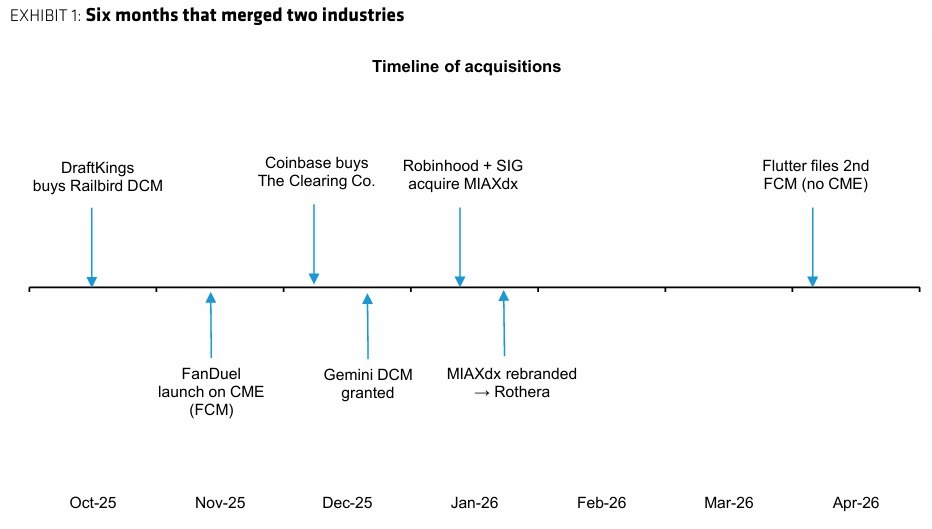
Prediction-market operators are bringing trading infrastructure in-house, a rapid shift that could trigger a wave of acquisitions across crypto platforms, sportsbooks, brokerages and standalone exchanges, according to analysts at Bernstein.
In a research report on Monday, Bernstein said the industry is going through “operational consolidation,” with major platforms moving to control more of the prediction-market stack.
“Every consumer platform that matters has merged the front and back end of the prediction-market stack,” they said. This includes distribution, brokerage, exchange and clearing. That convergence had placed businesses that historically operated in separate industries within a single competitive landscape.
Bernstein pointed to Robinhood routing major World Cup contracts through Rothera, the exchange it jointly owns with Susquehanna, and DraftKings launching DKeX and moving volume away from CME and Crypto.com infrastructure. The firm also cited Coinbase’s acquisition of The Clearing Company and its launch of event contracts as evidence that consumer platforms are seeking to control more of the prediction-market stack.
Owning the infrastructure allows platforms to retain fees that previously flowed to outside partners, making acquisitions a faster route to distribution, licenses, or completing missing parts of the stack. However, the same convergence that strengthens the case for consolidation could also heighten state and federal scrutiny by further blurring the regulatory boundary between financial trading and gambling.
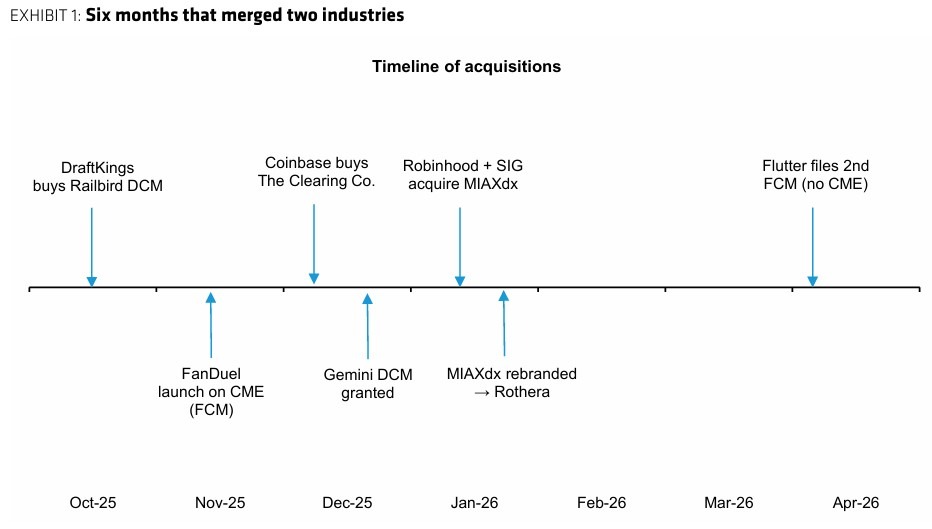
Timeline of acquisitions. Source: Bernstein
Regulatory clash could constrain consolidation
Bernstein said regulatory scrutiny remains one of the main barriers to larger integrations across the prediction-market sector.
While combining crypto platforms with brokerages, sportsbooks and exchanges could improve margins and reduce reliance on outside partners, Bernstein said such deals could attract antitrust scrutiny and deepen disputes over whether sports event contracts should be regulated as financial derivatives or gambling products.
Related: About 60% of World Cup bettors on Polymarket are first-time crypto users
That could further stoke the jurisdictional conflict already playing out across several states. Minnesota enacted what the Commodity Futures Trading Commission (CFTC) described as the first outright ban on prediction markets, while Illinois adopted legislation requiring platforms to obtain a state license before offering sports event contracts.
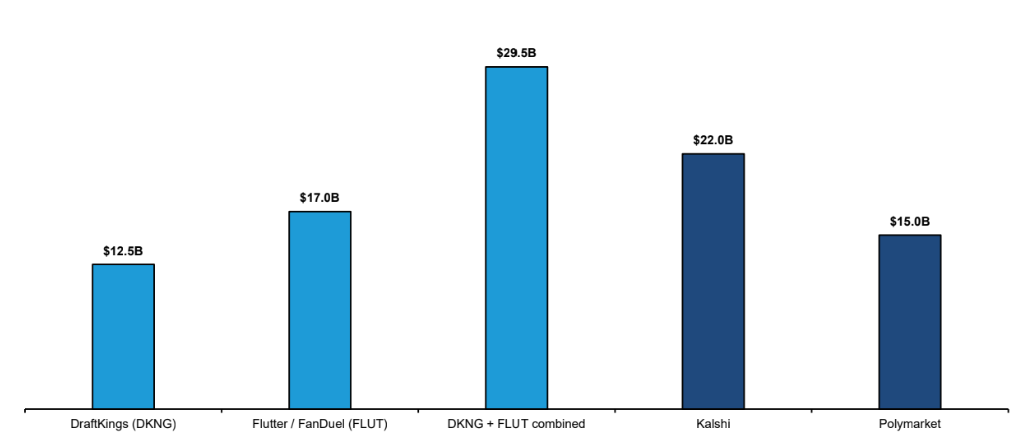
Valuation of online sports books compared to leading prediction markets.
Source: Bernstein.
Kalshi challenged both states’ restrictions, arguing that federally regulated exchanges fall under the CFTC’s exclusive authority.
The growing resistance suggests that consolidation may make commercial sense but remain difficult to execute until regulators and courts settle where federal derivatives oversight ends and state gambling authority begins.
Magazine: Bitcoin slides to $58K, XRP hits $1 but onchain data promising: Market Moves
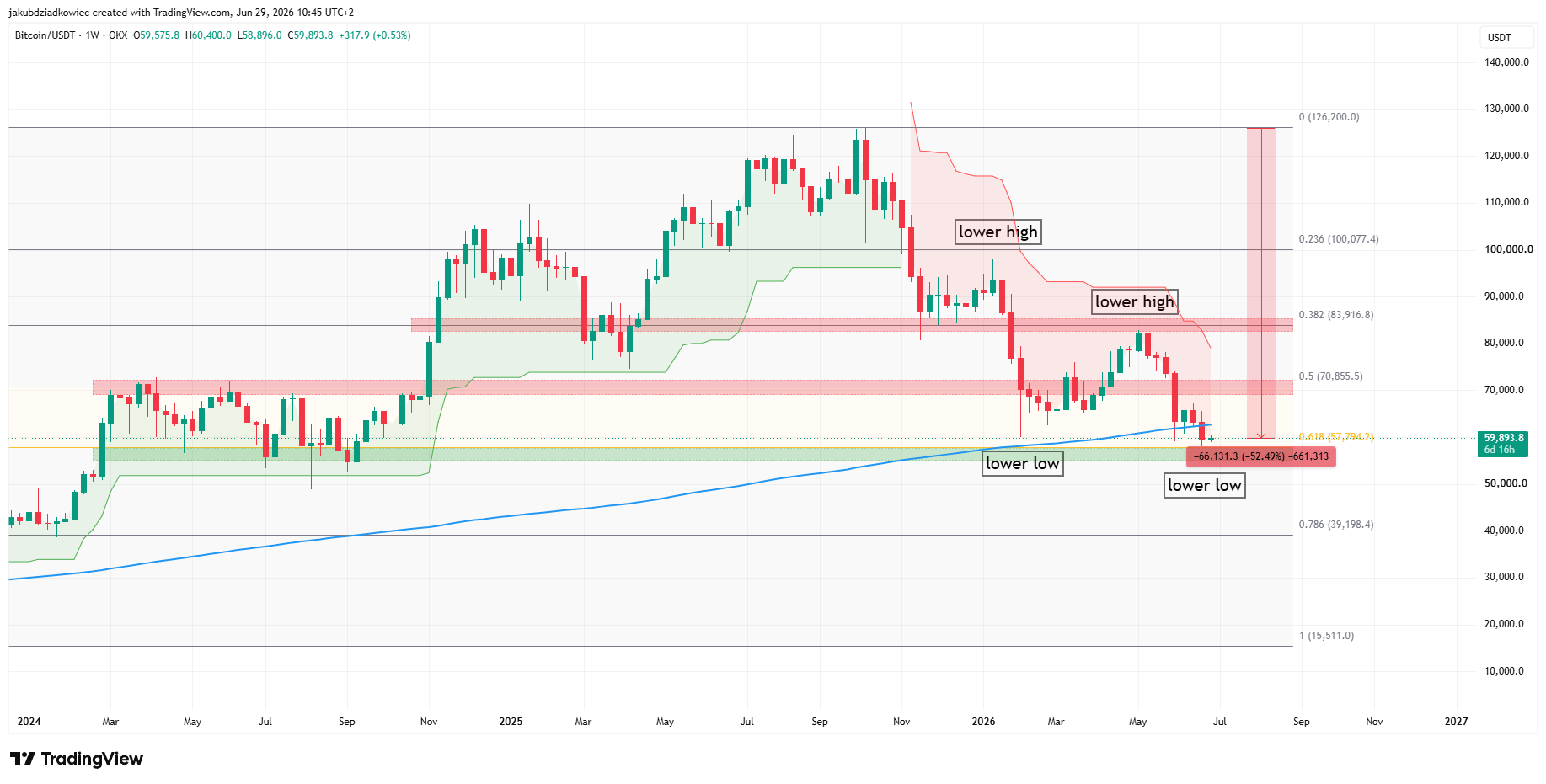
Bitcoin (BTC) and silver have almost nothing in common, yet both now sit roughly 52% below their record highs at the same moment. Their weekly charts have started to rhyme, candle for candle.
Bitcoin trades near $59,893, while silver hovers around $58.50 per ounce. Both assets broke key support levels in recent weeks, and their momentum indicators rolled over together.
The 52% Mirror in Bitcoin and Silver
The headline number is hard to ignore. Bitcoin trades about 52% under its $126,200 peak from late 2025. Silver sits 52% beneath its $121.76 record set in January 2026.
The structure matches just as closely. Both weekly charts show a clear sequence of lower highs and lower lows since their tops.
Supertrend confirms the regime on each chart. The indicator flipped bearish on Bitcoin in November 2025 and on silver in mid-March 2026.

Each asset has also surrendered major Fibonacci supports. Bitcoin lost the 0.382 and 0.5 levels, and now defends the 0.618 golden pocket near $58,000.
Silver broke through both its 0.382 and 0.618 levels. Its last visible support is the 0.786 retracement around $54.50.

Where Bitcoin and Silver Split on the 200-Week Average
One difference breaks the symmetry. The 200-week moving average separates the two charts in a meaningful way.
Bitcoin closed below its 200-week moving average last week for the first time this cycle. That level had acted as a long-term floor at previous Bitcoin bottoms.
Silver tells a calmer story here. Its 200-week average sits near $36, far below the current price of around $58.50.
That gap gives silver a wide cushion. Bitcoin, by contrast, has already lost the support that bulls watch most closely.
A weekly close back above that average would ease the pressure on Bitcoin. Until then, the metal holds the stronger structural position of the two.
Momentum Warns That Both Trends Could Extend
Momentum points the same way on both weekly charts. Each relative strength index (RSI) has broken down in recent weeks.
Silver’s RSI lost an ascending support line that had held since July 2022. The line confirmed twice, in March 2025 and March 2026, before breaking in May 2026. The reading now sits near 39.

Bitcoin’s RSI looks weaker still. It trades inside a falling channel and failed to reclaim the midline in May 2026, sliding toward 34.

Readings below 40 points to fading demand on both assets, a divergence that earlier predictions also flagged. A move back above the broken levels would mark the first sign of repair.
For now, silver must defend $54.50 to avoid a slide toward its $50 long-term support. Bitcoin needs to hold the $58,000 golden pocket or risk a drop toward the 0.786 level near $39,000.
The two charts have fallen in step for months. Whether they bottom together or break down together is the question traders now face.
The post The 52% Coincidence: Bitcoin and Silver Are Bleeding in Near-Perfect Sync appeared first on BeInCrypto.
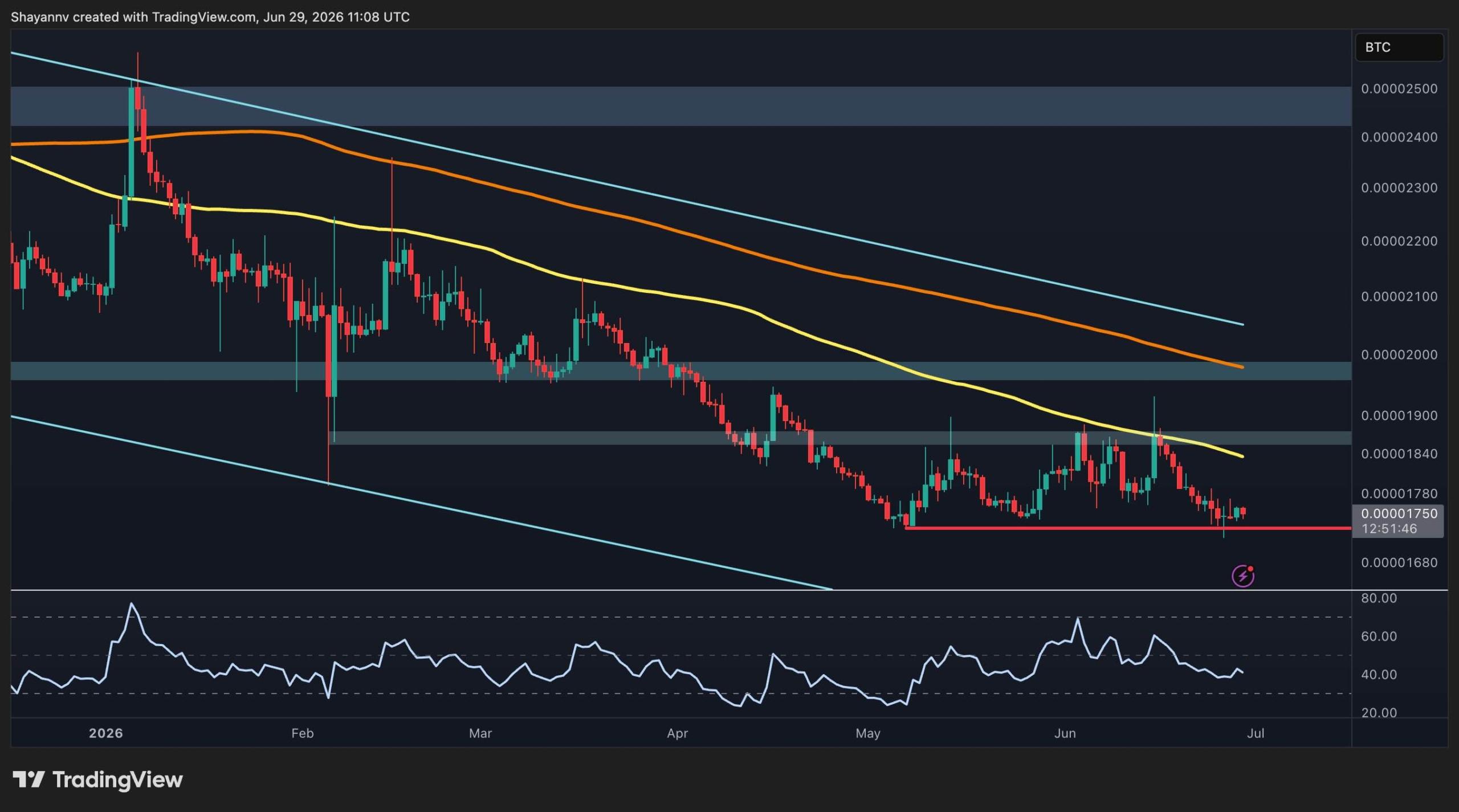
XRP is still under heavy selling pressure, mirroring the broader crypto market. Both its USDT and BTC pairs continue to trade within clear downtrend structures. While the dollar pair is testing a major demand zone, the BTC pair is also hovering just above an important support level, leaving the market at a key decision point.
Ripple Price Analysis: The USDT Pair
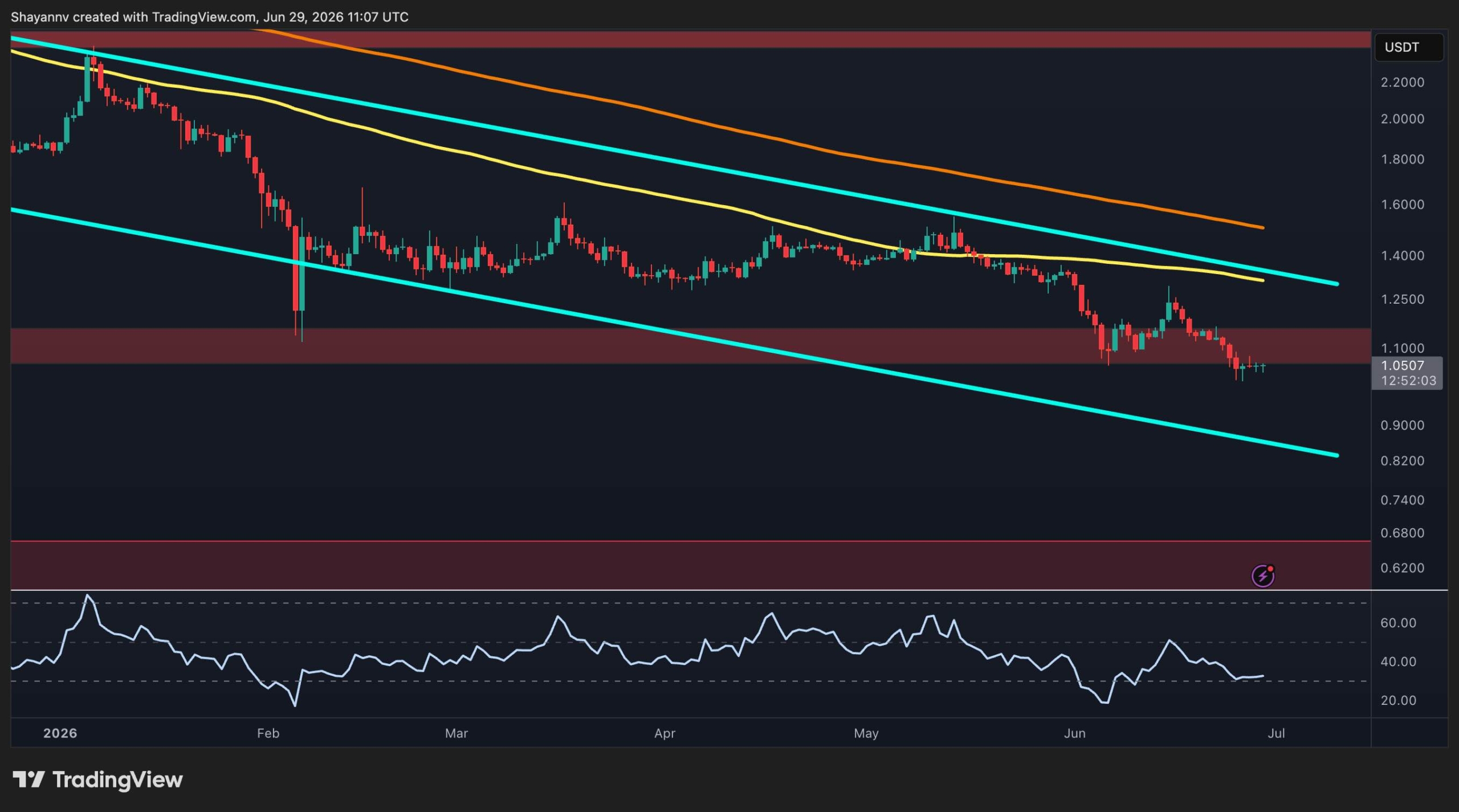
The daily chart shows XRP extending its broader bearish structure while remaining confined inside a long-term descending channel. The asset is currently trading around $1.05 after losing several higher lows over the past few weeks, confirming that sellers continue to dominate the higher timeframe.
The most important support now sits in the $1.00 to $1.10 zone, where the price is currently attempting to stabilize. This area has previously attracted demand and could produce a relief bounce if buyers manage to defend it once again. However, the overall trend remains bearish as XRP continues to trade below both major moving averages, with the 100-day and 200-day averages sloping lower simultaneously and acting as dynamic resistance levels.
Any recovery attempt is likely to face its first obstacle around the 100-day moving average near the $1.3 area, which coincides with the upper boundary of the descending channel. A breakout above both the channel resistance and the moving average would be required to signal a meaningful shift in market structure.
On the downside, losing the current support area could expose the lower boundary of the descending channel near the $0.80 region, making this support zone particularly important for the medium-term outlook.
The BTC Pair
Against Bitcoin, XRP continues to underperform, with the XRP/BTC pair remaining firmly inside its own descending channel. The pair is currently trading around 1,750 sats, sitting directly above a horizontal support level that has repeatedly prevented deeper declines since May.
Although this support has held on multiple occasions, none of the subsequent rebounds has produced a clear bullish breakout, highlighting persistent selling pressure and a lack of sustained bullish momentum. The repeated failures near the 100-day moving average further reinforce the bearish structure.
Overhead, the first major horizontal resistance is located around 1,850 sats, which converges with the declining 100-day moving average. Above that, stronger resistance emerges near 2,000 sats, followed by the descending 200-day moving average and the upper channel resistance. As long as XRP remains below these resistance clusters, the trend against Bitcoin favors continued relative weakness.
On the downside, a confirmed breakdown below the 1,700 sats support region would likely invalidate the current consolidation and open the door for another leg lower toward the psychological support level around 1,500 sats, and potentially lower. This keeps XRP at a critical decision point on both USDT and BTC charts, as the buyers and sellers fight one another to establish dominance over the trend.
The post Ripple Price Analysis: Calm Before the Storm for XRP as Decision Time Arrives appeared first on CryptoPotato.

Strategy has introduced a new “Digital Credit Capital Framework” aimed at monetizing part of its Bitcoin holdings to support dividends, bolster cash reserves, and fund share repurchases—while explicitly keeping a long-term Bitcoin strategy in place. The move was detailed in a Monday 8-K filing with the US Securities and Exchange Commission.
In the filing, Strategy also outlined changes to its STRC preferred stock dividend policy, including an increase in the annual dividend rate to 12% from 11.5%, and authorized separate buyback programs for its preferred securities and its Class A common stock. The company said it may sell Bitcoin to raise as much as $1.25 billion to strengthen liquidity for dividends, debt costs, and additional buybacks.
Key takeaways
- Strategy’s new Digital Credit Capital Framework formalizes a Bitcoin monetization program to generate cash for dividends, interest, and debt payments.
- Cash reserves are reported at $2.55 billion, covering about 17 months of preferred stock dividends and interest under the new rules.
- The annual dividend rate on STRC preferred stock rises to 12% from 11.5%, alongside buyback authorizations for both preferred securities and Class A shares.
- Strategy disclosed the company raised roughly $1.15 billion in net proceeds by selling 12.67 million shares, while also reporting no BTC purchases during the week ended Sunday.
A framework built around dividends, buybacks, and controlled monetization
Strategy’s 8-K filing with the SEC describes the Digital Credit Capital Framework as an approach designed to “monetize part” of its Bitcoin holdings. The stated purpose is to produce funds that can be used for dividends, replenishing cash reserves, and repurchasing securities, while maintaining the company’s broader long-term exposure to Bitcoin.
A central element is the disclosed capacity to sell Bitcoin—up to $1.25 billion—to increase cash reserves and support capital allocation. The company ties this liquidity plan to payments and buybacks rather than positioning it as a shift away from Bitcoin as a core treasury asset.
The filing also includes updated dividend mechanics for STRC preferred stock. Strategy raised the STRC annual dividend rate to 12% from 11.5% and revised aspects of how that dividend policy operates in relation to the company’s liquidity planning.
Cash reserve rules: $2.55 billion earmarked for payment coverage
Strategy said its cash reserve has grown to $2.55 billion. According to the filing, that reserve is intended to cover approximately 17 months of preferred stock dividends and interest payments.
Under the new policy, the reserve is restricted in use: it can only be used for dividend and interest payments, and it must be maintained at a minimum level equivalent to at least 12 months of those obligations unless the board approves changes.
Michael Saylor, Strategy’s executive chairman, said in connection with the framework that the company’s existing cash reserve, together with the $1.25 billion Bitcoin monetization capacity, could provide up to $3.8 billion in dividend coverage—equivalent to nearly 26 months.
For investors and traders, the key implication is that Strategy is trying to reduce uncertainty around short-term funding needs associated with preferred dividends and interest. By placing constraints around the cash reserve’s use and establishing minimum coverage requirements, the company is effectively outlining a “runway” for payments even if market conditions remain volatile.
Dividend increase and buyback authorization raise the stakes for liquidity management
Beyond the framework itself, Strategy adjusted two capital-return levers at the same time: the STRC preferred dividend rate and its ability to repurchase securities.
The filing indicates that the annual dividend rate for STRC preferred stock was increased to 12% from 11.5%. It also authorizes separate buyback programs for preferred securities and for the company’s Class A MSTR common stock.
This combination—higher dividend obligations alongside expanded repurchase permissions—places greater emphasis on the effectiveness of the liquidity plan described in the framework. Strategy’s approach suggests that the company views Bitcoin monetization capacity as a tool to keep both dividend payments and capital returns functioning through market drawdowns.
Strategy’s filings and related messaging also reference discipline in equity issuance under certain trading conditions. In one statement tied to the rollout, Michael Saylor said Strategy expects to remain disciplined in its use of MSTR issuance, particularly when the stock trades at or near 1x mNAV, according to posts on X associated with his remarks.
No BTC purchases reported; holdings unchanged at 847,363 BTC
Strategy’s SEC disclosure also covered its recent Bitcoin buying activity. The company reported that it did not acquire any BTC during the week ended Sunday, leaving its holdings unchanged at 847,363 BTC purchased for a combined $64.1 billion, at an average purchase price of $75,651 per bitcoin.
Cointelegraph previously reported Strategy’s approach to liquidity and treasury operations, including weekly reserve updates; in the context of this filing, the immediate takeaway is that the company’s Bitcoin inventory did not increase over the referenced week. It also reported adding a net 3,625 BTC so far in June after buying 3,657 BTC and selling 32 BTC earlier in the month.
Separately, Strategy disclosed that it raised around $1.15 billion in net proceeds by selling 12.67 million MSTR shares, a financing activity that complements—and may partially offset—the need to sell Bitcoin for cash.
At the same time, market conditions around Strategy’s equity have been pressured. The article cites TradingView data indicating STRC traded at a discount to par, and notes that MSTR shares were down nearly 50% year-to-date at the time of publication. Earlier commentary from Grayscale’s research head Zach Pandl suggested Strategy should consider selling $3 billion in Bitcoin to address cash obligations, as covered by Cointelegraph.
Monday’s market reaction reflected renewed investor interest: ahead of the Nasdaq open, MSTR shares were bid up by more than 5.5%, according to the account in the source article.
What to watch next
Investors should focus on how Strategy implements the framework—especially whether the company actually executes Bitcoin sales up to the stated $1.25 billion capacity and how quickly it uses that cash for dividends, debt costs, and buybacks while keeping the reserve rules intact. The next signals to track are updates on cash reserve levels, execution of repurchase programs, and any further disclosures linking the framework’s monetization plan to market volatility.

Money has undergone a remarkable transformation throughout human history. From trading goods through barter systems to using coins, paper currency, credit cards, and online banking, each innovation has made transactions faster and more efficient. Today, we are witnessing another major shift: the evolution of digital cash.
Digital cash is more than simply paying with a smartphone or making online purchases. It represents a new generation of programmable, decentralized, and borderless financial systems that redefine how value is stored, transferred, and managed. Powered by blockchain technology, digital cash is laying the foundation for a more connected and accessible global economy.
The Journey from Physical to Digital
Traditional cash served societies well for centuries because it offered simplicity and universal acceptance. However, as commerce expanded globally and the internet became central to daily life, physical money revealed several limitations:
- Slow international transfers
- High transaction costs
- Dependence on financial intermediaries
- Limited accessibility for the unbanked
- Vulnerability to inflation and counterfeiting
Electronic banking and digital payment platforms addressed many of these issues by allowing instant payments through centralized financial institutions. Yet these systems still rely heavily on trusted intermediaries that control transactions, maintain user data, and establish access rules.
Bitcoin: The First Truly Digital Cash
The launch of Bitcoin in 2009 introduced a groundbreaking concept: peer-to-peer digital cash without requiring banks or payment processors.
Bitcoin solved the long-standing “double-spending” problem through blockchain technology, enabling users to securely transfer value across the internet while maintaining transparency and decentralization.
Key innovations included:
- Borderless transactions
- Limited supply due to scarcity
- Cryptographic security
- Public verification
- Decentralized consensus
Although Bitcoin has increasingly been recognized as digital gold and a store of value, it has also demonstrated that decentralized money can function on a global scale.
Expanding Beyond Simple Payments
The evolution did not stop with Bitcoin.
New blockchain networks expanded digital cash by introducing programmable assets that can interact with smart contracts. This transformed digital currencies from simple payment tools into components of decentralized financial ecosystems.
Today’s digital assets can:
- Earn yield automatically
- Serve as collateral for loans
- Participate in decentralized governance
- Enable instant cross-border settlements
- Power decentralized applications (dApps)
- Facilitate automated financial services
Money is no longer static—it has become programmable.
The Rise of Stablecoins
One of the most important developments in digital cash has been the emergence of stablecoins.
Unlike cryptocurrencies with highly volatile prices, stablecoins are designed to maintain relatively stable values by being pegged to traditional assets such as the U.S. dollar.
Their benefits include:
- Faster international payments
- Lower transaction fees
- Reduced exchange-rate volatility
- Improved accessibility for businesses
- Efficient settlements for decentralized finance (DeFi)
Stablecoins have become essential infrastructure connecting traditional finance with blockchain ecosystems.
Digital Cash Becomes Intelligent
Artificial intelligence is introducing another layer of evolution.
AI agents can now interact directly with blockchain networks, enabling autonomous financial activities such as:
- Managing digital wallets
- Executing recurring payments
- Optimizing investment strategies
- Monitoring market conditions
- Rebalancing portfolios
- Paying for digital services automatically
This convergence of AI and blockchain is giving rise to autonomous financial systems where software can independently manage economic decisions within predefined parameters.
Cross-Chain Connectivity Changes Everything
Early blockchain ecosystems often operated in isolation, requiring users to remain within a single network.
Modern interoperability solutions now allow assets to move securely across multiple blockchains, creating a more unified financial landscape.
Cross-chain connectivity enables:
- Seamless asset transfers
- Greater liquidity
- Improved user experiences
- Multi-chain decentralized applications
- Broader financial accessibility
Instead of choosing one blockchain, users can benefit from the strengths of many interconnected networks.
Challenges That Remain
Despite rapid innovation, digital cash still faces several obstacles:
Regulation
Governments continue developing frameworks for cryptocurrencies, stablecoins, taxation, and digital asset compliance.
Scalability
Blockchain networks must continue increasing transaction throughput while maintaining decentralization and security.
Security
Protecting wallets, smart contracts, and users from cyber threats remains a top priority.
User Experience
Mass adoption depends on making blockchain technology as intuitive as today’s online banking and payment apps.
The Future of Digital Cash
Digital cash is steadily evolving into a comprehensive financial ecosystem rather than simply replacing physical money.
In the coming years, we can expect:
- Greater institutional adoption
- More widespread use of stablecoins
- AI-powered financial automation
- Tokenized real-world assets
- Enhanced privacy technologies
- Faster cross-border settlements
- Increased integration with everyday commerce
Digital cash will likely become an invisible layer of the internet, seamlessly powering transactions across both digital and physical economies.
Conclusion
The evolution of digital cash reflects humanity’s ongoing pursuit of faster, safer, and more inclusive ways to exchange value. From Bitcoin’s decentralized breakthrough to programmable money, stablecoins, AI-driven finance, and cross-chain interoperability, digital cash has grown into a sophisticated financial infrastructure capable of supporting the next generation of the global economy.
As blockchain technology continues to mature, digital cash will become increasingly embedded in everyday life—not merely as an alternative payment method, but as the foundation of a smarter, more open, and interconnected financial system.
REQUEST AN ARTICLE

Financial System and Dollar Economy

Basketball stars Malik Beasley and Ed Davis among suspects charged in plot to bet on NBA games

Madison Avenue Is Going All In on AI


-
 Sports6 days ago
Two goals and an assist by sheer aura: Cristiano Ronaldo just entered the World Cup chat
-

 Fashion3 days ago
Weekend Open Thread: Staud – Corporette.com
-

 Politics3 days ago
The House | Manchesterism won’t survive the painful trade-offs unless it gets citizens on board
-

 Politics4 days ago
Potential 2028er World Cup attendee leaderboard
-

 Business3 days ago
Asia stock markets slide as tech shares slump
-

 Tech4 days ago
A Look At A Gaggle Of Transputer Boards
-

 News Videos20 hours ago
MAJOR BITCOIN & MARKET UPDATE!!!! (MUST WATCH ASAP!!!)
-
Crypto World5 days ago
Bitcoin (BTC) Dips Below $62K, Ethereum (ETH) Plunges 6% Daily: Market Watch
-
 Crypto World4 days ago
Dell (DELL) Shares Tumble Over 5% Following Analyst Downgrade to Hold
-

 Crypto World5 days ago
Securitize Wraps Roubini's SEC-Registered ETF as Dubai VARA Digital Security
-
Business6 days ago
Entergy settles forward sale agreements, raises $672 million in cash proceeds
-

 Crypto World2 days ago
Coinbase, Circle Deepen Crypto Stock Losses Despite Resilient S&P 500
-

 Crypto World2 days ago
Kraken's xStocks Opens Bending Spoons IPO Registration to EEA Retail
-

 Sports3 days ago
FIH Pro League: India defeat Pakistan 7-1, register biggest win of campaign | Other Sports News
-

 Tech2 days ago
Russian hackers now target Signal backup recovery keys
-

 Crypto World3 days ago
RTX holders must register wallets before token distribution begins
-
 Crypto World3 days ago
Hyperliquid Named on Singapore MAS Investor Alert Register
-

 Tech2 days ago
Bluekit phishing kit adopts browser-in-the-middle for login theft
-

 Crypto World4 days ago
Bitcoin Sparks $600M Hourly Liquidations With $65,000 Set To Become Resistance
-

 Sports4 days ago
India vs Bangladesh LIVE Score, Women’s T20 World Cup: Bangladesh Opt To Bat; India Enter ‘Do-Or-Die’ Stage As Semi-Final Race Heats Up
You must be logged in to post a comment Login