

Crypto World
The 52% Coincidence: Bitcoin and Silver Are Bleeding in Near-Perfect Sync

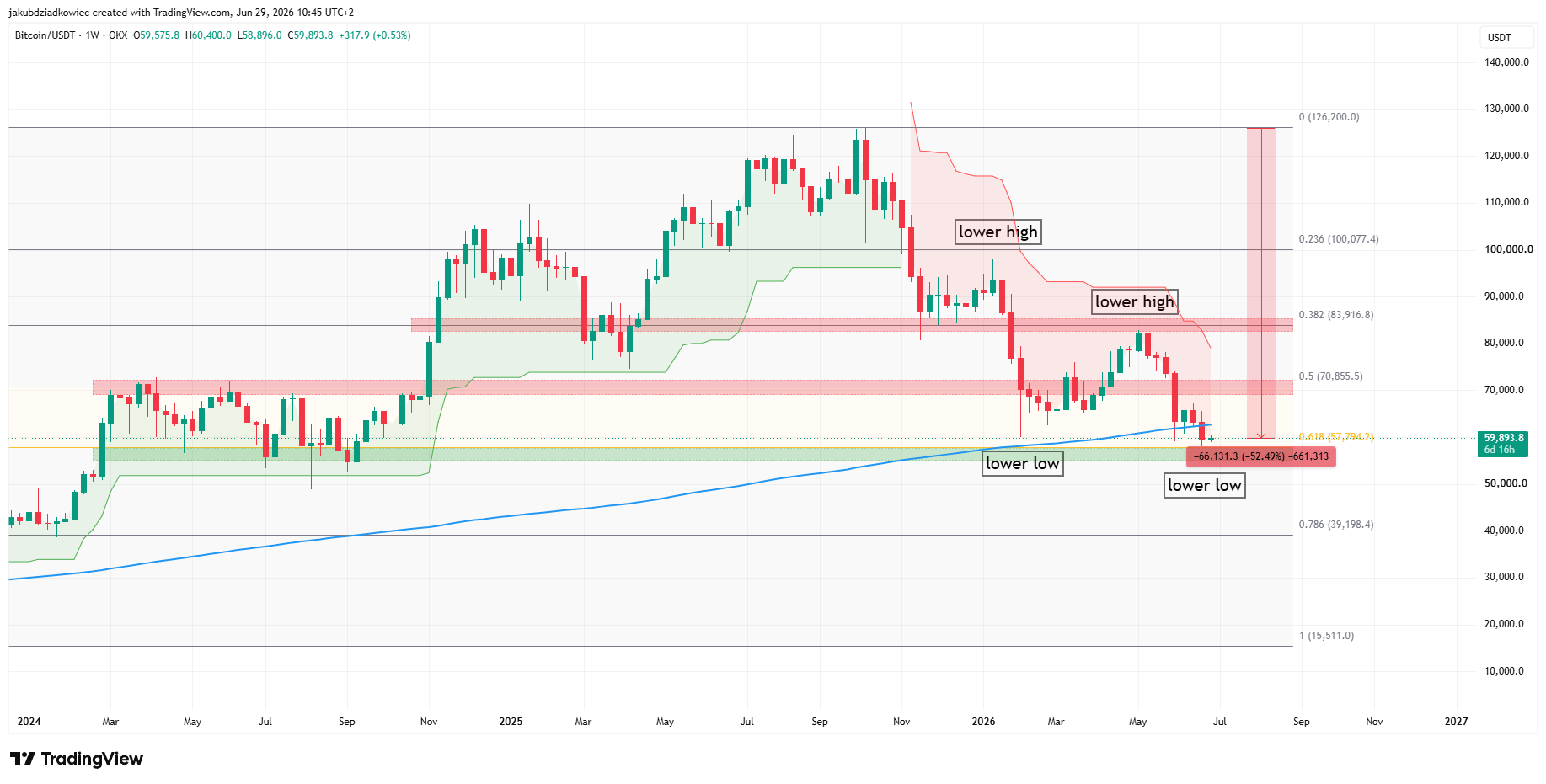
Bitcoin (BTC) and silver have almost nothing in common, yet both now sit roughly 52% below their record highs at the same moment. Their weekly charts have started to rhyme, candle for candle.
Bitcoin trades near $59,893, while silver hovers around $58.50 per ounce. Both assets broke key support levels in recent weeks, and their momentum indicators rolled over together.
The 52% Mirror in Bitcoin and Silver
The headline number is hard to ignore. Bitcoin trades about 52% under its $126,200 peak from late 2025. Silver sits 52% beneath its $121.76 record set in January 2026.
The structure matches just as closely. Both weekly charts show a clear sequence of lower highs and lower lows since their tops.
Supertrend confirms the regime on each chart. The indicator flipped bearish on Bitcoin in November 2025 and on silver in mid-March 2026.

Each asset has also surrendered major Fibonacci supports. Bitcoin lost the 0.382 and 0.5 levels, and now defends the 0.618 golden pocket near $58,000.
Silver broke through both its 0.382 and 0.618 levels. Its last visible support is the 0.786 retracement around $54.50.

Where Bitcoin and Silver Split on the 200-Week Average
One difference breaks the symmetry. The 200-week moving average separates the two charts in a meaningful way.
Bitcoin closed below its 200-week moving average last week for the first time this cycle. That level had acted as a long-term floor at previous Bitcoin bottoms.
Silver tells a calmer story here. Its 200-week average sits near $36, far below the current price of around $58.50.
That gap gives silver a wide cushion. Bitcoin, by contrast, has already lost the support that bulls watch most closely.
A weekly close back above that average would ease the pressure on Bitcoin. Until then, the metal holds the stronger structural position of the two.
Momentum Warns That Both Trends Could Extend
Momentum points the same way on both weekly charts. Each relative strength index (RSI) has broken down in recent weeks.
Silver’s RSI lost an ascending support line that had held since July 2022. The line confirmed twice, in March 2025 and March 2026, before breaking in May 2026. The reading now sits near 39.

Bitcoin’s RSI looks weaker still. It trades inside a falling channel and failed to reclaim the midline in May 2026, sliding toward 34.

Readings below 40 points to fading demand on both assets, a divergence that earlier predictions also flagged. A move back above the broken levels would mark the first sign of repair.
For now, silver must defend $54.50 to avoid a slide toward its $50 long-term support. Bitcoin needs to hold the $58,000 golden pocket or risk a drop toward the 0.786 level near $39,000.
The two charts have fallen in step for months. Whether they bottom together or break down together is the question traders now face.
The post The 52% Coincidence: Bitcoin and Silver Are Bleeding in Near-Perfect Sync appeared first on BeInCrypto.

Ethena says it has integrated USDe, its synthetic dollar, into BlackRock’s Aladdin platform. The move targets the institutions that run portfolios and risk on the system.
The announcement also named BlackRock’s tokenized fund as the white-label backing. BlackRock has not published a matching statement.
USDe Gains a Path to Aladdin’s Institutions
USDe is one of the larger dollar-pegged tokens, with a supply near $4.5 billion as of June 29. It holds its peg with a delta-neutral strategy that pairs staked Ether (ETH) with short perpetual futures. That structure sits at the core of Ethena’s synthetic dollar model.
Ethena pitched the integration as institutional distribution. Its post pointed to the scale of capital that Aladdin already touches.
“The integration of USDe on Aladdin provides unique institutional access for the >$20 trillion of assets managed by financial institutions on Aladdin,” Ethena wrote in the announcement.
Follow us on X to get the latest news as it happens
BlackRock does not publish a single Aladdin asset figure, so that scale reflects the company’s own claim.
Native support would let those institutions track and analyze USDe inside tools they already run. For now, Ethena has not detailed how deep the integration goes.
BUIDL Deepens an Existing BlackRock Tie
The relationship is not new. BUIDL, the BlackRock USD Institutional Digital Liquidity Fund, launched in March 2024 and ranks among BlackRock’s largest tokenized funds.
BUIDL already provides most of the reserves behind USDtb, the stablecoin backed by BUIDL that Ethena launched in late 2024. Naming it the primary asset for a white-label product lets other firms issue branded versions of Ethena’s dollars.
A new liquidity facility will connect BUIDL with USDe and USDtb for on-chain transactions. It builds on earlier work with Securitize that enabled around-the-clock swaps between the fund and Ethena’s tokens.
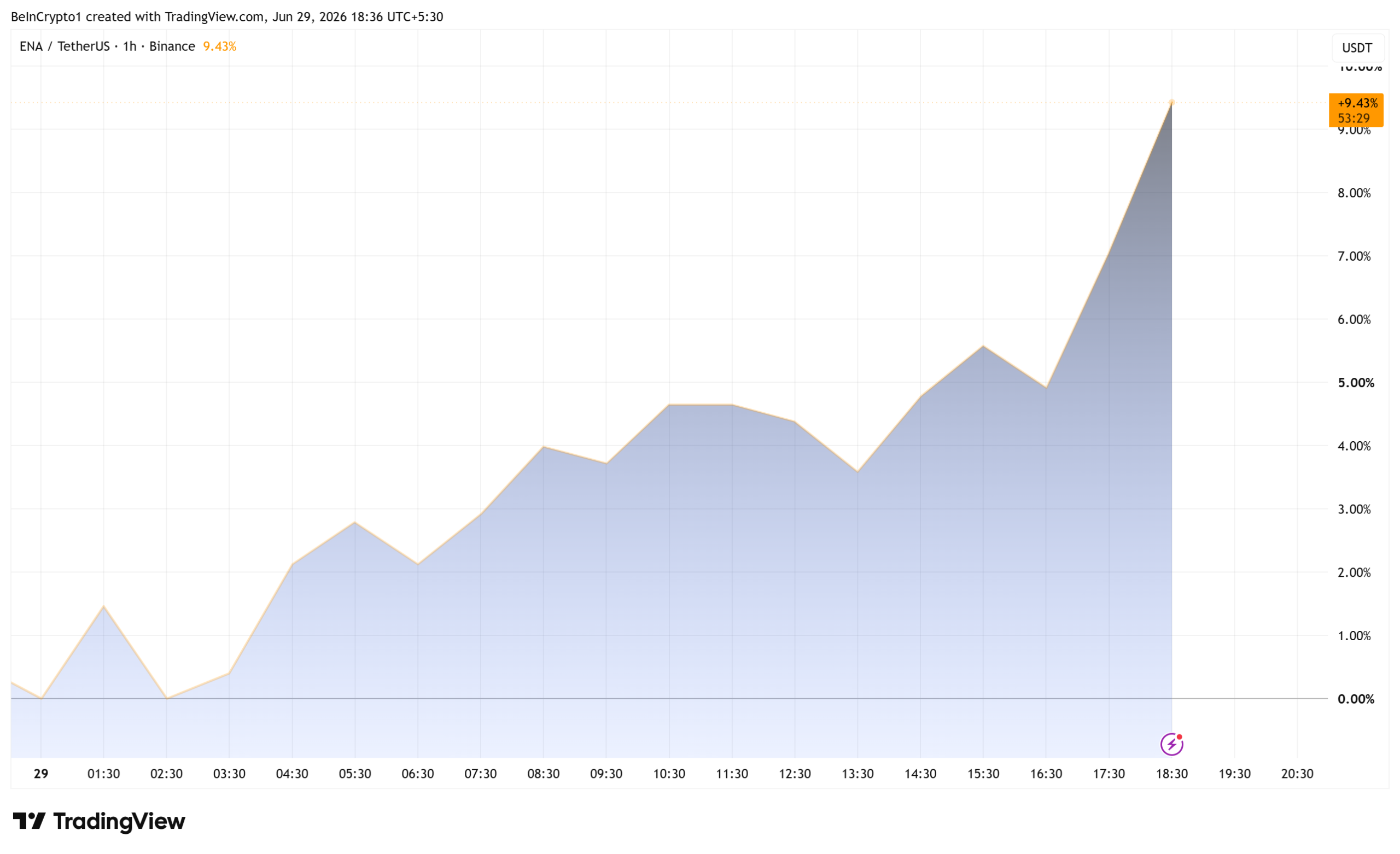
Ethena’s ENA token rose on the news, rising almost 10% in the immediate aftermath of the news, with the token near $0.0811 as of this wrting.

The bounce stands against a steep slide. ENA has fallen about 17% in a week and roughly 70% over the year.
The reaction echoes earlier institutional deals. An investment from a Wall Street asset manager lifted ENA before.
However, USDe still carries regulatory baggage. In April 2025, Germany’s BaFin ordered Ethena’s local entity to wind down USDe issuance. It was the regulator’s first action under the EU’s MiCA rules.
Whether Aladdin’s institutions allocate to USDe, rather than simply monitor it, will be the clearer test in the coming weeks.
The post BlackRock Fuels 10% Surge for Ethena as USDe Joins $25 Trillion Aladdin Platform appeared first on BeInCrypto.
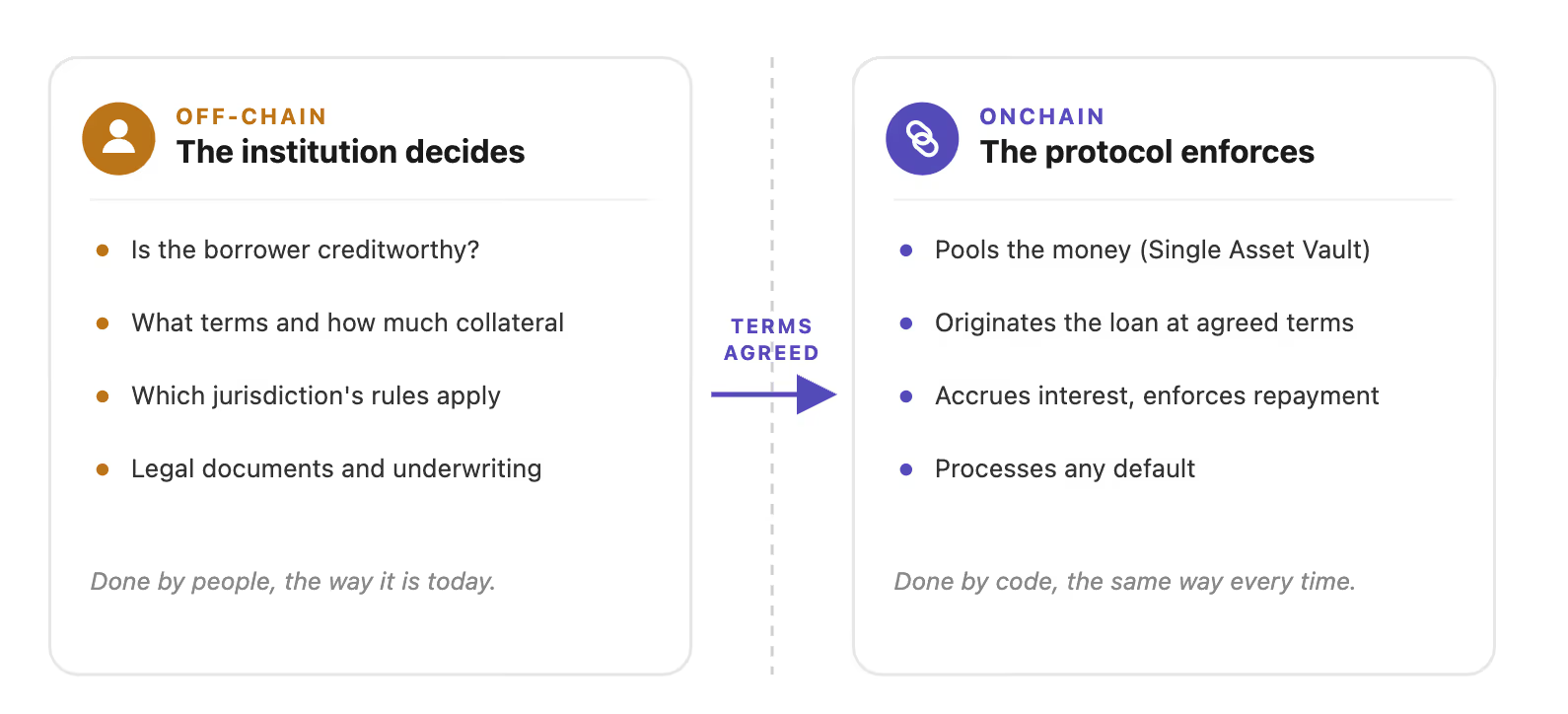
The protocol has two parts. A Single Asset Vault pools a single asset, and the lending layer turns that pooled money into loans with set terms. Both are still proposals, defined in technical drafts known as XLS-65 and XLS-66, and remain subject to approval by the validators who run the network. The features are available to test on a development network but are not live.

The use Ripple leads with is short-term financing. A payment company holding reserves in RLUSD, its US dollar-pegged stablecoin, might need cash to fund outgoing payments before a cross-border settlement clears two days later.
Instead of drawing on a bank credit line or selling assets, it could borrow against the incoming settlement through an approved pool, with repayment enforced automatically.
This is separate from XRP, the token the network is best known for, and from RLUSD, which is one of the assets such a system could lend against. It is infrastructure aimed at institutions rather than a product retail users would touch directly.
Ripple is also walking into a crowded field, however. Onchain lending already runs at scale through protocols like Aave, Compound, Maple and Clearpool, which collectively hold billions in deposits.
However, Ripple says that those systems were built around crypto-native governance, where a protocol can change its risk rules through community votes, which it says institutions cannot underwrite in advance. Its counter is to fix the lending mechanics at the network’s base layer so the behavior does not shift underneath a lender, while keeping the network public rather than walling it off to a closed group as some permissioned systems do.
The U.S. Supreme Court has blocked President Donald Trump’s bid to remove Federal Reserve Governor Lisa Cook, preserving the Fed Board’s current balance as the administration continues pushing for lower interest rates.
Summary
- The U.S. Supreme Court has blocked President Trump’s attempt to remove Federal Reserve Governor Lisa Cook in a 5-4 ruling.
- Chief Justice John Roberts said the Court’s decision addresses legal standards, not whether Cook can ultimately be removed for cause.
- The ruling leaves Trump without a majority on the Fed Board as he continues to push for lower interest rates.
According to the Court’s 5-4 decision, the justices rejected Trump’s effort to dismiss Cook over allegations of mortgage fraud, ruling that the legal dispute must proceed under the proper standards rather than allowing the president to remove a Fed governor without judicial review.
Court says removal powers remain subject to legal review
Writing for the majority, Chief Justice John Roberts said accepting the administration’s position would effectively allow a president to dismiss a Federal Reserve governor at any time and for any reason, reducing statutory “for-cause” protections to little more than at-will employment.
Roberts added that the Court was not deciding whether Trump ultimately has legal grounds to remove Cook. Instead, he said the ruling addresses the legal framework that lower courts must apply before reaching that question.
“To be clear, the ultimate question of whether the President can remove Cook for cause will depend in part on the underlying facts,” Roberts wrote. “In this opinion, we have not addressed the facts, as they have yet to be found or analyzed under the relevant legal standards.”
The decision keeps Cook on the Federal Reserve Board while the legal proceedings continue, leaving Trump without a majority of governors despite changes elsewhere in the central bank’s leadership.
Ruling complicates Trump’s push for lower interest rates
Soon after the ruling, Trump responded on Truth Social by arguing that the Supreme Court had sent the case back on procedural grounds rather than ruling on the merits. He added:
“We will take appropriate action immediately to make sure that someone who has committed wrongdoing will not be making vital decisions concerning the Welfare of the United States of America!”
The decision also comes as Trump continues to call for lower interest rates. Although he appointed Kevin Warsh to succeed former Fed Chair Jerome Powell, Trump previously said he would not pressure Warsh over monetary policy and would leave interest-rate decisions to the Federal Reserve.
During his Senate confirmation hearing in April, Warsh reinforced that position by telling the Senate Banking Committee that Trump had never asked him to predetermine, commit to, or decide any interest-rate action before taking office. He added that he would never agree to such a request.
Even under Warsh’s leadership, the Federal Reserve kept interest rates unchanged at its June FOMC meeting while maintaining a cautious stance on inflation, underscoring that policy decisions continue to be driven by economic conditions rather than White House preferences.
Cook’s continued presence on the Board means Trump still lacks the majority needed to reshape the Federal Reserve’s policy direction through appointments alone, making future interest-rate decisions dependent on votes within the central bank.
The ruling arrives as inflation remains a key concern for policymakers. As crypto.news previously reported, the Fed left interest rates unchanged in June despite relatively hawkish economic projections from many officials.
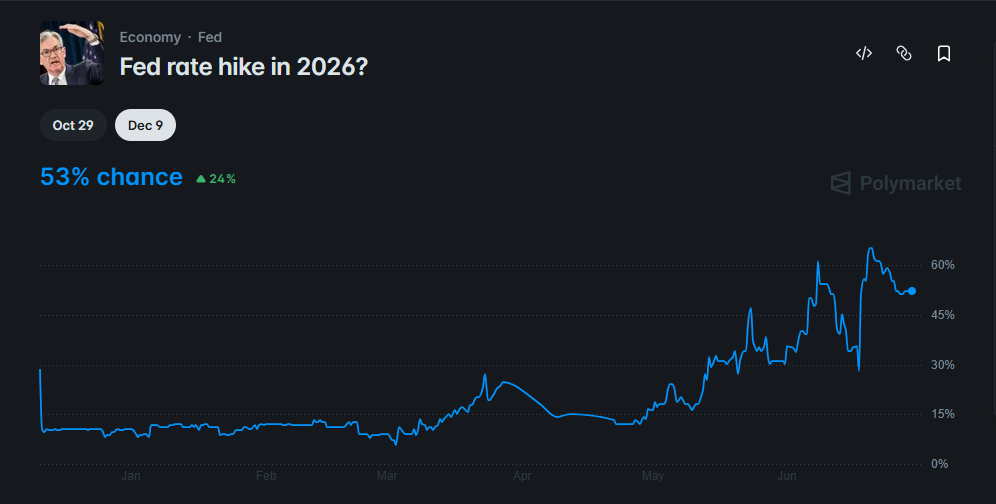
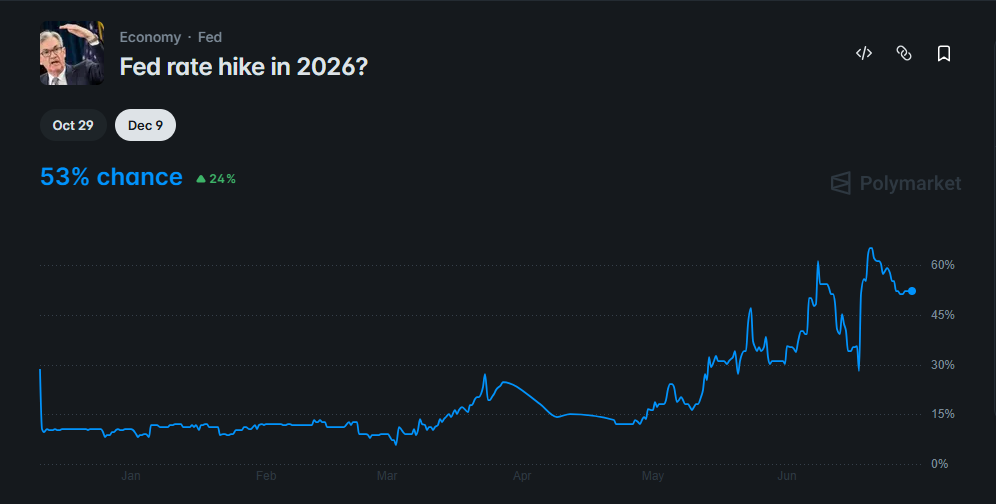
Separate crypto.news reporting also noted that the latest Personal Consumption Expenditures inflation reading reached 4.1%, its highest level since 2023. Against that backdrop, Bank of America has forecast three rate hikes beginning later this year, while Polymarket currently assigns a 53% probability that the Federal Reserve raises rates before year-end.

Key Takeaways
- Shares of Roblox surged more than 14% Monday, starting at $50.90 and reaching approximately $54.29, following Arete Research’s upgrade from Neutral to Buy alongside a $95 price target.
- The stock broke above both its 20-day and 50-day moving averages, though it continues trading roughly 30% under its 200-day moving average.
- First-quarter revenue reached $1.44 billion, falling short of the $1.74 billion estimate, while EPS of -$0.35 exceeded the consensus forecast of -$0.41.
- In May, Roblox approved a $3 billion stock repurchase program, representing up to 9.5% of shares outstanding.
- Arkansas’s Attorney General launched legal action against Roblox, claiming the company misled users about child safety protocols.
Shares of Roblox (RBLX) kicked off Monday trading at $50.90, rising from Friday’s closing price of $47.56, before advancing to approximately $54.29—marking a roughly 14.5% increase—accompanied by elevated volume exceeding 2.5 million shares.
The primary driver behind this rally was Arete Research’s decision to upgrade RBLX from Neutral to Buy while simultaneously lifting its price target from $75 to $95. This represents one of the most optimistic outlooks currently on Wall Street for the gaming platform.
During Monday’s trading session, the stock reclaimed territory above its 20-day simple moving average ($46.03) and 50-day simple moving average ($47.92). However, shares remain approximately 30% beneath the 200-day moving average of $79.09, with a death cross pattern having materialized in December 2025.
The MACD indicator now sits above its signal line with a positive histogram reading—suggesting diminishing downward momentum. Critical resistance levels exist around $60.50, while support appears established near $52.50.
Wall Street Remains Divided on RBLX
Not all analysts share the same enthusiasm. Wells Fargo reduced its price objective from $97 down to $78, while maintaining an Overweight rating. Piper Sandler shifted to Neutral with a $50 target back in May. DA Davidson also maintained a Neutral stance while lowering its target to $45.
Goldman Sachs preserved its Buy recommendation but reduced its price objective to $65. BMO reaffirmed its Outperform rating, and Oppenheimer initiated coverage with an Outperform designation.
According to MarketBeat, the consensus rating stands at Moderate Buy with an average price objective of $86.30.
For the first quarter, Roblox reported EPS of -$0.35, surpassing the -$0.41 forecast. Revenue totaled $1.44 billion—representing 43.4% growth year-over-year—but missed the $1.74 billion consensus expectation.
The company’s board greenlit a $3 billion share repurchase authorization in May, permitting buybacks of up to 9.5% of outstanding shares. CEO David Baszucki and insider Matthew Kaufman both executed stock sales in May for tax withholding purposes related to vested equity compensation.
Legal Challenge Over Child Safety Practices
Tim Griffin, Arkansas Attorney General, initiated legal proceedings against Roblox alongside Discord, claiming both platforms provided misleading information regarding their safety measures and facilitated predator access to children.
The filing further asserted that Roblox distributed over $900 million annually to developers whose content included explicit material. Roblox issued a statement saying it “strongly disputes” these allegations and highlighted recently implemented age verification requirements for chat functionality.
Institutional stakeholders control approximately 94.5% of RBLX shares. Multiple funds established new positions during Q4 2024, with Norges Bank acquiring a position worth roughly $435 million.
The company’s next quarterly earnings announcement is scheduled for July 30, 2026. Wall Street analysts anticipate a loss of 34 cents per share alongside revenue of $1.60 billion.

OKX and Coinbase Race to Sign Up Binance's Displaced EU Users Before MiCA Deadline OKX and Coinbase have launched competing deposit bonus campaigns targeting European users losing access to Binance before the bloc's Markets in Crypto-Assets regulatory deadline, offering rewards of up to 8% to users… Read the full story at The Defiant
BNY has expanded its Digital Asset Custody platform to let institutional clients store, transfer, mint and redeem Circle’s USD Coin, making it the first stablecoin supported on the platform.
The new capabilities allow BNY clients to convert US dollars into USDC and redeem the stablecoin back into dollars directly through the bank while also storing and transferring USDC on its custody platform. BNY said it plans to expand the service to additional stablecoins and digital cash workflows over time.
The expansion builds on BNY’s existing role as the primary custodian of the assets backing USDC, extending its relationship with Circle beyond safeguarding reserve assets to include client-facing stablecoin services.
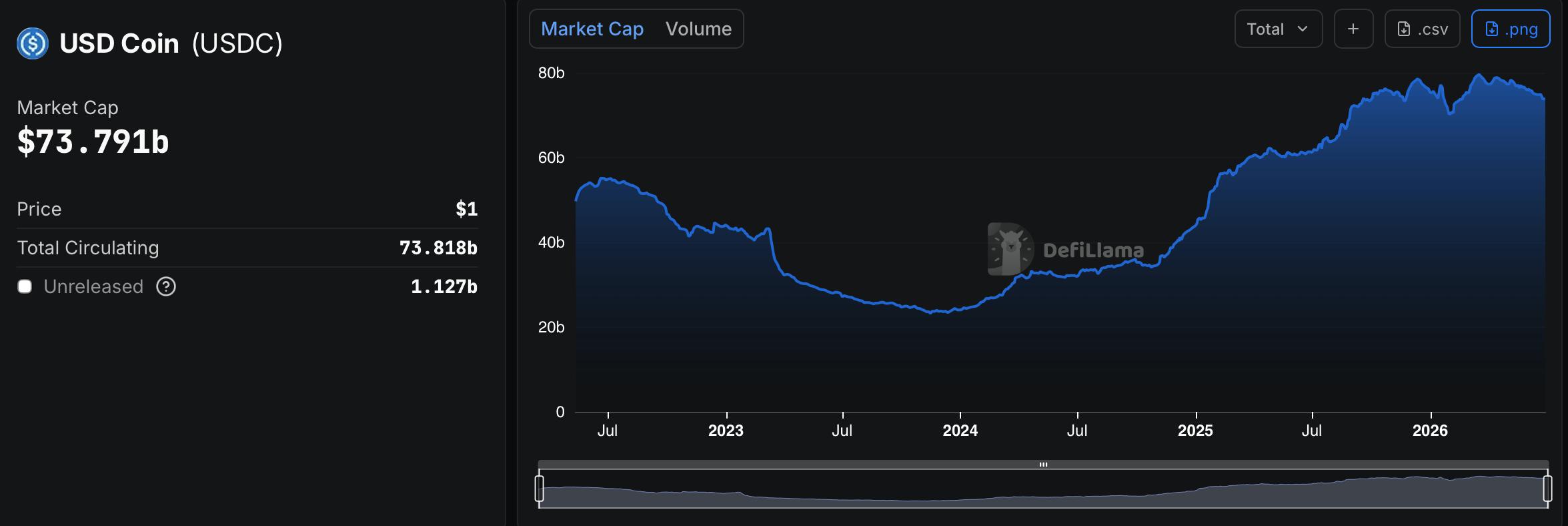
According to BNY, the custodian bank oversees $59.3 trillion in assets under custody and administration and serves more than 90% of Fortune 100 companies. USDC is the world’s second-largest stablecoin by market capitalization, with more than $73.8 billion in circulation, according to DefiLlama data.
In May, BNY partnered with Abu Dhabi-based Finstreet and the ADI Foundation to develop institutional custody services for Bitcoin (BTC) and Ether (ETH), with plans to later support stablecoins and tokenized real-world assets.
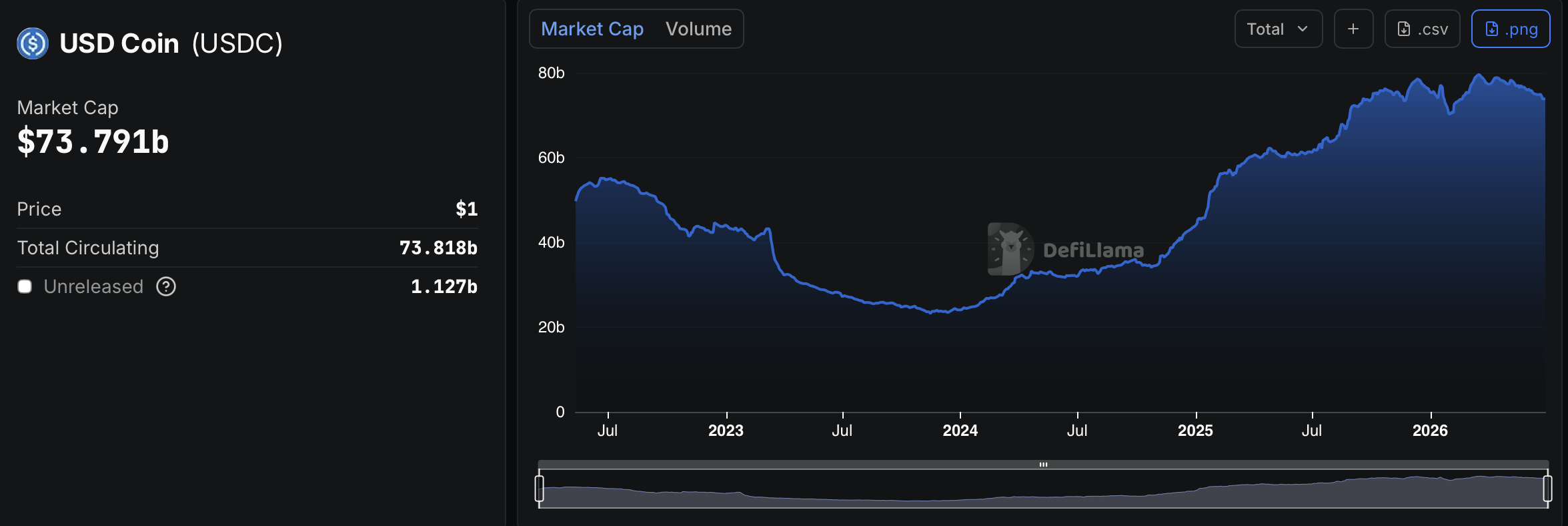
Source: DefiLlama
Related: Breez launches Bitcoin-to-stablecoin payments across more than 30 blockchains
Traditional finance expands stablecoin infrastructure
BNY’s announcement is the latest in a series of stablecoin-focused products launched by major financial institutions in recent months, as traditional banks and asset managers expand services supporting reserve management, custody and blockchain-based payments.
In May, JPMorgan filed to launch a tokenized money market fund that would allow stablecoin issuers to hold reserve assets in a regulated investment vehicle while earning interest. The Ethereum-based fund is designed to invest in US Treasury bills and overnight repurchase agreements that back payment stablecoins.
Earlier this month, State Street launched a government money market fund for stablecoin issuers, offering a vehicle to hold reserve assets in compliance with the GENIUS Act. The fund invests in US government securities and repurchase agreements and counts State Street Bank and Anchorage Digital among its initial investors.
Other large financial institutions are pursuing stablecoin strategies as well. In July 2025, Bank of America said it was exploring stablecoins to modernize its payments infrastructure, while in January, Fidelity Investments launched a US dollar-backed stablecoin, FIDD, after receiving conditional approval to operate a national trust bank.
The stablecoin market is valued at approximately $313 billion, according to DefiLlama, with Tether’s USDT accounting for about 60% of the market.
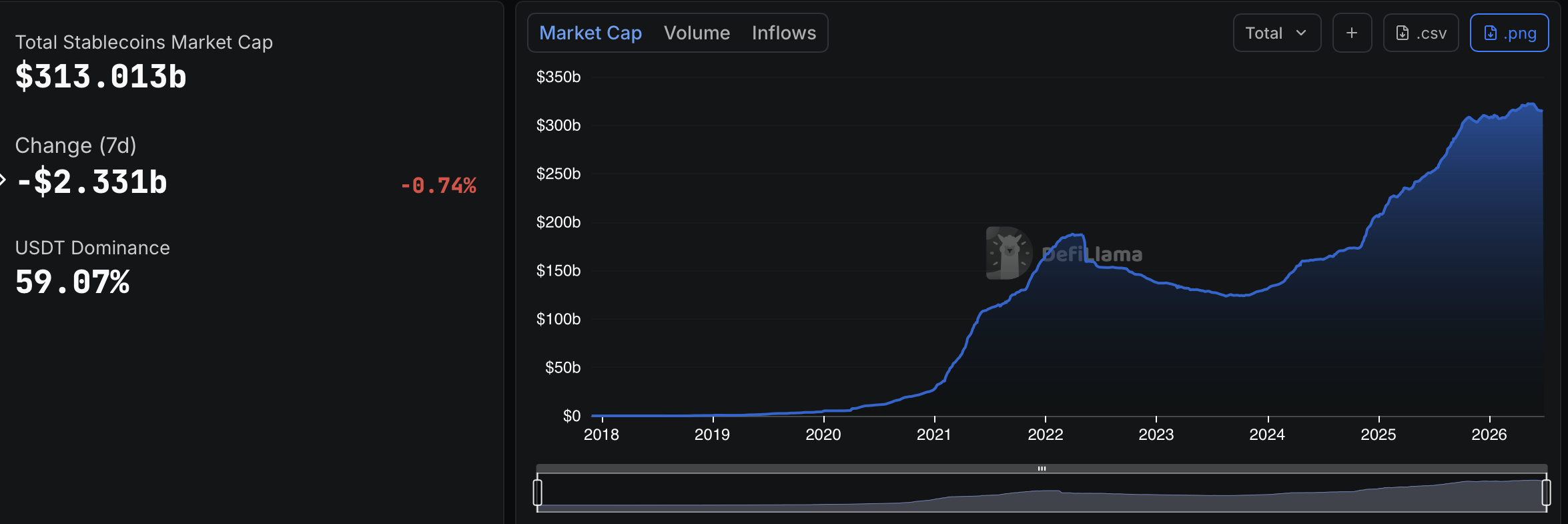
Source: DefiLlama
Magazine: Bitcoin slides to $58K, XRP hits $1 but onchain data promising: Market Moves

Anthropic’s announcement of its “Mythos” cybersecurity models has sparked a fresh round of debate in crypto: will advanced AI tools make decentralized finance easier to exploit, or will they simply accelerate the pace of defense? The discussion gained traction as Anthropic positioned Mythos-class systems for security-focused tasks and—according to the company—reported improvements in vulnerability research and exploit analysis compared with earlier iterations.
For DeFi investors, developers, and security teams, the underlying question matters less about hype and more about operational reality: can AI meaningfully shorten the gap between discovering weaknesses and turning them into working attacks? And just as importantly, can defenders use the same capability to identify issues earlier and patch faster?
Key takeaways
- Anthropic frames Claude Mythos as a cybersecurity-focused AI system aimed at tasks such as vulnerability research and layered security reasoning.
- AI can accelerate code review, but moving from “finding a vulnerability” to “stealing funds” still requires technical and operational execution attackers often must plan for.
- Current limits—including false positives and incorrect reasoning—mean expert oversight and process discipline remain central to DeFi security.
- Defensive teams and developers can also adopt AI-assisted testing, potentially raising baseline security standards across the sector.
- DeFi risk is uneven: smaller projects, fast launch cycles, reused code, and weak audit coverage tend to face higher exposure.
What Claude Mythos is intended to do
Claude Mythos is Anthropic’s most advanced AI system for cybersecurity tasks, designed differently from general-purpose assistants that simply explain concepts or generate code on request. Anthropic has described Mythos-class capabilities as oriented toward complex security workflows rather than broad chat-based usage.
While the company initially limited access instead of offering immediate broad distribution, Anthropic’s published materials emphasized measurable improvements in areas that matter to security teams—particularly vulnerability research and exploit analysis. The relevance for crypto is obvious: smart contract security depends on identifying flaws quickly in public codebases and evaluating how weaknesses might be leveraged in practice.
The most practical concern for DeFi is timeline compression. If AI helps reduce the time it takes to locate and reason through potential vulnerabilities, attackers could benefit by shifting from slow discovery to faster exploitation. But that same speed advantage could also shorten the defensive cycle—reviewing code, verifying assumptions, and preparing fixes before exposure becomes capitalized.
Why DeFi looks like an attractive target
DeFi security concerns aren’t new, and they don’t rely solely on technical complexity. DeFi protocols often custody large sums through smart contracts, which means a software issue can potentially become direct financial risk rather than a theoretical bug. The sector has repeatedly seen losses linked to a range of failure modes—exploits, flash-loan-style attacks, cross-chain issues, governance manipulation, and smart contract weaknesses.
Two factors make these environments particularly sensitive. First, smart contract code is frequently public, which is good for transparency and security research but also gives attackers the same information defenders get. Second, many DeFi systems are young or rapidly evolving, and even audited protocols can still contain gaps or assumptions that don’t hold under changing conditions.
In that context, AI tools that can triage large repositories, summarize complex systems, and suggest likely attack paths can be seen as a force multiplier. If a model can sift through patterns and reason about potential exploit routes faster than traditional manual review, attackers may be able to scale their efforts beyond what small teams could previously accomplish.
AI can help, but it doesn’t guarantee profitable attacks
Even if AI can identify vulnerabilities efficiently, the path to successful exploitation is not a straight line. Many real-world crypto attacks require more than recognizing a weakness—they depend on understanding protocol mechanics, coordinating transaction sequences, managing liquidity dynamics, working through governance pathways, and minimizing the chance of detection.
Anthropic’s own research materials and broader cybersecurity experience point to a key operational reality: AI systems can be useful while still producing errors. In practice, AI-driven analysis may surface multiple possible issues, not all of which are valid or exploitable. That means defenders should still assume that automated tools will generate noise alongside value, and teams will need to verify findings rather than treat model output as final truth.
For DeFi users, this distinction matters. A vulnerability that appears in a report does not automatically translate into drained funds. Attackers may also face constraints—capital requirements, timing, or dependencies across contracts—that AI can’t remove. Likewise, defenders who can act quickly on high-confidence findings may blunt the window in which attackers can convert theory into execution.
Where AI could strengthen DeFi security
Another reason the “AI will only weaken DeFi” narrative doesn’t fully hold is that defensive teams have access to similar tools. Security firms can integrate AI-assisted review into their workflows, and developers can use AI to augment code checks. Bug hunters may also be able to widen coverage and speed up pre-release scrutiny, potentially catching classes of issues earlier than traditional processes alone would allow.
That opens a more balanced scenario: AI becomes a normal part of secure development rather than an edge only attackers possess. In this framing, the decisive variable becomes not whether AI exists on the offensive side, but how quickly teams can incorporate AI-backed analysis into deployment pipelines and how effectively they respond once issues are detected.
It’s also worth noting that major crypto incidents have sometimes been driven by factors unrelated to smart contract code—such as compromised private keys, social engineering, or governance manipulation. AI improvements in code review won’t eliminate those risks, but they may reduce one category of exposure by tightening how contract logic is assessed.
DeFi builder priorities in an AI-accelerated world
For protocol teams, the clearest lesson is to assume that automated vulnerability research is becoming easier to run. That doesn’t mean every weakness will be instantly exploited, but it does mean security expectations should rise. Teams should focus on shortening the time between identifying a potential issue and shipping a fix—because in a faster ecosystem, delays can matter as much as prevention.
Actionable priorities highlighted by this shift include expanding automated security testing, running continuous audits rather than one-off reviews, and integrating AI-assisted code analysis into development workflows. Many teams are also likely to benefit from improving threat monitoring and incident response readiness, since faster detection and triage can reduce the real-world impact of whatever vulnerabilities do slip through.
Risk also isn’t evenly distributed across DeFi. The protocols most exposed are often those with limited security resources, rushed deployment schedules, heavy reuse of existing code, weak third-party audit coverage, or legacy smart contract designs that rely on assumptions no longer aligned with current exploit techniques. For these teams, AI-assisted analysis could lower barriers—but it also raises the bar they must meet to keep up.
A shift in standards, not a guaranteed breakdown
Mythos—and the broader trend of cybersecurity-focused AI—signals a major change in how quickly complex security tasks can be tackled. Still, the idea that DeFi is headed for unavoidable collapse overlooks practical constraints: discovering a flaw doesn’t ensure exploitation, AI analysis remains imperfect, and defenders can adapt as attackers do. The more likely outcome is an evolution in security standards, with faster vulnerability discovery and more pressure on teams to update code and respond in shorter timeframes.
What readers should watch next is how protocol teams operationalize AI-assisted security—whether audits become continuous, how response timelines improve, and whether the sector closes gaps faster than attackers can exploit them.
Anthropic’s Mythos preview research and coverage of Anthropic’s cybersecurity model capabilities informed the discussion of how Mythos performs on security-related tasks. Additional context on Mythos-related reporting appears in Reuters.
Crypto World
Bullish (BLSH) Stock Dips Despite Gibraltar Green Light for Digital Securities Platform

Key Highlights
-
BLSH stock declines 2.25% following Gibraltar Financial Services Commission authorization.
-
Gibraltar regulator clears path for regulated blockchain-based securities operations.
-
Platform designed for qualified international participants outside United States.
-
Planned Equiniti acquisition enhances end-to-end tokenization capabilities.
-
Platform rollout anticipated within several weeks pending final requirements.
Shares of Bullish (BLSH) experienced downward pressure Monday following announcement of regulatory clearance for digital asset trading. BLSH declined 2.25% to close at $22.77 despite initially dropping more sharply. Trading remained subdued throughout the late-morning session as investors digested the news.
GFSC Grants Authorization for Digital Asset Infrastructure
Bullish announced receiving clearance from Gibraltar’s Financial Services Commission to operate a tokenized securities platform. The authorization provides regulated infrastructure for blockchain-based financial instruments. This milestone deepens Bullish’s operational ties with Gibraltar’s supervisory authorities.
Collaboration between the firm and GFSC commenced in 2025 focusing on digital asset frameworks. Initial discussions centered on establishing compliant blockchain financial systems. The current authorization represents an extension of these efforts into the securities tokenization space.
Gibraltar has established itself as an early adopter of crypto regulation. The territory implemented specialized legislation governing Distributed Ledger Technology providers. Bullish considers Gibraltar strategically important for maintaining supervised digital market operations.
International Blockchain Trading Platform Excludes U.S. Participants
The company intends to launch tokenized asset trading for qualified international investors excluding U.S. persons. Services will operate under Gibraltar’s regulatory oversight utilizing blockchain technology. Final operational commencement awaits completion of pre-launch compliance requirements.
Tokenized securities leverage distributed ledger technology to digitally represent conventional financial instruments. This approach enables continuous trading cycles and accelerated settlement processes. Additionally, it minimizes inefficiencies associated with traditional clearing and settlement systems.
From an issuer perspective, tokenization delivers enhanced visibility and streamlined shareholder recordkeeping. The technology facilitates more direct investor relations management. Accordingly, Bullish positions this authorization as integral to its broader capital markets vision.
Transfer Agent Acquisition Strengthens Tokenization Ecosystem
Bullish connected the regulatory approval to its pending Equiniti acquisition. The company announced in May 2026 its intention to acquire the international transfer agent. Equiniti maintains relationships with approximately 3,000 corporate issuers and administers records for over 20 million beneficial owners.
This transaction would enable Bullish to provide comprehensive tokenized securities services. The integrated solution aims to encompass origination, registry management, and secondary market trading. It would bridge traditional transfer agent functions with Bullish’s distributed ledger and exchange technology.
Gibraltar’s regulatory clearance provides the secondary market component for this integrated strategy. Bullish now possesses regulatory infrastructure supporting tokenized asset liquidity. Management indicated platform launch could occur within weeks.


The immediate impact will fall on customers whose exchanges are withdrawing services, Fazel told CoinDesk
Several exchanges, including Binance, have announced changes to their European services ahead of the July 1 deadline, while others continue seeking MiCA authorization or adjusting their products.
“When a platform pulls back, users unfortunately absorb the shock, like a tenant being evicted by its landlord with no notice,” Fazel said. “People shouldn’t keep hunting for a new home. They should pick one built to stay.”
“When you’re choosing a new home, the price is one thing.”But we need to look at the identity match, the platform, its culture, its security, the features you’ll actually use, and the community you’re joining.”
“Incentives fade,” he added. “A home you trust doesn’t.”
Coinbase and OKX last week offered deposit and transfer incentives to attract new users amid some exchanges scaling back services in Europe.
Fazel said those offers may persuade some customers to switch, but argued they should not be the deciding factor.
“Every exchange is piling into the same rat race of bigger bonuses, louder cheques,” he said. “But money does not earn trust. A local track record does.”
Crypto World
J.P. Morgan broadens Kinexys blockchain settlement network as banks modernize cross-border payments


J.P. Morgan has expanded the number of currencies supported by its Kinexys blockchain payments platform, a move that could make it easier for multinational companies to move money between countries at any hour of the day.
The bank added the Australian dollar, Hong Kong dollar, Japanese yen, Chinese renminbi and Singapore dollar to Kinexys’ Blockchain Deposit Account network, a feature that lets clients move tokenized bank deposits over the platform. The new additions join the U.S. dollar, euro and British pound, giving institutional clients access to eight currencies for blockchain-based settlement and foreign exchange.
The announcement comes as banks look for ways to solve a longstanding problem in global finance: moving money faster across borders without transactions having to go through multiple banks limited by local banking hours.
Kinexys is designed to remove some of those delays. Instead of relying solely on traditional payment rails, it uses a permissioned blockchain network operated by J.P. Morgan to record and settle transfers between participating clients. Because the platform runs continuously, businesses can move funds, exchange currencies and manage liquidity 24 hours a day, seven days a week.

Ex-Tesla Optimus engineer settles trade secret lawsuit and raises $11M to build robot hands

Bitcoin Bear Market OVER? $69K Short Squeeze Incoming! | BTC Price Analysis

Council agrees to knock down ‘ageing’ buildings and replace with 165 new homes


-
 Sports6 days ago
Two goals and an assist by sheer aura: Cristiano Ronaldo just entered the World Cup chat
-

 Fashion3 days ago
Weekend Open Thread: Staud – Corporette.com
-

 Politics3 days ago
The House | Manchesterism won’t survive the painful trade-offs unless it gets citizens on board
-

 Politics4 days ago
Potential 2028er World Cup attendee leaderboard
-

 Business3 days ago
Asia stock markets slide as tech shares slump
-

 News Videos22 hours ago
MAJOR BITCOIN & MARKET UPDATE!!!! (MUST WATCH ASAP!!!)
-

 Tech4 days ago
A Look At A Gaggle Of Transputer Boards
-
Crypto World6 days ago
Bitcoin (BTC) Dips Below $62K, Ethereum (ETH) Plunges 6% Daily: Market Watch
-
 Crypto World4 days ago
Dell (DELL) Shares Tumble Over 5% Following Analyst Downgrade to Hold
-

 Crypto World5 days ago
Securitize Wraps Roubini's SEC-Registered ETF as Dubai VARA Digital Security
-

 Crypto World2 days ago
Coinbase, Circle Deepen Crypto Stock Losses Despite Resilient S&P 500
-
Business6 days ago
Entergy settles forward sale agreements, raises $672 million in cash proceeds
-

 Crypto World3 days ago
Kraken's xStocks Opens Bending Spoons IPO Registration to EEA Retail
-

 Sports3 days ago
FIH Pro League: India defeat Pakistan 7-1, register biggest win of campaign | Other Sports News
-

 Tech2 days ago
Russian hackers now target Signal backup recovery keys
-

 Crypto World3 days ago
RTX holders must register wallets before token distribution begins
-
Crypto World3 days ago
Hyperliquid Named on Singapore MAS Investor Alert Register
-

 Tech2 days ago
Bluekit phishing kit adopts browser-in-the-middle for login theft
-

 Crypto World4 days ago
Bitcoin Sparks $600M Hourly Liquidations With $65,000 Set To Become Resistance
-

 Sports4 days ago
India vs Bangladesh LIVE Score, Women’s T20 World Cup: Bangladesh Opt To Bat; India Enter ‘Do-Or-Die’ Stage As Semi-Final Race Heats Up
You must be logged in to post a comment Login