
TL;DR
Ex-Tesla Optimus lead Jay Li settled a trade secret lawsuit with Tesla and raised $11M to ship dexterous robot hands from his startup Proception.





U.S. shoppers spent a record $26.4 billion across all retail sites during Amazon’s four-day Prime Day event, and for the first time, the people most likely to complete a purchase were those who arrived from AI chatbots.
It’s the latest twist in a high-stakes bet by Amazon. The AI assistants now sending retailers their best-converting customers are the same ones Amazon has worked to keep away from its own store, hoping to keep shoppers coming directly to Amazon.com and using its own on-site AI assistant instead.
Adobe reported over that weekend that visitors who clicked through to shopping sites from AI assistants were 40% more likely to make a purchase during the four-day event than those showing up through search, email or social media.
AI still accounts for a small fraction of total shopping traffic, but a trend is starting to emerge. In the past, shoppers sent by AI were the least likely to buy, according to Adobe’s data. The change suggests that ChatGPT, Claude, Gemini and others are becoming more effective at giving shoppers the information they need to buy with confidence.
Those figures span all of U.S. retail — “Prime Day” has become much more than a day, and much bigger than Amazon alone. The distinction matters, because Amazon has taken a different path than many of its rivals. While Walmart, Target and others have opened their catalogs to outside AI assistants, Amazon has kept them out.
Agentic AI drives less than 1% of traffic across every major online store, but Amazon’s share is the lowest of the group, at about 0.4%, according to J.P. Morgan data.
That’s by design: Amazon sued Perplexity, for example, over its browser that shopped on customers’ behalf, and won a preliminary injunction barring the tool from the logged-in parts of its site, arguing that unauthorized shopping agents degrade a trusted experience. Perplexity is appealing.
Amazon has separately blocked ChatGPT’s crawlers from reading its listings — even as it has begun buying ads inside ChatGPT to bring shoppers back, a move first spotted by Marketplace Pulse founder Juozas Kaziukėnas and reported by Business Insider and Modern Retail.
On Amazon’s most recent earnings call, in April, CEO Andy Jassy said the company was in talks with the AI companies to come up with a better experience between Amazon and third-party agents to “find something that works for customers and all the companies.”
In the meantime, Amazon is focusing on its own AI assistant.
@media (max-width: 600px) {
aside.callout { float:none !important; max-width:100% !important; margin-left:0 !important; margin-right:0 !important; }
aside.callout .callout-img { display:none !important; }
}
The tool — launched as Rufus and folded in May into a service called Alexa for Shopping — has drawn more than 250 million users, with monthly users up more than 115% over the past year, the company said. Customers who use it while shopping are more than 60% more likely to buy, and Amazon Web Services has said the tool drove nearly $12 billion in incremental sales last year.
Jassy said on the earnings call that third-party agents weren’t good enough yet — that they lacked a shopper’s history and often couldn’t get prices right — and that people would gravitate to whichever assistant knew them best. That’s the opening Amazon is going after with its own AI chatbot and related tools on Amazon.com.
“We are aiming to have it be the best shopping assistant anywhere,” Jassy said.
The strategy reflects one of the ways Amazon is increasingly making money. Advertising is now among its most profitable businesses. J.P. Morgan expects it to bring in about $83 billion in revenue this year and, because the margins are high, to account for roughly a third of the company’s operating income.
That advertising revenue depends on Amazon getting shoppers to browse its own site rather than handing the decision to an outside chatbot it doesn’t control.
The big question long-term is whether Amazon can maintain its own role as a primary destination for shoppers and avoid becoming just another selection on a chatbot’s shelf.
OS PLATFORMS
Polished Mandriva descendant still makes room for PCs the 64-bit world has left behind
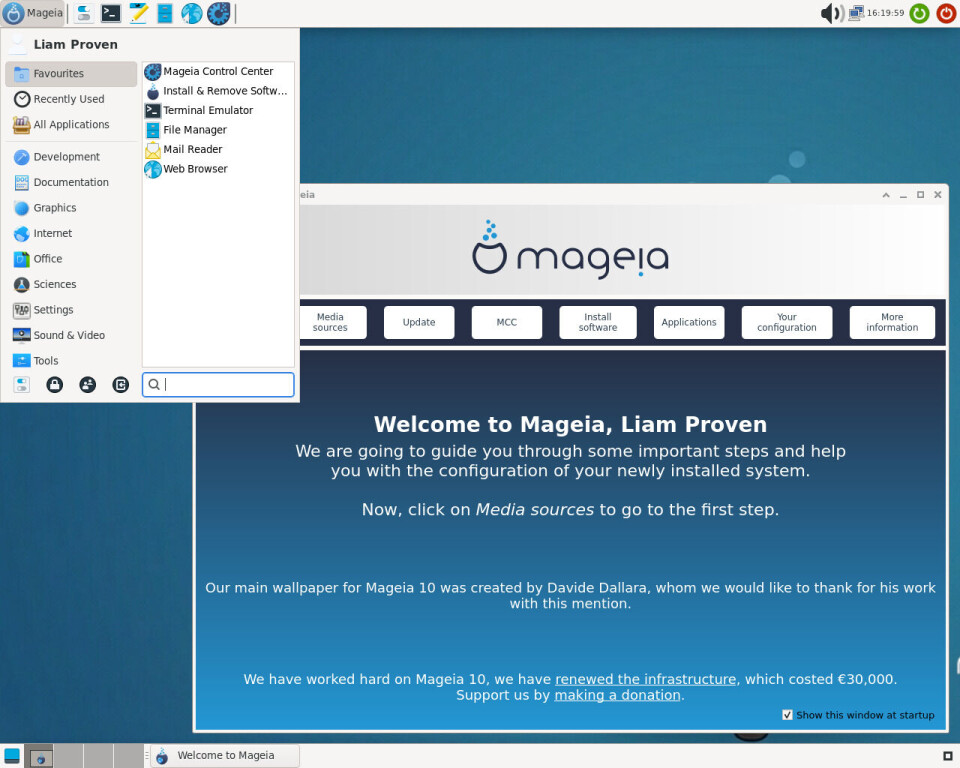
Mageia 10 marks 15 years since the distribution’s first release in June 2011. The project began the previous year as a fork of Mandriva, itself formerly known as Mandrake Linux. We last looked at Mageia alongside the other Mandrake descendants in 2022.
What sets Mageia apart from OpenMandriva Lx, PCLinuxOS, and Russia’s ROSA Linux is its continued support for 32-bit x86 PCs. Its GNOME and KDE Plasma live images are available only for x86-64, while the Xfce edition comes in both x86-64 and x86-32 versions.

There is also a “Classic Installer” ISO, which lets you choose your own desktop from nine different desktop environments, plus another 16 window managers, as detailed in the release notes. Both the standard GNOME session and GNOME Classic are available, while Liquidshell provides a lightweight alternative to KDE Plasma.
Mandrake Linux started out in 1998 as an easier version of Red Hat Linux using the new KDE desktop, which, at that time, Red Hat refused to incorporate due to concerns over the licence of KDE’s Qt toolkit. Nearly three decades later, Mageia remains an RPM-based distro. Version 10 offers two RPM package-management tools: Mageia’s urpmi command and DNF. urpmi also has its own graphical wrapper called Rpmdrake, but Fedora’s dnfdragora is an optional install. Since RHEL and the RHELatives, Fedora, SUSE and openSUSE all use RPM as well, packages of big-name apps such as Google Chrome are available – but Mageia is a different distro, whose common ancestry dates back more than 25 years, and packages for Fedora or openSUSE may not install or work correctly. It comes with Flatpak preinstalled, although no Flatpak applications are installed by default. As with other niche distros, Flatpak may help when you can’t find a native package of something. For those with the 32-bit edition, though, we suspect that few Flatpaks support that architecture.
Mageia 10 is a polished, friendly graphical Linux, built from recent components such as kernel 6.18. True, it does feel a little old-fashioned in some ways: for instance, it uses separate root and user accounts – although sudo is installed, it’s not configured for use. However, it’s a solid choice if you want to get away from the Debian/Fedora mainstream – and if you have a capable 32-bit machine, like a Windows 10 32-bit box, or some other need to run a 32-bit OS such as specific hardware support, then this is one of the best choices around today.

The Welcome screen is rich and very helpful, offering the ability to install extra apps, switch repositories, and more. Alongside it is the Mageia Control Center, which can manage most aspects of the OS without going near a command line. The distro is also well documented, with a substantial Mageia wiki.
It does use systemd, but, even so, it’s relatively lightweight. In our testing on a 32-bit VirtualBox VM, the Xfce edition used just 633 MB of RAM at idle, which is low by modern standards, and 7.8 GB of disk space. If you choose the KDE Plasma desktop, you get Plasma 6.5.5 with a choice of X11 or Wayland. The installation occupies about the same amount of disk space, although the RAM usage rises sharply: about 1.7 GB at idle. Xfce has an unusual GNOME 2-style two-panel setup, while the Plasma layout is clean and simple. We installed the Liquidshell desktop to have a look, but it’s very basic and rather clunky.
Mageia forked from Mandriva in 2011, before the company closed down, while OpenMandriva did so afterwards. They are still quite similar distributions, though, and we really wish that the two teams could settle their differences and merge the distros. Either way, Mageia’s 32-bit edition is an increasingly rare offering in an increasingly 64-bit world, which might win it some new admirers. ®

Waymo robotaxis are no longer available on Uber’s ride-hail app in Phoenix, Arizona, ending a nearly three-year partnership in the city, both companies confirmed to TechCrunch on Monday.
Uber said it is readying the launch of a separate autonomous vehicle partnership in the city, but did not name the partner. Waymo told TechCrunch that the vehicles Uber used for this “pilot” program have already been integrated into its own Phoenix fleet, available through its app. Waymo users started noticing that the company’s vehicles were absent from Uber’s network in recent days. Waymo’s vehicles are still available on Uber in Austin and Atlanta, for instance.
The quiet end to this partnership in Phoenix, which Waymo said happened in May, comes as the Alphabet-owned company is starting to put its newest robotaxis — the Zeekr-made van it calls Ojai — on the road. It’s also happening as the Uber-Waymo relationship appears to be wearing in some places, with the two companies poised to directly compete against each other in London as early as this year.
Still, both companies praised the collaboration in Phoenix as a successful jumping-off point for their respective robotaxi plans, which have gotten increasingly ambitious since 2023.
“This was a productive pilot that paved the way for future expansions and partnerships across the globe. After hundreds of thousands of trips with Uber, we have integrated these vehicles back into our Phoenix fleet, where they will continue to serve riders through Waymo, including our public transit integration with Via, and delivery with DoorDash,” Waymo told TechCrunch. “We’re grateful to all of the Uber customers who took fully autonomous trips with us, and we look forward to continuing to serve the Phoenix community.”
“Phoenix was our first pilot market with Waymo and was an intentionally limited deployment, reaching just over a dozen vehicles dedicated to the program. We learned a lot from that collaboration, which helped us to quickly scale Austin and Atlanta, where hundreds of Waymo AVs are available exclusively on Uber and our coverage area continues to expand,” Uber said.
The robotaxi landscape looks much different than it did when these two companies kicked off this collaboration in 2023. Back when it was first announced, the idea of Uber and Waymo partnering up still seemed unlikely given their messy legal battle that ended in a settlement in 2018. Robotaxis as a technology were in a far more uncertain place, as no operator had reached scale yet. Cruise was still seen as a viable competitor, as it had not yet gone through its own scandal and been absorbed into General Motors.
In the three years since, Waymo has grown its fleet to around 4,000 vehicles, and Uber has inked deals to add dozens of autonomous vehicle partners to its network.
This Phoenix partnership remained an unusual one, as it was the only city where Waymo operated directly and through Uber. Waymo is in the process of launching in around 20 new cities this year, is operating in 11 major U.S. metro areas, and the company offers more than 500,000 trips every week.
When you purchase through links in our articles, we may earn a small commission. This doesn’t affect our editorial independence.

On June 28, the International Society for Transforming Education — the organization behind the editorially independent news site EdSurge — released an expanded version of its “Profile of an AI-Ready Graduate,” a framework designed to help K-12 educators teach students how to work with artificial intelligence.
The updated framework, designed with support from the nonprofit Britebound, goes beyond basic literacy to higher-order skills. It identifies six roles the organization says students should fill when using AI tools: Learner, Researcher, Synthesizer, Problem Solver, Connector and Storyteller.
“Today, we are releasing a fully fleshed out version, 30 skills aligned with each of these roles to help model using AI to support our uniquely human skills,” said Richard Culatta, CEO of the organization. “Humans have always used tools to accomplish human tasks. AI is no different, but when we teach AI as a way to support us being better at being human, it is far more relevant and far more meaningful than when we just talk about what AI is.”
The announcement was made at the organization’s annual conference in Orlando, Florida, one year after the initial rollout of the Profile. While the original framework focused on basic technical understanding of AI, the updated version shows what those skills look like in practice — with role-by-role descriptions, classroom examples and articulations for middle and high school.
The framework is intended to layer on to the work educators are already doing and aligns with the International Society for Transforming Education’s existing student standards and “Transformational Learning Principles.”
The updated Profile of an AI-Ready Graduate is available as a free download here.
(Editor’s note: EdSurge is an editorially independent newsroom of the International Society for Transforming Education.)
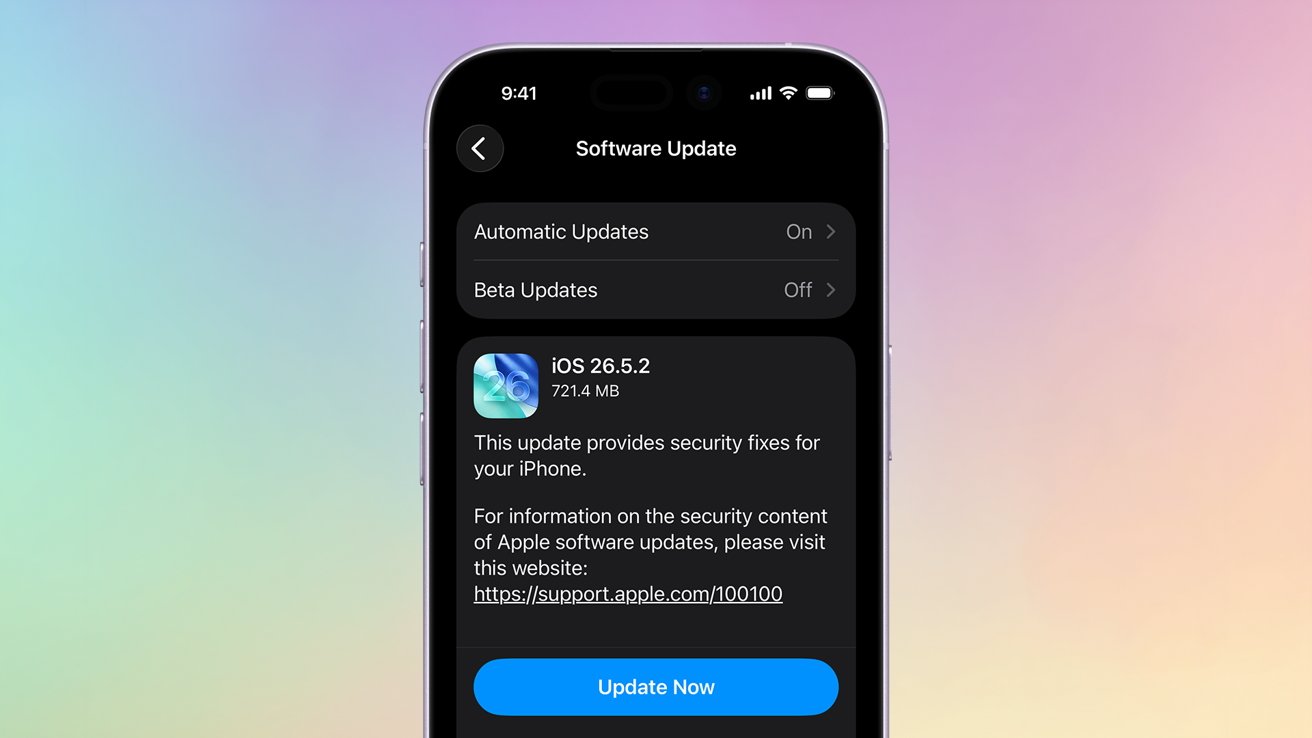
It’s time to update your Mac, iPhone, and iPad, as Apple has released a new trio of security patches for its operating systems.
Apple pushed out three new updates on Monday in an effort to patch an apparent security flaw. As of publication, Apple has not specified what issue the patch is meant to fix.
Because Apple has not announced what is in the update, it is also possible that it contains bug fixes as well.
To update, you can follow the steps below.
AppleInsider and Apple suggest installing these kinds of minor patches. Security patches are essential for keeping your device safe and operational.


A single fake error report hijacked Claude Code in controlled testing — the agent ran the attacker’s code with the developer’s full privileges, and not one alert fired. EDR, WAF, IAM, and the firewall all missed it completely.
Tenet Security’s June agentjacking disclosure describes a single crafted Sentry error event — sent through a public credential that requires no breach and no authentication — that injected attacker instructions into error data that Claude Code, Cursor, and Codex then executed as trusted diagnostic output. Tenet tested 100-plus targets in controlled conditions and achieved an 85% success rate. Sentry called the flaw “technically not defensible.”
he Cloud Security Alliance classified agentjacking as a systemic MCP vulnerability class within days of the disclosure. No credentials were stolen, no policy was violated, no perimeter was breached: every step in the chain was authorized. That is the problem.
Tenet identified 2,388 organizations with publicly exposed Sentry credentials that could be used to inject malicious events at scale. The research is proof-of-concept, not confirmed exploitation across all 2,388. But one captured Claude Code environment held a live AWS secret access key and private repository URLs.
Here is the scope test: If your AI coding agents are connected to Sentry, Datadog, PagerDuty, Jira, or any MCP-connected data source your developers trust — and those agents can execute shell commands — then your stack has the same blind spot.
Organizations running Sentry should audit all publicly exposed DSNs immediately. Sentry’s architecture intentionally makes DSN credentials public for frontend error reporting, so the mitigation isn’t revoking the DSN — it’s restricting what agents can do with the data those DSNs return.
Agentjacking works because every step is authorized: The attacker sends a valid Sentry API call using a public DSN, the MCP server returns the injected event as authentic output, and the agent executes the instruction using the developer’s privileges. No signature fired. The victim saw only benign diagnostics while the agent silently exposed cloud credentials and source-control tokens.
SOC teams have never needed to distinguish between a developer running an npm install and an agent running that command in response to a malicious error event. That distinction did not exist until AI coding agents became production tools. The stack that cannot make it is the stack agentjacking bypasses.
Five independent surveys from the first half of 2026 found that enterprises trust their AI agents far more than their enforcement justifies.
Only 34% of organizations apply the same security controls to AI agents as to humans, according to an Okta/Apprize360 survey of 292 executives and 492 knowledge workers. Fifty-two percent of employees use unapproved AI tools, and 58% of executives reported an AI-related incident or close call in the prior year.
HiddenLayer’s 2026 AI Threat Landscape Report surveyed 250 IT and security leaders: 33% reported agents had already exceeded intended scope, and 31% could not confirm whether they had experienced an AI breach. One in eight AI breaches was linked to agentic systems.
Gravitee’s survey of over 900 executives and practitioners found only 14.4% of agents went live with full security approval, and 88% reported confirmed or suspected incidents. A follow-up of 750 leaders in April found agent estates had doubled while monitoring barely moved.
“Securing agents looks very similar to securing highly privileged users,” said Elia Zaitsev, CTO of CrowdStrike, in an interview with VentureBeat. “They have identities, access to underlying systems, they reason, they take action.”
Zaitsev pointed to the gap the industry left open. “No one has been talking about securing agents at runtime. We are doing that now. What is your safety net? If all these controls fail, how do you prevent them from failing silently?”
CrowdStrike’s fleet data quantifies the exposure: more than 1,800 agentic applications on enterprise endpoints, approximately 160 million instances under monitoring. On June 15, CrowdStrike shipped Continuous Identity for AI Agents at Identiverse, replacing static policies with continuous enforcement that authorizes every agent action in real time. The control class that announcement reflects — continuous action-level authorization with verifiable agent identity — is now a baseline procurement criterion regardless of vendor.
“People have kind of forgotten about runtime security,” Zaitsev said. “We did this with endpoint, virtualization, and cloud. People focused on patching vulnerabilities, locking down permissions. Somehow, they always seem to miss something. The safety net is runtime.”
Zaitsev was equally direct about sandbox approaches. “If you start with an agent in a sandbox that has no ability to touch anything, it is worthless. Very quickly, you are in this race of giving it more capabilities. And then what is the point of your sandbox?” Agents derive their value from access. Every access grant is an attack surface.
Kayne McGladrey, an IEEE Senior Member, described the structural challenge in an exclusive interview with VentureBeat. “The CISO doesn’t have the budget. The CISO doesn’t have the staff. We can observe risks, we can advise on business risks, but we don’t own the business systems affected by those risks,” McGladrey said. When agent governance spans six departmental budgets, no single executive can confirm whether agents get the same access reviews as humans.
The Okta survey quantifies the disconnect. Only 43% of workers say agent policies are clear, compared to 65% of executives, and nearly two-thirds apply weaker controls to agents than to humans. The people deploying agents daily do not recognize the governance posture their leadership claims to have built.
Assaf Keren, chief security officer at Qualtrics and former CISO at PayPal, put it plainly. “The real risk starts not by the implementation of AI systems. It is the fact that baseline architecture is not well established. When we put an AI system on top of something not architected well, we are accelerating the fractures.” Keren called runtime behavior analytics “an unsolved problem right now.”
The five-question gap test draws on five surveys from the first half of 2026. Each question maps to a gap that agentjacking exploits. Run this before any Q3 vendor evaluation.
|
Gap to test |
The proof |
What breaks |
Monday action |
Source / sample |
|
1. Agent inventory. What percentage of agents, MCP connections, and LLM automations completed security review before deployment? |
14.4% get full security/IT approval before going live. 52% of employees use unapproved AI tools. Average enterprise now manages 37+ deployed agents, roughly doubled from Q4 2025. |
Unapproved agents are invisible to your identity platform and unaccountable in a breach disclosure. Agentjacking targets exactly these unmanaged MCP connections. No census means no audit trail for regulatory response. |
Commission a full agent, MCP server, and LLM automation census. Make census completion a procurement gate for all Q3 vendor evaluations. Flag any agent discovered post-census as a shadow AI incident. |
Gravitee State of AI Agent Security 2026, 900+ respondents (Feb 2026); Gravitee April 2026 update, 750 senior tech leaders; Okta/Apprize360, 292 execs + 492 workers (June 2026) |
|
2. Controls parity. Do agents receive the same access reviews, privilege scoping, and revocation timelines as human employees? |
34% always apply the same controls to agents as humans. 61% of privileged access fulfilled without proper review. Only 22% treat agents as independent identity-bearing entities. |
An agent with a static OAuth token and no review cycle is a permanent privileged account with no termination date. Agentjacking inherits whatever privileges the developer holds. 45.6% of orgs rely on shared API keys for agent-to-agent auth. |
Add every production agent to the next access review cycle. Mandate human-in-the-loop for any agent action touching PII, financial data, or production infrastructure. Replace shared API keys with scoped, short-lived tokens. |
Okta/Apprize360 (784 respondents, June 2026); Palo Alto Networks (2,930 respondents); Gravitee (900+, shared API keys data) |
|
3. Scope drift. Have any agents accessed data or systems beyond their defined scope in the last 12 months? |
33% report agents already exceeded scope. 53% say agents exceed permissions occasionally or sometimes. Meta Sev 1, March 2026: agent posted sensitive data to unauthorized channel. Only 8% say agents never exceed intended permissions. |
Scope drift triggers reportable events under GDPR, CCPA, HIPAA, and SEC cybersecurity rules. If detection cannot distinguish agent-initiated from human-initiated access, disclosure timelines are unachievable. Agent-spawned sub-agents (25.5% of deployed agents can create other agents) make audit trails algebraically intractable. |
Run a 90-day scope-drift audit on every production agent. Compare actual resources touched against approved scope documentation. Block agent-to-agent delegation without explicit human approval for any action exceeding the parent agent’s scope. |
HiddenLayer AI Threat Landscape 2026 (250 IT/security leaders); CSA AI Agent Security Survey (scope violations data); Gravitee (agent spawning data) |
|
4. Governance perception gap. Would 50 knowledge workers say your AI agent policies are clear? |
22-point gap: 65% of executives say policies are clear, 43% of workers agree. 77% of security teams see shadow AI risk but lack visibility to act. 76% cite shadow AI as a definite or probable problem. |
You are evaluating vendors against a governance posture your workforce does not recognize. Every shadow agent undermines the vendor comparison. Knowledge workers sharing internal messages (54%), HR data (45%), and confidential docs (39%) with unapproved AI tools. |
One-question survey before your next vendor demo. Gap exceeds 15 points, pause procurement. Publish an internal AI agent acceptable-use policy with specific examples of approved and prohibited agent behaviors. |
Okta/Apprize360 (784 respondents, June 2026); Ivanti 2026 AI Maturity Report (1,200 respondents); HiddenLayer (shadow AI data) |
|
5. Breach detection certainty. Can your security team confirm whether you experienced an AI-related breach in the last 12 months? |
31% cannot answer. 88% reported confirmed or suspected AI agent security incidents. One in eight reported AI breaches now linked to agentic systems. Agentjacking proved EDR, WAF, IAM, and firewall pass an agent-mediated attack without a single alert. |
No basis for disclosure timelines. No evidence chain for incident response. No defensible position in a regulatory investigation. EU AI Act high-risk compliance obligations take effect August 2, 2026. |
Require agent-specific runtime detection as a procurement prerequisite. Confirm your org can distinguish agent-initiated actions from human-initiated actions in production telemetry. Test your SOC’s ability to attribute a specific action to a specific agent within 60 minutes. |
HiddenLayer (250 IT/security leaders); Gravitee (900+, incident rate); Tenet Security (2,388 orgs exposed); CSA (systemic MCP vulnerability classification) |
EU AI Act high-risk compliance obligations take effect August 2, 2026. Worth factoring into Q3 planning timelines.
Run the five-question gap test above before any Q3 vendor evaluation — it costs nothing to administer, and the procurement clarity it creates is worth far more than the 30 minutes it takes.
Consider mandating agent-specific runtime detection. If your stack cannot tell what an agent did from what a developer did, agentjacking will bypass it the same way it bypassed every layer in Tenet’s testing. That distinction is the one that matters now.
Treat every agent as a privileged insider. According to the Okta/Apprize360 survey, only 34% of organizations apply the same controls to agents as to humans; closing that gap is the single most impactful thing most security teams can do this quarter.
Test the perception gap before investing in new tooling. One question to 50 knowledge workers. Do you know your company’s AI agent policies? If the gap between their answer and leadership’s answer exceeds 15 points, that is the problem to solve first. No vendor product fixes a governance posture your own workforce does not recognize.
Make agent census completion a procurement gate — every agent, every MCP connection. The security teams getting this right are the ones that started with a complete inventory and worked forward from there.
Agentjacking stripped away an assumption that has survived every security architecture since the first firewall went live. Authorized does not mean safe. When every step in the chain is legitimate, the only defense that matters is the one watching what agents do. Not what policies say. What agents do.


AI and ML
Central bank for central banks sees shades of dotcom mania in hyperscaler capex binge
The central bank for central banks is concerned about the eye-watering sums being invested into AI, and it’s raising the specter of a global recession should the bubble burst.
In its annual report for 2026, the Bank for International Settlements compared the current craze to historical events, including canal and British railway mania in the 1800s, electrification exuberance of the 1920s, and the dotcom boom of the 1990s.
The report states: “all shared one common trait: a genuine technological breakthrough that attracted capital in excess of what commercial returns could ultimately justify.
“These episodes ended with an eventual reversal in investment, inducing economy-wide recessions. The scale and pace of the current AI investment boom accompanied by expectations of large productivity payoffs bear resemblance to these precedents, highlighting potential downside risks in the near term.”
The Register has already reported that Amazon forecasts capital expenditures of $200 billion for 2026, Microsoft is projecting $190 billion, Google some $180 billon and Meta up to $140 billion. Oracle is also betting big on AI.
BIS estimates the five largest hyperscalers are set to spend more than a trillion dollars on AI-related capex in 2026 – and given the inflationary conditions regarding memory and that each rival is trying to outdo each other, that seems plausible.
“These commitments are outpacing earnings and the free cash flow of these firms, leading some to issue debt to raise additional financing. This investment race may be partly driven by the perception that only a small number of players with superior technology will ultimately dominate the market shares.”
Intense competition is leading to the risk of the tech giants overcommitting resources to “investment projects with still uncertain returns, leaving all firms vulnerable to disappointments in AI payoffs.” This is because as competitive pressure drives spending ever higher, the net economic surplus for the tech industry declines and “could turn negative in adverse scenarios.”
“Disappointment in returns could trigger a sudden pullback in financing and turn the capex boom into a protracted investment bust with potential knock-on effects on the financial conditions,” the annual report continues.
The report also cited concerns about a looming “supply side roadblock” around issues like electricity availability, chip shortages and grid connection bottlenecks. AI datacenters are already putting pressure on energy prices and input costs with “potential spillovers to inflation.”
“Looking ahead, these temporary shortages may also amplify over-investment, as firms attempt to lock in future capacity through long-dated contracts that further expose them to any disappointments in demand.”
Should inflation spike or AI-led investment collapse, the macroeconomic consequences could be amplified by “existing financial vulnerabilities.” Policy rates being tightened to get a hold on inflation may precipitate a “sharp pullback in asset prices after a prolonged period of exuberant risk-taking, triggering disruptive macro-financial feedback loops.”
Given AI companies’ “rising leverage” and a “growing footprint in credit markets”, a major change in optimistic sentiments towards these businesses could have serious financial knock-on effects. ”Vulnerabilities extend to their supplier ecosystem, including engineering, procurement and construction contractors whose balance sheets are comparatively weak, leaving them exposed to any Capex pullback by hyperscalers.”
The “opacity” of AI-sector financing is compounding vulnerabilities as corporations create a web of private arrangements – circular financing – and the terms of datacenter facility leases are often not fully disclosed, BIS adds.
The backdrop to all of this is that, while enterprises running pilots report some efficiency gains at a employee level, few report discernible productivity gains from AI projects that went into production environments at scale.
The Register has long discussed concerns about the dynamics of the AI industry, as outlined in the many links in this article above. It now seems that suits in the finance industry are waking up to the potential pitfalls too. ®

One of WhatsApp’s most in-demand features is finally coming out of beta. Later this year, the messaging app used by over 3 billion people plans to add usernames. It’s an additional (and more privacy-friendly) way for WhatsApp users to connect without sharing phone numbers.
But that means the race to grab the best WhatsApp usernames is about to begin. Hold on tight.
WhatsApp says username reservations open up this week on the platform, and you’ll see a notification in the app when it’s available. Check in the app by going to Settings and then Account. Here’s where you’ll find the Username tab if it’s enabled. Then, you’ll have the option to create a new username or port over your existing name from Instagram or Facebook. WhatsApp offers a username generator, but you can also just go with your gut (or really whatever you’re feeling at the moment).
“Usernames are designed to give you control over who gets to see your phone number in the first place,” says Alice Newton-Rex, vice president of Product at WhatsApp. “It’s an optional feature; you choose your own username, you can change it or remove it, and it doesn’t have to match your handle or account name on any other app.”
Newton-Rex stressed that this WhatsApp feature was designed around user privacy. There’s no public list of usernames for people to search through. Users can also add an extra layer of security by only allowing people who know a unique four-digit key, in addition to their username, to contact them.
Courtesy of WhatsApp

These usernames will remain fully optional, but Newton-Rex sees this new choice as a privacy measure many existing users have already expressed excitement about. “I do think that we’ll see a lot of adoption, but that’s going to be one of the things that we learn as we start rolling it out,” she says.
WhatsApp is not shy about this feature’s similarities to competitors. “Signal usernames are probably a good comparison,” Newton-Rex says. “This will work in a very similar way.” Signal rolled out usernames on its platform in 2024. Many messaging apps are still experimenting with different ways for users to connect without sharing numbers. For example, Germ DM allows its users to create “burner cards” so people can connect with multiple groups in different ways.


Ex-Tesla Optimus lead Jay Li settled a trade secret lawsuit with Tesla and raised $11M to ship dexterous robot hands from his startup Proception.
Proception, a robotics startup founded by former Tesla Optimus engineer Jay Li, has settled a year-long trade secret lawsuit with Tesla and raised an $11 million seed round led by First Round Capital to build dexterous robotic hands. The company told TechCrunch it is now shipping the first batch of its high-dexterity hand to researchers and robotics companies while opening to wider orders. Y Combinator and early-stage fund BoxGroup also participated in the round.
Tesla sued Li and Proception in federal court in Northern California in June 2025, accusing Li of downloading confidential files related to robotic hand actuation onto personal devices before resigning and founding the startup six days later. The lawsuit alleged that Proception’s hands bore “striking similarities” to Tesla’s internal designs. After months of legal proceedings, the two sides reached a settlement and Tesla dismissed the case earlier this month.
Li told TechCrunch he views the experience as “a resilience test, or pressure test” and believes the company emerged stronger for having survived it. He also said he would not be surprised if Tesla eventually comes to Proception for help with its own hand problem. Tesla did not respond to a request for comment.
Dexterous manipulation, the ability to grasp, rotate, and manipulate objects with human-like precision, remains one of the most stubborn unsolved problems in robotics. Even Elon Musk has called robot hands one of the biggest engineering challenges yet to be solved. Kevin Lynch, the director of Northwestern University’s Center for Robotics and Biosystems, told the Wall Street Journal last year that his team believes it will be a decade before robot hands become functional and useful enough to do what humans do.
Li thinks Proception can move faster, largely because of how it collects training data. Most companies training humanoid robots use teleoperators, where a human wearing a virtual reality headset controls a robot remotely and the system learns from the commands. A key drawback, according to Li, is that the operator receives no tactile feedback from the objects the robot touches, and the approach is limited to however many robots a company has available.
Proception’s alternative is a sensor-laden glove that captures human hand interaction data without requiring a robot in the loop. The same glove also serves as the sensor-packed “skin” on the robotic hand Proception is developing, which has 22 degrees of freedom and multiple joints per finger. Li argues this combination of scalable data collection and high-dexterity hardware is what the market is missing.
The dexterous hand market has attracted significant capital this year. China’s Linkerbot, which holds 80 percent of the global market in high-degree-of-freedom hands, is targeting a six billion dollar valuation after shipping more than 1,000 units a month. Genesis AI, a European startup, raised $105 million for a wheeled robot with dexterous hands, and Chinese competitors like Xynova have raised nearly one billion yuan.
Proception is betting that most humanoid robot companies will buy hands rather than build them in-house, mirroring how the automotive industry treats specialised components. First Round partner Bill Trenchard, who led the investment, told TechCrunch that dexterous manipulation is “the last mile of getting these robots to be truly performant.” He also praised Li’s leadership under the pressure of the Tesla lawsuit.
Tesla has discussed producing Optimus at its Shanghai Gigafactory and has deployed more than 1,000 Gen 3 units across its own facilities, but the robot’s hands remain its weakest link. Musk has set a target price of $20,000 to $30,000 per unit and projected production scaling to tens of thousands by 2028. Whether Tesla builds its hands internally or eventually sources them from companies like Proception is one of the open questions in the humanoid robot supply chain.
More than 150 companies are now chasing the humanoid robot market, with billion-dollar valuations common and only 23 percent of enterprise buyers satisfied with the products available. In that environment, a startup selling the component everyone agrees is the hardest to get right has a clear pitch, even at the seed stage. Whether Proception can scale from its first batch of shipments to a position where it shapes how an entire category of machines uses its hands is the bet First Round Capital just made.

IGN has reported that, based on its internal affiliate data, Grand Theft Auto 6 preorders on PS5 are surging ahead of Xbox preorders of the game at a rate of eight to one — Xbox is now saying this is far from the full picture. Though, I have a hard time believing Xbox is doing a heck of a lot better than this data suggests.
In a statement to Windows Central, an Xbox spokesperson explained that “This doesn’t represent pre-order data. We’ve had record orders. People should wait for real data and not clicks on affiliate links.”
Through IGN Finds’ and commerce affiliate linking program, the data is showing that PlayStation is outperforming Xbox by a rate of 8-to-1. Link in bio for more on GTA’s effect on console sales. #IGNSummerOfGaminghttps://t.co/Hc8yYr0FQJ#IGNSummerOfGaming pic.twitter.com/TaKQS2RgxHJune 27, 2026
Now, I don’t doubt that GTA 6 is selling gangbusters everywhere it’s playable, leading to “record sales.” Grand Theft Auto 5 is considered the third-best-selling game of all time — trailing only Minecraft and Tetris (though not everyone counts Tetris, as the figures aggregate several versions of the game, and you might see some places calling GTA 5 the second-best-selling of all time). So it tracks that out of the gate GTA 6 would be hugely popular too, and I expect it will only get more popular when GTA 6 Online and the PC port eventually release.
However, Xbox seeing record orders and its preorders lagging behind PlayStation’s aren’t mutually exclusive. In fact, it’s no secret that the PS5 has outsold Xbox consoles this generation, so you’d expect the Sony hardware to have more GTA 6 game sales — though with estimated sales figures sitting at around 95 million for PlayStation to 35 million Xboxes, you would expect a rate of two or three to one, not eight to one.
Is something more going on here as Xbox suggests?

On Xbox’s side of the argument, there are reasons not to extrapolate too much from affiliate link data.
First, people might simply be picking the game up digitally directly from Xbox’s store rather than through typical affiliate partners like Walmart, Argos, and Amazon. Given that GTA 6’s physical edition is functionally identical to the digital version — as there’s no disc, just a download code in a plastic case — there’s little to no advantage to buying from a retail store.
And given Xbox’s digital gaming focus with services like Game Pass and multi-platform gaming across consoles, PCs, and PC handhelds (even if GTA 6 doesn’t look set to be a Play Anywhere title at launch), it makes sense that Xbox gamers would be more comfortable (and possibly more likely to shop) at Xbox’s own store compared with PS5 gamers and PlayStation’s store.
What’s more, affiliate data doesn’t necessarily mean sales. IGN hasn’t said much on what exactly its data is based on, but if it’s affiliate link clicks (as the Xbox spokesperson suggests it is), then that doesn’t necessarily mean the PS5 version is selling eight times more copies, just that links for the PS5 version are eight times more popular.

Gamers could simply be clicking on them more but then not buying the game, or clicking a few times before making a purchase, though I’m not sure why you wouldn’t expect Xbox and PlayStation gamers to be equally flaky on a post-click purchase.
The only final piece of support for Xbox would be if IGN’s audience skewed more towards PlayStation at a rate disproportionate to the overall population’s two- or three-to-one.
Though as a general gaming outlet rather than one dedicated to either side of the aisle, I don’t see that being the case — all I could see happening is IGN’s audience of gaming enthusiasts could be more likely to own both an Xbox Series and PlayStation 5 console, and then with Sony’s promise that GTA 6 “plays best on PS5” they’d be more likely to pick up a copy for Sony’s hardware compared with Xbox’s.
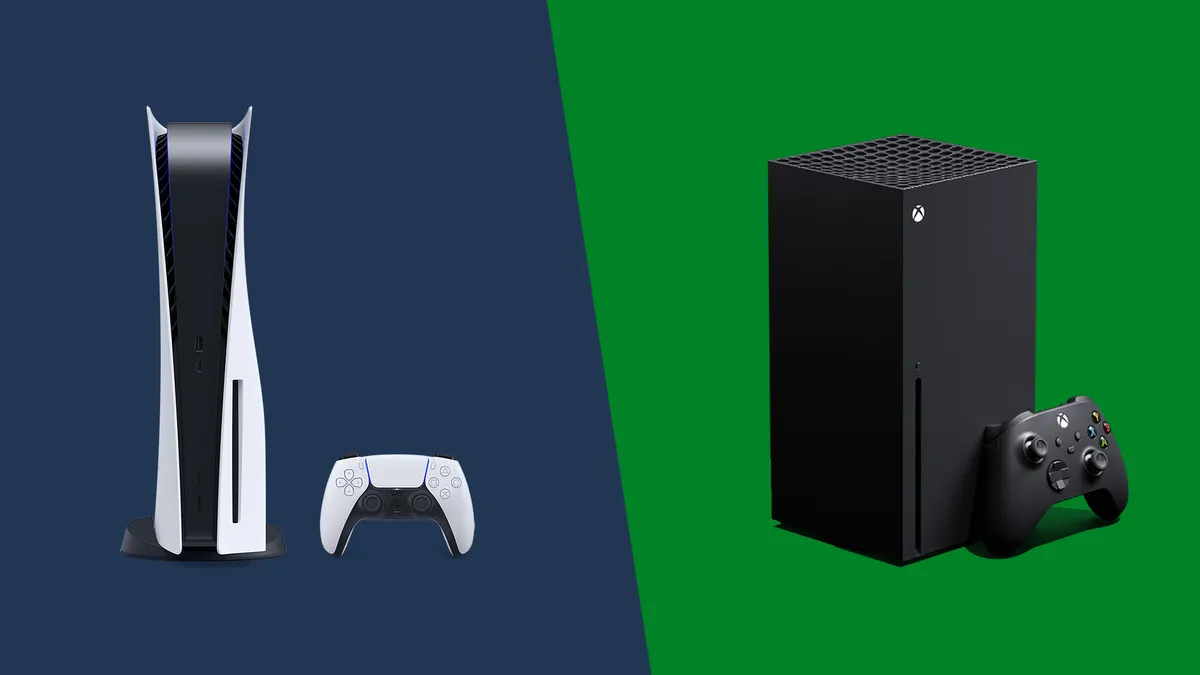
All that’s to say, while IGN’s stats might not be entirely accurate to the final picture, I don’t doubt that PS5 sales of GTA 6 are blowing Xbox’s out of the water. And even if current sales aren’t quite eight-to-one, I wouldn’t be surprised if sales trend in that direction.
My argument here is Xbox consoles are set to get a major price hike effective August 1, 2026, putting the Series X at $749 for the all-digital, and $899 for the disc drive equipped model (price increases outside the US are yet to be confirmed) — a sharp raise on the previous costs of $599 and $649 respectively which are the identical to the equivalent PS5 models.
Sony may announce similar hikes itself — it isn’t immune to the cost increases hitting the whole industry, though its drastically better sales may help it weather the storm for a little longer — but until it does, the PS5 looks like a much better deal. If casual gamers still rocking a last-gen console finally want to upgrade so they can play GTA 6, there will be a clear winner: the PlayStation 5.
There’s still a lot of time before Grand Theft Auto 6’s eventual November 19 release date (I’ll be ready for another delay until it’s actually in my hands), but I don’t think Xbox’s fortunes will turn around dramatically by then.

Follow TechRadar on Google News and add us as a preferred source to get our expert news, reviews, and opinion in your feeds.

I’ve spent years watching gaming phones make the same promise and stutter at expected chores. Needless to say, I’ve learned to brace for the caveat every single time. The chip is fast, the display refreshes at a number that sounds impressive, and then, twenty minutes into a ranked match, the experience starts to crumble, heat builds up, and the frame output quietly falls off a cliff. Throttling is an almost inescapable reality of mobile gaming.
So when Infinix offered me a sit-down with the product manager behind the latest and greatest in its GT Series, I went in with the one big conundrum that I actually cared about. Has a brand finally built a phone around the heat problem instead of skirting around it? The answer, it turns out, is the entire pitch of the GT 50 Pro. And to the team’s credit, they didn’t miss.
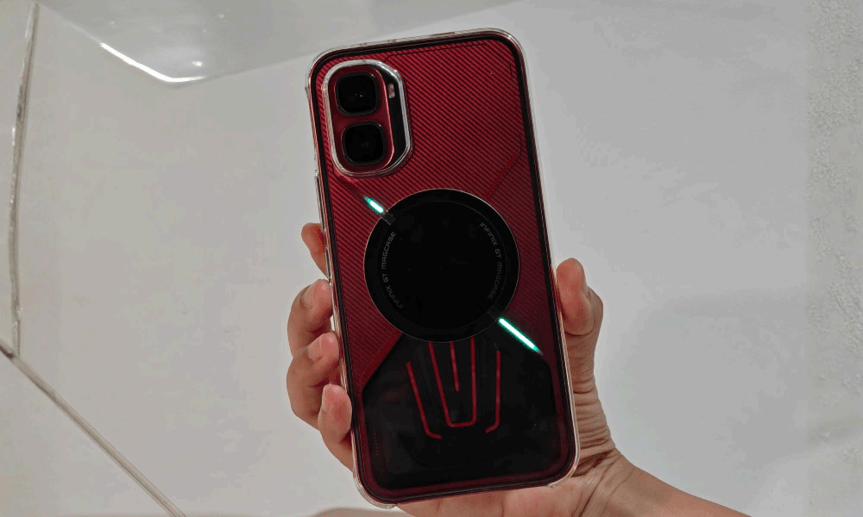
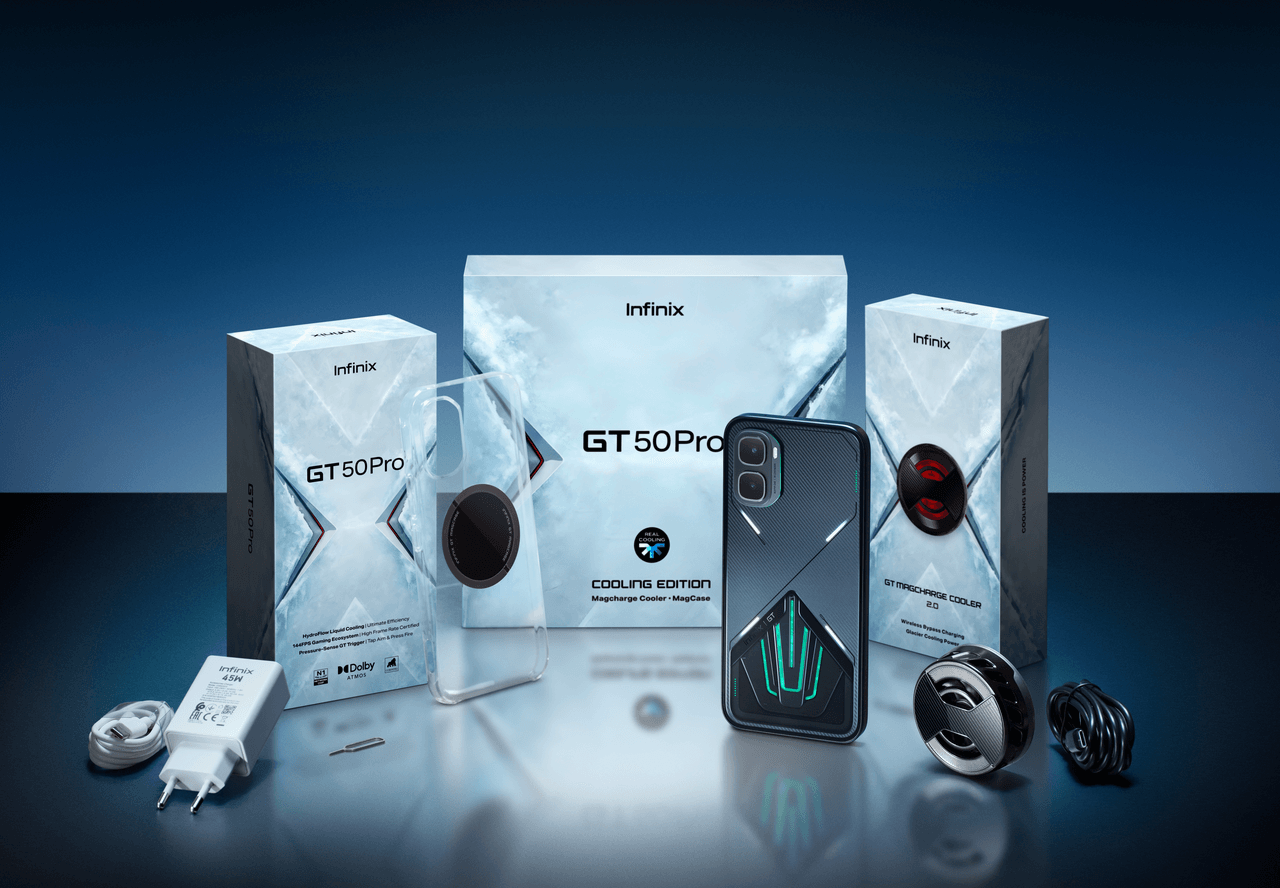
The biggest draw of the Infinix GT 50 Pro is the HydroFlow Liquid Cooling system. It’s the headline achievement, and the team is proud of engineering what it claims to be the industry-first 100% coverage of the core heat sources. Most phones cool a region and hope the rest sorts itself out. Infinix’s approach is active circulation, and when I asked about the engineering challenges of cramming that system into a slim chassis, the manager framed it as the most ambitious thing the series has done:
“The integration of the HydroFlow Liquid Cooling system represents our most ambitious engineering achievement in the Infinix GT Series to date,” Infinix GT Series Product Manager told me. What struck me was that they treated it as a design constraint rather than a marketing afterthought. The biggest concern, they explained, was that even a powerful chipset throttles after fifteen or twenty minutes of heavy play, leaving you to pick between graphics quality and stable frames.
Nobody wants to make that choice mid-match. I don’t want to live with that constraint either, but on mainstream phones, it’s inevitable. What I think is the standout aspect of this phone is how Infinix took the idea of building around cooling. Rather than treating the thermal system as a supporting feature bolted on at the end, the team designed the chassis to accommodate it first. It’s a bold claim, and when I pushed on whether the engineering actually backed it up, I saw it working in more ways than one.

Now, HydroFlow might sound like a fancy name, but it’s actually what the tech is all about. It’s essentially a liquid that carries heat and keeps the phone running cool. The conversation got technical at this point, but I appreciated it because I wanted to get an inside look at the thermal engineering. Most phones cool a region and hope the rest sorts itself out. Infinix’s approach is active circulation.
“The liquid cooling system precisely targets and suppresses thermal stress right at the source.”
At the heart of the whole system is a piezoelectric-driven ceramic micro-pump moving specially formulated coolant at 6.5ml per minute across a 6,437mm² diaphragm, which they say is the largest in the industry. The channels carrying the coolant liquid are laser-etched at micron-level precision so that heat gets pulled directly off the components that generate it.
Over the years, I’ve heard a lot of cooling claims from different brands, but what made this one land was the durability data. Infinix told me that they ran over 720 hours of accelerated aging tests, including punishing sessions at 75°C ambient temperature and 85% humidity. When subjected to those conditions, the ceramic pump can manage hours of continuous operation with minimal degradation. The real-world example they gave was the one that mattered the most, and this is something that mobile gaming enthusiasts ultimately want to hear.
“During intense team fights when gaming, a sudden performance surge can spike total power consumption to a 9W peak. Without efficient thermal management, instant SoC overheating will immediately trigger frame rate drops and severe stuttering,” the Infinix executive tells me. “The liquid cooling system precisely targets and suppresses thermal stress right at the source.” Simply put, that’s the difference between bold claims and material engineering you can actually feel making a discernible difference in your hands.
There’s a showy element, too, and I’ll admit I’m a fan. Instead of hiding all this liquid cooling wizardry, the Infinix GT 50 Pro puts a transparent Pipeline Window on the back so that you can watch the coolant liquid’s flow in real time. The design language leans into hypercar aesthetics. You get Kevlar and carbon-fiber-inspired textures, and aerodynamic contours that the team says were inspired by hypercar wind tunnel testing to improve grip during long gaming sessions. When I expressed that the design was bold and that I quite liked it, Infinix pointed out that the design maturity over the GT 10 Pro was deliberate. It leans less into the overt “gamer” class and edges closer to a refined performance machine.
It goes without saying that cooling is the foundation for any performance-centric phone, and the Infinix GT 50 Pro embodies that label. A phone, however, still needs the right silicon to justify the hype. The latest from Infinix comes armed with the MediaTek Dimensity 8400 Ultimate silicon built atop the 4nm process. It’s a fairly powerful chip, but the team, in particular, focused on a few key perks. We are the first to feature MediaTek D8400 frame rate converter ( MFRC) , delivering GPU motion estimation and motion compensation technology, both of which combine to push the native 144FPS output while reducing the graphics engine load. The core logic behind the whole exercise is fairly obvious — deliver segment-leading frame rates with a cooling system that can actually sustain it for long gaming sessions.

Mobile gaming, however, is not all about the raw firepower. Internet speeds play a crucial role, too, especially if you’re engaged in fast-paced multiplayer games. Thankfully, Infinix paid attention to this aspect, as well. On the Infinix GT 50 Pro, Connectivity gets the same in-house treatment courtesy of the self-developed N1 network chip, which the team linked to with a 360-degree layout of twelve antennas. Lab tests tout a roughly 60% improvement in weak-signal environments, like elevators and underground garages. For online play, fewer signal drops matter as much as frames, so I’m glad that a robust on-device network infrastructure wasn’t an afterthought.
Then there is the Pressure-Sense GT Trigger, and as someone who has tested physical and capacitive shoulder buttons on smartphones for years, this is where I get picky. The Open-Cut Pressure-Sense GT Trigger on the Infinix GT 50 Pro is special for multiple reasons. It delivers sub-20ms latency, offers ten levels of adjustable sensitivity, and lets you play with up to eight mapping points. These are fairly resilient, too, thanks to a claimed lifespan rated at over three million presses. I asked Infinix what tangible edge these triggers bring to the table for a serious player over capacitive systems, which I’ve always found a little vague under the finger.
“This physical tactile feedback allows pro-level esports players to feel exactly how much pressure they are applying, enabling much finer control than capacitive systems, which often feel imprecise,” the Infinix executive tells me. The manager’s advice for anyone learning, including my own tech-obsessed siblings, was refreshingly practical. The best way is to start with the built-in trigger tutorial in XArena, begin at medium sensitivity, and expect noticeable gains within a week or two.
I’m usually skeptical when a gaming phone claims “AI optimization.” Gaming enthusiasts aren’t fans of AI seeping into the world of gaming, either. Refreshingly, the GT Gaming Co-Lab pitch, which is Infinix’s engineering partnership with game publishers, came with specifics I could dug into. The team described three engines working together during a 144FPS session in titles such as Call of Duty: Mobile.
“Most gaming devices in the industry operate on a reactive model, they only try to suppress the heat after the phone has already overheated. The Infinix GT Gaming Co-Lab changes this paradigm.”
Simply put, the intelligent power allocation system dials back the CPU and GPU during low-intensity moments like early-game looting, so the device runs cooler before the fight even starts. The AI Frame Rescue Engine touts predictive foresight, as it anticipates a processing deficit a few frames before a heavy scene hits. When needed, it delivers a frequency boost to rescue the frame before players can experience a frame drop. And as the thermals approach their limit, the Game Thermal Control Engine jumps into action and dials down the frame output in progressive gradients instead of the big 144-to-60 FPS drop I’ve seen on a majority of smartphones.
“While other devices wait until they are boiling hot to start cooling down, the Infinix GT 50 Pro uses AI to prevent heat before it builds, rescue frames before they drop, and gently smooth performance when thermal limits are pushed,” Infinix tells me. Whether it holds up under my own testing is another article, but as a design philosophy, it all makes sense.
The GT Magcharge Cooler 2.0 further extends that thinking with industry-first wireless bypass charging, routing up to 15W juice directly to the motherboard so the battery is largely skipped during the top-up session. The team tells me that they measured a 4°C drop in peak temperatures when compared to charging through the battery. On the topic of battery health, I asked why they capped wired charging at 45W while rivals chase bigger numbers. The decision was strategic, I was told.
“We refused to sacrifice long-term battery health and premium design for marketing gimmicks, delivering a phone that stays slim, light, and reliable for years,” says the Infinix executive I interviewed. The team zeroed in on 45W wired and 30W wireless output with a bypass charging facility. Furthermore, the AI battery self-healing tech helps the battery unit reach 1,600 charge cycles. I respect this approach, because it avoids marketing hype at the peril of real-world in-hand experience.
My conversation with Infinix branched off toward the end, as interviews tend to do. Notably, the Infinix GT 50 Pro anchors what the company refers to as the New GT Ecosystem, an “esports sanctuary” built alongside the GTWATCH 5 Pro and GTBUDS 5. The smartwatch acts as a tactical second screen, pushing notifications to your wrist so that the phone stays distraction-free, while also monitoring your heart rate. The buds lean on Bluetooth 6.0 and LE Audio standards to deliver an impressive 44ms latency, while Dolby spatial tuning delivers an immersive listening experience with sharp sonic details.
For an average value-conscious buyer eyeing a switch from a major brand, Infinix’s pitch is that you’re investing in a platform that keeps evolving through the Co-Lab’s software work rather than a phone that peaks on day one. And now that Infinix has progressed to the fifth iteration of the GT Series, they are reaching for a new standard. What’s changed is the levels of sophistication and a holistic approach.

“ In the long term, this ecosystem represents a much smarter investment. While many flagship phones deliver strong one-time performance that may degrade over time, the New GT Ecosystem is designed as a continuously evolving platform. Infinix has a clear 3–5 year roadmap that includes new additions like the upcoming GT Game Controller, which will deliver enhanced ergonomics and powerful haptic feedback synced with the phone’s vibration motor,” Infinix tells me.
“This results in faster reaction times, smoother execution of advanced maneuvers, and reduced finger fatigue during long sessions.”
I’ll reserve my final verdict for a full hands-on, because claims are claims until the phone is in my hands, sweating through a few intense online battles. But what makes the Infinix GT 50 Pro interesting isn’t any single number. On the contrary, Infinix made cooling the organizing principle and then built everything else, which includes the triggers, a proactive AI engine, the clever bypass charging tech, and a whole ecosystem. If you’re a hardcore mobile gamer who keeps running into the throttling curse, or chasing top-tier endurance without elite sticker shock, this is a phone worth experiencing in person. On paper, at least, it’s the rare gaming phone that seems to understand its own asterisk and set out to delete it handsomely.



Two goals and an assist by sheer aura: Cristiano Ronaldo just entered the World Cup chat


Weekend Open Thread: Staud – Corporette.com


The House | Manchesterism won’t survive the painful trade-offs unless it gets citizens on board


Potential 2028er World Cup attendee leaderboard


MAJOR BITCOIN & MARKET UPDATE!!!! (MUST WATCH ASAP!!!)


Asia stock markets slide as tech shares slump


A Look At A Gaggle Of Transputer Boards
Bitcoin (BTC) Dips Below $62K, Ethereum (ETH) Plunges 6% Daily: Market Watch

Dell (DELL) Shares Tumble Over 5% Following Analyst Downgrade to Hold


Coinbase, Circle Deepen Crypto Stock Losses Despite Resilient S&P 500


Securitize Wraps Roubini's SEC-Registered ETF as Dubai VARA Digital Security
Entergy settles forward sale agreements, raises $672 million in cash proceeds


Kraken's xStocks Opens Bending Spoons IPO Registration to EEA Retail


FIH Pro League: India defeat Pakistan 7-1, register biggest win of campaign | Other Sports News


Russian hackers now target Signal backup recovery keys


RTX holders must register wallets before token distribution begins


Bluekit phishing kit adopts browser-in-the-middle for login theft

Hyperliquid Named on Singapore MAS Investor Alert Register


Bitcoin Sparks $600M Hourly Liquidations With $65,000 Set To Become Resistance

AAVE price tests 9-month trendline after 17% rebound as breakout hopes build



You must be logged in to post a comment Login