Connect with us
DAPA Banner
DAPA Coin
DAPA
COIN PAYMENT ASSET
PRIVACY · BLOCKDAG · HOMOMORPHIC ENCRYPTION · RUST
ElGamal Encrypted MINE DAPA
🚫 GENESIS SOLD OUT
DAPAPAY COMING

Business

‘Good growth in every British postcode’: Business reacts to Andy Burnham’s speech and devolution plans

Published

on

Business Live

Likely next PM pledges ‘biggest rebalancing of power our country has seen’ and support for businesses

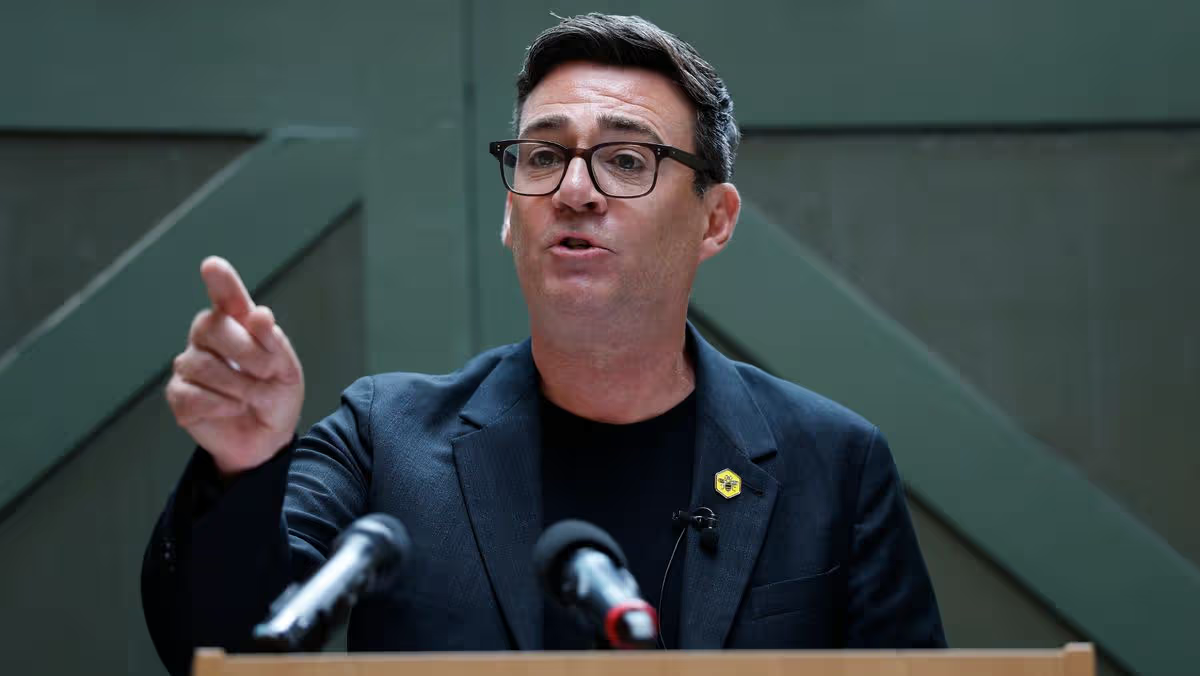
MP for Makerfield, Andy Burnham, delivers a speech at The People's History Museum

Andy Burnham delivered his first major speech since Sir Keir Starmer announced his resignation(Image: Getty Images)

Andy Burnham’s pledges to create a number 10 North and to create ‘good growth in every British postcode’ have been welcomed by business leaders in the North and across the UK.

Mr Burnham is expected to become the UK’s next Prime Minister after his victory in the Makerfield by-election, and today in Manchester gave his first speech outlining his plans for office. He promised to create the “biggest rebalancing of power our country has seen”, creating a ‘Number 10’ in the North based in Manchester to help shift decision-making from Whitehall.

Advertisement

Mr Burnham also promised support for business, including making sure that Whitehall backs British companies. He said: “For too long, UK public procurement policy has been based on chasing cut-price deals around the world rather than helping our own British-based suppliers become more stable and competitive.

“No more. From here on, every pound raised from taxpayers will work harder for them, and that approach will apply fully to the defence investment plan.”

Mr Burnham added he will “back our scientists, technologists, entrepreneurs and creatives”. He also committed to a house-building programme and to a “complete rethink” on education. He said he rejected the “trickle-down model” and added: “We will create a more streamlined state with a clearer purpose to power up all parts of the country and put a laser-like focus on growth and regeneration, good growth.”

Henri Murison, chief executive of the Northern Powerhouse Partnership, said: “Today Andy Burnham has made a bold commitment to further devolution. From giving places the tools to tackle economic inactivity to devolving post-16 skills, our verdict on these proposals are that they would help reduce the rising costs of welfare and the ill-health that places increasing pressure on the NHS.

Advertisement

“Alongside investment in infrastructure to drive productivity, raise wages and increase tax revenues, they would help turn the structural fiscal deficits seen across many parts of the North into surpluses that can be reinvested in future regional growth.

“We should all want a more united country. The Greater South East will benefit from greater freedom to raise the investment it needs, while, over time, having a reduced responsibility to subsidise other parts of the country as other regional economies become stronger.

“‘No.10 North’ will help ensure that the relocation of civil servants to places such as Darlington, York and Manchester delivers its full potential. These new government offices are helping regenerate those places, but Ministers themselves have not yet made effective use of them. A regular ministerial presence outside Whitehall would strengthen decision-making and bring government closer to the communities it serves.”

Shevaun Haviland, director-general of the British Chambers of Commerce said: “Firms need consistency, clarity and stability from policymakers, if business confidence is to be improved.

Advertisement

“Businesses will judge Andy Burnham’s plans on whether they deliver the boost to investment, productivity and trade desperately needed to unlock growth. As our recent report outlined, government must always ask whether policy passes a ‘growth delivery test’ to encourage firms to invest and grow.

Shevaun Haviland, Director General British Chambers of Commerce, pictured during the British Chambers Commerce Annual Global conference in June 2022.

Shevaun Haviland, director-general of the British Chambers of Commerce

“It’s crucial that the devolution agenda has local business at its heart and brings benefits to all parts of the UK.

“Our Chamber network completely understands how national ambition can be translated into local economic growth. We’ve long argued that more decisions affecting local economies, including transport, skills and infrastructure, should be taken closer to the communities they serve.

“Successful Chamber-led Local Skills Improvement Plans across England show the power of devolution to help address the challenges facing our economy. Creating greater parity between academic and technical qualifications is something business wholeheartedly supports.

Advertisement

“A pledge to improve the public procurement system is welcome, but it must quickly bring benefits to SME supply chains across the UK.

“Fiscal devolution must see money spent in the right way, to boost local growth. It must not mean further costs on business. BCC analysis shows government-imposed costs on SMEs have risen by more than 70% in just 10 years. New local business taxes and visitor levies would stifle economic growth.

“The difficult truth is, whoever leads the UK, the primary challenge remains the same – delivering growth. Business stands ready to work in partnership with any new Prime Minister to focus on that crucial task.”

Jane Gaston, CEO of Net Zero North West, said: “It’s encouraging to see a renewed focus on reindustrialisation, place-based growth and giving regions a stronger voice in shaping the UK’s economic future. Those principles closely reflect the approach we’ve been championing across the North West for many years.

Advertisement

“Our recent Why Industry Matters report highlighted that the North West contributes £270.8 billion to the UK economy, generates £68.5 billion in exports and supports 337,000 manufacturing jobs. The region is already one of the UK’s most significant industrial economies and has a critical role to play in safeguarding sovereign capability, strengthening energy security and delivering the clean energy transition.

“We welcome the ambition behind proposals such as a ‘Number 10 North’ and the recognition that industrial strategy must be built around places. However, any national plan for reindustrialisation must fully recognise the North West’s industrial strengths alongside other key regions. The North West is home to globally significant manufacturing, chemicals, advanced engineering and energy clusters that are fundamental to the UK’s future competitiveness.

“We also welcome the emphasis on strengthening UK supply chains and creating greater social value through public procurement. Combined with long-term policy certainty, investment in skills and infrastructure, and a genuinely joined-up approach to energy and industrial policy, these are the foundations needed to unlock sustainable growth across the whole country.

Mayor of the West Midlands, Richard Parker (left) greets MP for Makerfield, Andy Burnham, as he arrives at The People's History Museum

Mayor of the West Midlands, Richard Parker (left) greets MP for Makerfield, Andy Burnham, as he arrives at The People’s History Museum(Image: Getty Images)

“The vision is encouraging. The next step is ensuring it is backed by a clear delivery plan that fully harnesses the strengths of regions like the North West, where the capability, expertise and partnerships to deliver long-term industrial growth already exist.”

Advertisement

Wayne Jones OBE, chair of Greater Manchester Chamber of Commerce, said: “It was good to hear Andy Burnham put greater devolution of power to the regions at the heart of his speech. As Mayor of Greater Manchester, he has seen first-hand what can be achieved when regions are given control over areas such as public transport.

“For far too long power in this country has been centralised in London with little thought about the needs of individual regions. Having regional mayors has been a step in the right direction but more power needs to be devolved for the regions to achieve their full potential.

“As it seems likely Andy Burnham will become Prime Minister unopposed next month, this speech is our first real indication of what he will do when he is in power. We hope he will stick to what he has set out in his speech and devolution doesn’t get lost among all the other issues that will face him when he gets into Downing Street. It is encouraging that he talked about setting up a ‘No 10 North’ which should help to keep government focused on what needs to be done across the North.”

Subrahmaniam Krishnan-Harihara, director of business policy and research at the chamber, added: “Andy Burnham’s first major leadership speech today sets out an ambitious, long-term vision to ‘lift Britain back up’ through a 10-year mission focused on raising living standards. Greater Manchester Chamber of Commerce welcomes the emphasis on sustained economic renewal rather than short-term fixes, and the clear recognition that the current centralised model has left too many parts of the country behind.

Advertisement

“Mr Burnham’s call for the biggest transfer of power out of Whitehall in modern times, delivered through greater devolution to regions and local leaders, is a positive step. Empowering mayors and combined authorities to drive ‘good growth in every postcode’, with a proposed ‘No 10 North’ in Manchester, could help tailor solutions to local needs and rebalance the economy.

The new Chair of Greater Manchester Chamber of Commerce, Wayne Jones OBE

Chair of Greater Manchester Chamber of Commerce, Wayne Jones OBE(Image: Greater Manchester Chamber of Commerce)

“The emphasis on a partnership approach between government, business, universities and communities echoes what has worked in Greater Manchester and deserves support. His use of the phrase ‘give Britain the circuit breaker it needs’ appears to signal a decisive reset: a break from the cycle of over-centralisation, uneven growth and declining public trust in politics. It’s framed as a structural intervention rather than a short pause, aimed at changing how the country is governed to deliver better outcomes.

“That said, while the speech rightly highlights reindustrialisation, infrastructure, housing and utilities reform, it was notably light on the immediate pressures facing businesses, especially SMEs. There was no direct reference to the rising cost of employment, inflationary pressures coming from geopolitical events or the ongoing challenge of business rates, all of which remain significant burdens for smaller firms.

“Business was only mentioned at a high level in the context of the partnership model and procurement reform to support British industry and apprenticeships, but there was little granularity on how devolution or the 10-year plan would specifically ease costs, improve access to finance or reduce regulatory complexity for SMEs. The ambition and long-term framing are encouraging but the key test will be whether the new economic vision and promised devolution deliver practical, tangible support for small businesses on the ground, rather than remaining at the level of an ambitious strategy.”

Advertisement

Eva Barboni, executive director of Enterprise Britain, said: “There were signals in Andy Burnham’s speech that he recognises the critical role start-ups and scale-ups play in delivering a better future for Britain.

“We welcome his commitments to back Britain’s entrepreneurs, build clusters of innovation around our world-leading universities, and ensure that we capture the full value of British businesses.

“These commitments must be followed by a clear plan of action.

“Devolution alone will not automatically deliver growth. We need bold measures to unlock the capital British start-ups and scale-ups need to grow, ensure they can hire the right talent at the right time, and tear down the barriers that are holding ambitious businesses back.

Advertisement

Vanessa Hale, chief executive at Real Estate:UK, said: “The real estate sector has a critical role to play in boosting growth across the UK, working not only with national government, but also with newly empowered mayors and local leaders through genuine partnership working to deploy place-based funds, facilitate the development of industrial clusters, deliver the successful regeneration of places, and build new homes as part of a place-first, ‘good growth’ approach. With a stable and supportive policy framework, we can build the affordable and higher density homes that Andy Burnham says he wants.

“However, the full benefits of this will only be delivered if the same radical approach to reforming the role of government is also applied to how government works with the private sector, including full recognition of the challenges that the real estate industry faces, such as the viability crisis which has effectively stalled building activity across the country, that enhanced local and regional authorities need the extra resourcing to match the scale of their ambition, and an understanding that the need for stability is paramount for those seeking to make long-term investment into the UK.”

Michael Moore, chief executive at UK Private Capital, said: “We welcome Mr Burnham’s focus on public and private investment working hand in hand to make the UK an innovation nation. Private capital has a vital role to play in every nation and region of the UK, backing businesses, unlocking investment and helping local economies realise their full potential.

“By bringing decision-making closer to the communities it affects, and by strengthening partnerships between local leaders, businesses and private capital, investors such as our members can help more scale-up businesses and innovative spin-outs across the country grow and commercialise their ideas.

Advertisement

“Such focus on place-based collaboration and investment as a baseline for the UK economy presents a serious new opportunity for building a more dynamic and growing economy.”

Richard Caten, CEO at infrastructure consultancy Ardent, said: “It’s encouraging to see infrastructure and regional growth moving to the centre of the national conversation. The ambition to deliver ‘good growth in every postcode’ and strengthen decision-making outside Westminster is one the infrastructure sector will welcome.

“But ambition must now be matched by delivery. Unlocking sustainable economic growth depends on having a planning system that enables investment, meaningful engagement with communities from the outset, and the transport, energy and utility infrastructure needed to support new homes, businesses and jobs.

“Whether it’s through greater devolution or initiatives such as a ‘No 10 North’, success will ultimately be measured by how quickly projects can move from policy to delivery. If regions are given the powers, certainty and resources to bring forward critical infrastructure, they will be better placed to attract investment, unlock development and create long-term prosperity for communities across the UK.”

Advertisement

Cllr Louise Gittins, Chair of the Local Government Association, said: “Successive devolution agreements have demonstrated that devolving powers to local communities is the best way of unlocking the potential of people and their places, while boosting inclusive economic growth.

“It is now vital that the government steps up its ambition to deliver genuine devolution right across England, giving councils who know their communities the power to tackle long-standing local and national challenges, including driving infrastructure investment, plugging skills gaps, building more affordable housing and boosting productivity.

“By working together as equal partners across different levels of government, we can build prosperity and opportunity for our communities and businesses.”


Advertisement
Continue Reading
Click to comment

You must be logged in to post a comment Login

Leave a Reply

Business

Delta Air Lines Q2 Earnings Preview: Here Are The Real Long-Term Signals

Published

on

Delta Air Lines Q2 Earnings Preview: Here Are The Real Long-Term Signals

Delta Air Lines Q2 Earnings Preview: Here Are The Real Long-Term Signals

Continue Reading

Business

Form DEF 14A Nuveen Municipal Credit Income For: 30 June

Published

on


Form DEF 14A Nuveen Municipal Credit Income For: 30 June

Continue Reading

Business

Why European Bettors Are Choosing Verified Betting Sites

Published

on

In contemporary times, being recognized as a sports enthusiast often involves betting on one's favourite games. Studies indicate that most young adults have integrated bookmaker apps into their mobile phones.

There are several answers to that question. But in 2026, the trend is clear: security.

These days, punters are no longer just looking for competitive odds and attractive promotions; the security of their funds, operational transparency and user protection are factors that increasingly influence the final decision on where to place a bet.

But bear in mind that this trend is taking place against a backdrop of sustained industry growth. According to data from the European Gaming and Betting Association (EGBA) and H2 Gambling Capital, the European gambling market reached €123,400 million in gross revenue in 2024, recording year-on-year growth of 5 per cent. Furthermore, online gambling already accounts for 39 per cent of the total European market, and this percentage is expected to continue rising over the coming years.

So, how can you identify verified betting sites? This is a question many people ask themselves, given the large number of unlicensed online operators; many of them are blacklisted by the iGaming industry due to numerous user complaints about slow withdrawals, as well as a lack of customer support and responsible gambling tools.

For this reason, many users turn to specialist directories and independent comparison sites such as Bet Brothers before signing up. Verified European sports betting sites have become an essential tool for assessing licences, reputation, payment methods and terms of use. This way, you can enhance your betting experience and minimise the risks.

Advertisement

Verification and secure payment methods

The importance of regulation is also reflected across various European markets. For example, in Sweden, recent reports have warned that a significant proportion of betting continues to take place with unauthorised operators. According to data cited by various specialist media outlets, the proportion of betting channelled towards regulated operators stood between 69% and 82% during 2024, below the official target of 90%.

With this in mind, it is hardly surprising that several European Union countries, including Spain, have reopened the debate on the need to review and strengthen existing gambling laws and regulations.

Another factor driving the preference for verified bookmakers is the speed of deposits and withdrawals. And this is only possible through reliable payment methods that enable swift transactions. Many operators accept payments via bank cards, bank transfers, e-wallets, cryptocurrencies, etc.

Last but not least, we must mention promotions. Bettors have learnt that the best promotions do not always come from unknown operators. In fact, regulated bookmakers tend to offer transparent promotions, with clearly defined terms and conditions, even for exclusive events such as the 2026 World Cup.

Advertisement

As a result, limited-time Betting Deals in Europe attract the attention of thousands of users looking to maximise the value of their bets without compromising the security of their money or personal data. And this is only possible on verified betting sites.

Advertisement
Continue Reading

Business

Form PRE 14A Weatherford International PLC For: 30 June

Published

on


Form PRE 14A Weatherford International PLC For: 30 June

Continue Reading

Business

Form 424B5 Realty Income Corp For: 30 June

Published

on


Form 424B5 Realty Income Corp For: 30 June

Continue Reading

Business

Dole: Pricing Tailwinds And Discounted Valuation Create A Buying Opportunity

Published

on

Dole: Pricing Tailwinds And Discounted Valuation Create A Buying Opportunity

Dole: Pricing Tailwinds And Discounted Valuation Create A Buying Opportunity

Continue Reading

Business

Form 4 La-Z-Boy Inc For: 30 June

Published

on


Form 4 La-Z-Boy Inc For: 30 June

Continue Reading

Business

The Ultimate Guide to Latvian Citizenship by Descent

Published

on

The Ultimate Guide to Latvian Citizenship by Descent

Discovering where your ancestors came from can be an emotional journey, but it also has the power to change your practical daily life.

Many families who left Europe during the difficult years of the twentieth century passed down stories of their homeland to their children and grandchildren. For those with roots in Northern Europe, these stories can open the door to a valuable second passport. The Republic of Latvia provides a clear legal pathway for the descendants of its former citizens to recover their original nationality.

However, trying to understand foreign immigration laws can feel completely overwhelming. Many people get stuck trying to decipher old family timelines, dealing with confusing government rules, or worrying about whether they have to learn a difficult new language. If you have a parent, grandparent, or great-grandparent who lived in Latvia before the mid-1940s, you might already have a legal claim to a European passport. Securing your latvian citizenship by descent allows you to keep your current passport while gaining the freedom to live, work, and study anywhere in Europe. This comprehensive guide simplifies the legal rules, documentation requirements, and application steps so you can confidently reclaim your family heritage.

What Is Latvian Citizenship by Descent?

Latvian nationality law is based on a traditional legal principle called Jus Sanguinis, which simply means the right of blood. Under this framework, citizenship is passed down directly through family bloodlines rather than being determined by the country where you were born. The official rules are set by the national Citizenship Law, known in Latvia as Pilsonības likums, which protects the rights of the global diaspora to maintain their legal connection to the country.

The application process is treated as a formal restoration of nationality instead of a standard immigration application. Because you are reclaiming a status that historically belonged to your family, the government does not require you to move to Europe, pay local taxes, or give up your current nationality. The central authority in charge of reviewing these claims is the Office of Citizenship and Migration Affairs, which is commonly referred to as the PMLP. The officers at this department review historical records to verify that your ancestral lineage remains unbroken under international legal standards.

Advertisement

Determining Your Eligibility: Who Qualifies Under Latvian Law?

The legal system organizes ancestry claims into specific categories based on the exact dates and historical reasons your family left the country. To determine if you have a valid claim, you must look at your family tree and find out where your relatives were living during the interwar independence years. The foundation for every single claim is proving that your ancestor was a recognized citizen of Latvia on or before June 17, 1940.

The Forced Exile Pathway (1940–1990 Timeline)

The most common path to citizenship applies to descendants of individuals who were forced to leave their homes due to war and political danger. You qualify under the exile rules if your direct ancestor was a legal citizen on June 17, 1940, and fled the country between that date and May 4, 1990, to escape the devastating Soviet occupation or the Nazi regime.

This specific rule was created to support the global Latvian diaspora who lost their homes but kept their cultural identity alive overseas. If your parents or grandparents had to live in European displaced persons camps after World War II before settling in countries like the United States, Canada, the United Kingdom, or Australia, you likely fit this category. The law allows descendants of these exiles to register their citizenship easily without any requirement to drop their current passport.

Descendants of Pre-War Interwar Citizens

Not every family left the Baltic region because of the outbreak of war or subsequent geopolitical occupations. Some families chose to emigrate voluntarily during the peaceful interwar years between 1918 and 1940 for economic reasons, marriage, or new career opportunities. If your family left during this earlier peacetime window, you can still reclaim your legal rights based on the continuous historical existence of the state.

Advertisement

For this group of applicants, the process focuses heavily on showing that your relative maintained active citizenship before they boarded a ship or crossed the border. Because these families left voluntarily rather than fleeing as refugees, the government checks older civil registers and population surveys to ensure the citizenship was never formally given up under older international agreements.

Dual Nationality Regulations for European Union Citizens

Getting a second passport is a major benefit, but you always have to make sure that your home country allows you to hold two nationalities at the same time. The European Union framework values open borders and global mobility, and Latvia updated its national laws to match this modern reality. According to current regulations, Latvia fully permits dual citizenship for individuals who hold passports from specific approved countries.

These permitted countries include all twenty-seven member states of the European Union, EFTA countries, and NATO member states. This means if you are currently living and working in a country like Germany, Ireland, or France, you are legally allowed to hold both passports. You will never be asked to renounce your birth country’s passport during the application process or after your approval.

A Clear Look at Required Documents: Putting on Your Research Glasses

The single biggest reason applications get delayed or rejected is a lack of clear documentation. Since government workers in Riga cannot rely on family stories or memories, you need to put on your research glasses and collect physical, undeniable proof of your heritage. Your main goal is to build an unbroken chain of paper certificates connecting your current legal identity back to the original records of your ancestors.

Advertisement

Tracking down these old records can feel frustrating, especially if your family lost their original papers during their long migration journeys. Fortunately, historical data is safely stored across several public archives in Riga. If you are missing key files, you can request official research assistance from the Latvian State Historical Archives or the central Civil Registry Department, which hold millions of nineteenth and twentieth-century records.

Vital Records and Archival Evidence You Must Gather

To assemble a successful application dossier, you must collect official, certified documents for every single generation in your family line. A complete document package typically requires the following items:

  • Your current valid passport or state identification card.
  • Your official birth certificate displaying the full names of your parents.
  • Marriage certificates for yourself, your parents, and your grandparents to track any changes in family surnames.
  • The original pre-war passport, birth certificate, or military draft records of your qualifying ancestor.

If your family does not own any original papers from before the war, a certified archive extract issued directly by the state repositories in Riga can serve as a full legal replacement.

Navigating the Apostille Process and Official Translations

Any document issued by a government outside of Latvia must go through an official legalization process before the immigration department will accept it. Most international records are verified with an apostille stamp under the guidelines of the international Apostille Convention. However, there is a helpful rule that benefits applicants who live inside the European single market. Public documents issued by other European Union countries are usually exempt from the apostille requirement due to regional paperwork simplification laws.

After you collect and legalize all your family records, you must have them accompanied by a certified Latvian translation. These translations must meet the exact legal standards set by the official Cabinet of Ministers Regulations. Every single translation must feature a formal declaration from a professional translator, including their signature, stamp, and the exact date the work was completed.

Advertisement

Step-by-Step Application Guide with the PMLP

Once your documents are organized, checked for errors, and translated, you are ready to begin the formal submission process. All ancestry applications are routed to the main headquarters of the migration department in the capital city of Riga for a thorough legal review.

To get started, you must accurately fill out the official application forms. Adult applicants must use Form Number 21, which must be completed entirely in the Latvian language. You must sign the paperwork and attach your clear identification copies, your translated family certificates, and your confirmation receipt for the state processing fees.

If you are currently living inside the European Union, you can send your complete application package directly through the mail to the main office in Riga. Alternatively, you can book a personal appointment at the nearest embassy or consular office in your home country. If you want to check the specific document submission rules for your local region before scheduling a visit, you can visit De Civitate to access updated guidebooks and local tools.

The time it takes for the department to review your file depends on how complicated your family tree is and the category you apply under. For standard historical exile applications, the law states that officers should issue a decision within four months from the day they receive a complete file. If you are applying under the older pre-war citizen category, the deeper archival check means the review process can take up to one full year.

Advertisement

When the office grants your approval, they will send a formal notification to your address or email. The department then enters your details into the national population register and issues you a unique personal identity number. Once you have this number, you can visit any diplomatic mission to order your physical biometric passport and national identity card.

Overcoming Common Hurdles: Mismatched Names and Legal Rules

The most common problem that causes stress for applicants is finding spelling variations across different family documents. When families moved to new countries after the war, foreign border officials frequently misspelled, shortened, or changed traditional Baltic names to make them sound more familiar. For example, a traditional surname like Bērziņš was often changed to Berzins or altered entirely on immigration records in Western Europe.

If your family papers contain minor spelling differences, the reviewing officers can generally accept them as long as the birth dates and geographical locations line up perfectly. For major name changes, you will need to provide an official name change deed or a notarized statement proving that the different names belong to the exact same person. To stay updated on changing document rules and name policies, you can read the latest legal guides on https://latviancitizenship.eu/.

Another common worry for many applicants is whether they need to speak a new language to qualify. While standard immigrants must pass a difficult language and history exam to move to the country, the law gives a total exemption to individuals who claim their citizenship through direct ancestry or exile paths. You do not need to know how to speak, read, or write the language to successfully claim your passport.

Advertisement

Frequently Asked Questions About Latvian Ancestry Passports

Can I apply for Latvian citizenship through my grandparents?

Yes, you can. The legal framework allows you to trace your lineage back through multiple generations. You are eligible to apply if your parent, grandparent, or great-grandparent was a legal citizen of the country before June 17, 1940.

Does Latvia allow dual citizenship with all European Union countries?

Yes, it does. The modern updates to the national nationality laws explicitly permit dual citizenship with all twenty-seven member states of the European Union. This allows you to obtain your Baltic passport without putting your current nationality at risk.

Do I need to pass a Latvian language test to qualify?

No, you do not. Applicants who meet the qualifications through the direct ancestral descent pathway or the historical exile rules are fully exempt from all language and history examinations.

Can I pass citizenship to my children?

Yes, once your own citizenship is officially approved and registered, you can easily register your children as citizens, securing a permanent European heritage for the next generation.

Advertisement

Conclusion: Your Path to Restoring Your Baltic Heritage

Reclaiming your historical heritage is a deeply meaningful way to honor the challenges your ancestors faced while building a secure foundation for your family’s future. Gathering old certificates and dealing with government ministries takes patience, but the final reward is an official connection to your roots and a passport that grants you full living, working, and travel freedoms across the European continent.

By collecting your documents carefully and following the official steps, you can complete the process smoothly and reclaim your rightful place in the European community.

Advertisement
Continue Reading

Business

GoodBelly unveils functional smoothies

Published

on

GoodBelly unveils functional smoothies

The smoothies feature protein and probiotics and are free from dairy.

Continue Reading

Business

FAA proposes noise rules to lift ban on supersonic flights over US

Published

on

FAA proposes noise rules to lift ban on supersonic flights over US

The Department of Transportation on Tuesday announced that regulators are moving toward enabling civilian supersonic flights over the continental U.S., which have been banned for decades due to sonic booms.

The Federal Aviation Administration (FAA) proposed a rule that sets a noise-based certification standard for supersonic aircraft and signaled that it will propose another rule later this year covering landing and takeoff noise standards for supersonic aircraft.

Advertisement

Taken together, the FAA’s regulatory moves will give guidance to aircraft manufacturers so they can finalize designs and bring civilian aircraft capable of flying at supersonic speeds into service for travelers.

“Restoring supersonic flight over land isn’t just about speed, it’s about unleashing American innovation and ushering in a Golden Age of Travel,” said Transportation Secretary Sean Duffy.

FASTER-THAN-SOUND PASSENGER FLIGHTS COULD SOON RETURN TO US SKIES AFTER KEY HOUSE VOTE

Sean Duffy speaking

Transportation Secretary Sean Duffy announced the proposed rules to enable supersonic civilian flights over the U.S. (Reuters/Brian Snyder)

“Thanks to President Trump’s leadership, we are working at lightning speed to safely enable the next quantum leap in aviation technology and deliver an exciting new way to fly to the American flying public,” Duffy added.

Advertisement

The FAA is planning to finalize both rules by mid-2027.

Supersonic flights travel at speeds at or above Mach 1, flying at about 770 miles per hour or more. By contrast, commercial airliners generally fly between 550 and 600 miles per hour, giving supersonic aircraft a speed edge that can reduce travel times.

NASA ASTRONAUTS COULD SOON WEAR PRADA AS LUXURY LABEL UNVEILS NEW GEAR FOR ARTEMIS IV

control tower

The FAA aims to finalize the rules by mid-2027. (Justin Sullivan/Getty Images)

Civilian flights in the U.S. have been prohibited from operating at speeds above Mach 1 over land in the U.S. under an FAA rule meant to protect the public from the impact of sonic booms, which can present noise issues at ground-level and may damage windows.

Advertisement

Technological advancements have led to a new flight technique called Mach cutoff, which the FAA explained uses the aircraft design, atmospheric conditions, speed and altitude to work together to make the sonic boom bend and refract up into the atmosphere – significantly reducing the ground-level impact in the process.

US IS ‘AHEAD’ OF CHINA IN SUPERSONIC JET AIRCRAFT, SAYS BOOM SUPERSONIC CEO

A Concorde flight over Paris

The Concorde was a commercial airliner capable of supersonic flight, though it was phased out of service in 2003. (STF/AFP via Getty Images)

“Advances in aerospace engineering, materials science, noise reduction, and new operational concepts will eliminate the old sonic boom,” said FAA Administrator Bryan Bedford. “This means we can ultimately repeal the ban from the 1970s on supersonic flight over U.S. territory while minimizing noise impacts to residents in communities along the route and near airports.”

While the newly proposed regulations would apply to domestic supersonic flights, the FAA is also working with its regulatory counterparts from around the world to develop frameworks that could enable supersonic aircraft to serve international flights.

Advertisement

GET FOX BUSINESS ON THE GO BY CLICKING HERE

A year ago, President Donald Trump signed an executive order that called for the FAA to secure safety aviation agreements with foreign aviation regulators to allow for the safe international operation of supersonic aircraft.

Continue Reading

Trending

Copyright © 2025