

Crypto World
Can AI Drain DeFi? Checking Claims Behind Claude’s Hype


Anthropic’s announcement of its “Mythos” cybersecurity models has sparked a fresh round of debate in crypto: will advanced AI tools make decentralized finance easier to exploit, or will they simply accelerate the pace of defense? The discussion gained traction as Anthropic positioned Mythos-class systems for security-focused tasks and—according to the company—reported improvements in vulnerability research and exploit analysis compared with earlier iterations.
For DeFi investors, developers, and security teams, the underlying question matters less about hype and more about operational reality: can AI meaningfully shorten the gap between discovering weaknesses and turning them into working attacks? And just as importantly, can defenders use the same capability to identify issues earlier and patch faster?
Key takeaways
- Anthropic frames Claude Mythos as a cybersecurity-focused AI system aimed at tasks such as vulnerability research and layered security reasoning.
- AI can accelerate code review, but moving from “finding a vulnerability” to “stealing funds” still requires technical and operational execution attackers often must plan for.
- Current limits—including false positives and incorrect reasoning—mean expert oversight and process discipline remain central to DeFi security.
- Defensive teams and developers can also adopt AI-assisted testing, potentially raising baseline security standards across the sector.
- DeFi risk is uneven: smaller projects, fast launch cycles, reused code, and weak audit coverage tend to face higher exposure.
What Claude Mythos is intended to do
Claude Mythos is Anthropic’s most advanced AI system for cybersecurity tasks, designed differently from general-purpose assistants that simply explain concepts or generate code on request. Anthropic has described Mythos-class capabilities as oriented toward complex security workflows rather than broad chat-based usage.
While the company initially limited access instead of offering immediate broad distribution, Anthropic’s published materials emphasized measurable improvements in areas that matter to security teams—particularly vulnerability research and exploit analysis. The relevance for crypto is obvious: smart contract security depends on identifying flaws quickly in public codebases and evaluating how weaknesses might be leveraged in practice.
The most practical concern for DeFi is timeline compression. If AI helps reduce the time it takes to locate and reason through potential vulnerabilities, attackers could benefit by shifting from slow discovery to faster exploitation. But that same speed advantage could also shorten the defensive cycle—reviewing code, verifying assumptions, and preparing fixes before exposure becomes capitalized.
Why DeFi looks like an attractive target
DeFi security concerns aren’t new, and they don’t rely solely on technical complexity. DeFi protocols often custody large sums through smart contracts, which means a software issue can potentially become direct financial risk rather than a theoretical bug. The sector has repeatedly seen losses linked to a range of failure modes—exploits, flash-loan-style attacks, cross-chain issues, governance manipulation, and smart contract weaknesses.
Two factors make these environments particularly sensitive. First, smart contract code is frequently public, which is good for transparency and security research but also gives attackers the same information defenders get. Second, many DeFi systems are young or rapidly evolving, and even audited protocols can still contain gaps or assumptions that don’t hold under changing conditions.
In that context, AI tools that can triage large repositories, summarize complex systems, and suggest likely attack paths can be seen as a force multiplier. If a model can sift through patterns and reason about potential exploit routes faster than traditional manual review, attackers may be able to scale their efforts beyond what small teams could previously accomplish.
AI can help, but it doesn’t guarantee profitable attacks
Even if AI can identify vulnerabilities efficiently, the path to successful exploitation is not a straight line. Many real-world crypto attacks require more than recognizing a weakness—they depend on understanding protocol mechanics, coordinating transaction sequences, managing liquidity dynamics, working through governance pathways, and minimizing the chance of detection.
Anthropic’s own research materials and broader cybersecurity experience point to a key operational reality: AI systems can be useful while still producing errors. In practice, AI-driven analysis may surface multiple possible issues, not all of which are valid or exploitable. That means defenders should still assume that automated tools will generate noise alongside value, and teams will need to verify findings rather than treat model output as final truth.
For DeFi users, this distinction matters. A vulnerability that appears in a report does not automatically translate into drained funds. Attackers may also face constraints—capital requirements, timing, or dependencies across contracts—that AI can’t remove. Likewise, defenders who can act quickly on high-confidence findings may blunt the window in which attackers can convert theory into execution.
Where AI could strengthen DeFi security
Another reason the “AI will only weaken DeFi” narrative doesn’t fully hold is that defensive teams have access to similar tools. Security firms can integrate AI-assisted review into their workflows, and developers can use AI to augment code checks. Bug hunters may also be able to widen coverage and speed up pre-release scrutiny, potentially catching classes of issues earlier than traditional processes alone would allow.
That opens a more balanced scenario: AI becomes a normal part of secure development rather than an edge only attackers possess. In this framing, the decisive variable becomes not whether AI exists on the offensive side, but how quickly teams can incorporate AI-backed analysis into deployment pipelines and how effectively they respond once issues are detected.
It’s also worth noting that major crypto incidents have sometimes been driven by factors unrelated to smart contract code—such as compromised private keys, social engineering, or governance manipulation. AI improvements in code review won’t eliminate those risks, but they may reduce one category of exposure by tightening how contract logic is assessed.
DeFi builder priorities in an AI-accelerated world
For protocol teams, the clearest lesson is to assume that automated vulnerability research is becoming easier to run. That doesn’t mean every weakness will be instantly exploited, but it does mean security expectations should rise. Teams should focus on shortening the time between identifying a potential issue and shipping a fix—because in a faster ecosystem, delays can matter as much as prevention.
Actionable priorities highlighted by this shift include expanding automated security testing, running continuous audits rather than one-off reviews, and integrating AI-assisted code analysis into development workflows. Many teams are also likely to benefit from improving threat monitoring and incident response readiness, since faster detection and triage can reduce the real-world impact of whatever vulnerabilities do slip through.
Risk also isn’t evenly distributed across DeFi. The protocols most exposed are often those with limited security resources, rushed deployment schedules, heavy reuse of existing code, weak third-party audit coverage, or legacy smart contract designs that rely on assumptions no longer aligned with current exploit techniques. For these teams, AI-assisted analysis could lower barriers—but it also raises the bar they must meet to keep up.
A shift in standards, not a guaranteed breakdown
Mythos—and the broader trend of cybersecurity-focused AI—signals a major change in how quickly complex security tasks can be tackled. Still, the idea that DeFi is headed for unavoidable collapse overlooks practical constraints: discovering a flaw doesn’t ensure exploitation, AI analysis remains imperfect, and defenders can adapt as attackers do. The more likely outcome is an evolution in security standards, with faster vulnerability discovery and more pressure on teams to update code and respond in shorter timeframes.
What readers should watch next is how protocol teams operationalize AI-assisted security—whether audits become continuous, how response timelines improve, and whether the sector closes gaps faster than attackers can exploit them.
Anthropic’s Mythos preview research and coverage of Anthropic’s cybersecurity model capabilities informed the discussion of how Mythos performs on security-related tasks. Additional context on Mythos-related reporting appears in Reuters.

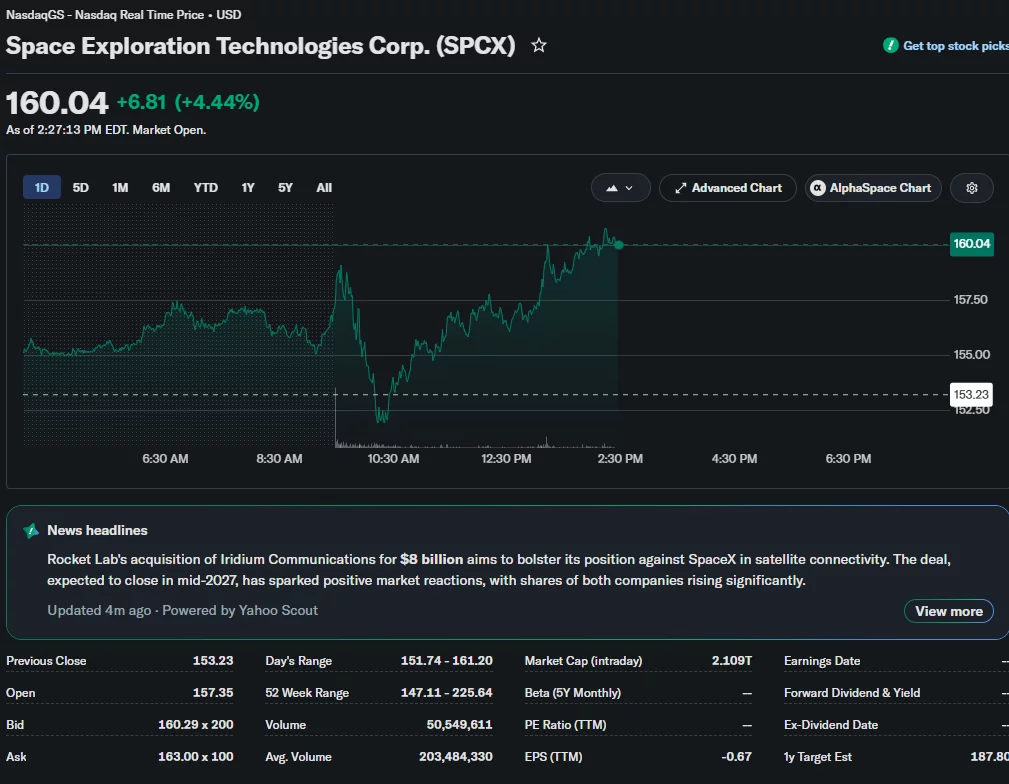
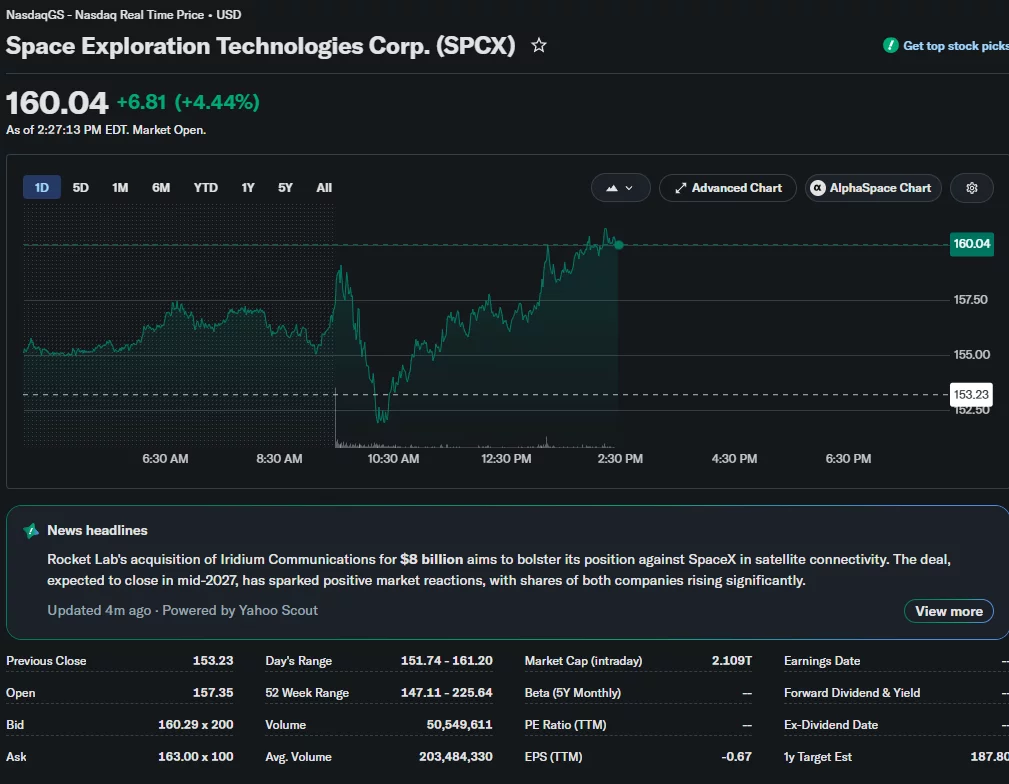
SpaceX stock has climbed nearly 4.5% to around $161 on Monday ahead of its expected Nasdaq-100 entry, even as Citadel Securities has warned that mounting risks could slow the AI-driven market rally.
Summary
- SpaceX stock climbed nearly 4% ahead of its expected Nasdaq-100 inclusion on July 7.
- Citadel Securities warned that higher interest rates could challenge the ongoing AI-driven market rally.
- ARK Invest added $7.01 million in SpaceX shares as Allianz raised concerns over the firm’s debt offering.
According to market data, SpaceX (SPCX) shares were trading near $160 at the time of writing after gaining 4.4% during the session. The advance comes days before the company is expected to join the Nasdaq-100 Index on July 7, a move that investors believe could attract billions of dollars in passive fund inflows.
Nasdaq-100 inclusion has strengthened demand expectations
With the index addition approaching, investors have continued building positions in the stock. Passive funds and exchange-traded funds that track the Nasdaq-100 are expected to purchase SpaceX shares once the company joins the benchmark.
Market estimates suggest the inclusion could generate almost $4 billion in passive buying, increasing liquidity and institutional ownership. Alongside the Nasdaq-100 addition, SpaceX has already secured a place in the Russell 1000 Index, although it remains ineligible for the S&P 500 because the index requires newly qualified companies to wait 12 months before being considered.
Institutional investors have also continued adding exposure. Last week, Cathie Wood’s ARK Invest bought 45,728 SpaceX shares valued at about $7.01 million across its ARKK, ARK Autonomous Technology & Robotics ETF (ARKQ), ARKW, and ARK Space Exploration & Innovation ETF (ARKX).
Citadel has cautioned that AI stocks could face new pressure
Despite the strong momentum in SpaceX shares, a Bloomberg report citing Citadel Securities said investors may be underestimating how committed Federal Reserve officials remain to bringing inflation under control.
According to the report, interest rates staying higher for longer could weigh on high-growth companies and other risk-sensitive assets. The trading firm’s assessment has also added to concerns in cryptocurrency markets, where digital assets have remained under selling pressure over recent weeks.
Bloomberg also reported that Citadel Securities expects the AI-led rally to encounter additional challenges from softer demand, weaker investment returns, and rising political and regulatory scrutiny.
The report did not identify SpaceX as facing those issues directly, but investors are assessing whether a slowdown across AI-related companies could eventually influence sentiment toward the stock.
Separate concerns have also emerged around the company’s financing strategy. As reported by crypto.news earlier, Allianz Chief Investment Officer Ludovic Subran said SpaceX’s enlarged debt offering may indicate that financial markets are showing signs of bubble-like conditions. He argued companies are taking advantage of elevated equity valuations and favorable borrowing conditions to raise additional capital.
The comments followed earlier reports that SpaceX was preparing a larger bond sale, a development that has attracted attention even as investor demand for the company’s shares continues to strengthen ahead of next week’s Nasdaq-100 inclusion.
GWEI, VELVET, and DEXE rank among the strongest altcoins to watch as the first week of July opens. GWEI surged roughly 50% in 24 hours, VELVET added about 275% in seven days, and DEXE gained near 40%.
Each token shows a clean technical setup heading into July. Breakout structures, defended support levels, and momentum signals point to possible continuation. Still, stretched indicators warn that volatility could cut both ways.
GWEI Price Eyes $0.24 After Breaking Two Key Levels
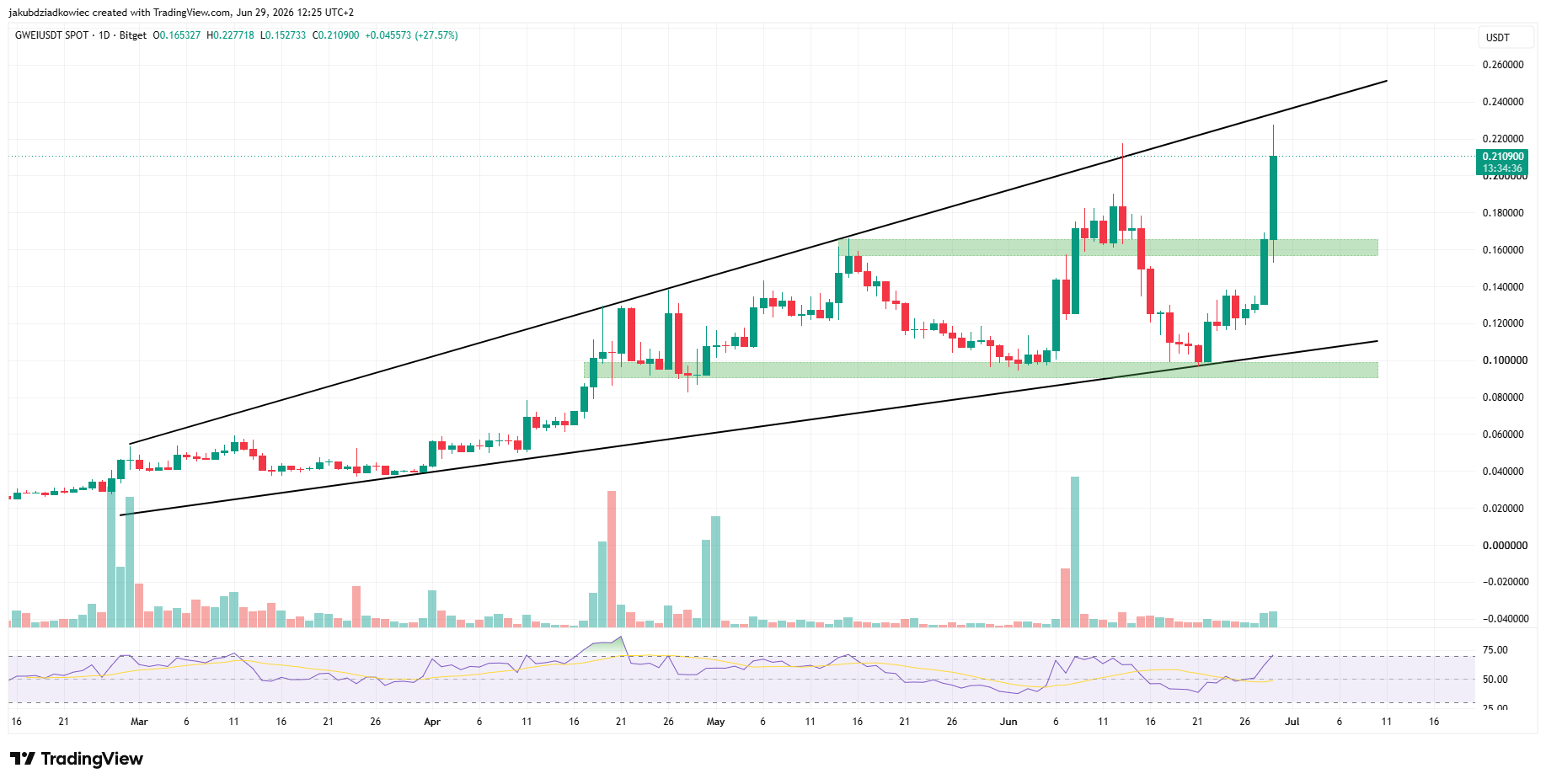
ETHGas (GWEI) trades near $0.21 after a sharp move higher. The token climbed roughly 50% over the past 24 hours.
On the daily chart, GWEI trends higher inside a broadening, or megaphone, pattern. Price recently cleared two important levels.
The $0.10 and $0.16 zones now act as support after serving as resistance. That flip strengthens the bullish structure.

GWEI now targets the upper band of the pattern near $0.24. A daily close back below $0.16 would weaken the case.
The Relative Strength Index (RSI) has pushed back above 70 into bullish territory. The move also tries to negate a developing bearish divergence. GWEI joins other altcoins drawing trader attention this summer.
VELVET Price Holds $0.60 Support Below $2 Resistance
Velvet (VELVET) trades near $1.67 after a strong run. The token added about 275% over the past seven days.
The daily chart shows two strong expansion moves to higher prices. Resistance now sits just below $2.00.
VELVET printed an all-time high near $2.07 this week before easing back. The $2 area now caps further upside.

A new support has formed at $0.60. That level acted as resistance between June 13 and June 25.
The RSI shows a first sign of bearish divergence. However, the indicator remains in bullish territory for now. VELVET stays among the week’s top gainers.
Altcoins to Watch: DEXE Price Targets $30 After Cup-and-Handle Breakout
DeXe (DEXE) trades near $21.78 and shows the most mature setup here. The token gained about 40% over the past seven days.
On the weekly chart, DEXE broke out of a cup-and-handle formation (purple). Price now follows the pattern’s projected path higher.
DEXE is trying to close above the resistance near $24, its highest level in years. A weekly close above it would confirm strength.

The first target sits near $30, which aligns with the 1.272 Fibonacci extension. A second target sits near $38 at the 1.618 extension.
Volume has been contracting during the move. That pattern often signals exhaustion before a fresh volatility expansion. DEXE recently exploded 70% in a short squeeze, and earlier analysis flagged building positioning.
All three altcoins show breakout momentum heading into July. Still, stretched indicators and thin volume mean traders should weigh the risk of sharp reversals.
The post 3 Altcoins to Watch in the First Week of July appeared first on BeInCrypto.


Institutional demand for perpetual futures remains limited, with the products largely viewed as speculative trading instruments rather than viable replacements for traditional derivatives, according to a Monday report by Wall Street bank JPMorgan.
Based on conversations with clients and market participants, the bank said institutional interest in perpetuals has been muted. While the contracts offer 24/7 trading and eliminate futures roll costs, most activity is driven by traders seeking leveraged directional exposure rather than producers, consumers or other participants hedging underlying market risk.
“Our due diligence within J.P. Morgan suggests that there is no/limited institutional demand that our desks are seeing,” the bank’s analysts said in the Monday report
“The consensus opinion seems to be that perps activity is more akin to speculative use cases by traders versus hedging by producers/consumers or those players with real exposure to the underlying,” the analysts added.
The report argued that perpetuals offer few incremental benefits over legacy derivatives for institutional investors. On-chain perpetuals are unlikely to appeal to U.S. institutions because they lack traditional clearing protections, while off-chain products reduce roll risk but retain other structural drawbacks.
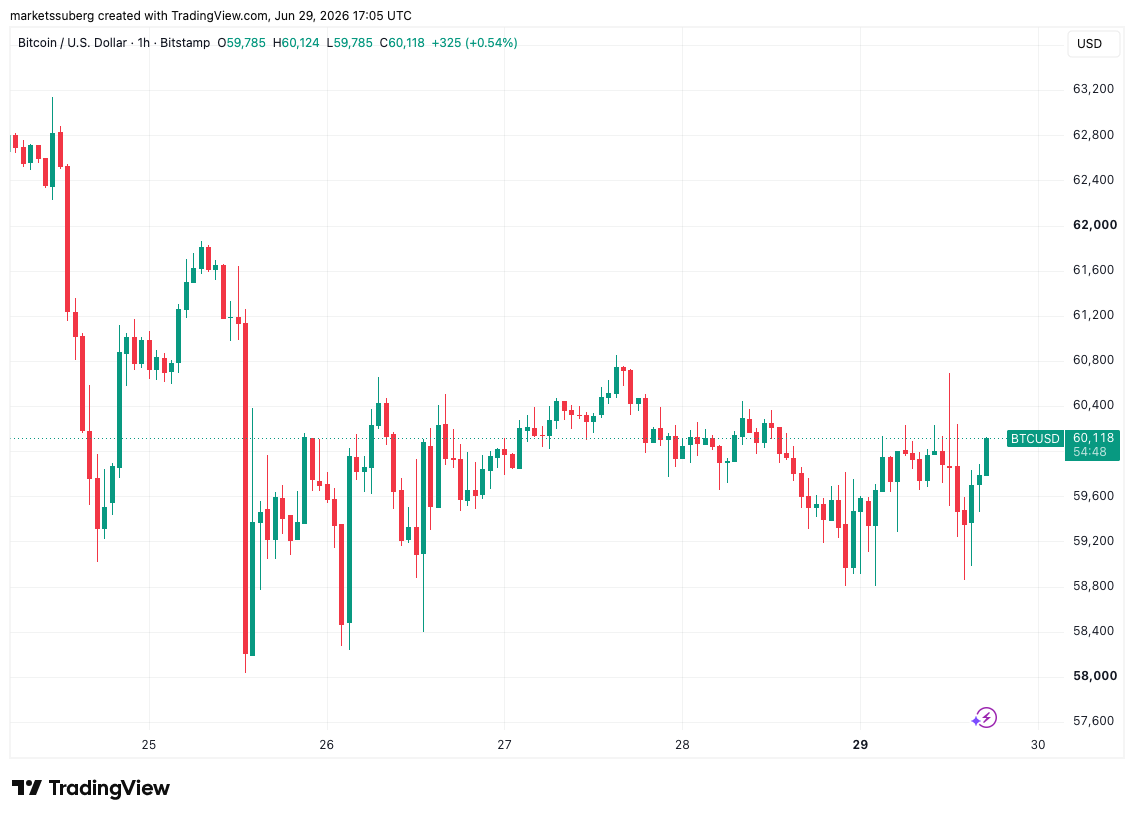
Bitcoin (BTC) struggled near $60,000 around Monday’s Wall Street open as bulls increasingly risked a support/resistance flip.
Key points:
- Bitcoin bulls face an uphill struggle to flip $60,000 back to support, even as US stocks see fresh upside.
- Iran peace hopes fuel a more positive risk-asset mood, but analysis says that Bitcoin buyers “lack conviction.”
- Market participants are “defensive” around current price action.
US-Iran meeting announcement sends stocks higher
Data from TradingView showed an ongoing battle to regain control of $60,000, with BTC price strength again failing to keep pace with US stocks.
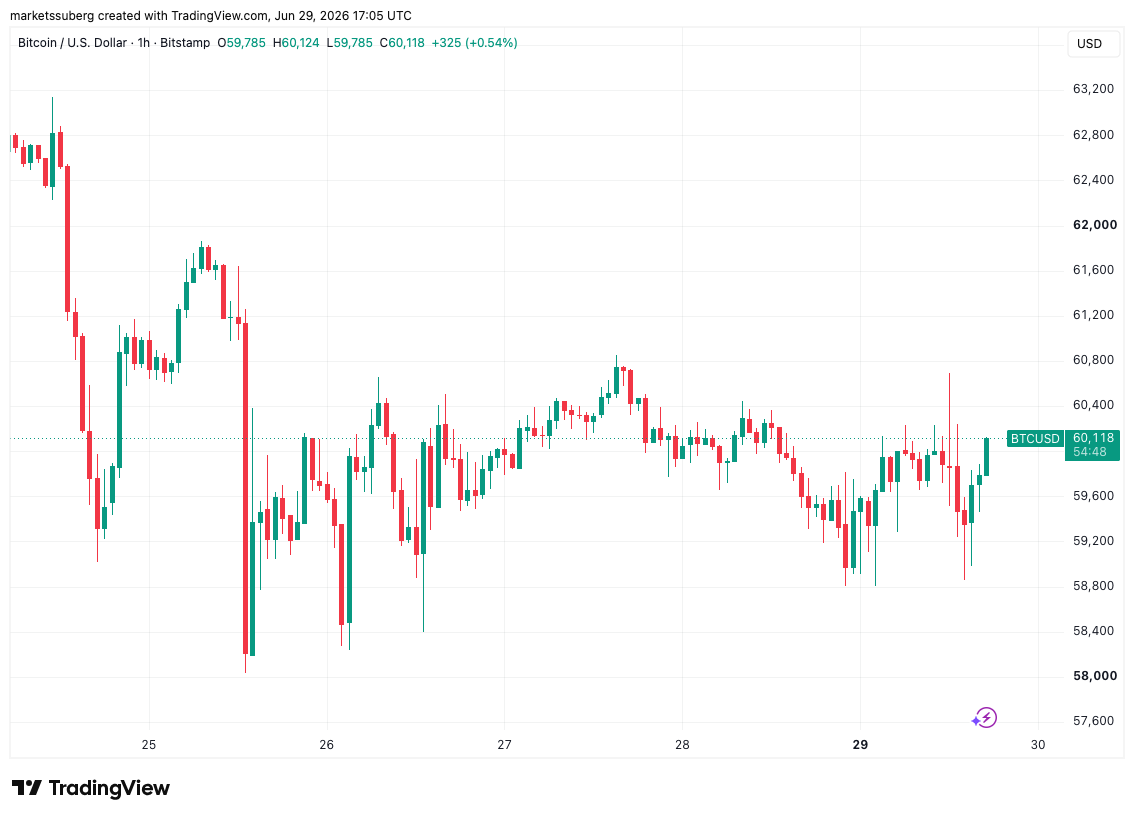
BTC/USD one-hour chart. Source: Cointelegraph/TradingView
The S&P 500 and Nasdaq Composite Index both started the week in the green amid renewed optimism of rescuing the US-Iran peace deal.
In a post on Truth Social, US President Donald Trump wrote that Iran had “requested a meeting,” which would take place in Doha, United Arab Emirates, on Tuesday.
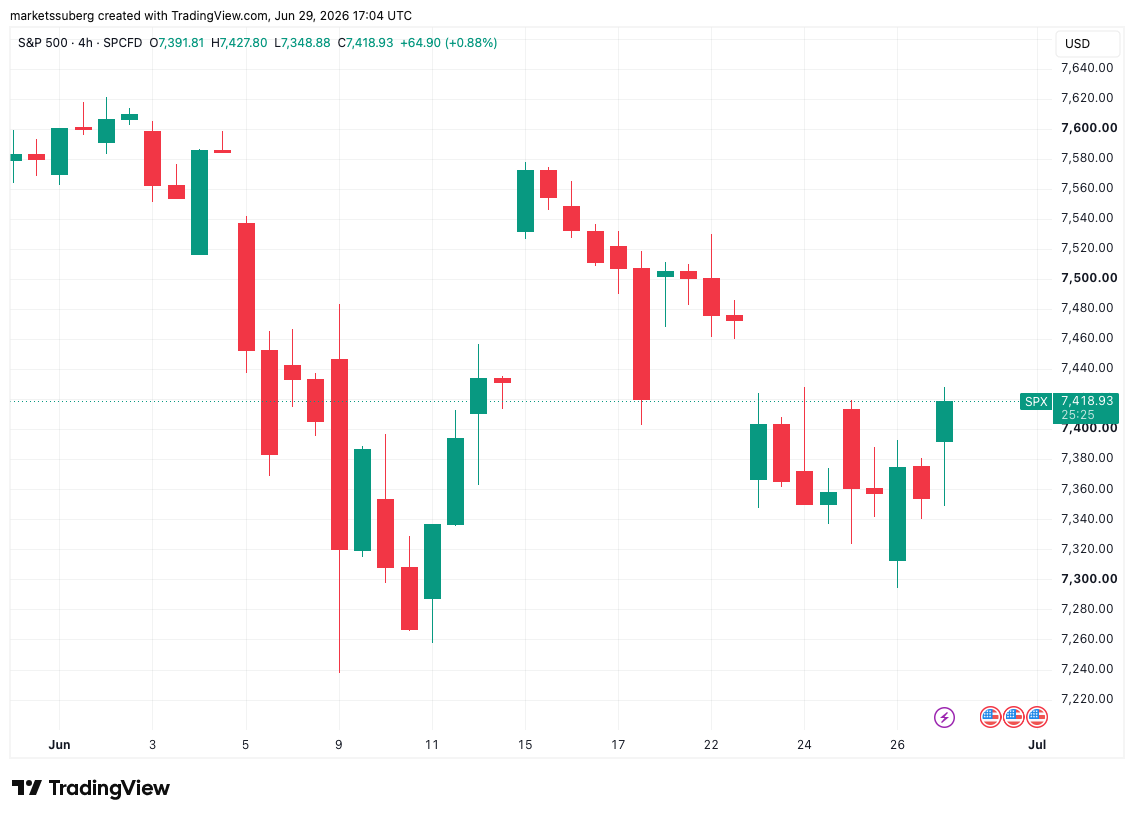
S&P 500 four-hour chart. Source: Cointelegraph/TradingView
Commenting on the latest events, trading company QCP Capital nonetheless cautioned over the potential for oil prices to rebound — a key potential headwind for crypto.
“While both countries appear to have agreed to stand down for now, the situation remains uncertain. That said, oil prices have remained largely stable in the low $70s, suggesting cautious optimism that tensions may ease,” it wrote in its latest Market Color analysis.
“However, this relatively muted market reaction also leaves significant upside risk for oil prices should supply recovery prove slower than expected.”
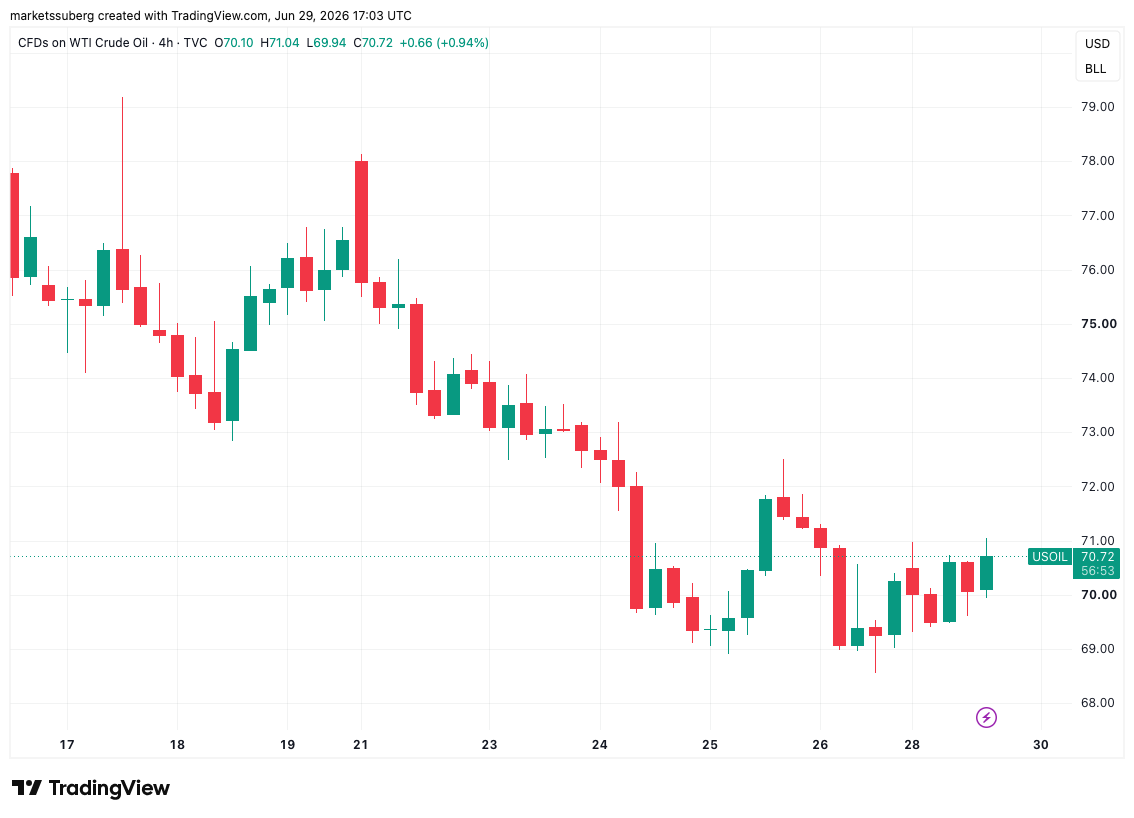
CFDs on WTI crude oil four-hour chart. Source: Cointelegraph/TradingView
On Friday, WTI crude fell below $68 per barrel for the first time since early March, but was back above the $70 mark at the time of writing.
“U.S. markets are also set to be closed on Friday, while the situation between the U.S. and Iran remains fluid, leaving volatility likely to stay elevated, partly driven by thinner liquidity conditions, similar to what we saw over the past weekend,” QCP added.
Bitcoin needs more “conviction” from buyers
Bitcoin market participants thus sat on the sidelines as “choppy” price moves defined low-time-frame market action.
Related: BTC price RSI prints key 2026 signal: Five things to know in Bitcoin this week
“Chopping around in this range at the previous June lows. The ~$60K region keeps capping price as we have some marginally higher low wicks below,” trader Daan Crypto Trades wrote in his latest X analysis.
“The longer price spends moving around in this region, the bigger the following move upon a range break will be. Eyes on $58K & $61K.”
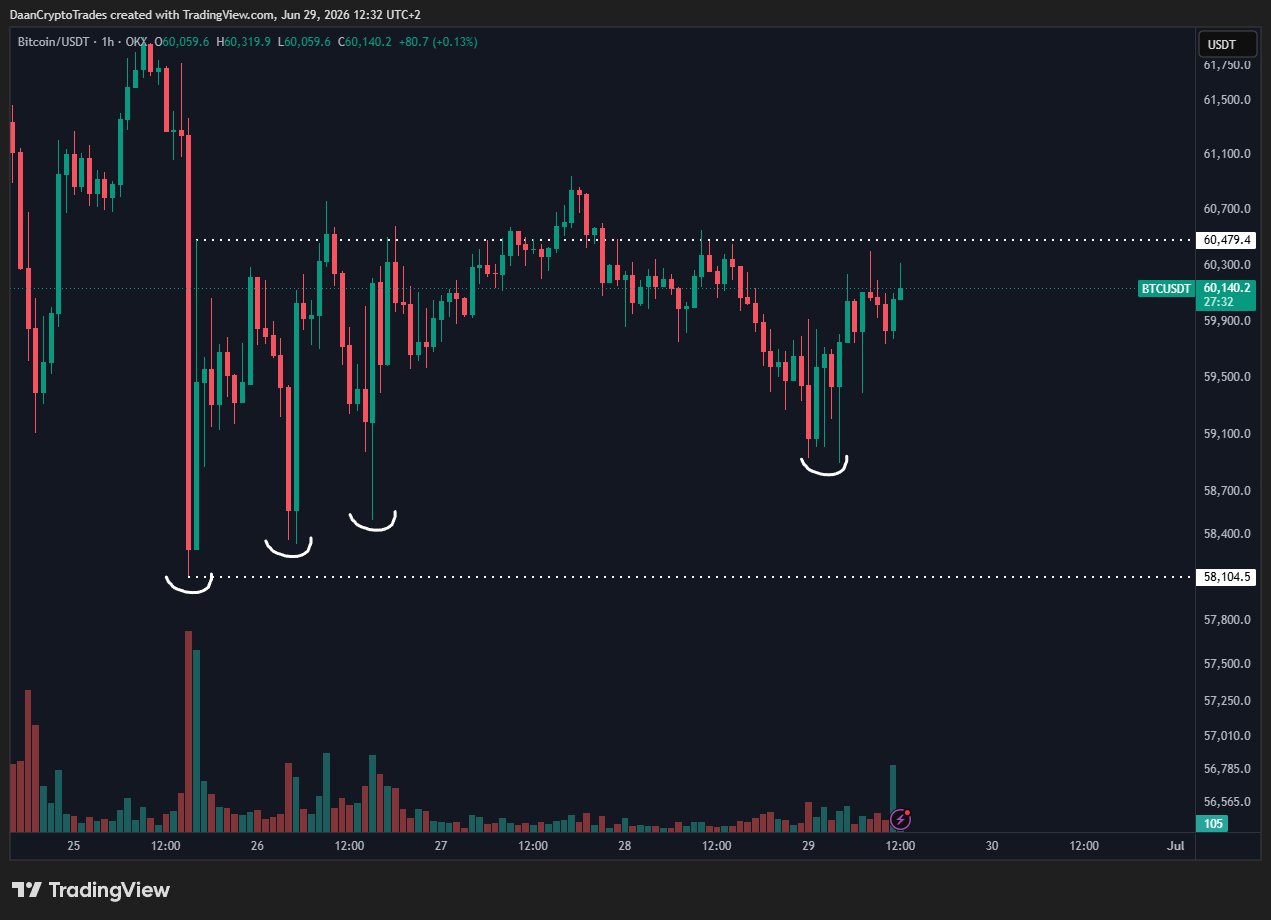
BTC/USDT one-hour chart. Source: Daan Crypto Trades/X
In its latest Market Pulse bulletin, onchain analytics platform Glassnode said that buyers “have so far lacked the conviction required to establish a sustained recovery, leaving price range-bound near local lows.”
“Beneath the surface, the market remains in a phase of structural adjustment as capital continues to contract and participants adopt a more defensive posture,” it reported.
“Spot markets are still experiencing persistent net selling despite an increase in trading activity, suggesting that available liquidity is being used primarily to distribute rather than accumulate Bitcoin at current prices.”
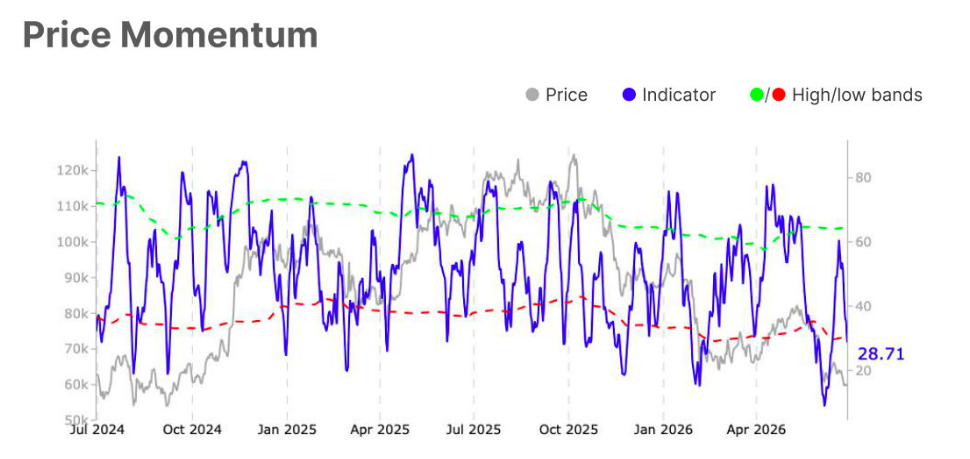
Bitcoin price momentum data (screenshot). Source: Glassnode
While noting “more balanced” onchain data, Glassnode added that a shift toward supply ownership by more speculative investors increased the potential for price volatility.
“Taken together, Bitcoin appears to be stabilizing around the $60K region, but with spot order flow, derivatives positioning, and institutional demand all remaining defensive, a sustained recovery is likely to require a meaningful return of buyer conviction,” it concluded.
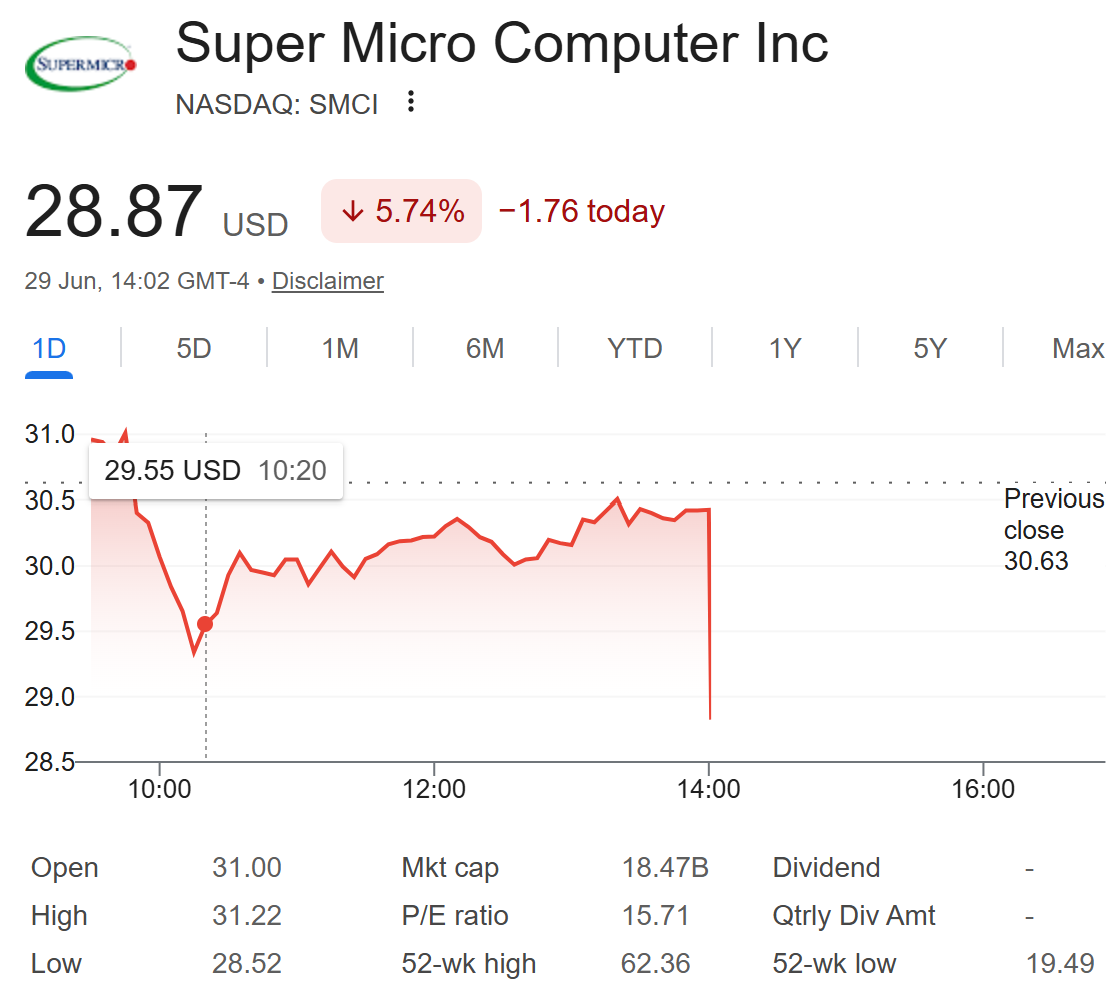
Super Micro Computer Inc.’s Taiwan office was raided Monday as authorities expanded their investigation into alleged smuggling of Nvidia AI chips into China using the company’s servers.
SMCI shares fell sharply on the news. Taiwan’s Keelung District Prosecutors Office searched the residences of six individuals and premises of three affiliated companies, including Super Micro’s local operations. Prosecutors also summoned individuals for interviews.

Targeted Companies Confirm Searches
Distributor Albatron Technology confirmed it was searched in a regulatory filing and reported no material financial or operational impact. Data center operator Chief Telecom was also among the sites visited.
Follow us on X to get the latest news as it happens
Building on Prior Action
Bloomberg reported the Monday operation, which extends May 2026 raids by the same office, covering 12 locations and leading to the seizure of approximately 50 high-end Super Micro servers containing restricted Nvidia chips. Those actions targeted document falsification related to exports.
Super Micro has previously stated it is cooperating with Taiwanese authorities and was not charged as a company in earlier phases of the probe. The company did not immediately respond to requests for comment on the latest developments.
U.S. Controls Drive Regional Enforcement
The case reflects sustained U.S. pressure to restrict advanced AI semiconductors to China over national security concerns. Taiwan, a critical hub for semiconductor manufacturing and server assembly, does not yet treat AI chip exports to China as a standalone crime.
Authorities currently rely on laws covering document falsification. Taipei is actively considering legislation to criminalize such exports directly, which would provide stronger enforcement tools.
What’s Next
The latest raids highlight tightening scrutiny on downstream distribution in the AI supply chain. Further updates from prosecutors or Super Micro could clarify scope and potential charges.
For investors, the developments add to compliance risks even as demand for AI servers remains strong. SMCI’s stock reaction shows how regulatory headlines continue to influence sentiment in the sector.
The post Taiwan Raid Hits Super Micro Office, Slamming SMCI Shares appeared first on BeInCrypto.
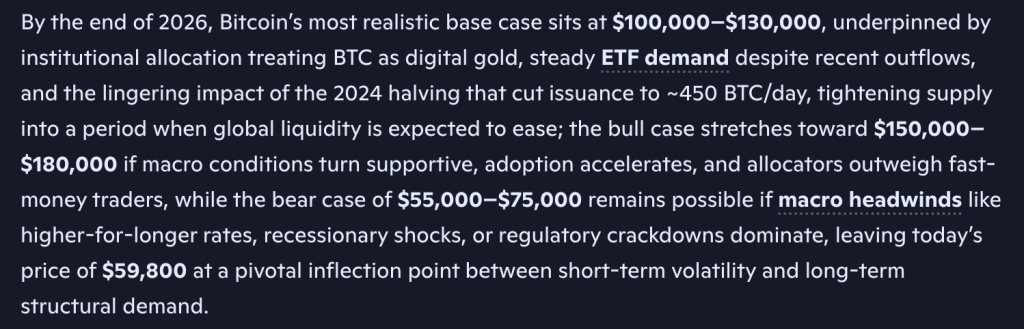
Microsoft Copilot AI just laid out a full spectrum view on Bitcoin price prediction that frames today’s price as standing at a genuine fork in the road. The model predicts a realistic base case of $100,000 to $130,000 by the end of 2026, with a bull case stretching to $150,000 to $180,000 if the right conditions line up.
The bull case leans on a few durable forces rather than a single short term spark. Bitcoin trades near $59,800 today, and the model frames that as a pivotal inflection point between near term volatility and long term structural demand.
Institutional allocation continues treating bitcoin as digital gold, a framing that has only grown stronger as more traditional capital looks for an inflation resistant store of value.
ETF demand remains steady even through recent outflows, which suggests the underlying buyer base has not actually walked away despite choppy headlines.

The lingering impact of the 2024 halving still matters too, since issuance dropped to roughly 450 BTC per day, tightening supply right as global liquidity is expected to ease going forward.
If macro conditions turn genuinely supportive, adoption accelerates faster than expected, and longer term allocators end up outweighing fast money traders chasing short term swings, the model sees that combination stretching price toward the $150,000 to $180,000 range.
The bear case is just as plausible given where things stand today. If macro headwinds like higher for longer interest rates, a recessionary shock, or fresh regulatory crackdowns end up dominating the landscape instead, the model sees bitcoin staying contained in a $55,000 to $75,000 range for an extended period.
That would mean a much longer wait for the structural bull case to play out, with price essentially churning sideways while those headwinds resolve one way or another.

Don’t Miss Out on Our $1,000 USDT Airdrop on ByBit
Bitcoin Price Prediction: BTC Stands At The Exact Fork Copilot Is Describing
The daily chart shows Bitcoin at $59,887 after a long decline from highs near $128,000 set back in October. That drop has been a grinding, persistent downtrend, broken up by a relief rally into May that topped out close to $83,000 before rolling over into the current stretch of weakness.
Price has spent the last several weeks consolidating in the high $50,000s to low $60,000s, which lines up almost exactly with the $59,800 level called out as the pivotal point in this prediction.
That kind of tight, extended consolidation right at a psychologically important number often signals a market waiting for its next real catalyst rather than committing in either direction.
Immediate resistance sits near $64,000, a level price has tested and failed at multiple times recently, with a much heavier ceiling further up near $76,000 where the May rally eventually lost steam.
Support holds in the $58,000 to $59,000 zone, the same area price is currently testing on this very candle. The broader structure remains a clear downtrend stretching back to October, with lower highs and lower lows defining nearly the entire move.
Momentum on the daily candles looks tired rather than decisive, with small, choppy candles clustering near the lows instead of showing strong directional conviction either way.
Given how directly current price lines up with the inflection point in this prediction, the next decisive break above $64,000 or below $58,000 looks like the signal that determines which half of this base to bull range actually starts to play out.
Discover: The Best Token Presales
You Might Like What Copilot AI Predicts About LiquidChain
The rotation is already happening. Most people will only see it in hindsight.
Large-cap crypto is not failing. It is capped. Bitcoin, Ethereum, and XRP have been pressing against the same resistance bands for weeks. The macro tailwinds keep getting delayed.
The institutional inflows keep getting pushed to next quarter. Holding assets where the upside depends on catalysts you cannot control is not a strategy. It is waiting.
A capital that has navigated enough cycles does not wait at resistance. It moves before the destination becomes obvious.
Early-stage infrastructure plays operate on different math entirely. A small enough market cap means a modest rotation produces dramatic price movement. The asymmetry exists because the market has not priced in what is being built yet. That gap between current valuation and what the project is actually worth is where the returns come from.
Multi-chain fragmentation costs DeFi real money every single day. Bitcoin, Ethereum, and Solana run completely isolated liquidity systems with no native way to connect them. Every user moving value between ecosystems absorbs that cost directly in fees, slippage, and failed transactions.
LiquidChain collapses all 3 networks into a single execution layer. One deployment. Full ecosystem access. No cross-chain tax on every interaction.
The market has not found this yet. That is the entire point.
The presale is at $0.01454 with just over $840,000 raised. Ground floor is not a marketing phrase here. It is a description of where this actually sits in its lifecycle.
Execution is unproven. Adoption is unknown. Those risks are real and worth naming directly. Established assets offer a smoother ride toward a ceiling that is already visible. This offers an earlier seat at a table that has not been set yet.
Explore the LiquidChain Presale
The post Microsoft Copilot AI Predicts Incredible Bitcoin Price by End of 2026 appeared first on Cryptonews.
Crypto World
Tom Lee blames bitcoin, ether weakness on quarter-end rebalancing as Bitmine (BMNR) buys $43M ETH

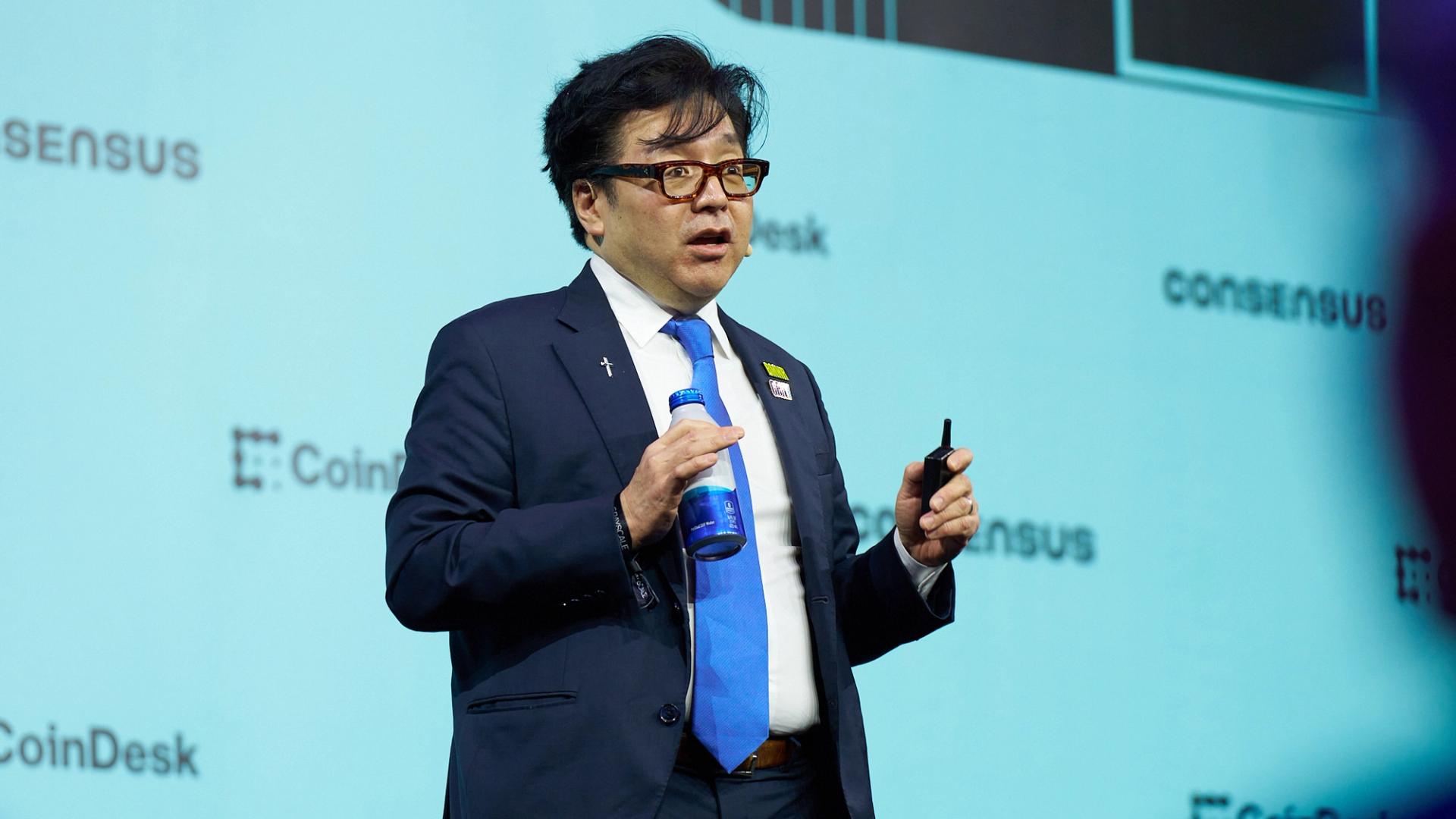
Bitmine Immersion Technologies (BMNR), the largest Ethereum treasury company, bought 27,084 ether (ETH) last week, extending its accumulation streak despite another slide in crypto prices.
The purchase, worth roughly $43 million based on ETH’s current price of around $1,580, lifted Bitmine’s holdings to 5.7 million ETH, according to a Monday company update. The stash is worth about $8.9 billion and represents roughly 4.7% of Ethereum’s circulating supply, nearing the firm’s 5% goal.
The company also held 206 bitcoin, $555 million in cash and marketable securities and stakes in Beast Industries and Eightco Holdings, bringing total crypto, cash and investment holdings to $9.8 billion.
The latest acquisition was the smallest purchase since early May, down from 52,203 ETH the previous week and well below the 126,971 ETH batch earlier this month, suggesting the company is dialing back its buying pace after months of aggressive accumulation. Bitmine nevertheless remains one of the few large digital asset treasury firms still consistently adding to its crypto holdings while many peers have paused purchases amid the market downturn.
Crypto weakness
Chairman Thomas “Tom” Lee pointed to quarter-end rebalancing behind the latest bout of weakness in crypto markets with investors cutting their losses as we enter the second-half of the year.


Prediction-market operators have increasingly moved to own more of their trading infrastructure, setting the stage for an acquisition wave across crypto exchanges, sportsbooks, brokerages and trading venues, according to Bernstein.
Summary
- Bernstein expects prediction markets to enter an acquisition phase as platforms consolidate trading infrastructure.
- Robinhood, Coinbase, DraftKings and Cboe are expanding in-house prediction market capabilities.
- Bernstein warns regulatory disputes between federal and state authorities could slow industry consolidation.
According to a research report published by Bernstein on Monday, the sector is entering a period of operational consolidation as consumer-facing platforms bring together distribution, brokerage, exchange and clearing functions under one roof instead of relying on outside providers.
The analysts wrote that “every consumer platform that matters has merged the front and back end of the prediction-market stack,” arguing that businesses once separated across financial trading, crypto and sports betting are now competing within the same market.
Consumer platforms are taking control of trading infrastructure
Recent product launches and acquisitions illustrate the trend outlined by Bernstein. Robinhood now routes major FIFA World Cup prediction contracts through Rothera, the exchange it jointly owns with Susquehanna, while DraftKings has introduced DKeX and redirected trading volume away from infrastructure supplied by CME and Crypto.com.
Coinbase has also expanded its presence by acquiring The Clearing Company and launching its own event contracts, a move Bernstein cited as another example of platforms assembling every part of the prediction-market business.
Instead of paying third parties for execution, clearing or exchange services, companies that own the full trading stack can keep more of the fees generated by customer activity. Bernstein said acquisitions may therefore become the fastest way for platforms to obtain licenses, reach new users or add missing infrastructure rather than building those capabilities internally.
Outside the crypto sector, traditional financial exchanges have also begun entering the market. Last week, Cboe Global Markets introduced Cboe Predicts, launching binary option contracts tied to the Mini-S&P 500 Index (XSP). Cboe said the products operate as security options under the existing U.S. regulatory framework for listed options, allowing traders to take yes-or-no positions on where the index finishes.
Large technology companies are also exploring the space. Meta has reportedly assembled a team to develop Arena, a prediction-market application expected to compete with platforms including Polymarket and Kalshi. According to reports, Arena will rely on a points-based system similar to video games instead of real-money wagering.
Regulatory disputes could slow dealmaking
While Bernstein sees economic incentives for consolidation, the firm warned that regulation remains one of the biggest obstacles to larger transactions.
The report said combinations involving crypto exchanges, brokerages, sportsbooks and derivatives venues could improve profitability by reducing dependence on external providers.
At the same time, Bernstein cautioned that such deals may attract antitrust scrutiny while intensifying debate over whether sports event contracts should be treated as financial derivatives or gambling products.
Regulatory disagreements are already emerging across the U.S. Bernstein noted that Minnesota has enacted what the Commodity Futures Trading Commission described as the first outright ban on prediction markets, while Illinois has passed legislation requiring platforms to obtain a state license before offering sports event contracts.
Kalshi has challenged both measures, arguing that exchanges regulated by the CFTC fall under the agency’s exclusive jurisdiction rather than state gambling authorities.
According to Bernstein, the commercial logic behind consolidation remains intact, but many of the largest acquisitions may prove difficult to complete until courts and regulators establish where federal derivatives oversight ends and state gambling regulation begins.


Pump.fun, the Solana-based memecoin launchpad that has generated more than $1.1 billion in lifetime fees, has repurchased over $400 million of its PUMP token, with the running total crossing that mark in recent days, according to the company's onchain dashboard. The tracker showed cumulative… Read the full story at The Defiant


Ethena said its yield-generating “synthetic dollar” token will be integrated into BlackRock’s (BLK) Aladdin risk management platform as the crypto protocol is deepening its relationship with traditional finance firms.
The Monday announcement sent Ethena’s governance token ENA (ENA) up about 8% on the day as investors welcomed another high-profile institutional partnership.
Aladdin is BlackRock’s portfolio construction and risk management platform used by banks, insurers, pension funds and asset managers overseeing more than $20 trillion in combined assets.
Ethena also said BlackRock’s tokenized money market fund, BUIDL, will serve as the primary reserve asset for a forthcoming white-label product.
The firms also unveiled a $100 million liquidity facility that will allow eligible holders of BlackRock’s tokenized Treasury fund, BUIDL, to exchange their holdings for USDC, USDtb and other supported stablecoins outside traditional market hours, and convert those assets back into BUIDL.
“We believe stablecoins and tokenized real-world assets to be inextricably linked,” Robert Mitchnick, BlackRock’s head of digital assets, said in a statement. “This liquidity facility enables a level of frictionless interoperability that is core to the unique utility that tokenizing treasury funds makes possible.”

SpaceX stock jumps as Citadel flags growing risks to AI rally

Britain’s heatwave response was straight from the Covid playbook

What to Expect as Enzo Maresca Takes Over as Manchester City Boss


-
 Sports6 days ago
Two goals and an assist by sheer aura: Cristiano Ronaldo just entered the World Cup chat
-

 Fashion3 days ago
Weekend Open Thread: Staud – Corporette.com
-

 Politics4 days ago
The House | Manchesterism won’t survive the painful trade-offs unless it gets citizens on board
-

 Politics4 days ago
Potential 2028er World Cup attendee leaderboard
-

 News Videos1 day ago
MAJOR BITCOIN & MARKET UPDATE!!!! (MUST WATCH ASAP!!!)
-

 Business3 days ago
Asia stock markets slide as tech shares slump
-

 Tech4 days ago
A Look At A Gaggle Of Transputer Boards
-
Crypto World6 days ago
Bitcoin (BTC) Dips Below $62K, Ethereum (ETH) Plunges 6% Daily: Market Watch
-
 Crypto World4 days ago
Dell (DELL) Shares Tumble Over 5% Following Analyst Downgrade to Hold
-

 Crypto World2 days ago
Coinbase, Circle Deepen Crypto Stock Losses Despite Resilient S&P 500
-

 Crypto World6 days ago
Securitize Wraps Roubini's SEC-Registered ETF as Dubai VARA Digital Security
-
Business6 days ago
Entergy settles forward sale agreements, raises $672 million in cash proceeds
-

 Crypto World3 days ago
Kraken's xStocks Opens Bending Spoons IPO Registration to EEA Retail
-

 Sports3 days ago
FIH Pro League: India defeat Pakistan 7-1, register biggest win of campaign | Other Sports News
-

 Tech2 days ago
Russian hackers now target Signal backup recovery keys
-

 Crypto World3 days ago
RTX holders must register wallets before token distribution begins
-

 Tech2 days ago
Bluekit phishing kit adopts browser-in-the-middle for login theft
-
 Crypto World3 days ago
Hyperliquid Named on Singapore MAS Investor Alert Register
-

 Crypto World4 days ago
Bitcoin Sparks $600M Hourly Liquidations With $65,000 Set To Become Resistance
-
 Crypto World4 days ago
AAVE price tests 9-month trendline after 17% rebound as breakout hopes build
You must be logged in to post a comment Login