FOX Business Madison Alworth reports on NYC Democrats’ proposed tax that could hammer luxury condo owners with massive annual surcharges and rattle the city’s real estate market.
Luxury retailer Saks Global on Friday announced it will operate with a new name after it exited bankruptcy after cutting its store count and reducing its debt obligations.
The company – which is the parent of notable retail brands including Saks Fifth Avenue, Neiman Marcus and Bergdorf Goodman – will operate under the new name Exemplar Luxury Group (ELG) and will focus on luxury retail.
Advertisement
“Moving forward as Exemplar Luxury Group reflects the shared ideals that anchor each of our banners and our commitment to setting the standard of excellence for luxury retail across all three,” said CEO Geoffroy van Raemdonck.
“As the gateway to the U.S. luxury customer, we are uniting coveted brands with unrivaled customer experiences to drive growth for Exemplar Luxury Group and the broader luxury ecosystem,” he added.
Saks Global is rebranding as Exemplar Luxury Group after its bankruptcy and restructuring. (Mike Segar/Reuters)
The company said that the restructuring it underwent in the bankruptcy process allowed it to eliminate 75% of previous debt, while the process also wiped out its equity and reduced its store count.
Advertisement
It exited bankruptcy with 49 stores after closing 62 of its off-price locations, including 57 of its Saks OFF 5th and all five Neiman Marcus Last Call stores.
The company also closed 12 Saks Fifth Avenue stores in March, as well as three Neiman Marcus locations. It had entered bankruptcy with 33 Saks Fifth Avenue locations.
The rebranded firm is the parent of brands including Neiman Marcus. (Noam Galai/Getty Images)
During the restructuring, Saks Global ended its partnership with Amazon to sell its products on the e-commerce platform during the restructuring after facing pushback from luxury brands about selling on a mass-market site.
Advertisement
Saks Global’s $2.7 billion merger with Neiman Marcus in 2024, which was orchestrated by the company’s former CEO, was designed to create a luxury powerhouse but burdened Saks with debt when global luxury sales were slowing – a dynamic which complicated an already difficult turnaround.
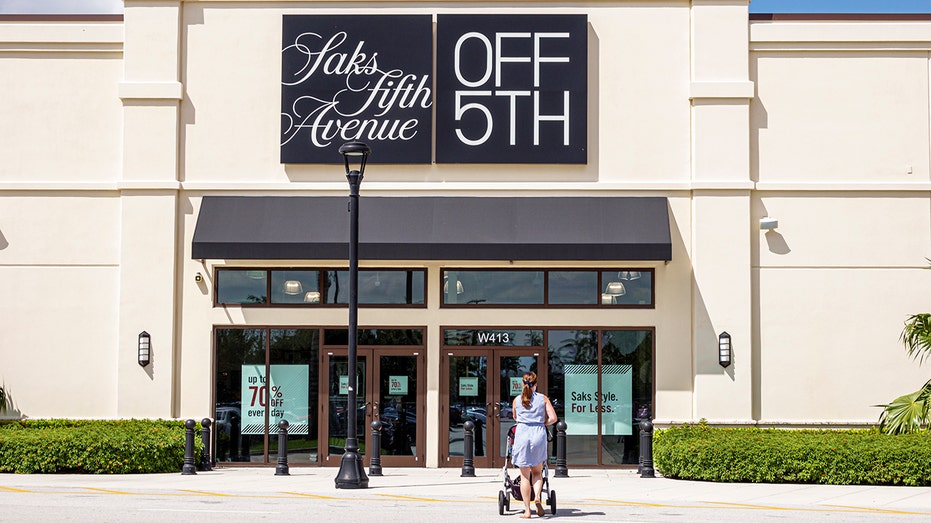
The restructuring saw the parent company close off-price locations like Saks OFF 5th. (Jeff Greenberg/Education Images/Universal Images Group via Getty Images)
After it struggled with weak sales for over a year as its debt mounted, Saks filed for bankruptcy in January with $3.4 billion in debt, including over $337 million owed to critical suppliers like Chanel and Kering, the owner of Gucci.
The company received approval for a $1 billion bankruptcy loan in February and planned to use $600 million of that financing to cover vendor payments.
ELG’s new board will include two representatives each from investment firms Pentwater Capital Management and Bracebridge Capital that partnered with the company during the restructuring process.
Budget airline easyJet has launched a new route from Cornwall Airport to London Gatwick days after announcing plans for its first international flights from Newquay.
The carrier’s summer route to the capital took off last week and will operate twice weekly on Tuesdays and Saturdays throughout the summer season.
Advertisement
It comes two months after airline Skybus abruptly cancelled its future flights between Cornwall and London due to rising fuel costs. Skybus took over the route last year under a Passenger Service Obligation (PSO) contract jointly funded by the government and the council after previous operator Eastern collapsed into administration.
But after the service was cancelled in April, it left only Ryanair’s Newquay to Stanstead route.
EasyJet launched its first Cornwall to London Gatwick flight on June 23. Nigel Scott, commercial director at Cornwall Airport Newquay, said it was “fantastic” to see the new service “take to the skies”.
“[The route will strengthen] our London connectivity during the busy summer season and give local passengers greater choice while making it even easier for visitors to experience everything Cornwall has to offer,” he said.
Advertisement
He also described the launch of easyJet’s first international route from the airport – to Geneva in Switzerland – as a “real milestone” for the transport hub.
“Demand for direct ski access from the region is high, and the new Geneva service provides an affordable and convenient way for travellers to land on the doorstep of some of Europe’s best resorts,” he added.
The new winter route from Newquay to Geneva will operate once a week on Saturdays from January 16, 2027, until February 27, 2027, providing a connection for travellers from Cornwall and the surrounding areas to the Alps during the ski season, with dates including February half term.
Kevin Doyle, easyJet UK country manager, said: “We are delighted to have launched our summer route between London Gatwick and Newquay, and to be putting our first international service from the region on sale, with our winter route to Geneva.
Advertisement
“Together they offer customers greater regional connectivity and access to Europe and beyond through our leading short-haul network, while continuing to support Cornwall’s important visitor economy.”
Fares for London Gatwick start from £43.99, with flights to Geneva starting from £37.99.
NEW YORK — Shares of Booking Holdings Inc advanced modestly Monday, reflecting continued investor confidence in the online travel company’s diversified platform and resilient consumer demand for leisure and business travel experiences.
The stock gained about 0.7% to around $182.77 in afternoon trading, adding to recent performance as Booking Holdings benefits from its global reach and multiple booking brands amid a normalizing post-pandemic travel environment.
Booking Holdings operates a portfolio of leading travel platforms including Booking.com, Priceline, Agoda, Rentalcars.com and KAYAK. The company’s comprehensive offerings span hotels, flights, car rentals, vacation rentals and attractions, serving customers worldwide.
Recent quarterly results showed robust gross bookings growth and improving profitability metrics. Management highlighted strong demand across regions, with particular strength in international travel recovery and domestic leisure segments.
Advertisement
The company’s direct booking model and loyalty programs drive customer retention and higher lifetime value. Booking Holdings has invested in personalized recommendations and seamless user experiences to compete in a crowded digital travel marketplace.
Monday’s share movement occurred without major company-specific news, suggesting continuation of positive sentiment from recent operational updates and broader consumer discretionary sector stability. Booking Holdings shares have demonstrated resilience as travel demand normalizes.
Analysts maintain generally favorable views on Booking Holdings, citing its network effects, brand portfolio and pricing power in the online travel agency space. Some highlight potential for margin expansion as marketing efficiency improves.
Booking Holdings’ global scale provides diversification across geographies and travel segments. The company serves both leisure travelers seeking value and business customers requiring flexible options.
Advertisement
Innovation remains central to Booking Holdings’ strategy. The company continues enhancing its mobile apps, artificial intelligence-powered search features and sustainability tools to meet evolving consumer expectations.
The travel industry has recovered strongly from pandemic lows, though challenges including inflation, geopolitical tensions and labor shortages persist in certain markets. Booking Holdings’ platform model allows flexibility in responding to demand shifts.
Monday’s trading reflected measured activity in consumer discretionary names. Booking Holdings’ performance aligns with sector trends as investors assess summer travel booking patterns.
The company’s Genius loyalty program and subscription offerings aim to increase customer stickiness and lifetime value. These initiatives complement core commission-based revenue from bookings.
Advertisement
International markets contribute significantly to Booking Holdings’ growth. Platforms like Agoda cater to Asian travelers while Booking.com maintains strong European presence.
The company has invested in alternative accommodations including vacation rentals and homestays, expanding beyond traditional hotels. This diversification captures shifting preferences toward unique travel experiences.
Booking Holdings faces competition from other online travel agencies and direct supplier websites. Its multi-brand strategy and global reach provide competitive advantages in customer acquisition and conversion.
Monday’s gains contribute to Booking Holdings’ steady performance amid broader market movements. The stock reflects confidence in its business model and ability to generate cash through travel cycles.
Advertisement
The online travel sector benefits from secular shifts toward digital booking channels. Booking Holdings’ technology investments position it to capture market share as consumers increasingly research and book online.
Sustainability initiatives include tools for customers to choose lower-carbon travel options and partnerships with accommodations pursuing environmental certifications. These efforts respond to growing consumer awareness.
Booking Holdings maintains a disciplined approach to capital allocation, balancing investments in growth with shareholder returns. The company has executed share repurchases while managing debt levels.
As summer travel peaks in the Northern Hemisphere, Booking Holdings benefits from increased booking activity. Its platform provides comprehensive options for vacations, business trips and last-minute getaways.
Advertisement
Analyst commentary often emphasizes Booking Holdings’ ability to navigate economic cycles through its diversified revenue streams and global footprint. The company’s focus on user experience drives repeat business.
Monday’s session highlighted Booking Holdings’ relative stability within consumer discretionary names. Its platform business model supports consistent results across economic conditions.
The travel recovery has created opportunities for Booking Holdings to strengthen supplier relationships and expand inventory. Strong demand for international destinations has boosted cross-border bookings.
Booking Holdings continues exploring artificial intelligence applications for personalized travel planning and dynamic pricing. These technologies aim to enhance customer satisfaction and operational efficiency.
Advertisement
Investor attention centers on gross booking trends, conversion rates and marketing return on investment. Consistent execution on these metrics supports valuation in the competitive online travel space.
The company’s role in facilitating global travel connects millions of travelers with accommodations and experiences worldwide. Its platforms drive economic activity in tourism-dependent regions.
As Booking Holdings advances its strategy, focus remains on technology leadership, customer-centric innovation and sustainable growth. Its trajectory depends on successful navigation of competitive dynamics and economic variables.
Eli Lilly and Regeneron are among the first seven companies the U.S. Food and Drug Administration selected for a pilot program designed to accelerate reviews of new domestic pharmaceutical manufacturing facilities, CNBC has learned.
Lilly, Regeneron, Amneal, Cellares, Fujifilm Biotechnologies, Kriya Therapeutics and Kyowa Kirin are the first companies that will participate in the FDA’s PreCheck pilot program, according to FDA spokesperson Benjamin Nichols. The initiative will allow regulators to start reviewing new manufacturing facilities while they’re under construction to catch and correct any issues, which the FDA estimates could save companies up to 14 months.
Producing more drugs domestically has been a priority for the Trump administration. The initial recipients range from the most valuable healthcare company in the world to closely held biotechs developing gene therapies. The majority of them plan to make biologic drugs or genetic medicines, which involve more complex manufacturing than the pills most Americans know best.
Advertisement
To be eligible for the PreCheck program, companies needed to build a new manufacturing facility capable of making drugs that would address a market supply gap or improve access to therapies for unmet medical needs. Only drugs that rely on the facility will be covered by the program.
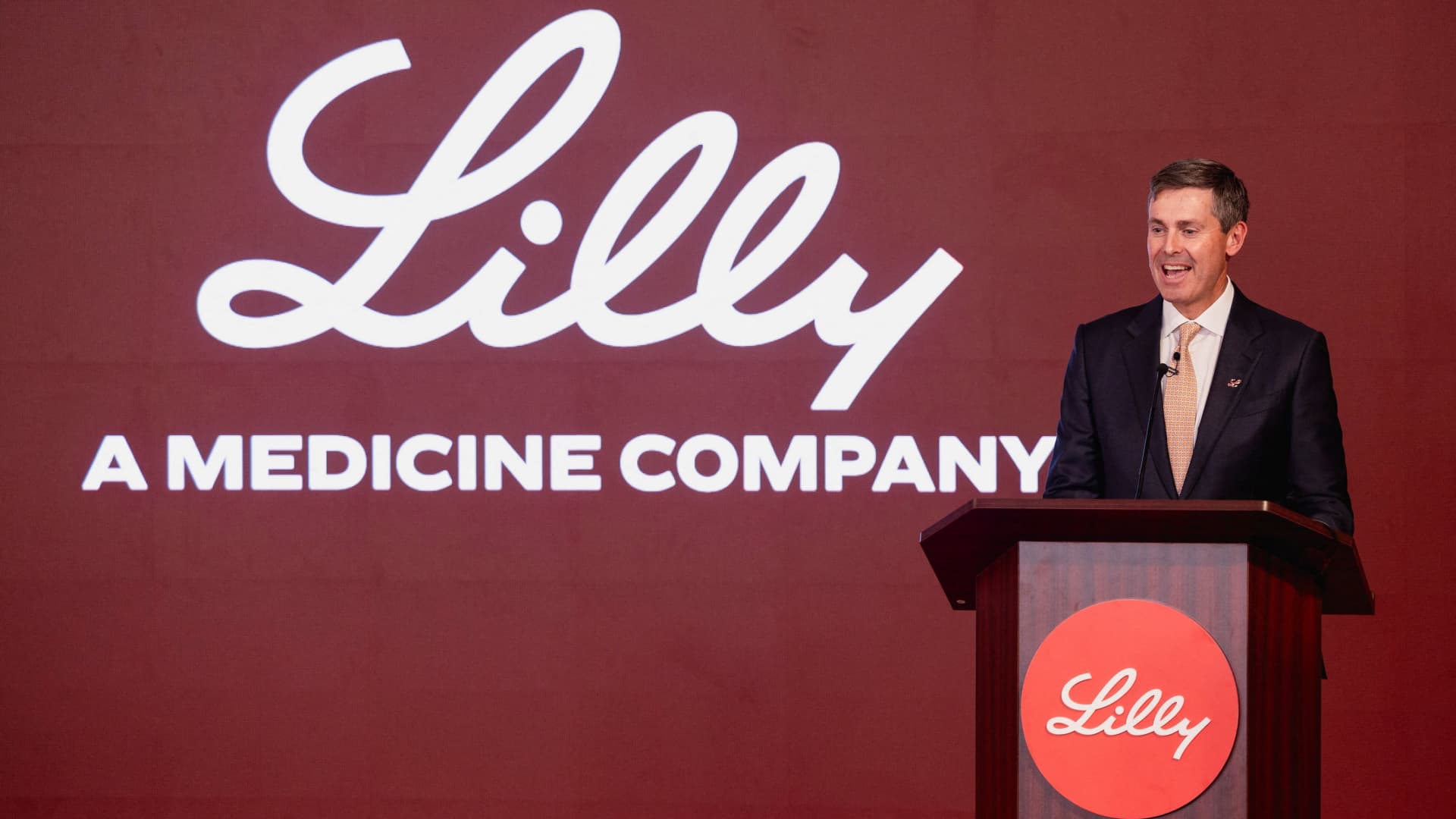
Lilly Chair and CEO Dave Ricks speaks during a press conference for Eli Lilly and Company in Houston, Texas, U.S., Sept. 23, 2025.
Antranik Tavitian | Reuters
For example, the FDA selected Lilly’s Lebanon, Indiana, facility that will make the main ingredients of GLP-1 pills and shots. Lilly said it’s “evaluating how PreCheck and related regulatory improvements may impact the facility’s timeline and will continue to work closely with FDA to support the program’s success.”
Advertisement
The $2 billion Saratoga Springs, New York, site that Regeneron announced last fall was also chosen. In a statement, Regeneron CEO Leonard Schleifer said Regeneron has invested in U.S. biologics manufacturing and advocated for increased focus on domestic production of medicines.
“We’re pleased to see programs like the FDA’s PreCheck Pilot Program that encourage collaboration between innovators and regulators to build next generation manufacturing capabilities and strengthen America’s biopharmaceutical industry,” he said.
Another recipient is Fujfilm Biotechnologies’ new facility in Holly Springs, North Carolina. The contract manufacturer opened the site last year. It’s already making monoclonal antibodies for customers Regeneron and Johnson & Johnson, and will produce them for other customers as more parts of the site open in 2027 and 2028.
The PreCheck program includes two components: facility readiness, where the FDA gives the companies technical guidance before the site opens, and application submission, where participants can get more hands-on feedback from the FDA and expedited inspections and facility evaluation.
Advertisement
Fujifilm said it expects the operational readiness review before the end of the year thanks to the expedited process. And it expects the program will allow its customers to explore faster approval pathways with the FDA.
Initial participants in the FDA’s PreCheck pilot program
Amneal Pharmaceuticals: Amneal’s facility in New York that will make small molecule sterile liquid products for pain management, respiratory and ophthalmic diseases
Cellares: Cellares’ facility in New Jersey that will manufacture cell-based gene therapies for oncology and hematology diseases
Eli Lilly: Eli Lilly’s Indiana facility that will make the main ingredients of GLP-1 pills and shots
Fujifilm Biotechnologies: Fujifilm’s facility in North Carolina that will produce monoclonal antibodies
Kriya Therapeutics: Kriya’s facility North Carolina that will manufacture AAV-based gene therapies for chronic diseases
Kyowa Kirin: Kyowa’s facility in North Carolina that will manufacture biologics for rare diseases.
Regeneron: Regeneron’s facility in New York that will produce biologic drug substance, sterile injectables and protein therapeutics for multiple diseases
HMRC has confirmed it will not appeal the tribunal decision that football referees engaged by Professional Game Match Officials Ltd (PGMOL) are self-employed rather than employees, drawing a line under one of the longest-running employment status disputes the tax authority has pursued.
In a statement given to IR35 Shield, an HMRC spokesperson said: “The tribunal decided that these referees were not employees based on the specific facts of the case, and we won’t be appealing this decision. Taking the case to the Supreme Court was important because it clarified how to distinguish employees and self-employed workers for tax purposes, and confirmed our longstanding approach.”
The concession brings to a close a saga that has run for the best part of a decade and travelled all the way to the country’s highest court. The Supreme Court handed down its judgment in September 2024, ruling that the tests of mutuality of obligation and control were both met, before sending the matter back to the First-tier Tribunal to weigh the relationship in the round. When the tribunal applied that final stage, it found the referees did not bear the hallmarks of employment after all.
For Dave Chaplin, chief executive of IR35 Shield and a regular presence at the PGMOL hearings, HMRC’s framing of the outcome sits awkwardly with the result.
“HMRC continues to maintain that its longstanding approach to employment status is correct, which begs the question why they got the referees case wrong for 10 years,” Chaplin said.
Advertisement
His central criticism concerns mutuality of obligation, the principle that has long been a battleground in status cases. “HMRC has consistently argued that mutuality of obligation simply means payment for work completed. However, the Supreme Court ruled otherwise, confirming that the nature of the obligations between the parties was central to determining employment status.”
The distinction matters well beyond the touchline. Mutuality of obligation goes to whether an engager is bound to offer work and the worker bound to accept it. In the referees’ case, the obligations reset after every match, with no commitment on either side to future appointments, a feature the tribunal treated as telling.
Chaplin reserved his sharpest words for HMRC’s Check Employment Status for Tax (CEST) tool, the online questionnaire businesses are encouraged to rely on when determining a contractor’s status.
“If the facts of the case are entered into HMRC’s Check Employment Status for Tax (CEST) tool, it fails to reach the correct conclusion, instead returning an ‘indeterminate’ result and suggesting the case is finely balanced,” he said. “The judge reached the opposite view, stating that the case was not finely balanced and that the referees did not exhibit the hallmarks of employment.”
The PGMOL outcome lands in a line of high-profile defeats that have dented HMRC’s record on status. Television presenters including Kaye Adams, who won her own IR35 case against HMRC after a nine-year ordeal, have spent years and considerable sums fending off the taxman over arrangements that tribunals ultimately judged to be genuinely self-employed.
For the businesses and freelancers caught in the middle, the lesson is uncomfortable but clear. Status is decided on the full picture of a working relationship, not on a single factor and not on a one-size-fits-all questionnaire. HMRC may insist its approach has been vindicated, but a ten-year pursuit that ended in defeat, and a tool that could not call the result, tell a more complicated story.
Jamie Young
Jamie is Senior Reporter at Business Matters, bringing over a decade of experience in UK SME business reporting.
Jamie holds a degree in Business Administration and regularly participates in industry conferences and workshops.
When not reporting on the latest business developments, Jamie is passionate about mentoring up-and-coming journalists and entrepreneurs to inspire the next generation of business leaders.
Comcast logo on the wall of a building at Universal Studios in Orlando, Florida, July 18, 2019.
Roberto Machado Noa | Lightrocket | Getty Images
Analysts think Comcast is priming for deals. Comcast leadership says they’re wrong.
Advertisement
The company announced Monday it plans to separate its two primary businesses — cable broadband and the media units of NBCUniversal and Sky. It’s the second major structural change for the decades-old company in recent months, and it’s raising questions of potential future deals for either half of the company.
But on a call with investors to discuss the split, Comcast executives came ready with cold water:
“Absolutely not,” Comcast co-CEO Brian Roberts said Monday, when asked if investors should view the separation as a potential setup for future deals.
Roberts, son of founder Ralph Roberts and Comcast’s controlling shareholder, won’t be CEO of either company after the separation but will continue to be “actively involved” in the leadership of both companies, Comcast said.
Advertisement
“This is the right move to put each company in the strongest position to create value, fully monetize its assets, and aggressively pursue its own organic growth strategies,” Roberts said.
Co-CEO Mike Cavanagh echoed that denial: “On the NBCUniversal side and [with] Sky, definitely not.”
A reason Comcast is squashing deal speculation? There may not be many good ones left.
Splitting before M&A
Wall Street and industry onlookers have called for a split of Comcast for years, motivated by the rise of streaming and severe competition in the media industry.
Advertisement
While company leaders have discussed a separation at various points since at least 2019, executives have never seriously considered it until now, according to a person close to the situation who spoke anonymously due to the private nature of the discussions.
When Comcast decided to siphon off its cable TV networks into a separate publicly traded company less than two years ago — the spinoff that would ultimately become CNBC-parent Versant Media Group — the prospect of carving out NBCUniversal as a whole never came up, the person said.
Instead, the move to sever NBCUniversal and Sky from the Xfinity cable business came together rather quickly in recent months, the person said.
Wall Street just witnessed a large media deal following an announced spin, noted Mike Proulx, research director at Forrester. Before Warner Bros. Discovery launched a sale process that resulted in dueling bids from Netflix and Paramount Skydance, WBD said it planned to separate its assets into two companies.
Advertisement
“Comcast is following a playbook we have already seen. Warner Bros. Discovery split itself apart as it moved into a deal with Paramount. Now Comcast is doing the same with NBCUniversal. History matters here because Peacock increases NBCUniversal’s acquisition potential,” said Proulx.
Michael Angelakis (L), vice chairman and chief financial officer of Comcast Corp. and Brian Roberts, chairman and chief executive officer of Comcast Corp., attend the Allen & Company Sun Valley Conference on July 9, 2014 in Sun Valley, Idaho.
Scott Olson | Getty Images
It comes against the backdrop of widespread consolidation. Paramount Skydance itself is the product of a merger that closed just about a year ago. Soon after closing, it fought off streaming giant Netflix for the WBD assets.
Advertisement
Smaller deals have come to market too, as the media industry grapples with shifting consumption habits. Earlier this month Fox agreed to buy streaming platform company Roku for $22 billion. And broadcast station owners have been desperate to combine to gain scale.
With the exception of bidding on WBD, Comcast has stayed away from M&A and has focused on its own businesses.
“There’s no surprise that both the media and telecom landscapes have become increasingly competitive and that pace of change continues to accelerate. We simply don’t see these conditions changing anytime soon,” Cavanagh said on Monday’s call.
Cavanagh will be CEO of the media businesses post-spin, Comcast said.
Advertisement
“Our plan for NBCUniversal and Sky is to build and invest for growth. We have the ambition that’s big to pursue opportunities that keep us ahead of evolving consumer behavior and audience demands, and we have the freedom now to explore adjacent business where we have the right to play,” Cavanagh said.
Deal hurdles
The motivation behind splitting a company apart is often to open up more deal opportunities. Still, it’s not clear what deals the newly created company of NBCUniversal and Sky assets could explore without serious regulatory challenges.
For one, housing broadcast network NBC creates various obstacles. The company wouldn’t be able to merge with a company that has another national network, effectively taking Disney, the owner of ABC, and Paramount Skydance, owner of CBS off the table.
Even eliminating the broadcasters from the equation, a deal with Paramount Skydance — which has been on something of a shopping spree under new CEO David Ellison — would be a stretch following the completion of its deal with WBD.
Advertisement
Fox, the remaining major player in linear TV, has stayed away from traditional media after hiving off its entertainment assets years ago and likely doesn’t have the appetite for another deal after its Roku agreement.
But Netflix’s interest in WBD was in its film studio and streaming assets, casting aside WBD’s linear networks. Even with major sports properties like the NFL’s Sunday Ticket, the NBA and other top film content, it’s hard to imagine Netflix would make such a shift and get into linear TV via a hypothetical deal with NBCUniversal.
That leaves little else on the table when it comes to media deals, with the largest players all pretty much spoken for. Comcast didn’t specify Monday what it expects either company to be valued at post-spin, but between the Universal theme parks business, a substantial, albeit small, streamer and a respected content library, NBCUniversal would likely be too large for a smaller player to swallow.
Advertisement
On the cable side, it may be a similar scenario.
Cord keepers
A Comcast Xfinity work truck is seen on April 23, 2026 in Miami, Florida.
Joe Raedle | Getty Images
The remaining Comcast assets after the spin off — broadband, mobile and pay TV under the Xfinity brand — have gone from gangbusters growth to stagnation and often quarterly losses of broadband customers as competition has ramped up from wireless and satellite providers.
Advertisement
The market immediately rewarded the stock of Charter Communications, another cable giant in the midst of completing a different acquisition, on Monday after Comcast’s announcement.
Charter shares soared 10%, signaling investors could be favoring a possible Comcast and Charter merger, tying up the two largest U.S. cable companies.
Charter and Comcast have both invested heavily in their broadband networks and mobile businesses, even as competition has intensified. They are part of a joint venture in which Charter cable TV customers can use Comcast’s Xumo streaming devices.
They’ve also each aggressively changed pricing packages to go after and retain customers. But such moves have done little for either stock price.
Advertisement
There’s some historical precedent driving Wall Street’s anticipation of a potential deal. Comcast attempted to acquire Time Warner Cable in 2014. When Comcast dropped its bid amid regulatory opposition, Charter scooped up the asset — then the nation’s second-largest U.S. provider. The majority of modern-day Charter used to be Time Warner Cable.
Still, there’s reason for skepticism, according to MoffettNathanson analyst Craig Moffett. The Department of Justice had been prepared to block a Comcast-Time Warner Cable deal. Even if a hypothetical Comcast-Charter deal got federal approval, it would need state-by-state acceptance, which may not be easy in Democrat-controlled states such as Massachusetts, Illinois and Maryland, Moffett said in an interview.
“You’d have to go through a gauntlet of individual state public service commissions,” Moffett said. “There would likely be pretty staunch opposition in blue states that are traditionally opposed to mergers like this.”
There’s also the enormous debt load that would come with such a combination, according to the person close to the matter.
Advertisement
Charter is in the midst of closing its merger with Cox, which would leave it with a debt load of more than $100 billion after taking on Cox’s debt. Assuming Comcast shoulders much of the debt load post-spin in a move to alleviate NBCUniversal — a hallmark of the Versant spinoff was a low amount of debt on the new company — combining the two cable companies would create a hefty debt burden, the person said.
There are also strategic questions about a Charter-Comcast deal. In 2014, when Comcast tried to buy Time Warner Cable, one of the driving forces of that transaction was the ability to gain leverage over media programmers in TV carriage disputes by adding subscribers. More than a decade later, the cable TV business has become a far smaller component of both Charter and Comcast, diminishing the value of this potential synergy.
There are few broadband synergies by simply owning more customers, Moffett said. Cable businesses are local operations that are largely unaffected by adding scale, he said.
“Your cost structure in Chicago isn’t meaningfully affected if you own systems in North Carolina,” Moffett said.
Advertisement
To be sure, former Comcast chief financial officer and incoming CEO of the cable assets post-spin, Michael Angelakis, said Monday he believes the company has the network assets it needs to compete.
Future transactions
Rather than an immediate transaction, Comcast may be looking years ahead.
“It may not be imminent. But I think it probably sets the stage on the M&A front,” said Jonathan Miller, a media industry veteran, who currently serves as chief executive of Integrated Media, which specializes in digital media investments.
“This is literally done for the purpose of having more optionality around different opportunities,” Miller added.
Advertisement
Timing of a future deal may also come down to technicalities. Comcast estimated a one-year timeline to close the split. After that, standard U.S. tax regulation compels potential acquiring companies to wait even longer before acquiring a recently spun-off target. However, depending on details such as the kind of deal and timing, there are varying degrees to just how long a company has to wait, the person familiar said.
Disclosure: Versant Media Group is the parent company of CNBC.


















































You must be logged in to post a comment Login