



Knife in hand, Paul Parker bursts into a garage and is confronted by two men. He stabs them, but one manages to draw a gun and shoot him, inflicting a fatal wound.
The 52-year-old’s death last month was sudden and violent. Given he was a veteran of Liverpool’s vicious gang scene, that is hardly surprising.
More unexpected, however, was where he met his end: an industrial estate in Heerhugowaard, a Dutch commuter town 25 miles north of Amsterdam.
Detectives will want to know what Parker was doing in Heerhugowaard. But his death also shines a light on something rarely discussed outside law enforcement: the deep ties between the British and Dutch underworlds.
Parker, 52, was no stranger to the Netherlands. At the time of his death, he was wanted over the 2017 murder of Dutchman Pieter Hoovers and his 32-year-old Thai wife, Tae Kawepanya.
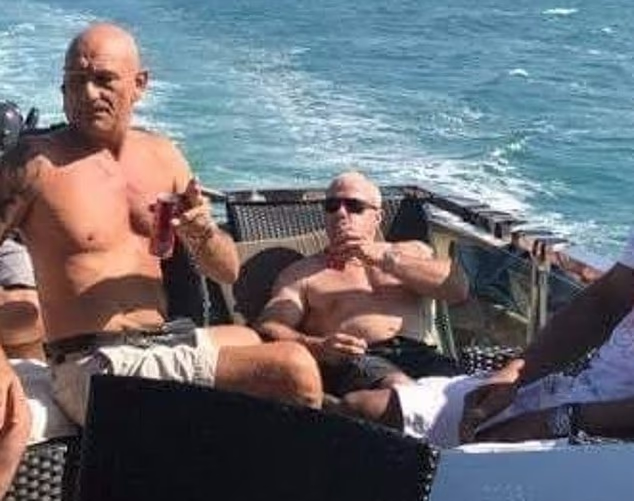
A photo shows Parker sitting next to Hoovers on a boat, suggesting they were once on friendly terms. Yet within a few years, Hoovers had been gunned down alongside his wife in an Amsterdam apartment.
Local police reportedly identified Paul Parker as the prime suspect, implying that he could have been working as a hitman for an organised crime group.
A Dutch source told the Daily Mail that Parker (who went by the name ‘Tommy’ in the Netherlands) was in Heerhugowaard to enforce a debt, which adds further weight to the theory he was working as hired muscle for a gang.
According to the source, he had been living on the Continent for at least two decades and was recently based in Portugal before entering the Netherlands on a fake passport.
Liverpool gangster Paul Parker – in sunglasses – was shot dead in the Netherlands on June 1. Dutch news outlets reported that Parker was a suspect in the murder of Pieter Hoovers (pictured left) and his Thai wife, Tae Kawepanya

The police investigation focused on an unknown man who appeared on camera footage three times around the time of their murders in Amsterdam

Mr Hoovers, who has a background in martial arts, founded record label Outland Records before selling the business and relocating to Thailand in the mid-1990s
This comes as no surprise to long-time observers. While Spain’s Costa del Sol has long had a reputation as the leading European hub for British criminals, the importance of the Netherlands has been largely overlooked.
Unlike in southern Spain, where gangsters flaunt their wealth and engage in bloody turf wars, their Netherlands-based counterparts tend to stay under the radar.
In the land of tulips and windmills, multi-million-pound deals are struck in backstreet cafes or via text messages on encrypted apps, while disputes are resolved behind closed doors.
British traffickers began arriving in the Netherlands in the 1980s, when it emerged as a key European meeting point for international drug gangs.
‘The Netherlands – and Amsterdam in particular – became the stock exchange of the drug world – it was the place to go to do deals,’ explains Peter Walsh, author of Drug War: The Secret History.
‘The Dutch have strong trading connections with countries in South America and the Caribbean.
‘Drug possession is tolerated, and Amsterdam has bars, brothels and cannabis cafes – which are all things people connected with the drug trade enjoy.’
The 1990s saw the arrival of Liverpool kingpin Curtis Warren, who earned an estimated £200million fortune – and a place in The Sunday Times Rich List – by forging direct supply lines with South American cartels.
His unlikely Dutch base was an isolated farmhouse, where he kept a stash of automatic weapons and hand grenades hidden in guest bedrooms. In 1996, it was raided by armed police, who found £125million worth of cocaine and MDMA.
Today, much of Europe’s cocaine still makes landfall at ports such as Rotterdam – the continent’s largest container hub.

Café De Ketel, a cafe that was run exclusively for gangsters in the port of Rotterdam

Curtis ‘Cocky’ Warren (pictured February 2020) operated in the Netherlands in the 1990s

One British gang smuggled £7billion worth of heroin, cocaine and cannabis inside cargoes of onion, garlic and ginger – a failed attempt to distract sniffer dogs

Ringleader Paul Green, from Widnes in Cheshire, was jailed for 32 years in 2024
The sheer volume of trade means only a fraction of cargo can be inspected, while corruption serves as a vital lubricant.
One British network, led by Paul Green from Widnes in Cheshire, smuggled £7billion worth of heroin, cocaine and cannabis inside cargoes of onion, garlic and ginger.
The operation – thought to be the largest drug smuggling conspiracy ever detected in the UK – continued for a two-and-a-half-year period until Green was caught and jailed for 32 years in 2024.
Organised crime in the Netherlands is dominated by the Mocro Maffia, a network of criminal groups recruiting from the Dutch Moroccan community.
Under the leadership of crime boss Ridouan Taghi, it gained a reputation for savage violence. In one raid, police found a makeshift torture chamber inside a shipping container containing a dentist’s chair alongside pliers, hammers and a hedge trimmer.
Taghi himself has been linked to at least ten murders, including the 2019 assassination of Derk Wiersum – a lawyer who was representing a key witness against his gang – and the killing of celebrity crime reporter Peter R. de Vries two years later.
Since Taghi’s arrest in 2019, the Mocro Maffia has moved away from high-profile displays of violence and reinvented itself as a middleman for other drug gangs, including those supplying the UK.
‘They secure cocaine shipments from South American cartels before meeting up with British gangsters in the Netherlands and selling it on wholesale,’ says Chris Dalby, who runs the consultancy World of Crime.
‘It’s become an integrated ecosystem. British dealers are often based in or passing through the Netherlands. The groups have almost become sister organisations.
‘Surprisingly, you don’t hear too much about violence by British drug dealers in the Netherlands like you do in Spain.
‘I think it’s about competition. If you look at southern Spain there is a higher degree of drug violence because it’s a far more contested market with drug dealers from lots of different nationalities. But you don’t have that in the Netherlands.’

Ridouan Taghi, leader of the Mocro Maffia, a network of criminal groups recruiting from the Dutch Moroccan community

A makeshift torture chamber, discovered by Dutch police in 2020 in the village of Wouwse Plantage. Mercifully, it was never used
One example of this discreet cooperation was the Café De Ketel in Rotterdam, which became a known meeting point for traffickers from across Europe.
Open for 18 hours a day, it looked like an ordinary café on the surface, but a buzzer system ensured only recognised criminals could enter. The organised crime entrepôt finally shut up shop after being raided by the National Crime Agency in 2013.
In Amsterdam, the British presence has become so entrenched that gangsters have built their own routines and meeting places.
One of them was a branch of M&S, which became popular with criminals from Liverpool.
‘We would all pile into Marks for a cooked chicken and some sticky buns,’ one man who spent time out there says.
‘You might bump into faces from back home and have a chat about the game and that. All the scallywags could jump on a budget flight from Liverpool to Amsterdam or even get the ferry from Hull.’
The branch closed in 2016, forcing traffickers to go elsewhere for their home comforts.
One notorious gangster to ply his trade in the Netherlands was Francis Coggins, one of the brothers behind the Huyton Firm, one of Liverpool’s most feared gangs.
The 60-year-old had been living in the coastal town of Zandvoort, where he bought cocaine and heroin before shipping it to the UK via the UPS network.
He remained at large after his younger brother Vincent – who focused on the gang’s UK operations – was arrested and jailed in 2020.

Francis Coggins had managed to evade the authorities for five years before he was arrested by Dutch police for being drunk and disorderly. He had rarely been pictured before this mugshot

Coggins sent drugs from mainland Europe to North Wales by putting them into parcels with UPS waybills attached
But like many Brits before him, Francis overindulged in Dutch hospitality and was found ‘collapsed’ in the street outside a house after an alcohol-fuelled bender. He was promptly arrested and flown back to Britain, where he was jailed for 18 years in 2025.
If British drug peddlers appear relatively unlikely to resort to public violence in the Netherlands, the reason is hardly comforting.
‘What causes violence is a missed payment, protecting turf or a betrayal,’ says Chris Dalby.
‘But there’s now so much cocaine around – and so much demand from the UK – that there are fewer reasons for friction. That’s what makes Parker’s death relatively unusual.’
In other words, Britain’s insatiable appetite for illegal drugs means there is more than enough business to go round.
And peace, after all, is profitable.























































You must be logged in to post a comment Login