Connect with us
DAPA Banner
DAPA Coin
DAPA
COIN PAYMENT ASSET
PRIVACY · BLOCKDAG · HOMOMORPHIC ENCRYPTION · RUST
ElGamal Encrypted MINE DAPA
🚫 GENESIS SOLD OUT
DAPAPAY COMING

Tech

The fight to preserve Australia’s underwater forests

Published

on

Catalina A Musrri of the University of Sydney and Georgina Wood of Flinders University discuss the significance of underwater seaweed forests and how to preserve them.

Click here to visit The Conversation.

A version of this article was originally published by The Conversation (CC BY-ND 4.0)

Australia’s Great Southern Reef is built not by coral but by seaweed. The seaweed forests on these rocky reefs stretch more than 8,000km around southern Australia.

Amid the swaying fronds live seadragons, rock lobsters, giant cuttlefish and southern blue devils. The reef is home to more than 1,500 seaweed species and contributes billions to the economy each year.

Advertisement

But these remarkable cold water forests face a worsening threat. The ocean is getting steadily warmer, pushing seaweed species outside their survival zone. Much of this damage is done by sudden marine heatwaves, where temperatures spike and remain high for some time. Heatwaves have driven the decline of seaweed forests across the country.

To protect these underwater forests, we need to preserve their genetic diversity. We led the first attempt to cryopreserve (freezing and storing reproductive material at ultra-low temperatures) a key Australian seaweed, crayweed, and found the idea shows promise, though the techniques need to be perfected.

Why does seaweed matter?

Most of us encounter seaweed as a slightly stinky mass spotted when walking along a beach. But underwater, these large algae (not plants) form beautiful forests swaying in the current – some as tall as 30 metres.

Seaweed forests are among the most productive ecosystems on Earth. Like forests on land, they provide habitat, shelter and food for many creatures. They underpin valuable fisheries such as lobster and abalone.

Advertisement

When local populations are wiped out, they take something important with them – genetic diversity. Species with high genetic diversity can better adapt to change. Some populations will be able to tolerate heat better, for instance. But if these populations disappear, their unique genes go with them.

In 2011, an extreme marine heatwave in western Australia led to two common seaweed species losing an estimated 30pc to 65pc of their genetic diversity. These losses may mean poorer outcomes in response to intensifying threats.

Consider the crayweed

Golden-brown crayweed (Phyllospora comosa) once formed extensive underwater forests along Sydney’s coastline. Many of these disappeared in the 1980s, likely due to sewage pollution. But crayweed didn’t return even after pollution levels fell.

Over the past 14 years, scientists and divers have replanted this species around Sydney through Operation Crayweed. Their work has led to the return of self-sustaining populations, including Australia’s first named seaweed forest – Yanggaa forest at Coogee Beach.

Advertisement

But restoration may not be enough in a rapidly warming ocean. Our research shows separate crayweed populations harbour unique genetic diversity – and some individuals appear better equipped to tolerate heat. It may make sense to plant germlings (baby seaweed) from these individuals in vulnerable populations to boost their chances of survival.

Of seed banks, biobanks and cryopreservation

For decades, thousands of land-based plant species have had their genetic diversity preserved through seed banks. The seeds stored are sleeping but still alive. If planted in the right conditions, they will grow.

Some kelp species can also be kept alive in biobanks – not as seeds, but in a microscopic form (gametophytes) able to be kept alive in laboratories for years. Current kelp collections support research, aquaculture and restoration programmes around the world, including in Australia.

These banks are important. But they won’t be enough. The majority of seaweed species dominating the Great Southern Reef are known as fucoids. Unlike true kelps, fucoids don’t have this microscopic life stage; they release sperm and eggs directly into seawater that fertilise and form germlings. This makes species such as crayweed, bull kelp (Durvillaea potatorum), Cystophora sp and Scytothalia dorycarpa more challenging to conserve.

Advertisement

It is possible to bank species which rely on sexual reproduction, such as humans, cows, corals and fucoids. Assisted reproduction methods such as IVF rely on cryopreservation: storing reproductive material, tissue or early life stages at ultra-low temperatures (around –196°C) so it remains viable for future use.

Our recent research tested whether frozen crayweed sperm and germlings were viable after being thawed. We found the sperm did well, but the germlings did not (for now). Our ultimate goal is to develop proven methods able to work across a broader range of Australian seaweed species.

Preserving the genetic diversity of seaweed species would mean these genes can be drawn on to bring them back. This buys valuable time and keeps the door open for new methods such as assisted gene flow, where individuals from better-adapted populations are used to help vulnerable ones cope with warmer conditions.

Time for seaweed biobanks?

Australia already has an impressive algal culture collection and is a global leader in coral cryobanking.

Advertisement

Even so, it will take real work to develop methods of preserving the forest-forming seaweed species that rely on sexual reproduction. We need to learn which populations contain unique or threatened genetic diversity, understand which are most vulnerable to climate change, and improve freezing and recovery techniques.

Choosing which species and populations should be done alongside indigenous custodians, governments, conservation organisations and local communities.

Cryobanking doesn’t solve climate change or replace the need to protect habitat. It’s an insurance policy for biodiversity. Much has already been lost. Preserving the remaining genetic diversity of our seaweed forests may well be critical to the survival of the Great Southern Reef.


Advertisement

The Conversation
By Catalina A Musrri and Georgina Wood

Catalina A Musrri of the University of Sydney recently completed her PhD in seaweed forest restoration in the context of climate change. She is interested in the impacts of climate change and other anthropogenic activities, such as pollution and overfishing, on coastal habitats.

Georgina Wood is an early career Australian Research Council fellow at Flinders University and adjunct research fellow at the University of Western Australia whose research focuses on repairing nature in a changing climate, particularly temperate kelp forest ecosystems.

Don’t miss out on the knowledge you need to succeed. Sign up for the Daily Brief, Silicon Republic’s digest of need-to-know sci-tech news.

Advertisement

Source link

Continue Reading
Click to comment

You must be logged in to post a comment Login

Leave a Reply

Tech

I tried a hidden video trick in iOS 27, and it saved me a ton of frustration

Published

on

If you’ve ever been on vacation and chose to record video instead of taking photos only to avoid missing the fun moments, thinking you’d pause and take screenshots later, you might have ended up questioning your decision later. 

You see, the process involves multiple steps, starting from hunting for the right frame, pausing, and taking a screenshot. If it doesn’t look good, you go back to the video, pause somewhere else, and try taking another screenshot. You see where I’m going with this?

It’s a specific little misery that iOS 27 has now quietly fixed, and I genuinely can’t believe it took this long.

How does the new “Save video frame as photo” feature work?

The new “Save Video Frame as Photo” option in the Photos app does exactly what it sounds like. You can save a single frame from a video directly to the gallery as a photo, without the hassle of capturing screenshots. You can use it in two ways.

Advertisement

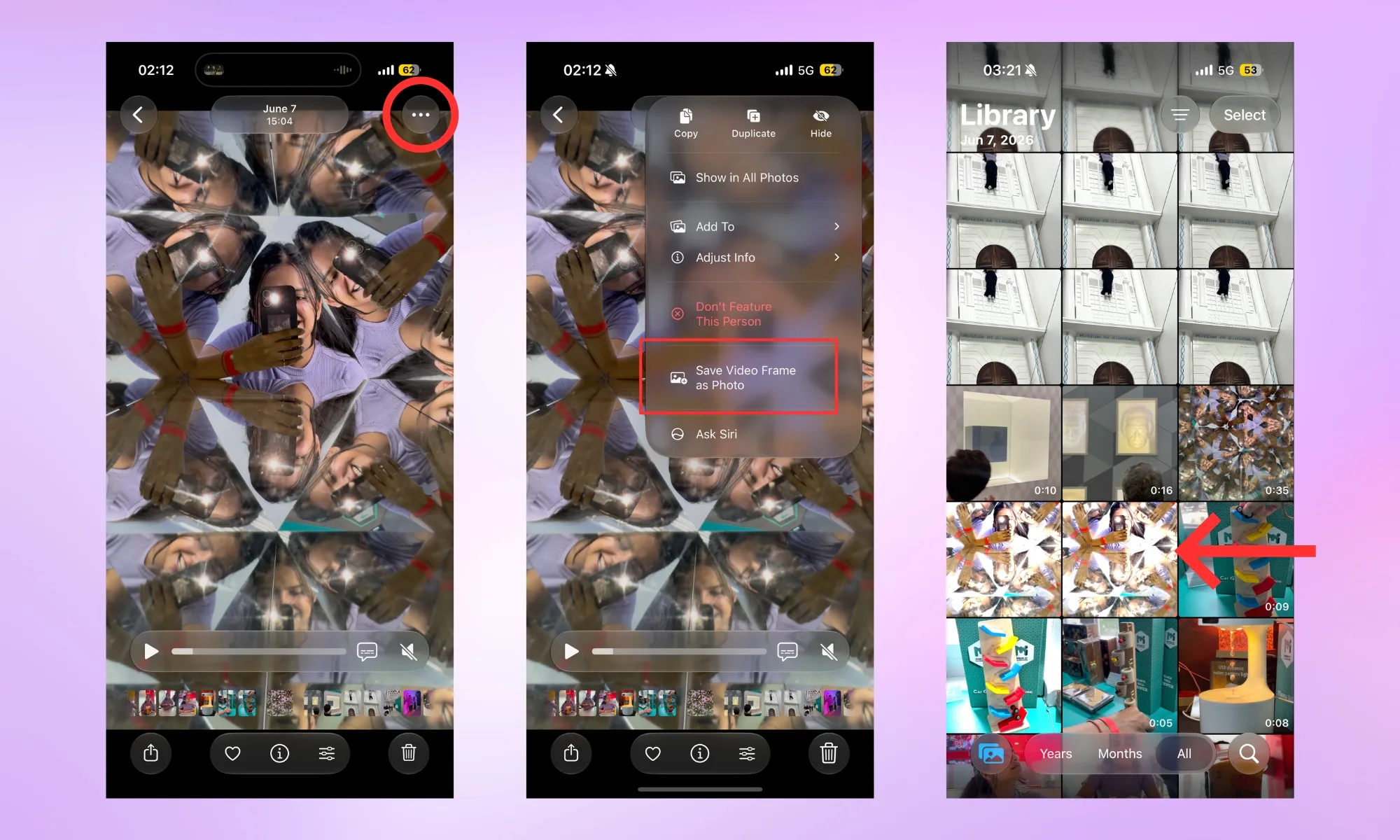
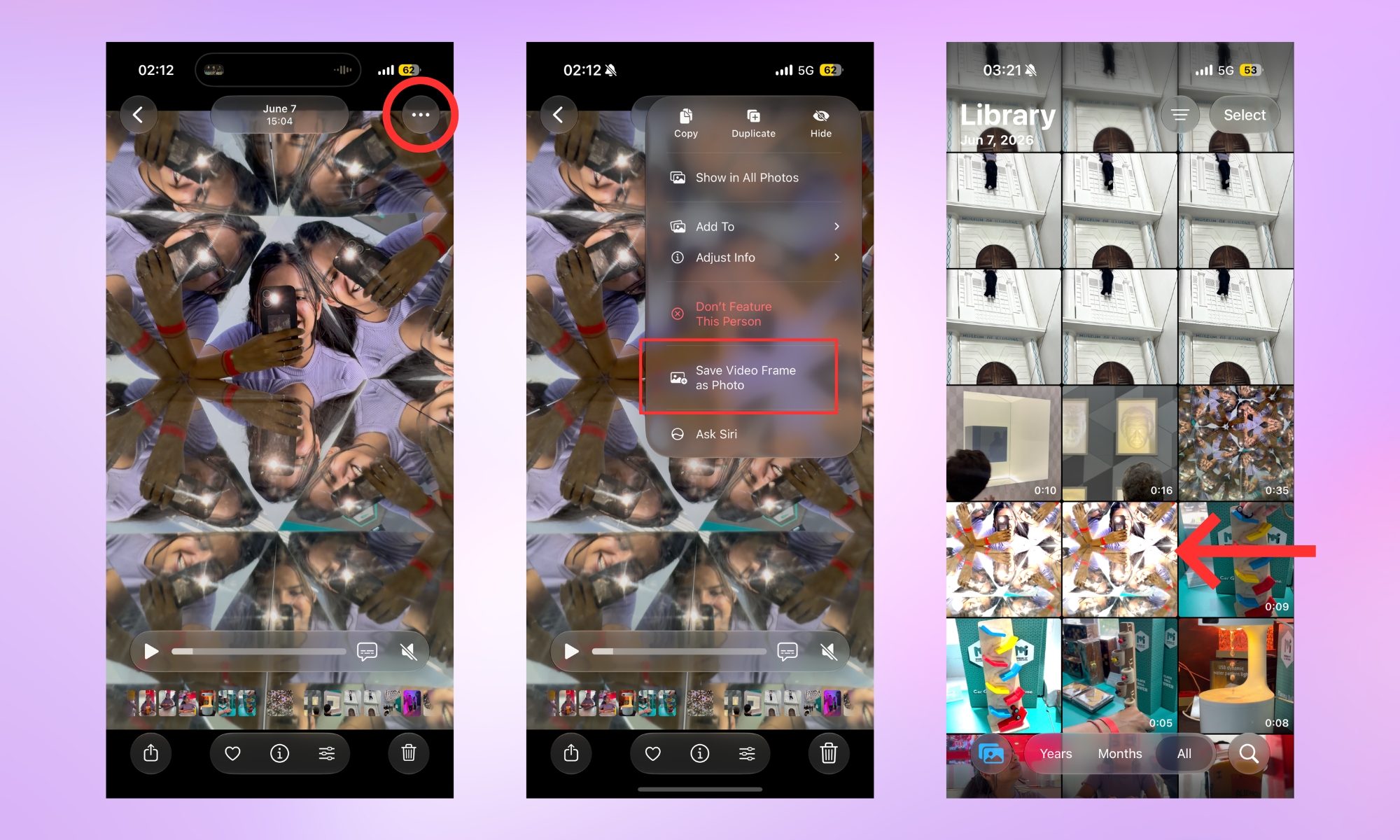
The first one lets you use the feature quickly and save a video frame as a photo in as little time as possible. Open the video in the Photos app, scrub to the moment you want, pause, tap the three-dot menu at the top right of the screen, then tap the “Save Video Frame as Photo” button. 

You should see a “Saved Video Frame” dialogue box pop up at the bottom of the screen. The saved frame shows up in your library, right next to the video you’ve extracted it from.

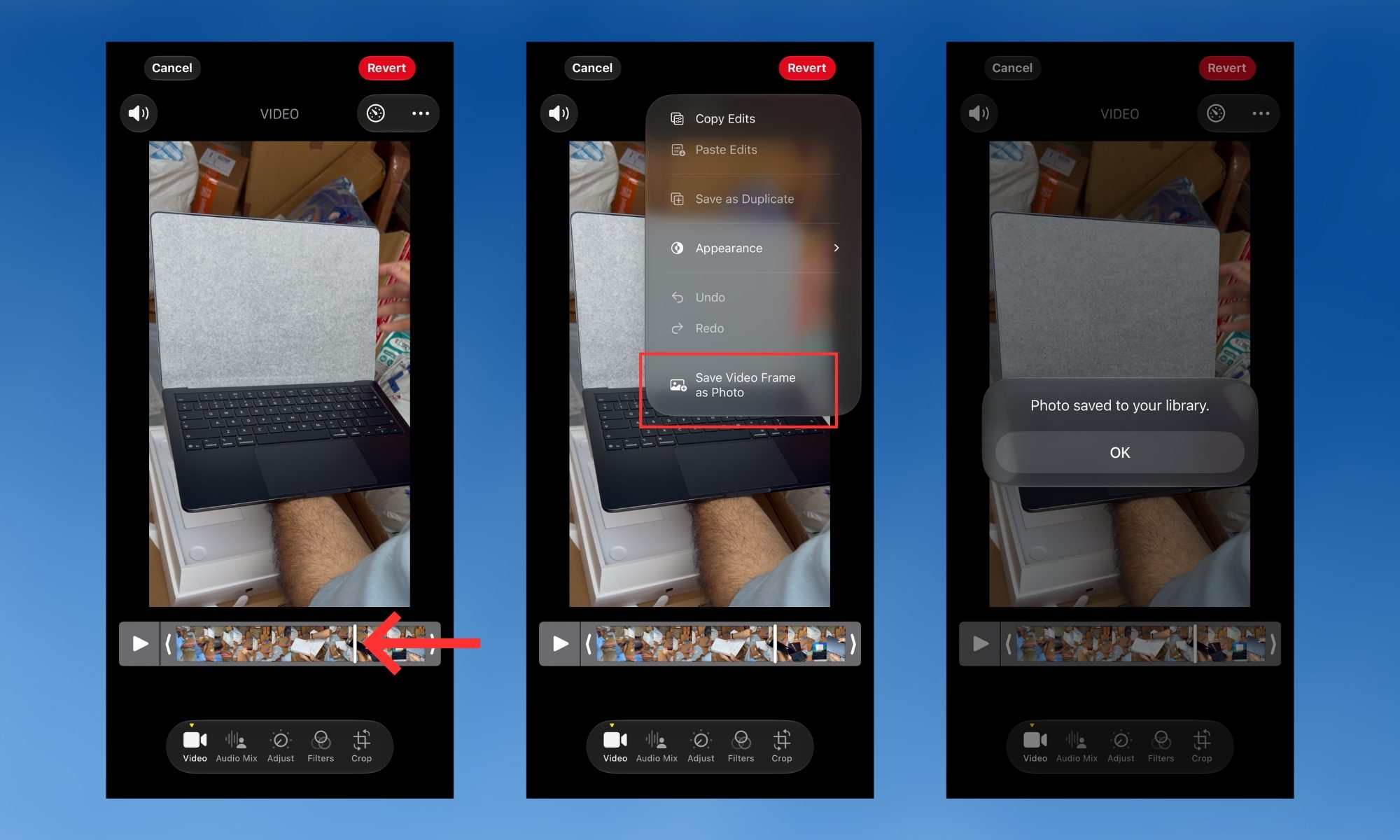
However, if you need frame-by-frame flexibility, open a video, then tap the hamburger menu at the bottom to enter the edit menu. Use the timeline at the bottom of the screen to scrub through the video one frame at a time. 

Once you find the exact moment, tap the three-dot menu again and tap “Save Video Frame as Photo.” You should see a “Photo saved to your library” message on the screen. Tap the “OK” button below it, and you’re good to go.

The feature is genuinely better than capturing screenshots

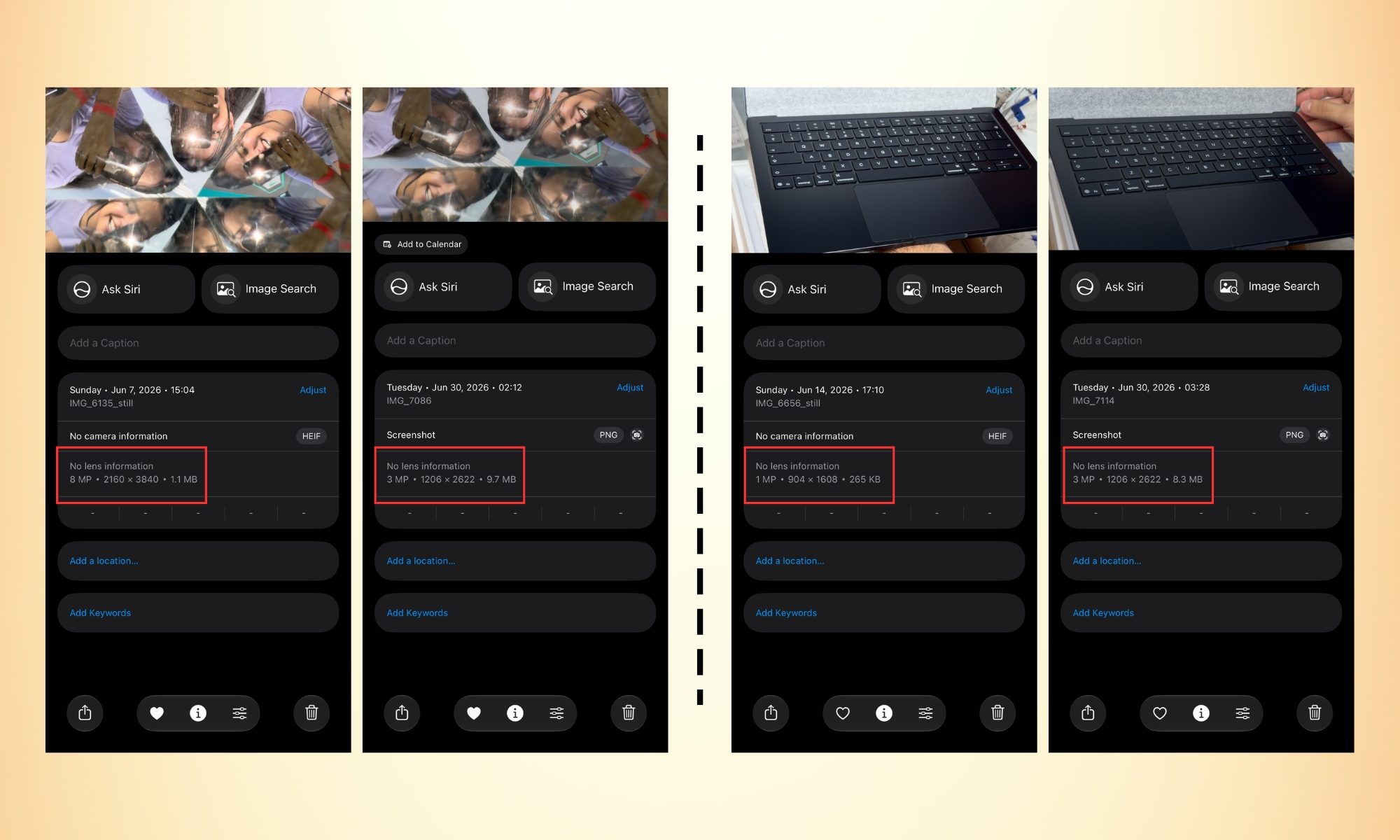
The difference in quality here is worth understanding. Saving a video frame as a picture is the same as taking a picture when you’re recording a 4K video at 60 fps; the saved frame comes out as an 8 MP photo (in Apple’s HEIF format). 

Screenshots, on the other hand, save as PNG files that are lower in resolution but larger in file size. In a nutshell, the frame-extracted picture has both a smaller file size and a higher resolution than screenshots. 

Furthermore, it doesn’t capture unwanted visual elements, such as the video progress bar at the bottom or a notification pop-up that shows up at the exact moment (I hate those).  

Advertisement

It’s one of those iOS 27 features Apple didn’t announce onstage, and yet once you know it exists, you’ll wonder how you ever managed without it.

Source link

Advertisement
Continue Reading

Tech

Mary Jo Foley: What’s a consumer-focused outsider doing at the helm of Microsoft’s AI push?

Published

on

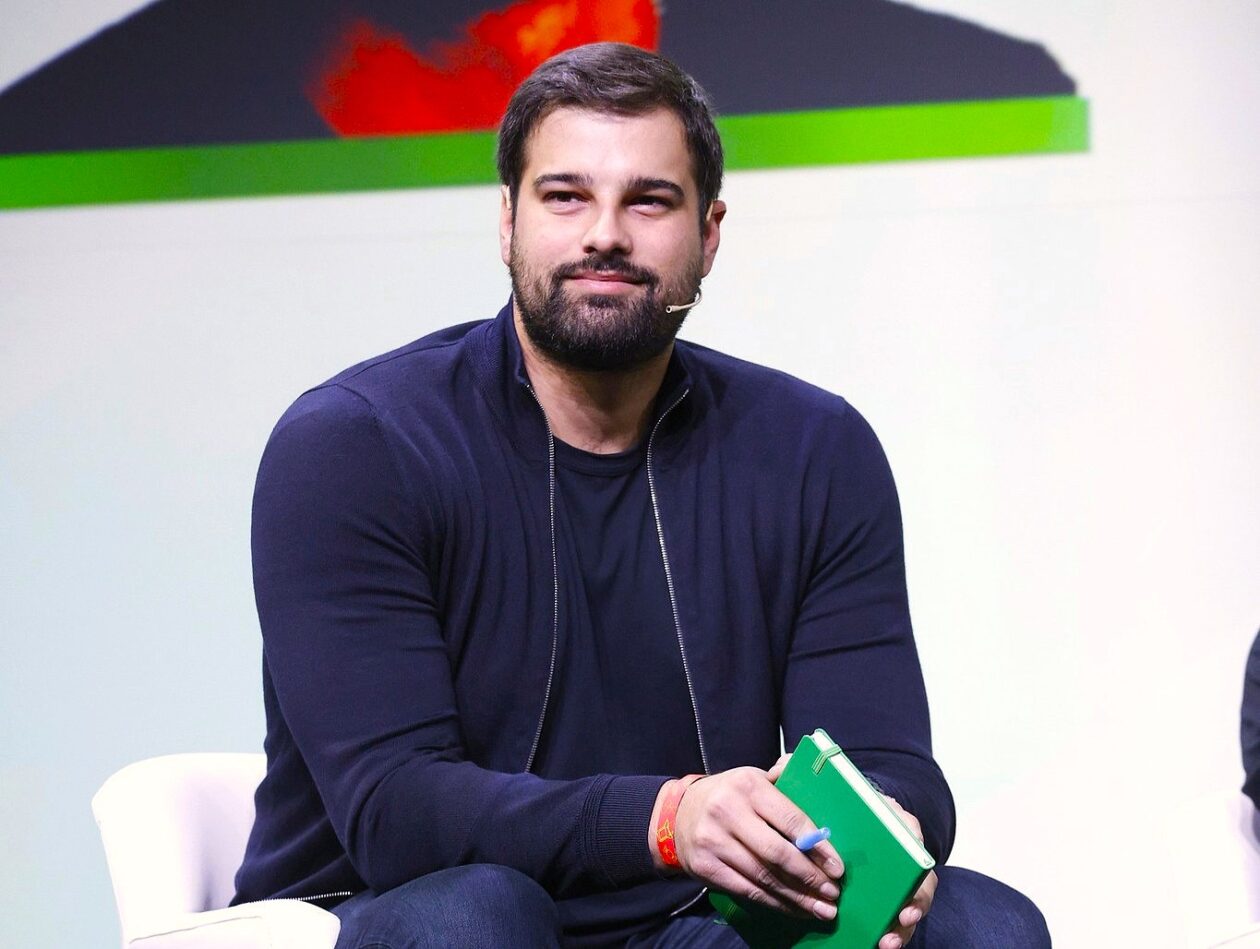
Jacob Andreou speaks onstage during TechCrunch Disrupt 2023. (Photo by Kimberly White/Getty Images for TechCrunch, CC By 2.0)

It’s not surprising that Microsoft is looking to turn its Copilot platform into a “Super App,” given that its rivals are doing the same. But Microsoft is going about the task in a way that doesn’t follow its usual playbook, by putting a big bet on a consumer-savvy hire from the outside with some feather-ruffling ways.

The company’s newly minted Copilot Executive Vice President Jacob Andreou came to Microsoft from Greylock Partners and before that, Snapchat-maker Snap. Andreou currently oversees more than 11,000 Microsoft employees, according to a recent profile in Fortune.

Microsoft is bringing onboard another former Snap (and Discord) vice president, Peter Sellis, to help, GeekWire has learned. Sources say Sellis will be leading Copilot Design, Growth and Engineering, reporting to Andreou.

Andreou is part of a recently formed Copilot Leadership Team. His charter is to lead the “Copilot experience” by driving design, product, growth and engineering, as outlined in a March 2026 reorg memo from CEO Satya Nadella. He is one of a small group charged with shaping the future of Copilot, alongside others focused on the underlying Copilot platform and AI models.

Given Andreou’s Snap background, his plan to meld Microsoft’s consumer and enterprise Copilot experiences makes sense. It won’t be a snap, however. (See what I did there?)

Advertisement

Even though both share the Copilot brand, consumer Copilot and Microsoft 365 Copilot don’t work the same way or use the same data sources or architecture. To boot, Microsoft hasn’t had a lot of luck with this kind of consumer-enterprise unification, as evidenced by the low interest in and uptake of its free, consumer-focused Teams product compared to its business-focused Teams collaboration offering.

The 33-year-old, Los Angeles-based Andreou seemingly is undaunted by the challenge and is pushing some employees to clock 12-hour days to keep up with younger, AI-focused companies, Fortune reports.

Microsoft was infamous for requiring employees to work long hours and weekends during crunch times leading up to delivering Windows NT and Windows 95, but not so much in recent years. Microsoft is known as a place where outsiders often struggle to thrive compared to those who climb the corporate ladder for years, making Andreou’s approach feel even riskier.

Andreou has been a big backer of the Tasks productivity layer in consumer Copilot, which is still in public preview. Tasks, which enables Copilot to handle actionable items, is similar to the recently released Copilot Cowork layer that is part of Microsoft 365 Copilot. (I asked Microsoft if the two would merge as a single Cowork-type offering at some point but was told the company had no comment.)

Advertisement

However, the holy grail remains the “Super App.” With the Copilot Super App, Microsoft is looking to give consumers and business users a reason to stay within Copilot regardless of the AI task with which they – or their agents – are engaging.

“Come summer, we will be bringing coding to all knowledge work within one Copilot Super App. That’s really exciting. So you’re going to have Chat, Cowork, and Code all in Copilot,” Nadella told Microsoft Build conference attendees in early June.

Microsoft isn’t the only AI-focused company working on extending its AI coding capability beyond just developers. Nor is it the only one betting on the Super App concept.

  • OpenAI is working to turn ChatGPT into a Super App that brings together ChatGPT and Codex into a single environment that operates like a personal assistant.
  • Anthropic is extending Claude to become a Super App (though it hasn’t used that terminology), as well, by creating a single environment that combines productivity, development and automation tools.

The Copilot Super App isn’t Andreou’s only focus. He tells Fortune that AI model choice and home-grown AI model excellence also are among his key priorities.

Microsoft is expanding model choice in the Copilot Cowork feature beyond Anthropic to include OpenAI and soon, Microsoft’s own Cowork 1 model – which may be based on Microsoft’s hosted version of the open-source DeepSeek model. Cowork 1 will be the newest addition to Microsoft’s growing pool of Microsoft-developed models, seven of which debuted at Build this year. Microsoft is seeking to position itself as the champion of lower cost, efficient models built for those who are token-maxxed out.

Advertisement

Andreou definitely has his work cut out for him as a consumer guy in a heavily enterprise-centric company.

Microsoft 365 Copilot and consumer Copilot are just two of more than two dozen different “Copilot”-branded commercial offerings available across the various Microsoft product teams, which can feel overwhelming.

Microsoft also needs to give users a clearer way to find and use the quickly expanding stable of first- and third-party agents, like the OpenClaw-based Microsoft Scout personal assistant. Will Andreou and his Super App quest bring at least some order to the Copilot and agent madness? We’ll know more sometime this summer.

Source link

Advertisement
Continue Reading

Tech

EOFY gaming laptop deals Australia: Acer Nitro and Lenovo Legion are on sale

Published

on

EOFY is a good time to check gaming laptop deals, even if the laptop isn’t going to be used for work. Gaming laptops can be quite expensive, so a legitimate discount can make a bigger difference than it does on a basic everyday laptop.

That said, a gaming laptop can also be a powerful workstation if your work does need extra grunt. A fast CPU, dedicated GPU and plenty of RAM can help with video editing, 3D work, coding, running AI tools, creative apps or just keeping a lot of browser tabs and programs open at once.

It’s also worth checking our main EOFY laptop deals hub even after June 30, because in previous years we’ve seen some great laptop deals hang around or pop up in early July as retailers clear leftover stock.

For gaming laptops, we have deals from lower-cost RTX 5060 machines with generous RAM, through to much more expensive RTX 5090 desktop replacements.

Advertisement

The Acer Nitro V 16S is a good option for a buyer who wants current-gen gaming performance without paying big money. You still get an RTX 5060, 32GB RAM, a 1TB SSD and a 180Hz display for AU$1,777, which is a lot of hardware for the price.

The RTX 5060 is a lower-end current-gen GPU, but that’s still a good fit for 1080p or 1200p gaming, especially if you’re happy to use DLSS or turn down a few settings in the most demanding games. With RAM prices rising, 32GB of RAM is harder to take for granted at this price, so it’s good to see Acer include it rather than cutting back to 16GB.

The Lenovo Legion Pro 7i is at the other end of the scale. Our Lenovo Legion Pro 7i review described it as “perfect for a desktop replacement, just okay as a portable”, and that’s exactly how I’d frame this deal.

Advertisement

You’re not buying it because it’s cheap or easy to carry everywhere. You’re buying it because you want a very powerful 16-inch gaming laptop with an RTX 5090, 32GB RAM, a 1TB SSD and a 240Hz OLED screen.

Our review gave the Legion Pro 7i 4 stars and called out its excellent gaming performance, gorgeous OLED screen and useful port selection. That makes it a good fit if you want one machine for demanding games, an external monitor setup and heavier work like editing, rendering or development.

The big caveat is battery life, which our review said “is not great”, but that’s the trade-off with this kind of desktop-replacement gaming laptop.

If neither of these gaming laptop deals is quite right, our main EOFY laptop deals hub has more options across cheaper Windows laptops, MacBooks, 2-in-1s and higher-end gaming machines.

Advertisement

Source link

Continue Reading

Tech

How And Why To Fight Back Against Social Media Bans

Published

on

from the moral-panic-creeping-further-and-further dept

Several U.S. states are pushing to ban young people from social media entirely. This marks the latest wave of censorship bills masquerading as “children’s online safety” measures, with states like MassachusettsIdahoMinnesotaNorth CarolinaSouth CarolinaIllinois, and EFF’s home state of California leading the charge.

Just a few years ago, lawmakers supporting age-gating laws insisted their efforts were narrowly targeted at limiting young people’s access to adult content. At the time, we warned that they would not stop there: once the government established the authority and built the infrastructure to collect and “verify” massive troves of user data, it would inevitably sweep broader and broader categories of lawful speech into this mass surveillance and censorship system. 

Unfortunately, our predictions came true. As legislators across the country advance proposals that would block all young people from accessing the “modern public square,” the Overton window has shifted dramatically towards mass censorship—and the speed of this shift should concern all of us. 

This primer breaks down this dangerous wave of social media bans: how they work (and why they don’t), who they harm, and how we can fight back. 

Advertisement

How to Spot a Social Media Ban

The details of these bills vary from state to state. Some (like California’s AB 1709) are a flat-out social media ban for all young people under a certain age, while other states (like South Carolina and Minnesota) allow access to young users who hand over even more data to show verifiable parental consent. Many bills regulate certain social media features, too, including by setting default privacy settings, time limits, or notification preferences for all accounts that fail the age-gate.

As for the age-gating mechanism itself, most proposals fall into two broad categories: age verification bills and behavioral age estimation bills. 

Age Verification Bills require online services to collect highly sensitive data, including government ID and biometric information, from all users before either restricting or allowing them access. 

For example, take California’s social media ban (AB 1709). Starting in January 2027, operating systems will be required to collect enough information from users to sort them into age groups, or “brackets.” Under AB 1709, social media apps would then use that age bracket information to completely block anyone under 16, while supposedly letting everyone else through. By contrast, Florida’s law (HB 3) takes a more aggressive route by forcing platforms to verify users’ identities directly, usually by contracting with private third-party companies to perform verification services.

Advertisement

Behavioral Age Estimation Bills, on the other hand, are a more recent innovation of states like Minnesota (HF 1438) and South Carolina (H 4591). These bills require platforms to estimate the ages of users based largely on data that they already collect, including self-attested age, behavioral information, and account history and activity. In practice, these bills enable tech companies to use algorithms and/or AI to analyze our online behavior and estimate age based on that. 

Proponents of behavioral age estimation bills claim that their proposals avoid the massive security risks that come with mandatory age verification bills. However, much of the data that social media platforms collect from us “in the ordinary course of operation” is collected in order to serve us targeted behavioral ads. If we force platforms to use this imperfect data to make more important judgments about who can access their services, we risk entrenching those insidious data collection practices. Surely we don’t want to give social media companies more reasons to justify and sustain their reliance on this exploitative business model.

If you want to dig into the nuance here, our terminology guide sheds more light on the technical differences between age verification and age estimation bills. 

Overall, it’s a lose-lose scenario: either platforms collect new forms of our most sensitive and immutable data, or they unleash their AI and algorithms on our existing behavioral data to make creepy guesses about who we are and what we deserve to see. No matter which age-gating method your state chooses to execute its social media ban, there will be lots of error at the margins—and lots of users who will be blocked or chilled from access to lawful online speech.

Advertisement

Why Social Media Bans Are So Dangerous

Social media bans are unconstitutional, discriminatory, and deeply misguided. They reinforce existing structures of oppression, and they are broadly unsupported by young people, whose voices are conspicuously absent from this conversation. They undermine parental decision-making and replace tailored family-level solutions with a one-size-fits-all band-aid. And, in the places we have seen social media bans go into effect, early reports show that they don’t even work

For example, in Australia, where a social media ban has been in effect since late 2025, a majority of young people can still access social media, those who can’t have lost their access to the news, and crisis helplines are reporting skyrocketing numbers of calls from youth left stranded without online community or resources.

We could go on and on about all of the inherent harms here, but we’ll try to keep this short as we walk through some of the major issues.

1. Security Risks and Privacy Harms

In order to ban some users, social media platforms first must confirm the ages of all users, regardless of age. Bans thus incentivize companies to force users of all ages to hand over government IDsface scans, and other sensitive information. When parental consent is required, companies must collect even more verification data and often create explicit links between child and parent accounts—further destroying users’ anonymity. 

Advertisement

Both of these databases create massive data “honeypots” that invite identity theft and permanent surveillance. We’ve already seen repeated data breaches involving age- and identity-verification services. Yet these laws would force both adults and the youth they claim to protect to feed their most sensitive data into this growing surveillance ecosystem. 

If we don’t trust tech companies with our private information now, we shouldn’t pass laws that force us to give them even more of it. 

2. Disproportionate Harm to Vulnerable Communities

Age-verification technology is deeply flawed and prone to discrimination. These systems frequently misidentify or lock out people of colorpeople with disabilities, and trans or gender-nonconforming individuals whose IDs may not match their appearance. 

Where these bills require parental consent, they impose disproportionate access barriers on low-income, non-traditional, and immigrant families. These sorts of families are more likely to share a single family device or have strong reasons to not want the government to track family associations and ID documents. 

Advertisement

Beyond the technical failures, these bans cut off a vital lifeline. For LGBTQ+ youth, foster kids, and those stuck in unsupportive home environments, social media is often the only place to find community, explore their identity, or access life-saving resources. Forcibly removing young people isolates those who need connection the most, while creating massive new barriers for adults. 

You can read a breakdown of the diverse groups vulnerable to these laws here

3. Based on Shoddy Science

The current legislative push to ban young people from social media relies heavily on the idea that the “great rewiring” of the adolescent brain is a proven fact. This simply isn’t true.

Social science indicates that moderate internet use is a net positive for teens’ development, and negative outcomes are usually due to either lack of access or excessive use. For LGBTQ+ and marginalized youth in particular, social media offers an essential space to access support they might lack offline. By forcing youth into digital isolation, these bans cut off vital access to political news, community, and health resources. They also completely ignore the calls of young people themselves who favor digital literacy and education over restrictive government control.

Advertisement

Instead of cutting off these lifelines, we should support measures that arm all youth (and the adults in their lives) with the knowledge they need to navigate online spaces safely.

4. Reckless Free Speech Violations for Users of All Ages

No matter your age, the First Amendment protects your right to speak and access information. 

Blanket social media bans immensely and unconstitutionally chill all users’ exercise of this right. They cut off young people’s access to lawful speech, or ruin their privacy in the home by mandating parental consent and sometimes even parental access to their account activities and settings. They force all users (adults and young people alike) to hand private information over to tech companies before speaking or accessing information on social media platforms, imposing annoying obstacles on lawful online expression and wrongfully blocking some adults outright. 

Critically, these bans destroy our right to online anonymity—a cornerstone of our right to free expression that protects whistleblowers, journalists, activists, immigrants, and everyone who has ever used a private browser or account to ask the internet an embarrassing question.

Advertisement

How to Fight Back

Social media bans weaponize parents’ concerns about children’s safety to justify unprecedented levels of surveillance and censorship. In the process, these laws deny young people their rights, threaten online anonymity for everyone, expose our sensitive personal data to breach and abuse, and replace parental decision-making with state authority. This is a battle over the future of the open, private, and free internet, and we must act now to protect it.

Here’s how you can help us fight back: Talk to your community (including young people!) about what’s at stake. If you’re a parent, lean on open conversations and platforms’ existing tools to tailor your child’s experiences instead of handing that power over to the government. And no matter where you live, contact your government representatives and tell them clearly that social media bans are not the answer to kids’ online safety.

Republished from the EFF’s Deeplinks blog.

Filed Under: age estimation, age verification, california, free speech, idaho, illinois, massachusetts, minnesota, moral panic, north carolina, social media, social media ban, south carolina

Advertisement

Source link

Continue Reading

Tech

RAM prices expected to rise another 40-50% in Q3 2026, and then 30% more in Q4 as AI demand outpaces supply

Published

on


Ethan Tan, a memory industry consultant and former Samsung China executive, told Jefferies Equity Research analysts during a recent briefing that he expects memory prices to rise by 40% to 50% in the third quarter of 2026 compared to the prior quarter, and by another 30% to 40% in Q4….
Read Entire Article
Source link

Continue Reading

Tech

Want a cheap Yeti cooler for your 4th of July celebrations? I’m a deal-hunting outdoor expert, and I’ve tracked down the only holiday offers actually worth your money

Published

on

Looking for a deal on a Yeti cooler for your July 4th celebrations? I’ve got you covered. As the former editor of an outdoor adventure website, I know exactly where to look to find the best offers on Yeti gear, and I have uncovered some great deals that will arrive in time for the big day.

Amazon has some great offers, particularly on soft coolers like the Hopper Flip 8 and 12, both of which are ideal for cans or lunches. There are also big discounts on the roomier Yeti M Series, including backpack-style coolers that make carrying your food and drinks a breeze.

Want a hard cooler? Take a look at Yeti Rescues, where you can find heaps of like-new coolers approved by the company itself, and with big price cuts. It’s a smart way to get a top-quality cooler for a lot less than list price. I’ve tested outdoor gear for years, and these price cuts are rare, so grab them while you can.

Advertisement

Yeti deals at Amazon

Yeti’s online store often holds seasonal sales and special deals on selected colors and product lines. Here are today’s best offers.

Yeti Rescues deals

Can’t see the cooler you want in the Black Friday sale? Take a look at Yeti Rescues — an official Yeti program that takes coolers and other equipment that’s not brand spanking new (products that have been returned, for example, or that Yeti has used for demos or displays), inspects them, cleans them, and sells them at a bargain price.

Advertisement

More Yeti deals

Amazon and Yeti Rescues aren’t your only options when you’re shopping for a cheap Yeti cooler. Dick’s Sporting Goods has a decent selection of offers as well. I’ve rounded up a handful of the best below, but you can also check out the full sale yourself.


Advertisement

Google logo on a black background next to text reading 'Click to follow TechRadar'

Follow TechRadar on Google News and add us as a preferred source to get our expert news, reviews, and opinion in your feeds.


Source link

Advertisement
Continue Reading

Tech

Gemini’s personalized AI image generation is now free for US users

Published

on

Google announced on Monday that the Gemini app is now offering its personalized Nano Banana-powered image generation feature to a broader audience. Starting today, all eligible users in the U.S. can access the feature for free, a service that was previously only available to Plus, Pro, and Ultra subscribers.

Google initially announced that Gemini’s Personal Intelligence feature would get Nano Banana-powered image generation back in April, allowing users to create images that reflect their unique interests. This means that images can be generated based on Gemini’s understanding of your likes and preferences without you having to specify them in your prompt. Gemini utilizes data from your Google account connections — such as Gmail, Google Photos, YouTube, and Search — to achieve this. 

For example, instead of saying, “Create an illustration of me and my favorite things, such as coffee and baking,” you can simply request, “Create an illustration of me and my favorite things.”

Gemini can also pull actual images of you from Google Photos, so you don’t need to manually upload photos. 

Advertisement
Image Credits:Google

Google initially rolled out the Personal Intelligence feature earlier this year, making it widely available to all U.S. users in March. The company recently expanded this functionality to users in India and Japan. 

Personal Intelligence is an opt-in feature, allowing you to decide which apps Gemini can access. Once enabled, it is set as the default for every prompt, but you can disable it using a new toggle in the Tools menu.

Additionally, last month, Google announced several upcoming updates for the Gemini app, including a new “Daily Brief” feature, a revamped interface, access to AI video model Gemini Omni, and a personal AI agent named Gemini Spark.

Notably, Google’s AI chatbot Gemini surpassed 750 million monthly active users (MAUs) earlier this year, reinforcing its position as a major player in the AI space.

When you purchase through links in our articles, we may earn a small commission. This doesn’t affect our editorial independence.

Advertisement

Source link

Continue Reading

Tech

Sensitive iPhone Supplier Details Were Part Of Last Week’s Data Leak At Tata Electronics

Published

on

Some of Apple’s corporate secrets aren’t so secret any more.

On top of leaks around its next smartphone generation, Apple has had sensitive details about its manufacturing processes revealed. Reuters reported that the documents posted on “the dark web” allegedly show information about both components and their suppliers for the iPhone 18 Pro. The leak included specifics on hundreds of parts, such as chips on the main circuit board and elements of the smartphone’s battery and cameras, according to the publication. Last week, AppleInsider first reported on the cyberattack, which took more than 630GB of data from India-based Tata Electronics. Fellow clients Tesla and Taiwan Semiconductor Manufacturing Co. also had documents in the leak, but much of the information seems to center on Apple.

Tata has risen to become one of Apple’s most prominent suppliers outside of China. Apple told Reuters that it is working on long-term security measures with Tata and that it is investigating this incident. The company has typically kept quiet about the specifics of its supplier relationships, and having these details exposed could put Apple on the back foot in terms of any future negotiations with its partners, particularly as it increases prices for many products in the wake of RAM shortages. Apple is expected to announce the iPhone 18 Pro, along with the iPhone 18 Pro Max and possibly its first foldable smartphone this fall.

Advertisement

Source link

Continue Reading

Tech

Why the Giving Pledge doesn’t work, explained

Published

on

Historically, being ultra-wealthy meant that there was an obligation to share a chunk of it with the world. Gilded Age industrialists like John D. Rockefeller and Andrew Carnegie made lasting cultural and philanthropic contributions, many of which still bear their names. But increasingly, our modern billionaires don’t seem inclined to follow suit.

To show just how little they’ve given, let’s look at the Giving Pledge. Over 15 years ago, some of America’s ultra-rich promised to give at least half of their wealth to charity throughout their lives or when they died. Even Elon Musk, briefly the first-ever trillionaire in history, signed it. That pledge is now on life support.

Bella DeVaan is the director of the Charity Reform Initiative at the Institute for Policy Studies, where she co-authored a study looking at how the pledge is impossible to fulfill. To explain the study’s findings, DeVaan spoke with Today, Explained co-host Sean Rameswaram about why the pledge isn’t the road to a more equitable future and how philanthropy should be done instead.

Below is an excerpt of the conversation, edited for length and clarity. There’s more in the full podcast, so listen to Today, Explained wherever you get podcasts, including Apple Podcasts, Pandora, and Spotify.

Advertisement

Can you remind us what the Giving Pledge was and who signed it?

The Giving Pledge was a voluntary philanthropic commitment founded by Bill Gates, his then-wife Melinda French Gates, and Berkshire Hathaway chair Warren Buffett in 2010. Since then, north of 250 people in the world have signed onto this pledge. And it’s people with tons of money who feel like signing onto something like this is something that they could do, or at least want to be seen as pledging to do.

The Giving Pledge is now 16 years old. My team did a study at 15 — old enough for a driver’s permit. And we feel like there’s a significant body of evidence that the pledge is unfulfilled and unfulfillable. Of the 32 original signers who are still billionaires, they had collectively gotten 283 percent wealthier — or 166 percent adjusting for inflation — since they signed onto the pledge, and only one couple in the group fulfilled their pledge.

So the idea is to get poorer over time, and meanwhile, almost everyone, or if not everyone, has gotten significantly richer.

Advertisement

That’s exactly right. Mackenzie Scott, who is one of the most prolific and generous pledgers, has given away $26 billion. [But] she’s decreased her wealth by less than $6 billion since her separation from Jeff Bezos. So if that’s what the most generous philanthropist is struggling to keep up with, everybody else is faring far worse.

Is it because they don’t genuinely want to give their money away, or is it because they’re simply doing so well all the time and getting exponentially richer all the time that it is really hard to do?

If we want to give them some credit, yes, it is mathematically incredibly challenging to give away as much money as their skyrocketing wealth. But I definitely think these billionaires are not stepping up to the plate and giving as much as they should and even as much as they’ve committed to.

A great caveat of the Giving Pledge is that you get to fulfill it upon your death in your will. That could look like giving your children control of your charitable intermediaries. A big part of our study was finding out that 80 percent of all the gifts that these pledgers have given go into private foundations, often that they control.

Advertisement

That’s what it looks like when you can make a donation that seems like you’re parting ways with your wealth and delivering some kind of benefit to the public, but actually that money doesn’t reach public charities or public works or on-the-ground aid until it leaves the foundation, and there’s a significant lag time in there.

And what’s wrong with all the money going to their foundation that then goes and distributes money to, I don’t know, needy children, medical research firms, whatever it might be?

A weigh station lengthens the journey, right? We figured out that out of all of the living pledgers who are still billionaires, when they signed on, their median foundation payout rate was 9.2 percent a year.

If you’re getting so much wealthier and your foundation is only giving away a single-digit percentage of your foundation’s wealth every year, and you’ve gotten a tax incentive and reduction up front for your gift — which the general public is subsidizing up to 73 cents per dollar — that’s a very significant investment. You’re asking the public to shoulder it and that money is trickling out back to the public. It’s not keeping pace.

Advertisement

Is there any good news here, Bella? Have we accomplished anything? Have we eradicated any diseases? Have we cured any diseases?

It depends who you ask, but I would say no. I think that the great indignity of philanthropy and concentrated wealth at this scale is that multiple things can be true at once.

It can be true that billionaires overexert their power, that they are able to influence the state of science, innovation, the deliverance of public aid, the shape of housing policy, and that can make significant inroads and deliver benefits to people. There’s no arguing with that. But at the same time, they can be hoarding wealth, not doing enough, resting on their laurels, banking on this idea that the reputational benefit of signing the pledge is enough.

That those two things can be true at the same time, while regular people are struggling to make ends meet, means that the system is in need of a dramatic overhaul. And if the billionaires who promised to give half their money away are doing this poorly at it, that tells us everything that we need to know.

Advertisement

Tell us about an overhaul. If you designed the Giving Pledge or a system that’s altogether different, what would it look like?

If it were up to me, the number one most meaningful intervention is to figure out how to tax wealth, figure out how to restructure our economy so that people can’t accumulate these fortunes in the first place, over which they can exercise such plutocratic control.

But knowing that we live in a society that has all these billionaires already and has all these foundations with piles of money that haven’t been deployed for the public benefit, I think we have to increase transparency so that donors can’t use donor-advised funds and other popular intermediary and foundations to conduct dark-money giving or play shell games to change the timing of tax benefits, so that philanthropists have to make the gift and then see their tax benefit instead of getting it upfront without having any obligation to move money.

I’m hearing tax the Rich, I’m hearing reform tax code, I’m hearing change public policy. But as you could admit, less likely to happen. And I just wonder, have all of those things become less en vogue 15 years down the road?

Advertisement

Elon Musk talks about empathy as a weakness. He made cuts to USAID programs that directly resulted in hundreds of thousands of people dying. And people still love him and want to invest in his companies and make him even richer! Do you think we’ve seen a cultural shift around giving around empathy itself?

Yes. In these political conditions, the Giving Pledge is what we’re stuck with. We’re stuck with waiting for a voluntary effort to reshape society instead of knowing that we’ll get structural reform that would be guaranteed to deliver it.

These are all very concerning trends. Philanthropy in America has always been an expectation of the wealthy people in the country. Reaching back to Andrew Carnegie and Rockefeller, that is what is expected of a rich person in America. That value is no longer closely held at all.

Regular people are as generous as they can be. We see this in remittances. We see this in small donations to your local food bank, to your religious institution. Everyday people are as generous as they can be, and I think that our ultra-wealthy people need to take after them more.

Advertisement

Source link

Advertisement
Continue Reading

Tech

IBM Says It Can Fit Nearly 100 Billion Transistors On a Chip

Published

on

IBM has unveiled “what it says is the world’s first sub-1-nanometer chip technology,” reports ZDNet, “designed to pack nearly 100 billion transistors on a fingernail-size die, roughly doubling the density of IBM’s earlier 2-nm test chip, first shown in 2021… Today, the smallest, most powerful chips top out at about 80 billion transistors.”


At the heart of the announcement is NanoStack. This is a three-dimensional, nanosheet-based transistor design that scales vertically, or along the z-axis, by stacking and staggering CMOS devices. Unlike today’s nanosheet architectures, which IBM also pioneered and which are being adopted by leading foundries at 3 nm and 2 nm, NanoStack bonds two nanosheet transistors into a single vertical structure, with each tier optimized independently and contacted from opposite sides. Each transistor in the demonstrated structure uses three sub-5 nm-thick nanosheets, about “15 silicon atoms” across, separated by roughly 9 nm spacers. Two such devices are then bonded vertically using an ultra-thin dielectric process IBM describes as a key innovation. Because the top and bottom devices can use different channel materials, dielectrics, and metals, IBM argues NanoStack is less a single trick and more a transistor platform that can be extended through multiple generations: 7 angstrom (Å), 5 Å, 3 Å, and potentially down to 1 Å in its internal roadmap.

An angstrom, by the by, is one ten-billionth of a meter. In terms of chips, an angstrom is a tenth of a nanometer. “This is the world’s first sub-1 nanometer chip technology with a new transistor architecture,” said Jay Gambetta, Director of IBM Research and IBM Fellow, during a press briefing. “We’re not just making smaller transistors, we’re reinventing how chips are built to deliver dramatically more power and energy efficiency….” Based on internal benchmarking against its 2 nm node, the company said its new chips will deliver up to 50% higher performance at the same power, or up to 70% lower power for the same performance. Big Blue also highlighted a 40% improvement in the scaling of static random-access memory (SRAM) cell area relative to its 2 nm technology.

This is a change IBM described as a “step the industry hasn’t seen in over a decade” and one that could be particularly important for AI accelerators that live or die on on-chip memory bandwidth… According to Huiming Bu, IBM’s VP of silicon technology R&D, NanoStack is a new paradigm. It’s moving chips to scaling fully into three dimensions and giving the industry at least “another decade” of logic advances as it crosses from nanometers into angstroms… The 40% SRAM density bump could also help architects push caches and on-die memory closer to compute units, cutting data movement overhead in training and inference workloads.
IBM sees a path to production use “in as early as the next 5 years”, according to the article, and “expects NanoStack to eventually underpin CPUs, GPUs, mobile SoCs, and SRAM arrays.”

Advertisement

IBM’s VP of silicon technology R&D says the new innovation “can improve performance by 50% compared to the best available chip today, and at the same time can reduce power by 70%.”

Source link

Continue Reading

Trending

Copyright © 2025