

Crypto World
OKX Courts Stranded Users as Bybit Starts EEA Trading Restrictions



Bybit will progressively restrict crypto trading on its Global platform for users across the European Economic Area, becoming the second major exchange after Binance to pull back from Europe before the July 1 MiCA deadline.
The exchange said affected users will receive advance notice and keep access to their assets. Bybit EU, its separately licensed European entity, stays open, while rival OKX moves to capture traders leaving both Bybit and Binance.
Bybit Steps Back From Europe Before the MiCA Deadline
The MiCA transitional period ends on July 1, 2026. After that, only firms holding a Crypto-Asset Service Provider (CASP) license can serve EEA residents. ESMA has ruled out any extension and issued a final warning to unlicensed firms.
In its notice, Bybit named 29 EEA countries where Global platform access will be limited in stages. Affected users will get timelines to manage positions and keep custody and withdrawal rights.
“We would like to inform you of certain operational and structural developments in the European Economic Area (EEA) in the context of our ongoing regulatory alignment efforts,” read an excerpt in the announcement.
Bybit EU, the group’s licensed arm in Vienna, stays open. It counts among just 14 fully licensed European exchanges on the ESMA register, though Malta sits outside its passport for now.
Follow us on X to get the latest news as it happens
OKX Courts Traders as Binance Exits the EU
Binance set the precedent days earlier. The world’s largest exchange withdrew its Greek MiCA application after reports that its regulator would balk at clearing co-founder Changpeng Zhao (CZ).
That scrutiny has history. Binance pleaded guilty in the United States in 2023 and paid more than $4.3 billion, while CZ admitted a money laundering charge and resigned as chief executive.
Binance will wind down EU services from July 1 and plans to reapply, reportedly in France.
OKX moved quickly to turn the disruption into an opportunity. It was among the first global exchanges to be licensed under MiCA, receiving Malta’s approval in January 2025, and holds a MiFID permission for derivatives.
That product matters here. Binance, OKX, and Bybit rank as the three largest derivatives venues by 2026 volume, yet Bybit EU currently offers only spot trading.
OKX Europe’s chief, Erald, urged Bybit and Binance users to switch, promoting an 8% deposit offer.
“Now we offer 8% on new deposits. Don’t wait to transfer your assets from Bybit Global and Binance to OKX,” said Erald.
Elsewhere, CEO Star Xu questioned whether Binance’s failure was really a loss for Europe, extending the longstanding public rivalry and aggression against Binance and its founder, CZ.
Xu’s appeal to the rule of law is pointed. OKX pleaded guilty in the United States in 2025 over more than $5 billion in suspicious transactions, paying a $504 million settlement. Months after gaining its MiCA license, Malta fined its European unit €1.1 million.
Compliance Becomes Europe’s New Dividing Line
Other licensed venues are pressing the advantage. Coinbase opened a Luxembourg hub, joining the regulated platforms chasing displaced traders.
The shake-out rewards firms that prepared early. Marcos Viriato, CEO and co-founder of Parfin, said a permit alone settles little.
“A license doesn’t create adoption. It creates the conditions for adoption… Compliance has become a competitive advantage,” Viriato told BeInCrypto in an email.
Whether consolidation around fewer licensed venues helps or hurts European users should become clearer in the months after the deadline.
The post OKX Courts Stranded Users as Bybit Starts EEA Trading Restrictions appeared first on BeInCrypto.

Cointelegraph is committed to providing independent, high-quality journalism across the crypto, blockchain, AI, and fintech industries.
All news, reviews, and analyses are produced with full journalistic independence and integrity. For more details on our standards and processes, please read our Editorial Policy.


By Rembrandt, founder of OLY
Charlie Munger had a rule that explains more of crypto than any whitepaper ever written: “Show me the incentive and I will show you the outcome.”
Now look at the incentives of every token you have ever held. Strip away the Discord, the roadmap, the word “community,” and the game underneath is simple: a pool of limited liquidity and a race to take it from each other.
There is exactly one way to get paid: market-sell before everyone else does. Buy early, dump at the right moment, onto the latecomers and the believers.
The traders dumped at the first sign of weakness. The mercenary farms dumped their emissions on your head.
The VCs unlocked and sold into your conviction. A handful of early insiders capture most of the money, everyone else funds it, and the whole arrangement wears the costume of a movement. That is not a market failure.
That is the design, working exactly as built: player versus player, dressed up as community. For four straight cycles the patient subsidized the impatient, and the industry called it normal. We all know what it was: extraction by design.
OLY exists because that game does not deserve another cycle.
Before OLY had a name, it had a list of every action a user can take in a token’s life: buy, hold, stake, provide liquidity, sell slowly, sell instantly. Each one was tested against a single question.
Does this action feed the people who stay, or feed on them? Then every action was priced to match. Nothing is banned, and nothing is free of consequence.
Munger’s rule, run in reverse: choose the outcome, then build the incentive that makes it the rational move.
The result runs like a machine with three parts. The fuel: tax revenue, paid by sellers. The engine: the vaults that generate long-term revenue for stakers.
The defense: a strategic liquidity buy wall that meets every crash. Start with the fuel, because nothing shows the design faster than the exits.
The fuel: exits, priced
OLY has three exits, priced by the damage they do.
A market-sell is the only act that truly pushes the price down. Every red candle you have ever stared at was someone choosing the fastest door.
OLY prices that door to match the damage: a dynamic tax that scales with the protocol’s market cap, highest while the protocol is young and stepping down automatically as it grows.
The exact brackets live in the whitepaper; the principle is what matters: the cost of the fast door falls as the protocol grows.
Taxes in the main pool are collected in ETH, using Uniswap V4 hooks. A limit order waits for a real buyer instead of eating the book, for a small flat fee.
An exit through single-sided liquidity is the unsung hero of the design. Instead of selling into the pool, you become the pool: your tokens sit as depth, earn trading fees while they wait, and convert to ETH as buyers arrive.
It is the one exit that cannot print a red candle, and it costs zero.
That price is not generosity. The protocol wants every leaver to choose the door that leaves the market standing.
What OLY prices is the damage: leave through the cheapest door and nobody feels it; slam the expensive one and you pay everyone still in the room.
Notice what the tax is in this design. Not a punishment. A price, and a revenue stream. Sellers are not the enemy; they are the fuel.
The engine: where the revenue goes
The largest share flows into a staked-ETH vault earning validator rewards through Lido.
The rest is split between a Uniswap liquidity vault that earns trading fees, direct staker payouts in ETH, a buy and burn that permanently shrinks supply, and the protocol’s newest layer: the Liquidity Defense, which gets its own section below. A percentage of the downside, captured and recycled into the system.
Follow that loop into a drawdown and you find the design’s strongest property: when the impatient rush to market sell, protocol revenue rises, and staker payouts rise along with it.
The moment every other system starves its people is the moment this one pays its stakers the most. Capitulation has a beneficiary: those with the highest conviction.
And what do the people who stay actually collect? The best of what DeFi has to offer: ETH from every taxed exit, stETH earning validator yield, trading fees from blue-chip liquidity positions, and, as the vault system grows, whatever the DAO adds next. One token, staked once, collecting a portfolio.
Most protocols pay stakers in freshly printed versions of themselves. OLY pays its stakers in everything else.
And the vault system is built to grow. The roadmap ahead includes an RWA vault on Robinhood Chain, pending DAO deployment, streaming tokenized stock yield to the same stakers, with more vaults to follow as Ethereum DeFi evolves.
Each new vault walks the same path: deployed, proven in production, then locked immutable. One stake, and your rewards reach beyond DeFi entirely.
The defense: liquidity that stands its ground
This is the part of the machine no tax can replicate. A tax makes the panicking seller pay, but it does not stop the fall; in a thin pool the crash happens anyway, just with a toll booth on the way down. So OLY defends with liquidity instead.
The protocol takes a share of every tax collection and stands it below the market price as concentrated ETH bids.
A crash cannot fall past those bids without selling into them, and every token they catch is permanently burned.
Sell-offs do not just pay the stakers; they arm the defense that meets the next sell-off. The more the price crashes, the more the protocol buys.
Commitment is priced too
The mint, opening August 28, prices patience directly: three pillars, best terms to the longest commitment.
Stakes run 88 days to 1,776, with share bonuses up to four times for the longest locks, and rewards landing on five rolling cycles of 8, 28, 90, 369, and 888 days.
The 888 was chosen because it is roughly one full crypto cycle.
Voting power comes from staking shares, not idle tokens. The steering wheel belongs to the people locked to the destination.
This is also how OLY answers the whale problem. In every token you have ever held, the largest holders were the largest threat: unstaked, unaccountable, one rumor away from nuking the chart. In OLY, size only works through staking.
Rewards flow to shares, voting power flows to shares, and shares come from locking, with real penalties for breaking the commitment.
A whale who wants whale economics must lock like everyone else, which means the largest positions in the system belong to the people least able to dump on you. The bigger the holder, the longer the alignment.
None of this makes OLY immune to markets. A reserve built on staked ETH falls when ETH falls.
Staking is a real commitment with real penalties for abandoning it. And a young protocol is a young protocol, whatever its architecture. What the design changes is not whether the storm comes. It changes who gets paid while it passes.
The thesis
Most tokens are extractive by design: they ensure value flows from the believers to the insiders. OLY is the reversal. Protection by design.
The impatient pay the patient. Conviction collects. Show me the incentive, and I will show you the outcome.
By the end of every cycle, the people who held are the people who matter. OLY is the incentive structure that finally agrees with them.
The mint opens August 28.
Website:oly.io • Whitepaper:oly.io/whitepaper • X:@olympusxreserve
This article is authored by a third party, and CoinJournal does not endorse or take responsibility for its content, accuracy, quality, advertisements, products, or materials. Readers should independently research and exercise due diligence before making decisions related to the mentioned company.


Grayscale’s filing for a proposed Worldcoin ETF has revealed that the 100 largest wallets control roughly 90% of the circulating WLD supply.
Summary
- Grayscale’s proposed Worldcoin ETF filing says the largest 100 wallets hold about 90% of the circulating WLD supply.
- The filing states that governance remains largely under the World Foundation while World Chain continues to rely on centralized infrastructure.
- The disclosures come days after Grayscale sought SEC approval to launch a spot Worldcoin ETF that would hold WLD directly.
According to a recent SEC registration statement filed by Grayscale for its proposed Grayscale Worldcoin ETF, the largest 100 wallets held approximately 90% of all WLD in circulation as of the filing date. The disclosure appeared in the fund’s risk factors, where the asset manager outlined ownership concentration and governance risks tied to the token that would back the proposed exchange-traded fund.
The filing comes only days after Grayscale sought approval to list the product on Nasdaq under the ticker GWLD, offering investors direct exposure to Worldcoin through a traditional brokerage account instead of requiring them to purchase and store the token themselves.
If approved, the trust would hold WLD directly, use the CoinDesk Worldcoin Benchmark Rate to determine its net asset value, and rely on BitGo Bank & Trust as custodian, while The Bank of New York Mellon would serve as administrator and transfer agent.
The ownership data disclosed by Grayscale differs from Worldcoin’s original vision for token distribution.
Worldcoin’s whitepaper said most WLD tokens would eventually be claimed by individuals who verified themselves as unique humans through the project’s identity system. Grayscale instead warned that a relatively small group of early adopters currently controls a substantial share of the tokens already released.
The registration statement adds that it is “reasonably likely” that early holders own a significant portion of the circulating supply, making WLD more concentrated than its long-term distribution goals suggest.
One of the largest addresses identified in public blockchain data belongs to the bridge connecting Ethereum and World Chain, meaning part of the concentrated holdings may represent assets deposited by multiple users rather than a single owner. Even so, Grayscale’s filing presents the overall concentration level as a material risk for prospective investors.
Filing outlines governance and decentralization risks
Beyond token ownership, the filing also describes several parts of the World Network that remain under centralized control.
According to Grayscale, governance of the network continues to be substantially guided by the World Foundation despite previous plans to decentralize decision-making over time. The filing states that WLD may eventually be used for governance, although the mechanisms required to support that transition remain new and untested at scale.
The disclosure contrasts with earlier statements from the project, which had promoted proof-of-personhood as a foundation for one-person-one-vote governance. Grayscale’s prospectus says governance has not yet reached that stage and continues to rely largely on the World Foundation.
The filing also identifies operational risks linked to the blockchain itself. World Chain currently depends on a centralized sequencer, while upgrade functions remain under the coordinated control of a limited group associated with the World Foundation, Tools for Humanity, and Optimism, the Ethereum layer-2 infrastructure supporting the network.
Grayscale further states that the Orb devices used to verify users are still manufactured and distributed mainly by or under the direction of Tools for Humanity. The filing also notes that the World Foundation continues to exercise significant influence over the protocol, the WLD treasury, and ecosystem grants.
ETF proposal arrives after recent ecosystem developments
The governance disclosures accompany Grayscale’s broader proposal to launch the first U.S. exchange-traded fund holding WLD directly.
Under the proposed structure, the trust would function as a passive investment vehicle without leverage or derivatives. Authorized participants would create and redeem shares in blocks of 10,000, known as baskets, either by delivering WLD directly or through cash transactions facilitated by liquidity providers. Grayscale has not yet disclosed the management fee, seed investment, or the number of WLD represented by each share, leaving those details for future amendments.
The SEC filing does not guarantee regulatory approval, and Nasdaq cannot list the product unless regulators approve the registration process.
The proposed ETF follows several developments that have increased attention on Worldcoin during recent months. In June, Robinhood added WLD to its trading platform, giving the token access to a larger retail audience.
Despite the listing, WLD fell nearly 15% on the day as traders focused instead on allegations reported by third parties involving Sam Altman and entities connected to the Worldcoin ecosystem, alongside continuing criticism of the project’s biometric identity verification system and token distribution model.
Pons has unveiled its V2 upgrade plan, introducing an ETH-based bonding curve, Uniswap V4 integration, creator payouts in ETH, and support for tokenized real-world asset trading pairs as Robinhood Chain’s competition among token launchpads continues to intensify.
Summary
- Pons has announced its V2 upgrade with an ETH based bonding curve, Uniswap V4 integration, and creator payouts in ETH.
- The update will support custom trading pairs including tokenized assets such as USDG, NVDA, AAPL, and HOOD while removing trading restrictions for regular wallets.
- The release comes as Robinhood Chain’s launchpad market continues to evolve after Noxa’s exit and growing competition among rival platforms.
According to an announcement published by the Pons team, the update is scheduled for next week and will redesign how tokens launch, trade, and transition into decentralized liquidity pools on Robinhood Chain. The team said the contracts are still undergoing audits with two partners, meaning every feature remains subject to change until deployment.
Pons said the latest version was shaped by user feedback gathered during the platform’s first weeks of operation. The team also said it had stabilized the protocol with infrastructure partners after dealing with several attacks following its launch and plans to continue building products for Robinhood Chain traders.
Bonding curve and new trading model
One of the biggest changes in Pons V2 is the replacement of its previous launch model with an ETH-denominated bonding curve.
The team said trading restrictions will remain configurable only for developer wallets while all other wallets will be able to trade freely. According to Pons, the change is intended to eliminate failed transactions experienced by third-party trading applications under the earlier version.
Developers will also be able to launch tokens against custom trading pairs instead of ETH alone. The announcement listed assets including USDG, NVDA, AAPL, and HOOD as examples, allowing deployers to create markets tied to tokenized real-world assets or other supported tokens.
The expansion comes as Robinhood Chain continues building infrastructure around tokenized financial products. As crypto.news previously reported, Robinhood has already introduced transferable stock tokens backed one-for-one by underlying shares while positioning the Ethereum Layer 2 network as infrastructure for tokenized securities and decentralized finance.
Earlier this week, a FalconX research primer found that Robinhood Chain had accumulated approximately $431 million in total value locked, nearly $400 million in stablecoin market capitalization, and close to $9 billion in cumulative decentralized exchange volume within three weeks of launch. The report also found that more than 80% of decentralized exchange activity still comes from memecoin trading despite the network’s long-term focus on tokenized assets.
New fee structure and automatic graduation
Pons also plans to redesign how creators and the protocol collect fees.
According to the announcement, V2 will use Uniswap V4 pools and Hooks so creators receive payouts in ETH by default instead of accumulating fees in the launched token. The protocol said fee conversion will occur within the liquidity pool, allowing creators to avoid receiving small balances of memecoins that might otherwise be sold on the open market.
Deployers seeking exposure to their own tokens will need to purchase them through the market like other participants rather than receiving them automatically through protocol mechanics.
Liquidity migration has also been redesigned. Instead of launching directly into Uniswap V3 pools, new tokens will remain on the bonding curve until reaching 4.2 ETH, the same graduation threshold used previously.
Once that level is reached, the protocol said an automated two-step process will transfer liquidity into a permanently locked full-range Uniswap V4 position. If a token is paired with an asset other than ETH, the accumulated ETH will first be swapped into the selected quote asset before the liquidity pool is created.
According to the team, permanently locking the resulting liquidity position is intended to prevent liquidity from being withdrawn after graduation.
Creator payouts and governance features
Alongside ETH payouts, Pons said creators will have the option at deployment to receive protocol fees in another supported asset, including stablecoins or tokenized real-world assets such as USDG.
The team said the feature allows deployers to receive more predictable payouts or gain exposure to different assets instead of relying entirely on their token’s market performance.
Governance tools are also being updated. Pons said V2 will introduce a CTO feature protected by a three-day timelock after an oversight in the V1 contracts prevented protocol administrators from changing the fee recipient. According to the announcement, the delay is intended to give communities advance notice and time to react if a malicious attempt is made to take control of a project.
Another planned addition is an optional transaction tax applied to token purchases and sales. The protocol said integration partners could use the collected fees for yield generation or other holder incentives through reflection-style token models.
Competition grows after Noxa’s exit
The update arrives as Robinhood Chain’s launchpad market continues to evolve following the departure of its earliest market leader.
As crypto.news previously reported, Noxa halted new token launches on July 11 after generating more than $12 million in protocol fees and supporting over 60,000 token launches, accounting for roughly 75% of all deployments on Robinhood Chain. The platform later became unavailable before announcing that future trading fees would be redirected entirely to token creators.
Noxa’s shutdown was followed by declines in several of the chain’s most actively traded memecoins, including CASHCAT, while rival launchpads such as flap.sh, trensh.today, bankr, and Pons began competing for displaced activity.
Although Robinhood Chain has continued attracting users and liquidity, FalconX said speculative memecoin trading remains the network’s largest source of decentralized exchange volume. The addition of custom RWA trading pairs alongside updated memecoin launch mechanics positions Pons to participate in both areas of the ecosystem as Robinhood Chain expands its on-chain financial products.
The Pons team said the V2 contracts are expected to be deployed next week after ongoing audits are completed, with token launches initially taking place through the platform’s ponsfamily.com domain.
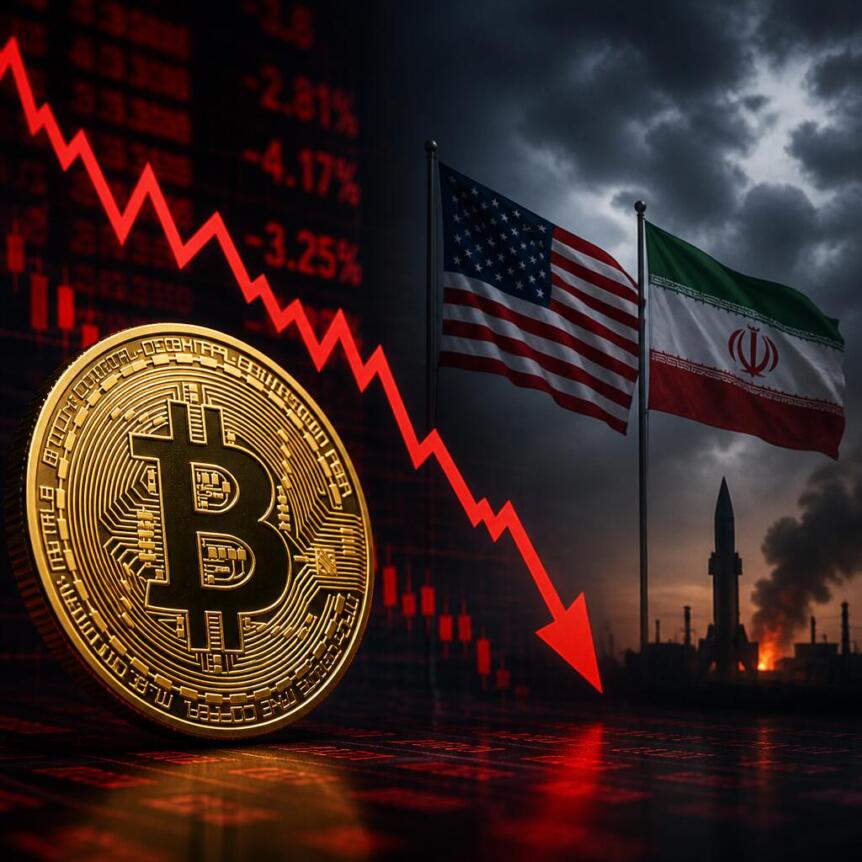
Bitcoin (BTC) started the week in positive territory, reclaiming $65,000 and extending its gains on Tuesday, crossing $66,000 and reaching an intraday high of $66,923.
However, the flagship cryptocurrency failed to cross $67,000 as another escalation in hostilities between the US and Iran raised oil prices and dampened optimism.
Bitcoin Stumbles After Fresh Geopolitical Headwinds
Bitcoin (BTC) almost breached the $67,000 mark before sellers stepped in and drove prices lower. Price action is still being dictated by three key drivers: US-Iran tensions, the Federal Reserve meeting scheduled for July 28 and 29, and risk appetite. The immediate reason for BTC’s latest downturn is fresh tension between the US and Iran.
The ongoing geopolitical situation has adversely impacted global markets and investor sentiment. Oil prices briefly declined thanks to a fragile truce between the warring nations.
However, the latest round of escalatory actions has pushed prices higher again. US Crude rose nearly 3% to $84.70 per barrel as supply fears, amid the prospect of another closure of the crucial Strait of Hormuz, resurfaced. Rising oil and energy costs could push inflation higher. A report in Reuters also confirmed a damaged tanker near the Strait of Hormuz and warned of delays in Saudi crude shipments. Houthi forces have also issued threats to ships in the area.
Clarity Act Progress And Sustained ETF Inflows Behind Bitcoin Push Above $65,000
Bitcoin (BTC) pushed higher on Tuesday after the Trump Administration reached an agreement on comprehensive federal ethics rules. The rules could also apply to President Donald Trump’s crypto interests, an issue raised repeatedly by Senate Democrats. However, it remains unclear how the restrictions will be imposed. Democratic senators have pushed for tighter restrictions on political crypto dealings, with Senator Elizabeth Warren stating that a bill that does not address the president’s links to the crypto industry would be worthless.
Reports of the agreement also pushed crypto-linked stocks higher, with Coinbase and Circle shares surging nearly 10%.
Meanwhile, spot Bitcoin ETFs extended their inflow streak for a sixth day, recording $203.2 million in inflows on Tuesday, according to Coinglass data. Total inflows over the past six days currently stand at $930.2 million. Additionally, over $223 million was liquidated in 24 hours, of which $181 million were short positions.
Bitcoin Price Action
Bitcoin (BTC) briefly pushed above the upper Bollinger band when it crossed $66,000, indicating substantial buying pressure. However, with sellers dominating around $67,000, the flagship cryptocurrency has lost ground over the past two sessions.
BTC reached an intraday high of $66,923 on Tuesday but failed to cross the resistance at $67,000. As a result, it declined to $66,086 and has extended its decline during the ongoing session, and currently trades around the $65,700 mark.
Disclaimer: This article is provided for informational purposes only. It is not offered or intended to be used as legal, tax, investment, financial, or other advice.

[PRESS RELEASE – Willemstad, Curaçao, July 23rd, 2026]
Leading crypto entertainment platform 1win announces the launch of its new X.com Ambassador Program, inviting content creators to join the brand’s growing global ambassador network and help shape conversations across the crypto and online entertainment communities.
As social platforms continue to advance in crypto adoption, the initiative is designed to strengthen 1win’s online presence by partnering with creators who can authentically engage their audiences and contribute to discussions around cryptocurrencies, crypto entertainment, blockchain, sports, Web3, and more.
Successful applicants will join 1win’s global ambassador ecosystem that includes internationally recognized names such as Luis Suárez, Tyga, Gable Steveson, and other members of the 1win family.
The 1win Ambassador Program offers three tracks tailored to different creator profiles:
- Brand Ambassador for creators who maintain a consistent, positive presence around 1win through regular organic content on X.
- Gambling Ambassador for performance-oriented creators focused on introducing new users to the platform through their content.
- Streaming Ambassador for streamers who showcase and promote 1win during their live broadcasts.
To support collaboration and community building, all ambassadors will be coordinated through a dedicated Discord server, where participants will receive campaign updates, creative guidance, exclusive opportunities, and direct communication with the 1win team.
Applications for the program are now open to active creators interested in becoming part of the 1win ecosystem and contributing to the brand’s continued global growth.
About 1win
Founded in 2016, 1win is a crypto entertainment platform in the global gaming industry. Operating across Asia, Latin America, and Africa, 1win offers a wide range of entertainment products adapted to regional audiences. The brand has active collaborations with international public figures, including football legend Luis Suarez, martial artist Jon Jones, and Olympic champion and UFC fighter Gable Steveson. In 2026, 1win welcomed rapper Tyga and UFC legend Ilia Topuria as members of the 1win VIP community.
The post 1win Invites Creators to Join Its Global Ambassador Network appeared first on CryptoPotato.
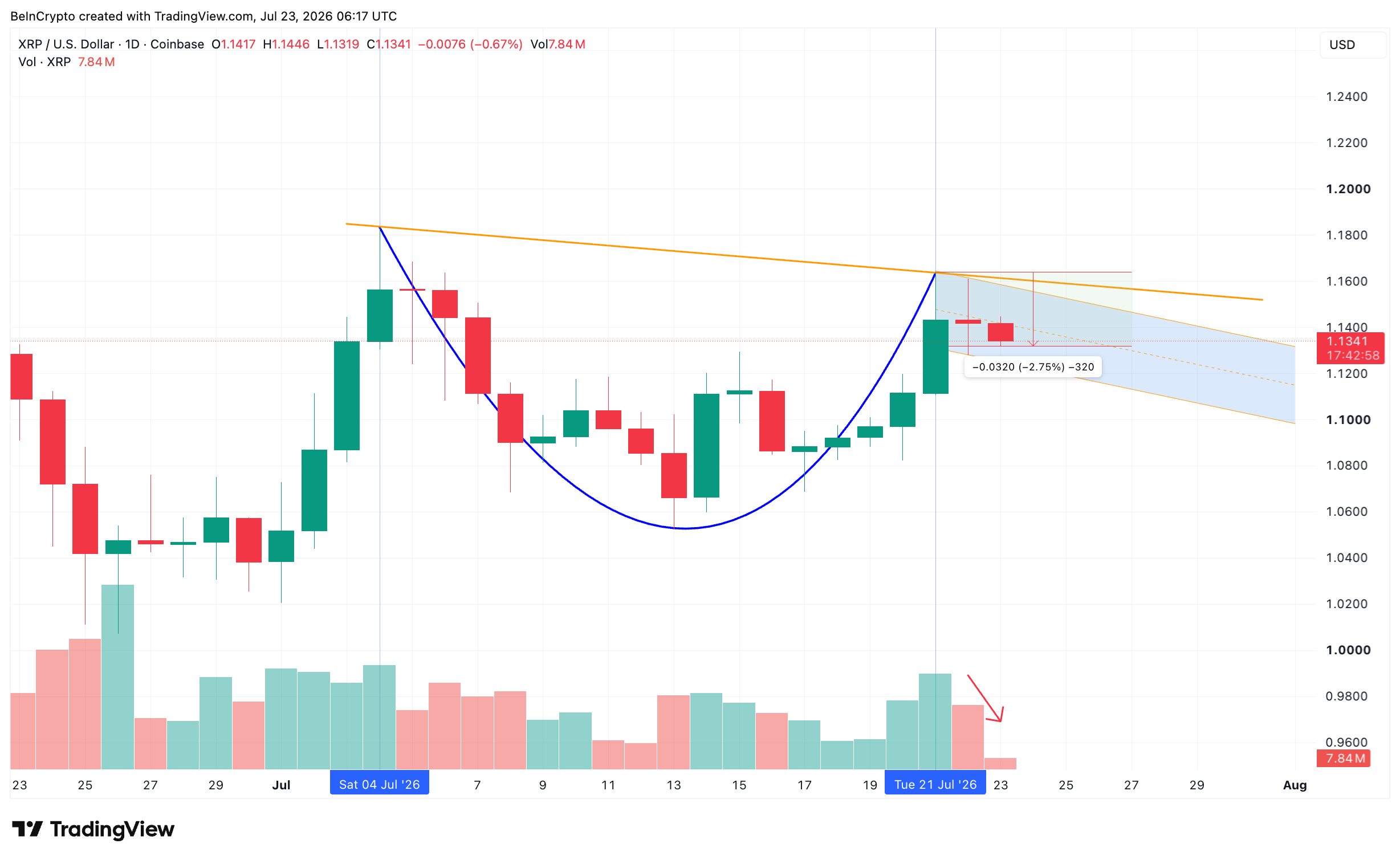
XRP (XRP) price is holding just above $1.13 after a mild pullback, keeping a bullish chart structure alive even as institutional demand shows signs of cooling.
The token has slipped since July 21, yet the drop looks orderly rather than panicked. That calm hides a sharper tension building between the price chart and the money flowing into XRP funds.
XRP Builds a Bullish Cup and Handle as Selling Fades
Since early July, XRP price has traced a cup and handle, a rounded recovery followed by a small drift lower that often forms before a breakout. The current consolidation, running since July 21, fits neatly as the handle.
Want more token insights like this? Sign up for Editor Harsh Notariya’s Daily Crypto Newsletter here.
Crucially, volume has thinned during this recent slide. Falling sell volume suggests the pullback is a pause rather than a fresh wave of exits, which keeps the XRP breakout case intact.

Still, a clean chart means little if the buyers behind it start to walk away.
XRP ETF Inflows Look Green, but the Trend Is Quietly Fading
However, the flow data carries a subtle warning that is easy to miss. On the surface, XRP ETF inflows still show green, with fresh money arriving every month since launch. Most readers would see that and assume steady strength.
Look closer at the pace, though, and a different picture emerges. Monthly inflows climbed from $81.59 million in April to a $131.94 million peak in May, then fell by more than half to $59.46 million in June.

So far in July, the funds have drawn just $12.43 million, the weakest month on record. The numbers stay positive, yet the steady slide suggests institutional buyers may be quietly stepping back, a sign of cooling XRP ETF demand.
Fund flows, however, are only half the demand picture. On-chain holder behavior hints at the same quiet shift.
Hodler Net Position Change Echoes a Familiar Warning
The Hodler Net Position Change, a metric that tracks whether long-term holders are adding or trimming their coins, is flashing a familiar signal. Back on June 22, it hit one of its highest readings.
From there, the metric fell steadily into July 1, and XRP price corrected alongside it. The XRP price fell from $1.13 to $1.05 during that time.
Then, as XRP holders began adding again, the price recovered, so the two have moved closely together.

Since July 19, the metric has turned lower once more, easing from about 231 million to roughly 226 million XRP. If that link holds, the price could fade the same way.

That leaves the chart to settle the argument.
XRP Price Levels to Watch Now
With the current swing still forming, the key levels come from the July 1 to July 13 move. The first hurdle sits at $1.15, the 0.618 Fibonacci zone, a strong technical level that marks a common pullback point within a prior move.
A clean break above $1.15 would crack the handle and put the cup neckline near $1.16 in play. Above that, $1.18 and $1.21 open up for XRP price. Still, XRP has a history of failed cup formations, so a breakout needs a decisive daily close, not just a wick.

On the downside, a drop under $1.13 exposes $1.12, then the $1.09 support. A fall below $1.05, the cup low, would void the pattern entirely. For now, $1.15 separates a fresh push toward $1.21 from a slide back to $1.09.
The post Bullish XRP Chart Clashes With an ETF Warning, Who Wins? appeared first on BeInCrypto.

AFX Trade, BSquaredNetwork, and Verus have all fallen victim to exploits over the last 24 hours.
In what many are calling “Hackers Day,” the three protocols have collectively lost over $35 million in crypto assets.
Crypto Industry Hit With Three Separate Hacks
PeckShieldAlert said it detected an attack on Arbitrum-based protocol AFX on July 22, with estimated losses of about $24.15 million USDC. The on-chain security firm added that the exploiter bridged the stolen funds from Arbitrum to Ethereum, after which they swapped them for 12,467.5 ETH.
Less than an hour later, PeckShieldAlert reported that attackers had drained BSquaredNetwork of $8.59 B2 tokens on BNB Chain, resulting in it losing approximately $3.86 million. The hackers then quickly swapped the tokens for more than 5,000 WBNB, converted them into 1,128 ETH, and bridged the funds out using NEAR Intents. The impact on the market was quick, with B2’s price dropping by over 15% in the aftermath of the exploit.
It doesn’t stop there; blockchain security firm Lookonchain also alerted the public to another incident, this time affecting Ethereum-based cross-chain bridge Verus protocol. In this case, the exploiters made off with $7.55 million.
Additionally, the latest exploit comes about two months after Verus lost roughly $11.58 million in a separate incident. Blockaid said that the July attack seems to be related to the previous exploit, describing the two as involving the same bridge contract, same entry path, and same bug class.
Monahan Questions AFX’s Security
Steven Goldfeder, a contributor at Arbitrum, has confirmed that the compromised bridge was operated independently by AFX and was not one of its native bridges.
Meanwhile, there seems to be a storm brewing elsewhere, with on-chain security expert Taylor Monahan questioning why the AFX bridge had $24 million on it in the first place.
She revealed that she had found some “terrifying” details after going through a recently published audit of the bridge. According to her, the protocol had almost no test coverage, several issues flagged by auditors were acknowledged but never fixed, and the auditors allegedly couldn’t even fully review the code because they received only parts of it.
“Honestly, they seem like a super chill team. Ah yeah it’s probably fine we’ll just wait it out and then manually send if we need to,” she wrote.
Monahan says that the biggest red flags were what the technical vulnerabilities revealed about the team’s approach to security, explaining that the situation suggested a culture that didn’t prioritize it.
The post ‘Hackers Day’: 3 Crypto Protocols Drained of $35 Million in 24 Hours appeared first on CryptoPotato.


Kakao Group has partnered with stablecoin issuer Circle to explore payment infrastructure for won-backed stablecoins as South Korea prepares a broader regulatory framework for crypto assets.
On Thursday, the companies announced that Kakao, Kakao Pay and Kakao Bank had signed a strategic memorandum of understanding (MOU) with Circle Internet Group. Under the agreement, the companies will explore ways to connect Circle’s blockchain and global payment infrastructure with Kakao’s consumer platforms and financial services.
The agreement highlights how major South Korean consumer and financial platforms are positioning themselves ahead of expected stablecoin legislation, even before the regulatory framework is finalized.
Under the MOU, the companies plan to examine stablecoin payments, cross-border remittances, merchant settlement and connections between existing financial systems and blockchain networks.
The companies will also consider support for tokenized financial services, but they did not disclose any products or launch timelines.
Cointelegraph reached out to Circle and Kakao Group but did not receive a response before publication.
South Korea’s stablecoin framework
South Korea has been working toward legislation governing won-backed stablecoins as policymakers seek to encourage digital payment innovation while addressing risks related to reserves, redemption and issuer oversight.
The government has been preparing a bill that would establish requirements covering stablecoin issuance, collateral management and internal controls. Lawmakers have also introduced competing proposals as support has grown for won-pegged tokens aimed at reducing reliance on the US dollar.
However, the regulatory process has stalled over disagreements about which institutions should be permitted to issue won-based stablecoins.
The Bank of Korea, the country’s central bank, argued that banks should retain a majority stake in stablecoin issuers, while the Financial Services Commission warned that eligibility limits could restrict competition and innovation.
In its economic growth strategy announced on July 14, the government listed advancing the Digital Asset Basic Act among its priorities for the second half of 2026.
Related: South Korean regulator misses stablecoin bill deadline: What’s next?
Meanwhile, companies and financial institutions have begun testing the technology in South Korea. In April, internet bank Kbank partnered with Ripple to test blockchain-based remittances.
In May, KB Financial Group completed a pilot covering stablecoin issuance, offline merchant payments and cross-border remittances through the Kaia blockchain. The group said it was preparing to introduce stablecoin services once the regulations take effect.
Magazine: Why Australia’s $17B crypto opportunity depends on regulation
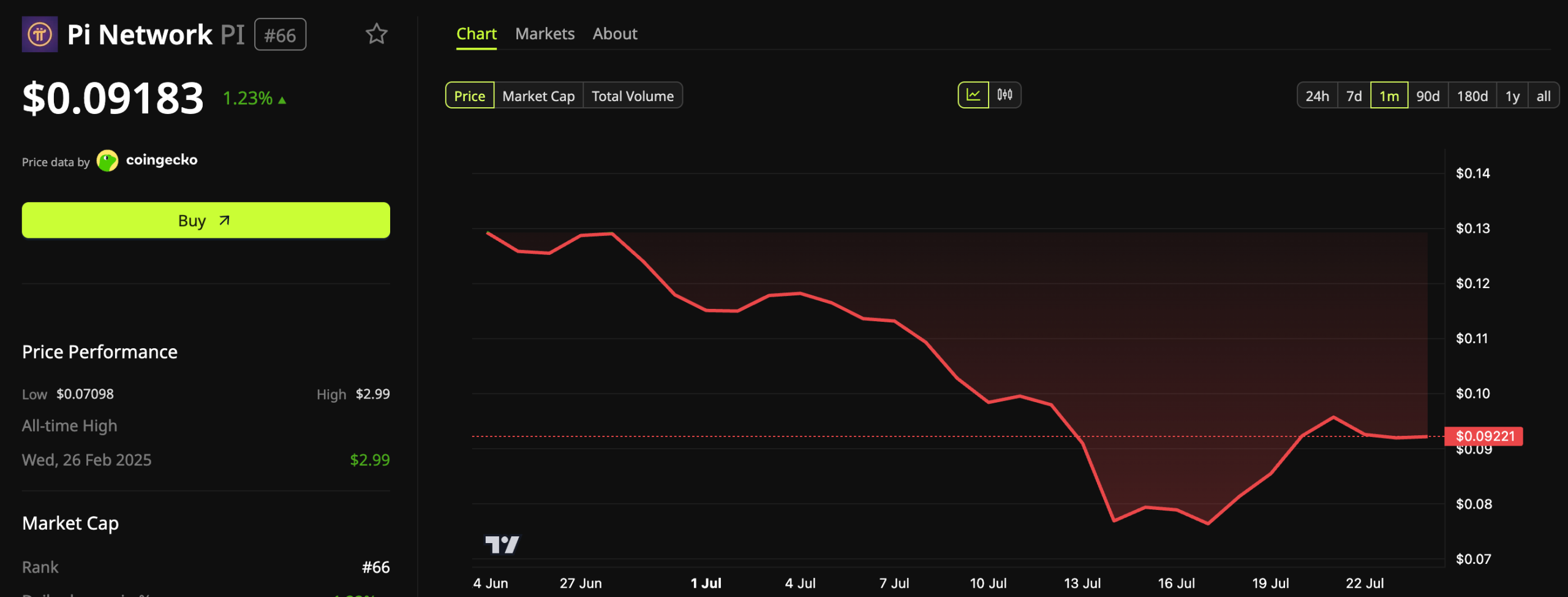
Pi Network activated Protocol v25 on July 22, its latest major upgrade of 2026, yet PI stalled below $0.10 after a rally carried the token briefly beyond that level.
The result echoed earlier upgrades. Recent protocol releases drew trader interest but failed to produce a lasting price gain.
Pi Coin’s Rally Stalls Amid Protocol Upgrade
PI slipped to an all-time low of $0.0705 on July 14. It recovered through the following week, briefly spiking to an intraday high of $0.103 on July 19, but failed to hold the level
Buyers positioned into the July 22 upgrade, a dated catalyst that gave the market a clear event to trade around. Both price and volume increased before the release landed.
Pi coin has since eased back toward $0.0918, unable to reclaim the $0.10 level it briefly tagged.

Volume tells the same story. Daily volume rose to $33.7 million on July 20, then fell to about $18.5 million on launch day and has been lower since. Buyer interest thinned as the event passed.
Protocol v24 followed a similar pattern in June. PI posted modest gains ahead of the upgrade, only to resume its downtrend.
Why the Pi Network Upgrade Struggles to Move Price
Protocol v25 introduces BN254 cryptography and Poseidon hashing, the building blocks for building modern zero-knowledge applications. The Pi Core Team also shipped a redesigned mining app for its 60 million Pioneers.
Follow us on X to get the latest news as it happens
The improvements are real, yet the price response was muted. The answer lies in broader market forces and PI’s own supply.
Exchange flows show little sign of forced selling. Tracked exchange wallets recorded a net outflow of about 260,000 PI over 24 hours, a minor move against balances near 540 million PI.
The pressure sits further out. According to PiScan, roughly 1.71 billion PI, worth about $157 million, is scheduled to unlock over the next 12 months, with the heaviest single month near 432 million PI in December 2027.
That steady release meets a thin market, capping rallies regardless of upgrade news. The same overhang blunted earlier releases.
Development news drives short-term bounces, while unlock supply sets the ceiling. Whether v25 can convert utility into demand remains the open question for the weeks ahead.
Subscribe to our YouTube channel to watch leaders and journalists provide expert insights
The post Protocol v25 Goes Live as PI Rally Stalls Below $0.10 appeared first on BeInCrypto.

‘House of the Dragon’ Just Exposed the Darkest Storyline in ‘Game of Thrones’ History

Fine skies a welcome sight for Litt and Barber in 2026

Why Lettuce Is Always Making People Sick

Renter of Home in Anne Heche Crash Denies Settlement With Son

No Jackpot Winner as $257 Million Prize Rolls Over to $269 Million Monday Draw

Weekend Open Thread: Staud – Corporette.com

The Gold Revaluation Theory That Could Change Bitcoin Forever!

3 Valuable Financial Tips on how to not SCREW your life up as a Blue Collar Worker, Thoughts?

Why XRP Could Explode To 4 Digits Very Soon??! (Andrei Jikh & David Schwartz)
-
 NewsBeat7 days ago
London Mayor Sadiq Khan handed a peerage by Keir Starmer alongside 15 other Labour figures… just days before the PM leaves No10
-

 Fashion6 days ago
Weekend Open Thread – Corporette.com
-

 Politics5 days ago
The House | The City of London can help the new chancellor deliver growth in every postcode
-

 Crypto World5 days ago
Ripple Payments Joins MiCA With 14 Firms, Does It Mean Anything For XRP?
-
 Crypto World6 days ago
Two July Windows Left: The CLARITY Act’s Senate Fight and What Failure Means
-

 Politics4 days ago
Democrats look to World Cup watch parties to register thousands of voters
-

 Crypto World5 days ago
Ripple wins EU-wide access as ESMA adds it to MiCA register
-

 Crypto World2 days ago
Grayscale Files For Worldcoin ETF, WLD Registers Sharp Rise
-

 NewsBeat3 days ago
Unregistered fitter used Gas Safe logo on business flyers
-

 Tech2 days ago
Sail Virtually Aboard The “Itanic” With IA-64 Emulator
-

 Crypto World6 days ago
Injective Submits SEC Transfer-Agent Registration to Onchain Ownership Records
-
 Tech2 days ago
Turtle Beach Command Series KB7 review: a nifty screen-equipped gaming keyboard
-

 NewsBeat6 days ago
Registration is now open for March for Men with Kev 2026
-
 Business1 day ago
New Jersey voter registration controversy explained: How 6,600 noncitizens got on the rolls, and what happens next
-

 Crypto World6 days ago
Claude Fable 5 Slips to Second in AI Coding Leaderboard
-

 News Videos6 days ago
Money | Class 12 Economics | CBSE Board Exam 2026-27
-

 Business6 days ago
Banco Bilbao Vizcaya Argentaria, S.A. (BBVA) Discusses Global Macro Environment and Economic Outlook for Core Markets Transcript
-

 Crypto World5 days ago
Kaspersky exposes OkoBot’s 20-module crypto wallet attack
-

 News Videos4 days ago
Big Money Is Entering XRP
-

 NewsBeat5 days ago
Durham County Council to send out electoral registration emails
You must be logged in to post a comment Login