

Crypto World
XRP Holds Strong Above $1 Mark Amid Surging Network Activity and ETF Interest

Key Takeaways
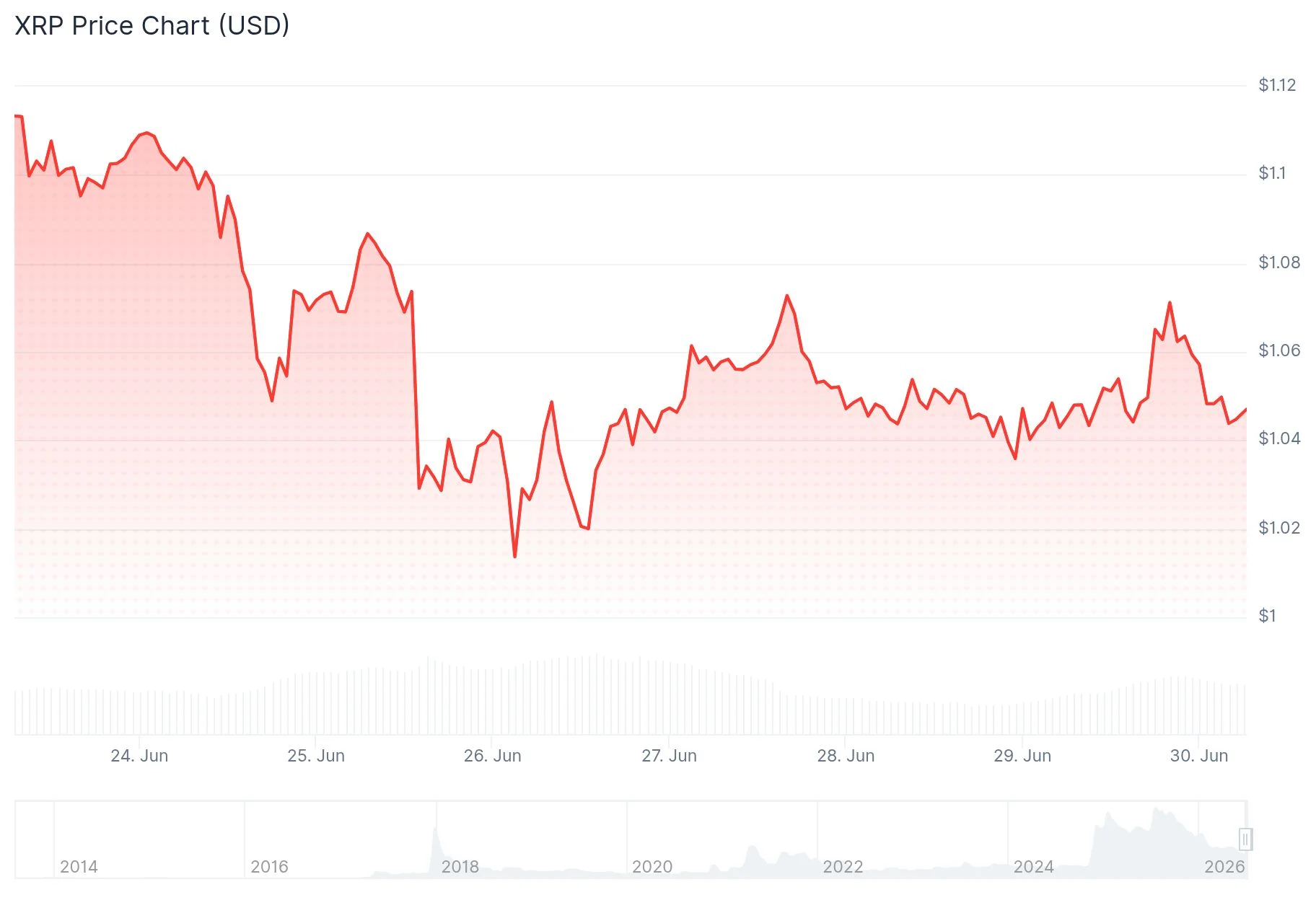
- XRP currently hovers around $1.05, maintaining stability above the critical $1 threshold following a June 25 dip to $1.01—the lowest level in 19 months.
- Tokens flowing out of exchanges increased dramatically, jumping from 40.7 million to approximately 123 million XRP within days, suggesting potential accumulation by holders.
- Spot XRP ETFs recorded their eighth consecutive week of positive inflows, bringing total cumulative inflows to approximately $1.47 billion.
- Network engagement surged with daily active addresses climbing 72% over a two-week period, moving from 23,000 to nearly 39,500.
- Derivatives open interest contracted sharply from 1.3 billion to under 150 million, indicating a significant deleveraging event.
XRP maintains its position around the $1.05 level following a challenging June performance. The digital asset touched approximately $1.01 on June 25, marking its lowest valuation in 19 months, yet purchasing pressure has successfully defended the psychologically important $1.00 threshold in subsequent trading sessions.
While price action has remained subdued, the underlying XRP Ledger has demonstrated notable vitality. The blockchain recorded 4,941 newly created wallets within a 24-hour window, representing the most significant single-day expansion in wallet creation observed over the past three months.
Concurrently, daily active addresses have experienced substantial growth. The metric expanded from approximately 23,000 on June 14 to nearly 39,500 by June 27, reflecting a 72% increase within a fortnight.
Token Movement and Institutional Capital Flow
Blockchain analytics reveal an accelerating trend of tokens being withdrawn from centralized exchanges. The exchange net position change metric shifted from roughly 40.7 million XRP on June 22 to approximately 123 million XRP several days afterward, representing an increase of nearly 200%.

Such withdrawal patterns typically indicate that holders are moving assets into self-custody rather than positioning for immediate sales. Meanwhile, institutional appetite for XRP exposure continues unabated.
Spot XRP exchange-traded funds have maintained positive net inflows for eight consecutive weeks. Total cumulative inflows now approach $1.47 billion, with an additional $22.99 million recorded during the week ending June 26.
Notably, on June 26, XRP-focused ETFs attracted $15.6 million in capital while bitcoin-based products experienced $444.5 million in withdrawals and ethereum funds recorded $12.9 million in outflows.
The derivatives market has undergone significant consolidation. Open interest across primary trading venues declined from a peak exceeding 1.3 billion to beneath 150 million, eliminating substantial speculative positioning that accumulated during XRP’s previous upward movement.
Market intelligence firm Santiment Intelligence highlighted this divergence between price weakness and growing network participation in a recent analysis. The firm observed that new wallet creation and optimistic market sentiment are materializing even as price threatens the $1 level, with sentiment analysis revealing 3.7 positive comments for each negative one—the highest ratio in three months.
Critical Technical Zones Under Observation
XRP has remained confined within a descending price channel throughout the past year. The 20-period exponential moving average, which tracks near-term momentum, currently aligns with the upper boundary of this channel in the $1.18 to $1.22 range.
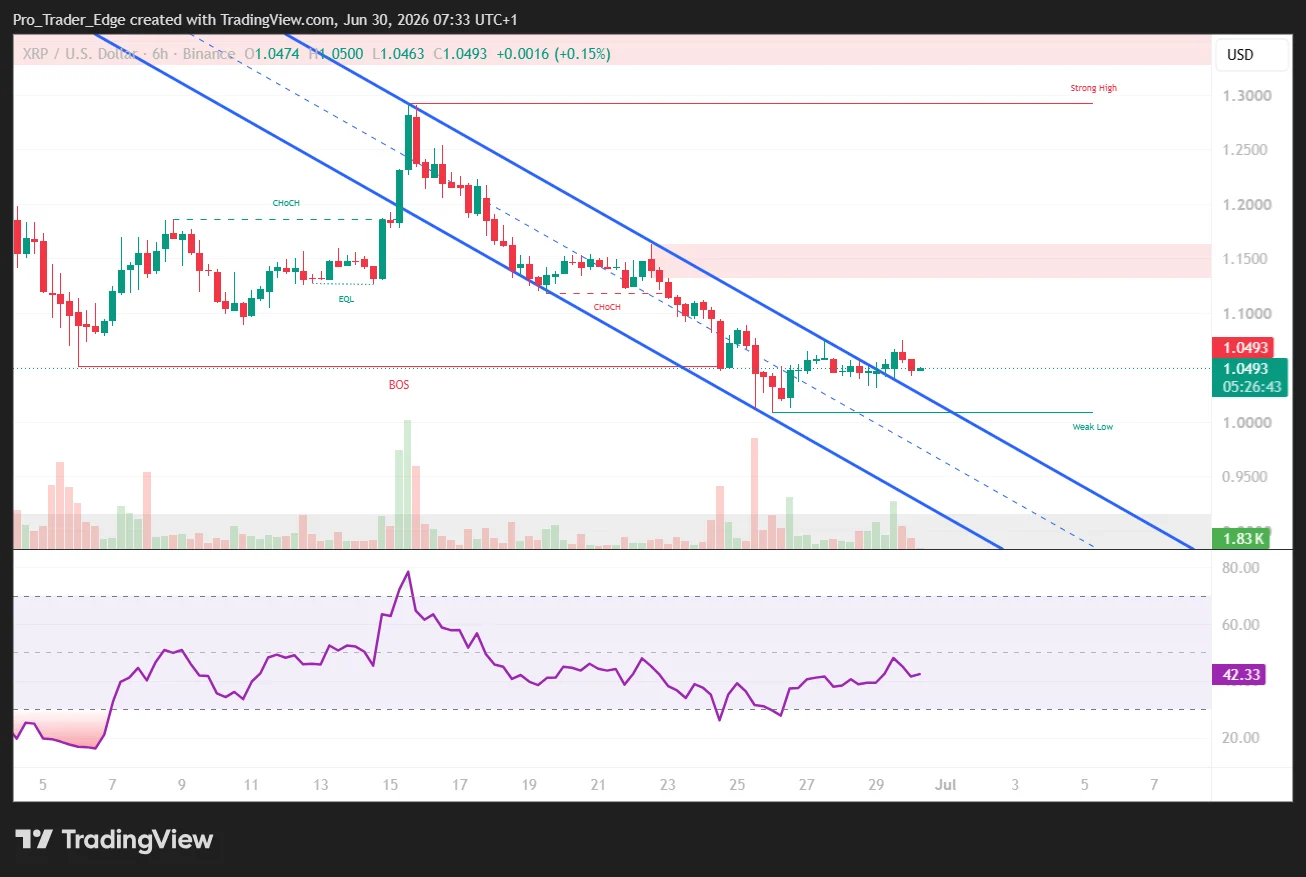
This region also coincides with a Fibonacci retracement level at $1.178 and a concentration of approximately 22.8 million XRP in cost basis distribution between $1.18 and $1.19. An additional 27.4 million XRP are positioned between $1.21 and $1.22.
These price zones represent areas where previous purchasers may attempt to exit positions at breakeven, establishing resistance. A decisive move above $1.18 followed by $1.22 would push XRP beyond its established downtrend into more neutral technical territory.
For downside protection, immediate support is established near $1.02. A violation of this level could potentially trigger a decline toward $0.87, according to Fibonacci extension analysis.
In the near term, market participants are monitoring $1.06 as initial resistance, followed by the $1.09 to $1.10 zone where previous recovery attempts have encountered selling pressure. A sustained move above $1.20 would represent the first meaningful indication of a potential trend reversal.
The 4-hour relative strength index has recovered to 46 after entering oversold territory, though it remains below the neutral 50 threshold. Price action recently consolidated within a $1.03 to $1.06 range, with peak trading volume occurring on June 29 at 17:00 UTC when 86.5 million XRP were exchanged.



Key Points
- Since reaching its peak in October, Tencent has experienced a market capitalization decline of approximately $309 billion, with Hong Kong-listed shares falling over 35%.
- Daily stock repurchases have become routine since mid-May, with June’s buyback expenditure exceeding HK$9 billion ($1.1 billion), marking the highest monthly figure in 2025.
- Following a May 13 shareholder vote, Tencent secured authorization to repurchase approximately 912 million shares, representing roughly 10% of outstanding stock.
- Market participants continue expressing skepticism regarding the company’s ability to generate returns from AI investments, which are projected to exceed 36 billion yuan by 2026—more than double current levels.
- Current forward price-to-earnings ratio stands at 11.2x, representing the lowest valuation in company history and trading below even utility provider CLP Holdings.
The tech powerhouse based in Shenzhen has embarked on an aggressive share repurchase campaign rather than pursuing external acquisitions. Since mid-May, Tencent has been systematically acquiring its own equity on nearly every trading session in an effort to stabilize a stock price that has suffered dramatically in recent months.
Tencent Holdings Limited, TCTZF
The data paints a stark picture. Since October’s peak, Tencent‘s Hong Kong-traded shares have plummeted more than one-third in value. This dramatic downturn has vaporized approximately $309 billion in total market capitalization.
June has emerged as a particularly active period for share repurchases. The company allocated more than HK$9 billion, equivalent to roughly $1.1 billion, toward buying back its own stock this month. This figure is on track to establish a new record for monthly repurchase activity in 2025.
On a single day—June 15—Tencent repurchased approximately 1.081 million shares totaling HK$5.01 billion, with transaction prices spanning HK$458 to HK$475.6 per share. Earlier, on May 22, the company acquired an additional 1.132 million shares for HK$500.56 million.
Market Sentiment Shifts Negative
The stock’s decline can be traced directly to investor apprehension surrounding Tencent’s substantial AI investment commitments. March witnessed a catastrophic single-session market value erosion of $66 billion following the company’s disclosure of its artificial intelligence spending roadmap.
Management announced in March plans to more than double AI-related capital allocation to surpass 36 billion yuan—approximately $5.3 billion—by 2026. Market participants remained unconvinced that future returns would justify such substantial expenditure.
“Market participants are adopting a wait-and-see approach—they’re demanding tangible evidence that these investments will generate returns, but concrete proof has been lacking,” explained Agnes Ng, portfolio specialist at T. Rowe Price. She noted that investors are specifically awaiting clear monetization pathways for Tencent’s AI initiatives.
Notably, mainland Chinese investors—who traditionally provided support during previous downturns—have become net sellers for three consecutive months ending in June.
Authorization for Share Repurchases
The company’s buyback initiative operates under substantial authority. During the annual general meeting held May 13, shareholders granted approval for Tencent to repurchase up to approximately 912 million shares, equivalent to nearly 10% of total issued equity.
This authorization provides considerable flexibility for continued share acquisitions should the downward price trajectory persist. As of late June, the company’s market capitalization has fluctuated between approximately $470 billion and $485 billion.
Despite the extensive buyback activity, Tencent’s shares remained down 1.8% for June. This compares favorably to the Hang Seng Tech Index, which experienced a more severe 10% decline during the same timeframe.
Should June conclude in negative territory, it would represent the company’s fifth consecutive monthly loss, establishing the longest losing streak since 2018.
Tencent’s situation reflects broader industry trends. Citigroup analysts, including Alicia Yap, anticipate increased buyback activity across Chinese internet firms as companies attempt to retain investor confidence. Meituan’s chief executive recently characterized the food delivery platform as “severely undervalued” and announced plans for its own repurchase program.
Both Meituan and Alibaba shares have declined approximately 35% year-to-date. Regarding valuation metrics, Tencent currently trades at 11.2 times one-year forward earnings, representing an all-time low for the company and falling below utility operator CLP Holdings, which trades above 15 times earnings.
This month, Tencent initiated testing of a new AI-powered assistant integrated into WeChat, branded as Weixin domestically, as part of its strategy to remain competitive with local AI developers.
Last week was one of the worst for US technology stocks since the beginning of 2026, with the index losing around 4.6% under the influence of two opposing factors. Firstly, the market continued to reassess the pace of returns on AI infrastructure investment — concerns that spending is outpacing actual returns triggered a sell-off in semiconductor stocks, with the Philadelphia Semiconductor Index falling nearly 8% over the week. Secondly, the US-Iran conflict surrounding the Strait of Hormuz escalated over the weekend: Tehran claimed responsibility for attacks on commercial vessels, while the US responded with air strikes. By Monday morning, tensions had eased somewhat as both sides announced a temporary halt to hostilities and agreed to hold talks in Doha on Tuesday. Against this backdrop, Nasdaq-100 futures gained around 1.1%.
Technical Picture
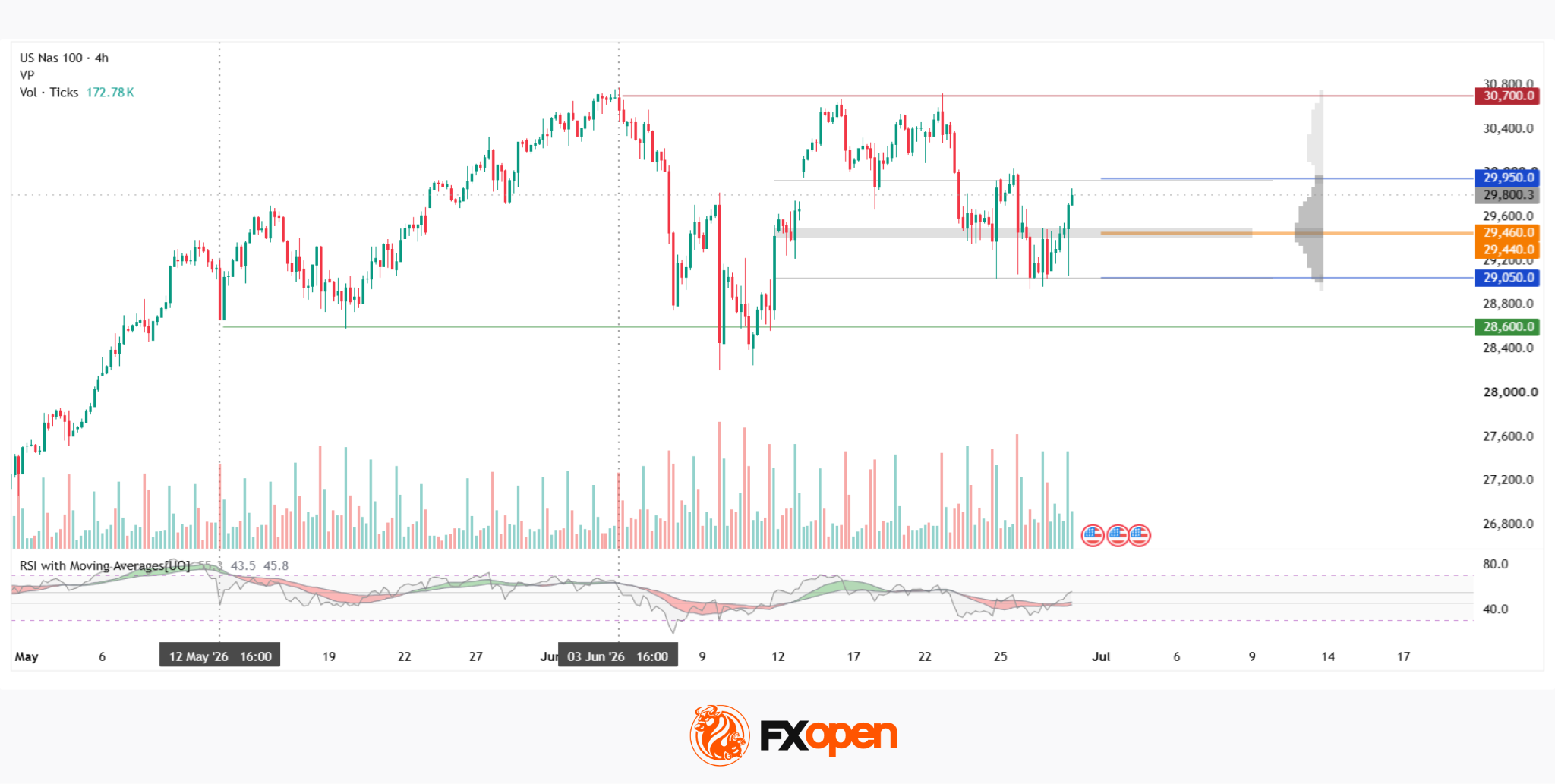
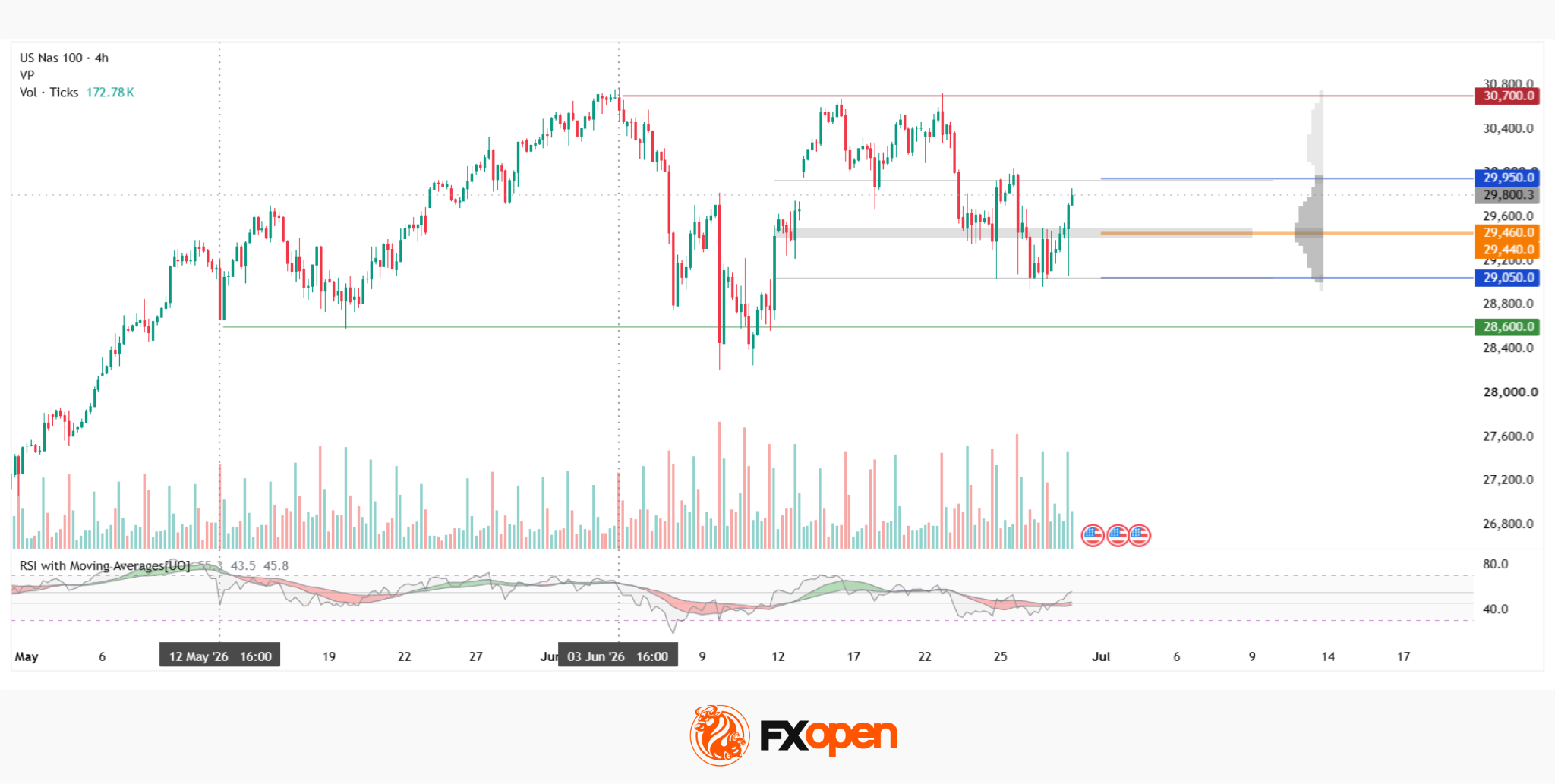
On the four-hour chart, the Nasdaq-100 (NDXm on FXOpen) has been trading within a sideways range since May, bounded by support near 28,600 and resistance around 30,700 — a range that formed following the June peak. After reaching that peak, the index experienced a sharp decline on 9 June, accompanied by exceptionally high trading volume. As a result of buyers defending the local lows, the price has since concentrated near the centre of the current range.
At present, the price is holding above the POC zone at 29,440–29,460, which may be viewed by market participants as the key point of attraction within the range. The price is approaching intermediate resistance at the upper boundary of the profile at 29,950, above which lies the red resistance level. RSI + MAs shows readings of 55, 43 and 45 — the oscillator remains above both moving averages, although the moving averages have yet to confirm a potential reversal and remain near the lower boundary of the neutral zone.
Key Takeaways
News of a pause in the US-Iran conflict supported the Nasdaq-100 at the market open, although concerns surrounding AI-related spending remain unresolved and were the primary driver of price action throughout June. The POC zone continues to serve as the key reference point for the balance between supply and demand: this is where the largest concentration of horizontal volume is located, and holding above this area could indicate that the market is preparing to continue its move towards the upper part of the range.
Trade global index CFDs with zero commission and tight spreads (additional fees may apply). Open your FXOpen account now or learn more about trading index CFDs with FXOpen.
This article represents the opinion of the Companies operating under the FXOpen brand only. It is not to be construed as an offer, solicitation, or recommendation with respect to products and services provided by the Companies operating under the FXOpen brand, nor is it to be considered financial advice.
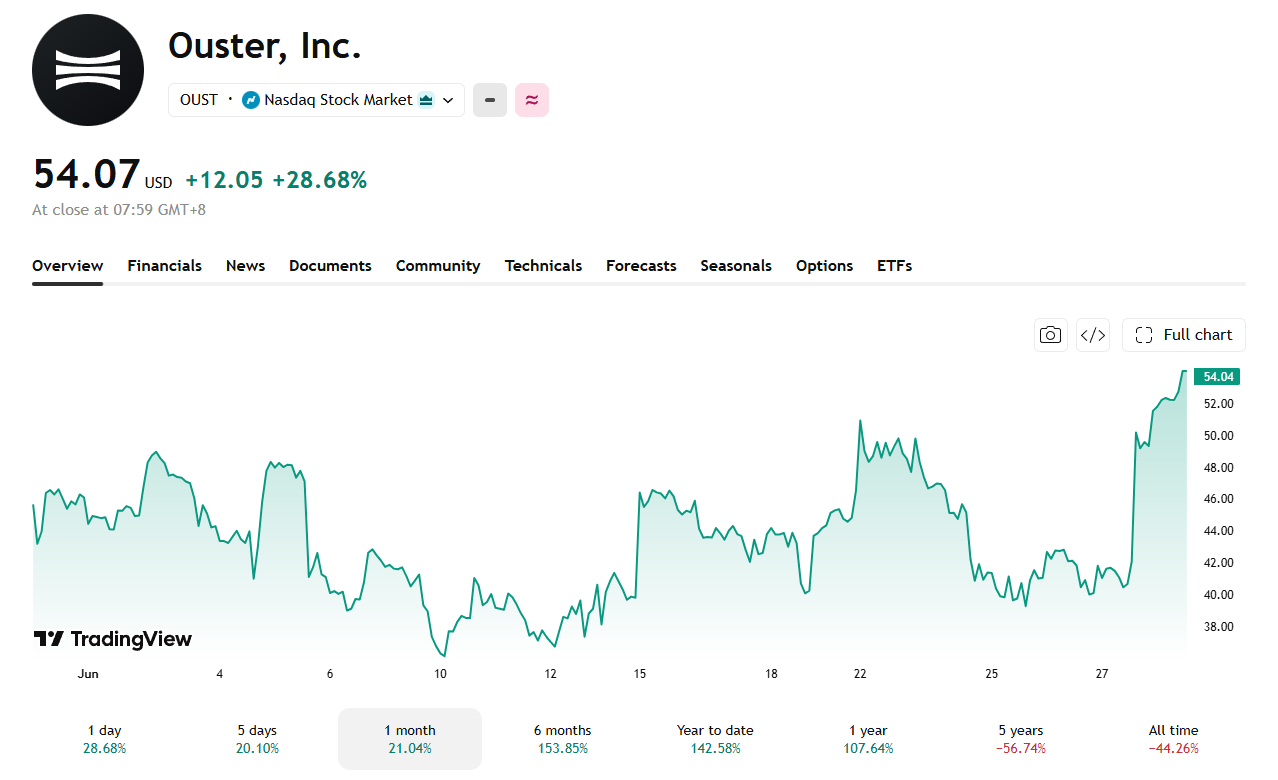
Ouster (NASDAQ: OUST) shares jumped by more thab 28% on June 29, extending a multi-week rally that has taken the stock to near $55.
The move follows a stack of newly announced manufacturing and partnership deals tied to the company’s Rev8 lidar platform.
What Is Driving Ouster Stock Higher
Ouster is a San Francisco-based lidar company, founded in 2015 by Angus Pacala and Mark Frichtl, that makes high-resolution digital lidar sensors giving 3D vision to vehicles, robots, drones, and fixed infrastructure like traffic systems.
Year-to-date, the company is up 142%, but on Monday, it rose 28.68% in a single day. Trading volume on the rally days has run several times above Ouster’s average. The stock’s 52-week high was set in the same stretch at around $54.

The centerpiece of the run is an expanded manufacturing partnership with Benchmark Electronics. Ouster is committed to building more than 100,000 Rev8 OS digital lidar sensors per year over a 10-year horizon, targeting industrial, robotics, automotive, and smart infrastructure customers.
Ouster also signed a multi-year agreement with AIM Intelligent Machines to supply Rev8 native-color lidar for autonomous heavy equipment. The deal targets retrofitting mining, construction, and defense machinery into self-driving fleets.
AIM designed its autonomy kit to install in under 24 hours without voiding equipment warranties, and it can run without cellular networks, cloud access, or GPS. That offline capability matters for remote mining sites and defense applications where no one can guarantee connectivity.
The Risks Behind the Rally
Ouster still isn’t making money. The company brought in about $169 million in revenue over the past year and keeps a healthy chunk of that as gross profit, but after covering operating costs, it’s losing money, and it’s burning cash too. On the plus side, Ouster has little debt and plenty of cash on hand, so it isn’t under pressure to raise money anytime soon.
That said, the stock price has run well ahead of the business itself. Investors are now paying a steep premium relative to Ouster’s sales. This is the kind of pricing that assumes a lot of future growth actually shows up. Company insiders have also sold tens of millions of dollars’ worth of shares over the past three months.
The real test comes at Ouster’s next earnings report on August 6. That’s when investors will find out whether the Benchmark, AIM Intelligent Machines, and FieldAI deals are actually turning into revenue. Or, whether the stock has gotten ahead of what the company can currently deliver.
Robotics and Government Deals Add Momentum
A separate collaboration with FieldAI puts Rev8 lidar into general-purpose robots built for unstructured environments. The deal broadens Ouster’s addressable market beyond passenger vehicles into the wider robotics buildout.
Ouster’s BlueCity traffic management platform has also gone live at more than 40 highway sites near MetLife Stadium. The deployment creates a digital model of traffic flow ahead of matches for the FIFA World Cup. It added roughly 4% to the stock on the announcement.
The post OUST Stock Explained: The Deals Behind Ouster’s Explosive 28% Rally appeared first on BeInCrypto.
Crypto World
Ionic Digital, Celsius-Linked Bitcoin Miner, Targets Nasdaq Direct Listing Amid AI Shift

Ionic Digital, the company formed out of the Celsius Mining restructuring, has filed with the U.S. Securities and Exchange Commission to list on the Nasdaq via a direct listing. The move is designed to create a public trading venue for existing shareholders rather than to generate fresh funding for the business.
In a registration statement submitted on Monday, Ionic said registered stockholders may sell up to 10.8 million shares of Class A stock under the proposed ticker “IOND,” according to the SEC filing: https://www.sec.gov/Archives/edgar/data/2007691/000118518526002704/ionicdigis1061026.htm.
Key takeaways
- Ionic Digital has filed for a Nasdaq direct listing that would allow existing shareholders to sell Class A shares, not to raise new capital.
- The company plans to trade under the proposed ticker “IOND,” with up to 10.8 million Class A shares available for sale by registered stockholders.
- Ionic’s strategy is shifting from Bitcoin mining toward AI and high-performance computing infrastructure.
- A major part of that plan centers on a 234-megawatt Texas power site that the company leased for AI workloads under a long-term contract.
- Recent financial results show leasing revenue rising while Bitcoin mining revenue has declined year over year.
Why the direct listing matters for Celsius creditors
For many participants in the Celsius bankruptcy process, the practical challenge has been converting received restructuring shares into liquid, market-priced assets. Ionic’s filing indicates that the proposed Nasdaq direct listing is meant to address that: the listing “will not raise new capital” and instead establishes a public market for existing shares.
That includes former Celsius creditors who received Ionic shares through the lender’s restructuring plan, the company said in its SEC submission. In other words, the immediate purpose is liquidity and price discovery—important for holders who may otherwise be waiting for private market exits or secondary trading limitations.
From mining operator to AI infrastructure provider
Ionic was formed in 2024 to acquire Celsius Mining’s assets as part of the bankruptcy restructuring. In its filing, the company described a strategic pivot that began in 2025: it is repositioning itself from a Bitcoin-mining-focused business into a digital infrastructure company that serves AI and high-performance computing workloads.
A key element of that pivot is the company’s Ward County property in Texas. The site—originally developed to support Bitcoin mining—has been repurposed for AI infrastructure demand. According to the company, Ionic’s AI strategy is anchored by a long-term lease that turns a mining power base into contracted computing capacity.
The Ward County lease underpins the new revenue model
The SEC filing ties the AI transition to a contract Ionic executed in October 2025. Ionic said it leased the Ward County facility to AI infrastructure provider Nscale under a 126-month agreement. Ionic characterized the deal as nearly $2 billion in contracted revenue.
Importantly, the company noted the contract may be expandable. The agreement could include an additional 89 MW if Ionic secures the necessary capacity and approvals. If that additional capacity is brought into the arrangement, Ionic said the contracted revenue could rise to approximately $2.6 billion, as stated in the filing.
The company also pointed to evidence that its pivot is beginning to reflect in financial reporting. In the first quarter of 2026, Ionic reported $44 million in digital infrastructure leasing revenue. At the same time, it said Bitcoin mining revenue declined 82% year over year to $7.4 million, alongside a reduced number of active miners and the ongoing repurposing of the Ward County site.
Share sale logistics and what comes next
Under the SEC registration statement, registered stockholders may sell up to 10.8 million shares of Ionic’s Class A stock in connection with the proposed direct listing. Because a direct listing does not necessarily involve a traditional underwriting process designed around raising capital, the structure typically emphasizes secondary liquidity—consistent with Ionic’s stated goal that the Nasdaq move is not intended to fund new operations.
The filing also lands after Ionic completed a $400 million equity private placement on Friday, according to company communications referenced in the original coverage. Ionic said the proceeds are intended for general corporate purposes, and its CEO, Andy Stewart, indicated the funding supports continued development of its digital infrastructure assets.
For investors and Celsius creditors watching this transition, several details will likely determine how quickly the market starts pricing Ionic’s AI thesis. These include how much additional capacity (if any) is secured beyond the initial contract footprint, and whether leasing revenue keeps growing fast enough to offset the decline in mining-related income.
Near-term, the key question is whether Ionic’s contractual roadmap for AI and high-performance computing continues to translate into steadily increasing reported revenue as Bitcoin operations are further wound down and capacity is redeployed.
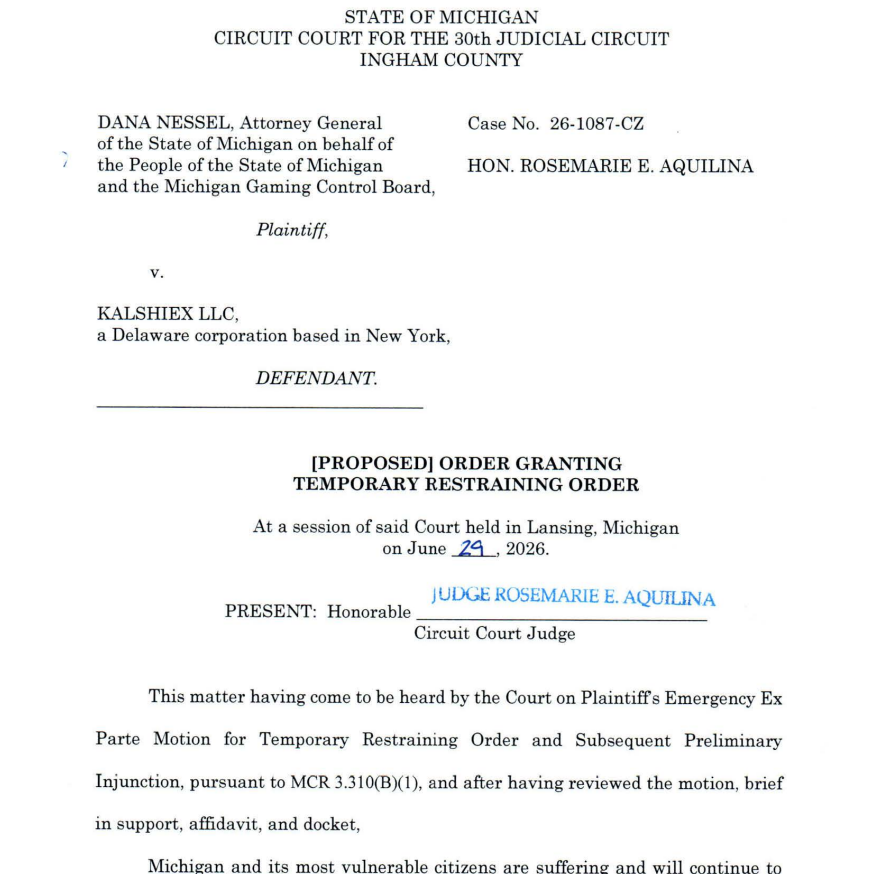
A Michigan judge temporarily blocked prediction market Kalshi from allowing residents to place bets on sporting events, after the state’s attorney general accused the platform of violating gambling laws.
Kalshi was hit with a temporary restraining order from Ingham County Circuit Court Judge Rosemarie Aquilina, who said the platform would be fined $120,000 for each day it fails to comply with the order’s geolocation requirements, according to a Monday court filing. The order lasts for 14 days and expires on July 13.
Aquilina wrote that Michigan residents would suffer irreparable harm from being “exploited by Kalshi’s sports betting operation masquerading as an investment opportunity.”
The move adds to the growing regulatory scrutiny on prediction market sports betting. It makes Michigan the second US state to enact a court-ordered ban on Kalshi’s sports event contracts, after Nevada issued a temporary ban on Kalshi earlier in March.
On June 17, Kentucky sued five prediction market platforms, including Kalshi and Polymarket, accusing them of operating unlicensed sports betting platforms. More than a dozen other states have taken prediction market operators to court.
The US Commodity Futures Trading Commission (CFTC) has sued several states, arguing that federally regulated event contracts fall under its exclusive authority.
Cointelegraph has approached Kalshi for comment on how the platform will respond to the verdict.
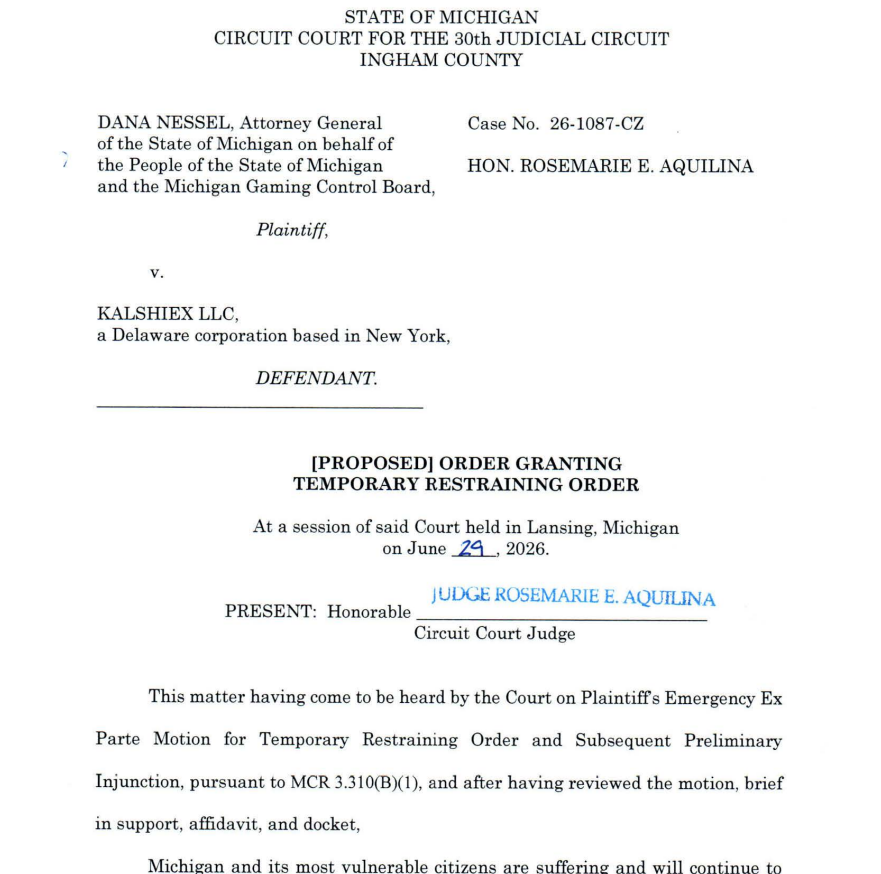
State of Michigan vs. Kalshi, court filing. Source: Law360
Prediction market sports betting rises after the FIFA World Cup
Sports betting activity has been rising on prediction markets since the beginning of the FIFA World Cup.
Daily taker volume, which measures contracts bought or sold by traders filling existing orders, reached a record $713 million on June 20, according to Dune data. The milestone came more than a week after the World Cup started on June 11.
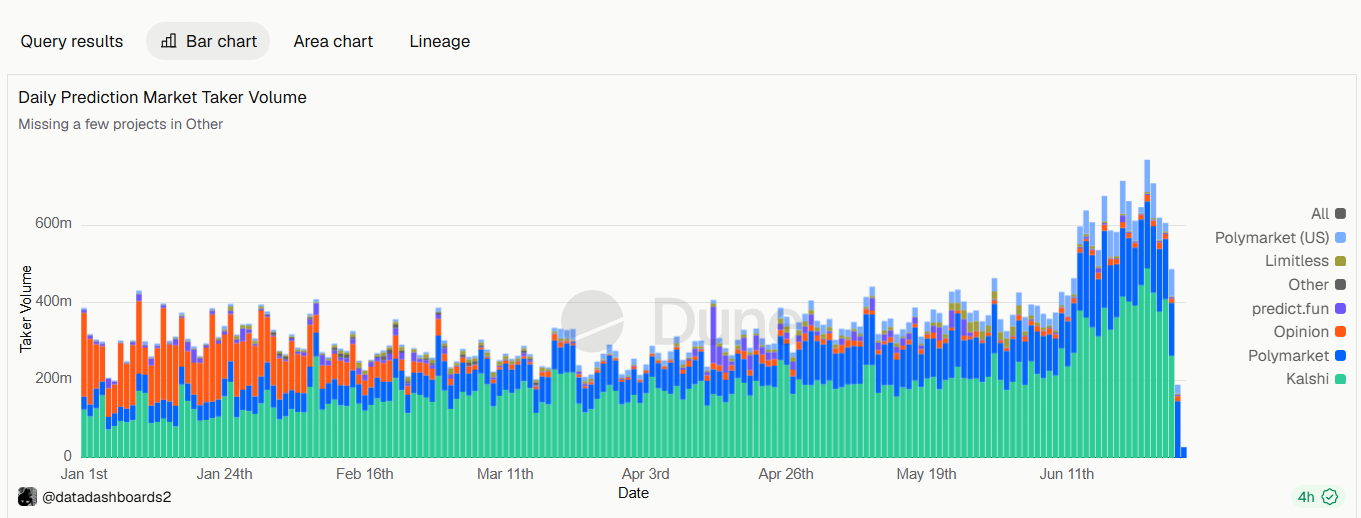
Daily prediction market taker volume. Source: Dune
Looking at monthly prediction market volume, sports betting was the leading category on the two largest prediction markets, rising 40% to $9.5 billion on Kalshi and 175% to $5.3 billion on Polymarket, Defirate data shows.
A June 11 Bernstein report predicted that the 2026 FIFA World Cup would generate more than $3 billion in incremental sports betting handle and between $5 billion and $10 billion in additional consumer prediction market volume.
Related: Kalshi in early IPO talks with investment banks: Report
The World Cup winner contract alone has generated over $3.5 billion in trading volume on Polymarket, according to platform data.
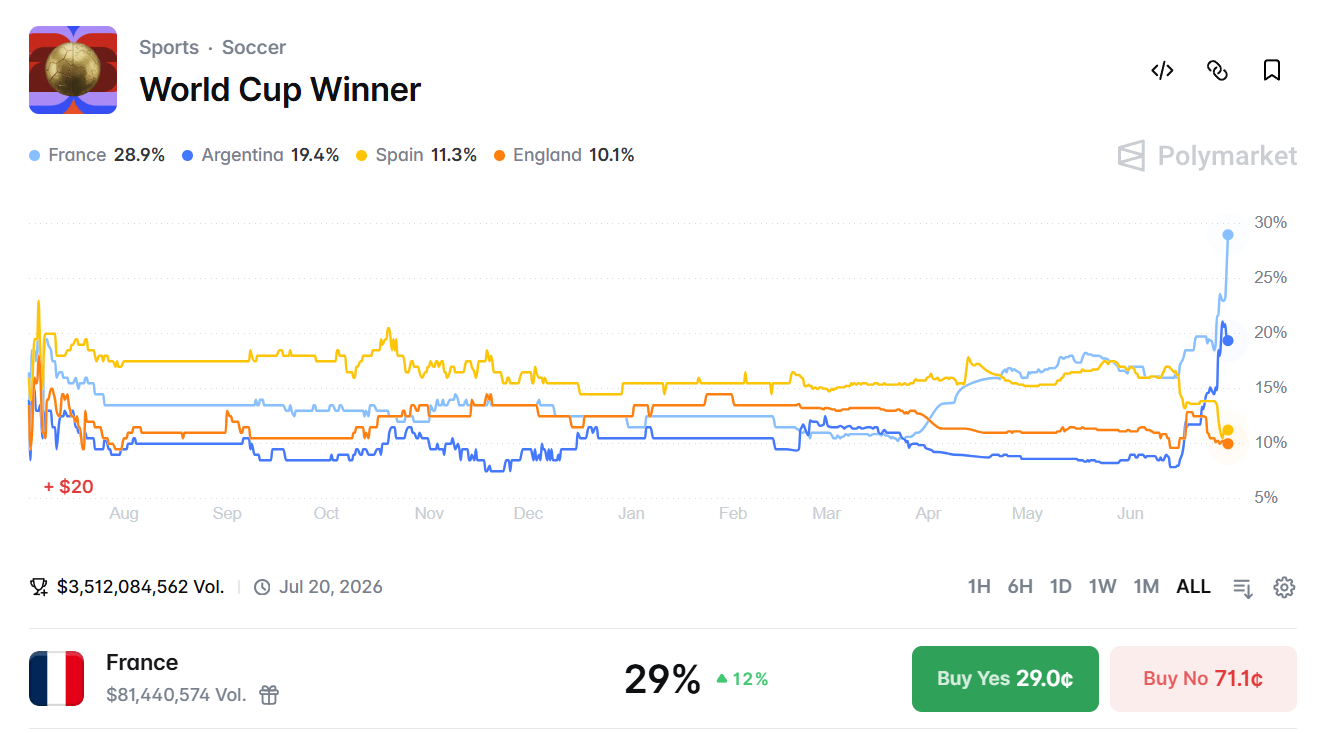
World Cup Winner event contract. Source: Polymarket
The growing betting activity helped Polymarket emerge as an onboarding layer for new cryptocurrency users, as about 60% of World Cup bettors interacted with the blockchain for the first time during their prediction market entry, according to a Bitget Wallet study of 857,000 users, shared with Cointelegraph.
Magazine: How crypto laws changed in 2025 — and how they’ll change in 2026
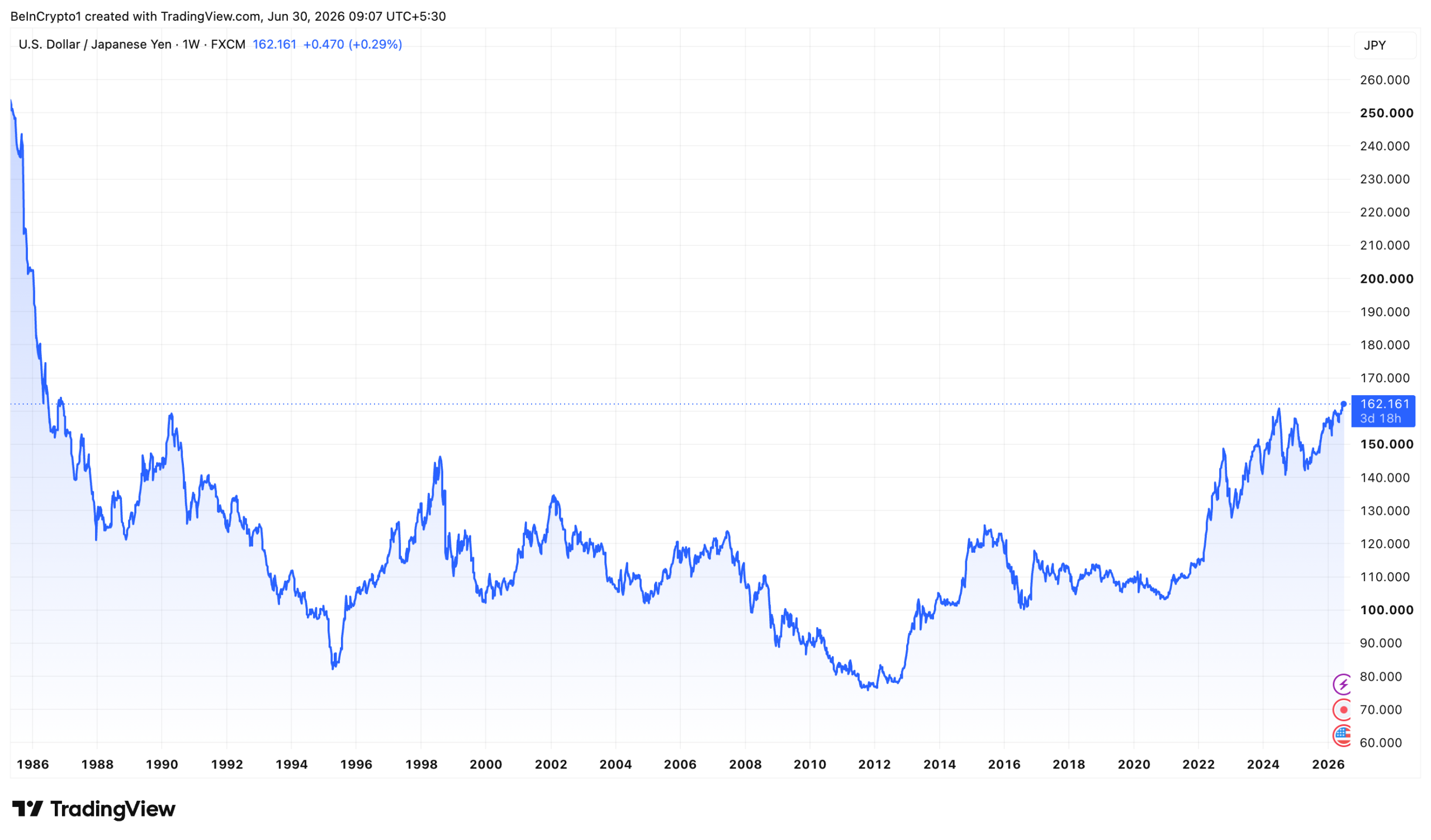
The Japanese yen slid to its weakest level since 1986, putting Tokyo back under pressure to defend the currency.
The currency has declined more than 2% this quarter. The latest drop marks its fourth consecutive quarterly loss, the longest losing streak since 2022, when the currency weakened for seven straight quarters.
Tokyo Signals Readiness to Act
On Tuesday, the yen touched an intraday low of 162.4 per dollar. At press time, it stood at 162.1.

Meanwhile, Finance Minister Satsuki Katayama said authorities stood ready to respond to currency moves at any time.
“This includes taking decisive action, as confirmed between Japan and the US,” she said
Chief Cabinet Secretary Minoru Kihara said the government would work to build an economy less exposed to foreign-exchange swings while remaining prepared to intervene if needed.
Japan has already spent heavily to slow the decline. Authorities deployed a record 11.7 trillion yen, or $72.25 billion, between late April and late May. The yen still resumed its fall once that support faded.
Follow us on X to get the latest news as it happens
The Bank of Japan has also continued tightening monetary policy. It recently raised its benchmark interest rate to 1%, following a December hike to 0.75%.
Still, strategists doubt that intervention alone can reverse the trend. Carol Kong, currency strategist at Commonwealth Bank of Australia, called intervention a question of when, not if.
“However, any intervention is unlikely to reverse the broader uptrend in USD/JPY. We forecast USD/JPY to keep rising to 164 by early 2027,” she said.
Fed Outlook Adds Pressure
Higher US rate expectations have further undercut the yen. Traders now price a 63.1% chance of a Federal Reserve rate hike by September after three months of stronger-than-expected payroll gains.

Attention is now turning to Thursday’s US employment data for June. A Reuters survey projects 110,000 new jobs for the month.
A strong print would reinforce bets on a Fed rate hike, widening the yield gap that has driven the yen lower. A weaker number could hand Tokyo a softer dollar to lean on if it chooses to step in.
Subscribe to our YouTube channel to watch leaders and journalists provide expert insights
The post Japanese Yen Falls to Four-Decade Low as Tokyo Signals Decisive Action appeared first on BeInCrypto.

Key Points
- Britain’s Financial Conduct Authority released its comprehensive digital asset regulatory structure this Tuesday.
- Digital currency companies have a specific application window from September 30, 2026 through February 28, 2027.
- Complete regulatory enforcement begins October 25, 2027.
- Updated regulations encompass authorization requirements, capital reserves, market manipulation prevention, and digital dollar standards.
- Current anti-money laundering registrations won’t automatically transfer to the updated framework.
Britain’s Financial Conduct Authority has unveiled its complete regulatory structure for digital assets. Tuesday’s release represents the culmination of several years of work to establish formal government oversight of cryptocurrency activities.
The regulatory blueprint establishes a definitive schedule. Firms may submit authorization applications beginning September 30, 2026. Applications will no longer be accepted after February 28, 2027.
Full regulatory enforcement commences October 25, 2027. Before this implementation date, the FCA’s jurisdiction remains confined to promotional materials and money laundering prevention protocols.
Scope of the Updated Framework
The regulatory structure encompasses numerous crypto business categories. Trading venues, digital wallet providers, and stablecoin creators fall under these requirements.
Staking operations, crypto lending platforms, and specific decentralized finance operations are also covered. According to the FCA, DeFi protocols will face regulation when an identifiable party maintains operational control.
Businesses currently registered for anti-money laundering compliance won’t receive automatic authorization. These entities must submit fresh applications under the revised framework alongside newcomers to the industry.
Exchange platforms now confront enhanced asset listing standards. The regulator eliminated a previous exemption that permitted certain digital tokens to be listed without disclosure documentation.
Digital Dollar Standards and Capital Reserves
The FCA modified stablecoin requirements following sector consultation. Token issuers no longer must provide redemption projections for their reserve holdings.
Current regulations mandate a legal trust structure over reserve funds. Issuers may maintain up to five percent in additional backing reserves and utilize restricted affiliated custody solutions, provided appropriate protections exist.
Capital reserve requirements received adjustments as well. The FCA reduced the capital coefficient for stablecoin creation to one percent, down from the initial two percent proposal.
Regarding exchange platforms, qualifying digital assets will face a unified forty percent net risk position standard. This supersedes the previous framework that would have divided assets into separate risk classifications.
The authority intends to consult with the Bank of England during the latter half of this year. These discussions will address regulatory application for stablecoin issuers designated as systemically important by HM Treasury.
Manipulation Prevention and Trading Violations
Updated market manipulation standards address illicit trading and price manipulation. The FCA maintained an industry-driven approach for major exchange platform operators.
The regulator reduced blockchain monitoring obligations for these larger entities. It also refined standards regarding disclosure of privileged information.
David Geale, the FCA’s executive director overseeing payments and digital finance, stated the framework provides businesses with regulatory clarity. He emphasized it doesn’t require firms to sacrifice either certainty or innovation capability.
Geale emphasized that consumers will receive protection standards comparable to those established throughout traditional financial sectors. He stressed that investment dangers associated with digital currencies remain present.
Matthew Long, the FCA’s director managing payments and digital assets, indicated the regulator will continue developing DeFi guidance independently. He explained that “genuine DeFi,” where no individual entity exercises control over operations, will remain beyond this regulation’s jurisdiction.
Upcoming Developments
The FCA will conduct an informational webinar on July 17 to explain its policy declarations. Pre-application consultation sessions for businesses also commence in July.
An additional policy statement is anticipated in September. This documentation will provide clarity regarding how regulatory boundaries apply to cryptocurrency operations generally.
During the second half of this year, the FCA will additionally initiate a distinct consultation addressing DeFi guidance and operational resilience standards for businesses employing blockchain technology.
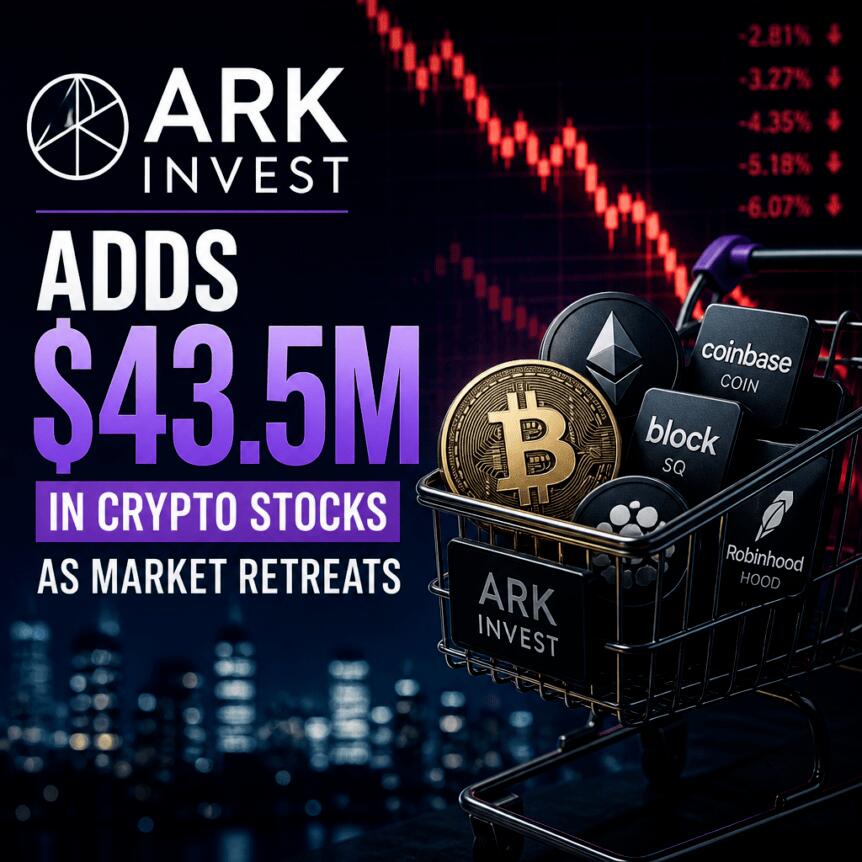
Tech-focused asset manager ARK Invest has moved to buy additional shares of several major crypto-adjacent companies during the market’s recent pullback, totaling about $43.5 million across the past three trading days. The purchases arrive as sentiment has cooled around cryptocurrency-related equities, with multiple names down sharply over the last month.
According to ARK Invest’s own trading data, the firm added 122,544 shares of Coinbase worth approximately $18.6 million and bought 169,777 shares of Circle for about $12.9 million in the same period. ARK also bought positions in Bullish (BLSH) and Robinhood (HOOD), both of which have also been drawing attention as firms explore or expand tokenization and other crypto-related initiatives.
Key takeaways
- ARK Invest deployed roughly $43.5 million in new buys over three trading days, led by Coinbase and Circle.
- Coinbase shares are down about 16.9% and Circle is down roughly 27.6% over the past month, reflecting broader caution toward crypto-linked stocks.
- Most of ARK’s additions were allocated to its ARK Innovation ETF (ARKK), with additional buys also appearing in ARK Next Generation Internet ETF (ARKW).
- ARK also increased exposure to crypto-related equities inside its ARK Blockchain & Fintech Innovation ETF (ARKF), while trimming positions in several non-crypto holdings.
ARK Invest buys into crypto-linked stocks as equities slide
ARK Invest’s latest tranche of buying focuses on companies tied closely to the digital-asset ecosystem, particularly exchanges and payments and tokenization enablers. Over the past three trading days, the firm purchased shares across multiple tickers, including Coinbase and Circle—two high-profile names often used by investors as proxies for demand and regulation-driven momentum in crypto.
ARK Invest’s disclosures show that the firm bought another 122,544 shares of Coinbase since Thursday, totaling about $18.6 million. It also added 169,777 shares of Circle, worth roughly $12.9 million during the same timeframe.
While the buys may look concentrated by dollar value, the intent appears broader: ARK also acquired exposure to other parts of the industry. The firm purchased nearly $5.2 million worth of Bullish shares and added about $5.12 million in Robinhood. In addition, ARK bought $1.69 million of SoFi Technologies shares on Monday.
Where the shares went: ARKK leads, ARKW and ARKF follow
ARK’s allocations were not evenly spread across its funds. Most of the newly purchased shares were added to its ARK Innovation ETF (ARKK), the firm’s flagship offering, underscoring that the trades were likely intended to flow through a mainstream vehicle rather than remain confined to narrower crypto themes.
After ARKK, ARK placed additional purchases into the ARK Next Generation Internet ETF (ARKW). The ARK Blockchain & Fintech Innovation ETF (ARKF) also received tops-ups with crypto-related stocks, indicating ARK maintained its separate thematic exposure for investors seeking more direct positioning.
On top of these equity moves, ARK Invest also bought and adjusted positions in other sectors over the same period. The firm increased exposure to Elon Musk’s SpaceX indirectly through a position labeled as SpaceX (SPCX) and added to Palantir (PLTR), while trimming holdings including Alibaba (BABA), Roku (ROKU), and Strata Critical Medical (SRTA).
The broader backdrop: bearish sentiment and softer crypto-linked confidence
ARK’s buying comes as investors have turned cautious on cryptocurrency-related stocks. The article’s data indicates steep declines over the past month for several of ARK’s target names: Circle is down about 27.6%, Coinbase is down roughly 16.9%, and Bullish has fallen around 26.3% in that period.
At the same time, the underlying crypto market appears to have pressured risk appetite for equities tied to the sector. Bitcoin (BTC) reportedly slipped to a near two-year low of $58,190 earlier in the downturn referenced by the source, illustrating how equity weakness is often intertwined with broader crypto price and sentiment cycles.
In addition, confidence in US legislative progress—specifically expectations that the CLARITY Act could pass before the midterm elections in November—has reportedly faded. Even when investors are not trading directly on politics, shifts in perceived regulatory timelines can materially affect how the market prices “crypto infrastructure” stocks.
What traders should watch after ARK’s repositioning
ARK’s latest purchases highlight a pattern common in risk-off markets: when crypto-linked equities fall faster than the broader market narratives around them, large asset managers may seek to build positions in companies they view as strategically positioned for the next leg of adoption or regulatory clarity.
That said, ARK’s moves do not remove the key uncertainties driving the sector. Investors looking at similar names may want to monitor whether crypto stock weakness continues alongside BTC’s recovery or whether equity-specific factors—such as business momentum, regulatory developments, or capital-market conditions—separate these companies from broader crypto price trends.
Given that ARK deployed the bulk of the purchases into ARK Innovation ETF (ARKK), future filings and fund updates will likely reveal whether the firm maintains this exposure during volatility or shifts again if market conditions worsen. The next signals to watch are likely ARK’s follow-on trading activity across ARK’s crypto-focused funds (including ARKF) and the direction of sentiment around US crypto regulation.

Altcoins are arguably the segment that has suffered the most throughout this bear market, said CryptoQuant analyst ‘Darkfost’ on Tuesday.
84% of altcoins are trading below their 200-day moving average and are in a “state of total underperformance,” he added.
“Every attempt at a momentum recovery has failed outright,” he said, adding that the altcoin market capitalization (excluding ETH) continues to slide, with a weekly close below the 200 DMA now confirmed.
Altcoin Apocalypse
This is not new, as altcoins have been battered for the past eight months and have the second-longest underperformance streak since 2020.
The analyst described it as a “prolonged period of stagnation across the majority of altcoins, one that is pushing investors to their limits.”
He ended on a bullish note, stating that such periods have “historically also presented medium-term opportunities,” but identifying them “demands significantly more rigorous asset selection” than in previous cycles.
84% of Altcoins are trading below their 200-DMA
Altcoins are arguably the segment that has suffered most throughout this bear market.
Every attempt at a momentum recovery has failed outright, and the Total 3, which tracks altcoin market capitalization excluding ETH,… pic.twitter.com/Umz8ONIZQu
— Darkfost (@Darkfost_Coc) June 29, 2026
The broader crypto market is down around 51% from its peak in terms of capitalization, which is currently $2.15 trillion.
However, high-cap altcoins such as BNB, XRP, and Solana are down between 60% and 75% from their peaks. The majority of the lower-cap altcoins are down between 80% and 90% from their all-time highs.
Nevertheless, the top three altcoin season indexes show between 48 and 51 out of 100, which is neutral.
Permabull analyst ‘Sykodelic’ was bullish as usual, stating, “things are shaping up very well for altcoins.”
“I know that is very hard to believe after the soul-destroying performance of alts over the last few years, but things really are looking very constructive here,” he said on Monday.
This was backed up by technical analysts showing that, for the first time in over two years, the 1-week MACD has entered positive territory, “with the chart forming a strong bottom position,” mirroring the 2020 cycle bottom.
Crypto Market Outlook
A few altcoins have made marginal gains today, including Solana, Hyperliquid, and Zcash, but most remain at bear-market bottoms.
Bitcoin reclaimed $60,000, but it didn’t last, falling back below that psychological level during the Tuesday morning Asian trading session.
Meanwhile, Ether reclaimed $1,600 after Bitmine’s latest purchase, but it only lasted a few hours, with the asset falling back to $1,590 at the time of writing.
The post Crypto Apocalypse: 84% of Altcoins in a State of ‘Total Underperformance’ appeared first on CryptoPotato.


Ripple CEO Brad Garlinghouse has criticized Michael Saylor’s Bitcoin strategy, arguing that Strategy’s funding approach added pressure to the wider crypto market.
Summary
- Brad Garlinghouse said Strategy’s Bitcoin funding model added pressure during the latest crypto market pullback.
- Strategy authorized up to $1.25 billion in Bitcoin sales to support dividends, reserves and buybacks.
- Ripple’s CEO said long-term crypto value should come from utility, not complex capital structures.
In a CNBC clip shared by Squawk on the Street, Garlinghouse said, “I think team Michael Saylor wasn’t focused on the right stuff, and that has hurt the overall market.”
Garlinghouse later posted on X that “Financial engineering doesn’t drive long-term value. Utility does.” As previously reported by crypto.news, he also said during a CNBC interview that lasting value in digital assets should come from real-world use, not from financial structuring used to keep buying Bitcoin.
His comments came as Bitcoin and XRP remained under pressure after months of weak price action. The debate now centers on whether large corporate Bitcoin strategies can support the market during downturns, or whether they add selling pressure when capital structures weaken.
Strategy Bitcoin plan draws scrutiny
Strategy has relied on equity and preferred stock programs to grow its Bitcoin holdings. Its STRC preferred stock has traded below its $100 reference level, raising questions about investor demand for the product and the cost of funding future Bitcoin purchases.
As reported by crypto.news, Strategy has now approved a new Digital Credit Capital Framework that allows the company to monetize up to $1.25 billion worth of Bitcoin if needed. Proceeds may go toward cash reserves, preferred stock dividends, debt obligations and buybacks of preferred securities or Class A shares.
The company also raised STRC’s annual dividend rate to 12% from 11.5% and increased its protected cash reserve to $2.55 billion. Strategy said the reserve covers about 17 months of preferred dividends and interest payments.
Reuters reported that Strategy’s enterprise value fell below the value of its Bitcoin holdings for the first time, with its mNAV ratio at 0.99. The company’s shares rose after it announced buybacks and the Bitcoin sale authorization, but the report said the milestone could weaken confidence in its long-running Bitcoin bet.
Market debate shifts to utility
Garlinghouse’s remarks framed the issue as a split between financial structure and utility. His position is that crypto projects need real use cases, active payment rails, settlement value and institutional adoption to create durable demand.
That message fits Ripple’s recent public focus on payments, stablecoins, custody and tokenization. Garlinghouse has argued that XRP sits at the center of Ripple’s 2026 strategy across payments, custody, liquidity and treasury management.
Supporters of blockchain utility made similar points after Garlinghouse’s comments. XRP Ledger validator Vet wrote that blockchain can solve real-world problems such as 24/7 settlement, weekend access to collateral and neutral internet-native assets.
The exchange also comes as Strategy faces pressure from its own Bitcoin-heavy balance sheet. As reported by crypto.news, Strategy holds 847,363 BTC, bought for about $64 billion at an average cost near $75,650 per coin, leaving the position billions underwater when Bitcoin trades below $60,000.

Defence investment plan LIVE: Keir Starmer launches ‘game-changing’ boost to armed forces

Warriors Secure Kristaps Porzingis With Two-Year $40 Million Extension Ahead of Free Agency
Tencent (TCTZF) Stock Buybacks Accelerate Amid $309B Market Cap Decline


-
 Sports7 days ago
Two goals and an assist by sheer aura: Cristiano Ronaldo just entered the World Cup chat
-

 Fashion4 days ago
Weekend Open Thread: Staud – Corporette.com
-

 Politics4 days ago
The House | Manchesterism won’t survive the painful trade-offs unless it gets citizens on board
-

 Politics4 days ago
Potential 2028er World Cup attendee leaderboard
-

 News Videos2 days ago
MAJOR BITCOIN & MARKET UPDATE!!!! (MUST WATCH ASAP!!!)
-

 Business4 days ago
Asia stock markets slide as tech shares slump
-

 Tech5 days ago
A Look At A Gaggle Of Transputer Boards
-

 Crypto World6 days ago
Securitize Wraps Roubini's SEC-Registered ETF as Dubai VARA Digital Security
-
Crypto World6 days ago
Bitcoin (BTC) Dips Below $62K, Ethereum (ETH) Plunges 6% Daily: Market Watch
-
 Crypto World5 days ago
Dell (DELL) Shares Tumble Over 5% Following Analyst Downgrade to Hold
-

 Crypto World3 days ago
Coinbase, Circle Deepen Crypto Stock Losses Despite Resilient S&P 500
-
Business6 days ago
Entergy settles forward sale agreements, raises $672 million in cash proceeds
-

 Crypto World3 days ago
Kraken's xStocks Opens Bending Spoons IPO Registration to EEA Retail
-

 Sports4 days ago
FIH Pro League: India defeat Pakistan 7-1, register biggest win of campaign | Other Sports News
-
 Crypto World4 days ago
Bitcoin Sparks $600M Hourly Liquidations With $65,000 Set To Become Resistance
-

 Tech2 days ago
Bluekit phishing kit adopts browser-in-the-middle for login theft
-

 Tech3 days ago
Russian hackers now target Signal backup recovery keys
-
Crypto World4 days ago
Hyperliquid Named on Singapore MAS Investor Alert Register
-

 Crypto World4 days ago
RTX holders must register wallets before token distribution begins
-
 Crypto World5 days ago
Ripple and SBI launch RLUSD in Japan after JFSA approval
You must be logged in to post a comment Login