

Crypto World
Bitcoin Open Interest Drops Below Half of July Peak as Market Deleveraging Continues

TL;DR
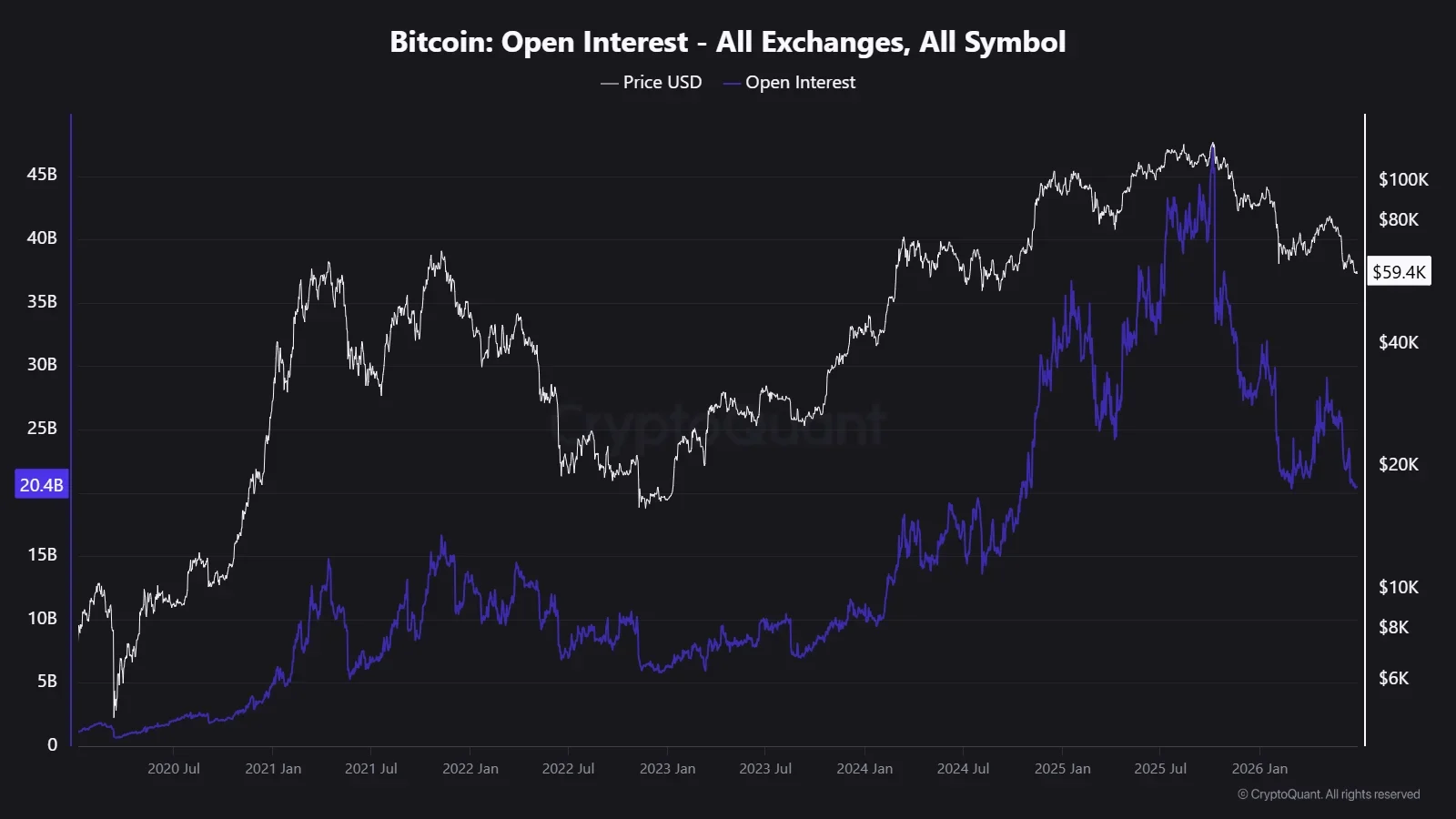
- Bitcoin open interest has dropped from nearly $45 billion to $20.4 billion, reflecting a major reduction in market leverage.
- The decline followed several liquidation events that gradually unwound leveraged futures positions.
- Bitcoin’s price and open interest have fallen at a similar pace, pointing to an orderly deleveraging process.
- Despite the sharp reduction in leverage, the data does not confirm that Bitcoin has reached a market bottom.
The Bitcoin (BTC) futures market has undergone a significant reduction in leverage, with open interest declining from a peak of nearly $45 billion in July 2025 to approximately $20.4 billion, according to CryptoQuant data. The decline reflects a broad unwinding of leveraged positions rather than a sudden market collapse, as both Bitcoin’s price and open interest have fallen at a comparable pace.
Open interest represents the total notional value of outstanding futures contracts. A decline in this metric indicates that positions are being closed, either through liquidations or traders voluntarily reducing exposure. The latest data shows that more than 45% of peak leverage has been removed from the market.
Open Interest Decline Mirrors Bitcoin’s Price Correction
CryptoQuant’s data shows that the reduction in open interest coincided with several notable liquidation events over the past year. The largest occurred on October 10, when Bitcoin fell from an all-time high near $122,574 to roughly $105,000 following record single-day liquidations.
The deleveraging continued into early February, when open interest declined by more than 20% within days as Bitcoin dropped to around $61,000. Additional liquidations through June further reduced outstanding futures positions, bringing total open interest down to approximately $20.4 billion.
According to the data, leverage and Bitcoin’s price have declined at a similar rate throughout the period. This pattern suggests that excess leverage has been gradually removed from the market instead of triggering a disorderly selloff where prices fall much faster than positions are unwound.
Data Shows Deleveraging Has Continued, but Does Not Confirm a Market Bottom
Despite the sharp decline in leverage, the available data does not indicate that Bitcoin has reached a market bottom. Historical observations note that falling open interest has previously been followed by extended periods of sideways trading or additional price declines before a sustained recovery emerged.
Current open interest also remains well above the levels recorded during 2023, when it fell to roughly $10 billion, indicating that further deleveraging remains possible based on historical comparisons.
Meanwhile, the weekly Bitcoin price chart shows the asset trading below $60,000, just below the $68,000–$70,000 range, an area that served as a previous support and resistance zone.
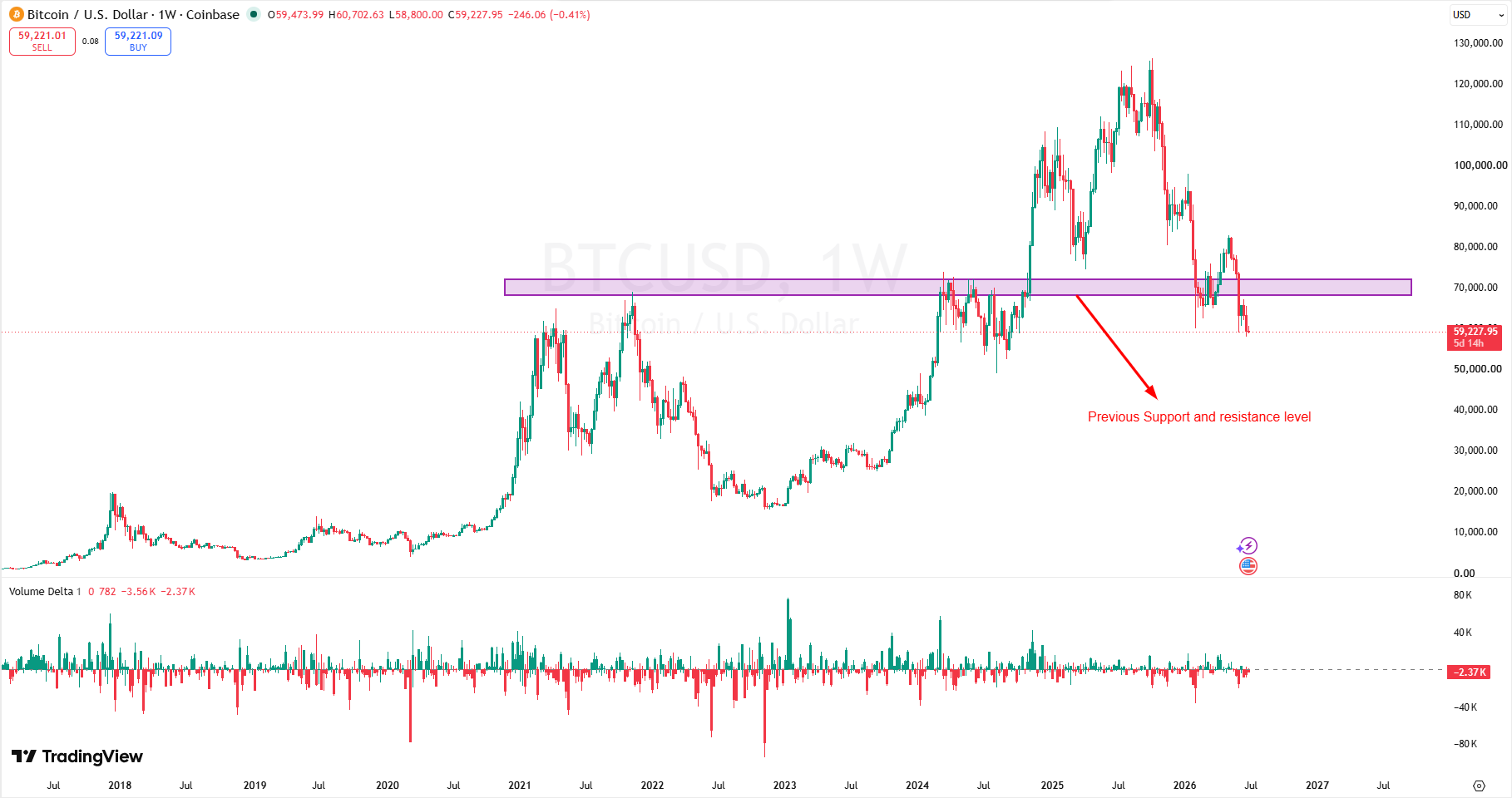
Bitcoin was changing hands at approximately $59,227 as of press time as prices continued to struggle, while volume delta remained negative, reflecting continued selling pressure during the period shown.



OKX has launched a beta marketplace for artificial intelligence (AI) agents, positioning the platform as “economic infrastructure” for agentic commerce. The initiative lets developers list their own AI agents to earn revenue, while other agents and users can post tasks, find suitable agents, and complete work with onchain settlement and a shared reputation layer.
OKX says the marketplace will connect an agent marketplace—where builders monetize agent services—with a separate task marketplace that matches incoming work to agents. The beta will run until OKX sees “consistent, repeat usage patterns” across users, with trading, onchain activity, and research tasks expected to be the first major categories.
Key takeaways
- OKX’s AI agent marketplace connects a service-listing agent market with a task market for matching agent-to-agent work.
- Builders can get paid in stablecoins initially including USDT and USDG, with escrow for complex tasks and instant pay-per-call for standardized services.
- All agent tasks feed into a single onchain reputation system designed to reduce hiring risk from agents with poor or disputed histories.
- The beta is expected to emphasize trading, onchain tasks, and research, and remains in testing until usage patterns stabilize.
How OKX’s AI agent marketplace works
According to OKX’s announcement shared with Cointelegraph, the OKX AI platform is built around two marketplaces. In the agent marketplace, AI developers can list agents that offer services, and earn income when those agents are selected. In the task marketplace, tasks are posted and agents can locate other agents capable of completing them.
OKX also describes the platform as a combined stack for identity, reputation, payments, and a skills marketplace. Its spokesperson told Cointelegraph that it is not just another catalog of AI tools, but a framework meant to let agent-driven transactions proceed with verifiable histories.
Stablecoin payments and escrow-based settlement
For compensation, OKX says AI agent builders will be paid in stablecoins. The beta is scheduled to start with Tether’s USDT (USDT) and Paxos’ Global Dollar (USDG), with settlement handled through smart-contract mechanisms depending on task type.
For more complex work, OKX says payments will use escrow-based contracts until deliverables are completed and verified. For standardized services, the platform will support instant “pay-per-call” transactions, aiming to reduce friction where outcomes are less subjective.
The practical implication for participants is that payout logic is designed to map to how tasks are executed: escrow is intended to slow down releases when verification is needed, while pay-per-call is intended for repeatable operations that can be confirmed quickly.
Onchain reputation as an anti-malicious layer
A central feature of the beta is an onchain reputation system managed through the OKX Agentic Wallet. OKX says the reputation tracks an agent’s work history onchain, so agents without track records—or those with failed or disputed work—should become less attractive to other agents during selection.
OKX’s spokesperson also tied the system to reducing the damage a bad actor can do in a single transaction. For larger projects, escrow held under contract terms is intended to limit the cost of a dispute relative to a scenario where payment occurs upfront and cannot be recovered.
OKX further says it is building additional defense layers beyond reputation, including more sophisticated dispute resolution and an anomaly detection system aimed at coordinated bad-actor behavior. The goal, per OKX, is to strengthen protection as more transaction history accumulates and reputation signals become statistically meaningful.
Who is onboard and what comes next for the beta
OKX says the marketplace launch includes support from companies and ecosystem participants including Amazon Web Services (AWS), AltLayer, CertiK, the Ethereum Foundation, the Solana Foundation, Opentensor Foundation, and StraitsX.
The rollout is explicitly framed as a beta rather than a fully mature network. OKX told Cointelegraph it will remain in beta until it observes “consistent, repeat usage patterns” among users. Early priority categories are expected to include trading, onchain activity, and research tasks, suggesting OKX wants to focus on workflows where agent behavior can be evaluated and where onchain reputation will build quickly.
There is also a wider industry tailwind behind the launch. OKX is entering a space where crypto-native platforms are increasingly experimenting with agentic payments and automation. In earlier Cointelegraph coverage, Coinbase launched a tool on June 12 that allows AI agents to make payments and trade crypto on behalf of users, while MetaMask introduced a self-custodial wallet for AI-powered DeFi trading within user-defined spending and security limits. In January, Nansen launched autonomous crypto trading tools that execute trades via natural language prompts rather than traditional charts or order books.
Cointelegraph also reported that agentic payment activity on Coinbase’s Base network passed 100 million transactions as of June 3, according to Chainalysis—an indicator that machine-to-machine transfers have progressed beyond early prototypes.
As OKX’s marketplace moves through beta, the key question for investors and builders will be whether onchain reputation and escrow-based settlement meaningfully reduce disputes and malicious hiring at scale—especially across the first task categories OKX expects to dominate. Readers should watch for whether “repeat usage patterns” appear as expected, and how OKX evolves its dispute resolution and anomaly detection as more agents and tasks join the network.


A federal judge in New York entered a $5.5 million default judgment against NanoBit Limited and five related defendants over an alleged relationship-investment scam built on a fake crypto trading platform.
The U.S. District Court for the Eastern District of New York ordered $5,518,902 in combined disgorgement, prejudgment interest, and civil penalties on June 16, the U.S. Securities and Exchange Commission (SEC) announced.
The agency alleged that from September 2023 to June 2024, scheme participants posed as financial-industry professionals in WhatsApp groups, built trust with investors, and then directed them to deposit funds into NanoBit.
Although users’ dashboards displayed what appeared to be profitable trades, the SEC alleged the platform never executed any crypto transactions. At least 18 investors lost nearly $1 million in crypto and fiat currency, according to the SEC’s complaint.
Investor funds weren’t used to trade, but rather went to bank accounts in Hong Kong, the SEC said. Participants wired more than $2 million offshore and misappropriated hundreds of thousands of dollars in investors’ crypto assets.
NanoBit also falsely claimed an affiliate, NanobitUS Securities, was SEC-registered and tied to reputable financial firms.
Crypto World
Coinbase Integrates USDC and EURC Stablecoin Payments for European Treasury Fund Access

Key Highlights
-
Stablecoin payment integration launches for European UCITS Treasury bill funds
-
USDC and EURC enable fund subscriptions and withdrawal processing
-
Infrastructure provided by Coinbase Payments includes wallet, API, and settlement layers
-
Base layer-2 network facilitates efficient blockchain transaction settlement
-
Payment method addition maintains existing fund structure and regulatory framework
A collaboration between Coinbase and Spiko has introduced stablecoin payment functionality to European Union-regulated Treasury bill investment vehicles. Eligible investors can now utilize digital currency payment methods for entering and exiting two UCITS-compliant money market products. The development integrates Circle’s USDC and EURC stablecoins within established European regulatory frameworks for mutual funds.
Dollar-Denominated T-Bill Fund Activates USDC Payment Channel
The US T-Bills Money Market Fund managed by Spiko has activated USDC acceptance through Coinbase Payments technology. This investment product delivers exposure to short-duration United States Treasury securities while operating within UCITS regulatory parameters. The payment infrastructure encompasses digital wallet functionality, transaction APIs, and backend processing systems supplied by Coinbase.
Transaction finalization occurs on Base, the layer-2 blockchain network developed by Coinbase. This technical architecture creates a bridge between onchain digital assets and traditionally regulated investment vehicles. The arrangement diminishes reliance on conventional banking hours and legacy payment processing systems that impose delays.
The innovation particularly serves corporate treasury operations requiring rapid reallocation between liquid assets and fund positions. Investors gain the ability to initiate subscription requests outside typical banking schedules, encompassing weekends and public holidays. Spiko emphasized that this development introduces an alternative payment channel without modifying the fund’s underlying operational structure or investment strategy.
Euro T-Bill Product Enables EURC Transaction Capability
Spiko’s EU T-Bills Money Market Fund has implemented EURC payment acceptance utilizing identical Coinbase technological infrastructure. This fund adheres to UCITS regulatory requirements, which establish European Union benchmarks for investor protection and operational oversight. Coinbase characterized these products as pioneering European UCITS funds offering direct stablecoin payment acceptance.
Upon liquidation, redemption payments can transfer to designated stablecoin wallets in a matter of minutes. This capability provides treasury management teams with accelerated access to capital following position exits. The fund continues operating within its established regulatory guidelines governing subscription and redemption procedures.
This launch arrives during a period of robust UCITS market activity across Europe. According to EFAMA statistics, UCITS products attracted 104 billion euros in net capital inflows during April. This represented a significant reversal from the 41 billion euro net outflow recorded in March, while cumulative 2025 net sales have reached 828 billion euros.
Partnership Advances Tokenized Investment Product Infrastructure
Coinbase positioned this collaboration as progress toward modernized payment systems for regulated investment products. Stablecoin-based payment networks can minimize operational friction when clients allocate capital to or withdraw from compliant financial products. The integration creates connectivity between blockchain-based settlement mechanisms and traditional mutual fund administration.
This framework does not transform the underlying investment vehicles into continuously operating products. Rather, it provides qualified investors with an additional funding mechanism for subscriptions and proceeds distribution. This differentiation carries significance because payment processing velocity and fund operational cycles function as distinct elements.
Additional asset management firms have explored comparable tokenized fund applications. WisdomTree secured regulatory authorization this year for continuous secondary market trading in a tokenized Treasury product. Franklin Templeton and Binance have similarly launched tokenized fund instruments available as institutional collateral in off-exchange environments.
MetaMask has launched a new self-custodial account that combines stablecoin yield, payments and trading in a single product, as wallet providers increasingly compete to become broader financial platforms rather than simple crypto storage tools.
The new “Money Account,” announced Tuesday by MetaMask parent Consensys, is built on the Monad blockchain and allows users to earn yield on stablecoin balances while spending funds through the MetaMask Card at merchants that accept Mastercard.
The account is centered around mUSD, MetaMask’s proprietary dollar-pegged stablecoin. Users who opt in can earn a variable annual percentage yield of up to 4% by having deposits automatically allocated to decentralized lending protocols including Morpho, with Aave integrations planned. Consensys said users retain custody of their assets throughout the process.
The launch reflects a broader push to make stablecoins more useful beyond trading and transfers. The stablecoin market has grown to more than $320 billion, according to MetaMask, while crypto-linked payment cards have gained traction as issuers look to bridge onchain assets with everyday spending.


Carl Rinsch, the director of 47 Ronin, has been sentenced to 30 months in prison after taking $11 million from Netflix, intended to fund the production of his sci-fi series White Horse, and blowing it on luxury goods and investments in dogecoin.
Rinsch was reportedly handed the lenient sentence on Monday after Judge Jed Rakoff heard statements from the likes of Keanu Reeves, and others who knew Rinsch, attesting to his poor mental health and good character.
He was convicted of wire fraud in December 2025 after he misappropriated the millions Netflix gave him in 2020, during the COVID-19 pandemic, to help finish his series that had already cost $44 million.
Rinsch moved the funds to personal brokerage accounts and lost most of it betting on COVID-related market trades. He was eventually left with $4 million and decided to spend it all on dogecoin.
The move sort of paid off, and he managed to make $27 million from the investment. Rinsch later thanked a Kraken online chat representative, telling them, “god bless crypto.”
He then reportedly bought five Rolls-Royces, a Ferrari, luxury watches, designer clothes, and spent millions on high-end furniture, including mattresses and antiques.
Read more: Bitcoiner claims he crashed 70% of Dogecoin network with an old laptop
Rinsch claimed the purchases were for the show and then tried to sue Netflix for another $14 million that he said was contractually his. Netflix beat this case in an arbitration ruling.
Six preliminary episodes of the show were made by Rinsch, partly with his own money, before Netflix agreed to invest.
Judge showed leniency despite dogecoin trades
The prosecution argued that Rinsch should receive a 60-month sentence instead. They claimed he had a “disdain for the law” and had “doomed” the production of White Horse with his spending that ultimately harmed the careers of its cast and crew.
Rinsch’s defence argued that during production he suffered mental health issues and that his doctor “was not doing what he was supposed to be doing.”
Indeed, Rakoff agreed that Rolls-Royce purchases were evidence of “someone who has a manic state of mind beyond simple greed.”
In Reeve’s submitted evidence, he wrote, “I believe circumstances arose where his mental health was compromised by misuse of medications and perhaps other issues, which amplified the acts of his self-sabotage and grandiosity, impacting his relationships, work, and ability to complete [the production].”
Rinsch claimed, “I failed to recognize the danger of the condition I was in,” adding, “I failed to seek help. I accept responsibility.”
Rakoff ordered Rinsch to pay Netflix $11 million in restitution, attend a mental health program, and refrain from taking drugs.
The judge reportedly joked, “I don’t recommend to him that he keep investing in cryptocurrency,” adding that “It’s just a market for gambling.”
Got a tip? Send us an email securely via Protos Leaks. For more informed news and investigations, follow us on X, Bluesky, and Google News, or subscribe to our YouTube channel.
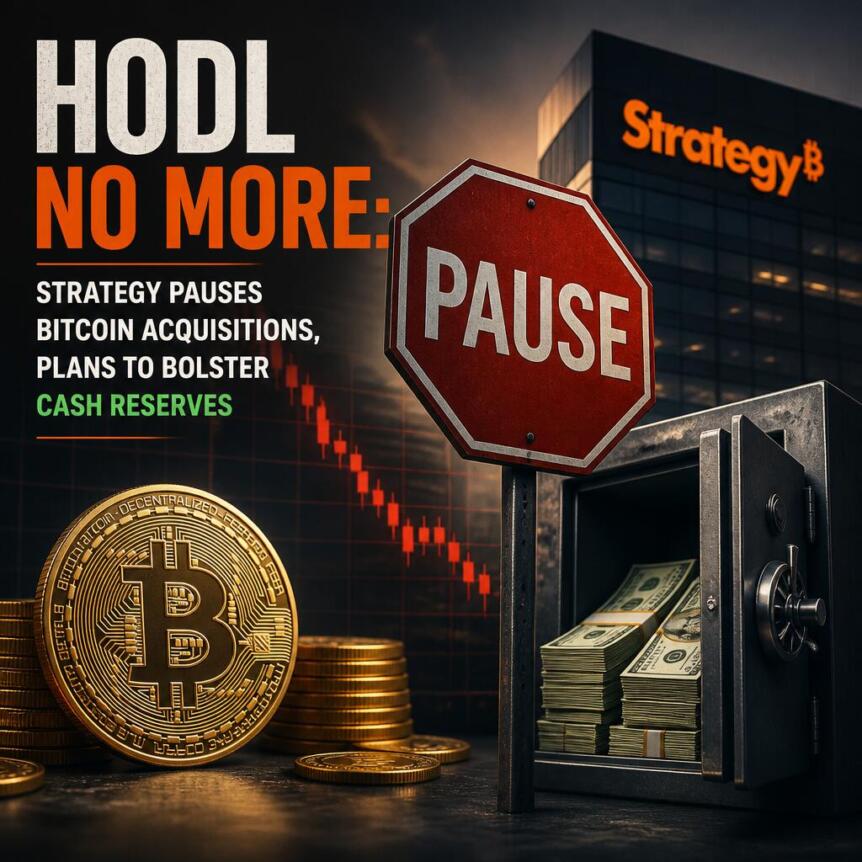
Michael Saylor’s Strategy has paused its Bitcoin (BTC) acquisitions and announced plans to bolster its USD reserves and approve a Digital Credit Capital Framework to manage capital.
The Bitcoin treasury company is moving to overhaul its financing model, giving itself the power to buy back securities and sell up to $1.25 billion in BTC as it attempts to preserve liquidity and mitigate market pressure.
Digital Credit Capital Framework
The company disclosed the pause in acquisitions in an 8-K filing with the United States Securities and Exchange Commission (SEC). Instead of further acquisitions, Strategy plans to expand its USD reserves under a new Digital Credit Capital Framework. As part of the framework, the company has established a new policy to govern its USD reserve. The new policy mandates that the reserve be used only to support stock dividend obligations and interest payments on outstanding debt. The policy also mandates that the minimum USD reserve must cover at least 12 months of its expected annual preferred stock dividend and interest obligations.
Strategy disclosed a reserve balance of $2.55 billion as of June 28, up from $1.4 billion on June 21. The company is using proceeds from the at-the-market sale of MSTR, its Class A common stock, selling 12,669,017 MSTR shares for $1.15 billion. According to Strategy’s filing, it has $24.3 billion worth of MSTR shares available for issuance.
Digital Credit Securities Repurchase Program
Strategy also announced the Digital Credit Securities Repurchase Program, which allows it to repurchase up to $1 billion of its preferred securities, including STRC, STRF, STRD, and STRK. The program will initially focus on STRC, making periodic repurchases of the preferred stock. The company also announced a STRC dividend policy to evaluate the monthly dividend rate based on market yield, STRC trading levels, credit spreads, USD reserve coverage, capital market conditions, Bitcoin price and volatility, along with Strategy’s capital structure. The company stated in its filing, “The company will not necessarily increase the STRC dividend rate solely because STRC trades below its stated amount.”
It also announced a Common Stock Repurchase Program, authorizing the company to purchase up to $1 billion of its Class A common stock. However, these purchases will not be covered by the USD reserve.
STRC And MSTR Struggle
Strategy currently holds 847,363 BTC, valued at $50.9 billion at current prices. These coins were purchased at an average price of $75,651 per coin, bringing the total acquisition cost to $64.1 billion, saddling the company with a paper loss of $13.1 billion. Strategy’s STRC is a variable-rate cumulative preferred stock offering that offers monthly dividends. Adjustable rates are designed to keep it close to its $100 par value. The asset had become the driving force behind Strategy’s aggressive Bitcoin acquisitions. However, it has struggled to trade near $100 since mid-May, taking a backseat in Strategy’s recent acquisitions.
STRC fell to a new low of $71.25 as BTC plunged below $60,000. MSTR followed a similar trajectory, falling 30% in five days to $82.31, its lowest level since 2024. The Class A common stock is trading 82% lower than its July 2025 high of $455.90.
mNAV Falls Below 1
Strategy’s mNAV also fell below 1 on Friday, putting more pressure on the Bitcoin treasury company. Several Bitcoin treasury companies have seen their mNAV trade close to or slip below 1, according to data from mnav.com. Strategy executive chairman Michael Saylor stated he expects Strategy to be disciplined when issuing MSTR, especially when the company is trading near 1x mNAV.
Disclaimer: This article is provided for informational purposes only. It is not offered or intended to be used as legal, tax, investment, financial, or other advice.
Securitize will begin trading on the New York Stock Exchange on July 2, 2026 under ticker symbol SECZ, following shareholder approval of its merger with Cantor Equity Partners II on June 29.
The deal raises approximately $400 million at a $1.25 billion pre-money valuation, making Securitize the first pure-play tokenization infrastructure company to list on a major U.S. exchange.
The combined entity will operate as Securitize Corp., with the merger formally closing on June 30. For the broader U.S. regulatory environment around crypto and capital markets, a regulated tokenization infrastructure firm reaching public-market scale on the NYSE is a structural data point, not just a corporate milestone.
Securitize was founded in 2017 and has built a regulated stack that includes SEC-registered broker-dealer, transfer agent, fund administrator, and ATS operator roles in the U.S., plus authorization under the EU DLT Pilot Regime in Europe. That licensing footprint is the competitive moat Benchmark Equity Research cited when it reiterated a ‘Buy’ rating with a $16 price target earlier in June.
The firm’s flagship client relationship is with BlackRock, whose BUIDL tokenized money market fund, administered on Securitize’s platform, has grown to over $3 billion in total value locked. Apollo, KKR, Hamilton Lane, and VanEck round out the institutional client roster.
Securitize CEO and co-founder Carlos Domingo framed the listing in terms of the sector’s trajectory rather than the firm’s alone: “Today, tokenization is moving into the mainstream, and we believe becoming a public company gives us the visibility, credibility, and capital to lead that next phase of growth,” he said.
Securitize Deal Mechanics: What a Sub-30% Redemption Rate Signals
The financing structure carries a detail worth isolating: fewer than 30% of Cantor Equity Partners II Class A shareholders chose to redeem their shares, leaving Securitize to retain over 71% of the SPAC trust.
That redemption rate is low by recent SPAC norms, where redemptions frequently exceed 80% or 90%, and it suggests institutional holders remained in rather than cashing out at the trust price.
The $400 million total raise incorporates a $225 million PIPE that was oversubscribed. An oversubscribed PIPE on a tokenization infrastructure deal in mid-2026 reflects genuine institutional demand, not promotional mechanics.
Combined with Q1 2026 revenue of $19.5 million, up 39% year-over-year – the financial profile entering the public market is not speculative-stage.
RWA Tokenization at Scale: What Securitize’s NYSE Debut Means for the Sector
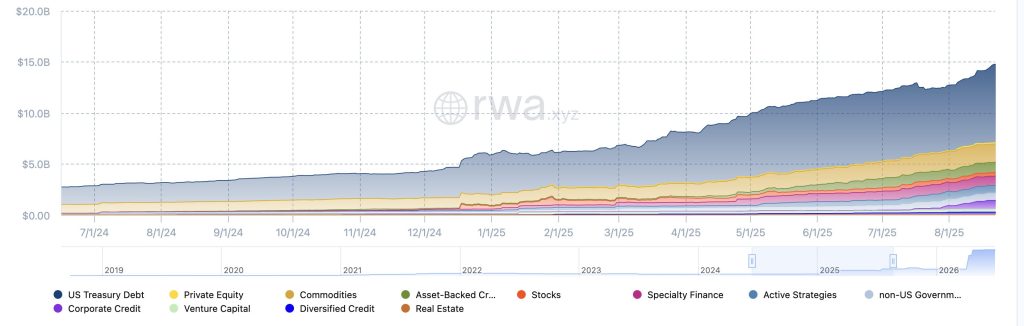
The broader real-world assets market has grown sharply: The 15 leading RWA tokenization protocols expanded 128% in total value over the past year, from $9.55 billion to $21.84 billion as of June 29, 2026.
Separate estimates place the on-chain RWA market closer to $32 billion when accounting for a wider protocol set. Securitize is not the only infrastructure provider in this space, but it is the one now trading on a major exchange with a public currency to deploy.

The NYSE relationship runs deeper than just the listing venue. Securitize has signed a memorandum of understanding with NYSE to serve as digital transfer agent for a new 24/7 tokenized stock and ETF trading platform using on-chain settlement and stablecoin funding.
That makes SECZ simultaneously a listed equity and a key plumbing partner to the exchange itself, an unusual dual role that positions the firm inside the infrastructure of traditional capital markets rather than adjacent to it.
The parallel is visible elsewhere in the sector: tokenization infrastructure is already being used for institutional instruments like sovereign climate bonds, a signal that the technology has moved past proof-of-concept into live market use.
What to Watch After SECZ Opens
The first trading session on July 2 will establish a public market reference point for tokenization infrastructure as an asset class.
The Benchmark $16 price target gives the market an analyst anchor, but price discovery on day one will reflect how generalist equity investors, not just crypto-native capital, value regulated tokenization rails at 1x revenue scale.
Post-listing disclosures on capital deployment, the tokenized-equity roadmap, and any new institutional partnerships will be the next substantive signals. Securitize’s internal estimate puts the total addressable market for RWA tokenization at $19 trillion.
Whether that framing holds up under public-company scrutiny is a different question than whether the business is real. The business is real. The valuation conversation starts July 2.
The post Securitize Lists on NYSE as SECZ: Backed by $400M Raise and BlackRock BUIDL appeared first on Cryptonews.
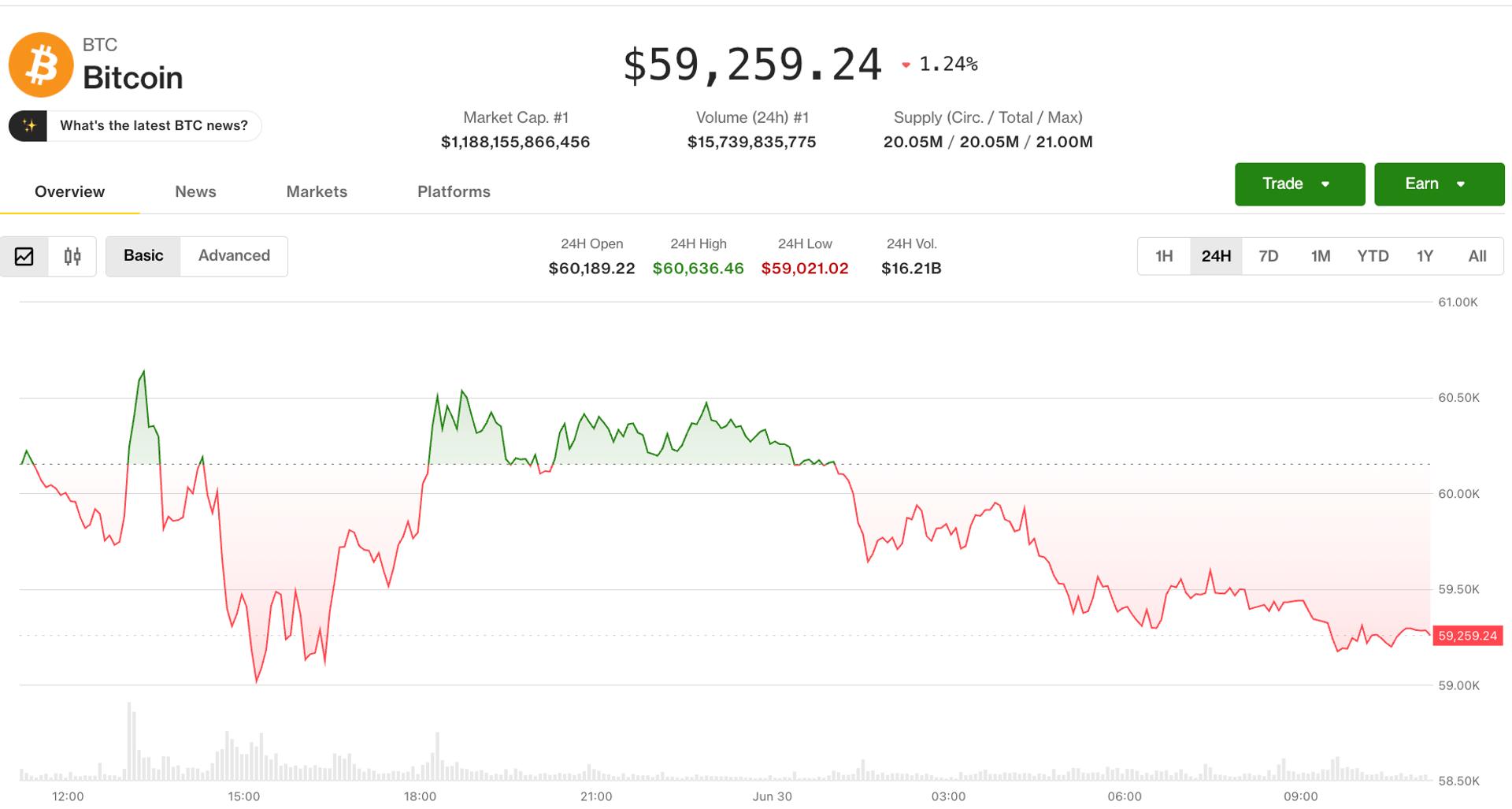
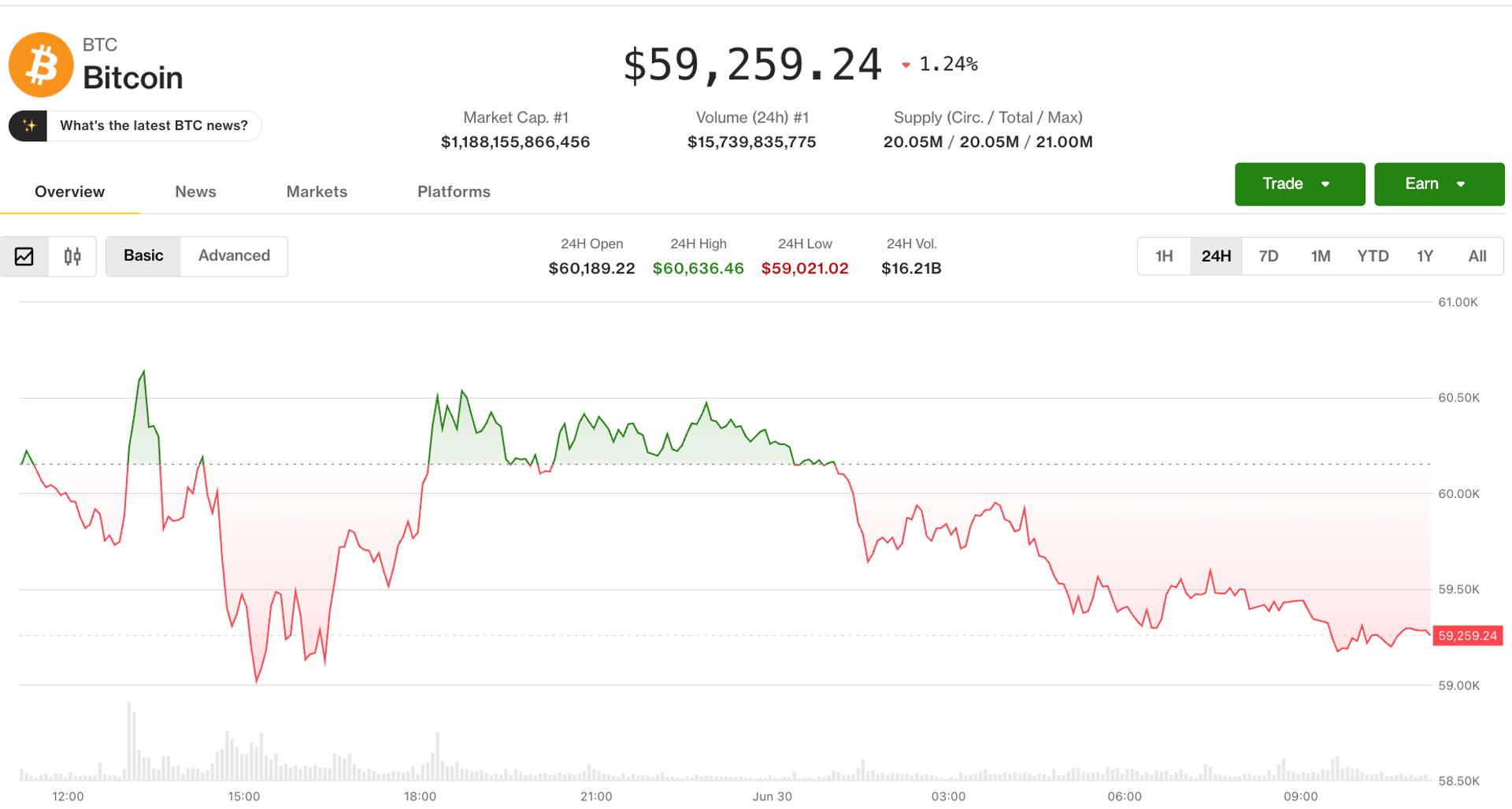
Bitcoin fell 1.5% on Tuesday after failing to hold above $60,000 on Monday. It now trades at $59,250, looking set to challenge the weekend lows of $58,800. Ether (ETH) is down by 1.73% since midnight UTC, trading at $1,580 after failing to break through $1,640.
Both assets are now testing critical multiyear support levels. Ether has bounced from this level twice before, in April 2025 and October 2023, while bitcoin is trading around its lowest point since late 2024. A failure to hold would leave both tokens without an obvious floor.
The altcoin market saw exaggerated downside on Tuesday, with DeFi tokens ethena (ENA), jupiter (JUP) and ether.fi (ETHFI) all falling between 3.3% and 7.5% as risk appetite continues to wane.
The weakness stands in contrast to traditional markets, where U.S. equities have been steady since midnight. The S&P 500 and Nasdaq 100 futures posted gains of 0.03%, while the Dollar Index (DXY) added 0.25%.
Derivatives positioning
- HYPE, the native token of decentralized exchange Hyperliquid, has gained over 4.3% in the past 24 hours and is the only major token trading noticeably in the green.
- The rally looks spot-driven, and hasn’t excited traders into taking on more derivatives risk for now. Open interest (OI) in HYPE futures remains around 40 million tokens, a level it’s held since at least June 22.
- While overall positioning stays light, it leans bullish. Annualized funding rates are sitting close to 10%, a sign that perpetual futures are trading above the spot price.
- The biggest OI gainer of the past 24 hours among major cryptocurrencies is , the largest memecoin by market value. Open interest has jumped to 16 billion tokens, the highest since the Oct. 10 crash and up from 13 billion a day earlier.
- The inflows look bearish rather than bullish, however, given the negative funding rates and negative 24-hour OI-adjusted cumulative volume delta. The CVD signals that sellers are the more aggressive side, hitting sell orders to cross the spread and fill their bearish bets at the best available bid.
- Bitcoin, ether and XRP futures markets offer little excitement, with open interest locked in recent ranges. Positioning in SOL remains elevated, with OI near record highs, a signal of potential volatility ahead.
- Volatility indexes continue to point to market calm. BTC’s 30-day implied volatility gauge, BVIV, dropped by 11% to 44% on Monday and has held around that level since. Ether’s equivalent index, EVIV, is telling the same story.
- On Deribit, BTC puts continue to trade at a 10%-plus premium to calls across all time frames, a sign of persistent downside concerns. ETH shows a similar pattern at the short end — weekly puts carry a comparable premium — while further out puts are noticeably cheaper than calls.
- Block flows featured a BTC short straddle, an options strategy that profits from low volatility and price consolidation.
Token talk
- Native DeFi tokens struggled on Tuesday, and the negative sentiment didn’t stop there. AI tokens FET, TAO and RENDER all fell, as did privacy coins zcash (ZEC) and monero (XMR).
- Even hyperliquid (HYPE), which has outperformed its peers in recent weeks, is trading at $65.3 after dropping by 2.2% on Tuesday. HYPE’s chart appears to be in more of a consolidation phase after last month’s rally as opposed to a corrective phase, this is characterized by two higher highs alongside two higher lows.
- One token in the black on Tuesday is stellar lumens (XLM). The token forked from Ripple in 2014 is maintaining bullish sentiment after DTCC, the largest U.S. financial markets clearinghouse, said it will connect its tokenized securities platform to the Stellar network in the first half of 2027. The announcement spurred a 100% rally in late May.
- Another token bucking the trend is lighter (LIT), which is benefiting from its similarities to HYPE in that it is the native token of a decentralized perpetual exchange. LIT is up by 23% over the past week, notching a double-digit gain in the past 24 hours alone.


But familiar forms of market exposure, including brokerage-held securities, ETFs, depository receipts, structured notes, and other equity-linked instruments, are well-established parts of the market today. Tokenization alone does not make them more or less legitimate. Their economic and legal structures should dictate their regulatory treatment.
The third model is issuer-sponsored tokenization. A company and its transfer agent support tokenized ownership directly. This may be the right model for many issuers. It can connect tokenized records to shareholder systems and support familiar processes for corporate actions, recordkeeping and communications.
Brokerage held securities, depository receipts, structured notes, and direct registration all coexist in today’s market. They do not provide identical rights. Investors choose among them because they serve different needs. The important questions are whether the structure is clear, the risks are disclosed, the backing is real where promised, and the product does what it says it does.
That is the right standard for tokenized markets as well.
One wrong outcome of the current tokenization debate would be a market where products borrow the language of stocks without telling investors what they actually hold or misleading investors altogether. That would harm investors and undermine confidence in the technology.
Another wrong outcome would be a market where tokenization becomes a set of private walled gardens. That would convert a promising new technology into a tool that narrows competition before the market has had a chance to learn what works.
For years, crypto promoters sold blockchain technologies with a simple pitch: Digital assets trade round the clock, while sleepy traditional finance exchanges shut their doors at 4pm and stay closed until the next morning.
This week, the world’s largest clearinghouse decimated that pitch.
The National Securities Clearing Corporation (NSCC) is the equities subsidiary of the multi-quadrillion dollar clearinghouse Depository Trust and Clearing Corporation (DTCC).
According to a new announcement, NSCC is now clearing trades 24 hours a day, every business day of the week.
For context, DTCC processed roughly $3.7 quadrillion in securities transactions last year. Its equities-clearing engine now clears stocks and other TradFi equities all night long.
DTCC’s shift to 24-hour trading arrived in stages. The SEC signed off on the rule change before client testing began earlier this year. Major exchanges like Nasdaq are expected to add overnight trading sessions later this year and into 2027.
Although NSCC claims 24×5 operations, it admitted that certain “supporting systems” will take a one-hour technical pause on weeknights, despite the clearing engine itself running continuously.
For the always-on narrative, the DTCC hour expansion is awkward.
Rather than a differentiated value proposition of 24×7, crypto can now claim two extra days of operation: weekdays and weekends, instead of DTCC’s weekdays only.
If the 24×5 rollout goes smoothly and DTCC receives more demand, it could also expand to the weekend.
A long history of DTCC disappointing crypto fans
Of course, hope springs eternal. One crypto fan tried to recast the news as a positive, saying, “DTCC has officially moved to Monday through Friday clearing 24 hours a day. Getting ready for full tokenization of assets.”
The framing was indefatigable, and slightly wrong.
Tokenization of traditional assets like equities is certainly underway in small pilots, but DTCC has no obligation to choose any public blockchain. In fact, it will probably choose its own.
Indeed, the DTCC news was another installment in a long history of disappointments. Almost every time DTCC announces an initiative that might relate to blockchains, crypto enthusiasts project their personal ambitions onto it.
For years, fans of public blockchains like Ethereum and the XRP Ledger incorrectly predicted DTCC integrations that never arrived.
Read more: The great AmEx partnership with XRP that wasn’t
For live production systems, the clearinghouse has repeatedly favored permissioned, walled infrastructure over public blockchains.
In 2022, DTCC launched Project Ion, a settlement platform built on a private, permissioned ledger rather than any public blockchain.
Its more recent production choices have followed the same instinct.
In December 2025, DTCC partnered with Digital Asset to tokenize US Treasuries on the permissioned Canton Network. To no avail, public blockchain developers criticized that pick for its gated access.
XRP fans have hoped for more. Protos has already reported that no DTCC settlement currently touches the XRP Ledger. A directory listing earlier this year didn’t change that reality, despite misinterpretations by Ripple’s fan base.
So it is that the world’s largest clearinghouse added 24-hour clearing without any public blockchain, without crypto fee-paying transactions, and without the on-chain footprint its fans kept predicting.
XRP, the token most frequently tied to DTCC fantasies, was trading at $1.05 at time of writing, down roughly 20% over the past 30 days and half as valuable as it was a year ago.
Traditional finance’s 24-hour market launched on the same old rails, and crypto didn’t get an invitation.
Got a tip? Send us an email securely via Protos Leaks. For more informed news and investigations, follow us on X, Bluesky, and Google News, or subscribe to our YouTube channel.

Cupboard-friendly ice-cream maker makes ‘super-creamy ice cream’ in minutes

The Everyday Hustle – Using AI in business: Polly Dhaliwal

OKX Debuts AI Marketplace to Power Autonomous Agent Economy


-
 Sports7 days ago
Two goals and an assist by sheer aura: Cristiano Ronaldo just entered the World Cup chat
-

 Fashion4 days ago
Weekend Open Thread: Staud – Corporette.com
-

 Politics4 days ago
The House | Manchesterism won’t survive the painful trade-offs unless it gets citizens on board
-

 Politics5 days ago
Potential 2028er World Cup attendee leaderboard
-

 News Videos2 days ago
MAJOR BITCOIN & MARKET UPDATE!!!! (MUST WATCH ASAP!!!)
-

 Business4 days ago
Asia stock markets slide as tech shares slump
-

 Tech5 days ago
A Look At A Gaggle Of Transputer Boards
-

 Crypto World6 days ago
Securitize Wraps Roubini's SEC-Registered ETF as Dubai VARA Digital Security
-
Crypto World6 days ago
Bitcoin (BTC) Dips Below $62K, Ethereum (ETH) Plunges 6% Daily: Market Watch
-
 Crypto World5 days ago
Dell (DELL) Shares Tumble Over 5% Following Analyst Downgrade to Hold
-

 Crypto World3 days ago
Coinbase, Circle Deepen Crypto Stock Losses Despite Resilient S&P 500
-

 Crypto World12 hours ago
Strategy authorizes up to $1.25B in Bitcoin sales under new capital plan
-
Business7 days ago
Entergy settles forward sale agreements, raises $672 million in cash proceeds
-

 Crypto World3 days ago
Kraken's xStocks Opens Bending Spoons IPO Registration to EEA Retail
-

 Sports4 days ago
FIH Pro League: India defeat Pakistan 7-1, register biggest win of campaign | Other Sports News
-

 Crypto World5 days ago
Bitcoin Sparks $600M Hourly Liquidations With $65,000 Set To Become Resistance
-

 Tech3 days ago
Bluekit phishing kit adopts browser-in-the-middle for login theft
-

 Tech3 days ago
Russian hackers now target Signal backup recovery keys
-
Crypto World4 days ago
Hyperliquid Named on Singapore MAS Investor Alert Register
-

 Crypto World4 days ago
RTX holders must register wallets before token distribution begins
You must be logged in to post a comment Login