I love cordless vacuums, and I don’t just say that because I’m one of CNET’s primary testers of the category. I say it because switching from corded vacuums to cordless vacuums was a big quality-of-life upgrade, thanks to the ease of use and maneuverability around my apartment. The downside is that cordless vacuums don’t usually match the suction power and cleaning capabilities of upright or canister models.
Shark’s PowerDetect Transformer 3-in-1 is the company’s attempt to address this trade-off without forcing you to buy multiple vacuums.
“The upright vacuum has looked and worked the same way for decades,” said Petra Oman, vice president of marketing at SharkNinja, in a press statement. “We saw an opportunity to rethink the category by eliminating the bulky hose and creating a system that adapts to the way people actually clean. Transformer delivers the deep-cleaning performance consumers expect from an upright, with the flexibility and reach needed to clean everything from floors and carpets to stairs, furniture, ceilings and the car.”
Advertisement
The main upright dustbin is detachable when you want to use it as a slimmer cordless vac.
Shark
As the name suggests, the PowerDetect Transformer is three vacuums in one. It’s a full-size upright vacuum that’s intended for deep cleaning carpets and hardwood floors with the strongest suction. Shark says you can remove the main canister with one click, and it’ll turn into a slim stick vacuum for regular, lightweight cleaning, getting under furniture and into other tight spots. One more click turns it into a handheld vacuum, making it easier to clean stairs, upholstery, corners and cars.
In terms of specs, the Transformer will have key features from Shark’s most popular models, including LED lighting to help you find debris and automatic detection of dirt levels, flooring types, edges and movement to automatically adjust suction and cleaning performance. It features anti-tangle brushrolls, odor-neutralizing tech like the Shark Stratos and HEPA filtration. It’ll also come with an auto-emptying system that empties the debris into the main dustbin when the handheld clicks back into place.
Advertisement
I haven’t had a chance to go hands-on with this vacuum yet, and I’m not entirely sure how the system breaks down. I’ll be testing it both at home and at CNET’s Louisville lab. The most interesting question will be whether the PowerDetect Transformer can truly deliver the cleaning performance of an upright vacuum without compromising elsewhere.
The Transformer has all the key features we’ve liked from the most popular Shark models.
Shark
Price and availability
The Shark PowerDetect Transformer 3-in-1 will be available on SharkNinja and TikTok Shop for $529. It’ll also come to Amazon, Walmart, Best Buy, Target, Costco and Sam’s Club.
The eastern US is the latest place to be hit with intense heat as the world plays a game of hot potato.
In the coming days, New York is expected to see temperatures rise to near 100 degrees Fahrenheit (38 degrees Celsius), but with humidity, it could feel more like 109 degrees Fahrenheit (43 degrees Celsius). Temperatures in other cities ranging from Detroit to Washington, DC, to Boston will see temperatures 20 degrees Fahrenheit above normal as the holiday weekend approaches.
The temperatures won’t be as high as they are in Phoenix. But this isn’t a dry heat; coupled with the humidity, anyone venturing outside is sure to experience roughly the equivalent of hanging out inside a dog’s mouth. Beyond the sheer grossness of hot, humid weather, there are also very serious health concerns.
Humidity hampers sweating—the most powerful tool the human body has to cool off. Sweat removes heat from the body by evaporating into the air, but this becomes less effective in humid conditions, when the atmosphere is already full of vaporized water. “When there’s high humidity, especially in a heat wave, it’s much more difficult for the body to physiologically cool off,” says Richard Allan, a climate scientist at the University of Reading.
Advertisement
The National Weather Service map of warnings is a patchwork of reds and pinks, with the agency raising extreme heat warnings and watches. While daytime highs will be eye-popping, overnight lows will be particularly problematic.
“Several days in a row of hot temperatures with little relief from overnight low temperatures can increase heat stress on the human body,” the NWS warned in its forecast.
That danger was underscored by New York mayor Zohran Mamdani, who wrote in a social post that New Yorkers should come up with a heat plan. First and foremost that means finding access to air conditioning, then checking on neighbors and people with illnesses that may make them susceptible to heat-related health issues.
The blast of extreme heat comes a week after Europe dealt with record-shattering temperatures. (The continent also saw blistering temperatures and high humidity in late May.) Burning fossil fuels has ensured that nearly every heat wave is more intense than it would’ve been in a preindustrial climate.
Advertisement
“The warming from rising greenhouse gases is clearly adding to global temperature, and that adds extra heat to the heat waves,” Allan says. “It promotes moderate heat to become extreme heat … These humid conditions may be more likely to be promoted into a hot, humid heat wave rather than just humid and warm.”
El Niño is another culprit that could be playing a role in this heat wave.
The natural climate phenomenon forms every few years in the tropical Pacific, but it affects weather around the world. That includes helping boost temperatures across the northern tier of the US and parts of Canada. El Niño was declared earlier this month, and it’s expected to be a particularly potent iteration that will only strengthen as summer goes on. With the hottest months still ahead, that means the odds are good that if you missed this chance to feel what it’s like inside a dog’s mouth, you’ll have plenty more chances.
With this funding, European researchers can test how their scientific work could impact society.
Four Irish-based researchers have won Proof of Concept grants from the European Research Council (ERC).
Funding for the first funding round this year is worth more than €27m, and is divided between 182 researchers with ideas that show potential for commercial or societal impact. Each individual grant is worth €150,000.
Some of the chosen ideas include developing 3D-printed ‘bio-inspired’ electronics, a tool to help doctors protect vital parts of the brain during surgery, and an advanced ready-made breast cancer vaccine.
Advertisement
University College Dublin (UCD) researcher Prof Niamh Nowlan received ERC funding to further her work around new treatments for a broad range of paediatric growth disorders.
Nowlan is a professor of biomedical engineering at the UCD School of Mechanical and Materials Engineering and a fellow of the UCD Conway Institute.
Her project, called ‘Grow-Reg’, will attempt to identify specific cell surface markers that aid in the growth of children’s bones, to help develop treatments designed to speed up or slow down growth of one or more bones without systemic drugs or surgeries.
“Advancing basic research closer to patients (especially babies and children) is hugely rewarding and we are excited to get started,” said Nowlan. Grow-Reg builds on a previous ERC-funded project led by Nowlan.
Advertisement
“By creating the foundation for a targeted delivery platform capable of modulating growth plate activity with high anatomical precision, we hope to ultimately enable new treatments for a broad range of paediatric growth disorders, reduce reliance on invasive surgery, and improve the safety and specificity of existing biologic therapies,” she said.
Meanwhile, two University of Galway research projects also succeeded in receiving Proof of Concept grants. Led by systems biomedicine professor Ines Thiele, ‘iChatRD’ aims to develop a user-centred clinical decision support system to diagnose rare and inherited metabolic diseases.
“When exploring avenues for translating our fundamental research on digital metabolic twins into patient-focused applications, we kept encountering a major challenge. The richest clinical information exists as free text – the language of a human, not of a computer,” Thiele said.
“iChatRD bridges this gap by enabling metabolic modelling and natural language work together to suggest candidate diagnoses for inherited metabolic diseases.
Advertisement
“The ERC Proof of Concept grant now helps us take iChatRD into the real world by working directly with clinicians to help shorten the diagnostic odyssey that may burden rare disease patients for years.”
The second Galway project, called ‘GelEV’, will focus on developing technology that could improve regenerative medicine delivery to injured tissue sites. Led by Meadhbh Brennan, the project is engineering a hyaluronic acid hydrogel for better delivery to extracellular vesicles.
University of Limerick also bagged a grant win with a project called ‘Eve Heals’ that hopes to heal diseases affecting the skin using in-vitro engineered living substitutes. The project is led by Dimitrios Zevgolis, who also works across institutes at UCD.
“Many of today’s innovations begin with a researcher asking a fundamental question. These 182 projects show that curiosity-driven science and real-world impact go hand-in-hand,” said Ekaterina Zaharieva, the European commissioner for start-ups, research and innovation.
Advertisement
“With Proof of Concept funding, ERC researchers can test how their discoveries could become new treatments, technologies, services or solutions that benefit people across Europe.”
2026’s first Proof of Concept round invited 15pc more proposals than a year ago, the ERC said. Applications for the second round are open, with a September deadline.
Don’t miss out on the knowledge you need to succeed. Sign up for the Daily Brief, Silicon Republic’s digest of need-to-know sci-tech news.
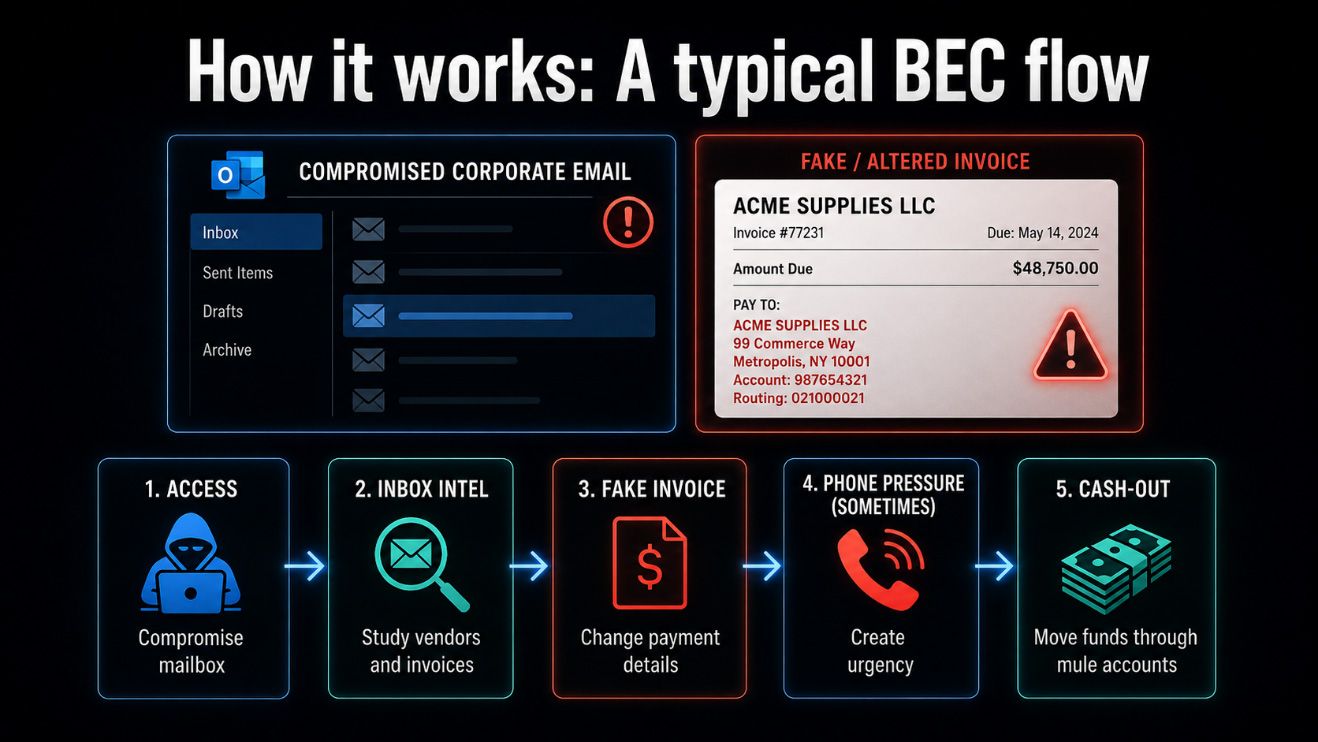
Business Email Compromise (BEC) is often described in the media as merely an email scam, but in reality, it’s part of an organized broad operation. The email itself is only one part of the attack chain. In order to support a successful monetization of email fraud, attackers need to be patient and learn about the procurement process in the organization, and to build or rent an entire infrastructure and operation.
A single BEC often includes gaining access to their targeted business, gathering raw data, analyzing the mailbox context, building reliable communication channel, accessing t reliable payment infrastructure, orchestrating everything in the right timing, and finding a way to move money after it’s stolen.
Flare researchers sampled and analyzed underground posts related to BEC from the past year; Highlights of the findings include:
AI-powered BEC is getting popular, reducing the learning time and increasing the scam “quality”.
Actors are interested mainly in SaaS accounts (such as O365). Corporate leadership and financial employees are the most desired targets.
Advertisement
There are special call centers designed to apply pressure on a targeted business to finalize the fraudulent payment.
Cash-out is the biggest bottleneck of BEC, hackers need to find relevant business bank accounts or cash-out partners which is relatively considered a difficult task.
BEC Exceeds the Boundaries of Email
BEC begins with access to an organizational mailbox or a business SaaS account. Once in, the threat actors often analyze the account, then study and map the organization, mainly by understanding organizational structure and specifically financial privileges, procurement process, internal conversations, communication with vendors, and invoices.
After everything is collected, the threat actors can attempt to make a fraudulent request.
Image explaining the BEC process
This is what makes BEC difficult to detect. A suspicious email from an unknown sender is one thing. But a message sent from a compromised mailbox, inside an existing conversation, using real names, real invoice references, and familiar wording is much harder for employees to question.
Unsurprisingly, Flare data shows that threat actors highly value email accounts of employees from the finance department, as they are tools to understand the financial operations.
Advertisement
Inside these accounts, the threat actors are looking for referenced accounts receivable, accounts payable, payrolls, invoices, overdue payments, and customer payment relationships.
Screenshot taken from Flare’s platform about interest in corporate email accounts tied directly to finance functions. Sign up for the free trial to access if you aren’t already a customer.
Case Study: Hacker Discussions on BEC
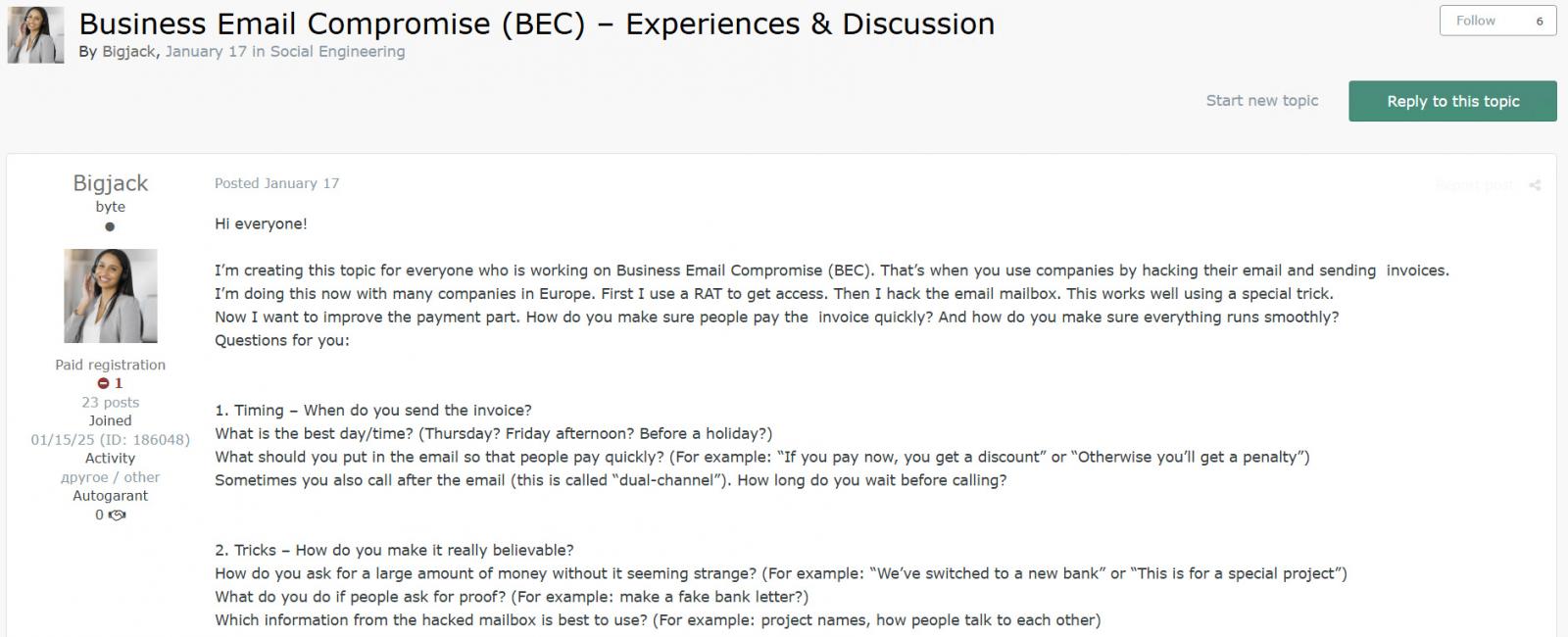
A thread named “Business Email Compromise (BEC) – Experiences & Discussion” created by a threat actor named Bigjack, in January 2026, clearly illustrates how this operation works.
Screenshot taken from Bigjack’s post in the forum
Bigjack described how he is using remote access malware to gain initial access, then compromising company mailboxes and using them to send invoices. The actor’s questions focused less on the technical intrusion and more on the practical fraud aspects based on experience:
When to send the invoice
How to create urgency
How to ask for a large amount without raising suspicion
Advertisement
What mailbox information should be reused
What kind of proof can be provided if questioned
Which mistakes can ruin the operation
The replies showed how other threat actors view BEC and therel experiences. One threat actor highlighted the significance of intercepting an invoice payment process. Another said that identifying who validates the payment requests and defrauding him is the most important aspect. Other threat actors’ emphasize the significance of cash-out, saying that reliable collaboration and support is the most critical aspect.
This single correspondence clearly depicts the mindset of threat actors regarding BEC. Threat actors learn from experience that they need to fully understand the procurement process (the right timing, the right pressure, the right financial context, and the right receiving account) before they can start sending effective fraudulent invoices.
Advertisement
From compromised finance accounts to cash-out networks and call center recruitment, threat actors plan BEC operations openly on criminal forums.
Flare monitors these discussions, so you can see the attack coming before the invoice does.
Monetization of BEC is nearly impossible without a reliable proper receiving account, so. threat actors connect to mule networks and use cash-out services. This is a hard task because the threat actors need to find a reliable, operational, “clean”, relevant bank account to finalize the fraud.
A threat actor named neoresu emphasizes that it’s not just the destination bank account, but also the person who validates the payment needs special care. He offered his services and also talked about using a call center to increase the success rate.
Advertisement
Another threat actor named “Capita” claimed to have operated BEC activity for six years in Europe (mainly in Germany, Finland, and Austria) and described using peer-to-peer money movement, and a call center to pressure companies into faster payments.
There are also posts that are looking to recruit money mules for a BEC scheme. Specifically involving business bank accounts, and fast money transfer.
Screenshot from Flare’s platform about “mules for BEC operation.” Sign up for the free trial to access if you aren’t already a customer.
Support Call Centers to Apply Pressure
Several posts also referenced calls as part of the BEC process. In the Bigjack thread, the actor asked when to call after sending the invoice, while another participant claimed to operate a call center used to pressure companies into faster payments.
This matters because BEC is not always email-only fraud. A follow-up call can make the request feel more legitimate and urgent. For defenders, a second channel should not be treated as proof of authenticity if the requester introduced or controlled that channel.
AI-Powered BEC Attacks
Underground discussions indicate that AI is increasingly being adopted to improve the effectiveness and scalability of BEC campaigns.
Advertisement
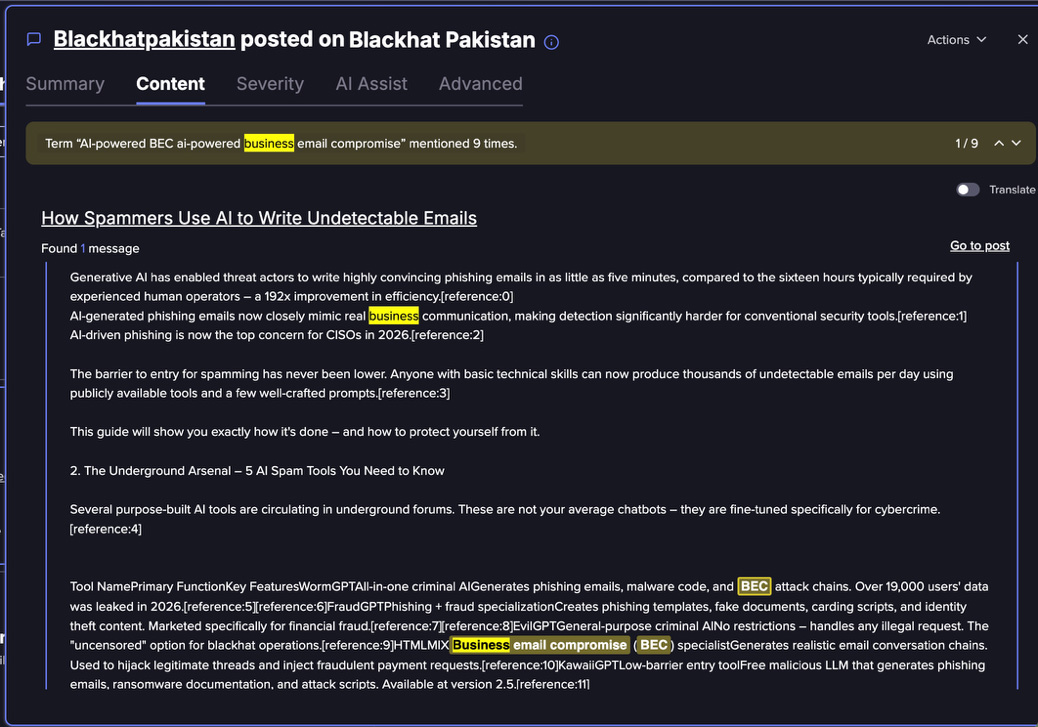
In the post below by blackhatpakistan, the threat actors describe using AI to generate realistic business correspondence, mimic executive and employee writing styles, and produce context-aware payment requests or invoice fraud emails that blend into legitimate communication.
Rather than relying on a single template, AI enables the creation of thousands of unique email variations, making campaigns more difficult for traditional content-based detection systems to identify.
Dedicated underground tools are also promoted for generating entire email conversation chains, allowing attackers to hijack existing business discussions and inject fraudulent payment requests with a higher degree of authenticity.
Screenshot from Flare’s platform about how hackers use AI in BEC attacks. Sign up for the free trial to access if you aren’t already a customer.
Practical Advices for Defenders
Underground discussions clearly show that we must increase BEC defenses.. The security posture should begin way long before the first fraudulent invoice arrives. What we’ve learned from attackers:
Attackers target specific personnel in the organization. Defenders must identify the potential targets and apply additional training to leadership, the financial department and whoever takes part in the procurement process.
Advertisement
Attackers are now using AI-powered artifacts such as emails, invoices, documents, and messages. Defenders need to identify AI-generated content and deep-fake items.
Attackers leverage dedicated call centers to pressure financial decision-makers and payment approvers into authorizing fraudulent transactions. Defenders should gather intelligence and learn what techniques these centers use to better educate their relevant employees.
Attackers highlight the significance of specific points in time, waiting for approvers to be on vacation, as well as other tips to improve the success rate of their fraudulent activity. Defenders should learn about these special markers and apply further defense mechanisms during specific periods, such as employee vacations.
Flare helps by giving security teams visibility into these underground markets and by monitoring exposed employee credentials, corporate domains, login portals, SaaS applications, and related indicators across deep and dark web sources.
This allows organizations to detect when their access points appear in credential collections or search-service advertisements, prioritize the most relevant exposures, and respond faster with password resets, session revocation, MFA enforcement, and investigation of possible account misuse.
X is making it easier for AI assistants like Claude, Cursor, Grok Build, and other MCP-compatible apps to connect directly to the platform through a new hosted MCP server.
MCP, for context, is an open standard that defines a common way for AI models to connect to external tools and services. Previously, if developers wanted an AI assistant like Claude or Cursor to access X, they would have to build their own MCP server, host it, connect to the X API, and handle the authentication. Now, X hosts the MCP, and users authenticate with their own X account’s permissions.
This allows developers to save the time spent on integration work to focus on whatever it is they’re actually building.
Advertisement
Developers have long been able to search X, read posts, look up users, analyze conversations and trends, and do more using the platform’s API. The hosted MCP doesn’t add new capabilities on that front; it just makes them easier to expose to AI applications. By doing so, X can position itself as an information network filled with real-time data to retrieve and analyze, rather than just a social hangout.
The move sees X joining a growing number of companies that now offer their own official MCP servers or endpoints, like GitHub, Slack, Notion, Stripe and Salesforce.
Of course, there’s always concern that by removing an infrastructure hurdle, X is opening itself up to more automated posting or spam.
It’s worth noting that the hosted MCP isn’t bypassing X’s API rules, which continue to restrict its use if the company detects spammy behavior.
Advertisement
X also updated its API v2 earlier this year to address the issue of AI-generated spam, particularly programmatic replies to conversations. Plus, it recently updated its API pricing, increasing the cost for publishing posts to $0.015, and posting links to $0.20. The price increases were designed to “curb vectors of misuse,” X said at the time — meaning it’s at least getting more expensive to spam X.
When you purchase through links in our articles, we may earn a small commission. This doesn’t affect our editorial independence.
Perfectly balanced, powerful, and incredibly quiet, the Stihl FSA 50 Cordless Grass Trimmer is a must for any serious home gardener. It’s an expensive piece of kit, but it’s worth the money for its performance and handling.
Converts to an edging tool in seconds
Excellent balance and minimal vibrations
Quiet operation
Some might struggle with the safety trigger
Key Features
Advertisement
Review Price:
£159
28cm cutting width
Advertisement
Ideal for clearing growth quickly.
Adjustable length
Advertisement
Change the shaft length to suit your height.
Battery powered
Advertisement
Runs on Stihl’s AK battery system.
Introduction
If you’re in the habit of gardening early in the morning or late at night, this ultra-quiet grass trimmer will keep you in your neighbour’s good books. Powerful, comfortable, and highly versatile, I think the Stihl FSA 50 Cordless Grass Trimmer is one of the best cordless grass trimmers available right now.
Find out why in my in-depth review.
Advertisement
Advertisement
Design and Features
Adjustable shaft length
Adjustable cutting head angle
Converts to an edge trimmer
First off, this is an incredibly well-made grass trimmer. The steel shaft trigger, blade guard and handle feel premium, and there’s no wobble or rattling during use.
Image Credit (Trusted Reviews)
Weighing just over 4kg when combined with the AK20 battery, I thought this cordless grass trimmer would feel heavy. Thanks to Stihl’s excellent ergonomics and balance, it doesn’t feel weighty at all. The shaft length can be adjusted by about 20cm to suit gardeners of different heights, and the front loop handle can be adjusted to a comfortable position and locked in place.
A collar halfway along the shaft lets you rotate the cutting head, converting the trimmer to a powerful edging tool in seconds. The cutting head uses bump feed, too, paying out fresh line whenever you tap it on the lawn. In my opinion, bump feed beats auto feed because it’s more economical and has fewer moving parts that can go wrong.
Image Credit (Trusted Reviews)
Advertisement
Down at the business end of the grass trimmer, there’s plenty of adjustment available too. The cutting head angles to stay running flat on the lawn, regardless of your height. Flick the switch round to the “E” setting and the head drops straight down for edging the lawn instead. And another clever bit of thinking from Stihl, you can adjust it with your foot and not have to bend over. Notably, a cordless grass trimmer like this offers more convenience for different lawn jobs.
Image Credit (Trusted Reviews)
Running on the powerful AK system, the battery slots into the back of the trimmer and helps to keep things balanced and comfortable. And the 28cm cut width is wide enough for clearing decent swathes through long grass.
It all adds up to a supremely comfortable grass trimmer. The only place that might cause issues is when you want to stow it away. Although the shaft length is adjustable, it doesn’t fold or break down into two pieces. So, if you have limited storage a smaller grass trimmer would be a better option.
Advertisement
Performance
Minimal vibration even at top speed
Extremely quiet
Effective variable speed trigger
Assembling the FSA 50 for its first use took me about five minutes. The loop handle bolts on and tightens in place by hand, but you’ll need a cross head screwdriver to attach the blade guard. The flower guard snaps into place without much fuss, but I had to be careful to avoid scratching the plastic.
Advertisement
Image Credit (Trusted Reviews)
It’s great to see that Stihl includes a pair of safety glasses in the box, and they’re big enough to go on over top of most glasses as well. Safety is always a priority when using a grass trimmer, so it’s a welcome addition to the FSA 50.
The lack of noise that this trimmer makes is impressive. If you really want to avoid annoying the neighbours, trimming on the lowest speed is almost silent. And controlling the speed is easy too, thanks to the sensitive trigger. I found it easy to keep it at a low enough speed to conserve battery life but kick it up to full speed when necessary. Additionally, the cordless grass trimmer design helps keep noise levels down for quiet operation.
The two stage safety trigger might not be to everyone’s tastes, however. To turn on the trimmer, you need to engage the rear and side safety switches before the variable speed trigger works. It’s an effective safety feature but a little fiddly to get used to.
The lack of vibration is another welcome feature. Even at full speed, the FSA 50 didn’t push much vibration into my hands. It’s definitely an easy trimmer to use, even for long periods.
Advertisement
I used an AK20 battery in the trimmer, which is rated to power the trimmer for up to 50 minutes. The smaller AK10 will give you 25 minutes of trimming, and the big AK30 battery provides an hour of use.
Advertisement
While the trimmer comes with a line trimmer head and 1.6 mm round line, you can swap it out for the Polycut 3-2 mowing head with plastic blades to double your working time. That’s good to know if you have lots of brush to clear.
However, if you have a bigger garden to look after you might want to take a look at the FSA 50’s big brother, the mighty Stihl FSA 70R instead.
Advertisement
Should you buy it?
You want power and flexibility
Ergonomically brilliant, this trimmer is comfortable and easy to use, working as well as an edge trimmer as in regular use.
Advertisement
You want something smaller and lighter
If you’ve got a smaller garden, a smaller, easier-to-store trimmer might make more sense.
Advertisement
Final Thoughts
I’m struggling to find the downsides of this grass trimmer. It works just as well as an edging tool, it’s quiet, comfortable, and easy to use for extended periods of time. So, although it’s expensive even without batteries, this is the ultimate multi-purpose trimmer. If you need something smaller (or larger), read the guide to the best grass trimmers.
How We Test
We test every grass trimmer we review thoroughly over an extended period of time. We use standard tests to compare features properly. We’ll always tell you what we find. We never, ever, accept money to review a product.
Advertisement
Find out more about how we test in our ethics policy.
Used as our main trimmer for the review period
Used on a variety of grass lengths and weeds to see how well the mower cuts
Tested to see how easy the trimmer is to carry, use and store
Advertisement
FAQs
What type of battery does the Stihl FSA 50 use?
This trimmer uses Stihl’s AK series of batteries, which are compatible with a wide range of garden tools.
Slashdot reader joshuark summarizes this walk down memory lane from the tech site MakeUseOf: Facing real competition from Digital Research’s DR DOS, Microsoft secretly embedded a sabotaging mechanism known as “AARD code” into beta versions of Windows 3.1 to prevent it from running on Digital Research’s competing DR DOS operating system. This code triggered fake, alarming error messages to convince developers that DR DOS was unstable… Although Microsoft disabled the feature in the final retail release, the California-based firm Caldera, Inc., which had acquired DR DOS assets, sued Microsoft for anti-competitive practices. Microsoft settled the lawsuit out of court in 2000 for $280 million, a figure that remained sealed until it was unsealed in 2009.
When you’re driving your car, you’re probably regularly looking at the speedometer to make sure you comply with the local speed limits. The method by which it works is simple enough: the rotation of the wheels is sent mechanically via a cable to a dial on the dash, or an electronic sensor counts the rotations of the drivetrain and an electronically-controlled needle or display shows the speed.
But what about if you were in an aircraft, and the wheels had nothing to do with how fast you were going? How would you even begin to measure speed? There are two ways: there’s a convenient solution to this problem rooted in simple fluid mechanics, and a far-more-complex modern solution. Today, we’ll explore how planes and helicopters are able to figure out how fast they’re going, by the old ways and the new.
Classical Methods
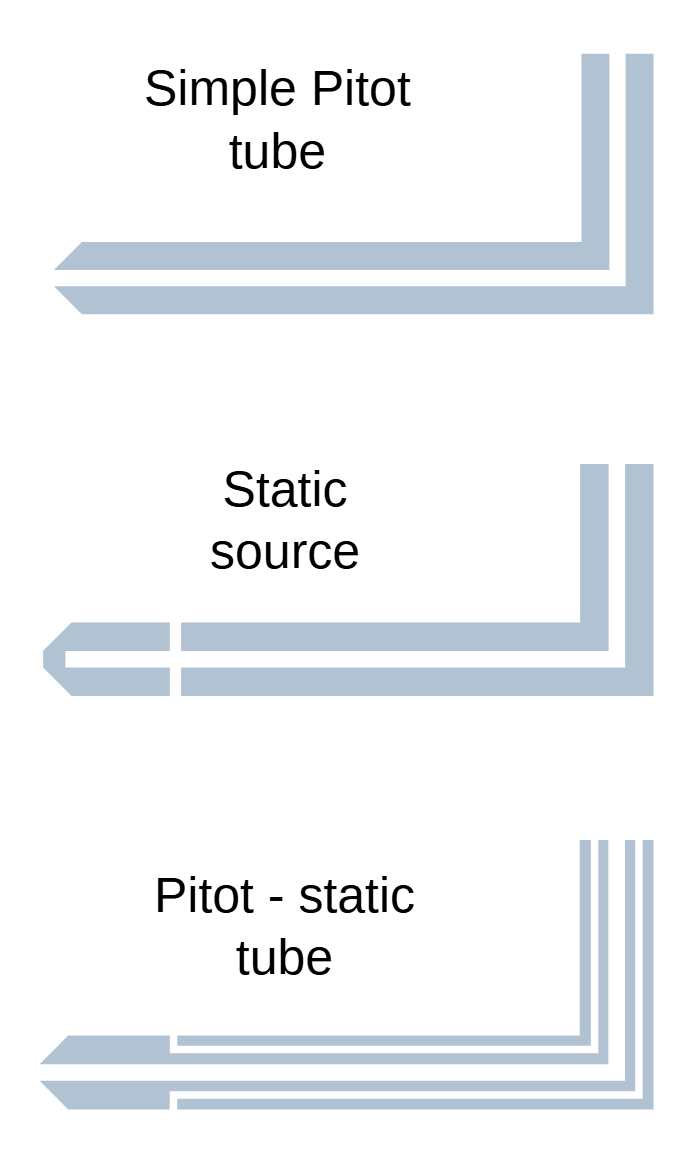
Measuring airspeed can be achieved by measuring stagnation pressure with a pitot tube, and comparing this to static pressure. This can be done at different points on the aircraft, or a pitot-static tube can be used, which measures both stagnation pressure and static pressure in a single probe. Credit: Chaos386, CC BY-SA 3.0
A key thing most aviators want to know is how fast their aircraft is going. Specifically, it’s nice to know how fast it’s moving relative to the airstream around it, which is referred to as airspeed. This is important, because it’s the aircraft’s velocity relative to the flow, such as wind, that determines the performance of the airfoils, how much lift is generated, and whether or not the aircraft is approaching a stall condition where it might fall out of the sky.
Bernoulli’s equation, rearranged to find airspeed (u), by subtracting static pressure from stagnation pressure, multiplying it by 2, dividing by fluid density, and taking the square root of that result.
Measuring airspeed is most commonly achieved with the use of a device called a Pitot tube. The pitot tube is a tube with a hole in one end that points directly into the airflow in the direction of travel of the aircraft.
As air flows in, it reaches a dead end and the flow slows to a stop, or stagnates, since it has nowhere to go. This allows a pressure sensor or a manometer or other device to measure the stagnation pressure at this point. The stagnation pressure measurement is related to the flowspeed of the incoming air since the kinetic energy of the flow is converted to pressure as the flow comes to a halt.
A secondary tube, pointing perpendicular to the airflow, is then used to measure the static pressure of the surrounding air, without the ram effect of the air being forced in by the aircraft’s forward motion. Then, it’s possible to calculate the velocity of the aircraft relative to the airstream by plugging the stagnation pressure and static pressure into a rearranged Bernoulli’s equation. If the pitot tube and static tube are hooked up to electronic sensors, the airspeed can be calculated electronically, and fed to a display or digital gauge.
Advertisement
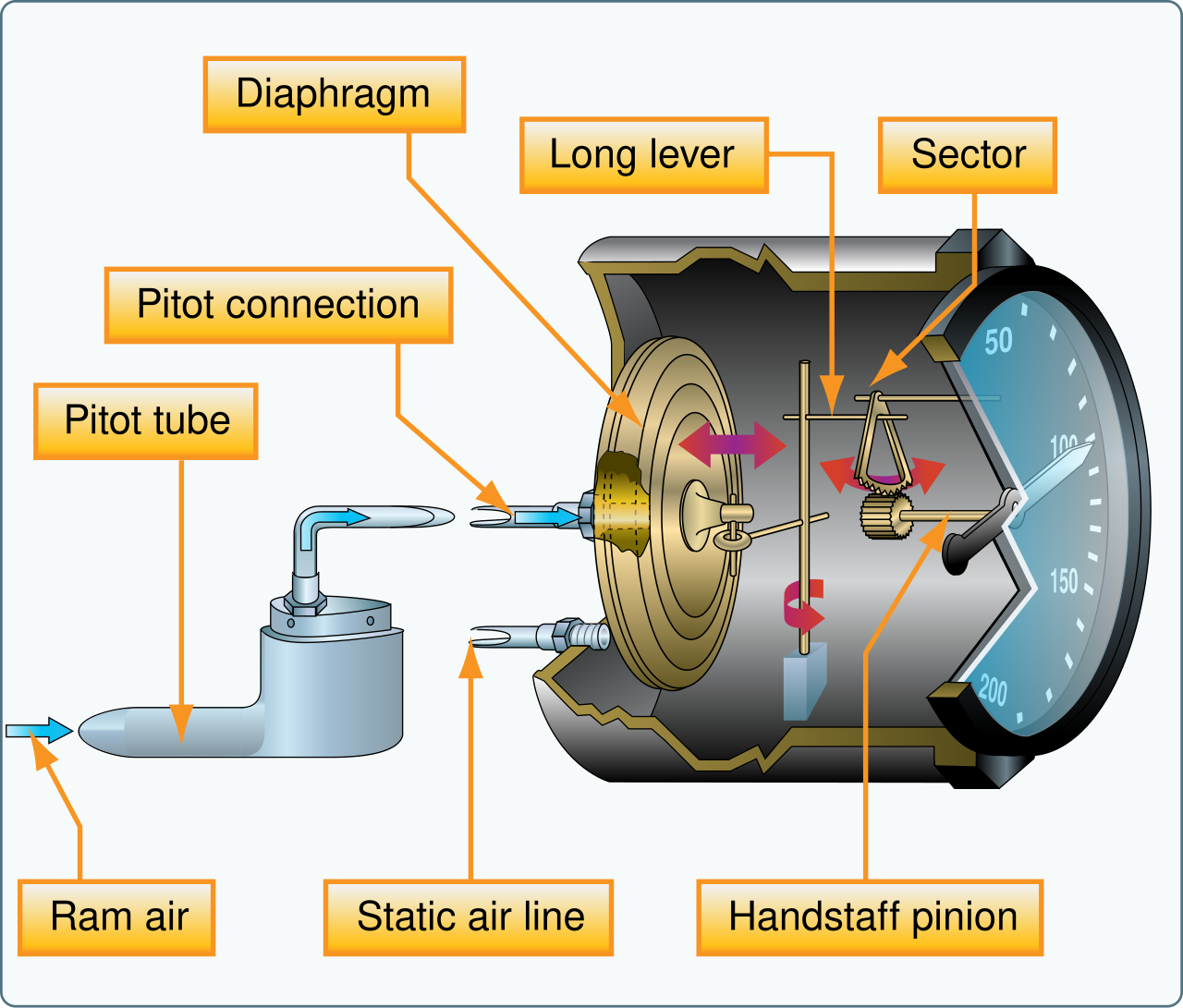
A classic airspeed indicator has the pitot tube and static tube feeding right into the gauge in the cockpit. The pressure differential causes the diaphragm to expand as the airspeed increases, which mvoes a mechanism causing the needle to move on the gauge. Credit: FAA, public domain
Alternatively, it’s possible to effectively do this “calculation” mechanically. In earlier days, static and stagnation pressure captured by each tube would be fed to a gauge. Inside, the stagnation pressure would be fed to a diaphragm which moved due to the difference relative to the static pressure which is fed into the gauge body, and the movement of the diaphragm would, via a simple mechanism, shift the needle on the gauge.
A small General Aviation aircraft might mount a single pitot tube on the aircraft, feeding the air speed instrument in the cockpit. Commercial aircraft might mount two or more for safety’s sake, in case one becomes inoperable, while large airliners may have four or even more to provide a high level of redundancy and error checking. Heaters are commonly included on pitot tubes to ensure they can be kept free of ice, which can otherwise completely block a tube and make it impossible to obtain an airspeed reading.
Pitot tubes sticking out in the airstream underneath a Boeing 777-381. Credit: Cassiopeia sweet, public domain
For pilots, not knowing how fast (or slow) the aircraft is going can be highly dangerous, as it can lead to entering unstable flight regimes such as stall. Thus, it’s imperative that the pitot tubes remain unobstructed and functional for safe flight. Many aircraft accidents have occurred because of blocked or malfunctioning pitot tubes or airspeed instruments.
The New Way
Of course, you could fuss about with pitot tubes and pressure sensors and deicing measures, but that’s all very fiddly and old hat. There is an entirely different way to figure out a plane’s speed, though it’s only been available for the last few decades. It’s as simple as throwing a GNSS receiver on the aircraft.
Yes, whether your particular poison is GPS, Baidou, GLONASS, or Galileo, any major satellite navigation system will be able to tell you the speed of your receiver. Simply measuring the change in the receiver’s position over time is enough to calculate out the speed, and any off-the-shelf receiver will present this information as standard. It’s generally not used as a primary indicator in aircraft, because it reports ground speed, not airspeed, the latter being more relevant for aviation purposes. Still, it can prove to be a useful sense check when traditional airspeed indicators are non-operative or reporting confusing data, and GNSS devices are widely used on many aircraft today.
Flying High
Many modern aircraft have so-called “glass cockpit” displays that include feeds from GNSS receivers, which can provide supplementary data such as satellite-based ground speed measurements. However, these readings are generally not used for the primary task of flying the aircraft. Credit: Bluedisk, CC BY-SA 3.0
If you’ve ever wondered how an aircraft measures its speed as it floats through the amorphous gas cloud we call an atmosphere, now you know. Even to this day, where electronics and computer wizardry control our fanciest aircraft, airspeed measurements are still done with the same simple physics, just with some fancier sensors for help. The fundamentals haven’t changed at all. Now you know, you can always dig deeper into the many other rich applications of Bernoulli’s equation and fluid mechanics in general. Happy learning.
Meta wants its own AI coding tools. To get there, it is telling its engineers to be careful with the rival tools they lean on today.
Meta has placed strict limits on how engineers in its applied AI division use Anthropic’s Claude Code and OpenAI’s Codex, The Information reported. The worry is inadvertent distillation. One internal memo even told some teams to pause tasks that used the outside tools. It warned that the rivals’ output could seep into Meta’s training data and trigger “serious escalations with partner companies”.
What distillation means here
Distillation is when one model learns from another model’s outputs. A company feeds a strong model’s answers into its own system, and the smaller model picks up the bigger one’s skills. The method is cheap, fast, and legally fraught.
That is the heart of Meta’s problem. The company is building its own coding tool, called MetaCode, to replace Claude Code and Codex. If its engineers rely on those rival tools while shaping the replacement, Meta could end up training on a competitor’s model by accident. That could breach the rivals’ terms of service and hand them a lawsuit.
Advertisement
The bind Meta is in
The situation is awkward. Meta still needs the best coding tools to move fast. For now, the best ones belong to Anthropic and OpenAI. So Meta is asking staff to keep using the very products it wants to leave behind, only with more caution. The rules sit inside its new applied AI engineering division, the unit Meta built to catch up in the model race.
The 💜 of EU tech
The latest rumblings from the EU tech scene, a story from our wise ol’ founder Boris, and some questionable AI art. It’s free, every week, in your inbox. Sign up now!
Cost is the other half of the story. Meta is trying to wean itself off expensive outside coding tools. It is not alone. Amazon is weighing cheaper alternatives after Anthropic raised its prices. The pressure to cut the AI bill is everywhere.
Advertisement
Anthropic keeps gaining leverage
This is the latest sign of Anthropic’s growing clout. Its Claude models have become a default for coders, which gives the company room to push. It recently struck a half-price deal to put Claude across California’s state agencies. It is also winning paying customers at pace.
The flip side is friction with the very firms that depend on it. Anthropic has already accused Alibaba of distilling Claude into a rival model. Meta clearly does not want to be next in line.
Squeezed on every side
Meta’s pinch is not only about Anthropic and OpenAI. Google has capped how much Meta can use its Gemini models for coding and chatbots, Engadget reported, citing a lack of capacity. So Meta faces limits from three rivals at once. It must build its own tools, and fast.
That is a strange place for a company of Meta’s size. It spends billions on AI talent and chips. Yet on coding tools, it still depends on the labs it is racing against. The new rules try to close that gap without tripping a legal wire.
Advertisement
Why it matters
The episode shows how the AI business is maturing. The model makers are no longer just selling access. They are guarding their outputs as prized training data, and they are watching who learns from them.
For Meta, the lesson is sharp. Owning the frontier means more than raw compute and big hires. It means controlling the tools your own engineers use every day. Until Meta’s in-house coding system is ready, it has to borrow from rivals while trying not to copy them. That is a tightrope, and the memos show Meta knows it.
Apple’s App Store is quietly a major source of the company’s revenue. Every time an iPhone user subscribes to a service through Apple’s billing platform, the Cupertino giant skims up to 30 percent off the top of each recurring charge. The practice has been so brazen that a court ruled Apple must allow third-party billing to be offered, then, last year, the same court found the company in contempt for violating that ruling when it charged developers a comparable fee to implement their own billing tools.
But app developers had already adjusted to Apple’s fee skimming long before the court case was decided. Rather than eat a 15-30 percent loss on subscription revenues, many developers simply offset those costs by charging customers more when they subscribe through the App Store. A service that might be $10 when you subscribe on the company’s website becomes $13 when you subscribe on the App Store. It’s a phenomenon that’s become known as the “Apple tax.”
YouTube Premium is a prime example. We’ve noted that some users can swap existing music subscriptions for YouTube Premium, but it’s a different story when subscribing through the App Store. Indeed, when we look at pricing for YouTube Premium, we can see Google charging an Apple Tax. When subscribed to through the YouTube website, the monthly subscription cost for an individual is $16. However, head to the App Store, and the price tag increases to $21 a month. That’s $5 leaving your wallet each month for no reason other than helping Google to cover Apple’s tolls, making it much harder to get your money’s worth from YouTube Premium.
Advertisement
Apple’s App Store is convenient for managing subscriptions, but it’s not worth paying extra for YouTube Premium
Reyanaska/Shutterstock
Some people prefer to bill their subscriptions through Apple’s App Store because of how predatory first-party billing can be. Once you give some companies your credit card information, it can be nearly impossible to get them out of your pocket. After digging around in settings menus to find the “cancel subscription” button, which appears deliberately hidden like Waldo, you’re made to go through three confirmation screens, presented with a special, one-time-only discount offer, and then made to fill out a survey explaining why you want to cancel. And that’s if you’re lucky. Some subscriptions from smaller outfits will make you send an email, or you might resort to replacing your credit card in order to stop the subscription from being charged.
There may be situations where paying an Apple tax on your subscriptions is worth a few extra dollars for the peace of mind that comes with the ability to cancel them in just a few taps on your smartphone. Apple would love to keep collecting its fees from your subscription, but the company also wants you to enjoy using your iPhone and is therefore not as straightforwardly incentivized to act like a gremlin with your credit card.
Even so, it’s worth saving money where you can. Thankfully, YouTube Premium makes it reasonably easy to cut off a subscription on its own billing platform. Canceling is a relatively straightforward process, and Google won’t give you much guff about your decision to stop giving it money. If you’re currently overpaying for YouTube Premium through the App Store, or if you’ve been considering signing up for the service, you’re better off doing so away from the tax collector at Apple’s walled garden gates.
Conducted jointly with China Telecom and optical equipment maker Dekoli, the test ran on the world’s longest cross-border commercial HCF cable. The result sets a new world record achieved without the signal boosters that long-haul fiber links typically depend on. Read Entire Article Source link
































































You must be logged in to post a comment Login