

Crypto World
Nasdaq to Deliver Proprietary On-Chain Market Data via Pyth


Nasdaq has chosen Pyth, an onchain financial data network, to distribute Nasdaq’s proprietary market data to blockchain applications and other software platforms, expanding how institutional trading feeds can be consumed by decentralized systems.
The collaboration begins with access to Nasdaq TotalView, the exchange’s depth-of-book data feed that captures every displayed bid and ask across price levels, along with order imbalance information around the opening and closing auctions. For traders and developers, the emphasis is on richer liquidity visibility than standard quote feeds, since a full order book can help power more informed execution, market-making analytics, and trading logic.
Key takeaways
- Nasdaq selected Pyth to make Nasdaq market data available to blockchain and other software platforms via onchain distribution.
- Initial coverage is Nasdaq TotalView, including full displayed order books and order imbalance data around opening and closing auctions.
- Pyth positions its integration as “single” access, aiming to simplify how applications obtain first-party market data.
- Nasdaq joins existing Pyth publishers such as Euronext, Tradeweb, Kalshi, Singapore Exchange (SGX FX), and the US Department of Commerce.
From exchange microstructure to onchain use
Traditional market data products typically serve low-latency trading systems and professional analytics, where order book visibility is critical. Nasdaq TotalView is designed for that purpose, offering a more complete picture of market liquidity by publishing the full displayed order book at each price level rather than relying only on top-of-book quotes.
By routing this type of feed through an onchain data network, Nasdaq is effectively lowering the integration barrier for applications that want to incorporate exchange-grade market information. According to Pyth, the service allows software applications to access first-party market data through a single integration, and it is intended for a range of use cases including blockchain applications, digital asset exchanges, prediction markets, and trading systems.
For builders, this matters because onchain trading and derivatives often struggle with a lack of consistent, high-quality market inputs. Depth-of-book and auction-related imbalance data can also support models that go beyond last-trade or index pricing, potentially improving how decentralized systems interpret liquidity conditions around times when participation and price formation are especially active.
Nasdaq’s broader digital-asset push
The Pyth partnership aligns with a series of moves by established exchange operators to expand into crypto-adjacent infrastructure and regulated market services.
In March, Nasdaq expanded its tokenization efforts through an agreement with crypto exchange Kraken and its infrastructure affiliate Backed to develop infrastructure aimed at linking traditional equities with blockchain networks. The company has framed this as part of a larger push to integrate tokenized assets with existing capital markets rails.
Nasdaq has also continued to deepen its regulated crypto derivatives strategy. The SEC approved Nasdaq’s proposal to list Bitcoin index options tied to the Nasdaq Bitcoin Index, with trading pending approval from the Commodity Futures Trading Commission. In parallel, Nasdaq partnered with CME Group to launch cryptocurrency index futures that track a basket of seven digital assets, including Bitcoin, Ether, Solana, and XRP, as part of its broader regulated derivatives lineup.
Exchange peers and the race for crypto product scope
Nasdaq is not alone in expanding beyond legacy exchange offerings. ICE—the parent of the New York Stock Exchange—has taken steps into crypto futures by partnering with OKX to launch perpetual futures tied to ICE’s Brent crude and West Texas Intermediate oil benchmarks. The announcement was described as the first product under that partnership.
ICE CEO Jeffrey Sprecher has also argued that regulators should allow traditional exchanges to offer 24/7 onchain perpetual futures. The core point is competitive: regulated venues should be able to contend with crypto-native platforms that already operate perpetual products around the clock.
While Nasdaq’s current Pyth deal is centered on market data distribution rather than trading products, it fits the same competitive theme—improving the ability of institutional-grade infrastructure to connect with blockchain applications. In practice, data access is often a prerequisite for building or operating decentralized systems that can respond to real liquidity conditions.
What to watch next
Investors and developers should keep an eye on how Nasdaq TotalView data is rolled out through Pyth beyond the initial scope, and whether additional Nasdaq market data offerings follow. As onchain applications increasingly seek higher-fidelity inputs, partnerships like this could become a differentiator for decentralized trading and prediction systems—provided integration remains practical and latency or data quality expectations can be met in real-world deployment.



Machi Big Brother, one of Hyperliquid's most-liquidated traders, was liquidated again on an Ethereum long and has now lost more than $80 million on the onchain derivatives exchange since September, according to onchain analytics firm Arkham. Arkham said the trader, whose real name is Jeffrey Huang,… Read the full story at The Defiant


Lighter, one of the largest decentralized perpetuals exchanges by trading volume, said it will start permanently burning the LIT tokens it buys back with exchange revenue and will fund staking rewards from its ecosystem token reserve. Lighter has bought back about 15.5 million LIT — roughly 6.3% of… Read the full story at The Defiant

Michael Burry attends “The Big Short” New York screening at the Ziegfeld Theater in New York, on Nov. 23, 2015.
Astrid Stawiarz | Getty Images
Michael Burry said Tuesday he has placed a bearish wager against Caterpillar, believing the construction-equipment maker has become one of the market’s most overvalued beneficiaries of the artificial intelligence investment boom.
The famed investor said he shorted Caterpillar shares at $1,060.98, alongside new bearish positions in Nvidia, Applied Materials, Tesla and the iShares Semiconductor ETF (SOXX), as he prepared for what he believes is an increasingly overextended rally in AI-linked stocks.
“Caterpillar jumped out at me,” Burry wrote in a Tuesday SubStack post. “I have never shorted Caterpillar. It has always done great for me on the long side in the past.”
Caterpillar shares just capped off the first half of 2026 with an 86% gain, making the construction equipment giant one of the best-performing stocks in the S&P 500 this year as investors increasingly embraced it as a proxy for the global AI infrastructure buildout.

Caterpillar year to date
Burry said Caterpillar’s stock valuation has reached levels that caught his attention. He shared a chart showing Caterpillar’s price-to-sales ratio climbing to the highest level in at least three decades at the same time the stock surged to record highs.
The investor, who famously predicted and profited from the subprime mortgage crisis in 2008, also reiterated his broader concerns about semiconductor valuations. He said the Philadelphia Semiconductor Index is trading about 65% above its 200-day moving average, a level he said was only reached previously during the dot-com bubble in 2000.
“The proximate cause of today’s rally is big spending announced out of Korea. Well, I see that as the beginning of the end,” Burry said. “It is only a matter of time now.”
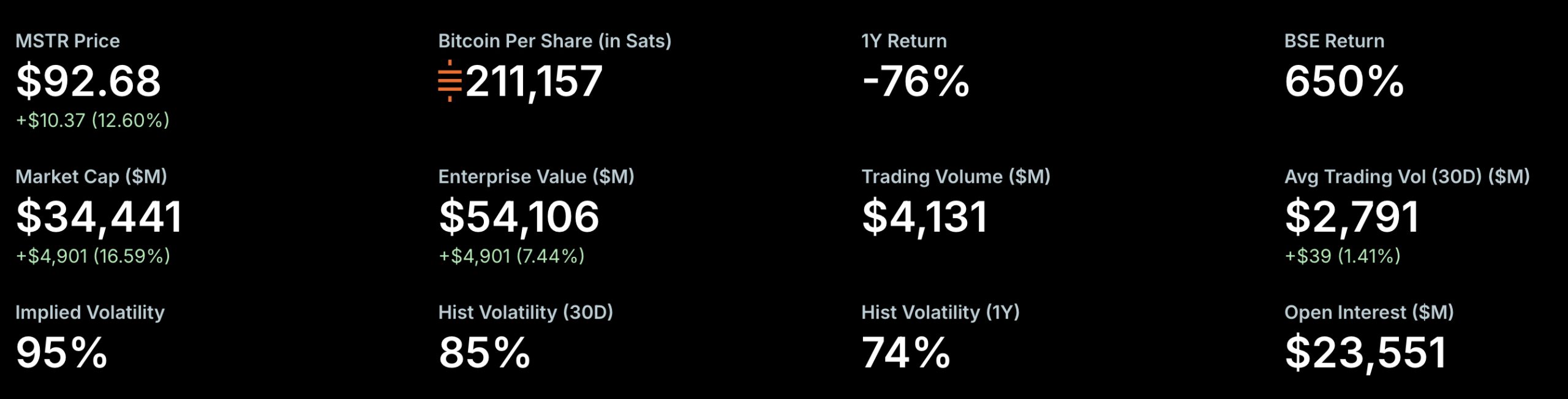
Bitcoin is holding a narrow consolidation price range as its prediction hangs in the balance on Michael Saylor’s next move and macroeconomic catalyst. Strategy’s MSTR shares snapped a nine-day losing streak on Monday after the firm unveiled a formalized capital framework that could allow it to sell up to $1.25 billion in Bitcoin to strengthen its balance sheet.
The announcement centered on Strategy’s expanded USD Reserve alongside a “BTC Monetization Program” that formalizes potential Bitcoin sales as a cash management tool. Meanwhile, Michael Saylor raised its dividend for the eighth time, targeting a 12% annual yield through twice-monthly distributions.
As one analyst noted, Saylor’s recent $1 billion Bitcoin purchase was financed entirely through STRC preferred stock sales, with no dilution of MSTR common shares. However, the preferred share product STRC rebounded after the news and sent the company’s mNAV above 1.0.

Macro context adds a layer of uncertainty. The Bank of Japan’s upcoming rate decision, a potential hike to the highest levels in 30 years, remains a live risk-off trigger for BTC and risk assets. So, until the BoJ verdict lands, directional conviction is thin.
Discover: The Best Crypto to Diversify Your Portfolio
Bitcoin Price Prediction: Break $70,000 This Week?
Bitcoin is trading around $60,000, 52% below its all-time high. Price remains locked inside a defined range after several failed breakout attempts. Meanwhile, MACD still favors buyers, although bullish momentum has weakened over the past two days. RSI is also trying to move above its signal line.
If buyers defend support near $58,800 and momentum strengthens, Bitcoin could challenge resistance around $64,100. A successful breakout would expose the next upside target near $71,700. However, the market still needs stronger buying pressure to confirm a sustained recovery.

Don’t Miss Out on Our $1,000 USDT Airdrop on ByBit
The most likely outcome remains continued consolidation while traders wait for the Bank of Japan’s policy decision and any fresh announcement from Strategy regarding additional Bitcoin purchases. On the downside, a surprise rate hike or disappointing corporate demand could drag Bitcoin toward support near $55,000.
We might still see some short-term volatility as traders adjust their exposure. Although Michael Saylor continues projecting Bitcoin could eventually reach $150,000 and later $1 million, price direction will ultimately depend on liquidity and sustained capital inflows rather than long-term forecasts.
Discover: The Best Token Presales
Bitcoin Hyper Targets Early-Mover Upside as Bitcoin Tests Key Levels
Bitcoin consolidating 50% below its high is the textbook setup where established-asset upside gets slowly priced in. It’s also where early-stage infrastructure plays attract rotational interest from traders who’ve done the math on BTC’s remaining percentage moves.
At the current rate, a 10x from here would make BTC a $10 trillion asset; that’s a very different probability calculus than it was at $1,000. That’s the context to keep in mind when evaluating what gets built on top of Bitcoin’s base layer.
Bitcoin Hyper ($HYPER) is positioning itself as the first Bitcoin Layer 2 with SVM (Solana Virtual Machine) integration, targeting the performance gap between Bitcoin’s security and Solana-grade execution speed.
The presale has raised close to $33 million at a current price of $0.01368, with staking available and a decentralized canonical bridge for native BTC transfers. The core pitch: fast, low-cost smart contracts on Bitcoin without sacrificing the trust layer.
Research Bitcoin Hyper before the presale window closes.
The post Bitcoin Price Prediction: How Michael Saylor’s Capital Strategy Could Impact BTC appeared first on Cryptonews.
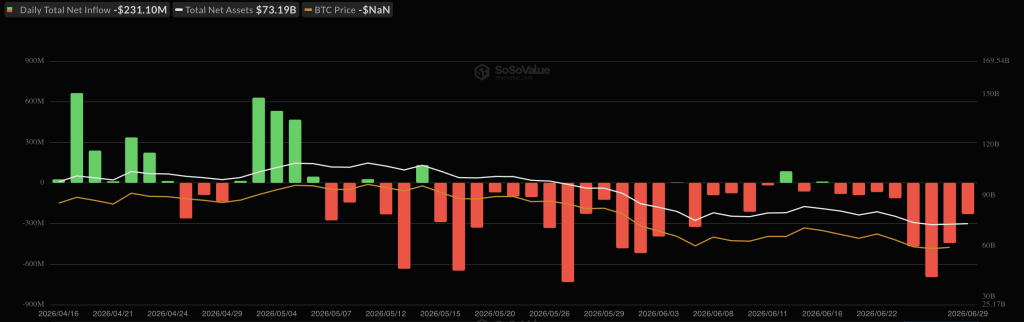
Spot bitcoin ETFs just posted their third-worst week on record, bleeding $1.79 billion in net outflows between June 22 and June 26، and BTC hasn’t been able to hold the $60,000 handle since.
Ethereum is trading near $1,585, up a marginal 0.7% over 24 hours but still down roughly 8% on the week, while ether ETFs just extended their outflow streak to seven consecutive weeks.
There’s a detail buried in the fund-flow breakdown that most headline readers are missing.
BlackRock’s IBIT alone accounted for $1.3 billion of the bitcoin ETF exodus, with Fidelity’s FBTC adding $314.9 million and Grayscale’s GBTC shedding another $135.3 million. Smaller pockets of demand, Grayscale’s Bitcoin Mini Trust picked up $71.7 million, Morgan Stanley’s MSBT brought in $26.2 million, were nowhere near enough to offset the tide.

Meanwhile, analysts are flagging BTC’s current state as a fragile recovery phase, with roughly $448 million in leveraged long liquidations clearing out in the last 24-hour window alone. The macro backdrop isn’t helping: Federal Reserve meeting minutes and U.S. Treasury General Account movements are the two catalysts traders are stacking their scenarios around this week.
What happens at $60,000 over the next 48 hours will answer most of the near-term questions.
Can Bitcoin and Ethereum Hold Support as ETF Outflows Mount?
Bitcoin is currently oscillating between $60,000 and $59,400. The $60,000 level has now been a firm rejection zone across multiple breakout attempts, with sell-side pressure consistently materializing as the price approaches that level.
Rebuilding open interest suggests some traders are re-entering, but short-dated put options are still trading at a premium to calls; the market is hedging downside, not loading for upside.

Key support sits at $59,000, with a deeper floor in the mid-$50,000s if that level fails. The bull case depends on Fed minutes landing dovish enough to trigger a risk-on rotation; if that materializes, a move back toward the $64,000–$66,000 prior resistance zone becomes credible.
The base case is a continued range chop between $59,000 and $62,000 until a macro catalyst forces a directional decision. Bear case invalidation: a clean close below $59,000 with volume opens the mid-$50,000s as the next structural reference.
Ethereum’s picture is marginally more stable but not materially better. At $1,585, ETH is holding above the $1,530–$1,550 intraday low zone, and the $1,500 level remains the line that matters. A break there, per technical consensus, opens further downside with limited structural support until the low-$1,400s.
The recovery target is $2,000, but ETH needs to reclaim $1,700 first, and seven straight weeks of ETF outflows don’t suggest that institutional rotation is imminent. The $3 billion-plus outflow pattern is becoming a structural overhang, not a one-week anomaly.
Bitcoin Hyper Could be The Next 1000x In Crypto And Here is Why
When BTC consolidates in a range defined by macro uncertainty and institutional de-risking, the asymmetric opportunity shifts to early-stage infrastructure with direct Bitcoin exposure, but without the ETF wrapper or the spot price ceiling.
Smart money accumulation in Bitcoin Layer 2s during ETF outflow cycles is a pattern that’s begun attracting serious attention precisely because the infrastructure thesis doesn’t require BTC to immediately reclaim $64,000.
Bitcoin Hyper ($HYPER) is positioning itself as the first Bitcoin Layer 2 with full Solana Virtual Machine (SVM) integration, targeting the core limitations that have kept Bitcoin’s programmability behind Ethereum and Solana: slow transactions, high fees, and no native smart contract layer.
The presale is currently priced at $0.0136824, with $32,898,380.61 raised to date. Staking is live with a high APY, and the architecture includes a Decentralized Canonical Bridge for BTC transfers alongside sub-second finality claims that, if delivered, would make it faster than Solana on its own infrastructure. The $32M raised during the current BTC dip isn’t noise; it reflects genuine appetite for scalable Bitcoin infrastructure ahead of a potential macro pivot.
The post Bitcoin ETFs Just Posted Their Third-Worst Week Ever And BTC Can’t Hold $60,000 appeared first on Cryptonews.

A dispute over Bitcoin’s proposed BIP-110 soft fork has intensified after critics argued that the upgrade could break certain wallets and leave some users with permanently unspendable BTC if it activates.
This is according to crypto investment advisor Farside Investors, who were challenging claims made by BIP-110 supporter Fred Krueger in a June 28 post on X.
BIP-110 Could Break Wallets and Freeze Funds
In his Sunday post, Krueger stated that BIP-110 would leave Bitcoin’s monetary properties untouched, with the 21 million coin supply, proof-of-work, Lightning, multisig wallets, self-custody and address functionality all being unchanged.
“The primary effect is that large arbitrary data used by Ordinals, Runes, and similar protocols would no longer be valid,” he noted.
However, Farside disputed that assessment, saying that BIP-110 would ban several Taproot scripting features, including the OP_IF opcode used by Miniscript. According to its explanation, after the fork activates, wallets that support Miniscript will still let users generate and send funds to addresses built on the now-banned scripts.
While those transactions will look valid under BIP-110’s own rules, the BTC sent to them will become unspendable because the required spending conditions will no longer apply under the new consensus rules.
Ironically, the latest version of Bitcoin Knots, one of the node implementations supporting BIP-110, could itself create these incompatible addresses.
Farside went further, pointing out that BIP-110 will also ban the creation of new pay-to-public-key (P2PK) outputs, a script type that was used extensively during Bitcoin’s early days and is holding more than 1.7 million BTC.
However, spending the existing P2PK outputs would still be allowed, although under certain circumstances, per the investment company, the proposal could temporarily freeze funds or expose users to theft risks, despite including safeguards such as grandfathering older outputs and limiting enforcement to about one year.
The proposal can become active either if 55% of miners signal support during a difficulty adjustment period or, if that does not happen, through a mandatory signaling process starting at block 961,632, which is expected to be reached in August 2026.
Debate Extends Beyond Wallet Compatibility
The fight over BIP-110 is part of a wider argument about what’s clogging Bitcoin’s network space, with Krueger and other supporters saying that inscriptions, BRC-20 tokens and similar uses have created unnecessary bloat on the network, and the new proposal is a way to discourage such transactions without changing BTC’s monetary policy.
But others, including the Block Runner podcast account, have rejected that reasoning, insisting that the 126.7 million inscriptions on Bitcoin account for just 1.267 BTC of value, a fraction it likened to a coin dropped in the ocean.
According to them, miners actually profiting from that activity, including AntPool, ViaBTC, SpiderPool, F2Pool, and Luxor, are helping offset Bitcoin’s declining security budget, while BIP-110 itself has only thin miner and node support.
The network’s activity has stayed high through this period despite price action. Recent data from CryptoQuant showed that usage was near record territory even with BTC plunging below $60,000, a sign that demand for blockspace, whether contested or not, isn’t going away any time soon.
The post Critics Say BIP-110 Could Break Self-Custody and Risk User Funds appeared first on CryptoPotato.
Crypto World
Crypto wallet Phantom pushes deeper into perps hiring team behind Hyperliquid’s OpenAI, Anthropic markets


The race is also spreading beyond crypto. Last month, prediction market operator Kalshi launched its own perpetual futures business after regulatory approval, joining exchanges betting that always-on derivatives will become a larger part of financial markets.
For Phantom, the hires are part of a broader push into trading.
Best known as one of crypto’s largest self-custody wallets, Phantom has steadily expanded beyond asset storage into swaps, staking and derivatives as wallets increasingly compete to become full-service financial apps rather than simple interfaces for holding tokens.
The company said it has become the largest distribution partner in the Hyperliquid ecosystem and plans to deepen its focus on perpetual futures.
“Open markets have become a major focus for us,” Millman wrote. “We’ve gone deep on perps, and we intend to go deeper.”
Millman described Hyperliquid as “one of the best examples anywhere of what open markets make possible,” pointing to its global liquidity and transparent onchain infrastructure.
Bringing on the Ventuals team will help Phantom accelerate its efforts to build trading products around the ecosystem, he said.

TLDR
- Strategy introduced a new capital framework that allows potential Bitcoin sales to raise liquidity.
- Strategy stocks MSTR and STRC recorded strong gains before easing in premarket trading.
- Benchmark reaffirmed a Buy rating and said the new model improves capital flexibility.
- Strategy shifted from pure Bitcoin accumulation to a more active balance sheet management approach.
- The company authorized up to $1.25 billion in Bitcoin sales, representing a small portion of holdings.
Strategy drew mixed reactions after unveiling a revised capital framework, even as its stocks posted strong gains. Analysts supported the changes, but some market participants questioned the long-term impact on Bitcoin holdings. The update introduces flexibility, yet it shifts Strategy away from its previous accumulation-only stance.
Strategy Gains Analyst Backing as Stocks Rise
Benchmark Equity Research reaffirmed a Buy rating on Strategy’s Class A stock MSTR with a $570 price target. The firm stated that the revised capital framework improves financial flexibility and strengthens balance sheet management. As a result, Strategy attracted renewed attention from institutional analysts.
Meanwhile, Strategy’s MSTR shares climbed 12.6% to about $92.70 during Monday trading sessions. At the same time, STRC preferred shares rose 12.2% to approximately $83.70, reflecting strong investor response. However, both Strategy stocks moved slightly lower in Tuesday premarket trading activity.
Benchmark analysts stated that Strategy no longer operates as a one-direction Bitcoin accumulator. Instead, Strategy now manages both assets and liabilities through an active capital structure approach.
They added, “Strategy is now an active manager of both sides of its capital structure.”
Strategy authorized potential Bitcoin sales worth up to $1.25 billion under its updated capital framework. This amount equals about 21,082 BTC based on current market prices, according to available data. The allocation represents nearly 2.5% of Strategy’s total holdings of 847,363 BTC.
Previously, Strategy relied mainly on issuing equity or debt to raise capital for operations. However, the new framework allows Strategy to access liquidity through direct Bitcoin sales when required. This shift reflects a broader approach to managing financial obligations and market conditions.
Strategy has executed Bitcoin sales before despite its long-term accumulation narrative. The company sold 32 BTC in May 2026 and previously sold 704 BTC in 2022. Later, Strategy repurchased a similar amount, maintaining its overall exposure to Bitcoin.
Strategy Plan Divides Market Participants
Investor Simon Dedic suggested the update could signal a local bottom for Strategy’s recent market performance. He added that some selling pressure likely reflected preparations for liquidity adjustments ahead of the announcement. His comments indicated partial confidence in Strategy’s revised approach.
Trader Scott Melker acknowledged that Strategy responded to investor concerns by increasing flexibility and cash reserves. However, he stated, “Only time will tell” whether the framework restores confidence in Strategy’s long-term outlook. His remarks reflected uncertainty about the sustainability of the changes.
Arca CIO Jeff Dorman argued that Strategy may need to sell between $2 billion and $3 billion in Bitcoin. He stated that such sales could remove persistent market overhang linked to Strategy’s large holdings.
Meanwhile, Ripple CEO Brad Garlinghouse said, “Financial engineering doesn’t drive long-term value,” criticizing Strategy’s approach.


The U.S. Securities and Exchange Commission is asking market participants to weigh in on how exchange-traded funds should be regulated when they introduce “novel” asset classes or use new investment strategies. The SEC’s request for public comment targets a central question facing modern ETF issuers: whether the agency’s current framework is sufficient for products that don’t fit neatly into traditional categories.
In a filing posted as a Federal Register notice, the SEC said it is evaluating existing rules and whether changes to ETF registration and oversight procedures may be needed as these funds reach the market. The comment window will remain open for 60 days after the notice is published in the Federal Register, giving investors, issuers, and industry groups time to respond before the regulator decides on any potential next steps.
Key takeaways
- The SEC is soliciting feedback on whether current ETF regulations adequately cover products tied to new asset types and investment approaches.
- The consultation also asks whether the ETF registration process itself should be adjusted as issuers launch increasingly customized strategies.
- Regulatory focus comes as ETF assets have expanded quickly, with the SEC citing growth from roughly $4 trillion in 2019 to more than $12 trillion by the end of 2025.
- Newer ETF designs in crypto and beyond—such as staking-, stablecoin-reserve-, and options-based structures—illustrate why the SEC is reviewing fit-for-purpose rules.
- The SEC’s request follows another recent SEC/CFTC consultation aimed at aligning portfolio margin rules across securities and derivatives markets.
Why the SEC is revisiting ETF oversight
According to the SEC, the request for comment is aimed at ETFs that invest in innovative asset classes or rely on strategies that may fall outside the assumptions embedded in existing regulation. The agency’s stated intent is not limited to crypto; rather, it addresses a broader trend in ETF design that increasingly blends traditional market exposure with novel mechanisms.
The SEC’s framing is significant for investors because ETF rule changes typically affect how products are approved, how risks are disclosed, and how far issuers can stretch strategies before triggering additional scrutiny. For issuers, the consultation signals that regulatory expectations may evolve as market offerings become more complex.
The full context is likely to be read alongside the SEC’s broader ETF activity over the past year, including sustained interest in how new fund structures interact with disclosure rules, custody expectations, derivatives usage, and operational controls. While the SEC did not provide specific details in the excerpted report beyond asking the public to address whether and how existing rules should be adapted, the emphasis on “registration” suggests the agency is prepared to consider procedural adjustments—not just interpretive guidance.
Crypto ETF strategies are moving beyond simple tracking
Crypto-related ETFs and ETPs have increasingly diversified beyond price-tracking products, and the SEC’s request arrives at a time when that shift is accelerating. In recent months, issuers have introduced funds tied to staking exposure, stablecoin reserve concepts, and more specialized allocation approaches.
Examples highlighted in earlier market coverage include ProShares’ GENIUS Money Market ETF, described as a Treasury-focused product structured around reserve assets permitted under the GENIUS Act for payment stablecoins. The same period also saw Grayscale launch its Hyperliquid Staking ETP, which seeks exposure to HYPE while targeting staking rewards.
These launches matter because they highlight different regulatory pressure points than straightforward spot exposure. Staking-related approaches raise questions about how rewards are generated, accounted for, and managed over time. Stablecoin reserve-linked structures introduce additional issues around the nature of reserve assets and the mechanics of how those assets are held and valued.
Bitcoin ETFs: options and rules-based income themes
The move toward more elaborate crypto ETF structures is also visible in Bitcoin product filings and proposals, especially those using options strategies or income-style mechanics rather than pure spot replication.
BlackRock proposed an options-based Bitcoin income ETF in January, according to the filing referenced in prior reporting. Goldman Sachs followed with an options-focused Bitcoin income concept that combines spot Bitcoin exposure with covered-call strategies, as noted in earlier coverage.
Earlier this month, Franklin Templeton proposed two ETFs that would systematically reinvest stock dividends into Bitcoin-linked investments. The proposals describe a rules-based Bitcoin allocation and identify multiple possible instruments that could be used to gain Bitcoin exposure, including exchange-traded products, futures, options, and Bitcoin-backed depositary receipts.
From an investor standpoint, these structures can change the risk profile and return drivers of a Bitcoin ETF. Options strategies can affect volatility and how returns behave in different market conditions, while rules-based dividend reinvestment creates a distinct linkage between U.S. equities and Bitcoin exposure. That kind of hybrid design is precisely the scenario the SEC says it wants input on: whether existing ETF rules are built to handle novel approaches consistently and transparently.
Cross-asset ETF experimentation adds to the regulatory challenge
Beyond crypto-only products, ETF experimentation is increasingly cross-asset. Bitwise, for example, launched an actively managed ETF pairing Bitcoin with gold, precious metals, and mining equities.
Blended strategies can complicate the regulatory review process because the ETF’s underlying risks are no longer tied to a single market driver. Instead, investors may be exposed to correlations and dynamics across digital assets, commodities, and equity-linked mining exposure. Regulators reviewing how these funds are registered and monitored may need to consider whether existing frameworks sufficiently address how risks are calculated, disclosed, and managed when multiple asset classes and strategies interact.
And while the SEC’s request is broad, the timing is telling: it comes after the agency and the CFTC sought public feedback on harmonizing portfolio margin rules across securities and derivatives markets. Together, those initiatives point to regulators taking a more coordinated look at how market structure and product design should be handled when ETFs interact with derivatives and non-traditional exposures.
For investors, the next step is straightforward: watch for what the SEC receives during the 60-day comment period—especially arguments about whether ETF registration rules should be updated for funds that mix assets and strategies in ways regulators haven’t previously had to address at scale. The consultation may not immediately change approvals, but it could influence how the SEC evaluates the next wave of innovative ETF structures.
TLDR
- The UK Financial Conduct Authority introduced new crypto rules covering trading platforms, custody, and lending activities.
- The framework requires firms to hold capital based on their risk exposure and conduct annual stress tests.
- The crypto rules extend to stablecoin issuers with reduced capital requirements set at one percent.
- The regulator introduced market abuse controls targeting insider trading and manipulation in crypto markets.
- Firms must apply for full authorization under the new crypto rules before the 2027 deadline.
The Financial Conduct Authority has introduced new crypto rules to position the UK as a global digital asset hub. The framework sets capital standards, market conduct rules, and stablecoin requirements ahead of 2027 enforcement. As a result, the UK aims to balance innovation and oversight through structured crypto rules across the sector.
UK Expands Oversight with Broad Crypto Rules Framework
The regulator now applies crypto rules to trading platforms, custodians, and lending providers across the UK market. In addition, the framework covers staking firms and certain DeFi entities with identifiable control structures. Therefore, the crypto rules extend supervision to most commercial digital asset activities.
Meanwhile, firms must meet prudential standards, including capital buffers tied to their internal risk exposure levels. Each company defines its own risk profile and submits annual stress test results to regulators. As a result, these crypto rules introduce structured financial discipline without mirroring traditional banking requirements.
However, firms will design their own stress scenarios rather than follow centralized models from authorities. This approach gives flexibility, yet it requires firms to justify their assumptions clearly. Consequently, the crypto rules aim to enforce accountability while maintaining operational independence.
Market Abuse Controls and Stablecoin Concessions Take Shape
The framework introduces crypto rules addressing insider trading and market manipulation within digital asset markets. Large trading platforms will monitor activity using industry-led systems instead of strict centralized surveillance mandates. Therefore, the regulator narrows earlier proposals while still enforcing market integrity under crypto rules.
Eligible assets on UK platforms must meet a single 40% net risk requirement and counterparty adjustment standard. This replaces the earlier two-tier classification system proposed during consultations. As a result, the crypto rules simplify compliance requirements for listed digital assets.
At the same time, the regulator eased stablecoin requirements after industry feedback on earlier proposals. The capital coefficient now stands at one percent of issued token value, down from previous levels. Consequently, these crypto rules align more closely with global standards to maintain competitiveness.
Stablecoin issuers can hold up to five percent surplus cash within reserve backing pools for liquidity management. In addition, firms no longer need to forecast redemption levels for backing assets under revised crypto rules. Therefore, the framework reduces operational burdens while maintaining financial safeguards.
Authorization Timeline and Global Competition Intensify
Crypto firms must apply for full authorization under the new crypto rules before the 2027 enforcement deadline. The application window opens in September 2026 and closes in February 2027 for all applicants. Meanwhile, regulators will offer pre-application support meetings to guide firms through compliance requirements.
Existing anti-money laundering registrations will not convert into authorization under the updated crypto rules framework. Therefore, firms must submit new applications regardless of their current regulatory status. This ensures consistent standards across all participants under the new regime.
Until implementation, oversight remains limited to financial promotions and anti-money laundering compliance measures. David Geale said the framework balances certainty with innovation under the new crypto rules.
He stated, “We created a framework that supports innovation while ensuring firms meet consistent standards.”
The UK introduced these crypto rules as global jurisdictions compete to attract digital asset businesses. The European Union enforces MiCA, while the United States advances stablecoin legislation under Donald Trump. Therefore, the UK positions itself as a stable and competitive destination for crypto firms.

After US coaching journey, Jimmy Alapag gets his big break in PBA

Blue Origin decides not to re-create ruined pad but will move on to a different launch concept

Why hot weather can leave you feeling stressed and anxious





-

 Fashion4 days ago
Weekend Open Thread: Staud – Corporette.com
-

 Politics5 days ago
The House | Manchesterism won’t survive the painful trade-offs unless it gets citizens on board
-

 Crypto World20 hours ago
Strategy authorizes up to $1.25B in Bitcoin sales under new capital plan
-

 Politics5 days ago
Potential 2028er World Cup attendee leaderboard
-

 Business5 days ago
Asia stock markets slide as tech shares slump
-

 News Videos2 days ago
MAJOR BITCOIN & MARKET UPDATE!!!! (MUST WATCH ASAP!!!)
-

 Tech5 days ago
A Look At A Gaggle Of Transputer Boards
-

 Crypto World7 days ago
Securitize Wraps Roubini's SEC-Registered ETF as Dubai VARA Digital Security
-
Crypto World7 days ago
Bitcoin (BTC) Dips Below $62K, Ethereum (ETH) Plunges 6% Daily: Market Watch
-
 Crypto World5 days ago
Dell (DELL) Shares Tumble Over 5% Following Analyst Downgrade to Hold
-

 Crypto World3 days ago
Coinbase, Circle Deepen Crypto Stock Losses Despite Resilient S&P 500
-
Business7 days ago
Entergy settles forward sale agreements, raises $672 million in cash proceeds
-

 Crypto World4 days ago
Kraken's xStocks Opens Bending Spoons IPO Registration to EEA Retail
-

 Business19 hours ago
Australia treasurer says alleged access of prime minister’s bank data ’incredibly concerning’
-

 Sports4 days ago
FIH Pro League: India defeat Pakistan 7-1, register biggest win of campaign | Other Sports News
-

 Crypto World5 days ago
Bitcoin Sparks $600M Hourly Liquidations With $65,000 Set To Become Resistance
-

 Tech3 days ago
Bluekit phishing kit adopts browser-in-the-middle for login theft
-

 Tech3 days ago
Russian hackers now target Signal backup recovery keys
-
Crypto World4 days ago
Hyperliquid Named on Singapore MAS Investor Alert Register
-

 Crypto World6 days ago
Ripple and SBI launch RLUSD in Japan after JFSA approval
You must be logged in to post a comment Login