

Crypto World
Bitcoin ETFs Post Record $4.5B Outflows in June

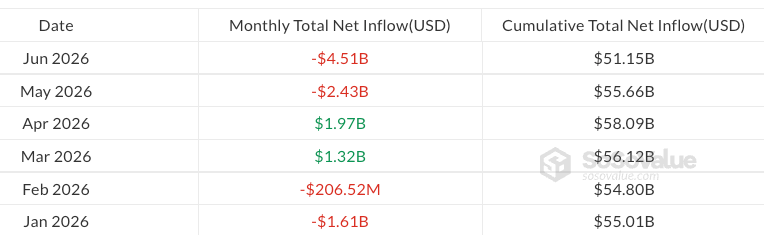
US-listed spot Bitcoin exchange-traded funds (ETFs) posted a record $4.5 billion in net outflows in June, more than three times the $1.25 billion Strategy is authorized to raise through its new Bitcoin monetization program.
The record monthly withdrawals pushed US spot Bitcoin ETFs to roughly $5.5 billion in year-to-date net outflows for 2026, reducing cumulative net inflows since the funds launched to about $51.2 billion, according to SoSoValue data updated on Wednesday.
BlackRock’s iShares Bitcoin Trust (IBIT) accounted for about 79% of June’s withdrawals, posting $3.55 billion in net outflows, according to Farside Investors.
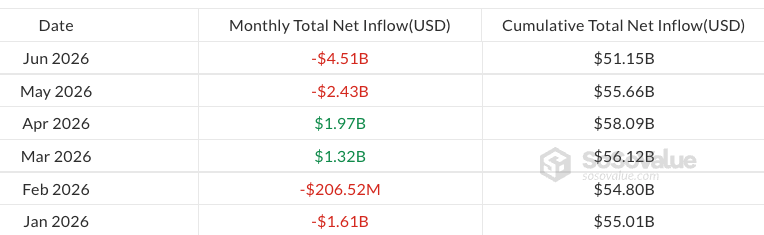
Monthly flows in US-listed spot Bitcoin ETFs. Source: SoSoValue
The figures highlight weakening demand for US spot Bitcoin ETFs, despite much of the market’s attention remaining fixed on developments surrounding the industry’s largest corporate Bitcoin treasury company.
Bitcoin ETF holdings fall below year-ago levels despite higher inflows
According to SoSoValue, cumulative net inflows into US spot Bitcoin ETFs have risen 4.6% from about $49 billion a year earlier. But CryptoQuant data shows the funds now hold less Bitcoin than they did at the same time last year.
“US-based Bitcoin ETF holdings are now lower than at this same day last year,” CryptoQuant’s head of research Julio Moreno wrote on X on Tuesday.
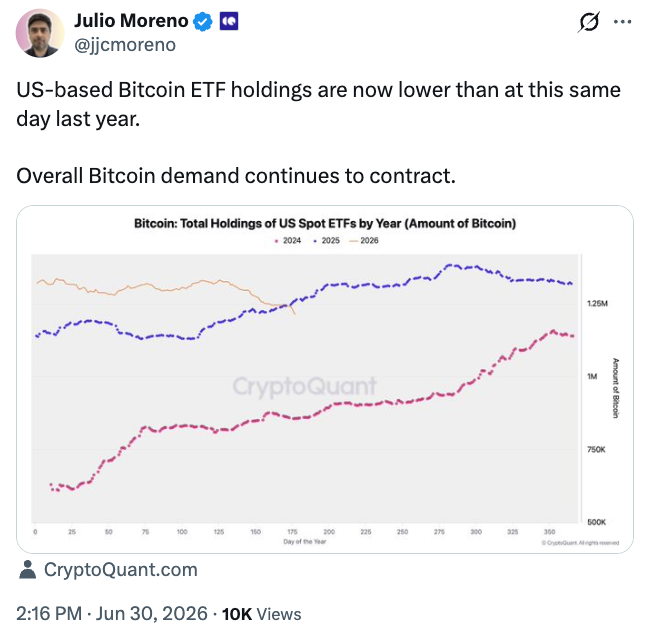
Source: Julio Moreno
Moreno said overall demand for Bitcoin continues to weaken, with total holdings across US spot Bitcoin ETFs falling below 1.25 million BTC.
Related: Swan’s Cory Klippsten sees record Bitcoin holder supply revealing early bottom
ETF withdrawals dwarf Strategy’s Bitcoin plan
Strategy announced its Bitcoin monetization program on Monday as part of a broader capital framework designed to support dividend obligations tied to its preferred securities, a move widely viewed by investors as a response to growing funding pressure within the company’s structure.
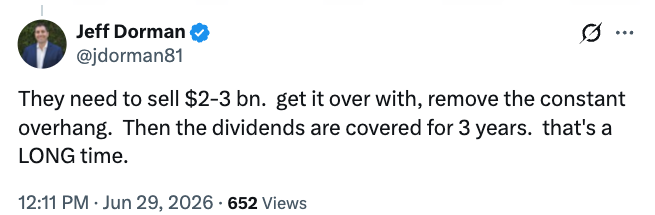
Source: Jeff Dorman
The move drew mixed reactions across the community, with some viewing it as financial flexibility while others flagged concerns over the new capital structure’s long-term sustainability and argued it could ultimately sell much more than $1.25 billion.
Strategy’s Class A common stock (MSTR) initially surged as much as 12% to above $90 following Monday’s announcement before reversing course and closing at $86.93 on Tuesday, down 6.2% on the day, according to Yahoo Finance.
Meanwhile, Strategy’s preferred stock (STRC) traded higher at $84.86 on Tuesday, according to Yahoo Finance.
Magazine: Bitcoin slides to $58K, XRP hits $1 but onchain data promising: Market Moves



Global mergers and acquisitions (M&A) reached a record $2.8 trillion in the first half of 2026, up 48% from a year earlier. This marked the strongest opening six months since LSEG began tracking deals in 1980.
Large takeovers carried the market. Fewer companies changed hands, yet the deals that closed were far bigger, lifting total value to a record.
Global M&A Surges to Record $2.8 Trillion
Transactions above $10 billion set the pace. Roughly 47 such deals, worth more than $1.3 trillion combined, drove close to half of all value in the period, according to LSEG data.
Meanwhile, the total number of deals fell 9% to about 24,000, the lowest first-half count in six years. Buyers favored fewer, bigger bets over broad activity.
Ivan Farman, co-head of Global M&A at Bank of America, said the stronger pace of large-scale deals compared with smaller transactions “reflects a growing view that a $1 billion to $3 billion deal takes just as much time as a larger one, so when an opportunity for a big transaction arises, companies see this as the moment to act.”
“So when an opportunity for a big transaction arises, companies see this as the moment to act,” Farman added.
Follow us on X to get the latest news as it happens
Ample financing made that ambition possible. Global investment-grade corporate debt issuance reached $3.4 trillion in the first half, up 10% from last year, Reuters reported.
Technology continued to dominate global merger and acquisition activity. Announced deals totaled $649 billion in the first six months of the year.
Meanwhile, cross-border M&A surged to $893 billion during the first half of 2026, marking a 62% increase from the same period last year. It also represented the strongest start to a year since 2018. The US drew the most interest, at 25% of cross-border transactions. Britain ranked a close second.
While the first half has been notable, full-year momentum points higher. Global M&A is projected to reach $4 trillion in 2026, which would mark the strongest year since 2021, according to PwC.
Subscribe to our YouTube channel to watch leaders and journalists provide expert insights
The post Mega-Deals Drive Global M&A to $2.8 Trillion in First Half of 2026 appeared first on BeInCrypto.
Crypto World
707 Cayman Holdings (JEM) Stock Explodes 267% on New Director Appointment and Blockchain Strategy

Key Highlights
- Shares of JEM closed 267.59% higher during Tuesday’s regular session at $3.97, followed by an additional 154.41% gain after-hours to $10.10
- The explosive move followed news that Robin Hoksnes Karlsen was appointed as executive director, revealed before markets opened
- Volume exploded to 122.24 million shares — approximately 130 times the typical daily average of 940,600
- Directors greenlit exploration of an AI-powered blockchain supply chain system with a preliminary budget of $10–12 million across three years
- No funds have been allocated yet; any cryptocurrency payment trials require regulatory clearance in Hong Kong, the EU and compliance with FATF standards
707 Cayman Holdings (JEM) delivered one of Tuesday’s most dramatic market performances. Shares finished regular trading up 267.59% at $3.97, before climbing an additional 154.41% in extended hours to $10.10.
707 Cayman Holdings Limited Ordinary Shares, JEM
The dramatic rally was sparked by news that Robin Hoksnes Karlsen had been named executive director. The announcement arrived ahead of market open.
Karlsen is the founder of AMIHAN Innovations Ltd., a Web3 and technology firm, and brings over ten years of expertise spanning real estate investing, capital structuring and institutional Real World Asset (RWA) tokenization within decentralized finance ecosystems. His educational credentials include a master’s degree from the University of Hong Kong and an undergraduate degree from University College London.
Trading activity underscored the intensity of investor interest. The session saw 122.24 million units change hands — roughly 130 times JEM’s standard daily volume of 940,600.
With a market capitalization around $7.15 million, the company remains firmly within small-cap boundaries. JEM’s 52-week trading range spans $1.02 to $135, while its RSI currently registers at 67.99 after the dramatic price movement.
Company Unveils AI and Blockchain Supply Chain Strategy
Also on July 1, the board revealed approval to investigate a cutting-edge digital infrastructure merging AI capabilities, blockchain-based traceability and a cryptocurrency payment pilot designed to digitalize its worldwide apparel supply network.
The initiative responds to growing demand from European and North American customers for enhanced supply chain visibility, accelerated restocking cycles and authenticated ESG documentation.
Leadership presented a preliminary three-year funding framework of $10 million to $12 million for staged implementation. The roadmap encompasses AI-enhanced supply chain efficiency, AI design tools, blockchain-powered origin verification and a crypto transaction pilot program.
The board emphasized that no capital commitments have been finalized. The schedule and extent of any cryptocurrency payment operations hinge on securing regulatory permissions in Hong Kong, the EU and meeting FATF compliance requirements.
Karlsen’s expertise in blockchain tokenization and real estate finance is being highlighted as strategically aligned with this expansion trajectory.
Short Position Data and Historical Performance
Some broader perspective deserves attention here. While Tuesday brought explosive gains, JEM remains down 96.17% across the trailing twelve months. The six-month performance shows a gain of 12.15%.
Short interest currently represents 36.2% of available float. Such elevated short positioning can magnify price swings in either direction when traders rush to close positions.
Technical analysis signals from TipRanks currently indicate a sell rating for the stock.
JEM’s market capitalization stays modest at $5.6–7.15 million based on different measuring points. This means even moderate purchase activity can generate disproportionate price reactions.
The company’s typical daily trading activity before Tuesday stood at merely 940,600 units, contrasting sharply with the 122.24 million shares that traded during the session.

Ethereum has remained pinned near the $1,500 support zone after quarter-end selling, whale distribution, and weak institutional flows kept the second-largest cryptocurrency under pressure despite continued corporate treasury accumulation.
Summary
- Ethereum has logged its first-ever third straight quarterly loss as quarter-end selling keeps ETH near $1,500 support.
- SharpLink and Bitmine expanded their ETH treasuries, but whale selling and ETF outflows continue to weigh on price.
- Analysts say reclaiming $1,700 is key, while losing $1,500 could expose ETH to another leg lower.
According to data from crypto.news, Ethereum (ETH) traded around $1,580 at the time of writing, down roughly 5.3% over the past seven days and about 25% for the quarter. The decline completed Ethereum’s first-ever streak of three consecutive quarterly losses.
Selling pressure also intensified after the Ethereum Foundation announced a restructuring on June 23 that included a 20% workforce reduction and a 40% budget cut, raising fresh concerns about development spending while large holders continued reducing exposure.
Corporate buyers, however, have continued to accumulate into the weakness. SharpLink disclosed another purchase of 10,000 ETH at an average price of $1,611, spending about $16.1 million to expand its treasury. Separately, Bitmine added 27,084 ETH during the past week, lifting its holdings above 5.7 million ETH. Those purchases have so far failed to offset persistent selling from whales and institutional investors.
Bitmine, however, framed the quarter-end weakness as partly technical rather than purely fundamental. In a June 30 post on X, the company said “window dressing is taking place,” adding that institutions often sell underperforming assets toward the end of a quarter. Bitmine noted that Bitcoin was down 13% and Ethereum was down 25% for the quarter, saying crypto was “being sold” into the reporting period.
On-chain activity has remained mixed. According to Ali Martinez, Ethereum whales sold roughly 550,000 ETH over the past week, adding substantial supply to the market. Lookonchain separately reported that one whale exited a 2,468 ETH position after holding it for more than five months, realizing a loss of about $4.33 million after selling near $1,572.
FG Nexus has also struggled with its Ethereum treasury strategy. According to Lookonchain, the company has realized about $86.6 million in losses after buying ETH near the 2025 highs and later selling at much lower prices.
Meanwhile, institutional demand has yet to recover. Spot Ether ETFs have recorded approximately $274 million in cumulative net outflows across consecutive sessions without posting a single day of positive inflows. At the same time, capital has continued flowing into U.S. artificial intelligence stocks and the recently launched SpaceX IPO, leaving fewer buyers available to absorb Ethereum’s selling pressure.
Technical structure leaves Ethereum trapped between $1,500 and $1,650
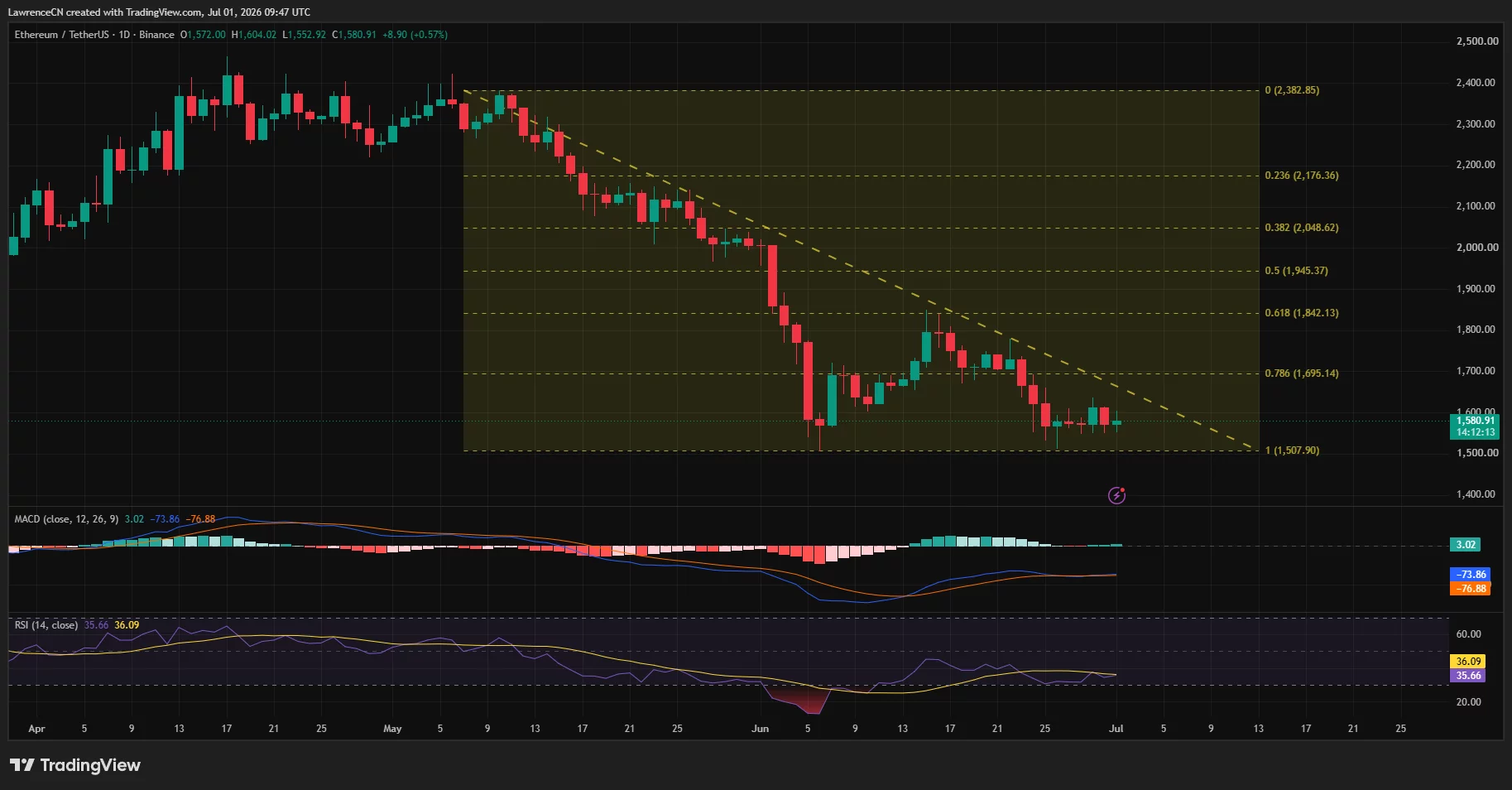
Ethereum’s daily chart continues to trade below a descending trendline that has capped every recovery attempt since May. The asset also remains below the daily Supertrend resistance near $1,644, while the 78.6% Fibonacci retracement around $1,695 forms the next major resistance level should buyers regain control.
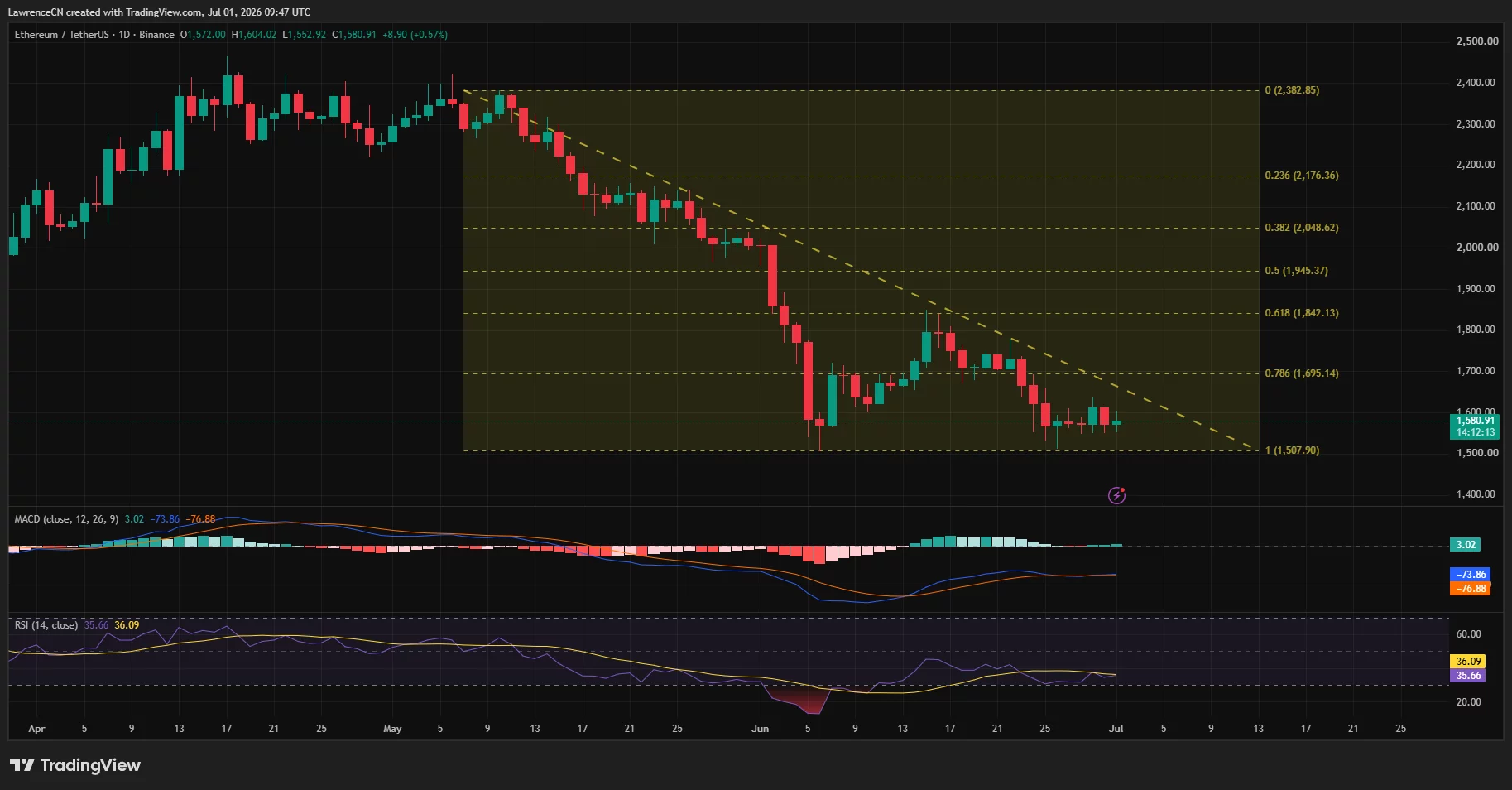
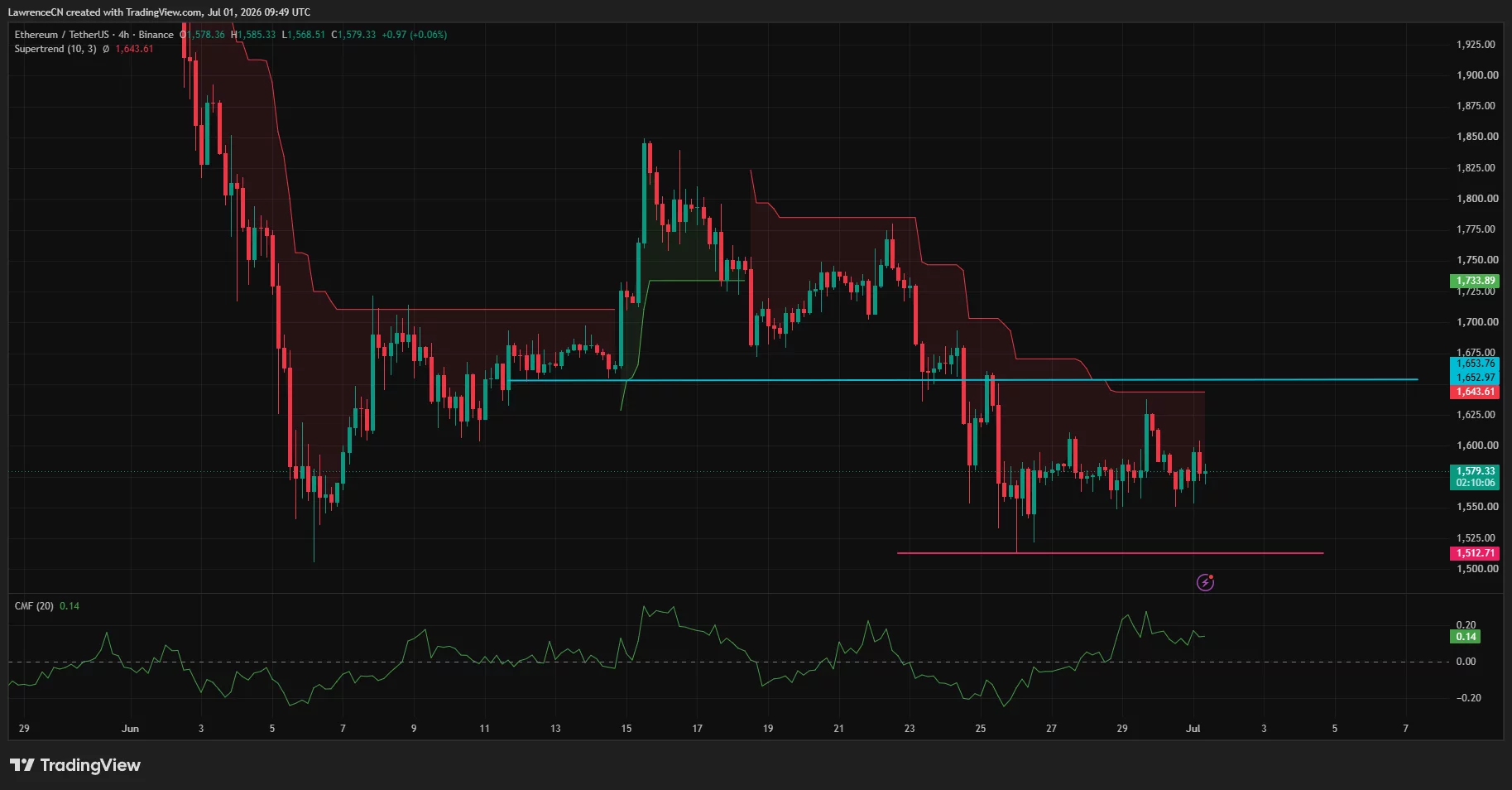
Momentum indicators have yet to confirm a reversal. The daily RSI remains near 36, keeping Ethereum in bearish territory despite stabilizing above recent lows. MACD has begun flattening after weeks of decline but has not produced a decisive bullish crossover. On the 4-hour chart, Chaikin Money Flow has climbed back above zero, suggesting buyers have started returning, although the recovery remains limited while price stays below key resistance.
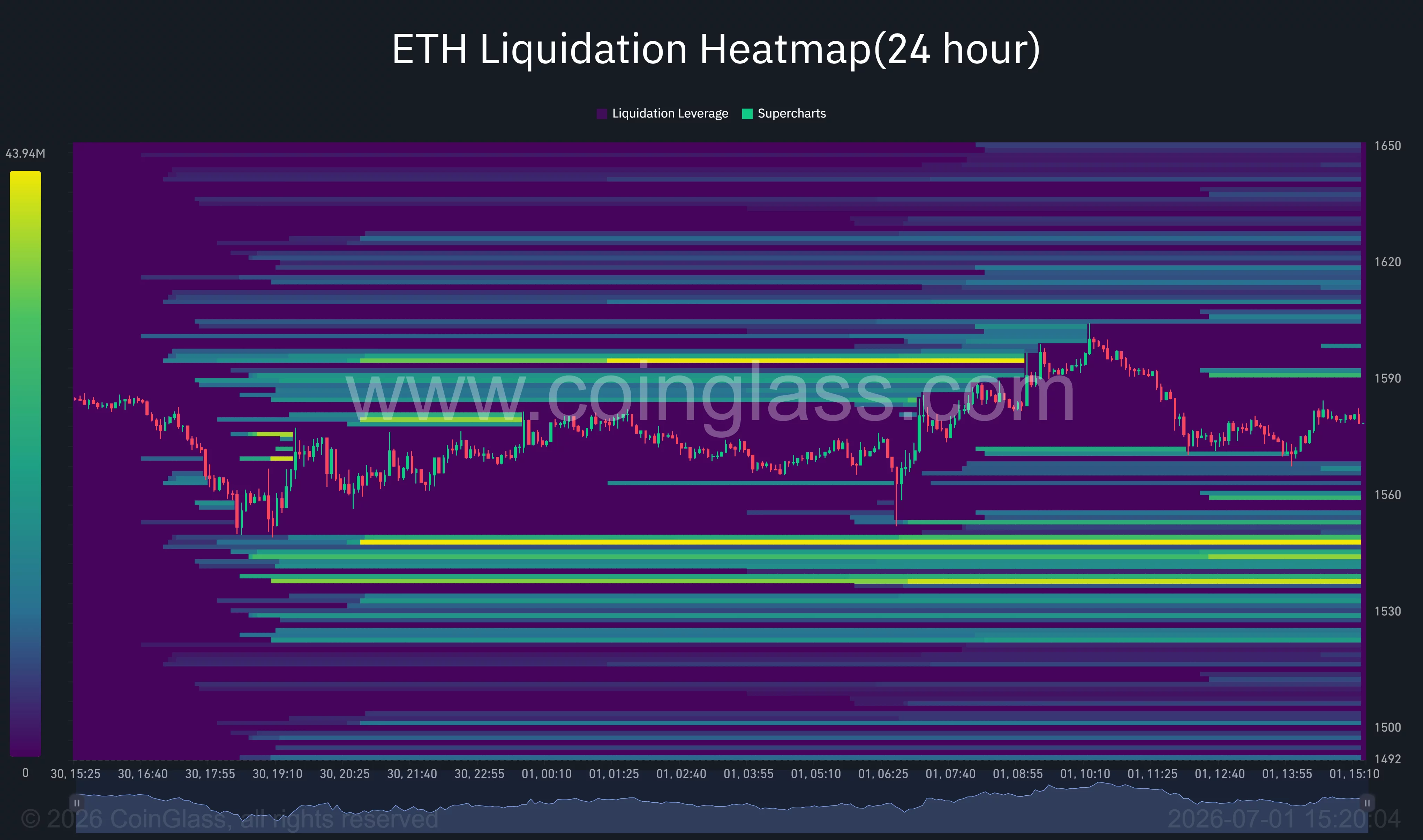
Derivatives positioning also presents a mixed picture. CoinGlass liquidation data shows the largest short liquidation cluster sitting around $1,590-$1,600, while a much larger concentration of long liquidations has built between roughly $1,530 and $1,545. A break above the upper cluster could trigger a short squeeze toward the $1,640-$1,700 region, whereas losing the lower liquidity pocket could accelerate selling into the psychological $1,500 support.
Commenting on the market structure, crypto analyst Ted Pillows wrote:
“ETH is holding better than BTC now… Until Ethereum reclaims the $1,700 level, the chances of a new low will go up.”
His view aligns with the current technical picture, where reclaiming $1,700 would invalidate the series of lower highs that has controlled price action for nearly two months.
Loss of $1,500 support could expose another leg lower
The bearish case strengthens if Ethereum fails to defend the $1,500-$1,510 support band, which also aligns with the recent swing low on the daily chart. A breakdown below that region would invalidate the current consolidation and expose the next downside targets near $1,400 before attention shifts toward the $1,200 area discussed by several market participants.
Macro conditions continue to add uncertainty. Sticky U.S. inflation, expectations for higher interest rates, geopolitical tensions in the Middle East, and weaker decentralized finance activity have reduced risk appetite across digital assets.
Unless ETF flows stabilize, whale selling eases, and Ethereum reclaims resistance above $1,640 and eventually $1,700, quarter-end weakness may continue to weigh on price even as corporate treasuries keep accumulating ETH.
Disclosure: This article does not represent investment advice. The content and materials featured on this page are for educational purposes only.


Against the backdrop of a weak UK economy and inflation above target, the Bank of England paused on 18 June, leaving the base rate unchanged at 3.75% for a fourth consecutive meeting, despite internal disagreements among committee members over the need for a rate hike. The contrast with the European Central Bank’s actions was notable: on 11 June, the ECB raised interest rates in response to a surge in eurozone inflation driven by higher energy prices amid the Middle East conflict. As a result, the monetary policy paths of London and Frankfurt temporarily diverged, with market attention now shifting to two upcoming meetings: the ECB on 23 July and the Bank of England on 30 July.
Technical Outlook
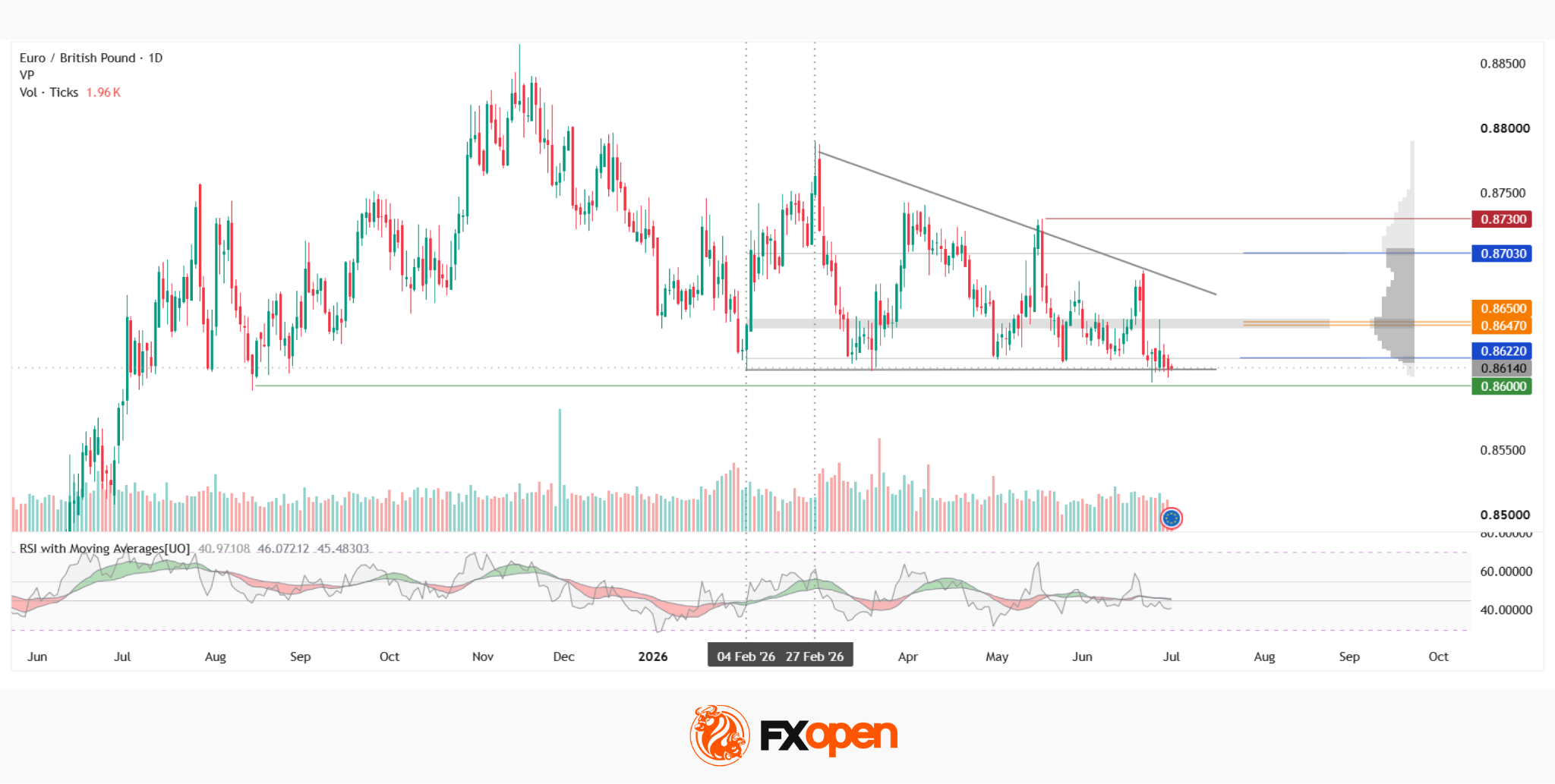
On the daily chart, EUR/GBP has been forming a bearish structure since November last year. After peaking around 0.8860, the pair moved into a broad trading range, and in February a descending triangle began to take shape. The price is currently testing the triangle's lower boundary.
Immediately below the triangle's lower boundary lies support at 0.8600, while slightly above it is the lower boundary of the current volume profile at 0.8622. This cluster of three technical levels could help keep the pair within the triangle, whereas a downside break may trigger increased market activity.
Above this area is the Point of Control (POC) zone at 0.8647–0.8650, where the bulk of trading volume for the first half of the year is concentrated. If the price breaks above this zone, it could move on to test the triangle's upper boundary. Should buying pressure overcome the descending resistance line, the upper boundary of the volume profile at 0.8703 and the resistance level at 0.8730 may act as the next barriers.
The RSI and MAs indicators currently stand at 41, 46 and 45, respectively. The RSI remains below the neutral 50 level, while the MAs, although approaching the lower boundary of the neutral zone, remain positively aligned.
Summary
The combination of the Bank of England keeping interest rates unchanged and the ECB's recent rate hike creates a backdrop in which the technical reaction around 0.8600 or the POC zone could become a key factor in determining the next directional move for EUR/GBP.


The MiCA transition period and final deadline have ended, marking a decisive shift for the European crypto market. Only providers holding a valid license under the EU Markets in Crypto-Assets Regulation (MiCA) can now legally offer services across the European Economic Area.
The grace period that allowed unlicensed crypto service providers to keep operating is now gone. In the weeks leading up to the deadline, the European Securities and Markets Authority (ESMA) issued a final warning to unauthorized firms, telling them to wind down EEA operations before the cutoff.
A Single EU Rulebook Replaces 27 Markets
For the first time, a harmonized regulatory framework covers crypto-asset service providers across Europe. MiCA’s passporting principle means a single license obtained in one member state is valid throughout the entire EU.
This eliminates the patchwork of national regimes that previously required separate compliance efforts in each country.
For institutional investors, that clarity is critical. Regulatory uncertainty has kept many banks and asset managers on the sidelines of the digital asset space.
MiCA now sets explicit standards for custody, governance, and capital requirements, a framework that traditional financial institutions can actually plan around.
Simon Schneider, CEO of Sygnum Europe, describes the end of the transition period as a defining moment for the competitive landscape:
“The end of the transition period is a sorting moment: the market will increasingly consolidate around regulated players who can both operate at scale in terms of operational experience and regulatory compliance as much as innovative products and service. Bank-grade trust becomes a competitive moat under MiCAR.”
Market Consolidation Already Underway
The shakeout is well underway. Bybit restricted its platform for EEA users as Binance also scaled back its European presence.
On the other side, Coinbase opened a MiCA hub in Luxembourg covering all 27 EU states, and Ripple secured a preliminary CASP license in Luxembourg. Euro stablecoins hit record highs under MiCA, suggesting that regulatory clarity does attract capital.
For regulated providers already holding licenses and operational infrastructure, the new environment opens significant growth opportunities.
More than 5,000 banks across Europe have not yet offered digital asset services, largely due to the cost and complexity of building the required infrastructure safely.
MiCA’s clarity changes the calculus. For many, the realistic path may be through established regulated partners rather than building from scratch.
Schneider sees this as a structural shift in how trust and market access relate:
“As traditional and digital finance increasingly converge, trust will remain Europe’s most valuable currency. Direct access to the European market, powered by our global banking platform, will help us bring Sygnum’s trusted, secure services to more clients across Europe,” said the CEO of Sygnum Europe.
Whether MiCA delivers the expected acceleration in institutional crypto adoption will become clearer over the coming months. This is particularly true as MiCA-compliant stocks attract investor attention and banks decide whether to build, partner, or stay out entirely.
The post MiCA Transition Period Ends: Who Wins the EU Crypto Market? appeared first on BeInCrypto.

Cryptocurrency markets headed into the third quarter of 2026 with a notable reset in leverage, but also with noticeably thinner liquidity. A wave of liquidations in Q2 cleared out a large portion of leveraged positioning, even as key demand drivers weakened into the same period, according to Talos data cited in a market update.
That combination—less leverage clearing the system but less depth to cushion future selling—sets up a market that may be less prone to immediate forced cascades, while still capable of sharp price swings when large orders hit thin order books.
Key takeaways
- Q2 liquidation totals were substantial: Talos reports $8.35 billion in combined Bitcoin and Ether long liquidations.
- Derivatives leverage fell: Bitcoin open interest dropped to $33.5 billion (down 32% from its Q2 peak) and Ether open interest fell to $16.2 billion (down 40%).
- Liquidity thinned: Bitcoin order-book depth slipped to roughly $35–$40 million by late June from around $70 million in early May.
- Demand pressures aligned with deleveraging: Talos links the liquidation wave to spot Bitcoin ETF outflows, reduced buying by Strategy, and contraction in stablecoin supply.
Deleveraging cleared leverage, but market depth fell
Talos’ update points to Q2 as a period where speculative positions were largely unwound. Long liquidations for Bitcoin and Ether totaled $8.35 billion, a move that Talos describes as contributing to a more stable environment entering Q3.
However, stability after a liquidation event does not automatically translate into resilience. Talos warns that reduced order-book depth—meaning there is less buy and sell liquidity near current prices—can leave the market less able to absorb renewed selling pressure. In practical terms, fewer resting orders can raise the odds of abrupt moves when market participants try to exit at once.
By midweek, Bitcoin was trading at $58,656, after hitting an intraday low of $57,742. That level was its lowest since Sept. 17, 2024, underscoring how the post-liquidation reset did not eliminate downside pressure.
Open interest drops: a gauge of how much leverage remains
One of the clearest signals that leverage was reduced in Q2 is open interest, which tracks the notional value of outstanding derivatives positions. Talos reports that Bitcoin open interest fell to $33.5 billion, down 32% from the Q2 peak. For Ether, open interest declined to $16.2 billion, a 40% drop.
Lower open interest generally means fewer leveraged bets remain outstanding. That can reduce the likelihood of rapid liquidation spirals if prices move sharply. Still, the other side of Talos’ caution is liquidity: if trading activity remains weak and depth stays shallow, markets can still experience large price swings even without the same level of leveraged positioning.
Stablecoins, order books, and spot volumes: the liquidity picture
Alongside the deleveraging, Talos highlights a market that is trading with less capacity to absorb shocks. Bitcoin’s 2% order-book depth—the aggregate value of orders within 2% of the market price—fell to about $35–$40 million by late June from approximately $70 million in early May.
Spot activity also weakened. Talos reports spot exchange volume declined 28% quarter-over-quarter to $2.32 trillion. When both order-book depth and spot volumes contract, traders often face a market that clears faster but with less friction—meaning fewer participants are absorbing size, and price can move more quickly on incremental flow.
Demand softening: ETF outflows and Strategy’s slower buying
Talos ties the deleveraging period to weakening spot demand during Q2. The report points to spot Bitcoin ETF outflows and reduced Bitcoin purchases by Strategy, alongside a contraction in stablecoin supply.
ETF flows illustrate that demand did not hold steady. Cointelegraph previously reported that US spot Bitcoin ETFs logged $696.3 million in net outflows on June 25. Earlier coverage also noted that June saw roughly $4.5 billion in outflows, which pushed year-to-date outflows to $5.5 billion (as reported by Cointelegraph in links cited above).
Strategy’s buying pace also slowed materially over the same quarter window. Company disclosures cited in the original coverage indicate Strategy purchased about 3,600 BTC in June—down from roughly 25,000 BTC in May and more than 50,000 BTC in April. The same set of disclosures indicated a net sale of 32 BTC earlier in June and a June ending treasury of 847,363 BTC, bought at an average price of $64,103 per coin (details referenced in the cited Cointelegraph links).
The significance for investors and traders is straightforward: when spot demand is weaker, the market has less “natural” buyer absorption during selloffs. That doesn’t guarantee a downtrend, but it can change how quickly prices react to negative catalysts—especially when liquidity is already thinning.
What to watch next: depth, flows, and leverage metrics
The key question heading deeper into Q3 is whether liquidity and demand stabilize at current levels. Talos’ data suggests the market may be less leveraged but also less buffered, so traders should monitor order-book depth, spot volumes, ETF net flows, and open interest for signs of either renewed fragility—or a return of steadier participation.
The EUR/CHF pair is trading within a clear divergence between the two central banks. The ECB raised rates by 25 basis points on 11 June, lifting the deposit rate to 2.40% — its first hike since 2023 — after eurozone inflation climbed to 3.2% in May on the back of the Middle East-driven energy shock. More recent signals suggest easing pressure, though, as falling oil prices following the peace agreement have reduced expectations of a further hike in July.
On the Swiss side, the SNB left rates unchanged at 0.00% on 18 June, while signalling greater readiness to intervene in the currency market to contain excessive franc strength. Despite the ECB’s rate advantage, the franc remains structurally firm below parity, underpinned by its so-called safe-haven status and the still-fragile geopolitical backdrop. A renewed bout of risk-off sentiment could see the franc regain ground even against a higher-yielding euro.
Technical Analysis of EUR/CHF
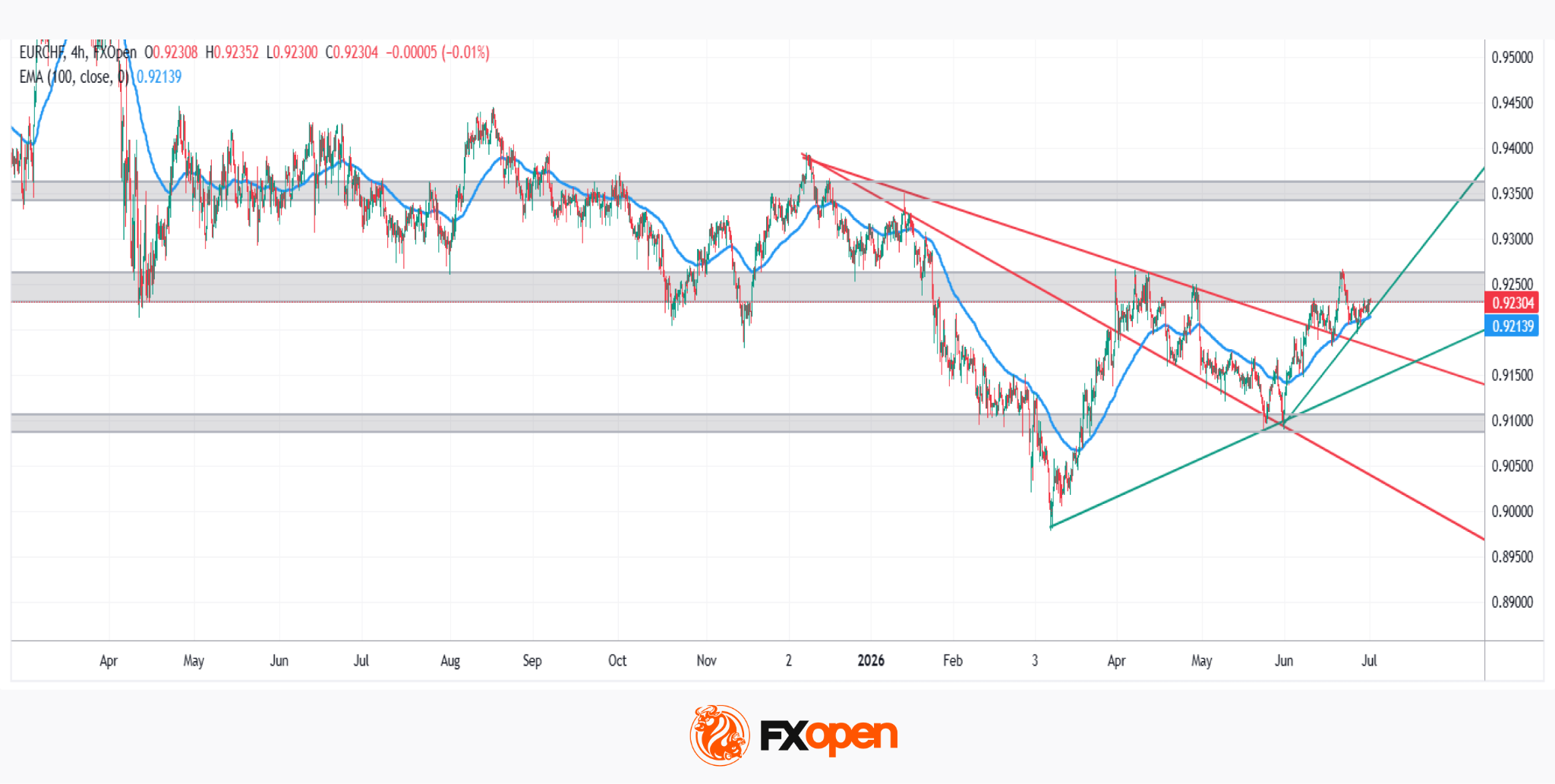
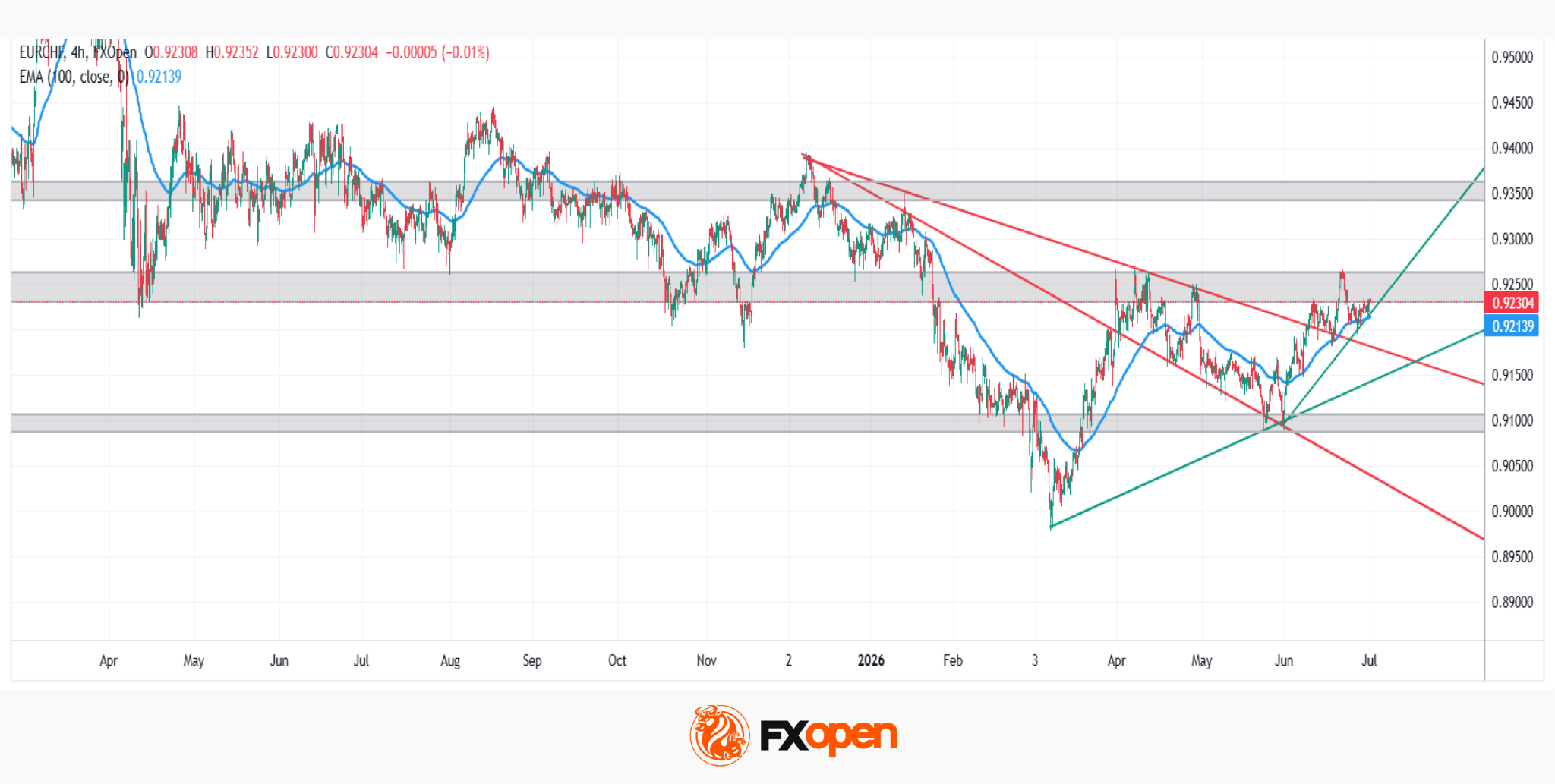
After bottoming out in March 2026, EUR/CHF has been building a medium-term bullish structure. Price is now testing a pivotal zone, the former support around 0.9240–0.9260, which has since flipped into resistance.
Bullish scenario
The 100-period EMA has been underpinning price for several sessions, while two ascending trendlines reinforce the recent breakout from the descending channel. A confirmed break above the 0.9240–0.9260 zone could open the way toward the next key level near 0.9350, validating a bullish structural shift for the pair.
Bearish scenario
A rejection from the current zone, with price slipping back inside the descending channel it recently broke out of, could reignite stronger bearish pressure and drag the pair back toward the 0.9100 support area.
With both the fundamental and technical picture converging at this decisive juncture, and the next central bank moves still uncertain, will EUR/CHF finally manage to break through this heavily contested zone?
Trade over 50 forex markets 24 hours a day with FXOpen. Take advantage of low commissions, deep liquidity, and spreads from 0.0 pips (additional fees may apply). Open your FXOpen account now or learn more about trading forex with FXOpen.
This article represents the opinion of the Companies operating under the FXOpen brand only. It is not to be construed as an offer, solicitation, or recommendation with respect to products and services provided by the Companies operating under the FXOpen brand, nor is it to be considered financial advice.


The MiCA deadline is here, which means the European market is now closed to unlicensed crypto exchanges and platforms targeting EU clients. MiCA is the biggest regulatory overhaul in digital asset history. The new framework has seen many giant exchanges like Binance exit the €10 billion market. However, some exchanges, like Gate, have successfully achieved this regulatory milestone.
So, what is the secret behind the MiCA success? The case of Gate, a crypto exchange with over 54 million global users, can provide some insight.
The MiCA Maze: A Challenge Worth Facing?
MiCA has replaced Europe’s fragmented national crypto rules with a common framework for issuers and crypto-asset service providers. The regime puts authorisation, governance, client protection, operational controls, and market integrity at the centre of crypto activity in the EU.
Gate Europe enters this period with two important approvals in place. The company obtained a MiCA CASP license and a Payment Institution license at an early stage, giving its European business a regulated base for digital asset services, payment activity, and long-term regional expansion.
Platforms serving EU users now need stronger internal controls, compliance teams, reporting systems, and governance processes. Users and institutions are also placing greater focus on regulatory oversight when choosing where to trade, hold assets, or build partnerships.
The grace period closes on July 1, 2026. This period allowed crypto-asset service providers already active in the EU before MiCA’s main CASP rules applied on December 30, 2024, to continue operating temporarily while seeking authorization from their national regulator. After July 1, platforms without approval must complete their exit from the European market.
Individual users now have more information for evaluating platforms. A licensed provider operates under defined rules covering client assets, complaints, conflicts of interest, and business conduct. These standards give users a stronger basis for comparing platforms beyond fees, token coverage, and app design.
Institutional clients face an even higher bar. Banks, asset managers, fintech firms, and professional trading desks need crypto counterparties capable of passing compliance reviews, vendor checks, and legal assessments. MiCA gives these clients a common European benchmark for assessing regulated crypto service providers.
Gate’s Licensing Journey Was Eight Years in the Making
Gate Europe’s compliance path began in 2018, years before MiCA became the central EU framework for crypto-asset service providers. The company describes its European regulatory work as a multi-year process built through early registrations, internal compliance development, and engagement with regional authorities.
Securing a MiCA license requires an application plus governance, risk controls, reporting procedures, operational oversight, and compliance systems capable of meeting financial supervision standards. These elements require investment across legal, product, security, finance, and management teams.
Gate Europe’s early preparation gave the company more time to build those capabilities before the final MiCA grace window. By the time authorization became central to EU market access, Gate Europe had already developed a regional compliance base designed for a supervised market.
The company’s MiCA license now supports regulated crypto-asset services across Europe, while its Payment Institution license strengthens the link between digital asset activity and payment services. Together, these approvals give Gate Europe a more complete regulatory foundation in the region.
“Europe is setting a high standard for digital asset regulation, and we view compliance as the foundation for sustainable growth in the region,” said Dr. Giovanni Cunti, CEO of Gate Europe. “We remain focused on building a secure and trusted platform for our users.”
The Licence is Only the Start
Gate now faces the harder part of MiCA: maintaining the standard after approval. Authorisation gives the company market access, but supervision will test how well its controls work in practice.
That means keeping client assets properly protected, managing conflicts of interest, maintaining reliable reporting, strengthening complaint handling, and ensuring that governance decisions match regulatory expectations. It also means proving that growth across Europe does not weaken internal controls.
It’s 8-years of preparation and a head-start does give the exchange a competitive advantage that others have failed to achieve or sustain in this market.
The post Gate Europe’s MiCA Status Marks a New Era for Licensed Crypto in Europe appeared first on BeInCrypto.
Crypto World
Crypto News, July 1: Bitcoin Price Holds $59K as Ethereum Stays Steady on MiCA Day Zero
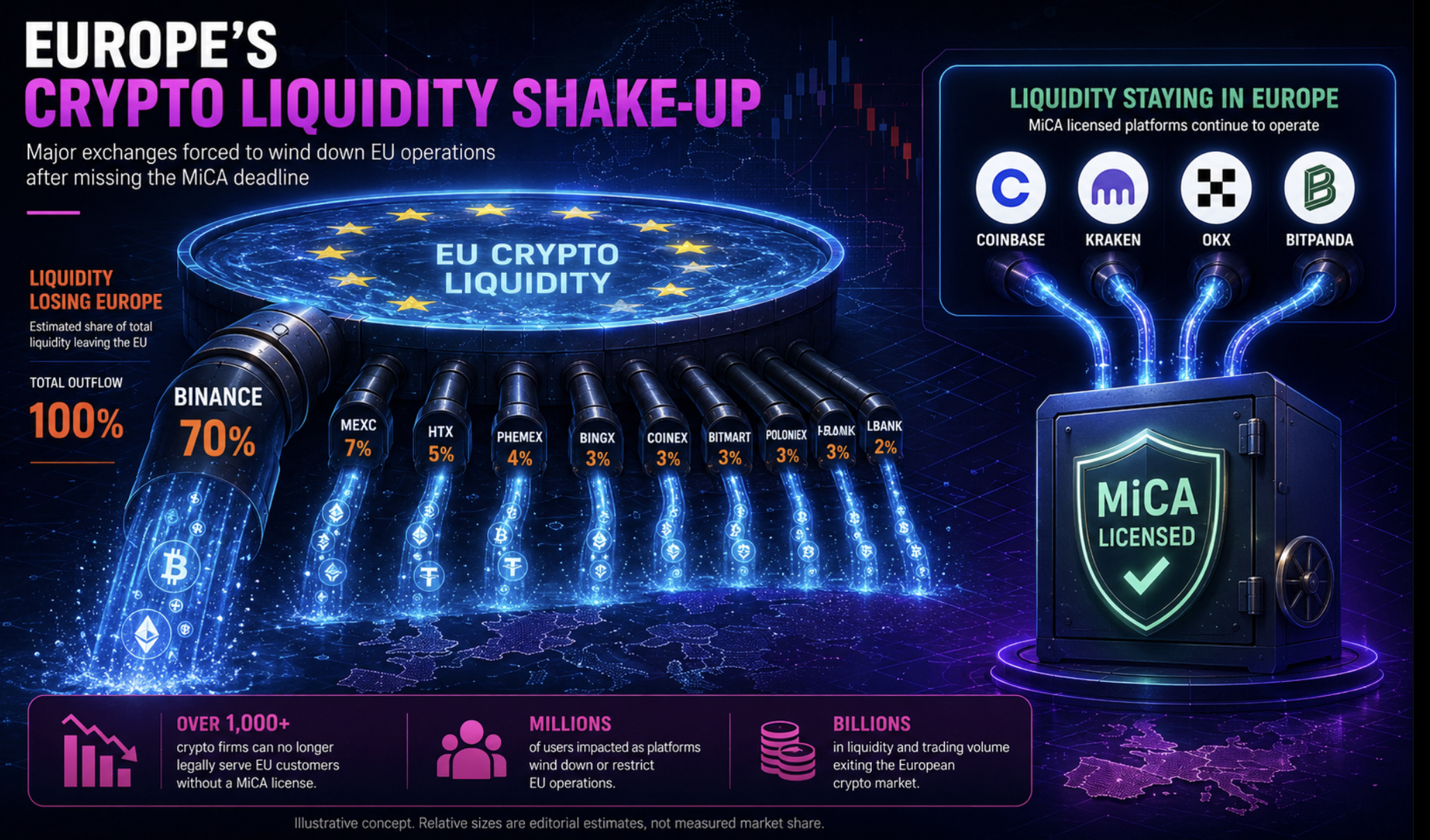
Markets opened Q3 steadily, Bitcoin price is holding the $59K level, Ethereum shows strength at what could be the bottom, and MiCA full enforcement just hit with almost no fireworks. Crypto has been bracing for liquidity trouble as MiCA takes effect, especially with Binance among others thinning the liquidity.
The expected moves were obvious for months; Bitcoin price and Ethereum price were already baked in the changes, so the actual day zero passed quietly.
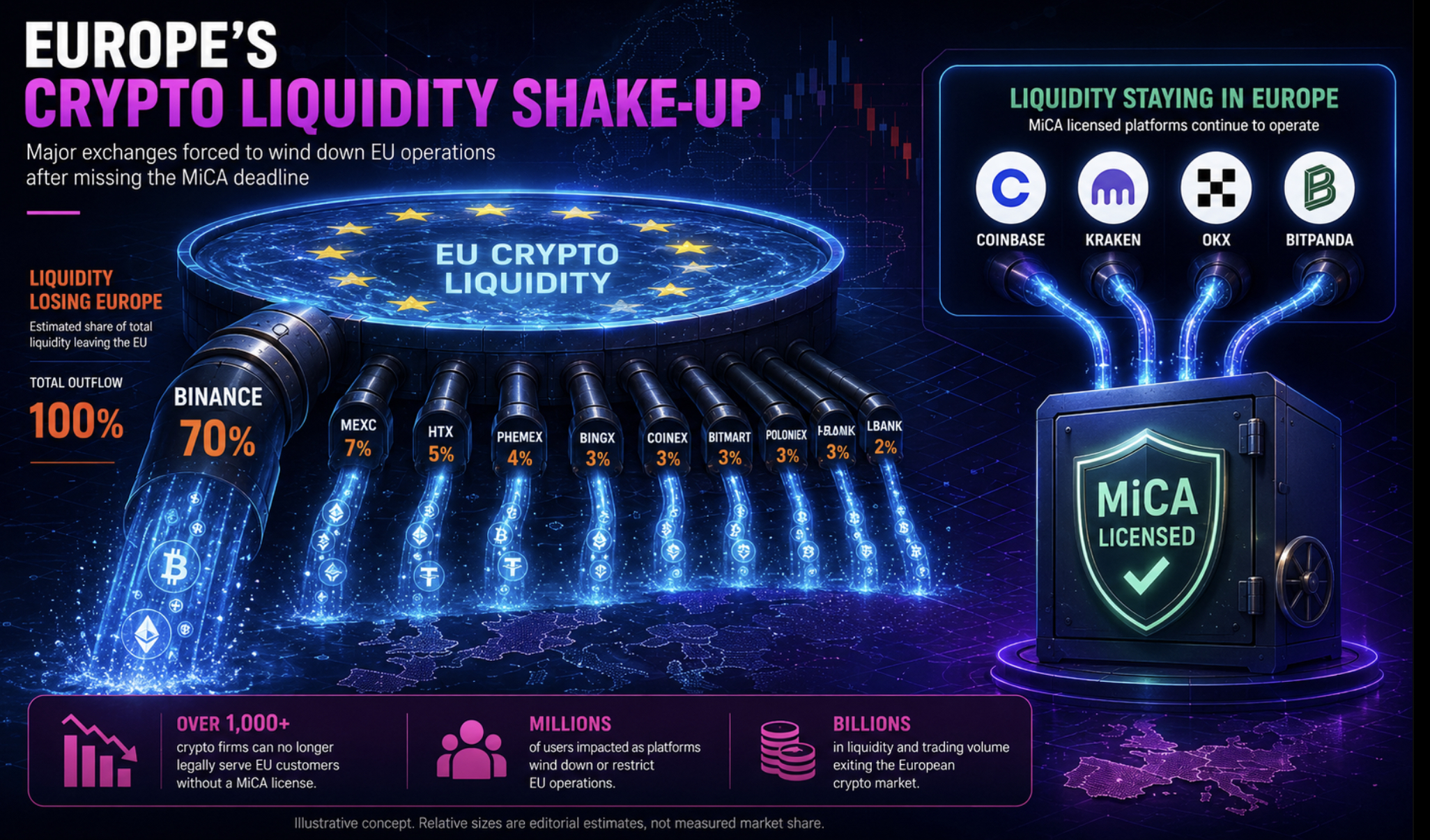
On the other side of the world, Trump’s latest financial filing has dropped. It showed over $1.4 billion in crypto earnings last year, with Bitcoin exposure in a healthy sum. This likely sends a signal that he’s not walking away from this space anytime soon.
Discover: The Best Crypto to Diversify Your Portfolio
Bitcoin Price Holding Its Ground

Although Bitcoin price took a hit from record ETF selling with $4.51 billion in outflows last month, or the worst since they launched, it has found support and has not broken lower. Some profit-taking and money rotating into AI stocks are some of the reasons that took the blame for the recent plunges.
As of today, the total ETF assets sit above $70 billion, so the selling looks more like a pause than a collapse. It’s not a good day for spot holders when US spot Bitcoin ETFs saw $4.51B in net outflows in June. However, it looks more like a temporary adjustment than a deeper pullback.
Discover: The Best Token Presales
Ethereum Price Stays Calm, MiCA Day Zero Passes Quietly

Ethereum price traded flat around $1,570–$1,590, with no big swings even as MiCA rules were locked in today. The Ethereum Foundation has also just staked another 4,938 ETH worth close to $8 million on Lido. It shows they’re comfortable parking more capital in the staking system right when Europe tightens up, and foundation rebalancing is going on.
BREAKING: As of today, the most used dollar on earth cannot be bought or sold by a single European on a single licensed exchange. — Shanaka Anslem Perera
It did not break. It refused to bend, and a 27-nation bloc decided that was enough.
That is Tether… pic.twitter.com/PUYV5d8A2N
 (@shanaka86) June 30, 2026
Don’t Miss Out on Our $1,000 USDT Airdrop on ByBit
Ethereum price has been grinding along as MiCA full rules are live. Unlicensed platforms like Binance have now stopped serving EU users or shut down, with a lot of smaller operators already pulling back or moving. On top of that, UK investors filed a $200 million lawsuit against Binance and CZ over unauthorized derivatives sold to retail traders.
The MiCA shift and the Binance legal noise haven’t moved the market much. Liquidity concerns turned out lighter than expected, Trump’s big crypto profits, and the Ethereum Foundation’s fresh Lido stake tell that some are still bullish. Big players are still putting money to work instead of running for the exits.
Discover: The Best Token Presales
The post Crypto News, July 1: Bitcoin Price Holds $59K as Ethereum Stays Steady on MiCA Day Zero appeared first on Cryptonews.

As Bitcoin fell to a 21-month low of $58,100, Santiment said on-chain data shows a widening gap between the behavior of large holders and retail investors.
Wallets holding between 10 and 10,000 BTC reduced their combined holdings by 0.37% since June 15, according to Santiment’s Supply Distribution metric. This indicates continued selling by whales and sharks during the market decline. On the other hand, wallets holding less than 0.01 BTC increased their holdings by 0.51% over the same period, suggesting that smaller investors are continuing to buy the dip.
Rare Bottom Signal
Santiment said this divergence is indicative of how retail traders appear convinced that the market is nearing a bottom and is “treating the dip like a buying opportunity”, while larger stakeholders remain on the sidelines and “refusing to bite for now.”
The analytics firm added that Bitcoin and the broader crypto market may need more time to establish a convincing bottom until large holders resume accumulation.
Meanwhile, a separate analysis by Ali Martinez highlighted that Bitcoin has entered a rare on-chain phase that has historically appeared only around major market bottoms. The analyst found that around 10.45 million BTC are currently held at a loss, while about 9.60 million BTC remain profitable. This is the first time in the current market cycle that Bitcoin’s supply in loss has exceeded its supply in profit.
Martinez said the crossover suggests that more than half of the circulating BTC supply is now underwater, meaning much of the speculative froth has been washed out of the market. Looking at historical cycles, he said that the same pattern has occurred only a handful of times over the past 15 years.
The first crossover appeared in September 2011, following which Bitcoin established its bottom by November that year before beginning a new bull market. A second crossover emerged in September 2014 and remained in place until October 2015, when the next major expansion began.
The pattern repeated in November 2018 before the crypto asset started a new bull market in March 2019. During the market crash in March 2020, the crossover lasted just 17 days before prices recovered sharply in April.
Martinez explained that the first crossover in the current cycle occurred in June 2026 and remains active. While the analyst acknowledged that these periods have historically lasted anywhere from a few weeks to several months, he added that the current setup places Bitcoin in what he described as a high-conviction accumulation zone.
Macro Catalysts Still Needed
Looking beyond on-chain metrics, Bitget’s Chief Analyst, Ryan Lee, believes that the market needs a stronger catalyst. This includes better macro data, a rebound in Bitcoin ETF inflows, cooling geopolitical risk, or renewed institutional positioning. In a statement to CryptoPotato, Lee said,
“The next major signals will be US inflation data and how it reshapes expectations for Fed policy. We see crypto remaining highly sensitive to any shift in the rate outlook because Bitcoin, Ethereum, and altcoins are still trading as liquidity-sensitive risk assets. If inflation stays sticky, the Fed would have less room to cut rates and could maintain a more hawkish stance for longer. It eventually pressures crypto prices by reducing risk appetite, tightening liquidity, and making non-yielding assets less attractive.”
The post Bitcoin Whales Are Dumping: But This Rare Signal Says the Bottom May Be Close appeared first on CryptoPotato.

The companies most exposed to consumer UPF concerns

Mega-Deals Drive Global M&A to $2.8 Trillion in First Half of 2026
“Dutton Ranch” hires new boss for season 2 after moving on from creator





-

 Fashion5 days ago
Weekend Open Thread: Staud – Corporette.com
-

 Politics5 days ago
The House | Manchesterism won’t survive the painful trade-offs unless it gets citizens on board
-

 Crypto World1 day ago
Strategy authorizes up to $1.25B in Bitcoin sales under new capital plan
-

 Politics5 days ago
Potential 2028er World Cup attendee leaderboard
-

 Business5 days ago
Asia stock markets slide as tech shares slump
-

 News Videos3 days ago
MAJOR BITCOIN & MARKET UPDATE!!!! (MUST WATCH ASAP!!!)
-

 Tech6 days ago
A Look At A Gaggle Of Transputer Boards
-
 Crypto World6 days ago
Dell (DELL) Shares Tumble Over 5% Following Analyst Downgrade to Hold
-

 Crypto World4 days ago
Coinbase, Circle Deepen Crypto Stock Losses Despite Resilient S&P 500
-

 Business1 day ago
Australia treasurer says alleged access of prime minister’s bank data ’incredibly concerning’
-

 Crypto World4 days ago
Kraken's xStocks Opens Bending Spoons IPO Registration to EEA Retail
-

 Sports5 days ago
FIH Pro League: India defeat Pakistan 7-1, register biggest win of campaign | Other Sports News
-

 Crypto World5 days ago
Bitcoin Sparks $600M Hourly Liquidations With $65,000 Set To Become Resistance
-

 Tech3 days ago
Bluekit phishing kit adopts browser-in-the-middle for login theft
-

 Tech4 days ago
Russian hackers now target Signal backup recovery keys
-
 Crypto World5 days ago
Hyperliquid Named on Singapore MAS Investor Alert Register
-

 Crypto World6 days ago
Ripple and SBI launch RLUSD in Japan after JFSA approval
-

 Crypto World5 days ago
RTX holders must register wallets before token distribution begins
-

 Tech1 day ago
Anonymous researcher drops 0-day ‘exploitarium’ repo
-
 Business2 days ago
The AI boom won’t burst all at once. It will pop in ‘rolling bubbles’: Macquarie
You must be logged in to post a comment Login