Connect with us
DAPA Banner
DAPA Coin
DAPA
COIN PAYMENT ASSET
PRIVACY · BLOCKDAG · HOMOMORPHIC ENCRYPTION · RUST
ElGamal Encrypted MINE DAPA
🚫 GENESIS SOLD OUT
DAPAPAY COMING

Tech

Apple's fight with Epic over App Store fees reaches the Supreme Court

Published

on


The justices have agreed to hear Apple’s appeal against a lower-court ruling that found the company in contempt of a 2021 injunction from US District Judge Yvonne Gonzalez Rogers.
Read Entire Article
Source link

Continue Reading
Click to comment

You must be logged in to post a comment Login

Leave a Reply

Tech

Microsoft set for new round of job cuts next week, spanning Xbox, sales and consulting

Published

on

GeekWire File Photo

Microsoft is preparing to cut thousands of jobs next week, continuing to rein in operating costs as the company pours unprecedented sums into AI infrastructure. 

Business Insider broke the news Tuesday afternoon, saying that the cuts will impact less than 2.5% of the company’s global workforce of about 220,000 people. It includes not just Xbox, where cuts have been signaled for weeks, but also layoffs in sales and consulting. 

GeekWire confirmed the details of the report with a person familiar with the company’s plan. Microsoft isn’t commenting on the report.

The timing follows a familiar pattern. Microsoft often restructures its operations around the close of its fiscal year on June 30, and the cuts would come just as the new year begins. 

The reductions were bigger last year. Microsoft laid off more than 15,000 people in two rounds of cuts a few weeks apart: about 6,000 in May 2025, then around 9,000 (roughly 4% of the company at the time) in early July 2025.

Advertisement

One difference this year: Microsoft’s first-ever voluntary retirement program. About a third of the approximately 8,750 eligible U.S. employees took the buyout, reportedly allowing the company to cut a smaller share of its workforce through layoffs than a year ago. 

@media (max-width: 600px) {
aside.callout { float:none !important; max-width:100% !important; margin-left:0 !important; margin-right:0 !important; }
aside.callout .callout-img { display:none !important; }
}

The company is on pace to spend more than $100 billion building AI and cloud infrastructure in the fiscal year that just ended — up from $88.7 billion the year before — with about two-thirds going to the chips that power AI. 

Microsoft shares closed Tuesday at $373.02, down 19% over the past month and near a 52-week low, as Wall Street questions whether its heavy AI spending will pay off.

The layoffs come amid a broader wave of restructuring across the tech industry, which has shed more jobs than any other sector this year. U.S. tech companies have announced 123,653 cuts so far in 2026, up 66% from the same stretch of 2025, according to a report from outplacement firm Challenger, Gray & Christmas. 

Advertisement

Across all sectors, not just tech, AI was the most commonly cited reason for job cuts in May — the third straight month it has led the list. The 38,579 cuts attributed to AI were the most in any month since Challenger began tracking the cause in 2023. For the year, AI has been linked to 87,714 cuts, already surpassing the 54,836 attributed to it in all of 2025.

Source link

Continue Reading

Tech

Sony Will Stop Making Disc-Based PlayStation Games Starting 2028

Published

on

Xbox and Nintendo have also been pushing consumers towards digital games.

Sony has announced that PlayStation is going all digital, with physical game disc production being discontinued starting January 2028. After this date, you’ll only be able to purchase new games digitally on the PlayStation Store and in retailers.

Sony says its decision is a response to “shifting trends in consumer preference,” with digital sales significantly outweighing physical. Last year, physical game distribution accounted for just three percent of PlayStation’s revenue, and the fact that the PS5 Pro launched in 2024 without a disc drive was a pretty good indication of Sony’s future direction.

The strategic shift will have no impact on physical games already released or those that are planned for release before January 2028, but the ramifications of the announcement are huge. The second-hand video game market will obviously take an enormous hit if people were no longer able to trade in their unwanted PS5 games. Retailers are also likely to feels some negative effects too.

Advertisement

The writing was already on the wall when Rockstar announced that it’s ditching discs for GTA 6, and today’s news will quash any hopes of that being an outlier. Physical discs might be good for the consumer and those who care about preservation, but the cost benefit of a digital-only model to companies like Sony is clear. Xbox has been moving away from physical for a while now, and even Nintendo, which remains the dominant force where physical game sales are concerned, seems to be nudging customers towards digital with comparatively cheaper prices and game-key card cartridges that don’t contain the whole game.

Sony waving goodbye to discs isn’t the only PlayStation-related news today. The company has also announced that it’s closing the PlayStation Store on PS3 and the PS Vita. Once they’re gone, it’ll no longer be possible to purchase new games or content on those platforms, although Sony will still allow people to download previous purchases “for the foreseeable future.”

In some markets these store closures will happen as soon as August 2026, but in the US you have until next summer, July 2027, to load up on any games you might want to add to your libraries. “We know this news may be disappointing to PS3 and PS Vita players who hold a special place in their hearts for this generation of gaming,” Sony said in a press release. “PS3 and PS Vita represent an important era in our PlayStation history, so this was not an easy decision for us to make.”

Advertisement

Source link

Continue Reading

Tech

Hey Ezra Klein: Why Did You Stop Talking About Broadband And The Infrastructure Bill?

Published

on

from the you-got-boondoggle-in-my-boondoggle dept

Last fall, Ezra Klein was getting a lot of attention for his book Abundance, which basically argued that American had become bureaucracy-obsessed and fallen out of love with building things. I thought it was mostly simplistic cack, downplaying or ignoring the fact that the U.S. government has become so blisteringly corrupt, it clearly no longer functions in the public interest.

As a longtime telecom beat reporter I was particularly struck by Klein’s chapter on broadband, which mostly seemed to amplify Republican attacks. One of Klein’s biggest targets was the infrastructure bill and Broadband, Equity, Deployment, and Access (BEAD) program, which was part of the 2021 infrastructure bill, and set aside $42.5 billion for improved internet access.

BEAD was never going to be a poster child for government efficiency. But as I noted at the time, Klein’s criticism of the program was bizarre and simplistic, downplayed why the program was taking so long (we had to remap the entirety of U.S. internet access, for one), and ignored how other legislation that same year (like ARPA) was delivering much of the abundance Klein claimed to be looking for.

I could tell from reading Klein’s Abundance chapter on broadband that he didn’t spend much time talking to telecom policy experts. After Klein’s attacks made inroads on the podcast circuit (including on Jon Stewart’s) they were then picked up again by right wing media, further perpetuating the idea that BEAD was a completely useless boondoggle:

Advertisement

I bring it up because a little more than a year later and this BEAD program really is now a boondoggle under Trumpism, as Sean Gonsalves and I explored in a new feature over at The Verge.

Republicans, it should be noted, voted against the infrastructure bill and ARPA, but can still routinely be found taking credit for the improvements they opposed.

Last election season, Republicans ran on the idea that they’d reshape BEAD and trim the fat. Instead they’ve stripped away all oversight, eliminated any requirements that taxpayer-funded broadband be affordable or equitably deployed, and gone out of their way to redirect money away from future-proof fiber toward Elon Musk and Jeff Bezos low-Earth-orbit satellite broadband networks.

Republicans — and the Joe Rogan infotainment universe — are positively convinced that Starlink is akin to magic. So they’ve decided to throw billions of taxpayer money at Bezos and Musk in exchange for slower, more expensive, congested low-Earth orbit satellite connectivity that chips away at the ozone layer. It’s worth noting they’re being given billions for service that already exists and was already set to be deployed.

In our Verge piece, we talked to minority communities in Louisiana who were slated to get fiber upgrades, but are now being shoveled toward Starlink service (that already existed) thanks to Republican BEAD changes. They are very aware they’re now getting the short-end of the stick:

Advertisement

“The most frustrating part is that it was a zero dollar investment in infrastructure,” Wills told The Verge. “Nothing fundamentally changed. People with Starlink are going to just get mailed a box and many won’t be able to install it. And we still won’t have anybody really served,” leaving the community with “no growth in our economic potential.”

“No money will stay here,” he said. “No jobs will be created from this — no installation jobs, zero construction jobs, or even any small stimulus.”

Republicans are then claiming they “saved taxpayers money” by throwing money at billionaires for satellite broadband they already planned to deploy. States and the Trump administration are now bickering over these $20 billion in “non deployment funds.” Congress said this money had to be used for broadband access; but the law under Trumpism is very clearly optional. It’s a giant mess.

All of this corrupt retooling has caused endless new delays, pushing real-world deployments out by another year or two. As of this writing, the $42.5 billion program has only provided new (fixed wireless) connections to a handful of homes in Louisiana and Nebraska (the Trump administration tried to use this as a press op highlighting how amazingly successful their revamp has been).

Due to the higher costs of deployment created by stupid tariffs and pointless wars, many additional fiber deployment bids originally supposed to be funded by BEAD are likely to go into default and be cancelled, opening up the possibility of Musk and Bezos getting billions more in taxpayer subsidies. It’s expected that this whole mess will get significantly uglier later this year.

Advertisement

Curiously, Ezra Klein hasn’t made a peep. All the press coverage last election season about how BEAD was a boondoggle is nowhere to be found now that the program is a bigger boondoggle than ever. And it’s a bigger boondoggle than ever because the U.S. is too corrupt to function, something that needs to be addressed (and candidly acknowledged by our press) before we can even begin to sniff “abundance.”

I’ve always felt that the abundance movement was an influence campaign by affluent centrists to pre-empt genuine populist progressive reform as the response to authoritarianism. The abundance movement always struck me as Clinton-era vibes-based deregulatory corporatism with a new coat of paint; something seemingly supported by its proponents’ curiously limited attention span.

Filed Under: abundance, bead, broadband, donald trump, elon musk, ezra klein, high speed internet, internet access, jeff bezos, ntia, taxpayers, telecom

Companies: spacex, starlink

Advertisement

Source link

Continue Reading

Tech

Playstation To Stop Producing Physical Discs In 2028

Published

on


In a move that’s sure to not win any fans, Sony announced today that it will stop making physical discs for new Playstation titles starting in 2028. A press release on Sony’s Playstation blog states: “In response to shifting trends in consumer preference, new games will be released on PlayStation Store and at retailers in digital formats only.”

This news comes after it was discovered that Sony would remove over 500 purchased titles from Playstation users in the UK due to the expiration of licensing agreements. To make matters worse, the Playstation Blog also announced that the PS3 and PS Vita online stores will be shutting down over the course of this and next year.

Sony’s announcement wasn’t entirely unforeseen, of course. Grand Theft Auto VI, maybe the most anticipated game of the decade, won’t be launched on a physical disc. Additionally, both the Playstation 5 and Xbox are available without a disc drive entirely. 

Advertisement

It’s not just Sony

As unfortunate as it is among those of us who still like physical media, the rest of the gaming and movie-watching market just don’t follow that trend. In a cold, unfeeling financial sense, it’s logical why Sony decided to cease production of physical discs. It sees that most people just download or stream movies or games anyway, negating the need to have a production facility for physical copies. Let’s also not forget the graveyard of “dead” Sony media formats. 

For everyone else, however, it follows a concerning trend among big publishers, showing that you don’t truly “own” your digitally purchased games or movies in the traditional sense and your library of titles could be erased based on the whim of the publisher. It’s not just Sony who is to blame.

Advertisement

Of course, there is still a huge market for physical copies of media. There’s a reason why, for example, vinyl records are still popular. There will always be a group of people who want to physically hold a copy of something in their hands. Records, cassettes, Blu-Rays, CDs, and DVDs will probably always exist in some form or another, but for the moment, it looks like new Playstation games won’t be joining that list.


Advertisement

Source link

Continue Reading

Tech

Turning Indicators into Intelligence in OpenCTI with Criminal IP

Published

on

Criminal IP + OpenCTI header

Cyber threat intelligence becomes more valuable when indicators are enriched with context that supports investigation, correlation, and decision-making. Through the Criminal IP integration with OpenCTI, security teams can transform IP addresses, domains, and URLs from isolated indicators into structured intelligence within the OpenCTI knowledge graph.

The integration automatically enriches indicators with Criminal IP’s reputation scoring, infrastructure intelligence, vulnerability data, behavioral signals, and phishing analysis.

The resulting information is structured as OpenCTI entities and relationships, allowing analysts to investigate connected infrastructure, identify potential attack surfaces, and prioritize high-risk indicators.

Integration Highlights

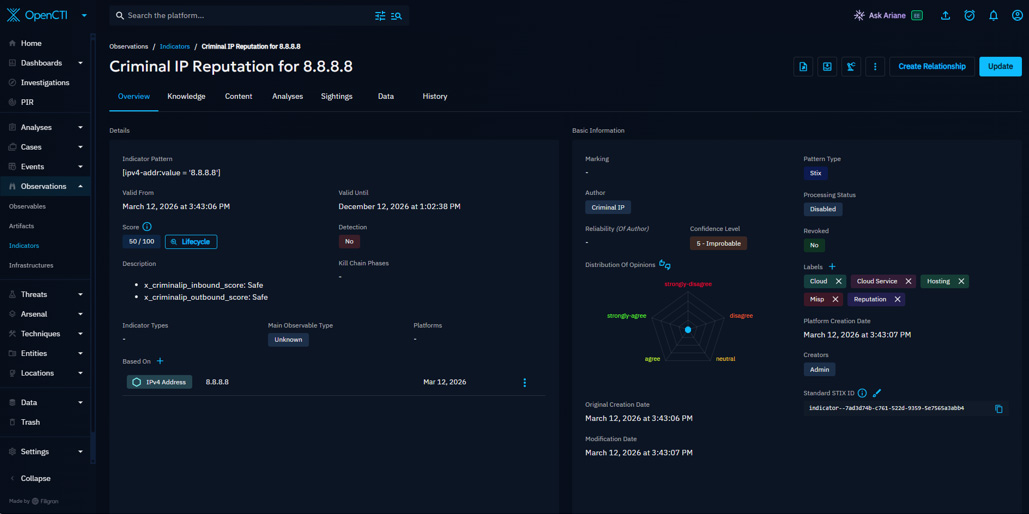
Criminal IP enrichment results for an IP address within OpenCTI, showing contextual risk scoring and behavioral indicators
Criminal IP enrichment results for an IP address within OpenCTI,

showing contextual risk scoring and behavioral indicators

Contextual Risk Scoring Beyond Simple Reputation

Criminal IP provides dual-perspective risk scoring (inbound and outbound), reflecting both how an IP is targeted and how it behaves externally. This gives analysts a more nuanced signal than traditional single-score reputation models and improves prioritization of high-risk infrastructure.

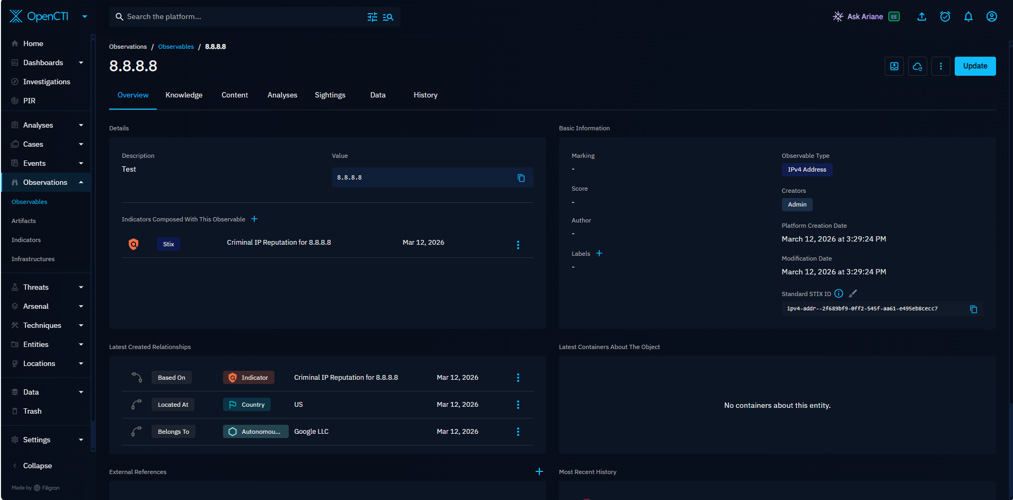
Criminal IP enrichment structures IP intelligence as connected OpenCTI entities,

enabling analysts to pivot across indicators, network ownership, and geographic context

Deep Infrastructure Intelligence Embedded in the Graph

Enrichment goes beyond tagging indicators, Criminal IP creates structured OpenCTI entities and relationships, including vulnerabilities (CVEs), Autonomous Systems (ISPs), and geolocation. This enables analysts to pivot across infrastructure, uncover shared components, and identify related infrastructure within the graph.

Service Exposure & Vulnerability Correlation

By linking observed services to known CVEs, the integration provides immediate insight into potential attack surfaces. Analysts can quickly assess whether an IP is not only malicious, but also exploitable or actively leveraged in attacks.

Advertisement

High-Fidelity Threat Labeling & Behavioral Signals

Automatically generated labels incorporate multiple data points such as anonymization technologies (VPN, proxy, TOR), hosting characteristics, and malicious classifications. This layered labeling approach provides richer context than binary “malicious/benign” tagging.

Advanced Domain & Phishing Intelligence

For domains, Criminal IP performs full URL analysis to detect phishing activity, credential harvesting, suspicious files, and impersonation techniques. Confidence scores are directly tied to phishing probability, giving analysts a quantifiable measure of risk.

Infrastructure Mapping & Analysis support

The integration links indicators to network ownership (Autonomous Systems), physical locations, and resolved IP infrastructure. This allows teams to identify hosting patterns, regional clustering, and and infrastructure patterns across indicators.

Integrate Criminal IP with OpenCTI to enrich IP addresses, domains, and URLs with contextual threat intelligence.

Advertisement

Automatically add dual-perspective risk scoring, infrastructure relationships, vulnerability data, behavioral signals, and phishing analysis to the OpenCTI knowledge graph, enabling faster investigation, correlation, and prioritization.

Explore Criminal IP Integration

How Integration Works

Indicators such as IP addresses, domains, and URLs are first ingested into OpenCTI.

The Criminal IP connector then automatically enriches each indicator with reputation scoring, infrastructure intelligence, vulnerability information, behavioral signals, and phishing analysis.

The enriched data is structured into entities and relationships within the OpenCTI knowledge graph. Analysts can then use the resulting intelligence for investigation, correlation, infrastructure pivoting, and threat analysis.

Advertisement

The process can be summarized as follows:

  1. Indicators (IP addresses, domains, URLs) are ingested into OpenCTI
  2. The Criminal IP connector automatically enriches each indicator with reputation scoring, infrastructure intelligence, and phishing analysis
  3. Enriched data is structured into entities and relationships, enabling investigation, correlation, and analysis within the OpenCTI knowledge graph

Key Use Cases

SOC Triage and Alert Validation

Rapidly validate suspicious IPs and domains using dual risk scoring, infrastructure context, and phishing intelligence, enabling analysts to prioritize high-risk indicators and support prioritization of high-risk indicators.

Threat Hunting and Infrastructure Pivoting

Leverage enriched relationships such as CVEs, Autonomous Systems, and geolocation to pivot across connected infrastructure and uncover related assets used in attacker operations.

Phishing and Campaign Analysis

Identify and analyze malicious domains, credential harvesting pages, and supporting infrastructure to track phishing activity and understand broader campaign patterns.

OpenCTI Platform

OpenCTI is an open-source cyber threat intelligence platform designed to structure, store, and analyze threat data using a graph-based model. It enables organizations to connect indicators, vulnerabilities, threat actors, and campaigns into a unified knowledge base for investigation, collaboration, and intelligence sharing.

Advertisement

Criminal IP

Criminal IP delivers decision-ready cyber threat intelligence by analyzing IP addresses, domains, and URLs across the global internet. Powered by AI and OSINT, it provides reputation scoring, infrastructure visibility, and real-time detection of malicious activity, including phishing, exposed services, and anonymization technologies such as VPNs and proxies. Its API-first architecture enables seamless integration into security platforms to enhance visibility, automation, and response.

Sponsored and written by Criminal IP.

Source link

Advertisement
Continue Reading

Tech

Cinder City becomes the first PC game to recommend 64GB of RAM, and at the worst time

Published

on


Games are getting bigger, more hardware-intensive, and less well-optimized. The end result is usually more high-end GPUs being required for “standard” gameplay, but Cinder City asks for just an RTX 4060 (8GB). What’s unusual, however, is the staggering 64GB of RAM it recommends.
Read Entire Article
Source link

Continue Reading

Tech

Hide My Email has a year-old issue that still hasn’t been fixed

Published

on

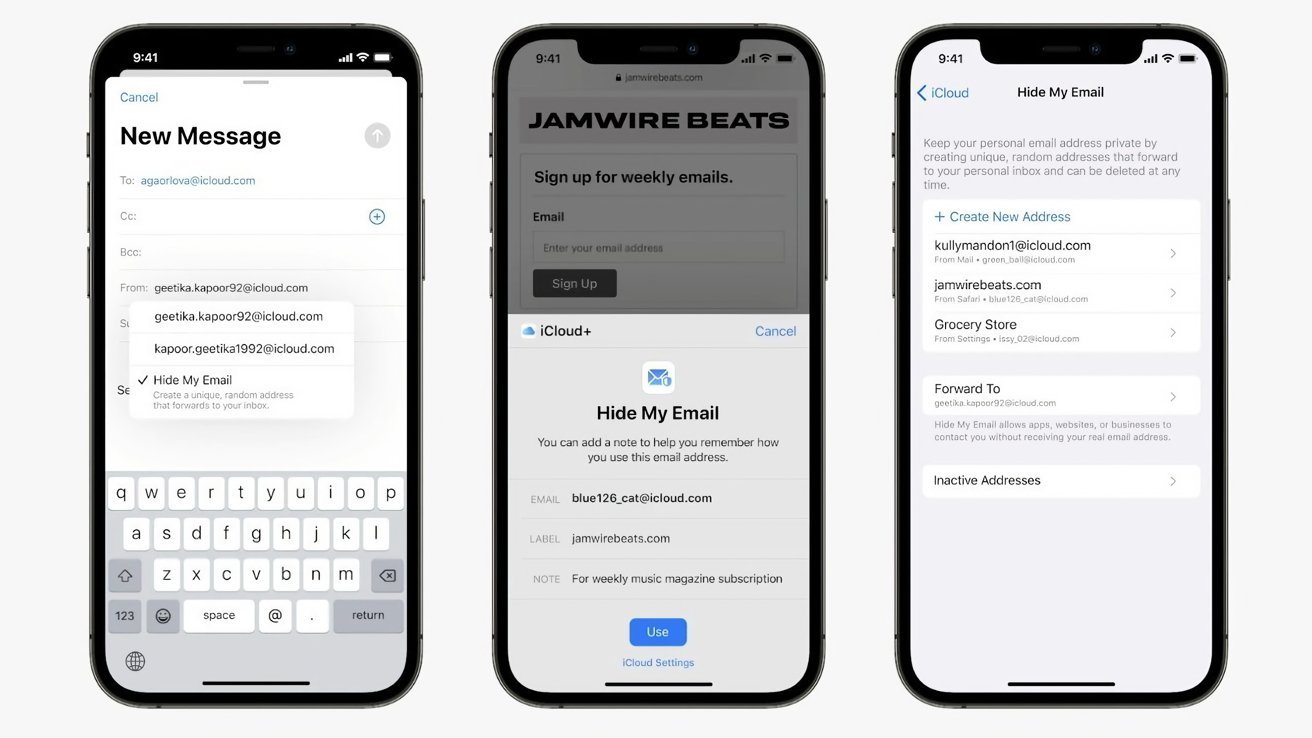
A vulnerability was discovered in Apple’s “Hide My Email” that allows an attacker to work out your real email address. It’s not been fixed for over a year.

Hide My Email has been a great help for Apple users who need to communicate with services and companies, but don’t want to provide their real email address. Spam, as ever, continues to be a problem requiring solutions like this.

However, while it is capable of thwarting your typical spammer or marketing-happy small business, it’s not foolproof. As a report from 404Media reveals, it’s a feature that can be beaten.

The exact nature of the vulnerability hasn’t been detailed, due to the lack of action by Apple to fix it. Testing on Monday by the report verified that it is still a problem.

Advertisement

EasyOptOuts co-founder Tyler Murphy discovered an issue with Hide My Email in June 2025, and responsibly reported it to Apple as well as the publication. Twelve months later, and the problem still exists.

Murphy explains that the issue was reported and instructions to replicate it where provided to Apple. He doesn’t know why it hasn’t been fixed, but also didn’t feel comfortable waiting to discuss the problem any longer.

“Hide My Email users deserve to know that it may be possible for attackers to discover their hidden email addresses,” he declared.

There are free websites accessible to the public that link email addresses to other personal details, he adds. Anyone relying on Hide My Email may find themselves at risk of being identified on them.

Advertisement

Under Investigation

While Apple hasn’t yet fixed the hole in Hide My Email, it is certainly aware of the problem. One month after Murphy contacted Apple, it confirmed it was looking into the issue.

In March 2026, Apple said it had “addressed the reported issue in a recent system change.” However, Murphy discovered the hole hadn’t been plugged.

Again, more information was provided to Apple, which replied a month later saying it was doing more checks.

Apple updated Murphy in May, insisting it was “still investigating” the problem. It also wished for Murphy to hold off disclosing the problem until after the investigation concluded.

Advertisement

Murphy wrote back, proposing that Apple could stop selling access to Hide My Email until a fix was available, as a means to limit the number of users at risk.

By the end of May, Apple said that it would be addressed in a security update “expected in the coming weeks.”

After being alerted by Murphy, the publication contacted Apple multiple times, but did not get a response.

Questionable changes

While it is unknown exactly when and how the vulnerability will be fixed, it may end up accompanying other changes to the service. These are changes that have questionable value to its users.

Advertisement

A June 15 developer notice warned that the email domains used for Sign In with Apple and Hide My Email will be updated in the future. The intention is for email providers and developers to update their systems in advance of the changeover.

The changes basically mean that newly-generated relay email addresses for Hide My Email will change from the domain iCloud.com to private.icloud.com. Sign In With Apple currently creates relay addresses ending with privaterelay.appleid.com, and will change to the private.icloud.com version.

The problem here is that there’s nothing stopping a website or newsletters from blocking email addresses using private.icloud.com, forcing them to sign up with another legitimate account.

For Hide My Email at least, the change removes the source ambiguity protecting the service and its users.

Advertisement

Source link

Continue Reading

Tech

Oppo’s Air 5s are AirPods 4 rivals with ANC

Published

on

Oppo has unveiled the Enco Air5s, the brand’s first semi-in-ear earbuds with Active Noise Cancellation, placing them in direct competition with Apple’s AirPods 4 with ANC.

The open design that gives semi-in-ear earbuds their comfortable fit has traditionally been a poor fit for effective noise cancellation, since it leaves more room for ambient sound to leak through.

Oppo’s Real-time Adaptive Noise Cancellation addresses that limitation by adjusting noise reduction based on fit, ear canal shape and surrounding sound, all processed through an 800kHz sampling rate for faster response to changing conditions.

Alongside that adaptive system, the Enco Air 5s also include a Tailored Voice-Canceling System built to suppress vocal frequencies and reduce nearby conversations, a feature aimed at noisy environments such as crowded cafés.

Advertisement

Each earbud weighs just 3.9 grams, a figure Oppo credits to its Excimer Craftsmanship finishing process, which combines a shimmering surface with a smooth touch while keeping the overall build ultra-lightweight. Complementing this is the Ergonomic Semi-in-Ear Fit, intended to conform more closely to natural ear contours and reduce friction during extended wear.

Advertisement

Sound comes from a newly customised 12mm dynamic driver built around a Copper-Clad Aluminum Wire coil, paired with an Acoustic Cavity Design that Oppo says delivers crisp highs, impactful bass and clear vocals. An upgraded 10-band Custom EQ allows listeners to fine-tune low, mid and high frequencies, while Adaptive Sound Enhancement compensates for sound leakage in real time.

Oppo Enco Air5s breakdownOppo Enco Air5s breakdown
Image Credit (Oppo)

Connectivity is Bluetooth 6.0 alongside Oppo’s own Smart Bluetooth system, with Dual Connection Across Systems letting users switch between paired devices without manually reconnecting.

Beyond standard pairing, the earbuds introduce AI Translate, supporting face-to-face translation for situations such as ordering food or attending meetings abroad, alongside Slide Volume Control for hands-free adjustment without touching a connected phone.

Advertisement

Battery life reaches up to 48 hours with the charging case, with Oppo stating the cells retain over 80 percent capacity after 1,000 charge cycles, a claim backed by TÜV Rheinland certification.

Advertisement

The Enco Air 5s will launch in Lunar White, Midnight Black and Starlight Purple finishes, though Oppo has not confirmed pricing or release dates beyond noting that details will follow through official local market announcements.

Advertisement

Source link

Continue Reading

Tech

Terminus Is A Text Only Phone Because Telephony Is Dead Anyway

Published

on

This may say more about us than the current state of the telephone network, but unless your Grandma is still kicking, how many phone calls do you take that are actually worth picking up? Around here it’s one variety of scam or another, with the odd cold-calling salesperson to round it out.

So when we saw [Bolan Xu]’s texting-only TERMINUS cell phone project, it took but a minute to decide that, yeah, we wouldn’t miss the telephone part of the phone very much either.

The trade-offs are immense when compared to your smartphone; there’s no voice, no web browser, no social media, and no camera. But on the flip side there’s also no spyware and no annoying spam calls. Besides, he’s built a QWERTY keyboard onto this thing, and that does seem to be what most of us miss in this era of black rectangles.

Advertisement

In terms of electronics, its rocking a tiny OLED display for you to read your messages on, driven by an ESP8266. When WiFi is available the plan was to bridge over the internet in an SMS version of VOIP, but [Bolan Xu] ended up installing a cellular modem in it anyway.

As you can tell from the skeletal case, this is very much a prototype, but it is a promising project. We’ve seen ESP-based phones before, but they tend to be a bit smarter, and run on ESP32 instead of the more modest ESP8266.

Advertisement

Source link

Continue Reading

Tech

AI agents need context everywhere they run, even where the cloud can’t follow

Published

on

The competitive edge in enterprise AI is shifting to context: which platform can give an agent the right memory, the right retrieval and the right data at the moment of decision.

Couchbase on Tuesday announced its AI Data Plane, combining persistent agent memory, real-time context retrieval and an enterprise-managed MCP server in a single operational platform. 

Couchbase’s roots are in caching and high-transaction databases — an architecture the company argues makes it better suited for agent memory than vendors that came to the problem from search or analytics. The AI Data Plane runs identically across cloud, on-premises and disconnected edge environments, extending agent memory and local vector search to devices with no network connection.

“How do you make sure that the intelligence that you get out of these models are the ones that databases specialize in?” Gopi Duddi, CTO at Couchbase, told VentureBeat. “How can you get that value out of storage systems, which are still going to be databases?”

Advertisement

What the AI Data Plane delivers

The AI Data Plane packages three components designed to replace the fragmented stacks most enterprises are currently running.

Agent memory: A unified persistence layer for conversational context, structured operational data and vector embeddings. Couchbase says the guardrails are what distinguish it from standalone memory services: token constraints per session, time-to-live limits on stored memories and metering controls that cap compute consumption per agent session.

Enterprise MCP server: An enterprise-supported self-managed server for standardized model-context protocol integration, shipping as part of the platform rather than requiring a separate service.

Agent catalog: A function-level catalog of discoverable agent tooling built by Couchbase. Duddi distinguished it from metadata catalogs like Databricks Unity or AWS Glue — describing it, in his words, as closer to a glorified MCP that surfaces agent functions as callable tools within the platform.

Advertisement

Memory-first architecture takes agent context to the disconnected edge

The lineage of Couchbase and its core architectural foundation is what Duddi says gives it an edge when it comes to context.

“We were a cache before we became a database,” Duddi said.

Writing to memory is 10x faster than writing to disk, Duddi said — a speed advantage he argues separates Couchbase from NoSQL databases that layer memory workloads on top of disk-based storage.

Couchbase isn’t the only data technology that has its roots in a caching layer. Redis similarly is rooted in cache and also recently announced an agentic AI context layer. Duddi argued that Couchbase is different in that it maintains an ACID (Atomicity, Consistency, Isolation, and Durability) compliant database which matters for transactional workloads. Couchbase also has a long history across multiple deployment modalities.

Advertisement

That architecture extends to the edge through Couchbase Lite, the platform’s on-device runtime. It runs SQL, full-text search and vector search locally without a network connection, using a proprietary sync mechanism to replicate bidirectionally back to cloud or between edge nodes when connectivity returns. The target environments are retail floor operations, field service, industrial deployments and regulated settings where agent data cannot leave the device.

Duddi cited hotel reservations as an early example: multiple agents serving customers concurrently, each pulling local context and running vector search on-device, with shared session memory synchronizing centrally. The practical benefit is token efficiency. Rather than every agent independently retrieving and processing the same data, the platform caches shared context so concurrent sessions draw on it without burning tokens repeatedly.

VB Transform · July 14–15 · Menlo Park · Agentic context layers

Your agents are only as good as the data they can reach.

Advertisement

Sessions at Transform cover the RAG architectures powering agentic systems at scale — including how enterprises are connecting agents to live genomics, clinical, and enterprise data.

See the full agenda →

Agora’s view from production

Agora, a platform that helps developers embed real-time voice, video and conversational AI into enterprise applications, has run Couchbase in production since February 2024.

The initial use case was its Signaling product, managing channel setup and state synchronization for live calls. Expanding into conversational AI agents brought stricter requirements: memory-first architecture, full JSON support for storage and query, cross-datacenter replication for high availability and enterprise-grade vendor support.

“Couchbase was the best fit based on these criteria,” Patrick Ferriter, SVP of Product at Agora, told VentureBeat.

Advertisement

Agora is now extending that relationship to support context retrieval for conversational AI agents.

“This will simplify the architecture and deliver enterprise grade RAG with predictable lower latency required for conversational AI use cases,” Ferriter said.

For data professionals trying to figure out the best approach to context, there is no one answer. On platform selection, Ferriter was direct.

“It depends on the preference and goals of the organization, including timing,” Ferriter  said. “If they want something enterprise grade and optimal for immediate production and scale vs. having to optimize and maintain an open-source solution with community support. We wanted the former and that is why we looked at an expanded partnership with Couchbase.”

Advertisement

Competitive context: following the right trend

The context layer has become a crowded space in 2025.

Oracle put a memory core in its database back in March providing a context layer. Redis added a context layer in May as did vector-native database vendor Pinecone.  

“Couchbase is following this trend, not setting it, but it’s the right one to follow,” Devin Pratt, Research Director for AI, Automation, Data and Analytics at IDC, told VentureBeat. “Its real edge is reach, running the same platform from cloud to edge to mobile, which is how enterprises actually operate. The test now is to scale against bigger names.”

For teams navigating the vendor landscape, Pratt’s framing is direct. “Match the tool to the workload. Consolidate where it makes sense, use a specialized engine like a graph database where relationship-heavy reasoning earns it, and let governance drive the call rather than treating memory as plumbing,” Pratt said.

Advertisement

Source link

Continue Reading

Trending

Copyright © 2025