

Crypto World
What is alt season? And why it keeps not arriving



Alt season is the phase when altcoins outrun Bitcoin and portfolios go vertical. Traders have waited more than 260 days for the latest one. Here is what it is, how to measure it, and why it keeps failing to show up.
Summary
- Alt season, or altcoin season, is a sustained period when most altcoins outperform Bitcoin, often producing the largest percentage gains of a market cycle.
- It is measured by the Altcoin Season Index, which tracks how many of the top 100 altcoins beat Bitcoin over 90 days; above 75 is alt season, below 25 is Bitcoin season, and the index sits near 43 in mid-2026.
- The classic pattern is a rotation: Bitcoin rises first, then consolidates, and capital flows out into large-cap alts, then mid-caps, then small-caps.
- The reason alt season keeps not arriving in 2026 is a mix of a bearish Bitcoin far below its record, high Bitcoin dominance, and the ETF wall, where institutional money is locked into Bitcoin through regulated funds instead of rotating into alts.
- The index is reactionary, confirming an alt season only after it has begun, which is why chasing it late and rotating prematurely are the two most common and costly mistakes.
Alt season is the crypto market’s most anticipated and most argued-about phase. It is the stretch of a cycle when the thousands of coins that are not Bitcoin suddenly outrun it, and portfolios that spent months going nowhere go vertical. Traders wait for it, debate whether it has started, and often miss it. As of mid-2026, the wait has stretched past 260 days since the last confirmed alt season, long enough that some question whether the phenomenon still works the way it used to. This guide explains what alt season actually is, how it is measured, the rotation that drives it, and, most usefully right now, why it keeps failing to arrive.
What alt season is
An altcoin is any cryptocurrency other than Bitcoin, from large names like Ethereum, Solana, and XRP down to thousands of small tokens. Alt season is the phase of a market cycle when these altcoins, as a group, significantly outperform Bitcoin over a sustained stretch, typically weeks to a few months. During one, it is common for many altcoins to double or triple while Bitcoin moves sideways or rises more slowly, and the best-performing names can post gains of several hundred percent.
The defining feature is relative performance, not just rising prices. Altcoins can go up while Bitcoin also goes up; what makes it an alt season is that they go up more. Capital that had concentrated in Bitcoin spreads outward into the rest of the market, lifting a broad range of tokens and shifting attention, liquidity, and speculation toward new narratives and projects. It is the part of the cycle that produces the outsized returns crypto is famous for, and also the sharpest reversals when it ends.
Alt season is the counterpart to Bitcoin season, the phase when Bitcoin leads and altcoins lag. The market cycles between the two, and knowing which phase you are in is one of the most useful pieces of context a crypto participant can have, because the same portfolio behaves very differently depending on which is in force.
The Altcoin Season Index
The most-cited way to judge the phase is the Altcoin Season Index, a tool that turns the question into a single number. It measures how many of the top 100 altcoins, excluding stablecoins, have outperformed Bitcoin over the previous 90 days, and expresses that as a score from 0 to 100. The thresholds are simple: a reading above 75 signals a confirmed alt season, meaning at least three quarters of the leading altcoins beat Bitcoin over the window. A reading below 25 signals Bitcoin season, where altcoins are broadly lagging. Anything between 25 and 75 is a mixed or neutral market where no clear rotation has taken hold.
As of mid-2026, the index sits around 43, up sharply from June lows near 11 to 12 but still well short of the 75 needed to confirm rotation. That reading tells a precise story: altcoins have gained some strength off the bottom, with more of them starting to beat Bitcoin, but the market remains in neutral territory, leaning toward Bitcoin, not in an alt season. The jump from the low teens to the low 40s shows early signs of life without confirmation.
The index has one important weakness that every user should understand. It is built on a trailing 90-day window, which makes it a lagging, reactionary measure. By the time it climbs above 75 and confirms an alt season, much of the move has already happened, so the confirmation arrives after the best entry points have passed. The index is excellent for describing where the market has been and poor at predicting where it is going next.
Bitcoin dominance and the rotation
The companion metric is Bitcoin dominance, often written BTC.D, which is Bitcoin’s share of the total crypto market capitalization. When dominance is high, Bitcoin holds most of the market’s value; when it falls, value is shifting into altcoins. Traders watch dominance closely because a sustained decline is one of the clearest signs that capital is rotating out of Bitcoin and into the rest of the market, the essence of an alt season.
In mid-2026, Bitcoin dominance sits in the mid-to-high 50s, and analysts have flagged a sustained break below 55%, and ideally lower, as the threshold that would signal a real, broad rotation. Above that level, Bitcoin is still absorbing the market’s capital, and altcoins struggle to get sustained traction. The mechanism links dominance to the index: falling dominance means altcoins are gaining share, which shows up as more of them outperforming Bitcoin, which lifts the Altcoin Season Index. The two metrics describe the same rotation from different angles.
The reason dominance matters so much is that it captures the flow of money, not just price. An altcoin can rise in dollar terms while Bitcoin rises faster, in which case dominance climbs and it is still Bitcoin season despite green candles everywhere. Only when altcoins outpace Bitcoin does dominance fall and rotation begin. That is why seasoned traders watch dominance alongside price: it strips out the illusion that a rising market is automatically an alt season.
The four phases of the cycle
Alt season does not appear at random; it tends to arrive at a specific point in a repeating cycle with four rough phases. The first is accumulation, when prices stabilize near the bottom of a downturn and early buyers quietly build positions while sentiment is still poor. The second is the Bitcoin-led rally, when fresh capital enters the market and flows first into Bitcoin, the primary on-ramp, pushing it up and often to new highs while altcoins lag.
The third phase is where alt season lives. After Bitcoin rallies hard and then consolidates, moving sideways, holders who have made gains start looking for higher returns elsewhere and rotate capital into altcoins. This rotation is usually sequential instead of simultaneous: money moves first into large-cap alts like Ethereum, then into mid-caps, and finally into small-cap and speculative tokens as risk appetite grows. The fourth phase is the top and unwind, when euphoria peaks, the last speculative money piles into the smallest and riskiest coins, and the cycle eventually reverses into a downturn.
Understanding this sequence explains why alt season has a prerequisite that is often missed: it typically follows a Bitcoin rally to new highs and a consolidation. Without Bitcoin first leading and then pausing, there is no pool of Bitcoin gains to rotate, and no stable backdrop for capital to move out along the risk curve. The phase is not just a mood; it is a specific stage that depends on what came before it.
Why alt season keeps not arriving in 2026
This is the question on every trader’s mind, and the answer is a convergence of factors instead of a single cause. The first is the most basic: alt season usually follows a Bitcoin rally to new highs and a consolidation, and in 2026 Bitcoin has done the opposite. It sits far below its record, in a bearish, drawn-out drawdown, so the precondition of a fresh Bitcoin high that seeds rotation has simply not been met. There are no large Bitcoin gains sitting around waiting to rotate into alts when Bitcoin itself is down.
The second factor is dominance. Bitcoin dominance has stayed elevated in the mid-to-high 50s, above the threshold analysts see as necessary for broad rotation, which means capital keeps concentrating in Bitcoin instead of spreading out. The third, and the most structurally interesting, is the ETF wall. Spot Bitcoin exchange-traded funds have pulled enormous institutional capital into Bitcoin through regulated products, but that money is largely confined to Bitcoin. Unlike the retail flows of past cycles, which moved freely from Bitcoin into thousands of altcoins, institutional capital that enters through a Bitcoin ETF tends to stay in Bitcoin, because those investors gain crypto exposure through the fund and do not rotate down the risk curve into individual tokens. The channel that once carried money from Bitcoin into alts is partly blocked.
There is a fourth factor: selectivity. Even where rotation is happening, it is narrative-driven and concentrated instead of broad. Institutional participation has made the market more discerning, so money managers favor altcoins with clear fundamentals, regulatory standing, and liquidity, while thousands of microcap tokens with no product and no revenue are left behind. The result is that even partial rotations lift a handful of sectors, real-world assets, AI infrastructure, blue-chip DeFi, instead of the whole market. A rising tide that once floated every boat now floats a chosen few, which is why the broad, everything-pumps alt season of past cycles keeps failing to materialize.
Historical alt seasons
The past shows what a real alt season looks like, and how the forces behind them change. The first major one ran through 2017 and into early 2018, driven by the initial coin offering boom. Hundreds of new projects raised money by issuing tokens directly to retail investors, flooding the market with new assets and speculators, and Bitcoin dominance collapsed from around 86% in late 2017 to under 40% at the start of 2018 as money poured into altcoins. It ended in a deep, prolonged bear market that erased most of the gains.
The second ran through 2020 and 2021, powered by different narratives: decentralized finance protocols, non-fungible tokens, new layer-one blockchains, and eventually meme coins. Capital rotated from Bitcoin into DeFi, then NFTs, then competing smart-contract chains, producing enormous gains across sectors. Institutional investors began entering crypto during this cycle, making the market larger but also beginning the shift toward the selectivity now visible in 2026.
The contrast between those cycles and the present is the whole lesson. Both past alt seasons ran on free-flowing retail capital that moved easily from Bitcoin into a wide field of tokens. The 2026 market has more institutional money, more regulation, and the ETF wall, all of which channel capital differently. The historical pattern is not broken, but the plumbing has changed, which is why the same triggers produce a weaker and more selective response than they once did.
The conditions that would trigger one
If alt season is late instead of dead, what would actually bring it? Analysts point to a set of conditions that, when several align, have historically preceded rotation within a quarter. The first and most important is Bitcoin making a new high and then consolidating, which creates both the gains and the stable backdrop that seed rotation. Until Bitcoin recovers and leads, the sequence cannot begin.
The second is a sustained break in Bitcoin dominance below the mid-50s, confirming that capital is genuinely leaving Bitcoin for alts instead of just lifting the whole market together. The third is expanding liquidity, often from central-bank rate cuts, because looser financial conditions push investors toward higher-risk, higher-beta assets, and altcoins are the highest-beta assets in crypto. The fourth is the Altcoin Season Index sustaining a move above roughly 40 to 50 with momentum, showing that outperformance is broadening instead of flickering.
The practical approach that follows from this is to watch the conditions converge instead of guessing a date. When three or more are present at once, the odds of rotation rise sharply. Until then, the index sitting in neutral is telling you plainly that this is not yet alt season, and the traders who override that signal to get in early are usually the ones left holding underperforming tokens while Bitcoin does the work.
The traps to avoid
Alt season is where fortunes are made and lost, and the losses usually come from two predictable mistakes. The first is chasing it late. Because the index is reactionary, by the time it confirms an alt season above 75, the largest and easiest gains have already happened, and entering then means buying near the top of a fast-moving, overextended market. The window is typically two to five months, and the last stretch is the most dangerous, when the smallest and riskiest coins spike and then collapse hardest.
The second mistake is rotating prematurely, moving fully into altcoins before Bitcoin has confirmed a new high and led the cycle. Every past alt season was preceded by Bitcoin leading first, so rotating early means holding depreciating altcoins while Bitcoin outperforms, the opposite of the intended trade. The index sitting in Bitcoin season or neutral is an explicit signal that the rotation has not started, and ignoring it to position early is a common and expensive error.
The deeper trap is treating alt season as a guaranteed event rather than a probability. It is not an on-off switch that must flip in every cycle; it is a phase that depends on conditions, and those conditions can fail to line up, as 2026 shows. The disciplined approach is to track the index and dominance daily, watch for the trigger conditions to converge, and add altcoin exposure selectively and gradually once the signals confirm, instead of betting the portfolio on a rotation that the data has not yet endorsed.
Where the money rotates first
If a rotation does begin, it does not lift every token at once, and knowing the order helps separate a real broadening from a narrow bounce. The sequence tends to follow the risk curve. Capital leaves Bitcoin first for the largest, most liquid altcoin, historically Ethereum, because it is the safest step out along the curve and the easiest for large money to enter. A sustained move in the ETH/BTC ratio is often read as the opening signal that rotation has started at the top of the market.
From there, money tends to move down the size ladder. After large-caps like Ethereum absorb the first wave, capital flows into mid-cap tokens with proven products and liquidity, then finally into small-cap and speculative names as risk appetite grows and traders chase higher percentage gains. This is why the late stage of an alt season is the wildest: the smallest and least proven coins move last and hardest, which is also why they fall the fastest when the phase ends. The order is a rough gauge of how far a rotation has traveled.
Sector leadership matters as much as size. In any given cycle, rotation concentrates in a few narratives instead of spreading evenly, and the leading sectors change from cycle to cycle. In 2026 the candidates most often cited include layer-two scaling networks, real-world asset tokenization, blockchain infrastructure for artificial intelligence, and blue-chip decentralized finance. Meme coins typically peak last and crash hardest, which makes their surge a late-stage signal more than an early one. Watching which sectors lead tells you what the market is actually rewarding, not just that alts are moving.
The selectivity point returns here with force. Because institutional capital favors tokens with fundamentals, liquidity, and regulatory standing, a modern rotation can lift a handful of quality names while thousands of microcaps stay flat, which looks nothing like the everything-pumps seasons of the past. A trader watching only a favorite microcap might conclude alt season never came, while large-cap and sector leaders quietly outperformed. Judging rotation by the leaders and the index, not by one held bag, gives a truer read.
The practical use of all this is sequencing your own attention. Track the ETH/BTC ratio for the first sign that money is stepping out of Bitcoin, watch whether strength broadens from large-caps into mid-caps as confirmation, and treat a frenzy in the smallest coins as a late-cycle warning instead of an invitation. Rotation is a process with an order, and reading that order is more useful than waiting for a single index number to flip.
Frequently Asked Questions
What is alt season in crypto?
Alt season, or altcoin season, is a sustained phase of the market cycle when most altcoins, meaning cryptocurrencies other than Bitcoin, significantly outperform Bitcoin. During one, many altcoins can double or triple while Bitcoin moves sideways or rises more slowly. It is defined by relative performance, altcoins gaining more than Bitcoin, and it produces some of the largest percentage returns of a cycle.
How is alt season measured?
The main tool is the Altcoin Season Index, which tracks how many of the top 100 altcoins, excluding stablecoins, outperformed Bitcoin over the previous 90 days, scored from 0 to 100. Above 75 confirms an alt season, below 25 signals Bitcoin season, and 25 to 75 is neutral. Traders also watch Bitcoin dominance, since a sustained decline signals capital rotating from Bitcoin into altcoins.
What is Bitcoin dominance and why does it matter?
Bitcoin dominance is Bitcoin’s share of the total crypto market capitalization. High dominance means Bitcoin holds most of the market’s value; a falling reading means capital is shifting into altcoins. A sustained break below the mid-50s is often flagged as the threshold for a real, broad rotation. Dominance captures the flow of money, so it can reveal Bitcoin season even when altcoin prices are rising.
Why has alt season not arrived in 2026?
Several factors have converged. Bitcoin is far below its record in a bearish drawdown, so the usual precondition of a fresh Bitcoin high has not been met. Dominance has stayed elevated. And the ETF wall keeps institutional money locked in Bitcoin through regulated funds instead of rotating into alts. Rotation that does occur is selective and narrative-driven instead of broad.
What is the ETF wall?
The ETF wall describes how spot Bitcoin exchange-traded funds pull large institutional capital into Bitcoin but largely keep it there. Unlike past cycles where retail money moved freely from Bitcoin into thousands of altcoins, investors who gain exposure through a Bitcoin ETF tend to stay in Bitcoin rather than rotating into individual tokens. This partly blocks the channel that historically carried money into alts.
What would trigger an alt season?
Analysts point to a set of conditions that, when several align, have preceded rotation: Bitcoin making a new high and consolidating, a sustained break in Bitcoin dominance below the mid-50s, expanding liquidity such as from rate cuts, and the Altcoin Season Index sustaining above roughly 40 to 50 with momentum. When three or more appear together, the odds of rotation within a quarter rise sharply.
Is the Altcoin Season Index a good timing tool?
Only partly. The index is built on a trailing 90-day window, which makes it reactionary. By the time it confirms an alt season above 75, much of the move has already happened, so it describes where the market has been better than where it is going. It is useful for context, but relying on it to time entries usually means arriving late, after the easiest gains have passed.
What mistakes do traders make around alt season?
The two most common are chasing it late, buying after the index confirms and the biggest gains are gone, and rotating prematurely, moving into altcoins before Bitcoin has led and confirmed a new high, which leaves them holding underperforming tokens while Bitcoin rises. A third is treating alt season as guaranteed rather than a conditional phase that can fail to arrive, as 2026 has shown.
Disclaimer: This article is for information and educational purposes only and does not constitute financial, investment, or trading advice. Cryptocurrency prices are highly volatile, and market cycles are unpredictable. Nothing here is a recommendation to buy or sell any asset. Always do your own research and consider consulting a licensed professional before making financial decisions. Figures such as the Altcoin Season Index and Bitcoin dominance are accurate as of July 1, 2026, and will change.


Key Highlights
-
Security Matters shares advanced 6.90% following increased interest in its verification technology.
-
The company’s digital passport system connects plastic materials with authenticated documentation.
-
Stricter U.S. recycling regulations are driving demand for robust verification infrastructure.
-
Security Matters focuses on supply-chain transparency, regulatory compliance, and material authentication.
-
Authenticated recycled plastics could achieve competitive parity with virgin materials.
Security Matters (SMX) stock advanced 6.90% to reach $14.33 following the opening bell, driven by heightened interest in its recycling authentication technology. The stock experienced early gains, softened briefly, then held steady near peak levels. This movement came as investors focused on the company’s material verification platform and evolving U.S. recycling regulations.
SMX (Security Matters) Public Limited Company, SMX
Security Matters Advances Recycling Authentication Technology
SMX has centered its business model on verification-driven recycling rather than general environmental messaging. The company’s Digital Material Passport Platform creates connections between physical plastics and protected digital documentation. Consequently, plastic materials can carry information about source, composition, handling history, lifecycle phase, and regulatory alignment.
The firm employs molecular tagging to establish permanent material identification. This methodology enables brands, producers, and oversight bodies to authenticate recycled plastic throughout every phase. Recycled components can progress through distribution networks supported by enhanced documentation and transparent oversight.
Growing media coverage has elevated Security Matters’ visibility within the recycling technology sector. Numerous prominent publications featured its contributions to plastic authentication and data-driven environmental solutions. The organization’s primary emphasis continues to center on regulatory alignment, supply-chain transparency, and quantifiable recycling results.
Tightening U.S. Regulations Drive Verification System Adoption
The American recycling sector has transitioned toward more rigorous verification requirements. Individual states persistently broaden regulations covering recycled content mandates, collection programs, and producer responsibility frameworks. Consequently, organizations require more definitive documentation when reporting or substantiating environmental commitments.
Corporations encounter intensified oversight as regulatory authorities examine sustainability assertions more thoroughly. Producers require validated information before establishing pricing, purchasing, funding, or disclosing recycled material usage. Municipal governments demand stronger confirmation that collected plastics return to beneficial applications.
SMX addresses this requirement through authentication systems, passport documentation, and compliance-oriented analytics. The platform facilitates recycled-content validation, custody chain records, origin tracking, and lifecycle reporting. Collectively, these capabilities transform scattered recycling assertions into organized datasets.
Security Matters Connects Material Documentation With Market Value
Security Matters’ operational reach extends nationally and touches multiple recycling system components. The organization integrates physical marking, digital documentation, compliance analytics, and marketplace functionality. Accordingly, the platform can facilitate sourcing, capital access, plastic credit systems, and brand authentication.
The firm additionally advances its Plastic Cycle Token and recycled plastic registry framework. These instruments seek to align validated recycling operations with quantifiable financial value. Subsequently, certified materials can compete more effectively against virgin feedstock.
SMX has articulated this transformation through its Age of Parity initiative. The initiative contends that authenticated recycled plastic can emerge as a viable economic alternative. As supply constraints and regulatory pressure intensify, Security Matters presents its verification platform as essential recycling infrastructure.



“Large groups of large companies coordinate poorly, have misaligned incentives, slow things down and rarely create the space for real durable innovation,” he wrote.
Test for the consortium model
That skepticism is shared by Lorenzo Valente, director of digital asset research at ARK Invest, who noted that crypto has seen several consortium-backed stablecoin initiatives over the years, including Meta’s Diem project and Paxos-led Global Dollar Network.
“Every year we get our consortium-style initiative around a stablecoin,” Valente wrote in an X post. “While the set of players here is obviously potent, I remain highly skeptical any of these initiatives can hit scale.”
He said Open Standard’s biggest challenge may be coordinating more than 140 participants with competing interests.
“A consortium of hundreds of rivals has no precedent for working,” he said. “The pace of decision-making across competitors is going to be glacial.”
Valente likened the model to decentralized autonomous organizations, or DAOs, whose governance structures often struggled to make timely decisions.
“‘Owned by everyone’ almost always means accountable to no one,” he said. “I’d bet on the two operators who can ship unilaterally over a committee that has to ask hundreds of rivals for permission.”
He also questioned whether large banks, payment networks and technology companies would remain committed if the project encounters regulatory pressure. Circle and Tether, he noted, have spent years building global regulatory infrastructure and licensing, while a consortium could find it harder to stay aligned if conditions become more challenging.

Cuts of beef are displayed at Handy Market on May 14, 2026 in Burbank, California.
Justin Sullivan | Getty Images
With oil and gas prices falling in the wake of the detente between the U.S. and Iran, prediction market traders now think inflation has peaked.
Speculators on prediction market platform Kalshi think there’s only a 28% chance that headline inflation this year peaks above 4.2%, which was the annual rate of increase in the Consumer Price Index in May.
The next CPI report, measuring inflation in June, is due for release by the Bureau of Labor Statistics (BLS) on July 14.
The contract on Kalshi asks if traders think CPI will deliver a reading above various percentages in 2026. Contracts are resolved using the CPI data released each month by the BLS.
The inflation outlook has eased primarily due to recent declines in its main driver: energy prices. After shooting higher after the start of the U.S.-Iran war jn late February and the subsequent closure of the Strait of Hormuz, gas and oil prices have started to retreat after the partial reopening of the waterway.
Average national gasoline prices as of Wednesday stood at $3.84, according to AAA, down from more than $4.50 at their peak. That reflects weaker U.S. crude oil prices, which have fallen below $70 per barrel for the first time since the war began.
Energy prices in May accounted for 60% of CPI’s month-over-month increase.
Now the decline in gas prices is leading Kalshi traders to think that CPI in June will show prices falling by 0.2% compared with May, in-line with Wall Street consensus estimates.


Coinmetro, an Estonian-based cryptocurrency exchange, has claimed that it has filed “a reorganisation application to the Estonian court.”
In its announcement, it states that this is required because of “an extraordinary situation caused by a failure of one of our financial service providers.”
It further claims that it had already suspended user registrations, deposits, and withdrawals back on June 22.
Interestingly, in the Estonian register both Coinmetro OÜ and Coinmetro Group OÜ are past due on annual reports. Coinmetro Group OÜ is also listed as having a tax debt.
The announcement didn’t disclose which financial service partner led to this failure, and Coinmetro has yet to respond to Protos’ questions regarding that issue.
During a YouTube based “Ask Me Anything” with Coinmetro Chief Executive (and beneficial owner) Kevin Murcko, he claimed that it was actually more than one provider that failed, despite the announcement only claiming one.
He also claimed that there was a multi-year internal investigation, suggesting that this failure happened well before this current announcement.
Additionally, he stated that he originally believed that Coinmetro’s balance sheet was strong enough that this wasn’t originally material, but has become material as Coinmetro has approached the July 1 licensure deadline for compliance with Markets in Crypto Assets regulations.
Prime Trust
The Prime Trust bankruptcy estate (PCT Litigation Trust) filed an adversary proceeding against Coinmetro in August of last year.
This proceeding attempted to clawback withdrawals made in the days immediately preceding bankruptcy.
This proceeding claims that Prime transferred $1,205,751.10 to Coinmetro in the days before Prime’s failure.
Read more: Prime Trust accused of using customer funds to cover lost deposits
The mistakes and fraud committed by Prime apparently make it extraordinarily difficult to determine who was owed which funds from Prime Trust.
This means that Coinmetro didn’t necessarily withdraw more funds than it deposited because of the failure, and Prime Trust is trying to clawback many of the withdrawals from the final days.
Protos reached out to Coinmetro for comment, but it didn’t respond before publication.
Got a tip? Send us an email securely via Protos Leaks. For more informed news and investigations, follow us on X, Bluesky, and Google News, or subscribe to our YouTube channel.
[PRESS RELEASE – St. John’s, Antigua and Barbuda, July 1st, 2026]
XBTFX has announced the launch of its MCP Server and Skills Hub, expanding its developer ecosystem following the introduction of its REST and WebSocket Trading API. The new infrastructure enables compatible software agents, coding assistants, and automation frameworks to connect with eligible live XBTFX trading accounts through structured, authenticated workflows, allowing supported applications to retrieve account information, access market data, and submit structured trading requests.

Intelligent software agents and automation tools are increasingly being used to analyze markets, process news, write code, and support research workflows. However, most remain separate from the trading account itself. While they can assist with analysis, they typically cannot retrieve live account data, inspect open positions, monitor margin, or submit structured account requests without additional integration.
The newly released infrastructure is designed to connect those two environments. XBTFX is not launching a proprietary decision engine, automated strategy, or black-box execution system. Users define their own logic, instructions, permissions, and risk controls, while XBTFX provides authenticated account access, market-data connectivity, and execution infrastructure.
Built as Infrastructure, Not a Trading Strategy
The stack is designed to make trading accounts programmable through structured, authenticated workflows. When a user interacts with a compatible client or software agent to check exposure, retrieve a market price, calculate position size, or prepare a trade with defined parameters, the client converts that instruction into a structured tool call or API request. The natural-language instruction itself is not sent directly to the trading account.
XBTFX authenticates and processes the corresponding account, market-data, or trading request. Users remain responsible for their strategy logic, configurations, credentials, and risk management.
This distinction is especially important for crypto and active CFD traders, where automation and around-the-clock monitoring can be useful while user-defined risk controls remain essential.
Three Ways to Connect
The MCP Server acts as a structured tool layer between compatible clients and the XBTFX Trading API. Supported clients can access balances, margin, positions, orders, history, instrument data, prices and, depending on permissions, submit structured trading requests such as opening or closing positions and modifying stop-loss or take-profit levels.
The Skills Hub provides reusable instructions, endpoint definitions, implementation examples, and developer guidance for software agents and applications that do not connect through MCP directly, including workflows using LangChain, CrewAI, OpenClaw, Claude Code, and custom agent implementations.
The Trading API provides REST and WebSocket access for developers building dashboards, automated strategies, signal-to-execution systems, reporting tools, and account-management applications.
Together, the three access paths provide traders and developers with different ways to connect automated workflows and software agents with eligible XBTFX accounts, depending on their technical setup and use case.
Built for Crypto, Forex, and Around-the-Clock Market Monitoring
The integration layer supports workflows across forex, cryptocurrency CFDs, metals, indices, energies, and stocks, with access to more than 400 instruments. Available instruments and trading conditions depend on the account linked to the API key.
XBTFX also supports BTC, ETH, and USDT-denominated trading accounts alongside major fiat account currencies, giving traders and developers a crypto-denominated environment for automated monitoring, account management, and structured trading workflows.
For crypto-focused traders, the always-on nature of digital asset markets is a key part of the use case. When a software agent or automated process is configured to run continuously, it can monitor market data, account conditions, margin, and exposure outside conventional trading hours and respond according to predefined instructions, validation rules, and risk controls.
XBTFX does not provide trading recommendations through the MCP Server or Skills Hub, and the integration does not determine when a user should buy or sell any instrument.
Developed With HuracanAI
The MCP Server, Skills Hub, Trading API, and supporting execution architecture were jointly developed by XBTFX and HuracanAI, a financial technology firm specializing in brokerage infrastructure, liquidity connectivity, trading bridges, APIs, and software-agent systems.
The collaboration combines brokerage execution infrastructure with agent connectivity, supporting a more programmable model for traders and developers working with live account environments.
Control Stays With the Account Holder
Each XBTFX API key is associated with an individual eligible trading account. Users can manage API keys through the XBTFX Console and revoke them if they are no longer required or may have been exposed.
Because the integration operates with live trading accounts, XBTFX recommends testing account-information and market-data functions first, using limited exposure, and reviewing agent behavior before enabling broader automated workflows.
“Modern software agents and automation tools have become increasingly capable of supporting research and operational workflows, but they have generally remained separate from the trading account itself,” said – Peter Speros, XBTFX executive. “Our infrastructure is designed to provide structured, authenticated access to account information, market data, and account functions while keeping control with the account holder.”
Getting Started
To connect a compatible software agent or supported application, users can open or select an eligible live XBTFX trading account, generate an account-bound API key through the XBTFX Console, and connect through the MCP Server, Skills Hub, or Trading API.
The MCP Server, Skills Hub, and Trading API are available without a separate API subscription or per-request fee. Normal spreads, commissions, financing charges, and other trading costs continue to apply. Documentation is available through the XBTFX Developer Hub and Developer Documentation.
About XBTFX
XBTFX is a multi-asset online broker providing access to global financial markets through contracts for difference. Its product offering includes forex, cryptocurrency CFDs, metals, indices, energies, and stocks. XBTFX serves retail traders, active traders, strategy developers, and technology-focused market participants with trading platforms, execution infrastructure, automation tools, APIs, and developer resources.
For more information, visit the official website.
Risk Warning
Trading leveraged products, including CFDs, involves substantial risk and may not be suitable for all investors. AI agents and automated applications may misunderstand instructions, use incorrect parameters, encounter software or connectivity failures, or behave unexpectedly. Connecting an AI agent to a trading account does not reduce market risk, guarantee execution quality, or improve trading performance. Nothing here constitutes financial, investment, or trading advice. Past performance is not indicative of future results.
The post XBTFX Launches MCP Server and Agent Stack for Crypto and CFD Trading Workflows appeared first on CryptoPotato.
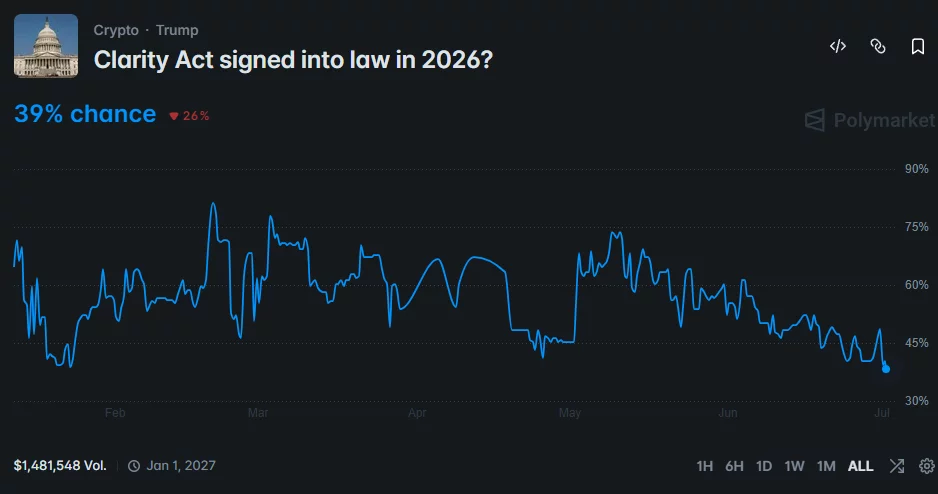
U.S. President Donald Trump has defended the financial gains disclosed in his latest filings after records showed he earned at least $1.4 billion from crypto-related ventures, while market expectations for the CLARITY Act’s passage this year have weakened.
Summary
- Trump defended his investment gains after disclosures showed at least $1.4 billion in crypto-related income.
- Polymarket odds for the CLARITY Act passing this year have fallen to 39% amid ethics debate.
- Senate Democrats and Elizabeth Warren have renewed scrutiny of Trump’s crypto business interests.
According to Trump’s remarks to reporters before departing for a trip, the president attributed his investment gains to the strong performance of the stock market rather than to any personal trading decisions. He said his finances are managed by investment funds and added that he is not directly involved in making investment decisions.
The comments came shortly after financial disclosures for 2025 showed Trump reported more than $1.4 billion in income tied to cryptocurrency ventures. According to the filing, much of that income came from licensing agreements connected to the TRUMP meme coin and sales of the World Liberty Financial (WLFI) token.
Although the filing detailed substantial crypto earnings, Trump did not address those revenues directly in his remarks. Instead, he pointed to the stock market rally and noted that many investors had benefited from rising asset prices. His comments also followed speculation in recent weeks that he has been actively trading through investment accounts, although he stated that outside fund managers oversee those assets.
The Trump administration has also maintained investments outside the crypto sector. Among them is Intel, whose shares have risen sharply since the administration disclosed its position in the company.
Political scrutiny has intensified around Trump’s crypto business
The latest disclosure arrives as lawmakers continue debating ethics rules tied to digital asset legislation in Congress.
According to Polymarket data, the probability of President Trump signing the CLARITY Act into law in 2026 has fallen to 39%, indicating traders now see a lower chance of the market structure bill clearing Congress this year.
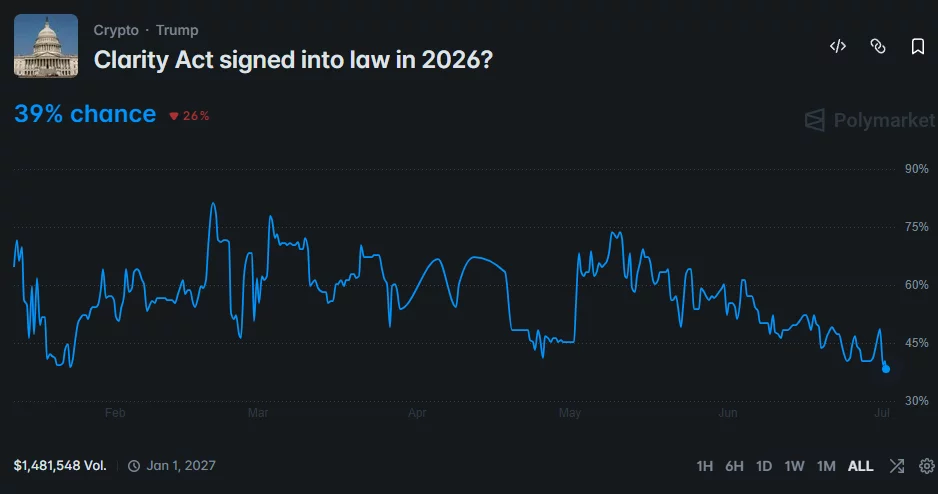
The disclosure has also renewed criticism from Democratic lawmakers. Following the release, Senator Elizabeth Warren argued that the legislation should include safeguards preventing Trump and his family from continuing to profit from crypto while federal digital asset policy is under consideration.
As previously reported by crypto.news, Senate Democrats recently requested hearings into a reported $500 million investment in World Liberty Financial linked to the United Arab Emirates. The lawmakers questioned whether the transaction had any connection to later U.S. policy decisions involving arms sales and expanded AI chip access for the UAE.
The newly released financial filing adds an official record to that debate by showing crypto generated more reported income for Trump in 2025 than the business segments most closely associated with his personal brand.
Some officials still expect crypto legislation to advance
Despite weakening prediction market odds, several policymakers continue to express confidence that digital asset legislation can still move forward before the end of the summer.
As previously reported by crypto.news, Congress faces a limited legislative window before the Senate begins its recess, leaving the CLARITY Act with only a short period to advance. The timing has become more important as negotiations continue over whether an ethics provision should be included in the final legislation.
Separately, Hester Peirce has maintained an optimistic outlook. According to her recent comments, the U.S. Securities and Exchange Commission commissioner believes Congress can still pass the CLARITY Act during the summer, even as political disagreements over ethics rules continue.
Crypto World
Bitcoin (BTC) climbs toward $60,000 level after Fed Chair Warsh said inflation risks has come down


Bitcoin climbed back toward the $60,000 level on Wednesday after Federal Reserve Chair Kevin Warsh said inflation risks had eased while reaffirming the central bank’s commitment to returning inflation to its 2% target.
Warsh declined to provide guidance on the Federal Reserve’s next interest-rate decision, saying policymakers would debate incoming data at their meeting in four weekds, during a panel discussion at the European Central Bank’s annual forum in Sintra, Portugal.
Instead, he emphasized that the Fed remained focused on price stability.
“Inflation risks have come down,” Warsh said. “If there were people in households or the business sector, in the financial markets, who thought that this central bank was going to be comfortable with an inflation objective above 2%, well, I guess they’d be disappointed. We’re going to deliver price stability in the U.S.”
Bitcoin pared earlier losses to trade back around the $60,000 level, an increase of more than 2% over the past 24 hours, according to CoinDesk Data.


Christopher Alexander Delgado, the former CEO of Goliath Ventures, pleaded guilty to fraud and money laundering charges stemming from a crypto investment scheme prosecutors said stole at least $400 million from investors.
Delgado, a Florida resident, pleaded guilty Tuesday to conspiracy to commit wire fraud, wire fraud and money laundering, according to the U.S. Attorney’s Office for the Middle District of Florida.
He faces up to 20 years in prison for each fraud count and up to 10 years on the money laundering count.
Goliath Ventures, formerly Gen-Z Venture Firm, solicited investors from at least January 2023 through January 2026 with pitches for monthly payouts it claimed came from crypto liquidity pools, prosecutors said. Delgado admitted in his plea agreement to causing at least $250 million in investor losses.
Investor money was used to pay earlier investors, fund withdrawals and cover luxury spending, according to prosecutors. Delgado bought at least 6 residential properties worth between $1.15 million and $8.5 million each, plus Lamborghinis, Rolls-Royces, Rolex watches, dozens of Louis Vuitton bags and custom Tiffany jewelry, with the funds.
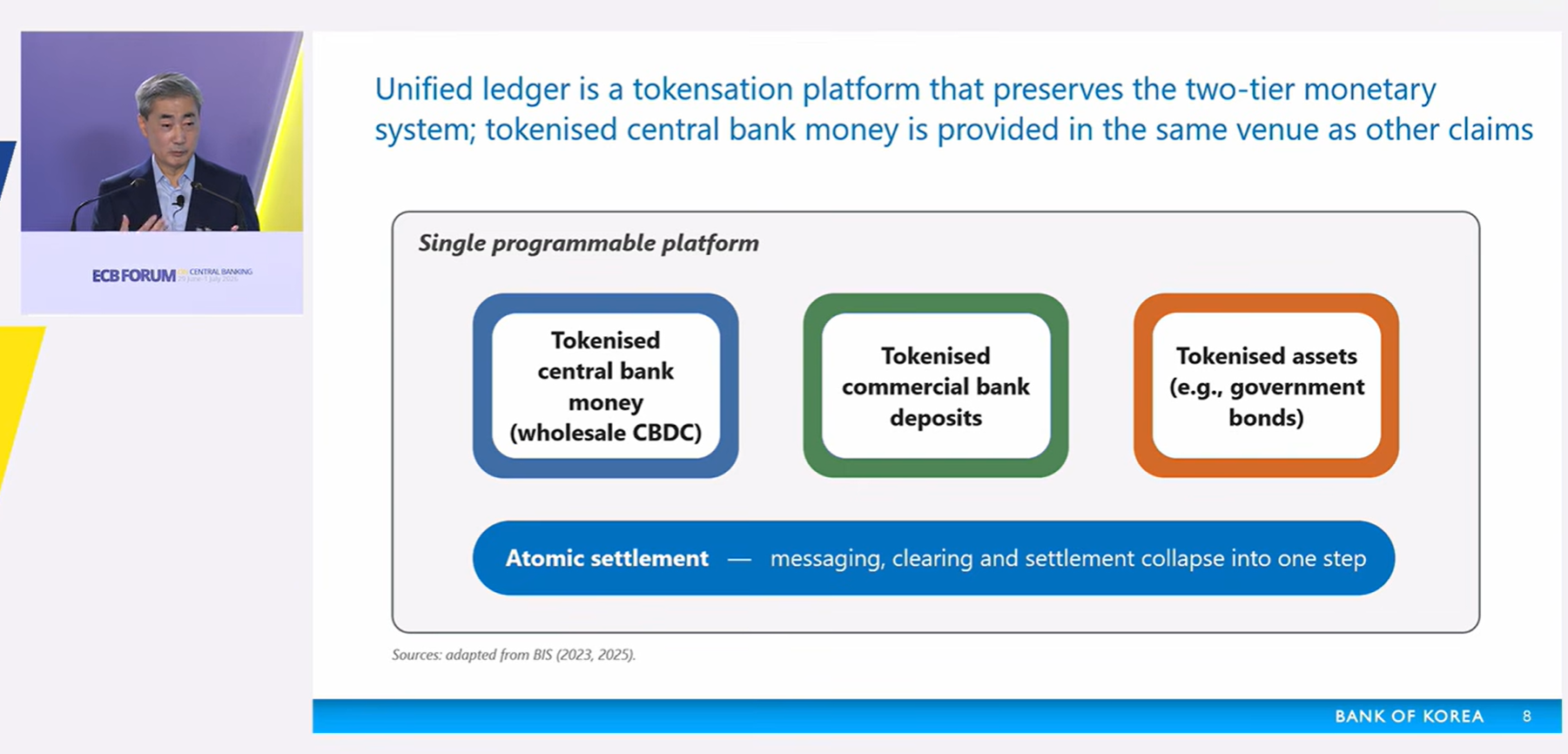
Hyun Song Shin, the governor of the Bank of Korea, praised tokenization for its ability to simplify the issuance and management of government bonds.
Shin said during a Wednesday panel discussion at the European Central Bank (ECB) Forum on Central Banking in Sintra, Portugal, that tokenized bonds would make it easier to verify collateral, credit the asset provider’s account and reverse transactions at the appropriate time.
“The big prize is tokenizing government bonds,” Shin said, adding that it is “much easier, much less prone to mistakes if you have everything tokenized.”
US Treasury debt is the largest tokenized real-world asset category, representing $14.6 billion, or about 46% of the $31.7 billion RWA market, according to data provider RWA.xyz.
Shin also outlined plans to bring tokenized government bonds, wholesale central bank digital currencies and tokenized commercial bank deposits on a unified ledger, as part of an extension to “Project Hangang,” a Bank of Korea-led pilot project testing a blockchain-based wholesale CBDC system.
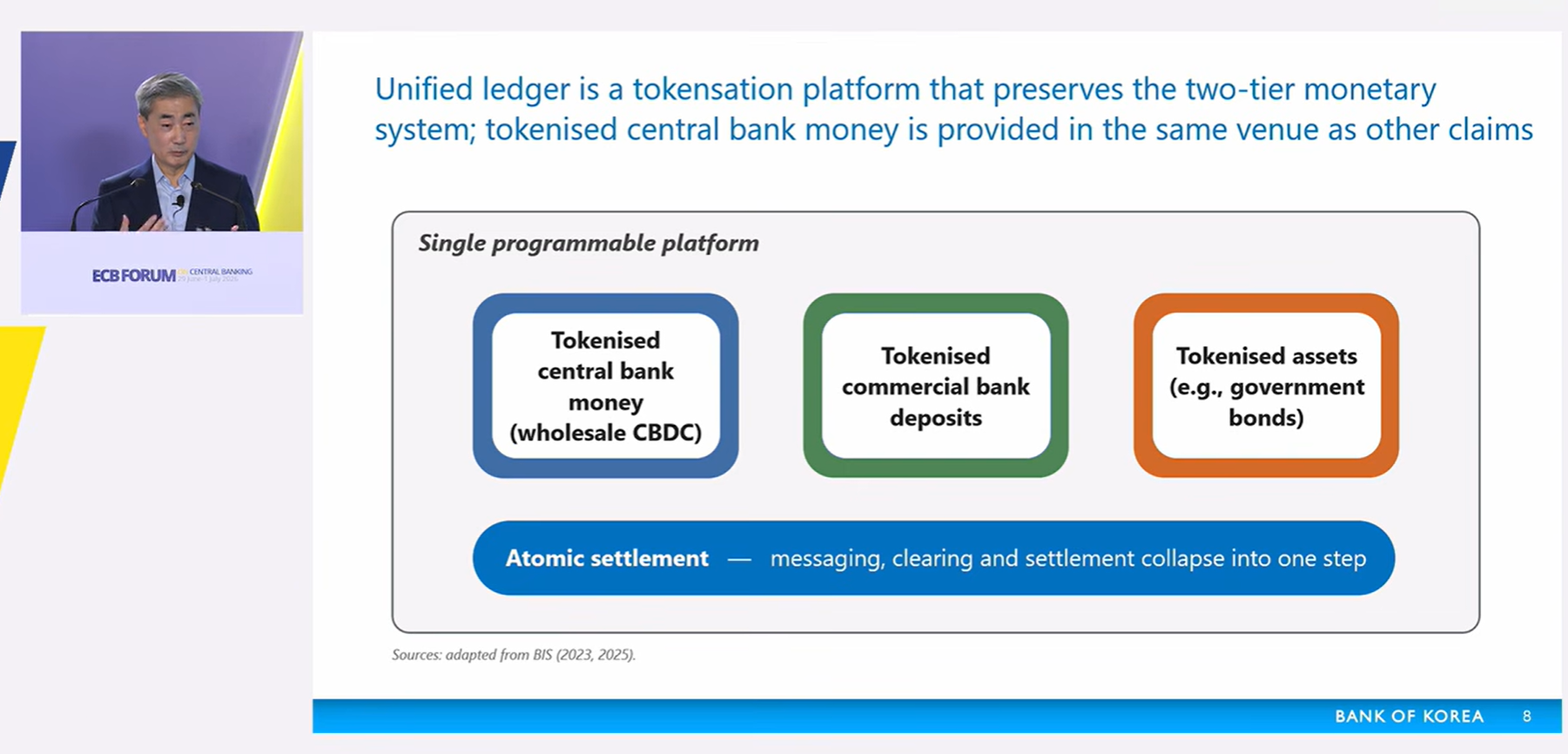
Hyun Song Shin, governor of the Bank of Korea, speaks during a panel discussion at the ECB Forum on Central Banking. Source: YouTube
Tokenized government bonds may boost financial innovation: BIS
Government bond tokenization could improve market efficiency and support financial innovation, provided regulatory and infrastructure challenges are addressed, according to a July 2025 report by the Bank for International Settlements (BIS).
Related: Former BIS chief softens stance on stablecoins, backs coexistence with fiat
Government securities play a crucial role in the financial system, acting as a savings vehicle for households and firms and as collateral in a range of transactions, the report said, adding:
“By enabling the contingent execution of actions, tokenisation can help to enhance the efficiency of markets, reduce settlement risk, broaden investment access and spur the creation of new financial services.”
The report examined 39 tokenized bonds, including 24 issued by corporations and 15 by governments. Compared with traditional, non-tokenized bonds, the BIS found “suggestive evidence” of lower bid-ask spreads and comparable issuance costs and yields.
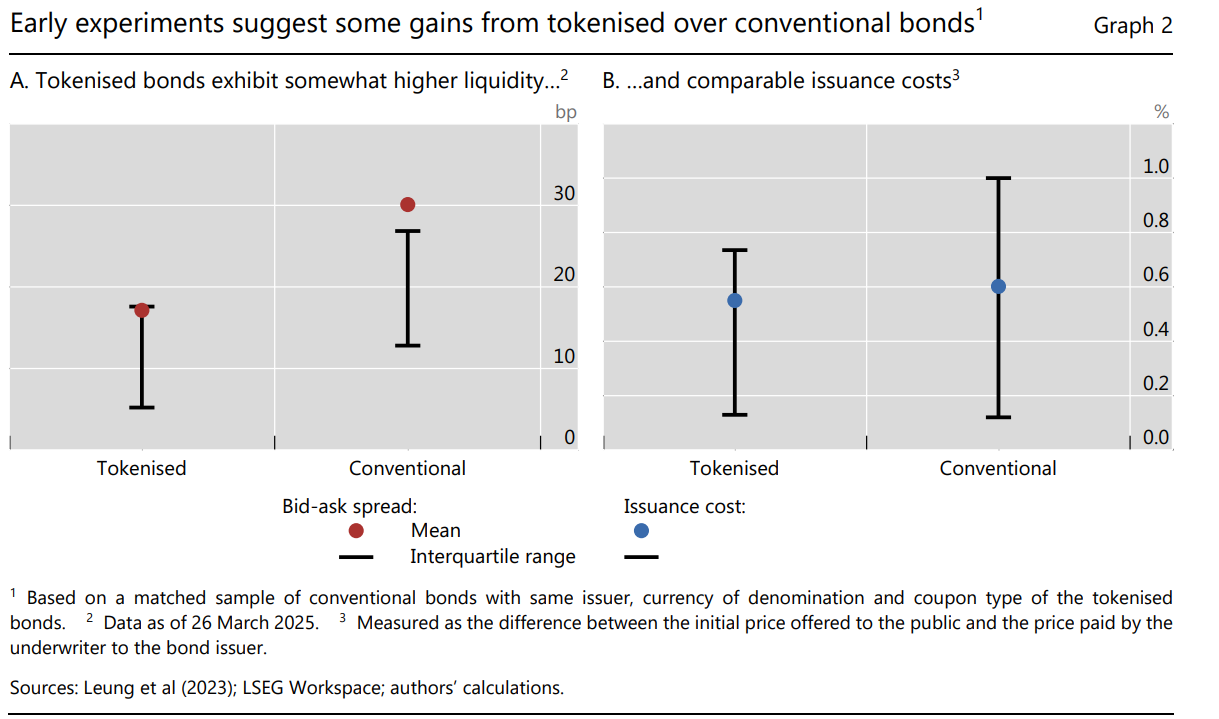
Tokenized bonds vs conventional, non-tokenized bonds, liquidity, issuance costs. Source: BIS
Magazine: Guide to the top and emerging global crypto hubs: Mid-2026


For now, most AI agents still live inside safe boxes. They summarize documents. Write code. Search databases. Help customer support teams move faster.
In finance, they are already creeping into fraud detection, compliance, research, and back-office workflows. Cambridge Judge Business School found this year that 52% of financial firms are actively adopting agentic AI, with 23% already scaling or transforming around it.
Bond Labs, a blockchain superapp network, is betting on the next step. It wants AI agents to trade, borrow, lend, move funds, and eventually spend money across crypto and traditional payment rails.
The company has launched on 0G, an AI-native blockchain network, with a DeFi platform designed for both humans and autonomous AI agents.
Bond says its platform combines
- A spot decentralized exchange,
- Perpetuals exchange
- Lending and borrowing markets,
And also a planned neobank layer with fiat on/off ramps, global transfers, on-chain IBAN access, Visa debit cards, and yield-bearing accounts.
That is a large promise. It also arrives at a moment when the financial industry is trying to work out how much autonomy it can safely give to software that can reason, plan, and act.
The Agent Needs a Wallet
The idea behind Bond is simple enough. If AI agents are going to become economic actors, they need financial infrastructure.
A chatbot can tell a user how to rebalance a portfolio. An agent could, in theory, do it. It could move idle funds into a yield account, borrow against collateral, hedge exposure, or route money across chains and payment systems.
That shift requires more than a prompt window. It needs liquidity, execution venues, credit markets, identity checks, payment access, and risk controls.
Bond is trying to put those pieces into one environment.
Its DeFi layer includes a spot DEX based on Uniswap V3-style automated market-making, a perpetual DEX using a central limit order book model, and lending markets with dynamic interest rates.
The company also plans to add a neobank layer within the next three months, bringing fiat access, global transfers, Visa card functionality, and accounts connected to 0G Chain.
Bond also says it will build a real-world asset division, giving users and agents exposure to tokenised assets for trading, settlement, and investment.
In plain terms, Bond wants to be the financial operating system for AI agents.
The Money Is Following the Thesis
The launch comes with direct ecosystem support from 0G Labs.
Bond is backed by a $10 million incentive programme from 0G Labs, a $3.5 million direct investment, and a stated $50 million TVL target. The incentive programme will run over 12 months and will be tracked on-chain. Bond says AI-agent trades will be included in the rewards structure.
The goal is liquidity. Without it, an agent-facing financial platform is just an interface. With it, agents can actually execute trades, access lending markets, and move value without waiting for a human to manually approve every step.
“The vision of AI agents managing someone’s finances has been held back by fragmented infrastructure,” said Bond Labs CEO Taweh Beysolow. “Bond provides the missing layer DeFi primitives and a neobank where agents can trade, borrow, spend, and earn, all within a single platform.”
Michael Heinrich, CEO of 0G Labs, framed Bond as part of a wider AI economy.
“0G is building the foundational infrastructure for an AI-native economy, and a core part of that vision is giving autonomous agents the ability to transact, manage assets, and access financial services as easily as any human,” Heinrich said. “Bond is the first platform to fully realize that vision, combining institutional-grade DeFi with a user-friendly neobank, all on a blockchain designed from the ground up for AI agents.”
The Pipes Behind the Platform
Bond has also lined up infrastructure and liquidity partners.
The company says Turtle will support liquidity and incentive distribution, Re7 will act as a DeFi vault curator, Midas will provide vault infrastructure, and Wormhole will support cross-chain interoperability.
It has also named Cicada Capital, Diffuse, GSR, and Flow Traders as liquidity providers.
Those names are important because AI-agent finance will not work without deep markets. An agent that manages capital needs execution quality, reliable settlement, and enough liquidity to avoid poor pricing.
Essi, CEO of Turtle Club, said the pre-deposit campaign had to work for different types of participants.
“Bond is building a superapp for an audience that spans retail and institutional. The pre-deposits campaign needed DeFi-native LPs who could underwrite both ends. We structured it with the Bond team until the economics held without compromising what Bond was committing to its users. Proud to be working alongside them.”
The Risk Is No Longer Theoretical
Deloitte’s 2026 enterprise AI survey found that 74% of companies expect to use AI agents at least moderately by 2027. In finance, Cambridge found agentic AI adoption is already further along among fintechs than traditional institutions.
Regulators are watching the same trend. The Financial Stability Board has warned that AI is spreading across AML, KYC, fraud detection, credit risk, cybersecurity, portfolio management, and compliance.
The Bank of England has gone further, warning that autonomous agents could eventually transact for consumers, execute trading strategies, and amplify market volatility if many systems behave in similar ways.
That makes security central to Bond’s pitch. The company says it has taken a security-first approach, including smart contract audits by Hashlock. That will matter as DeFi platforms remain exposed to exploits, oracle failures, bridge risk, liquidity shocks, and bad incentive design.
The harder question is governance. If an AI agent makes a trade, approves a payment, or borrows against collateral, the system needs clear rules for consent, limits, liability, and emergency shutdowns.
Bond’s launch is an early test of whether AI agents can move from assistants to financial actors. The infrastructure is starting to appear.
But the market now has to prove that autonomous finance can work without turning speed into fragility.
The post AI Agents are Starting to Handle Money. This Blockchain Wants to Build Their Bank appeared first on BeInCrypto.

Why Is Gold Crashing? Biggest Fall Since the 2008 Financial Crisis | Vantage on Firstpost | 4K

Criminal Record: Crown denies protecting Sturgeon and woman mowed down by car

Trump won’t extend USMCA trade pact with Canada and Mexico

No Jackpot Winner as $257 Million Prize Rolls Over to $269 Million Monday Draw

Renter of Home in Anne Heche Crash Denies Settlement With Son

Two goals and an assist by sheer aura: Cristiano Ronaldo just entered the World Cup chat
Why Is Gold Crashing? Biggest Fall Since the 2008 Financial Crisis | Vantage on Firstpost | 4K

This Changes Everything for XRP & Crypto.

Trump reports more than $1 billion in income from crypto ventures in financial disclosure
-

 Fashion5 days ago
Weekend Open Thread: Staud – Corporette.com
-

 Politics5 days ago
The House | Manchesterism won’t survive the painful trade-offs unless it gets citizens on board
-

 Crypto World2 days ago
Strategy authorizes up to $1.25B in Bitcoin sales under new capital plan
-

 Politics6 days ago
Potential 2028er World Cup attendee leaderboard
-

 Business5 days ago
Asia stock markets slide as tech shares slump
-

 News Videos3 days ago
MAJOR BITCOIN & MARKET UPDATE!!!! (MUST WATCH ASAP!!!)
-

 Tech6 days ago
A Look At A Gaggle Of Transputer Boards
-
 Crypto World6 days ago
Dell (DELL) Shares Tumble Over 5% Following Analyst Downgrade to Hold
-

 Crypto World4 days ago
Coinbase, Circle Deepen Crypto Stock Losses Despite Resilient S&P 500
-

 Business2 days ago
Australia treasurer says alleged access of prime minister’s bank data ’incredibly concerning’
-

 Crypto World4 days ago
Kraken's xStocks Opens Bending Spoons IPO Registration to EEA Retail
-

 Sports5 days ago
FIH Pro League: India defeat Pakistan 7-1, register biggest win of campaign | Other Sports News
-

 Crypto World6 days ago
Bitcoin Sparks $600M Hourly Liquidations With $65,000 Set To Become Resistance
-

 Tech4 days ago
Bluekit phishing kit adopts browser-in-the-middle for login theft
-

 Tech4 days ago
Russian hackers now target Signal backup recovery keys
-
Crypto World5 days ago
Hyperliquid Named on Singapore MAS Investor Alert Register
-

 Crypto World5 days ago
RTX holders must register wallets before token distribution begins
-
 Crypto World7 days ago
Ripple and SBI launch RLUSD in Japan after JFSA approval
-

 Tech2 days ago
Anonymous researcher drops 0-day ‘exploitarium’ repo
-

 Sports4 hours ago
Broncos roster: OL Ben Powers (No. 74) entering final year of contract
You must be logged in to post a comment Login