
Crypto World
AI Agents are Starting to Handle Money. This Blockchain Wants to Build Their Bank



For now, most AI agents still live inside safe boxes. They summarize documents. Write code. Search databases. Help customer support teams move faster.
In finance, they are already creeping into fraud detection, compliance, research, and back-office workflows. Cambridge Judge Business School found this year that 52% of financial firms are actively adopting agentic AI, with 23% already scaling or transforming around it.
Bond Labs, a blockchain superapp network, is betting on the next step. It wants AI agents to trade, borrow, lend, move funds, and eventually spend money across crypto and traditional payment rails.
The company has launched on 0G, an AI-native blockchain network, with a DeFi platform designed for both humans and autonomous AI agents.
Bond says its platform combines
- A spot decentralized exchange,
- Perpetuals exchange
- Lending and borrowing markets,
And also a planned neobank layer with fiat on/off ramps, global transfers, on-chain IBAN access, Visa debit cards, and yield-bearing accounts.
That is a large promise. It also arrives at a moment when the financial industry is trying to work out how much autonomy it can safely give to software that can reason, plan, and act.
The Agent Needs a Wallet
The idea behind Bond is simple enough. If AI agents are going to become economic actors, they need financial infrastructure.
A chatbot can tell a user how to rebalance a portfolio. An agent could, in theory, do it. It could move idle funds into a yield account, borrow against collateral, hedge exposure, or route money across chains and payment systems.
That shift requires more than a prompt window. It needs liquidity, execution venues, credit markets, identity checks, payment access, and risk controls.
Bond is trying to put those pieces into one environment.
Its DeFi layer includes a spot DEX based on Uniswap V3-style automated market-making, a perpetual DEX using a central limit order book model, and lending markets with dynamic interest rates.
The company also plans to add a neobank layer within the next three months, bringing fiat access, global transfers, Visa card functionality, and accounts connected to 0G Chain.
Bond also says it will build a real-world asset division, giving users and agents exposure to tokenised assets for trading, settlement, and investment.
In plain terms, Bond wants to be the financial operating system for AI agents.
The Money Is Following the Thesis
The launch comes with direct ecosystem support from 0G Labs.
Bond is backed by a $10 million incentive programme from 0G Labs, a $3.5 million direct investment, and a stated $50 million TVL target. The incentive programme will run over 12 months and will be tracked on-chain. Bond says AI-agent trades will be included in the rewards structure.
The goal is liquidity. Without it, an agent-facing financial platform is just an interface. With it, agents can actually execute trades, access lending markets, and move value without waiting for a human to manually approve every step.
“The vision of AI agents managing someone’s finances has been held back by fragmented infrastructure,” said Bond Labs CEO Taweh Beysolow. “Bond provides the missing layer DeFi primitives and a neobank where agents can trade, borrow, spend, and earn, all within a single platform.”
Michael Heinrich, CEO of 0G Labs, framed Bond as part of a wider AI economy.
“0G is building the foundational infrastructure for an AI-native economy, and a core part of that vision is giving autonomous agents the ability to transact, manage assets, and access financial services as easily as any human,” Heinrich said. “Bond is the first platform to fully realize that vision, combining institutional-grade DeFi with a user-friendly neobank, all on a blockchain designed from the ground up for AI agents.”
The Pipes Behind the Platform
Bond has also lined up infrastructure and liquidity partners.
The company says Turtle will support liquidity and incentive distribution, Re7 will act as a DeFi vault curator, Midas will provide vault infrastructure, and Wormhole will support cross-chain interoperability.
It has also named Cicada Capital, Diffuse, GSR, and Flow Traders as liquidity providers.
Those names are important because AI-agent finance will not work without deep markets. An agent that manages capital needs execution quality, reliable settlement, and enough liquidity to avoid poor pricing.
Essi, CEO of Turtle Club, said the pre-deposit campaign had to work for different types of participants.
“Bond is building a superapp for an audience that spans retail and institutional. The pre-deposits campaign needed DeFi-native LPs who could underwrite both ends. We structured it with the Bond team until the economics held without compromising what Bond was committing to its users. Proud to be working alongside them.”
The Risk Is No Longer Theoretical
Deloitte’s 2026 enterprise AI survey found that 74% of companies expect to use AI agents at least moderately by 2027. In finance, Cambridge found agentic AI adoption is already further along among fintechs than traditional institutions.
Regulators are watching the same trend. The Financial Stability Board has warned that AI is spreading across AML, KYC, fraud detection, credit risk, cybersecurity, portfolio management, and compliance.
The Bank of England has gone further, warning that autonomous agents could eventually transact for consumers, execute trading strategies, and amplify market volatility if many systems behave in similar ways.
That makes security central to Bond’s pitch. The company says it has taken a security-first approach, including smart contract audits by Hashlock. That will matter as DeFi platforms remain exposed to exploits, oracle failures, bridge risk, liquidity shocks, and bad incentive design.
The harder question is governance. If an AI agent makes a trade, approves a payment, or borrows against collateral, the system needs clear rules for consent, limits, liability, and emergency shutdowns.
Bond’s launch is an early test of whether AI agents can move from assistants to financial actors. The infrastructure is starting to appear.
But the market now has to prove that autonomous finance can work without turning speed into fragility.
The post AI Agents are Starting to Handle Money. This Blockchain Wants to Build Their Bank appeared first on BeInCrypto.

Crypto World
Institutional crypto trading hits a record 72% as Wall Street calms crypto’s wild swings


That concentration could make future altcoin rallies more selective.
“The result is a market where the flow that increasingly sets direction is concentrated in fewer names, traded more selectively,” the report said. It added that broad-based rallies, where most alternative cryptocurrencies rise together, are becoming less likely as institutional capital focuses on a handful of assets.
Derivatives and tokenization gain traction
The report also points to growing use of derivatives as another defining trend. Wintermute said notional trading volume in altcoin options on its OTC desk increased about 3.4 times from the second half of 2025 to the first half of 2026, driven largely by investors seeking yield rather than outright price exposure. At the same time, contracts for difference, or CFDs, are being used across a wider range of cryptocurrencies for directional trading, hedging and basket strategies.
Beyond trading, tokenized real-world assets continued to gain momentum, with the value of tokenized assets climbing nearly 50% to $31 billion during the first six months of the year, while average monthly transfer volume more than doubled to $9 billion. The firm said institutions are primarily adopting tokenized Treasuries, money market funds and private credit, while retail investors remain more active in tokenized equities.
While Wintermute expects retail participation to return during the next crypto bull market, it argues institutional influence is unlikely to fade. Instead, it said the market is increasingly taking on the characteristics of its largest participants, with professional investors shaping liquidity, pricing and the types of assets that attract capital.
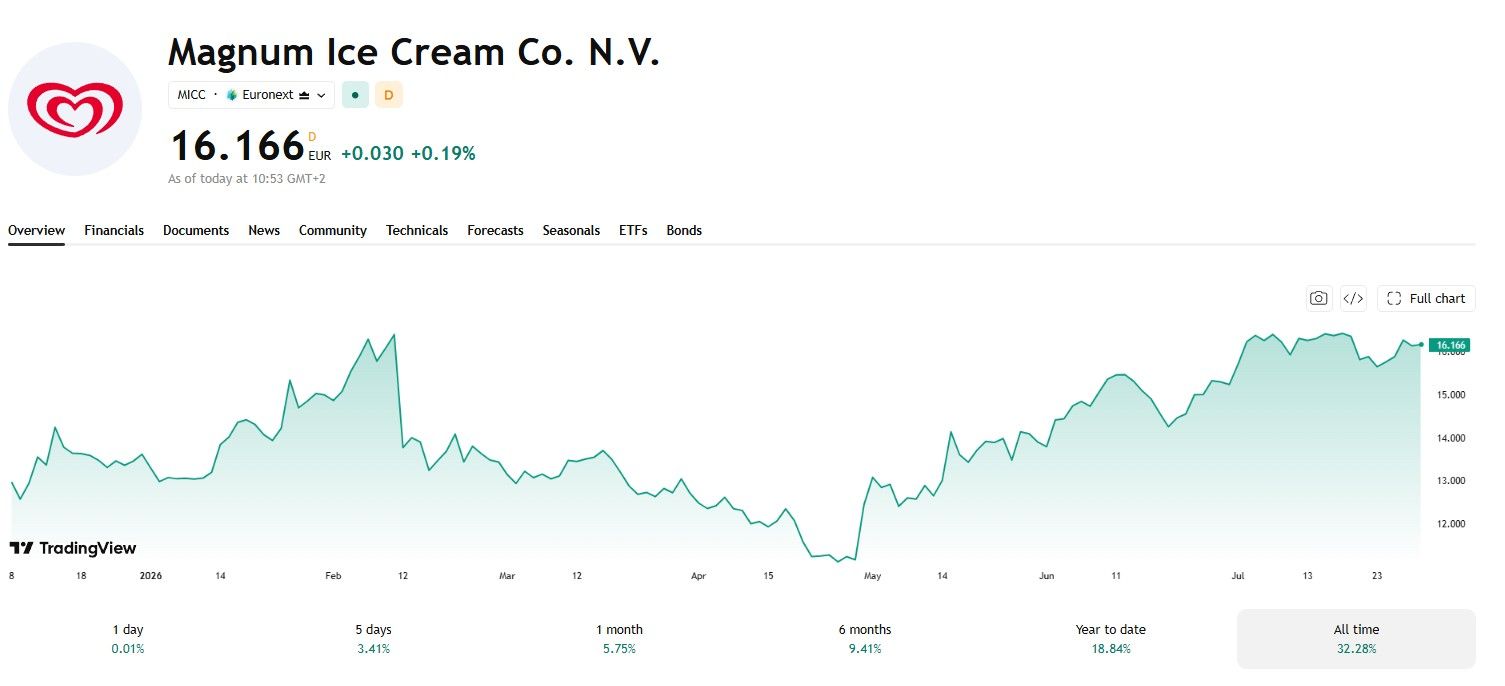
The Magnum Ice Cream Company (MICC) posted first-half core earnings above analyst expectations on July 30. Cost cuts since its 2025 spinoff from Unilever (UL) drove the beat, alongside a heatwave-driven summer surge for Ben & Jerry’s.
Revenue reached €4.7 billion, up from €4.5 billion a year earlier, with organic sales growth of 4.7% across every region. Adjusted EBIT climbed 7.5% to €716 million, though separation costs pulled net profit down to €349 million.
Ben & Jerry’s Powers a Hot Start to Summer
Ben & Jerry’s led the gains across the portfolio. Growth accelerated sharply once summer heat set in across Europe. New stick and sandwich formats pulled fresh buyers into the brand, both in the Americas and in Europe.
“Ben & Jerry’s grew mid-single-digit and had an outstanding second quarter with 9.2% growth.”
Peter ter Kulve, the company’s CEO, praised a frontline-first operating model in a statement tied to the results. Sustained heat across Europe has already lifted other heatwave-driven cooling stocks this summer, and that trend now extends to frozen treats.
Magnum, Cornetto, and the Heartbrand also posted gains. All four core brands showed positive momentum, and Yasso, the company’s high-protein pint line, kept growing at a double-digit pace. The pattern echoes the seasonal plays behind several US stocks to watch this July.
Magnum’s Cost Cuts and Productivity Gains Lift Margins
A productivity programme launched in 2024 delivered €90 million in first-half savings, most of it from the supply chain. Waste reduction and better factory use both contributed. Meanwhile, a favorable working capital swing tied to the Unilever separation nearly doubled Free Cash Flow to €273 million.
Standalone financing pushed net finance costs up to €72 million, compared with just €10 million a year earlier. That shift lines up with the broader high-rate backdrop highlighted by the Fed’s July decision to hold rates steady, a move that rattled bond markets and pushed long-term borrowing costs to multi-year highs.
The earnings beat nonetheless continues a summer pattern of firms topping Wall Street estimates. It follows Robinhood’s earnings beat and Intel’s surprise profit beat earlier this season, both delivered despite mixed investor reactions.

Shares of Magnum Ice Cream (EURONEXT: MICC) were changing hands near €16.16 ahead of the print, up roughly 19% for the year and close to the all-time high of €16.74 hit on July 7. The stock has climbed steadily since bottoming near €11 in late April, and the chart shows that run largely intact heading into results day.
Management reaffirmed full-year guidance of 3% to 5% organic sales growth. The company now enters peak summer demand with momentum intact. A pending antitrust review of its freezer-cabinet practices in Türkiye adds a regulatory wrinkle to watch.
The next quarter should still show whether the heat and the cost discipline both hold.
The post Heatwave Boosts Ice Cream Sales as Magnum Beats Earnings Forecasts appeared first on BeInCrypto.


[Update 08:55 UTC, July 30: Updates with additional reporting and context.]
Online brokerage Robinhood posted record second-quarter revenue and earnings, though cryptocurrency transaction revenue fell 38% from a year earlier.
The company said Wednesday in its earnings report that crypto transaction revenue fell to $100 million from about $160 million a year earlier. Overall revenue rose 32% year-over-year to $1.31 billion, while net income increased 48% to $573 million. Transaction-based revenue climbed 44% to $776 million.
Robinhood reported $40 billion in crypto notional trading volume during the quarter. Of that total, $18 billion came from the Robinhood app, down 35% from a year earlier, while $22 billion came from Bitstamp, the crypto exchange it acquired in June 2025.
The price of Robinhood shares was down 3.15% on Wednesday ahead of the company’s earnings release, according to Yahoo Finance data.
Robinhood expands crypto ecosystem
Despite the decline in crypto trading revenue, Robinhood continued expanding its digital asset business during the quarter, completing its acquisition of Canadian crypto platform WonderFi as it broadened its crypto offerings beyond trading.
After the quarter ended, the company unveiled the public mainnet of Robinhood Chain, introduced tokenized US stocks to eligible users in more than 120 countries and debuted its first decentralized lending product, Robinhood Earn.
Related: Bernstein raises Robinhood price target, cites tokenization and prediction markets
Data from DefiLlama shows Robinhood’s new Ethereum layer-2 network had $348 million in total value locked on Thursday, more than $500 million in stablecoins and over $1 billion in bridged assets.
Platform growth offsets crypto slowdown
Cryptocurrency was the only major transaction category to decline during the quarter.
Robinhood said growth in event contracts, options and equities more than offset the weakness, with event contract revenue surging more than tenfold to $156 million, options revenue rising 29% to $342 million and equities revenue jumping 95% to $129 million.
The company also reported record net deposits of $21.7 billion during the quarter, while total platform assets increased 32% year over year to $369 billion and funded customers grew 7% to 28.4 million.
Robinhood lowered and narrowed its 2026 outlook for adjusted operating expenses and share-based compensation to between $2.675 billion and $2.775 billion, from $2.7 billion to $2.825 billion previously. Adjusted EBITDA rose 35% to $741 million, while total operating expenses increased 33% to $734 million.
Magazine: Bitcoin price wedged into ‘most divided’ FOMC as Iran war spikes oil prices 8%
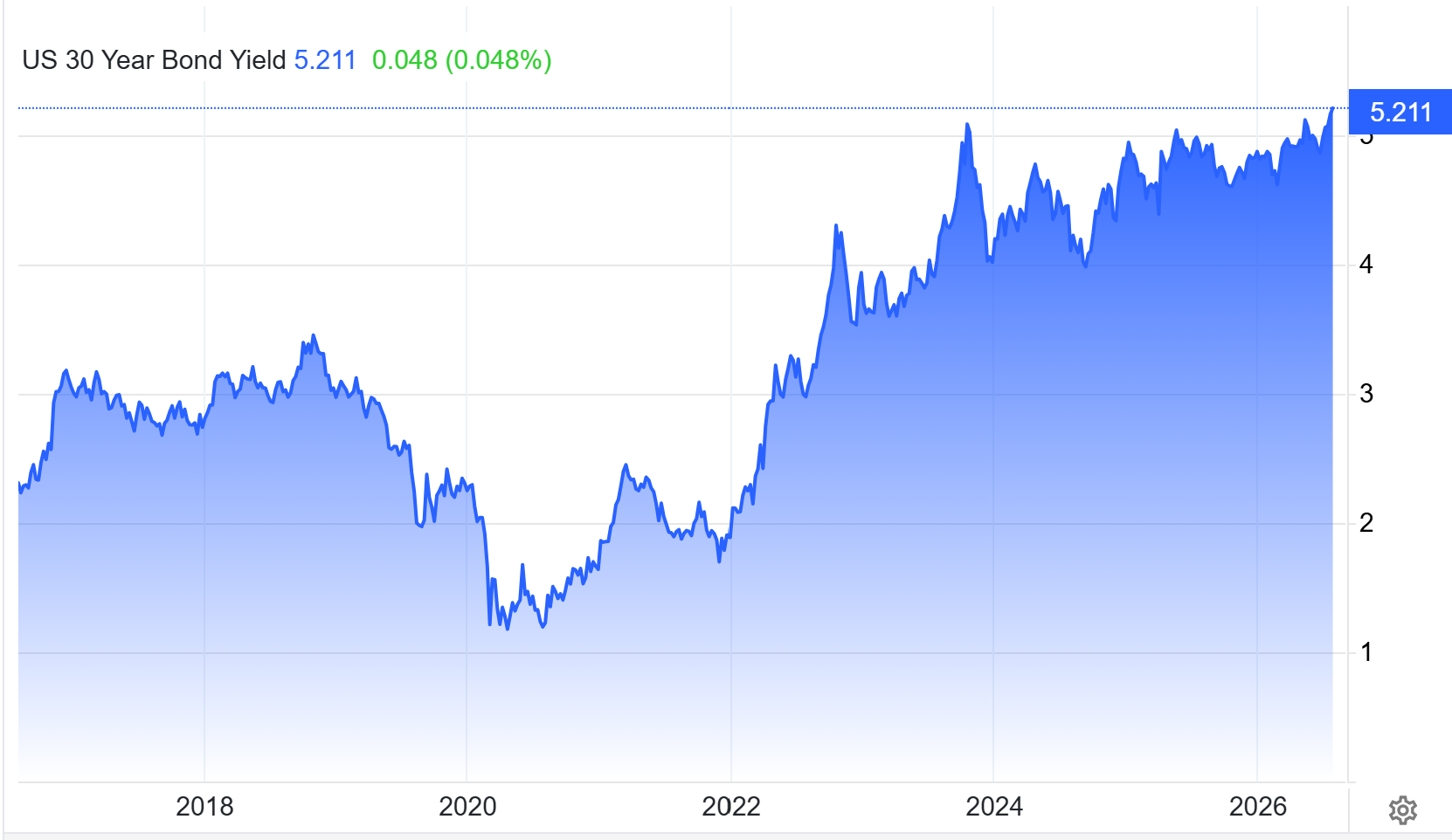
The US government has not paid this much to borrow money since 2007. The 30-year Treasury yield closed at 5.20% on Wednesday, hours after the Federal Reserve left interest rates alone.
Three Fed officials wanted a rate hike instead. Bond traders sided with them.

Why the 30-Year Treasury Yield Jumped
A bond yield is what lenders charge to hold government debt. When it rises, borrowing gets pricier for everyone.
The Federal Open Market Committee (FOMC) kept its rate range at 3.50% to 3.75%. The vote was 9 to 3.
Beth Hammack, Neel Kashkari and Lorie Logan each wanted a quarter point increase, the Fed statement shows.
Long-term bonds fell hardest. The 30-year yield rose from 5.09% to 5.20%, and the 10-year climbed to 4.67%.
Short-term bonds went the other way. The two-year yield slipped to 4.22%.
That split is the signal. Traders are worried about the next 30 years, not the next 30 days. Some intraday quotes ran as high as 5.244%.
Three dissents sound dramatic. They are not that rare, and four officials broke ranks in April. The direction is what stands out. Three votes for higher rates at one meeting last happened in September 2016.
The Fed has not raised rates since July 2023. The three dissenting officials want that streak to end.
Chair Kevin Warsh took the job on May 22. He refused to call the decision a pause and defended the 2% inflation target at his press conference.
Follow us on X to get the latest news as it happens
This Looks Like 2007, But It Is Not
The last time the 30-year yield sat here, the Fed was about to cut rates. In July 2007, the yield was 5.28%. The Fed’s own rate was 5.25%. The two were basically level.
Two months later the Fed cut by half a point. Warsh, then a Fed governor, voted for it. Today the picture is flipped. The 30-year yield sits roughly 1.45 percentage points above the Fed’s rate.
In 2007, long rates were falling toward a rescue. Now they are climbing away from one. Someone pays for that. The interest bill on US debt hit $857 billion in nine months, up 13% from a year earlier.
“Outlays for net interest on the public debt rose by $98 billion (or 13 percent) because the debt was larger than it was in the first nine months of fiscal year 2025 and because of higher long-term interest rates,” the Congressional Budget Office reported.
Interest now costs more than Medicare, at $778 billion. It also beats military spending, at $677 billion.
Total US debt reached about $39.8 trillion in late July.
Oil is not helping either. West Texas Intermediate crude settled 6.6% higher at $84.46 a barrel on Wednesday.
US Central Command said Iran fired ballistic missiles at American forces on July 28. All were intercepted. The US-Iran ceasefire collapse keeps oil risk alive.
Where Bitcoin and Gold Fit In
Crypto did not follow bonds down. Bitcoin (BTC) traded near $64,730 on Thursday, up 0.48% on the day.
Bitcoin’s recent price action shows a 9.2% gain over 30 days, though it is down 45% over a year.
Gold traded near $4,078 an ounce on Thursday. It had settled at $4,036.30 the day before.

Ellen Zentner, chief economic strategist at Morgan Stanley Wealth Management, says traders only delayed the hike.
“September remains a live meeting, and the incoming inflation data between now and then will be all that matters,” Zentner said.
Thursday’s inflation data helped the doves. The Fed’s preferred gauge, personal consumption expenditures (PCE), rose 3.7% in the year to June, down from 4.1% in May.
Core PCE, which strips out food and fuel, came in at 3.3%.
Even so, inflation has topped 2% every month since March 2021. Global bond yields climbed to their highest since 2008 earlier this year, and the long end never came back down.
The Fed meets again on September 15 and 16. That is when the three dissenters find out if they were right.
The post 30-Year Treasury Yield Hits 2007 High as Bond Market Doubts the Fed appeared first on BeInCrypto.


Russian authorities charged BitRiver founder Igor Runets with alleged fraud tied to a $8 million crypto mining equipment deal involving Russian billionaire Oleg Deripaska.


Malaysian police have dismantled an illegal Bitcoin mining operation and arrested two men after seizing 73 mining machines that investigators say were powered through stolen electricity.
Summary
- Malaysian police arrested two men and seized 73 Bitcoin mining machines during raids on three properties in Tronoh.
- Investigators said the mining operation used stolen electricity through illegal power connections confirmed by TNB inspections.
- The latest crackdown follows earlier Bitcoin mining raids in Terengganu and Kuala Lumpur linked to electricity theft across Malaysia.
According to a statement from Batu Gajah district police chief Assistant Commissioner Md Noor Aehawan Mohammad, officers carried out coordinated raids at three properties in Tronoh on Tuesday night under Op Elektrik, uncovering what investigators described as illegal Bitcoin mining activities supported by unauthorized electricity connections.
The operation began at about 9:02 p.m. and involved personnel from the district Criminal Investigation Department together with the Technical Unit of Malaysia’s national electricity provider, Tenaga Nasional Berhad (TNB), also known as the SEAL Team.
Police detained two local men, aged 40 and 52, to assist with the investigation. Alongside the arrests, officers confiscated 73 Bitcoin mining machines and additional equipment believed to have been used to operate the mining network.
Bitcoin mining operation used illegal power connections
Police said inspections carried out during the operation found that each of the three premises had been used for Bitcoin mining. Technical examinations conducted by TNB later confirmed electricity theft at two abandoned houses, while the third property involved in the case was an unoccupied house.
Md Noor Aehawan said investigators found evidence that the mining equipment had been connected through illegal electricity supply lines rather than legitimate metered connections.
Both suspects have been remanded for three days, beginning Wednesday and ending Friday, to facilitate further investigations.
Authorities are investigating the case under Section 427 of Malaysia’s Penal Code for committing mischief, including electricity theft, as well as Section 37(1) of the Electricity Supply Act 1990, which covers interference with electrical installations.
Police also urged residents to report suspicious activities linked to electricity theft or unauthorized cryptocurrency mining. Members of the public with relevant information have been asked to contact the Batu Gajah district police operations room or the nearest police station.
Malaysia has continued targeting illegal Bitcoin mining
The latest enforcement action follows several similar crackdowns carried out across Malaysia over the past year as authorities continue to target cryptocurrency mining operations that bypass electricity meters.
In May, Terengganu police dismantled another suspected Bitcoin mining syndicate during Op Letrik after raiding properties in the Hulu Terengganu and Marang districts. Working alongside TNB’s SEAL unit, officers seized 45 illegal Bitcoin mining machines from two premises, including a residential property in Bukit Perpat and a commercial building in Wakaf Tapai.
At the time, Terengganu police chief Datuk Mohd Khairi Khairuddin said investigators believed the premises had been modified to bypass electricity meters, causing estimated monthly losses of about RM36,000 for TNB. Authorities also seized mining-related equipment valued at approximately RM225,000, although no arrests were announced in that operation.
The Terengganu investigation proceeded under Sections 379 and 427 of the Penal Code together with Section 37 of the Electricity Supply Act 1990.
Earlier cases have exposed electricity theft
Another illegal mining operation came to light in February after firefighters responded to reports of an explosion and smoke at a house in Kuala Lumpur.
Authorities later discovered modified electrical wiring that had caused a fire before uncovering several Bitcoin mining rigs inside the property. Investigators also confirmed that the operation had been drawing electricity through unauthorized connections, prompting a separate investigation.
Malaysia’s national electricity provider has repeatedly warned about the financial impact of electricity theft linked to cryptocurrency mining. TNB reported in 2024 that illegal Bitcoin mining had caused losses of more than 440 million Malaysian ringgit, or roughly $101 million, due to stolen electricity.
The utility also estimated that electricity theft associated with illegal cryptocurrency mining resulted in losses of about $755 million between 2018 and 2023, highlighting the continued challenge posed by unauthorized mining operations across the country.
Outside Malaysia, governments have taken similar action against illicit cryptocurrency mining where unauthorized electricity use has strained national power systems. Iran has conducted repeated crackdowns on illegal mining operations, while Venezuela introduced a ban on crypto mining to protect its electricity grid from excessive energy demand.

Disclosure: This article does not represent investment advice. The content and materials featured on this page are for educational purposes only.
Fhenix and Canopy integrate confidential computation to simplify private onchain app development.
Summary
- Fhenix and Canopy integrate confidential computation, enabling developers to build privacy-preserving onchain apps with encrypted data.
- The two projects have launched a confidential app template, bringing fully homomorphic encryption to sovereign blockchain applications.
- Fhenix brings encrypted computation to the Canopy Stack, simplifying confidential onchain app development with familiar tooling.

Fhenix and Canopy are integrating confidential computation into the Canopy Stack, giving developers a direct way to build sovereign onchain apps that keep user data encrypted while it is being used. The integration removes the need for teams to assemble a separate cryptography stack or hire specialist cryptographers before they can ship private application logic.
The new Canopy Confidential App template is powered by Fhenix’s CoFHE coprocessor for fully homomorphic encryption (FHE). Developers will be able to add encrypted computation through a familiar TypeScript library, making confidentiality part of the app from the start rather than a feature added later. The approach extends Canopy’s existing platform model: the stack handles the underlying infrastructure so builders can focus on the application.
Public-by-default infrastructure works for many onchain use cases, but it breaks down when applications handle commercially sensitive, personal, or strategic data. Some teams respond by moving to closed networks. Fhenix and Canopy are taking a different approach: keep the network open while keeping the data encrypted.
Confidential operations are added through Canopy’s plugin and runtime layer without changing its base consensus. A user’s input is encrypted in the Canopy wallet and submitted as a standard transaction. CoFHE processes the encrypted data offchain, and when a result must be disclosed, a trust-minimized process returns a signed value for Canopy to verify before state is settled. Builders access the flow through familiar tooling, without managing a separate privacy stack or encryption keys.
The core Canopy components are already live, including plugin lifecycle hooks, the state bridge, plugin scaffolding, and the wallet runtime. CoFHE is currently deployed across Ethereum, Arbitrum, and Base. Work on the remaining encrypted-transaction components is in progress.
What it enables
In an onchain game, a player’s hand, units, and map knowledge can remain encrypted. Players submit moves privately and learn only the outcome of each encounter, such as who won, how much damage was dealt, or which territory changed hands.
The same model applies to business workflows. A buyer can open an RFP, receive encrypted bids from multiple suppliers, and publish only the winner and winning price at the deadline. The losing bids do not need to be revealed to the other participants.
The Fhenix integration is in development and is scheduled to roll out in Q4 2026. Canopy is currently live on public testnet, with 16.8k forks and more than 100,000 daily active wallets.
Disclosure: This content is provided by a third party. Neither crypto.news nor the author of this article endorses any product mentioned on this page. Users should conduct their own research before taking any action related to the company.

Bitcoin’s market cycles could be more closely linked to the US political calendar than many investors think, according to a new analysis shared by Alphractal founder Joao Wedson.
In a July 30 post on X, he showed that the flagship cryptocurrency has repeatedly entered bear markets before US midterm elections, only to recover after voters head to the polls.
Recurring Election Cycle Patterns
Wedson compared Bitcoin’s price history against US election cycles and found what he described as a recurring sequence. According to his chart, BTC enters a bear market about one year before every US midterm election before starting a longer bull market right after the vote. In some cycles, the market bottom formed just days before the election, while in others it came shortly afterward.
He also noted that presidential elections have produced a different effect, with Bitcoin rallying strongly every time a president won an election before approaching a major cycle top not long after the president was inaugurated.
“Data reveals patterns that narratives often miss,” wrote the analyst.
According to Wedson, XRP offers an even more striking example, starting a steep rally on the day Donald Trump won the 2024 election and reaching a local peak on January 20, 2025, the day Trump was inaugurated.
His observations are quite similar to those made in a Binance Research report from earlier in the year, which found that BTC has historically struggled during US midterm election years before posting gains once the political uncertainty faded.
Per the report, Bitcoin dropped by an average of about 56% during completed midterm cycles since 2014, before returning an average gain of roughly 54% in the year after the elections.
Wedson had earlier contended that while many market participants believed Bitcoin has already established a bottom, “a price recovery alone does not confirm a structural shift.” He said there must be clear signs of capitulation and deleveraging, as well as short-term investors bringing in new capital before such a conclusion can be reached.
Macro Conditions Could Shape Whether History Repeats
There’s still about three months left before Americans go to the polls, and BTC is currently hovering around the $64,000 level, which is nearly 50% below its October 2025 all-time high of over $126,000, with data from CoinGecko showing it dipped about 2.5% in seven days.
However, it’s still up nearly 8% across the last month, after weathering the latest Federal Reserve decision to leave interest rates unchanged at 3.50% to 3.75%.
The post Bitcoin’s Next Bull Run Could Follow US Midterms: Analyst appeared first on CryptoPotato.

The leading cryptocurrency experienced enhanced volatility over the past week, eventually stabilizing at around $64,500 (per CoinGecko’s data).
Given the ongoing bear market, though, the price may soon head south again, but one popular analyst claimed that a dip to around $60K should actually be welcomed as good news.
Exactly What BTC Needs?
The renowned analyst Ali Martinez argued that a drop by nearly five grand would complete a classic inverse head-and-shoulders pattern that could set the stage for a serious pump. The setup consists of three dips – a low (left shoulder), a deeper plunge (head), and another low (right shoulder) and signals that sellers are running out of steam.
According to Martinez, the completion of the pattern combined with a confirmed breakout above $66,500 could open the door to a pump to a two-month high of around $74,000.
The analyst has been quite focused on BTC lately, revealing that whales have purchased roughly 29,000 units (worth more than $1.8 billion at current rates) over the past week. Accumulation from this cohort of investors is considered a bullish sign as it suggests that they are preparing for a potential upward move. Their actions could encourage smaller players to hop on the bandwagon, too, thus distributing fresh capital into the ecosystem.
Another comment from Martinez was his recent prediction about when BTC will reach its bottom. If the 4-year cycle theory holds, he expects that to happen between October 6 and October 16. This is a common thesis among analysts, as many believe the cryptocurrency could nosedive to multi-year lows before entering a new bull run. Others, like Joao Wedson, anticipate that the pivotal moment when bulls would finally regain control is the midterm elections in the US scheduled for early November.
An Additional Bullish Forecast
Vivek Sen – an X user with almost 300,000 followers – presented another optimistic scenario for BTC, based on the formation of a cup-and-handle breakout.
The pattern represents a big rounded dip (the cup), followed by a smaller pullback (the handle) and typically shows that the asset has built up strength and is perhaps gearing up for a rally. According to the analyst, this formation could be a precursor to a giant increase, setting $220,000 as the minimum target.
“Most people will only find out after it happens,” he added.
The post ‘Don’t Fear a Drop to $60K:’ Analyst Sees That as a Healthy Reset for BTC appeared first on CryptoPotato.
Crypto World
Ark Invest Rotates Within Crypto Equities, Adding Coinbase and Circle While Trimming Other Names

Ark Invest sold shares of Bitmine Immersion Technologies, Bullish, and Block as crypto-related equities extended losses across U.S. markets. The move raised questions after months of aggressive buying during previous pullbacks. Rather than signaling a broad exit, the latest trades suggest Ark is actively rotating capital within its crypto portfolio instead of abandoning the sector.
That view is supported by recent buying activity. Over a three-day period, Ark purchased roughly $43.5 million in crypto stocks, including 122,544 Coinbase shares valued at nearly $18.6 million and 169,777 Circle shares worth about $12.9 million. The purchases came as both companies declined alongside Bitcoin and weakening expectations for U.S. crypto legislation.
— Rahul K (@iamrahulinc) July 30, 2026
 𝗔𝗥𝗞 𝗜𝗡𝗩𝗘𝗦𝗧 𝗦𝗟𝗜𝗖𝗘𝗦 $𝟮𝟬𝟬𝗠 𝗙𝗥𝗢𝗠 𝗕𝗜𝗧𝗠𝗜𝗡𝗘!
Ark Invest trimmed its crypto‑related holdings on Wednesday as prices fell.
The firm sold 120,665 Bitmine shares worth about $2 million, plus 13,403 Block Inc. shares (~$1.1 M), 12,561 Robinhood shares… pic.twitter.com/RaRUCm4Ufv
The broader backdrop also explains the pressure. Falling digital asset prices have weighed on exchange revenues and crypto-related valuations. At the same time, uncertainty surrounding U.S. market structure legislation has cooled investor optimism. Stocks that previously benefited from expectations of regulatory progress have been among the hardest hit during the recent pullback.
Discover: The Best Crypto to Diversify Your Portfolio
Position Rotation Looks More Likely Than a Thesis Change
Ark’s history with these companies provides important context. The firm invested roughly $16.8 million into Bullish and about $7.6 million into Bitmine during late 2025. It also deployed approximately $38.7 million into Coinbase, Bitmine, Circle, and Bullish during another sharp crypto equity decline. Those earlier purchases leave plenty of room to trim positions without changing the broader investment thesis.

The direction of recent trades reinforces that interpretation. Ark previously sold about $8.9 million worth of Block, Bullish, and Robinhood while purchasing roughly $12.5 million of SpaceX and Bitmine. That pattern suggests the firm is reallocating capital toward higher conviction ideas rather than reducing overall crypto exposure.
Block deserves separate attention because its business extends beyond cryptocurrency. Payments, merchant services, and Bitcoin products all contribute to its revenue. Selling Block alongside Bullish and Bitmine therefore points to a broader reduction in crypto equity risk instead of targeting only pure play digital asset companies.
Coinbase and Circle tell a different story. Ark continued adding to both positions during the latest selloff despite near-term losses. That approach signals conviction rather than retreat. While those investments may currently sit below Ark’s average purchase price, the firm appears willing to absorb short-term weakness in exchange for longer-term growth potential.
Circle also occupies a different position within the crypto ecosystem. Its outlook depends heavily on stablecoin adoption and regulatory clarity rather than exchange trading volumes. Continued buying suggests Ark sees stablecoin infrastructure as a stronger long-term opportunity than several other crypto-related equities currently under pressure.
Trade Crypto and Stocks on Bybit and Get a Chance to Win Our $1,000 USDT Airdrop
Bitcoin, Regulation Will Shape Ark Invest Next Moves
Ark’s daily trade disclosures remain the clearest indicator of its strategy. If the firm resumes buying Bitmine or Bullish during additional weakness, the recent sales will likely be viewed as routine portfolio management. However, continued net selling across multiple sessions without offsetting purchases would suggest a more meaningful reduction in risk appetite.
External conditions will ultimately drive that decision. Bitcoin price trends remain the biggest factor influencing crypto equity performance, while regulatory developments continue shaping investor sentiment. Delays to market structure legislation could pressure valuations further, whereas renewed momentum in Washington may revive demand for crypto-linked stocks.
Ark has already shown it will act quickly when conditions deteriorate. Earlier this year, the firm sold roughly $11.2 million of its ARKB spot Bitcoin ETF alongside about $84 million in technology holdings during a broader risk reduction move. That history suggests Cathie Wood remains flexible. For now, the latest transactions look more like selective portfolio rotation than a broad retreat from crypto equities.
Discover: The Best Token Presales
The post Ark Invest Rotates Within Crypto Equities, Adding Coinbase and Circle While Trimming Other Names appeared first on Cryptonews.

US interest rates held as Fed boss says ‘no magic wand’ to tackle high prices

Institutional crypto trading hits a record 72% as Wall Street calms crypto’s wild swings

Nazi-linked Reform councillor linked to vigilante street group


-

 Fashion6 days ago
Weekend Open Thread: Brooks Brothers
-
 Sports4 days ago
Commonwealth Games boxing: Jadumani Singh seals dominant 5-0 win over Pakistan’s Sumama Rehman to enter quarter-finals | Commonwealth Games News
-

 Business17 hours ago
Why Trees Belong on the Risk Register
-

 Tech4 days ago
Intel is reversing course and bringing hyper-threading back to its server chips
-

 Crypto World5 days ago
Ripple bought a bank in pieces. The $4 billion audit
-

 Politics3 days ago
Luke Littler dismantles Gerwyn Price to retain title in Blackpool
-

 Politics2 days ago
The Part of the Electric Transition Nobody Wants to Discuss
-
 Entertainment6 days ago
A New Post-Apocalyptic Gundam Anime Series Blasts Into SDCC
-

 News Videos4 days ago
BITCOIN JUST ENTERED THIS CRITICAL ZONE…
-

 Fashion6 days ago
16 Dresses for the High Summer Event
-

 Sports6 days ago
2026 3M Open leaderboard: Scottie Scheffler finds putter in Round 1, sits three back
-

 News Videos7 days ago
The Peugeot Family: How 200 Years of an “Old Money” Dynasty Died in A Boardroom
-

 Business1 day ago
Major shareholder moves on Canyon
-

 Crypto World4 days ago
XRP Ledger adds $2.6B as RWA inflows rank second
-

 Politics4 days ago
Spain sweeps the board at 2026 World Cup with individual awards
-

 News Videos2 hours ago
Bitcoin Enters the 3rd Stage of the Bear Market
-
 Entertainment2 days ago
‘Stargate’ Creator’s New Sci-Fi Series Returns for Season 3 Tomorrow
-

 Crypto World7 days ago
Uniswap (UNI) pushes deeper into tokenized RWAs with permissioned trading pools
-

 Tech5 days ago
Anthropic launches Claude Opus 5, a cheaper AI model for coding, agents and enterprise workflows
-

 Crypto World2 days ago
Kraken Enables Retail Access to Jersey Mike’s IPO via Tokenized Shares
You must be logged in to post a comment Login