

Crypto World
Foundation unveils policy guide for governments and institutions



To support its case, the report highlighted Ethereum’s technical track record, noting that the network has maintained uninterrupted uptime since launching in 2015. Citing a recent OpenZeppelin report, the foundation said Ethereum was secured by roughly $76 billion worth of staked ETH as of March 2026, while emphasizing its geographically distributed validator network, multiple independent client implementations and large developer ecosystem.
Beyond technical metrics, the report framed Ethereum as digital public infrastructure rather than simply a financial network. It pointed to existing deployments, including decentralized identity initiatives in Bhutan and Buenos Aires and Ethereum-based land registry projects in India, as examples of governments already experimenting with the technology.
The publication comes as governments around the world increasingly explore blockchain-based infrastructure for identity, asset tokenization and public records. The Ethereum Foundation said policymakers should distinguish between decentralized public blockchains and networks that remain controlled by corporations or foundations, arguing that governance structures will play a critical role in determining which platforms are suitable for long-term public sector use.
Read more: Ethereum gets a new nonprofit focused on institutional adoption



Disclosure: This article does not represent investment advice. The content and materials featured on this page are for educational purposes only.
UmexGain offers traders access to multiple asset classes, market analysis, educational resources, and tools designed to support informed trading.
Summary
- UmexGain combines multi-asset trading, market analytics, and educational resources to support informed trading decisions.
- The platform offers diverse financial instruments, analytical insights, and learning tools for traders of all experience levels.
- It enhances trading with broad market access, educational content, and timely analytics for global investors.
When choosing a broker, traders consider the variety of assets, the quality of analytical support, the convenience of services, and the availability of learning materials. These elements offered by UmexGain are essential for making market participation both more comfortable and more productive.
The company provides a comprehensive approach to client support, combining a wide selection of instruments with up-to-date analytical resources. This format enables each user to select a suitable trading style, enhance their knowledge, and receive the timely information needed to make informed decisions.
Broad asset base
One of UmexGain’s key advantages is the extensive array of available assets. Clients can work with various financial instruments, including currency pairs, stocks, indices, commodities, and cryptocurrencies. Each tool features unique properties, allowing for versatile market applications.
The inclusion of digital assets, which continue to play a significant role in the global financial system, deserves special mention. This allows the company’s clients to use the ever-growing opportunities within modern financial markets and craft diverse trading strategies tailored to their preferences.
This broad selection of instruments helps UmexGain customers focus on areas of greatest interest. The ability to choose from various asset classes also adds flexibility to the trading process and opens up new avenues for executing individual strategies and effective portfolio diversification.
Analytics and education
High-quality information support is essential for success in financial markets. UmexGain provides clients with all the data necessary to make informed decisions in a timely manner. This includes learning materials, helping beginners master the fundamentals of trading while allowing experienced professionals to refine their strategies. This data is presented in a user-friendly format, offering an introduction to core trading principles, market specifics, analysis methods, and strategies for building a personal plan.
Timely analytics enables the assessment and comparison of different assets’ prospects. It helps users track key events, monitor the performance of various instruments, and gain insights to assess market conditions. This allows clients to quickly process current information and use the data to inform their next steps.
The combination of learning resources and analytical support creates an optimal environment where UmexGain customers can continuously expand their knowledge. This approach fosters confident skill development, regardless of the user’s experience level.
Seamless trading experience
A modern broker must provide a convenient environment for daily activities. UmexGain strives to make the trading experience as intuitive and streamlined as possible. A well-organized interface ensures that key features are easy to locate, allowing users to focus on market analysis and implementing deals.
The combination of diverse tools and comprehensive information support offers a significant advantage. This approach allows users to dedicate more time to identifying new opportunities, developing their strategies, and honing their practical skills. Regardless of experience level, every client gains access to resources that help them navigate financial markets with greater confidence.
Summing up
UmexGain is a broker that combines a wide range of assets, modern trading capabilities, and high-quality information support. A vast array of financial instruments, including cryptocurrencies, enables clients to utilize the expanding opportunities of modern financial markets and select the most promising areas for their activities.
A key advantage of the company is its comprehensive user support. UmexGain provides clients with the information needed to make well-informed decisions in a timely manner, offering learning resources to master key trading concepts and refine strategies, alongside up-to-date analytics for evaluating and comparing the prospects of various assets. The combination of a diverse range of instruments, learning materials, and current market analysis makes UmexGain an attractive choice for those seeking to expand their knowledge and confidently pursue their goals.
Disclosure: This content is provided by a third party. Neither crypto.news nor the author of this article endorses any product mentioned on this page. Users should conduct their own research before taking any action related to the company.
Ethereum Institutional launched Wednesday, the ecosystem’s second nonprofit in nine days, backed by Tom Lee’s BitMine, SharpLink Gaming and co-founder Joe Lubin.
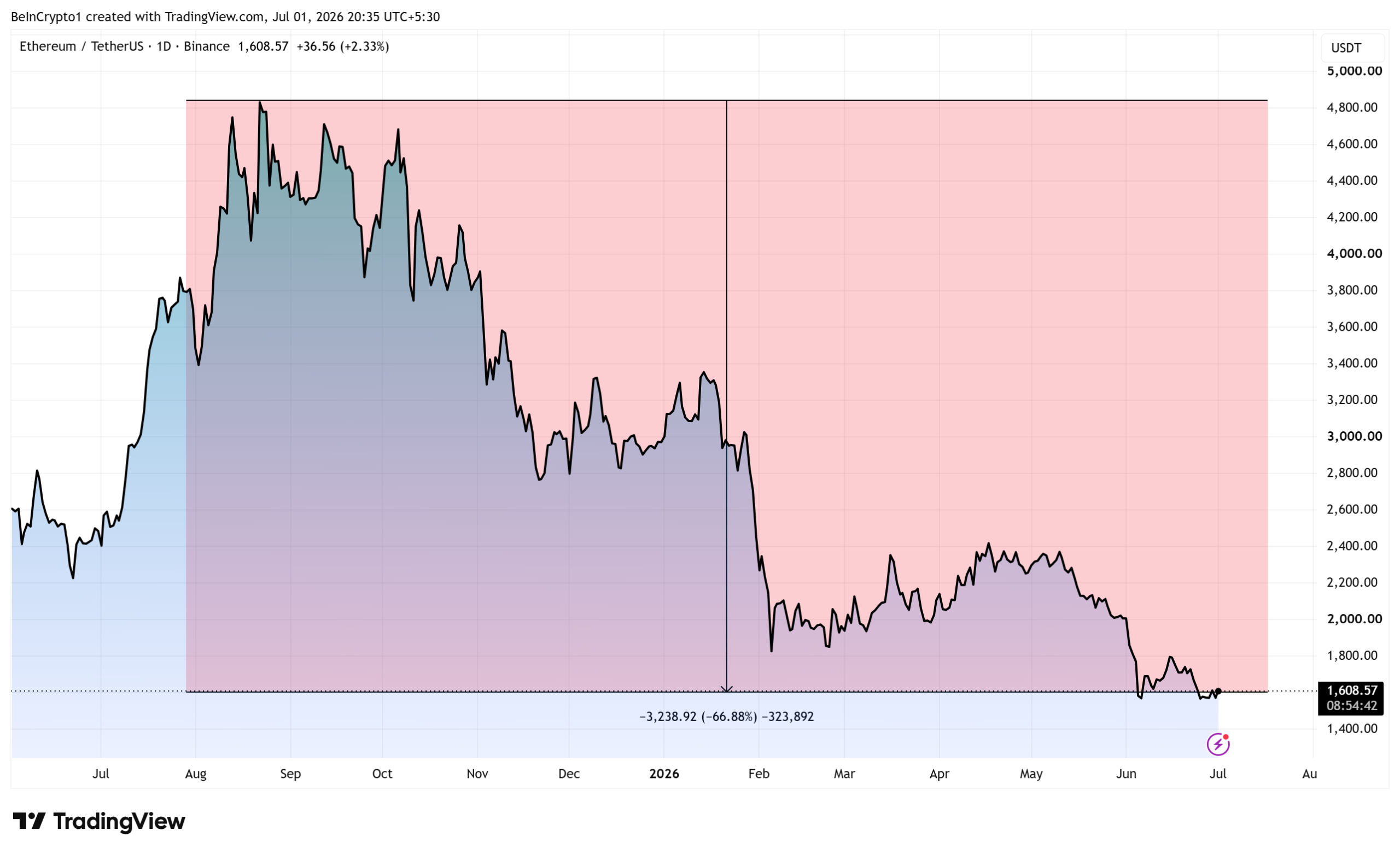
The launches show the backers doubling down while price stays weak. Ether (ETH) trades near $1,600, down about 67% from its 2025 peak.

Two Nonprofits in Nine Days
Ethereum Institutional follows the research nonprofit Ethlabs, which launched on June 22. Its backers cast Ethlabs as readying the network for an institutional supercycle.
Both share the same anchor funders and the same aim, drawing institutional interest to Ethereum. The launches come as the Foundation keeps narrowing its core role to protocol stewardship.
The funders are heavily exposed to ETH. BitMine, the largest corporate holder, controls about 5.7 million ETH, or roughly 4.7% of supply, per a late-June company disclosure. SharpLink, the second-largest treasury, added 10,000 ETH just before the launch.

ETH traded near $1,610 as of this writing, up almost 5% over 24 hours. However, the largest altcoin on market cap metrics still sits about 67% below its August 2025 record high. That is a steeper drop than Bitcoin (BTC), which trades about 53% below its own peak.
The token has spent 2026 near the low end of its range. The backers are wagering that institutional demand can lift ETH before price follows.

Ethereum Institutional’s Neutral Front Door
Ethereum Institutional describes itself as a credible, independent front door for institutions assessing the network, according to its website. Its founding team previously built the Ethereum Foundation’s enterprise function.
David Walsh, Marius Smith and Matthew Dawson lead the organization. Walsh earlier ran the Foundation’s enterprise efforts.
The nonprofit set five priorities from day one. These span institutional engagement, market intelligence, ecosystem marketing, industry research and events. More supporters are expected soon.
“The world’s largest institutions are deciding where tokenization, stablecoins, and onchain markets will settle. We’re ready to make Ethereum the base layer for institutional finance,” read an excerpt in the announcement.
Follow us on X to get the latest news as it happens
Standard Chartered Sees a Bigger Opportunity
Geoff Kendrick, global head of digital assets research at Standard Chartered, called the two launches important for Ethereum’s commercialization. He said they arrive as TradFi enters the network at scale, filling a longstanding gap in Ethereum’s institutional outreach.
“This commercialization is central to ensuring Ethereum capitalizes on its current lead towards becoming the settlement layer of the global economy,” Kendrick wrote in a client note.
Kendrick sees Ethlabs and Ethereum Institutional as complementary. One readies the protocol, while the other brings institutions through the door.
Tom Lee, who chairs BitMine, welcomed the launch, after floating a long-term ETH target of $250,000, betting tokenization pulls institutions onchain.
The ambition runs ahead of the price. Whether the two nonprofits convert institutional interest into demand will show in the months ahead.
The post Ethereum Banks on Institutional Interest to Save ETH as Price Remains 70% Below Peak appeared first on BeInCrypto.
Bitcoin (BTC) traded as high as $60,200 on Wednesday, up about 2.7% over the past 24 hours after falling to a 21-month low of $57,737 earlier in the session. Ether (ETH) and Solana (SOL) also gained, up 3% and 4.85%, respectively.
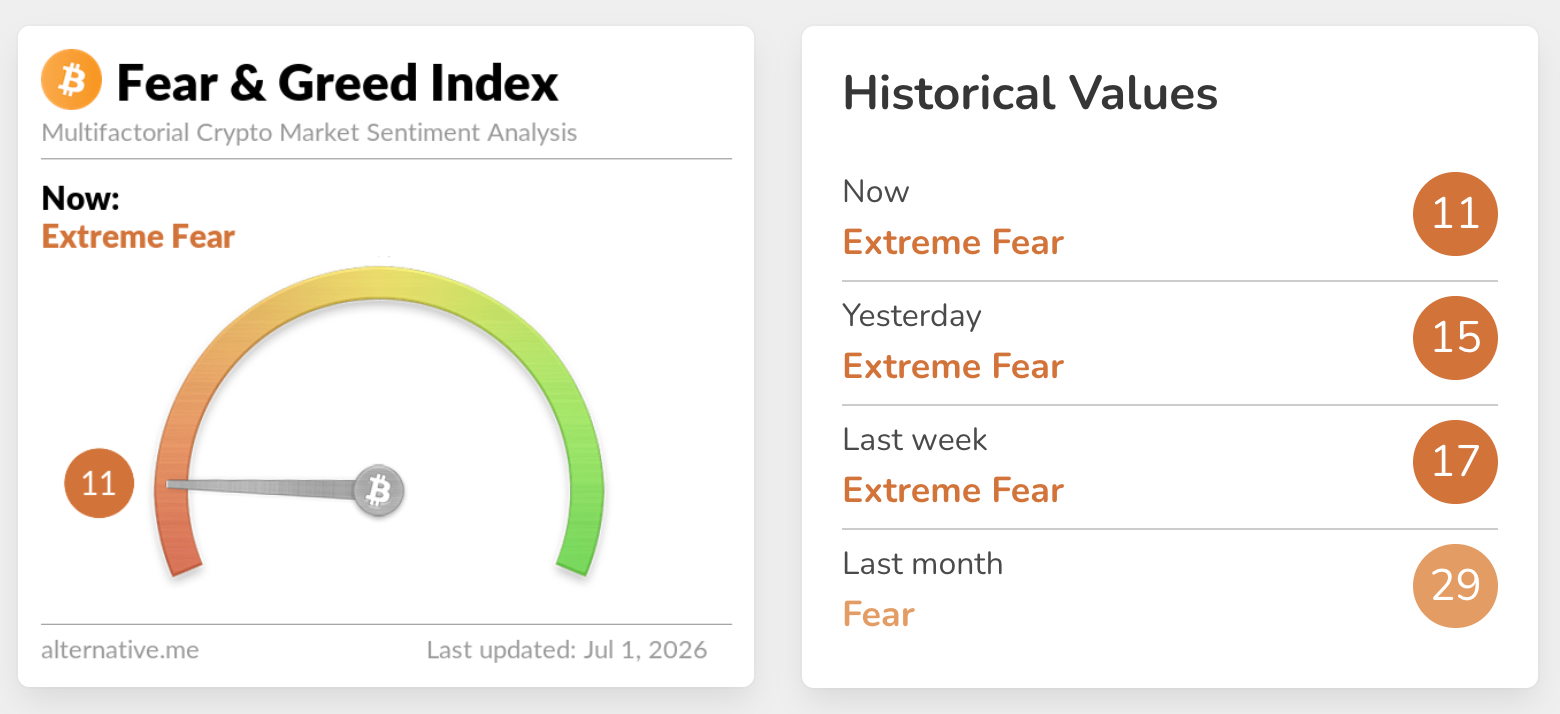
The bounce took place amid deep investor caution, with sentiment trackers gauging the balance of fear and greed in crypto markets currently reading around 11 out of 100, in “Extreme Fear” territory. Despite the rebound from the yearly low, Bitcoin remains down roughly a third since the start of the year.
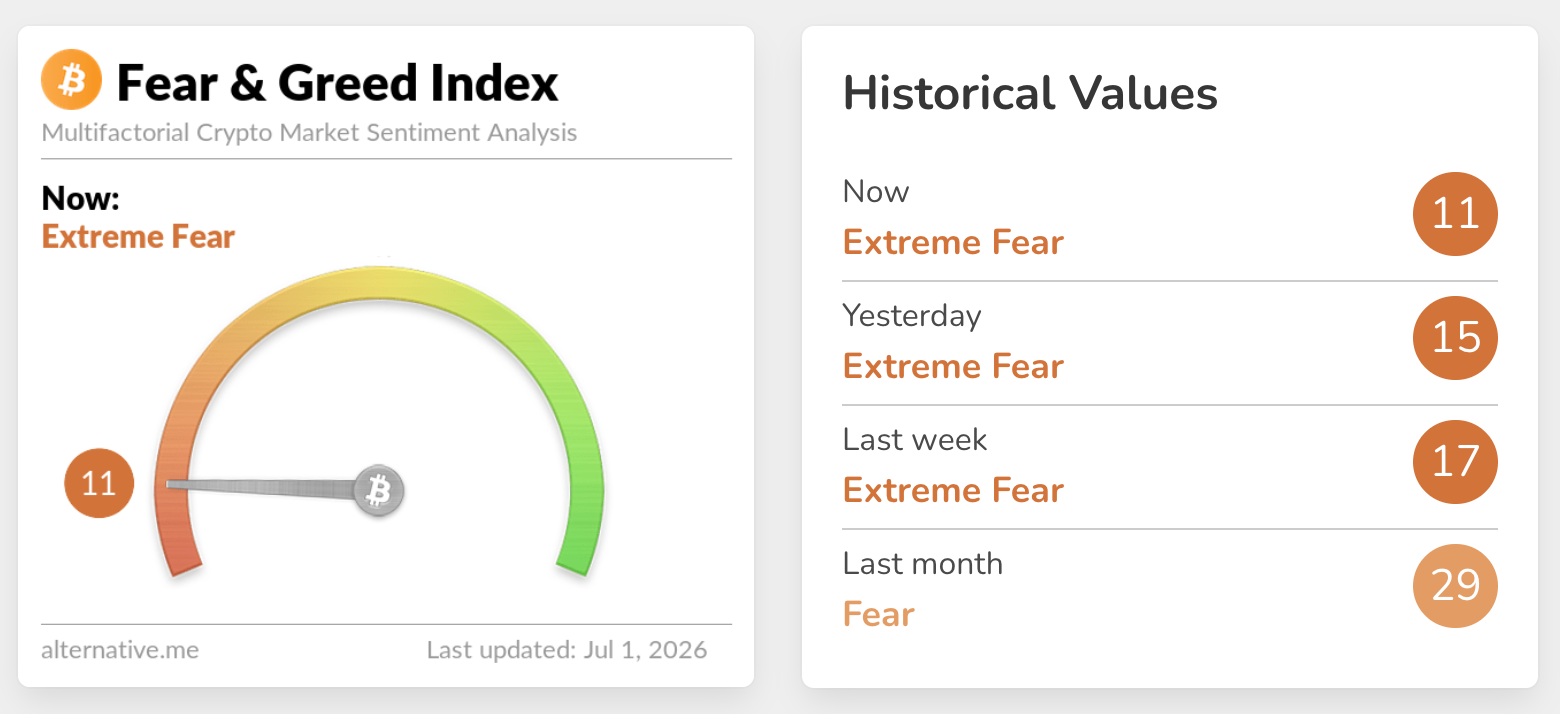
Crypto Fear & Greed Index. Source: Alternative.me
Bitcoin dip-buyers overshadowed by fear of future selling
Investors’ cautious stance shows up differently depending on what data is analyzed. US spot Bitcoin exchange-traded funds (ETFs) have seen more money leave than enter in recent weeks, including a reported $4.5 billion total outflow in June, the largest since the funds launched.
At the same time, onchain data shows that long-term holders added roughly 270,000 BTC over the past two weeks. That is generally read as a sign that some bigger investors see the recent decline as an opportunity rather than a reason to sell.
Looking at the past few days, one useful gauge is the funding rate. That figure has stayed positive for three straight days, meaning bets on rising prices have remained crowded even as Bitcoin fell to new lows. When leverage builds up on one side of the market like this while price is weak, it can add to volatility, since more traders become exposed to being forced out of their positions if the market moves further against them.
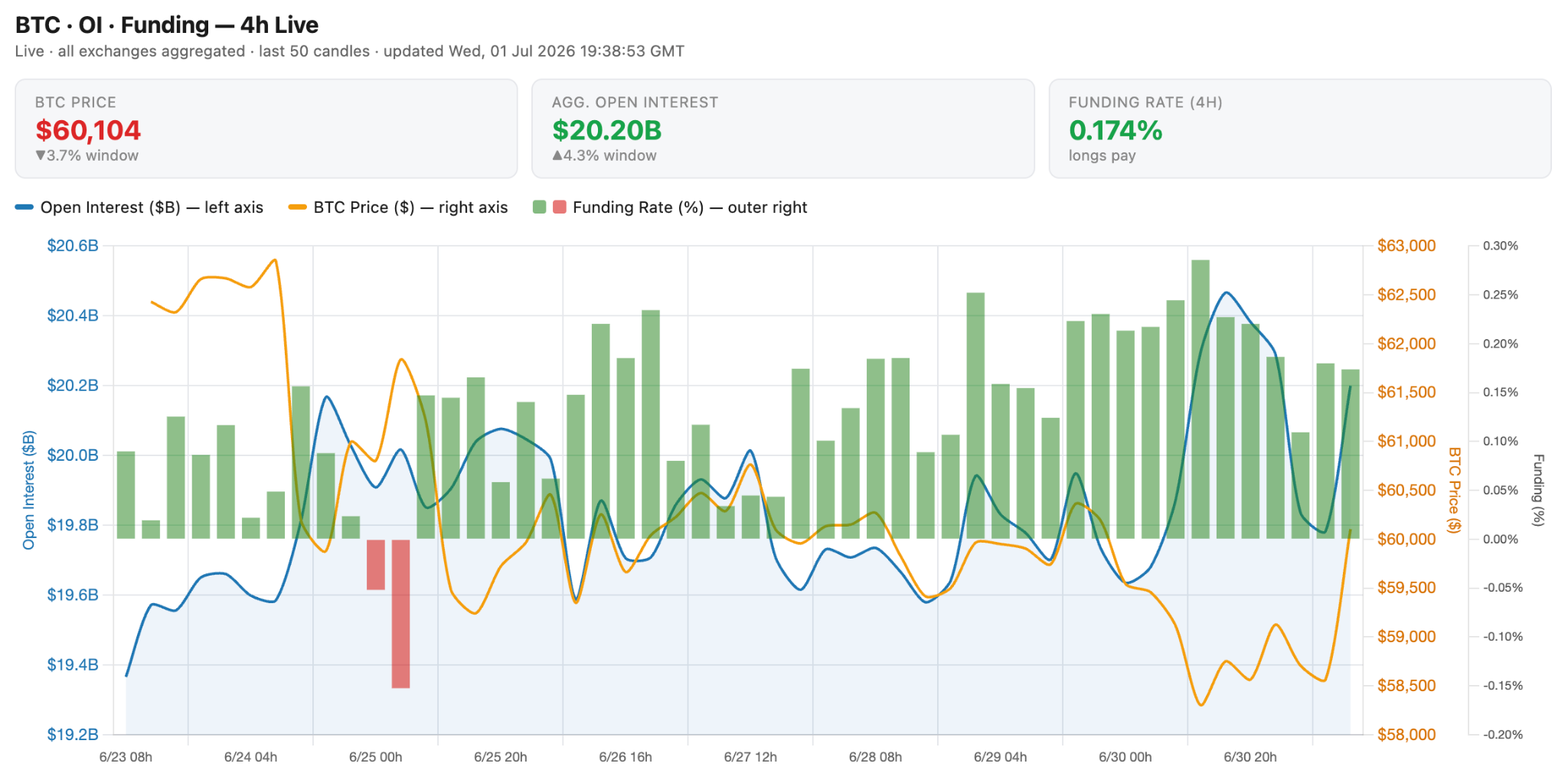
Bitcoin open interest, funding rate. Source: Hyblock
Liquidations continue to define the price action
A broader look at where leveraged positioning is concentrated, combining data from three major exchanges over the past week, shows the heaviest concentration of positioning is roughly between $57,000 and $60,500, which closely wraps around the range Bitcoin has traded in since late June. That concentration thins out noticeably above about $61,000 to $62,000, and again below about $55,000 to $56,000.
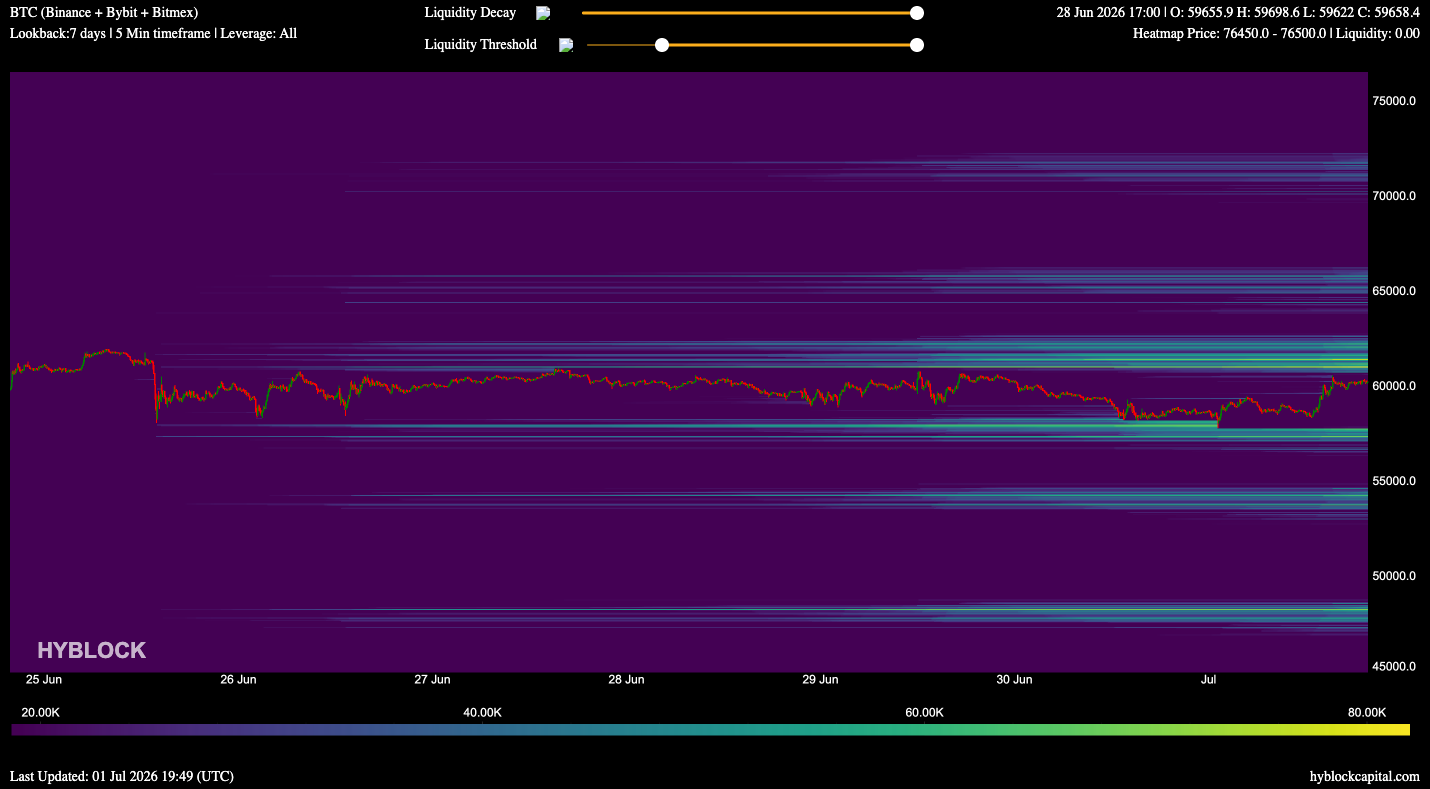
Bitcoin liquidation heatmap, 3-day look back. Source: Hyblock
In practical terms, most of the leverage that could be forced to unwind sits close to the current price rather than in a distant zone, so a decisive move beyond roughly $61,000 on the upside, or $56,000 on the downside, is where forced position closures would likely have the most room to accelerate a move.
The view for the next 24 hours leans neutral and a genuine shift in positioning would likely need to show up as rising leveraged positioning alongside a rising Bitcoin price, a combination that has not yet appeared in the data.
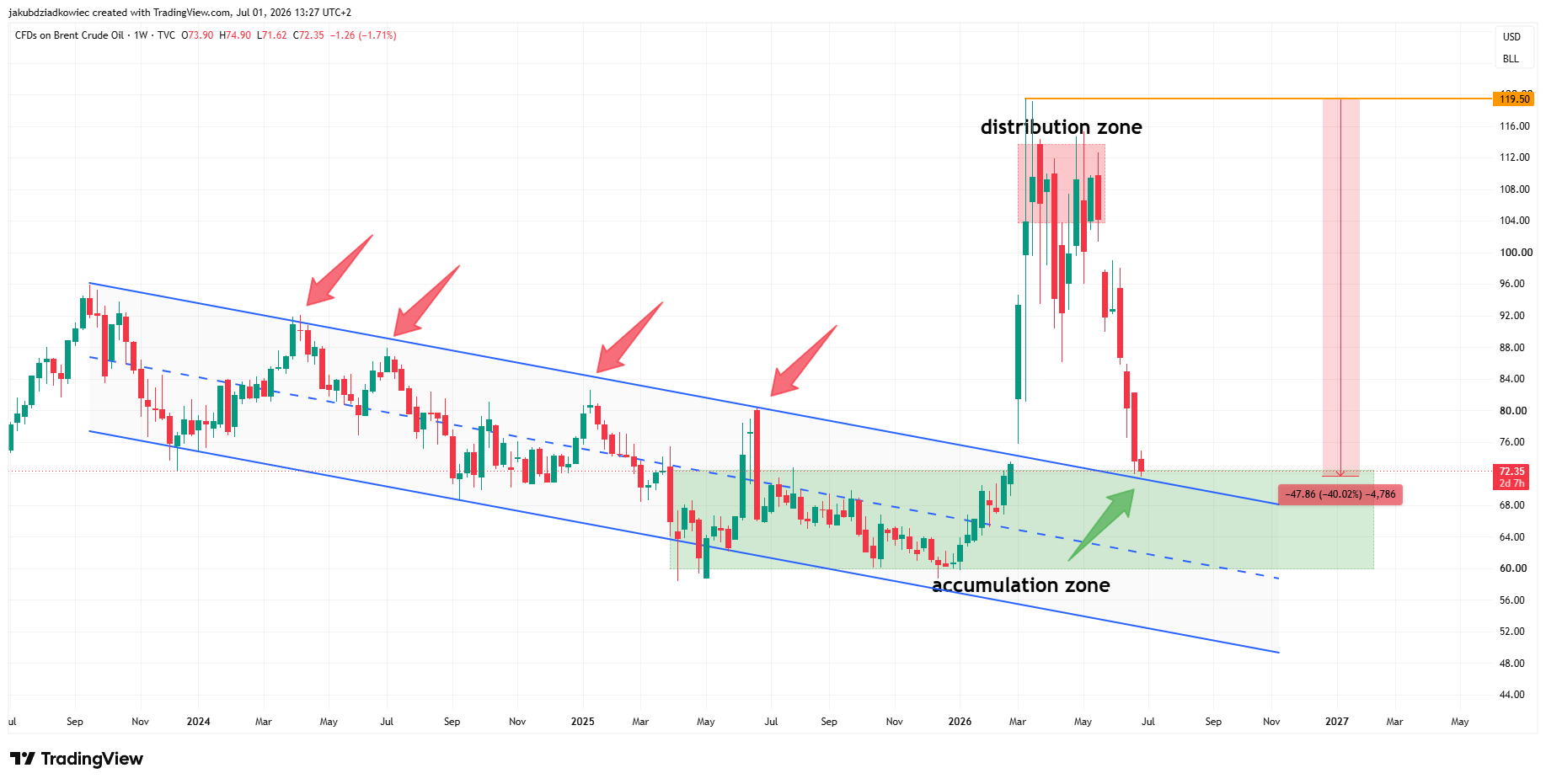
Brent crude oil has erased its entire war premium, sliding roughly 40% from its March peak near $120 to trade around $72.25 on Wednesday. The move returns oil to its pre-war support base.
The retreat follows stalled diplomacy between Iran and the United States. Traders have shifted focus away from conflict risk and back toward supply, demand, and the broader economic outlook.
Brent Crude Oil Falls Back Into Its Multi-Year Channel
The weekly chart frames the whole story. Brent crude oil has traded inside a descending parallel channel since late 2023. That structure defined the pre-war regime for more than two years.
The channel’s upper band rejected price four separate times through 2024 and early 2026. Each test capped rallies and sent oil back toward the middle of the range.
Then the conflict changed everything. Price broke out sharply after the Iran-US escalation, with the Doha talks still unresolved. Brent surged into a distribution zone between $104 and $114, peaking near $120.

That advance has now fully unwound. The weekly chart shows a 40.02% decline from the peak. Oil has fallen back into the accumulation zone between roughly $60 and $72.
The upper band of the channel now sits directly beneath the price. Old resistance can flip into support, and that band is the first line the bulls must defend.
Daily Triangle Breakdown Pushes RSI to Oversold
The weekly structure hints at support, yet the daily chart complicates that read. Momentum has turned sharply against oil.
Brent crude oil built a symmetrical triangle after the March top. Price coiled between a lower series of highs and a rising series of lows toward an apex near $108.
The pattern resolved lower. Oil broke down from the triangle in late May and fell in a near-vertical drop as war fears faded around Hormuz shipping lanes.

Price is now back on the pre-war support zone between $68 and $73. That band held as a base during January and February before the conflict began.
The daily Relative Strength Index (RSI) has fallen below 30. That marks the first oversold reading since April 2025 and signals deeply negative momentum. However, such stretched readings often precede a pause or bounce.
Oil Price Prediction Hinges on the $68 to $72 Support Zone
The two timeframes converge at a single decision point. The weekly upper band, the daily support base, and a rising trendline off the early-year lows all stack up between $68 and $72.
Brent crude oil sits at the top of that confluence near $72.25. The triangle’s widest span measured about $29, and the breakdown near $100 projected toward roughly $71. That target has now been met, suggesting much of the downside has been spent.
A hold here keeps the pre-war base intact and could open a rebound toward the $80 shelf that broke in June. A daily close back above $80 would ease the bearish pressure.
A loss of $68 would invalidate that thesis. The next support sits near $60 at the accumulation floor, with the lower channel band below it.
Fundamentals could tip the balance either way. Falling US inventories and a supply warning argue for a floor, while a fresh Iranian oil license and cooling war risk keep rallies capped.
Whether oil holds this zone or slides toward $60 now depends on the next Middle East headline, weighed against the forces of supply and demand.
The post Brent Crude Oil Erases Entire War Premium, Falls 40% to Pre-War Levels appeared first on BeInCrypto.
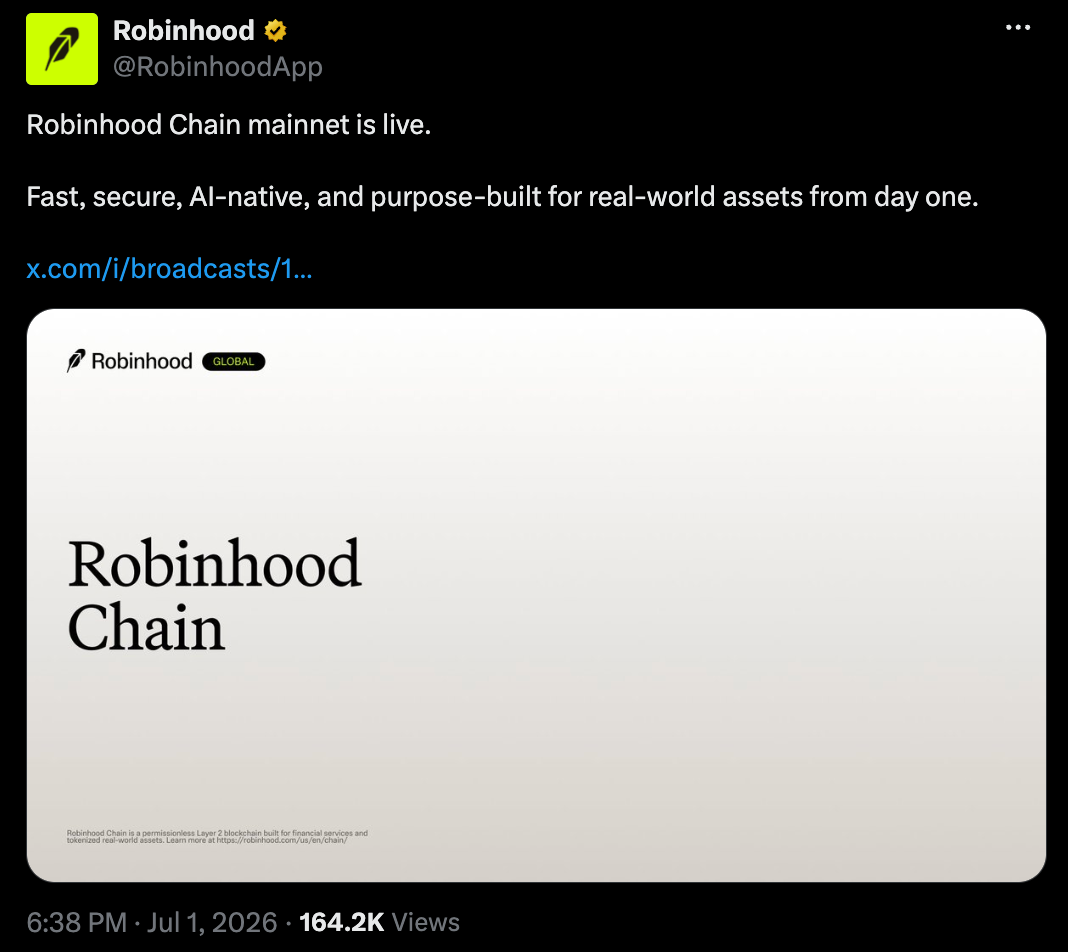
Stock and cryptocurrency trading platform Robinhood announced the launch of its public mainnet about four months after it began testing the network.
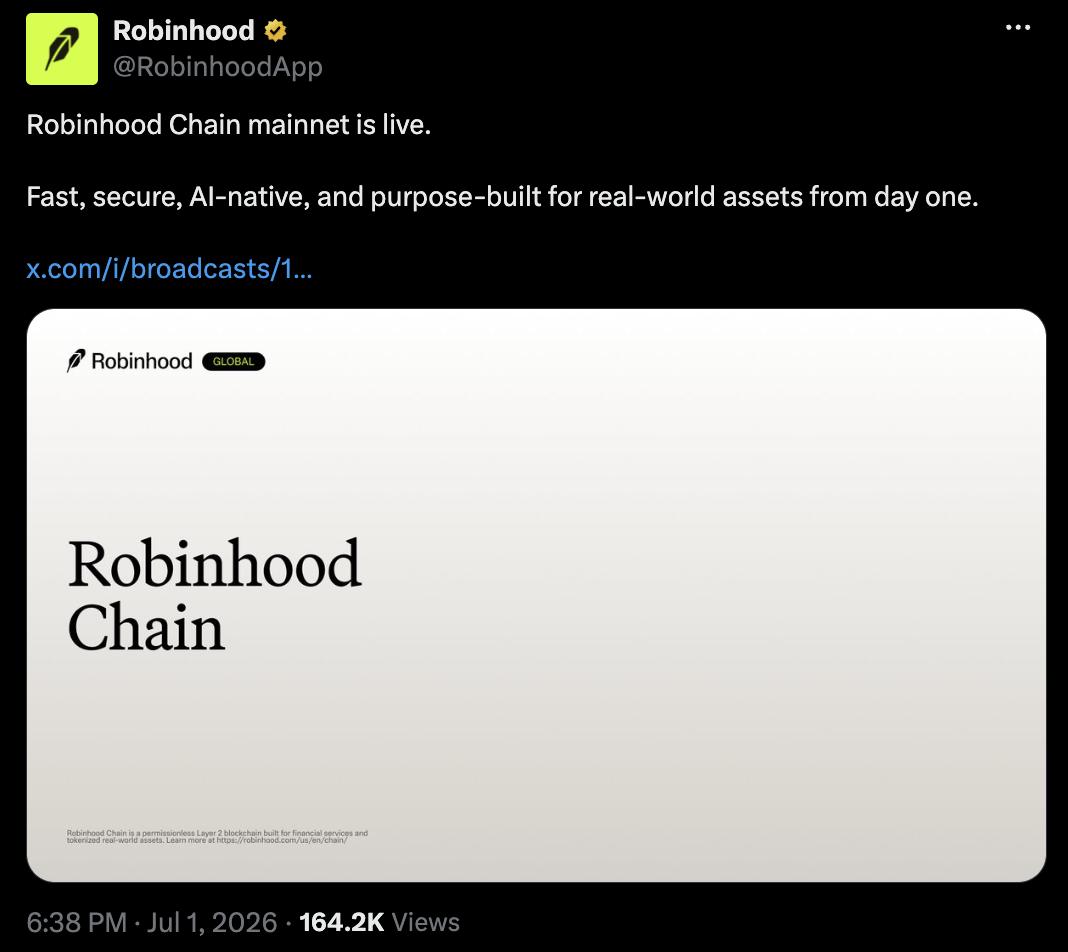
On Wednesday, the company said Robinhood Chain, a layer 2 (L2) blockchain built on Arbitrum, had officially launched after the network went live on testnet in February. The blockchain, which the company described as “AI-native and purpose-built for real-world assets,” comes amid Robinhood’s expansion of crypto- and decentralized finance-related services.
According to Robinhood, it plans to launch crypto trading in the UK soon. The company also said that its tokenized stock products were live and available through its wallet app to users in more than 120 countries. CEO Vlad Tenev called tokenized stocks “inevitable” in January, arguing that offering the products could help prevent trading freezes that sometimes occur on traditional exchanges.
Source: Robinhood
The launch of the public mainnet came just a few weeks after Tenev announced that Robinhood would cut 10% of its workforce as part of a restructuring move. The company is expected to announce its 2026 second-quarter results on July 29, but reported in April that its crypto transaction revenue dropped by almost 50% year-on-year, from $252 million to $134 million.
Related: Last-minute MiCA approvals mark end of EU transition period
The company also introduced Robinhood Earn, a decentralized product that allows users to lend USDG, a dollar-backed stablecoin, through a self-custody wallet at an estimated 7% annual percentage yield. Robinhood shares rose about 8% on Wednesday.
Base’s L2 network reports back-to-back outages
Robinhood is entering an increasingly competitive L2 market dominated by networks such as Base, the Coinbase-backed blockchain.
In June, Base experienced two outages within hours of each other, which the engineering team later reported had been the result of a sequencer bug. The mainnet is the second-largest layer 2 network by total value secured at about $11 billion.
Magazine: AI is banking the unbanked in Africa… faster than crypto
Crypto World
Kroger (KR) Stock Drops 2% Following $1.65 Billion Giant Eagle Acquisition Announcement

TLDR
- Kroger revealed plans to purchase Giant Eagle in a transaction valued at $1.65 billion, consisting of $1.25 billion cash and $400 million in liability assumption.
- The acquisition brings approximately $9 billion in yearly revenue, 197 grocery locations, and 11 independent pharmacy outlets.
- Shares of Kroger declined 2.12% during Wednesday’s session, adding to a year-to-date drop of 12.11%.
- Transaction completion is anticipated in 2027, contingent upon regulatory clearance.
- Analysts at Wolfe Research characterized the acquisition as evidence Kroger is operating “more offensively,” projecting approximately 6% revenue growth.
Shares of Kroger (KR) slipped 2.12% during Wednesday trading following the supermarket operator’s announcement that it would purchase family-run grocery chain Giant Eagle in a $1.65 billion transaction.
The transaction structure includes $1.25 billion in cash consideration alongside $400 million in liability assumption. The Cincinnati-based retailer stated the purchase won’t push its net total debt to adjusted EBITDA multiple beyond its designated target corridor of 2.3 to 2.5 times.
Giant Eagle maintains a footprint of 197 grocery stores and 11 independent pharmacy locations throughout northern Ohio, western Pennsylvania, West Virginia, Maryland, and Indiana—regions where Kroger maintains an established market position.
The regional chain generates approximately $9 billion in yearly sales—a substantial contribution to Kroger’s operations.
Greg Foran, Kroger’s Chief Executive Officer, characterized the transaction as an obvious “strategic fit,” highlighting Giant Eagle’s customer loyalty initiatives, pharmaceutical services, and proprietary brand offerings as valuable assets.
What the Numbers Look Like
Greg Badishkanian, an analyst at Wolfe Research, noted the purchase aligns with Kroger‘s leadership team’s “increased openness to do M&A” and will enable the retailer to strengthen its store concentration while expanding into neighboring territories.
Wolfe’s analysis suggests Giant Eagle’s EBIT margins fall within the 2.0–2.5% range—comparable to Albertsons—and anticipates an additional EBIT contribution between $200 million and $250 million.
With Kroger’s sales forecast to reach $151 billion by 2027, the acquisition would increase total revenue by approximately 6%, bringing it to roughly $160 billion. Badishkanian anticipates modest EPS accretion during the second complete year following transaction closure.
The 197 additional locations would expand Kroger’s total store portfolio by roughly 7% from its existing network of 2,739 stores.
When Does the Deal Close?
Kroger anticipates finalizing the Giant Eagle acquisition in 2027, pending regulatory approval and customary closing requirements.
The grocery retailer indicated the transaction will contribute positively to adjusted EPS during the second complete year post-closure—when excluding one-time transaction expenses and integration-related costs.
To reassure shareholders, the company reaffirmed its commitment to maintaining dividend distributions and continuing its $2 billion stock buyback initiative.
Wednesday’s trading volume registered approximately 1.86 million shares, significantly below Kroger’s three-month average daily volume of roughly 7.77 million.
KR shares have declined 12.11% year-to-date and dropped 20.93% over the trailing twelve-month period.
Analyst sentiment on KR reflects a Moderate Buy consensus, comprising six Buy recommendations and seven Hold ratings issued within the past three months. The mean price target stands at $69.33, suggesting potential upside of approximately 27.4% from present levels.

Tradeweb, an institutional electronic trading platform, has executed an onchain transaction involving tokenized US Treasuries, with Franklin Templeton transferring a tokenized Treasury security to Virtu Financial in exchange for tokenized cash over the Canton Network.
Tradeweb provided execution and price discovery, while the Canton Network synchronized settlement between the tokenized Treasury and tokenized cash. The companies said the trade settled in real time, but did not disclose its size.
A Tradeweb spokesperson told Cointelegraph the deal marked the industry’s first real-time purchase and sale of a tokenized US Treasury settled against USDCx, a USDC-backed stablecoin issued on Canton. Participants included Blockdaemon, Digital Asset, Societe Generale, Franklin Templeton, Tradeweb and Virtu Financial.
According to the announcement, the transaction precedes the planned launch of the Depository Trust & Clearing Corporation (DTCC) Tokenization Services later this year. DTCC said the service will allow participants to tokenize select stocks, exchange-traded funds (ETFs) and US Treasury securities while maintaining the same investor protections and ownership rights as traditional assets.
Related: Franklin Templeton launches dedicated crypto division after closing 250 Digital acquisition
The transaction is also the latest step in Franklin Templeton’s expansion into tokenized financial assets. Earlier this year, the asset manager partnered with Binance to let institutions use tokenized money market fund shares as trading collateral while the assets remained in regulated custody, and with Ondo Finance to bring tokenized ETFs onto blockchain networks.
Governments expand tokenized bond initiatives
Governments have also been expanding efforts to bring sovereign debt onto blockchain infrastructure. Several jurisdictions have launched digital bond programs to test blockchain-based issuance, settlement and market infrastructure.
Hong Kong was among the first jurisdictions to issue tokenized government bonds, launching its inaugural digital green bond in 2023. The government completed its third digital green bond issuance in November 2025, raising HK$10 billion ($1.3 billion) across four currencies, which it said was the world’s largest digital bond issuance at the time.
Last month, Hong Kong said it would build a digital asset platform through the Hong Kong Monetary Authority to support the issuance and settlement of tokenized bonds, with plans to expand the infrastructure to other digital assets and connect it with tokenization platforms across the region.
Elsewhere, the UK government appointed HSBC Orion to support its Digital Gilt Instrument pilot, which is designed to test blockchain-based issuance, settlement and secondary trading of government bonds.
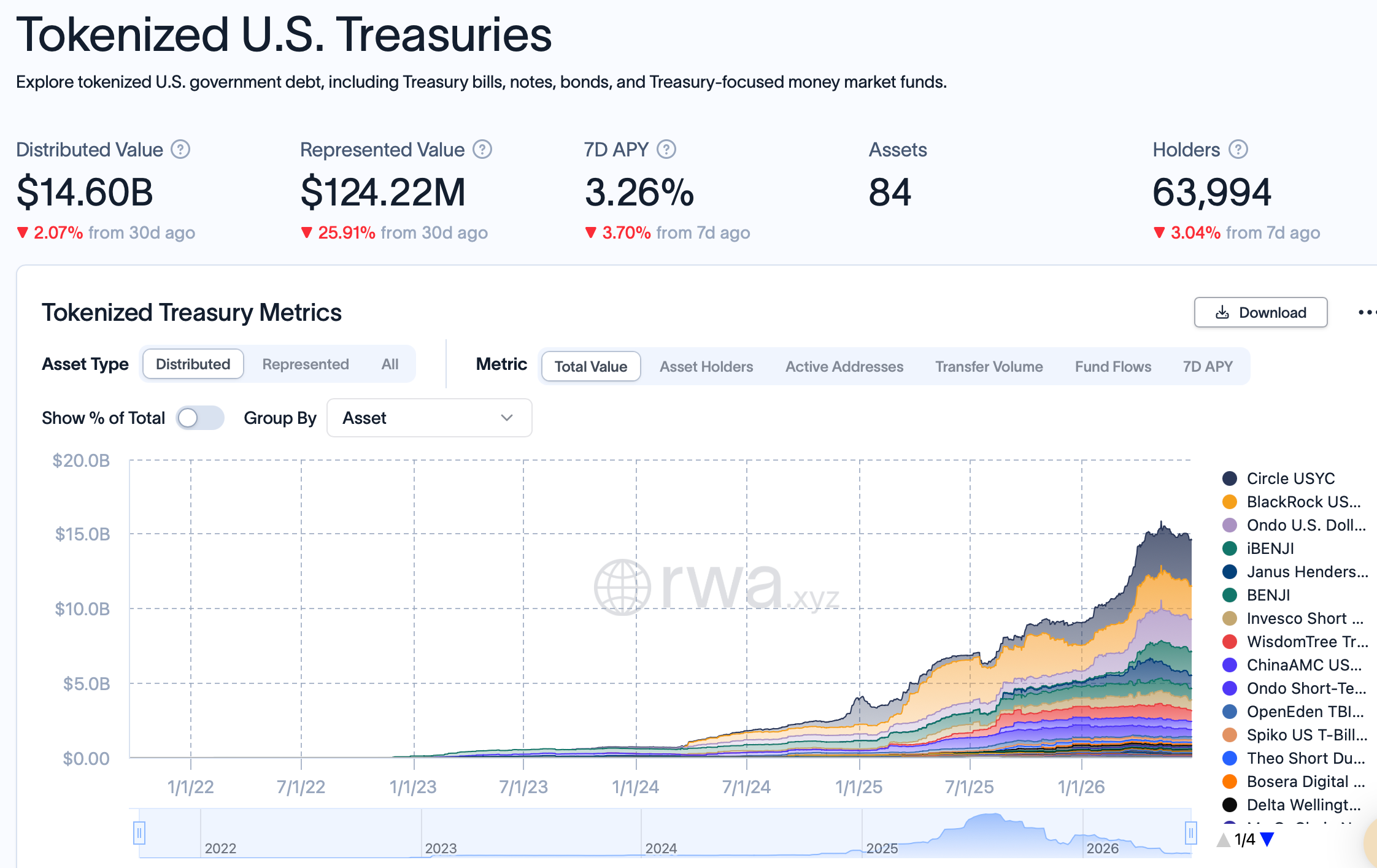
Meanwhile, tokenized US Treasury products have grown into a $14.6 billion market, according to data from RWA.xyz. The sector spans 84 on-chain products and is the largest segment of the tokenized real-world asset market.
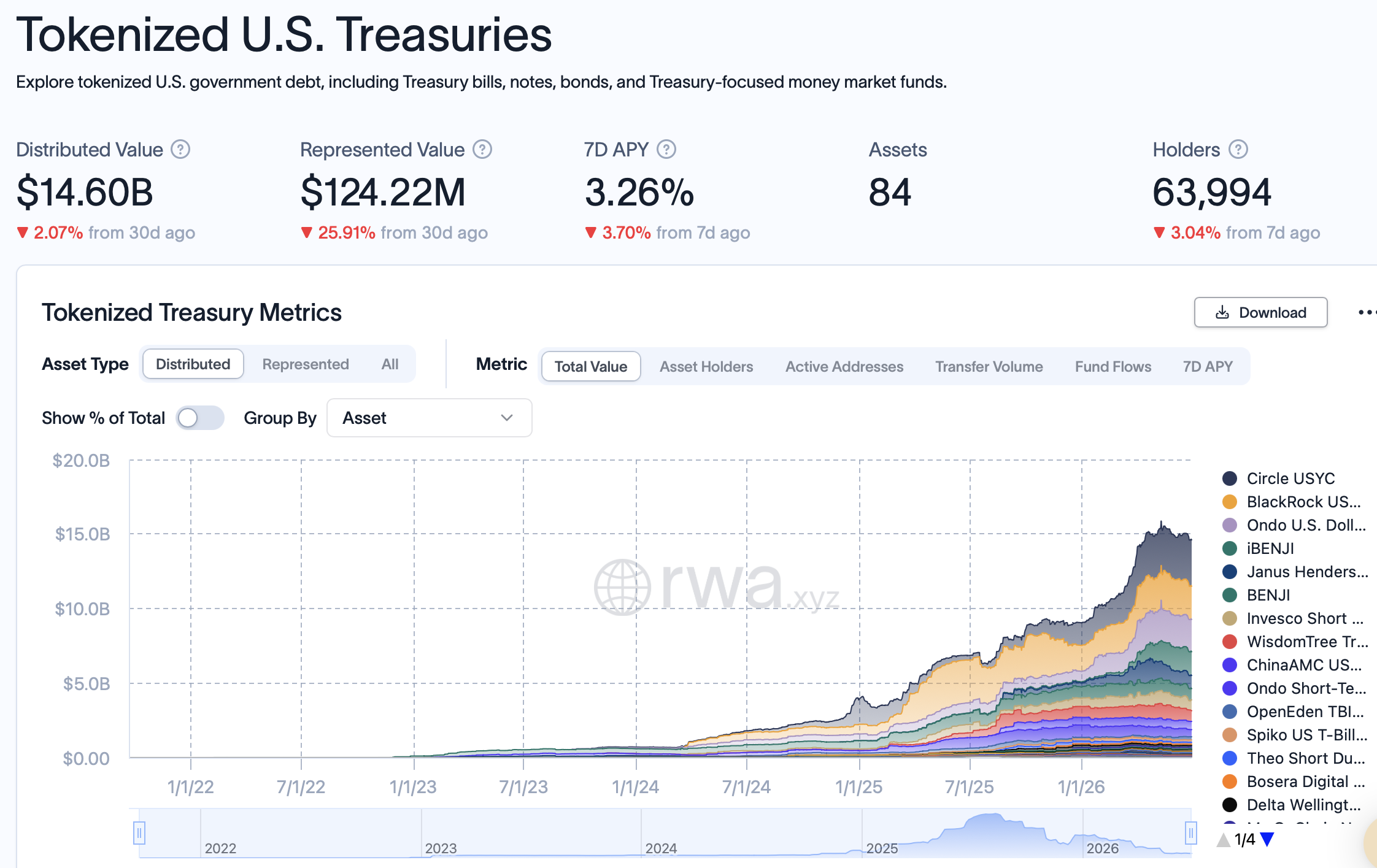
Tokenized US treasuries. Source: RWA.xyz
Magazine: Bitcoin decouples from tech stocks, Ether eyes ‘selling wave’: Market Moves
Crypto World
Market Movers: Meta’s Cloud Ambitions, Warsh’s Inflation Update, and Nike’s China Troubles

Key Takeaways
- Meta is preparing to enter the AI cloud infrastructure space, positioning itself against established enterprise providers
- Federal Reserve Chair Kevin Warsh indicated that inflationary pressures are subsiding while maintaining commitment to the 2% objective
- Major indexes including the S&P 500 and Dow Jones advanced as the second half of 2026 began
- Nike stock declined following cautious guidance on China market performance, overshadowing positive earnings results
- Crude oil values retreated as diplomatic progress between Washington and Tehran reduced supply concern
Meta Prepares to Challenge Cloud Giants With AI Infrastructure Offering
Meta emerged as a standout performer following news that the technology giant is developing a standalone AI cloud infrastructure platform.
This strategic expansion would mark a significant departure from Meta’s traditional advertising-focused revenue model, positioning the company against entrenched cloud computing leaders serving artificial intelligence enterprise clients.
Market participants have demonstrated considerable enthusiasm for firms expanding AI infrastructure capabilities throughout this year. Meta’s substantial experience operating massive-scale AI systems across its social media ecosystem is viewed as a competitive advantage in penetrating this expanding market segment.
Warsh Signals Declining Inflation Threat at Federal Reserve
Federal Reserve Chair Kevin Warsh communicated to financial markets that inflationary threats have diminished, while emphasizing the central bank’s continued focus on achieving its 2% inflation benchmark.
His remarks preceded Thursday’s employment data for June, which market observers are scrutinizing for indicators regarding the trajectory of monetary policy adjustments.
For technology-oriented and expansion-focused equities, declining inflation expectations typically represent favorable conditions. Reduced borrowing costs generally enhance the present value of projected earnings, particularly benefiting companies in rapid-growth industries.
Equity Markets Maintain Upward Trajectory as New Half-Year Begins
U.S. stocks continued their positive momentum, with both the S&P 500 and Dow Jones Industrial Average recording advances on July’s opening trading session.
These gains follow what proved to be one of the most robust quarterly performances for equity markets since 2020. Market participants maintained their optimistic stance on long-term profit expansion despite persistent questions surrounding interest rate policy and economic conditions.
Semiconductor equities experienced modest headwinds throughout the trading day, though robust performance across industrial, healthcare, and consumer sectors provided sufficient support to keep broader market indices in positive territory.
Nike Shares Retreat Despite Earnings Success on China Market Concerns
Nike delivered quarterly financial results exceeding analyst projections, yet the stock declined following management’s cautious assessment of persistent challenges in the Chinese market.
Market participants concentrated on the company’s forward-looking statements rather than historical performance metrics. Leadership suggested the recovery timeline may extend beyond previous market expectations.
Nike’s quarterly performance serves as an important barometer for international consumer demand patterns. The market’s reaction to the report exemplifies a consistent theme throughout this earnings cycle — forward guidance carries greater weight than retrospective achievements.
Crude Oil Values Decline Following Diplomatic Progress With Iran
Crude oil prices retreated after diplomatic engagement between the United States and Iran alleviated concerns regarding potential interruptions to global supply chains.
Declining energy prices help moderate inflationary forces while reducing operational expenses for sectors including aviation, retail distribution, and manufacturing operations.
Given inflation remains a primary consideration for market participants, developments in energy markets will continue receiving significant attention alongside forthcoming economic indicators.
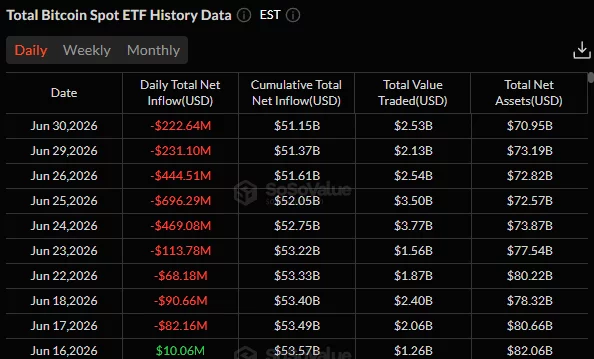
Bitcoin has remained under pressure after U.S. spot ETFs recorded $222.64 million in outflows, while Changpeng Zhao has reiterated his belief that the cryptocurrency can reach $1 million over the next decade.
Summary
- Changpeng Zhao says Bitcoin could reach $1 million as global ownership remains below 1%.
- U.S. spot Bitcoin ETFs recorded $222.64 million in net outflows, led by BlackRock’s IBIT.
- Bitcoin trades below key resistance, with $57.8K support and $63.7K–$65.3K as upside targets.
According to an interview Zhao gave to Block, the Binance founder argued that Bitcoin ownership remains extremely limited worldwide, with fewer than 1% of people currently holding the asset.
He said the low level of adoption leaves substantial room for future demand as more retail and institutional investors enter the market over multiple cycles.
Low ownership remains central to Zhao’s bullish outlook
Building on that argument, Zhao said Bitcoin could climb to around $600,000 during the next major market cycle, representing roughly a fivefold increase from current levels. He added that another cycle would only need to double that valuation for Bitcoin to reach the $1 million milestone, describing the scenario as achievable if adoption continues to expand.
Although Zhao acknowledged he could not predict exactly when those milestones would be reached, he maintained that long-term price appreciation would depend more on rising ownership than on short-term market speculation. He also noted that institutional participation, alongside continued retail adoption, could support Bitcoin’s value over time as ownership becomes more widespread.
Zhao’s comments come as long-term Bitcoin price forecasts remain a recurring topic across the digital asset industry, with several market participants continuing to argue that growing global acceptance could support higher valuations over the coming years.
Institutional demand pauses as technical resistance holds
While Zhao focused on Bitcoin’s long-term adoption story, U.S. spot Bitcoin ETFs experienced a setback on June 30 after recording $222.64 million in net outflows. Data from SoSoValue showed BlackRock’s IBIT accounted for the largest withdrawal, posting $212.45 million in net outflows during the session.
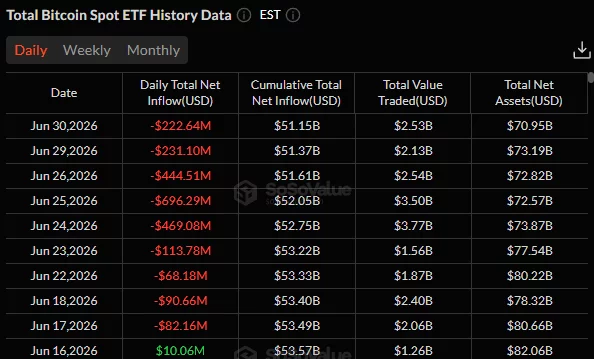
Even with the daily withdrawals, cumulative net inflows across U.S. spot Bitcoin ETFs stood at $51.15 billion, while total net assets remained at $70.95 billion. Daily trading volume reached $2.53 billion, indicating that investors continued to trade actively despite the temporary pullback in fund flows.
The ETF withdrawals also coincided with Bitcoin struggling to reclaim key technical levels. On the 4-hour chart, the cryptocurrency traded near $60,100, just above the 23.6% Fibonacci retracement around $60,065, while remaining below the Supertrend resistance near $60,900. A descending trendline connecting lower highs since mid-June continued to cap rallies, leaving sellers in control unless buyers reclaim nearby resistance.
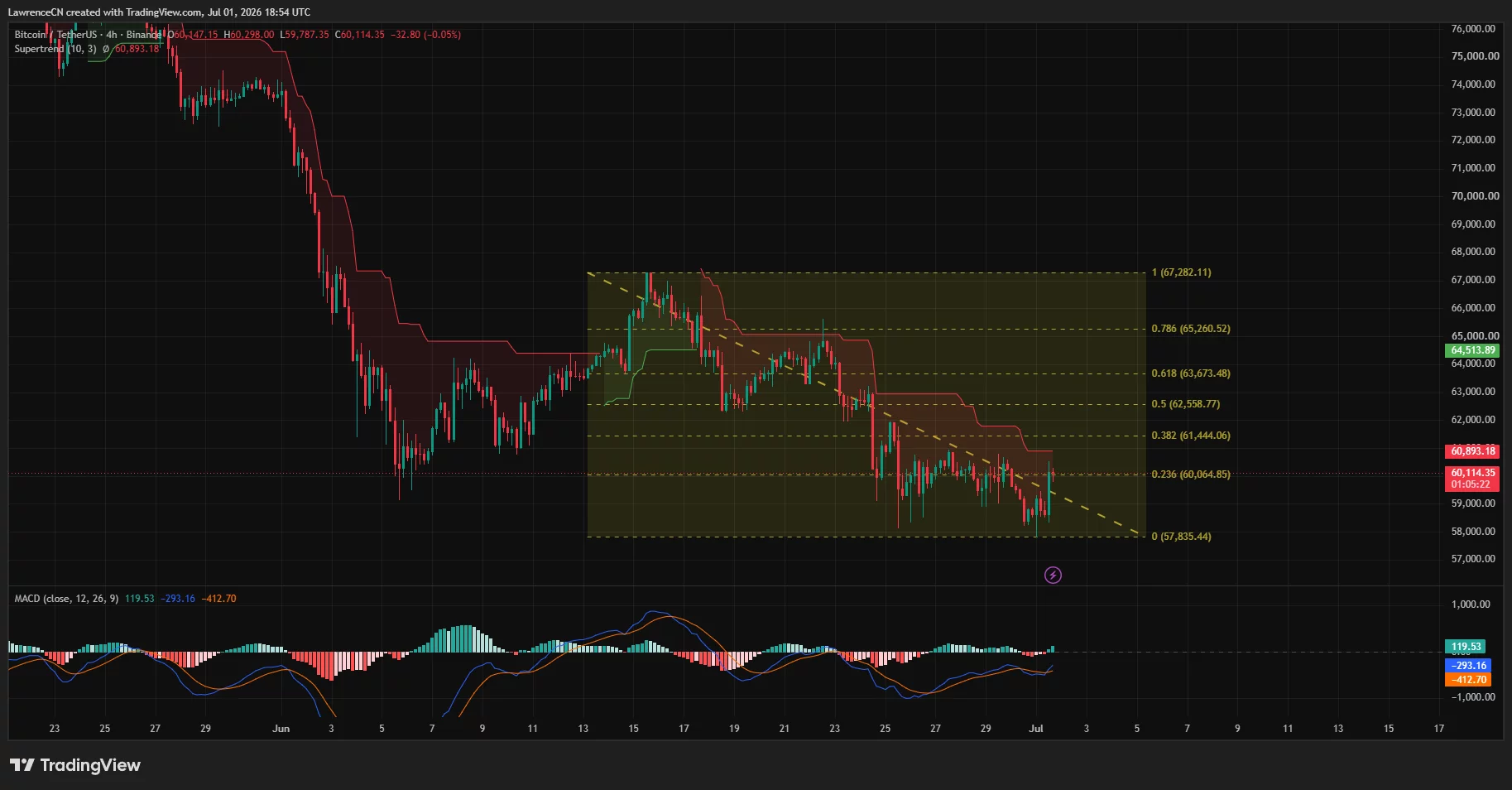
If buyers manage to break above the Supertrend and the descending trendline, Bitcoin could target the 38.2% Fibonacci level near $61,444, followed by $62,559 at the 50% retracement. A sustained move beyond those barriers would expose the 61.8% Fibonacci level around $63,673, with the 78.6% retracement near $65,261 becoming the next major upside objective.
On the downside, losing the $60,065 Fibonacci support could increase selling pressure toward the recent swing low around $57,835. A break below that level would invalidate the current rebound attempt and leave Bitcoin vulnerable to a deeper decline if buyers fail to step in.
Momentum indicators, however, hinted at improving conditions. The MACD histogram has turned positive and the MACD lines have started curling higher, suggesting bearish momentum is fading even though a confirmed bullish trend reversal has yet to develop.
For now, Bitcoin’s short-term direction may depend on whether institutional demand returns after the latest ETF outflows.
A recovery above nearby resistance could strengthen the case for a move toward the mid-$63,000 region, while another rejection may keep attention on support near $57,800. Zhao’s $1 million forecast, meanwhile, continues to rest on a much longer timeline driven by rising global Bitcoin ownership rather than short-term fund flows.
Disclosure: This article does not represent investment advice. The content and materials featured on this page are for educational purposes only.
Crypto World
Crypto claws back some losses but derivatives markets point to more pain ahead: Crypto Markets Today
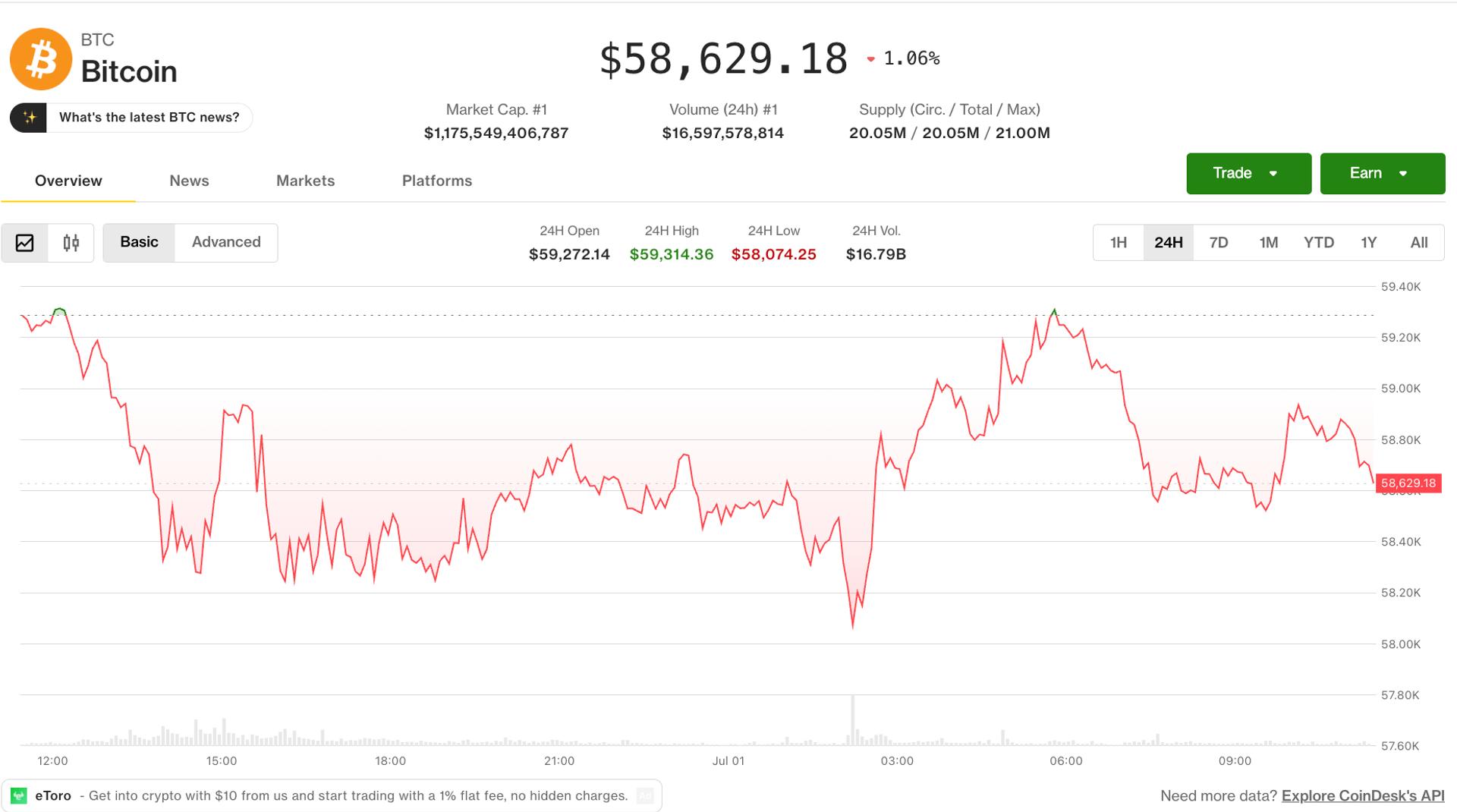
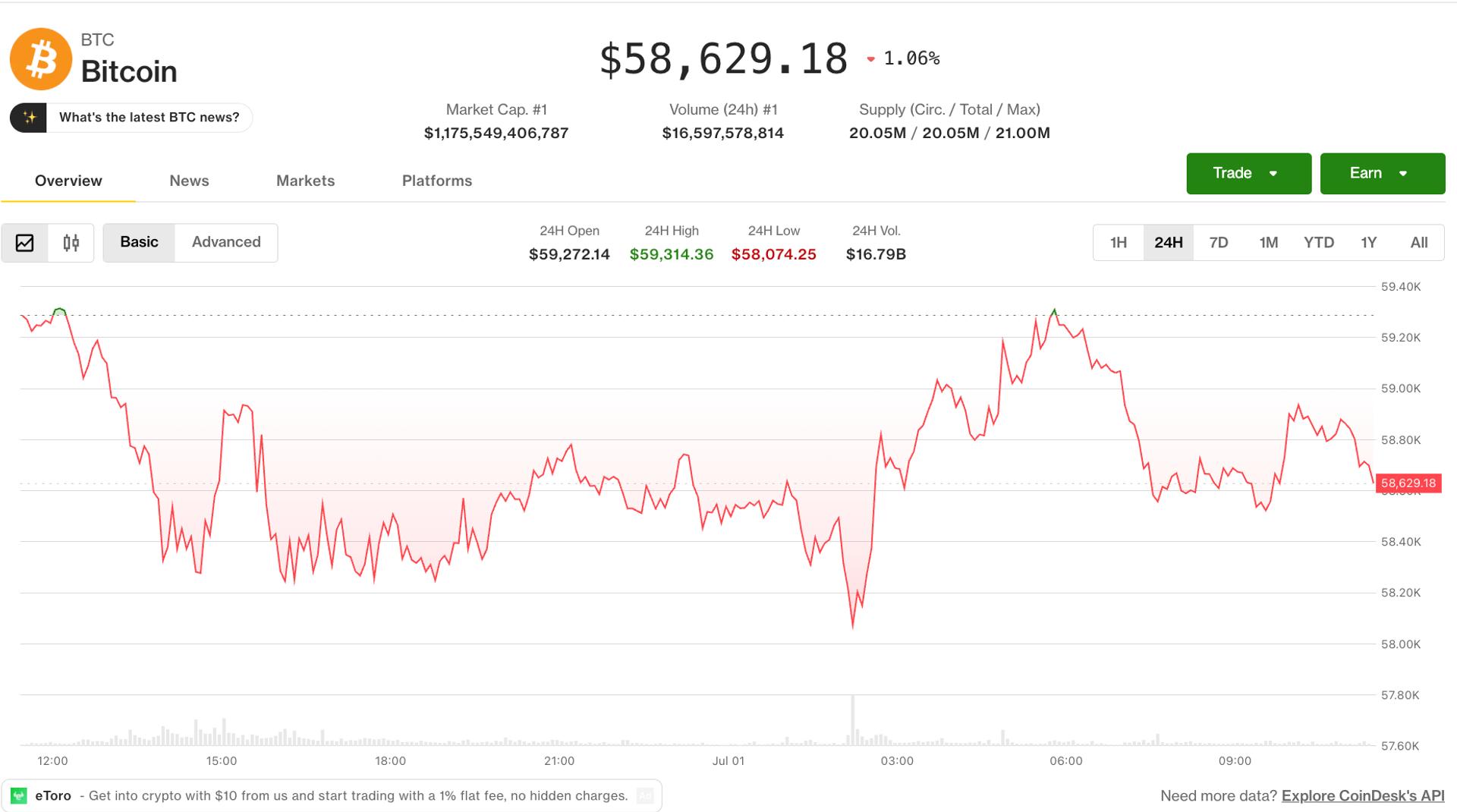
Bitcoin rose 0.3% to $58,700 on Wednesday, showing a sliver of strength after spiking down to $57,700, the lowest point since September 2024, shortly after midnight UTC.
Ether (ETH) is at $1,580, having also experienced a slight relief bounce since 01:00 UTC.
U.S. equity index futures are lower since midnight UTC, with S&P 500 futures and Nasdaq 100 futures in the red by 0.2%-0.4%
Risk assets like crypto and tech stocks have been struggling in recent weeks as concerns of impending inflation have lifted the U.S. dollar and made traders cautious.
The altcoin market has been the hardest hit because it lacks the liquidity and demand to deal with precipitous moves to the downside and liquidation cascades.
Derivatives positioning
- A total of $395 million worth of crypto futures bets have been liquidated in 24 hours, with bullish plays accounting for most of the tally. That’s hardly surprising given BTC’s dip to lows under $58,000 early in the day.
- The real story is crude futures listed on crypto exchanges. They have seen liquidations worth $15 million, the fifth-largest tally among all tokens. The figure shows just how popular TradFi trading has become on crypto exchanges.
- BTC’s futures open interest (OI) jumped to 768K BTC from 740K BTC a day ago. While the influx of money is encouraging, it’s unclear whether the bias is for bullish or bearish bets. For instance, the annualized funding rates hover near 5%, hinting at a bullish bias, while the 24-hour cumulative volume delta is negative, suggesting bears are being more aggressive and trading with market orders rather than passive limit orders.
- Gold perpetual futures OI hit a record high of 222K XAU tokens. This comes as the metal’s spot price shows a bearish death cross, signaled by the 50-day simple moving average crossing below the 200-day SMA. Prominent gold ETFs are displaying a similar bearish pattern.
- Bitcoin and ether’s 30-day implied volatility indexes are steady after June’s double-digit gains. Bitcoin’s index, BVIV, is now hemmed between the 200-day average as resistance and the 50-day as support. A break above the 200-day MA might mean new turbulence and a deeper price slide.
- On Deribit, bitcoin and ether puts remain pricier than calls across all time frames as traders seek downside protection.
- Key flows at over-the-counter desk Paradigm featured demand for the September expiry bitcoin put at the $50K strike price. This is a bet that prices could slide below $50K by the end of the third quarter. Meanwhile, someone lifted a SOL call option at the $86 strike. The token is currently trading around $75.
Token talk
- While the broader altcoin market is struggling, Solana-based DeFi token jupiter (JUP) has posted a trend reversal, rising by 11% since midnight UTC with a 55% increase in daily trading volume.
- The increase comes alongside a jump in total value locked (TVL), with the protocol, a decentralized exchange (DEX) aggregator. TVL has risen to more than 20 million SOL from 13.9 million in May.
- Stellar lumens (XLM) extended gains, rising from $0.168 on Sunday to $0.196, an increase of 17%.
- The strong performance of a select few altcoins kept CoinMarketCap’s “Altcoin Season” index sticky at around 48/100 after ending June little changed despite weakness across the sector.
- AI tokens have been the recipient of that weakness. Bittensor (TAO) lost 2.5% on Wednesday and is now down by over 30% since June 15.

FINANCIAL ASTROLOGY !! NIFTY BANK NIFTY PREDICTION !! SENSEX EXPIRY !! 02 JULY

Teenage boy injured after shooting in Birmingham

Which Offers Better Durability for Outdoor Spaces?





-

 Fashion5 days ago
Weekend Open Thread: Staud – Corporette.com
-

 Politics6 days ago
The House | Manchesterism won’t survive the painful trade-offs unless it gets citizens on board
-

 Crypto World2 days ago
Strategy authorizes up to $1.25B in Bitcoin sales under new capital plan
-

 Politics6 days ago
Potential 2028er World Cup attendee leaderboard
-

 Business6 days ago
Asia stock markets slide as tech shares slump
-

 News Videos3 days ago
MAJOR BITCOIN & MARKET UPDATE!!!! (MUST WATCH ASAP!!!)
-

 Tech6 days ago
A Look At A Gaggle Of Transputer Boards
-
 Crypto World6 days ago
Dell (DELL) Shares Tumble Over 5% Following Analyst Downgrade to Hold
-

 Crypto World4 days ago
Coinbase, Circle Deepen Crypto Stock Losses Despite Resilient S&P 500
-

 Business2 days ago
Australia treasurer says alleged access of prime minister’s bank data ’incredibly concerning’
-

 Crypto World5 days ago
Kraken's xStocks Opens Bending Spoons IPO Registration to EEA Retail
-

 Sports5 days ago
FIH Pro League: India defeat Pakistan 7-1, register biggest win of campaign | Other Sports News
-

 Crypto World6 days ago
Bitcoin Sparks $600M Hourly Liquidations With $65,000 Set To Become Resistance
-

 Tech4 days ago
Bluekit phishing kit adopts browser-in-the-middle for login theft
-

 Tech4 days ago
Russian hackers now target Signal backup recovery keys
-
Crypto World5 days ago
Hyperliquid Named on Singapore MAS Investor Alert Register
-

 Crypto World5 days ago
RTX holders must register wallets before token distribution begins
-
 Crypto World7 days ago
Ripple and SBI launch RLUSD in Japan after JFSA approval
-

 Tech2 days ago
Anonymous researcher drops 0-day ‘exploitarium’ repo
-
 Business2 days ago
The AI boom won’t burst all at once. It will pop in ‘rolling bubbles’: Macquarie
You must be logged in to post a comment Login