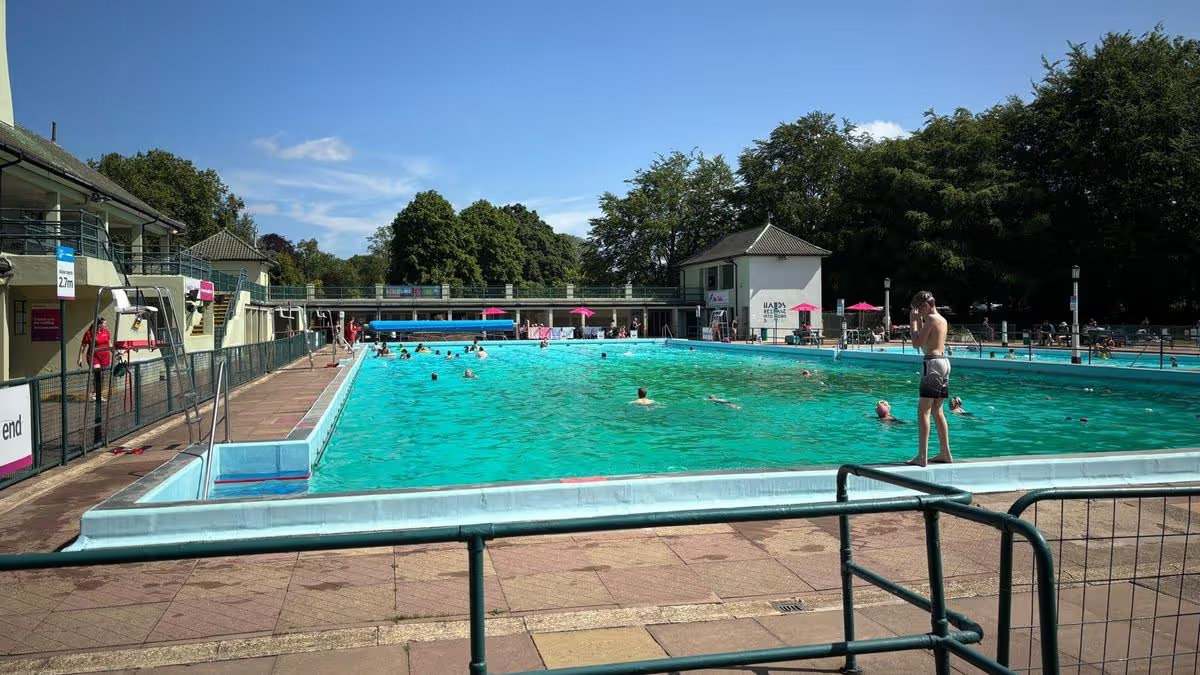
The Lido was closed on Wednesday for ‘essential maintenance’
08:32, 02 Jul 2026Updated 08:39, 02 Jul 2026
A Cambridgeshire Lido will remain closed for a second day due to an “issue”. The Peterborough Lido was closed on Wednesday (July 1) so staff could carry out “essential maintenance”.
However, the pool will remain closed today (Thursday, July 2). In a social media post, a Vivacity spokesperson said: “Unfortunately we will not be reopening this morning and have turned off bookings for the rest of today while we continue to try to rectify the issue with the pool.
“As soon as we have an update, we will post again. Thank you for your patience.”
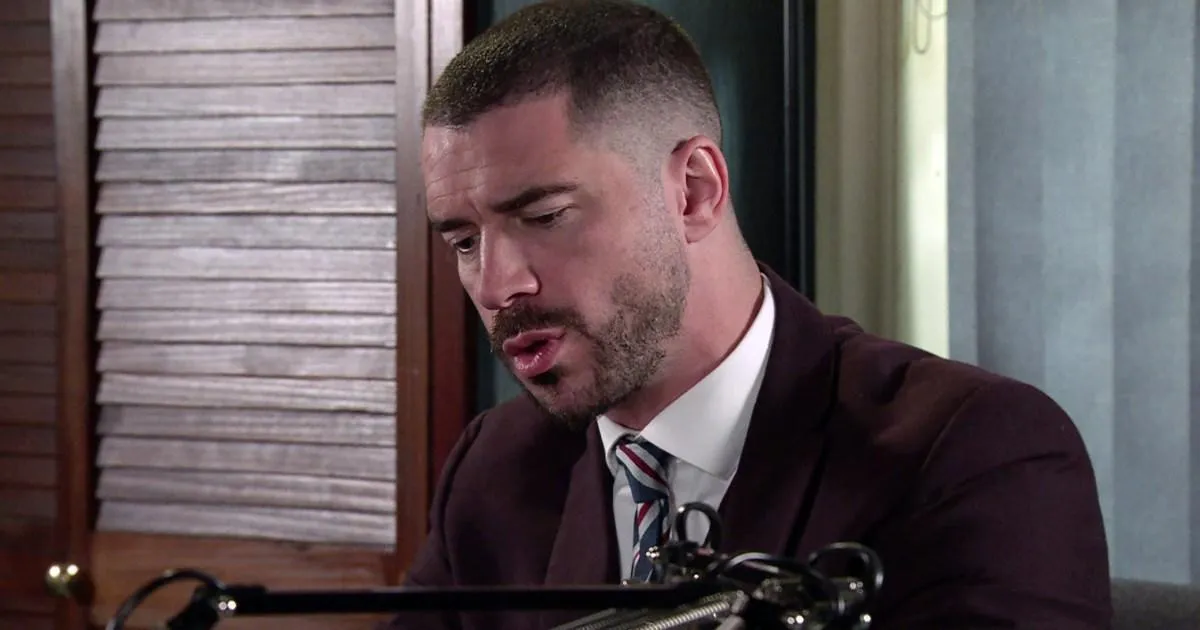
Adam Barlow has caused quiet the stir among Corrie fans as he steps into new role (Picture: Danielle Baguley/Shutterstock)
Coronation Street fans have been left scratching their heads after spotting what they believe is a major mistake during Megan Walsh’s (Beth Nixon) upcoming trial, with many questioning how Adam Barlow (Sam Robertson) has suddenly become a barrister.
The ITV soap is gearing up for the next chapter in Megan’s dramatic storyline, which sees her finally face court following the shocking events involving Will.
Over recent weeks, viewers have watched Megan’s behaviour become increasingly disturbing, with her actions towards Will prompting many fans to brand the character ‘vile’ and even call for her to be sent to prison.
Now, with her day in court arriving, another talking point has stolen the spotlight.
Advertisement
Rather than focusing solely on the outcome of the trial, viewers have instead become fixated on Adam’s role in the courtroom, with many insisting there’s one major problem.
Ask Metro
Use AI to go deeper into the stories you care about – powered by Metro and trusted publications.
Advertisement
Adam has long been established as Weatherfield’s resident solicitor, but in the latest scenes he’s seen representing Megan in court in what appears to be the role of a barrister.
The trial has got underway this week with Will taking to the stand (Picture: ITV)
The apparent switch hasn’t gone unnoticed.
One confused viewer wrote: ‘I didn’t know Adam Barlow was a barrister!’
Another quickly replied: ‘He’s not!’
Others questioned whether they’d somehow missed an important development in Adam’s career.
Advertisement
‘Since when did Adam become a barrister?!!’ one fan asked, while another echoed: ‘Have I missed a chapter here, since when was Adam a barrister?’
A fourth simply pointed out: ‘Adam isn’t a barrister, he’s a solicitor.’
One viewer, who claimed to have worked in the legal profession, suggested there could be an explanation but felt it hadn’t been properly addressed on screen.
‘They are struggling through it the best they can, no Adam is not a Barrister but a solicitor who all of a sudden has become solicitor advocate,’ they wrote.
Advertisement
‘When I worked in a big law firm in London we instructed Barristers, solicitors never stood in as Barristers despite the fees they charged which were eye watering.’
Viewers will be hooked as they await the verdict of the trial but it seems Adam is the current talking point (Picture: ITV/Shutterstock)
Another fan was even more critical, arguing the entire courtroom storyline lacked realism.
‘Such an unrealistic storyline. No way in the real world would a barrister be allowed to represent someone he knows, let alone go into the local boozer where the prosecutor’s family run the pub! Come on script writers, get your act together & write true to life court drama!’
While fans have labelled it a blunder, there may be more to the situation than first appears.
In England and Wales, solicitors can gain additional rights of audience and become solicitor advocates, allowing them to represent clients in higher courts. There’s also the separate route of transferring to the Bar, enabling a qualified solicitor to become a practising barrister.
Advertisement
However, if either of those routes applies to Adam, Coronation Street has yet to mention it on screen, leaving many viewers confused about exactly what qualifications the character now holds.
However, a spokesperson for ITV has confirmed that Adam’s role does allow him to make representations in court. They told Metro: ‘Adam is in fact a solicitor advocate who can defend in court like a barrister. This is the same as Imran and Dee-Dee previously. Adam has the same advocate qualifications.’
They also went on to advise that ‘Solicitors in England and Wales were granted extended rights to appear as advocates in the higher courts (such as the Crown Court, High Court, and Court of Appeal) when the Courts and Legal Services Act 1990 came into effect in 1994. This legislation broke the historic advocacy monopoly held by barristers.’
‘Have I missed a chapter here? Since when was Adam a barrister?’ (Picture: ITV)
That said, it does seem unusual for a neighbour and regular of the local pub that is ran by the prosecution to suddenly be representing someone in such a life-changing trial. It’s easy to see why viewers have been left questioning it. Of course, soaps often take a few creative liberties for the sake of the drama, so we do need to take things with a pinch of salt sometimes.
Viewers have become increasingly vocal in recent weeks, with many insisting Megan deserves to be jailed following her treatment of Will. Her actions have sparked fierce discussion online, with fans branding her behaviour ‘vile’ and arguing she should face the full consequences if found guilty.
As her trial unfolds, the verdict is set to have huge repercussions for everyone involved.
But for many fans, it’s Adam’s unexpected courtroom role that’s proving to be the biggest talking point of all, with viewers hoping the soap will soon clarify exactly how Weatherfield’s familiar solicitor ended up leading the defence.
Whether the show addresses the apparent career change remains to be seen, but until then, fans are convinced something doesn’t quite add up.
The high street beauty retailer collapsed into administration earlier in September and had not been able to secure a buyer for its chain of stores in the UK.
Administrators at advisory firm Interpath said this meant it had made the difficult decision to close them down.
Savers, another health and beauty retailer, returned to the Mill Gate in March this year and saw crowds of hundreds of shoppers turn up for its opening.
Bodycare’s previous Market Place store in Bolton remains unoccupied.
Bodycare was founded in 1970 in Lancashire and sold beauty products, fragrances and other bathroom items.
Advertisement
Its stores were based in shopping centres and high streets in towns and cities across the UK.
Now Bodycare has announced it will reopen in 17 locations, with 15 to open within the space of one year.
Bury’s Mill Gate is on the list, along with Blackburn and Warrington, but not Bolton.
The full list is as follows:
Advertisement
– Sheffield
– Leicester
– Derby
– Brierley Hill
Advertisement
– Bradford
– Blackburn
– Leeds
– Bury
Advertisement
– Livingston
– Sunderland
– Cwmbran
– Gateshead
Advertisement
– Glasgow
– Luton
– Warrington
– Northampton
Advertisement
– Wakefield
The retail company’s website states each store will have “its own in-store content creator studio” complete with good lighting that will be completely free to use.
The site states it is “a space to film, create, experiment, and finally make the content you’ve been dreaming about.”
Bodycare also promises it will continue to stock health and beauty essentials, along with K-beauty, fine fragrance and piercing studios.
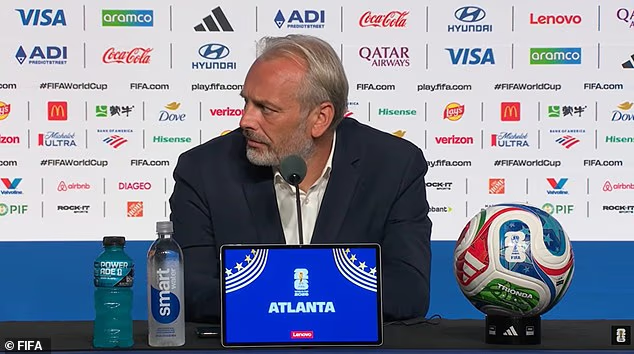
DR Congo head coach Sebastien Desabre has been praised for his ‘dignity and devotion’ to the national team after the death of his father was announced following their World Cup last-32 defeat by England.
Advertisement
Desabre’s side had threatened to produce one of the biggest shocks of the tournament after taking an early 1-0 lead through Brian Cipenga.
England required a late Harry Kane brace to send them through to the last-16 at DR Congo’s expense.
Desabre had praised his team’s efforts in the match and during their World Cup campaign in his post-match press conference.
The press conference ended in unexpected fashion, as after confirming there were no further questions for Desabre, the DR Congo press officer then revealed the loss of his father.
Advertisement
‘Thank you but we are announcing that the coach has lost his father,’ the press officer announced in French. ‘So sincere condolences.’
DR Congo head coach Sebastien Desabre appeared stunned after a press officer announced the death of his father in a post-match press conference
Desabre had reportedly been informed prior to DR Congo’s last-32 tie against England, which ended in a 2-1 defeat
Advertisement
Your browser does not support iframes.
The public announcement to the media appeared to surprise Desabre, who looked towards the press officer in apparent astonishment.
Advertisement
Desabre ended the press conference by thanking the journalists, before glancing again to the press officer as they stood up to leave.
Congolese journalist Stanis Bujakera Tshiamala reported following the press conference that Desabre had been informed of the loss of a ‘very close family member’ prior to the match.
Desabre was reportedly determined to lead the team in the last-32 tie, with the Frenchman being praised for his ‘devotion to Congo’.
Didier Budimbu Ntubuanga, DR Congo’s Minister of Sport, offered his condolences on social media to Desabre and praised his dignity during the World Cup.
Advertisement
‘Deeply touched by the grief that strikes our coach Sébastien Desabre,’ he wrote.
‘Even in the ordeal, his dignity and professional demeanor throughout the competition command the admiration of the entire Nation.
‘I extend my most heartfelt condolences to him and his loved ones. Much courage, coach.’
Desabre was thanked for his devotion to DR Congo after he was reportedly determined to lead the team in the match despite the loss of his father
Advertisement
Desabre had focused on the performance of his team during his press conference and praised their display against England, who he described as ‘one of the best teams in the world’.
‘We’re disappointed because we believed in it,’ Desabre said.
‘Perhaps we lacked a bit of experience towards the end, but that’s football. We learn, we continue to progress, and we continue on our path calmly.
‘We fought like the Congolese people. We played good football today against one of the best teams in the world. That’s what we’ll remember.
Advertisement
‘In Congo, there are good players who play with an impeccable attitude, and that’s important.’
How much is David Beckham set to pocket from his World Cup brand deals? Take on our quiz in our newsletter HERE
Share or comment on this article:
The remarkable moment DR Congo’s manager left stunned as press officer announces the death of his father in a press conference after England defeat
Kate welcomes the real heroes of Wimbledon: Princess of Wales surprises fans in the infamous queue who waited for hours overnight to gain entry to SW19
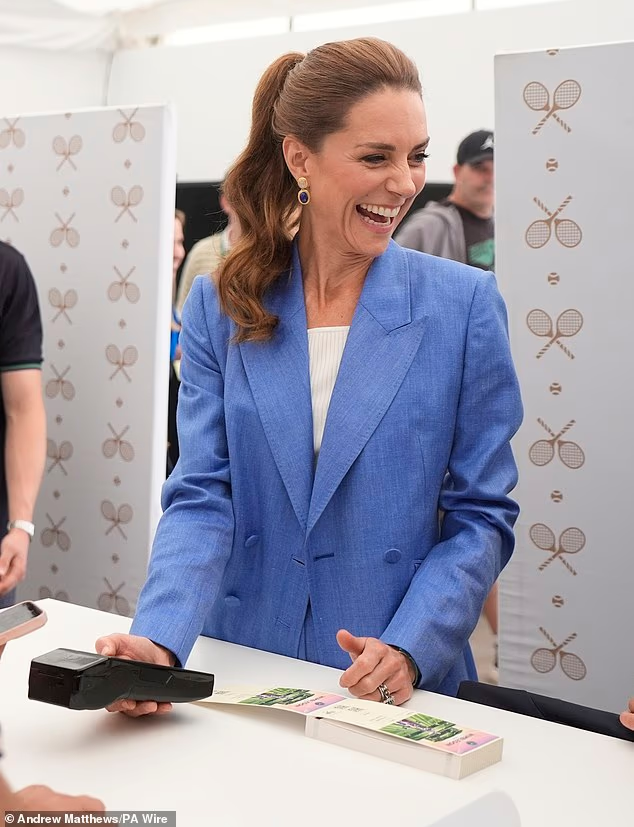
The Princess of Wales has wowed the Wimbledon crowds as she arrived at the Championships for the first time this year.
Catherine, 44, smiled as she chatted to members of the public who had joined the queue for Wimbledon tickets in the early hours of this morning.
Advertisement
She also helped out as she handed out grounds passes to tennis fans, some of whom had camped overnight in Wimbledon Park.
During her time at Wimbledon today, Kate is expected watch a match on one of the outer courts, alongside Tim Henman.
They will also be joined by chair of the All England Club Deborah Jevans.
Kate will also meet children from Shine Camera Club, a creative photography programme which supports children from disadvantaged backgrounds.
Advertisement
As a royal patron of the All England Lawn Tennis and Croquet Club since 2016, Kate is a regular fixture at the prestigious tournament.
She has attended most years since 2011, missing only 2013, when she was pregnant with Prince George, and 2020, when the tournament was cancelled due to the Covid-19 pandemic.
The Princess of Wales helps out in the ticket office on day four of the Championships
Advertisement
The Princess of Wales has wowed the Wimbledon crowd as she appeared at the Championships for the first time this year
As a royal patron of the All England Lawn Tennis and Croquet Club since 2016, Kate is a regular fixture at the prestigious tournament
Kate speaks to the crowds during her visit to the Championships today
It is unclear whether she will sit in the Royal Box on Centre Court today where third seed Iga Swiatek is due to take on Karolina Pliskova in the second round of the ladies singles.
Advertisement
This will be followed by young French star Arthur Fils, 20, who is taking on Italian player Matteo Berrettini.
Two-time Wimbledon champion Elena Rybakina will close out play on the show court with her match against American Caty McNally.
Kate’s appearance at the Championships today comes just days after she completed the gruelling Three Peaks Challenge on Saturday night.
She did the endurance event solo and was supported on the route by Mountain Rescue, with her family meeting her at the last stop at the base of Snowdon in Wales.
Advertisement
Kate was last at Wimbledon for the men’s final last year when she handed Jannik Sinner the Wimbledon trophy following an enthralling four-set final.
She was joined in the Royal Box today by her husband Prince William, eldest son Prince George and Princess Charlotte but Louis stayed at home.
The Princess donned her ‘Wimbledon bow’ – a brooch featuring the tournament’s iconic colours – which it’s believed she has worn every time she has visited Wimbledon.
Advertisement
Share or comment on this article:
Kate welcomes the real heroes of Wimbledon: Princess of Wales surprises fans in the infamous queue who waited for hours overnight to gain entry to SW19
Many people in the UK now use apps, smartwatches or wearable devices to track their physical activity. Fitness trackers promise to help users become fitter, happier and healthier versions of themselves. For many people, they can be useful: a nudge to move more, a way to notice patterns, or a reminder that activity does not have to happen in a gym.
But self-tracking devices do more than record behaviour. Through prompts, defaults, streaks, badges and automated feedback, they also shape it. There is good evidence that tracking can help some people become more active. But there are also growing reports of anxiety, shame and disordered eating among people who track closely.
This raises questions about how common these harms are and why they happen, which is what I have spent the past decade researching. Here are five reasons tracking can become harmful.
1. The fixation on steps
The 10,000-step target comes from a marketing slogan for a 1960s Japanese pedometer, and has no firm scientific basis as a universal target. Researchers continue to debate the ideal number, with some pointing to around 7,000 as a more realistic and beneficial target for many adults. Yet 10,000 steps remains widely treated as a badge of good health.
Advertisement
The trouble is that a single target cannot fit everyone. It can also distort what people think activity is worth. A tracker may misread wrist movement, or fail to capture cycling, swimming or strength training properly because these do not look like stepping.
This means trackers often privilege what they can easily count. Steps are visible, while strength work, mobility, Pilates, rehabilitation and recovery can appear less important, even though they may be exactly what someone needs. This can give users a skewed sense of what counts as worthwhile movement.
2. Movement loses its joy
The hardest part of becoming active is making it a habit that lasts. Chasing a target can work against that if it turns movement into a chore rather than something enjoyable. The point becomes closing a ring instead of noticing what your body can do.
Advertisement
Research suggests that repeatedly failing to meet goals can lead people to abandon both the device and the habits they were trying to build. Enjoyment helps habits stick, while external metrics can erode the internal motivation to move.
So the next time you head out, try leaving the numbers alone. Take a friend, put on a podcast, or call your mum. When you feel satisfied, go home. The activity still counts, and over time it may help you reach your goals without making the numbers the only measure of success.
3. The more-is-more approach
Many devices still make “more” feel like the default measure of success. The prompts are persistent, the summaries often feel like gentle reproaches, and the clearest currency is usually steps.
What this often misses is ability, skill and context. Do you know how much exercise you need? What kind of movement might cause injury? Can you interpret your own VO2 max data? These competencies are often taken for granted, but many people have never had the chance to build them.
Advertisement
Our research shows that people are most vulnerable to harm when they are left to manage with assumptions already made for them. They may hand their judgement over to the device and accept whatever it tells them. Yet the device may not know enough about whether you are recovering from illness, short on sleep, injured, newly active or pregnant to interpret today’s data safely.
4. The default user does not exist
Much of the design and marketing of these devices is aimed at a standard, average consumer. But research repeatedly shows that this person does not exist. We differ in our bodies, histories, goals and circumstances, so asking everyone to squeeze into the same mould is poor design.
The problem is the body imagined by the device: often able-bodied, non-pregnant, already confident with exercise and free to prioritise activity every day. Some defaults also follow narrow social norms, often built around male bodies, and amplify questionable ideas about health and beauty.
Think of BMI, which can penalise muscular bodies and treat perfectly healthy women’s bodies as problems to be solved. Similar assumptions can be baked into self-trackers when they nudge users towards weight loss by default or reinforce dated ideals about size and ability. At their worst, they can push some people towards over-exercising or under-eating, with real damage to body and mind.
Advertisement
5. It blames you when things go wrong
Sedentary living is a society-wide problem. Yet trackers often frame inactivity as a matter of individual willpower. That can draw attention away from the conditions that shape how much people move: safe streets, time, money, caring responsibilities, disability, local facilities and access to green space.
Many people report feeling pressure from the device. When life gets in the way of their targets, they may feel shame, failure, or give up altogether.
Research shows that people use these devices for a wide range of reasons and goals. That means support and personalisation are essential to making tracking safer. Devices should account for individual goals, experience and context rather than loading all responsibility onto the user, a familiar and unfair pattern across health and social care.
Some would call these harms unintended side effects. But they are also the predictable result of design choices that reward more, simplify health into scores and treat missed targets as personal failure.
Advertisement
For users, the first shift is to treat tracking as information rather than instruction. A watch can tell you what it has measured. It cannot tell you what your body needs today.
The bigger responsibility sits with developers. Trackers could place less emphasis on fixed step targets, make strength and non-step activity more visible, build in rest and recovery without guilt, and offer safer defaults for people with different bodies, abilities, health histories and goals.
None of this means abandoning the technology – it means refusing to let a made-up number decide whether movement has counted.
IT promises to be the biggest scrap in New York since Anthony Joshua was flattened in Madison Square Garden.
Or the titanic tussle between Muhammad Ali and Joe Frazier in the ‘fight of the century’ back in 1971. And the fight to see who can land the knockout blow, will captivate football fans around the world.
Erling Haaland will be in the Norwegian corner. Looking to take down his hated rival from Brazil, in the shape of Gabriel in the yellow one.
Let’s hope no punches will be thrown this time, like the ones Andy Ruiz landed on Joshua to produce one of the biggest upsets in boxing history. But the verbal ones that have been exchanged between footballing heavyweights Haaland and Gabriel in recent times, have been damaging enough. It’s safe to say there is no love lost between these two.
The feud started in the 2024/25 season, when Haaland scored a late equaliser for Manchester City against Arsenal, then three the ball at the back of Gabriel’s head.
“What happens on the football pitch stays there,” said Haaland. “That’s just how it is. It’s a battle, a war, so it’s normal to have provocative acts in football. It’s part of the game.”
The Arsenal man was furious however and Gabriel said he would be ‘waiting” for Haaland in the return fixture at the Emirates. He then celebrated like a mad man in Haaland’s face when Arsenal thumped Pep Guardiola’s side 5-1.
“I did it (the celebration) because he threw the ball at my head, to provoke him the way he provoked me. The moment we scored, he was right next to me, so I went straight to shouting in his ear.”
A seismic spat had been spawned.
Advertisement
Haaland continued it last season, singing “oh sometimes, I get a good feeling’ into the TV cameras after City had secured a huge 2-1 win over Arsenal at the Etihad. During the game, Gabriel had attempted to headbutt the City striker as things reached boiling point between the pair. He escaped a sending off when referee Anthony Taylor booked the pair instead and Haaland believed that his reaction saved his rival.
“I think it’s a red card,” he said post-match. “I think most agree with me. If I go down like any other guy, it’s a red card. It’s not something I would do. My father taught me to stay on your feet.
Advertisement
“That’s the reality. Should I have gone down? Maybe. Then it would’ve been easier. But I didn’t.”
Ultimately, Gabriel waited until the end of the campaign before responding.
And he hit hard, posting a video of himself lifting the Premier League trophy to background music of the same Flo Rida song Haaland had sung a few months ago.
Content cannot be displayed without consent
The intense rivalry had now migrated from the pitch to social media. And now the footballing gods have decided to bring them back together again. This time face-to-face in New York, when the winner will book a place in the World Cup quarter finals – and the loser will go home.
Advertisement
The script is one Steven Spielberg himself might be proud of. A sporting blockbuster, being played out in the Big Apple instead of Hollywood.
Haaland heads into the contest in prime shape. He has scored five goals in three games, and is hot on the heels of Lionel Messi in the race to win the Golden Boot.
Haaland has also found the back of the net in his last 13 competitive games, scoring 25 in total.
But Gabriel remains the rock around which Brazil’s defence is built. He might have missed the penalty which cost Arsenal the Champions League title in Budapest last month, but he has showed no signs of bringing a hangover to North America.
Whether Haaland likes it or not, Gabriel is one of the best centre backs on the planet. But then again, Haaland is one of the best strikers. If not THE best.
So buckle up to witness the collision between the irresistible force and immovable object. Something will have to give.
And the chances are that whoever blinks first, will get to hear about it from the person who made him do it.
Advertisement
Content cannot be displayed without consent
Join our new WhatsApp communityand receive your daily dose of Mirror Football content. We also treat our community members to special offers, promotions, and adverts from us and our partners. If you don’t like our community, you can check out any time you like. If you’re curious, you can read our Privacy Notice.
Their investigation concluded that the cause of last Friday’s crash was “personal reasons,” according to a statement posted on social media by Beijing’s Chaoyang district government.
The pilot, a 66-year-old man, died and 13 other people were injured. None of the injuries are life-threatening and one of the injured has been discharged, the government statement said.
The crash, which happened in a downtown skyscraper district as people were leaving work around 6 p.m., raised questions about security in the Chinese capital. It left a hole in the glass facade of the 108-story CITIC tower, nicknamed the “Zun” building because it mimics the shape of an ancient wine vessel of that name.
Advertisement
The pilot, identified only by the surname Liu, first flew with someone else in the two-seat training plane, then took off on a solo flight from a general aviation airport in the outskirts of Beijing, the Chaoyang statement said. He deviated from the planned flight path and contact with him was lost, it said.
Liu had no fixed job, was divorced and lived alone, according to the statement. He had insomnia and anxiety and his diary had multiple references to ending his life, it said.
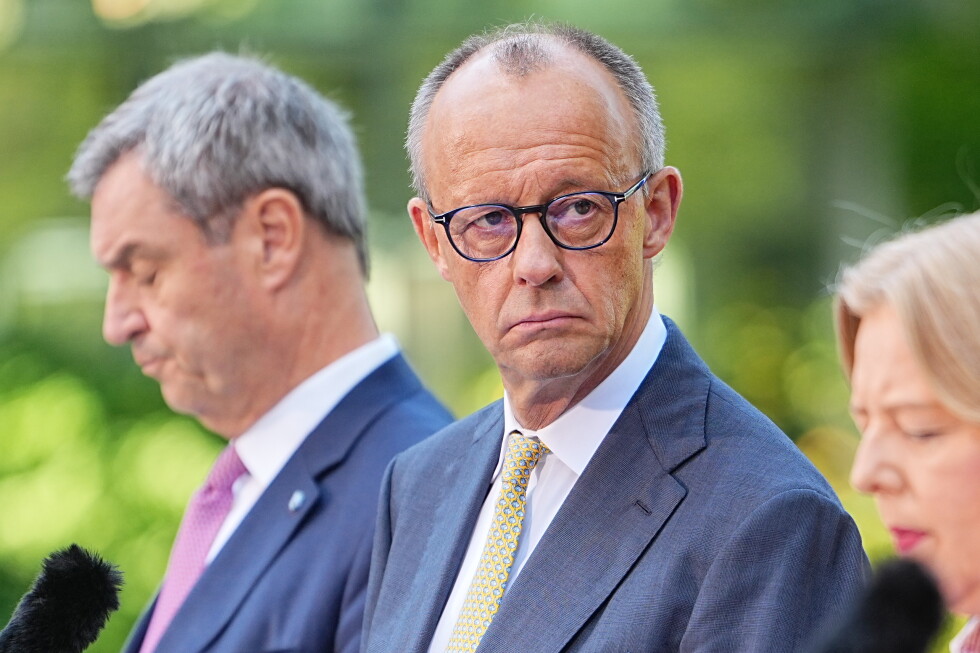
BERLIN (AP) — German Chancellor Friedrich Merz and his government coalition partners presented a comprehensive reform package Thursday with the goal of getting the country’s sluggish economy back on track.
The 34 reform measures include an income tax reform with tax cuts for low- and middle income families, an overhaul of the creaking pension system, tougher rules for employees’ sick leave and a reduction of the country’s stifling bureaucracy.
“These reforms all have one goal: We’re setting out into the future,” Merz said Thursday. “We’re strengthening ourselves so that we can live well in these new times.”
Merz’s coalition of center-right and center-left parties took office just over a year ago with pledges to reform and turn around Germany’s sluggish economy, Europe’s biggest. It has since become deeply unpopular, in part because of perceptions that it has squabbled but so far achieved little.
Advertisement
Merz is trying to cut his government coalition free from that negative reputation.
“From the very beginning, we set an agenda with a single goal in mind: We want to get Germany back on track. It is now clear that this is possible,” the conservative chancellor said.
Germany’s economy returned to modest growth last year after shrinking for two years in a row. The government expects underwhelming growth of 0.5% this year, a figure that has been pushed down by the fallout from the war in Iran.
The country of 83.5 million people already faced increasing competition from Chinese companies, higher energy costs following Russia’s full-scale invasion of Ukraine and issues including U.S. President Donald Trump ’s tariffs and trade threats. On top of that, it has deeper problems such as high production costs, lagging private investment and increasingly costly health and pension systems caused by an aging population.
Advertisement
On Thursday, the government coalition leaders said that the tax cuts, once fully implemented in 2028, would give an annual tax break for a family with two working parents, two children and a total taxable income of 60,000 euros ($64,416) of up to more than 600 euros. The total tax relief provided by the reform amounts to approximately 10 billion euros per year.
The pension system reform would include raising the retirement age gradually in line with life expectancy. The coalition leaders said they would implement the recommendations presented by a government-mandated panel of experts and politicians last month to stabilize the pension system. The aim is to prevent the level of pensions from falling and ward off the need for a big, long-term increase of the levy employees pay into the pension system.
Advertisement
Sign up for Morning Wire:
Our flagship newsletter breaks down the biggest headlines of the day.
Advertisement
The tougher rules for sick leave would no longer allow employees to call in sick to work for up to three days without seeing a doctor or call up the doctor and ask for a sick leave letter of one week without actually seeing the doctor. Instead, employers would be able to ask for a doctor’s certificate from the first day a person is on sick leave.
Merz had repeatedly complained that the rate of sick leave is too high in Germany and harming the country’s productivity.
When it comes to Germany’s runaway bureaucracy, various reporting and documentation requirements are to be eliminated, and data protection is to be reduced to the European minimum, the government said, adding that there would also be less red tape when it comes to filing tax returns.
Merz appealed to all Germans to support the reform package.
Advertisement
“We know that you, ladies and gentlemen — the citizens of our country — want decisions, and you don’t want conflict. And that is exactly what we have delivered,” he said at the chancellery’s garden in Berlin as the reforms were presented to the public.
“Join us; support us in carrying out the reforms that are now necessary.”
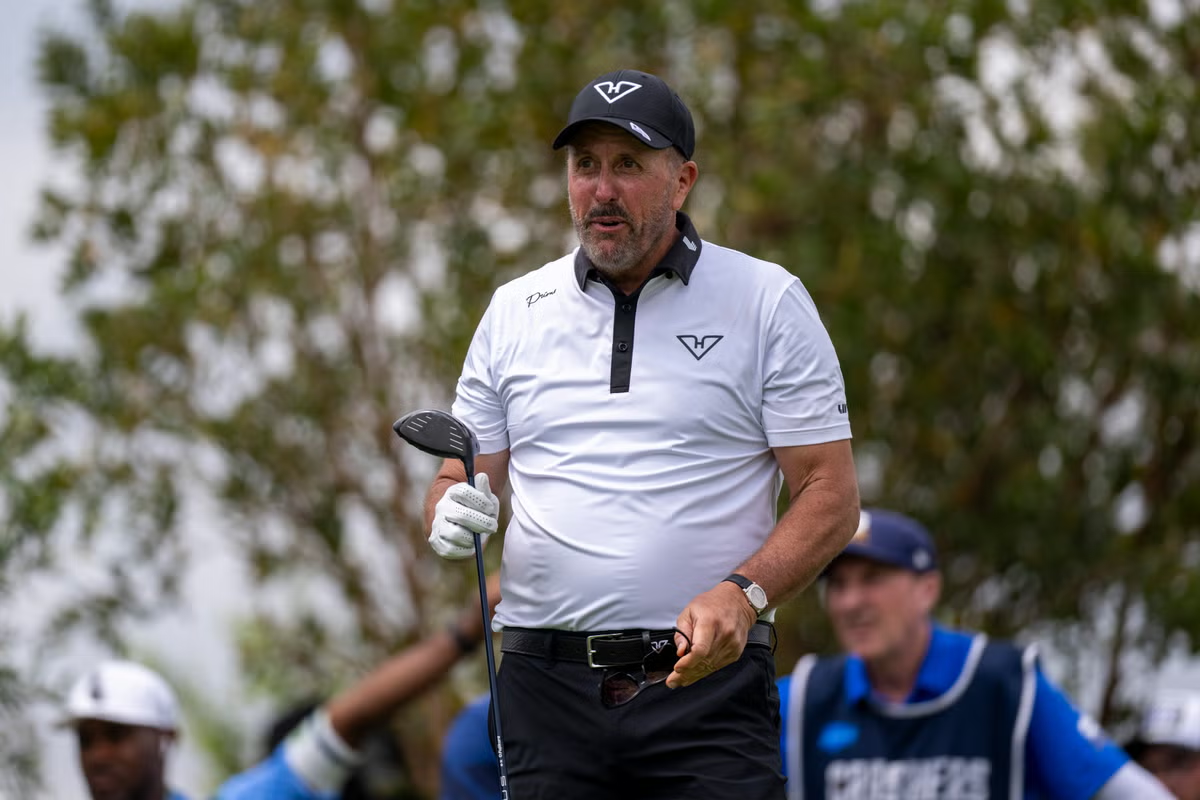
Phil Mickelson has forcefully denied allegations of inappropriate behavior toward women after a report claimed he was no longer welcome at several exclusive golf clubs.
In a statement issued Wednesday to the New York Post, representatives for the six-time major champion dismissed the allegations published by Skratch Golf as an “anonymously sourced drive-by shooting” designed to create “a compelling, click-bait narrative over an accurate one.”
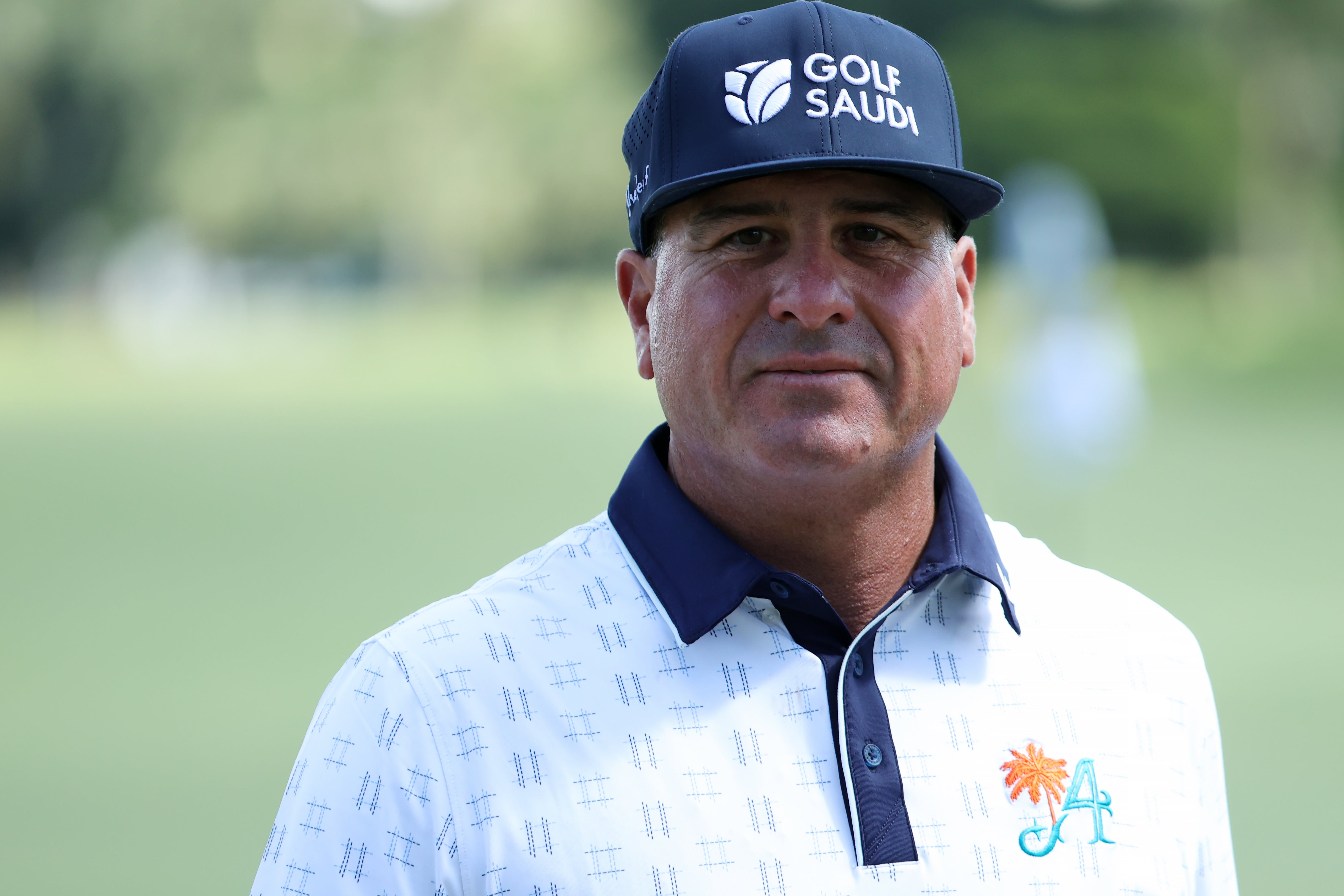
The denial follows a Skratch Golf investigation alleging that Mickelson was barred from three California golf clubs for his conduct. The report also cited claims from Ashley Perez, the former wife of golfer Pat Perez, who alleged Mickelson showed her a nude photo of himself in 2015 and suggested she visit him after her husband had gone to sleep.
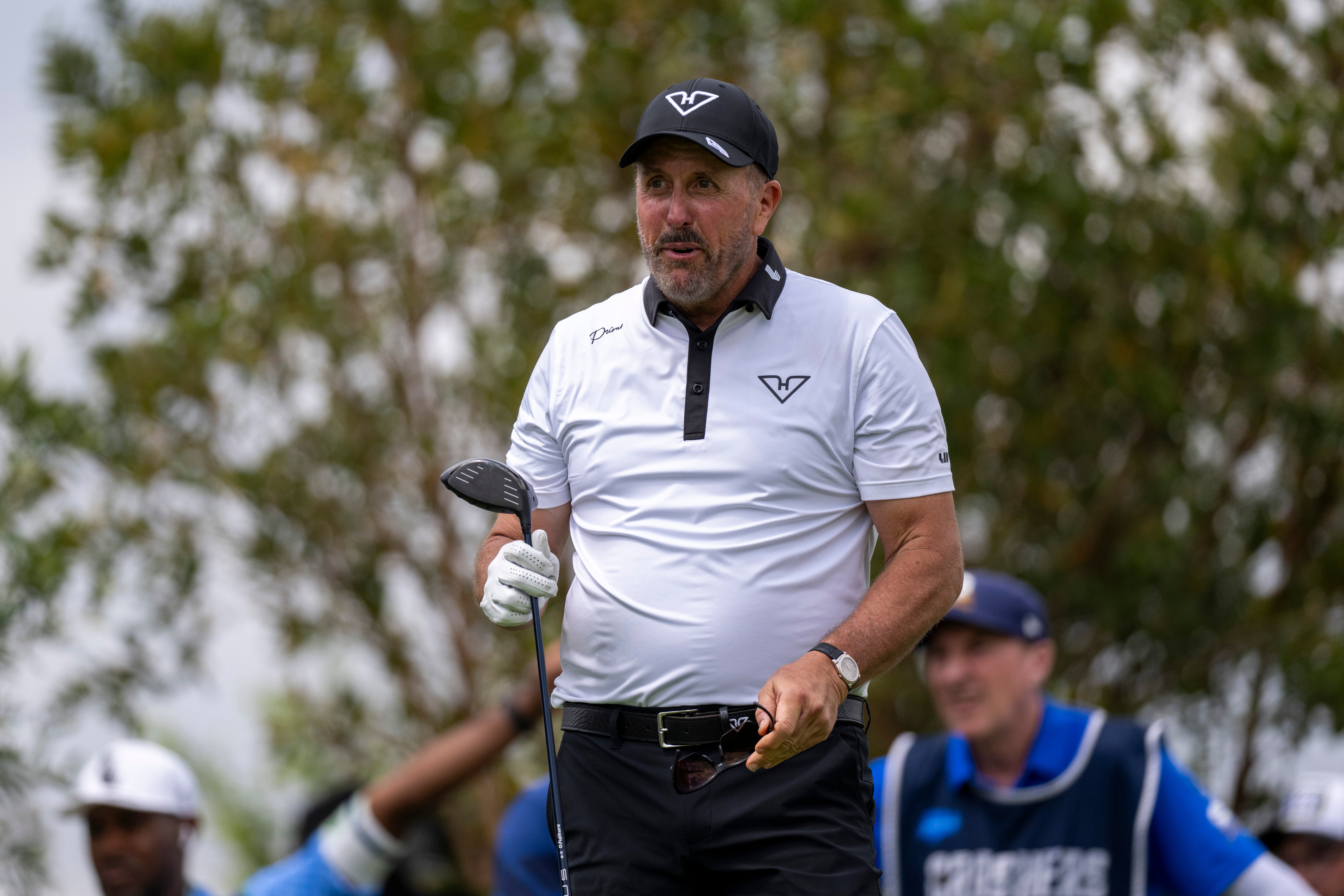
Phil Mickelson of Hyflyers GC plays his shot from the fifth tee during day two of LIV Golf South Africa at The Club at Steyn City on March 20, 2026 in Johannesburg (Getty)
The allegations came weeks after Golf Digest reported that Mickelson’s membership at The Farms Golf Club in Rancho Santa Fe had been revoked over alleged nonconsensual and inappropriate physical contact with a female club employee.
Skratch also reported, citing anonymous sources, that Mickelson is no longer welcome at The Madison Club in La Quinta and The Bridges at Rancho Santa Fe, and alleged his wife, Amy Mickelson, played a role in the decisions.
Advertisement
Mickelson’s representatives denied the claims, saying, “Mr. Mickelson has never been expelled from a golf club. His membership has never been revoked by a golf club. Those decisions were his alone.”
Pat Perez of 4Aces GC walks from the seventh green during Day Two of the LIV Golf Invitational – Miami at Trump National Doral Miami on October 21, 2023 in Doral, Florida (Getty)
His team also disputed Skratch’s account of his interaction with Ashley Perez, adding that while Mickelson had apologized for his conduct, “that should not be misconstrued as an admission of every allegation made against him.”
The statement further noted that Skratch is affiliated with the PGA Tour, which Mickelson left in 2022 to join the rival LIV Golf circuit, suggesting readers should consider that relationship when evaluating the report.
Skratch editor-in-chief Ben Boskovich rejected the criticism, telling the Post that Mickelson and his representatives were given an opportunity to respond before publication but declined. He said the outlet “stands by its reporting.”
Mickelson, 56, is one of golf’s most accomplished players, with six major championships and 45 PGA Tour victories.
When you’re hungry, it’s normal to find yourself thinking about what you’re going to eat next.
But for some people, thoughts of food and eating can feel constant – even when they’re not physically hungry. This experience has been termed “food noise”.
For someone who struggles with food noise, this might mean thinking repeatedly about the next meal, feeling distracted by snacks in the house or finding it hard to ignore food cues such as adverts or supermarket displays. The experience can be exhausting.
But food noise should not be taken to mean that every thought or craving for food is a problem. Hunger, fullness, cravings, anticipation of eating and pleasure from food are all normal parts of our appetite system.
Advertisement
The goal for people who struggle with food noise should not be to eliminate all food-related chatter from their lives. Rather, it’s about reducing the harmful thoughts about food that are persistent, intrusive, distressing and disruptive.
So, food noise is not one single thing. Two people may both report experiencing “food noise”, but the underlying causes may be different.
For one person, food noise may reflect an internal hunger signal after skipping a meal. For someone else, it might be food cravings triggered by stress or tiredness. And for yet another, it may feel closer to distressing, intrusive thoughts or a fear of losing control over eating.
Advertisement
While it’s common to experience food noise, it becomes concerning if it starts to interfere with daily life. It may make it harder to concentrate, increase anxiety or shame around eating and leave people feeling as if they are constantly battling food thoughts.
Food noise can make it difficult to ignore the lure of supermarket displays and food adverts. Nicoleta Ionescu/ Shutterstock
Although research on the effects of food noise is limited as the concept is quite new, research on food cravings, cue reactivity and food thought suppression suggests these experiences can make it harder for some people to avoid overeating. In more serious cases, they may be linked with loss of control, binge eating or wider eating-related distress.
Reducing food noise
GLP-1 medications, such as semaglutide (Wegovy) and tirzepatide (Mounjaro), have become linked with the concept of food noise.
Scientifically, these drugs are shown to reduce hunger, increase fullness, reduce cravings, alter food reward and improve control over eating.
Advertisement
Anecdotally, many people taking these drugs report that they help reduce food noise. Food feels less demanding, less urgent and less mentally intrusive. For those taking these medications, a reduction in food noise may feel like a major improvement in their quality of life.
Food cravings can also intensify when dieting – at least in the short term. Cravings may be especially strong if someone skips meals, eats too little, cuts out favourite foods completely or uses very rigid food rules.
Trying not to think about certain foods can also sometimes make them more mentally prominent. This is one reason very strict diets can make appetite feel harder to manage.
But experiencing hunger or food-related thoughts doesn’t automatically have to be something negative. Hunger is not a defect. It’s one of the body’s normal biological cues, helping us recognise when we need energy.
Advertisement
This is also why the return of some food noise is not necessarily something to fear when GLP-1 medications are reduced or stopped.
The aim then, shouldn’t be to silence appetite or food noise completely. Most people don’t want a life in which they never feel hungry or fully enjoy their food. Eating is part of culture, identity and daily life.
A better goal is for appetite to feel manageable, so food can be enjoyed without taking up too much mental space. So if you’re someone who finds food noise feels too loud, here are some things you can do:
Identify the signal before reacting to it. Are you physically hungry, craving something specific or reacting to food cues around you? Hunger usually builds gradually and can be satisfied by a range of foods. A craving is often more sudden, specific and tied to a particular food. Different causes need different responses.
Reduce unnecessary food cues. If having snacks in your house makes food thoughts more intrusive, keeping those tempting foods out of sight or planning your meals before shopping may reduce avoidable triggers.
Pay attention to your emotions. Food noise can be linked with stress, anxiety, tiredness, loneliness or needing comfort. In such instances, what the body and mind might really need may not be food. Other coping strategies, such as rest or taking a short walk, may be more useful.
Physical activity may help reduce craving for unhealthy foods, reduce stress and improve mood. Being active may also make your hunger and fullness signals easier to interpret. This means that exercise can not only help you manage food noise in the short-term, it may also gradually improve your appetite system’s function over time.
Seek support if food thoughts become distressing or disruptive. If they’re linked with binge eating, shame, anxiety, loss of control or major disruption to daily life, speaking with a GP, dietitian, psychologist or eating disorder specialist can help you understand your eating patterns and develop safer coping strategies.
Food-related thoughts are part of a healthy, normal appetite system. Learning to detect, interpret and respond in tune with internal appetite signals is key for sustainable weight management.





















































You must be logged in to post a comment Login