Indian serial entrepreneur Bhavin Turakhia is making a $30 million personal bet that there is still room for another enterprise AI company. His new venture, Neo, is built on a simple premise: workplace software designed before the AI era cannot simply be upgraded with chatbots — it has to be redesigned from the ground up.
Turakhia, 46, is no stranger to ambitious enterprise technology bets. Over the past two decades, he has co-founded companies including Directi, Radix, Titan, and banking software firm Zeta, largely backing them with his own cash before bringing in outside investors. He’s doing the same with Neo.
Turakhia told TechCrunch he is bootstrapping this much money because he believes AI marks a technology shift significant enough to justify rebuilding workplace software from scratch.
“If you want to build an iPhone, you can’t take the parts of a Nokia and somehow convert it into an iPhone,” he said.
Advertisement
Launched internally in April this year, Neo is an enterprise work platform that combines project management, documents, file storage, and AI into a single product. The goal, Turakhia said, is to make AI an active participant in day-to-day work rather than just another assistant employees turn to separately.
Turakhia argued most incumbents face a structural disadvantage when adding AI to products designed before generative AI. Neo, he said, was designed from the ground up for AI and is model-agnostic, allowing enterprises to switch between AI models rather than being tied to a single provider.
He’s not alone in thinking this way. Investor Chamath Palihapitiya initially launched enterprise AI coding venture 8090 with his own capital before raising a $135 million funding round this week.
Still, Turakhia’s bet comes as enterprise AI has emerged as one of the most competitive areas in technology. Microsoft, Google, and Salesforce are embedding AI across their workplace software. Meanwhile every startup from the giant labs like Anthropic and OpenAI, to the productivity companies like Notion and Superhuman are racing to reshape how businesses use AI in their daily workflow.
Advertisement
Turakhia argued enterprise software has never been a winner-takes-all market, saying even a small share of global enterprise AI spending would represent a sizeable company.
“Even if we end up with 2% to 5% market share, that’s larger than anything I’ve built so far,” he said.
For the past few months, Neo has been in internal use across Turakhia’s companies, including Zeta. The company plans to begin rolling out the software to mid-sized businesses in the coming months, initially targeting knowledge workers across technology, consulting, and professional services firms.
Turakhia said Neo’s initial platform was built in three months, with AI extensively used in the development process, work he estimates would have taken more than a year with a much larger engineering team before generative AI.
Advertisement
The Bengaluru-based startup currently employs about 45 people, including 18 engineers. Turakhia told TechCrunch that it expects to grow to around 100 employees by the end of the year, with most new hires focused on AI and software engineering.
When you purchase through links in our articles, we may earn a small commission. This doesn’t affect our editorial independence.
Earlier this year, shares of traditional SaaS companies tumbled amid investor fears that software built with AI could eventually displace those businesses. Despite such concerns, Bending Spoons, a company that acquires and revitalizes stagnating but well-known tech firms, saw its shares surge in its market debut.
It closed at $40.50 on Wednesday, nearly 40% above its $29 IPO price. At that price, the 13-year-old Milan, Italy-based company has a market capitalization of $25.7 billion, more than double its last private valuation of $11 billion. The company raised $1.68 billion in its offering.
Bending Spoons has grown rapidly by acquiring aging, but once popular, brands like AOL, Eventbrite, Evernote, Meetup, and Vimeo, then turning them profitable, typically through aggressive cost-cutting, launching new features, and raising prices. While the company’s approach is similar to private equity, there is one key difference: Bending Spoons has no plans to sell these businesses.
The company’s disclosed financials show it has indeed turned its growing portfolio of assets profitable. Bending Spoons reported $601 million in revenue for Q1, generating $27.4 million in net income. That’s a significant turnaround from the same period last year, when the company reported a $112 million net loss on $259 million in revenue, according to the SEC filing.
Advertisement
Bending Spoons, whose name comes from a scene in the science-fiction movie “The Matrix,” generated the majority of its revenue from subscriptions, which accounted for 84% of its business last year.
Before the offering, Baillie Gifford was Bending Spoons’ largest outside shareholder, followed by smaller stakes from buyout fund Renaissance Partners, Cox Enterprises, Durable Capital Partners, Fidelity, and T. Rowe Price.
The IPO also represents a significant windfall for Bending Spoons’ five co-founders: Luca Ferrari, Francesco Patarnello, Matteo Danieli, Luca Querella, and Tomasz Greber.
Besides Bending Spoons, other investors follow the strategy of acquiring, fixing, and holding stalled software firms, often referred to as “venture zombie” companies. These firms include Constellation Software, Curious, Tiny, saas.group, Arising Ventures, and Calm Capital.
Advertisement
When you purchase through links in our articles, we may earn a small commission. This doesn’t affect our editorial independence.
[Brian] had an absolute monster of a PCB with thousands of nets to be routed, the kind of design that stopped traditional routers in their tracks. It would take months to route by hand, likely trying the patience of a saint in the process. To solve this specific problem he created OrthoRoute, a GPU-accelerated autorouter that he cautions is no more trustworthy than any other autorouter, but at least it’s fast!
A closeup of an extremely high-density board routed by OrthoRoute.
A KiCad plugin, OrthoRoute is so named because traces are laid down in a Manhattan lattice, a grid of orthogonal segments. All components (surface-mount only, no through-hole stuff) go on the top layer of the PCB, and all lower levels contain a grid of traces, connected as needed with blind and buried vias to route everything. OrthoRoute takes a structured and iterative approach, eventually converging on a satisfactory layout.
How does OrthoRouter actually decide how to connect things? [Brian] adapted PathFinder, an algorithm designed for routing FPGAs. Laying out a grid of orthogonal traces and punching down through them with vias to make connections has a lot in common, conceptually, with routing FPGAs. GPU acceleration makes the whole thing far more efficient than pipelining the calculations through a CPU.
OrthoRoute was built to solve a very specific problem, but in the process showed that GPU-accelerated routing is definitely feasible. Check it out in the videos, embedded below the page break.
[Brian] cautions that as-is, OrthoRoute is useful to maybe a handful of people at best, but as a KiCad plugin it’s highly modular and the hard parts are all done. If you want a closer look, or have some ideas about how to repurpose or extend it, check out the GitHub repository.
I’ve been low-key obsessed with Darren Aronofsky’s AI-drenched video project On This Day…1776 since it landed out of the blue on YouTube in late January.
As a narrative, the ongoing series of short videos tracks select events throughout the United States’ birth year, when the outcome of the looming revolution was truly precarious. As a Hollywood-adjacent initiative, it’s also meant to be a proving ground for what creative professionals might be able to accomplish with generative AI tools that are evolving by leaps and bounds.
Through the first half of 2026, and especially as we’ve closed in on the country’s 250th anniversary on July 4, what has emerged has been an increasingly surreal blend of technical ambition, snapshot patriotism and a penchant for the grotesque.
Advertisement
It’s that TV show that you’re sure is the worst thing ever, but you can’t stop hate-watching because you want to see what weird twist comes next. And some of it is truly bonkers.
Produced by Aronofsky’s AI-centric Primordial Soup studio and promoted by Time Studios, On This Day…1776 drew a burst of media attention — and backlash — with the simultaneous debut of its first two episodes. People hated it simply because it was heavily AI-generated. The flaws in the execution were all too apparent. It was a betrayal of the humanity of Aronofsky’s own films. As much as I tried to be open-minded, I couldn’t help but sum it up as “a hellish broth of machine-driven AI slop and bad human choices.”
For a while, it seemed like the criticism had been too much to bear and the project had been shelved. Time Studios had promised weekly episodes, but nearly a month went by before the third one dropped. (No splash — it simply appeared on the YouTube page, as every episode has done since.)
Advertisement
On This Day…1776 serves up many encounters with a distinguished Gen. George Washington. His dream sequence is not one of them.
Primordial Soup via YouTube/Screenshot by CNET
It seemed to have fallen off everyone’s radar. The initial episode garnered 199,000 views — not exactly a viral sensation, but not nothing. The four episodes from mid-May to mid-June each have under 2,000 views as of this writing.
For every episode since the start — 11 so far, most well under five minutes long — a handful of those views are mine.
Like I said, I’m obsessed. My compulsive viewing has centered on three things: whether the series could meet the weekly schedule (hard fail), how it presents the history (wacky, and getting wackier) and how the AI looks (often impressive, often dubious).
Advertisement
In May, speaking about the 1776 project at the Cannes Film Festival’s AI Summit, Aronofsky said this: “I encourage you to watch it because it’s an experiment to see how it’s gonna progress.”
Challenge accepted.
Before I get into those particulars, though, let me also say that regardless of my judgment of this one series, this isn’t a referendum on AI video as cinema or its general place in the arts. Whether you like it or not, generative AI is on the verge of becoming a fixture in movie-making, from storyboarding to providing the settings and scenery around human actors to creating full-on featurefilms.
I’m here to look at whether On This Day…1776 is succeeding or failing on its own terms. The series is a given, and I’m here to review it as I would any other show, like, for example, Widow’s Bay. What is the story that it’s telling? And is it telling that story well?
Advertisement
AI meets the Great Man of History theory
On This Day…1776 is not your high school American history class. Textbook it is not, even if it has more than a few stodgy, leaden moments.
It does — as promised — work through 1776 in chronological order, hitting some greatest-hits moments, including the fledgling Continental Army scaring the British fleet out of Boston Harbor, while often digging up deep cuts that don’t have specific dates attached to them, such as the forced recruitment of German villagers into the Hessian army. It cheats a bit with the calendar, though. The March 5: Massacre Day episode focuses on the Boston Massacre, even though that bloody event happened six years earlier. (It also didn’t appear on YouTube until March 17, a date that was actually significant in 1776 because it marked the fleet’s departure.)
Talk about a jump cut. One second, these 18th-century French government ministers and their table and chairs are in a palatial drawing room. The next, they’re at sea amid a fishing crew and their catch.
Advertisement
Primordial Soup via YouTube/Screenshot by CNET
There’s a global perspective woven into the series. We see the developments throughout that year from multiple angles: American revolutionaries, British soldiers, French royalty, Hessian mercenaries. Extended sequences are spoken in French and German — with subtitles — or with a tangy Scottish accent. (The production takes pains to point out that SAG-credentialed human voice actors handle the dialogue. Other humans involved include writer, director, editor and composer, all of whom are credited at the end of the each episode, starting with the fourth.)
It’s got an ensemble cast that’s largely a Great Men of History parade: Ben Franklin, Thomas Jefferson, Thomas Paine, George III, John Adams. If there’s a lead character, it’s George Washington, who was a towering and central figure in 1776. A rare exception is the curiously two-episode saga featuring an unfortunate, unknown German conscripted into the Hessian ranks just after his wedding.
We spend time with Betsy Ross in the Flag Day episode (which landed a few days late), but she has no lines. She’s too busy sewing.
“Mindblowing” improvements, Aronofsky says
In his May comments at Cannes, Aronofsky called the production advances from January to the April 29 episode (the sixth one, and the most recent at that moment) “mindblowing.” It wasn’t just the AI models getting better, he said, but also the Primordial Soup pipeline and the unspecified artists working on the project.
Advertisement
I’m not convinced. Maybe it’s more of a back-end thing, as the production team gets more comfortable with the tools. But on the business end, where I’m watching? Sorry, no.
Faces remain inconsistent from both scene to scene and from frame to frame within the same scene. Ben Franklin looks a little more doughy, then less so; a little older, then a little younger. Lip sync is also maddeningly off almost all the time, like a badly dubbed foreign film. The historical figures still feel too much like props: Washington striding into a room feels staged, not lived. And there’s often a plasticky quality to the images.
A frustrated and high-strung John Adams vents his anger in a bowl of water. The historical record is silent on his feelings about the use of generative AI tools in the creative process.
Advertisement
Primordial Soup via YouTube/Screenshot by CNET
There’s a constant feeling that Primordial Soup is showing off: Look at the macro detail in this fabric! Watch someone blow picture-perfect bubbles! It’s technically impressive, but also wicked distracting. Time Studios refers to On This Day…1776 as an “animated series,” which feels like an odd description given its relentless pursuit of photorealism.
Yet somehow the more recent episodes do feel improved in a way that’s hard to pin down.
Episode 10, the Betsy Ross one, has a stirring montage of red, white and blue flag threads forming and reforming into Uncle Sam, Amelia Earhart and her airplane, the moon landing, the flag raising at Iwo Jima, an elephant and donkey facing off, Jimi Hendrix, Arlington Cemetery. It feels like something you’d see on the Jumbotron at a political rally. It’s one of the most impressive sequences in the series so far.
I think it’s confidence. The Primordial Soup team seems to be feeling more and more empowered to get weird. To indulge their inner David Lynch. To move beyond diorama history and toward a specific vision, however demented.
Advertisement
One of the early episodes gave us George Washington having a bad dream, playing out the misgivings that he really did record in private correspondence. As he’s getting ready for bed, we get an all too vivid look at his false teeth. In the extended dream sequence, a musket ball hits him squarely in the forehead, lingers a moment and falls off.
That Boston Massacre callback? It’s done in a vertical video format, as if someone had recorded the episode on a smartphone. That’s hardly the only anachronism. In later episodes, we get glimpses of “Join or die!” spray-painted on a statue, and in another, a call for “No more kings.”
Trippy and getting trippier
The April 29 episode was trippy from start to finish. An account of debates within France’s ruling class over whether to aid the American colonists, it opens with a tracking shot of a housefly zipping through palace rooms before it’s finally swatted onto a map with a gruesomely comic flourish. In another scene, a fish flops across a table in front of a dismayed royal. Bewigged ministers debating in a palace room suddenly find themselves aboard a ship on a roiling sea, table and chairs included. (The episode ends with a guillotine beheading. Whee!)
The June 5 episode gives us a stressed-out John Adams who is perilously close to being a clone of Larry from the Three Stooges.
Advertisement
It’s touch and go for a while in a cartoon battle between Declaration of Independence author Thomas Jefferson and England’s King George III. When Jefferson — and the Declaration — eventually win out, the crowd chants “USA! USA! USA!”
Primordial Soup via YouTube/Screenshot by CNET
But nothing prepared me for the newest episode, which dropped June 30 as I was wrapping up this review. It is, I kid you not, rendered in a thoroughly 21st-century anime style, complete with a garish WWE-style showdown between Thomas Jefferson and George III as Jefferson wrestles with the soul-stirring phrases that would make the Declaration of Independence the defining document of the American experiment. Your high school history teacher probably never paired “We hold these truths to be self-evident, that all men are created equal” with:
George III: “Kneel before your king!” Jefferson: “Kneel before this, bitch.”
Advertisement
In this episode, as in the real events of history, Jefferson does get the last word, and the W.
On This Day…1776 is less a history lesson than a work of historical fiction, staying largely faithful to the real people and events while never hesitating to veer off in service of the story it wants to tell. It’s a costume drama that’s still getting comfortable in its breeches, buckle shoes and tricorne hat, a period piece eager to prove its relevance to the present day.
Unfortunately, there are many, many unanswered questions about how much of what we’re seeing is the unvarnished product of the AI tools themselves (how elaborate the prompts must be!) and how much is the work of the human artists and technicians using them. Is an episode’s director an auteur or a spectator? What goes into the post-production process? Where is the line between human creativity and AI automation? Will it ever be more than glorified slop?
Advertisement
On This Day…1776 stumbles and falters repeatedly. And while it may never win over the large “AI-isn’t-art” camp, its better moments are aren’t half bad.
Not every experiment succeeds. But maybe, hopefully, we learn something along the way.
Last September, Denmark was gripped by a spate of drone sightings near airports. It’s familiar territory for Hackaday, as we reported on a similar drone panic saga at British airports back in the last decade. Back then the British police dragged their feet and hid behind secrecy laws for years to avoid admitting they overreacted, but it seems in Denmark they do things differently (Danish language, Google Translate link.).
The Danish police in Jutland have rolled back their report, and noted that a reported observation alone is not enough to confirm a drone was present. It’s not confirmed why they’ve taken this step, but we’ve been told that there’s been an effort within the drone community to identify possible aircraft flight paths which could have resulted in a false drone sighting at the times in question.
We welcome this correction, and hope that its important message travels widely. Of course it is the right thing to do for a police force to take drone reports seriously, but overreacting as the British police did is of little help. We commend the Danish police for taking this step, and we’re likely to trust any drone reports from them a little bit more in the future. If you’d like to read our plea for a sensible response at the time, it’s here.
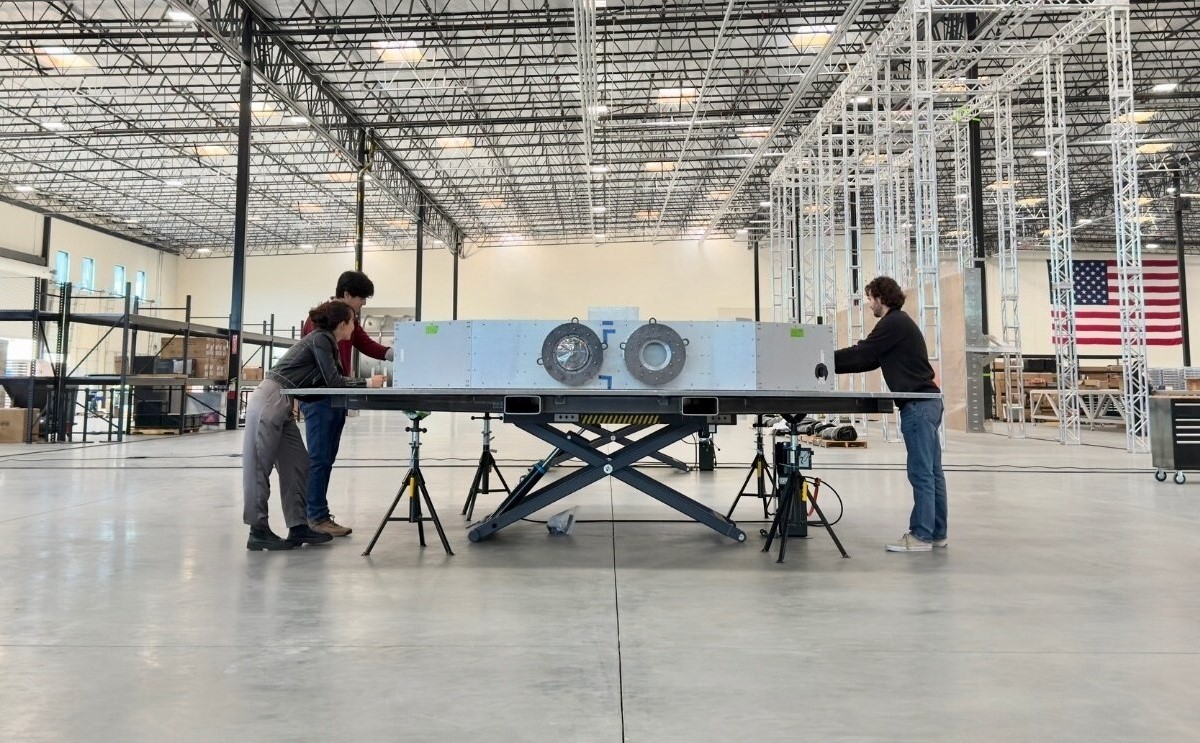
Engineers prepare a high-power satellite for testing at K2 Space’s manufacturing facility in Torrance, Calif. (K2 Space via PRNewswire)
California-based K2 Space is establishing a satellite engineering hub in the Seattle area, adding to a thriving regional ecosystem of satellite ventures.
The Pacific Northwest operation will support the company’s drive to build large, high-power satellites for government and commercial customers. The satellites are manufactured at K2’s factory in Torrance, Calif. The company also maintains a policy and strategy office in Washington, D.C.
Since its founding in 2022, K2 Space has raised more than $500 million in capital and registered more than $1 billion in contracts. While many satellite companies focus on miniaturization, K2 Space is going big on satellite mass and power. K2 had its first “mega-class” satellite, dubbed Gravitas, launched into orbit on a SpaceX Falcon 9 rocket in March. The two-ton, 20-kilowatt satellite carried a dozen undisclosed payload modules for multiple customers, including the Department of Defense.
“As we carefully evaluated our expansion plans to align with our next phase of growth, the Seattle area was a natural fit, given its decisive reputation as an aerospace and engineering hub,” K2 Space CEO and co-founder Karan Kunjur said in a news release. “From flight software and autonomy to the low-level systems that drive our satellites’ most demanding workloads, our Seattle team will contribute to satellites operating at the edge of what’s possible.”
Advertisement
K2 Space currently has more than 300 employees, and several employees are already working in the Seattle area on a remote basis. Supporting those workers’ needs was one of the factors behind the decision to establish a Seattle-area office. A representative of K2 Space told GeekWire via email that the company was targeting the Bellevue area for the office, but was still finalizing a specific location.
The region’s other satellite manufacturers include Starcloud in Redmond, Xplore in Bellevue and Portal Space Systems in Bothell. South of Seattle, Tukwila serves as the home base for satellite production facilities operated by BlackSky (formerly LeoStella) and Starfish Space.
California-based Cowboy Space, a data center satellite company formerly known as Aetherflux, has an engineering office in the Seattle area. Another California company focusing on satellite-based computing, Sophia Space, has a Seattle presence as well.
Advertisement
Jeff Bezos’ Blue Origin space venture, which is headquartered in Kent, Wash., is gearing up for satellite projects including Terawave and a proposed data-center constellation called Project Sunrise. Blue Origin’s job listings suggest that facilities in the Seattle area, Los Angeles and Denver will play roles in those operations.
Sam Altman is in talks with the US government in a bid to clear political hurdles, says the Financial Times.
Andrew Harnik/Getty Images
OpenAI’s Sam Altman has reportedly been in talks with the US government to ensure his company’s path towards achieving its goals remains free of political hurdles. According to the Financial Times, Altman has suggested giving the government a five percent stake in the company, in order to share the spoils of the AI boom with the public. But his idea doesn’t only involve OpenAI: Under his proposal, other top AI companies like Google, Anthropic, xAI and Meta would have to agree to give the government a similar stake in their businesses.
AI companies like Anthropic and OpenAI have recently encountered roadblocks from the US government when it came to releasing their latest AI models. Anthropic had to block all access to its Mythos and Fable cybersecurity models after being ordered to do so by the Trump administration. It was only recently granted permission to restore users’ access to them. Meanwhile, OpenAI had to roll out a limited preview of its GPT-5.6 model to government-approved partners, as requested by the administration, as well.
In June, Trump had signed a scaled-back executive order, which asks AI companies to share their most powerful models for voluntary government review 30 days before making them available to the public. Politicians, including Trump’s allies, as well as organizations like the UN, however, are calling for more stringent AI policies.
Advertisement
As the Times notes, giving the government part ownership worked for another firm before. President Trump used to call for Intel CEO Lip-Bu Tan to resign until his administration took a 10 percent stake in the chipmaker. Trump even recently boasted that “America’s stake [in Intel] is now over 60 billion dollars” from $8.9 billion in 2025.
Altman and other OpenAI executives reportedly floated the idea of having leading AI developers give a five percent equity to sovereign funds, such as the Alaska Permanent Fund, which pays dividends to the state government and residents. Talks between OpenAI and the government are in their very early stages, though, and the Times says any deal would still require Congress approval.
SK Hynix will spend 80 trillion won, or roughly $51.46 billion, building a new NAND flash memory factory in Cheongju, South Korea, with production targeted to begin in the first half of 2029.
Chief executive Kwak Noh-jung announced the plan at an event attended by President Lee Jae Myung, folding the new fab, called M17, into a broader push by South Korea’s two memory giants to keep up with demand the industry is struggling to satisfy.
The announcement follows Samsung’s own $647bn domestic investment plan, unveiled days earlier for the same chip-starved corner of the country. The $51.46 billion figure covers the NAND fab alone.
SK Hynix’s total spending commitment, once a separate advanced packaging plant is included, rises to 100 trillion won, or about $64 billion.
Advertisement
The 💜 of EU tech
The latest rumblings from the EU tech scene, a story from our wise ol’ founder Boris, and some questionable AI art. It’s free, every week, in your inbox. Sign up now!
That second facility, known as P&T7 and also sited in Cheongju, is intended for wafer-level packaging and is targeted for completion by 2027, two years ahead of the main fab. Reuters reported both figures, and Korean outlets corroborated the split between the two projects.
M17 will be SK Hynix’s fourth NAND fab and represents a bet that flash storage, long the less glamorous half of the memory business compared with the high-bandwidth memory (HBM) chips that feed AI accelerators, still needs serious new capacity.
Advertisement
NAND chips handle long-term data storage in solid-state drives, distinct from the DRAM and HBM used as working memory inside AI servers.
Industry trackers including TrendForce and DigiTimes have flagged tightening NAND supply as datacentre operators buy up storage alongside compute, even as most attention around SK Hynix’s stock rally has centred on HBM.
President Lee’s government unveiled an investment plan worth somewhere between $520 billion and $576 billion, depending on which outlet’s tally you use, on June 29, with Samsung and SK Hynix both committing to new fabs and packaging lines across the Chungcheong region.
Reuters and Nikkei Asia have linked the spending spree to warnings that the global memory shortage, driven largely by AI datacentre buildouts, could persist into 2027 rather than easing this year.
Advertisement
That shortage has already rippled into consumer electronics. Memory prices have climbed sharply enough this year that Apple discontinued its entry-level Mac Mini, and DRAM buyers elsewhere have turned to alternative suppliers, including a reported shift by Corsair toward Chinese-made DRAM in some of its kits.
The scale of the response from SK Hynix and Samsung suggests both expect the squeeze to last well beyond the next product cycle.
Construction on M17 is expected to begin next year, giving SK Hynix roughly three years to bring the fab from groundbreaking to output, a typical timeline for a facility of this scale. Neither SK Hynix nor the South Korean government has detailed how the investment will be financed beyond the company’s own capital plans.
Cheongju, already home to SK Hynix’s existing NAND operations, is becoming the centre of gravity for the company’s storage ambitions well into the next decade.
Advertisement
SK Hynix overtook Samsung last year as South Korea’s most valuable listed company, a shift driven almost entirely by the HBM boom rather than NAND, which makes this fresh bet on flash storage notable in its own right.
NAND capacity additions rarely draw the same headlines as HBM supply deals, but the two product lines increasingly compete for the same wafer starts and packaging capacity inside SK Hynix’s Korean plants.
Executives at both companies have been candid that memory has become the bottleneck constraining how fast the wider AI industry can build.
South Korea’s government has framed the combined spending as a matter of national strategy, treating the country’s memory dominance as an asset worth defending through direct policy support.
Advertisement
Whether that translates into tax incentives or faster permitting for the Chungcheong region’s fabs has not yet been detailed publicly.
For now, the concrete commitment is SK Hynix’s own: two plants, one region, and a 2029 deadline.
As New York City braces for an extreme heat wave amid the July 4th weekend and World Cup festivities, government officials and local hospitals are ramping up efforts to prevent heat-related illness.
Temperatures are expected to reach 100 degrees Fahrenheit (38 Celsius) by Thursday, with a heat index between 105 and 110 degrees—unusually hot for New York. Friday is expected to be just as sweltering.
“These are extremely dangerous conditions, and they will affect every part of our city,” New York City mayor Zohran Mamdani said in a press conference on Tuesday.
Many major cities have heat emergency plans that involve setting up cooling centers, conducting outreach to vulnerable populations, and sending out emergency alerts. With heat waves becoming more intense and common as the planet warms, more cities are writing and implementing these types of plans to keep residents safe.
Advertisement
This year, New York City first activated its heat emergency plan on May 19—the earliest it’s ever done so—due to a severe spring heat wave that pushed temperatures past the 90-degree mark across the Northeast. It activated that plan again in preparation for this latest heat wave.
As part of that emergency plan, the city will have more than 650 cooling stations up and running, including at libraries, recreation centers, and Petco stores, as well as some extra “nontraditional” cooling stations, which include government buildings, says Christinia Farrell, commissioner of the New York City Emergency Management Department. She says excessive heat warnings are becoming more common in New York.
The Mamdani administration is deploying cooling vans across the city to provide wellness checks, medical care, water, electrolytes, sunscreen, as well as transportation to cooling centers or health care facilities. LinkNYC kiosks, which have replaced old pay phones throughout the city, will also be programmed to display walking directions to the nearest cooling center, another new initiative under Mamdani.
To help the grid cope with more residential cooling demand, business owners are being asked to set their thermostats to 78 degrees, which the Department of Energy recommends during peak summer months.
Advertisement
Workers with the city’s Department of Social Services will be conducting in-person outreach to unhoused people. Individuals who need short-term housing will not be required to go through the typical intake procedure at shelters under the heat plan.
Philadelphia is also bracing for high heat. The city—which is hosting a World Cup match on July 4—has activated its heat emergency plan and has moved the hours for its FIFA Fan Festival to the evening. The city will have cooling and tents, free water refill stations, shaded areas, and multiple medical stations for fans. Still, the match between Paraguay and France will kick off at 5 pm ET, when it’s forecast to still feel well above 100 degrees with the heat and humidity.
The risk of heat-related death and illness is expected to grow as extreme heat events become more frequent and intense. A recent study from Yale University found that deaths associated with high temperatures nearly doubled in the US over the past two decades, from an annual average of 2,670 between 2000 and 2009, to more than 4,000 between 2010 and 2020. Most heat-related deaths occur indoors after prolonged exposure to heat without air-conditioning.
New York emergency departments say they’re preparing to handle an increase in patients with acute heat illnesses in the coming days.
Advertisement
Erik Blutinger, an emergency medicine physician at Mount Sinai Queens, says the hospital is stocking up on towels, fans, and other supplies to make sure patients with heat sickness can be adequately treated. He says it’s important for people to be able to recognize the symptoms of heat-related illness so they can seek treatment as soon as possible.
Watch the John Deere Classic 2026 for CA$25 a month
TSN Plus
Advertisement
It’s a stacked lineup for Independence Day weekend at the Deere Run, with an $8.8-million prize up for grabs at the John Deere Classic 2026 in Silvis, Illinois.
Last year’s tournament saw Brian Campbell claim his second career victory on the PGA Tour. His par on the first playoff hole was enough to see off the challenge of Seamus Power.
Traditionally serving as a warm-up for next week’s Open Championship at Royal Birkdale, this year’s event has Ben Griffin, Tom Kim and Keegan Bradley among the pretournament favorites. Two-time winner Jordan Spieth will also be there, looking to end a four-year wait for a win on the PGA Tour.
Advertisement
PGA golfer Brian Campbell won the 2025 John Deere Classic.
Brian Spurlock/Icon Sportswire via Getty Images
What is the US TV schedule for the 2026 John Deere Classic?
While the Golf Channel has exclusive rights to show Thursday and Friday’s action live, the key linear TV coverage in the US is with CBS, which will be showing the tournament’s latter stages. That coverage will also be available to watch via streaming service Paramount Plus. For more comprehensive coverage, PGA Tour livestreaming coverage takes place Thursday through Sunday on ESPN Plus, offering main action feeds, marquee groups, featured groups and featured hole coverage.
Here’s the full TV schedule (all times ET):
Advertisement
Thursday
Golf Channel: 4 p.m. – 7 p.m.
ESPN Plus: 7:30 a.m. – 7 p.m.
Friday
ESPN Plus: 7:45 a.m. – 7 p.m.
Golf Channel: 4 p.m. – 7 p.m.
Saturday
Golf Channel: 1 p.m. – 3 p.m.
CBS/Paramount Plus: 3 p.m. – 6 p.m.
ESPN Plus: 7:45 a.m. – 6 p.m.
Sunday
Golf Channel: 1 p.m. – 3 p.m.
CBS/Paramount Plus: 3 p.m. – 6 p.m.
ESPN Plus: 7:45 a.m. – 6 p.m.
Livestream the John Deere Classic 2026 in the US
The key linear TV coverage in the US is on CBS, which will be showing the tournament’s latter stages. That coverage will also be available to watch via streaming service Paramount Plus.
Sarah Tew/CNET
Paramount Plus has two main subscription plans in the US: Essential for $9 a month and Premium Plus for $14 a month. Both offer coverage of the John Deere Classic.
Advertisement
The cheaper Essential option has ads for on-demand streaming, but it lacks live CBS feeds and the ability to download shows to watch offline later. Students may qualify for a 25% discount.
PGA Tour livestreaming coverage of all four days, Thursday through Sunday, is available on ESPN Plus, which will be offering main action feeds, marquee groups, featured groups and featured hole coverage.
ESPN Plus is accessible via the network’s ESPN Select or ESPN Unlimited streaming packages. ESPN Select carries ESPN Plus and is the cheaper option at $13 a month.
ESPN’s streaming platforms have been shaken up in recent months. The sports network now offers two tiers with its new direct-to-consumer setup: ESPN Select and ESPN Unlimited. ESPN Select is essentially what ESPN Plus used to be, with the same content available to subscribers, including PGA golf, for $13 a month. If you want full access to ESPN’s networks and services, such as ESPN, ESPN2, ESPN3, ESPNews and ESPN Deportes, as well as all of ESPN Select’s content, then ESPN Unlimited is the way to go. It costs $30 a month.
The Golf Channel’s coverage of the tournament’s early stages can be streamed via Peacock.
Hulu with Live TV starts at $90 per month for the ad-supported bundle and includes the Golf Channel. Click the “View channels in your area” link on its welcome page to see which local channels are offered in your ZIP code.
Golf fans in the UK can watch the tournament live on Sky Sports. The tournament will be broadcast across its Sky Sports Golf and Main Events channels, with further coverage on its Red Button service.
Advertisement
Now TV
Viewers in the UK will be able to watch the John Deere Classic 2026 on Sky Sports Golf, with extensive coverage of each day’s play. Subscribers can also stream the action via the Sky Go app. Sky subsidiary Now (formerly Now TV) offers streaming access to Sky Sports channels with a Now Sports membership. You can get a day of access for £15 (perhaps just for the final round), or sign up to a monthly plan from £35 a month to watch all four days of the tournament.
Livestream the John Deere Classic 2026 in Australia
The John Deere Classic 2026 can be watched Down Under on Fox Sports via Foxtel. If you’re not a Fox subscriber, your best option is to sign up for the streaming service Kayo Sports.
Advertisement
Kayo Sports
A Kayo Sports subscription starts at AU$30 a month and lets you stream on one screen, while its Premium tier costs AU$46 a month for simultaneous viewing on up to three devices.
The service gives you access to a wide range of sports, including F1, NRL, NFL, NHL and MLB, and there are no lock-in contracts.
Advertisement
Better still, if you’re a new customer, you can take advantage of a one-week Kayo Sports free trial.
Stream the John Deere Classic 2026 in Canada
Live coverage of the weekend’s action from Silvis, Illinois, will be available to watch in Canada via TSN. Cord-cutters can also watch TSN’s coverage via the network’s streaming service TSN Plus.
TSN
Advertisement
TSN Plus full streaming package boasts exclusive coverage of NFL games, F1, Nascar and Grand Slam tennis tournaments. Ideal for cord-cutters, the service is priced at CA$25 a month.
After living in big cities like San Francisco and New York, when I set foot in Wally World in the Midwest, I heard angels sing. Rows and rows of fluorescent lights highlighted any and every product needed for your house in one place. Screw the mom-and-pop bodega—I missed this level of convenience. If by chance they don’t have what you need in-store, there’s even more online, with pickup and delivery available.
Get Walmart Coupon Savings Today
Walmart has quite literally thousands of flash deals that change weekly, with up to 65% off tech, appliances, end-of-season, and holiday items, so be sure to check often to find the best rotating deals. And if you’re like me, I’m always searching for the best tech deals without breaking the bank. So whether you’re looking to purchase a new 17-piece non-stick cookware set, Dyson cordless vacuum cleaner, or this season’s latest clothing trends for men, women or children—Walmart is your one-stop shop for it all.
You can also enjoy great benefits with Walmart+, a paid membership that gives early access to promotions and events like Walmart Black Friday deals, free delivery, free shipping with no order minimum, savings on fuel, streaming with Paramount+, and more. You can pay monthly or annually, and you’ll get a free trial of Walmart+ for 30 days to try it out. Walmart+ Assist helps qualifying government aid recipients get a membership at a lower cost.
Don’t Miss 4th of July Savings at Walmart
Walmart is pretty much the one-stop-shop for everything, including Fourth of July planning. That’s why they have discounts on thousands of products for the Fourth of July. This includes savings on tech like Bluetooth speakers, fashion like themed tees, and rollbacks on mattresses and bedding, and so much more. Make sure to check out this Walmart sale ahead of your party planning!
Advertisement
Join Walmart Today to Get Free Delivery
Did you know that Walmart basically has its own Amazon Prime-esque membership plan? It’s called Walmart+, and it’s a great option for people who shop at Walmart often. It’ll give you free grocery delivery, free shipping with no order minimum, savings on fuel, and early access to promotions and events. Plus, you can try Walmart+ free for 30 days to see if the service is right for you or your family. The annual plan is $98 (roughly $8 per month) after trial, meaning you’ll get $57 in savings annually.
In a Rush? Get Fast Delivery at Walmart
If you don’t want to leave your home, Walmart offers fast delivery in as fast as an hour! You’ll just need to book a timeslot through the site to get your favorites and essentials right to your door. This even includes delivery of important refrigerated prescriptions, like Insulin, GLP-1s, antibiotics, and more. Plus, it’s great for when you’re sick and need cold/flu remedies like DayQuil, Theraflu, tea, and more.
What Is OnePay Walmart Spend Card?
The OnePay Walmart Spend Card is a Walmart-exclusive credit card (meaning that it can only be used at Walmart and Walmart.com). If you don’t qualify for the OnePay CashRewards Mastercard (and have poor credit scores), this is a great way to build credit history—but you won’t get the cash-back rewards of the CashRewards card. This card can not only help you build credit, but also doesn’t require an annual fee. Just know that when you apply for a OnePay Card, you will first be considered for the OnePay Cash Rewards Card, but if you don’t qualify, you’ll be considered for a OnePay Walmart Spend Card. Interested applicants can apply online at Walmart.com, the Walmart app, or in-store.
Get 5% Cashback Walmart as a Walmart+ Member
Being a Walmart+ member has tons of perks, including 5% cash back when you shop at Walmart, plus, 1.5% cash back on all other purchases with zero annual fees. And when you open a OnePay Card and spend over $75 on that card within 30 days, you’ll get an extra $35 cash back. To get these rewards, all you need to do is pay with your OnePay CashRewards Card at Walmart (or anywhere Mastercard is accepted), earn OnePay points on your purchases, and redeem for cash (or a statement credit into a OnePay Cash Account).
Advertisement
35% Off Diabetes Essentials at Walmart
It can be anxiety-inducing to have a medical condition like diabetes, which needs managed care, and not to mention can get extremely expensive. (Thanks USA for not having universal healthcare!) Walmart knows that your health is a priority, and wants to make these medically necessary items cheaper for folks with diabetes. Walmart has a whole section online for (often) discounted diabetes essentials, to take the headache and guesswork out of shopping. You can get up to 35% off things like glucose monitors and insulin coolers, along with test strips, and medical bags. Plus, diabetic supplies and wearables like socks, footwear, and mobility aids are also available for fast shipping and most are FSA/HSA eligible.

























































You must be logged in to post a comment Login