



Connect with us
DAPA Banner
DAPA Coin
DAPA
COIN PAYMENT ASSET
PRIVACY · BLOCKDAG · HOMOMORPHIC ENCRYPTION · RUST
ElGamal Encrypted MINE DAPA
🚫 GENESIS SOLD OUT
DAPAPAY COMING

Business

Wall St opens higher after June jobs report eases rate-hike bets

Published

on

Wall St opens higher after June jobs report eases rate-hike bets
Continue Reading
Click to comment

You must be logged in to post a comment Login

Leave a Reply

Business

Rigetti: The Market Is Pricing In A Future That Hasn’t Arrived Yet (NASDAQ:RGTI)

Published

on

Rigetti: The Market Is Pricing In A Future That Hasn't Arrived Yet (NASDAQ:RGTI)

This article was written by

Dear Reader,I am a Senior Derivatives Expert with over 10 years of experience in the field of Asset Management, specializing in equity analysis and research, macroeconomics, and risk-managed portfolio construction. My professional background covers both institutional and private client asset management, where I have advised on and implemented multi-asset strategies, but highly focusing on equities and derivatives.As you might be as well, I am a stock market enthusiast. My core passion lies in understanding how macro trends influence both asset prices and investor behavior. I closely follow EU and US central bank policies, sector rotation, and sentiment dynamics, and construct actionable investment strategies.BA in Financial Economics, MA in Financial Markets. In the past decade, I have navigated through various market conditions, and this was my PhD.One of the essential goals of writing on Seeking Alpha is to share insights with colleagues, fellow investors, exchange ideas, and become slightly better than yesterday. I contribute to the idea that investing should be accessible, inspiring, and empowering. It might sound like a cliche, I know, but in the end it’s highly valuable – so let’s help each other build confidence in long-term investing. The analysis and opinions shared in my articles and comments are for informational purposes only and should not be considered financial advice. Please do your own research before making any investment decisions.Thank you and have a lovely day!Best regards

Analyst’s Disclosure: I/we have a beneficial long position in the shares of NVDA either through stock ownership, options, or other derivatives. I wrote this article myself, and it expresses my own opinions. I am not receiving compensation for it (other than from Seeking Alpha). I have no business relationship with any company whose stock is mentioned in this article.

Seeking Alpha’s Disclosure: Past performance is no guarantee of future results. No recommendation or advice is being given as to whether any investment is suitable for a particular investor. Any views or opinions expressed above may not reflect those of Seeking Alpha as a whole. Seeking Alpha is not a licensed securities dealer, broker or US investment adviser or investment bank. Our analysts are third party authors that include both professional investors and individual investors who may not be licensed or certified by any institute or regulatory body.

Advertisement
Continue Reading

Business

Tesla Shares Slide Despite Record Q2 Deliveries as Investors Weigh Robotaxi Timeline

Published

on

Tesla is facing a backlash in China

Tesla Inc. shares fell more than 6% to trade around $396 Thursday despite the electric vehicle maker reporting stronger-than-expected vehicle deliveries for the second quarter, highlighting investor focus on the pace of autonomous driving progress and profitability amid heavy spending on artificial intelligence initiatives.

The company delivered 480,126 vehicles in the April-June period, surpassing analyst expectations and marking a significant rebound from prior quarters. Production exceeded 450,000 units, with energy storage deployments reaching 13.5 gigawatt-hours, demonstrating operational strength across multiple segments.

Deliveries benefited from recovering demand in Europe and steady performance in other international markets, though North American sales faced headwinds. The results provide a positive data point ahead of Tesla’s full quarterly earnings later this month, where margins, capital expenditure and future guidance will face greater scrutiny.

Tesla’s Robotaxi ambitions remain central to its valuation narrative. The company has begun unsupervised operations in limited areas of Austin, Texas, with plans for broader expansion. Progress on Full Self-Driving software continues, though regulatory approvals and safety validations will determine commercialization timelines.

Advertisement

Chief Executive Elon Musk has emphasized artificial intelligence and autonomy as core to Tesla’s future, positioning the company beyond traditional automotive manufacturing. Investments in data centers, computing infrastructure and robotics underscore this strategic direction.

Delivery Rebound and Operational Highlights

Second-quarter deliveries exceeded the Wall Street consensus of approximately 397,000 to 406,000 vehicles. The beat reflects improved supply chain dynamics, new model refreshes and marketing efforts to stimulate demand.

Model 3 and Model Y continued dominating sales volumes, while Cybertruck production ramped steadily. Energy storage growth highlighted diversification beyond vehicles, with Megapack deployments supporting grid stability projects worldwide.

Tesla’s Shanghai factory and other international facilities contributed meaningfully to output. The company maintains flexibility to adjust production based on regional demand patterns.

Advertisement

Analysts expect second-quarter revenue and profit figures to reflect higher vehicle volumes, though increased competition and pricing pressures may affect average selling prices. Cost reductions through manufacturing efficiencies remain a key focus.

Autonomy and AI Investments

Tesla’s Full Self-Driving software has received regulatory nods in additional markets, enabling supervised and unsupervised testing. The Cybercab robotaxi vehicle, designed without steering wheel or pedals, represents the company’s vision for dedicated autonomous fleets.

Unsupervised operations in Austin mark a milestone, though scaling to profitable ride-hailing networks requires overcoming technical, regulatory and public acceptance hurdles. Competitors including Waymo and others have established operations in select cities.

Capital spending remains elevated as Tesla builds AI training infrastructure and expands manufacturing capacity. The company has committed billions toward these initiatives, betting on long-term leadership in autonomous technology.

Advertisement

Musk has repeatedly highlighted the transformative potential of robotaxis, projecting significant revenue contributions in coming years. Skeptics point to historical delays in meeting ambitious timelines for Full Self-Driving capabilities.

Market Position and Challenges

Tesla maintains leadership in the global electric vehicle market despite intensifying competition from legacy automakers and Chinese manufacturers. Pricing strategies and technology differentiation help sustain demand.

The company’s energy business, including solar and storage, provides a hedge against automotive cyclicality. Virtual power plants and grid services represent growing opportunities as renewable energy adoption accelerates.

Regulatory environments vary globally, with incentives for electric vehicles supporting sales in Europe and parts of Asia while policy shifts in the United States create uncertainty. Trade tensions and tariffs impact supply chains and costs.

Advertisement

Tesla’s valuation reflects expectations for growth beyond vehicles into software, energy and robotics. High multiples leave limited room for execution shortfalls, contributing to stock volatility.

Outlook and Investor Sentiment

Wall Street analysts maintain a range of views, with bulls citing robotaxi potential and bears emphasizing near-term margin pressures and competition. Consensus price targets suggest moderate upside from current levels, though forecasts vary widely.

Second-quarter earnings, scheduled for late July, will provide updates on profitability, cash flow and forward guidance. Delivery numbers offer an early positive indicator, but operational metrics will determine market reaction.

Tesla continues expanding its Supercharger network and exploring new vehicle platforms to address different market segments. Software updates regularly enhance existing vehicle capabilities, supporting customer satisfaction and residual values.

Advertisement

The company’s gigafactories in multiple continents support production scalability while mitigating regional risks. Vertical integration in battery technology provides competitive advantages in cost and performance.

As Tesla navigates its transformation into an AI and robotics company, execution on autonomy milestones will heavily influence investor confidence. The coming months will test the company’s ability to convert technological progress into sustainable financial returns.

Continue Reading

Business

Why Gen Z are taking mini-retirements

Published

on

A young woman sits on an elevated platform overlooking the coastline.

Many young people are choosing to spend money they would otherwise put into a pension, on trips now.

Continue Reading

Business

Quantum Computing: More Treasury Income Than Product Revenue (NASDAQ:QUBT)

Published

on

Quantum Computing: More Treasury Income Than Product Revenue (NASDAQ:QUBT)

This article was written by

Hi, my names Tyler! While I am currently a student at University of South Carolina well on my way to earning majors in Finance and Risk Management, I spend nearly all my free time analyzing companies and the market. My credentials include a Level 2 certification through the Adventis FMC program as well as certificates from Bloomberg Market Concepts.I have been investing since middle school, however, I am much more focused on investing now than I was then. Overall, I am event-driven, opportunistic investor who is just looking for the next best thing.I was particularly inspired by Cornwall Capital, who found stocks others deemed “risky” and completed in-depth research to find the true story. This is my main strategy today, finding ignored or underfollowed stocks that bring more to the table than people think. This led me to make my first “Cornwall” trade back in May acquiring shares and LEAP option contracts of Opendoor Technologies at $0.75, before the meme rally. I acquired more shares around $0.56 and $2.00 and although I sold my option contracts for a profit of 4000%+, I continue to hold my shares to this day. I write and post anything that I find interesting or I believe has a strong opportunity ahead across any industry or sector. I’ve always enjoyed sharing my thoughts on companies with family members and friends so I figured, why not share with everybody!

Analyst’s Disclosure: I/we have no stock, option or similar derivative position in any of the companies mentioned, and no plans to initiate any such positions within the next 72 hours. I wrote this article myself, and it expresses my own opinions. I am not receiving compensation for it (other than from Seeking Alpha). I have no business relationship with any company whose stock is mentioned in this article.

Seeking Alpha’s Disclosure: Past performance is no guarantee of future results. No recommendation or advice is being given as to whether any investment is suitable for a particular investor. Any views or opinions expressed above may not reflect those of Seeking Alpha as a whole. Seeking Alpha is not a licensed securities dealer, broker or US investment adviser or investment bank. Our analysts are third party authors that include both professional investors and individual investors who may not be licensed or certified by any institute or regulatory body.

Advertisement
Continue Reading

Business

Renewed calls for urgent Government action to support North East automotive sector

Published

on

Business Live

Top car making groups point to challenges facing the sector

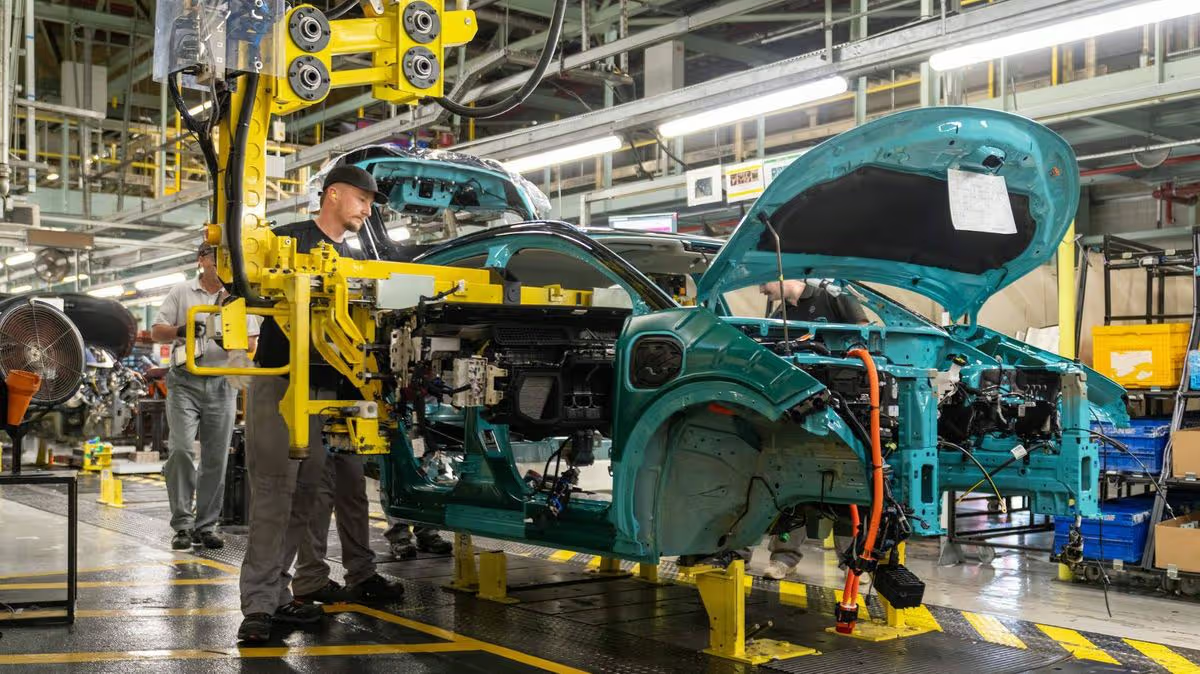
The Nissan Leaf being built

(Image: Nissan)

A key voice in the region’s automotive sector has called for decisive action from Government to support a “strategic national asset”.

Amid widespread anxiety in the industry about the impact of the Zero Emission Vehicle mandate, the North East Automotive Alliance’s CEO Paul Butler has said policymakers must address EV sales rules, energy supply and the country’s trading relationship with the EU. The call from the North East cluster – which is said to be the largest in the country and is home to embattled Nissan – echoes similar announcements at a national level.

Mr Butler said : “The NEAA supports industry calls for decisive action to review the ZEV Mandate, to secure a sustainable long-term trading relationship with the EU, to address industrial energy costs and accelerate delivery of the Industrial Strategy. Getting these fundamentals right is critical to protecting jobs, attracting investment, growing exports, and ensuring the North East and wider UK remains a world-leading location for automotive manufacturing and innovation”.

The NEAA has said the North East is in prime position to lead the country’s transition to electrification, but says the move can only be capitalise upon if an investment friendly and competitive environment is cultivated. Its call follows the results of a major, national-level survey of sector leaders conducted by the Society of Motor Manufacturers and Traders (SMMT), identifying barriers that Government must tackle.

Advertisement

Those issues include the ZEV Mandate, securing fair UK-EU trade, and cutting the underlying energy and business costs that shape investment decisions. ZEV is seen as the most pressing of those challenges, and is said to be forcing manufacturers, like Nissan, to subsidise the market at unsustainable levels because demand is below the trajectory needed to meet 2030 targets.

Pressure from the rules is likely to increase in January next year when annual targets rise to 38% for battery electric vehicle sales for cars and 34% for vans. Current market share is about 24% for cars and 9.5% for vans. The SMMT says brands have already spent more than £12bn on discounts – money they say could otherwise have supported new models, jobs and investment.

In addition to growing employment and energy costs, the group underscored the threat posed by the European Commission’s ‘Made in Europe’ rules which effectively makes UK automotive products uncompetitive in the majority of the European market unless the EU agrees to UK products being recognised as “assembled in the EU”. And, early next year, tightened up rules of origin under the EU-UK Trade and Cooperation Agreement will trigger a 10% tariff on 70% of battery electric and plug-in hybrid models sold in Europe.

Mike Hawes, SMMT chief executive, said: “UK Automotive can drive growth, innovation and net zero, but only if the right decisions are taken now. The Industrial Strategy sets out a plan, but delivery is now what matters.

Advertisement

“We need open trade with Europe, competitive conditions at home, and a realistic route to grow zero emission vehicle uptake. Reforming the ZEV Mandate is not about weakening ambition; it is about making the transition achievable, protecting investment and ensuring the UK remains a place where automotive businesses can build, sell, export and grow. The window for action is closing, which means we cannot wait for lengthy discussions.”

Continue Reading

Business

No longer magnificent? How Apple, Microsoft and other Mag 7 stocks are crumbling under AI pressure

Published

on

No longer magnificent? How Apple, Microsoft and other Mag 7 stocks are crumbling under AI pressure
The dominance of the Magnificent Seven technology stocks (Apple, Microsoft, Alphabet, Amazon, Meta Platforms, Nvidia and Tesla) is facing its biggest test since the artificial intelligence rally began. After leading global markets for nearly three years, the world’s largest technology companies are now underperforming as investors question whether the enormous amounts they are spending on AI will generate enough returns.

The shift has become visible in recent weeks. According to deVere Group, nearly $2.3 trillion has been wiped off the combined market value of the Magnificent Seven during June.

The correction comes after a strong run that was driven by expectations that AI would transform the technology industry and create a new wave of corporate profits. That optimism is now giving way to a more cautious approach as investors wait for evidence that the spending is translating into higher earnings.

The upcoming June-quarter earnings season is expected to be an important test for the sector.

Advertisement

Nigel Green, chief executive of deVere Group, said markets are entering a more demanding phase for AI investments.

The Pakistan connection that helped Donald Trump make $1.4 billion crypto jackpot”The easy phase of the AI investment story is over. Investors were willing to support massive spending when expectations were high and stock prices kept rising. Now they want proof that these investments will deliver returns,” he said.
The biggest concern is the scale of spending. Microsoft, Amazon, Alphabet and Meta are investing hundreds of billions of dollars in AI infrastructure, including data centres, advanced chips and cloud computing capacity. Instead of slowing, these investments continue to rise.
Reports suggest that spending by the largest technology companies on AI infrastructure could exceed 700 billion this year, around 70% higher than last year. This has started affecting free cash flow, as companies spend more cash on expansion instead of generating higher profits.

An Apollo Global Management presentation released in June points to the same trend. The report says investors are beginning to rotate away from companies with heavy capital expenditure towards businesses with stronger free cash flow. It also shows that free cash flow among hyperscalers has started declining while capital expenditure as a share of operating cash flow continues to rise.

The Magnificent Seven index has fallen more than 13% from its recent peak, while the broader S&P 500 and Nasdaq have seen much smaller declines. Investors who treated the seven companies as one trade are now beginning to differentiate between them based on business models, profitability and AI monetisation.

The pressure is not uniform across all seven stocks. Amazon, Microsoft, Alphabet and Meta are facing questions over whether their massive AI infrastructure spending will eventually produce enough revenue. Apple is dealing with rising memory and storage costs, which recently forced the company to increase prices on several products. Nvidia, despite remaining the biggest AI beneficiary so far, is also facing increasing competition in the semiconductor market.

Advertisement

At the same time, investors are shifting towards companies that supply the AI ecosystem rather than those building it. Chipmakers, memory manufacturers and computing infrastructure providers have continued to perform well even as the technology giants have struggled.

Green believes this reflects a broader change in investor thinking. “The companies supplying chips, memory and computing power are performing much better than those spending hundreds of billions building AI systems. Owning an AI strategy and owning the economics of AI are two different things,” he said.

The shift also reflects concerns over financing. With interest rates expected to remain elevated, borrowing to fund AI projects becomes more expensive. Several large technology companies are increasingly relying on debt markets despite holding significant cash reserves.

Reports suggest investors are no longer rewarding AI announcements alone. Instead, they want to see measurable revenue growth, expanding margins and improving cash generation.

Advertisement

Macquarie said in a recent strategy note that AI adoption continues to grow much faster than previous technology cycles. Annualised AI revenues are already estimated at around $175 billion, while investment in AI is expected to reach about $850 billion this year. The brokerage noted that adoption rates remain strong even though concerns over valuation and spending have increased.

Apollo also does not view the recent correction as the end of the AI cycle. Instead, it argues that markets are becoming more selective and placing greater emphasis on profitability rather than growth alone.

Green believes the biggest change will be in how investors view the Magnificent Seven. He expects the market to stop treating them as a single group and instead reward only those companies that successfully convert AI investments into sustained earnings growth.

(Disclaimer: Recommendations, suggestions, views and opinions given by the experts are their own. These do not represent the views of Economic Times)

Advertisement
Continue Reading

Business

Houston Rockets Sign Marcus Smart to Signal Kevin Durant-Led Win-Now Era Has Officially Begun

Published

on

Kevin Durant

HOUSTON — The Houston Rockets have spent the past several years building one of the most intriguing young cores in the NBA, drafting and developing Alperen Şengün, Amen Thompson and Reed Sheppard while patiently waiting for the talent to mature around veteran star Kevin Durant. That patience, according to every signal the organization has sent over the first days of NBA free agency, is now officially over.

The Rockets have agreed to a two-year deal with former Boston Celtics point guard Marcus Smart and are finalizing an agreement with veteran shooter Bogdan Bogdanović, moves that appear modest on the surface but speak loudly about what the franchise expects from itself heading into the 2026-27 season. Both players are proven veterans who will push younger players on the roster for time and opportunity, and neither has been signed to develop or to absorb growing pains. They have been signed to win.

The urgency is understandable given how the previous season concluded. Durant arrived last summer to a team coming off a 52-win season and expectations of a deep Western Conference playoff run. The campaign unraveled early when veteran point guard Fred VanVleet suffered an ACL tear just before training camp, forcing Thompson and Sheppard into primary ball-handling roles they were not yet ready to carry at the highest level of the game’s pressure situations. Houston still won 52 games for the second consecutive season, but lost in the first round.

General manager Rafael Stone did not attempt to spin the outcome. He called the year “frustrating and disappointing” at his end-of-season news conference, a frank assessment that reflected how far short of expectations the season had fallen given the talent on the roster.

Advertisement

The Smart signing addresses the most glaring gap exposed by VanVleet’s injury. The 2022 NBA Defensive Player of the Year brings experience and physicality to a backcourt that was repeatedly burned by its own inexperience last season. Smart’s value extends beyond his defensive reputation. He is a player who communicates, organizes and competes at a level that resonates with younger teammates who are still learning how to perform consistently in high-leverage moments, and his presence alongside a returning VanVleet gives Houston options and redundancy rather than relying entirely on the health of a 31-year-old coming off major knee reconstruction.

Houston’s head coach Ime Udoka pointed to shooting as the most urgent priority for improvement after the playoff exit. The Rockets ranked 28th in the league in three-point attempts per game last season, a startlingly low figure for a team that asked Durant, one of the sport’s most complete offensive players, to carry the primary scoring burden. Bogdanović addresses that directly. The 33-year-old had a reduced role with the Los Angeles Clippers last season, but his track record as a knockdown shooter with the Sacramento Kings and Milwaukee Bucks established him as a perimeter option that defenses must respect even when his usage is limited. For a team that too often allowed opposing defenses to crowd Durant and collapse on the roll man without paying a price for leaving the corners open, having a genuine shooting threat off the bench changes the math.

The deeper implication of this offseason’s direction is the pressure it places on everyone in the organization, not just the players. Udoka, who signed a lucrative extension last summer, will face heightened scrutiny if the team’s offensive execution does not improve noticeably from the first weeks of the season. His rotations and his late-game decision-making drew pointed criticism after the first-round exit, and adding veteran players makes that standard of accountability more reasonable, not less. Coaches can more credibly ask for clean execution from experienced professionals than they can from players still adjusting to NBA pace and decision speed.

Stone faces a different but equally real version of the same pressure. He has been methodical and disciplined in building Houston’s roster, resisting the urge to deal from the youth core in pursuit of blockbuster upgrades that were available but came at prices he considered too high. Giannis Antetokounmpo, Jaylen Brown and Kawhi Leonard all became trade candidates at various points during the offseason, and Stone passed on each. His confidence in the existing core and his belief that the right deal would present itself at the right cost has kept assets intact, but it has also narrowed the gap between credit and accountability. If Houston underperforms again next season with Durant, VanVleet, Smart, Şengün, Thompson and Bogdanović on the roster, the questions about why Stone passed on bigger upgrades will only grow louder.

Advertisement

The most obvious remaining trade chip is Dorian Finney-Smith, set to earn $13.3 million this season on a deal with two non-guaranteed years beyond it. Attaching draft compensation to Finney-Smith could conceivably return additional rotation help in a deal, and the Rockets have enough first-round picks in reserve to structure something attractive if the right partner emerges.

Houston’s selection of former Ohio State guard Bruce Thornton with the 31st pick in this year’s draft also reveals something about how Stone views the roster’s near-term future. Adding a developmental guard to the mix only makes sense if the organization has settled on a clear hierarchy and is comfortable signaling to Sheppard that his path to consistent minutes must be earned through performance rather than preserved through rotation necessity. Thornton’s presence makes VanVleet’s $25 million expiring contract more viable as a trade piece and makes a theoretical departure from Sheppard more manageable if he does not take a clear step forward.

The Rockets have tried to balance winning now with developing for later for the past two seasons. Smart, Bogdanović and the clear message from Stone’s end-of-season press conference all say that balance has now shifted decisively toward winning now. Durant will be 38 when next season begins and is entering the final year before he could become an unrestricted free agent, a timeline that makes every game this season more consequential than it might otherwise seem.

The time for patience is over. Houston is telling its players, its coach and itself exactly that.

Advertisement
Continue Reading

Business

MSC Industrial: A Broadening Industrial Recovery Is Driving Shares To New Highs (NYSE:MSM)

Published

on

MSC Industrial: A Broadening Industrial Recovery Is Driving Shares To New Highs (NYSE:MSM)

This article was written by

Stephen Simpson is a freelance financial writer and investor.Spent close to 15 years on the Street (sell-side, buy-side, equities, bonds).

Analyst’s Disclosure: I/we have a beneficial long position in the shares of MSM either through stock ownership, options, or other derivatives. I wrote this article myself, and it expresses my own opinions. I am not receiving compensation for it (other than from Seeking Alpha). I have no business relationship with any company whose stock is mentioned in this article.

Seeking Alpha’s Disclosure: Past performance is no guarantee of future results. No recommendation or advice is being given as to whether any investment is suitable for a particular investor. Any views or opinions expressed above may not reflect those of Seeking Alpha as a whole. Seeking Alpha is not a licensed securities dealer, broker or US investment adviser or investment bank. Our analysts are third party authors that include both professional investors and individual investors who may not be licensed or certified by any institute or regulatory body.

Advertisement
Continue Reading

Business

June Jobs Report: Weak Hiring Or Fewer Workers?

Published

on

June Jobs Report: Weak Hiring Or Fewer Workers?

June Jobs Report: Weak Hiring Or Fewer Workers?

Continue Reading

Business

Form 4 NACCO Industries Inc For: 2 July

Published

on


Form 4 NACCO Industries Inc For: 2 July

Continue Reading

Trending

Copyright © 2025