

Crypto World
The Biggest Blockchain Upgrades Coming in 2026

Most crypto investors still obsess over price charts. But in 2026, a growing share of attention is shifting back to improving the fundamentals of the protocols.
Ethereum, Solana and Avalanche are preparing some of their largest protocol upgrades in years, while Coinbase’s Base network rolled out its Beryl hard fork last Friday in a bid to streamline the network, with a native token standard and shorter withdrawal windows.
Bitcoin development however, remains frozen, with developers still arguing over controversial covenant proposals and post-quantum computing upgrades.
Tim Sun, a senior researcher at Hong Kong-based asset manager HashKey Group, told Cointelegraph that protocol upgrades have historically focused on adding features, speed and throughput.
However, in 2026, he said the emphasis is shifting toward reliability, predictable governance, and institutional-grade infrastructure that can support large-scale financial use cases.
Here are the top five major blockchain upgrades to watch in the second half of 2026.
Ethereum: Glamsterdam
Glamsterdam is arguably the most consequential upgrade this year, and its already being tested on devnets. According to Ethereum’s public roadmap, Glamsterdam is designed to improve scalability, harden the layer-1, and make the network easier to use, with a mainnet launch expected sometime in the second half of 2026.
Sun said the upgrade should improve processing speeds by allowing more transactions to be processed simultaneously, expand capacity so Ethereum can handle more data at higher throughput, and reduce database bloat. Those changes should make the chain better suited for stablecoin settlement and real-world asset use cases, he said.
Related: Ethereum’s much-hated staking ‘tax’ may already be obsolete
Holly Atkinson, chief product and technology officer at 1inch, told Cointelegraph that Glamsterdam is viewed by many as Ethereum’s most significant upgrade since The Merge in September 2022, which transitioned the blockchain from proof-of-work to proof-of-stake.
Glamsterdam. Source: Ethereum.org
She said enshrined proposer-builder separation (ePBS) is a key change because most validators still depend on a small set of specialized builders and relays, which concentrates control over transaction ordering.
That setup amplifies maximal extractable value (MEV), censorship and centralization risks, she said. ePBS is designed to pull block building and proposing back into the protocol and make the process more transparent and accountable.
Pavan Kaur is a Solana Foundation judge and founder of RuleSpark, a compliance engine for digital asset marketing. She told Cointelegraph that ePBS is better understood as one step in Ethereum’s broader roadmap and does not eliminate MEV or fully solve builder centralization. “Practices like sandwich attacks may therefore migrate rather than disappear,” she said.
Solana: Alpenglow
Solana’s biggest change this year is Alpenglow, a consensus upgrade that reworks the network’s core protocol. Alpenglow has been billed by many, including Solana ecosystem lead David Liang, as the chain’s “most significant consensus upgrade yet.”
After being overwhelmingly approved through a governance process in September 2025, Alpenglow remains under development but is expected to ship alongside the Agave 4.1 validator client release later in 2026.
Arun Krishnakumar, vice president of institutional capital at R3 enterprise software firm, told Cointelegraph that Alpenglow will be a major tailwind that will reinforce the ‘internet capital markets’ thesis even more strongly.
Solana Network Updrades. Source: Solana
At its core, Alpenglow is designed to dramatically speed up how quickly the network reaches finality. Instead of relying on Solana’s existing TowerBFT-based consensus mechanism, it introduces a redesigned system built around a new voting component called Votor.
Related: Solana treasury firms resist Forward Industries’ consolidation push
The practical impact is a major reduction in confirmation times, with finality targeted at roughly 100-150 milliseconds in optimal conditions, compared to around 12.8 seconds today.
Beyond speed, the upgrade also removes onchain vote transactions, which currently account for a significant portion of network activity. By streamlining how validators communicate and agree on the state of the chain, Alpenglow is intended to make Solana both lighter and more efficient under load.
Hadley Stern, board director, DeFi Development Corp, told Cointelegraph that removing onchain vote transactions is the “real story” for institutional allocators because it “cleans up validator economics and gives you honest telemetry, which matters when you’re underwriting SOL as a treasury asset.”
He said that a network that can migrate its consensus layer as cleanly as is planned, would show the kind of “governed adaptability legacy financial infrastructure can’t match.”
Base: Beryl
Base’s Beryl hard fork went live on Friday, following a short sequencer-related outage, when block production stalled for around two hours following an invalid block that triggered a temporary consensus failure.
Base co-founder Jesse Pollak said user funds were unaffected during the incident. While he stressed that “all funds are safe,” he added that “a halt is not okay” and said that lessons learned from the episode will be used to further strengthen Base as a platform for “global, 24/7 finance.”
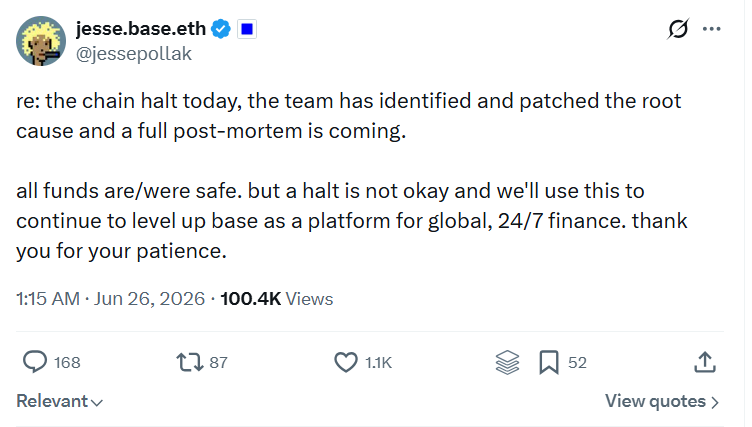
Jesse Pollak speaks about the chain halt. Source: Jesse Pollak
According to Base’s documentation, Beryl introduces a set of changes aimed at tightening the network’s performance and reducing friction at the edges. These include the B20 native token standard, a shortening of withdrawal finality from seven days to five, and integration with Reth V2, which is expected to reduce node storage requirements while improving execution efficiency.
Related: Coinbase’s Base resumes block production after 2-hour outage
Sun said Base has been moving toward a more unified “stack” approach, giving it greater control over how the network is built and upgraded, and allowing changes to ship more quickly than under the earlier Optimism Superchain model.
The trade-off, he said, is that liquidity, which once moved more freely across the broader Superchain ecosystem, may become more fragmented, even as Base deepens its integration with Coinbase’s wider user base.
Avalanche: Octane
Avalanche’s next chapter is less about a single branded hard fork than a broader push to improve performance while courting institutions and tokenized asset issuers.
Sun told Cointelegraph that Avalanche’s recent Etna hard fork replaced the old subnet model with sovereign Avalanche L1s, cutting the cost of launching a dedicated blockchain by more than 99% and making the network more attractive to institutional players.
It’s already seen success in this regard. Sun pointed to Progmat, which he said accounts for roughly 63% of Japan’s national security token market, which migrated more than $2 billion in tokenized assets to a dedicated Avalanche L1, as well as the Avalanche Payments Collective backed by firms including Franklin Templeton, VanEck and WisdomTree.
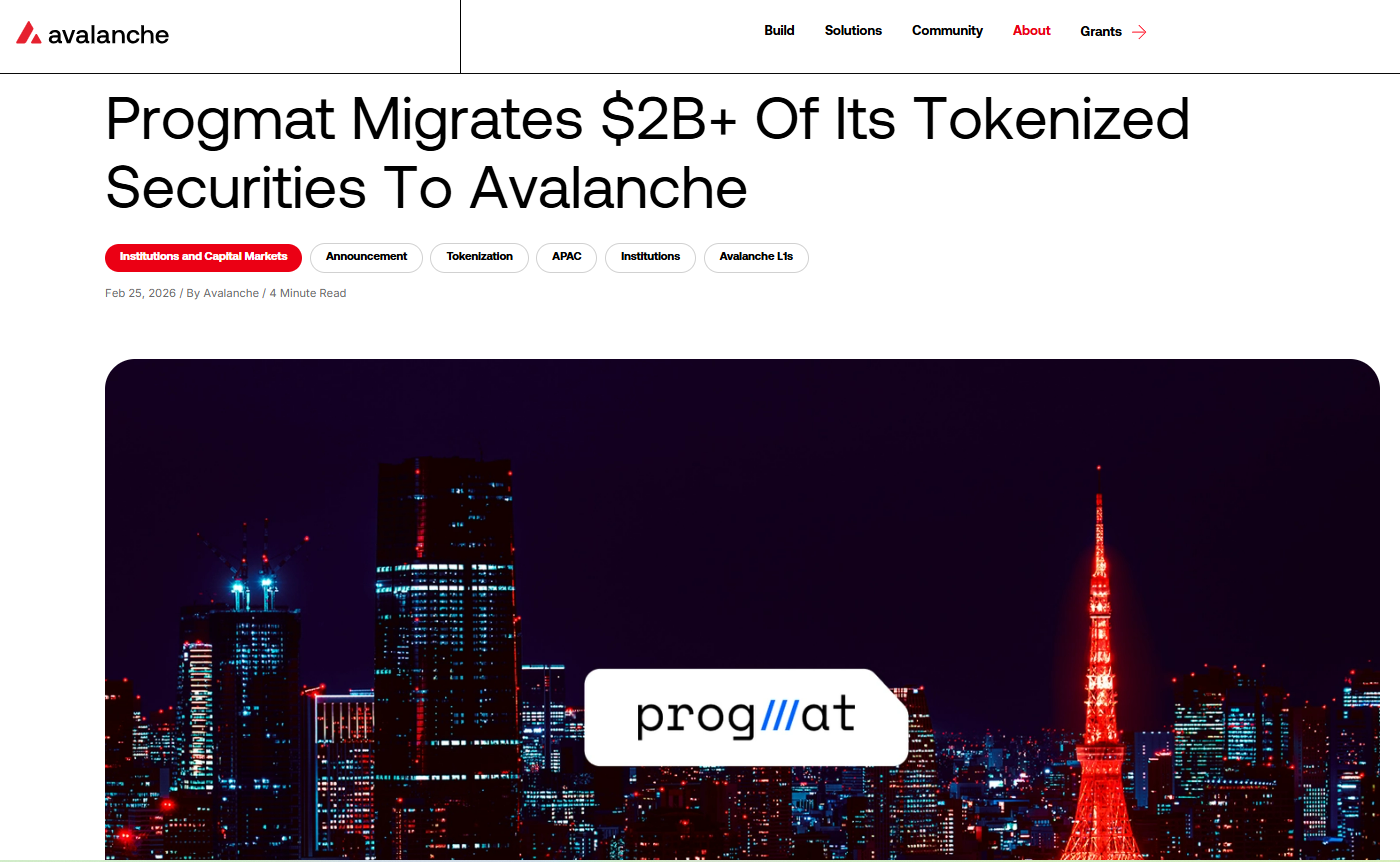
Progmat Migrates $2B+ of its Tokenized Securities to Avalanche. Source: Avalanche
Atkinson said Avalanche is also pushing two upgrades aimed at making its C-Chain one of the fastest Ethereum Virtual Machine (EVM) environments.
Related: Avalanche Treasury falls 16% as it debuts on Nasdaq
She described Streaming Asynchronous Execution as a way to separate transaction execution from consensus so the chain can run more continuously and size capacity closer to normal demand. For users, she said, the practical effect should be higher throughput and lower, steadier fees during periods of heavy activity.
Bitcoin: OP_CAT
Bitcoin is the outlier here because its biggest developments in 2026 are not scheduled upgrades but a continuation of passionate debates over whether the protocol should become more programmable and how urgently it should be hardened against quantum threats.
Bitcoin has not activated a major soft fork since Taproot in 2020, which upgraded Bitcoin’s scripting to make transactions more flexible and improve privacy.
Since then, discussion around covenant-related proposals such as OP_CAT, CheckTemplateVerify (CTV) and Lightning-focused ideas like LNHANCE has intensified. None of these changes has an agreed path to activation.
Researchers have also been debating BIP-360 and related proposals as ways to make it easier to migrate coins into quantum-resistant spending paths, if and when the quantum computing threat becomes real.
Atkinson described Bitcoin as the wildcard of the group. She said covenant proposals could unlock safer storage and richer scripting, but the subject remains divisive and subject to much debate.
Sun said those proposals could improve self-custody security, fee management and protocols such as Lightning and Ark, while giving institutions more programmable custody logic directly on the L1.
Bitcoin development is infamously slow, and any change to the protocol is pored over from every angle. There is general agreement that no covenant opcode is on track for activation this year, and reaching consensus on proposals like OP_CAT or CTV is still some distance away.
On the post-quantum side, BIP-360’s authors estimate that a full migration to quantum-resistant addresses and signatures would take years even under optimistic assumptions. It seems unlikely at this point that a quantum-resistance upgrade will be implemented before the end of 2026.
Magazine: How AI just dramatically sped up the quantum risk for Bitcoin

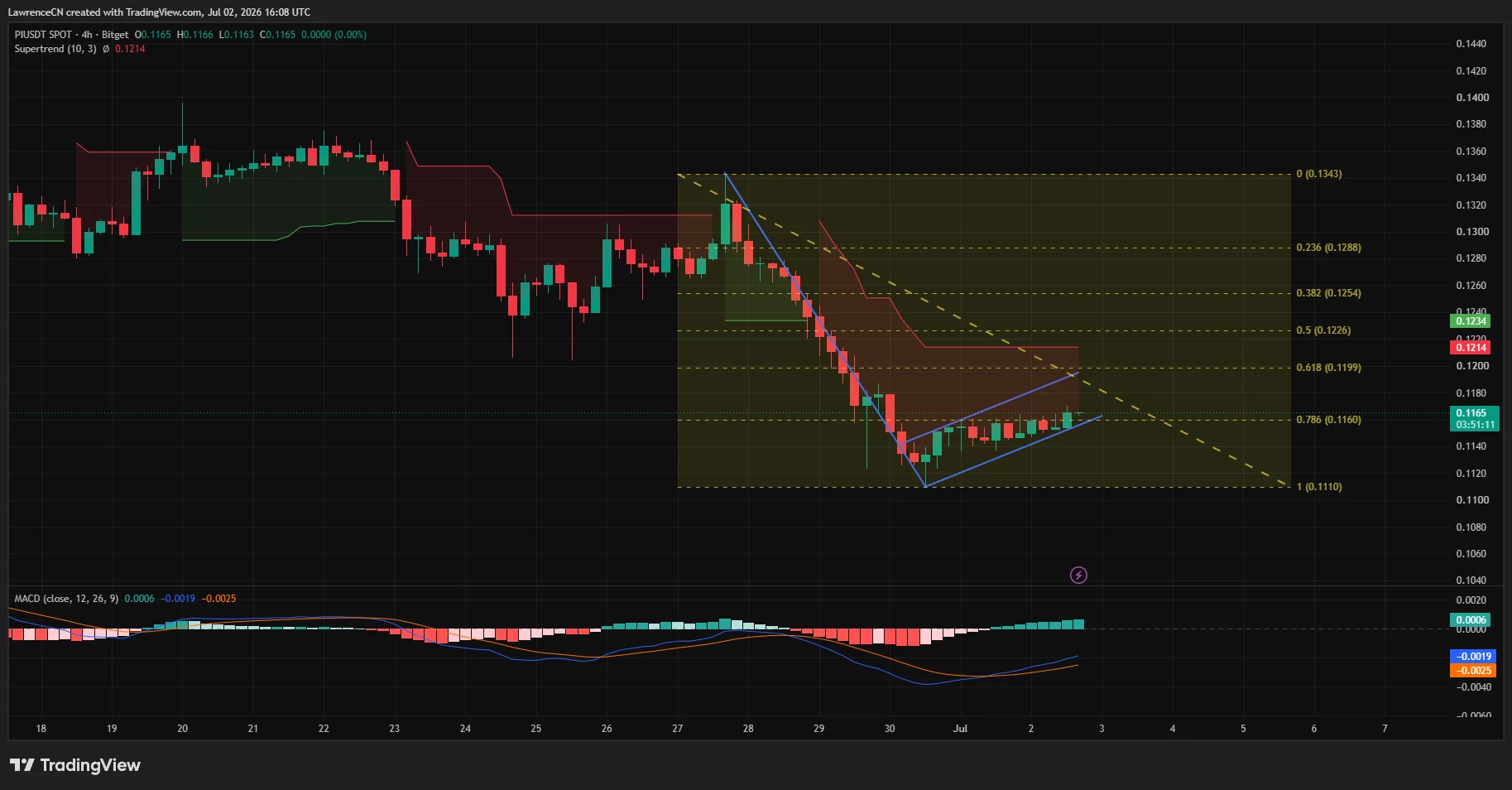
Pi Coin price has edged higher after Pi Network introduced three ecosystem upgrades, while buyers stepped in following the token’s fresh all-time low and a broader crypto market rebound lifted sentiment.
Summary
- Pi Coin edged higher after Pi Network launched SoloHost, Pi Sign-In, and PiVerify during its Pi2Day event.
- A rebound from oversold conditions lifted PI, but a potential bearish flag continues to weigh on the short-term outlook.
- Large monthly token unlocks and limited exchange listings remain the biggest obstacles to a sustained recovery.
According to data from crypto.news, PI price traded near $0.115 on July 2, up around 0.5% over the past 24 hours after the Pi Core Team unveiled SoloHost, Pi Sign-In, and PiVerify during the Pi2Day event. The move also came as derivatives activity improved, with open interest climbing back above $20 million after falling during last week’s selloff.
Pi Network said SoloHost allows developers to build AI-powered applications on its infrastructure, while Pi Sign-In offers a unified authentication system for decentralized applications. PiVerify gives third-party businesses access to Pi’s network of more than 18 million KYC-verified users, creating an additional use case that requires developers and businesses to interact with the ecosystem.
At the same time, macro conditions favored risk assets. Bitcoin climbed back above $61,000 and briefly traded beyond $62,000 after weaker-than-expected U.S. June jobs data strengthened expectations that the Federal Reserve could cut interest rates later this year. The rally added roughly $50 billion to the total crypto market capitalization and helped several altcoins post intraday gains alongside PI.
Oversold bounce meets bearish chart structure
PI’s latest uptick followed a sharp decline that pushed the token to a fresh all-time low near $0.1141 on July 1. The daily Relative Strength Index dropped to around 27 before buyers returned, giving the token a foothold around the $0.115 support zone.
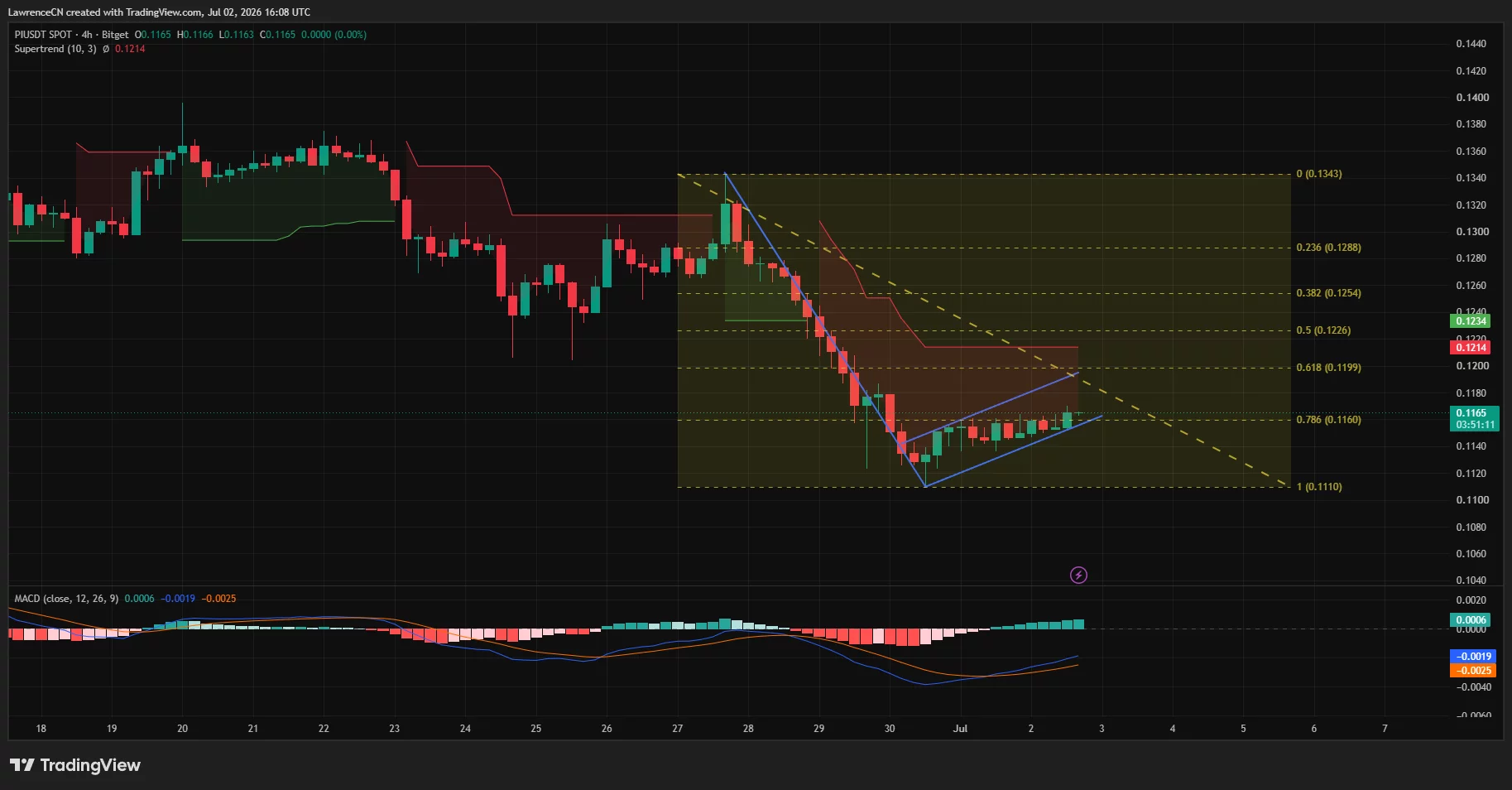
The 4-hour chart, however, continues to favor sellers. PI has formed what appears to be a potential bearish flag, with price moving inside a narrow ascending channel after the steep decline from roughly $0.132. A descending trendline has rejected every recovery attempt since late June, while the Supertrend indicator remains above price near $0.121.
The MACD has started to improve, with the histogram returning above zero and the MACD lines curling upward. Buyers still need to reclaim several resistance levels before the short-term structure changes. Fibonacci retracement levels place the first barriers near $0.116, $0.120, and $0.123, while a move above the descending trendline and Supertrend would weaken the bearish setup.
Token unlocks remain the biggest downside risk
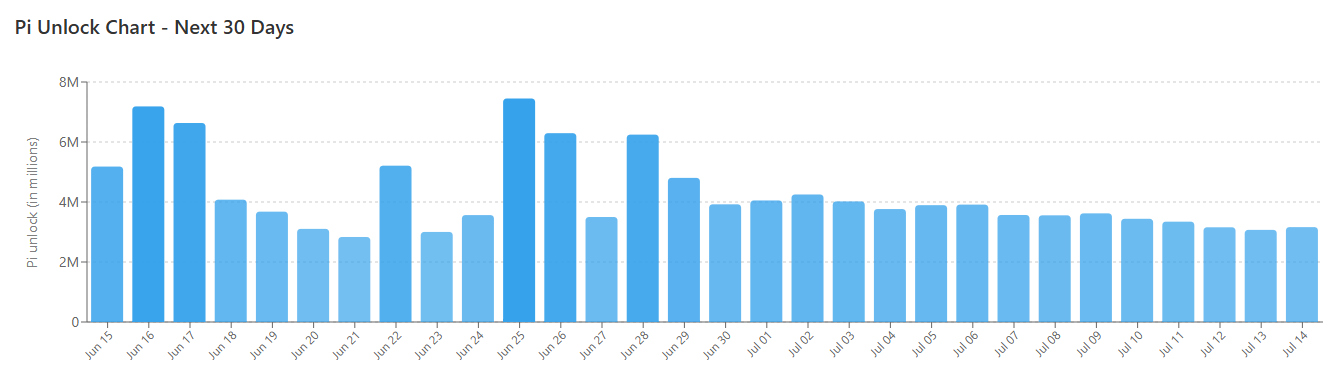
Supply pressure continues to overshadow the network’s new utility releases. PiScan data shows between 76 million and 149 million PI tokens are scheduled to unlock during rolling 30-day periods, while more than 1.7 billion tokens are expected to enter circulation over the next 12 months.
The steady increase in liquid supply has consistently outpaced demand and remains the main reason PI continues to trade near record lows. Liquidity also remains limited because Binance, Coinbase, and Bybit have yet to list the token.
A breakdown below the lower boundary of the four-hour bearish flag and the recent $0.111 low would strengthen the bearish case and expose fresh all-time lows.
On the upside, sustained buying above $0.120-$0.121, supported by growing adoption of SoloHost, Pi Sign-In, and PiVerify, would invalidate the current bearish pattern and open the door for a recovery toward $0.123-$0.125.
Disclosure: This article does not represent investment advice. The content and materials featured on this page are for educational purposes only.
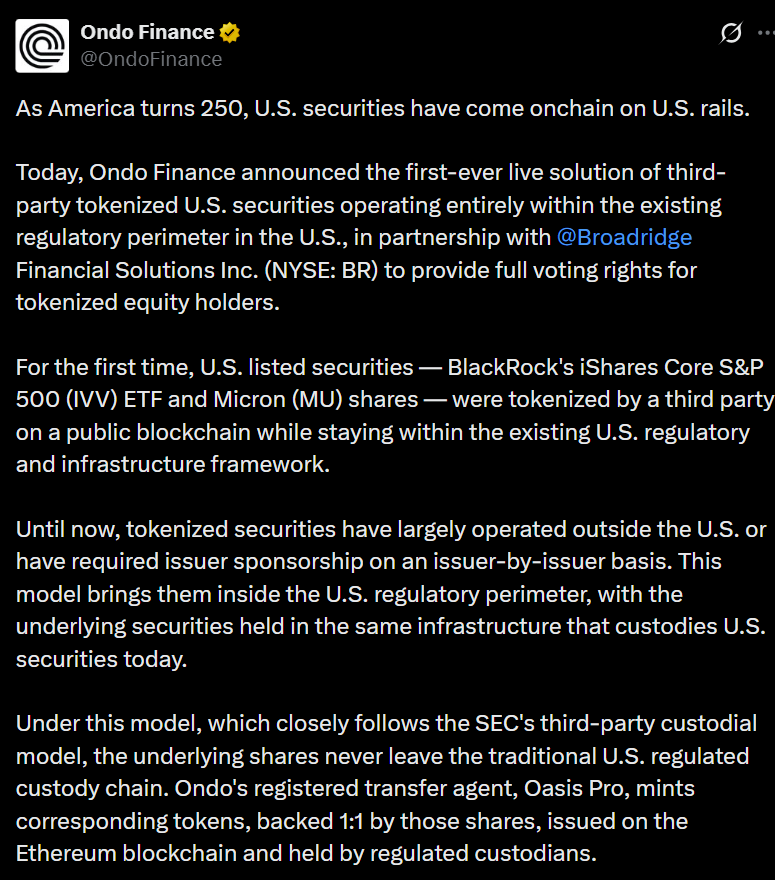
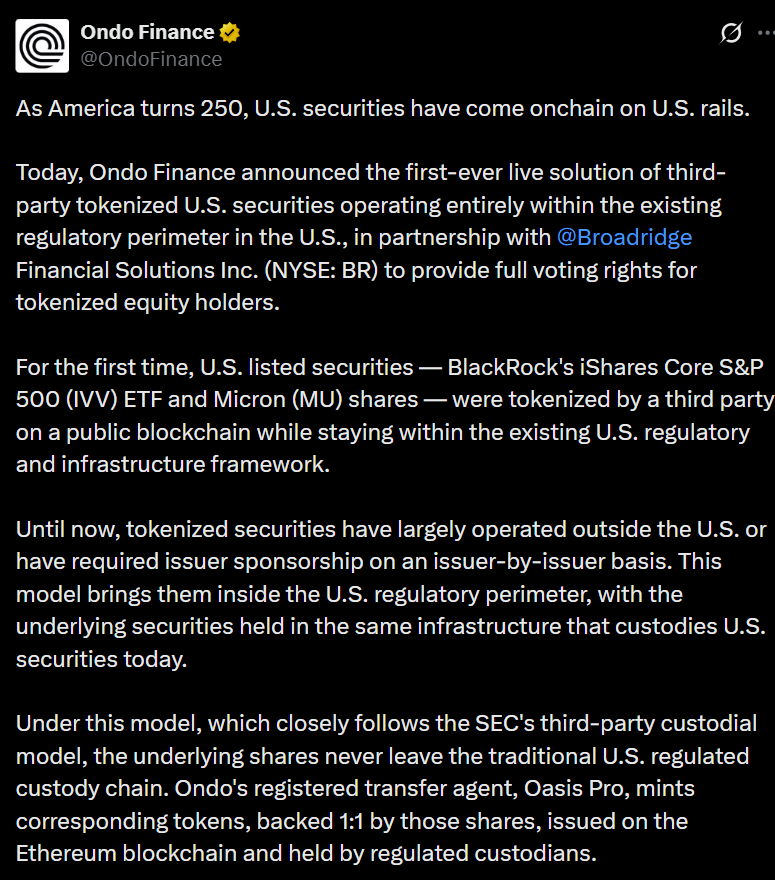
Ondo Finance is adding shareholder voting rights to its tokenized stocks and exchange-traded funds (ETFs) through a partnership with financial infrastructure provider Broadridge, addressing one of the key limitations of blockchain-based securities.
The companies announced Thursday that holders of more than 250 tokenized securities issued through Ondo will be able to participate in proxy voting and access corporate communications, including regulatory filings and other shareholder documents.
The integration uses a Web3-enabled version of Broadridge’s investor communications platform, allowing users to authenticate with blockchain wallets while accessing governance services typically reserved for shareholders in traditional markets.
The move comes as tokenized equities gain momentum among digital asset companies seeking to bring conventional financial products onchain. While tokenization promises faster settlement and around-the-clock trading, questions have remained over whether investors would receive the governance rights that accompany traditional direct stock ownership.
Source: Ondo Finance
Ondo said the governance features will accompany the launch of its first US custodial tokenized securities, including tokenized versions of BlackRock’s iShares Core S&P 500 ETF (IVV) and Micron Technology (MU). The company said the assets are the first issued under the US Securities and Exchange Commission’s third-party custodial framework for tokenized securities.
Related: Blockchain.com deepens onchain stock offerings as tokenized equities market grows
Competition heats up in tokenized equities
The market for tokenized stocks has expanded rapidly this year, as its total value first surpassed $1 billion in March, according to Foresight Ventures. Data published by Ondo on Wednesday showed the market has since grown to $1.67 billion, with nearly 181,000 unique holders.
Ondo is one of several companies competing for a share of the fast-growing market. Backed Finance, which issues tokenized stocks through its xStocks platform, has also expanded its footprint, with its products now available across multiple crypto exchanges and blockchain networks.
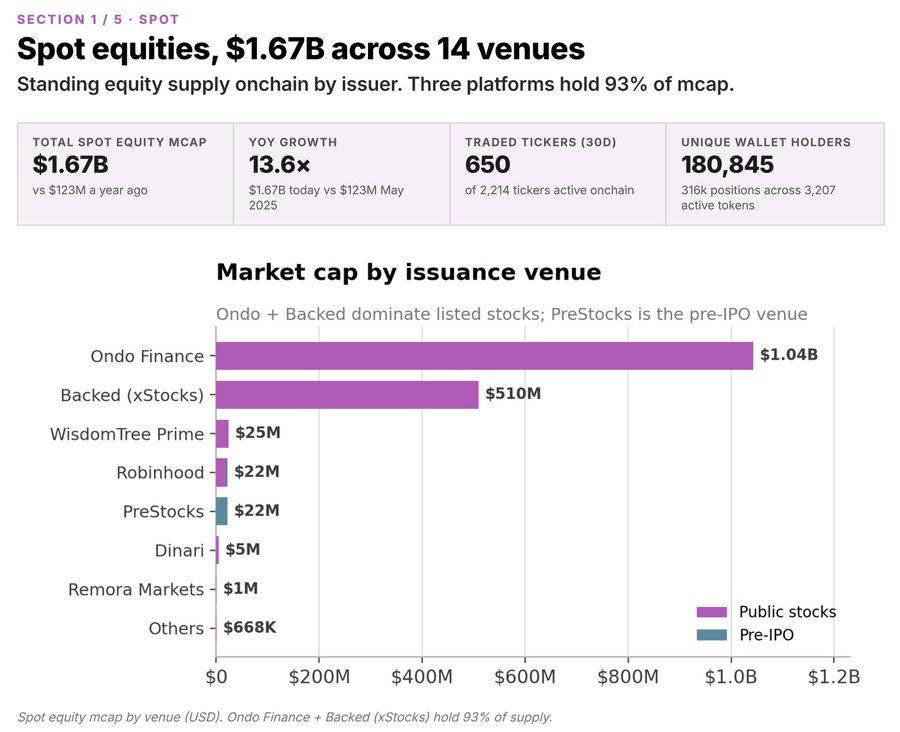
The market for tokenized stocks has grown nearly 14-fold since May 2025. Source: Ondo Finance
Tokenization has emerged as one of crypto’s fastest-growing sectors in 2026, defying broader market weakness. A recent 21shares report attributed the trend to rising institutional adoption and improving infrastructure. Separate data from Binance showed the value of tokenized real-world assets, including stocks, has surged nearly 600% over the past year.
Related: Crypto Biz: The cost of stacking sats
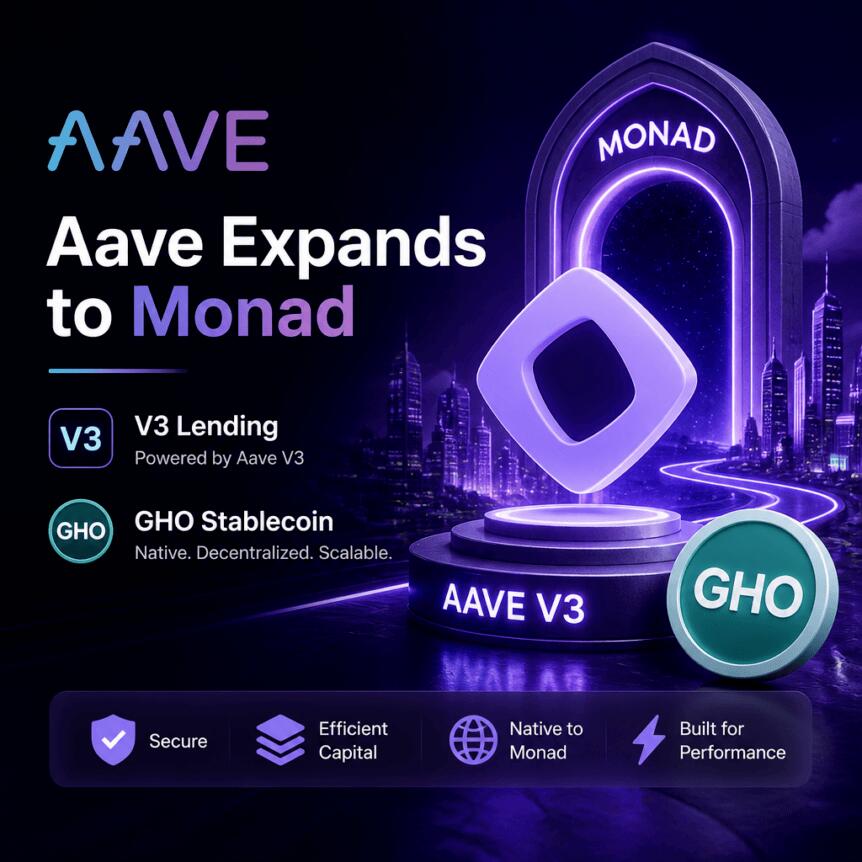
DeFi lending protocol Aave has expanded its multi-chain footprint by deploying its V3 lending markets on Monad, a layer-1 network designed to run Ethereum-compatible applications. The rollout introduces Aave on Monad with 12 supported assets at launch, aiming to give Monad users an established borrowing venue and to accelerate liquidity formation via incentives.
In its announcement on Thursday, Aave said the initial markets include USDT, USDC, Aave’s GHO stablecoin, USDe, mUSD, AUSD, WETH, cbBTC, wstETH, weETH, syrupUSDC, and sUSDe. It also highlighted that this is Aave’s first deployment with Chainlink Smart Value Recapture enabled from day one, a mechanism that redirects part of the value generated from liquidations back to the protocol.
Key takeaways
- Aave V3 is live on Monad with markets for 12 assets, including GHO and multiple stablecoin and wrapped-asset pairs.
- Chainlink Smart Value Recapture is enabled from launch, redirecting a portion of liquidation-generated value back to Aave.
- Governance materials show Monad’s ecosystem support includes $15 million in incentives over the first 12 months and additional GHO commitments.
- A risk assessment cited concerns about early activity on Monad compressing after an initial strong start, with liquidity remaining concentrated in established protocols.
What Aave V3 brings to Monad
The deployment matters for Monad because it moves beyond isolated DeFi activity and adds a battle-tested lending framework with liquidity incentives and a mature stablecoin ecosystem. Aave’s governance proposal notes that Monad is compatible with Ethereum’s application environment, meaning developers can reuse existing Solidity contracts and Ethereum tooling with minimal changes.
Aave also positioned the launch as more than a deployment checklist: it is meant to connect Monad’s users to GHO and to borrowing/lending liquidity designed for sustained market use. In addition to the asset list, Aave underscored the strategic role of Chainlink Smart Value Recapture in its liquidation flows, which can affect how value accrues on the protocol side and how incentives are structured during early adoption.
Incentives to jump-start liquidity—plus a reality check
Aave’s governance documentation indicates that the Monad Foundation committed $15 million in incentives during the first 12 months following activation. The foundation also agreed to acquire and retain 10 million GHO for more than six months, while the Aave DAO committed an additional 500,000 GHO in incentives to support onboarding on Monad.
That funding structure is designed to reduce early friction for borrowers and suppliers, but it does not automatically guarantee long-term utilization. A risk assessment by LlamaRisk pointed to a key uncertainty: while Monad’s mainnet launched on Nov. 24, 2025, network usage reportedly softened after a strong start. As of June 8, LlamaRisk estimated Monad’s total value locked at about $359.5 million, while noting that liquidity remained concentrated in already established protocols.
LlamaRisk backed the Aave deployment with conservative initial parameters, explicitly citing Monad’s short operating history at the time of evaluation. The practical takeaway for investors and traders is that incentive-backed liquidity often looks strong early, but the sustainability of borrow/supply activity will be tested as rewards decline and market participants decide whether to stay without continued subsidization.
Why tokenized assets could make lending more important
The Aave-on-Monad rollout lands as tokenized real-world assets (RWAs) increasingly intersect with DeFi lending strategies. Earlier coverage noted that institutions are looking at ways to bring tokenized assets into DeFi lending markets, and Standard Chartered previously said that tokenized assets entering DeFi could drive deposits into Aave. According to that same earlier reporting, Aave’s deposit base reached roughly $75 billion at its October 2025 peak.
Meanwhile, Centrifuge has discussed bringing tokenized Treasurys, private credit, and AAA-rated collateralized loan obligations to Monad for use across lending, collateral, and secondary-market activity. While the input does not indicate that Centrifuge assets have been integrated into Aave yet, the logic for Monad users is straightforward: if tokenized asset issuers expand into Monad, having an established lending venue such as Aave V3 can lower the barrier for turning those assets into productive borrowing and collateral workflows.
What to watch after the launch
Aave’s deployment gives Monad an immediate, Ethereum-compatible lending destination with a defined set of markets and liquidation value-sharing mechanics. The next signal that will matter most is whether borrowing demand and supply growth persist after early incentives—particularly given LlamaRisk’s observation that activity compressed after Monad’s initial strong start and that liquidity was concentrated in established venues. Readers should watch for changes in utilization across the new Aave markets and for any confirmed integration of tokenized asset products into Aave on Monad as the ecosystem develops.
Pi Network rarely stays out of the spotlight, as the Core Team consistently rolls out ecosystem upgrades and major announcements.
Yet despite the steady stream of updates, the project’s native token has continued to slide, recently tumbling to a fresh all-time low.
The Latest Developments
Pi Network’s community has been desperately waiting for a potential catalyst that could finally trigger a price rebound for PI, with numerous members pinning their hopes on Pi2Day.
The date is symbolic, as it represents the mathematical constant 2π, and it is celebrated annually on June 28. There was widespread speculation that the team would unveil groundbreaking announcements that day, as some even anticipated a listing on Binance.
Instead, Pi Network introduced SoloHost, Pi Sign-in, and PiVerify – tools designed to expand the ecosystem beyond native apps and into AI, digital identity, and third-party services. Several hours ago, the Core Team offered additional clarification on these features, saying:
“Together, these releases point to a broader direction for the ecosystem: Pi products are built both for the Pi ecosystem and to extend Pi services and resources to the external world. This, in turn, enriches and strengthens the Pi ecosystem.”
The Reaction
Some industry participants and entities praised Pi Network for releasing the aforementioned tools. X user Onur described these as “banger updates,” while CiDi Games argued that everything the team shipped on Pi2Day “points in the same direction: real utility, built by the people who use it.”
The community, though, wasn’t unanimously impressed. Many urged the team to fix the ongoing KYC and migration issues first, claiming that these problems are more urgent than new feature releases.
PI Price Outlook
The overall market weakness, and perhaps the emergence of a classic “sell the news” scenario after Pi2Day, has resulted in a further price decline for PI, which fell to a new ATL of just over $0.11 towards the end of June.
As of press time, the token trades at roughly $0.115, representing a minor 0.8% increase on a daily scale and a whopping 96% crash since the historic peak of $3 witnessed at the start of 2025.
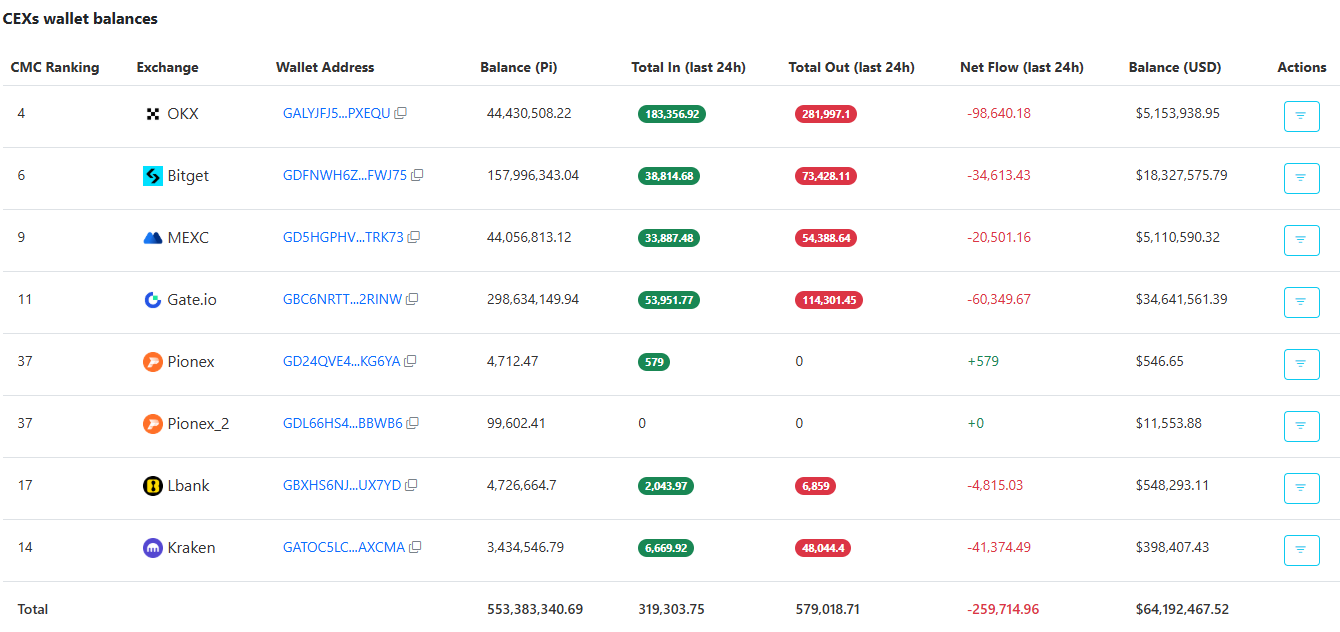
Still, some factors suggest that bears may loosen their grip in the short term. The number of PI coins stored on crypto exchanges has decreased by about 260,000 over the past day, bringing the total to 553.3 million. Such a trend usually leads to reduced selling pressure.
The upcoming token unlocks are also worth monitoring. Roughly 127.5 million PI are scheduled for release over the next 30 days, with an average daily unlock of 4.25 million. This is far less aggressive than in previous months and may help set the stage for a period of price stabilization.
The post Pi Network (PI) News Today: July 2 appeared first on CryptoPotato.
Decentralized finance (DeFi) platform Aave has deployed its V3 lending protocol on Monad, expanding the layer-1 blockchain’s lending ecosystem with support for 12 assets at launch.
On Thursday, Aave announced that the initial market supports USDT0, USDC, Aave’s GHO stablecoin, USDe, mUSD, AUSD, WETH, cbBTC, wstETH, weETH, syrupUSDC and sUSDe. It is also Aave’s first deployment with Chainlink Smart Value Recapture enabled from day one, allowing part of the value generated from liquidations to be redirected back to the protocol.
The deployment expands Aave’s multichain lending network while giving Monad users and developers access to an established borrowing market, Aave’s GHO stablecoin and liquidity incentives intended to support early adoption.
Monad is compatible with Ethereum’s application environment, allowing existing Solidity contracts and Ethereum tooling to be used with minimal changes, according to Aave’s governance proposal.
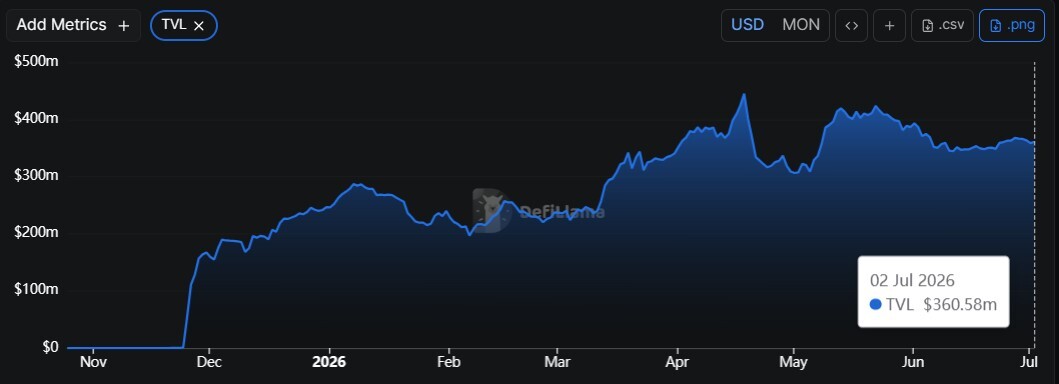
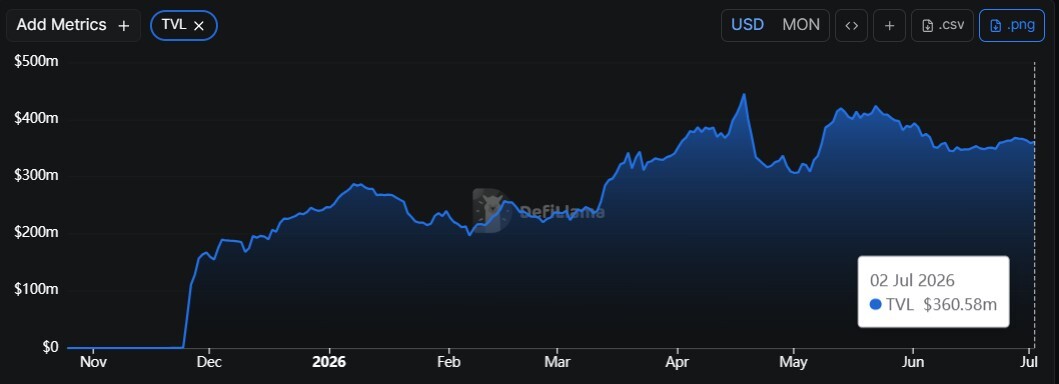
Monad’s total value locked as of Thursday. Source: DefiLlama
Aave deployment tests Monad’s liquidity ambitions
Aave’s governance documents show that the Monad Foundation committed $15 million in incentives during the first 12 months after activation. The foundation also agreed to acquire and retain 10 million GHO for over six months, while Aave DAO committed another 500,000 GHO in incentives to support adoption on Monad.
These incentives could help establish initial liquidity. However, user activity will need to persist after incentives decline. According to a risk assessment by LlamaRisk, Monad’s mainnet launched on Nov. 24, 2025, and had about $359.5 million in total value locked as of June 8. It said early network usage had compressed after a strong start and that liquidity remained concentrated in established protocols.
LlamaRisk supported the deployment with conservative initial parameters, citing Monad’s short operating history.
Related: DeFi TVL drops 39% in 2026 amid market downturn and record hack activity
The launch also comes as institutions increasingly explore bringing tokenized assets into DeFi lending markets. In June, Standard Chartered said that tokenized assets entering DeFi could drive deposits into Aave, whose deposit base reached about $75 billion at its October 2025 peak.
In April, Centrifuge revealed plans to bring tokenized Treasurys, private credit and AAA-rated collateralized loan obligations to Monad for use in lending, collateral and secondary-market activity.
Although Centrifuge has not announced that its assets will be integrated into Aave, the deployment gives Monad an established lending venue that could support tokenized assets as its ecosystem develops.
Magazine: China’s 107 Bitcoin memory thief, Bithumb CEO booked: Asia Express
Crypto World
Every Setup Says Dogecoin Is Due a Big Rally: One Barrier Could Trigger the Next Leg Higher

Dogecoin is trading around $0.074 after recovering from recent lows, yet it remains below a key resistance area. That ceiling has become the market’s main focus. Crack it, and sentiment could shift quickly; miss it, and we may face another round of sideways action.
DOGE is tightening beneath resistance, a pattern that often comes before a stronger move. If buyers push through and hold the breakout, the next technical target sits near $0.1172.
Meanwhile, Javon Marks sees a much bigger picture. His cycle analysis points to a potential target at $1.25, and even above $1.80 if past market patterns repeat. That’s an ambitious roadmap, but it starts with clearing the same resistance first.
Still, charts cannot do all the heavy lifting. Stronger market liquidity and steady buying demand must back any breakout. Until then, the bullish case remains promising, though it is still waiting for its starting gun.
Discover: The Best Crypto to Diversify Your Portfolio
Can Dogecoin Price Reclaim $0.11 and Set Up a Run Toward $0.12?
Dogecoin has dropped from about $0.117 in January to $0.074 today, after sliding below $0.07 late in June. Since then, buyers have stepped in, although the price remains stuck in a narrow range as the chart suggests consolidation rather than a decisive trend change.
Attention now shifts to the $0.09-$0.11 zone, where DOGE previously found strong demand. A move above $0.11 could open the door to a retest of $0.117. Even so, that breakout still needs convincing trading volume to avoid turning into another false start.

The most likely outcome is continued sideways trading between $0.07 and $0.10 while the market searches for direction. If buyers regain control above $0.11, momentum could improve quickly. On the other hand, a drop below the late-June low near $0.069 would weaken the recovery setup.
Dogecoin still adds about five billion new tokens each year, although the inflation rate gradually declines as supply grows. Merchant adoption has improved over time, but that alone has not been enough to offset weak demand during cautious market conditions. In short, the chart can open the door, but the market still has to walk through it.
Discover: The Best Token Presales
Maxi Doge Targets Early-Mover Upside as DOGE Tests Key Levels
Dogecoin’s breakout potential is compelling, but at its current market cap, the math on a 10x return is a different conversation than it was in 2021. Traders who want asymmetric exposure to meme coin momentum, without waiting on a $0.11 reclaim that may or may not materialize, are rotating into earlier-stage plays where the entry price still reflects genuine speculation rather than priced-in hope.
Maxi Doge ($MAXI) is one such play. Built on Ethereum as a meme token engineered around a 1000x leverage trading mentality, it has raised $4.8 million in presale at a current price of $0.0002827, and dynamic staking APY is live for presale participants.
The project runs holder-only trading competitions with leaderboard rewards, a Maxi Fund treasury allocated to liquidity and partnerships, and a community culture built around what it calls “gym-bro” viral marketing. It’s a loud, repeatable, and sticky in the same way early DOGE humor was.
Don’t Miss Out on Our $1,000 USDT Airdrop on ByBit
The post Every Setup Says Dogecoin Is Due a Big Rally: One Barrier Could Trigger the Next Leg Higher appeared first on Cryptonews.
More than half of the tokenized real-world asset market showed no weekly transfer activity, according to new research from BeInCrypto.
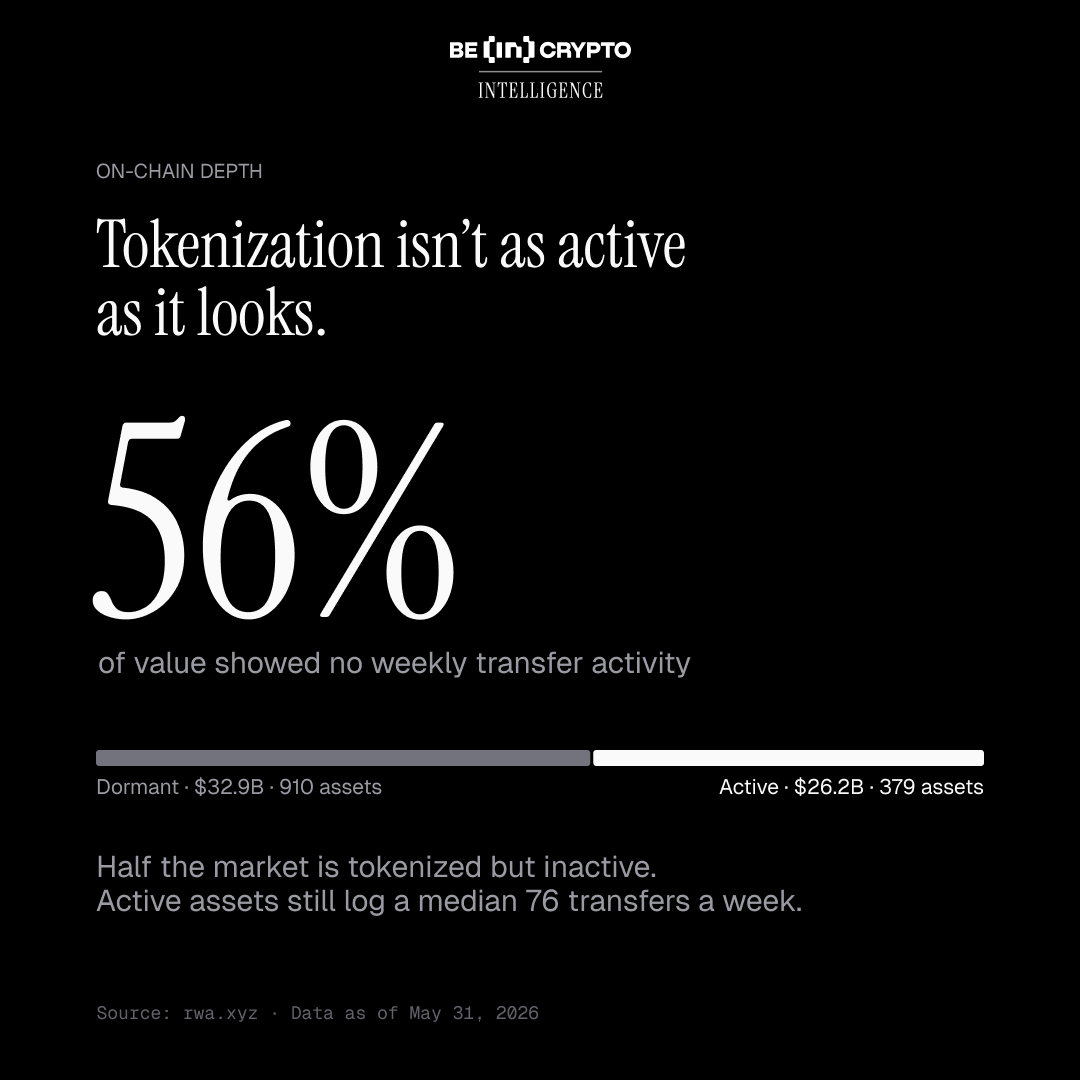
The report, Real State of Tokenization in 2026, tracked roughly $60 billion in tokenized real-world assets across more than 7,000 products and 12 asset classes. It found that the market is growing fast, but actual on-chain activity remains far thinner than the headline numbers suggest.
Across 1,289 tokenized assets worth more than $100,000, 910 showed zero weekly transfers. Those dormant assets represented $32.9 billion in value, or 56% of the market measured for transfer activity.

Only 379 assets showed weekly movement. Together, they represented $26.2 billion in active value.
Tokenization Has Value, But Not Always Movement
The finding points to one of the biggest gaps in tokenized finance. Assets may be brought on-chain, but that does not mean they are actively traded, transferred, or used across financial infrastructure.
The report draws a distinction between “Distributed” assets and “Represented” assets.
Distributed assets can move on public blockchain rails and may be used across wallets, platforms, or DeFi protocols.
Represented assets use blockchain more like an internal ledger or digital record of an off-chain position.
But why does this distinction matter? Because about $27 billion of dormant value came from Represented assets.
In these cases, low transfer activity does not necessarily mean failure. Some products were not designed for public secondary-market movement in the first place.
However, the data still shows that tokenized finance has not yet become a broad, liquid market. Even among active assets, activity is concentrated in a much smaller group than the total product count suggests.

The Next Problem Is Infrastructure
The research concludes that tokenization’s next phase depends less on launching more assets and more on building the systems that allow those assets to move, settle, comply with regulation, and reach investors.
Without stronger infrastructure around access, transfer controls, compliance, collateral use, and market depth, many tokenized assets may remain digital records rather than usable financial instruments.
The full BeInCrypto Research report is available here.
The post Half of the $60 Billion Tokenization Market Has No Real Activity appeared first on BeInCrypto.

SEC Commissioner Hester Peirce said on the Searching for Mana podcast that she expects the CLARITY Act to pass the full Senate this summer, adding an authoritative internal voice to a timeline the market has treated as optimistic but far from guaranteed.
The bill cleared the House on a 294–134 bipartisan vote in July 2025 and advanced out of the Senate Banking Committee on a 15–9 vote in May 2026, meaningful procedural progress, but still short of a floor vote, a merged text, and a presidential signature.
That distinction matters. Peirce is not a neutral observer offering a general forecast, she is a sitting SEC commissioner and former Senate Banking Committee staffer who knows exactly how many gates remain.
Her saying this publicly signals that the agency’s leadership does not regard the summer timeline as aspirational cover, but as a live expectation.
The procedural math is tighter than the headline optimism suggests. The Senate Banking Committee text and a parallel Agriculture Committee bill, the latter focused on commodities and derivatives, must be merged before a floor vote. That merged text then needs 60 votes to clear cloture, a threshold that requires sustained bipartisan cooperation.
JUST IN: — Bitcoin Magazine (@BitcoinMagazine) July 1, 2026
 SEC Commissioner Hester Peirce on the Clarity Act: "I'm still optimistic it will get done this summer."
"I expect that we'll see it pass soon."  pic.twitter.com/DwiZcJwy2a
Democrats Ruben Gallego of Arizona and Angela Alsobrooks of Maryland joined all 13 Republicans in committee, which is an encouraging signal, but committee votes and floor votes are different arithmetic problems.
The urgency is not theoretical. More than 100 crypto firms and trade associations have signed a public letter pressing Senate leadership to move the bill forward, and Treasury Secretary Scott Bessent has framed passage as critical to maintaining U.S. financial leadership and the dollar’s reserve status.
Agency guidance is reversible, a future administration can undo every no-action letter and staff bulletin without legislation. Statutory clarity from this bill is not. That asymmetry is what makes the summer window consequential beyond a single news cycle for digital assets markets.

Discover: The Best Token Presales
CLARITY Act: How Crypto Oversight Gets Split Between SEC, CFTC, and the Howey Test
Peirce outlined the bill’s core mechanics plainly. The CLARITY Act would divide jurisdiction over crypto between the SEC and the CFTC based on a three-bucket classification framework.
Digital commodities, Bitcoin and Ethereum are the clearest cases, with Solana likely included, would fall under CFTC jurisdiction for spot market oversight, a structure that does not currently exist in statute. Assets that qualify as investment contracts would remain under SEC oversight. Permitted payment stablecoins would sit under joint supervision.
The Howey Test clarification is the piece with the most direct market-structure implication. Under current law, whether a token constitutes part of an investment contract depends on a fact-intensive analysis that the SEC has applied inconsistently, leaving issuers and secondary market participants exposed to retroactive enforcement.
The CLARITY Act would codify a clearer standard for when that test applies to a given token, resolving the ambiguity that has kept major Layer 1 tokens in a classification gray zone and suppressed U.S. exchange listings.
Peirce has long argued the prior enforcement-first approach made honest builders indistinguishable from fraudsters; this provision would give developers a statutory framework to build against rather than a body of contradictory staff positions.
The Clarity Act has 16+ illicit finance safeguards, not loopholes:
Sec 201: BSA/AML applies to crypto
If you don’t like crypto, then say it, but stop these baseless attacks. https://t.co/JZVhjC9Efn— Senator Cynthia Lummis (@SenLummis) July 1, 2026
The developer liability protection in the bill addresses a separate but related risk. Under the prior SEC regime, software developers faced exposure when third parties used their protocols in ways regulators later deemed unlawful.
The CLARITY Act would shield developers from that liability in cases where a decentralized network lacks a centralized intermediary exercising control, a protection that directly affects DeFi protocol builders and open-source contributors who currently operate under meaningful legal uncertainty.
Peirce framed the window directly: “This is a rare window where you have a lot of regulatory goodwill.
Use that to build things that last, things that matter,” she said.

SEC Chair Paul Atkins reinforced the same directional signal in separate remarks to the Economic Club of New York and in a Fox News interview, saying President Trump had challenged the agency to make the U.S. the crypto capital of the world and faulting the prior administration for treating digital assets as suspect by nature.
Atkins pledged to bring innovators who had left the country back to build under American law, framing consistent with Peirce’s comments and indicative of aligned SEC leadership on the bill’s importance. The Trump administration’s deep financial exposure to the crypto sector adds political weight to that commitment beyond rhetoric.
Don’t Miss Out on Our $1,000 USDT Airdrop on ByBit
The post SEC’s Peirce Expects CLARITY Act Senate Vote Before August Recess appeared first on Cryptonews.

At the start of May, oil markets were still pricing in elevated geopolitical risk and expectations of sustained supply disruption.
But easing tensions between Washington and Tehran, along with improving supply expectations, have rapidly shifted sentiment back toward fundamentals.
📉 Brent crude has fallen back to around $71–74 per barrel
📊 Prices are now close to pre-conflict levels after a drop of more than 35% since early May
⚖️ The market is reassessing whether the geopolitical risk premium has been fully removed
The debate is now split between two clear narratives.
📉 Bearish case: supply is recovering and demand remains uneven
📈 Bullish case: geopolitical risks in the Strait of Hormuz are still not fully priced in
The key question for markets is whether oil has already priced in good news — or whether volatility is simply paused, not gone.
Gain insights to strengthen your trading knowledge.
Watch it now and stay updated with FXOpen.
💬 Don’t forget to like, comment, and subscribe for more professional market insights every week.
This article represents the opinion of the Companies operating under the FXOpen brand only. It is not to be construed as an offer, solicitation, or recommendation with respect to products and services provided by the Companies operating under the FXOpen brand, nor is it to be considered financial advice.
“Today’s milestone shows we can tokenize securities in ways that meet both market and regulatory requirements, for U.S. and global investors and provides a strong foundation for our expanding access to onchain investments for more U.S. investors,” he added.
Tokenization, or the process of representing traditional assets as blockchain-based tokens, has emerged as one of the fastest-growing areas blurring digital assets and traditional finance. Supporters say it can modernize capital markets through faster settlement, around-the-clock trading and easier movement of assets across financial platforms. A report by Citi projected that tokenized securities could reach $5.5 trillion market size by 2030.
Debate around tokenization models
The launch follows the SEC’s January staff statement on tokenized securities, which outlined how a third-party custodial model could comply with existing securities laws. SEC staff statements don’t have the full weight of formal guidance approved by the agency’s commissioners, but do indicate how the regulator is thinking about issues like tokenization.
Under that approach, a regulated intermediary holds conventional shares in custody and issues blockchain-based tokens representing a holder’s entitlement to those assets. That’s an alternative approach to the issuer-sponsored tokenization, where the issuer of the underlying security is involved in the process.
The agency’s guidance coincided with a growing debate over whether tokenized stocks issued without issuer involvement confer the same rights as traditional shares. The topic drew broader attention when OpenAI said last year it did not authorize Robinhood’s tokenized offering tied to its shares and warned the tokens did not represent equity in the company.

How to set your air conditioner for its best efficiency
India’s textile stocks become market standouts on trade deals

Pi Coin price steadies after Pi2Day launches as bearish flag caps recovery


-

 Fashion6 days ago
Weekend Open Thread: Staud – Corporette.com
-

 Politics6 days ago
The House | Manchesterism won’t survive the painful trade-offs unless it gets citizens on board
-

 Crypto World3 days ago
Strategy authorizes up to $1.25B in Bitcoin sales under new capital plan
-

 Politics7 days ago
Potential 2028er World Cup attendee leaderboard
-

 Business6 days ago
Asia stock markets slide as tech shares slump
-

 News Videos4 days ago
MAJOR BITCOIN & MARKET UPDATE!!!! (MUST WATCH ASAP!!!)
-

 Tech7 days ago
A Look At A Gaggle Of Transputer Boards
-
 Crypto World7 days ago
Dell (DELL) Shares Tumble Over 5% Following Analyst Downgrade to Hold
-

 Crypto World5 days ago
Coinbase, Circle Deepen Crypto Stock Losses Despite Resilient S&P 500
-

 Tech3 days ago
Anonymous researcher drops 0-day ‘exploitarium’ repo
-

 Business3 days ago
Australia treasurer says alleged access of prime minister’s bank data ’incredibly concerning’
-

 Crypto World5 days ago
Kraken's xStocks Opens Bending Spoons IPO Registration to EEA Retail
-

 Sports6 days ago
FIH Pro League: India defeat Pakistan 7-1, register biggest win of campaign | Other Sports News
-
 Crypto World7 days ago
Bitcoin Sparks $600M Hourly Liquidations With $65,000 Set To Become Resistance
-

 Tech5 days ago
Bluekit phishing kit adopts browser-in-the-middle for login theft
-

 Tech5 days ago
Russian hackers now target Signal backup recovery keys
-
 Crypto World6 days ago
Hyperliquid Named on Singapore MAS Investor Alert Register
-

 Crypto World6 days ago
RTX holders must register wallets before token distribution begins
-
 Crypto World6 days ago
Tether (USDT) Passes Ether in Market Cap as ETH Drops Toward $1.5K
-

 Sports1 day ago
Broncos roster: OL Ben Powers (No. 74) entering final year of contract
You must be logged in to post a comment Login