

Crypto World
SEC’s Peirce Expects CLARITY Act Senate Vote Before August Recess


SEC Commissioner Hester Peirce said on the Searching for Mana podcast that she expects the CLARITY Act to pass the full Senate this summer, adding an authoritative internal voice to a timeline the market has treated as optimistic but far from guaranteed.
The bill cleared the House on a 294–134 bipartisan vote in July 2025 and advanced out of the Senate Banking Committee on a 15–9 vote in May 2026, meaningful procedural progress, but still short of a floor vote, a merged text, and a presidential signature.
That distinction matters. Peirce is not a neutral observer offering a general forecast, she is a sitting SEC commissioner and former Senate Banking Committee staffer who knows exactly how many gates remain.
Her saying this publicly signals that the agency’s leadership does not regard the summer timeline as aspirational cover, but as a live expectation.
The procedural math is tighter than the headline optimism suggests. The Senate Banking Committee text and a parallel Agriculture Committee bill, the latter focused on commodities and derivatives, must be merged before a floor vote. That merged text then needs 60 votes to clear cloture, a threshold that requires sustained bipartisan cooperation.
JUST IN: — Bitcoin Magazine (@BitcoinMagazine) July 1, 2026
 SEC Commissioner Hester Peirce on the Clarity Act: "I'm still optimistic it will get done this summer."
"I expect that we'll see it pass soon."  pic.twitter.com/DwiZcJwy2a
Democrats Ruben Gallego of Arizona and Angela Alsobrooks of Maryland joined all 13 Republicans in committee, which is an encouraging signal, but committee votes and floor votes are different arithmetic problems.
The urgency is not theoretical. More than 100 crypto firms and trade associations have signed a public letter pressing Senate leadership to move the bill forward, and Treasury Secretary Scott Bessent has framed passage as critical to maintaining U.S. financial leadership and the dollar’s reserve status.
Agency guidance is reversible, a future administration can undo every no-action letter and staff bulletin without legislation. Statutory clarity from this bill is not. That asymmetry is what makes the summer window consequential beyond a single news cycle for digital assets markets.

Discover: The Best Token Presales
CLARITY Act: How Crypto Oversight Gets Split Between SEC, CFTC, and the Howey Test
Peirce outlined the bill’s core mechanics plainly. The CLARITY Act would divide jurisdiction over crypto between the SEC and the CFTC based on a three-bucket classification framework.
Digital commodities, Bitcoin and Ethereum are the clearest cases, with Solana likely included, would fall under CFTC jurisdiction for spot market oversight, a structure that does not currently exist in statute. Assets that qualify as investment contracts would remain under SEC oversight. Permitted payment stablecoins would sit under joint supervision.
The Howey Test clarification is the piece with the most direct market-structure implication. Under current law, whether a token constitutes part of an investment contract depends on a fact-intensive analysis that the SEC has applied inconsistently, leaving issuers and secondary market participants exposed to retroactive enforcement.
The CLARITY Act would codify a clearer standard for when that test applies to a given token, resolving the ambiguity that has kept major Layer 1 tokens in a classification gray zone and suppressed U.S. exchange listings.
Peirce has long argued the prior enforcement-first approach made honest builders indistinguishable from fraudsters; this provision would give developers a statutory framework to build against rather than a body of contradictory staff positions.
The Clarity Act has 16+ illicit finance safeguards, not loopholes:
Sec 201: BSA/AML applies to crypto
If you don’t like crypto, then say it, but stop these baseless attacks. https://t.co/JZVhjC9Efn— Senator Cynthia Lummis (@SenLummis) July 1, 2026
The developer liability protection in the bill addresses a separate but related risk. Under the prior SEC regime, software developers faced exposure when third parties used their protocols in ways regulators later deemed unlawful.
The CLARITY Act would shield developers from that liability in cases where a decentralized network lacks a centralized intermediary exercising control, a protection that directly affects DeFi protocol builders and open-source contributors who currently operate under meaningful legal uncertainty.
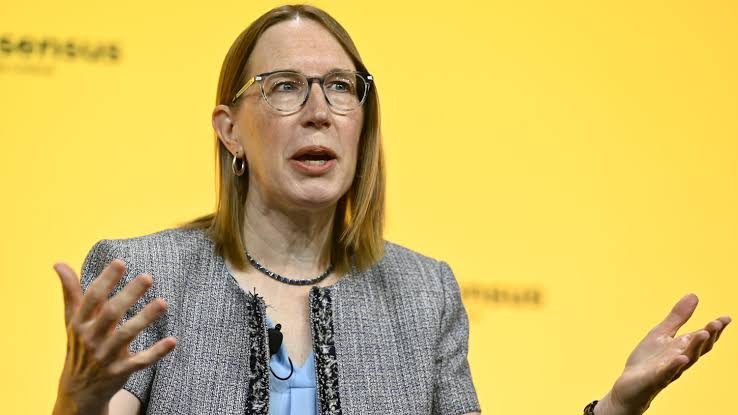
Peirce framed the window directly: “This is a rare window where you have a lot of regulatory goodwill.
Use that to build things that last, things that matter,” she said.
SEC Chair Paul Atkins reinforced the same directional signal in separate remarks to the Economic Club of New York and in a Fox News interview, saying President Trump had challenged the agency to make the U.S. the crypto capital of the world and faulting the prior administration for treating digital assets as suspect by nature.
Atkins pledged to bring innovators who had left the country back to build under American law, framing consistent with Peirce’s comments and indicative of aligned SEC leadership on the bill’s importance. The Trump administration’s deep financial exposure to the crypto sector adds political weight to that commitment beyond rhetoric.
Don’t Miss Out on Our $1,000 USDT Airdrop on ByBit
The post SEC’s Peirce Expects CLARITY Act Senate Vote Before August Recess appeared first on Cryptonews.


DeFiLlama has cut all ties with DL News after unidentified buyers acquired the outlet’s website and X (Twitter) account. The analytics platform says no future posts from the brand carry its endorsement.
Core developer 0xngmi went further, warning users not to trust anything the brand publishes. DL News ended editorial operations in May 2026 before its assets changed hands.
From DeFiLlama News Arm to Sold Asset
DL News launched in 2022 as the news arm of DeFiLlama, the open-source analytics platform tracking DeFi deposits. Unlike the platform, however, the outlet was built to turn a profit.
DeFiLlama announced the break in a July 1 statement on X.
“New owners have taken over the @dlnews website and assets. We expect them to resume posting soon. They’re no longer affiliated with DefiLlama in any way. We can’t corroborate any information about outreach and no posts should be considered to be endorsed by us.”
Follow us on X to get the latest news as it happens
The relationship fractured in March 2023, when 0xngmi publicly threatened a fork over a LLAMA token plan the team opposed. The sides reconciled within days, but the newsroom operated separately for the next two years.
Director Paige Aarhus announced the closure on May 7, citing shrinking readership and AI’s damage to search traffic.
DL Research, its 2024 commercial arm, grew revenue by 270% in 2025 and crossed the seven-figure mark. The growth still failed to offset the audience collapse.
DeFiLlama, meanwhile, continues to operate as normal. It recently drew scrutiny for relisting Aster perpetual data, a sign of how closely users watch its neutrality.
Why DeFiLlama’s DL News Buyback Failed
0xngmi told users not to trust anything published under the DL News name, likely indicating the open-source analytics platform no longer endorses the publication.
Further, the core developer explained that DeFiLlama attempted to buy the assets after the shutdown but failed.
The purchase failed because the brand belonged to Llama Corp, a Dubai-based entity, not the analytics team.
“Why does being sold mean it can’t be trusted? Doesn’t automatically follow, new ownership doesn’t guarantee bad journalism,” one user challenged.
The core developer did not immediately respond to BeInCrypto’s request for comment.
The site still lists Llama Corp in its footer and displays the closure notice.

The buyers remain unidentified. But market data suggests why the brand still found one.
An April 2026 analysis of 107 crypto news sites found more than 40 with zero organic traffic. Five outlets captured 78% of search visits.
That concentration gives dormant brands residual value. AI tools also drive over 25% of referrals to US crypto media, rewarding domains with citation history.
Trust remains the open question. Research shows crypto press releases can move risky asset prices, and an inherited newsroom brand could carry similar influence.
Whether the new owners identify themselves once publishing resumes may decide how much credibility survives the transfer.
The post DefiLlama Cuts Ties With DL News After Mystery Ownership Sale appeared first on BeInCrypto.
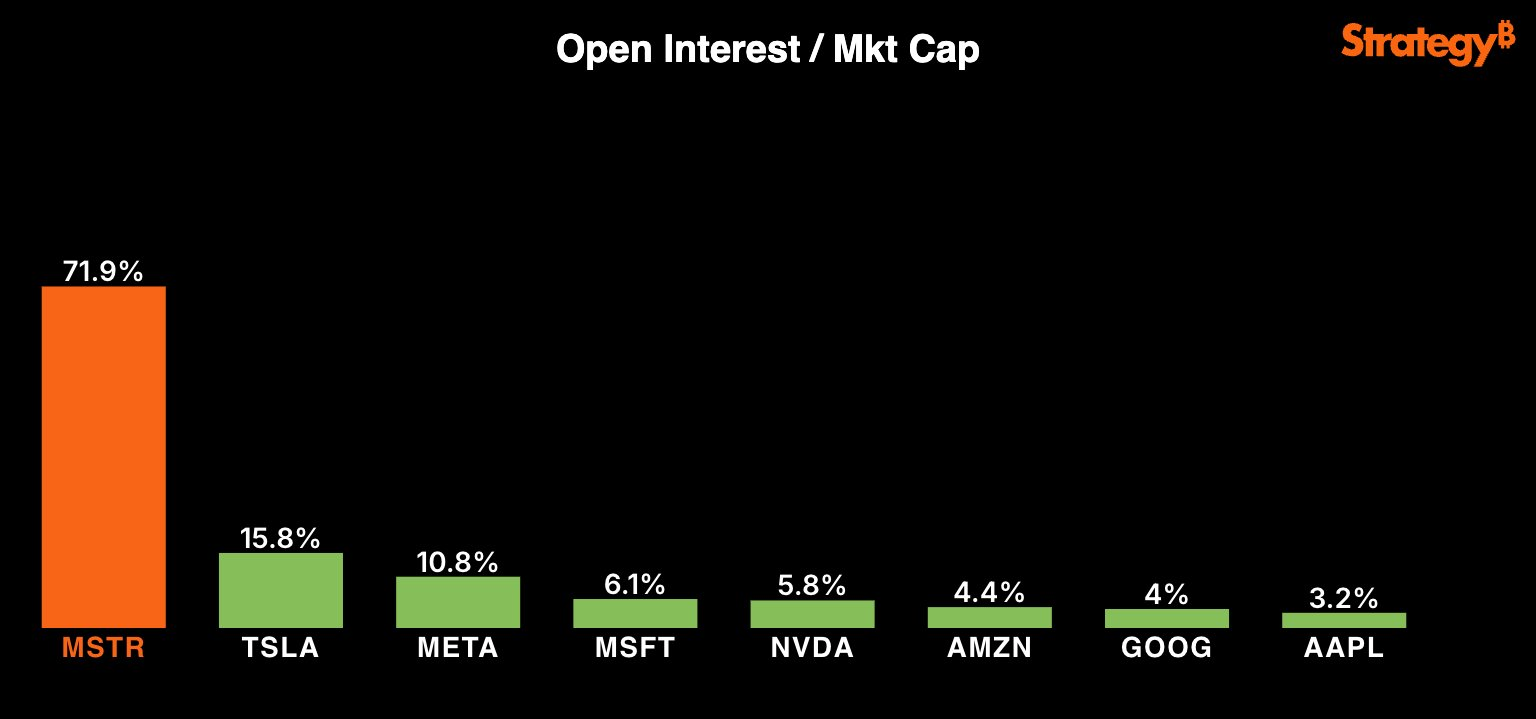
Michael Saylor pitted Strategy (MSTR) against the Magnificent 7 (Mag 7) on July 2, branding his company the “MoST inteResting” stock on Wall Street as shares recover from last week’s lows.
The comparison rests on derivatives positioning rather than price performance. According to a chart Saylor shared, MSTR options open interest equals 71.9% of the company’s market capitalization, several times higher than any Mag 7 member.

MSTR Options Interest Dwarfs the Mag 7
Saylor’s post capitalized select letters in “MoST inteResting” to spell out the MSTR ticker. His chart put Tesla (TSLA) closest at 15.8% and Meta (META) at 10.8%, with the remaining Mag 7 members lower still. Notably, the numbers are Strategy’s own presentation and capture one snapshot in time.
Follow us on X to get the latest news as it happens
The ratio captures how traders treat the stock. With a beta of 3.54, per S&P Global data, MSTR moves like a leveraged proxy for its $64 billion Bitcoin bet. Options remain the preferred vehicle for that exposure.
MicroStrategy’s latest filing shows 847,363 Bitcoin (BTC), over 4% of the circulating supply. The company paid $64.1 billion, an average of $75,646 per coin.
However, with BTC trading near $61,760, the position is now worth about $54 billion. This comes only days after Strategy’s valuation fell below the value of its Bitcoin holdings for the first time on June 26.

July Rebound Rides a New Capital Playbook
MSTR jumped 12.5% on Monday after unveiling its capital management overhaul. It then slid 6.2% to $86.93 on Tuesday as TD Cowen cut its target to $260 from $400.
On Thursday, shares climbed more than 7%, effectively recovering above $1009 to suggest a July recovery that is still pending confirmation.

The June 29 framework set aside a $2.55 billion cash reserve, covering 17.4 months of preferred dividends and interest. It also authorized up to $1.25 billion in Bitcoin sales and $2 billion in buybacks. Company leadership cast the change as deliberate.
“Strategy is evolving from one-way capital issuance to active capital management,” Phong Le, CEO of Strategy, said in the announcement.
Meanwhile, Wall Street’s response captures the tension. Citi kept its Buy rating but slashed the price target from $260 to $136, saying the plan buys time for Bitcoin to stabilize.
TD Cowen and BTIG also kept Buy ratings while lowering targets. Separately, Rosen Law Firm opened a securities probe into Strategy.
Saylor also reiterated the $100 STRC target as the preferred stock recovers from its June 26 record low of $71.25.
Supporters read the options dominance as conviction. In contrast, critics counter that the same leverage dragged the stock from a 52-week high of $457.22 to $81.81.
Whether derivatives fervor converts into durable equity performance still hinges on Bitcoin holding above $60,000. Strategy reports earnings on July 30, the first test of the new playbook in action.
The post Michael Saylor Pits MSTR Against Mag 7: Is the July Rebound Real? appeared first on BeInCrypto.


Bitwise CIO Matt Hougan has said Bitcoin may be moving closer to a market bottom as Strategy’s STRC stress drains excess leverage from the market.
Summary
- Bitwise CIO Matt Hougan says the STRC unwind could signal Bitcoin is nearing a market bottom.
- Hougan expects institutional investors to replace Strategy as the primary driver of Bitcoin demand.
- He believes the current deleveraging phase could pave the way for a new Bitcoin bull market this fall.
Bitwise Chief Investment Officer Matt Hougan wrote in his latest weekly memo that the recent volatility in Strategy’s STRC preferred stock looks like a late-cycle unwind rather than a sign of more serious structural damage.
“The volatility in STRC is a natural and important part of the crypto cycle. I think we’re nearing the bottom.”
STRC stress has forced leverage out of Bitcoin
STRC is a perpetual preferred stock created by Strategy to offer investors a high yield while keeping the instrument close to its $100 par value. Hougan said Strategy used the product to raise about $10.5 billion, with proceeds helping finance more Bitcoin purchases.
The trade weakened last week after Bitcoin and MSTR declined, sending STRC to roughly $75 and raising concerns over Strategy’s ability to keep funding preferred dividends. The company responded this week by increasing STRC’s annual dividend to 12%, authorizing up to $2 billion in common and preferred stock buybacks, and introducing a capital management framework that allows Bitcoin sales to strengthen reserves, meet dividend and debt obligations, and fund share repurchases.
According to Barron’s, STRC recently fell to a record low of $73.62 before Strategy increased the dividend and moved toward what it called active capital management. The report also said Strategy authorized up to $1.25 billion in Bitcoin sales to help strengthen reserves.
Hougan said the move means Strategy may no longer act as a one-way source of Bitcoin demand. “For years, Strategy has been the most dominant Bitcoin buyer in the world and a one way source of Bitcoin demand,” he wrote. “Those days are likely over.”
Institutions could lead the next Bitcoin rally
Hougan does not expect Strategy to become a forced seller, saying the company still has enough assets to cover debt and preferred obligations. He argued Bitcoin would need to fall much further and stay depressed before Strategy faced serious balance sheet pressure.
Instead, Hougan expects the next cycle to depend more on institutions, including banks, asset managers, pension funds, endowments, sovereign wealth funds, and financial advisers.
The Bitwise CIO compared the STRC unwind with the collapse of the Grayscale Bitcoin Trust premium after the 2019 to 2021 bull market. In his view, both structures pulled capital into Bitcoin during strong markets before losing support and forcing a painful reset.
Meanwhile, Bitcoin briefly climbed above $62,000 after softer U.S. jobs data improved risk appetite. Reuters reported that the U.S. added 57,000 jobs in June, below expectations, while stocks rose and the dollar weakened as traders reduced expectations for Fed tightening.
Hougan said investors should watch for MSTR trading below the value of its Bitcoin holdings, extreme Crypto Fear and Greed Index readings, and negative funding rates. While he warned that bottoms are impossible to call in real time, he wrote that the STRC unwind suggests the market is entering the final stage of the cycle.
“I’m convinced the bottom is closer than ever,” Hougan wrote, adding that he expects a new Bitcoin bull market to begin in the fall.
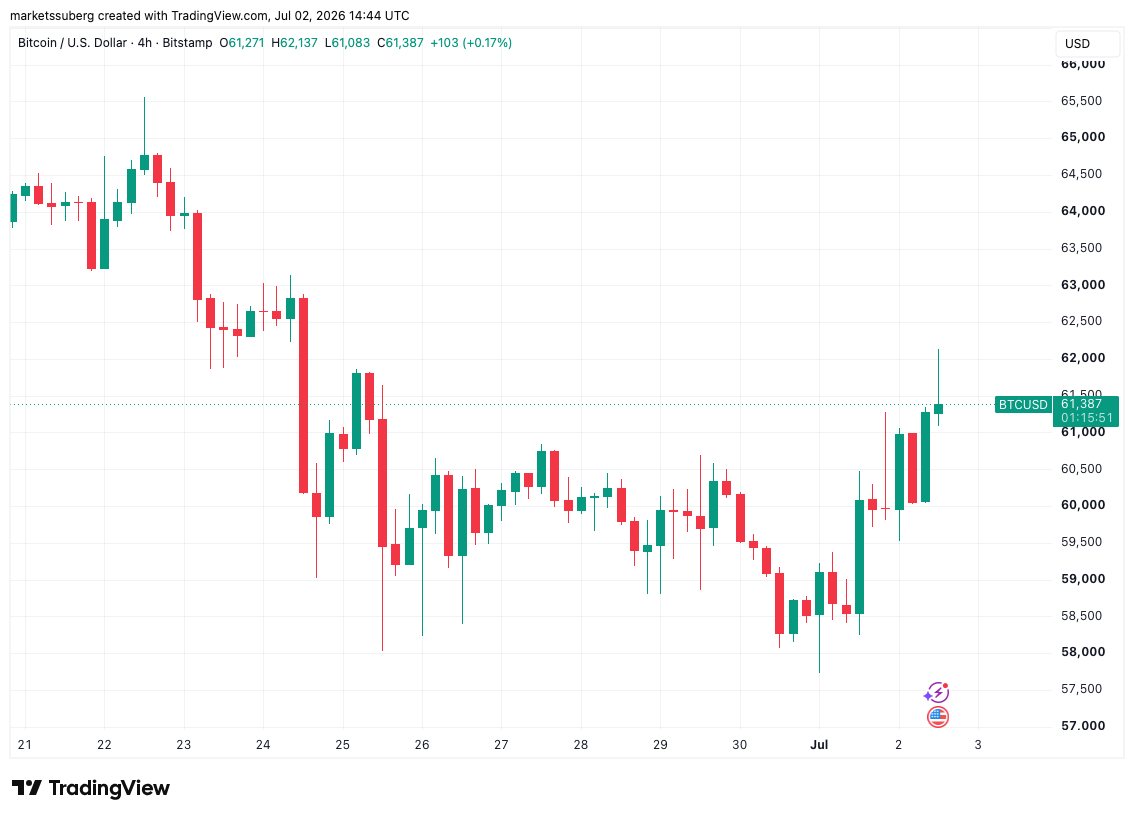
Bitcoin (BTC) passed $62,000 at Thursday’s Wall Street open as crypto reacted to weak US employment figures.
Key points:
- US nonfarm payrolls data delivers a crypto market boost as job additions for June fall short.
- Investors eye an easing in the inflation outlook as optimism over BTC prices increases.
- Crypto begins its forecast “green July” by liquidating nearly $500 milllion of short positions.
Bitcoin gains amid “volatile situation” for US labor market
Data from TradingView showed new July highs of $62,137 on Bitstamp, with BTC/USD up nearly 4% on the day.
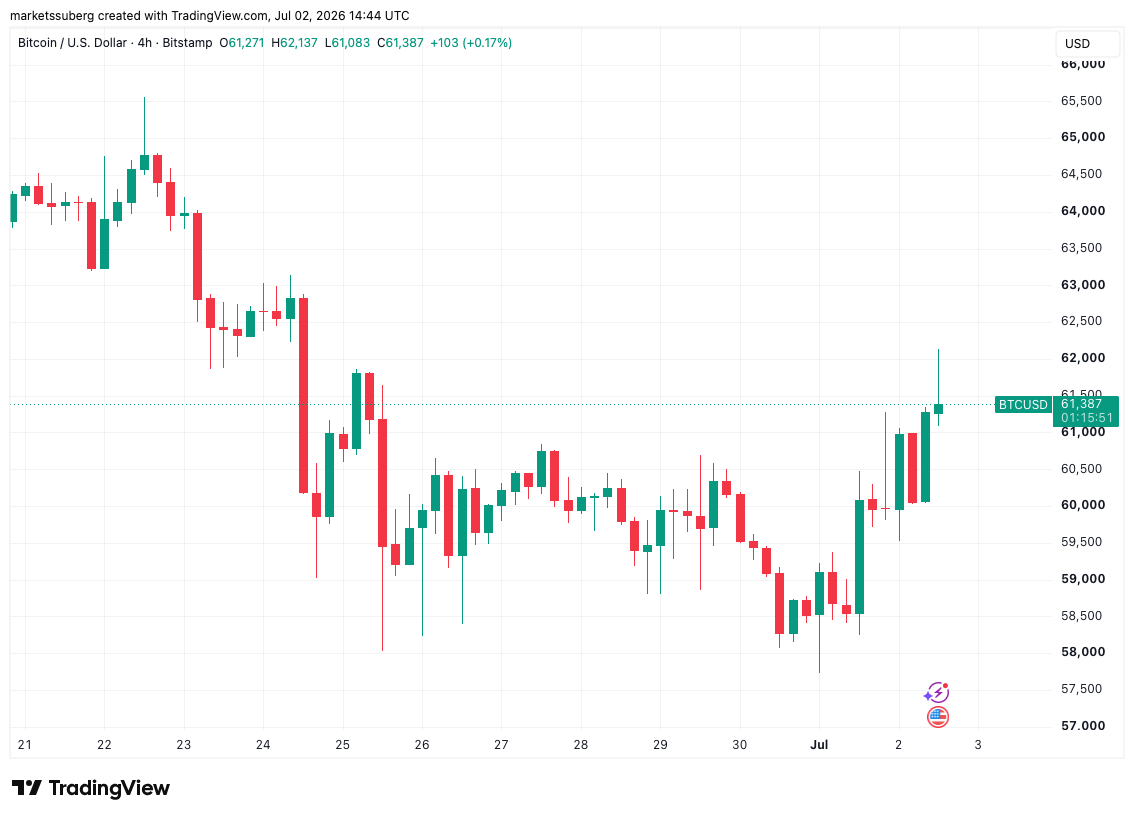
BTC/USD four-hour chart. Source: Cointelegraph/TradingView
The latest nonfarm payrolls data from the Bureau of Labor Statistics (BLS) showed that the US added far fewer jobs than expected in June, at 57,000 versus the anticipated 114,000.
“Both the unemployment rate, at 4.2 percent, and the number of unemployed people, at 7.1 million, changed little in June,” an official news release stated.
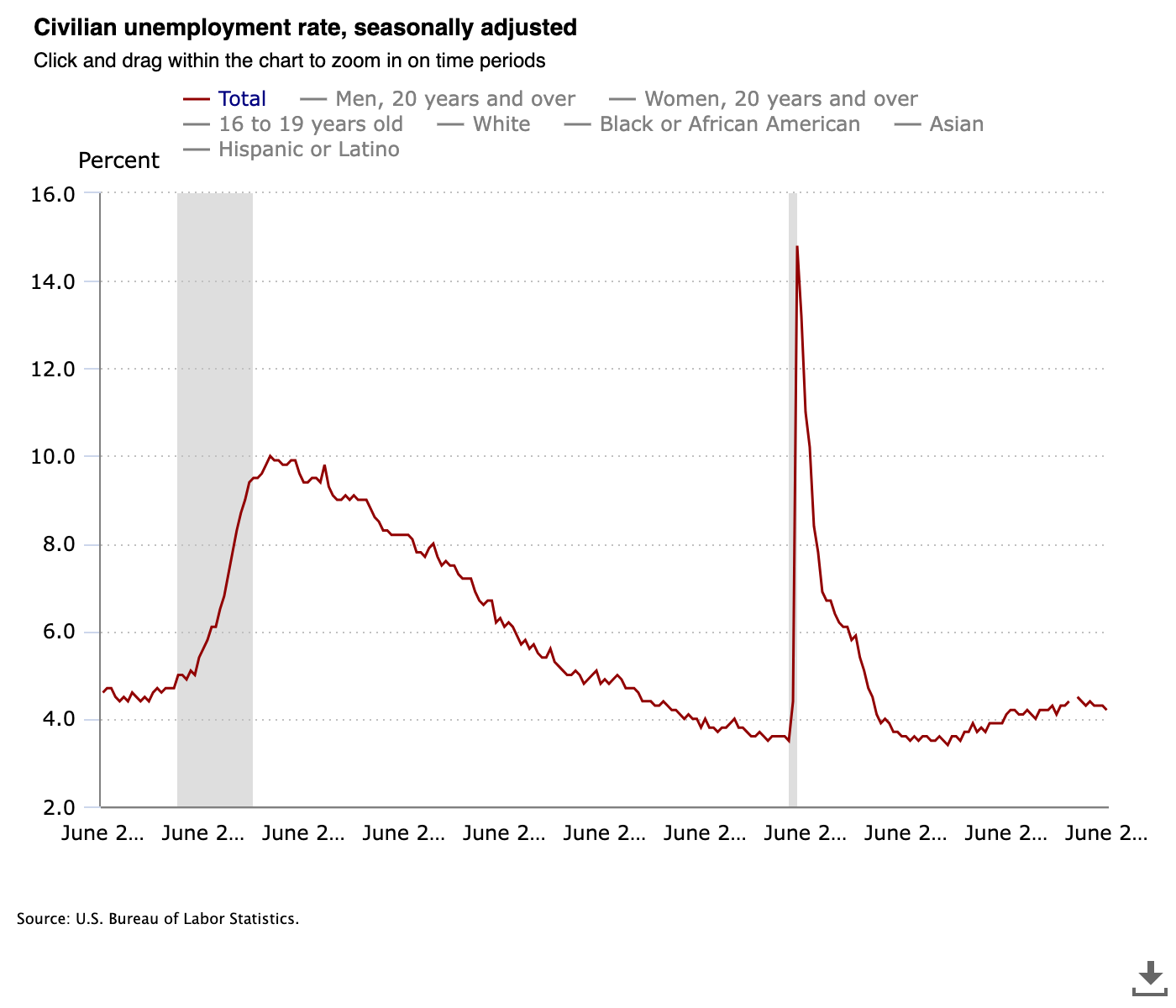
US unemployment data. Source: BLS
The jobs numbers painted a weak picture of the labor market — a potential tailwind for risk assets should the Federal Reserve loosen financial policy as a result.
“May’s jobs number was also revised down by -43,000 jobs,” trading resource The Kobeissi Letter noted in a reaction on X.
“The labor market remains in a volatile situation.”
As Bitcoin and altcoins headed higher, crypto trader and analyst Michaël van de Poppe was among those shifting toward a more optimistic mid-term market view.
“Inflation expectations have come down. Now, unemployment drops too. It’s at its lowest level in close to a year. Those are strong, public signals about the direction of the markets,” he told X followers.
“I don’t think we’ll see another drop on Bitcoin if Bitcoin can clearly break through $65,000 from here.”
Bitcoin “buyers are back and strong”
Other market participants also drew attention to Bitcoin bulls’ newfound strength.
Related: Bitcoin bear market ‘dead’ after first TD9 reversal signal since July 2022 fires
“Price drilling through large asks on Binance perps orderbook is actually sign of strength. Plus, we have chasing bids supporting aggressive buyers,” commentator Exitpump reported about exchange order-book data.
“Buyers are back and strong.”
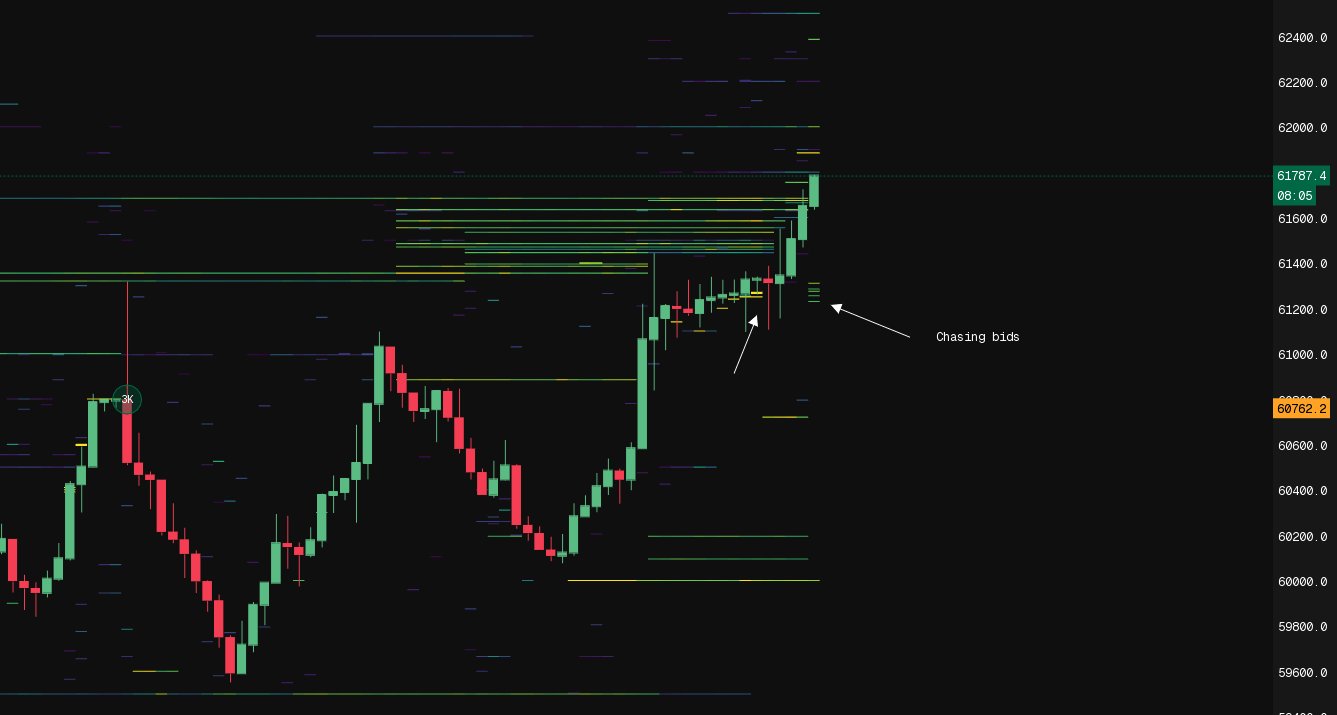
BTC/USDT chart with order-book liquidity data. Source: Exitpump/X
Data from CoinGlass put 24-hour crypto short liquidations at nearly $450 million at the time of writing.
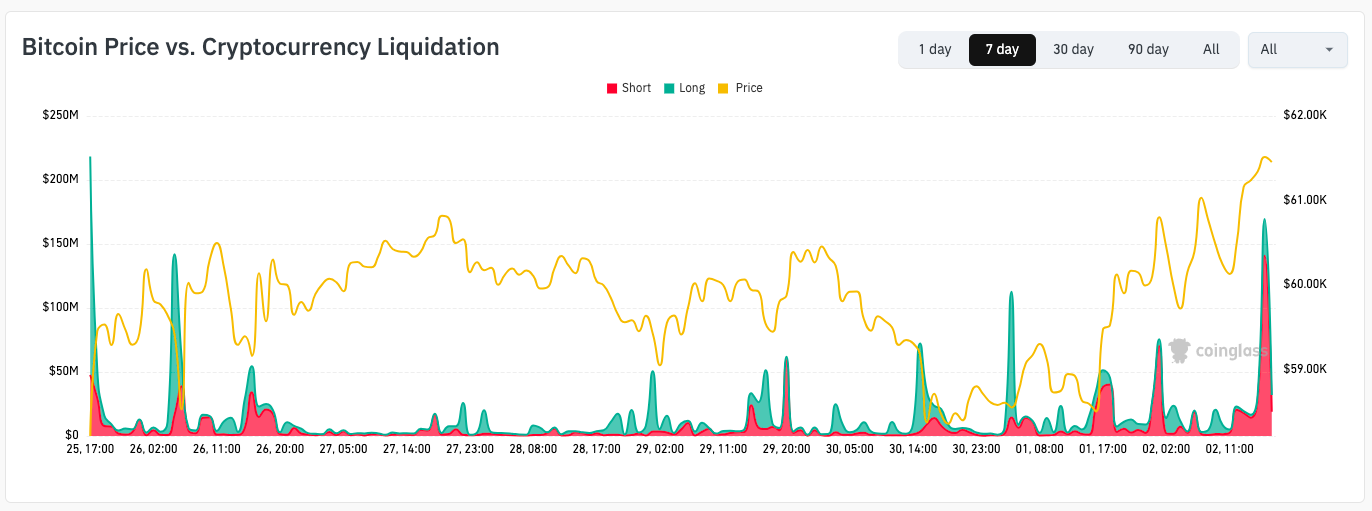
BTC/USD vs. cryptocurrency liquidations (screenshot). Source: CoinGlass
“Welcome to green July,” trader and analyst Rekt Capital continued.
As Cointelegraph reported, Rekt Capital expects a July relief rally for Bitcoin before bear-market momentum resumes in August.
An accompanying chart, which featured the 21-month and 50-month exponential moving averages (EMAs), drew comparisons to the 2022 bear market, with the implication that the cycle lows were still to come.
“And once Bitcoin turns the 50 EMA into new resistance on this relief rally, it will likely enter additional Bearish Acceleration over time,” Rekt Capital added in a separate X post.
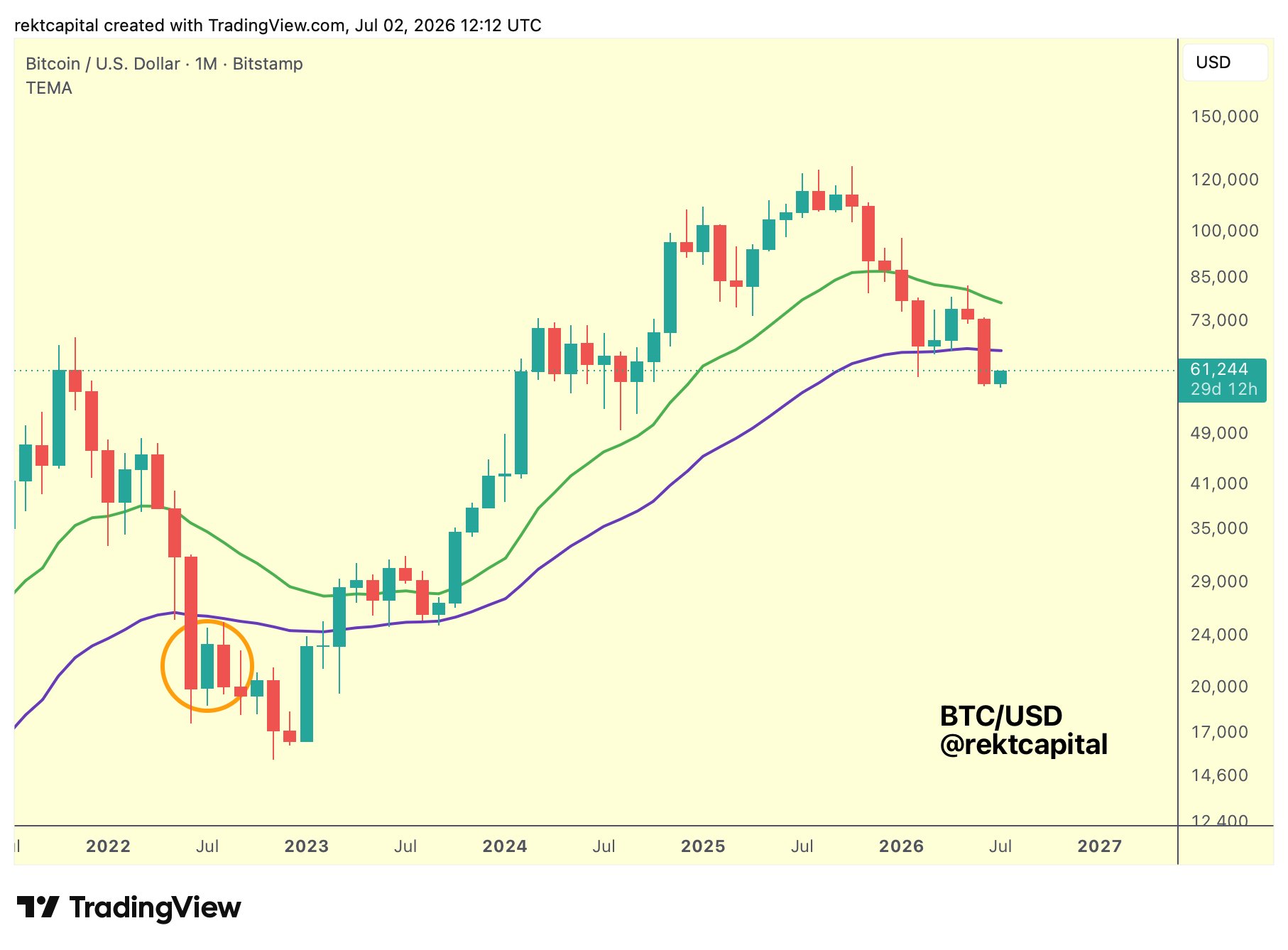
BTC/USD one-month chart with 21, 50EMA. Source: Rekt Capital/X
Crypto World
Nasdaq listed Korean Media firm that once wanted to buy 10,000 bitcoin sells all its BTC, pivots to AI
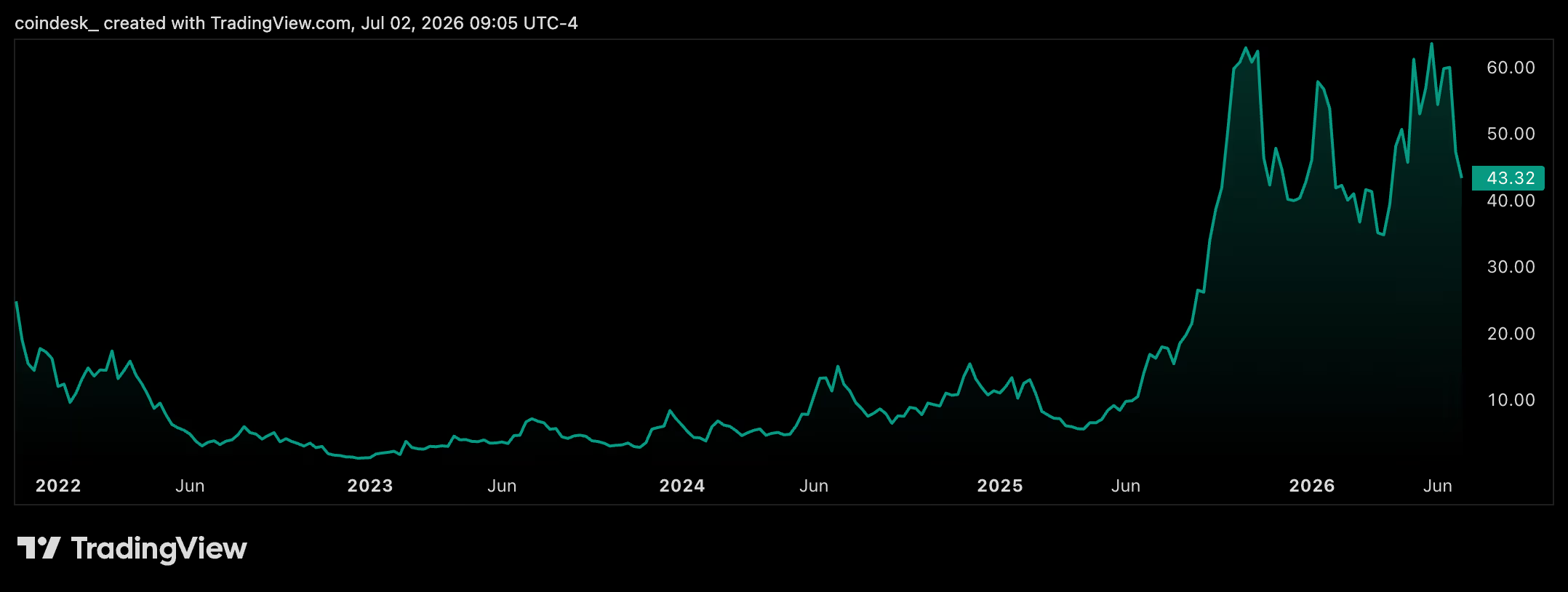
It is moving from a weak position. Shares closed near 16 cents on June 29, and Nasdaq has twice warned the company this year that it no longer meets listing rules, in January for trading below $1 and again in June because its publicly held shares are worth less than the $15 million minimum.
K Wave is considering a reverse stock split, which combines shares into fewer, higher-priced shares to raise the quoted price. The $250 million it hopes to raise is many times its entire market value.
The retreat fits a pattern followed by bitcoin miners.
These firms have sold more than 15,000 bitcoin from peak holdings and signed over $70 billion in AI computing contracts, chasing steadier margins than mining offers, and treasury companies are now joining that rotation. And it worked for some of the struggling miners, as their stock rallied from their lows. For example, IREN, a previously bitcoin mining company that pivoted to AI, saw its shares surge more than 200% after languishing since 2022.

It is the same shift of money out of crypto and into the AI trade that has weighed on bitcoin through a losing first half.
Whether the switch works remains unproven so far. AI infrastructure is capital-heavy and crowded with better-funded rivals, and K Wave has to stay on Nasdaq long enough to spend what it raises.

The idea of prediction markets is centuries old. Informal information markets date back to early 16th-century Italy, where people speculated on who would become the next pope and circulated the odds through handwritten letters. While the technology has changed dramatically, the underlying instinct has not.
People have always looked to collective opinion as a way to understand what may happen next. But as prediction markets expand and attract attention from major technology companies such as Meta, the industry faces a new question: if these platforms are designed to reflect collective intelligence, why are so many markets still shaped by centralized teams?
Rain Trade is taking a different approach to forecasting. Rather than treating market creation as a centralized process, the platform allows anyone to launch public or private prediction markets on any topic, in any language. Users decide what deserves a market, whether it’s the game aired tonight, a political development, or even the outcome of the latest season of Love Island USA, which generated more than $20 million in trading volume on Kalshi during its first two weeks.
The launch coincides with the 2026 FIFA World Cup, during which millions of fans continually debate match outcomes, player performances, and tournament predictions. The launch campaign is backed by former heavyweight champion Mike Tyson, who will serve as the face of Rain Trade’s official rollout.
Roy Shaham, CEO of Rain Protocol, the foundation on which Rain Trade is built, said the platform reflects where prediction markets are heading next: “Users want more than a list of markets chosen for them. They want the freedom to create, participate, and build communities around the events they care about. Rain Trade was designed to give them that control, turning prediction markets into something shaped by users, not just platform operators.”
That user-driven approach is central to Rain Trade’s model. Unlike traditional platforms, where markets are selected by the platform itself, Rain Trade allows users to create and share their own markets. They can keep them public or keep them private and password-protected for a specific community, group, or audience. That flexibility allows prediction markets to be shaped less by major headlines and more by the smaller conversations happening in real-time across online communities and in private chats.
To encourage participation, market creators can earn a share of the trading activity generated by the markets they launch. Whether the markets are formed around the World Cup, entertainment, politics, or in a private group chat, the idea is that the community, not a centralized team, should always be the ones to decide what is worth predicting.

TLDR
- Netflix shares rose 3.95% on July 2, outperforming the Software & IT Services sector, which fell 1.01%.
- Market sentiment improved after concerns eased around possible Warner Bros Discovery and NBCUniversal acquisition activity.
- NFLX stock gained support from a lower valuation, which attracted buyers after recent selling pressure.
- Netflix’s advertising tier remained a major growth driver, supported by its Omnicom partnership and wider distribution reach.
- The $400 million Radford Studio Center acquisition signaled Netflix’s continued focus on production efficiency and cost control.
Netflix (NFLX) stock rose 3.95% on July 2, while Software & IT Services fell 1.01%, showing clear market outperformance. The move came with strong turnover, intraday swings, and confidence after weak sessions. NFLX stock also beat major sector peers.
Microsoft rose 1.24%, Meta fell 4.09%, and Palantir gained 2.72% among the sector’s busiest names. However, Netflix drew stronger attention because buyers entered after recent selling pressure. The price action showed renewed demand near depressed valuation levels.
NFLX stock benefited as traders shifted focus back to Netflix’s core business and away from deal speculation. The company faced concerns over large media deals that could raise leverage. Yet management avoided costly merger risks and preserved capital discipline during a volatile backdrop.
Deal Concerns Ease Around Netflix
Market sentiment improved after Netflix moved away from major acquisition speculation. Reports had linked the company with Warner Bros Discovery, but concerns eased after the overhang faded. Management also saw NBCUniversal rumors denied, which reduced deal pressure and stabilized expectations.
The market viewed that restraint as positive for NFLX stock because it reduced concern over large commitments. Large media mergers often create debt concerns, integration risks, and uncertainty over earnings. Therefore, Netflix’s decision helped restore attention to subscriber growth, advertising revenue, and content returns.
NFLX stock gained momentum as deal risks faded and organic growth returned to focus. Netflix did not issue a fresh statement on the move, and the stock traded on market interpretation. Still, the reduced deal noise supported a cleaner investment case for NFLX stock and strengthened the recovery.
Valuation and Ads Support Momentum
NFLX stock also attracted demand after trading near its 52-week low and a cheaper forward earnings multiple. The lower valuation encouraged dip buying from funds and active traders before the next earnings update. Technical signals also improved after earlier oversold readings, which helped short-term momentum.
The advertising business added another growth driver for NFLX stock as Netflix expands beyond standard subscription revenue. Its Omnicom partnership strengthens ad targeting, campaign tools, and monetization across the ad-supported base. The company also expands access through Spectrum’s app store distribution deal, which may support wider reach.
NFLX stock gained further support from cost controls and studio investments. Netflix bought Radford Studio Center for $400 million to improve production efficiency and manage content costs. Together, ads, valuation, and spending discipline drove the 3.95% move in NFLX stock.


Ondo Finance says it is moving beyond simple “tokenized ownership” by adding shareholder-style governance tools to its onchain securities. Through a partnership with financial infrastructure provider Broadridge, holders of certain Ondo-issued tokenized stocks and ETFs will be able to participate in proxy voting and receive corporate communications through a Web3-enabled workflow.
The announcement targets a recurring concern in tokenized securities: even when users can buy and hold tokenized shares, it has not always been clear how, or whether, they receive the voting and notice rights that come with traditional direct stock ownership.
Key takeaways
- Ondo plans to enable proxy voting and access to corporate communications for holders of more than 250 tokenized securities issued through its platform.
- The solution is powered by a Web3-enabled version of Broadridge’s investor communications platform, designed to authenticate via blockchain wallets.
- Ondo says the governance features will accompany the launch of its first US custodial tokenized securities, including tokenized products tied to iShares Core S&P 500 ETF (IVV) and Micron Technology (MU).
- The company frames the rollout as aligned with the US SEC’s third-party custodial framework for tokenized securities.
- The move arrives as the tokenized equities market continues expanding, with growing competition among tokenization providers.
Why governance rights matter for tokenized equities
Tokenization has helped reshape parts of capital markets by enabling digital settlement and potentially more flexible access to investment products. But governance—specifically proxy voting and access to corporate materials—is where tokenized products often face scrutiny from investors and market structure observers.
Ondo’s new integration with Broadridge is designed to close that gap. According to the companies, holders can participate in proxy voting and receive corporate communications such as regulatory filings and other shareholder documents, using an interface that connects onchain identity (blockchain wallet authentication) to services traditionally reserved for registered shareholders.
For investors, this matters because governance rights are not merely an administrative feature. They are tied to how shareholders influence corporate decisions, respond to proposals, and receive timely disclosures—elements that can be central to due diligence and long-term ownership strategies.
Broadridge integration brings Web3 wallet authentication to investor communications
Ondo said its implementation uses a Broadridge investor communications platform adapted for Web3 use. The goal is to let users authenticate with blockchain wallets while accessing governance services that typically operate through conventional shareholder channels.
While the market has increasingly focused on execution—how quickly assets can transfer and trade—Ondo’s emphasis is on the “investor experience” layer. By connecting wallet authentication to proxy voting and document delivery, the company is effectively targeting the part of tokenized securities that can otherwise feel incomplete compared with traditional brokerage ownership.
Ondo’s announcement also indicates that the governance capability is expected to scale across a broad set of tokenized instruments—specifically, more than 250 securities issued through Ondo that are covered by the rollout.
Custodial tokenized securities and the SEC’s third-party framework
Ondo said the voting and corporate communications functions will be included with the launch of its first US custodial tokenized securities. The company named tokenized versions of BlackRock’s iShares Core S&P 500 ETF (IVV) and Micron Technology (MU) as part of that initial offering.
In its explanation of the regulatory approach, Ondo linked the rollout to the US Securities and Exchange Commission’s third-party custodial framework for tokenized securities. That framework, as discussed in earlier coverage from Cointelegraph, is one of the core regulatory pathways that distinguishes how tokenized securities may be structured and held.
By anchoring governance features to the launch of custodial tokenized products, Ondo is also signaling that it views custody, investor rights, and compliance mechanics as interconnected—not optional add-ons.
Tokenized equities keep growing—competition intensifies
Ondo’s governance push lands as tokenized equities show continued momentum. Foresight Ventures data, cited in Ondo’s recent reporting, indicated the tokenized stocks segment first surpassed $1 billion in March. Ondo later said that the market grew to $1.67 billion and reached nearly 181,000 unique holders, referencing data shared in its own publication.
In addition to Ondo, other firms are expanding their tokenized-stock offerings. Backed Finance, for example, issues tokenized stocks via its xStocks platform and has broadened distribution across multiple crypto exchanges and blockchain networks, according to the article context.
The broader category—tokenized real-world assets—has also attracted attention even during periods of weaker overall crypto sentiment. A recent 21shares report attributed sustained growth in institutional participation to improving infrastructure, while Binance data referenced in the source material said the value of tokenized RWA assets, including stocks, surged nearly 600% over the past year.
Together, these figures help explain why governance integrations are becoming more strategic. As more providers enter the space and assets proliferate, investors will likely demand more complete “shareholder-equivalent” functionality rather than only trading access and settlement speed.
What to watch next for investors
Investors should watch how Ondo and Broadridge operationalize proxy voting and document delivery across supported securities, including how wallet authentication maps to investor eligibility and participation. As tokenized equities continue to scale, governance functionality may become a differentiator as important as liquidity and custody.
Standard Chartered has become the first Global Systemically Important Bank (G-SIB) to offer institutional clients direct access to USDC minting and redemption, through a partnership with issuer Circle announced on July 2.
Eligible clients can convert dollars to USDC and back inside their existing banking relationship, with no separate Circle accounts required. However, the launch covers Dubai only, and a rival bank rolled out similar services three days earlier.
Standard Chartered USDC Access Starts in Dubai
The capability, developed with Circle, runs through the bank’s Dubai International Financial Centre (DIFC) operations.
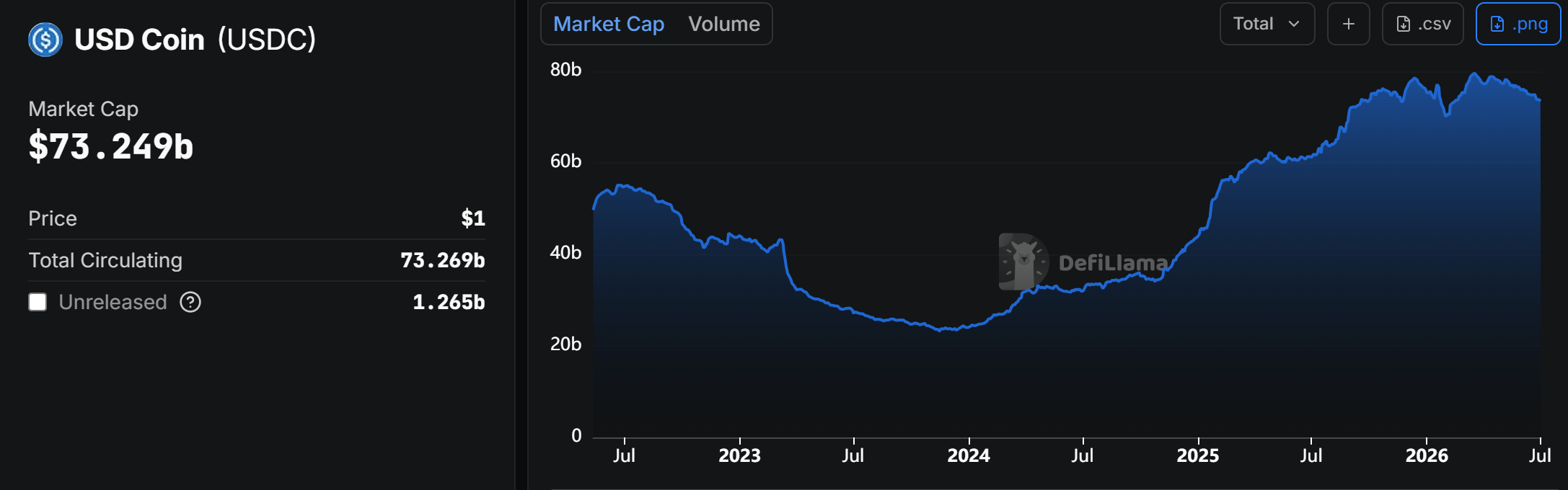
It gives institutions a single onboarding route into USDC, which commands a $73.2 billion market cap.

Standard Chartered says the service supports on-chain settlement, treasury operations, and liquidity management, with payment use cases planned later. Expansion into additional markets depends on regulatory approvals and market readiness.
“Digital assets are becoming an increasingly important component of global financial infrastructure, and institutional clients are seeking the same levels of trust and governance that underpin traditional markets,” Roberto Hoornweg, CEO of Corporate and Investment Banking at Standard Chartered, said in the announcement.
Follow us on X to get the latest news as it happens
The relationship runs deeper than one launch. Standard Chartered has helped design the Circle Payments Network since April 2025, alongside Santander, Deutsche Bank, and Société Générale.
This week, the bank also initiated coverage of the DeFi lending protocol Morpho.
Rivals are Already Moving on USDC
It is imperative to note, however, that Standard Chartered is not the first. On June 29, BNY enabled clients to mint, redeem, and hold USDC through its Digital Asset Custody platform.
BNY is no fringe player. It custodies USDC’s reserves and oversees $59.3 trillion in assets under custody or administration.
More may follow. BNY says it plans to add further stablecoin issuers over time, while Standard Chartered cites growing demand from institutions and corporations for regulated stablecoin infrastructure.
Circle, meanwhile, has its own reasons to court bank partners. Its stock fell 15% last week after 140 firms, including Visa and Coinbase, backed rival stablecoin Open USD.
Bank distribution hands USDC deeper institutional rails just as its enterprise lead comes under attack.
Regulation will set the pace. Circle kept its European listings under MiCA while Tether’s USDT exited, yet Standard Chartered’s global rollout still awaits approvals market by market.
Whether treasurers route real settlement flows through bank-issued USDC rather than pilots will determine how quickly the rest of the G-SIB pack moves.
The post Two Big Banks Adopt Circle’s USDC Stablecoin This Week appeared first on BeInCrypto.


Earlier this week, Strategy unveiled a capital framework allowing selective bitcoin sales to fund preferred dividends, while authorizing preferred share repurchases and stock buybacks. It also set a minimum cash reserve covering 12 months of preferred dividend and interest payments. Its $2.55 billion cash balance currently covers about 17 months.
Hougan said the episode marks a broader shift in Strategy’s role within bitcoin markets. Rather than serving as crypto’s dominant, one-way buyer, the firm is likely to become a more flexible participant whose bitcoin purchases or sales depend on market conditions.
Looking ahead, Bitwise believes institutional investors, including asset managers, banks, pensions, endowments and sovereign funds, are positioned to replace Strategy as bitcoin’s primary source of demand.
More broadly, STRC volatility is seen as part of the leverage unwind that typically marks the late stages of every crypto cycle. As speculative excess is flushed from the system, the market moves closer to establishing a durable bottom, though the exact timing remains impossible to predict, the report added.
Wall Street bank JPMorgan said Strategy’s new policy allowing selective bitcoin sales to fund preferred dividends creates avoidable two-way risk, increasing uncertainty and market volatility.
Read more: JPMorgan says Strategy’s bitcoin sales policy adds ‘two-way risk’ to crypto markets

Taylor Frankie Paul Bachelorette Season Could Air, Ex-Producer Says

The $249.78 XRP Demand SHOCK!

The Choir Of Man, Grand Opera House, York – review


-

 Fashion6 days ago
Weekend Open Thread: Staud – Corporette.com
-

 Politics7 days ago
The House | Manchesterism won’t survive the painful trade-offs unless it gets citizens on board
-

 Crypto World3 days ago
Strategy authorizes up to $1.25B in Bitcoin sales under new capital plan
-

 Politics7 days ago
Potential 2028er World Cup attendee leaderboard
-

 Business6 days ago
Asia stock markets slide as tech shares slump
-

 News Videos4 days ago
MAJOR BITCOIN & MARKET UPDATE!!!! (MUST WATCH ASAP!!!)
-

 Tech7 days ago
A Look At A Gaggle Of Transputer Boards
-

 Crypto World5 days ago
Coinbase, Circle Deepen Crypto Stock Losses Despite Resilient S&P 500
-

 Tech3 days ago
Anonymous researcher drops 0-day ‘exploitarium’ repo
-

 Business3 days ago
Australia treasurer says alleged access of prime minister’s bank data ’incredibly concerning’
-

 Crypto World6 days ago
Kraken's xStocks Opens Bending Spoons IPO Registration to EEA Retail
-

 Crypto World7 days ago
Bitcoin Sparks $600M Hourly Liquidations With $65,000 Set To Become Resistance
-

 Sports6 days ago
FIH Pro League: India defeat Pakistan 7-1, register biggest win of campaign | Other Sports News
-

 Tech5 days ago
Bluekit phishing kit adopts browser-in-the-middle for login theft
-

 Tech5 days ago
Russian hackers now target Signal backup recovery keys
-
 Crypto World6 days ago
Hyperliquid Named on Singapore MAS Investor Alert Register
-

 Crypto World6 days ago
RTX holders must register wallets before token distribution begins
-

 Crypto World6 days ago
Tether (USDT) Passes Ether in Market Cap as ETH Drops Toward $1.5K
-

 Sports1 day ago
Broncos roster: OL Ben Powers (No. 74) entering final year of contract
-
 Business3 days ago
The AI boom won’t burst all at once. It will pop in ‘rolling bubbles’: Macquarie
You must be logged in to post a comment Login