

Crypto World
Can Ansem and a $300M Airdrop Revive Pump.fun Before Its $130 Million Unlock?

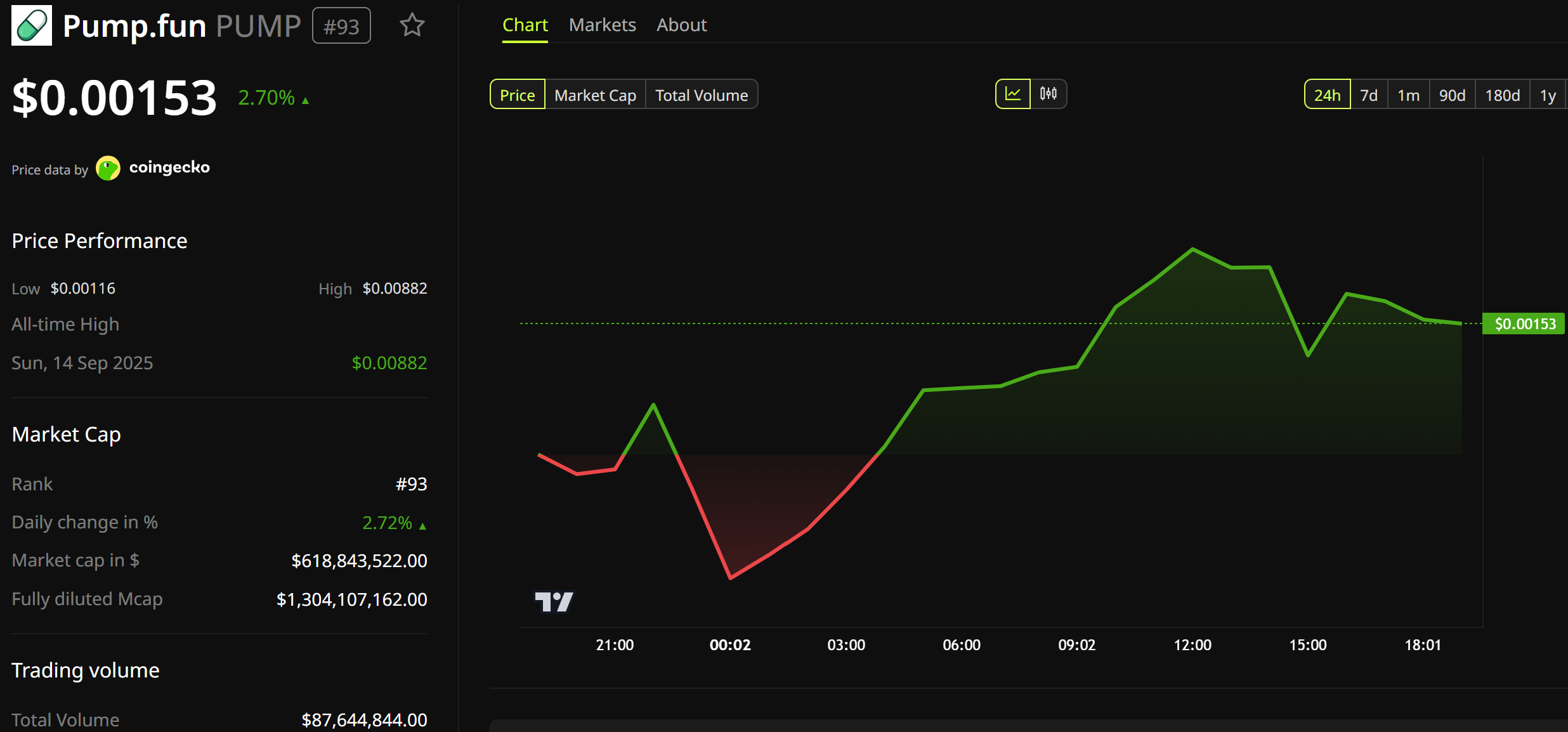
Crypto trader Ansem has urged Pump.fun to launch a PUMP airdrop worth up to $300 million for early users. The demand lands less than two weeks before the platform’s first investor token unlock on July 12.
Pump.fun (PUMP) trades near $0.0015, more than 80% below its September 2025 peak. The debate now centers on whether rewards or burns offer holders better protection when locked tokens hit the market.

Ansem Pushes for a $300 Million PUMP Airdrop
Ansem’s argument is that a large distribution would reward loyal traders and repair public opinion toward the platform, potentially driving price upwards.
“all im saying is if they give the trenches a $250-$300M airdrop stimmy as solana is breaking out & gaining attention again + incentivize future trading volumes, the public opinion towards them would change at breakneck speeds,” Ansem suggested.
His words carry weight in the meme coin community. The ANSEM token gained nearly 20,000% in a week after he pledged weekly creator fee airdrops. The platform, however, has not announced any airdrop plans.
Burns, Buybacks, and the July 12 Unlock
Pump.fun has so far chosen destruction over distribution. In April, the platform executed a $370 million token burn that removed about 36% of the circulating supply. It also committed half of its revenue to automated buybacks and burns for one year.
Critics said those tokens should have gone to users instead. Co-founder Alon Cohen defended the strategy at the time.
“Every dollar not burned is a dollar being put to work toward the same outcome,” Cohen said in a post.
Yet supply reduction has not delivered lasting price gains. An earlier buyback program struggled against sustained whale selling in late 2025.
The July 12 unlock now poses a bigger test. It falls one year to the day after PUMP sold at $0.004 in its initial coin offering.

As the cliff expires, 82.5 billion tokens worth roughly $133 million will vest to existing investors, according to Tokenomist data.
The tranche equals about a fifth of the circulating supply. Moreover, PUMP remains 62% below its ICO price despite gaining almost 20% over the past week.
Pump.fun can answer Ansem with an airdrop, more burns, or silence. Whichever it chooses, July 12 will test whether shrinking supply and renewed attention can cushion its first investor unlock.
The post Can Ansem and a $300M Airdrop Revive Pump.fun Before Its $130 Million Unlock? appeared first on BeInCrypto.

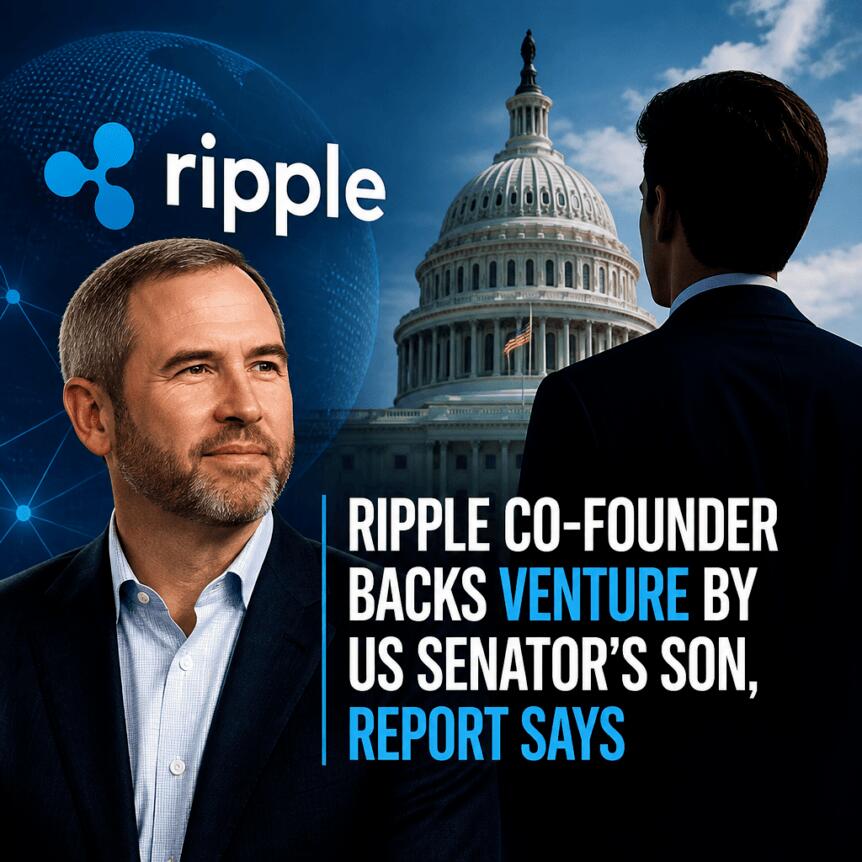
Ripple executive chair Chris Larsen has been reported as one of the backers of a financial venture launched by Theodore Gillibrand, the son of US Senator Kirsten Gillibrand, according to a Politico report dated Thursday. The development lands in parallel with ongoing Senate negotiations over the Digital Asset Market Clarity (CLARITY) Act—US crypto market-structure legislation that lawmakers say could reshape how digital-asset businesses operate.
Politico reports that American Perpetuals Exchange Corp. (APEC), founded by Theodore Gillibrand, raised $30 million, with most investors contributing between $5,000 and $10,000 apiece. Larsen’s reported involvement was noted by Politico, though the report did not specify Larsen’s exact contribution.
Key takeaways
- Politico reports Chris Larsen was among investors backing APEC, Theodore Gillibrand’s derivatives-focused venture.
- APEC’s funding is described as totaling $30 million, with typical contributions reportedly in the $5,000–$10,000 range.
- The investment is unfolding while Senator Kirsten Gillibrand negotiates ethics provisions in the CLARITY Act.
- Democratic lawmakers are pressing Republicans to include ethics language, with questions framed around conflicts involving lawmakers and government officials.
- The Senate schedule—returning July 13 and then breaking again for an extended state work period—narrows the time left for CLARITY to advance.
APEC funding and the Larsen connection
In its Thursday coverage, Politico said Larsen was one of a small set of investors supporting APEC, the company created by Theodore Gillibrand. The report emphasizes that while APEC attracted a broader group of investors, individual stakes cited in the coverage were relatively modest, with “the majority” contributing between $5,000 and $10,000.
However, Politico did not publish Larsen’s exact amount. For readers tracking the intersection of finance and policy, the more relevant takeaway is not the dollar figure itself, but the timing: the reported investment is occurring while Gillibrand’s office and other lawmakers work to finalize provisions of a bill widely expected to influence the regulatory environment for crypto exchanges, issuers, and derivatives markets.
Ethics provisions in the CLARITY Act are front and center
The reported APEC backers’ list is becoming part of a broader political debate because the CLARITY Act is in active negotiation, and Gillibrand has publicly tied her support to ethics reforms.
As Cointelegraph previously reported, Gillibrand said in May that lawmakers would not be voting for the bill unless ethics concerns were addressed—specifically, the risk that members of Congress or senior administration figures could benefit financially from the crypto industry due to their government roles. In that context, she characterized such outcomes as an unacceptable form of “pay for play.”
“[T]he truth is, is that we cannot allow members of Congress, senior administration officials, presidents or vice presidents, to get rich off of these industries because of their insider status. It is the worst form of pay for play.”
A spokesperson for Gillibrand told Cointelegraph that her son was “a grown adult starting his own independent business” and that the senator had “no involvement in it whatsoever.” Politico’s report does not resolve the underlying political dispute, but it intensifies scrutiny of how lawmakers’ personal or family-adjacent business ties are perceived while ethics language is being negotiated for a major policy package.
Cointelegraph also reported that it reached out to APEC for comment but did not receive an immediate response.
Republicans expect movement—Democrats push harder on ethics
CoinShares data is not referenced in the reporting provided here; instead, the key developments revolve around how Congress plans to handle CLARITY’s legislative path. Democratic lawmakers have been urging Republicans, who hold a majority in Congress, to adopt ethics language in the act. Their calls cite concerns that involve the current administration’s ties to the crypto industry.
On the Republican side, leaders have signaled they expect the bill to move through the Senate in July. Senator Cynthia Lummis, according to Cointelegraph reporting from June, said lawmakers were “working a little bit on ethics,” along with other topics raised in negotiations, including decentralized finance and illicit transactions.
That mix matters because CLARITY is not just a single-issue bill—it is positioned as market-structure legislation. If ethics provisions end up changing the compliance burdens, definitions, or governance expectations for firms operating in the US, those downstream impacts could affect everything from how trading and derivatives products are offered to what internal controls businesses must maintain.
At the procedural level, the Senate’s thin margin means Republicans will need at least some Democratic support to reach the 60-vote threshold for CLARITY to pass.
The legislative timetable is tightening
Even as the debate continues, lawmakers’ calendars are becoming an additional constraint. The Senate is currently in its Independence Day holiday period. Per the schedule described in Cointelegraph’s reporting, the chamber is set to return to session on July 13 and then head into another month-long state work period in August.
That means the practical window for crypto market-structure action is shrinking well before the US election season—an environment that often leads to renewed legislative delay and reprioritization. For crypto firms and investors, the key watch item is whether negotiations on ethics provisions keep the bill on track through July, or whether the calendar effectively pushes momentum into a later legislative session.
While the APEC funding story may appear at first glance to be separate from CLARITY policy talks, it is the simultaneous timing that’s likely to influence political attention. As ethics language becomes part of the bill’s final shape, stakeholders will want to monitor not only the bill’s progress, but also how the Senate frames conflicts-of-interest concerns and whether those discussions drive any substantive changes to the bill text.
What to watch next is the Senate’s ability to reconcile ethics negotiations with broader market-structure provisions before the July vote window narrows—alongside any further disclosure or clarification about the reported involvement of industry figures in private-sector activity during an election-adjacent legislative crunch.
SBI Crypto, a cryptocurrency-focused division of Japanese financial conglomerate SBI, is shutting down its Bitcoin mining pool after a five-year run.
The company announced Wednesday that it will end mining pool operations on July 31 and will stop accepting mining shares at the same time. It did not provide its rationale for closing the pool.
SBI Crypto said miners should keep directing hashrate to the pool until the cutoff so final payouts can be calculated correctly before operations end. “We would sincerely appreciate your continued support by mining with us until the final day of operation,” it said.
The shutdown marks the end of one of Japan’s better-known corporate mining pool operations and is the latest sign of SBI’s intentions to expand its broader cryptocurrency strategy beyond mining.
SBI Crypto’s BTC mining pool ranks No. 12 globally
SBI Crypto launched its Bitcoin mining pool in March 2021, entering a market that at the time was dominated by operators such as Poolin, F2Pool and Binance Pool.
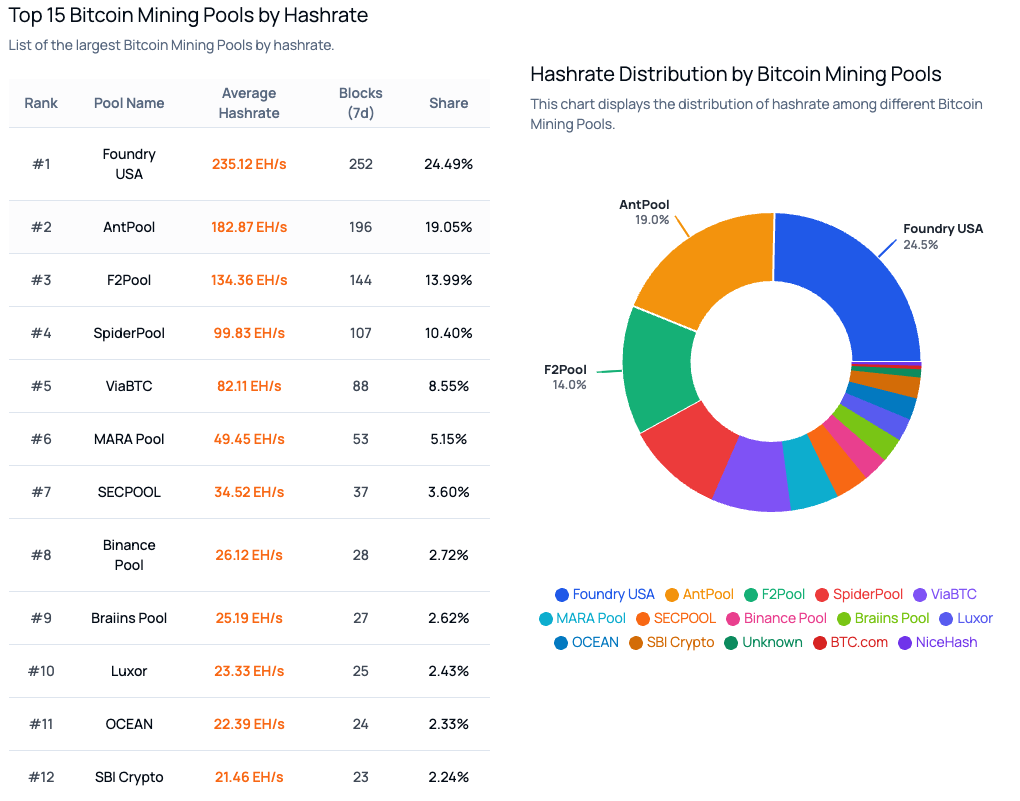
Data from SimpleMining shows SBI Crypto currently ranks as the 12th largest Bitcoin mining pool globally, with about 21.46 exahashes per second (EH/s) of hashrate and roughly 2.24% of total Bitcoin network share.
Source: SimpleMining
That places it far behind leaders like Foundry USA, which controls about 24.49% of the network, and AntPool at around 19.05%. Mid- and lower-tier mining pools such as ViaBTC and MARA Pool account for about 8.55% and 5.15% of the global Bitcoin mining hashrate, respectively.
Miner migration to alternative pools
SBI Crypto directed miners toward several alternative Bitcoin mining pool operators as it prepares to shut down its service, including Braiins, Luxor and NeoPool.
Among them, Braiins and Luxor are established mid-tier mining infrastructure providers, each controlling around 2%-3% of global Bitcoin hashrate, according to SimpleMining data. NeoPool is not included in the top-ranked pools by hashrate.
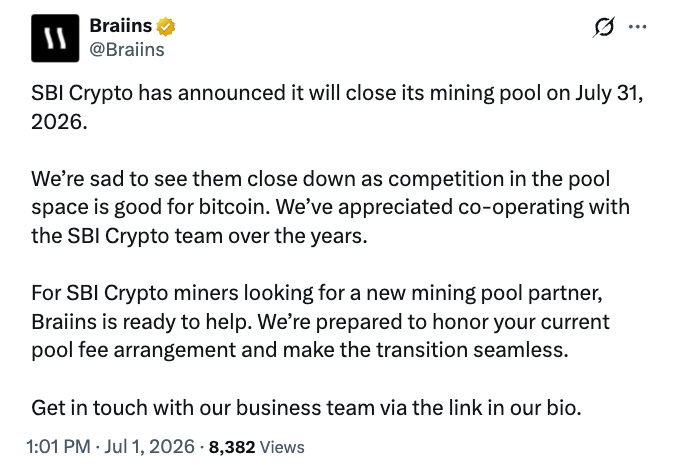
Source: Braiins
“Some operators may offer special programs or preferential conditions for clients transitioning from SBI Crypto,” the company said, adding that customers are encouraged to contact each operator directly for details.
Related: Bitcoin mining difficulty drops 10% in 11th largest downward adjustment
The shutdown comes as SBI Holdings continues to expand its broader cryptocurrency strategy beyond mining.
The company recently agreed to acquire full control of crypto exchange Bitbank in a 46.7 billion Japanese yen ($289 million) deal, aiming to create Japan’s largest cryptocurrency exchange.
SBI has also been increasing its focus on stablecoins, backing JPYSC, a new trust bank-backed Japanese yen stablecoin, and supporting Ripple’s rollout of the Ripple USD (RLUSD) stablecoin in Japan.
Magazine: Bitcoin miners are pivoting to AI, so why is the hashrate near ATHs?
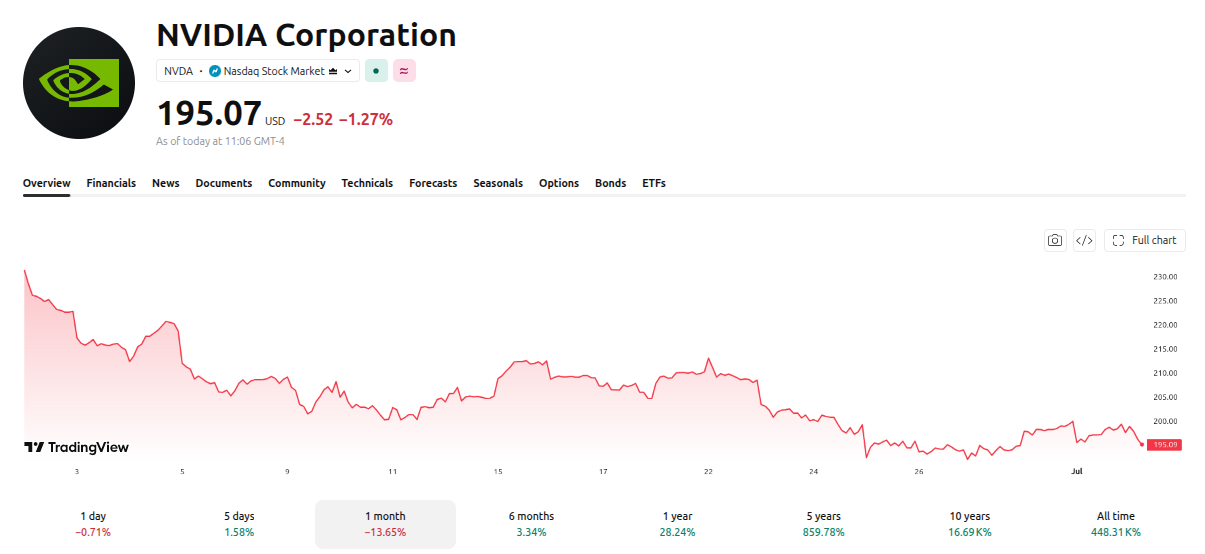
NVIDIA is expanding its AI infrastructure business with a new model designed to accelerate the deployment of computing capacity across global cloud providers.
The move arrives as Michael Burry increases bearish positions against NVIDIA, creating a sharp debate over AI growth prospects.

What is NVIDIA’s New AI Compute Model
NVIDIA’s new AI compute framework allows cloud providers to deploy advanced hardware using revenue-sharing and credit-support agreements. The goal is to reduce infrastructure barriers for startups, enterprises, model developers, and regional AI operators.
The company earns revenue from hardware sales and from cloud usage generated by supported capacity. This approach aims to accelerate the construction of large-scale AI factories capable of serving inference workloads and token-intensive applications.
Follow us on X to get the latest news as it happens
The strategy addresses one of the industry’s biggest challenges: the enormous capital required to build AI infrastructure. By helping partners expand capacity faster, NVIDIA hopes to increase utilization rates while making advanced computing resources more accessible.
Early participants illustrate the scale of the initiative. Sharon AI plans to deploy up to 40,000 Grace Blackwell GB300 GPUs. Meanwhile, Firmus is developing a major campus in Indonesia that could support approximately 170,000 GPUs and 360 megawatts of power capacity.
Why is Michael Burry Betting Against NVDA
Despite NVIDIA’s continued momentum, some investors remain skeptical about how long current AI-driven valuations can be sustained. Among the most prominent bears is Michael Burry, the investor known for predicting the 2008 housing market collapse.
Burry’s latest move goes beyond a general warning about the sector. He disclosed a direct short position on NVIDIA at approximately $198.09 per share, while also establishing bearish positions against Tesla, Applied Materials, Caterpillar, and the iShares Semiconductor ETF (SOXX).
His thesis is centered on what he views as excessive enthusiasm surrounding artificial intelligence. Burry argues that massive investments in data centers, chips and AI infrastructure may be creating conditions similar to previous technology bubbles.
He has specifically raised concerns about rapid hardware obsolescence, aggressive capital spending by hyperscalers, and the possibility that demand growth could eventually slow.
Supporters of NVIDIA see the situation differently. They point to strong demand for AI inference, which is accelerating enterprise adoption and strengthening the company’s dominant position in advanced computing. NVDA traded near $195 at the time of writing, giving the chipmaker a market value of roughly $4.77 trillion.
The result is a growing divide on Wall Street. NVIDIA’s bulls believe the company remains at the center of a multi-year AI expansion cycle, while Burry is positioning for a scenario in which expectations have outpaced economic reality. The coming quarters could determine which view gains the upper hand.
What Could Happen Next for NVIDIA
The coming quarters may provide important answers for both bulls and bears. NVIDIA’s success depends on executing its AI factory vision and maintaining strong demand for current and future platforms, including Blackwell and Rubin-based systems.
Investors will closely monitor earnings results, cloud partnership expansion, and progress on infrastructure deployment. If adoption continues accelerating, NVIDIA could further strengthen its position at the center of the global AI ecosystem.
However, valuation concerns are unlikely to disappear. Any slowdown in spending, infrastructure utilization, or enterprise demand could increase volatility.
The result is a high-stakes contest between technological transformation and concerns that expectations may have outpaced economic reality.
Subscribe to our YouTube channel to watch leaders and journalists provide expert insights
The post NVIDIA Unveils New AI Compute Model, But Michael Burry is Shorting Its Stock appeared first on BeInCrypto.
JPMorgan warned that MicroStrategy’s new Bitcoin sales policy adds unnecessary risk to the crypto market. The Michael Saylor-led firm may sell up to $1.25 billion in Bitcoin to fund preferred dividends across the coming months.
The warning arrives as Strategy (formerly MicroStrategy) loses ground on both its common and preferred stock across broader financial markets.
Why JPMorgan Sees Two-Way Risk in MicroStrategy’s Plan
A two-way risk is a scenario in which price moves in either direction can create potential losses for market participants exposed to the underlying asset. JPMorgan analysts led by Nikolaos Panigirtzoglou say Strategy’s new Bitcoin sales policy has now introduced exactly that dynamic into the crypto market.
MicroStrategy revealed the option to sell up to $1.25 billion in Bitcoin to strengthen its balance sheet. Furthermore, the company could also authorize preferred stock repurchases and share buybacks. The move follows a period of stress on both MSTR common shares and its preferred series.
Follow us on X to get the latest news as it happens
The company also set a new minimum cash reserve target. Strategy now aims to cover 12 months of preferred dividends and interest expense.
However, its current $2.55 billion in reserves only covers 17 months of obligations, leaving limited flexibility in the coming quarters.
JPMorgan pushed back hard on the approach. Analysts recommended a higher coverage target of 24-36 months. Moreover, they urged MicroStrategy to issue common equity to expand dollar reserves. That would reassure investors that the firm will not need to sell Bitcoin going forward.
Strategy remains the largest Bitcoin buyer globally. The firm has purchased roughly $13.7 billion of Bitcoin in 2026 alone and holds 847,363 BTC.
As a result, whether it buys or sells, the movement now creates significant unnecessary flow risk across the broader crypto market environment.

How Bitcoin and MSTR Are Digesting the Fresh Risks
Strategy’s May Bitcoin sale sent ripples across the market. The company sold 32 Bitcoin for approximately $2.5 million between May 26 and May 31. Furthermore, the move marked its first Bitcoin sale since 2022, a sharp reversal from Michael Saylor’s public “never sell” stance.
JPMorgan flagged the direct market impact of that transaction. The bank noted that MicroStrategy’s sale contributed to Bitcoin’s stress in late May and early June. Moreover, greater price volatility could ultimately hurt the company itself, raising the cost of future equity and debt financings.
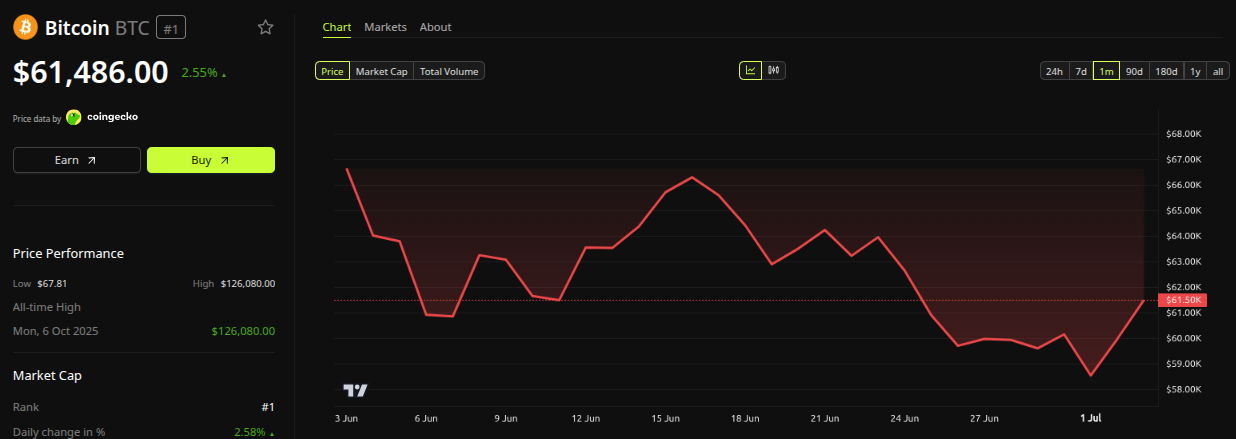
MSTR stock has slid 34% this year to $100.77. Its STRC preferred series follows the same pattern, down 12% at $87.09. Bitcoin also trades under pressure, off 30% year-to-date at $61,486.

However, JPMorgan analysts see a potential contrarian angle. The current bearish sentiment could set up a stronger second half if two conditions align. Strategy must expand dollar reserves. Moreover, the United States must approve the CLARITY Act to unlock renewed institutional flows.
Subscribe to our YouTube channel to watch leaders and journalists provide expert insights
The post JPMorgan Sounds the Alarm on MicroStrategy’s New Bitcoin Sales Policy appeared first on BeInCrypto.

Binance has returned to the Philippine market through a regulatory sandbox route, while its European operations face new limits. The exchange gained access through BlockShoals Technologies, which secured approval from the Philippine SEC. However, Binance also restricted some services in several EU countries after MiCA rules fully took effect.
Binance Re-Enters Philippines Through SEC Sandbox
The Philippine Securities and Exchange Commission approved BlockShoals Technologies to test crypto-related services under its regulatory sandbox. The approval allows the company to operate its Stratbox model with selected products for local users. As a result, Binance gains a regulated pathway back into the Philippine market.
The sandbox approval followed an earlier clearance granted in November 2025, after BlockShoals met the remaining compliance requirements. The SEC said the company will operate under a crypto-asset intermediary model. Therefore, Philippine users can access selected services through a global crypto-asset service provider partner.
Binance acts as the global partner in the approved testing framework. BlockShoals will connect its systems with a local virtual-asset service provider partner during a 90-day rollout. After that, the company will continue testing user onboarding and product access under regulatory supervision.
Philippine Crypto Rules Tighten As Binance Returns
The approval comes as the Philippines continues to tighten its crypto market rules. Regulators have moved to strengthen listing standards and restrict assets that raise oversight concerns. Earlier, the country also pushed restrictions on privacy coins under its broader compliance approach.
This background gives Binance’s return a narrow but important regulatory angle. The exchange does not re-enter through a full open-market relaunch. Instead, it enters through a controlled sandbox with defined products, safeguards, and testing limits.
The structure also gives regulators more room to monitor user access and platform activity. It allows the SEC to test how offshore crypto services connect with local rules. Therefore, the Philippine market becomes a measured entry point for Binance in Southeast Asia.
Binance Limits EU Access After MiCA Deadline
While Binance gains room in the Philippines, it faces tighter conditions in Europe. The exchange has suspended new user registration, deposits, and Earn products in several EU markets. These restrictions affect users in Italy, Spain, France, Poland, Belgium, and Sweden.
The changes followed the end of the European Union’s MiCA transition period on July 1. MiCA created a unified licensing framework for crypto-asset service providers across the bloc. However, exchanges must secure authorization in an EU member state to continue full operations.
Binance had planned to seek authorization in Greece, but later withdrew that application before the deadline. The company said it will now pursue licensing in another EU member state. Meanwhile, it continues to work with regulators to restore compliant services across the region.
Withdrawals Remain Open As Binance Adjusts
Binance said affected users can still withdraw and transfer their assets. The exchange also said product access will vary by country, account status, and available services. Therefore, some users may face broader limits than others, depending on local restrictions.
The company has told users to rely on official communication channels for updates. It also said customer support will handle product access and withdrawal-related questions. This approach aims to reduce confusion as service limits take effect across affected markets.
The contrast between the Philippines and Europe shows Binance’s uneven regulatory path. In one market, the exchange gains access through supervised testing and local partnerships. In another, it pulls back while seeking a license under stricter regional crypto rules.

Russia’s central bank governor Elvira Nabiullina has said the country is prepared to launch its central bank digital currency (CBDC), the digital ruble, by Sept. 1—after the timeline previously outlined for the project. According to Russian state media outlet RIA Novosti, Nabiullina framed the schedule as feasible and suggested that work continues on shaping the system’s functionality.
As the digital ruble heads toward an expected rollout, the project remains entangled with sanctions dynamics. The European Union has already announced restrictions tied to Russia’s CBDC plans, while domestic Russian officials have discussed the legislative pathway and the expected transition period after the law takes effect.
Key takeaways
- Elvira Nabiullina said Russia is ready to launch a digital ruble on Sept. 1, with initial acceptance by financial and credit institutions.
- The digital ruble is intended to function alongside the existing ruble, rather than replace it.
- European Union sanctions included restrictions affecting Russia’s CBDC efforts announced earlier this year.
- Russia’s first deputy central bank governor, Vladimir Chistyukhin, said the enabling law would be enacted on Sept. 1, followed by a transition period until July 2027.
- In the U.S., a separate legislative push would impose a ban on a CBDC issued by the central bank until 2030, reflecting a contrasting regulatory direction.
Digital ruble timetable reaffirmed
RIA Novosti reported that Nabiullina said “everyone is ready” for a Sept. 1 launch of the digital ruble. The central bank governor also emphasized the goal of making the system useful in real-world payments, stating that the authorities are continually discussing what features and functionality should be developed.
In the reporting, Nabiullina described the digital ruble as a complement to Russia’s fiat currency—the ruble—designed to be adopted first through financial and credit institutions. That positioning is important for how the project is likely to be implemented in practice: rather than starting as a consumer-facing token ecosystem, the initial pathway appears geared toward regulated intermediaries.
The digital ruble project has been underway since 2021, and its progress has increasingly been assessed through both technical readiness and the legal timetable. What’s newly underscored by the latest statement is that the central bank is reiterating that the schedule remains on track for a Sept. 1 go-live.
Sanctions pressure and compliance constraints
Russia’s CBDC plans have also been met with preemptive restrictions from the European Union. The EU announced restrictions on the digital ruble in April, as part of a sanctions package described by the Council of the European Union as responding to Russia’s “war of aggression against Ukraine.”
The sanctions framework matters for investors and market participants because it signals how cross-border financial institutions and payment rails may interpret compliance risk around the digital ruble. Even if the CBDC is primarily used within Russia, the broader financial system still connects to global counterparties, correspondent banking, and technology supply chains—areas that sanctions can affect directly or indirectly.
Commentary on the strategy has extended beyond government statements. In a February 2025 report carried by Australian Institute of International Affairs, Dr. Jack Jarmon—described as having served as a USAID technical adviser for the Russian government in the 1990s—argued that Russia could face “structural limitations” if it relies on proof-of-work (PoW) digital assets such as Bitcoin to help evade sanctions. He pointed to energy infrastructure constraints, including the age and upgrade needs of Russia’s power grid, and argued that sanctions cut Russia off from financial capital and technology while leaving the country dependent on external suppliers for components.
While Jarmon’s remarks focused on PoW mining and sanctions circumvention risk rather than the CBDC itself, the broader implication is that Russia’s financial modernization efforts are happening under constraints that can shape implementation speed, technology sourcing, and system design choices.
Law enactment and a multi-year transition
In addition to Nabiullina’s launch timeline, reporting attributed to Russia’s central bank adds specificity on the legal mechanics. RIA Novosti said Vladimir Chistyukhin, the bank’s first deputy governor, stated that legislation enabling the digital ruble would be enacted on Sept. 1, with a transition period extending until July 2027.
This kind of phased structure is often critical for CBDCs because it gives regulators time to define operational rules, settlement responsibilities, and governance frameworks. For market observers, the transition period also suggests that the Sept. 1 date should be viewed as a formal starting point, not necessarily as the end of policy and implementation adjustments.
At the same time, the combination of EU restrictions and an internal transition schedule creates a dual-track environment: the central bank can proceed domestically with regulatory rollout, while external counterparts may apply tighter compliance screening as sanctioned entities and technologies could still be relevant to cross-border processes.
U.S. legislative momentum highlights the global split
Russia’s move stands in sharp contrast to the U.S. approach. While Russia is preparing for a digital ruble rollout, the article notes that U.S. President Donald Trump has received the 21st Century ROAD to Housing Act—a housing bill that includes a ban on a digital dollar as part of housing affordability legislation.
The reported mechanism is notable: the article says Trump expects not to sign the bill, but it would still become law automatically if no action is taken within 10 days. Under that timeline described in the report, the ban would take effect in July. The same reporting indicates that the ban would cover central bank issuance or creation of a CBDC until 2030.
For global observers, this highlights how CBDCs are not treated uniformly across jurisdictions. Instead, regulation is emerging as a policy battleground intertwined with national priorities—financial sovereignty concerns in some cases, and skepticism toward digital-dollar rollout in others. The divergence can affect cross-border planning for fintech providers, banks, and payment infrastructure vendors that operate in multiple regulatory environments.
It also matters for interoperability expectations. Even if CBDCs expand domestically, future integration across borders can be shaped—or limited—by differences in legal authority and political will.
With Sept. 1 now repeatedly referenced by Russia’s central bank leadership, attention is likely to shift from announcements to execution: how the digital ruble will be operationalized through financial and credit institutions, how the transition period to July 2027 unfolds, and how EU restrictions and compliance practices influence any future external access. On the U.S. side, the key watch item is whether the CBDC ban’s effective date and scope become a durable baseline for U.S. digital currency policy through 2030.
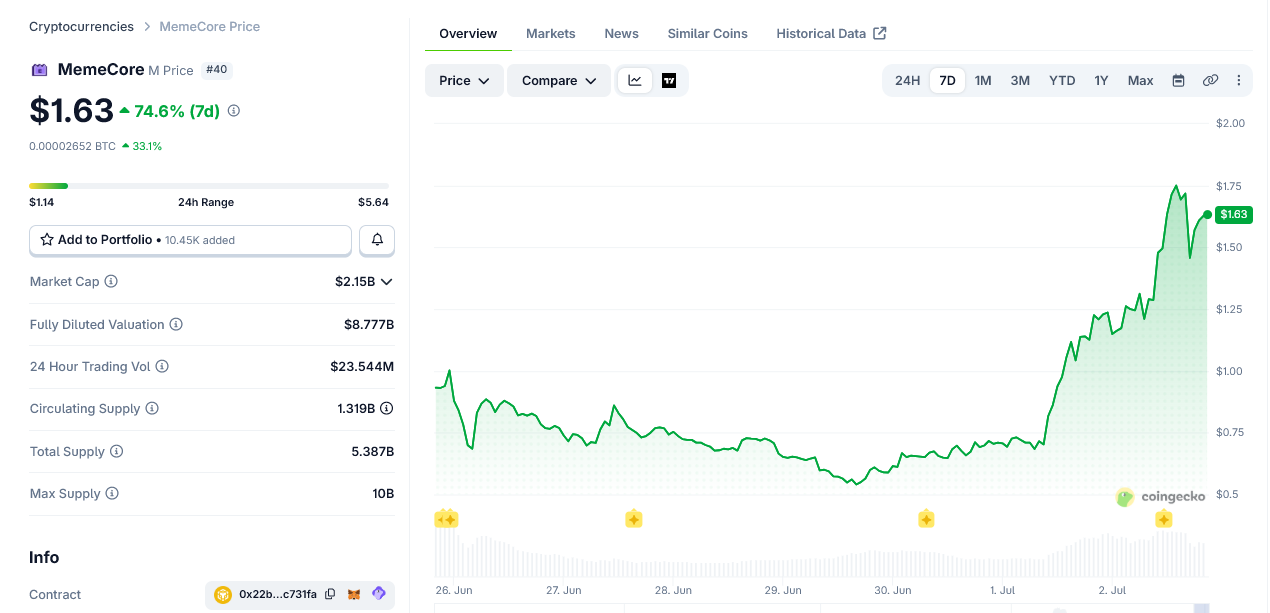
MemeCore (M) rebounds nearly 150% this week and trades at $1.66 after its treasury announced a buyback worth more than $10 million.
The token collapsed 76% on June 25 and briefly traded near $0.50. Weekly and daily charts now show the recovery pressing into resistance zones that could decide the next major move.

A $10 Million Buyback Answers the 76% Crash
MemeCore’s M token fell from $2.66 to an intraday low of $0.50 on June 25, a crash that pushed its market cap from around $3.5 billion to $903 million. The selloff arrived without any confirmed catalyst.
Onchain investigator ZachXBT connected the collapse to structural weaknesses he had flagged months earlier. He cited less than $100,000 in onchain liquidity on BNB Chain against a market cap still near $900 million.
“Myself, Mlm, & Wazz previously highlighted a number of red flags on X about MemeCore with inorganic supply concentration and deceptive practices by its team to boost user numbers,” he said on Telegram.
Meanwhile, trader Ash Crypto estimated that the selloff liquidated around $8 million in long positions. MemeCore responded days later with a treasury buyback worth more than $10 million, as trader rapperr111 noted on X.
The team stated that an internal investigation found no protocol or infrastructure issues. It also denied any selling by the team or foundation and attributed the crash to a single large market sell order. This explanation has not been independently verified.
The announcement coincided with the start of the recovery. M has since climbed back to rank 40 by market cap after falling to 72 during the crash.
MemeCore Rebound Holds the Key Weekly Support Zone
The weekly chart shows the crash candle wicking down to $0.53 before buyers stepped in. Notably, the selloff stopped almost exactly at the support zone between roughly $0.60 and $0.85.
This area acted as resistance from July to August 2025, before the token began its long rally toward the all-time high. Historically, such flipped zones often generate strong demand, and the current bounce fits that pattern.

However, the breakdown also destroyed the long-term ascending trendline that had guided M since mid-2025. That trendline now converges with the horizontal supply zone near $1.80, directly above the current price.
The weekly RSI stands at 45, reset from readings above 80 near the April peak. Therefore, a reclaim of $1.80 could open the path toward the next supply zone between $2.80 and $3.00. In contrast, rejection at $1.80 would signal downtrend continuation toward the $0.60 to $0.85 area.
M Price Prediction as the $2.10 Fib Caps the Bounce
The daily chart confirms the June 25 breakdown, which cut through the 0.5 Fibonacci retracement at $2.63 on record volume. The decline extended for several sessions and bottomed near $0.41.
Since then, buyers have reclaimed the 0.236 Fib at $1.46. M trades at $1.66 at press time, up 54% in 24 hours, according to BeInCrypto Markets data.
The next target is the 0.382 Fib level at $2.10, which is around 27% above the current price. A breakout there would expose the 0.5 Fib at $2.63, which coincides with the descending trendline drawn from the April 24 all-time high of $4.85. This confluence makes $2.63 the decisive barrier for the entire recovery.

Momentum supports the bulls for now. The daily RSI has recovered to 43 after printing oversold readings near 20 during the crash. A previous analysis showed M respecting the same Fibonacci structure in May, before the trend reversed.
On the downside, a break of the 0.236 Fib at $1.46 would invalidate the bullish setup and expose the $0.85 to $0.60 support again. Whether the buyback marks a durable bottom or only a pause in the downtrend now depends on the $2.10 test.
The post MemeCore (M) Rebounds 150% After $10 Million Buyback appeared first on BeInCrypto.


President Donald Trump renewed his pro-crypto message by questioning whether Bitcoin should be taxed like a traditional investment while defending his financial disclosure, which revealed substantial crypto-related earnings.
Speaking to reporters at Joint Base Andrews before departing on Air Force One late July 2 into July 3, Trump also praised the stock market, reaffirmed support for digital assets, and addressed concerns about his business interests.
Trump Says Bitcoin Shouldn’t Face Capital Gains Tax
During the informal press gaggle, Trump argued that Bitcoin has evolved into a form of money and questioned why users should pay capital gains tax on everyday purchases.
Using a coffee purchase as an example, Trump said a friend recently pointed out that Bitcoin transactions should not trigger taxes if the asset functions as money, a view he said he agrees with.
The remarks echo Trump’s campaign-era calls for friendlier crypto regulations and come as his administration continues positioning the United States as a global leader in digital assets.
‘Crypto’s a Big Deal,’ Trump Says
Trump doubled down on his support for the industry, calling crypto “a big deal” and insisting the United States should lead the sector.
“Anything we do, we want to be number one,” Trump said, framing digital assets as a strategic technology race rather than simply an investment trend.
His comments reinforce the administration’s broader pro-crypto agenda, including support for digital asset innovation and efforts to strengthen America’s position against competing financial hubs.
Financial Disclosure Draws Questions
Reporters pressed Trump after his latest annual financial disclosure highlighted significant crypto-related income alongside broader investment gains.
Trump responded by distancing himself from the day-to-day management of his businesses.
“My kids run my business. I’m not involved,” he said, adding that professional managers oversee his investments.
He also defended his wealth, saying he has “always made money” while reiterating that he does not personally manage investment decisions.
Fed, Growth, and Markets Remain in Focus
Beyond crypto, Trump commented on Federal Reserve Chair Kevin Warsh, saying the Fed board is “a little bit hostile” while adding that Warsh “has to do what he has to do.”
The president also praised the stock market and expressed confidence that U.S. economic growth could eventually exceed 4%, suggesting it could reach 12% or 13% under the right conditions.
What’s Next?
Trump’s latest remarks reinforce that cryptocurrency remains central to his economic messaging. While no immediate policy changes were announced, his renewed criticism of Bitcoin taxation is likely to fuel debate over digital asset tax reform in Congress.
Investors will now watch whether the administration translates its pro-crypto rhetoric into concrete legislation, particularly around capital gains rules and broader regulatory reforms that could influence Bitcoin adoption and market sentiment.
The post Trump Defends Crypto Fortune, Says Bitcoin Shouldn’t Be Taxed Like Stocks appeared first on BeInCrypto.
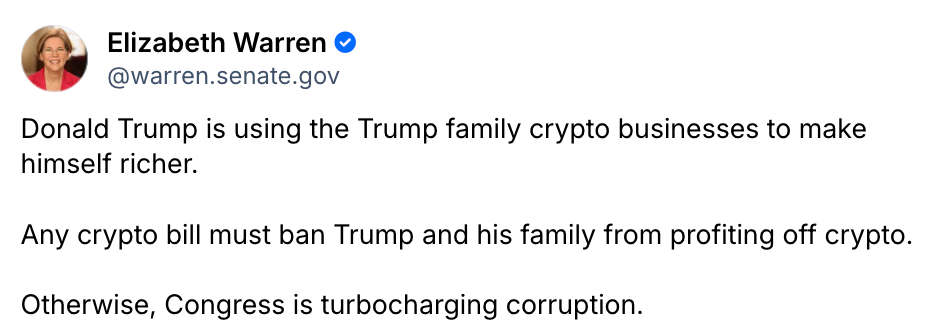
Chris Larsen, co-founder and executive chair of Ripple Labs, was reportedly among those backing the financial venture of US Senator Kirsten Gillibrand’s son as negotiations over a significant piece of crypto-related legislation continue in the Senate.
According to a Thursday Politico report, Larsen was one of a handful of investors backing the American Perpetuals Exchange Corp. (APEC), founded by Theodore Gillibrand. Although Larsen’s exact contribution was not included in the report, the majority of investors contributed between $5,000 to $10,000 each into the derivatives platform, which reportedly raised $30 million.
The investment comes as the New York lawmaker is involved in negotiations over ethics provisions in the Digital Asset Market Clarity (CLARITY) Act, legislation expected to have a significant impact on crypto companies operating in the US, including Ripple. Gillibrand said in May that no one would be voting for the bill without addressing ethics:
“[T]he truth is, is that we cannot allow members of Congress, senior administration officials, presidents or vice presidents, to get rich off of these industries because of their insider status. It is the worst form of pay for play.”
A spokesperson for the senator referred Cointelegraph to her June 18 statement saying that her son was “a grown adult starting his own independent business” and she had “no involvement in it whatsoever.” Cointelegraph reached out to APEC for comment but did not receive an immediate response.
Related: Fed chair nominee pressed on potential conflicts of interest, independence
Democratic lawmakers have been pushing Republicans, who hold a majority in Congress, to support efforts to add ethics language to the CLARITY Act, citing US President Donald Trump’s ties to the crypto industry. Republican leaders in the Senate are expecting the bill to pass the chamber in July, with Senator Cynthia Lummis saying in June that lawmakers were “working a little bit on ethics,” decentralized finance and illicit transactions as part of negotiations.
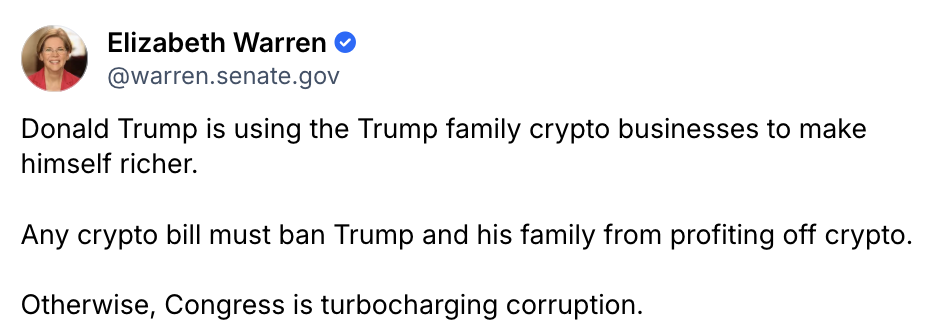
Source: Senator Elizabeth Warren
Senate Republicans hold a slim majority in the chamber, meaning they will need some Democratic support to meet the 60-vote threshold for CLARITY to pass.
Congressional schedule squeezes window for CLARITY bill
Lawmakers in the US Senate are on state work periods for the Independence Day holiday. Scheduled to return to session on July 13 and leave for another month-long state work period in August, the window to pass crypto market structure is closing before US election day, which is expected to result in additional delays.
Magazine: AI is banking the unbanked in Africa… faster than crypto


Securitize began trading on the New York Stock Exchange Thursday under the ticker SECZ and simultaneously put its own newly listed common stock onchain, according to a press release the tokenization firm distributed via PR Newswire. Eligible U.S. investors can access tokenized SECZ through… Read the full story at The Defiant

New Shed Seven album – and band say it’s ‘our best yet’
Form 4 Aehr Test Systems For: 2 July

Ripple Co-Founder Backs Venture by US Senator’s Son, Report Says


-

 Fashion6 days ago
Weekend Open Thread: Staud – Corporette.com
-

 Politics7 days ago
The House | Manchesterism won’t survive the painful trade-offs unless it gets citizens on board
-

 Crypto World3 days ago
Strategy authorizes up to $1.25B in Bitcoin sales under new capital plan
-

 Politics7 days ago
Potential 2028er World Cup attendee leaderboard
-

 Business7 days ago
Asia stock markets slide as tech shares slump
-

 News Videos4 days ago
MAJOR BITCOIN & MARKET UPDATE!!!! (MUST WATCH ASAP!!!)
-

 Crypto World5 days ago
Coinbase, Circle Deepen Crypto Stock Losses Despite Resilient S&P 500
-

 Tech3 days ago
Anonymous researcher drops 0-day ‘exploitarium’ repo
-

 Business3 days ago
Australia treasurer says alleged access of prime minister’s bank data ’incredibly concerning’
-

 Crypto World6 days ago
Kraken's xStocks Opens Bending Spoons IPO Registration to EEA Retail
-

 Crypto World7 days ago
Bitcoin Sparks $600M Hourly Liquidations With $65,000 Set To Become Resistance
-

 Sports6 days ago
FIH Pro League: India defeat Pakistan 7-1, register biggest win of campaign | Other Sports News
-

 Tech5 days ago
Bluekit phishing kit adopts browser-in-the-middle for login theft
-

 Tech5 days ago
Russian hackers now target Signal backup recovery keys
-
 Crypto World6 days ago
Hyperliquid Named on Singapore MAS Investor Alert Register
-

 Crypto World6 days ago
RTX holders must register wallets before token distribution begins
-

 Crypto World7 days ago
Tether (USDT) Passes Ether in Market Cap as ETH Drops Toward $1.5K
-

 Sports1 day ago
Broncos roster: OL Ben Powers (No. 74) entering final year of contract
-
 Business3 days ago
The AI boom won’t burst all at once. It will pop in ‘rolling bubbles’: Macquarie
-

 Tech5 days ago
Silicon Valley paid to kill AI regulation, now it wants the rules back
You must be logged in to post a comment Login