

Business
Goldman Sachs will give $1,000 to Trump Accounts belonging to employees’ kids

U.S. Securities and Exchange Commission chair Paul Atkins discusses the value of Trump investment accounts on Kudlow.
Goldman Sachs on Thursday announced that it will make a matching contribution to Trump Accounts for eligible children of the firm’s employees.
The company will make a one-time matching contribution of $1,000 to employees with children born between 2025 and 2028 upon the time of enrollment in Trump Accounts, matching the $1,000 federal seed contribution.
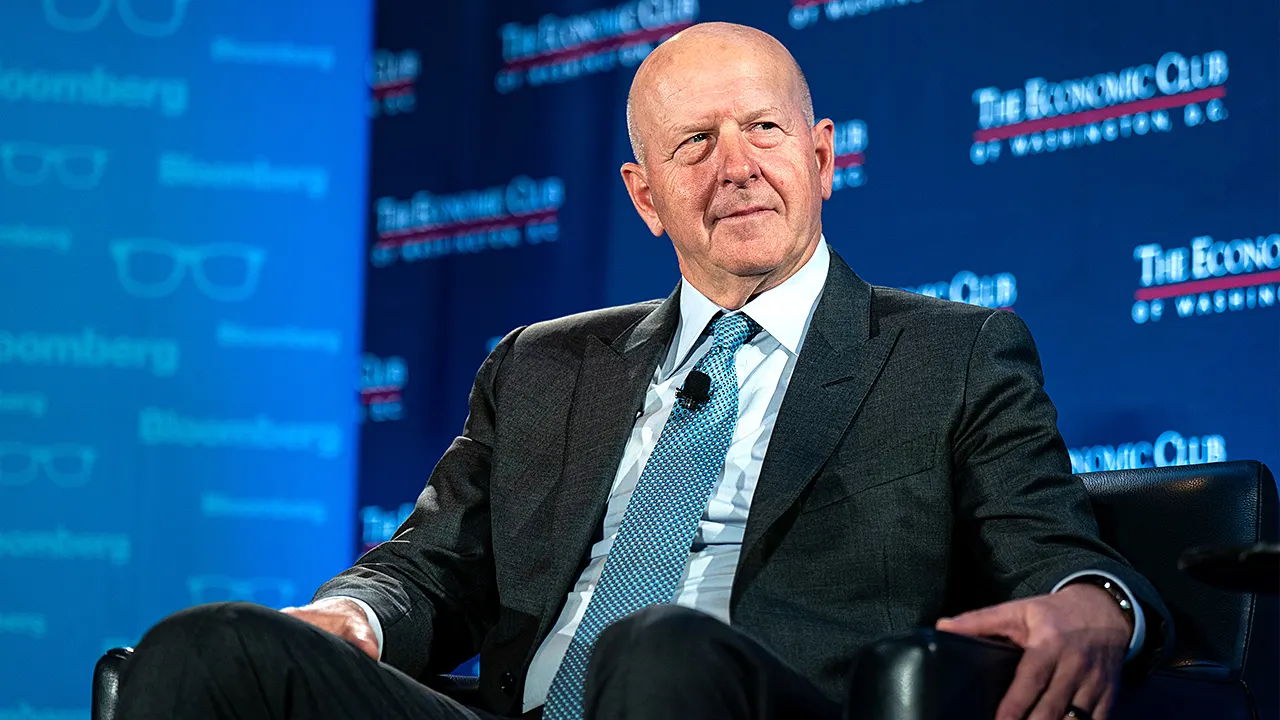
“Starting early and staying invested for the long term is one of the most reliable ways American families build lasting financial security,” said Goldman Sachs CEO David Solomon.
“We have long been committed to the importance of savings and investment as a pathway to a more resilient financial future, and we’re proud to continue our support of this partnership and invest in the future of America,” Solomon added.
WHITE HOUSE UNVEILS TRUMP ACCOUNTS MOBILE APP AHEAD OF JULY 4 ROLLOUT
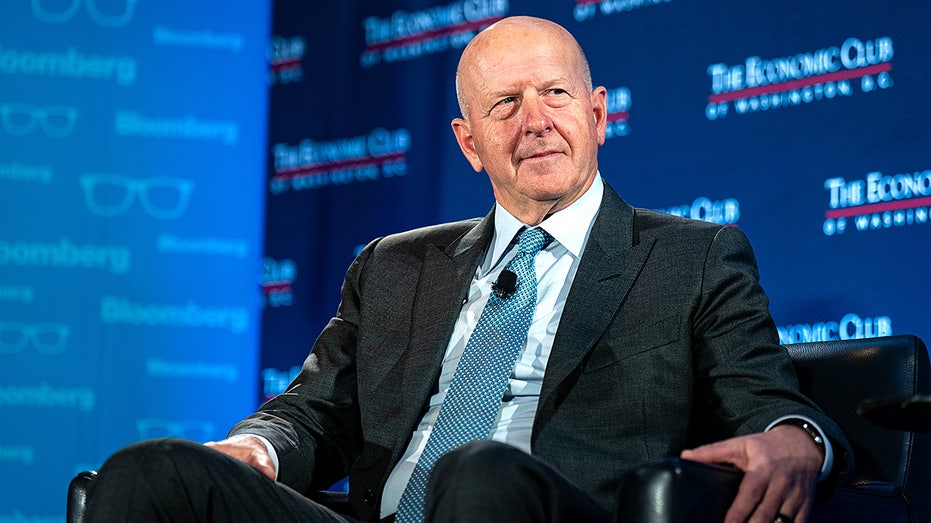
Goldman Sachs CEO David Solomon said that Trump Accounts can help instill savings and investment as financial habits. (Al Drago/Bloomberg via Getty Images)
The company said in a statement that it views the public-private initiative as a way to “instill the fundamental economic principles of savings and investing in America’s next generation.”
With the matching contribution, Goldman Sachs joins the ranks of U.S. companies that have opted to participate in the Trump Accounts program.
HOW TO KNOW IF YOUR CHILD QUALIFIES FOR A TRUMP ACCOUNT: ‘A FINANCIAL STAKE IN THE FUTURE’

Trump Accounts are scheduled to officially launch on July 4. (Valerie Plesch/Bloomberg via Getty Images)
Financial firms including Citi, JPMorgan Chase, Bank of America and Vanguard have all announced that they will make contributions to the Trump Accounts of their employees’ children that at least match the $1,000 federal contribution for children born between 2025 and 2028.
Michael and Susan Dell also announced the donation of $6.25 billion to seed 25 million accounts belonging to children 10 and under with $250 each, providing a boost that includes some children who wouldn’t have been eligible for the federal seed money.
HERE’S HOW MUCH TRUMP ACCOUNT BALANCES COULD GROW OVER TIME

The Trump Accounts app will feature eight exclusive financial literacy modules that families can access before the July 4 rollout. (U.S. Department of the Treasury / Fox News)
Trump Accounts were created by the One Big Beautiful Bill Act, the package of tax cuts and reforms that Republicans passed through Congress and was signed into law by President Donald Trump last year.
The initiative invests the savings in low-cost index funds that provide broad, diversified exposure to the U.S. stock market.
GET FOX BUSINESS ON THE GO BY CLICKING HERE
Parents and guardians may contribute up to $5,000 per year to the accounts belonging to their children, while a parent’s employer can contribute up to $2,500 annually without impacting the employee’s taxable income.


Keurig Dr Pepper Disappointed Me (Rating Downgrade)

Form 4 Lifeway Foods Inc For: 2 July
Cerus Corp chief legal officer Chrystal Jensen sells $71,597 in stock
Form 4 Big Digital Energy Inc For: 2 July

Lion Finance Group PLC (BDGSF) Analyst/Investor Day – Slideshow

“We don’t have robots that are nearly as good at understanding the physical world as a rat,” says Yann LeCun, one of the leading figures in the world of artificial intelligence.
He worked at Facebook-owner, Meta, for a decade, where he was chief AI scientist, but left in 2025 and founded Advanced Machine Intelligence Labs (AMI Labs).
His goal is to move AI beyond current systems like ChatGPT, Claude and Gemini. They have their uses, he says, but will never be able to tackle complicated situations in the real world, like getting a robot to do household chores.
“They’re not a path towards human level or human-like intelligence, or even animal-like intelligence, because they cannot deal with real world data, they just are not built for that,” he tells me on the sidelines of VivaTech, France’s leading technology conference.
So, Paris-based AMI Labs is busy developing a new type of artificial intelligence not based on the tech behind ChatGPT and its rivals.
Investors think it has potential. Earlier this year AMI Labs announced that it had raised more than $1bn (£760m), with investors including US computer chip giant Nvidia and the fund that manages the private wealth of Amazon-founder Jeff Bezos.
That so-called seed funding round – the earliest round of start-up fundraising – was one of the biggest of its kind in Europe.
Large Language Models (LLMs) like ChatGPT are extremely good at some things like coding, mathematical problems and generating text, LeCun says.
But he argues that these are well defined and predictable problems.
“They [LLMs] basically just accumulate knowledge… They can regurgitate something, you train them to regurgitate, but they’re not particularly smart. They don’t have an underlying understanding,” he says.
In the real world there is a bewildering array of outcomes to any action, which requires a more flexible type of artificial intelligence.
LeCun holds a pen upright on its tip. What happens when you let go, he asks? Even a toddler would know that the pen would topple over. But no human would bother to guess in which direction the pen might fall, there’s no way to tell.
But an LLM might try to generate a single prediction about the pen’s next move based on statistical patterns from its training data.
The prediction would almost certainly be wrong, because the system is not reasoning about the physical reality of the situation – it is generating what appears to be statistically plausible.
LeCun says the system his company is developing, called Joint Embedding Predictive Architecture (JEPA), is set up to deal with problems like that.
It creates abstractions of the real world that allow it to assess the outcomes of actions.
Creating these abstractions involves difficult maths, but essentially they filter out useless information, just leaving the AI with useful pictures of the world.
In the case of the pen, the AI would know that there’s no point in trying to predict which way the pen would fall.
Form 4 Aehr Test Systems For: 2 July
Business
Palantir Stock Surges 3.5% Again Today After D.A. Davidson Upgrades to Buy, Cites Most Attractive Valuation
Palantir Technologies shares climbed further Thursday morning, adding to a string of daily gains as a fresh analyst upgrade from D.A. Davidson’s Gil Luria amplified momentum already building from a Nvidia partnership announcement, a U.S. government contract win and the partial retreat of one of the stock’s most prominent short sellers.
Shares of the Denver-based AI software and data analytics company were trading at $130.19 as of 10:47 a.m. EDT, up $4.46, or 3.55%, on the day, extending what has been a sharp recovery from the 52-week low of $106.37 the stock hit just two weeks ago. The multiple-day winning streak has now pushed the stock roughly 23% off that low, though shares remain approximately 37% below their 52-week high of $207.18 reached in late November 2025.
Thursday’s specific catalyst was D.A. Davidson analyst Gil Luria upgrading Palantir from Neutral to Buy and raising his 12-month price target to $175 from $165, implying upside of roughly 39% from Wednesday’s closing price. Palantir shares rose more than 3% in the immediate aftermath of the upgrade publication, with the stock continuing to add to those gains as the broader market also strengthened following the weaker-than-expected June nonfarm payrolls report.
Luria’s upgrade framing was pointed and specific, centering on both valuation and a newly articulated competitive advantage argument tied to the ongoing friction between AI model providers and the U.S. government. He cited recent tensions between Anthropic and the Trump administration, which had placed restrictions on the company’s AI models, as evidence that customers who built their technology stacks on top of underlying AI models directly faced serious business disruption risk when those models became unavailable.
“Anthropic’s repeated choice to take a confrontational tact with the US government has resulted in the government placing restrictions on AI models and Anthropic pulling its own model from the market,” Luria said in a note to clients, adding that companies that built directly on those models risked catastrophic disruption. He contrasted that risk with Palantir’s orchestration model, where the company’s platform can swap underlying AI models without disrupting the broader solution it delivers to clients.
On valuation, Luria was equally direct.
“We believe Palantir’s valuation is the most attractive it has been in a while, especially in relation to other high growth software companies,” he said.
That argument resonates with a growing portion of the investment community that has been watching Palantir’s stock decline throughout 2026 while its underlying business has continued to accelerate. The company’s first-quarter results, the most recent available, showed revenue surging 85% year over year to $1.63 billion, beating estimates of $1.54 billion, while the company raised its full-year 2026 revenue guidance to approximately $7.65 billion. Operating margin for the first quarter reached 60% on an adjusted basis, and the company now counts more than 1,000 commercial customers, a milestone that underscores how broadly its AI platform has penetrated enterprise markets beyond its traditional government base.
Yet the stock had fallen approximately 29% year to date heading into the current recovery, a decline that reflected persistent investor concerns about competition from OpenAI, Anthropic and other AI tool providers that could eventually allow enterprise customers to replace dedicated data orchestration platforms like Palantir with more commodity-like AI services. Luria’s analysis suggests that very threat, and the political and regulatory complications that have accompanied it, may be creating demand for Palantir’s model rather than eroding it.
Palantir CEO Alex Karp also added to the week’s storyline Wednesday, when he used a public appearance to criticize what he called “tokenmaxxing,” a reference to AI providers who charge per token in ways that create what he characterized as a “wealth tax” on enterprise customers using AI tools at scale. Karp’s language was direct and provocative, positioning Palantir as a more efficient and accountable alternative to the per-token pricing models that have drawn increasing customer scrutiny as AI usage scales.
“Combining Palantir infrastructure with Nvidia’s AI and Nemotron models will allow the U.S. government to unleash the full power of LLMs while removing the underlying security risks,” Karp said in a statement accompanying the Nvidia partnership announcement earlier this week.
That Nvidia collaboration, announced Monday, involves embedding Nvidia’s Nemotron open-source AI models into Palantir’s core product stack, including its AIP, Foundry, Ontology and Apollo platforms, creating what the companies described as a secure, customizable environment for U.S. government agencies and critical infrastructure operators to train, customize and deploy large language models without exposing sensitive data to external model providers.
President Trump’s most recent financial disclosure added an unusual political dimension to the recovery. The U.S. Office of Government Ethics released Trump’s certified 2025 financial disclosure showing he owns at least $1 million in Palantir shares, a holding he reportedly added to in the period covered by the disclosure. While the filing does not establish any formal commercial relationship between the administration and the company, market observers noted it attracted renewed retail investor attention to the stock in the days immediately following its release.
“Big Short” investor Michael Burry, whose publicly disclosed short position against Palantir had been a recurring negative overhang on the stock throughout the spring, disclosed he had trimmed roughly half of that position, a partial retreat that some investors interpreted as a signal that even a prominent bear had decided the stock’s decline had run its course, at least for now.
According to data from 32 analysts tracked by Stock Analysis, the consensus rating on Palantir stands at “Buy,” with an average 12-month price target of $182.75, representing potential upside of more than 40% from Thursday’s trading levels. With the D.A. Davidson upgrade adding to that bullish chorus, investors now appear to be coalescing around the view that Palantir’s prolonged valuation compression has created the most attractive entry point the stock has offered since before its 2025 run to all-time highs, particularly given the acceleration in its underlying business metrics.
Business
Maase Inc. Shares Rocket 20% on AI Computing Projects as Chinese Tech Pivot Ignites Small-Cap Rally
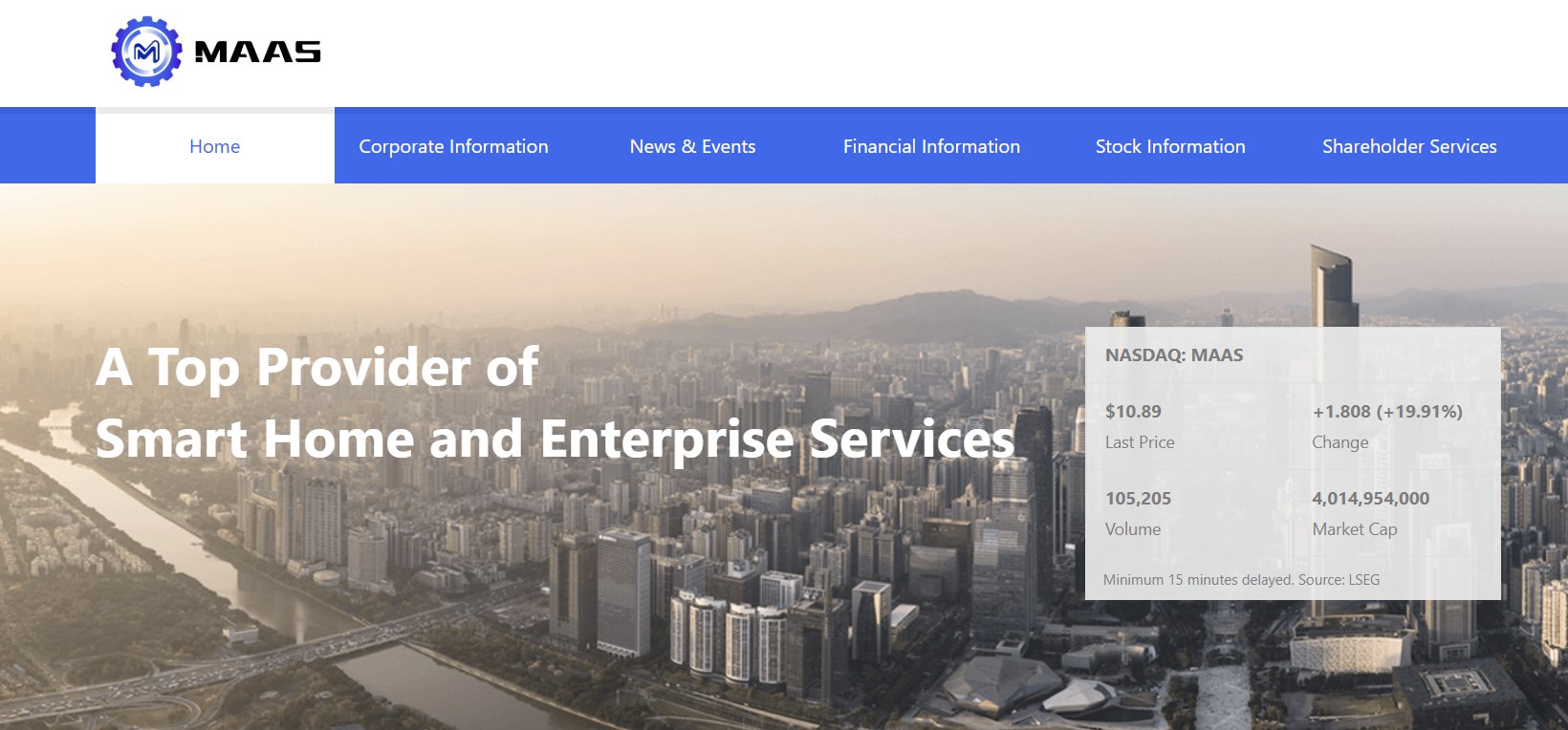
Maase Inc. shares surged nearly 20% to $18.70 in morning trading Thursday, continuing a remarkable run as the Chinese company advances multiple AI infrastructure initiatives following a series of strategic acquisitions.
The rapid re-rating of the former wealth management and insurance services firm reflects investor enthusiasm for its transformation into a full-stack AI operator focused on computing power, intelligent hardware and energy solutions. Maase has announced ambitious projects, including large-scale distributed intelligent computing centers, positioning it among a wave of smaller players chasing opportunities in China’s expanding AI sector.
Headquartered in Chengdu, Maase operates as an integrated provider of AI-centric digital systems. The company has completed several key acquisitions in recent months, including Huazhi Future and Times Good, aimed at building capabilities across computing infrastructure, algorithms and green energy applications.
In April, Maase announced the launch of the Stars Distributed Intelligent Computing Center Project with partners, outlining a planned investment of up to RMB5 billion. The initiative underscores ambitions to scale high-performance computing resources critical for AI training and deployment.
Subsidiary Huazhi Future has established a green energy infrastructure research team, designating 800VDC technology as a core focus. Additional collaborations explored with entities in Xinjiang and state-linked groups signal efforts to integrate sustainable power sources with AI computing demands.
Aggressive Acquisition Strategy
Maase’s pivot accelerated with the March completion of the Huazhi Group acquisition, described by the company as establishing “full-stack AI self-controllability.” Earlier deals targeted assets in new energy technologies and intelligent services.
The company, which began as Highest Performances Holdings, has methodically shifted its portfolio. Financial filings detail the integration of acquired businesses to create closed-loop solutions spanning hardware, software and deployment.
Such transformations are common in China’s technology landscape, where policy support for AI and domestic innovation encourages rapid evolution. However, execution risks remain high for smaller firms navigating complex integration and capital requirements.
Maase reported ongoing financial challenges typical of growth-stage tech companies, with historical losses as it invests in new capabilities. Recent interim filings provide updates on post-acquisition performance, though full details on synergies are still emerging.
Market Reaction and Valuation
The stock’s volatility reflects its speculative appeal. Year-to-date gains have been substantial, with periodic pullbacks as profit-taking occurs amid thin trading and limited analyst coverage. Thursday’s advance added to momentum built on successive positive announcements.
Trading volumes have spiked during rallies, characteristic of retail-driven small-cap moves in AI-themed names. With a market capitalization in the billions despite modest revenue scale, the valuation incorporates significant expectations for future growth.
Analysts caution that many such pivots face hurdles in delivering sustainable profits. Capital intensity for data centers and computing projects requires substantial funding, potentially through partnerships, debt or equity raises that could dilute shareholders.
Maase’s focus on green AI computing aligns with broader industry efforts to address energy consumption concerns around large-scale artificial intelligence. Collaborations on power infrastructure could differentiate it if successfully executed.
Competitive Landscape in AI Infrastructure
China’s AI push receives strong government backing, with national strategies emphasizing technological self-reliance. Major state-backed and private players dominate core infrastructure, leaving opportunities for specialized or regional operators in distributed computing and edge applications.
Maase’s distributed computing center approach aims to provide flexible, scalable resources potentially serving enterprises across industries. Success depends on securing customers, maintaining technological competitiveness and managing operational complexities.
The company’s earlier roots in financial services provide some experience in customer-facing platforms, which it seeks to leverage in AI-enabled intelligent networks and commercial applications.
Broader market enthusiasm for AI has propelled numerous Chinese and U.S.-listed stocks, though sustainability varies. Sentiment can shift quickly on regulatory news, macroeconomic developments or competitive announcements.
Risks and Long-Term Outlook
Investors face elevated risks with Maase, including integration challenges from rapid acquisitions, execution on large projects and dependency on favorable policy and funding environments. Geopolitical tensions and export controls on advanced chips could impact technology access.
Financial metrics indicate the company continues investing heavily, with profitability potentially years away if AI initiatives scale as hoped. Dilution, debt levels and cash burn warrant monitoring in future reports.
Positive catalysts could include contract wins, project milestones or further strategic partnerships. Conversely, delays or disappointing financial updates might trigger sharp reversals given current valuations.
As a Nasdaq-listed entity with primary operations in China, Maase navigates cross-border regulatory considerations, including reporting requirements and audit standards for U.S. investors.
The company’s trajectory exemplifies the high-reward, high-risk nature of technology sector transformations. While AI infrastructure demand offers substantial addressable markets, realizing value requires disciplined execution amid intense competition.
Market watchers will track upcoming filings for progress on integration and project timelines. For now, Maase’s stock performance highlights how narrative shifts and acquisition news can drive significant repricing in small-cap technology plays.
Broader adoption of AI across Chinese industries could provide tailwinds if Maase establishes defensible positions in computing power and intelligent systems. Investors are betting on management’s ability to capitalize on the ongoing technological wave.

Check out what’s clicking on FoxBusiness.com.
The Food and Drug Administration has upgraded a recall of certain Utz Quality Foods potato chips to its highest risk classification, warning consumers ahead of the Fourth of July holiday that the products carry a reasonable probability of causing serious health consequences or death if contaminated with salmonella.
The FDA designated the recall as a Class I recall after Utz voluntarily recalled certain Zapp’s and Dirty brand potato chips sold nationwide in May. The products were pulled after the company learned a seasoning ingredient used during production contained dry milk powder that could potentially be contaminated with salmonella.
The timing comes as many Americans stock up on chips and other snacks for Independence Day cookouts and gatherings.
According to the FDA, a Class I recall is issued when there is a reasonable probability that using or being exposed to a product will cause serious adverse health consequences or death. It is the agency’s most serious recall classification.
CHECK YOUR AC: 13,000 UNITS RECALLED OVER FIRE RISK

Utz Quality Foods is recalling certain Zapp’s 1.5-oz. Bayou Blackened Ranch Potato Chips. (FDA / Fox News)
The recall covers select Zapp’s Bayou Blackened Ranch, Salt and Vinegar and Big Cheezy potato chips, along with Dirty brand Salt and Vinegar, Maui Onion and Sour Cream and Onion potato chips. The products were sold at retailers nationwide with “Best By” dates ranging from Aug. 3, 2026, through Aug. 31, 2026. No other Utz products are included in the recall.
When Utz announced the voluntary recall in May, the company told FOX Business that the seasoning used on the affected chips had initially tested negative for salmonella before production. It later learned from an ingredient supplier that the seasoning contained dry milk powder sourced from California Dairies Inc. through a third-party supplier that was subject to a separate recall.
The company said it initiated the recall out of an abundance of caution and had not received any reports of illness linked to the affected products.
“We are working in coordination with the U.S. Food and Drug Administration on this recall,” Utz said in a statement at the time.
POPULAR POTATO CHIPS RECALLED DUE TO SALMONELLA FEARS

Utz Quality Foods is recalling Dirty brand Salt and Vinegar Potato Chips. (FDA / Fox News)
The potato chips are among dozens of products recalled after being linked to the contaminated dry milk ingredient, which has also prompted recalls involving other snack foods and seasonings.
| Ticker | Security | Last | Change | Change % |
|---|---|---|---|---|
| UTZ | UTZ BRANDS INC | 8.27 | +0.08 | +0.98% |
CLICK HERE TO GET FOX BUSINESS ON THE GO
Consumers who purchased the affected chips should not eat them and should discard the products.
According to the Centers for Disease Control and Prevention, salmonella can cause fever, diarrhea, nausea, vomiting and abdominal pain. While most healthy people recover without treatment, infections can become severe or even life-threatening for young children, older adults and people with weakened immune systems. In rare cases, the bacteria can spread to the bloodstream and cause more serious complications.
FOX Business’ Matthew Kazin also contributed to this report.

Nationals’ Cade Cavalli, Red Sox’s Willson Contreras suspended after benches-clearing incident
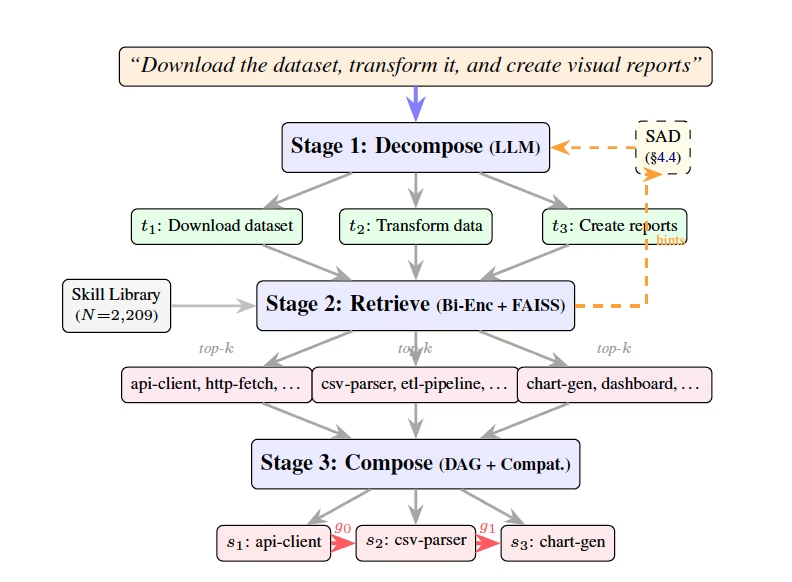
New Alibaba AI framework skips loading every tool, cutting agent token use 99%

Man City to complete Arsenal transfer hijack with deal ‘advanced’ for young star


-

 Fashion6 days ago
Weekend Open Thread: Staud – Corporette.com
-

 Politics7 days ago
The House | Manchesterism won’t survive the painful trade-offs unless it gets citizens on board
-

 Crypto World3 days ago
Strategy authorizes up to $1.25B in Bitcoin sales under new capital plan
-

 Politics7 days ago
Potential 2028er World Cup attendee leaderboard
-

 Business7 days ago
Asia stock markets slide as tech shares slump
-

 News Videos4 days ago
MAJOR BITCOIN & MARKET UPDATE!!!! (MUST WATCH ASAP!!!)
-

 Crypto World5 days ago
Coinbase, Circle Deepen Crypto Stock Losses Despite Resilient S&P 500
-

 Tech3 days ago
Anonymous researcher drops 0-day ‘exploitarium’ repo
-

 Business3 days ago
Australia treasurer says alleged access of prime minister’s bank data ’incredibly concerning’
-

 Crypto World6 days ago
Kraken's xStocks Opens Bending Spoons IPO Registration to EEA Retail
-

 Crypto World7 days ago
Bitcoin Sparks $600M Hourly Liquidations With $65,000 Set To Become Resistance
-

 Sports6 days ago
FIH Pro League: India defeat Pakistan 7-1, register biggest win of campaign | Other Sports News
-

 Tech5 days ago
Bluekit phishing kit adopts browser-in-the-middle for login theft
-

 Tech5 days ago
Russian hackers now target Signal backup recovery keys
-
 Crypto World6 days ago
Hyperliquid Named on Singapore MAS Investor Alert Register
-

 Crypto World6 days ago
RTX holders must register wallets before token distribution begins
-

 Crypto World7 days ago
Tether (USDT) Passes Ether in Market Cap as ETH Drops Toward $1.5K
-

 Sports1 day ago
Broncos roster: OL Ben Powers (No. 74) entering final year of contract
-
 Business3 days ago
The AI boom won’t burst all at once. It will pop in ‘rolling bubbles’: Macquarie
-

 Tech5 days ago
Silicon Valley paid to kill AI regulation, now it wants the rules back
You must be logged in to post a comment Login