On Wednesday, SwitchBot released its latest outdoor security camera. The smart home company bumped the resolution to 3K and now offers AI video descriptions, a feature that most security companies have added in the past year.
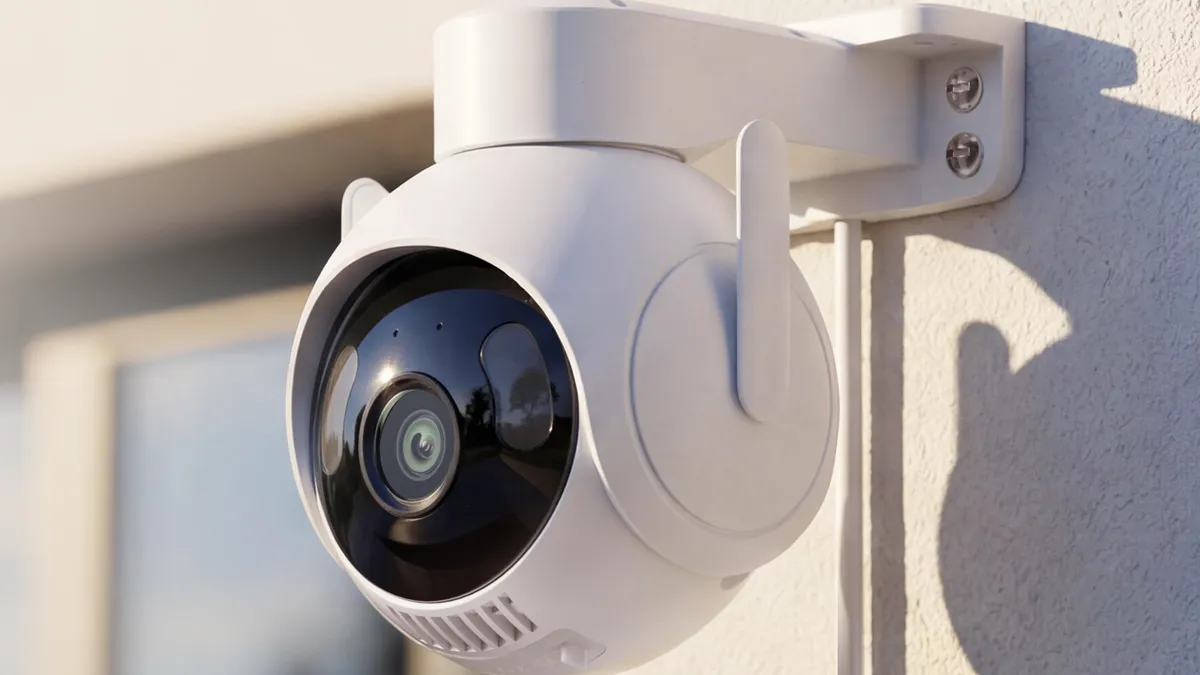
SwitchBot’s new outdoor pan/tilt camera, starting at $80, includes motion tracking and object recognition and offers you the choice between wired and wireless connections. It can also hold up to 512GB of local video clips or offer cloud storage as an option in its subscription plans.
The real standout is the AI recognition technology, which allows the camera to describe the events it captures. “A man in a UPS uniform walks on a porch with a package,” for example. The camera can also provide daily summaries of everything it’s seen, saving you even more time.
Advertisement
I’ve seen these features move into cameras from major brands including Ring, Nest, Blink and Arlo over the past year. They usually come with a hefty subscription fee around $20, but SwitchBot’s is lower than usual, starting at $5 per month.
Video descriptions are now common in home security, but SwitchBot is adding an animal species focus, too.
A representative from SwitchBot didn’t immediately respond to a request for comment.
SwitchBot has one trick, though, that really sets its camera apart from the pack: Its recognition features are specifically trained to identify wildlife, down to the species level. While most AI cams can tell the difference between dogs, cats and deer, this SwitchBot camera’s abilities go a little deeper. That’s useful if you want to get notifications like, “A coyote enters your yard,” alerting you that it may not be safe for your outdoor cats or other pets. And its spotting the difference between a possum and a raccoon could help you plan your pest management.
The camera also supports Alexa and Google Home, so you can use Echo Shows and Nest Hubs to view the live feed.
While SwitchBot’s camera and plans don’t currently include facial recognition, AI technology like this can sometimes be repurposed for other tasks, such as recognizing individual people, which raises surveillance and privacy concerns. I’ve asked SwitchBot whether it plans to address these concerns and will update this story when I receive a response. In the meantime, I’ll have to find a coyote and convince it to run around my yard for testing purposes.
Inside a vast exhibition hall in Bologna, one student stepped onto a platform three meters above the floor and gave the aircraft a firm push. The wings extended farther than a city bus is long, yet the structure left the edge cleanly and settled into a steady glide. It traveled 59 meters before its nose met a line of columns at the far end of the space. That single launch secured the Guinness World Record for the largest paper airplane ever built and flown. Engineering students from the University of Pisa created the aircraft, known as ICARUS. It spans 20.04 meters from wingtip to wingtip, measures 7 meters in length, and weighs 28.49 kilograms at completion.
The previous record, held since 2013 by a team from Germany’s Braunschweig Institute of Technology, was a real beast, with 18.21 meters of wingspan and an official flight distance of 18 meters, but this latest plane absolutely exploded the old mark, flying more than triple the distance while meeting all official requirements. You know what was really crazy? The whole thing was made entirely of paper and glue. The students utilized stronger 120-gram stock for the major pieces and lighter 40-gram sheets for the covering, then laminated many layers on top of each other in a smart honeycomb design that provided the necessary stiffness without adding bulk. That meant that the wings retained their shape well even under flying loads, and they managed to keep the overall weight low.
PILOTED FLIGHT – Grab a sheet of paper, fold it, and go! Instantly put yourself in the cockpit of an amazing smartphone controlled paper airplane that…
INCREDIBLE STABILITY – Loops, Barrel Rolls, & Hammerheads are achieved with the special Acro Mode! Your paper plane’s onboard computer automatically…
CONNECTED FLYING – Pair your plane with the POWERUP App to maneuver your plane, keep a robust flight log, compete with other flyers on the…
Fifteen engineering students built the entire thing from scratch, by hand. They included lengthy spars that run the length of each wing, as well as ribs to maintain the proper airfoil curve and a tail section to keep things stable. They even ran computer simulations of airflow around the shape to help refine the design before cutting out any large pieces, and they built smaller prototypes to test and tweak the balance and control, which began with some simple paper airplanes they folded during class breaks. That began out as a joke, but when the team decided to go for the record, science communicator Jakidale stepped in to help them out, sort of coordinating resources and sharing updates as they built the thing.
Advertisement
One of the most difficult challenges they faced was determining the appropriate humidity. Paper does not like wetness because it expands and compresses, wreaking havoc on surfaces and glued parts. They had to keep a constant check on the working conditions while assembling all of the separate sections, and every millimeter counted because excess weight or being even slightly off would reduce their lift and make it difficult to stay airborne.
Guinness World Records required a launch from a platform no higher than three metres and a minimum flight distance of 15 metres. ICARUS breezed past that with ease, and even had an official judge and an engineer on hand to inspect the wingspan and other dimensions during the We Make Future event at BolognaFiere. [Source]
Every June, after Apple wraps up its annual WWDC keynote, I install the latest iOS beta on my iPhone, watch the progress bar crawl to completion, and wait for the inevitable restart. For years, picking up my phone afterward felt almost identical to how it did before the update.
I saw the same grid of icons, the same Control Center, and the same version of Siri until iOS 26 finally broke that pattern in 2025.
Rachit Agarwal / Digital Trends
iOS 26 raised the bar. iOS 27 didn’t clear it
It was the first major update in years that made compatible iPhones feel genuinely different, and I’d give most of the credit to Apple’s Liquid Glass design language. With the redesigned Control Center and plenty of customization options (including the Clear Look for the Home Screen), iOS 26 actually felt substantial.
iOS 27, on the other hand, didn’t impress me quite as much. Don’t get me wrong. I’m not saying it’s bad. The new Apple Intelligence features, especially the revamped Siri experience (first promised in 2024), along with the new Photos features, are impressive enough that I’ve written entire pieces about them
To Apple’s credit, the AI features are real, functional, and occasionally delightful. The catch is that their value depends almost entirely on whether they slot naturally into your routine.
The problem isn’t Siri AI; it’s me
Over the last couple of years, I’ve tried pretty much every major AI service to figure out which one works best for me, and most of them have already secured a place in my workflow. I pay Claude a monthly fee because it’s become my go-to for research, fact-checking, and crunching numbers.
But what about the rest of the iOS 27 changelog? Respectfully, it feels like Apple is running out of room to reinvent the core iPhone experience or introduce a new one that doesn’t revolve around AI.
They’re useful under-the-hood additions that work in the background to improve your experience. The problem is that I’ve already moved on from several of these apps because they fell behind the curve for so long.
Shikhar Mehrotra / Digital Trends
The little things are genuinely better
It’s not like there aren’t changes I appreciate. AirDrop, for instance, feels much faster in iOS 27. App launches are noticeably quicker, and switching between mobile data and Wi-Fi is much smoother. Apple’s Continuity features are all intact and arguably better thanks to the under-the-hood refinements (even if they still decide to throw a tantrum every now and then).
However, after willingly putting my iPhone 17 through beta duty and installing iOS 27 with both excitement and nervousness, I came away feeling less rewarded than I’d initially hoped.
Maybe this is peak iOS
The more mature way to look at this might be that iOS has already reached a near-perfect state, both in terms of how it looks and the features it offers, and once we get there, every new feature or experience risks upending what already works.
Advertisement
Apple
I guess I need to re-evaluate my expectations for Apple’s annual updates. iOS 26 only felt so exciting and different because so many earlier versions looked exactly the same.
While I wouldn’t call iOS 27 only a fresh coat of paint, it also doesn’t feel like the kind of leap it might appear to be, at least not if Siri AI and Apple Intelligence aren’t already central to how you use your iPhone.
Startup Ampera has unveiled what it calls the first 3D-printed nuclear reactor module, built around a silicon-carbide core and pressure vessel designed for a thorium-based microreactor. The company says future systems could deliver 15 or 30 megawatts for up to 30 years without refueling. When The Register asked about availability, their spokesperson said: “We expect the power generation portion of the system to be available as early as 2027, with the nuclear module being available to customers about 2030 based on regulatory approval.” From the report: Founder and CEO Brian Matthews revealed the prototype microreactor, which features a fully 3D-printed silicon carbide reactor core and pressure vessel. “This next-generation nuclear core and pressure vessel sets the foundation for factory-built, mass-produced nuclear energy,” Matthews said. “The advanced technology and additive manufacturing used demonstrate a clear commercial path for new nuclear technology coming to market in an accelerated manner.” His company is developing a subcritical, solid-state, factory-built thorium-based nuclear reactor. Subcritical means the fuel cannot sustain a nuclear chain reaction on its own, which prevents a runaway power excursion.
Ampera uses “solid-state” to describe a design with solid rather than liquid fuel. The proposed fuel uses tristructural isotropic, or TRISO, particles, consisting of a fuel kernel containing thorium, surrounded by multiple ceramic and carbon layers. […] “Thorium is the future for ultra-safe, clean power production,” Matthews said at the time. “By producing TRISO thorium kernels in the United States, we can ensure ample access to the needed fuel supply as we scale up and also minimize price volatility risk.”
Ampera also describes the heart of the reactor as as a spherical monolithic gyroid core. A gyroid, as far as we can fathom, is a complex shape that provides a massive surface area relative to its volume, making it well-suited for heat transfer. Its complexity makes it difficult to produce using conventional manufacturing methods, which is where additive manufacturing comes in. The core is 3D-printed using silicon carbide and designed to operate for up to 30 years without refueling, the firm claims. Ampera says its planned systems will provide 15 or 30 MWe, depending on the configuration, enough to supply a typical datacenter. Larger configurations are planned. Matthews said that his company expects to be the first to industrialize factory-built nuclear power with near-term deployment timelines.
New leaks about the iPhone 18 Pro seem to be annoying Apple, while the guessing game continues over whether the iPhone Fold is coming in September, plus why we should not believe that the iPhone is the end of civilization, on the AppleInsider Podcast.
Among the more than 630GB of data taken from a Tata iPhone plant in India this week, were documents concerning plans for the iPhone 18 Pro. They included how the US is currently expected to continue using Qualcomm modems in this next iPhone, while the rest of world will get Apple’s own C2 one.
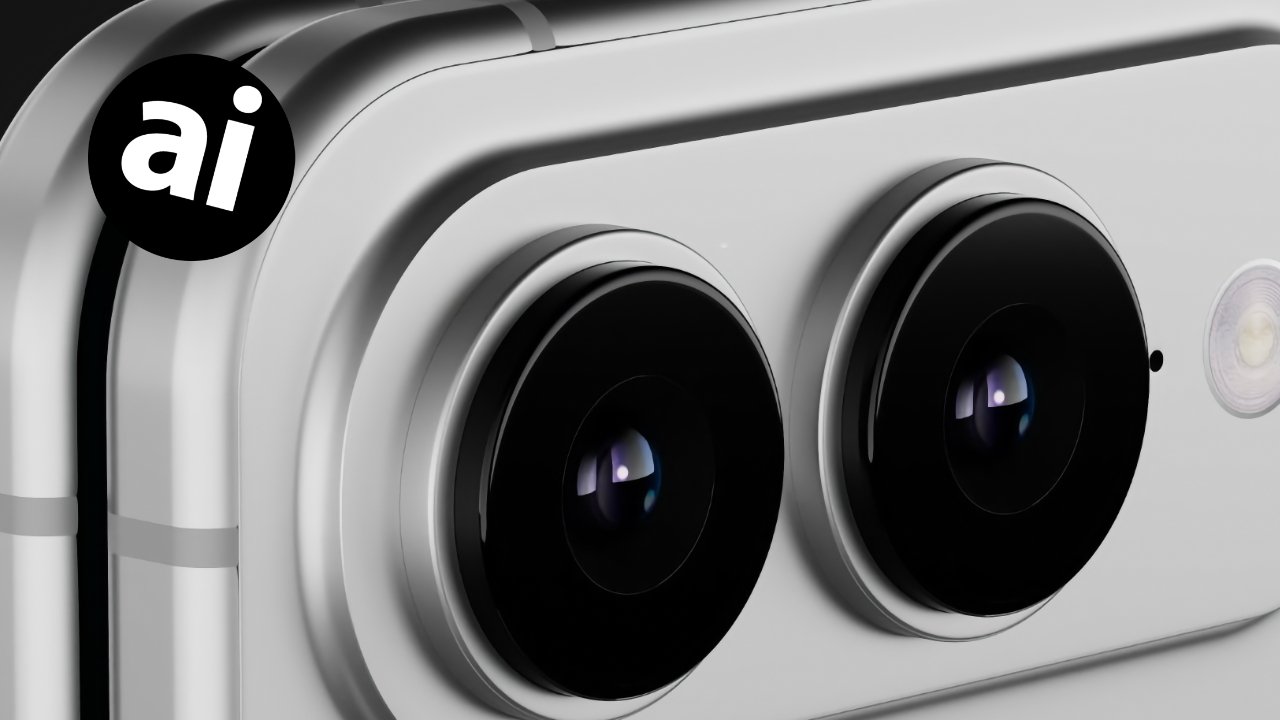
Then there are also a few but tantalizing details of camera updates, which hint at the possibility of a variable aperture system finally coming to the iPhone.
It’s unusual to see such a volume of leaks that are seemingly accurate and where the provenance is known. Perhaps that’s why Apple has been unusually active in pursuing it, including getting sites to take down certain materials.
Advertisement
There have, though, also been less substantiated reports this week that Apple has increased its order for the iPhone Fold. Then an arguably even less substantiated report takes the fact that the US birth rate is declining, and has a good go at blaming the iPhone.
Plus it is true that there is a genuine security problem with AirDrop, but wait until you hear just how contorted a situation you’d have to be in for it to be an issue.
BONUS: Subscribe via Patreon or Apple Podcasts to hear AppleInsider+, the extended edition. This time, as Elon Musk either does or does not show off an iPhone killer (it depends when you ask him), what possible AI devices could ever take the place of our phones?
Links from the show:
More AppleInsider podcasts
Tune in to our Smart Home Insider podcast covering the latest news, products, apps, and everything HomeKit related. Subscribe in Apple Podcasts, Overcast, or just search for HomeKit Insider wherever you get your podcasts.
Those interested in sponsoring the show can reach out to us at: [email protected].
Subscribe to AppleInsider on:
Keep up with everything Apple in the weekly AppleInsider Podcast. Just say, “Hey, Siri,” to your HomePod mini and ask for these podcasts, and our latest HomeKit Insider episode too. If you want an ad-free main AppleInsider Podcast experience, you can support the AppleInsider podcast by subscribing for $5 per month through Apple’s Podcasts app, or via Patreon if you prefer any other podcast player.
There was a time when every major technological breakthrough felt like a permanent addition to our lives. The typewriter took the better part of a century before it started to look replaceable. Incredibly, the telegraph didn’t fully disappear until 2006 after 150 years of faithful service. These days, obsolescence moves a lot faster. The 3D TV was marketed as the next best thing in the 2010s, and its rapid rise and fall is the perfect example. Nowadays, even a single software update on your smartphone can be enough to make last year’s flagship feel outdated.
But there are plenty of examples of technologies that were presumed dead and buried years, or even decades, ago that are still running quietly in the background, and some are even making a dramatic comeback. Most of these technologies have survived because they continue to work in situations where newer alternatives fail. Others have stuck around because they’re more affordable, while some have been resurrected after picking up new users who weren’t even born the first time they had their run. Somewhere between today and the headlines that announced their passing, each of the following has found legitimate reasons to stick around. Here’s a closer look at 10 technologies that have simply refused to die.
Advertisement
Landlines
nsiswan/Shutterstock
The old landline network has gotten much pricier to run as it’s aged. So once smartphones became cheap enough for most people to own, you would have been forgiven if you thought that was the end of the landline network. But plenty of people still haven’t ditched their old house phones. A survey by the CDC National Center for Health Statistics found that close to one in five adults still had a landline at home by the end of 2024. Across the pond in the U.K., it’s even more. In fact, landline ownership there only just dipped below 50% for the first time that same year. Most people over the age of 65 in the UK continue to hold onto their reliable landline telephone. And reliability is actually a very real reason why it remains in use.
A survey by telecommunications company NumberBarn found that people cited not having to constantly charge the phone as a top reason for keeping it. Respondents also reported that it was handy to have one as insurance against a lost or stolen smartphone, while others felt confident it was more dependable in a crisis — and for the latter, they aren’t wrong. Landlines get their power directly from telephone company networks. This means they stay on during a blackout. A digital line draws power from the grid and needs an active internet connection, and once the battery dies on a smartphone when the power is out, it’s effectively useless. A landline will also keep working when cell towers go down, and it has proven to be so reliable that hospitals and medical practices continue to rely on it. Although this is also because their fax machines run through the same line.
Advertisement
Fax machines
Eko Bc/Shutterstock
The clunky fax machine may seem like a relic from the pre-digital dawn and an obvious casualty of email and modern file-sharing, but it’s still around. In fact, certain industries never moved away from it. Insurance agencies, real estate agents, and banks still treat it as a standard part of business, and the technology also endures across the healthcare and legal industries. Worldwide usage is still at 17%. In the U.S., a significant 70% of healthcare companies still rely on this 160-year-old technology to some degree.
The reasons the fax machine has endured may surprise you. They essentially boil down to regulation, security, and good old-fashioned practicality. Healthcare providers, for example, can legally exchange patient information by fax under federal medical privacy laws — a status email doesn’t share. From a legal standpoint, faxed paperwork also holds up much better as legal documentation, another area in which email falls short. Given that faxes travel across telephone lines rather than the internet, they’re also harder for hackers to intercept than email, while newer fax platforms add further protection through modern encryption technology.
There are around 43 million fax machines still sending documents around the world, and a set of shared technical standards adopted in 1968 still governs how they communicate. This means machines built generations apart can still exchange documents without issue. There’s no sign of a slowdown in sales, either. The sector was valued at $3.3 billion in 2024, with substantial growth expected later in the decade.
Advertisement
Pagers
Dmitriy83/Getty Images
Mobile phones may have taken over as the dominant way people communicate, and pager use might have dropped significantly since its peak in the 1990s, but they are still around. It’s another reliable technology used in hospitals. In fact, there are a number of modern-day industries that still use pagers. They remain standard equipment mostly for one simple, yet familiar, reason: reliability. A survey commissioned by TigerConnect, ironically, a company that sells smartphone-based alternatives to pagers, found that 90% of the surveyed hospitals still had some level of pager usage. On top of their reliability, low cost and the ability to reach clinicians remotely were also cited as top reasons for their continued use.
“They’re like the cockroaches of the healthcare system,” Dr. Brittany Bankhead, a trauma surgeon in Lubbock, Texas, told the Wall Street Journal. “They won’t go away.” She prefers to use a pager because it picks up signals her phone can’t, and she can leave the device in her car the moment she’s off duty, which keeps her job from following her home. Another advantage is that a single page can trigger a siren with a follow-up voice message that can reach an entire care team at the same moment. There’s no truly effective equivalent built into a smartphone. Pagers also hold up well physically, running on batteries that outlast a smartphone’s by a wide margin, which adds even more points to their reliability.
Advertisement
Dot matrix printers
Supersmario/Getty Images
The place you’ll most commonly see a dot matrix printer is at the airport. Airlines still use them to print boarding passes. It punches letters onto the card with small metal pins like a fast, tiny typewriter, and mechanically, there’s nothing else on the market that can do what it does. That’s one reason it’s still around, despite the development of modern-day laser and inkjet printers. But dot matrix printers are also rugged machines. Heat, dust, and temperature swings that would knock out an inkjet barely register on a dot matrix printer. Running them at high volume also costs less, and without a complicated set of moving parts or ink cartridges constantly drying out, there’s much less maintenance involved.
It isn’t just airports where you’ll find them. Government offices and, once again, hospitals still use them. But they use them in a different way. Carbon copy printing is the process of using several stacked sheets so they’re all marked with one strike. Each layer becomes an identical copy, but usually on different-colored sheets. This creates an instant paper trail for record-keeping. One copy goes into the file; the others go to those who need them. Hospitals and clinics rely on this for billing and patient files, which suits the strict record-keeping rules in healthcare.
Advertisement
AM radio
JoshBryan/Shutterstock
Every generation seems to find a new way to consign AM radio to the history books. But it has survived television, FM radio, and now it’s contending with podcasts and streaming. Even electric cars are being forced to abandon AM radio, despite the fact that the U.S. government is fighting to keep it. At home, plenty of Americans still tune into the radio every week, and while the share of listeners choosing AM has shrunk and skews toward an older generation, industry figures suggest it still holds an audience approaching 50 million. A lot of that loyalty comes down to the content that’s on the dial. Conservative talk shows are still popular on the frequency, while independent stations have held on longer on AM than almost anywhere else. Quality non-English broadcasts are often easier to find on AM than they are on FM, too.
That said, one of AM’s biggest advantages is its reach. The signal can travel through buildings and over mountains to places where phones and the internet can be unreliable. This is why AM radio has a bigger following in rural areas than in urban centers. It’s also why the frequency remains central to emergency alerts, which is reason enough for government officials to back that bill requiring AM radio in new vehicles. Even Ford has retuned its AM radio decision after a massive backlash, and the fight to keep it in EVs rather than allowing automakers to drop it over interference concerns continues.
Advertisement
DVDs/Blu-rays
Smith Collection/gado/Getty Images
The way streaming took off, you might have expected DVDs and Blu-rays to have been wiped out years ago. The turning point arrived in 2011, when Netflix had the vision to switch its business model from mailing discs to streaming. From that point, owning a physical copy of a movie was no longer necessary. Yet, the format hasn’t disappeared.
The market might currently be running at around 14% of its prior sales, but there seems to be something of a turnaround taking place. Despite SlashGear previously describing the future of Blu-ray as bleak, the BBC states that British entertainment retail giant HMV has reported an increase in disc sales, with “4K and Blu-ray doing particularly well.” Additionally, Wired reports that Technicolor Home Entertainment Services distributed around 750 million discs worldwide in 2021. That’s still quite a bit of demand. Rental kiosks and dedicated new-release sales sections haven’t entirely disappeared from stores, either, which would be an odd thing to maintain if there weren’t demand.
Advertisement
People who still buy or rent discs tend to be in their late 20s and 30s, with some of them treating the current market as an opportunity. They consider now to be a good buying window because they can pick up discs cheaply before the format follows the vinyl record path toward scarcity and rising prices. However, good old-fashioned ownership also keeps the format alive. A physical disc cannot be pulled without notice from a streaming library, and this is especially important if you’re a fan of older or niche titles. Plus, there are extras like bonus footage and director’s commentary that give certain discs lasting value that streaming doesn’t provide.
Advertisement
Vinyl records
Mihailomilovanovic/Getty Images
You might think it would be old hippies or ’70s funksters nostalgically buying up all the vinyl records today. Not so. Data shows that millennials and Gen Z account for a significant share of vinyl buyers, and the global market was valued at an astonishing $1.6 billion in 2025. That’s quite the market for a format that was supposed to be long dead following the launch of CDs and, in more recent years, digital streaming. Even DJs started moving toward digital formats in 2001, with Pioneer’s introduction of the CDJ player. However, despite carrying a single CD case to gigs being markedly more convenient than hauling boxes of vinyl, turntable DJing never fully disappeared. Many who started out on the wheels of steel when vinyl was the preferred format stubbornly persisted with that heavy box hauling.
There are plenty of other reasons why more people are listening to vinyl records again. For one, there’s the financial aspect for artists. Money spent on a record funnels more easily to them than the fractional payouts that come from streaming. This matters a lot to many music fans. But the big question is, does vinyl actually sound better than CDs? Well, there’s the sonic quality adored by audiophiles. Vinyl’s “warmth” is an obvious texture that listeners immediately associate with the format, and it’s genuinely hard to replicate digitally. But some of what people love about records has little to do with the sound. It’s the ritual of it all. The admiration of the artwork, the reading of the liner notes, the placing of the needle on the record, and, of course, the comforting crackles that come just before the music kicks in. These are steps you simply don’t get with music streaming.
Advertisement
Wired headphones
Emilija Milenkovic/Getty Images
When Apple introduced the iPhone 7, the glaring omission of the headphone jack was highly controversial, and it looked like curtains for wired headphones. Sales steadily decreased for about five years. But with a premium pair of wireless headphones running into hundreds of dollars, cost was one factor that helped drive the comeback of wired headphones. Leading market research company Circana reports a sharp jump in wired headphone purchases in 2025, with that momentum carrying unabated into the new year. Revenue grew an astonishing 20% in the first couple of months of 2026 alone. But it’s not just affordability that has fueled that growth.
Celebrity culture has made wired headphones fashionable again. Ariana Grande and actress Zoë Kravitz have both been spotted wearing cabled earbuds, as have Lily-Rose Depp and other A-listers. A devoted following has sprung up online, centering around the aesthetics of wearing wired headphones or earbuds. Even Apple’s very own chief executive told the BBC, “People still buy them.” But do wired headphones really sound better than Bluetooth?
Audio quality was the simple reason they were always the preference of audiophiles. The editor at large for audio publication SoundGuys told the BBC in the same article that wired models tend to deliver better sound for the price than their Bluetooth equivalents, and you can also sidestep the pairing glitches that affect wireless listening. But for some users, the shift is just a quiet rebellion against the rapid advancement of technology, while not having one more battery to top up is another obvious advantage wired headphones hold.
Advertisement
USB-A
Derevianko Dmytro/Getty Images
USB 1.0 launched way back in 1996 and gradually evolved through faster versions over the next two decades until it was replaced by the slimmer, smaller, and faster USB-C. Or so we thought. Manufacturers haven’t fully completed that shift, and USB-A, as the older standard is now referred to, is still very much in use. Many wireless devices still pair with a dongle built for the old connector, while some manufacturers continue to build products with that same port.
Budget laptops usually retain a mix of both A and C types. But many premium brands (looking at you, Apple) have trimmed their port selection down in a way some might consider brutal. Critics have pointed out that ditching the USB-A port was simply a cost-cutting move and didn’t benefit consumers in any way, but that didn’t stop companies from doing it.
The reason that some other brands keep the older standard is that most everyday accessories run fine on it. There’s no need for the extra bandwidth that newer connections offer, so there’s little reason to swap them out. For many common peripherals, the lower bandwidth works just fine, and USB-A’s widespread adoption remains one of its biggest strengths. And because just about every cable supports it, mismatched gear rarely causes an issue. So, if you do have that fancy MacBook Pro but still have some older accessories, you’ll probably want a highly rated USB-A to USB-C adapter to keep things running smoothly.
Advertisement
Film cameras
Arta Pic/Shutterstock
There are many reasons why old film cameras are making a comeback. But the most surprising aspect of it all is that most people pushing the revival weren’t even around when film was the norm. The majority of buyers are young, and store owners will tell you that secondhand film cameras do not sit on their shelves very long. While many of them are being snapped up as fashion statements, other buyers are treating film photography as a pushback against smartphone photography.
You can take hundreds or even thousands of shots on a phone camera. But will you remember them all? Unlikely. In fact, shooting this way can dull your memory, which is just one way smartphones have changed how we travel. With a film camera, knowing that every shot costs money naturally stops you from firing off dozens of near-identical shots. You stop and think about composition, the light, and the angle. It’s about intentionality, not instant gratification.
There’s the visual signature, too. The color tones, the light halos, and the distinct grain are characteristics you only get in film photography. They combine into something that seems more authentic than the over-sharpened, over-saturated, over-the-top aesthetics we see on social media today. If you’re interested, there are plenty of classic SLR cameras still worth buying. If you just want to give it a go to see how you like it, there are also some excellent cheap film cameras that are great for beginners.
Advertisement
Methodology
Anastasioskappa/Shutterstock
These 10 technologies were chosen because each was widely expected to disappear at some point, yet all remain in active use for specific reasons. Few people are likely to seek out a dot matrix printer or a pager for personal use, but the reasons behind their continued survival are clear and well documented. Others, like vinyl records and film cameras, are sticking around for reasons that have nothing to do with practicality and everything to do with people just missing how things used to feel.
Loewe has launched Loewe Systems GmbH, a new Berlin-based division dedicated to designing high-end integrated audio and audiovisual systems for automotive, marine and residential projects worldwide.
That venture focuses on fully integrated high-end audio and audiovisual solutions for automotive manufacturers, luxury residences, super yachts and recreational vehicles, with its scope reaching well beyond the television and audio products that built Loewe’s reputation.
That expanded reputation follows Loewe Technology’s acquisition of French acoustics specialist Cabasse in April 2026, a deal that significantly strengthened the group’s capabilities in premium loudspeaker technology, acoustics and audiovisual engineering.
That engineering strength now sits behind a senior leadership team at Loewe Systems, with Alexander Meisen serving as managing director, Ajan Hannemann as director of acoustics and Robert Schletze as director of automotive engineering.
Advertisement
Meisen said “exceptional sound should not be confined to a single environment,” and added that the goal is to build experiences spanning homes, roads, the sea and future mobility concepts.
Advertisement
Integrated systems rather than individual components
Image Credit (Loewe L-R, Ajan Hannemann, Aslan Khabliev, Robert Schletze)
That mobility-spanning approach carries through to how Loewe Systems builds its projects and develops complete audiovisual ecosystems that combine acoustic architecture, loudspeaker integration, DSP calibration, user interfaces, display technologies and projection systems rather than individual components.
Aslan Khabliev, CEO of Loewe Technology GmbH, said the market increasingly demands holistic solutions rather than standalone products, and the new venture combined with Cabasse’s knowledge gives the group the expertise, technology and engineering capabilities to deliver integrated premium environments.
Alongside that expertise, global football icon Kylian Mbappé has joined Loewe Systems as both shareholder and global brand ambassador, a move that extends his existing relationship with the Loewe Group and lends high-profile support to the company’s international growth ambitions.
Advertisement
Those growth ambitions draw on the wider Loewe Group, a company rooted in more than a century of German engineering and recognised as a pioneer of television technology, now paired with Cabasse’s expertise in advanced acoustics and loudspeaker design.
Advertisement
Consumer and B2B business remain separate
While Loewe Technology continues to lead the group’s consumer-facing television and audio business, Loewe Systems will operate exclusively in the B2B space, serving automotive OEMs, hospitality groups, luxury property developers and yacht builders worldwide.
Loewe has not named specific automotive, hospitality or residential partners for the venture yet, though it already offers scalable system and IP platforms structured around curated automotive partnerships and bespoke installations.
Advertisement
Loewe has also not confirmed a timeline for when the venture will announce its first commercial partnerships, though the appointment of its leadership team and Mbappé’s involvement mark its opening moves across automotive, hospitality, marine and residential markets.
Much like radio operators being encouraged to use the least possible amount of power to make a contact, chemists have a similar rule encouraging using the least amount of materials in experiments. Not only is this rooted in economics, but in safety as well; if something goes wrong it’s generally good if there’s not excess amounts of reactants. With modern techniques, though, it’s possible to bring experimental chemistry down to incredibly small scales, and [Marb’s lab] found that they needed a custom built still for these new, diminutive experiments.
The first step is to build the heating component of the still. This is provided with a few custom aluminum parts for the base and a pair of heaters originally meant for 3D printers, with the assembled unit wrapped in insulation. The heater accomodates a 25 mL round-bottom flask. Temperature control of the heating mantle is provided by a controller mounted to a DIN rail which receives power from a 24V power supply, and an additional temperature probe is added to measure the temperature of the distillate. A test run with water shows the small still quickly and efficiently evaporating the water up to a condenser.
Although building a still doesn’t have to be technically difficult, building something this small that’s effective and safe is a bit more challenging than a backyard moonshining operation. Scaling chemical reactions down can often be a challenge but is possible with the right mindset and equipment. We’ve seen miniaturization of many things that we might not have expected including hydrogen production, aluminum smelting, and even the construction of a microscope.
Six malicious npm packages mimicking Rollup polyfill tools stole developer credentials and enabled remote access in a Lazarus-linked campaign.
Security researchers at JFrog have identified a set of malicious npm packages linked to North Korean threat actors that impersonate legitimate Rollup polyfill tooling to steal developer credentials and enable remote access to compromised machines. The packages, named “rollup-packages-polyfill-core” and “rollup-runtime-polyfill-core,” mimic the legitimate “rollup-plugin-polyfill-node” project down to its description, repository metadata, and package structure. All six packages in the campaign have since been removed from the npm registry.
The attack uses a layered delivery chain designed to evade detection. The first-stage packages install hidden second-stage dependencies disguised as SVG utilities, which then fetch a JSON object from a remote hosting service and execute the payload embedded in it. JFrog said the structure, combined with lookalike names, legitimate-looking metadata, and environment checks designed to avoid sandboxes and cloud development platforms, is consistent with previous Lazarus-linked npm campaigns.
Once the later stages execute, the malware gives the attacker both collection and control capabilities across the compromised machine. The payload steals data from web browsers and cryptocurrency wallets, captures clipboard content periodically, and harvests files matching specific extensions. It also targets developer tool configurations for VS Code, Windsurf, and Cursor, along with credentials for AWS, Microsoft Azure, Google Gemini, Anthropic Claude, and SSH keys.
The campaign is not an isolated incident. In April, researchers at Panther documented a sustained Lazarus npm operation that published 108 malicious packages across 261 versions to deliver BeaverTail and OtterCookie, two known North Korean malware families linked to the Contagious Interview campaign. The latest packages share features with OtterCookie, including the use of a forked keyboard and mouse control library that enables interactive remote terminal sessions, screenshot capture, and simulated user input on compromised Windows machines.
Advertisement
The disclosure arrives alongside a broader wave of supply chain attacks targeting open-source package repositories. Checkmarx, SafeDep, and AWS researcher Chi Tran separately identified clusters of malicious packages across npm and PyPI that steal cloud credentials, cryptocurrency wallets, SSH keys, and developer secrets. Rollup plugins are commonly loaded from developer workstations and CI build pipelines, environments that have proven increasingly vulnerable to supply chain compromises and that often hold access to sensitive assets including source code, API keys, and project secrets.
Online emporium’s Starlink rival says it will start service later this year as another 29 birds reach orbit
Amazon says it is preparing to roll out satellite broadband this year after the latest rocket launch brought its Leo constellation up to 396 units.
The digital bazaar and cloud computing giant reports that an Atlas V rocket launch on July 2 successfully propelled 29 satellites into low Earth orbit for the Amazon Leo network, formerly known as Project Kuiper until November last.
Advertisement
Amazon hasn’t finished flinging its hardware into orbit just yet, but said it is planning to begin providing an actual service through the network sometime this year.
“With hundreds of flight-ready satellites standing by at the Cape and a new, dedicated vertical integration facility ready to support Leo Vulcan 1 and subsequent missions, we have a clear path to increase launch and deployment cadence, helping us quickly expand network coverage following an initial service rollout later this year,” said director of Launch Systems Melissa Wuerl.
Amazon Leo was originally conceived as a broadband-from-space setup, just like its main rival, Starlink. According to the Bezos-founded biz, it will offer download speeds ranging from 100 Mbps to 1 Gbps, depending on which of three antenna options customers choose.
But in April this year, Amazon agreed to pay more than $11.5 billion to acquire Globalstar and its constellation of 24 satellites. Globalstar provides the satellite network used for Apple’s satellite services, introduced with the iPhone 14 in 2022, which would give Amazon a foothold in direct-to-device satellite communications as well.
Advertisement
With 396 satellites in low Earth orbit, Amazon has far fewer than Starlink, which boasts about 10,400 in operation at the moment. The firm has plans to loft more than 7,700 of its own eventually, but currently has a licence from the US Federal Communications Commission (FCC) for a cluster of 3,232.
The terms of that licence required Amazon to have 50 percent of its planned constellation in orbit by July 30, 2026 – a deadline it is clearly going to miss. The company sought an extension in January, and this was granted last month, but with strings attached.
Whether Amazon will be able to compete against Starlink, which has a significant head start, depends on a number of factors, such as the quality of service on offer. Its top-tier offering of 1 Gbps has a higher advertised maximum download speed than Starlink’s current residential tiers, although real-world performance has yet to be established.
Amazon has also yet to disclose what price tag its service will carry. Starlink’s US residential plans cost up to $130 a month, with equipment charges varying by plan and location.
Advertisement
UK telecoms regulator Ofcom granted Amazon Leo a license to beam its broadband down to Brit consumers over a year ago. ®
Multiple weaponized proof-of-concept (PoC) exploits on GitHub were found delivering a Python-based remote access trojan (RAT) named ChocoPoC that can execute commands and steal sensitive data in a campaign believed to target cybersecurity researchers.
Hiding malware in PoC exploits for various vulnerabilities is not new, as there are examples of threat actors posing as real security researchers and taking advantage of trending vulnerabilities to target vulnerability and penetration testers or low-skilled hackers.
However, ChocoPoC stands out for not embedding the malware directly in the exploit file but for adding malicious Python packages to the PoC’s dependency list.
According to researchers at cybersecurity companies Sekoia and YesWeHack, the packages are hosted on the Python Package Index (PyPI), a platform used by Python developers to source and share code.
Once the victim clones a malicious repository, a trojanized package named ‘frint’ is automatically fetched and installed on their systems.
Advertisement
Example of a malicious repository Source: Sekoia
During installation, the package pulls a malicious dependency package, ‘skytext,’ which contains a compiled native Python extension.
When the PoC executes, the extension runs automatically and decrypts additional embedded Python code that triggers a downloader to retrieve the final payload, ChocoPoC, from a Mapbox dataset.
The ChocoPoC RAT has the following capabilities:
execute arbitrary shell commands and arbitrary Python code
upload files and directories
collect browser passwords, cookies, autofill data, and browsing history
search for text files, markdown documentation files, and database files
gather shell history from the host
collect network configuration
enumerate running processes
Mapbox datasets are also abused for data exfiltration, though larger file uploads are handled separately via an HTTP server.
ChocoRAT infection chain Source: Sekoia
Sekoia has identified at least seven PoC repositories on GitHub that distribute ChocoPoC and host exploits for FortiWeb (CVE-2025-64446), React2Shell (CVE-2025-55182), MongoBleed (CVE-2025-14847), PAN-OS (CVE-2026-0257), Ivanti Sentry (CVE-2026-10520), Check Point VPN (CVE-2026-50751), and Joomla SP Page Builder (CVE-2026-48908).
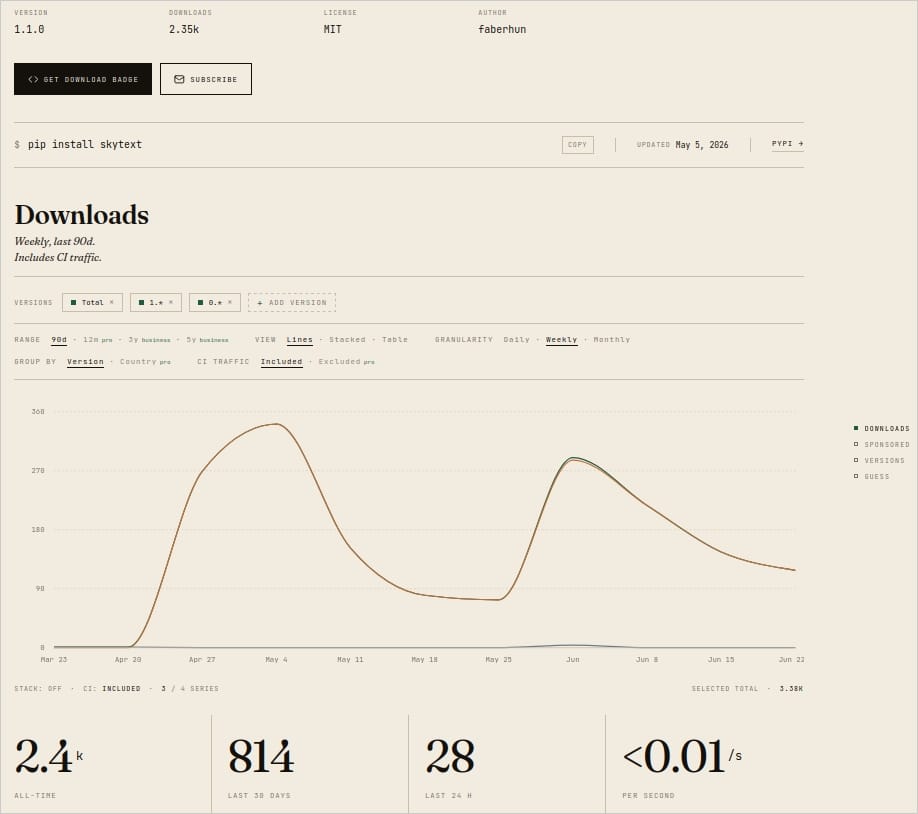
The researchers found that skytext was downloaded 2,400 times, mostly on Linux-based systems.
The downloads surged following the disclosure of a popular vulnerability, which served as a lure to draw unsuspecting researchers into downloading and testing PoCs from the repositories.
Advertisement
Download trends for skytext Source: Sekoia
Sekoia also reports that before frint and skytext, the campaign used two different packages, named ‘slogsec’ and ‘logcrypt.cryptography’, with very similar source code, and delivered the same ChocoPoC payload.
It is unclear who is behind this campaign, but researchers found several email addresses associated with GitHub committers linked to another PoC exploit trojanizing activity in late 2025.
Sekoia found that credentials for two of the emails used in the campaigns appeared in leak databases, and the login for another one “highly likely originates from an infostealer compromise.”
“According to these findings, we assess with high confidence that the attacker primarily employed compromised accounts to publish malicious PyPI packages and PoCs,” Sekoia researchers say.
Researchers warn that the new malware delivery technique allows keeping the exploit intact by assigning the malicious behavior to packages that seem harmless on their own.
Advertisement
Since vulnerability and penetration testers are attractive targets because they often run malicious or untrusted code, they are recommended to never blindly trust GitHub repositories and only execute unverified code in isolated environments.
Security teams log 54% of successful attacks and alert on just 14%. The rest move through your environment unseen.
The Picus whitepaper shows how breach and attack simulation tests your SIEM and EDR rules so threats stop slipping by detection.
























.jpg)












































You must be logged in to post a comment Login