

Crypto World
Revolut to End USDT Support in Europe as MiCA Rules Reshape Stablecoin Market


TL;DR
- Revolut will delist USDT, ending support for the stablecoin on August 31.
- Users can buy USDT until July 6 and deposit it until July 30 before the phased removal begins.
- Any USDT remaining after the deadline will be automatically converted into fiat at the prevailing exchange rate.
- The move reflects the impact of the EU’s MiCA rules, which continue to drive USDT delistings across regulated European platforms.
European fintech giant Revolut has announced that it will discontinue support for USDT, just days after Tether’s freezing move, giving customers until August 31 to withdraw or sell their holdings before the stablecoin is removed from the platform. The move comes as the European Union’s Markets in Crypto-Assets (MiCA) framework continues to reshape the region’s regulated crypto market.
According to notifications sent to users via email and the Revolut app, customers will be able to purchase USDT until July 6, while new USDT deposits will be accepted only until July 30. After that date, users can continue selling the stablecoin or transferring it to external wallets until August 31. Any remaining USDT balances left on Revolut after the deadline will be automatically converted into fiat currency at the prevailing exchange rate.
The announcement adds another major platform to the growing list of European companies ending support for the world’s largest stablecoin.
MiCA Continues to Drive USDT Delistings Across Europe
Revolut’s decision follows the completion of the European Union’s MiCA transition period, which took full effect on July 1, 2026. Under the new regulatory framework, licensed crypto platforms can only offer stablecoins that comply with MiCA requirements.
Rather than seeking authorization as an Electronic Money Token (EMT), Tether chose not to apply for MiCA approval. The company has previously argued that the regulation’s reserve requirements, including rules governing where reserves must be held, are incompatible with its existing reserve management strategy.
As a result, several major exchanges have already removed USDT from their regulated European services. Coinbase, Kraken, Crypto.com, and Binance have all ended or significantly restricted USDT trading for users in the region as the regulatory deadline approached.
The latest move by Revolut further reduces the number of regulated platforms where European customers can access the stablecoin.
Circle Gains Ground as Europe Adopts MiCA-Compliant Stablecoins
This comes as Circle takes the opposite approach by securing regulatory approval that allows USDC and EURC to operate across all 27 European Union member states, as earlier reported.
The shift has prompted exchanges and liquidity providers to increasingly support MiCA-compliant stablecoins, with many rebuilding trading liquidity around USDC after removing USDT trading pairs.
Although USDT is disappearing from regulated European trading platforms, Tether has maintained a presence in the region through technology partnerships. The company continues to support projects developing MiCA-compliant stablecoins using its Hadron tokenization platform, allowing it to remain active in Europe’s digital asset ecosystem without issuing a MiCA-approved stablecoin itself.
Revolut’s latest announcement underscores how the implementation of MiCA is reshaping the European stablecoin market. As regulated platforms align with the new rules, compliant alternatives such as USDC are gaining wider adoption while USDT’s availability across Europe’s licensed crypto services continues to decline.



Once among the top performers of the 2021 bull run, Shiba Inu (SHIB) continues to face difficulties after shedding over 95% of its all-time high price. The meme currency, which delivered enormous profits for its early investors, has been trading against a backdrop of strong selling pressure for the past few years due to changed market conditions.
While there has been some positive momentum for SHIB in 2024, hopelessness set back again amid increased economic uncertainties. Now, it is unclear whether SHIB is on the verge of hitting rock bottom or another fall can be anticipated. Despite having faith in the project’s future, there are a number of economic and market reasons that are restricting its potential to recover further.
Economic Situation Further Adds to Pressure on Meme Coins
Shiba Inu was able to start off 2024 well, reaching almost $0.00003 by December as the community expected a new bull run. But it did not last long.
As economic conditions worsened in late 2025 and early 2026 due to inflation, tensions, and slow economic growth, investors became less interested in taking risks. As a result, most of them withdrew money from meme coins.
SHIB fell towards the level of $0.000004, which was one of its lowest values in recent years and canceled out all the gains made by the previous rally. The overall crypto market was also affected as the situation with monetary policy worldwide became unclear.
Policy at the Federal Reserve Remains a Major Threat
Macroeconomic factors will continue to influence the forecast of SHIB’s price.
High inflation has been reported in the country, resulting in the Federal Reserve maintaining its tight monetary policy stance. Although interest rates have not seen changes in the latest meetings of policymakers, many participants in the market see interest rates staying high if inflation persists.
Interest rate hikes usually lead to lower liquidity levels in the financial market as investors tend to shift towards safe investments like government securities and cash. Cryptocurrencies become less popular amid higher interest rates due to their speculative nature. Since meme tokens are the most volatile cryptocurrencies on the market, price fluctuations will be higher if market sentiment declines.
High Supply of Tokens Hinders Price Increases
The next major hurdle that Shiba Inu faces is the huge supply of tokens.
At present, there are around 589 trillion tokens of SHIB in circulation. High token supply makes any significant price appreciation difficult compared to other assets with low token supply.
Even though there are increases in buying activity, it needs heavy demand to accommodate the huge amount of tokens that exist in the market. Despite temporary surges in demand, rallies have been challenging due to the high token supply. Community-initiated token burns keep reducing the supply; however, many experts think the rate is too slow to make any significant difference.
Is There Hope for Shiba Inu to Recover
Even with the current bearish trend, there are various elements that may favor the coin in the long run. Economic growth, lower levels of inflation, and a friendlier monetary policy from the Fed could revive demand for riskier assets. A bullish market for cryptocurrencies would also favor the success of meme coins like Shiba Inu.
One of the major strengths of the project is its massive and highly active community. The token continues to enjoy one of the largest communities in the cryptocurrency space, while development of the ecosystem will further bolster the confidence of investors. Nonetheless, there are numerous people who still hold big unrealized losses after buying the token close to its previous all-time high prices. In the event of a price recovery, some of these investors could dump their tokens during rallies.


The Major County Sheriffs of America (MCSA) has shifted to a neutral stance on the CLARITY Act. The group dropped its opposition after discussions with the administration regarding Section 604 of the digital asset bill.
In a July 3 letter to Senate Banking leaders Tim Scott and Elizabeth Warren, the group cited additional clarity. Recent talks addressed how the provision would be interpreted and implemented.
Why the Sheriffs Changed Course on the CLARITY Act
MCSA represents sheriffs’ offices in counties of 500,000 residents or more, serving over 120 million Americans. That reach covers roughly one-third of the US population, which gave its May 14 objection real weight.
The dispute centers on Section 604, also known as the Blockchain Regulatory Certainty Act. The provision shields non-custodial developers who do not control customer funds from money transmission rules.
Police groups had warned that the language could complicate prosecutions of crypto-enabled financial crime. Their resistance fed broader law enforcement opposition over the same section. However, supporters counter that the provision preserves liability for anyone who knowingly moves illicit funds.
“Based on that continued review, MCSA is now neutral on H.R. 3633. We look forward to continuing to work with Congress and the Administration on targeted improvements to the bill…”
Sheriff Bob Gualtieri of Pinellas County, Florida, signed the letter. Gualtieri began a two-year term as MCSA president in February.
Follow us on X to get the latest news as it happens
Sheriffs Want a Seat at the Table and More Resources
The organization stopped short of an endorsement. Instead, it asked Congress for a formal state and local role in the Section 309 Treasury study. It also seeks seats on advisory bodies and interagency working groups created under the Act.
The letter further requested funding for training, technology, and blockchain forensics. MCSA says local agencies handle most digital asset crime, from fraud and ransomware to narcotics trafficking and child exploitation.
The shift lands one day after NOBLE delivered the first police endorsement of the bill. Meanwhile, Senator Cynthia Lummis has defended the bill against Warren’s claims of illicit finance, citing more than 16 built-in safeguards.
The bill still needs 60 Senate votes before the August recess. Galaxy Research recently cut passage odds to 50% as floor time shrinks. Investor Mark Chadwick argued the sheriffs’ shift removes a major obstacle from that math.
“This is bigger than it looks…Their opposition was one of the biggest roadblocks in the Senate, reinforcing law enforcement concerns and stalling momentum. With that hurdle now out of the way, the path to passage just got a lot clearer. One more major hurdle down,” he wrote.
The coming weeks will show whether Congress folds the sheriffs’ requests into a bill that already earmarks $150 million for enforcement. For now, the loudest local objection has left the field.
The post Major County Sheriffs of America Drop Opposition to CLARITY Act appeared first on BeInCrypto.

Tim Draper, a billionaire venture investor and long-standing Bitcoin advocate, has denied moving any Bitcoin after blockchain analytics reports linked a wallet “possibly” associated with him to a transfer of 1,000 BTC to Coinbase Prime.
Speaking to Cointelegraph on Friday, Draper said he “Haven’t touched my BTC” and reaffirmed his $250,000 Bitcoin price expectation within one year. The exchange of claims underscores how quickly on-chain analytics are shaping public narratives around large transfers—and how difficult it can be to verify wallet ownership independently.
Key takeaways
- Lookonchain said a wallet “possibly linked” to Tim Draper moved 1,000 BTC to Coinbase Prime, citing Arkham address labeling.
- Draper directly denied any involvement, telling Cointelegraph he has not “touched” his BTC.
- Arkham’s attribution is tentative (“Tim Draper?”) and does not publicly detail the basis for linking the wallet to Draper.
- Draper continues to project Bitcoin at $250,000 within a year, a target he has repeatedly stated for years despite earlier misses.
- The episode highlights the growing influence—and limitations—of blockchain analytics in linking real-world identities to on-chain activity.
Analytics ties a large transfer to “Tim Draper?”
The latest controversy began after blockchain analytics platform Lookonchain reported Thursday that a wallet it described as “possibly linked” to Tim Draper transferred 1,000 Bitcoin to Coinbase Prime.
Lookonchain’s report cited Arkham labeling and pointed to the transaction details through Arkham’s explorer. In the same breath, it also emphasized the attribution’s uncertainty—something that matters to investors because wallet-to-identity mapping is often probabilistic rather than definitive.
Arkham labels the relevant wallet as “Tim Draper?”, but the platform does not publicly explain the methodology or evidence behind the classification in the material provided here. Cointelegraph said it reached out to Arkham for clarification on its approach and whether other Draper-linked wallets exist; it had not received a response by publication.
For market participants, the practical takeaway is straightforward: on-chain movement alone does not establish ownership. Even when analytics teams infer connections using clustering heuristics, exchange interaction patterns, or historical ties, those links may remain contestable until verified through additional evidence.
What the transaction history suggests—and what it doesn’t
The case centers on a wallet’s interaction with Coinbase Prime over the past year, including a transfer of 1,000 BTC from Coinbase Prime on July 9, 2025. Arkham’s explorer indicates that this activity occurred when Bitcoin was trading around $115,880 per coin at the time, based on CoinGecko’s historical price chart.
While such exchange-linked movements are commonly interpreted as liquidity or operational behavior, they still do not confirm that the wallet belongs to a specific person. Coinbase Prime is widely used by institutions and high-net-worth entities, and large transfers can reflect a range of custody or trading workflows.
That distinction is crucial. Analytics may be able to show a pattern—such as repeated Coinbase Prime interactions—but proving that pattern belongs to a particular public figure usually requires more than address labeling.
Draper’s denial and his recurring $250,000 target
Draper’s response directly addresses the allegation: “Haven’t touched my BTC,” he told Cointelegraph. In the same statement, he reiterated that he still expects Bitcoin to reach $250,000 within one year.
Supporters of Draper’s long-range thesis may view the denial as a reminder that identity attributions are often uncertain. Critics, meanwhile, may argue that repeated high-profile predictions without timing accuracy weaken the credibility of specific milestones.
Either way, the $250,000 target is not new. The article notes Draper has held the same price target since at least 2018, initially expecting Bitcoin to reach that level by late 2022 or early 2023. According to CoinGecko, Bitcoin’s all-time high to date has been $126,080 on Oct. 6, 2025, and at the time of publication Bitcoin was trading around $62,530.
On the wider market side, other prominent figures continue to frame Bitcoin’s long-term potential differently. Blockstream CEO Adam Back has suggested Bitcoin could eventually reach a much broader range—from $500,000 to $1 million—arguing the timeline may be closer than many expect. BlackRock CEO Larry Fink has also pointed to a scenario where Bitcoin rises significantly if institutional adoption accelerates, saying it could reach $700,000. Meanwhile, Peter Schiff has consistently criticized Bitcoin’s value proposition, arguing it could fall to zero.
How the market is pricing outcomes around 2026
Prediction markets offer a different lens on expectations. Polymarket’s “What price will Bitcoin hit in 2026?” event shows traders clustering the most likely outcomes between roughly $65,000 and $70,000, with bets concentrated near $68,000.
This distribution matters because it reflects what participants are willing to stake on in a near-term window, rather than long-horizon ideology. Draper’s $250,000-on-a-one-year view sits far outside that clustering—and that gap is likely to keep fueling debate around how different parts of the ecosystem frame risk, adoption, and timing.
Still, prediction markets can only tell you what the crowd prices today; they cannot explain why. When on-chain analytics stories and high-profile price calls collide, the resulting attention can blur signal and noise—especially when identity links remain uncertain.
Going forward, the key question is whether analytics providers can strengthen their wallet attribution with additional methodology transparency or corroborating evidence. Until then, readers should treat identity labels as leads—not proof—and watch for how exchanges, analytics platforms, and public figures respond when large transfers involving labeled wallets become public.
Key Takeaways
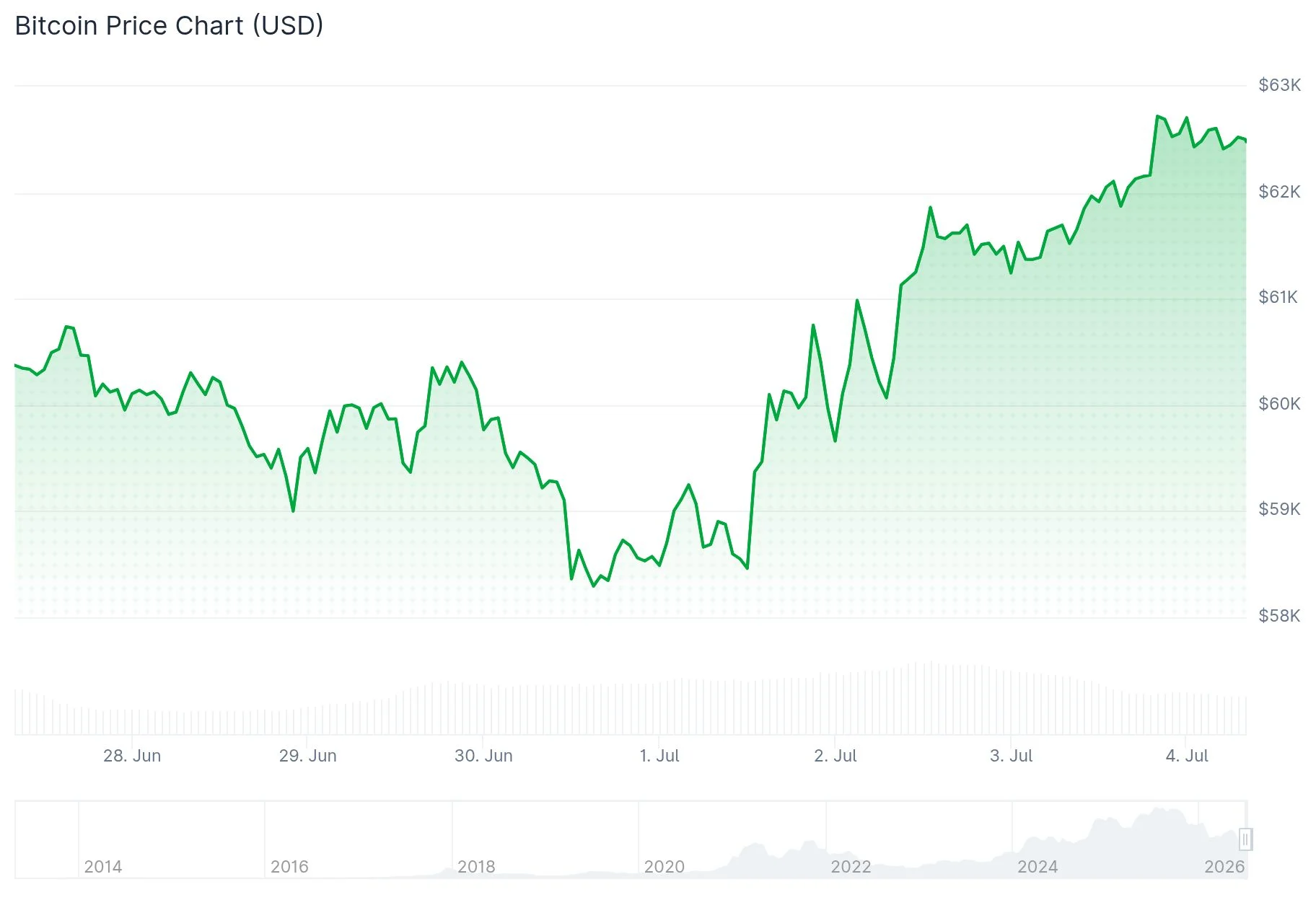
- Bitcoin reached $62,295 on July 3, 2026, marking its strongest level since June 24 — a nine-day high.
- Spot Bitcoin ETFs in the U.S. attracted $221.7 million in net inflows on July 2, breaking a 10-day withdrawal pattern.
- Fidelity’s FBTC dominated with approximately $166 million in inflows, while BlackRock’s IBIT saw a minor $40.4 million outflow.
- Technical analysts are focused on the 200-week moving average at $62,652 as a critical threshold for continuation.
- International equity markets reached record highs, while softer U.S. employment figures reduced expectations for aggressive Fed tightening.
Bitcoin (BTC) surged beyond the $62,000 threshold on July 3, 2026, reaching $62,295 on Bitstamp — the cryptocurrency’s strongest showing in over a week. The advance occurred during the Independence Day holiday window in the United States, with buying momentum persisting alongside broader risk asset strength worldwide.
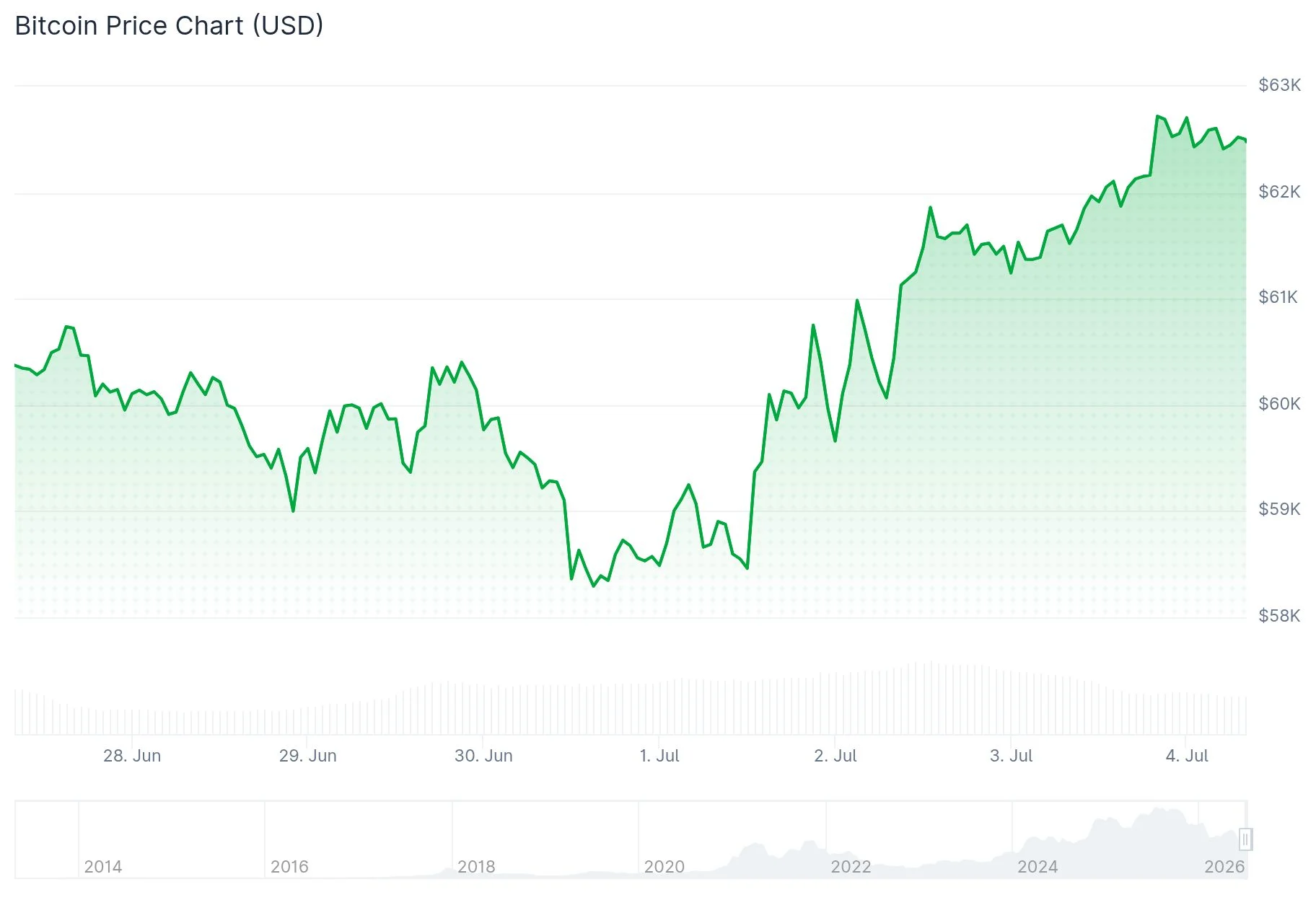
Market analyst Daan Crypto Trades highlighted the significance of the 200-week simple moving average (SMA), currently positioned at $62,652. “It is key for BTC now to hold this breakout and maintain its low timeframe bullish market structure,” he posted on X. He emphasized that this trading zone carries considerable weight for the weekly candle closure.
[[SCRIPT_0]]
Social media observer Exitpump identified “controlled slow buying” activity on trading platforms and marked the $62,000–$62,500 band as “a strong resistance area” that warrants attention for potential upside continuation.
ETF Capital Flows Turn Bullish
The primary driving force emerged one day prior. On July 2, U.S. spot Bitcoin ETFs captured $221.7 million in net capital inflows — representing the strongest single-session performance in more than eight weeks. This development terminated a 10-day exodus that had drained over $2.7 billion from these investment vehicles throughout June.
Fidelity’s Wise Origin Bitcoin Fund (FBTC) commanded the inflow activity with roughly $166 million. The ARK 21Shares Bitcoin ETF (ARKB) contributed approximately $92 million. In contrast, BlackRock’s iShares Bitcoin Trust (IBIT) registered a relatively small $40.4 million withdrawal.
Analyst Daan Crypto Trades offered his perspective on the reversal: “$BTC ETF flows finally flipped positive after a 10-day outflow streak and roughly $4.5B of outflows in June. $221M came in on July 1. That’s not massive, but the streak ending does matter.” He further observed that BTC holding around the ~$60K level throughout the outflow period indicated substantial buying absorption, a factor that could prove significant if prices advance further.
[[SCRIPT_1]]
Favorable Macroeconomic Backdrop
Global stock markets also contributed positive momentum. The Dow Jones achieved record closing levels on July 3, while aggregate global equity market capitalization touched fresh all-time peaks, as reported by The Kobeissi Letter.
[[SCRIPT_2]]
Below-consensus U.S. nonfarm payrolls figures additionally influenced market dynamics. Mosaic Asset Company characterized the employment report as a “Goldilocks” outcome — insufficient weakness to trigger growth concerns, yet not robust enough to accelerate Federal Reserve tightening expectations. CME Group’s FedWatch Tool indicated roughly balanced probabilities for either a Fed pause or rate increase at the September policy meeting.
Notwithstanding the price rebound, the Crypto Fear & Greed Index continued registering in “extreme fear” zones. Bitcoin’s realized price hovers near $53,000, with approximately half of the circulating supply currently positioned in profitable territory.
BTC was exchanging hands around $62,400–$62,500 during early hours of July 4, reflecting roughly 2% gains across the previous 24-hour period.


Revolut has confirmed it will remove Tether’s USDT from eligible European accounts after new European Union crypto rules took effect under the Markets in Crypto-Assets (MiCA) framework.
Summary
- Revolut will delist USDT for eligible European users under the EU’s MiCA regulations.
- Users can buy USDT until July 6 and withdraw or sell holdings until Aug. 31.
- Tether also recently froze 131 TRON wallets after new U.S. sanctions targeted ISIS-K-linked addresses.
According to an email sent by Revolut to affected customers, the fintech company will phase out support for USDT over the next two months, giving users until Aug. 31 to sell, withdraw, or transfer their holdings before the stablecoin is removed from eligible accounts.
Revolut has set a phased deadline for USDT holders
Revolut said customers will continue to be able to buy USDT until July 6. Beginning July 30, the platform will stop accepting new USDT deposits, while users will still be allowed to sell their tokens or transfer them to supported external crypto wallets until Aug. 31.
The company told customers to review their USDT holdings before Aug. 31 at 12:00 PM GMT because, after that deadline, the stablecoin will no longer be supported in eligible Revolut accounts. Under Revolut’s crypto delisting policy, any remaining USDT balance will be automatically converted into the account’s base currency using the market price of USDT at the time the delisting takes effect.
Revolut also clarified that the restrictions apply only to notified users. The company said the changes will not affect access to USDT in jurisdictions where the stablecoin continues to be supported.
MiCA requirements continue to reshape stablecoin access
Revolut linked the decision to the European Union’s MiCA framework, which now requires stablecoin issuers and crypto service providers operating in the bloc to comply with licensing, reserve, disclosure, and supervisory rules.
crypto.news previously reported that USDT has not received authorization under MiCA. Tether Chief Executive Officer Paolo Ardoino argued that the framework was not designed for the world’s largest stablecoin because of its reserve-related requirements. Ardoino previously said those rules raised concerns about reserve composition, liquidity management, and redemption risks for issuers.
Following the July 1 implementation of MiCA enforcement measures, Revolut joins other crypto platforms that have restricted access to USDT for European customers because the token lacks MiCA authorization.
The regulatory pressure comes as Tether continues to face increased scrutiny in other areas. As crypto.news reported earlier, the company recently froze USDT balances held in 131 wallets on the TRON blockchain after the U.S. Treasury’s Office of Foreign Assets Control updated sanctions tied to ISIS-K.
Notably, OFAC added 134 cryptocurrency wallet identifiers to its sanctions list on July 1, including 131 TRON addresses and three Monero addresses linked to ISIS-K.
The sanctions update identified the wallets as belonging to the Islamic State Khorasan Province, the Afghanistan and Pakistan branch of the Islamic State, which had already been designated as a terrorist organization before the additional wallet identifiers were published.
While the sanctions action is unrelated to MiCA, it highlights Tether’s ability to freeze tokens in response to regulatory and law enforcement actions. At the same time, Revolut’s delisting decision illustrates how new European crypto rules are affecting the availability of stablecoins that have not secured authorization under the bloc’s regulatory framework.
Key Highlights
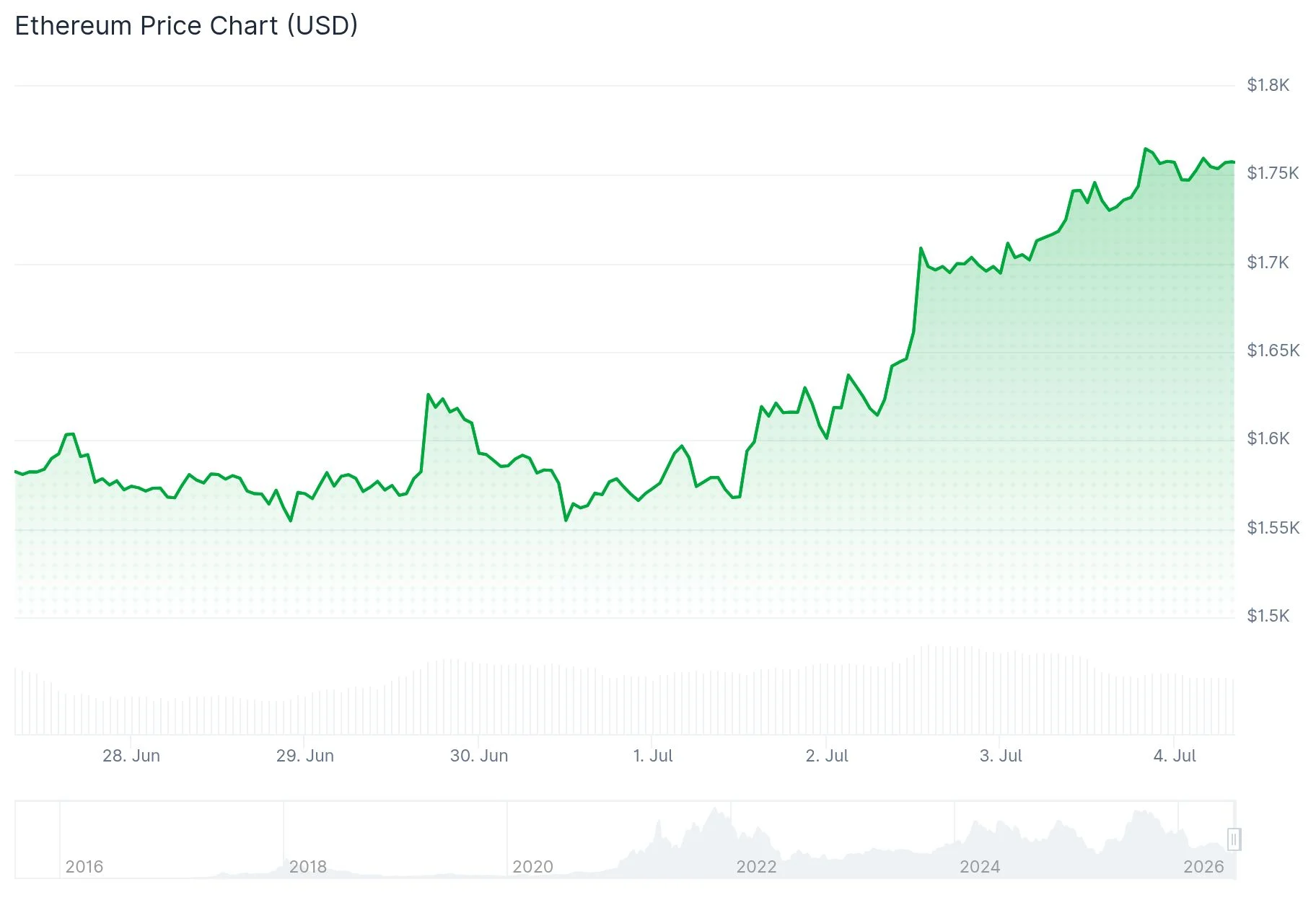
- Ethereum reached approximately $1,715 on July 3, posting gains exceeding 6% over a 24-hour period
- A seldom-seen monthly TD Sequential buy indication has emerged, previously appearing before significant price surges in 2022 and 2025
- United States spot Ethereum ETFs registered $29.08 million in net positive flows on July 2, with BlackRock’s ETHA at the forefront
- Market observer Daan Crypto Trades identified $1,750 as a critical threshold, characterizing it as a crucial test for ETH’s ability to overcome its downward trajectory
- Binance ETH withdrawal activity reached a three-year peak, although positive exchange netflow continues to indicate potential selling pressure
Ethereum successfully reclaimed the $1,700 mark on July 3, hovering around $1,715 following a robust rally that delivered over 6% gains within a single day. This upward movement returned ETH to a price point that market participants have been monitoring intently following several weeks of sustained downward pressure.
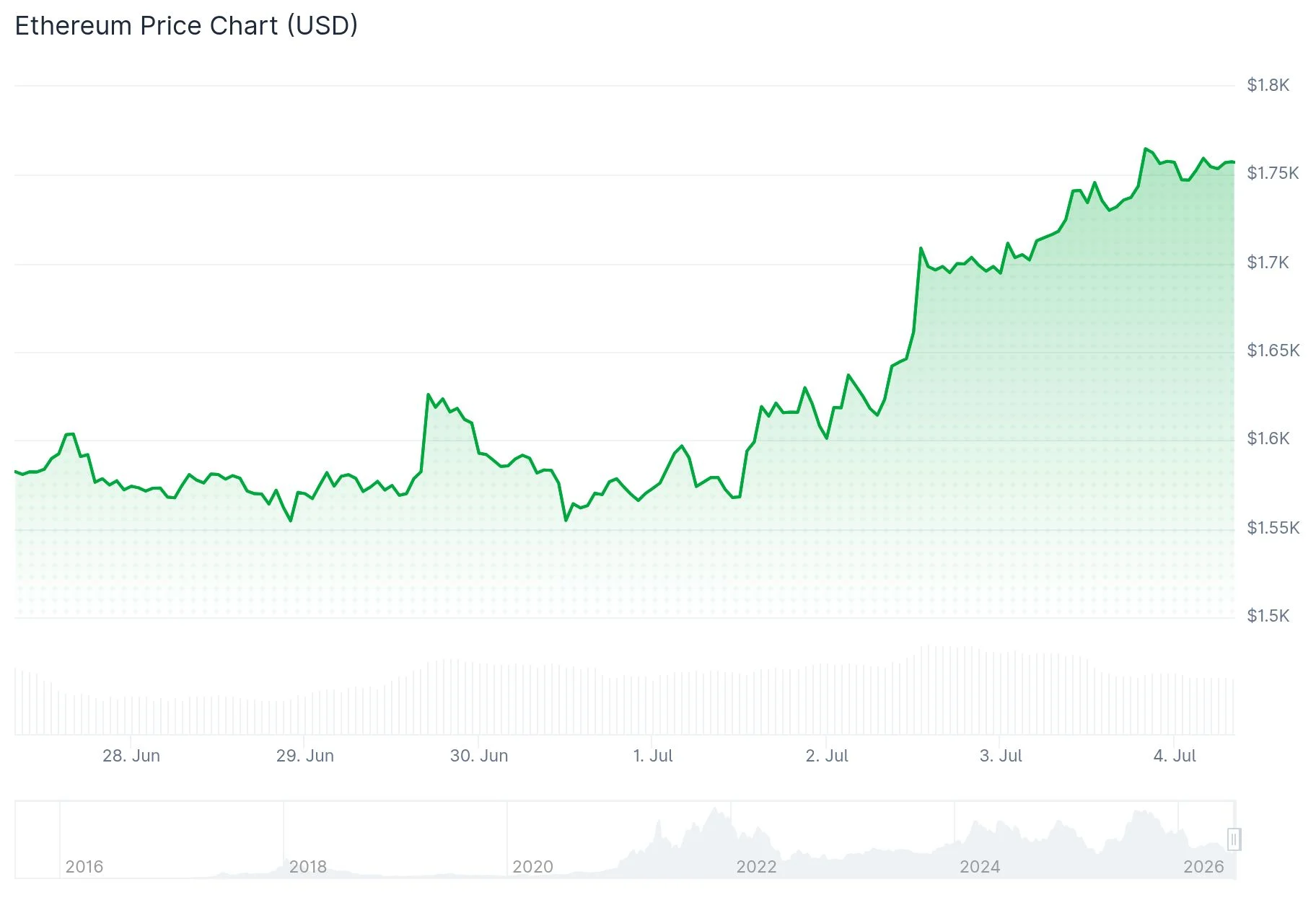
The resurgence coincided with renewed capital entering U.S. spot Ethereum ETFs. According to data from SoSoValue, these investment vehicles captured $29.08 million in aggregate net inflows on July 2. BlackRock’s ETHA product dominated the inflow activity with $29.74 million, whereas Grayscale’s ETHE experienced withdrawals totaling $2.75 million.
Market analyst Daan Crypto Trades shared his perspective on the price action through social channels. He observed that ETH had posted a 10% weekly gain and was challenging the February bottom around $1,750. He characterized this zone as an essential level for reclamation, stating it would “signal some strength.” He further explained that this identical area confirmed a structural breakdown in 2025, lending it historical significance. He acknowledged he held no firm conviction yet and was observing how price action unfolded around resistance at the session close.
Ethereum simultaneously generated a monthly TD Sequential buy indication — an uncommon technical occurrence. Market analyst Ali Charts suggested the signal reflects exhaustion among sellers on an extended timeframe. Historical monthly buy signals preceded rallies of 235% in 2022 and 182% in 2025. While the indicator doesn’t validate a fresh bullish trend, it has captured attention among technical market participants.
Technical Assessment
The MACD histogram registers positively at 19.33, with the MACD line crossing above its signal counterpart. Nevertheless, both indicators remain positioned below the zero threshold, indicating the trend hasn’t completely inverted. The RSI advanced to approximately 51.85, climbing above its moving average of 38.12 and surpassing the neutral 50 benchmark.
Ethereum bounced from a double-bottom formation near $1,565. Immediate resistance is positioned at $1,800, with $2,000 representing the next major obstacle. A concentration of liquidity around $1,740–$1,750 sits just above the current trading range, potentially acting as a magnet for short-term price action.
Market commentator Crypto Patel highlighted that ETH just completed its inaugural streak of three consecutive red quarters since inception — an unprecedented occurrence in Ethereum’s trading history.
On-Chain Metrics and Derivatives Analysis
Open interest expanded 10.64% to reach $24.54 billion, while ETH trading volume increased 14.48% to $44.74 billion. Funding rates jumped 113.86%, demonstrating that leveraged long positions proliferated throughout the rally.
CryptoQuant analyst Darkfost documented that Binance ETH withdrawal transactions achieved their highest count in three years, exceeding 166,000 within a 24-hour window. Concurrently, analyst PelinayPA observed that Binance ETH exchange netflow remained positive at +12,938 ETH, indicating more ETH deposits than withdrawals from the platform.
Institutional participation persisted. BitMine maintains holdings exceeding 5.7 million ETH following an acquisition of 27,084 ETH. SharpLink secured an additional 10,000 ETH valued at $16.1 million during the recent price decline.
Crypto World
ESMA Declares Prediction Markets Subject to Binary Options Ban Despite New Branding Efforts
Key Takeaways
- ESMA confirms binary-outcome prediction market contracts fall under the retail investor ban established by EU regulations in 2018.
- The regulator emphasizes product functionality determines legal status, not marketing terminology or platform rebranding efforts.
- ESMA issued no new regulations; the statement responds to the explosive worldwide expansion of prediction market platforms.
- Institutional and professional traders maintain access through properly authorized MiFID II-compliant firms.
- Retail clients across the EU’s approximately 450 million population lack access to any licensed prediction market platforms.
On July 3, the European Securities and Markets Authority delivered an unambiguous message to the prediction market industry. Products functioning as binary options will be regulated accordingly — regardless of branding or nomenclature.
ESMA’s announcement coincided with prediction market trading volumes exceeding $50 billion monthly worldwide. Cryptocurrency-based platforms have fueled this expansion significantly, creating markets covering topics from political elections to monetary policy announcements.
Since May 2018, the EU has prohibited binary options for retail investors. Initially implemented as a temporary restriction under the Markets in Financial Instruments Regulation framework, most EU nations subsequently enacted permanent bans through domestic laws.
According to ESMA, a product’s legal categorization derives from its operational characteristics rather than its promotional branding. Contracts providing predetermined payouts contingent on specific future outcomes qualify as financial instruments and remain subject to current restrictions.
Implications for Cryptocurrency-Based Platforms
Cryptocurrency prediction market platforms face straightforward consequences. Any platform providing binary-outcome contracts to EU retail traders violates current financial regulations, irrespective of blockchain-based settlement mechanisms.
Polymarket, currently the highest-volume crypto prediction market globally, has encountered comparable regulatory challenges. Following a 2022 agreement with the Commodity Futures Trading Commission, the platform restricted US user access. European retail traders now confront similar restrictions.
While ESMA refrained from identifying particular platforms, the directive was unequivocal: current regulations apply comprehensively, with the prediction market surge offering no regulatory exemptions.
Professional and institutional investors aren’t completely prohibited from participation. However, firms seeking to provide these products to professional clients must obtain complete MiFID II authorization — establishing that legitimate European market access requires substantial regulatory compliance.
United States Faces Distinct Regulatory Conflicts
Across the Atlantic, prediction markets navigate a separate jurisdictional battle. State gaming authorities and the federal Commodity Futures Trading Commission are locked in disputes over regulatory authority for event contracts.
By March 2026, regulators in 11 states had initiated legal or regulatory proceedings against platforms including Kalshi and Polymarket. Nevada temporarily suspended Kalshi’s activities, while Arizona pursued criminal charges against the organization.
In April, the CFTC asserted exclusive federal oversight of prediction markets. The agency initiated lawsuits against multiple states and submitted court documents supporting platforms like Kalshi.
The controversy intensified when a Massachusetts judge permitted state regulators to file an amended complaint against Kalshi on June 30, claiming its sports contracts violate state gambling prohibitions.
Tribal gaming associations and labor unions have petitioned Congress to modify proposed legislation by explicitly banning sports-related event contracts on prediction market platforms.
Legal analysts suggest this dispute may ultimately require Supreme Court resolution.
Currently, Europe maintains complete retail prediction market restrictions, while US regulatory frameworks remain contested and uncertain.
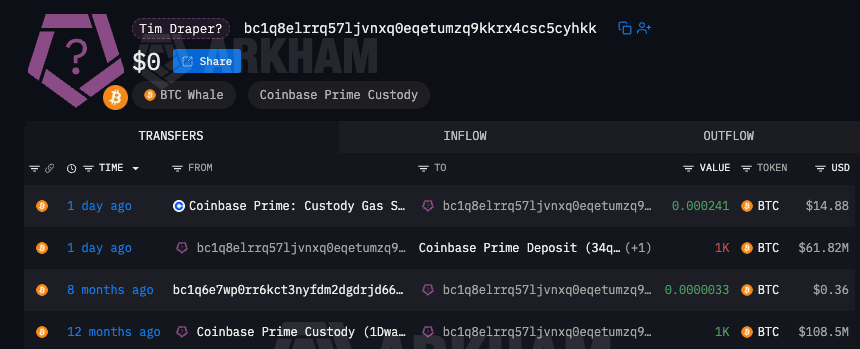
Billionaire investor and longtime Bitcoin bull Tim Draper has denied moving his Bitcoin after blockchain analysts linked him to a large BTC transfer to Coinbase Prime.
“Haven’t touched my BTC,” Draper told Cointelegraph on Friday, adding that he still expects Bitcoin to reach $250,000 within one year.
The statement came after blockchain analytics platform Lookonchain reported Thursday that a wallet “possibly linked” to Draper had transferred 1,000 Bitcoin worth about $62 million to Coinbase Prime, citing data from Arkham.
The case highlights both the growing role of blockchain analytics in tracking large crypto transfers and the challenges of independently confirming wallet ownership.
Draper bought nearly 30,000 BTC in 2014
Draper is best known in the crypto community as one of Bitcoin’s earliest high-profile investors, having won a US Marshals Service auction for nearly 30,000 Bitcoin seized by US authorities from Silk Road-related holdings in 2014.
According to Forbes, Draper paid about $18.7 million, or roughly $632 per Bitcoin, for the holdings, now worth about $1.9 billion.
Arkham labels the wallet involved in the transfer as “Tim Draper?”, indicating a tentative attribution, but does not publicly explain the basis for the classification.
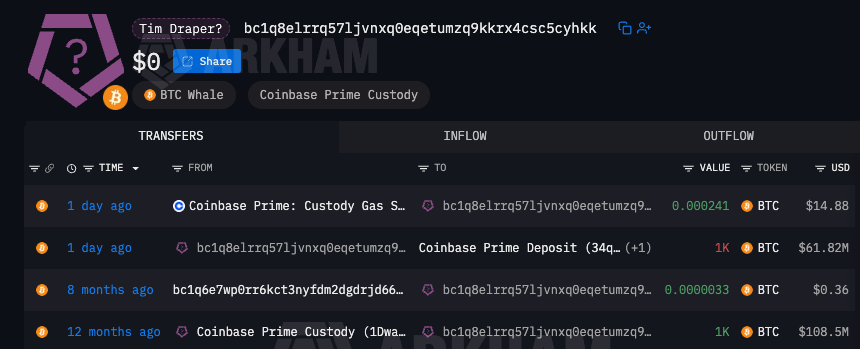
Source: Arkham
The wallet’s transaction history shows several interactions with Coinbase Prime over the past year, including a 1,000 Bitcoin transfer from Coinbase Prime on 9 July, 2025, when BTC traded around $115,880 per coin.
Cointelegraph reached out to Arkham for comment on its methodology and whether additional Draper-linked wallets exist, but had not received a response by publication.
Draper’s $250,000 Bitcoin forecast repeatedly missed timelines
Draper’s latest reiteration of his $250,000 Bitcoin target adds to a series of forecasts that have repeatedly missed earlier timelines.
The investor has held the same price target since at least 2018, initially expecting Bitcoin to reach the level by late 2022 or early 2023. However, Bitcoin’s highest recorded price to date is $126,080 on Oct. 6, 2025, according to CoinGecko. At publishing time, Bitcoin was trading around $62,530.

Source: Cointelegraph
Some Bitcoin bulls see further upside ahead, with Blockstream CEO Adam Back expecting Bitcoin could eventually reach between $500,000 and $1 million, arguing that the milestone may be “closer than people think.”
Related: Bitcoin profit and loss ratio falls to 43-month low
BlackRock CEO Larry Fink has also said Bitcoin could climb as high as $700,000 if institutional adoption increases significantly, while Bitcoin critic Peter Schiff has repeatedly argued that the asset lacks intrinsic value and could ultimately fall to zero.
Polymarket’s “What price will Bitcoin hit in 2026?” prediction market shows traders pricing the most likely outcome around $65,000 to $70,000, with bets clustering near $68,000.
Magazine: The end of anonymity? AI could unmask crypto’s hidden identities
The cryptocurrency market managed to sustain its recovery over the past 24 hours. Most of the large-cap altcoins are trading in the green. Bitcoin maintained its recent rebound, as some alts delivered even stronger daily gains.
The total crypto market cap also rose as traders returned to risk assets following a volatile start to the month. However, BTC’s dominance remains steady, suggesting that the market recovery is unfolding in a balanced manner.
BTC Defends $62K Following Latest Bounce
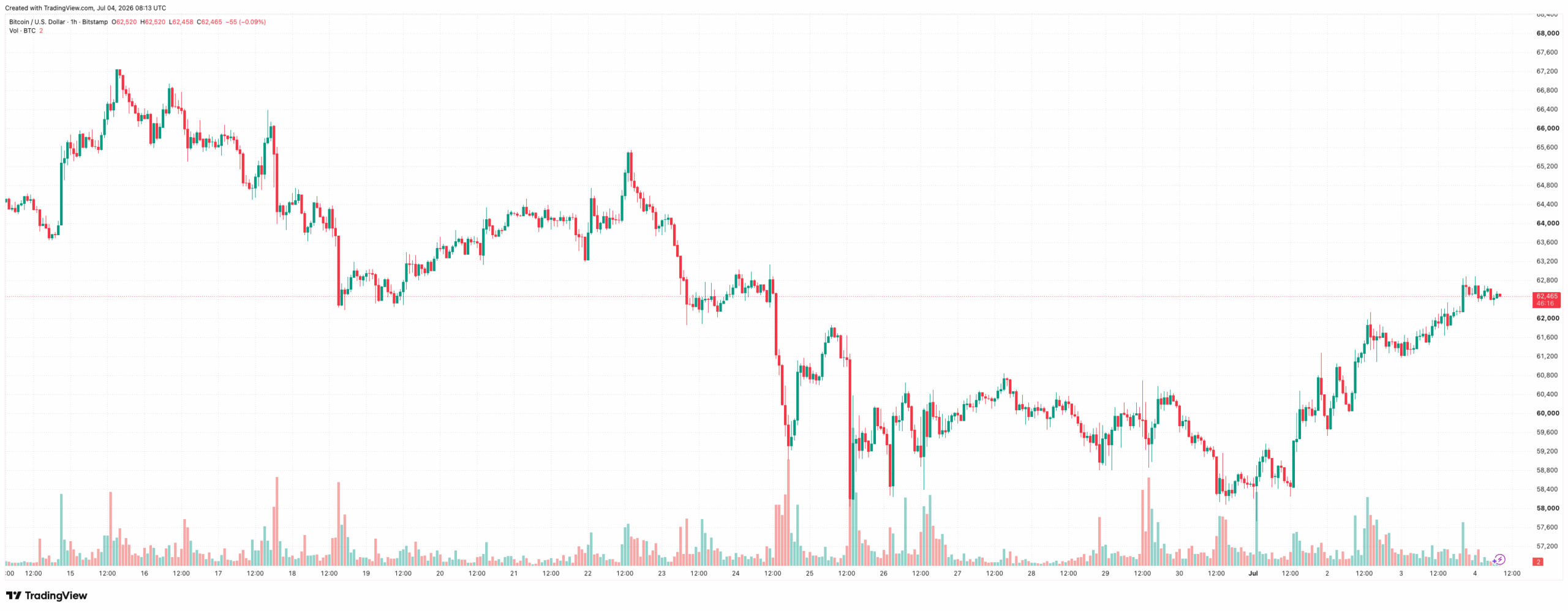
Bitcoin’s price traded mostly in the green throughout the past 24 hours, staying above the $62K mark after reclaiming it earlier in the week. The asset changed hands at roughly $62,500, up about 1.3% on the day and 3.6% on the week.
BTC moved within a relatively tight daily range, briefly dipping toward $61,500 before buyers pushed it back above, even charting an intraday high around $62,800. The move kept its capitalization around $1.25 trillion.
ETF flows also showed signs of stabilizing. US spot Bitcoin ETFs recorded around $220 million in net inflows on July 2nd. Interestingly, most of it came in Fidelity’s products, as BlackRock clients continued to sell and offloaded over $40 million.
HYPE, ADA, XRP Outperform
The broader cryptocurrency market improved as well, with the total capitalization surpassing $2.2 trillion.
Ethereum traded around $1,754 after gaining more than 2% on the day and roughly 11% over the past week, making it a standout performer. Among the larger altcoins, Hyperliquid’s HYPE was one of those that increased the most over the past 24 hours, rising above $71 and gaining upwards of 6%. Cardano also advanced sharply, while XRP, Stellar, Dogecoin, Solana, and others posted more moderate gains.
The market’s next test is whether Bitcoin can rise above the current area between $62K and $63K, while altcoin momentum continues into the weekend.

The post Bitcoin Holds Above $62K as HYPE, ADA Lead Altcoin Recovery: Weekend Watch appeared first on CryptoPotato.
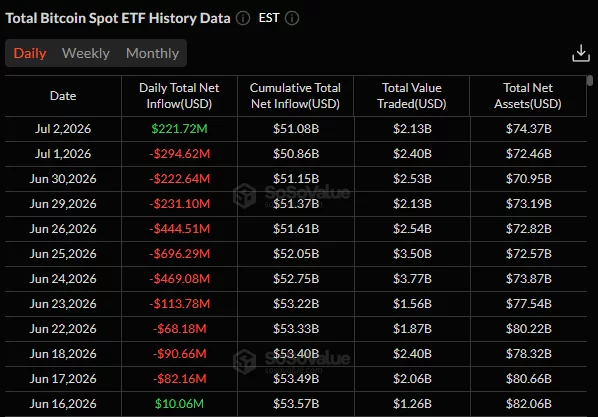
U.S. spot Bitcoin exchange-traded funds have recorded $221.7 million in net inflows, ending a 10-day withdrawal streak as softer U.S. economic data and easing Federal Reserve rate concerns helped Bitcoin recover from this week’s lows.
Summary
- U.S. spot Bitcoin ETFs recorded $221.7 million in inflows, ending a 10-day streak of net withdrawals.
- Weak U.S. jobs data and softer Fed comments helped Bitcoin rebound about 7.7% from its weekly low.
- Analysts pointed to strong historical July performance and late-cycle trends as sentiment improved.
According to data from SoSoValue, Thursday’s inflows were the strongest daily total in about two months after investors pulled nearly $2.7 billion from the funds during the previous 10 trading sessions.
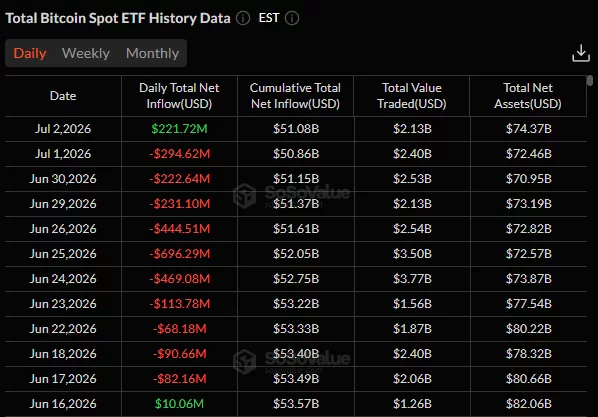
The rebound came as Bitcoin (BTC) climbed back above $61,000 after briefly dropping below $58,000 earlier this week. Per data from crypto.news, the cryptocurrency was recently trading near $62,500, about 7.7% above its weekly low.
Weak economic data revives ETF demand
Fidelity’s FBTC attracted the largest share of new money with $166 million in inflows, while ARK 21Shares’ ARKB added $91.8 million and VanEck’s HODL received $4.4 million. BlackRock’s IBIT remained the only major fund to post net withdrawals, losing $40.4 million and extending its outflow streak that began in mid-June.
The latest buying followed one of the toughest periods on record for U.S. spot Bitcoin ETFs. SoSoValue data showed the products lost roughly $4.5 billion during June, making it their worst monthly performance since launch.
The turnaround came after the U.S. Labor Department reported that nonfarm payrolls increased by only 57,000 in June, far below market expectations of around 110,000. At the same time, Federal Reserve Chair Kevin Warsh indicated that inflation risks had eased, reducing expectations of additional interest rate increases and weakening the U.S. dollar.
The combination of weaker labor market data and a less hawkish tone from the Fed improved investor appetite for risk assets, helping Bitcoin recover alongside renewed demand for spot ETF products.
Ethereum investment products also benefited from the improved sentiment. Notably, U.S. spot Ethereum ETFs attracted $14.9 million in net inflows on Wednesday, followed by another $29.1 million on Thursday.
Historical July trends add to recovery narrative
While the ETF rebound was driven by macroeconomic developments, several market participants pointed to historical price patterns that could support Bitcoin during July.
In a July 4 X post, analyst Cyclop said that Bitcoin has recorded gains exceeding 20% during July in every previous bear market, citing CoinGlass monthly return data. The post suggested the current recovery could resemble earlier bear-market rallies, although it did not predict that history would necessarily repeat.
Separately, crypto analyst Ardi argued that Bitcoin may be entering the final phase of its current correction based on previous market cycles. According to Ardi, earlier Bitcoin bear markets typically spent around one year forming a bottom, while the current correction has lasted roughly nine months.
He estimated this would place the market about three months away from the period that has historically offered the highest probability for a cycle low, although he cautioned that any bottom could arrive earlier or later than that statistical window.
Despite those historical comparisons, Thursday’s ETF inflows were tied directly to changing macroeconomic expectations, with investors responding to fresh U.S. economic data and signs that pressure for additional Federal Reserve tightening may be easing.

A Private Eye With a Supernatural Secret? This Sci-Fi Noir Series Is an Absolute Must-See

Donald Trump Made $1.4bn in Crypto Income in 2025, Raising His Net Worth

Eight of the 10 most populous countries are not in the World Cup


-

 Tech6 days ago
Bluekit phishing kit adopts browser-in-the-middle for login theft
-

 Fashion15 hours ago
Weekend Open Thread: High Hopes
-

 Tech6 days ago
Claude Code turned every engineer into three. Now companies need more product thinkers
-

 Crypto World4 days ago
Strategy authorizes up to $1.25B in Bitcoin sales under new capital plan
-

 Politics21 hours ago
The House | “Reframing the debate from a binary discussion of winners and losers”: Yuan Yang reviews ‘We Are Not Machines’
-

 News Videos6 days ago
MAJOR BITCOIN & MARKET UPDATE!!!! (MUST WATCH ASAP!!!)
-

 Tech4 days ago
Anonymous researcher drops 0-day ‘exploitarium’ repo
-

 Crypto World7 days ago
Coinbase, Circle Deepen Crypto Stock Losses Despite Resilient S&P 500
-

 Business4 days ago
Australia treasurer says alleged access of prime minister’s bank data ’incredibly concerning’
-

 Tech7 days ago
Russian hackers now target Signal backup recovery keys
-
 Business5 days ago
The AI boom won’t burst all at once. It will pop in ‘rolling bubbles’: Macquarie
-

 Sports3 days ago
Broncos roster: OL Ben Powers (No. 74) entering final year of contract
-

 Crypto World2 days ago
Binance stock trading tops $1B in first month after launch
-

 NewsBeat3 days ago
Presenter Caroline Flack’s brother Paul Flack dies aged 55
-

 Tech7 days ago
Silicon Valley paid to kill AI regulation, now it wants the rules back
-

 Tech7 days ago
OpenAI mulls delaying IPO over valuation concerns
-

 Crypto World2 days ago
Alibaba-affiliate Ant Group enters the humanoid robot market with 12 deals
-

 News Videos4 days ago
How to Build INSANE Live Financial Dashboards With Claude
-
 NewsBeat2 days ago
New exhibition reflects five decades of movement between island of Ireland and GB
-

 Business1 day ago
What a 10 Percent Drop Means for Buyers, Sellers and Renters
You must be logged in to post a comment Login