Connect with us
DAPA Banner
DAPA Coin
DAPA
COIN PAYMENT ASSET
PRIVACY · BLOCKDAG · HOMOMORPHIC ENCRYPTION · RUST
ElGamal Encrypted MINE DAPA
🚫 GENESIS SOLD OUT
DAPAPAY COMING

NewsBeat

How economic pressures are damaging Britain’s ‘zombie firms’

Published

on

How economic pressures are damaging Britain’s ‘zombie firms’

The UK’s borrowing costs are higher than the government would like them to be. Economic growth remains weak, and public finances are under constant pressure.

All of this make things difficult for pretty much everybody. But one particularly vulnerable group are the small businesses which survive mainly through continued borrowing.

Known as “zombie” firms, these are companies with persistently weak profitability which struggle to generate enough income to cover their debt costs over long periods of time.

Recent evidence suggests that the pressures on these companies are becoming more acute. Around one in six medium sized businesses in the UK is thought to be at risk of becoming a zombie firm.

Advertisement

And some sectors are more vulnerable than others. Businesses operating in leisure and hospitality, for example, often need substantial amounts of external finance to support tight margins, leaving them particularly exposed when borrowing costs rise.

But the worry is not simply that borrowing has become more expensive. It is that a combination of higher refinancing costs, weaker growth and geopolitical shocks could really damage firms that were already financially vulnerable.

The current pressure on firms is coming from several directions. One is the sharp increase in long-term borrowing costs across the UK economy.

In May 2026, the cost of borrowing for the UK government rose to its highest level in almost three decades after bond markets reacted to worsening tensions in the Middle East and the possibility of renewed inflationary pressure. Borrowing then tends to become more expensive for businesses as well.

Advertisement

But not all companies are affected equally. Large firms with strong balance sheets (like a bank or a big pharmaceutical firm) may be able to absorb higher financing costs relatively easily. Companies already carrying high debt and weak profitability are much more exposed.

Many firms borrowed heavily during the long period of exceptionally low interest rates that followed both the global financial crisis of 2008 and COVID. As those loans now mature, refinancing them becomes significantly more expensive. For some businesses, that shift may prove difficult to manage.

Zombie apocalypse now?

The rise in UK borrowing costs is closely tied to geopolitical developments.
Escalating tensions in the Middle East have increased fears of disruptions to energy supplies and shipping routes, particularly around the Strait of Hormuz and the Red Sea. Higher oil prices can feed quickly into inflation through fuel, transport and production costs.

Businesses that were already struggling with narrow profit margins may now face a devastating combination of higher refinancing costs, rising energy and transport bills, as well as weaker consumer demand and tighter lending conditions.

Advertisement

On their own, any one of these pressures might be manageable. Together however, they create the kind of environment in which financially fragile firms can quickly come under strain.

COVID led to cheaper borrowing.
1000 Words/Shutterstock

Smaller businesses are likely to face the greatest pressure because they depend heavily on bank lending and often operate with limited financial buffers.

Unlike large corporations, many small and medium-sized enterprises cannot easily raise money through financial markets. Their survival is closely tied to bank lending conditions and day-to-day cash flow.

But British banks may become more cautious as economic uncertainty rises. If lenders become less willing to refinance weaker companies, some firms that survived during the era of cheap credit could struggle to continue operating.

Advertisement

There is also evidence which suggests that prolonged periods of cheap borrowing can allow financially weak firms to survive longer than they otherwise would have. Some economists argue that this can reduce productivity by trapping labour and capital in inefficient businesses.

The current environment may therefore become a test of which firms remain viable once borrowing costs stay higher. The recent surge in UK borrowing costs is often discussed as a problem for government finances. But it may also signal something broader about the post-crisis economic model that dominated much of the past decade.

For years, exceptionally low borrowing costs helped support companies through periods of economic stress. Now that financing conditions are tightening again and geopolitical uncertainty is rising, some firms may find that survival becomes much harder.

That does not necessarily mean a sudden wave of collapses is imminent. Many businesses remain fundamentally healthy.

Advertisement

But the combination of higher refinancing costs and external shocks could increasingly expose firms whose survival depended on the unusually cheap borrowing conditions of the past decade. If that happens, the demise of zombie firms may start to become a much more visible feature of the UK economy.

Source link

Advertisement
Continue Reading
Click to comment

You must be logged in to post a comment Login

Leave a Reply

NewsBeat

Iran-US war latest: Mourners gather as six-day funeral for former supreme leader Ali Khamenei starts in Tehran

Published

on

Iran-US war latest: Mourners gather as six-day funeral for former supreme leader Ali Khamenei starts in Tehran

Powerful general in Iran emerges from hiding as Tehran prepares for Khamenei’s dayslong funeral

Photos published online by Iranian state media showed Gen. Ahmad Vahidi attending a meeting about the funeral of Khamenei, 86, then sitting alongside his casket as Iran’s theocracy held a smaller service for him Thursday night near the supreme leader’s former home in downtown Tehran.

Vahidi has become a major player in formulating Iran’s tough stance in negotiating a possible permanent end to the war with the United States, experts say.

He is believed to be part of a small clique in direct contact with Iran’s new Supreme Leader Ayatollah Mojtaba Khamenei, who remains in hiding after being reportedly wounded in the Feb. 28 Israeli strikes that killed his father, the elder Khamenei.

Advertisement

Maryam Zakir-Hussain4 July 2026 11:39

How Iran will try to use Khamenei’s funeral to hide cracks in regime

Iran is keen to present a unified front for the late supreme leader’s funeral, even as analysts warn support for the clerical leadership is waning, writes James C. Reynolds:

They hope to mobilise the public to flood the cities, offering transport, food and accommodation to lift the numbers, and are welcoming foreign dignitaries to show Iran still has powerful friends around.

Advertisement

Maryam Zakir-Hussain4 July 2026 11:20

Khamenei will be buried Thursday in Mashhad

Ayotallah Khamenei’s body will be transported to cities in both Iran and neighboring Iraq.

Authorities have shut down streets, airspace and daily life for the mourning, which will end Thursday as he’s buried at the Imam Reza shrine in Mashhad, Khamenei’s place of birth.

Advertisement

Authorities offered no immediate attendance count for the event Saturday, which saw the crowds cycle in and out of the Grand Mosalla and the surrounding streets.

Other cities across Iran also held mourning ceremonies.

On Sunday, a prayer for the dead is planned at the Grand Mosalla.

On Monday, his body and those of his family will be taken through the streets of Tehran, which likely will draw large crowds.

Advertisement

“I am here to say goodbye to my beloved leader Ali Khamenei,” said a weeping Hananeh Mousavi, 27, who attended the funeral alongside her mother.

“I never expected to see such a day. I wish I had died before this tragedy.”

Maryam Zakir-Hussain4 July 2026 11:01

Advertisement

‘This is a serious warning’: Iran’s chief negotiator sends message to Starmer and Macron

As the ceremony went on, Iran’s chief negotiator Kazem Gharibabadi criticized a joint statement overnight from Keir Starmer and French President Emmanuel Macron, which suggested their militaries stood ready to patrol the Strait of Hormuz.

Control of the strait has been a major point of leverage for Iran, which has suggested it wants to charge vessels passing through it, upending decades of the world considering it an international waterway.

“The security of Hormuz lies with the coastal states — the crisis-makers will be held accountable for the consequences of their adventurism,” Gharibabadi wrote on X. “This is a serious warning.”

Maryam Zakir-Hussain4 July 2026 10:43

Advertisement

Funeral crowds chant: ‘Death to America. Death to Israel’

Iran chose July 4, the 250th anniversary of the creation of the US, to begin the funeral.

While authorities did not acknowledge the timing, crowds at the ceremony in Tehran chanted: “Death to America!”

The refrain has been common in Iran since the 1979 Islamic Revolution and U.S. Embassy takeover and hostage crisis.

Advertisement

They also cried: “Death to Israel!”

The American president was not forgotten in Tehran.

In the crowd in Grand Mosalla, several mourners held a large flag that read: “#KillTrump.”

(AFP/Getty)

Maryam Zakir-Hussain4 July 2026 10:22

Advertisement

In pictures: Grieving crowds gather to pay respects to late supreme leader

Here are some of the latest photos from the funeral in Tehran today:

(AFP/Getty)
(AFP/Getty)
(AFP/Getty)

Maryam Zakir-Hussain4 July 2026 09:46

Mourners fill the streets of Tehran

Mourners thronged a vast prayer complex in Tehran on Saturday as the week-long funeral ceremonies of Iranian Supreme Leader Ayatollah Ali Khamenei began with the national anthem, religious eulogies and readings from the Quran.

Advertisement

Television footage showed his coffin draped with the Iranian flag and topped with his black turban.

It was placed, along with four other coffins of his slain family members, on a large black platform that resembled the Kaaba, representing Islam’s holiest site in Mecca.

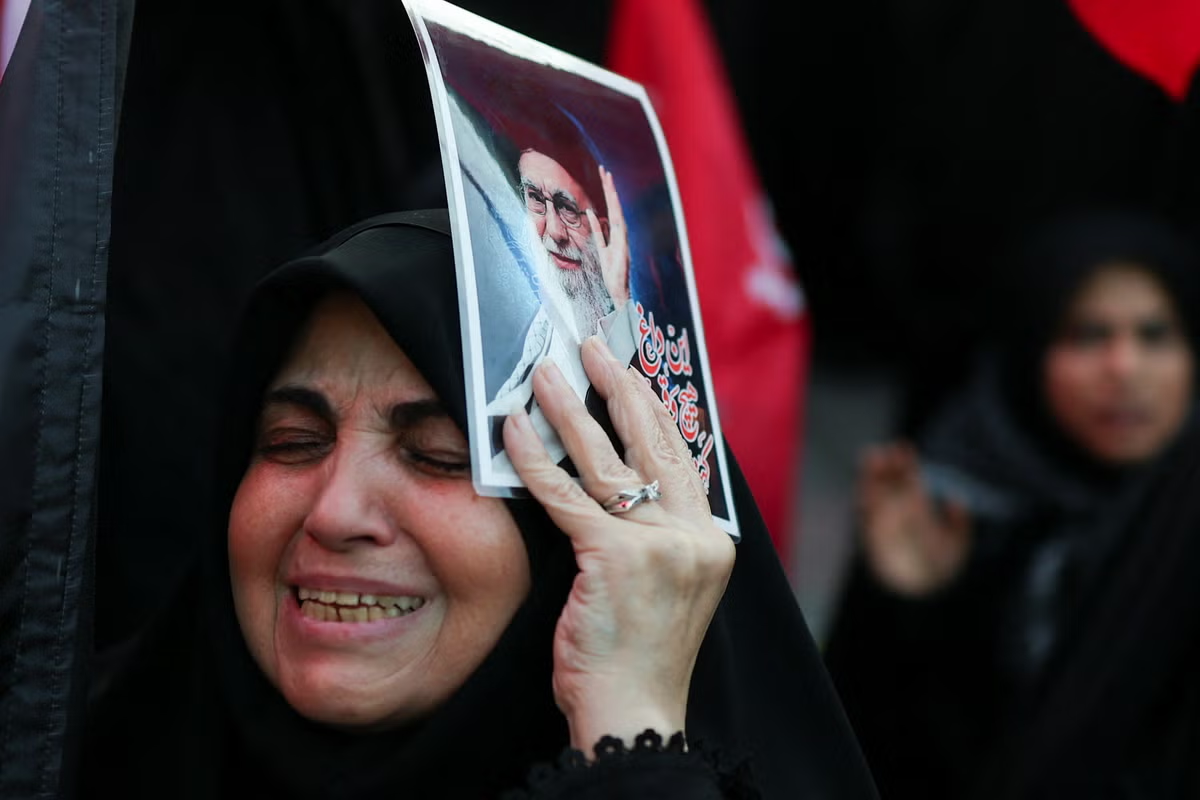
The vast courtyard of the complex, ‌the Imam Khomeini Grand Mosalla, was filled with mourners, many waving Iranian flags and carrying photographs of the slain leader.

(AFP/Getty)

Maryam Zakir-Hussain4 July 2026 08:51

Advertisement

In Video: Ali Khamenei’s funeral begins in Tehran

Iran: State memorial for Ali Khamenei begins in Tehran

Vishwam Sankaran4 July 2026 08:30

Small coffin of Khamenei’s granddaughter placed at funeral

A casket containing the body of slain Iranian leader Ali Khamenei was placed alongside the coffins of his relatives killed in US-Israeli airstrikes in February, including a small coffin of his 14-month-old granddaughter.

Zahra Mohammadi Golpayegani’s small coffin was draped in the Iranian national flag, with her framed photo next to it.

Advertisement

Six days of public funeral ceremonies have been planned, with Khamenei’s remains expected to be carried across cities in Iran and neighbouring Iraq.

Vishwam Sankaran4 July 2026 08:00

Video: Foreign leaders attend Khamenei funeral

Leaders from Pakistan, Turkey, and Russia arrived at Tehran to pay their respects to the slain Supreme Leader Ali Khamenei.

Advertisement
Khamenei Funeral: Leaders From Russia, China, Pakistan, Afghanistan &ampamp; Turkey Pay Their Last Respect

Some in attendance were Russian security council deputy chairman Dmitry Medvedev, Turkish vice president Cevdet Yilmaz, Iraqi president Nizar Amidi, Iraqi parliament speaker Mohammed al-Halbousi, Pakistani prime minister Shehbaz Sharif, Pakistani senate chairman Yousaf Raza Gillani and army chief Asim Munir

Vishwam Sankaran4 July 2026 07:30

Source link

Advertisement
Continue Reading

NewsBeat

‘I love my baby’s name but still worry I’ve doomed her for life’

Published

on

Daily Mirror

A mum-to-be is worried she may have ‘doomed’ her daughter for life over the name she’s chosen, as although she loves it, she believes people will struggle to pronounce it

Choosing a baby name isn’t always easy. Even when you’ve settled on a name that you love, there are considerations you have to make to ensure you’re not making a huge mistake, such as accidentally giving your child a name that can be turned into an unfavourable nickname.

Advertisement

Some parents choose to get a second opinion from family members or friends on the baby name they’ve chosen. However, as one mum-to-be on social media has found out, that might not be the best decision if you’re on the fence about a name – as their opinions could leave you regretting your choice.

In a post on Reddit, the mum said she and her husband have come up with a unique name for their child, but while she loves the name, she is now worried that she may have “doomed” her child with a moniker that is hard to pronounce.

She said: “I’m having a girl, and nobody has said anything about the name being weird, yet I just want to make sure I’m not dooming my poor kid. Me and the dad chose Araya (uh-ray-uh) with the middle name Avery, is this bad??”

Commenters on the post mostly told the mum that while the name isn’t “bad”, they found it “clunky” with the middle name, and believed the parents would constantly need to explain how its pronounced.

Advertisement

One person said: “It’s not terrible, but you’ll definitely always be explaining how to pronounce it.” Another added: “I really, really dislike it. It’s so clunky with Avery, too. Any chance you can go with Avery and find another middle name?”

A third wrote: “The fact that you had to explain how to pronounce it tells us it’s not a good name.”

Many people in the comments who had issues with the pronunciation claimed that they would assume Araya is either a variation of Aria (pronounced Ah-ree-uh) or Ariah (pronounced Ar-eye-uh). However, as the parents said they wanted to go for the “ray” sound in the middle instead of “eye”, they felt the name would be too complicated.

The mum later returned to her post to edit it after reading comments about the pronunciation, stating that she actually wanted it to be pronounced “Ar-eye-uh” first, but changed her mind after family and friends said they would intuitively pronounce it “Ah-ray-uh”.

Advertisement

She wrote: “I’m seeing the general consensus is that it’ll be mispronounced, and the middle name sounds clunky with it. Would like to say it originally was going to be pronounced (are-eye-uh), but funnily enough, the first group of people we texted about it thought it was pronounced the way we settled on!

“I also thought because it’s three standalone (a)s, with no (i)s or (e)s, most people would read it as (ay) instead of (eye) because (a) by itself doesn’t make that sound phonetically.”

The woman also said she would go back to the drawing board to find a more suitable middle name, but noted there would be little wiggle room in the first name as the dad is “pretty set” on the Araya spelling.

She continued: “I think I’ll workshop the middle name again, but the dad is pretty set on the spelling for the first name, it’s a mix of both of our first names, and the only one of the mixes we tried that didn’t stand out to me as letter vomit. (Are-eye-uh) does sound good with the last name at least, thankfully.”

Advertisement

Fingers crossed the couple get to the bottom of their dilemma soon!

Source link

Continue Reading

NewsBeat

Having a bad hair day? Don’t worry. My research will help you understand the problem

Published

on

Having a bad hair day? Don’t worry. My research will help you understand the problem

Think about the last time you looked in the mirror and sighed at the sight of your hair. Maybe it was frizzing, flattening, greying, thinning or simply refusing to do what you wanted. For many people, hair comes with a running commentary – a private, near-constant negotiation that we rarely stop to notice, let alone question.

My new research suggests this relationship matters far more than we think.

Hair has long been linked to identity, confidence, body image and quality of life. Research has shown that hair loss can affect psychological wellbeing in both men and women, while changes in hair texture, colour or style can influence how people see themselves and how they believe others see them.

Yet despite decades of research into appearance and body image, psychology has paid surprisingly little attention to one simple question: what does it actually mean to have a positive relationship with your hair?

Advertisement

To answer that question, I interviewed men and women about their experiences of living with their hair, before developing a new psychological model of what a positive relationship with hair looks like. What emerged wasn’t a picture of people with “perfect” hair or even people who loved their hair every day. Instead, they related to it differently.

People with a positive relationship with their hair took the time to understand it. They were curious about how it behaved, willing to learn what worked for it and open to experimenting rather than giving up.

Instead of spending their energy trying to force their hair to become something it wasn’t, they worked with its natural characteristics. They cared for it, respected it and, crucially, didn’t allow a bad hair day to become a judgment about themselves.

That doesn’t mean they never felt frustrated. Frizzy hair still frizzed. Fine hair still fell flat. Curly hair still had a mind of its own. The difference was in the conversation they had with themselves. Rather than thinking, “I hate my hair,” they were more likely to ask, “What does my hair need?” or “Maybe I haven’t found the right way to work with it yet.”

Advertisement

That shift may sound subtle, but psychologically it represents a very different relationship.

Do you have a bad relationship with your hair?
Islandstock

Why it matters

A positive relationship with your hair is about far more than avoiding the occasional bad hair day. It can influence how confidently you move through the world, how authentically you express yourself, and how you experience life.

The people I interviewed described hair as being woven into their experiences and memories. One man spoke about riding his motorbike with his long hair flowing in the wind, calling the feeling “magical”.

Another woman described the decision to stop dyeing her hair and embrace her natural grey as one of the most empowering choices she had made. Rather than seeing grey hair as something to hide, she saw it as an opportunity to challenge stereotypes about ageing and hoped that, by wearing it proudly, she might help make grey hair more accepted for other women too.

Advertisement

Others talked about embracing their natural curls as freeing or finding hairstyles that felt true to who they were.

Hair featured in some of their happiest memories. It was a vehicle for self-expression and moments of freedom, confidence, creativity, playfulness and joy.

So what might a healthier relationship with your hair look like in everyday life?

It starts with getting to know it. Every head of hair has its own texture, density, growth pattern and quirks. Instead of asking why your hair won’t behave like someone else’s, spend time understanding what makes yours unique. What does it do well? What helps it thrive? What have you never really learned about it?

Advertisement

It also means working with your hair rather than against it. That might involve speaking to a hairdresser, seeking inspiration, trying different products or simply learning more about your hair. There’s never been more information available, much of it free. The goal isn’t perfect hair – it’s finding ways to care for your own.

Part of that is developing routines that fit your lifestyle. Hair care is much easier to maintain when it works alongside the realities of everyday life rather than competing with them.

Woman enjoying her hair.
Hair is an act of self-expression.
AT Global/Shutterstock.com

Experiment

Give yourself permission to experiment, too. Try different styles, lengths or ways of wearing your hair and notice how they make you feel. The most meaningful question isn’t whether everyone else likes your hair. It’s whether it feels like you.

And when your hair disappoints you, resist the urge to turn that frustration against yourself. Respond with the same curiosity and self-compassion you might offer a friend. Ask what your hair needs, what you can learn and what you might try differently next time.

Like any relationship, the one you have with your hair will have good days and bad days. But my research suggests that when we stop trying to control our hair and start understanding it instead, we may find something more valuable than the elusive “perfect hair”: a healthier relationship with ourselves.

Advertisement

Source link

Continue Reading

NewsBeat

Liam Gallagher responds to fans as Oasis 2027 rumours heat up

Published

on

Daily Mirror

Oasis sent fans into a frenzy with their world tour last year and rumours are rife that Liam and Noel Gallagher are planning a spectacular 12-night residency at Manchester City’s stadium next summer

Liam Gallagher has teased fans with Oasis news after rumours the brothers are set to reunite again next year. Fans have begging for more after their Live 25 tour set the world alight following a 14-year hiatus.

There was such an incredible reception for the Brit Pop icons, particularly from the home crowd in Manchester, that it’s been reported that the Gallagher brothers are planning a spectacular 12-night residency at Manchester City’s stadium next summer with more dates to follow.

The band’s PR team and the stadium are yet to comment on the speculation. However, responding to an excited fan on X, who tweeted: “12 night at the Etihad?”, Liam set the record straight. While appearing to confirm that Oasis would be performing in Manchester next year, there seemed to be come confusion over the dates as the Don’t Believe the Truth star replied: “12? I thought it was 10 ffs”.

Advertisement

Oasis are reportedly planning a string of shows for for 2027, with sources suggesting a 12-night residency at the Etihad Stadium in Manchester was on the cards as part of as part of a massive new tour set to be announced within weeks.

It marks exactly one year since the stupendously successful Oasis Live ’25 comeback tour launched with an unforgettable opening night in Cardiff.

The Etihad Stadium is now preparing to host an epic 2027 homecoming for the Champagne Supernova stars, following their record-breaking 2025 reunion tour, multiple sources have told the MEN.

Advertisement

Further dates are expected to be revealed, with speculation mounting over a return to Knebworth.

Meanwhile, bookies are already tipping the band as odds-on favourites to headline Glastonbury next year.

A music insider told the publication: “It will be 12 nights at the Etihad Stadium across May and June. It’s just massive for Manchester and for the local economy.

“They could even add more dates to that as well; there’s talk of up to 20. The wider tour is also going to include a return to Knebworth.”

Advertisement

After wowing global crowds with their greatest hits last year, Liam and Noel are now among some of the wealthiest people in the UK after their hugely successful reunion tour.

The Mancunian siblings joined the likes of Beatles legend Sir Paul McCartney and the Glastonbury Eavis family on the Sunday Time’s Rich List, which was published in May.

Liam and Noel are said to have amassed a projected fortune of £375million following their comeback – just £25million behind Emily Eavis and her family, the founders and organisers of Glastonbury Festival, who are listed as having a bank balance of a staggering £400 million.

For more of the latest showbiz news and gossip, follow Mirror Celebs on TikTok , Snapchat , Instagram , Twitter , Facebook , YouTube and Threads .

Advertisement

Source link

Continue Reading

NewsBeat

Egyptian fans bring chaos to London as they battle with police and climb on double decker bus to celebrate team’s World Cup win

Published

on

Dramatic footage from the scene captured police officers wrestling with shirtless fans as crowds spilled across the road

Advertisement

Fans celebrating Egypt‘s historic World Cup victory brought chaos to the streets of London as they clashed with police, climbed on to a double decker bus and brought traffic to a standstill. 

Edgware Road in north west London descended into anarchy on Friday night as hundreds of supporters swarmed the street to celebrate Egypt’s dramatic penalty shootout win over Australia.

Advertisement

But as celebrations intensified, the packed road spiralled into disorder. 

Dramatic footage from the scene captured police officers wrestling with shirtless fans as crowds spilled across the road, bringing traffic to a complete standstill, as the chant ‘Free Palestine‘ echoed down the street.

In one tense confrontation, two officers grapple with a fan as screaming supporters surround the struggle before other revellers drag him away. 

As music blared out in the background, fans weaved between marooned vehicles, which included a line of buses, while some chose to clamber on top of them. 

Advertisement

Further along the road, topless fans who had scaled the roof of a double decker bus waved Egyptian flags while shouting down to the cheering and whistling crowd below. 

Edgware Road, long known as ‘Little Cairo’, is renowned for its links to Egypt, with numerous Middle Eastern and Arab cafes and shisha bars lining the street – many of which would have screened the game.

Dramatic footage from the scene captured police officers wrestling with shirtless fans as crowds spilled across the road

Advertisement
Topless fans who had scaled the roof of a double decker bus waved Egyptian flags while shouting down to the cheering and whistling crowd below

Topless fans who had scaled the roof of a double decker bus waved Egyptian flags while shouting down to the cheering and whistling crowd below

As music blared out in the background, fans weaved between marooned vehicles, which included a line of buses, while some chose to clamber on top of them

As music blared out in the background, fans weaved between marooned vehicles, which included a line of buses, while some chose to clamber on top of them

The celebrations erupted after Egypt secured their first ever World Cup knockout victory since 1934, defeating Australia 4-2 on penalties at Dallas Stadium following the 6pm BST kick-off.

Elsewhere on Edgware Road, footage captured the moment a grey 4×4 car drove through a section of the crowd, where many were still celebrating while wearing Egypt football team shirts.

Advertisement

Seconds later, the car collides with a man wearing a backpack as he crossed the road, leaving him sitting motionless in the middle of the road. Undeterred, the car continues to drive down the road. 

Bystanders sprinted down the road to help the injured victim, lifting him to his feet, while others ran after the fleeing driver in an attempt to catch the driver. 

National treasure and captain Mohammad Salah, named the ‘Egyptian King’, was in tears after Egypt made history. 

It joins Morocco in the last 16, which also made it the first time two African nations had won a knockout match at a single World Cup. 

Advertisement

For Australia, the outcome marked a third defeat in as many World Cup knockout matches. 

With the Socceroos heading home, Egypt will have a last 16 tie with either Argentina or Cape Verde in Atlanta on Tuesday July 7 at 5pm BST. 

Footage captured the moment a grey 4x4 car drove through a section of the crowd, where many were still celebrating while wearing Egypt football team shirts

Footage captured the moment a grey 4×4 car drove through a section of the crowd, where many were still celebrating while wearing Egypt football team shirts

Seconds later, the car collides with a man wearing a backpack as he crossed the road, leaving him sitting motionless in the middle of the road

Seconds later, the car collides with a man wearing a backpack as he crossed the road, leaving him sitting motionless in the middle of the road

Advertisement
Bystanders sprinted down the road to help the injured victim, lifting him to his feet, while others ran after the fleeing driver in an attempt to catch the driver

Bystanders sprinted down the road to help the injured victim, lifting him to his feet, while others ran after the fleeing driver in an attempt to catch the driver

The Metropolitan Police has been contacted for comment.  

Advertisement

Source link

Advertisement
Continue Reading

NewsBeat

Coastguard called to Flamborough paddleboarder rescue

Published

on

Coastguard called to Flamborough paddleboarder rescue

Coastguard teams from Bridlington and Filey, along with the Flamborough Lifeboat, responded to the incident just before 5pm following reports that the paddleboarders were potentially cut off and unable to self-recover near North Landing.

The casualties were quickly located by the lifeboat crew in a small cove, but rough sea conditions prevented a safe rescue by boat.


Recommended reading:

Advertisement

A cliff-top search and rescue operation was launched by the Coastguard team, who began setting up specialist rope equipment for a potential cliff rescue.

However, after receiving information that the individuals were cold and distressed, the officer in charge requested helicopter assistance.

A Coastguard rescue helicopter arrived shortly afterwards.

Advertisement

The helicopter’s winchman was lowered down, secured both casualties individually in rescue strops, and winched them safely to the cliff top.

Both individuals were assessed by Coastguard teams and found to be safe and well, though visibly shaken.

No further medical treatment was required.

The Coastguard is using the incident as a reminder to the public about the importance of preparation and safety when heading out onto the water.

Advertisement

A spokesperson said: “Before setting off, always check the weather and sea conditions, wear appropriate clothing and safety equipment for your activity and ensure you have a means of calling for help if things don’t go to plan.

“Being properly prepared can make all the difference.”

Source link

Advertisement
Continue Reading

NewsBeat

Inquiry into butcher brain surgeon Eljamel to go ahead in September after delay

Published

on

Daily Record

Stage one hearings had been scheduled for April but were postponed due to concerns around the venue.

The first hearings of the inquiry into disgraced brain surgeon Sam Eljamel are expected to go ahead in September as planned, Lord Weir has said.

The chair of the Eljamel Inquiry said work by the Scottish Government was under way to resolve building safety issues that led to the first evidence hearings being delayed. Stage one hearings had been scheduled for April but were postponed due to concerns around the venue at Waverley Gate in Edinburgh, which the inquiry team first became aware of last year.

Jamie Dawson KC, senior counsel to the inquiry, said it was not until February this year it “became apparent” to Lord Weir that the issue posed a “real risk” to attendees’ safety. In May, Mr Dawson KC criticised the Scottish Government’s handling of the issue, saying former patients had been left “uninformed, anxious and suspicious” by the lack of any public explanation for the delay.

Advertisement

On Friday, Lord Weir said he now expects the first hearings to go ahead over four weeks from September 7. He said the inquiry could now prepare for the hearings, including making contact with potential witnesses.

A provisional timetable for the hearings is also expected to be released next week. Lord Weir said the Scottish Government intends to resolve the safety issues by entering into a new lease covering the inquiry’s office space, hearing room and the corridor providing access to them.

He said he had been told the new lease should ensure the premises are safe for public use without the need for any construction work. While the Scottish Government said the issues should be resolved in time for the hearings, the inquiry chair said he could not guarantee this would be the case.

Advertisement

But he said he was “satisfied that the update with which I have been provided constitutes a suitable basis upon which we can proceed with the inquiry’s preparatory work on the assumption that the hearings will indeed go ahead in September”.

He added: “The Inquiry team will continue to monitor progress against milestones which the Scottish Government has set out. If there is any material slippage from the expected timetable, explanations and immediate solutions will be sought.

“In the meantime, I have instructed my team to make contact with the witnesses whom the Inquiry intends to call to give evidence at the section 1 hearings immediately so that a provisional timetable for the September hearings can be issued to core participants for their comment next week.”

A spokesperson for the Scottish Government said: “We fully recognise the pain and distress experienced by people impacted by Mr Eljamel’s practice. That is why we established the statutory public inquiry to ensure patients get the answers and justice they deserve.

Advertisement

“We understand the frustration caused as issues relating to the building are resolved. The Scottish Government has been working collaboratively with the inquiry teams, City of Edinburgh Council and the landlord of Waverley Gate to develop a solution that would allow inquiry hearings to take place in person as soon as safe to do so.

“Ministers are clear that as Eljamel Inquiry sponsor, the Government will continue to provide any necessary operational support to enable the chair and the inquiry to carry out their independent work and to ensure patients can fully participate in the inquiry process.”

Get more Daily Record exclusives by signing up for free to Google’s preferred sources. Click HERE.

Source link

Advertisement
Continue Reading

NewsBeat

The real reason FIFA wanted to change England vs Mexico kick-off time | Football

Published

on

The real reason FIFA wanted to change England vs Mexico kick-off time | Football

Close Overlay

In The Mixer’s World Cup special

Everything you need to know about the World Cup – England updates, the games to watch and stories you missed – in five minutes, at 1pm, every day.

Source link

Advertisement
Continue Reading

NewsBeat

How radical Victorian nuns pioneered education for poor girls

Published

on

How radical Victorian nuns pioneered education for poor girls

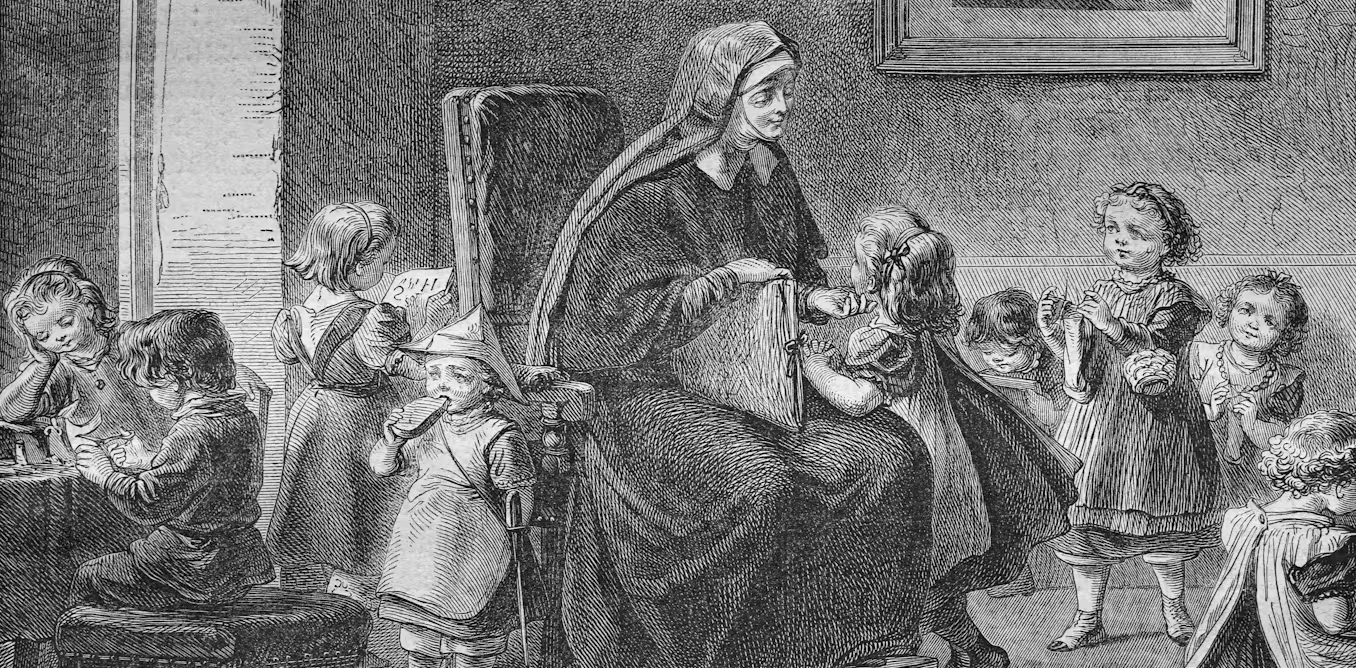
Nuns as teachers are historically associated with anything but progress. Often stereotyped as exactors of cruel discipline, nuns in the classroomv are thought of as wielding rulers – and worse – ready to rap disobedient children’s knuckles. And yet, during the 19th century, Catholic sisters were, in their own way, radicals as they engaged in work that challenged the norms of their time: the education of girls.

At that time, the education of women was still controversial. Some even argued that academic study was detrimental to women’s health, potentially causing infertility.

The standard education for a middle-class girl involved home schooling with an emphasis on social accomplishments in preparation for the marriage market, while working-class girls often started work as early as eight years old. Catholic sisters defied the low intellectual expectations of women of their time by providing education not only for well-to-do girls but also for poor ones.

While women in Catholic orders are most often thought of as living in cloistered retreat, the 19th century saw a dramatic rise in women living religious lives out in the world, engaging in education, nursing and other forms of social care. By 1880, these sisters, the term for women in active congregations, comprised 80% of Catholic women in religious orders.

Advertisement

The growth of girls’ education

Frances Mary Buss,was a contemporary of the 19th-century Catholic sisters who also pioneered education for girls in the Victorian era.
Wikipedia

Catholic sisters were not only leaders in education in Catholic countries but also made important contributions to girls’ education in Britain. Following the 1829 Catholic Relief Act, which dismantled the penal laws against Catholics, a flood of religious orders arrived.

In the 19th century, approximately 10,000 nuns and sisters lived in England and Wales as part of 105 orders, which grew to 175 by 1937. The majority of these were engaged in education.

Congregations such as the Faithful Companions of Jesus, the Sisters of Notre Dame de Namur, the Ursulines, and the Sisters of Mercy established schools for girls across Britain with particular concentrations in London and the industrialised urban areas in the northwest and west Midlands. These women were contemporaries of better-known education pioneers like Frances Mary Buss and actively participated in the growth of girls’ education.

Contrary to the popular notion of convents as finishing schools for elite young ladies, Catholic schools in Britain ran the gamut, from fee-paying boarding schools to “poor schools”, which provided free education to girls from lower socioeconomic backgrounds.

Advertisement

Catholic “poor schools” were larger and more rigorous than the contemporary “dame schools” in which local women provided education in their homes and the “ragged schools”, which gave free education and other resources to children in need. They provided religious education alongside reading, writing and functional skills training to serve the needs of a new influx of Irish immigrants.

While their focus on religious education might not accord with modern notions of progress, these schools were radical for their time as they countered the rigid Victorian association of women with the private domestic sphere.

By engaging in public processions and prize days, Catholic schools celebrated girls as individuals who were visible in the public sphere. The Catholic sisters who taught these girls modelled an alternative to the idea that a woman should exist solely for her family.

While the numbers of students taught by Catholic sisters is hard to gauge, we get some sense from examples like the Faithful Companions of Jesus, the first foreign order to set up schools after the Catholic Relief Act. The order ran more than 20 schools across the country in addition to working in primary schools and establishing night schools, teaching thousands of girls in poor parts of Liverpool and Manchester as well as in London.

Advertisement
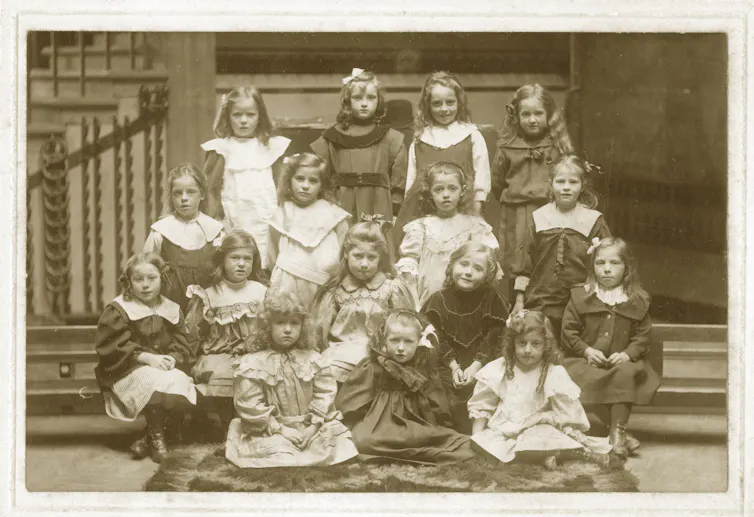
A group photo of Victorian schoolgirls arranged in rows, taken around 1900.
The education of girls in Victorian times was considered controversial.
Still Life Pictures / Alamy

Another order, the Sisters of Mercy, the largest convent network in the UK, taught in 41 elementary schools, 24 schools for middle and upper-class girls, nine orphanages as well as training schools for servants and five night schools. Between the first and second world wars, there were almost 1,600 Sisters of Mercy educating over 40,000 children.

Rather than remaining marginal and detached, these schools kept pace with changes in the British education system. As a series of education acts between the late 19th and mid 20th century (culminating in the Butler Education Act of 1944) made free schooling a right, Catholic sisters taught more and more children.

In order to keep providing education to a maximum number of students, these schools obtained grants from the government, which meant that they had to conform to national standards. Grant-aided schools also required certificated school teachers, so women’s congregations began to open their own teacher training colleges.

Inspection reports by the Board of Education show that Catholic girls’ schools offered rigorous educational programmes that kept up with the latest teaching developments. One 1901 inspection of a school in Birkenhead run by the Faithful Companions of Jesus reports that the geography course was “founded on some of the best modern textbooks. The lessons heard on the days of inspection were carefully prepared and thoughtfully given … The school possesses some good modern maps, and the equipment is constantly receiving additions”.

The changes in girls’ education over the course of the 19th and early 20th centuries were dramatic. Between 1851 and 1900, female literacy rose from 51% in 1840 to over 90% by 1900. In 1878, the first women were accepted for degrees at a UK university (the University of London).

Advertisement

Catholic sisters played a surprising role in these transformations. They opened some of the first formal schools for girls in the country, not only keeping up with developments in national education but sometimes anticipating them. Far from being an obstacle to women’s progress, nuns were significant players in the movement for equal education.

Source link

Advertisement
Continue Reading

NewsBeat

Good news for WhatsApp users as new feature taking ‘early reservations’

Published

on

Daily Record

The feature is ideal for privacy – and those massive group chats

WhatsApp users can now reserve their own username amid upcoming changes to the app.

Advertisement

The feature is ideal for people who want to join groups and chat to new pals without sharing their phone number with people they don’t know. This can be domne by using a unique username instead of a phone number.

Early reservation is now live meaning users can secure their preferred username before the feature launches later this year. WhatsApp explains: “You can reserve a username to use later this year when we launch this feature.

“With over three billion people on WhatsApp a lot of names overlap, which is why we’re opening reservations early so everyone has the opportunity to select the username that matters to them.”

It adds: “For most people, choosing a WhatsApp username should be something unique that only people you want to contact you will know. If you need help picking one, we have a username generator to make one work just for you.

“We also know that some people like creators, small businesses, and organisations may want to maintain a consistent presence online. For them, we reserved an option to claim their existing Instagram or Facebook username on WhatsApp.

“Usernames are our latest step to make WhatsApp even more private. There’s no directory to browse and no suggestions – people will need to know your exact username to contact you for the first time. To help control who can reach you on WhatsApp with your username, we’ve built an optional username key that others will need to know to message you.

“Once we launch usernames, when you message a person or business for the first time they will no longer see your phone number, if you enabled your username.”

How to reserve my WhatsApp username?

All you need to do is go to WhatsApp, click on Settings then Account and select Username.

It adds: “We’ll be rolling out usernames gradually over the coming months and will notify you in WhatsApp when they’re available in your country.”

Source link

Advertisement
Continue Reading

Trending

Copyright © 2025